Univ. of Kansas Spinout VOISS Cuts Edtech Churn via Student Co-Design
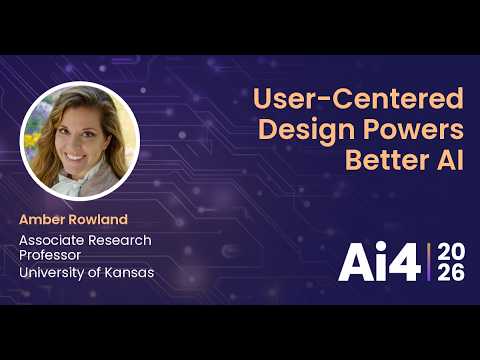
Ai4
Academic researchers must commercialize evidence-based tools through direct classroom co-design, because unvalidated startup rollouts trigger irreversible teacher churn while grant-funded laboratory projects die without commercial scale.
AI-assisted summary of User-Centered Design Powers Better AI With University of Kansas — original source. Check the original for full context.
Source published:
Detailed notes
## Background Published on YouTube by Ai4 on August 14, 2026, this presentation features Amber Rowland, an Associate Research Professor at the University of Kansas and Chief Science Officer at VOISS. According to the page description, the session explores how integrating iterative user experience research, user co-design, and evidence-based learning science yields transformative AI edtech tools, using the commercialized social skills simulation platform VOISS as a blueprint.
## TL;DR Amber Rowland outlines the development and design methodology behind VOISS, an AI-powered simulation platform created to help neurodivergent adolescents practice critical social communication skills. Addressing the tension between academic rigor and startup velocity, Rowland warns that shipping rushed, unvalidated minimum viable products leads to catastrophic customer churn among time-strapped educators. She presents the 'Confidence to Scale Helix,' a six-step co-design framework that pairs classroom observations, student paper prototyping, and live developer coding sessions to iteratively earn product confidence. While AI handles roughly 80% of multi-device technical stress testing, she emphasizes that the remaining 20% must remain anchored in lived human experience. Rowland concludes with a call to action for university researchers to actively commercialize grant-funded innovations so proven interventions can endure and reach students in need.
## Atmosphere & style The presentation carries an authentic, pragmatic tone that balances academic authority with the gritty realities of startup commercialization. Rowland speaks with candid warmth and relatable humor, using self-deprecating remarks about researchers being 'slow' and Kansas tornado metaphors to keep technical and pedagogical discussions lively. Grounded by the poignant developmental journey of Oliver, a middle schooler finding his voice, the talk feels deeply empathetic, mission-driven, and refreshingly honest about the limits of technology without human-centered oversight.
## Key takeaways - [00:04](https://www.youtube.com/watch?v=zilmb9q5BKM&t=4s) Building edtech on untested top-down assumptions leads to classroom failure, making direct user-centered design essential for real-world adoption. - [02:24](https://www.youtube.com/watch?v=zilmb9q5BKM&t=144s) The startup instinct to ship fast and fix later causes costly customer churn in education, as burned educators rarely return to broken software. - [02:24](https://www.youtube.com/watch?v=zilmb9q5BKM&t=144s) Developing effective AI tools requires active translation between pedagogical learning sciences and machine learning engineers so educational integrity is not compromised for speed. - [04:40](https://www.youtube.com/watch?v=zilmb9q5BKM&t=280s) The 'Confidence to Scale Helix' model illustrates how iterative co-design loops expand outward in reach and investment while building upward in design confidence. - [04:40](https://www.youtube.com/watch?v=zilmb9q5BKM&t=280s) AI-driven virtual simulations provide a psychologically safe environment for neurodivergent students to practice social communication and experience realistic peer consequences with zero real-world harm. - [06:58](https://www.youtube.com/watch?v=zilmb9q5BKM&t=418s) The six-step co-design pipeline (Listen, Confirm, Co-Design, Test, Refine, Scale) systematically filters raw stakeholder feedback through pedagogical and feasibility criteria before large-scale deployment. - [10:46](https://www.youtube.com/watch?v=zilmb9q5BKM&t=646s) Placing software engineers and machine learning developers directly into classrooms alongside students transforms how usability issues are identified and resolved. - [10:46](https://www.youtube.com/watch?v=zilmb9q5BKM&t=646s) Edtech creators must avoid a 'tech savior mentality' and remain transparent about human-centric safeguards to overcome student and educator skepticism toward AI. - [14:05](https://www.youtube.com/watch?v=zilmb9q5BKM&t=845s) While AI agents can automate roughly 80% of technical and multi-device stress testing, human testing remains irreplaceable for assessing emotional resonance and lived user experience. - [14:05](https://www.youtube.com/watch?v=zilmb9q5BKM&t=845s) Supporting multiple hardware platforms (Chromebooks, iPads, VR) is essential for accessibility, as many neurodivergent learners experience sensory aversion to facial VR headsets. - [15:28](https://www.youtube.com/watch?v=zilmb9q5BKM&t=928s) Partnering with university research faculty strengthens commercial edtech by integrating peer-reviewed learning science into product development. - [19:06](https://www.youtube.com/watch?v=zilmb9q5BKM&t=1146s) Academic researchers must actively pursue commercialization to prevent impactful, grant-funded educational technologies from dying when initial grant cycles conclude.
## Detailed walkthrough ### [00:04](https://www.youtube.com/watch?v=zilmb9q5BKM&t=4s) Introduction and the Story of Oliver
Amber Rowland, an Associate Research Professor at the University of Kansas and Chief Science Officer (CSO) of VOISS, introduces the mission behind her work: creating extended reality simulations powered by AI to help adolescents learn and practice critical social skills. Grounded in user-centered design (UCD), the session focuses on how authentic user involvement ensures educational technology actually works in real classrooms. To illustrate why this matters, Rowland shares the story of Oliver, a middle school student in Denver, Colorado. Oliver struggles daily with social skills, anxiety, and communication—challenges that are especially daunting during middle school, an already awkward developmental period. His family worries deeply about his long-term prospects, such as whether he will be able to make friends, sustain relationships, or hold down a job.
These personal struggles take place against the backdrop of a nationwide workforce shortage among special education teachers and therapists, alongside a rising number of children diagnosed with anxiety and social communication needs. Rowland notes that VOISS was born out of deep frustration with top-down, district-mandated technology that routinely fails in practice: "I would sit down and try to do something and it wouldn't work the way I think it does. Like, did you even have teachers try this before you put it out? Drive me nuts." She argues that building edtech or AI products on untested assumptions about what kids or educators need is a recipe for failure, whereas user-centered design provides the empirical confidence needed to build tools that genuinely work.
- **Primary User Profile**: Oliver, a middle schooler with autism and anxiety in Denver, Colorado. - **Systemic Challenges**: Severe shortages of specialized educators/therapists combined with surging rates of youth anxiety. - **Core Stance**: Without direct user-centered design, developers make faulty assumptions that derail classroom adoption.
---
[02:24](https://www.youtube.com/watch?v=zilmb9q5BKM&t=144s) The Tension Between Research Rigor and Startup Speed
Operating at the intersection of academia and entrepreneurship reveals a sharp cultural contrast between research validity and startup velocity. In an academic research environment, Rowland’s role is to evaluate every possible failure mode and success factor to ensure absolute validity, reliability, and instructional integrity. While she self-deprecatingly refers to her exhaustive approach as "slow," her startup CEO prefers to call it "thorough." In a startup environment—VOISS having spun out into a commercial venture about a year prior—the prevailing instinct is to launch a minimum viable product (MVP) as fast as possible into the wild and patch mistakes later.
```mermaid flowchart TD accTitle: Academic Rigor vs. Startup Velocity subgraph Academic["Academic Research Mindset"] A1["High Validity & Reliability"] --> A2["Exhaustive Evaluation"] A2 --> A3["Thorough / Methodical Pace"] end subgraph Startup["Startup Mindset"] S1["Speed to Market"] --> S2["Rapid MVP Deployment"] S2 --> S3["Fix Later in the Wild"] end subgraph Result["User-Centered Design Bridge"] R1["Prevent Expensive Customer Churn"] R2["Translate Between Pedagogy & ML Engineers"] end Academic --> Result Startup --> Result ```
Rowland points out that relying on post-launch fixes in the education sector is an extraordinarily expensive strategy due to customer churn. Educators have limited time, high stakes, and very little patience for broken software; once burned by a flawed product, they rarely return. To bridge this divide, Rowland acts as an active translator between classroom realities (teachers and students) and technical specialists (designers, software engineers, and machine learning developers), ensuring that foundational learning science is never compromised for speed.
- **The Churn Risk**: Educators are an unforgiving user base; releasing buggy MVPs leads to immediate abandonment and reputational damage. - **The Translator Role**: Bridging content knowledge, classroom pedagogy, and machine learning engineering. - **Commercialization Status**: Spun out from the University of Kansas accelerator program with active commercial deployment.
---
[04:40](https://www.youtube.com/watch?v=zilmb9q5BKM&t=280s) The Confidence to Scale Helix & Grounding in Learning Science
To represent how product validation expands over time, Rowland developed the "Confidence to Scale Helix." When she originally drafted the model, she called it the "spiral," but user feedback quickly flagged that spirals have negative, out-of-control connotations—especially in Kansas, where spirals evoke tornadoes. The model was rechristened a "helix" to convey that each iterative cycle expands outward (engaging more users, requiring more investment, and driving more revenue) while simultaneously rising upward in design confidence. This upward trajectory guarantees that by the time a product reaches broad distribution, word-of-mouth adoption is propelled organically by educators and administrators recommending it to their peers.
```mermaid flowchart LR accTitle: Confidence to Scale Helix Cycle subgraph Helix["Confidence to Scale Helix Cycle"] direction TB L["1. Listen"] --> C["2. Confirm"] C --> CD["3. Co-Design"] CD --> T["4. Test"] T --> RF["5. Refine"] RF --> SC["6. Scale"] SC --> L end ```
The underlying architecture of VOISS is grounded in rigorous academic research and randomized controlled trials (RCTs). It embeds evidence-based practices including social narratives, direct instruction, and simulated role-playing. In the virtual environment, students encounter realistic peer interactions—such as joining a basketball game. If a student makes an anti-social move, like stealing the ball and running to the opposite end of the court, the virtual peers react with realistic frustration. The student is then given immediate opportunities to replay the scenario, try alternate strategies, and achieve positive outcomes in a psychologically safe environment where "no kids harmed in the making of these social skills."
- **Evidence-Based Pillars**: Direct instruction, social narratives, and simulated role-play. - **Simulation Feedback Loop**: Real-time social consequence modeling paired with infinite, zero-consequence retries. - **Iterative Growth**: Expanding user numbers and investment with each loop of the helix.
---
[06:58](https://www.youtube.com/watch?v=zilmb9q5BKM&t=418s) The Co-Design Process and the 7-Step Cycle
The founding team behind VOISS combines deep academic and commercial expertise, featuring Amber Rowland, Maggie Mosher, Bruce Frey, Sean Smith, and CEO Paul, who was recruited via the University of Kansas accelerator to drive marketing and commercialization. Backed by a $4.5 million research grant, the team initiated their design cycle with a structured, multi-day think tank. They brought together educators, researchers, domain experts, and engineers for a day and a half to map out core pain points in social communication, organizing participants into both cross-disciplinary and role-alike working groups.
```mermaid flowchart TD accTitle: VOISS Seven Step Research to Scale Pipeline subgraph Discovery["1. Discovery & Validation"] S1["Listen: $4.5M Think Tank Brainstorming"] --> S2["Confirm: Filter Transcripts & Validate with Users"] end subgraph Design["2. Collaborative Creation"] S3["Co-Design: Paper Prototyping & Student Scenarios"] --> S4["Test: Button-Based vs. AI-Driven Testing"] end subgraph Deployment["3. Refinement & Growth"] S5["Refine: Live Developer Iterations"] --> S6["Scale: Multi-School RCT Deployments"] end Discovery --> Design Design --> Deployment ```
The co-design pipeline systematically processes stakeholder feedback from raw transcription to deployment: 1. **Listen**: Capturing every conversation during stakeholder think tanks to identify genuine pain points rather than assumptions. 2. **Confirm**: Filtering transcripts for feasibility, pedagogical evidence, and ROI, then reflecting the summary back to educators to confirm: "This is what we think we heard." 3. **Co-Design**: Partnering directly with students and teachers using paper prototypes (often accelerated by AI generation) for character and narrative arcs. 4. **Test**: Testing early scenarios with middle schoolers, including field research in Hawaii comparing a button-driven interface against an AI-driven conversational interface. 5. **Refine**: Having programmers implement real-time code updates directly alongside participating students. 6. **Scale**: Rolling out the validated platform across 10 schools in a Year 5 Randomized Controlled Trial (RCT).
A video testimonial illustrates the impact on Oliver, who shares that before using VOISS he rarely spoke to anyone at school out of fear and nervousness, but regular simulation practice taught him practical ways to initiate conversations without feeling overwhelmed. At Oliver's specialized school, students use the platform two to three times per week for 20 minutes per session to systematically reinforce social communication habits.
---
[10:46](https://www.youtube.com/watch?v=zilmb9q5BKM&t=646s) Practical UCD Strategies in EdTech
Rowland outlines several concrete, tactical practices that make user research effective in school environments:
- **Student & Teacher Screen Recordings**: Training classroom users to trigger screen recordings whenever a glitch or odd behavior occurs, eliminating the ambiguity of second-hand verbal descriptions. - **Developers in the Classroom**: Placing software engineers and ML developers directly in the room to observe students interacting with the platform in real time, which Rowland calls a transformative "game-changer." - **Task-Based Surveys**: Replacing vague "how did you like it?" surveys with rigid, step-by-step task scripts followed by targeted diagnostic questions. - **Pedagogical Oversight**: Requiring learning science and content experts to review every code iteration so features do not drift away from evidence-based practices. - **Direct Research Citations**: Actively publishing research studies and listing academic citations directly on `voiss.org` to prove efficacy.
Addressing the cultural climate in schools, Rowland warns against the "tech savior mentality." Many K-12 and higher education institutions exhibit strong pushback against artificial intelligence, with students frequently remarking that they refuse to use something simply because it contains AI. Drawing on insights from AI leader Pam Snyder, Rowland emphasizes that developers must be transparent and "loud about how you're ensuring it's responsible and human-centric." Furthermore, she highlights co-design methodologies from Sesame Workshop, such as scenario storyboarding and the "Meet the Martian" exercise—where children must explain concepts to someone dressed as an alien who has no prior knowledge of Earth—to elicit precise, assumption-free design specifications.
---
[14:05](https://www.youtube.com/watch?v=zilmb9q5BKM&t=845s) Balancing AI Speed with the Human Lived Experience
While artificial intelligence dramatically accelerates the design and validation pipeline, Rowland stresses that it must augment rather than replace human involvement. VOISS leverages large language models (LLMs) and autonomous agents for roughly 80% of technical validation tasks—conducting rapid stress testing, checking multi-device accessibility, discovering software edge cases, and proposing automated bug mitigations. This automated testing runs across all supported form factors, including iPads, Chromebooks, and Oculus VR headsets (an essential flexibility since many neurodivergent students with autism experience sensory aversion to wearing VR hardware on their faces).
However, the remaining 20% of testing must stay strictly human. Automated agents cannot replicate the subjective lived experience, emotional resonance, and unvarnished feedback of a child or teacher engaging with learning software. Maintaining this human-centered foundation creates a robust commercial advantage: investors gain confidence through measurable risk reduction, while school districts, parents, and enterprise buyers are significantly more receptive to products backed by validated, research-based learning science.
[15:28](https://www.youtube.com/watch?v=zilmb9q5BKM&t=928s) Partnering with Higher Education and Academic Research Publications
Adopting user-centered design and evidence-based learning science benefits both research rigor and the corporate profit and loss statement. While industry leaders often point out that edtech developers do not spend enough time directly engaging teachers on AI integration—a sentiment echoed by keynote speaker Fei-Fei Li—faculty at the University of Kansas School of Education, including Amber Rowland, Lisa Dieker, and Maggie Mosher, are actively bridging this gap. Rowland urges edtech teams to collaborate closely with higher education researchers who specialize in pedagogical integration and iterative design to replicate these outcomes at scale.
```mermaid flowchart LR accTitle: Confidence to Scale Helix Overview subgraph ResearchPhase["Evidence & Research"] A["Learning Science"] --> B["Iterative User Co-Design"] end subgraph ValidationPhase["Evaluation & Impact"] B --> C["Peer-Reviewed Rigor"] C --> D["Commercialization & Scale"] end ```
To help practitioners dive deeper into the literature, Rowland highlights an upcoming special issue of the *Journal of Special Education Technology*, where she serves as lead guest editor. The issue brings together 11 distinct publications demonstrating user-centered AI integration across various subject areas, including math, science, reading, writing, and social skill development.
- **Special Issue Overview:** The *Journal of Special Education Technology* special issue features peer-reviewed research across multiple disciplines, with early access available online ahead of the official print release. - **"Fewer Clicks Matter":** Rowland’s featured paper documents the user-centered design case study behind their team's first chatbot, translating the presentation's core methodologies into a formal research framework. - **Biometric Research:** The collection includes work by Lisa Dieker exploring the application of biometrics with student populations in educational settings.
---
[17:26](https://www.youtube.com/watch?v=zilmb9q5BKM&t=1046s) Industry Resources, Edtech Podcasts, and the Confidence Scorecard
Rowland points to several key external resources that reinforce user-driven development and learning sciences. She highlights the Tools Competition, an initiative where her team advanced to the third round. While they were not awarded funding in that specific cycle, the competition’s recent Trends Report offers invaluable insights into what makes edtech products and startups fundable, specifically emphasizing robust learning sciences and user-centered design.
```mermaid flowchart TD accTitle: Edtech Ecosystem Resources subgraph Competitions["Funding & Trends"] A["Tools Competition Trends Report"] end subgraph Media["Teacher & Design Podcasts"] B["AI Advocates Podcast<br/>(3-5 min tool walkthroughs)"] C["Co-Design with Kids<br/>(codesignwithkids.org)"] end subgraph Assessment["Implementation Tools"] D["Confidence to Scale Helix Scorecard<br/>(One-page team self-audit)"] end ```
To assist educators and product teams in staying informed and evaluating their own practices, several practical tools and media channels are available:
- **AI Advocates Podcast:** Hosted by Maggie Mosher and Lisa Dieker, this show delivers concise 3-to-5-minute episodes guiding educators through specific artificial intelligence tools and practical classroom integration strategies. - **Co-Design with Kids:** Run by the team at codesignwithkids.org, this initiative and its accompanying podcast provide practical frameworks for including youth directly in product co-design. - **Confidence to Scale Helix Scorecard:** A one-page self-assessment rubric developed by Rowland that allows teams to quickly score their level of user-centered design maturity across every development phase. Teams can request the scorecard by contacting Rowland directly via email.
---
[19:06](https://www.youtube.com/watch?v=zilmb9q5BKM&t=1146s) The Imperative of Commercialization: Oliver's Story and Beyond
Rowland concludes by grounding the entire design philosophy in its real-world human impact, reflecting on the story of a student named Oliver. Video footage and feedback from both Oliver's parents and his teachers show the transformative personal growth and empowerment he achieved after using VOISS. For Rowland, this transformation illustrates why academic researchers must move beyond traditional publishing to embrace product commercialization.
Without taking the deliberate step to commercialize, impactful interventions developed in universities risk dying as soon as their initial grant funding concludes. Rowland issues a call to action for more higher education faculty to bring evidence-based technologies out of the laboratory and directly into the commercial marketplace, ensuring that students everywhere can access tools that foster genuine behavioral and social growth.
## Notable quotes > [00:04](https://www.youtube.com/watch?v=zilmb9q5BKM&t=4s) I would sit down and try to do something and it wouldn't work the way I think it does. Like, did you even have teachers try this before you put it out? Drive me nuts. — Amber Rowland
> [02:24](https://www.youtube.com/watch?v=zilmb9q5BKM&t=144s) slow — Amber Rowland
> [02:24](https://www.youtube.com/watch?v=zilmb9q5BKM&t=144s) thorough — Paul
> [04:40](https://www.youtube.com/watch?v=zilmb9q5BKM&t=280s) no kids harmed in the making of these social skills. — Amber Rowland
> [06:58](https://www.youtube.com/watch?v=zilmb9q5BKM&t=418s) This is what we think we heard. — Amber Rowland
> [10:46](https://www.youtube.com/watch?v=zilmb9q5BKM&t=646s) game-changer — Amber Rowland
> [10:46](https://www.youtube.com/watch?v=zilmb9q5BKM&t=646s) how did you like it? — Amber Rowland
> [10:46](https://www.youtube.com/watch?v=zilmb9q5BKM&t=646s) tech savior mentality — Amber Rowland
> [10:46](https://www.youtube.com/watch?v=zilmb9q5BKM&t=646s) loud about how you're ensuring it's responsible and human-centric. — Pam Snyder
> [10:46](https://www.youtube.com/watch?v=zilmb9q5BKM&t=646s) Meet the Martian
> [15:28](https://www.youtube.com/watch?v=zilmb9q5BKM&t=928s) Fewer Clicks Matter — Amber Rowland
## Mentioned Amber Rowland, VOISS, University of Kansas, Oliver, Maggie Mosher, Bruce Frey, Sean Smith, Paul, Pam Snyder, Sesame Workshop, Fei-Fei Li, Lisa Dieker, Journal of Special Education Technology, Tools Competition, AI Advocates Podcast, Co-Design with Kids, iPad, Chromebook, Oculus VR
## Video description Amber Rowland - Associate Research Professor, University of Kansas
Effective AI-enabled edtech starts with users. Join us to explore how our team combines iterative user experience research, user co-design, and evidence-based learning science to create AI products that are intuitive, effective, and drive customer retention. We will share practical takeaways through the story of VOISS, our newly commercialized AI-powered simulation platform that helps adolescents build critical social skills. Grounded in academic research and proven success, you’ll see how our design process yields transformative tools and offers attendees a model for scalable, user-driven innovation. Whether you are developing AI tools, conducting research, or shaping learning experiences, this session will give you actionable strategies for building technology that is relevant, effective, and loved by users.
[Source](https://www.youtube.com/watch?v=zilmb9q5BKM)