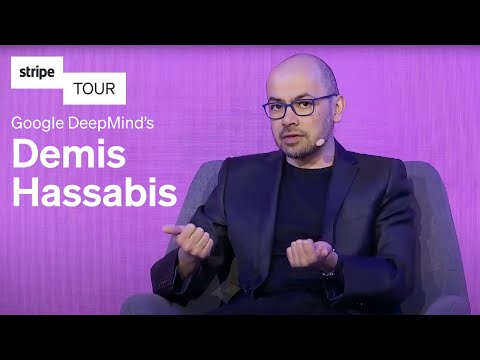
Google DeepMind CEO Says Scaling Alone Will Fail to Yield AGI
Stripe
Demis Hassabis argues that reaching human-level artificial general intelligence requires a handful of distinct architectural breakthroughs in planning and symbolic logic rather than merely expanding compute and data.
## Background
Published by Stripe on YouTube on June 7, 2024, this video features a fireside chat from Stripe Tour London. It captures Google DeepMind co-founder and CEO Demis Hassabis in conversation with Entrepreneur First co-founder Matt Clifford, discussing the building of deep tech companies and the most promising new developments in AI.
## TL;DR
Demis Hassabis traces DeepMind's journey from a stealthy 2010 startup with a 20-year roadmap to a global AI powerhouse driving breakthroughs like Project Astra, AlphaFold 3, and AlphaGeometry. He argues that scaling alone is insufficient for true AGI, emphasizing the need for planning, actions, and hybrid architectures that combine neural networks with symbolic reasoning. Hassabis also reflects on the evolution of the UK tech ecosystem, the legacy of Alan Turing, and the critical importance of a "bold and responsible" approach to AI safety over reckless commercial acceleration.
## Atmosphere & style
The conversation has an intellectually stimulating, visionary, yet grounded atmosphere, blending deep scientific ambition with pragmatic entrepreneurial wisdom. Hassabis speaks with a calm, measured optimism, reflecting his background as a world-class gamer and neuroscientist who respects the profound gravity of the technology he is building. The dynamic between Hassabis and host Matt Clifford is warm, collaborative, and deeply rooted in a shared appreciation for the UK's scientific heritage and the frontiers of human knowledge.
## Key takeaways
- [00:12](https://www.youtube.com/watch?v=D-eyJhJXXsE&t=12s) DeepMind was founded in 2010 on a 20-year roadmap to build an "Apollo program" for AI, combining deep learning, reinforcement learning, and neuroscience.
- [00:43](https://www.youtube.com/watch?v=D-eyJhJXXsE&t=43s) Project Astra represents DeepMind's vision for a natively multimodal, real-time universal AI agent with an expansive context window.
- [07:22](https://www.youtube.com/watch?v=D-eyJhJXXsE&t=442s) True planning and execution of actions remain unsolved challenges that cannot be solved by scaling next-token prediction alone.
- [10:30](https://www.youtube.com/watch?v=D-eyJhJXXsE&t=630s) AlphaFold 3 expands on AlphaFold 2's protein structure predictions by modeling dynamic interactions between proteins, DNA, RNA, and chemical compounds.
- [10:30](https://www.youtube.com/watch?v=D-eyJhJXXsE&t=630s) Isomorphic Labs aims to leverage AI to virtualize drug discovery, compressing timelines from years to months.
- [15:02](https://www.youtube.com/watch?v=D-eyJhJXXsE&t=902s) AlphaGeometry demonstrates the power of hybrid AI systems, combining neural language models with traditional symbolic reasoning engines.
- [17:55](https://www.youtube.com/watch?v=D-eyJhJXXsE&t=1075s) LLMs struggle with precise state-tracking in games like chess, highlighting structural limitations that scaling alone cannot fix.
- [21:24](https://www.youtube.com/watch?v=D-eyJhJXXsE&t=1284s) The UK tech ecosystem has transformed dramatically since 2010, evolving from a difficult funding environment into a world-class hub for deep tech talent.
- [25:10](https://www.youtube.com/watch?v=D-eyJhJXXsE&t=1510s) Scientific leadership is a prerequisite for global "soft power," allowing nations to shape international AI ethics and safety standards.
- [29:30](https://www.youtube.com/watch?v=D-eyJhJXXsE&t=1770s) DeepMind advocates for a "bold and responsible" approach to AI safety, focusing on benchmarking, virtual brain analysis, and secure sandboxes.
## Detailed walkthrough
### [00:12](https://www.youtube.com/watch?v=D-eyJhJXXsE&t=12s) The Early Days of DeepMind and the 20-Year Roadmap
The conversation begins with a warm welcome in London, the city where Demis Hassabis grew up, founded DeepMind in 2010, and now serves as the CEO of Google DeepMind. The host notes how much the AI landscape has shifted since those early days. In 2010, AI was far from an obvious bet—there were no international summits, nor were there trillions of dollars pouring into the space. Hassabis recalls that when he and co-founder Shane Legg were postdocs at the Gatsby Computational Neuroscience Unit at UCL, they could not even tell their professor about their plans to start an AI company. "He would have just definitely, at best laughed us out the room, at worst, sort of thought, we'd sold out," Hassabis jokes. His goal was to prove that cutting-edge, deep scientific research could be successfully conducted within a corporate structure, operating like an "Apollo program effort really for AI."
Hassabis explains that by 2010, he felt the necessary ingredients for rapid progress were finally coming together. Geoff Hinton and his colleagues had published foundational papers on deep belief networks around 2006 and 2007, GPUs were becoming widely available, and scientific understanding of the brain's algorithms was maturing. Despite this vision, scraping together their first seed round was incredibly difficult, and Hassabis did not pay himself a salary for the first couple of years. They operated on a 20-year roadmap. While the running joke in deep tech is that a 20-year roadmap always remains 20 years away, Hassabis remarks that, unbelievably, they are more or less on track. Their early bets on generality, reinforcement learning, and deep learning—which birthed the field of deep reinforcement learning through their early Atari work—proved to be correct.
- **Founding Year:** DeepMind was founded in 2010 by Demis Hassabis and Shane Legg.
- **Key Ingredients in 2010:** Deep learning (then often called deep belief networks), GPU availability, and insights from neuroscience.
- **Early Milestones:** Creating the field of deep reinforcement learning and demonstrating general learning capabilities on Atari games.
[00:43](https://www.youtube.com/watch?v=D-eyJhJXXsE&t=43s) Project Astra and the Power of Multimodality
The discussion shifts to Google's recent announcements at Google I/O, with Hassabis highlighting Project Astra as his personal favorite. Astra represents Google DeepMind's vision for a "universal assistant" or "universal AI agent" that can assist users in their everyday lives. The defining feature of Astra is its true multimodality, allowing it to understand the spatial and environmental context of the human user. Hassabis notes that traditional language-only agents are limited because they do not understand the physical space around them. To solve this, Google built the Gemini series of models to be natively multimodal from the ground up, capable of processing vision, audio, and other sensory inputs to generate any kind of output.
The host praises the Astra demo, pointing out a particularly impressive moment at the end of the video that showcases the power of having a very long context window for video processing. Hassabis explains that Gemini 1.5 introduced a million-token context window, which has now been extended to 2 million tokens and can go even further. This allows the system to ingest massive amounts of data—such as the entirety of *War and Peace* or an hour-long video—and answer highly specific questions about it. In a live-streaming scenario like Astra, this long context allows the agent to ambiently remember things that happened a long time ago in the video stream. Hassabis suggests this could be incredibly useful for everyday tasks, such as helping an elderly person remember where they left their medicine or finding misplaced car keys.
- **Project Astra:** A prototype for a universal AI agent capable of real-time, multimodal environmental understanding.
- **Gemini 1.5 Context Window:** Supports 1 to 2 million tokens, enabling the processing of massive text documents or hours of video.
- **Practical Applications:** Ambient memory for locating objects (e.g., medicine, car keys) and acting as a highly capable research assistant.
[07:22](https://www.youtube.com/watch?v=D-eyJhJXXsE&t=442s) The Next Frontier: Planning, Actions, and the Limits of Scaling
When asked about the remaining unsolved challenges in AI over the next couple of years, Hassabis identifies planning and actions as the critical missing pieces in current systems. While today's models possess some form of reasoning, they lack the ability to break down abstract, high-level goals into a series of achievable steps. Hassabis compares this to the game-playing agents DeepMind is famous for, like AlphaGo. In a game, the system has a clear objective (such as winning or maximizing points) and must execute a series of interim plans to achieve it. True planning in the real world requires capabilities like tree search over planning trajectories and the ability to "imagine in 3D in the mind's eye" to evaluate potential scenarios.
The host brings up the popular industry sentiment that "scale is all you need" to achieve artificial general intelligence (AGI). Hassabis agrees that scaling up compute and data is absolutely necessary and that large models will be a core part of the ultimate solution. However, he doubts that scaling alone is sufficient to produce complex planning capabilities. He believes that planning represents a "slightly different in kind" computation compared to next-token prediction. Consequently, Hassabis estimates that a "small handful of breakthroughs" are still required to bridge the gap to human-level AI, combining the planning techniques of AlphaGo with the rich semantic and multimodal understanding of modern large language models.
[10:30](https://www.youtube.com/watch?v=D-eyJhJXXsE&t=630s) AlphaFold 3 and the Revolution in Computational Biology
The conversation transitions to "AI for science," an area where Google DeepMind has established a unique and powerful footprint. Hassabis explains the significance of their recent release, AlphaFold 3, by first contextualizing the achievement of AlphaFold 2. Released a few years prior, AlphaFold 2 solved the 50-year-old "protein folding problem." Proteins are the workhorses of biology, and their functions are determined by how their amino acid sequences fold into complex 3D shapes. Historically, determining a single protein's structure experimentally was a grueling process, often taking a PhD student their entire five-year degree to complete. With AlphaFold 2, DeepMind computationally predicted the structures of all 200 million proteins known to science in just one year—an achievement that would have otherwise required a billion years of PhD effort.
AlphaFold 3 takes this work a step further by moving from static protein structures to dynamic biological interactions. Because biology is a dynamic, emerging system, understanding disease and designing drugs requires knowing how proteins interact with other biomolecules. AlphaFold 3 can model interactions between proteins, DNA, RNA, and chemical compounds (ligands). Hassabis reveals that his ultimate dream is to model an entire virtual cell "in silico" so accurately that scientists can run highly predictive experiments entirely on a computer before ever stepping into a physical wet lab. To commercialize and apply these breakthroughs, DeepMind spun out Isomorphic Labs, which uses generative AI and advanced biochemistry modules to design highly targeted drug compounds, aiming to compress the drug discovery timeline from years to mere months.
- **The Protein Folding Problem:** Predicting a protein's 3D structure from its amino acid sequence to understand its biological function.
- **AlphaFold 2 Impact:** Predicted 200 million protein structures in a single year, saving an estimated 1 billion years of manual research time.
- **AlphaFold 3 Capabilities:** Models the dynamic interactions of proteins with DNA, RNA, other proteins, and chemical ligands.
- **Isomorphic Labs:** A spin-out company focused on using AI to revolutionize drug design by minimizing off-target side effects and accelerating timelines.
[15:02](https://www.youtube.com/watch?v=D-eyJhJXXsE&t=902s) Beyond LLMs: AlphaGeometry and Hybrid AI Systems
The host points out that DeepMind's scientific achievements demonstrate that AI is not a monolithic field dominated solely by large language models. He highlights AlphaGeometry, a system released by DeepMind that solves geometry problems from the International Mathematical Olympiad (IMO) to a near-gold-medal standard. Hassabis agrees that mathematics is highly suited to AI exploration because mathematical operations can be treated like moves in a game, where the system evaluates whether a new equation state brings it closer to a solution. He expects DeepMind's systems to reach overall gold-medal standard at the IMO in the near future, which will in turn help improve AI capabilities in reasoning and coding.
Hassabis emphasizes that specialized systems like AlphaFold will continue to drive incredible breakthroughs in specific domains for years to come. While the ultimate goal of AGI is a single system that can perform all tasks at a high level, the immediate future will likely rely on a hybrid approach. In this paradigm, a general-purpose system acts as a controller that learns "tool use," calling upon highly specialized systems to solve complex mathematical equations, write code, or play games like chess. The host notes that AlphaGeometry itself is a prime example of this hybrid approach, as it successfully combined a neural language model with a traditional symbolic reasoning engine.
- **AlphaGeometry:** An AI system capable of solving complex Olympiad-level geometry problems by combining neural networks with symbolic logic.
- **The Hybrid Paradigm:** Future AI architectures where a general assistant model orchestrates and queries specialized domain-specific models.
[17:55](https://www.youtube.com/watch?v=D-eyJhJXXsE&t=1075s) Games as the Ultimate Testing Ground for AI
The conversation shifts to Demis Hassabis's personal background as a champion player of *Diplomacy*—a game famously defined by open-ended alliances, negotiation, and betrayal rather than the rigid, finite move-sets of chess. This serves as a springboard to discuss how AI has made surprising progress in complex, non-perfect-information games. Hassabis explains that using games was a core founding thesis of DeepMind. For any ambitious, 20-year deep tech endeavor, choosing the right interim milestones is critical to prove progress to backers, investors, and the team itself. For DeepMind, those stepping stones were Atari, Go, and eventually protein folding.
Hassabis, who trained his own mind on chess from a very young age, notes that AI can now play almost any game to an extraordinarily high standard. While AlphaZero represented the pinnacle of two-player, perfect-information games, newer systems are tackling games with hidden information (like Poker) or language-based negotiation (like Diplomacy). However, Hassabis expresses a lighthearted frustration with current Large Language Models (LLMs): "It always surprises me that the language models are terrible at playing even a simple game of chess. That's really annoying actually, and needs to be fixed." This failure highlights a fundamental limitation: LLMs do not implicitly maintain an active, precise representation of a board state. When nudged out of standard opening book patterns, they lose track of the pieces and begin "hallucinating" illegal moves, such as capturing their own pieces. Hassabis argues this gap cannot be solved by mere scaling; it points to a missing structural component in current architectures.
- **Interim Milestones:** Atari $\rightarrow$ Go $\rightarrow$ Protein Folding (AlphaFold).
- **AlphaZero:** The peak of DeepMind's two-player, perfect-information game agents.
- **The Chess Flaw in LLMs:** Out of standard openings, LLMs fail at precise state-tracking and hallucinate illegal moves, proving that scale alone is not a cure-all.
---
[21:24](https://www.youtube.com/watch?v=D-eyJhJXXsE&t=1284s) The Evolution of the UK Tech Ecosystem
The host reflects on the early days of DeepMind, founded in 2010, when the UK startup ecosystem was virtually unrecognizable compared to today. Back then, raising capital for deep tech in the UK was incredibly difficult due to a lack of understanding and a low appetite for long-term payoffs among local investors. Hassabis had to go to the US to find funding, securing backing not from traditional venture capitalists, but from individual successful entrepreneurs who intuitively understood the long-term journey.
Despite the funding hurdles, Hassabis chose to keep DeepMind in London to leverage the UK's world-class talent pool, which boasts several of the world's top ten universities. In 2011, highly skilled PhD graduates in fields like physics or computer science had few local options outside of joining investment banks or hedge funds. By establishing DeepMind in London, Hassabis secured a massive, virtually unopposed competitive advantage across the UK and Europe. Today, the landscape is "night and day." Multinationals have set up major London bases, VCs have stepped up, and DeepMind's success has proven to the global investment community that world-class deep tech companies can be built and scaled in the UK.
- **DeepMind Founding Year:** 2010.
- **Early Funding Source:** US-based individual entrepreneurs rather than traditional UK VCs.
- **Talent Arbitrage:** Capturing top-tier PhDs from elite UK and European universities who otherwise would have gone to finance.
---
[25:10](https://www.youtube.com/watch?v=D-eyJhJXXsE&t=1510s) ARIA, Soft Power, and the Legacy of Alan Turing
The discussion turns to the Advanced Research and Invention Agency (ARIA), the UK's newly established breakthrough science funding body modeled after America's DARPA/ARPA. The host, who chairs ARIA, and Hassabis, who serves on its advisory board, view the agency as a prime example of the UK "sticking its hand up" to build hard, world-changing technologies. Hassabis emphasizes that maintaining a leading position in science and technology is not just an economic imperative; it is a prerequisite for global influence. "If you're not at the forefront of the technology, then you sort of lose your moral authority to lead and influence," Hassabis notes, explaining that leading nations are the ones who get a seat at the table to shape international ethics, safety standards, and policy.
To illustrate this "soft power," the host shares an anecdote from his diplomatic trip to China to secure their attendance at the UK AI Safety Summit. The Chinese Minister of Science and Technology was highly engaged, breaking character from a Mandarin-translated meeting into fluent English to share that Alan Turing was one of his personal heroes, and that he had personally visited Turing's house and the Manchester Industrial Museum. Hassabis laments an alternate timeline where, instead of being persecuted by the government, Turing had been fully supported: "We could have had Silicon Valley in Manchester... Turing should have been at the head of something—mega startup."
- **ARIA:** Advanced Research and Invention Agency, modeled on DARPA's mission to "avoid and create technological surprise."
- **The Turing Legacy:** Turing and Charles Babbage anchor a deep British heritage in information theory and computing.
- **Soft Power Example:** China's participation in the UK AI Safety Summit was partly bridged by a shared reverence for Alan Turing.
---
[29:30](https://www.youtube.com/watch?v=D-eyJhJXXsE&t=1770s) Proactive AI Safety and the "Bold and Responsible" Philosophy
Hassabis addresses his long-standing commitment to AI safety, which he and co-founder Shane Legg integrated into DeepMind's DNA from day one. Because they "planned for success" and genuinely believed Artificial General Intelligence (AGI) was achievable within a couple of decades, they knew they had to build it responsibly. DeepMind's original internal ethics charter eventually served as the foundational draft for Google's public AI Principles. Hassabis expresses pleasant surprise at how quickly and intelligently global governments have engaged with the opportunities and risks of AI, spurred by LLMs going mainstream.
The host emphasizes that advocating for AI safety does not stem from an anti-tech stance, but rather from a desire to see amazing technology built safely. Hassabis agrees, advocating for a "cautious optimism" guided by the scientific method rather than the classic Silicon Valley mantra of "moving fast and breaking things." He outlines several critical defensive technologies and research areas that need urgent development:
- **Benchmarking and Capability Testing:** Developing rigorous evaluations to detect when dangerous new capabilities emerge, a difficult task that can be harder than designing the algorithms themselves.
- **Virtual Brain Analysis:** Creating analysis tools analogous to neuroscience to understand the internal representations built within neural networks (referencing work done by Anthropic and DeepMind's own computational neuroscientists).
- **Safe Sandboxes:** Building secure environments that prevent external cybersecurity breaches while ensuring advanced AI systems cannot "break out."
- **The "Bold and Responsible" Mantra:** DeepMind's counter-philosophy to "move fast and break things," prioritizing scientific intentionality over commercial frenzy.
[35:28](https://www.youtube.com/watch?v=D-eyJhJXXsE&t=2128s) The Enormity of AI and the "Crypto to AI" Crowd
Demis Hassabis reflects on the ultimate promise of artificial intelligence to accelerate scientific discovery and solve humanity's grandest challenges, ranging from climate change and disease to boosting global economic output. However, he finds amusement in the sudden influx of people who have only recently entered the AI space—specifically those who "were doing crypto last year or something" and have now rebranded themselves as "accelerationists." Hassabis points out that these newcomers do not fully grasp the sheer scale and gravity of what is on the horizon.
He emphasizes that while he remains highly optimistic about the future of AI, this optimism is contingent on proceeding with extreme care. He warns against rushing "headlong, blindly into it" and argues that the technology must be treated with the profound respect it deserves. If society can take the necessary time and handle development responsibly, Hassabis is confident that "in 10 years' time we'll be in an amazing flourishing society powered by AI."
[36:27](https://www.youtube.com/watch?v=D-eyJhJXXsE&t=2187s) Non-AI Book Recommendations and Closing Remarks
With only a minute remaining, the interviewer pivots to a personal question, highlighting Hassabis's reputation as an avid reader of books completely unrelated to artificial intelligence. When asked to recommend a single non-AI book, Hassabis admits it is tough to choose but highlights *The Fabric of Reality* by David Deutsch as one of his all-time favorites. He describes it as the premier book for understanding the nature of reality, which aligns closely with his ultimate goal of using AI to decode the universe.
For a more recent read, Hassabis highly recommends *When We Cease To Understand The World* by Benjamin Labatut, praising Labatut as an "amazing writer" who has crafted an "unbelievable book." The interviewer agrees, noting it offers one of the best insights into the nature of genius. Hassabis adds that the book beautifully captures the thrill of scientific discovery and "what it's like to be at the frontiers of knowledge." The session wraps up with warm thanks, and the host introduces Marc Fryer, the head of Stripe in the UK, to close out the day.
- **All-Time Favorite Book Recommendation:** *The Fabric of Reality* by David Deutsch, for its profound exploration of the nature of reality.
- **Recent Favorite Book Recommendation:** *When We Cease To Understand The World* by Benjamin Labatut, for its depiction of genius and the frontiers of scientific knowledge.
- **Closing Speaker:** Marc Fryer, leader of Stripe in the UK.
## Notable quotes
> [00:12](https://www.youtube.com/watch?v=D-eyJhJXXsE&t=12s) He would have just definitely, at best laughed us out the room, at worst, sort of thought, we'd sold out. — Demis Hassabis
> [00:12](https://www.youtube.com/watch?v=D-eyJhJXXsE&t=12s) Apollo program effort really for AI. — Demis Hassabis
> [17:55](https://www.youtube.com/watch?v=D-eyJhJXXsE&t=1075s) It always surprises me that the language models are terrible at playing even a simple game of chess. That's really annoying actually, and needs to be fixed. — Demis Hassabis
> [25:10](https://www.youtube.com/watch?v=D-eyJhJXXsE&t=1510s) If you're not at the forefront of the technology, then you sort of lose your moral authority to lead and influence. — Demis Hassabis
> [25:10](https://www.youtube.com/watch?v=D-eyJhJXXsE&t=1510s) We could have had Silicon Valley in Manchester... Turing should have been at the head of something—mega startup. — Demis Hassabis
> [35:28](https://www.youtube.com/watch?v=D-eyJhJXXsE&t=2128s) in 10 years' time we'll be in an amazing flourishing society powered by AI. — Demis Hassabis
## Mentioned
Demis Hassabis, Matt Clifford, Shane Legg, Geoff Hinton, DeepMind, Google DeepMind, Stripe, Project Astra, Gemini 1.5, AlphaGo, AlphaFold 2, AlphaFold 3, Isomorphic Labs, AlphaGeometry, AlphaZero, ARIA, Alan Turing, Charles Babbage, David Deutsch, Benjamin Labatut, The Fabric of Reality, When We Cease To Understand The World, Marc Fryer
Google DeepMind CEO Demis Hassabis argues that reaching artificial general intelligence requires bridging large multimodal models with specialized planning and scientific engines, cautioning that scale alone cannot solve critical reasoning gaps.
The Limits of Scaling and Missing Planning Capabilities (7:22)
While acknowledging that scaling compute and datasets is necessary for advanced AI, Hassabis contends that scale alone is insufficient to achieve human-level intelligence. Current large language models excel at next-token prediction but struggle with planning, which requires decomposing abstract goals into interim steps, executing tree search over possible trajectories, and maintaining accurate representations of state. This architectural shortfall is evident in chess, where models hallucinate illegal moves once pushed off standard opening books because they fail to track the board.
Multimodal Assistants and Hybrid Scientific Architectures (0:43)
DeepMind's near-term development focuses on multimodal agents and hybrid AI systems. Prototypes like Project Astra utilize Gemini's context window—ranging from 1 to 2 million tokens—to maintain ambient memory over live video and audio, enabling spatial awareness and practical assistance like finding misplaced items. In complex reasoning domains, Hassabis expects general-purpose models to operate as controllers that query specialized domain systems, mirroring DeepMind's AlphaGeometry, which combines a neural language model with a symbolic deduction engine to solve Olympiad geometry problems.
Transforming Biology Through Computational Modeling (10:30)
Applying AI directly to fundamental science remains a primary focus for DeepMind. Following AlphaFold 2's prediction of 200 million protein structures within one year, AlphaFold 3 expands into dynamic biological interactions involving proteins, DNA, RNA, and chemical ligands. Hassabis envisions modeling an entire virtual cell computationally to simulate experiments before wet-lab validation, while DeepMind spin-out Isomorphic Labs uses generative AI to accelerate targeted drug discovery timelines from years down to months.
Geopolitics, Governance, and Defensive Safety Research (25:10)
Hassabis links technical leadership directly to international influence, noting that domestic technological capability gives nations the standing required to establish safety baselines, ethical norms, and diplomatic engagement. DeepMind rejects rapid commercial iteration in favor of a proactive safety philosophy that combines stringent capability evaluations, neuroscience-inspired interpretability tools, and secure sandboxing to prevent containment failures.
Hassabis warns against uncritical accelerationism driven by recent industry arrivals, maintaining that societal benefits in climate and medicine will only materialize over the next decade if foundational safety benchmarks and structural reasoning breakthroughs are solved first.
精炼阅读摘要
Google DeepMind 首席执行官 Demis Hassabis 指出,实现通用人工智能(AGI)不能单凭算力与数据的规模扩展,必须攻克规划与行动等核心难题。他主张将原生多模态与专用科学系统相结合,并以严谨、负责的科学方法替代盲目的商业狂热,确保前沿技术在受控环境中造福社会。
规划能力为核心瓶颈,规模扩展难达 AGI (7:22)
针对业内“规模即一切”(scale is all you need)的论调,Hassabis 指出,增加算力与数据虽然必不可少,但单纯扩大模型规模无法自发产生复杂的规划能力。现存模型虽具备初步推理能力,但无法将高阶抽象目标拆解为可执行的步骤。规划在本质上是与“下一个 Token 预测”截然不同的计算范式,需要类似 AlphaGo 的轨迹树搜索算法以及在“心智中进行三维想象与推演”的评估能力。
这一缺陷在棋类任务中尤为显著:大型语言模型因缺乏对棋盘状态的稳定内部表征,脱离预设开局谱后便会失去跟踪能力,甚至产生吃掉己方棋子的非法走子“幻觉”。Hassabis 评估,实现人类水平智能仍需数项关键算法突破,核心在于将 AlphaGo 式的规划技术与语言模型的语义及多模态理解深度融合。
原生多模态与长上下文赋能通用智能助手 (0:43)
在产品与架构演进方面,Hassabis 将 Project Astra 视为实现日常“通用 AI 代理”的原型。他强调,传统纯文本模型缺乏对物理环境与空间维度的感知,而 Google 自底层将 Gemini 设计为原生多模态架构,能够同步处理视觉、音频等感官输入。
此外,Gemini 1.5 引入的 100 万至 200 万 token 超长上下文窗口,使得模型能够一次性处理一小时的视频或海量文本。在 Astra 的实时视频流交互中,这一长窗口赋予系统“常驻环境记忆”,使其能够被动记住长久之前发生的生活细节,例如协助用户在室内定位遗忘的钥匙或药物。Hassabis 认为,这种长程多模态理解能力是智能代理胜任日常协作与科研辅助的关键基石。
科学 AI 突破:从蛋白质折叠到虚拟细胞 (10:30)
在“AI for Science”领域,DeepMind 正在推动从静态结构预测向量子级生物动态交互演进。AlphaFold 2 曾解决困扰学界 50 年的蛋白质折叠问题,在一年内预测出 2 亿种已知蛋白质的结构,节省了约 10 亿年的人力研究时间。最新发布的 AlphaFold 3 则进一步模拟蛋白质与 DNA、RNA 及化学配体的相互作用,Hassabis 的终极目标是在计算机内高保真模拟整个“虚拟细胞”,使实验在进入物理湿实验室前即可在数字环境中完成。衍生公司 Isomorphic Labs 正致力于运用这些技术将新药研发周期缩短至数月。
Hassabis 同时强调,AI 的未来并非大语言模型独占。AlphaGeometry 通过结合神经网络与符号逻辑推理,在国际数学奥林匹克中达到接近金牌水平。他预测未来 AI 架构将趋于“混合范式”:由通用模型担任控制器,根据任务调用擅长数学、代码或生化计算的专用系统。
二十年路线图、人才套利与国家软实力 (0:12)
DeepMind 创立于 2010 年,Hassabis 与联合创始人 Shane Legg 设定的二十年技术路线图在深度科技领域罕见地按期推进。尽管早期在英国募集资本十分艰难,只能依靠极少数美国创业者的天使投资,但 Hassabis 坚持将总部留在伦敦以实施“人才套利”战略——吸纳顶尖高校中除投行外缺乏前沿科研去处的数理与计算人才,构建起高壁垒的技术团队。
结合在英国高级研究与发明局(ARIA)的任职经历,Hassabis 与主持人强调,保持科技前沿地位不仅关乎经济利益,更是掌握全球技术伦理、安全标准和国际话语权的前提。例如在筹备首届英国 AI 安全峰会时,中国科技界对英国计算先驱 Alan Turing 的崇敬成为双边沟通的重要纽带,印证了核心科技积淀所能转化出的深层国家软实力。
“大胆且负责”的治理哲学与防御性技术 (29:30)
针对技术安全与风险治理,Hassabis 反对硅谷传统的“快速行动、打破常规”信条,倡导“大胆且负责”(Bold and Responsible)的科学理念。鉴于创业初期便确信 AGI 将在数十年内成为现实,DeepMind 将安全准则早早写入公司章程,后续演化为 Google 的公开 AI 原则。Hassabis 提出亟需优先发展的防御性研究方向:建立能敏锐捕捉危险突现能力的评测体系、开发用于解析神经网络内部表征机制的“虚拟大脑分析”工具,以及构建防止外部渗透与模型失控逃逸的高安全沙箱环境。
Hassabis 批评了近期从加密货币等风口迅速转向 AI、自封为“加速主义者”的盲目投机群体,指出其低估了该技术的严肃性。他坚称乐观必须建立在严谨审慎的前提之上;唯有通过扎实的安全防御研发,社会才能在未来十年内真正迎来 AI 赋能的繁荣局面。
Hassabis 的核心判断表明,人工智能向人类水平智能的迈进是一场严肃的长期科学探索,而非简单的工程参数竞赛。尽管当前模型在多模态交互与特定科学计算上展现出巨大潜力,但在长程规划、状态表征与底层可解释性上仍面临本质挑战;唯有坚持科学审慎与主动安全防御,才能确保技术的长远演进不偏离人类福祉。
Source quotes
[0:12] Demis Hassabis: He would have just definitely, at best laughed us out the room, at worst, sort of thought, we'd sold out.
[0:12] Demis Hassabis: Apollo program effort really for AI.
[17:55] Demis Hassabis: It always surprises me that the language models are terrible at playing even a simple game of chess. That's really annoying actually, and needs to be fixed.
[25:10] Demis Hassabis: If you're not at the forefront of the technology, then you sort of lose your moral authority to lead and influence.
[25:10] Demis Hassabis: We could have had Silicon Valley in Manchester... Turing should have been at the head of something—mega startup.
[35:28] Demis Hassabis: in 10 years' time we'll be in an amazing flourishing society powered by AI.
Original transcript
[0:12] Welcome everyone.
[0:14] I am really excited
to be doing this with Sir Demis,
[0:18] who as you may know,
recently got his knighthood.
[0:20] Have you gone to be dubbed yet by the way?
[0:22] -No yet. Some time this summer.
-Okay, that's still to come.
[0:27] There is so much that I want to talk about
[0:28] and it's really great that
we're doing this here in London,
[0:31] where you grew up,
where you founded DeepMind
[0:34] and where you are now
CEO of Google DeepMind,
[0:37] running Google's AI efforts
around the world.
[0:39] Maybe let's start with that.
[0:40] So obviously, it must be
quite a weird experience for you,
[0:45] having started DeepMind in 2010 when,
to put it mildly, AI was not obvious.
[0:50] There were not
international summits on AI.
[0:54] There were not trillions of dollars
pouring into it.
[0:57] And now all those things are true.
[1:01] When you look back on the last,
[1:03] I guess it's now 14 years
since you started it,
[1:05] what's been most surprising both about
what has worked and what hasn't?
[1:11] -It's great to be here
and thanks everyone for coming.
[1:16] It's great to be here
in the heart of London
[1:19] thinking about these kinds of things.
[1:20] And you're right,
when we started 15 years ago,
[1:24] virtually no one was talking about AI.
[1:27] In fact, certainly no one in industry
and even in academia.
[1:30] I remember Shane Legg and myself,
[1:33] we were both postdocs
at Gatsby at UCL at the time.
[1:36] We couldn't really tell
our professor because
[1:39] he would have just definitely,
at best laughed us out the room,
[1:42] at worst, sort of thought, we'd sold out
and gone away from research.
[1:47] And what I was trying to do
was show that cutting edge research
[1:51] could be done in a company...
deep research.
[1:55] And also we felt that
there were enough new ideas in AI
[2:00] that we could make very fast progress.
[2:02] Kind of like an Apollo program
effort really for AI.
[2:06] And I'd been thinking about it for
at least 15/20 years, even before that,
[2:11] but I felt that around 2010
I could see we had the right ingredients.
[2:18] Deep learning, or they're called
deep belief networks--
[2:21] actually, Geoff Hinton and co
had just invented
[2:24] some foundational papers in 2006/2007,
[2:28] but it hadn't been
really widely adopted yet.
[2:30] GPU's were becoming widely available
[2:34] and we had some
understanding of neuroscience
[2:37] and how the brain's algorithms worked.
[2:39] And bringing that all together
was what made us feel like
[2:42] really fast progress could be made.
[2:45] -What was your starting point back then?
Because today there's lots of people,
[2:49] not that many people
because it's so expensive,
[2:51] but there's some people that are like,
"We're going to build an LLM",
[2:53] "We're going to raise..."
[2:54] But that wasn't on the table then.
Where did you start?
[2:57] -Yeah, we were just trying to scrape
together, frankly, our first seed round.
[3:03] It was almost impossible.
[3:06] I didn't pay myself a salary
for the first couple of years,
[3:09] things like that.
[3:11] But we knew this was our life's work
and certainly been my life's work.
[3:16] And I felt that finally,
maybe the time had come.
[3:20] So it was so exciting to try
and get that going
[3:22] and we managed to find enough people
to just get the seed round done
[3:26] and actually just start making progress
towards this overall goal,
[3:29] which seemed monumental at the time.
[3:31] We had a kind of 20-year roadmap.
[3:33] Everyone has a 20-year roadmap
for a deep tech company.
[3:36] The interesting thing is
usually the joke is like,
[3:39] it stays 20 years away
as the years progress,
[3:42] but actually, we're more or less
on track, unbelievably.
[3:46] Perhaps that's the most surprising thing
[3:47] is that all of these hypotheses we have,
I guess, came out to be true.
[3:52] So certainly on the research side
and the algorithm side,
[3:56] betting on learning
and generality very early on.
[4:00] Things like reinforcement learning
and deep learning.
[4:03] Obviously the core
of our very first work, in our Atari work,
[4:06] and we sort of invented
the field of deep reinforcement learning
[4:11] turned out to be the right approach.
[4:15] And then we also knew that if it did work
[4:18] it should become the biggest thing ever
[4:20] because you should be able to apply
this general intelligence
[4:24] to almost any field of human endeavor.
[4:28] And I think what's happened
in the last couple of years,
[4:30] is everyone has realized that now,
[4:33] what we knew maybe 20 plus years ago.
[4:37] -So, a lot of people
will have seen or heard about
[4:40] some of the stuff you demoed
last week at Google I/O,
[4:44] but from your perspective,
what were the highlights?
[4:46] What is AI capable of today?
[4:49] -Well, it was fantastic event
and it was very exciting.
[4:54] For me, the highlight was probably this
thing called Project Astra that we showed,
[4:59] which is our vision for what I'm calling
a kind of universal assistant
[5:05] or universal AI agent could be like,
[5:08] and how it could help
in your everyday life.
[5:10] And that the main key thing
about it is it's multi modality.
[5:15] So, its ability to understand all
the different modalities we operate in
[5:19] as human beings in the context we're in.
[5:22] So I think that was what's missing
from the language agencies.
[5:24] They didn't understand
the spatial context you were in,
[5:27] and the environment you are in.
[5:29] So that limits
their usefulness in the end.
[5:32] And we always had this vision
of something that could understand
[5:37] the world around you through vision,
[5:39] eventually audio and
all the other senses as well.
[5:42] And that's why we built Gemini,
our large series of models,
[5:47] to be multimodal from the beginning.
[5:49] Able to cope with any kind of input
[5:51] and eventually produce any kind of output.
[5:54] That's the vision that we have
for maybe the next year or two
[5:59] of having truly smart assistants,
[6:02] which I think will be
a pretty big game changer.
[6:06] -Yeah. If you haven't seen
the Astra demo video,
[6:08] I do encourage you to watch it.
[6:10] I don't want to spoil it,
but there's a bit right at the end
[6:13] which I think shows that these systems--
shows the power of
[6:17] actually having a very long context stock
on the video side.
[6:20] -That's right.
[6:21] That was one of the innovations
we came out with with Gemini 1.5 series
[6:25] is this million token long context.
[6:28] Actually, we extended it
to 2 million tokens now
[6:31] and maybe we can go
a lot further than that.
[6:33] And that means you can now ingest,
[6:37] all of War and Peace
or even an hour-long video
[6:42] and then ask questions
of the system about it
[6:45] and it can answer back intelligently.
[6:46] And that opens up whole new possibilities
[6:49] as an analysis tool or
a sort of research assistant.
[6:53] But also then with Astra,
[6:56] streaming live video obviously
[6:59] and then doing things like remembering.
[7:01] I think the thing you're referring to is
[7:03] remembering something
that happened a long time ago,
[7:05] ambiently in the video stream.
[7:07] And it could be super useful,
[7:09] for an elderly person
to remember where their medicine is
[7:13] or where your car keys are
or something like that.
[7:16] So, I just think we've barely
scratched the surface
[7:19] of what I can imagine
these things will be useful.
[7:22] -So, one thing I think a lot of people
will be interested to get your take on is,
[7:26] you already mentioned
that over the next couple years
[7:28] we can expect to have things like
more powerful personal assistants,
[7:32] artificially intelligent assistants.
[7:36] How do you think about--
[7:37] what are the big remaining
unsolved challenges
[7:41] that we might see progress in
over the next couple of years?
[7:43] -Yeah, I mean, it's pretty clear to me,
and I've said this publicly a few times
[7:46] that what's missing
from the current systems--
[7:49] so, obviously multimodality, memory,
[7:51] these are things that we're working on
and making good progress,
[7:54] but it's missing planning and actions.
[7:58] And it has some form of reasoning,
but not really.
[8:00] -What does planning mean in this context?
[8:02] -Well, sort of the ability
to break down,
[8:05] the ability to achieve a goal
that you might set a system.
[8:08] So, it has to be able to act
in the world, take actions.
[8:11] So, more like the game agents
we're famous for, we built in the past.
[8:16] I mean, like AlphaGo, there's some
objective that you give it as the user.
[8:20] And then obviously in games,
it's normally to win the game
[8:23] or to maximize the points.
[8:25] And then it's got to, if the objective
is pretty complicated or abstract,
[8:31] it has to have the ability to break
that down into a set of steps
[8:35] that are achievable,
set of interim goals, interim plans,
[8:39] and then that to build up overall
into this bigger plan
[8:43] and that involves
needing to do things like,
[8:46] maybe tree search
over a planning trajectory,
[8:50] perhaps imagine in 3D in the mind's eye,
[8:56] like what might happen in a certain
scenario in order to evaluate it.
[8:59] So, it implies a lot of extra capabilities
[9:01] that the current systems don't have.
[9:04] And I think what we need,
and I think the next big advance will be,
[9:08] combining the sorts of things
we did in planning
[9:10] for programs like AlphaGo.
[9:13] But instead of it just being limited
to a game environment,
[9:17] obviously instead,
you connect that to all of language
[9:21] and perhaps all of multimodal context
around you and that model,
[9:26] and then do planning over that.
[9:29] I think that's the next big advance
we're going to see.
[9:32] -Well, this is quite important, isn't it?
[9:33] Because I think clearly one
of the reasons that,
[9:37] particularly large language
and now multimodal models,
[9:39] have got so good over the last few years,
[9:41] is just the enormous amounts of compute
that are being invested
[9:44] in training and also in inference.
[9:47] And so some people like to say,
"Scale is all you need."
[9:50] But it sounds like
from what you're saying there
[9:51] that actually there are some new ideas
[9:53] that won't just come from scaling these.
[9:55] -I think that's right.
[9:56] I mean, look, I think
scaling is definitely required
[10:00] and these large models are going to be
part of an overall solution to AGI.
[10:04] So, I think there's not much doubt there.
[10:07] Now, the question is, is scaling enough?
[10:10] And it could be
that some of these properties
[10:12] that we're talking about
might just emerge,
[10:15] but I find it hard-- like some of
these other things we're discussing,
[10:18] like planning, feel like
slightly different in kind computations,
[10:21] So, my guess is that there's still maybe
a small handful of breakthroughs
[10:26] still required to get us
all the way to human-level AI.
[10:30] -Maybe that's a good segue
into talking about
[10:32] a very different sort of paradigm
of AI, if you like,
[10:34] from the large multimodal models,
which is AI for science,
[10:38] which I think Google DeepMind
probably has a unique strength in.
[10:44] So, a couple of weeks ago--
seems like forever in AI--
[10:47] it feels like in AI every week
there's a generation of progress
[10:51] but two or three weeks ago,
you released AlphaFold 3,
[10:55] which for a lot of scientists that I know,
they describe as revolutionary.
[11:00] Can you describe what it is for people
that don't know biology?
[11:02] -Yeah. So I mean,
maybe we start with AlphaFold 2,
[11:05] which was the program
we released a few years ago now,
[11:08] which essentially solved
one of the grand challenges in biology,
[11:13] 50-year grand challenge,
called protein folding.
[11:16] And essentially what it is, is a protein
[11:18] they're the workhorses of biology.
[11:20] Everything in your body,
everything in biology,
[11:22] depends on proteins for their function.
[11:25] And a protein is described
by its amino acid sequence.
[11:30] So, you can think of it roughly
as the genetic sequence for the protein.
[11:33] And the protein folding problem is
can you predict the 3D shape
[11:38] that that protein, that sort of
string of beads, if you like,
[11:41] folds up into in the body
just from the genetic sequence,
[11:45] the amino acid sequence.
[11:47] And the reason that's important
is the 3D shape
[11:51] tells you a lot about the function
that that protein does in the body.
[11:56] So, if you want to understand disease
[11:58] or you want to design a drug
to target something,
[12:01] you need to understand
the 3D shape of the protein.
[12:04] And then usually in the past,
experimentally,
[12:07] it's been extraordinarily difficult
to get that experimentally.
[12:11] It takes like five years.
[12:12] The rule of thumb is it takes
one PhD student
[12:14] their entire PhD to do one structure.
[12:17] But there's 20,000 proteins in humans.
[12:21] And then there's 200 million
known to science in all of nature.
[12:25] So, it would just take forever
to do it like that.
[12:27] So, we want
a computational solution to it.
[12:30] And that's what AlphaFold 2 was.
[12:31] And it sort of essentially
solved that problem.
[12:34] And then we spent a year folding
all 200 million proteins.
[12:37] So, that would have taken the equivalent
of a billion years of PhD time,
[12:42] which is incredible done in one year.
[12:45] So, that's the power of
computational methods.
[12:47] And then AlphaFold 3,
which we just released, as you said,
[12:50] last couple of weeks takes
that one step further now.
[12:53] And biology is not a static system, right.
[12:56] It's a dynamic emerging system.
[13:00] And so to really understand biology,
you want to understand the dynamics.
[13:03] So in effect, AlphaFold 2
is the static picture of a protein.
[13:06] And then AlphaFold 3
now allows you to understand
[13:10] how proteins interact
with other biomolecules.
[13:14] So of course, other proteins,
but also strands of DNA, RNA,
[13:18] and also things like ligands,
chemical compounds effectively
[13:22] useful for drug discovery,
[13:24] So, it's sort of another huge leap.
[13:27] And where we're going
with this is, eventually,
[13:30] I would like to model
an entire virtual cell,
[13:34] the workings of an entire
virtual cell really accurately
[13:37] so that one could do experiments
in silico on the cell, the virtual cell.
[13:41] And that would be informative
[13:43] of what would actually happen
in the real lab.
[13:46] -And, so, what do you
want to do with this?
[13:48] Because I think everyone here
will have obviously heard of DeepMind,
[13:50] but they may be less familiar
with Isomorphic Labs.
[13:53] What is Isomorphic
and what's your plans for it?
[13:55] -Right, so we span out Isomorphic
after AlphaFold 2 was done
[13:57] and the idea was always to-- the reason
we were interested in protein folding
[14:01] is eventually to revolutionize
the way we design drugs.
[14:06] And the first step is understanding
the surface of the protein.
[14:09] The next step, which Isomorphic is doing,
[14:12] is designing a drug compound that
will bind to the right part of the protein
[14:17] and ideally not bind to anything else
[14:21] because that would be
a side effect, right.
[14:22] So, you kind of want to minimize
the off-target binding
[14:26] and so Isomorphic is moving into--
[14:28] we're improving AlphaFold all the time
to make it more dynamic
[14:31] but also building other modules
like chemistry modules.
[14:36] More going into biochemistry
[14:38] which is also another perfect area
for generative AI
[14:42] to design molecules that will bind
to the right place.
[14:46] So, I think the hope is that,
well, of course,
[14:50] AlphaFold is being used
for millions of things now,
[14:52] fundamental biology and disease
understanding and so on,
[14:54] but also especially revolutionizing
drug design and drug discovery
[14:59] and taking it down from years
to maybe months.
[15:02] -I think what's particularly cool,
[15:04] apart from the sort of impact
that it can have on people's lives,
[15:08] one of the things from an AI perspective
[15:09] I really like about the stuff
that you and your team have done
[15:13] in the science side,
is that it does show that
[15:16] AI isn't this monolithic thing.
It's not just this large language models.
[15:20] One of the things that you put out
I think earlier this year,
[15:23] maybe it was the very end of last year,
[15:24] was this paper AlphaGeometry
[15:26] about solving problems from
The International Mathematical Olympiad.
[15:30] Which if you are not familiar with,
[15:31] extraordinarily difficult
mathematical problems.
[15:34] And people often talked about this
as one of the problems
[15:37] that would be the last things
before we got AGI.
[15:40] But AlphaGeometry solves basically
[15:43] to almost gold medal standard
geometry problems.
[15:45] -Yeah, no, it does. And obviously
the geometry problems
[15:49] are only around one third of the IMO
[15:52] usually in an average Olympiad
set of problems.
[15:56] But we're making progress
also on the non-geometry side, too.
[15:59] So yeah, I think that
maths is actually quite well suited
[16:03] to these sorts of systems and exploring--
[16:07] You almost can think of it as
moves in a game, right.
[16:10] If you convert a function
into another function,
[16:14] you do a mathematical operation that's
almost like making a move in a game.
[16:16] And then you have to assess whether
the new state of the equation
[16:20] is making progress towards
solving something.
[16:25] So, I think that it's just almost
limitless what we can apply it to.
[16:28] And I think we will be able to be
gold level soon at IMO.
[16:33] And then that can probably translate
to other things like reasoning, coding...
[16:38] You often find with these systems is
[16:40] if you build it to be better
in a certain direction,
[16:43] that actually improves, you can kind of
port that back into the main system
[16:46] and improve that.
[16:48] But you're right,
there's a lot more going on than
[16:49] just large language models.
[16:53] And I think for a long while yet,
the specialized systems
[16:56] will be able to do very interesting things
[16:58] like AlphaFold for specific domains.
[17:00] Eventually when we have AGI,
[17:02] we'll have one system that can do
everything to a very high level.
[17:06] But for now, I think that
the next few years,
[17:10] I think there's
going to be needs for both.
[17:13] The interesting thing is that the general
system can call the specialized system.
[17:16] -Right.
-So there's this sort of hybrid notion
[17:20] that we're investigating
and others are too.
[17:22] Like whether the general system
learns to do tool use.
[17:26] And then can use
the specialized systems to improve
[17:29] whatever that is, it's maths ability,
[17:31] it's coding ability
or playing things like chess.
[17:34] -Yeah. Well, I think that was
one of the things I found cool
[17:36] about that paper was that
it combined a language model
[17:39] and, kind of more traditional
symbolic reasoning engine. Yeah.
[17:42] Well, you talked about games a lot,
so let's talk about games.
[17:44] -Sure.
-So you were a very serious chess player.
[17:50] You then obviously very famously
"beat Go" with AlphaGo.
[17:55] And lots of people
have seen the documentary,
[17:58] I think less well-known,
although it's in the public domain,
[18:02] is that Demis is also
a champion Diplomacy player.
[18:04] I don't know if you know
what Diplomacy is,
[18:06] but it is a game of alliances
and betrayal.
[18:09] It's very open-ended.
[18:10] There's no sort of like--
it's not like chess
[18:14] where there's a limited number of moves.
[18:17] And slightly, well, hugely to my surprise,
[18:20] that is also an area where AI
has made a lot of progress.
[18:26] So, when you think about games,
what is AI not yet able to win
[18:30] and how do you think about that?
[18:32] -Yeah, I think we've got--
Games have always been--
[18:35] So that was part of
the founding thesis of DeepMind
[18:38] was to use games
as convenient testing ground.
[18:43] So I think that's
the issue always actually with
[18:46] if you're starting on a kind of
very ambitious deep tech company
[18:50] and maybe many of you in the audience
[18:52] are working on deep tech companies.
[18:55] You have this sort of
enormous 20-year ambitious goal,
[18:58] but you've got to be able to
break that down.
[19:00] One of the key things is actually
choosing the right interim milestones
[19:03] to prove to obviously
your backers and investors
[19:06] that you're making progress on your team,
[19:08] but also your team and yourself that
you're actually in the right direction.
[19:11] And I think that's one thing
we did well with DeepMind
[19:15] is pick the right kind of interim goals,
[19:17] whether that's Atari game,
Go, or protein folding
[19:21] and games was always
the thing I had in mind,
[19:24] partly because of
my background, obviously,
[19:26] playing a lot of games and using games.
[19:28] And I also training my own mind on games,
[19:30] I guess you could call it,
[19:32] playing chess from a very young age
was very formative for me.
[19:37] And I think that
it has all the right attributes
[19:39] to test out your AI algorithms on.
[19:42] But I think we have got to the point
in the last few years
[19:44] where AI can pretty much play
almost any game now
[19:47] to very high standard.
[19:48] And for us Alpha 0
was the pinnacle of that,
[19:50] which was a evolution of AlphaGo.
[19:53] But that could play any
two-player perfect information game.
[19:55] Of course there are other challenges,
like Poker and Diplomacy
[19:59] where there are other things
that come into it.
[20:01] In Diplomacy there's language,
[20:03] in Poker, there's hidden information.
[20:05] But even in those domains,
I think the current AI systems
[20:09] are getting pretty good,
[20:10] although it always surprises me
that the language models
[20:12] are terrible at playing even
a simple game of chess.
[20:15] That's really annoying actually,
and needs to be fixed,
[20:17] and we're working on, but it's
interesting that it has that issue.
[20:22] It's interesting what it says about
those kind of language models, right?
[20:25] They don't really have a board state,
[20:29] an active board state
that they can maintain.
[20:32] That's certainly not implicitly.
[20:34] So it's interesting actually
that they fail at that currently.
[20:36] -Do you think that will
go away with scale?
[20:39] Because I remember reading
that paper about Othello,
[20:41] which is a much simpler game
[20:42] and there is some evidence
that it has some representation
[20:44] of what's going on in Othello.
[20:46] -It does. It does
have some representation,
[20:48] but the hallucinations are especially bad
in something as precise as a game.
[20:51] So if you've ever tried
to play chess against it,
[20:54] then it will-- if you,
get it sort of out of the normal openings,
[20:58] so it's not pattern matching anymore--
[21:00] It starts taking its own pieces
and things like that.
[21:02] It just forgets where things are.
[21:04] So there's something clearly missing.
[21:06] I think it's quite important actually,
probably, what that's telling us.
[21:10] So I think that's--
going back to your earlier question,
[21:13] that's a big hole in the capabilities
of our current systems.
[21:17] I'm sure it'll get fixed, but it
suggests to me something's missing.
[21:20] Not just scale. Yeah.
[21:24] -You touched on a topic
I wanted to dive into a bit,
[21:26] which is entrepreneurship, and
especially entrepreneurship in the UK.
[21:30] I mean, when you started DeepMind,
[21:34] there were very few people
actually starting companies in the UK
[21:37] relative to today and
certainly deep tech companies like that.
[21:42] You ended up having to raise a lot
of your capital from outside the UK.
[21:47] What's your take on where the UK
is today as an entrepreneur?
[21:50] -My feeling is it's like night and day
[21:54] from how it was back in 2010.
It was hard to start anything,
[21:58] but especially it was really hard
to start a deep tech company.
[22:02] Very little understanding of that
in the UK investment community
[22:07] and also appetite for funding something
[22:09] that potentially would have
that long a payoff.
[22:14] And even though obviously
the payoff would be enormous.
[22:17] So, I did end up going to the US to find--
[22:19] actually even there
it wasn't really the VCs,
[22:21] it was more individual entrepreneurs
[22:22] who had made it themselves and understood
[22:25] what a journey like that would be like,
that were backing it.
[22:30] But the one reason
I stayed in the UK was,
[22:33] I mean, firstly, I obviously
I love it here, growing up here.
[22:36] But I do think we have
an enormous talent here, always have.
[22:39] I mean, it's like three or four
of the top 10 universities in the world
[22:44] are in the UK.
And it's always been that way.
[22:48] And so we produce amazing talent.
[22:50] And then we used to think,
and why I started DeepMind in London,
[22:54] was that back then, if you didn't want
to go and work for hedge funds,
[22:58] and say you had a PhD in physics
from Cambridge or something,
[23:02] then there weren't that many options
and you wanted to stay in the UK.
[23:04] -Totally.
[23:05] -So I felt there was
a sort of competitive advantage
[23:08] by being here and actually making
the most of that talent pool
[23:12] almost unopposed in the UK,
and actually for most of Europe.
[23:17] if you look at
the big technical universities
[23:19] in Switzerland, in Germany, and so on.
[23:21] And it worked
fantastically well for the first
[23:24] five, six, seven years, I would say.
[23:26] Then people caught on
and now it's great to see
[23:28] all of the multinationals
have got their London bases here.
[23:31] And also all the VCs stood up and noticed.
[23:35] So, I like to think that DeepMind
had a non-negligible part to play in that.
[23:41] Putting the UK on the map for deep tech,
[23:44] but also showing that
it could be successful here.
[23:46] There was the talent base to the VC world.
[23:49] And hopefully that's made it
a lot easier for companies
[23:52] that have followed since.
[23:55] And we've got so many strengths
here in the UK
[23:57] in biotech and fintech and
other places where I think quantum--
[24:00] where we've got
great university departments
[24:04] and great talent and
we just need to have that ambition.
[24:07] And then I think there is now
a much better funding environment.
[24:11] -Yeah. I mean,
we first got to know each other
[24:14] now quite a long time ago, back in 2017
[24:16] when our mutual friend
Reid Hoffman introduced us.
[24:20] And you invested alongside Reid
in Entrepreneur First Series A.
[24:23] And two things I'd say
on what you just said.
[24:27] One, it's amazing the impact,
because no one had heard of DeepMind
[24:30] because you were in stealth
as well, weren't you?
[24:32] -Yeah.
-I remember when you sold to Google
[24:35] the impact that had on particularly
graduate students in UK universities
[24:41] saying, "I don't actually have to do
this 10, 20, 30-year journey
[24:47] to being a principal investigator in a
lab, I could actually start something."
[24:50] And we saw an explosion
of AI startups around that time.
[24:54] But also this point
that it really was the case
[24:58] that nearly all the computer science grads
that we met,
[25:00] and our job was to go into universities
and find these people.
[25:02] They wanted to go work in banks.
[25:04] -Yeah.
-I mean, that was back in 2011, 2012.
[25:06] And I do think that's changed
beyond recognition.
[25:10] Something that
we're both involved in is ARIA,
[25:15] the Advanced Research
and Invention Agency,
[25:17] which Emily mentioned in her introduction
[25:18] and you kind of joined the advisory board,
[25:20] I'm the chair of the board.
[25:22] I think that is
a great example of something
[25:24] where the UK is actually
sticking its hand up
[25:27] and saying we're going to go all in
[25:30] on not just being a software capital,
[25:34] but actually trying
to do the really hard stuff
[25:36] that's going to change the world.
[25:37] -How do you think about that stuff?
-Yeah, I think it's fantastic.
[25:39] And I think it's amazing
what you've done with EF
[25:41] and encouraging these technical founders
to start things.
[25:47] I think ARIA is amazing too.
[25:49] And actually what the UK government's
doing in general
[25:51] to encourage science and technology,
[25:55] including things like
hosting the AI summits, safety summits,
[26:00] and I know, of course,
you've been heavily involved with that
[26:03] and Ian earlier, as well,
just encouraging that technology base.
[26:08] And I really think that
Britain needs to lean into that
[26:11] from several viewpoints, really.
[26:14] From an economic perspective to--
I think that's one of our superpowers
[26:17] is that we have
this really deep technical base.
[26:20] And I think now is the time
to start deep technical companies
[26:24] that produce
really amazing new technologies.
[26:29] And we can build
not just a company around that,
[26:31] but whole industries around that.
[26:32] And I think that's
what we're seeing with AI.
[26:34] That's what we may see in the years
to come in many other areas too.
[26:38] And I think it's great to see that
and us embracing that as a nation.
[26:42] And what it also means is that gives us
more influence on the global stage,
[26:47] if you're to then influence
the societal impacts of this
[26:51] and how it will go,
the ethics of it and so on.
[26:53] And I think if you're not
at the forefront of the technology,
[26:57] then you sort of lose your moral authority
[27:00] to lead an influence in that way
[27:02] and have a seat around the table.
[27:04] And also you'll be blindsided
by the advances.
[27:09] The only way to not be blindsided
is to be at the forefront,
[27:12] or have advisers or companies
and things and universities
[27:16] that are at the forefront
that can then advise government.
[27:20] And I think
it's fantastic experiments like ARIA
[27:23] to pursue that even further and
in this case change academia a bit too,
[27:27] to be more forward thinking,
more risk taking,
[27:29] more interdisciplinary,
go more ambitious
[27:33] perhaps like the old DARPA,
IARPA, or what ARPA was.
[27:37] I think that's
what it was modeled on, right?
[27:39] -And of course, DARPA had that line
in their founding mission,
[27:43] which was to avoid
and create technological surprise.
[27:47] And this point that
if you're not doing the science,
[27:50] you're not going to know what's coming.
[27:51] -I mean, look, I always imagine
an alternate universe timeline where--
[27:57] and Alan Turing is one
of my all-time scientific heroes.
[28:01] But imagine instead of persecuting him,
[28:03] the government had unlocked
[28:07] all of the secrets
[28:11] that were kind of
way past their sell-by-day.
[28:14] Frankly, after the war with
the Enigma machine numbers,
[28:16] we could have had Silicon Valley
in Manchester.
[28:19] Right, that's what should have happened.
[28:21] Turing should have been at the head
of something-- mega startup.
[28:26] -I will say just as a side note,
[28:28] because you've already mentioned
the safety summits.
[28:31] When I was co-leading the work
on the preparation for that last year,
[28:34] I went to China and went to do
the diplomatic work with with them
[28:39] about them coming, which they did do.
[28:41] And honestly, I think one of
the reasons that they were so engaged
[28:44] is that their
Minister of Science and Technology
[28:47] also had Alan Turing as one of his heroes.
[28:49] And we did this whole meeting
in Mandarin in translation.
[28:52] And then he broke into English to tell me
that he'd been to Alan Turing's house
[28:56] and to the Manchester Industrial Museum.
[28:58] So if that's not soft power,
I don't know what it is.
[29:00] -Well, exactly. I mean, look,
I've always said this about the UK,
[29:04] obviously we've got
world class universities today.
[29:07] I hope DeepMind has helped
to stimulate an AI industry here,
[29:11] and the work people like you have done
with the funding environment.
[29:14] But we've also got an incredible heritage
[29:15] with people like Turing and Babbage
even before that.
[29:19] And we've always been at the forefront
[29:20] of this kind of
technology information theory.
[29:23] So I think it's fitting that we're
helping to be in the vanguard of that.
[29:30] -So as you mentioned, there's now
a lot of international interest in AI.
[29:35] Just today, I think you were on a call
with a group of world leaders
[29:37] for the second AI Safety Summit,
[29:39] which is being hosted
in the Republic of Korea.
[29:44] One thing that I've always admired
about you and your co-founder Shane,
[29:48] is that you've been very, very consistent
[29:50] in how you've talked about
AI safety for long before
[29:55] anyone was talking about AI safety.
[29:58] How do you think about it today?
[29:59] -Yeah, the reason we were thinking that
[30:01] from the very inception of DeepMind
and even before,
[30:05] and then we've infused that into Google,
[30:06] and you can see
our original ethics charter
[30:11] became the first draft really
for Google's AI principles,
[30:14] which then became public several
years ago is that we plan for success.
[30:20] So we had this mad,
crazy ambitious scheme, roadmap,
[30:25] for how AGI could be reached.
[30:28] But then if we really believed
that it was possible in 20 years,
[30:32] then we also knew
the impact that would have
[30:35] and therefore it would need
to be done very responsibly
[30:39] and with ethics and safety at
the forefront of our minds at all times.
[30:43] And I think that's also transpired,
[30:46] with the way the technology's gone
[30:49] and the impact it's already had,
[30:51] which I think is just a fraction of
what we're going to see.
[30:55] And of course,
I spent my whole life working on AI
[30:59] because I believe it's going to be the
most beneficial technology ever invented,
[31:03] but only if we apply it in the right way
and build it in the right way.
[31:07] And that means
the next 10 years, let's say,
[31:10] 5-10 years is going to be very critical,
what happens from here.
[31:14] And I think it's great that maybe
the good part of this,
[31:21] all the language models
being super mainstream,
[31:24] is that the governments have woken up
to that and I think that's useful,
[31:30] and I've been pleasantly surprised
by their receptiveness,
[31:35] but also their smartness
around getting their heads around
[31:38] both the opportunities
and the challenges for these technologies.
[31:41] And I think it's great that we are having
that debate now with these summits.
[31:45] And you obviously helped organize the UK,
[31:48] played a major part
in helping organize the UK one.
[31:51] It's good that we're doing that now
ahead of time
[31:54] of when these things become
extraordinary powerful the next few years.
[31:58] -Yeah. And I think one thing that
you and I have talked about in the past,
[32:00] that, personally,
I find really important to emphasize,
[32:04] is that caring about this topic
doesn't come from being anti-tech.
[32:11] It comes from a position of really
wanting to see amazing tech built.
[32:16] And something that I know we both agree on
[32:19] is the way you deal with the risks
of any technology, not just AI,
[32:26] isn't just about, banning things
and regulating things.
[32:28] It's also about building safety
into what you do.
[32:33] You've done a ton of that
from the beginning at DeepMind.
[32:38] As you and I
were discussing the other day,
[32:39] I just started a program at EF dedicated
to building defensive technologies,
[32:43] which is the way I see acceleration
and safety going hand-in-hand.
[32:48] What do you think is missing?
[32:50] What would you like to see people build?
[32:51] -Yeah, I mean that's awesome
that you're doing that,
[32:53] sort of emphasizing
the defensive capabilities.
[32:55] I think it's great to try and make that
asymmetric. Would be amazing.
[32:59] I think we need a lot more research
on benchmarking and testing,
[33:05] because what we really want to be testing
is when new capabilities arrive.
[33:10] And then evaluating if those
are dangerous or not capabilities
[33:13] and that is something
the UK Safety Institute is working on
[33:17] and we're collaborating on
and many others.
[33:21] But it's a very hard space, in some ways,
coming up with the right benchmarks
[33:25] is maybe even harder than coming up with
the right algorithms, surprisingly.
[33:29] I think we need a lot more analysis tools
[33:32] and maybe analogous
to neuroscience analysis tools
[33:35] for real brains
to analyze these virtual brains.
[33:38] And there's great work folks
like Anthropic do
[33:42] on understanding the representations
[33:44] that are built up
in these neural networks.
[33:47] And we do a lot of work on that as well
[33:48] with a lot of computational
neuroscientists on our team.
[33:52] But that needs accelerating.
[33:54] I just think beyond that,
we need to think about
[33:59] building things like safe sandboxes
[34:01] that are safe from cyber security
perspective from outside breaking in,
[34:06] but also the AI systems
potentially breaking out.
[34:10] And so we need to evaluate.
A lot of these things are uncertain.
[34:13] It may turn out that a lot of
these things are much easier to deal with
[34:16] than we expected, and that would be great.
[34:19] But some of them
may be much more challenging
[34:21] or much more risky than we know today.
[34:24] So, I think in a situation where there's
a high degree of uncertainty,
[34:28] then one must proceed
with cautious optimism, in my view,
[34:32] is the correct way to proceed
until you get more evidence.
[34:36] That's the scientific method.
[34:37] That's the thoughtful and intentional way
[34:40] we've always tried
to advance the frontier.
[34:43] It gets hard when you're
in the middle of a commercial frenzy
[34:47] like we seem to be at the moment with AI.
[34:49] But at the core of it, at least for us,
we try to be bold and responsible,
[34:56] is the way we call it, rather than say,
moving fast and breaking things,
[35:00] which I think obviously is amazing
for making the fastest progress
[35:04] and that's the sort of value mantra.
[35:05] But I think is not appropriate
for something as transformative,
[35:09] as powerful as AI is potentially
going to be.
[35:12] I think something like the scientific
method is a much more suitable approach.
[35:16] And the funny thing we talk about is,
[35:19] you probably couldn't meet
two more techno-optimists than--
[35:22] I mean I'm unbelievably techno-optimist
[35:24] in the sense that I've always thought AI
would be the ultimate tool for science,
[35:28] scientific discovery,
and thereby advance all of humanity
[35:31] and solve many, many of the big
grand challenges that are facing
[35:35] society and humanity today,
[35:37] from climate to disease
to economic output.
[35:40] But what I maybe find amusing
about the people
[35:45] who come to this space a lot later,
maybe in the last year or so,
[35:49] perhaps they were doing
crypto last year or something.
[35:51] And then this year it's AI,
[35:52] and they're like accelerationists,
or whatever it is.
[35:56] And what is amusing is
they don't actually fully understand
[36:00] the enormity of what's coming.
[36:02] Because if they did, they would understand
[36:04] that I'm very optimistic
we can get this right,
[36:07] but only if we do it carefully
and take the time needed to do it
[36:11] and don't rush headlong, blindly into it.
[36:14] I think we've got to treat it with
the respect that the technology deserves.
[36:19] And if we do that,
I have no doubt in 10 years' time
[36:23] we'll be in an amazing flourishing society
powered by AI.
[36:27] -One minute left, I want to ask you
a completely different question.
[36:31] Something again,
people might not know about you is
[36:35] you are a very avid reader.
[36:38] You read a lot of things
that have nothing to do with AI.
[36:40] If you're going to recommend
one non-AI related book to the audience,
[36:43] what would it be?
[36:45] -Oh wow, there's so many to choose from.
[36:49] Look, I think
one of my all time favorite books,
[36:54] it would be The Fabric of Reality
by David Deutsch.
[36:57] I think that's the best book
on trying to sort of understand
[37:00] the nature of reality, which ultimately
is what I'd like to try and do with AI.
[37:04] And then maybe one of the books that
[37:08] in the last year I've read,
that I've enjoyed most, is
[37:11] When We Cease To Understand The World
by Labatut.
[37:14] He's an amazing writer,
it's an unbelievable book.
[37:16] -One of the best insights
to what genius is.
[37:20] -Yeah and scientific discovery
and how amazing it is
[37:23] but also what it's like
to be at the frontiers of knowledge.
[37:27] -Fantastic, well Demis
this has been great fun.
[37:30] Thank you for being here.
[37:32] And I think to wrap up the day
we have Marc Fryer,
[37:34] who leads Stripe in the UK.
[37:36] -Thanks, great. Cheers.
[37:43] -Thank you so much.
That was wonderful. Thank you.