Boeing AI Policy Lead Urges Compliance Shift to Product Model
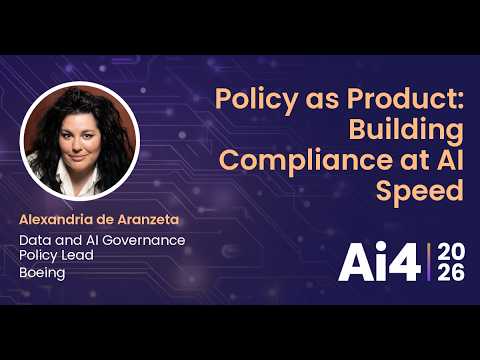
Ai4
Surging AI coding velocity requires compliance teams to abandon reactive enforcement and engineer automated guardrails directly into developer workflows.
AI-assisted summary of Policy as Product: Building Compliance at AI Speed With Boeing — original source. Check the original for full context.
Source published:
Detailed notes
## Background Published on YouTube by Ai4 on August 17, 2026, this presentation features Alexandria de Aranzeta, Data and AI Governance Policy Lead at Boeing. The talk outlines a fundamental shift for compliance organizations facing exponential AI velocity, presenting a phased roadmap and diagnostic questions to transform static policy into an adopted, living product.
## TL;DR Alexandria de Aranzeta argues that unprecedented technical velocity and mounting regulatory activity render traditional, reactive compliance archetypes obsolete. To avoid becoming bottlenecks, policy professionals must transition into proactive builders—such as architects, engineers, and integrators—who embed governance directly into developer workflows. Drawing on the Vitruvian triad of firmness, usefulness, and delight (*firmitas*, *utilitas*, and *venustas*), she explains that while legal firmness is already standard, modern governance succeeds or fails on usability and user experience. She maps this transition across a five-stage product lifecycle—Discover, Prototype, Ship, Iterate, and Scale—providing concrete diagnostic questions to test whether policies achieve genuine operational adoption.
## Atmosphere & style The presentation carries an urgent, incisive, and intellectually refreshing tone that seamlessly bridges classical architectural theory with modern software engineering. De Aranzeta speaks with poised authority and sharp, relatable candor, challenging long-standing bureaucratic habits with direct, grounded diagnostic questions. Watching it feels like a strategic wake-up call, shifting the mood from defensive regulatory anxiety to an empowering, constructive vision where policy creators proudly identify as product builders.
## Key takeaways - [00:04](https://www.youtube.com/watch?v=h9p7AeX8JkY&t=4s) The exponential surge in AI coding velocity (projected 14 billion annual GitHub commits) combined with a flood of AI regulations (over 150 state bills passed in a single year) renders traditional, slow-moving compliance unsustainable. - [02:12](https://www.youtube.com/watch?v=h9p7AeX8JkY&t=132s) Traditional compliance models rely on six reactive archetypes (Investigator, Arbiter, Interpreter, Enforcer, Advisor, and Domain Expert) that only trigger after an incident, dispute, regulation, or specific inquiry occurs. - [02:12](https://www.youtube.com/watch?v=h9p7AeX8JkY&t=132s) To prevent governance from becoming an organizational bottleneck, compliance must shift upstream from reactive problem solvers to proactive problem definers and system builders. - [04:52](https://www.youtube.com/watch?v=h9p7AeX8JkY&t=292s) The modern compliance operating model transforms reactive archetypes into proactive builder roles: Architect, Partner, Engineer, Integrator, Designer, and Researcher. - [04:52](https://www.youtube.com/watch?v=h9p7AeX8JkY&t=292s) As technical delivery accelerates and statutory mandates multiply, policy and compliance professionals are positioned to become key product builders within enterprise software ecosystems. - [07:14](https://www.youtube.com/watch?v=h9p7AeX8JkY&t=434s) Drawing from Vitruvian architecture, well-crafted governance must balance three core pillars: structural firmness (firmitas), practical usefulness (utilitas), and intuitive user delight (venustas). - [07:14](https://www.youtube.com/watch?v=h9p7AeX8JkY&t=434s) Historically, compliance functions have mastered legal firmness (firmitas) while almost completely neglecting operational usefulness and user delight. - [07:14](https://www.youtube.com/watch?v=h9p7AeX8JkY&t=434s) Because policy directly engages human users, dynamic workflows, and measurable adoption metrics, it must be developed, launched, and managed as an ongoing product. - [10:49](https://www.youtube.com/watch?v=h9p7AeX8JkY&t=649s) Effective policy discovery requires embedding directly within developer workflows to uncover operational ground truth, tested by the diagnostic question: 'Who did you talk to before you wrote it?' - [10:49](https://www.youtube.com/watch?v=h9p7AeX8JkY&t=649s) Instead of drafting rigid mandates in secret, compliance teams should release lightweight policy prototypes to skeptical stakeholders to intentionally expose failure points early. - [12:36](https://www.youtube.com/watch?v=h9p7AeX8JkY&t=756s) Publishing and formal executive approval do not equal adoption; treating policy as a product requires go-to-market execution based on audience segmentation, presentation, and workflow integration. - [13:52](https://www.youtube.com/watch?v=h9p7AeX8JkY&t=832s) Repeated policy inquiries and user friction should be treated as product telemetry signals indicating broken or ambiguous clauses that require iteration, rather than user resistance. - [13:52](https://www.youtube.com/watch?v=h9p7AeX8JkY&t=832s) Scalable governance relies on building automated guardrails directly into developer tooling and existing operational paths rather than maintaining external, standalone textual policies. - [15:05](https://www.youtube.com/watch?v=h9p7AeX8JkY&t=905s) As artificial intelligence turns enterprise roles into builder disciplines, the defining frontier of policy and governance over the next decade will be usefulness and user delight.
## Detailed walkthrough ### [00:04](https://www.youtube.com/watch?v=h9p7AeX8JkY&t=4s) The Velocity of AI and the Legislative Explosion
Alexandria de Aranzeta opens with a sharp observation about the temporal reality of the modern artificial intelligence landscape, grounding her remarks at a precise moment in time: August 5, 2026, at 11:22 a.m. In the fast-evolving world of AI, time is a critical unit of measurement, meaning perspectives and frameworks valid today may become outdated within a month, a week, or certainly a year. Clarifying that her viewpoints are strictly personal and do not represent past or present employers, she draws attention to two staggering metrics that illustrate the current technological inflection point: 14 billion and 150.
The first figure, 14 billion, represents the projected number of GitHub code commits by the end of the year—a dramatic 14-fold increase compared to the roughly one billion commits recorded the prior year. This exponential jump reflects an engineering velocity fueled by autonomous AI coding agents, enabling technical teams to ship software leaner and faster than ever before. Simultaneously, the regulatory landscape is attempting to keep pace: 150 is the number of AI-related bills passed by US state legislatures in the preceding year alone, whittled down from over 1,000 proposed bills, with legislative activity in 2026 already outpacing those benchmarks. This convergence of unprecedented technical velocity and legislative volume demands that organizational policy and compliance functions fundamentally transform to meet the AI moment.
- **14 Billion:** Projected annual GitHub commits, driven by AI agent-assisted development (a 14x year-over-year increase). - **1,000+ Proposed / 150 Passed:** AI-related bills across US states in the previous year, with current-year counts exceeding that pace.
---
[02:12](https://www.youtube.com/watch?v=h9p7AeX8JkY&t=132s) The Traditional Operating Model: Six Responsive Archetypes
For decades, the compliance and policy professions have operated under a highly stable, well-defined paradigm structured across six primary operational dimensions. These roles served organizations effectively when the pace of change was slow, allowing professionals time to read multi-hundred-page statutes, digest regulatory guidance, conduct internal socialization, and audit processes against clear, infrequent benchmarks.
However, each of these classic dimensions suffers from a shared structural vulnerability: they are entirely reactive and rely on external triggers to activate:
- **Investigator:** Triggered by an incident; steps in after a failure occurs to reconstruct facts and determine root causes. - **Arbiter:** Triggered by disputes; serves as a judge or tiebreaker between conflicting teams arguing over applicable rules. - **Interpreter:** Translates complex legal, statutory, and regulatory texts into human-readable organizational guidance. - **Enforcer:** Activated when a line is crossed; determines infractions and metes out punitive consequences after the fact. - **Advisor:** Delivers subject-matter guidance under severe time constraints and with incomplete operational data. - **Domain Expert:** Reads hundreds of pages of rules, synthesizes industry trends, and waits for specific technical questions to arise.
Because every dimension waits for an input—an incident, a dispute, a regulation, or a question—the traditional model cannot scale to the throughput of modern AI development. To avoid becoming bottlenecks, compliance practitioners must shift upstream from being reactive "problem solvers" to proactive "problem definers."
---
[04:52](https://www.youtube.com/watch?v=h9p7AeX8JkY&t=292s) The Future State: From Policy Officers to Product Builders
The future of compliance does not discard core investigative or analytical capabilities; rather, it elevates them into proactive, engineering-aligned builder archetypes. Instead of enforcing mandates after deployment or dispensing advice in isolated silos, compliance professionals must step into active development lifecycles to design guardrails directly into systems.
```mermaid flowchart LR accTitle: Evolution of Policy and Compliance Roles accDescription: Mapping the six traditional reactive compliance archetypes to modern proactive builder archetypes.
subgraph Reactive ["Traditional Reactive Model"] direction TB R1["Domain Expert"] R2["Advisor"] R3["Enforcer"] R4["Interpreter"] R5["Arbiter"] R6["Investigator"] end
subgraph Proactive ["AI-Era Builder Model"] direction TB P1["Architect"] P2["Partner"] P3["Engineer"] P4["Integrator"] P5["Designer"] P6["Researcher"] end
R1 --> P1 R2 --> P2 R3 --> P3 R4 --> P4 R5 --> P5 R6 --> P6 ```
In this transformed operating system, the domain expert becomes an **Architect** who designs the foundational scaffolding for internal controls. The advisor becomes an embedded **Partner** participating early in conceptual phases. Most notably, the enforcer becomes an **Engineer**—shifting the mechanism of compliance from post-hoc punitive consequences to pre-built, automated gates. The interpreter evolves into an **Integrator** connecting rules directly to individual user workflows rather than relying on one-way translations. The arbiter acts as a **Designer**, treating policy exceptions and workarounds as telemetry signals to co-design better systems. Finally, the investigator becomes a **Researcher**, using discovery techniques, user interviews, and fail-point mapping up front.
De Aranzeta stakes a bold futurist claim: over the next several years, "policy and compliance professionals are going to be shipping the best products." As statutory mandates multiply and AI agents accelerate code delivery, well-built governance mechanisms will distinguish leading organizations.
---
[07:14](https://www.youtube.com/watch?v=h9p7AeX8JkY&t=434s) The Vitruvian Triad: Why Policy Is a Product
To establish what it truly means to be a "builder," de Aranzeta journeys back two millennia to the 1st century BCE Roman architect Marcus Vitruvius Pollio and his seminal treatise *De Architectura*. Vitruvius posited that builders cannot merely understand physical masonry; they must be broadly educated in geometry, history, music, law, medicine, astronomy, and the arts so their creations can "stand within a world, not just on a page." This broad polymath requirement mirrors the interdisciplinary foundation required of modern policy builders.
Vitruvius established that any well-built structure must satisfy three indispensable conditions: *Firmitas* (firmness), *Utilitas* (usefulness), and *Venustas* (delight). Applying this classical triad to organizational governance reveals an acute industry imbalance:
| Dimension | Architectural Meaning | Policy Equivalent | Historical Reality | |:--- |:--- |:--- |:--- | | **Firmitas** | Structural strength, durability | Does the policy pass audits, withstand incidents, and satisfy regulators? | **Mastered:** "Firmitas for days." Standard policies are almost always legally sound and rigorously drafted. | | **Utilitas** | Functionality, utility | Is the policy self-serve? Can an engineer reference it on a Friday afternoon to ship safely? | **Inconsistent:** Often opaque, burdensome, or detached from operational realities. | | **Venustas** | Beauty, delight, aesthetic appeal | Does the policy deliver an intuitive, engaging user experience that teams actually want to use? | **Absent:** Rarely, if ever, prioritized in traditional compliance drafting. |
Achieving only one out of three criteria has been the classical definition of poor craftsmanship for 2,000 years. A true builder assumes accountability for how a product functions in the hands of end users. Because policy operates with real users, dynamic user experiences, and measurable adoption rates, it must be designed, delivered, and managed as a product.
---
[10:49](https://www.youtube.com/watch?v=h9p7AeX8JkY&t=649s) The Policy as Product Lifecycle: Discovery and Prototyping
Recognizing policy as a product provides compliance professionals with an established, battle-tested product management roadmap consisting of five iterative phases: **Discover**, **Prototype**, **Ship**, **Iterate**, and **Scale**.
```mermaid flowchart LR accTitle: The Policy as Product Lifecycle accDescription: Five iterative phases of the Policy as Product lifecycle showing feedback loops.
D["1. Discover"] --> P["2. Prototype"] P --> S["3. Ship"] S --> I["4. Iterate"] I --> Sc["5. Scale"] I -. "User Telemetry".-> D ```
Applying this product mindset redefines the first two stages:
- **Phase 1: Discover.** True discovery requires going directly to where developer and operational behaviors occur. Rather than relying on second-hand assumptions, policy authors must uncover the user's ground truth. Drawing from her background in enforcement reviewing hundreds of corporate policies, de Aranzeta notes that compliance failures rarely stem from poor drafting (*firmitas*), but from a lack of practical usefulness (*utilitas*). The essential diagnostic question every author must ask is: *"Who did you talk to before you wrote it?"* - **Phase 2: Prototype.** In classical compliance, policies are treated like formal legal filings—drafted in secret, heavily polished, and unveiled as rigid, finished mandates. In product design, however, early versions are intentionally built to fail rapidly in order to generate learning. Compliance practitioners should draft lightweight iterations, explicitly stamp them as prototypes, and strategically circulate them among the stakeholders expected to push back the hardest.
[12:36](https://www.youtube.com/watch?v=h9p7AeX8JkY&t=756s) Testing Rules and Shipping Policy as a Go-to-Market Product
When testing a policy before launch, drafting a few variations of a specific rule and placing them in front of three distinct teams offers immediate operational clarity. Asking those teams to walk through real use cases against the proposed wording yields ready-made case studies for post-launch implementation, while providing concrete directional feedback for final publication. The essential diagnostic question to pressure-test this phase is straightforward: *"What changed after someone tested?"*
Transitioning from testing to shipping requires re-evaluating the perceived finish line. Traditional organizations often celebrate the moment a policy is formally approved and published, but publication, formal approval, and awareness campaigns do not constitute adoption. Treating policy as a product means applying go-to-market disciplines borrowed from product marketing:
```mermaid flowchart LR accTitle: Policy Go-to-Market Framework subgraph GTM ["Go-to-Market Strategy"] direction TB A["<b>Segmentation</b><br>Prioritize audience & establish touchpoints"] --> B["<b>Presentation</b><br>Target right venue, timing & messaging"] B --> C["<b>Integration</b><br>Embed directly into behavior path & workflow"] end C --> D["<b>Adoption</b><br>Evaluate true adoption rate"] ```
- **Segmentation:** Identifying who to prioritize, how to reach them for the initial engagement, and how to maintain consistent contact thereafter. - **Presentation:** Delivering the message to the right target group at the right time, in the right venue, with precise messaging aligned to a predefined outcome. - **Integration:** Directly plugging policy requirements into existing operational workflows and behavioral paths. - **Diagnostic metric:** *"What is your policy's adoption rate?"*
---
[13:52](https://www.youtube.com/watch?v=h9p7AeX8JkY&t=832s) Iteration Loops and Scaling Compliance as a Co-Builder
Iteration serves as a critical operational feedback loop. When compliance teams begin receiving an influx of inquiries—whether twenty, fifty, one hundred, or two hundred and fifty requests regarding a single clause—that volume is a signal to revisit and refine the language internally. Rather than viewing friction as resistance, builders view repetitive queries as actionable data points. Teams must honestly ask themselves: *"Which policy are you keeping because it works and which one because it was really hard to align? We all know the one."*
At scale, the most effective policies are those that embody *utilitas*—they are actively used. When tools and policies are genuinely usable, they are followed, ensuring that organizational safeguards actually take effect. This dynamic transforms compliance into an active co-builder and co-designer alongside engineering teams. The core operating principle is to build where the work is currently happening and scale tools where the work is heading in the future, prompting the diagnostic inquiry: *"How much of your policy is actually built in?"*
- **Request thresholds:** Tracking support tickets and policy clarification requests (20, 50, 100, 250+) to identify broken or ambiguous clauses. - **Embedded compliance:** Shifting from standalone textual mandates to automated, built-in tooling within developer and operational workflows.
---
[15:05](https://www.youtube.com/watch?v=h9p7AeX8JkY&t=905s) The Vitruvian Builder: Firmitas, Utilitas, and Delight in the AI Era
Connecting the five-phase roadmap, the six dimensions of the compliance professional, and the five diagnostic questions reveals an ancient architectural truth. Over two thousand years ago, the Roman architect Vitruvius established that all good building must satisfy three conditions: firmness (*firmitas*), usefulness (*utilitas*), and delight (*venustas*).
The compliance and legal professions mastered *firmitas* (firmness and rigor) long ago, establishing robust legal guardrails and risk controls. However, artificial intelligence is rapidly transforming every skill set across the enterprise into a building discipline. This technological shift elevates usefulness and delight into the defining frontiers of governance. Policy professionals must embrace their emerging identity not merely as gatekeepers, but as active builders shaping useful, elegant, and resilient systems.
## Notable quotes > What if your policy had an adoption rate? — Alexandria de Aranzeta
> [00:04](https://www.youtube.com/watch?v=h9p7AeX8JkY&t=4s) 14 billion and 150. — Alexandria de Aranzeta
> [04:52](https://www.youtube.com/watch?v=h9p7AeX8JkY&t=292s) policy and compliance professionals are going to be shipping the best products. — Alexandria de Aranzeta
> [07:14](https://www.youtube.com/watch?v=h9p7AeX8JkY&t=434s) stand within a world, not just on a page. — Alexandria de Aranzeta
> [07:14](https://www.youtube.com/watch?v=h9p7AeX8JkY&t=434s) Firmitas for days. — Alexandria de Aranzeta
> [10:49](https://www.youtube.com/watch?v=h9p7AeX8JkY&t=649s) Who did you talk to before you wrote it? — Alexandria de Aranzeta
> [12:36](https://www.youtube.com/watch?v=h9p7AeX8JkY&t=756s) What changed after someone tested? — Alexandria de Aranzeta
> [12:36](https://www.youtube.com/watch?v=h9p7AeX8JkY&t=756s) What is your policy's adoption rate? — Alexandria de Aranzeta
> [13:52](https://www.youtube.com/watch?v=h9p7AeX8JkY&t=832s) Which policy are you keeping because it works and which one because it was really hard to align? We all know the one. — Alexandria de Aranzeta
> [13:52](https://www.youtube.com/watch?v=h9p7AeX8JkY&t=832s) How much of your policy is actually built in? — Alexandria de Aranzeta
## Mentioned Alexandria de Aranzeta, Boeing, Ai4, GitHub, Marcus Vitruvius Pollio, De Architectura
## Video description Alexandria de Aranzeta - Data and AI Governance Policy Lead, Boeing
What if your policy had an adoption rate? Keeping pace with AI demands a shift from a reactive way of working to an entirely different operating system. This talk will trace a phased roadmap for policy to meet the AI moment, the diagnostic questions to pressure-test how policy gets built today, and the one skill that will define the profession's next decade.
[Source](https://www.youtube.com/watch?v=h9p7AeX8JkY)