Zig AI Replaces Fragmented SaaS Stacks With Autonomous Sales Agents
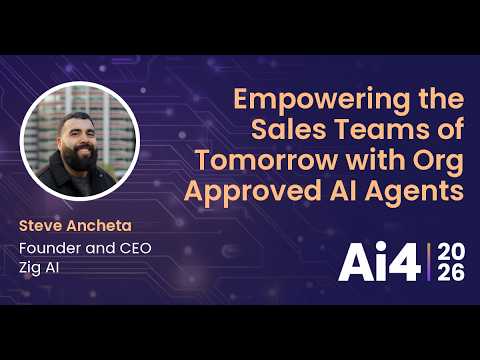
Ai4
Sales reps spend 70% of their workweek managing software instead of selling, driving quota attainment down to 16% unless companies replace reactive copilots with governed autonomous agents.
AI-assisted summary of Empowering the Sales Teams of Tomorrow with Org Approved AI Agents With Zig AI — original source. Check the original for full context.
Source published:
Detailed notes
## Background Published on YouTube by Ai4 on August 17, 2026, this presentation features Steve Ancheta, Founder and CEO of Zig AI. The talk explores how the traditional sales software stack is being superseded by org-approved, AI-native autonomous agents that manage research, outreach, and pipeline workflows within strict enterprise governance boundaries.
## TL;DR Addressing the steep collapse of B2B sales quota attainment caused by SaaS bloat and administrative overhead, Steve Ancheta explains why 95% of generative AI pilots fail and reactive copilots pull reps away from revenue-generating work. He presents the case for 'Org-Approved' autonomous multi-agent systems anchored to a compounding context graph, governed by least-privilege access and human-in-the-loop approval gates. Drawing on Zig AI's forward-deployed deployment framework, the presentation demonstrates how grounding agents in proprietary data transforms reps into managers of virtual employees, validated through an on-stage live voice orchestration demo.
## Atmosphere & style The presentation carries a sharp, authoritative keynote rhythm, grounded in the practical realities and scars of enterprise sales leadership. Ancheta blends sobering statistics on quota failures and data leakage with engaging audience polls, creating an informative yet urgent narrative arc. The session concludes on an energetic, high-tech note with a live voice-agent demonstration that makes the proposed future of autonomous sales operations feel immediate and tangible.
## Key takeaways - [00:04](https://www.youtube.com/watch?v=7MXJHMxwI3w&t=4s) B2B sales quota attainment has collapsed from 53% in 2012 to just 16%, largely because reps spend most of their time on administrative friction rather than live customer conversations. - [01:58](https://www.youtube.com/watch?v=7MXJHMxwI3w&t=118s) The explosion of fragmented SaaS point solutions forces sales reps to act as manual human middleware, juggling an average of 10 tools and spending 70% of their time managing software. - [04:10](https://www.youtube.com/watch?v=7MXJHMxwI3w&t=250s) Enterprise AI adoption spans four stages from curiosity to maturity, but 95% of GenAI pilots currently deliver zero P&L return due to poor data readiness. - [06:43](https://www.youtube.com/watch?v=7MXJHMxwI3w&t=403s) Shadow AI poses massive data security risks, with 71% of employees admitting to feeding confidential company data into public consumer models, driving average annual insider risk costs to $17.4 million. - [08:30](https://www.youtube.com/watch?v=7MXJHMxwI3w&t=510s) Unlike reactive copilots that require constant prompt engineering, org-approved autonomous agents own end-to-end workflows while operating under strict least-privilege access and mandatory human approval gates. - [10:23](https://www.youtube.com/watch?v=7MXJHMxwI3w&t=623s) High-performing autonomous AI requires co-building a single grounded knowledge layer and compounding context graph rather than deploying generic self-serve chatbots. - [12:10](https://www.youtube.com/watch?v=7MXJHMxwI3w&t=730s) A disciplined four-step implementation framework—structuring data, establishing governance, redesigning workflows, and scaling with champions—enables specialized multi-agent architectures to succeed. - [14:22](https://www.youtube.com/watch?v=7MXJHMxwI3w&t=862s) Sales representatives equipped with mature AI systems are 3.7 times more likely to achieve quota, with data maturity generating up to an $8 return per dollar invested. - [14:22](https://www.youtube.com/watch?v=7MXJHMxwI3w&t=862s) Building internal custom agents often backfires by forcing sales reps into ongoing tool maintenance rather than enabling them to manage virtual employees and focus on closing deals. - [16:51](https://www.youtube.com/watch?v=7MXJHMxwI3w&t=1011s) Live multi-agent voice orchestration demonstrates how field reps can effortlessly leverage historical institutional context to draft, approve, and execute follow-ups hands-free.
## Detailed walkthrough ### [00:04](https://www.youtube.com/watch?v=7MXJHMxwI3w&t=4s) The Quota Crisis and the Breakdown of the Modern Sales Rep
Drawing on 16 years of experience across the entire B2B sales spectrum—serving as an account executive, sales engineer, sales manager, head of sales, and founder of two sales-driven companies that were built and sold over the past decade—Steve Ancheta introduces the critical problem facing contemporary revenue teams. Looking at an average sales representative's weekly schedule, only a tiny sliver of time (represented as green) is actually spent having sales conversations and speaking with prospective buyers. Everything else is consumed by administrative overhead and operational friction.
Despite heavy market noise claiming that artificial intelligence is poised to replace sales professionals, initial corporate attempts to lay off sales staff in favor of automation have repeatedly backfired, forcing companies to rehire reps. AI cannot replicate human connection or the nuanced dynamics of interpersonal relationship-building. Instead of addressing the root issue, the tech sector's historical reaction has been to throw more tools or more bodies at sales organizations. This approach has led to a catastrophic decline in sales productivity over the last decade: while 53% of sales reps were hitting quota in 2012, that number plummeted to just 16% nationwide.
- In 2012, 53% of B2B sales reps hit quota; by the previous year, quota attainment collapsed to 16%. - Most of a salesperson's workweek is swallowed by non-selling tasks rather than customer conversations. - Artificial intelligence excels at automating the operational perimeter around a transaction, but cannot replace human-to-human relationship building.
---
[01:58](https://www.youtube.com/watch?v=7MXJHMxwI3w&t=118s) From Spreadsheets to Agents: The Evolution of the Sales Stack
Tracing the history of sales tooling illustrates how incremental technological solutions frequently introduced new operational complications. The industry began in the "spreadsheet era," an early effort at organization that remains an astonishingly durable habit among many reps today because of its sheer comfort and tactical simplicity. That transitioned into the CRM era, moving from customized on-premises systems like Siebel to cloud dominance led by Salesforce.
```mermaid flowchart LR accTitle: The Evolution of the Sales Technology Stack subgraph S1["1990s–2000s"] A["Spreadsheets"] --> B["On-Prem & Cloud CRM<br/>(Siebel, Salesforce)"] end subgraph S2["2010s–2023"] B --> C["The Stack Boom<br/>(Fragmented Point Tools)"] C --> D["Copilots (2023)<br/>(Conversational Prompts)"] end subgraph S3["Present"] D --> E["Agentic Era<br/>(Org-Approved Agents)"] end ```
The cloud CRM gave rise to the "stack boom," characterized by dozens of venture-backed startups addressing hyper-specific, narrow slices of the sales cycle in isolation. By 2023, the industry introduced generative copilots, culminating today in what Ancheta views as one of the most transformative tech shifts in our lifetime: the agentic era. However, the modern enterprise is currently drowning in SaaS sprawl. With roughly 30,000 SaaS products on the market and about 1,000 running in the average enterprise, the only integration layer tying these disparate point solutions together is the human rep.
- Account executives, RevOps specialists, and GTM engineers act as manual human middleware to stitch siloed applications together. - Only about one-third of software tools deployed inside an enterprise are actually integrated into daily operational workflows. - Sales reps juggle an average of 10 distinct software tools to close a single deal, spending 70% of their workweek simply managing and updating their software stack rather than selling.
---
[04:10](https://www.youtube.com/watch?v=7MXJHMxwI3w&t=250s) The AI Adoption Curve and Why 95% of GenAI Pilots Fail
Enterprise AI adoption follows a four-stage progression. It starts at Stage 0, where organizations are merely curious and exploring without financial investment, resulting in a net-zero ROI impact. The danger begins in Stage 1—experimentation—where companies bleed money and destroy ROI trying to parse through vendor noise. As Ancheta tells his team at Zig AI, their greatest competitor is not another startup or vendor, but the sheer market noise confusing enterprise buyers. The objective of true AI-native architectures is guiding enterprises out of Stage 1 experimentation into Stage 2 deployment and Stage 3 scaled maturity.
The urgency of this transition is underscored by the widespread failure of early generative AI deployments: 95% of generative AI pilots produce zero P&L impact, and 60% of all gen AI initiatives are abandoned or slated for abandonment before reaching full operational maturity. The root cause is data readiness. While an estimated 80% to 90% of companies actively dabble with AI, only 7% of organizations possess data that is genuinely "AI-ready." The 5% of implementations that do succeed share clear characteristics: they prioritize deep workflow integration, maintain ruthless data quality, ensure end-user adoption is owned directly by the front lines, and deploy systems that continuously learn from specific human interaction rather than generic web corpora.
- **Stage 0 (Curious):** Zero financial commitment, zero expected ROI, net-zero balance sheet impact. - **Stage 1 (Experimenting):** Unfocused testing, high vendor noise, and negative ROI where most mid-market and enterprise companies are stuck. - **Stage 2 & 3 (Integrated & Mature):** Deep production integration, front-line line ownership, and tangible P&L returns. - **The Readiness Gap:** Only 7% of enterprise data is structured and ready for AI models, explaining why 95% of gen AI pilots deliver zero financial return.
---
[06:43](https://www.youtube.com/watch?v=7MXJHMxwI3w&t=403s) Shadow AI, Data Leakage, and the RFP Anecdote
During an interactive audience poll, nearly the entire room raises their hands when asked if they use AI in their day-to-day work, but virtually every hand drops when asked if that AI delivers the correct output every single time. This disconnect highlights the hazards of "Shadow AI." Approximately 81% of enterprise employees admit to using unauthorized AI tools in their daily jobs, a figure that jumps to 93% among senior executives. Alarmingly, 71% of employees acknowledge pasting confidential, sensitive company data directly into open, consumer-grade models—driving enterprise insider risk costs to an average of $17.4 million annually.
To illustrate the concrete risks of unapproved AI usage, Ancheta shares an industry anecdote regarding a high-stakes government Request for Proposal (RFP). A vendor suspected their fierce, perennial competitor might have fed proprietary bid documentation into a public commercial LLM to generate responses. By strategically prompting the open model, the sales rep successfully reverse-engineered key pricing and technical details of the competitor's submission, allowing them to outmaneuver the rival and win the contract. Whether apocryphal or fully confirmed, the story reflects the severe exposure created when unmanaged data flows into external platforms.
- 81% of employees and 93% of executives admit to leveraging unapproved AI tools in their enterprise workflows. - 71% of personnel have fed sensitive corporate information into public generative models. - Enterprise insider data leakage and associated risk costs average $17.4 million per company per year.
---
[08:30](https://www.youtube.com/watch?v=7MXJHMxwI3w&t=510s) Copilots vs. Org-Approved Autonomous Agents
The fundamental operational distinction between copilots and true agents lies in their interaction model. Copilots are purely reactive—they only "answer when asked." While conversational prompts suit engineers who understand inputs, constraints, and algorithmic arithmetic—where "input plus context equals output"—they run counter to the instinctual rhythm of top-performing sales professionals. Forcing a salesperson to stop talking to clients in order to meticulously engineer prompts for a chat interface pulls them away from pipeline generation and directly saps revenue.
```mermaid flowchart TD accTitle: Copilots vs Org-Approved Autonomous Agents subgraph Reactive["Reactive Copilots"] R1["Rep stops selling to prompt chat"] --> R2["Model answers query"] R2 --> R3["Rep manually executes & pastes"] end subgraph Autonomous["Org-Approved Autonomous Agents"] A1["Agent owns end-to-end goal"] --> A2["Autonomous research, drafting & CRM updates"] A2 --> A3["Least-Privilege Approval Gate"] A3 --> A4["Rep Reviews & Approves Outcome"] A4 --> A5["Continuous System Learning"] end ```
By contrast, an effective AI agent takes full ownership of both the overarching goal and the end-to-end workflow: researching target accounts, drafting tailored communication, updating CRM pipeline stages, and managing follow-ups—a critical area where even seasoned reps routinely drop the ball. Crucially, autonomy does not mean abandoning oversight; human beings must always remain in the loop. Under the "Org-Approved" standard, agents operate with least-privileged system access, every external action requires explicit human sign-off, and all steps are comprehensively logged and fully reversible.
- Copilots require the rep to initiate work via conversational prompts, pulling them away from high-value prospect interactions. - Autonomous agents execute the complete operational loop: account research, email drafting, pipeline updates, and structured follow-up cadences. - "Org-Approved" architecture relies on three non-negotiable governance pillars: least-privilege system permissions, mandatory human approval gates for finished outputs, and fully auditable, reversible action histories.
[10:23](https://www.youtube.com/watch?v=7MXJHMxwI3w&t=623s) Procuring Org-Approved AI and Laying the Grounded Knowledge Layer
When procuring AI-native software, organizations must demand clear operational boundaries before deploying anything into their live environments. Critical questions must be answered: What is the least-privileged access policy? What human approval gates exist? Are actions fully logged and reversible? And how is data grounded, governed, and tied to measurable outcomes? The biggest failure mode among AI companies today is delivering provable, quantifiable results. At Zig AI, contractual commitments are tied directly to hard statistical benchmarks, because clear outcomes are the only way an AI system can reliably understand how to operate.
```mermaid flowchart TD accTitle: Zig AI Forward-Deployed Knowledge Architecture subgraph DataFoundation["Data Foundation & Governance"] A["Fragmented Enterprise Data"] --> B["Forward-Deployed Engineer"] B --> C["Compounding Context Graph<br/>(Governed Knowledge Layer)"] end subgraph ExecutionLayer["Operating System & Agents"] C --> D["Zig AI Operating System"] D --> E["Research Agent"] D --> F["Outreach Agent"] D --> G["Pipeline Agent"] end ```
Agents are only as effective as the ground they walk on. The solution is to co-build a single governed knowledge layer between the enterprise and the AI provider, verifying security postures and testing extensively. Zig AI executes this via a forward-deployed engineering model: an engineer embeds directly into the customer's organization, maps out fragmented data silos, and synthesizes them into a compounding context graph that acts as the company's "AI brain." On top of this foundation, specialized agents—for research, outreach, and pipeline orchestration—are deployed. While this requires a deeper upfront investment than plugging into a simple self-serve chatbot, the compounding returns are massive: within three to six months, the system understands the inner workings of the organization better than most human employees.
---
[12:10](https://www.youtube.com/watch?v=7MXJHMxwI3w&t=730s) The Four-Step Implementation Framework and Multi-Agent Design
Successfully rolling out autonomous systems requires a disciplined four-step implementation process:
1. **Structure the Data:** Map and aggregate all internal information assets. 2. **Set the Governance Bar:** Determine explicit boundaries regarding what data is exposed and what remains restricted. 3. **Redesign Workflows:** Realign operational paths around how data natively flows through the system. 4. **Prove and Scale:** Validate the model with a dedicated champion group, iterating constantly through feedback loops and on-the-ground human interviews with revenue-generating reps who know the end-to-end customer journey firsthand.
Once the underlying plumbing is established, agents transition from novelty features into engines solving core organizational problems. A compounding context graph extends far beyond sales, unlocking automated workflows across RevOps, HR, and payroll. In terms of agent architecture, a single agent assigned to tackle multiple disconnected tasks performs poorly. High-performing systems rely on a multi-agent framework where each distinct workflow is assigned a specialized agent operating under one-tap approval gates, complete audit logging, and reversible action histories.
---
[14:22](https://www.youtube.com/watch?v=7MXJHMxwI3w&t=862s) The Changing Sales Landscape and the Pitfalls of Building In-House
Sales organizations equipped with grounded AI show dramatic performance advantages, with reps operating alongside AI becoming 3.7 times more likely to hit their quotas and high data maturity yielding an estimated $8 return for every $1 invested. As repetitive administrative burdens shift from humans to agents, the rep's work week flips: CRM records update autonomously, sales cycles compress, and institutional intelligence compounds over time.
| Metric / Trend | Projected Impact | |:--- |:--- | | **Quota Attainment Multiplier** | Reps selling with AI are **3.7x** more likely to hit quota | | **Data Maturity ROI** | Yields **$8 return** per $1 spent | | **Agent-to-Rep Ratio (by 2028)** | AI agents will outnumber human sales reps **10 to 1** | | **AI-Mediated B2B Purchases** | **$15 Trillion** in B2B transactions mediated by AI | | **Current Brand Adoption** | **60%** of brands actively using agentic AI for 1:1 interactions |
In the enterprise debate between buying dedicated AI platforms versus building internal agent tooling, custom in-house solutions often backfire. Companies that instruct sales teams to build and script their own agents inevitably force reps right back into the manual overhead of tool maintenance. When the foundational plumbing is managed correctly by a dedicated platform, reps are freed to act as managers of virtual employees, prioritizing relationship building, live conversations, and closing deals.
---
[16:51](https://www.youtube.com/watch?v=7MXJHMxwI3w&t=1011s) Live Voice Demonstration: Managing a Field Agent at AI4
Demonstrating real-time voice orchestration on-stage at the AI4 conference, Steve Ancheta executes an end-to-end conference follow-up entirely hands-free:
- Steve activates the agent via voice: *"Hey, I just ran into Carlos over at Sinch here at AI4. Wanted to send him an email so we can connect next week."* - The agent immediately references historical institutional intelligence: *"Tony reached out to Sinch three months back and their Gong renewal is at year-end. That's right around the corner, so timing's perfect. I'll pull our Gong intel into the follow-up."* - When Steve asks to verify that his meeting link is included, the agent confirms it is already attached and presents the completed draft for authorization. - Upon Steve's verbal confirmation (*"Yeah, go ahead and send it"*), the agent dispatches the email and commits to monitoring the thread: *"Sent. Want me to call you the moment Carlos replies?"* - Steve confirms, and the agent schedules the real-time phone call trigger before closing: *"Have a good rest of your day at AI4, Steve."*
## Notable quotes > [08:30](https://www.youtube.com/watch?v=7MXJHMxwI3w&t=510s) input plus context equals output — Steve Ancheta
> [08:30](https://www.youtube.com/watch?v=7MXJHMxwI3w&t=510s) answer when asked — Steve Ancheta
> [10:23](https://www.youtube.com/watch?v=7MXJHMxwI3w&t=623s) Agents are only as effective as the ground they walk on. — Steve Ancheta
> [16:51](https://www.youtube.com/watch?v=7MXJHMxwI3w&t=1011s) Hey, I just ran into Carlos over at Sinch here at AI4. Wanted to send him an email so we can connect next week. — Steve Ancheta
> [16:51](https://www.youtube.com/watch?v=7MXJHMxwI3w&t=1011s) Tony reached out to Sinch three months back and their Gong renewal is at year-end. That's right around the corner, so timing's perfect. I'll pull our Gong intel into the follow-up. — Zig AI Agent
> [16:51](https://www.youtube.com/watch?v=7MXJHMxwI3w&t=1011s) Yeah, go ahead and send it — Steve Ancheta
> [16:51](https://www.youtube.com/watch?v=7MXJHMxwI3w&t=1011s) Sent. Want me to call you the moment Carlos replies? — Zig AI Agent
> [16:51](https://www.youtube.com/watch?v=7MXJHMxwI3w&t=1011s) Have a good rest of your day at AI4, Steve. — Zig AI Agent
## Mentioned Steve Ancheta, Zig AI, AI4, Salesforce, Siebel, Sinch, Gong, Carlos, Tony
## Video description Steve Ancheta - Founder and CEO, Zig AI
The Sales Software stack as we know it is being replaced. The next generation of sales teams won't toggle between a dozen SaaS tools, they'll operate through a single AI-native system where autonomous agents handle research, outreach, follow-up, and pipeline management while compounding institutional knowledge with every interaction. I'll explore why org-approved agents — ones that act independently but operate within defined boundaries, are the architecture separating high-performing teams from everyone else, and share what we've proven at zig.ai building in this space. If you're a sales leader wondering why your current stack feels like it's working against you, this talk will show you what's already replacing it.
[Source](https://www.youtube.com/watch?v=7MXJHMxwI3w)