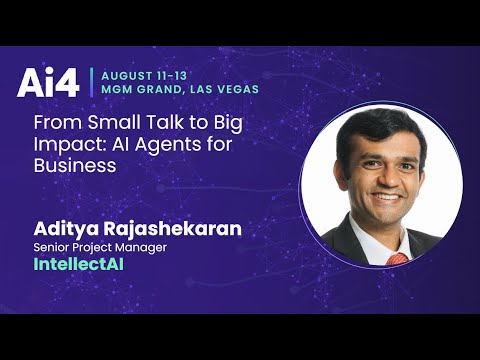
IntellectAI Guarantees 40% Back-Office Efficiency Gain via Multi-Agent AI
Ai4
IntellectAI claims its multi-agent AI system can cut back-office workload by over 40% in three months for enterprise teams with more than 100 employees by replacing manual search with automated evidence gathering and investigation.
## Background
Published on YouTube by the channel Ai4 on August 26, 2025, this presentation features Aditya Rajashekaran, Senior Project Manager at IntellectAI. According to the page description, the session explores how intelligent, multi-agent workforces autonomously coordinate, reason, and execute complex workflows to drive measurable business impact beyond traditional chatbots.
## TL;DR
Aditya Rajashekaran introduces IntellectAI's Purple Fabric platform, comparing chaotic back-office operations to a teenager's messy bedroom that holds immense latent value. Using a soccer metaphor to explain multi-agent coordination, he details a case study with the UK's largest wealth manager where multi-agent systems reduced complaint resolution times from 50 days to 20 minutes with over 90% accuracy. The talk highlights how automating data retrieval enables human experts to make 10 times as many high-leverage decisions, backed by full lineage traceability and model benchmarking. Rajashekaran concludes with a promise to optimize workforces with over 100 FTEs by more than 40% within three months.
## Atmosphere & style
The presentation is pragmatic, energetic, and highly structured, using relatable metaphors like messy bedrooms and soccer teams to ground abstract AI concepts. Rajashekaran speaks with the authoritative confidence of a seasoned fintech practitioner, balancing technical operational details with clear business outcomes. The overall vibe is solution-oriented and persuasive, turning complex enterprise bottlenecks into optimistic opportunities for digital transformation.
## Key takeaways
- [00:04](https://www.youtube.com/watch?v=XlKGCaoCIPk&t=4s) Purple Fabric is an open business impact AI platform built to help enterprises construct, benchmark, deploy, and scale operational AI agents in regulated contexts.
- [00:04](https://www.youtube.com/watch?v=XlKGCaoCIPk&t=4s) Back-office and mid-office operations are bogged down by chaotic, document-heavy, and manual processes, akin to a messy teenager's bedroom.
- [03:46](https://www.youtube.com/watch?v=XlKGCaoCIPk&t=226s) To win against complex operational challenges, enterprises need a coordinated team of multi-agent workforces rather than a single chatbot or single-agent model.
- [03:46](https://www.youtube.com/watch?v=XlKGCaoCIPk&t=226s) In a multi-agent workforce, specialized agents act like soccer roles (defenders, midfielders, strikers), while human domain experts function as managers in the loop.
- [05:53](https://www.youtube.com/watch?v=XlKGCaoCIPk&t=353s) For the largest wealth manager in the UK, IntellectAI deployed a multi-agent system to resolve a massive backlog of tens of thousands of historical complaints.
- [05:53](https://www.youtube.com/watch?v=XlKGCaoCIPk&t=353s) The multi-agent deployment slashed complaint investigation times from 50 days down to 20 minutes with over 90% accuracy and a 50% operating cost reduction.
- [09:13](https://www.youtube.com/watch?v=XlKGCaoCIPk&t=553s) Purple Fabric ensures decision explainability and trust through strict data source lineage tracing down to exact document chunks, database rows, or query outputs.
- [13:14](https://www.youtube.com/watch?v=XlKGCaoCIPk&t=794s) Automating data retrieval and synthesis allows subject matter experts to make 10 times as many high-leverage decisions in the same amount of time.
- [15:24](https://www.youtube.com/watch?v=XlKGCaoCIPk&t=924s) The platform's LLM Optimization Hub enables organizations to benchmark multi-agent workforces across accuracy, speed, and cost using a multi-vendor architecture.
- [19:33](https://www.youtube.com/watch?v=XlKGCaoCIPk&t=1173s) IntellectAI provides an infrastructure-agnostic deployment and guarantees a 40%+ workforce/workflow optimization within 3 months for teams with 100+ FTEs.
## Detailed walkthrough
### [00:04](https://www.youtube.com/watch?v=XlKGCaoCIPk&t=4s) Taming the "Teenager’s Bedroom" of Back-Office Operations
Aditya Rajashekaran, Product Manager for Purple Fabric at IntellectAI, introduces the primary goal of the Purple Fabric platform: enabling enterprises to build, benchmark, deploy, and scale AI agents within a trusted, regulated enterprise context. When asking the audience what comes to mind regarding back-office and mid-office operations, attendees quickly offer words like "unstructured," "speed or the lack thereof," and "complicated." Rajashekaran agrees, noting that real-world back offices are bogged down by complex, document-heavy, and highly manual processes.
To illustrate this operational reality, Rajashekaran compares the back office to a teenager's messy bedroom. While chaotic, chaotic spaces hold tremendous latent potential if you know where to look and how to organize them. IntellectAI is not an early-stage startup jumping on the recent generative AI trend; it is a 30-plus-year-old fintech enterprise that has served over 450 financial service institutions and governments worldwide. Having invested tens of millions of dollars over more than a decade in data and AI capabilities, IntellectAI created Purple Fabric as an open "business impact AI platform" (representing its "Wave 5" architecture) to transform traditional organizations into AI-native enterprises.
- **Platform Core Functions**: Purple Fabric allows organizations to build, benchmark, deploy, and scale operational AI agents.
- **Enterprise Footprint**: Served over 450 global financial service institutions and governments over 30+ years of operational history.
- **Investment Timeline**: Over 10 years of dedicated AI/data investment, extending far beyond the recent GPT-3.5 trend.
[03:46](https://www.youtube.com/watch?v=XlKGCaoCIPk&t=226s) The Soccer Metaphor: Coordinating Multi-Agent Teams
Rajashekaran emphasizes that business value stems from agents collaborating using natural language—working alongside other AI agents and human domain experts—rather than performing isolated tasks. Drawing an analogy to soccer, he compares an organization's operational challenges to a dynamic match. Complex tasks such as onboarding, failed transactions, lost packages, and sanctions screening represent the opposing team constantly launching attacks.
Attempting to tackle this complex operational landscape with a single chatbot or AI model is like placing a single goalkeeper on the pitch alone; even the world's best goalkeeper cannot win a match single-handedly. To actually win, an enterprise needs a coordinated team: specialized defenders to block incoming operational issues, midfielders to drive strategy, strikers to execute and finish tasks, and human experts acting as managers in the loop.
- "Think of now your operational landscape as a dynamic soccer match... Put on one goalkeeper or a single AI agent against your entire operational landscape, regardless of if it's the best goalkeeper in the world, you're not going to be able to win."
- **Team Roles**:
- **Defenders**: Block incoming operational friction and triage issues.
- **Midfielders**: Connect systems and execute analytical strategies.
- **Strikers**: Complete multi-step workflows and deliver final outcomes.
- **Human-in-the-Loop**: Acts as coach/manager to make final critical decisions.
[05:53](https://www.youtube.com/watch?v=XlKGCaoCIPk&t=353s) Real-World Impact: Resolving 10 Years of Wealth Management Complaints
To ground this operational framework in reality, Rajashekaran presents a case study involving the largest wealth manager in the UK. Following regulatory changes allowing UK customers to retroactively submit complaints dating back 10 years for poor advice or service, the institution's incoming complaints skyrocketed from roughly 100 per month to around 1,000 per week. Each individual complaint required approximately 50 days to investigate, as handlers had to evaluate an individual's complete medical history, investment record, retirement goals, age, risk tolerance, and evolving legal frameworks over a decade.
To resolve a massive backlog of tens of thousands of complaints, IntellectAI deployed a multi-agent workforce mirroring the soccer structure. A "Complaint Manager" agent intercepts incoming claims and passes them to classification agents (defenders). Evidence-gathering agents (midfielders) aggregate records across dozens of legacy platforms, building a comprehensive case dossier. Finally, investigation agents (strikers) analyze the evidence and generate a detailed decision recommendation for human approval.
```
+-----------------------------------------------------------------------------------+
| MULTI-AGENT WORKFLOW |
+--------------------------+--------------------------------------------------------+
| Role | Function |
+--------------------------+--------------------------------------------------------+
| Complaint Manager | Intercepts and logs incoming complaints. |
| Classification Agents | Triage and categorize case details. |
| Evidence Gatherers | Query CRM, policy, and legacy systems for dossiers. |
| Investigation Agents | Synthesize data and output decision recommendations. |
| Human Supervisor | Reviews synthesized evidence and signs off. |
+--------------------------+--------------------------------------------------------+
```
- **Resolution Time Shift**: Investigation time dropped dramatically from 50 days down to 20 minutes.
- **Operational Metrics**: Delivered a 50% reduction in operating costs alongside greater than 90% accuracy across the entire multi-agent system.
- **Backlog Resolution**: Successfully cleared tens of thousands of backlogged historical complaints.
[09:13](https://www.youtube.com/watch?v=XlKGCaoCIPk&t=553s) Processing Unstructured Evidence and Lineage Traceability
Investigating complex historical complaints requires analyzing both structured databases and unstructured artifacts, such as handwritten financial advisor meeting notes, fact-finding forms, and client correspondence from years prior. The multi-agent system connects to diverse enterprise environments—including Salesforce, Snowflake, SSP, and regulatory databases like the UK's Financial Conduct Authority (FCA)—to assemble an "Investigation Knowledge Garden."
To establish organizational trust in AI decisions, Purple Fabric incorporates strict data source lineage. Every recommendation or generated statement links directly back to its exact origin, down to the specific document chunk, database table, or execution query. Furthermore, system execution traces act like an "email chain between agents," giving human operators complete explainability into how agents reason, delegate sub-tasks, and classify nuanced issues without relying on rigid decision trees or pre-programmed hard rules.
- **System Integrations**: Native connectivity with Salesforce, Snowflake, FCA regulatory data, and policy admin engines (SSP).
- **Lineage Depth**: Identifies precise document chunks, database rows, and query outputs behind every conclusion.
- **Rule-Free Flexibility**: Classifies multi-part complaints dynamically based on context rather than hardcoded decision trees.
[13:14](https://www.youtube.com/watch?v=XlKGCaoCIPk&t=794s) Restructuring Operations for High-Leverage Human Decisions
In the client's previous operational model, four separate manual teams—Case Logging, Triage, Data Gathering, and Case Handling—processed tasks sequentially. The Case Handling team was both the largest and slowest bottleneck because subject matter experts spent the majority of their time searching for background data rather than applying judgment.
By automating data retrieval, classification, and preliminary analysis through AI agents, subject matter experts focus exclusively on evaluating pre-compiled case dossiers and recommendations. This shift allows human experts to make "10 times as many good decisions in the same amount of time." Instructing a digital agent functions much like onboarding a human employee: providing instructions in natural language, setting data access guardrails, and granting access to the necessary workplace tools.
- **Legacy Process Structure**: Divided across four distinct teams with strict weekly capacity caps.
- **SME Output Multiplier**: Subject matter experts achieved a 10x increase in decision-making throughput.
- **Onboarding Framework**: Digital agents are provisioned using natural language instructions, explicit role boundaries, and direct system access.
[15:24](https://www.youtube.com/watch?v=XlKGCaoCIPk&t=924s) Unlocking Business Impact: Hyper-Personalization and Benchmarking
Beyond efficiency and cost reduction, establishing an Investigation Knowledge Garden allows enterprises to query customer data for broader strategic insights. Specialized agents can analyze account histories to identify life-stage triggers, cross-sell or up-sell opportunities, and customer sentiment. This turns operational back-office processing into a strategic engine for hyper-personalization, driving retention and increasing Net Promoter Scores (NPS).
Addressing common enterprise barriers to AI adoption—such as legacy technology debt, uncertain ROI, and performance measurement—Rajashekaran introduces Purple Fabric’s LLM Optimization Hub. The module enables organizations to benchmark individual agents or multi-agent teams across accuracy, speed, and cost metrics before deployment. It supports model flexibility, allowing teams to mix and match models from Google (Gemini), OpenAI, Anthropic, or proprietary options to find the optimal combination for each task.
- **Strategic Outcomes**: Increases top-line revenue, boosts client retention, and elevates Net Promoter Score (NPS).
- **Optimization Hub Features**: Benchmarks agent teams across accuracy, response speed, and operational cost metrics.
- **Model Flexibility**: Supports multi-vendor architectures (Gemini, OpenAI, Anthropic, or bring-your-own-model API keys).
- **Scale and Governance**: Built to manage future enterprise scale, referencing a client goal of running up to 300,000 active AI agents over the next five years with role-based access controls and full auditing.
[19:33](https://www.youtube.com/watch?v=XlKGCaoCIPk&t=1173s) Infrastructure Flexibility and the Intellect Promise
Aditya Rajashekaran concludes his presentation by highlighting IntellectAI's deployment flexibility and delivering a strong value proposition for potential clients. He emphasizes that their AI solution is completely infrastructure-agnostic when it comes to deployment, ensuring smooth integration across diverse enterprise environments without imposing restrictive hardware or platform constraints.
Closing on an ambitious operational challenge, Rajashekaran offers "the intellect promise" directly to the audience. He guarantees that for any organization operating with a team of over 100 full-time employees (FTEs), IntellectAI can optimize their operational workforce by more than 40% within just three months. He thanks the audience and invites interested attendees to visit them at booth 421 for further discussions.
- **Deployment Compatibility:** Fully infrastructure-agnostic deployment model.
- **Performance Guarantee:** Over 40% workforce/workflow optimization within 3 months for teams with 100+ FTEs.
- **Exhibitor Location:** Booth 421.
## Notable quotes
> [03:46](https://www.youtube.com/watch?v=XlKGCaoCIPk&t=226s) Think of now your operational landscape as a dynamic soccer match... Put on one goalkeeper or a single AI agent against your entire operational landscape, regardless of if it's the best goalkeeper in the world, you're not going to be able to win. — Aditya Rajashekaran
## Video description
Aditya Rajashekaran, Senior Project Manager, IntellectAI
Abstracts
In a world full of chatbots, real business value comes from AI that doesn’t just talk - it thinks, acts, and delivers. This session will showcase intelligent multi-agent workforces that autonomously coordinate, reason, and execute complex workflows across the enterprise.
From streamlining operations to accelerating decisions, AI agents are able to drive real business impact through faster resolutions, greater efficiency, and measurable results. This session explores how multi-agent systems differ from traditional chatbots and single-agent models, with real-world examples of how they’re driving business impact. Learn how organizations are shifting from conversational AI to operational AI that takes action. Whatever your role, see how AI is evolving from conversation to execution and transforming business along the way.
IntellectAI's Aditya Rajashekaran argues that automating complex enterprise back offices requires shifting from standalone chatbots to coordinated, multi-agent teams that integrate with legacy infrastructure while keeping human experts in supervisory roles.
Coordinated Agent Teams for Complex Operations (3:46)
Rajashekaran contends that back- and mid-office environments—frequently characterized by manual, document-heavy, and unstructured workflows—cannot be effectively handled by a single artificial intelligence model. Comparing operations to a soccer match, he argues that relying on an isolated chatbot against complex institutional demands is akin to putting a single goalkeeper on the pitch without support.
To manage continuous operational events such as failed transactions, customer onboarding, and sanctions screening, organizations require specialized digital agents operating in defined roles. In this framework, classification agents act as defenders to triage and block incoming friction, analytical agents operate as midfielders connecting disparate systems, and execution agents function as strikers that synthesize tasks into final recommendations, all overseen by human domain managers.
Resolving Regulatory Backlogs in Wealth Management (5:53)
To demonstrate the multi-agent approach, Rajashekaran cites a case study from the UK's largest wealth manager. Following regulatory changes that allowed clients to retroactively submit complaints spanning a 10-year period, the institution's caseload expanded tenfold from approximately 100 cases per month to 1,000 per week. Evaluating each complaint manually required reviewing a decade of medical histories, investment records, and evolving regulatory standards, averaging 50 days per file.
IntellectAI deployed a specialized agent structure comprising a complaint manager, triage classification agents, evidence gatherers querying internal systems, and investigation agents drafting decision recommendations. According to Rajashekaran, the implementation cleared tens of thousands of backlogged claims, compressed the investigation window from 50 days to 20 minutes, reduced operating costs by 50%, and achieved an accuracy rate exceeding 90%.
Data Lineage and High-Leverage Human Supervision (9:13)
Deploying autonomous workflows in heavily regulated sectors requires verifiable explainability rather than black-box outputs or rigid decision trees. IntellectAI's Purple Fabric platform constructs an investigation knowledge repository aggregating structured databases and unstructured inputs, including handwritten advisor notes, Snowflake, Salesforce, policy administration systems, and Financial Conduct Authority data.
To ensure auditability, the system maintains strict source lineage that links every recommendation back to specific database rows, query outputs, or document segments. It also logs execution traces that reflect inter-agent communication. This restructuring eliminates legacy bottlenecks where human experts spent the majority of their time hunting for records across siloed teams; instead, domain specialists review pre-assembled dossiers and recommendations, which Rajashekaran reports increased decision throughput tenfold.
Benchmarking, Governance, and Enterprise Scale (15:24)
Beyond cost reduction, aggregated operational data can be re-evaluated to identify life-stage triggers, cross-selling possibilities, and customer sentiment to support retention and Net Promoter Scores. To address enterprise adoption hurdles around return on investment and legacy technology debt, Rajashekaran highlights Purple Fabric's optimization hub, which benchmarks agent accuracy, speed, and inference costs across models from Google, OpenAI, Anthropic, or proprietary providers prior to deployment.
Rajashekaran states that the architecture is infrastructure-agnostic and engineered for large-scale operations, referencing a client objective to coordinate up to 300,000 active AI agents over five years under central role-based access and auditing controls.
Rajashekaran pledges that IntellectAI can optimize operational workflows by over 40% within three months for organizations with more than 100 full-time employees. However, the evidence presented centers primarily on vendor-reported metrics from a single UK wealth management implementation, leaving open how seamlessly multi-agent teams adapt to organizations with different legacy software environments and regulatory burdens.
[3:46] Aditya Rajashekaran: Think of now your operational landscape as a dynamic soccer match... Put on one goalkeeper or a single AI agent against your entire operational landscape, regardless of if it's the best goalkeeper in the world, you're not going to be able to win.
Original transcript
[0:04] So I'm Adita. I'm a product manager for
[0:07] the platform Purple Fabric. And just a
[0:10] brief TLDDR, our platform allows you to
[0:14] build, benchmark, deploy, and scale
[0:17] agents within a trusted enterprise
[0:20] context, right? And what are the
[0:24] problems that these agents are trying to
[0:26] solve? And those problems are hidden
[0:29] behind that door. Behind that door are
[0:33] your back office and mid office
[0:35] operations. So just shout out what do
[0:38] you think of when you actually think
[0:40] about your back office operations?
[0:42] Anybody?
[0:44] >> Unstructured.
[0:45] >> Unstructured. Yes. Very very
[0:47] unstructured. Any other thoughts?
[0:51] >> Speed or the lack thereof in some cases.
[0:53] Right. Exactly. Anybody else?
[0:57] complicated. Yes, exactly. So, speed,
[1:01] unstructured, complicated,
[1:04] um, lots of documents, manual processes.
[1:08] This is really the back office that most
[1:10] of us are dealing with. And that's a
[1:12] reality today. And for me, it's really
[1:15] like a teenager's bedroom. You know,
[1:18] it's very messy. You have friends in all
[1:21] the time, lots of people, but there's a
[1:24] lot of potential if you know where to
[1:26] look. So the question is through that
[1:30] glorious mess, how do you actually get
[1:33] it in order to make sure that the
[1:35] teenager blossoms into something really
[1:37] amazing.
[1:39] A little bit about who we are. We are
[1:42] not a startup. We are a fintech giant
[1:45] who's been in operation for more than 30
[1:47] years. So we've delivered real solutions
[1:51] to over 450 financial service
[1:53] institutions around the world and these
[1:56] are enterprises and governments. What
[1:59] that means is that most of you probably
[2:03] are actually customers of our clients
[2:06] and we know what it's like to work with
[2:11] enterprises that have very very messy
[2:14] teenagers bedrooms and back offices that
[2:16] are critical to actually making sure
[2:19] that you as a customer are getting the
[2:21] best possible experience.
[2:24] Not only that, these are highly
[2:26] regulated industries where every single
[2:28] decision is up for scrutiny.
[2:32] And when we got onto the AI journey, it
[2:36] was not two years ago with the
[2:38] popularization of GPD 3.5, we've been
[2:42] investing in AI for over 10 years. And
[2:45] we've had different streams for data,
[2:48] different streams for AI. And what we've
[2:50] been doing is solving real problems for
[2:53] our real customers as we as we've spent
[2:56] tens of millions of dollars on this
[2:59] journey.
[3:00] That journey has brought us to purple
[3:02] fabric which is our open business impact
[3:05] AI platform. This is where we've unified
[3:08] our AI and data capabilities into a
[3:11] single enterprise ready foundation. This
[3:14] is what we call wave five and our goal
[3:17] is to help enterprises evolve into being
[3:21] AI native enterprises.
[3:24] So we focus on business impact. We don't
[3:28] do AI for the sake of AI because every
[3:31] single problem that we've solved has
[3:33] been for a customer. And I know that all
[3:38] of us are here today because we
[3:40] understand the disruptive potential that
[3:42] AI agents can actually bring our
[3:44] enterprises.
[3:46] I want to focus on the last capability,
[3:49] the ability for the AI agents to
[3:51] collaborate. Because they can talk in
[3:53] natural language, they can go beyond
[3:56] doing single tasks and actually work
[3:59] together not just with each other but
[4:02] with humans in the loop. specialized
[4:04] domain uh experts to solve big
[4:08] complicated problems and they work
[4:11] within your evolving and messy
[4:14] operations reality. Think of the
[4:16] teenager's bedroom.
[4:19] This can be illustrated with all of our
[4:22] favorite soccer coach Ted Lasso.
[4:25] So, think of now your operational
[4:28] landscape as a dynamic soccer match. You
[4:31] have customers to onboard, failed
[4:33] transactions, packages lost in trans uh
[4:36] in transit, uh sanction screening that
[4:39] you may have to do, right? That is the
[4:42] opposition team. That is your
[4:44] operational landscape. That's all of the
[4:46] challenges that are being thrown towards
[4:48] you. And your goal is to make sure that
[4:53] not only do you deal with that dynamic
[4:56] landscape to stay in the match, but that
[4:58] you have a strategy to actually win the
[5:00] match by scoring the goals. Now, if you
[5:04] put on one goalkeeper or a single AI
[5:07] agent against your entire operational
[5:10] landscape, regardless of if it's the
[5:12] best goalkeeper keeper in the world,
[5:14] you're not going to be able to win.
[5:17] What you need to do is ensure that you
[5:20] actually have a full team of AI agents
[5:23] that are specialized defenders that are
[5:26] actually blocking things that are coming
[5:28] your way. Midfielders that are thinking
[5:30] about strategy, how to approach the
[5:31] opposing half, and strikers who can
[5:33] actually finish it off. These don't have
[5:36] to be AI agents entirely. They can also
[5:38] be human in the loop. You can have human
[5:42] experts that are collaborating with AI
[5:44] agents to make sure that you're getting
[5:46] business impact. And let me introduce
[5:48] you to one of our clients real
[5:51] operational landscape.
[5:53] We're working with the largest wealth
[5:56] manager in the UK. And the operational
[6:00] landscape that they were operating in is
[6:03] one where the regulations changed which
[6:06] allowed customers like you or me to
[6:09] retroactively complain for the past 10
[6:12] years about poor advice or poor service
[6:15] that I had received on behalf of the
[6:18] wealth manager. What this meant was that
[6:21] instead of the hundred complaints that
[6:23] used to come in every month, I was now
[6:26] facing about a thousand a week, I was
[6:29] being crushed underneath the complaints
[6:31] that were coming in. And these are not
[6:34] simple complaints. These complaints take
[6:36] 50 days to investigate. The reason is
[6:39] the advice that has been given to me
[6:42] based on my health history, investment
[6:45] history, retirement goals, age, appetite
[6:48] for risk is going to be very different
[6:51] than the advice given to anybody else.
[6:54] And not just that, I need to look at
[6:56] dozens of systems, CRM systems, policy
[6:59] admin systems, handwritten notes that
[7:01] financial adviserss took 10 years ago in
[7:04] meeting with clients to actually gather
[7:06] the evidence I need to investigate this
[7:08] complaint. And over these 10 years,
[7:11] regulations have also been changing.
[7:14] This is a complicated operational
[7:16] landscape I need to take into account
[7:18] when investigating a complaint. And what
[7:21] we've put into production is a team of
[7:24] specialized a specialized AI agents that
[7:26] actually collaborate independently and
[7:29] with human in the loop to solve the
[7:31] problem. So going back to our soccer
[7:34] story, we have a team of expert agents,
[7:38] a complaint manager that is like the
[7:40] goalkeeper. The complaint manager
[7:42] actually intercepts a complaint coming
[7:44] in from going into the goal. He then
[7:47] passes it forward to the defenders who
[7:49] understand what type of complaint is
[7:51] this? How do we classify it? What
[7:54] actions do we need to further take? Then
[7:57] they pass it on to the midfielders, the
[7:59] evidence gathering agents who have
[8:01] access to the dozens of systems that run
[8:04] this enterprise where evidence is
[8:06] present. The evidence gathering agents
[8:09] actually create a case dossier and give
[8:11] it to the forwards, the complaints
[8:13] investigation agents to actually create
[8:16] a decision recommendation that is then
[8:18] provided to a human in the loop like uh
[8:22] Ted Lassel the manager to make a final
[8:24] decision on whether to actually really
[8:27] keep the complaint or to not. This is
[8:31] something that took the time required to
[8:34] actually gather evidence for and
[8:37] investigate a complaint from 50 days to
[8:39] 20 minutes. So, it was a step change and
[8:43] the tens of thousands of complaints that
[8:45] our client actually had on backlog were
[8:48] addressed because of the multi- aent
[8:51] solution that was put into production
[8:52] for them.
[8:54] All of this was also with a 50%
[8:57] reduction in cost and a greater than 90%
[9:00] accuracy over the entire multi- aent
[9:03] system. Once again, this is not
[9:06] theoretical. This is something that
[9:07] we've put in production and I'll show
[9:09] you bits and pieces of it so that you
[9:11] can see it for yourself.
[9:13] Apart from the structured information
[9:15] that was present in the CRM systems,
[9:17] policy admin systems, so on and so
[9:19] forth, unstructured evidence is very
[9:21] critical to investigate a complaint.
[9:24] That is a mock letter that a financial
[9:28] adviser has written way back in 2016
[9:31] just talking about what happened during
[9:33] this meeting with a client. So instead
[9:35] of looking just at different
[9:37] transactions
[9:38] um you need to really be able to
[9:40] understand what happened during these
[9:43] meetings as well. And this is for
[9:46] complaint letters themselves, factf
[9:48] finding documents, handwritten notes, so
[9:50] on and so forth.
[9:53] Once you actually understand what a
[9:55] complaint is about, you need to create
[9:57] an investigation knowledge garden. This
[10:01] is the AI agents connecting to all of
[10:05] your different enterprise platforms
[10:07] where you can actually find all of the
[10:10] information and data required to
[10:13] investigate a complaint. So, our AI
[10:15] agents are connected to Salesforce,
[10:18] um, to Snowflake, to the FCA, which is a
[10:20] regulatory authority in the UK, to SSP,
[10:24] and on the right side, you can actually
[10:26] see the AI agents going through all of
[10:29] these sources to go and gather evidence
[10:32] for a complaint that has been raised.
[10:37] Now that you've actually gathered the
[10:38] evidence, investigation agents
[10:41] scrutinize that case dossier and produce
[10:44] a final investigation report. So a
[10:47] complaint decision recommendation is
[10:49] provided with support and evidence that
[10:52] me as a complaint handler can then look
[10:54] at instead of going and actually finding
[10:58] all of the data myself and doing that
[11:01] analysis. I get a case dossier with a
[11:03] decision recommendation. I can act upon.
[11:08] How do I trust that the decision
[11:10] recommendation these AI agents have
[11:12] given is really sound? I can trust it
[11:16] because of data source lineage. On our
[11:19] platform, every single decision or
[11:22] recommendation or answer that AI agents
[11:24] give is always tracked back to the
[11:27] source. Not just the document itself,
[11:29] but which portion and which chunk of the
[11:32] document that information was found. Or
[11:34] in case it's an enterprise system or a
[11:36] database, you actually know which
[11:39] database, what query was run, what
[11:41] insights were received for you to
[11:43] actually get to that decision.
[11:47] When you have a team of over 20 agents
[11:50] that are collaborating with each other,
[11:52] how can you actually ensure that they're
[11:54] doing a good job, that they're actually
[11:57] uh working well together? That is where
[12:00] we bring traces for explanability. Think
[12:02] of it as an email chain between
[12:05] different agents. An agent receives a
[12:08] problem, they think about how they
[12:10] should solve it. Then they understand
[12:12] the operational landscape or their
[12:14] colleagues landscape available to them.
[12:17] They know that they have a colleague
[12:19] agent that actually connects with the
[12:21] complaints management system and can
[12:23] raise a complaint. So instead of doing
[12:25] it themselves, they go to the specialist
[12:28] agent that actually is connected to the
[12:30] complaints management system to raise a
[12:31] complaint. This particular agent that
[12:34] we've stopped on is a classification
[12:36] agent that's reads through a complaint
[12:38] and understands what a complaint is
[12:41] actually about. And you can see that
[12:43] there's two reasons that have been
[12:44] identified here. Inappropriate product
[12:47] transfer uh and partner service. You can
[12:51] see that there's two complaints, not
[12:54] just one. This is not rules-based. Just
[12:57] like a human would read a complaint
[12:59] letter and figure out, okay, you know,
[13:01] there's two complaints present here.
[13:03] That's what the AI agents do in this
[13:05] case. There's no decision tree. There's
[13:07] no rules that we tell the agents that
[13:09] there will be one or two or three
[13:11] complaints per letter.
[13:14] This is a picture of what the old
[13:16] process looked like. There were four
[13:18] teams in total doing the processes that
[13:21] you see on the right side. the case
[13:22] logging team, the triage team, the data
[13:24] gathering team, and the case handling
[13:26] team. All of them had a target capacity
[13:29] per week. And you can see that the
[13:31] subject matter experts, the case
[13:33] handlers making the decision was one of
[13:35] the largest teams and the slowest team
[13:38] because they had so much evidence to
[13:40] parse. And in today's world, most of
[13:43] these steps were taken over by AI
[13:45] agents. And AI agents provide a decision
[13:48] recommendation, which means that the
[13:51] manual case handling team only needs to
[13:54] look at the the decision recommendation
[13:57] and the evidence.
[14:00] In reality, now what we're able to do is
[14:03] optimize the case logging, triage, and
[14:05] data gathering teams because they're run
[14:08] by AI agents and the subject matter
[14:11] experts who are actually in charge and
[14:13] own the decisions. They're able to make
[14:16] 10 times as many good decisions in the
[14:18] same amount of time that they were able
[14:20] to previously without the solution and
[14:23] operation.
[14:26] All of this looks like it's going to be
[14:28] very complicating complicated having a
[14:31] team of over 20 agents that are
[14:33] connected to dozens of different data
[14:36] sources with different roles. But I'm
[14:38] here to tell you that instructing a
[14:41] digital expert is really like inducting
[14:43] a team member. You tell them what they
[14:46] have to do in English because they
[14:48] understand natural language. You give
[14:51] them access to relevant data sources so
[14:54] that they know that they have the
[14:56] relevant guard rails and guidelines in
[14:58] place to investigate and make decisions
[15:01] within your enterprise context. And you
[15:04] also provide them access to the team
[15:06] members and tools that are required for
[15:08] them to actually do their job much like
[15:11] you would do in a new employee
[15:12] induction.
[15:15] So now you actually have an
[15:17] investigation knowledge garden connected
[15:20] to your CRM systems, policy admin
[15:22] systems.
[15:24] What's amazing is that every single use
[15:27] case you put into production is not a
[15:29] transaction. It is a step towards
[15:32] something bigger. What you can do is
[15:34] create different agents with different
[15:36] personas to ask different questions of
[15:39] this investigation knowledge garden. So
[15:42] you can actually find life stage
[15:45] triggers. You can figure out what are
[15:47] the best um cross-ell or upsell
[15:50] opportunities for your customer. You can
[15:52] see their feedback, their account
[15:54] analysis and account activity. And
[15:57] what's very important to take away from
[15:59] here is this gives you the ability to
[16:02] hyperpersonalize your interactions with
[16:05] your clients. So instead of just saving
[16:08] cost and improving speed like you were
[16:10] doing in the previous example, you're
[16:12] able to actually improve your topline,
[16:15] give your customers better service,
[16:18] increase your retention, and also ensure
[16:20] that your NPS is climbing northwards.
[16:24] I've shown you just a couple of
[16:26] enterprise digital experts that are
[16:28] already working for our clients. Here
[16:31] are just a few more. So, it's really up
[16:35] to your imagination to figure out how
[16:38] the enterprise digital experts, how
[16:40] these AI agents can work within your
[16:43] organization
[16:45] and what is holding you back, what is
[16:47] holding most of our clients back from
[16:49] achieving business impact. We've done
[16:52] some research and this is what they
[16:54] said. Largely, how do you measure if the
[16:58] AI agents are actually performing well?
[17:00] How can you see if you're getting any
[17:02] ROI out of this? Also, there's a lot of
[17:05] legacy tech and infrastructure.
[17:08] And that is one of the biggest problems
[17:10] that we've solved. Our LLM optimization
[17:13] hub allows you to benchmark each agent
[17:16] in a multi- aent system and a team of
[17:20] agents for accuracy, speed, and cost.
[17:24] One of the things that we don't hold you
[17:27] to is certain LLM models or providers.
[17:29] So for one agent, what you can do is
[17:32] choose between Gemini, the OpenAI
[17:35] models, anthropic models to figure out
[17:37] which of those models actually powers
[17:39] the agents the best from an accuracy,
[17:41] speed, and cost perspective and make
[17:44] sure that you know the metrics of what
[17:46] you're getting out of it before you put
[17:48] them into production.
[17:50] This is just one of the features of
[17:53] Purple Fabric, the open business impact
[17:55] AI platform. And this is a very very
[17:59] short note at how we actually allow you
[18:02] to build to benchmark to deploy and
[18:07] scale AI agents within your enterprise.
[18:11] The enterprise knowledge garden really
[18:14] allows the platform to connect to all of
[18:16] your trusted data sources, be they
[18:18] structured or unstructured, to find the
[18:21] information that's required and put them
[18:23] in a format that is available for AI and
[18:26] AI agents to consume. This is all of the
[18:30] these are all of the connectors that you
[18:32] saw with Salesforce uh so on and so
[18:35] forth earlier, right? The enterprise
[18:37] digital experts allow you to actually
[18:40] build these AI agents and orchestrate
[18:42] them so that they're working together
[18:44] and with human in the loop. The LLM
[18:47] optimization hub is the benchmarking
[18:49] screen that you saw before, but what we
[18:51] also allow you to do is bring your own
[18:54] LLM models and your own LLM keys. So, we
[18:56] don't hold you to that. And finally, the
[18:59] enterprise governance is really
[19:02] important. We're working with a client
[19:04] that stated a desire to have 300,000
[19:07] agents in operation over the next 5
[19:10] years. How do you control them? How do
[19:12] you monitor them? How do you actually
[19:14] find these agents um limit them to the
[19:17] data entitlements that they have? How do
[19:19] you ensure that the people using these
[19:21] agents are not accessing data that they
[19:23] don't need? These are the problems that
[19:25] we're trying to solve along with
[19:27] explanability, traceability that you saw
[19:30] on purple fabric. And all of this is
[19:33] infraostic in terms of deployment. So
[19:36] thank you very much. And all I want to
[19:38] say is if you have a 100 plus FTE team,
[19:42] the intellect promise as is that we're
[19:45] going to be able to optimize it by more
[19:47] than 40% in 3 months. Thank you. We're
[19:49] at booth 421.