SmartData Deploys AI Agents to Replace Ad Testing Loops, Lower CAC
Ai4
Autonomous AI agents shift marketing from passive analytics to direct generative execution, eliminating multi-department testing bottlenecks to scale ad spend while cutting customer acquisition costs.
AI-assisted summary of The Foresight Era: AI Agents and the Future of Marketing Decisions With SmartData — original source. Check the original for full context.
Source published:
Detailed notes
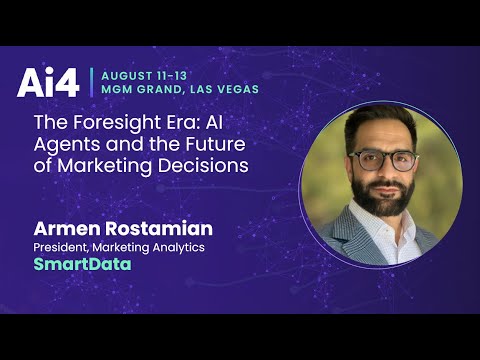
## Background Published on YouTube by the Ai4 channel on August 26, 2025, this presentation features Armen Rostamian, President of Marketing Analytics at SmartData. According to the session description, the talk examines how AI agents accelerate marketing insights to create predictive growth engines and power foresight-driven decisions across media investment, creative testing, and lifecycle strategy.
## TL;DR Armen Rostamian argues that agentic AI fundamentally compresses the distance between marketing vision and execution by removing corporate friction and technical bottlenecks. He introduces a five-stage analytics maturity curve culminating in generative execution, where diagnostic models directly trigger automated creative production and testing. Through a real-world cybersecurity case study, Rostamian shows how breaking ad creative down into structured metadata tables allowed a brand to break through audience fatigue, expanding media spend by 50% while cutting customer acquisition costs by 10%. He stresses that sustainable AI transformation must build upon solid data foundations and human intuition, multiplying human effectiveness rather than seeking blind automation.
## Atmosphere & style The presentation maintains an authoritative, polished, and pragmatic tone, blending high-level strategic forecasts with rigorous quantitative frameworks. Rostamian presents with steady clarity and executive confidence, systematically dismantling common corporate inefficiencies and replacing AI hype with concrete operational blueprints. Listening to the talk feels like attending a focused enterprise masterclass, transitioning smoothly from big-picture economic shifts to granular, data-driven marketing workflows.
## Key takeaways - [00:04](https://www.youtube.com/watch?v=dJs2Dk7ARwk&t=4s) AI agents enable an exponential productivity revolution in marketing, shifting the enterprise focus from simple cost reduction to organizational alignment and massive operational leverage. - [02:07](https://www.youtube.com/watch?v=dJs2Dk7ARwk&t=127s) Agentic workflows compress the gap between strategic vision and execution, removing bureaucratic red tape and the need for rare, polymath 'data unicorns'. - [04:21](https://www.youtube.com/watch?v=dJs2Dk7ARwk&t=261s) Marketing analytics is advancing past descriptive, diagnostic, predictive, and prescriptive stages into a fifth frontier: generative operational execution. - [10:12](https://www.youtube.com/watch?v=dJs2Dk7ARwk&t=612s) Traditional creative testing traps enterprises in an expensive, multi-departmental 'hamster wheel' that wastes budget and delays campaign iteration. - [12:16](https://www.youtube.com/watch?v=dJs2Dk7ARwk&t=736s) AI agents deconstruct qualitative creative assets into structured metadata, enabling marketers to isolate and optimize discrete variables like opening hooks and call-to-actions. - [12:16](https://www.youtube.com/watch?v=dJs2Dk7ARwk&t=736s) Deploying agentic creative synthesis to break narrative saturation allowed a cybersecurity brand to scale advertising spend by 50% while decreasing CAC by 10%. - [16:28](https://www.youtube.com/watch?v=dJs2Dk7ARwk&t=988s) Autonomous testing engines will eliminate budget waste by pre-screening tests with low mathematical probability of success and customizing core concepts across multi-channel algorithms. - [16:28](https://www.youtube.com/watch?v=dJs2Dk7ARwk&t=988s) High-performing AI workflows must be anchored in human intuition and deep customer empathy rather than unguided, blind automation. - [18:40](https://www.youtube.com/watch?v=dJs2Dk7ARwk&t=1120s) Achieving true agentic decision-making requires sequentially mastering foundational data infrastructure, process automation, and machine learning without taking shortcuts. - [18:40](https://www.youtube.com/watch?v=dJs2Dk7ARwk&t=1120s) Enterprise AI architecture must be modular and future-proofed so that new foundational model releases increase leverage rather than breaking existing workflows. - [19:50](https://www.youtube.com/watch?v=dJs2Dk7ARwk&t=1190s) Unlike deterministic channels such as direct mail, algorithmic ad platforms rely on opaque distribution systems where AI optimizes campaign targeting rather than guaranteeing deterministic delivery.
## Detailed walkthrough ### [00:04](https://www.youtube.com/watch?v=dJs2Dk7ARwk&t=4s) The Exponential Productivity Revolution in Marketing
Armen Rostamian, President of Marketing Analytics at SmartData, opens by outlining his firm’s core mission: enabling organizations to make sharper, more grounded marketing decisions by meeting them wherever they happen to be on their data journey. The central thesis of the talk, however, focuses on how artificial intelligence use cases and autonomous AI agents can unify fragmented teams and unlock superior business outcomes across enterprise marketing departments. To frame the scale of this shift, Rostamian highlights statements from two tech leaders: Sam Altman’s prediction that the tech ecosystem will soon witness a one-person organization achieve a billion-dollar valuation, and Jensen Huang’s forecast that AI will mint more millionaires over the next five years than the first two decades of the commercial internet combined.
In Rostamian's view, these two observations converge on a single fundamental truth: individual and organizational productivity can now scale exponentially. This transition is not merely about mechanical cost-cutting or appearing tech-savvy; it is about leveraging AI to forge organizational alignment. Looking at current benchmarks, industry leaders like Nvidia and Netflix represent the highest productivity per head in corporate history, generating roughly $2.5 million in revenue per employee. As marketing organizations incorporate agentic frameworks, they enter a similar structural revolution where individual decision-makers can multiply their output many times over.
- **Keynote Quotes**: Sam Altman projects the rise of a billion-dollar solo company; Jensen Huang predicts unprecedented wealth generation outpacing the internet's early era. - **Top Productivity Benchmarks**: Nvidia and Netflix currently lead corporate efficiency at approximately $2.5 million in revenue per employee. - **Primary Objective**: Shifting organizational AI adoption from simple cost reduction to strategic leverage and cross-functional alignment.
---
[02:07](https://www.youtube.com/watch?v=dJs2Dk7ARwk&t=127s) Closing the Distance Between Strategic Vision and Execution
When marketing organizations embrace advanced AI, the traditional catalog of corporate excuses disappears. The success of an initiative shifts entirely to the novelty and inherent strength of the strategic concept itself. In standard enterprise environments, great ideas often "die on the vine" due to layered corporate politics, interdepartmental red tape, and the sheer number of people chiming in at every juncture. Agentic AI drastically compresses the distance between initial strategic vision and final execution, cutting away unnecessary process so teams can focus purely on high-level strategy.
```mermaid flowchart LR accTitle: Vision to Execution Compression accDescription: Flow showing how AI agents eliminate corporate intermediaries between customer-centric strategy and deployment.
subgraph Traditional["Traditional Bureaucratic Pipeline"] A["Marketer Vision"] --> B["Multiple Departments & Politics"] B --> C["Technical Intermediaries / Data Unicorns"] C --> D["Diluted Customer Output"] end
subgraph Agentic["Agentic Streamlined Pipeline"] E["Customer-Centric Marketer"] --> F["AI Agent Network"] F --> G["Direct High-Velocity Execution"] end ```
Simultaneously, agentic systems eliminate steep technical barriers. Historically, marketing departments had to hunt for rare "unicorns"—individuals who possessed deep customer empathy while simultaneously mastering statistical regressions and software development. With autonomous agents handling data parsing, predictive modeling, and execution, the person sitting closest to the customer can make direct, high-impact decisions. Rather than demanding technical polymaths, organizations can empower customer-focused marketers to operate with exactness, freeing up cognitive headspace to improve quality rather than merely chasing operational efficiency.
---
[04:21](https://www.youtube.com/watch?v=dJs2Dk7ARwk&t=261s) Moving from Analytics to Operations: The Five Frontiers
To understand where AI agents fit, Rostamian reviews the classic analytics growth curve, which organizations typically climb across four historical stages: descriptive, diagnostic, predictive, and prescriptive. In descriptive analytics, an organization simply tallies metrics, such as reporting total daily sales revenue. Moving into diagnostic analytics, the team isolates the underlying mechanics, discovering that sales revenue is a direct function of website traffic and conversion rates. With those mathematical relationships understood, the predictive phase forecasts future outcomes, projecting tomorrow’s revenue from expected traffic volumes and conversion rates. Finally, prescriptive analytics recommends resource allocation, advising teams to invest in optimizing the sales funnel to lift conversion rates from 2% to 3% for a calculated return.
While organizations cannot bypass these foundational steps, AI provides a competitive edge by shifting the entire curve both upward and to the left—accelerating how rapidly teams advance and lowering execution friction at each step. Yet the most profound transition is that AI turns analytics into pure operations through a fifth frontier: generative execution. Instead of ending with a static prescriptive recommendation to overhaul a sales funnel, generative AI actively produces and deploys the solution, translating analytical intelligence directly into automated operational output with fewer resources.
```mermaid flowchart TD accTitle: The Extended Analytics Growth Curve accDescription: Five stages of marketing analytics maturity ending in generative autonomous operations.
subgraph Analytics["Traditional Analytics Maturity"] D["1. Descriptive: What happened? (Count sales & visits)"] DI["2. Diagnostic: Why did it happen? (Conversion & traffic drivers)"] P["3. Predictive: What will happen? (Forecast revenue & CAC)"] PR["4. Prescriptive: What should we do? (Invest in funnel upgrades)"] end
subgraph Operations["Autonomous Execution"] G["5. Generative: Direct automated execution & creative synthesis"] end
D --> DI --> P --> PR --> G ```
---
[07:15](https://www.youtube.com/watch?v=dJs2Dk7ARwk&t=435s) Creative Performance: Tackling the Qualitative Bastion of Marketing
To demonstrate how generative operations work in practice, Rostamian turns to the most qualitative, subjective domain of marketing: creative performance. While quantitative platforms and delivery algorithms mediate the space between brands and consumers, evaluating whether an ad creative resonates has traditionally relied on subjective opinion. Creative departments and external influencer networks bring vital creative instinct, but their workflows rarely operate with scientific or methodical precision.
Rostamian walks through a representative scenario: an enterprise spending $1,000,000 across its media portfolio with a six-month return horizon. Through descriptive tracking and machine-learning attribution models, the growth team diagnoses that click-through and conversion rates are dropping sharply on Meta ads. Feeding this data into a Media Mix Model (MMM)—a statistical predictive engine—reveals that the account has hit diminishing marginal returns on its current ad formats, causing customer acquisition costs (CAC) to spike. While the mathematical model might prescribe slashing ad spend to protect margins, business growth demands a different path: diversifying ad themes and refreshing creative concepts. In the generative era, these predictive signals no longer trigger slow agency brainstorms; they feed directly into generative systems that turn prescriptive diagnostic data into fresh creative inputs.
- **Scenario Profile**: Enterprise spending $1,000,000 with a six-month payback window facing audience fatigue. - **Diagnostic Signal**: Declining click-through and conversion performance isolated to Meta paid campaigns via ML attribution. - **MMM Finding**: Ad spend is past the optimal efficiency point on the degradation curve, driving CAC upward. - **Strategic Fix**: Creative diversification, converting predictive recommendations into generative AI prompts.
---
[10:12](https://www.youtube.com/watch?v=dJs2Dk7ARwk&t=612s) Breaking the Traditional Creative Hamster Wheel
In an ordinary enterprise, attempting to solve a creative fatigue problem triggers a bloated, multi-layered workflow fraught with delay and defensive corporate posturing. The analytics team hands down their performance findings, and the brand team often responds defensively, arguing their current concepts are sound. Once convinced to run a test, the brand team drafts a brief, introducing the first layer of human interpretation. That brief is passed to outside creative agencies or user-generated content (UGC) networks, who interpret the brief through their own subjective lenses and produce a batch of ad assets.
```mermaid flowchart TD accTitle: The Six-Layer Traditional Creative Hamster Wheel accDescription: Sequential handoffs showing failure points across five departments in legacy creative testing.
A["Analytics Team: Delivers diagnostic fatigue insight"] --> B["Brand Team: Defensive review, conceptualizes test brief"] B --> C["Creative Agency / UGC: Subjective interpretation & asset production"] C --> D["Internal Reviewers: Selects 'best' creatives subjectively"] D --> E["Media Buying Team: Configures audiences & runs campaigns"] E --> F["Finance Team: Reviews & approves incremental testing budgets"] F -.->|"Months later / $50k invested / 6 failure points"| A ```
Those assets return to internal committees, where individuals pick the "best" variants based on personal taste. The selected assets move to media buyers, who attempt to match them to target audiences, and finally to finance to secure incremental test budgets. This legacy loop spans five corporate departments, navigates six distinct communication layers with six potential points of failure, consumes upward of $50,000 in capital, and takes months to run. By the time results trickle back, the team is stuck on an exhausting operational "hamster wheel," burning capital on incremental tests while leaving real performance to chance.
---
[12:16](https://www.youtube.com/watch?v=dJs2Dk7ARwk&t=736s) Standardizing Creative Assets: The Cybersecurity Case Study
AI agents disrupt this fragmented loop by placing management directly into the hands of a lean, focused growth team. The first critical layer of agentic intervention involves standardizing the creative asset itself—converting what was once a purely qualitative review into structured, granular data. Instead of relying on a human reviewer’s impression that an influencer fits a specific demographic, computer vision and language agents catalog every micro-component of an ad into an exhaustive metadata table. The agent records precisely what occurs in the first three seconds (for instance, a female creator in a domestic setting introducing a cybersecurity hook), details how the product is pitched, and evaluates whether the closing call to action is explicit.
By deconstructing videos into discrete, quantifiable variables, marketers can isolate what truly drives performance:
$$\text{Creative Performance} = f(\text{Hook}_{0\text{-}3s}, \text{Narrative Framework}, \text{Audio Tone}, \text{CTA Format})$$
If the opening three-second hook performs exceptionally well but conversions stall due to a muddled five-second conclusion, the team can hold the working variables constant while isolating and replacing only the defective elements.
Rostamian illustrates this through a cybersecurity client experiencing plateauing growth. SmartData's agentic analysis showed that nearly all of the brand's ad spend was concentrated on a single repetitive narrative: "robocalls are annoying, and we can stop them." While initially successful, continuing to pour capital into this single concept pushed the company down a steep efficiency degradation curve.
Instead of waiting for an agency brainstorm, an AI agent identified the saturation point and synthesized a net-new thematic concept: the "vanish from the internet" angle. This theme repositioned the product around complete digital footprint removal rather than everyday call filtering, appealing to an entirely untapped audience segment. The brand deployed the agent-derived creative, scaling total advertising spend by 50% while simultaneously reducing customer acquisition cost (CAC) by 10%. The system bypassed the corporate hamster wheel entirely, validating and scaling a novel concept with minimal friction and zero organizational debt.
- **Cybersecurity Scaling Results**: Spend increased by 50% alongside a 10% CAC reduction. - **Narrative Shift**: Transitioned from saturated "stop robocalls" ads to an expansive "vanish from the internet" positioning. - **Analytical Mechanics**: Quantified qualitative video elements into a structured metadata table, isolating successful variables from failing ones.
---
[16:28](https://www.youtube.com/watch?v=dJs2Dk7ARwk&t=988s) Rewriting Campaign Testing Operations and Preserving Human Foundations
Looking ahead, Rostamian emphasizes that agentic workflows will fundamentally reshape the operational mechanics of campaign and testing strategies. Modern multi-channel marketing demands that core conceptual themes be customized for distinct platform algorithms; an ad concept must be expressed differently on TikTok than on Facebook while maintaining narrative cohesion. Generative engines excel here by taking a single validated concept, such as the "vanish from the internet" theme, and adapting it into platform-native variants. Soon, individual creative components produced by human talent will feed directly into generative assembly engines rather than being shipped straight to the end viewer, allowing AI to stitch together optimal, bespoke combinations dynamically.
On testing strategy, Rostamian notes that the single largest drain on corporate marketing budgets is running tests that have zero mathematical probability of success. AI agents eliminate these bad tests before they launch by assessing risk, audience overlap, and historical variance. In the near future, organizations will rely on an autonomous, continuously updated testing calendar that orchestrates experimentation risk and opportunity without manual upkeep.
Rostamian closes by grounding this technological shift in reality: every layer of AI capability is fundamentally built on top of non-AI knowledge. True competitive advantage does not stem from blind automation, but from anchoring agents in human understanding, domain intuition, and an empathetic grasp of the customer experience. Marketers must first understand what resonates and why; only then can AI agents scale that intuition into high-velocity operational execution.
[18:40](https://www.youtube.com/watch?v=dJs2Dk7ARwk&t=1120s) Laying the Foundation for Agentic AI and Future-Proof Systems
To interact with AI agents in a genuinely productive way, organizations must recognize that there are no shortcuts to success. The progression toward high-impact agentic systems requires completing each prerequisite layer methodically: building strong foundational data infrastructure, establishing robust process automation, deploying machine learning, and only then advancing toward autonomous AI decision-making. Skipping any of these intermediate steps undermines the reliability of the entire system.
```mermaid flowchart LR accTitle: The AI Decision-Making Maturity Curve A["Foundational Data"] --> B["Automation"] B["Automation"] --> C["Machine Learning (ML)"] C["Machine Learning (ML)"] --> D["Agentic AI Decision-Making"] ```
Forward-looking teams must design their architectures so that they "look forward to the next model release, not dread it." Solutions must remain flexible and modular, allowing organizations to seamlessly plug in newer, more capable foundational models to increase operating leverage rather than fearing that updates will break fragile workflows. Ultimately, the true goal of enterprise AI is not to replace people, but to "multiply the human effect," bringing brands closer to a genuine human-to-human connection with their customers while stripping out the operational noise that burdens internal teams.
- **Non-Negotiable Progression**: True AI decision-making rests on the sequential execution of data foundations, automation, and machine learning. - **Architectural Adaptability**: Systems should be built to gain leverage from future frontier models rather than becoming obsolete when new iterations drop. - **Human-Centric Amplification**: AI agents serve to remove procedural friction, resulting in improved experiences for both internal marketing teams and end customers.
---
[19:50](https://www.youtube.com/watch?v=dJs2Dk7ARwk&t=1190s) Q&A: Precision Targeting and Algorithmic Ad Delivery
Addressing an audience question on marketing delivery and prevention, the discussion turns to the difference between direct channels and algorithm-driven advertising platforms. In direct marketing channels, such as physical mailers, brands have precise, deterministic control over audience targeting and delivery.
In contrast, digital platforms like Meta operate on opaque internal bidding and distribution algorithms that make their own real-time delivery choices. While predictive AI agents and data signals can significantly guide and optimize campaigns to make them far more targeted, advertisers must acknowledge that algorithmic ad delivery cannot guarantee an absolute one-to-one match in the way deterministic channels do.
## Notable quotes > [00:04](https://www.youtube.com/watch?v=dJs2Dk7ARwk&t=4s) meeting them wherever they happen to be on their data journey — Armen Rostamian
> [02:07](https://www.youtube.com/watch?v=dJs2Dk7ARwk&t=127s) die on the vine — Armen Rostamian
> [04:21](https://www.youtube.com/watch?v=dJs2Dk7ARwk&t=261s) shifting the entire curve both upward and to the left — Armen Rostamian
> [10:12](https://www.youtube.com/watch?v=dJs2Dk7ARwk&t=612s) hamster wheel — Armen Rostamian
> [12:16](https://www.youtube.com/watch?v=dJs2Dk7ARwk&t=736s) robocalls are annoying, and we can stop them — Armen Rostamian
> [12:16](https://www.youtube.com/watch?v=dJs2Dk7ARwk&t=736s) vanish from the internet — Armen Rostamian
> [16:28](https://www.youtube.com/watch?v=dJs2Dk7ARwk&t=988s) built on top of non-AI knowledge — Armen Rostamian
> [18:40](https://www.youtube.com/watch?v=dJs2Dk7ARwk&t=1120s) look forward to the next model release, not dread it — Armen Rostamian
> [18:40](https://www.youtube.com/watch?v=dJs2Dk7ARwk&t=1120s) multiply the human effect — Armen Rostamian
## Mentioned Armen Rostamian, SmartData, Sam Altman, Jensen Huang, Nvidia, Netflix, Meta, TikTok, Facebook, Ai4
## Video description Armen Rostamian, President, Marketing Analytics, SmartData
Abstracts
What if you could act on insights before the signal even hits your dashboard?
AI agents can accelerate marketing insights—shifting us to predictive growth engines powered by collective intuition.
I’ll share real-world examples of how forward-thinking teams are deploying agents for media investment, creative testing, and lifecycle strategy—grounded in foresight and driven by automation.
Join me to discover how the next era of marketing is being built on decisions made ahead of the curve.
[Source](https://www.youtube.com/watch?v=dJs2Dk7ARwk)