## Background
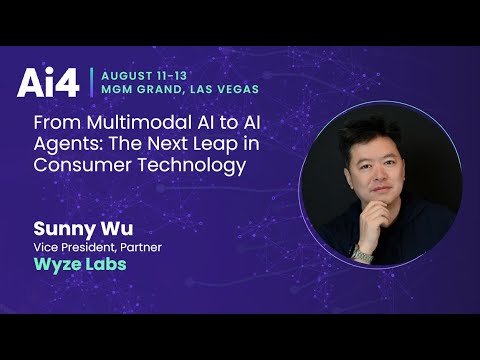
This talk was delivered by Sunny Wu (Vice President, Partner at Wyze Labs) and published on YouTube by Ai4 on August 26, 2025. According to the page description, the session explores how the evolution from LLMs to multimodal AI enables real-world AI agents in consumer technology, drawing on practical insights from Wyze's intelligent home security systems.
## TL;DR
Sunny Wu addresses the widespread issue of notification fatigue in smart home cameras, explaining how traditional single-sensory detection fails users when flooded with minor motion alerts. He outlines Wyze's technological evolution from lightweight PPPV object detection models to Vision-Language Models that power Descriptive Alerts and plain-English AI Video Search. Finally, Wu details the transition toward autonomous AI agents via the 'NBD' (No Big Deal) filter, which ranks alert urgency, learns household baselines, and sets the stage for an 'Agent as the OS' paradigm built on accuracy, personalization, and privacy.
## Atmosphere & style
The presentation carries an optimistic, polished, and developer-focused energy, blending pragmatic product design with forward-looking industry vision. Sunny Wu speaks with relatable empathy—grounding technical concepts in the shared, everyday annoyance of muted phone alerts—before transitioning into a structured, authoritative breakdown of AI architecture. The experience feels like an engaging industry keynote: clear, authoritative, and anchored by concrete real-world demonstrations and user validations.
## Key takeaways
- [00:04](https://www.youtube.com/watch?v=7RWGyqEvbys&t=4s) Frequent, irrelevant notifications cause users to ignore or mute smart camera alerts, representing a fundamental failure in home security product design.
- [00:04](https://www.youtube.com/watch?v=7RWGyqEvbys&t=4s) Wyze Labs is addressing notification fatigue through a three-stage evolutionary roadmap: traditional Object Detection, Multimodal Scene Summarization, and Autonomous AI Agents.
- [01:56](https://www.youtube.com/watch?v=7RWGyqEvbys&t=116s) Multimodal AI processes multiple sensory data streams simultaneously using transformer architectures, enabling systems to mirror complex human perception.
- [01:56](https://www.youtube.com/watch?v=7RWGyqEvbys&t=116s) Real-world implementations of multimodal AI include Meta smart glasses reading snack ingredients and Waymo vehicles fusing camera, LiDAR, radar, and GPS data for safe driving.
- [03:44](https://www.youtube.com/watch?v=7RWGyqEvbys&t=224s) To move past simple object detection (Person, Package, Pet, Vehicle), Wyze introduced Descriptive Alerts using an in-house Vision-Language Model (VLM) for real-time video summaries.
- [08:03](https://www.youtube.com/watch?v=7RWGyqEvbys&t=483s) AI Video Search transforms historical video recordings into a searchable plain-English database, allowing users to query events like package deliveries or pet activity.
- [09:30](https://www.youtube.com/watch?v=7RWGyqEvbys&t=570s) Autonomous AI agents rely on four core pillars: Sensors to perceive, Decisions to reason, Actions to execute, and Memories to store experiences and learn.
- [09:30](https://www.youtube.com/watch?v=7RWGyqEvbys&t=570s) Wyze's 'NBD Filter' (No Big Deal) uses anomaly detection and feedback loops to rate notification importance on a 1-to-5 scale, suppressing routine noise.
- [13:51](https://www.youtube.com/watch?v=7RWGyqEvbys&t=831s) The long-term vision 'Agent as the OS' shifts computing from app-centric manual management to goal-directed orchestration by an AI agent.
- [13:51](https://www.youtube.com/watch?v=7RWGyqEvbys&t=831s) Building consumer trust in AI agents requires accuracy and reliability, user control and personalization, and privacy by default.
## Detailed walkthrough
Here is a detailed, faithful walkthrough based on the transcript provided:
### [00:04](https://www.youtube.com/watch?v=7RWGyqEvbys&t=4s) The Challenge of Notification Fatigue
Sunny Wu opens his talk by asking the audience for a quick show of hands to see how many people own home security cameras, either indoor or outdoor. He then asks those same people to keep their hands raised if they routinely ignore or mute notifications from those cameras because the sheer volume is overwhelming or because they assume the alerts are irrelevant. Realizing he shares this exact frustration alongside countless others, Sunny introduces the concept of "notification fatigue." He emphasizes that the moment a user dismisses a core feature meant to alert them to important events, it represents a fundamental failure in product design.
Sunny outlines his goal for the session: walking through how Wyze Labs is tackling notification fatigue across different layers of AI, and charting where this technology is heading next. Sunny Wu introduces himself as an AI and software productization and monetization leader at Wyze Labs, a Seattle-based smart home company founded in 2017. Today, Wyze serves over 10 million American families with intelligent hardware, software, and peace-of-mind home security solutions. He lays out the session's roadmap, transitioning from traditional object detection to multimodal AI that describes visual scenes, and ultimately to autonomous AI agents that act on behalf of the user.
- **Wyze Company Scale:** Serves over 10 million U.S. families; founded in 2017 in Seattle, Washington.
- **Problem Statement:** Dismissing crucial home security notifications due to overwhelming volume ("notification fatigue").
- **Evolutionary Roadmap:** Object Detection AI → Multimodal AI (Describing Scenes) → AI Agents (Autonomously Acting).
### [01:56](https://www.youtube.com/watch?v=7RWGyqEvbys&t=116s) Multimodal AI and Why Life Demands It
Sunny breaks down multimodal AI in accessible terms, noting that traditional AI models operated on single sensory streams—able to read, see, or listen, but only one mode at a time. Multimodal AI breaks down these barriers by understanding multiple data streams in real time. Typically built on complex neural networks leveraging the transformer architecture, multimodal models are trained on diverse datasets containing various combinations of data types. This enables the AI to learn deep relationships and underlying patterns across different modalities.
Sunny explains that multimodal AI matters because human life itself is multimodal. Humans comprehend their environment by simultaneously seeing, hearing, reading, and evaluating context. To make AI genuinely helpful, it must mirror human perception. He illustrates this with two practical examples: Meta smart glasses inspecting a snack bag to read off its ingredients, and Waymo autonomous vehicles fusing camera vision, LiDAR, radar, and GPS data to perform a safe turn at an intersection. By fusing these inputs, AI gains a richer, more human-like grasp of the real world.
- **Multimodal Architectures:** Built primarily on complex neural networks using transformer models trained on cross-modal datasets.
- **Real-World Examples:**
- **Meta Smart Glasses:** Read ingredients directly off a snack bag being viewed.
- **Waymo Autonomous Vehicles:** Fuse camera vision, LiDAR, radar, and GPS data for safe navigation.
### [03:44](https://www.youtube.com/watch?v=7RWGyqEvbys&t=224s) From Object Detection (PPPV) to Descriptive Alerts
Returning to the issue of notification fatigue, Sunny notes that this problem plagues the entire smart home industry. Triggers like a blowing leaf, a crawling bug, or children playing in the front yard generate continuous motion alerts, leading users to disable their alarms entirely—defeating the purpose of having a home camera. Wyze's initial step to tackle this was deploying lightweight, hybrid object detection models internally referred to as PPPV models, designed to spot **P**ersons, **P**ackages, **P**ets, and **V**ehicles. While PPPV separated meaningful objects from background noise, it still fell short in heavy-traffic environments, such as a home on a busy street or kids playing outside for hours during summer break.
To deliver true context, Wyze launched a feature called "Descriptive Alerts" powered by their proprietary Vision-Language Model (VLM). This system analyzes video events in real time and generates textual video summaries on the fly. Sunny showcases a 90-second promotional video demonstrating how generic alerts ("Person detected") are replaced with detailed descriptions: a mother hugging her daughter on the porch, a herd of goats grazing on the lawn, a man falling off a hoverboard, a dog stealing a porch package, a stove fire, a speeding black SUV crash, or a delivery driver dropping a pizza box.
- **PPPV Model:** Custom hybrid model focusing specifically on **P**erson, **P**ackage, **P**et, and **V**ehicle detection.
- **Descriptive Alerts:** Uses Wyze’s in-house Vision-Language Model (VLM) to perform real-time video-to-text summarization.
- **Technical Challenges:** VLM models must filter out irrelevant background details (sky color, driveway cracks, tree species) and enforce proper grammatical structure so summaries are instantly readable.
### [08:03](https://www.youtube.com/watch?v=7RWGyqEvbys&t=483s) AI Video Search and High-Detail Perception
Building on scene descriptions, Wyze introduced "AI Video Search," a long-requested feature that turns a user's entire video history into a searchable database. Instead of manually scrolling through endless event logs trying to visually spot an event, users can query their footage using natural, plain English—such as searching for a garbage truck, a package delivery, or even a dog pooping in the yard. Sunny shares a real screenshot from his own front-door camera describing a UPS delivery truck parked on the street while a driver approaches with a box, illustrating how actionable details allow users to instantly assess whether an event requires attention.
- **AI Video Search:** Transforms event history into a plain-English searchable database (e.g., searching for "garbage truck" or "dog poop").
- **Precision:** Delivers granular, context-rich alerts so users can immediately decide if an event requires action or can be ignored.
### [09:30](https://www.youtube.com/watch?v=7RWGyqEvbys&t=570s) Stepping Up to AI Agents: The NBD Filter
While descriptive alerts greatly improved clarity, customers still faced high notification volumes and asked Wyze to only alert them when something actually matters. Sunny argues that moving beyond perception requires transitioning to AI agents. He defines AI agents as software entities designed to perform tasks autonomously by analyzing data to make decisions and improve over time. An AI agent relies on four core architecture pillars: **Sensors** (perceiving the environment), **Decisions** (processing and reasoning), **Actions** (executing tasks), and **Memories** (storing experience to learn). Unlike traditional tools that strictly obey manual commands, AI agents make independent choices and execute actions.
To put this into practice, Wyze launched the "NBD Filter" (short for "No Big Deal"). The NBD agent evaluates incoming video events and assigns them an importance score from 1 to 5:
- **Level 1 (Routine / "No Big Deal"):** A robot vacuum navigating a room or leaves blowing in the wind.
- **Level 3 (Noteworthy):** A crying toddler or a package delivery.
- **Level 5 (Urgent):** A house fire or an active break-in.
Because "importance" varies per household, the NBD Filter relies on anomaly detection. It observes daily routines to establish a baseline of normal events; any deviation triggers an anomaly alert. The agent then refines its scoring through two feedback loops: direct user feedback (thumbs up/down ratings) and indirect feedback (observing whether users ignore, dismiss, or engage with specific alerts).
### [13:51](https://www.youtube.com/watch?v=7RWGyqEvbys&t=831s) "Agent as the OS" and Building Systemic Trust
Sunny envisions a broader paradigm shift that he calls "Agent as the OS." Today's technology ecosystem is app-centric, where human users act as the primary operating system, manually juggling multiple apps and tools. In an agent-centric world, the AI agent becomes the operating system: users simply communicate their desired goals, and the agent orchestrates the underlying applications and tools. Technology fades into the background, allowing users to focus on setting goals and enjoying life rather than managing apps.
Achieving this vision requires absolute trust, which Sunny breaks down into three non-negotiable pillars:
1. **Accuracy and Reliability:** Practicing "trust but verify" (the NBD Filter triages notifications without deleting raw footage).
2. **User Control and Personalization:** Ensuring the agent remains fully subordinate to user preferences.
3. **Default Privacy:** Designing privacy directly into the agent architecture from the ground up.
Sunny shares a comment from a Reddit user subscribed to Cam Plus Unlimited who described the NBD Filter as an absolute game-changer that "totally changes how I get notifications now." He closes by reiterating his fundamental optimism for autonomous consumer agents and quotes computer scientist Alan Kay: "The best way to predict the future is to invent it."
- **Paradigm Shift:** Moving from an *App-Centric* model (Human OS) to an *Agent-Centric* model (Agent as OS).
- **Three Pillars of Trust:** Accuracy & Reliability ("trust but verify"), User Control & Personalization, and Privacy by Default.
- **Key Quote:** "The best way to predict the future is to invent it." — Alan Kay
> [08:03](https://www.youtube.com/watch?v=7RWGyqEvbys&t=483s) AI Video Search — Sunny Wu
> [09:30](https://www.youtube.com/watch?v=7RWGyqEvbys&t=570s) No Big Deal — Sunny Wu
> [13:51](https://www.youtube.com/watch?v=7RWGyqEvbys&t=831s) Agent as the OS — Sunny Wu
> [13:51](https://www.youtube.com/watch?v=7RWGyqEvbys&t=831s) trust but verify — Sunny Wu
> [13:51](https://www.youtube.com/watch?v=7RWGyqEvbys&t=831s) totally changes how I get notifications now — Reddit user
> [13:51](https://www.youtube.com/watch?v=7RWGyqEvbys&t=831s) The best way to predict the future is to invent it. — Alan Kay
## Mentioned
Sunny Wu, Wyze Labs, Ai4, Meta smart glasses, Waymo, LiDAR, GPS, PPPV model, Vision-Language Model, NBD Filter, Cam Plus Unlimited, Alan Kay, Reddit, UPS
## Video description
Sunny Wu, Vice President, Partner, Wyze Labs
Abstracts
What happens when AI can not only understand language but also see the world and take action?
This talk explores the shift from LLMs to multimodal AI—and how that evolution is laying the foundation for real-world AI agents in consumer technology. I’ll share insights from building intelligent home security experiences at Wyze, where cameras don’t just detect but understand the context and proactively assist.
Attendees will gain a clear understanding of how multimodal AI is transforming user interaction, product design, and the business models behind everyday devices.
If you want to see where AI is heading next in our daily lives, this session is for you.
Wyze部署AI智能体缓解安防摄像头通知疲劳
多模态AI与自主智能体通过解读视觉上下文并结合家庭日常作息评估事件紧急程度,从而减少警报数量。
Sunny Wu探讨了智能家居摄像头普遍存在的通知疲劳问题,解释了当轻微动态警报泛滥时,传统的单感官检测为何无法满足用户需求。他概述了Wyze的技术演进历程:从轻量级PPPV目标检测模型,发展到赋能描述性警报(Descriptive Alerts)和自然语言AI视频搜索的视觉语言模型(VLM)。最后,Wu详细阐述了通过“NBD”(No Big Deal,无关紧要)过滤器向自主AI智能体的转型,该过滤器可对警报紧急程度进行排序、学习家庭行为基线,并为建立在准确性、个性化和隐私基础之上的“智能体即操作系统”(Agent as the OS)范式奠定基础。
频繁且无关的通知导致用户忽略或静音智能摄像头提醒,构成了家庭安防产品设计上的根本性缺陷;为此 Wyze 确立了从传统目标检测到多模态场景总结,再到自主 AI Agent 的三阶段演进路线。 (0:04)
为突破人员、包裹、宠物和车辆(PPPV)等基础目标检测的局限,Wyze 基于自研视觉语言模型(VLM)推出了 Descriptive Alerts,能够实时生成具体事件的文本视频摘要。 (3:44)
Wyze 上线了 AI Video Search 功能,将历史视频转化为可通过自然语言检索的数据库,支持用户直接查询包裹派送、垃圾车或宠物活动等具体画面。 (8:03)
Wyze 推出的“NBD Filter”(No Big Deal)Agent 基于传感器、决策、行动和记忆四大支柱,通过异常检测对事件进行 1 至 5 级重要性评分并结合反馈回路压制日常琐碎通知。 (9:30)
Wyze 倡导从以 App 为中心转向以“Agent 即操作系统”的范式,并强调通过准确可靠、用户可控与默认隐私三大支柱建立系统级信任。 (13:51)
Reading summary
Wyze Labs product leader Sunny Wu argues that smart home notification fatigue stems from inadequate perception, requiring an architectural evolution from basic object detection to multimodal scene descriptions and autonomous AI decision agents.
The Limits of Basic Object Detection (0:04)
Smart home security cameras frequently overwhelm users with motion alerts triggered by wind, insects, or routine neighborhood activity. According to Sunny Wu, when users mute or ignore notifications out of frustration, the product fails its primary purpose of alerting them to critical safety events.
Wyze initially deployed lightweight hybrid models internally called PPPV to detect persons, packages, pets, and vehicles. While this filtered generic background movement, Wu noted that the system still fell short in high-traffic settings, such as homes on busy streets or yards where children play for extended periods.
Multimodal Models and Descriptive Alerting (1:56)
Because human perception relies on integrating multiple sensory inputs simultaneously, Wu contends that consumer AI must mirror this multimodal structure. Fusing cross-modal data enables models to understand context, comparable to Meta smart glasses reading snack ingredients or Waymo vehicles synthesizing LiDAR, radar, cameras, and GPS for navigation.
To apply this to smart cameras, Wyze implemented Descriptive Alerts using an in-house Vision-Language Model (VLM). Rather than sending generic alerts, the system generates real-time natural language summaries—such as distinguishing a delivery driver dropping a package from a porch theft or a stove fire. This perception layer also enables natural-language video search across historical footage without manual timeline scrubbing.
Triage Agents and Anomaly Scoring (9:30)
Wu argues that rich descriptions alone do not solve alert volume, requiring systems to advance from sensory perception to autonomous agency based on four architectural pillars: sensors, decisions, actions, and memories. Wyze implemented this via the 'NBD' (No Big Deal) Filter, an agent that scores events on an importance scale from 1 (routine occurrences like robot vacuums) to 5 (emergencies like active break-ins or fires).
Because relevance is household-specific, the agent uses anomaly detection to map normal baseline activity and flag deviations. It refines its decision thresholds using direct feedback, such as user ratings, alongside indirect signals like alert dismissals and app engagement.
The Agent-Centric Model and Systemic Trust (13:51)
Looking forward, Wu forecasts a transition from app-centric ecosystems—where humans act as the operating system coordinating disparate tools—to an 'Agent as the OS' model. In this setup, users state high-level objectives, and underlying software agents autonomously manage and execute the necessary tasks across applications.
Wu emphasizes that user adoption depends on three non-negotiable trust criteria: accuracy paired with verification (such as triaging alerts without deleting underlying video), explicit user control and personalization, and default privacy built directly into the agent architecture.
Wu frames autonomous consumer agents as the definitive next leap for smart home technology, though the model's viability ultimately rests on maintaining reliable anomaly detection without missing genuine low-frequency emergencies.
精炼阅读摘要
Wyze Labs 的 AI 与软件产品化负责人 Sunny Wu 指出,智能家居安防中普遍存在的“通知疲劳”暴露了传统警报设计的根本缺陷;为此,Wyze 正在将视觉系统从单一目标检测推向多模态实时理解,并构建具备自主分级与决策能力的消费级 AI Agent。
通知疲劳痛点与目标检测局限 (0:04)
在智能家居监控中,海量无意义警报导致用户习惯性忽略甚至静音摄像头通知。Sunny Wu 将此定义为“通知疲劳”(Notification Fatigue),并强调当用户选择关闭旨在防范风险的核心功能时,即意味着产品设计的失败。成立于 2017 年、目前服务超过 1000 万美国家庭的 Wyze Labs 最初试图通过轻量级混合检测模型(PPPV 模型,涵盖人员 Person、包裹 Package、宠物 Pet 和车辆 Vehicle)过滤干扰杂讯。
然而,Wu 指出基于固定类别的目标检测在高密度动态环境下依然存在缺陷。例如在临街住宅或儿童长时间在院内玩耍的场景下,摄像头仍会持续推送移动告警。简单的物体分类无法为用户提供深层情境信息,使得用户依然难以快速辨析安全威胁的真实紧迫性。
多模态场景描述与视频语义搜索 (3:44)
Wu 提出,人类理解现实环境依托于视觉、听觉与上下文推理的多模态融合,AI 也必须通过基于 Transformer 架构的多模态神经网络学习跨模态关联,以模拟人类的综合认知(如 Meta 智能眼镜识读配料表,或 Waymo 自动驾驶汽车整合摄像头、LiDAR、Radar 与 GPS 数据)。为此,Wyze 部署了由自研视觉语言模型(VLM)驱动的“描述性警报”(Descriptive Alerts),系统能够在事件发生时实时生成自然语言摘要。
该技术将原本机械的“检测到人员”警报转变为富含上下文的描述,例如门廊前的母女相拥、打翻的比萨盒、被盗的快递包,乃至炉灶起火或车辆事故。在工程实现上,模型必须在剔除天空色泽、地面裂纹等冗余背景细节的同时保持语法严谨。基于此项高精度感知能力,Wyze 还推出了“AI 视频搜索”功能,把监控历史转换为可使用日常英语检索的数据库,用户仅需输入类似“垃圾车”或“院子里排便的狗”等具体词句即可快速回溯录像。
AI Agent 架构与 NBD 分级过滤 (9:30)
虽然场景描述提高了信息可读性,但警报总数仍未减少。Wu 认为,系统必须从感知升级为具备自主行动力的 AI Agent。根据 Wyze 的界定,AI Agent 依赖四大支柱:传感器(Sensors,感知环境)、决策(Decisions,推理计算)、行动(Actions,执行任务)与记忆(Memories,沉淀经验)。区别于仅能被动执行静态规则的传统工具,Agent 能够根据环境数据做出独立判断并在运行中持续迭代优化。
作为具体应用,Wyze 推出了“NBD 过滤器”(No Big Deal)。该 Agent 基于异常检测为每个家庭建立日常行为基线,并对视频事件进行 1 至 5 级的重要性评分:1 级代表扫地机器人或被风吹动的树叶等日常琐事,3 级对应幼儿哭闹或包裹送达,5 级则代表房屋失火或非法入侵等紧急事态。为了适配差异化需求,NBD 系统结合两类反馈闭环进行微调:一是用户点赞或点踩的显式反馈,二是系统记录用户在应用内查看、忽略或划掉通知的隐式交互行为。
“Agent 即操作系统”与信任基石 (13:51)
Wu 预测消费科技将经历向“Agent 即操作系统”(Agent as the OS)的范式演进。在现行模式下,人类用户实际上扮演着操作系统的角色,必须在多个分散的 App 与设备间频繁手动协调;而在以 Agent 为核心的架构中,用户只需下达目标,Agent 便会在底层编排并调用各类软件与工具,使科技体验退居幕后。
Wu 强调,实现该愿景的核心前提在于建立系统性信任,并为此划定了三项不可妥协的标准:第一是准确性与可靠性,坚持“信任但需核验”(Trust but Verify)机制,例如 NBD 过滤器在分流筛选通知时不会删除任何原始视频;第二是用户控制权与个性化,确保 Agent 始终服从用户的自主偏好;第三则是默认隐私保护,将安全防护直接植入 Agent 底层架构。
Sunny Wu 表达了对自主消费级 Agent 普及前景的乐观态度,并引用 Alan Kay 的格言“预测未来的最好方法就是创造它”作为总结。然而,该方案的长期推行仍依赖于系统能否在复杂家庭环境中持续维持低误判率与零漏报,并在 Agent 自主代劳与保留用户最终控制权之间保持审慎平衡。
Detailed notes — zh
## Background
本视频由 Ai4 于 2025 年 8 月 26 日在 YouTube 平台发布。视频记录了 Wyze Labs 副总裁兼合伙人 Sunny Wu 的主题演讲,探讨从大语言模型(LLM)向多模态 AI 与 AI Agent 的演进,以及这一技术跃迁如何重构智能家居安防体验和消费级科技产品的未来范式。
## TL;DR
演讲直击智能安防摄像头频繁误报导致“通知疲劳”的行业痛点,系统阐述了 Wyze 如何通过 AI 架构升级化解这一矛盾。Wyze 从基础的目标检测演进至基于视觉语言模型(VLM)的“描述性警报”与自然语言视频检索,让摄像头能够看懂画面并精准描述事件上下文;随后进一步迈向具备传感器、决策、行动与记忆四大要素的 AI Agent,推出“MBD 过滤器”通过异常检测与双轨反馈对事件重要性进行分级分诊。Sunny Wu 提出“Agent 即操作系统”(Agent as OS)的未来愿景,强调在准确性、用户掌控与默认隐私保护的三大信任基石下,科技将真正隐退幕后主动服务人类。
## Atmosphere & style
整场演讲亲切务实又兼具前瞻视野,开场通过巧妙的举手互动瞬间拉近距离并引发全场共鸣。演讲中穿插了大量幽默生动的真实监控演示视频(如叼走包裹的小狗、摔倒后怀疑人生的滑板男子等),在轻松欢快的氛围中将硬核的多模态技术落地解析得通俗易懂;随着从功能演进过渡到 Agent 操作系统范式与用户真实好评,现场氛围逐渐升华为对消费级 AI 变革的坚定信念与感召力。
## Key takeaways
- [00:04](https://www.youtube.com/watch?v=7RWGyqEvbys&t=4s) 智能安防领域的“通知疲劳”已成为行业通病,频繁且缺乏上下文的报警导致核心安全提示常被用户习惯性忽略,使安防设备失去效用。
- [01:56](https://www.youtube.com/watch?v=7RWGyqEvbys&t=116s) 多模态 AI 突破了早期单一感官的割裂状态,通过深度神经网络与 Transformer 架构跨模态融合视觉、声音与文本,实现更贴近人类直觉的综合现实感知。
- [03:44](https://www.youtube.com/watch?v=7RWGyqEvbys&t=224s) 从人/包裹/宠物/车辆(PPPV)的基础目标检测,演进为基于视觉语言模型(VLM)的“描述性警报”,系统能够在动态视频流中提炼出富含情境的高价值语义摘要。
- [07:32](https://www.youtube.com/watch?v=7RWGyqEvbys&t=452s) 全局多模态理解将海量非结构化监控录像转化为结构化数据库,使用户能够通过自然语言像在搜索引擎中一样即时定位特定历史事件。
- [09:33](https://www.youtube.com/watch?v=7RWGyqEvbys&t=573s) 真正的 AI Agent 包含传感器(Sensors)、决策(Decisions)、行动(Actions)和记忆(Memories)四大要素,标志着系统从被动感知迈向自主决策与执行。
- [09:33](https://www.youtube.com/watch?v=7RWGyqEvbys&t=573s) Wyze 推出的 MBD(No Big Deal)过滤器引入 1 至 5 分的重要性打分机制,对捕获事件进行智能分级与排期,在完整保留录像的同时主动过滤低价值噪音。
- [12:16](https://www.youtube.com/watch?v=7RWGyqEvbys&t=736s) 通过异常检测算法结合显式(点赞/点踩)与隐式(滑动忽略/点击查看)双轨反馈闭环,智能体能够持续学习不同用户的生活节律,建立个性化的“重要性基准”。
- [13:51](https://www.youtube.com/watch?v=7RWGyqEvbys&t=831s) 人机交互正经历从“以 App 为中心”向“Agent 即操作系统(Agent as OS)”的范式转移,用户从亲自协调各类软件转变为直接向 Agent 委派意图与结果。
- [13:51](https://www.youtube.com/watch?v=7RWGyqEvbys&t=831s) 消费级智能体深度介入私人生活的核心前提是信任,必须建立在准确可靠(信任但需验证)、用户掌控与个性化、以及默认隐私保护三大不可妥协的支柱之上。
- [15:44](https://www.youtube.com/watch?v=7RWGyqEvbys&t=944s) AI Agent 在消费电子中的落地不仅是渐进式的体验修补,更是一场彻底重构人机交互界面与设备服务价值维度的全新范式跃迁。
## Detailed walkthrough
### [00:04](https://www.youtube.com/watch?v=7RWGyqEvbys&t=4s) 智能家居中的“通知疲劳”与 Wyze 的使命
演讲伊始,Sunny Wu 通过现场互动抛出了一个普遍痛点:“请大家举手示意一下,谁家里装了室内或室外的安防摄像头?如果曾经因为通知过于频繁,或者觉得无关紧要而忽略甚至静音过这些通知,请继续举着手。”面对现场几乎全场举起的双手,他直言这正是困扰数百万用户的核心痛点——“通知疲劳”(Notification fatigue)。当安防设备本该在关键时刻提醒用户,用户却下意识地划掉弹窗时,这个产品功能就已经失效了。Sunny Wu 此次分享的核心,正是 Wyze 如何通过多层 AI 技术化解这一矛盾,并探讨这一路径如何指引消费级技术的未来演进。
作为 Wyze 负责 AI 与软件产品化及商业化的副总裁兼合伙人,Sunny Wu 介绍了公司的发展背景。Wyze 于 2017 年在华盛顿州西雅图成立,是一家专注于向消费者提供全套智能家居软硬件与解决方案的公司。如今,Wyze 已服务超过 1000 万个美国家庭,为用户提供家庭安全感与守护。本次分享的主线清晰明了:从最初的基础目标检测 AI,跨越到能够观察并用语言描述画面的多模态 AI,最终迈向能够代表用户自主采取行动的 AI Agent(人工智能智能体)。
---
### [01:56](https://www.youtube.com/watch?v=7RWGyqEvbys&t=116s) 多模态 AI:打破感官壁垒以理解真实世界
Sunny Wu 用极其平实的语言剖析了多模态 AI 的本质。在早期,AI 往往只能依赖单一感官运作——要么仅能识别图像,要么只能阅读文本,或者只能单纯听懂声音,各类感知能力彼此割裂。而现代多模态 AI 则彻底打破了感官之间的壁垒,它大多构建在复杂的深度神经网络与 Transformer 架构之上,能够在统一模型中实时理解和融合多种模态的数据。通过在包含丰富组合类型的数据集上进行训练,模型学会了在不同模态之间挖掘深层关联与模式。
人类本身就是多模态生物,我们通过眼看、耳听、阅读并结合上下文情境来认知现实世界;AI 若要提供真正的帮助,也必须具备相同的综合感知能力。Sunny Wu 举了两个直观的现实例子:正如他佩戴的 Meta 智能眼镜能够直接看着零食包装袋讲出配料表,Waymo 自动驾驶汽车融合摄像头视觉、激光雷达(LiDAR)、雷达与 GPS 数据完成安全转弯一样,多模态 AI 通过融合多维度信息,获得了更丰富、更接近人类直觉的现实世界认知能力。
---
### [03:44](https://www.youtube.com/watch?v=7RWGyqEvbys&t=224s) 从基础目标检测到描述性警报(Descriptive Alerts)
回顾安防摄像头带来的通知疲劳,其本质是全行业面临的共同困境:一阵风吹过树叶、一只昆虫爬过镜头,或者孩子在院子里玩耍一小时,摄像头就会疯狂触发警报,最终迫使用户关掉提醒。Wyze 最初的应对方案是部署混合小型模型,专注解决基础目标检测,内部称之为“PPPV 模型”——即针对人(Person)、包裹(Package)、宠物(Pet)和车辆(Vehicle)的专用识别。虽然该模型成功过滤掉大部分无效杂讯,但对于住在主街旁或暑期孩子在庭院连续玩耍两小时的家庭而言,频繁推送的“检测到车辆”或“检测到有人”依然缺乏足够的上下文。
为了提供更有意义的信息,Wyze 在年初基于自研的视觉语言模型(Vision-Language Model, VLM)推出了“描述性警报”(Descriptive Alerts)功能,实现了动态的“视频转文本”(Video-to-text on the fly),对每一个视频事件进行即时分析与整段提炼。现场播放了一段 90 秒的幽默演示视频,对比了传统机械通知与描述性通知的巨大差异:
- 传统报警只会冷冰冰地提示“检测到人员”,而描述性警报能够清晰告知:“母亲在门廊前迎接回家的女儿并相互拥抱。”
- 面对各种真实或搞笑的场景,系统能精准描述:“一大群山羊正在前院草坪上吃草”;“一名男子骑着体感平衡车从车道滑下,摔倒后陷入了对人生的怀疑”;“一只小狗从前门廊叼走包裹逃跑了”;“一名男子冲进屋内挥动拐杖驱赶入侵的松鼠”;甚至“送餐员不小心把披萨掉在门廊上,符合十秒定律”。
现场展示了一张 Sunny Wu 家上周的真实截图,通知明确写着:“一辆 UPS 快递货车停在路边,一人正拿着包裹走向房屋。”这让用户一眼就能判断这是自己预期的包裹无需紧张,还是需要警惕的陌生来访。要在技术上实现这一点挑战极大:AI 必须学会像人类一样把注意力聚焦在核心事件上,忽略天空的颜色、树木种类或车道上的微小裂缝等无关细节;同时还要在语句结构与语法上做到简洁精炼,使用户能瞬间获取有效信息。
---
### [07:32](https://www.youtube.com/watch?v=7RWGyqEvbys&t=452s) 自然语言驱动的 AI 视频搜索
多模态能力带来的另一项重大突破是彻底改变了视频检索体验。以往用户若想在监控历史中查找特定事件,必须对着冗长的时间线事件列表逐个肉眼排查,过程极其痛苦。而基于多模态对视频内容的全局理解,用户的整个视频历史记录被转化成了一个结构化、可检索的数据库。
用户如今可以在 Wyze 应用中直接使用自然语言进行搜索,体验堪比在 YouTube 上使用 Google 文本检索。无论是搜“昨天的垃圾车”、“送达的包裹”,还是非常具体的场景如“狗便便”(dog poop),AI 都能精准命中。Sunny Wu 笑着提到,AI 有时生成的描述甚至非常具体且幽默,比如“在门廊上发现了一只松鼠”,这背后展现的技术解析精度令人赞叹。但他也强调:“仅仅描述世界,只完成了旅程的一半。”
---
### [09:33](https://www.youtube.com/watch?v=7RWGyqEvbys&t=573s) 迈向 AI Agent:核心架构与 MBD 过滤器
当 AI 已经能够以如此惊人的细节理解物理世界时,下一个逻辑必然的问题浮出水面:“它能帮我们采取行动吗?”用户虽然喜欢详细的事件描述,但信息总量的过载问题依然存在,用户真正的核心诉求其实是:“能不能只在真正重要的事情发生时才通知我?”要做到这一点,系统必须从单纯的“感知”(Perception)跨越到“AI Agent”(智能体)。
Sunny Wu 给出了他对 AI Agent 的定义:AI Agent 是旨在自主执行任务、利用数据制定决策并随着时间不断自我进化的软件实体。构建一个合格的 Agent 必须具备四大核心要素:
1. **传感器(Sensors)**:负责感知环境与接收原始数据;
2. **决策(Decisions)**:对信息进行深度加工并形成明智决策;
3. **行动(Actions)**:作用于环境以达成预设目标;
4. **记忆(Memories)**:存储并记录信息,从而在长期经验中学习。
数千年来人类创造的各种工具都只能被动听从命令,而 AI Agent 则能够自主权衡决策并付诸行动。基于这一理念,Wyze 在几个月前推出了名为“MBD 过滤器”(MBD Filter,MBD 即“No Big Deal / 没什么大不了”的缩写)的产品。该智能体会审查所有捕获的事件,并按照 1 到 5 分对事件的重要性进行打分评级:
- **1 分(常规事件)**:如扫地机器人在客厅游弋、微风吹落树叶,完全是“没什么大不了”;
- **3 分(值得注意)**:如幼儿在哭泣、快递包裹送达;
- **5 分(紧急危险)**:如房屋起火、发生外人破门入室等必须立即处置的情况。
```mermaid
flowchart TD
accTitle: Wyze MBD Filter Architecture
subgraph SENSING["1. 感知层 Sensors"]
CAM["智能摄像头事件流"] --> VLM["多模态大模型解析"]
end
subgraph DECISION["2. 决策与记忆 Decisions & Memories"]
VLM --> BASELINE["生活节律基线 (Memory)"]
BASELINE --> ANOMALY{"异常检测算法"}
ANOMALY --> SCORE["重要度评分 (1-5 分)"]
end
subgraph ACTION["3. 行动与反馈 Actions & Learning"]
SCORE --> TRIAGE["分级推送 / 抑制通知"]
TRIAGE --> USER["用户交互"]
USER -- "直接反馈 (点赞/点踩)" --> BASELINE
USER -- "间接反馈 (应用内浏览/忽略)" --> BASELINE
end
```
---
### [12:16](https://www.youtube.com/watch?v=7RWGyqEvbys&t=736s) 异常检测与反馈闭环构建个性化基准
将重要性量化为 1 到 5 分看似简单,落地却异常艰难,因为“何为重要”具有强烈的个人主观性与场景依赖性。某位用户高度关心的事物,对另一位用户而言可能毫无价值。Wyze 解决该难题的核心机制在于**异常检测(Anomaly Detection)**与**双轨反馈学习**。
智能体首先会深入学习用户的生活节奏,观察长期反复发生的日常事件,从而建立个性化的“正常基线”。一旦检测到打破原有生活节律的异常事件,系统就会将其标记并采取行动。更为关键的是,Agent 必须从反馈中持续进化:
- **直接反馈**:通过界面设计,用户可以直接对推送质量给予“点赞”或“点踩”,直接告知 Agent 决策是否准确;
- **间接反馈**:Agent 会在后台静默观察用户在 App 内的行为习惯,记录用户划掉了哪些通知、忽略了哪些内容、深度查看了哪些事件。
将这些多维反馈融合后,智能体能够动态更新对“重要性”的基准定义,决策质量日益提升。至此,从目标检测提供标签,到多模态 AI 提供理解,再到 AI Agent 执行智能动作,Wyze 完成了产品闭环——在大幅减少用户接收信息数量的同时,极大提升了留存信息的价值密度。
---
### [13:51](https://www.youtube.com/watch?v=7RWGyqEvbys&t=831s) Agent 即操作系统(Agent as OS)与信任的三大基石
这一连串的技术演进并非仅仅是修补功能,而是一次深刻的范式转换(Paradigm Shift),Sunny Wu 将其称为**“Agent as OS”(Agent 即操作系统)**。在过去数十年里,世界一直处于“以 App 为中心”(App-centric)的时代,人类充当着协调各项工具的“人类操作系统”,不得不亲自操作各种 App 来达成目的;而未来的世界是“以 Agent 为中心”(Agent-centric)的,Agent 成为底层操作系统,用户只需向 Agent 表达意图,Agent 便会自动协同调度各种工具与应用来完成任务。人类的角色从“指挥工具”彻底转变为“委派结果”,科技最终将隐退到幕后,让用户专注于设定目标和享受生活。
要实现科技隐退于无形的愿景,AI 必须深度接入私人生活,而这一进程中“唯一不可妥协的前提就是**信任(Trust)**”。Sunny Wu 阐述了构建信任的三大核心支柱:
- **准确性与可靠性(Accuracy and Reliability)**:践行“信任但需验证”(Trust but verify)的原则。这也是为什么 MBD 过滤器从不擅自删除任何视频,它完整保留所有记录,只对用户的注意力进行分诊排期。
- **用户掌控与个性化(User Control and Personalization)**:智能体必须完全归属于用户个人,严格遵从用户的定制指令运作。
- **默认隐私保护(Privacy by Default)**:在构建任何 Agent 系统时,隐私保护必须作为默认底层架构,绝非后续修补的附加选项。这不仅需要单家公司的努力,更需要整个行业通力合作。
---
### [15:44](https://www.youtube.com/watch?v=7RWGyqEvbys&t=944s) 用户共鸣与展望:共同创造消费级 AI 的未来
在演讲尾声,Sunny Wu 分享了一段来自 Reddit 社区的真实用户评价。该用户在订阅 Cam Plus Unlimited 并体验了 MBD 过滤器数月后写道:“它彻底颠覆了我接收通知的方式。感觉就像 Wyze 换了一家全新的 AI 合作伙伴,或者采用了完全不同维度的底层技术,其检测体验相比之前有着天壤之别。”Sunny Wu 动情地表示,当看到用户表示自己的行为习惯被彻底改变、甚至感觉面对的是一家全新的公司时,团队深刻体会到自己所做的绝非不痛不痒的渐进式更新,而是在创造全新的物种。
Sunny Wu 总结道,他对未来抱有坚定的乐观态度。向 AI Agent 的跃迁将彻底重塑人机交互界面,开启一个科技以极低人工干预主动为人类服务的新时代。正如传奇计算机科学家艾伦·凯(Alan Kay)的名言所述:“预测未来的最好方式就是去发明它”(The best way to predict the future is to invent it)。消费级智能体的发展才刚刚起步,Wyze 正在积极招募志同道合的人才,共同构建这一全新的未来。
## Notable quotes
> [00:04](https://www.youtube.com/watch?v=7RWGyqEvbys&t=4s) 请大家举手示意一下,谁家里装了室内或室外的安防摄像头?如果曾经因为通知过于频繁,或者觉得无关紧要而忽略甚至静音过这些通知,请继续举着手。 — Sunny Wu
> [03:44](https://www.youtube.com/watch?v=7RWGyqEvbys&t=224s) 母亲在门廊前迎接回家的女儿并相互拥抱。 — Sunny Wu
> [03:44](https://www.youtube.com/watch?v=7RWGyqEvbys&t=224s) 一辆 UPS 快递货车停在路边,一人正拿着包裹走向房屋。 — Sunny Wu
> [07:32](https://www.youtube.com/watch?v=7RWGyqEvbys&t=452s) 仅仅描述世界,只完成了旅程的一半。 — Sunny Wu
> [09:33](https://www.youtube.com/watch?v=7RWGyqEvbys&t=573s) 能不能只在真正重要的事情发生时才通知我? — Sunny Wu
> [09:33](https://www.youtube.com/watch?v=7RWGyqEvbys&t=573s) AI Agent 是旨在自主执行任务、利用数据制定决策并随着时间不断自我进化的软件实体。 — Sunny Wu
> [13:51](https://www.youtube.com/watch?v=7RWGyqEvbys&t=831s) 唯一不可妥协的前提就是信任(Trust)。 — Sunny Wu
> [15:44](https://www.youtube.com/watch?v=7RWGyqEvbys&t=944s) 它彻底颠覆了我接收通知的方式。感觉就像 Wyze 换了一家全新的 AI 合作伙伴,或者采用了完全不同维度的底层技术,其检测体验相比之前有着天壤之别。 — Sunny Wu
> [15:44](https://www.youtube.com/watch?v=7RWGyqEvbys&t=944s) 预测未来的最好方式就是去发明它(The best way to predict the future is to invent it)。 — Sunny Wu
## Mentioned
Sunny Wu, Wyze Labs, Ai4, Meta 智能眼镜, Waymo, MBD Filter, PPPV 模型, Cam Plus Unlimited, Alan Kay, Reddit, UPS, YouTube, Google
## Video description
Sunny Wu, Vice President, Partner, Wyze Labs
Abstracts
What happens when AI can not only understand language but also see the world and take action?
This talk explores the shift from LLMs to multimodal AI—and how that evolution is laying the foundation for real-world AI agents in consumer technology. I’ll share insights from building intelligent home security experiences at Wyze, where cameras don’t just detect but understand the context and proactively assist.
Attendees will gain a clear understanding of how multimodal AI is transforming user interaction, product design, and the business models behind everyday devices.
If you want to see where AI is heading next in our daily lives, this session is for you.
[Source](https://www.youtube.com/watch?v=7RWGyqEvbys)
Source quotes
[0:04] Sunny Wu: 请大家举手示意一下,谁家里装了室内或室外的安防摄像头?如果曾经因为通知过于频繁,或者觉得无关紧要而忽略甚至静音过这些通知,请继续举着手。
[3:44] Sunny Wu: 母亲在门廊前迎接回家的女儿并相互拥抱。
[3:44] Sunny Wu: 一辆 UPS 快递货车停在路边,一人正拿着包裹走向房屋。
[7:32] Sunny Wu: 仅仅描述世界,只完成了旅程的一半。
[9:33] Sunny Wu: 能不能只在真正重要的事情发生时才通知我?
[9:33] Sunny Wu: AI Agent 是旨在自主执行任务、利用数据制定决策并随着时间不断自我进化的软件实体。
[13:51] Sunny Wu: 唯一不可妥协的前提就是信任(Trust)。
[15:44] Sunny Wu: 它彻底颠覆了我接收通知的方式。感觉就像 Wyze 换了一家全新的 AI 合作伙伴,或者采用了完全不同维度的底层技术,其检测体验相比之前有着天壤之别。
[15:44] Sunny Wu: 预测未来的最好方式就是去发明它(The best way to predict the future is to invent it)。
Source quotes
[0:04] Sunny Wu: notification fatigue
[3:44] Sunny Wu: Descriptive Alerts
[8:03] Sunny Wu: AI Video Search
[9:30] Sunny Wu: No Big Deal
[13:51] Sunny Wu: Agent as the OS
[13:51] Sunny Wu: trust but verify
[13:51] Reddit user: totally changes how I get notifications now
[13:51] Alan Kay: The best way to predict the future is to invent it.
Original transcript
[0:04] Let me get started with a quick show of
[0:05] hands. How many of you has a security
[0:08] camera at home either indoor outdoor?
[0:11] Okay, keep your hands on if you ever
[0:13] ignore or mute your notification from
[0:15] those cameras because there are too many
[0:17] or think it's should be nothing.
[0:20] Okay, cool. Now you can put your hands
[0:22] down. I appreciate that. I have the same
[0:24] problem and a lot of people around me
[0:26] have the same problem as well. We call
[0:28] it
[0:29] Notification fatigue.
[0:32] Yeah, I think that little moment when
[0:35] you dismiss a feature which supposed to
[0:38] notify you when things matters that
[0:42] moment is a problem. It's a problem. I
[0:44] going to walk through you guys with how
[0:46] we solve the problem through different
[0:48] layer of AI and what does this
[0:50] technology is heading to.
[0:53] My name is Sunonny Wu. I'm a leader in
[0:55] wides focus on AI and software um
[0:59] productization and monetization. Uh for
[1:02] people who are not familiar with wides,
[1:04] we are leading smart home company based
[1:06] in Seattle, Washington. We build and uh
[1:10] ship and deliver um home intelligent
[1:13] hardware software and solution to
[1:15] consumers. Uh we founded in 2017 and now
[1:19] we're serving over 10 million US
[1:21] families um providing their peace of
[1:24] mind for their home and loved ones.
[1:29] So this is our journey today.
[1:32] I want to walk you through with this
[1:33] tangible example of notification fatigue
[1:36] and by first we're going through the
[1:39] object detection AI and then a multim
[1:42] model AI can see and describing things
[1:44] and the last is the AI agent which act
[1:47] on our behalf. This is the next great
[1:51] leap in consumer technology and will
[1:53] make our life better.
[1:56] First thing model AI this is not a techn
[2:00] technical tech technology track. So this
[2:02] is a simple concept. I use a simple way
[2:04] to explain maybe a lot of of you know
[2:06] this. So AI started with a simple sense
[2:11] single sense like the AI knows they can
[2:14] see AI can read AI can you know
[2:17] understand the context but listen things
[2:19] but one at a time multimodel AI breaks
[2:22] the wall between them. So it is kind of
[2:25] AI understand the multimodel data
[2:27] multiple data together in real time.
[2:31] Most of our model AI built on
[2:33] complicated neuronet network and based
[2:36] on transformer architecture.
[2:38] To make the AI work, it has to be
[2:41] trained on different data set containing
[2:43] different combination of data types and
[2:46] uh based on the training the AI will
[2:49] will be allowed to learn the
[2:50] relationship and patterns between
[2:52] different kind of modalities.
[2:56] And why this matters? Sorry. Why this
[2:59] matters? Because our lives are model.
[3:03] This is why this is how us human being
[3:06] understand the world. We understand
[3:08] world by seeing, by hear, by read and
[3:11] use a context. To make a AI really
[3:14] helpful. We need the AI to do the same
[3:16] thing. It's like the meta glasses I'm
[3:19] worried now tell me the ingredient of a
[3:21] snack bag I'm looking at. It's like the
[3:24] Whimo, you know, autonomous driving car
[3:27] fusing camera vision, LAR, radar and GPS
[3:30] data to make a safe turn. So by
[3:34] combining this information, AI gains a
[3:36] much richer, more human alike and
[3:39] understanding of what's actually going
[3:41] on in our world.
[3:44] Come back to the real problem.
[3:46] Notification fatigue is not a problem
[3:48] only at wise. It's actually across
[3:50] industry. So, you know what I mean,
[3:52] right? A leaf blowing by, a bug or your
[3:55] kids just play in the front yard for an
[3:57] hour, you get a lot of motion detected
[4:00] and that endways, you know, customers
[4:02] just ignore the alarm and turn it off.
[4:04] This is totally against the purpose of
[4:07] adapt and hire a secure camera for your
[4:09] home.
[4:10] So our first step to address this
[4:12] problem is build some small models,
[4:14] hybrid models and focus on object
[4:17] detection including person, package, pet
[4:21] and vehicle internally we call it PPPV
[4:24] model. With PPPV model AI can now
[4:27] distinguish you know those important
[4:30] object person package package pet
[4:33] vehicle from the noises and people get
[4:36] higher value from it. But imagine your
[4:40] house sit on a busy street and your kids
[4:43] like it's a summer break. My kids always
[4:45] play at the front yard for one two
[4:47] hours. You always still will still get a
[4:49] lot of vehicle detected, person
[4:51] detected. The context is still not
[4:54] enough. This is where multimodel AI can
[4:57] become a gamecher.
[4:59] So early this year, we launched a
[5:01] product called descriptive alerts based
[5:03] on our own vision language model. Now we
[5:06] analyze every single event, the video
[5:09] event and summarize the entire video.
[5:12] It's like a video to text AI on the fly.
[5:16] Here's a 90 seconds video.
[5:21] >> Person detected. Who in the world could
[5:24] that be? Your neighbor with another
[5:26] petition to sign. Your daughter
[5:28] attempting scooter stunts in a driveway.
[5:31] Well, what if you didn't have to wonder?
[5:35] A mother welcomes her daughter home and
[5:37] they hug on the front porch. Oh, see,
[5:39] ain't that much better? Introducing
[5:42] descriptive alerts powered by wise
[5:44] intelligence. A giant herd of goats
[5:47] graze on the front lawn. Yikes, they
[5:50] weren't kidding. A man rides down the
[5:52] driveway on a hoverboard. He falls and
[5:55] then questions his life choices. A dog
[5:58] steals a package off the front porch and
[6:00] runs away. Bad dog.
[6:03] >> With descriptive alerts, security
[6:05] cameras will never be the same. A fire
[6:08] has started on the stove in the kitchen.
[6:13] >> Oh, please. These are so last decade. A
[6:16] man barges into a home, swinging
[6:18] crutches at invasive squirrels.
[6:23] Go get him, Tiger. A speeding black SUV
[6:27] flies through the air and lands on a
[6:28] flower bed.
[6:31] Uh huh. Hope he had insurance. Pizza has
[6:35] been dropped by a delivery man on the
[6:37] front porch.
[6:41] >> 10-second rule. A girl leaves home while
[6:44] a dog starts to Okay, that one's a
[6:46] little uh too descriptive.
[6:49] >> Wives never wonder.
[6:56] That's cool, right?
[6:59] Okay, now things become interesting. So
[7:02] instead of deliver a message said person
[7:04] detected or vehicle detected, now we can
[7:08] tell you what's exactly happening. This
[7:10] is the actual screenshot from my home
[7:12] last week. It says a UPS delivered truck
[7:15] is parked on the street as a person work
[7:18] towards a house with a package. Now I
[7:21] know exactly what happened and I can
[7:23] say, "Oh, that's a package I was
[7:25] expecting, so no big deal." Or, "Yeah, I
[7:28] didn't order anything. and let me check
[7:29] this out. So it's really helpful. But to
[7:32] make this happen is not easy. There are
[7:34] so many challenges. For example, that
[7:37] you need to let the AI focus on things
[7:39] that matters in this frame. You can see
[7:41] here the color of the sky, the type of
[7:43] the tree or even crack on the driveway.
[7:45] Those are things doesn't matter. So they
[7:47] should focus on things like human focus.
[7:50] Another thing is about the structure.
[7:52] how to write a good enough description
[7:54] that let people get a concept and
[7:56] content instantly. So we need to pay
[7:59] attention to the structure, grammar and
[8:01] different things.
[8:03] So this capability also power us to
[8:06] deliver another feature called AI video
[8:07] search. This is a long-term wanted
[8:10] feature from customer as well. Imagine
[8:13] if you have a lot of events and you have
[8:15] a very specific thing you want to look
[8:18] for and the left is a previous you know
[8:21] experience which is a event list and you
[8:24] have to scraming through a long event
[8:26] list try to eyeball the exact moment
[8:28] you're looking for. It's definitely not
[8:30] a happy journey not the best experience
[8:33] now because you we understand all the
[8:36] things in the video and your video
[8:38] history become a searchable database.
[8:41] So, I know you you kind of have a like a
[8:43] Google, you know, um text search for
[8:45] your YouTube video. You can just use
[8:47] plain English to search any of the
[8:49] events you have. For example, the
[8:51] garbage truck or package delivered
[8:54] yesterday or even dog poop. Yes, we did
[8:56] that. We can search dog poop. So, this
[8:59] is the power of multimodel AI. It makes
[9:01] our devices understand and communicate
[9:04] what they sense.
[9:07] Sometimes the description from the AI
[9:10] become very specific and fun such as the
[9:13] right one. It found a square on my porch
[9:15] which is interesting but under the hood
[9:18] the value it demonstrate is pretty
[9:20] serious. So the level of the detail this
[9:23] technology now can provide is remarkable
[9:27] but describing the world is just half of
[9:30] the journey.
[9:33] Once an AI can understand the world in
[9:35] such a level of details, I think a
[9:38] renable logic question is can you do
[9:41] something about it? Our customer really
[9:43] enjoy the description, the details in
[9:46] those notifications, but volume is still
[9:49] a problem.
[9:51] So I think actually they are asking for
[9:52] is can you just notify me when anything
[9:56] important happened? Yes, we can. But we
[9:59] have to live up from perception to an AI
[10:03] agent.
[10:05] What are AI agents? You must be familiar
[10:08] with this is a popular, you know, topic
[10:10] in the past months or year. Here's my
[10:14] definition. AI agents are software
[10:16] entities designed to perform tasks
[10:20] autonomously using data to make
[10:22] decisions and improve over time.
[10:25] So to build a agent you have to have
[10:27] four key components
[10:30] sensors, decisions, actions and
[10:32] memories. And this four components build
[10:35] up the core architecture of AI agent and
[10:39] process complicated tasks by perceiving
[10:42] the environment data through sensors,
[10:44] processing information and making form
[10:46] decisions, acting upon the environment
[10:49] to achieve goals and finally learning
[10:53] from the experience by storing and
[10:55] record information in memory.
[10:59] For thousands of years, we human being
[11:02] built and create and invented a lot of
[11:05] tools, but they all follow our commands.
[11:09] AI agents don't. They make their own
[11:12] decisions and put into actions.
[11:16] That's exactly what we're looking for
[11:18] even for this relatively small and
[11:20] specific task.
[11:23] So, a couple months ago, we launched
[11:25] another product called the MBD Fielder.
[11:29] is short for you know no big deal. The
[11:31] name status all. So the MBD agent look
[11:35] at all the events and give each events a
[11:39] important score from one to five. A one
[11:43] is a routine like a robot vacuum
[11:45] wandering your in your house a leaf
[11:48] blowing by. No big deal. A three is
[11:50] something maybe noteworthy like your
[11:54] toddler is crying a package delivered. A
[11:56] when is definitely something urgent like
[11:58] your house caught fire or someone just
[12:01] break into your house. So this is
[12:05] interesting but to make this happen is
[12:07] not not easy because the decision the
[12:11] definition of importance are deeply
[12:13] personal and contextual.
[12:16] So if you want my importance is very
[12:19] different from yours like the things you
[12:21] care maybe to me is a non big deal but
[12:23] how can we solve that problem? The core
[12:26] is anomaly detection.
[12:28] So the agent should learn the rhythm of
[12:31] your life first to observe the repeating
[12:34] normal events and build a baseline and
[12:37] based on that if any unusual event was
[12:40] detected break this learn pattern it
[12:42] will be tagged as a anomaly anomaly
[12:45] events and the agent will take action
[12:47] but that's not enough. The agent needs
[12:50] to learn from the feedback. There are
[12:51] two kinds of feedback direct and
[12:53] indirect. The director will through the
[12:55] UI UX we designed the customer give us a
[12:57] sum up sum down let us know are we doing
[12:59] a good job on this let the agent know
[13:01] actually and the indirect is agent will
[13:04] observe your behavior within the app
[13:06] like you bypass some of the notification
[13:08] you ignor this you engage with that
[13:10] combine all the information together the
[13:12] agent will learn and update the baseline
[13:15] of what's important and increase the
[13:17] quality of decision making day by day
[13:21] so now we close the loop solving this
[13:23] problem. So we start with object
[13:26] detection to provide labels and
[13:28] multimodel AI providing understanding
[13:31] and AI agent um take intelligent
[13:34] actions.
[13:35] So and also along the way we reduce the
[13:39] quantity of information customer
[13:40] received and increase the quantity of
[13:43] the information. So this is not just
[13:46] another feature, it's a new paradigm.
[13:51] So where are they heading to?
[13:54] They're heading to a next paradigm shift
[13:56] in our life. I call it the aging as the
[13:58] OS. So now we're in a world which is a
[14:02] absentric world. We human beings set in
[14:05] the center. We are the human OS. In the
[14:08] past decades, years we just coordinate
[14:11] with different tools get things done.
[14:13] But in the future it's not like that.
[14:15] It's a agent centric world where agent
[14:17] is OS. We just took talk to the agent
[14:20] and agent coordinates all the tools and
[14:22] applications to get our job done. This
[14:26] is a fundamentally shifting the shift us
[14:29] from commanding tools to dedicating
[14:31] outcomes and as a result we welcome a
[14:35] new beautiful world where technology
[14:38] finally fade under the hood into the
[14:41] background and agent get all the actions
[14:43] down and we just set goals and enjoy our
[14:46] life. Isn't it beautiful?
[14:48] And to make this happen there's one
[14:51] thing non-negotiable thing has to do
[14:54] because AI need to access to our life
[14:56] one non-negotiable thing we have to
[14:59] achieve which is trust
[15:04] to make trust happen at least the three
[15:06] big pillars we need to achieve first
[15:08] accuracy and reliability so one of the
[15:11] key thing within it is trust but verify
[15:14] that's why the MBD filter does not
[15:16] delete anything. It just it save
[15:18] everything but it just triage your
[15:20] attention. And the second is user
[15:23] control and personal personalization.
[15:25] The agent must be yours. It follow your
[15:27] instruction. And third, this is most
[15:29] important. Privacy is the default when
[15:31] you build any of the agent system. And
[15:34] but it's not a just a single company who
[15:37] can achieve this goal. It should the
[15:38] entire industry collaborate together to
[15:41] achieve the goal.
[15:44] Now I want to close this with some
[15:46] customer words. This is a comment on
[15:48] Reddit from our customer. Yeah. Um
[15:51] couple months ago about MBD filter. He
[15:54] says, "So I'm using a new MBD filter
[15:56] through Cam Plus Unlimited and it's
[15:58] amazing." And when I say it's good, it
[16:00] totally changes how I get notification
[16:02] now. It's like they partner with a new
[16:04] AI company or using some completely
[16:07] different tech than Cam Plus. It's night
[16:09] and day better in detections for some
[16:12] reason.
[16:13] This is a moment we feel recognized and
[16:16] motivated. When you see a customer say
[16:19] things like totally change their
[16:20] behavior, when they say that they feel
[16:22] there's a brand new company behind it,
[16:25] you know that you are not just to make a
[16:27] incremental update. You're building
[16:30] something new.
[16:32] And this is remarkable.
[16:35] So personally, I'm fundamentally
[16:39] optimistic.
[16:40] The leap to a agents will reduce or
[16:43] redefine how we interact with
[16:45] technology. It will unlock a future
[16:47] where technology works for us
[16:49] proactively and with minimal human
[16:52] input.
[16:54] So I but I think this is at a very
[16:56] beginning stage. This is our moment to
[16:58] build this future. As a legendary
[17:02] computer scientist Alan K said the best,
[17:05] the best way to predict the future is to
[17:07] invent it. So if you have interest in to
[17:10] work in this future with us, talk to me.
[17:13] We're hiring. Thank you. That's all.