The future of the internet economy: insights from Atlassian, ANU, Zip, and Stripe
Stripe
AI-assisted summary of The future of the internet economy: insights from Atlassian, ANU, Zip, and Stripe — original source. Check the original for full context.
Source published:
Detailed notes
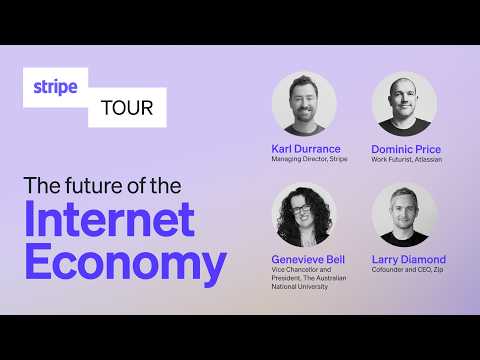
## Background Published on YouTube by Stripe on November 11, 2024, this video features a panel discussion from Stripe Tour Sydney. The session, moderated by Karl Durrance (Stripe's Managing Director for Australia and New Zealand), explores Australia's role in AI, the evolving payments landscape, and the importance of human-first business strategies alongside panelists Dominic Price (Atlassian), Genevieve Bell (ANU), and Larry Diamond (Zip).
## TL;DR The panel discusses the rapid expansion of the digital economy, which is projected to exceed $20 trillion by 2025, and how businesses can capture this growth without losing their human focus. The speakers critique the tendency to adopt technology for its own sake, sharing insights on the evolution of consumer payments, the realities of remote work, and Australia's hidden strengths in AI deployment. Ultimately, they advocate for a balanced approach that combines technological agility with deep human curiosity, responsible practices, and an awareness of the environmental costs of computing.
## Atmosphere & style The discussion is lively, intellectual, and grounded, balancing high-level futuristic concepts with pragmatic, real-world skepticism. The panelists share an easy, humorous chemistry, punctuated by lighthearted banter, self-deprecating jokes, and vivid analogies like 'creepy shoes' and 'fast idiots.' It feels like an engaging, thought-provoking conversation among seasoned experts who are deeply passionate about technology but highly protective of human connection and ethics.
## Key takeaways - [01:00](https://www.youtube.com/watch?v=mwqR_p1pA10&t=60s) The digital economy is growing 2.5 times faster than the rest of the global economy and is projected to exceed $20 trillion by 2025. - [05:08](https://www.youtube.com/watch?v=mwqR_p1pA10&t=308s) Businesses must avoid the 'photocopier economy' trap of automating bad, outdated processes without rethinking the user experience. - [08:08](https://www.youtube.com/watch?v=mwqR_p1pA10&t=488s) Sustaining business agility requires engineering a culture of experimentation, as culture ultimately eats strategy for breakfast. - [12:01](https://www.youtube.com/watch?v=mwqR_p1pA10&t=721s) Consumer payment preferences are shifting rapidly, with a massive generational aversion to traditional credit cards driving the rise of Buy Now, Pay Later (BNPL) utility. - [16:21](https://www.youtube.com/watch?v=mwqR_p1pA10&t=981s) E-commerce cart abandonment is often an act of digital window-shopping and imagination rather than a failed transaction. - [20:04](https://www.youtube.com/watch?v=mwqR_p1pA10&t=1204s) Successful distributed work models require intentional design, such as focusing on time-zone 'Halos' and practicing 'intentional togetherness' to combat isolation. - [24:48](https://www.youtube.com/watch?v=mwqR_p1pA10&t=1488s) Video call fatigue is rooted in biophysics, as slow screen refresh rates and close-up faces trigger constant cognitive strain and adrenal responses. - [29:51](https://www.youtube.com/watch?v=mwqR_p1pA10&t=1791s) Australia possesses world-class AI capabilities, particularly in computer vision, with massive real-world deployments in autonomous mining and banking security. - [33:40](https://www.youtube.com/watch?v=mwqR_p1pA10&t=2020s) Organizations must evaluate AI by asking both 'why' they are using it and 'why not' to ensure responsible, conscious deployment. - [35:28](https://www.youtube.com/watch?v=mwqR_p1pA10&t=2128s) AI workloads carry a massive, often invisible environmental footprint, consuming staggering amounts of energy and water globally. - [39:11](https://www.youtube.com/watch?v=mwqR_p1pA10&t=2351s) The ultimate competitive advantage for businesses is to stop trying to compete with technology and instead focus on amplifying unique human behaviors. - [42:15](https://www.youtube.com/watch?v=mwqR_p1pA10&t=2535s) The next decade of open data and Consumer Data Right (CDR) standards will usher in an 'open everything' world, intensifying market competition and empowering consumers.
## Detailed walkthrough ### [00:01](https://www.youtube.com/watch?v=mwqR_p1pA10&t=1s) The Digital Economy and the Next $50 Trillion
Karl Dar, Stripe's Managing Director for Australia and New Zealand, welcomes the audience to the final panel of the day. He frames the discussion around the massive scale of global GDP, which sits at roughly $100 trillion and continues to march "up and to the right." Dar poses a fundamental question: where will the next $50 trillion of global growth come from? Stripe postures that a significant portion of this growth will be driven by the digital economy.
Currently, the digital economy contributes about 15% to global GDP, but it is growing 2.5 times faster than the rest of the economy. It is projected to exceed $20 trillion by 2025, meaning it will have an outsized contribution to global growth over the next five to ten years. Dar highlights three key areas of opportunity driving this digital expansion:
* **Automation:** Business leaders are shifting focus toward optimization and efficiency by digitizing core processes in both the front end and the back office. * **Changing Consumer Expectations:** The way consumers pay for goods and services is shifting rapidly. Gen Z now represents 24% of the workforce, a large portion of the population no longer carries physical wallets, and cash usage has significantly declined over the last decade. * **International Expansion:** Stripe's recent research reveals that 86% of businesses believe it has never been easier to "go global," and 76% believe it has never been easier to reach a new customer segment.
[03:28](https://www.youtube.com/watch?v=mwqR_p1pA10&t=208s) Introducing the Panelists
To unpack these opportunities and challenges for Australia, Dar introduces three prominent thought leaders to the stage: Dominic Price, Work Futurist at Atlassian; Professor Genevieve Bell, Vice Chancellor and President of the Australian National University (ANU); and Larry Diamond, Co-founder and US Chairman of Zip.
After some lighthearted banter about where to sit on stage, Dar introduces the panelists' backgrounds. Price spends half his time helping Atlassian scale its distributed teams and the other half working with customers to optimize team performance. Bell, the first female Vice Chancellor of ANU, is a cultural anthropologist, former Vice President and Senior Fellow at Intel, and a leading voice on the intersection of cultural practice, technology, and AI. Diamond leads Zip, a digital financial services company connecting millions of customers with a global network of thousands of merchants.
[05:08](https://www.youtube.com/watch?v=mwqR_p1pA10&t=308s) Avoiding Technology for Technology's Sake
Dar kicks off the discussion by asking what Australian businesses can do today to capitalize on the digital opportunity over the next decade. Genevieve Bell jokes that she "drew the short straw" backstage to speak first, but offers a grounded perspective: businesses must focus on the immediate term rather than getting lost in five-to-ten-year predictions. "What should businesses be doing today, tomorrow, and the next day to in fact be in the world, not prepare for it as though it were turning up somewhere else?" she asks.
Bell warns against automating bad processes, recalling the early days of the internet when organizations simply copied physical paper forms and stuck them online without rethinking the user experience. She advises leaders to have a clear understanding of their business model before introducing technology like AI. Additionally, she emphasizes the importance of capability, asking whether senior leadership and board members know how to ask the right questions, and cautions businesses to be mindful of the dependencies and risks introduced by new technology partners.
* **The "Photocopier Economy" Analogy:** Bell points out that society never ran around talking about the "photocopier economy" or the "fax economy." Technology should be an enabler, not a "fetish" that distracts from the core purpose of a business. * **"A Fool with a Tool":** Dominic Price chimes in with a favorite saying: "A fool with a tool is still a fool—you've just made them faster." He jokes about having worked with some "proper fast idiots" who expected technology to solve human problems.
[08:08](https://www.youtube.com/watch?v=mwqR_p1pA10&t=488s) The Tension of the Borderless Business and the Muscle of Agility
Dominic Price warns against over-indexing on the future at the expense of learning from the past, noting that while nostalgia leads to failure, the past holds valuable lessons. He also challenges the hype surrounding "borderless businesses." When entrepreneurs assume their total addressable market is the entire $50 trillion global economy, they overlook the harsh reality of global competition and the intense demand for localization. Businesses face a difficult trade-off: build 150 different localized versions of a product, or build one generic version that "works for everyone and by working for everyone, it works for no one."
Larry Diamond adds that because technology is evolving at an accelerating pace, businesses must codify agility. While rapid experimentation is easy for small startups, it becomes incredibly difficult as companies scale. Diamond notes that the COVID-19 pandemic served as a massive "forcing function" that taught boards and management teams how to be agile, though Price wonders if many companies have since retreated to their 2017 habits rather than pushing forward to 2027. Diamond agrees that sustaining this agility requires engineering a culture of experimentation, because "culture eats strategy for breakfast."
[12:01](https://www.youtube.com/watch?v=mwqR_p1pA10&t=721s) The Evolution of Payments and Consumer Behavior
Dar steers the conversation toward changing consumer behaviors and generational shifts in payments. Diamond thanks Stripe, noting that Zip built its business off the back of Stripe's platform, which enabled their expansion into the US five years ago. He highlights the dramatic rise of Buy Now, Pay Later (BNPL) utility, particularly among Gen Z and Millennial cohorts who have a strong aversion to traditional credit cards.
Diamond shares contrasting data points between the Australian and US credit markets to illustrate this shift. In Australia, interest-bearing credit card debt has collapsed by 45% over the last decade, with 6 million Australians now preferring BNPL over credit cards. Conversely, the US has seen credit card debt surge by 50% since the low point of the pandemic. Despite these regional differences, 60% to 70% of Millennials globally trust BNPL as a primary alternative payment method. Diamond advises retailers to simply meet customers where they are: "If a million customers come through the door and want to pay with their left hand, you need to be able to meet that need and offer left-hand payments."
* **Checkout Abandonment:** Dar points out that in the e-commerce world, 70% of shopping carts are abandoned. One of the primary drivers of this abandonment is the lack of a customer's preferred or trusted payment method at checkout. * **Embedded Finance:** Diamond notes that consumers are no longer walking into physical bank branches to sign up for services. Financial services are becoming decentralized and embedded directly into the consumer journey. * **The Power of the Widget:** Diamond marvels at how a simple payment widget on a product detail page has disrupted online e-commerce, omni-channel retail, and traditional banking.
[16:21](https://www.youtube.com/watch?v=mwqR_p1pA10&t=981s) The Unintended Consequences of Abandoned Carts and Creepy Shoes
The panel explores the psychology behind the "abandoned cart" phenomenon in e-commerce. Dom shares his personal strategy for managing the high cost of raising twins: he deliberately selects items across multiple vendors, adds them to his cart, and then waits for the inevitable discount codes to arrive in his inbox. "I buy from you because I know the end product is the same," he explains. This highlights how consumers adapt to technology in ways businesses might not anticipate, turning a system designed to recover lost sales into a tool for bargain hunting. Genevieve points out that classifying a cart as "abandoned" assumes the transaction is the only goal. In reality, shopping is often an act of imagination and recreation—a "Fantastical" exercise where a customer might put red leather pants in a cart, only to wise up later and decide against it.
The conversation turns to the early, clumsy days of retargeting, before companies refined their strategies. Genevieve recalls a time when abandoned carts would relentlessly follow users across the internet. Consumers found it deeply unsettling, asking, "Why are the shoes following me?" This evolution reflects a broader shift in what shopping actually is: once a pragmatic task of acquiring necessary goods, it has transformed into an experiential activity of self-imagination.
- **The "Creepy Shoes" Era:** Early retargeting efforts were widely perceived by consumers as invasive and unsettling. - **Shopping as Fantasy:** Cart abandonment is often just a form of digital window-shopping and experimentation rather than a failed transaction. - **Dynamic Personalization vs. Human Nature:** While algorithms push toward hyper-personalized "shops" tailored to a user's exact history, Genevieve argues this can be counterintuitive. Humans crave a balance of familiarity and "discomforting" novelty to manufacture new tastes.
---
[20:04](https://www.youtube.com/watch?v=mwqR_p1pA10&t=1204s) Going Global from Australia and the "Work from Anywhere" Experiment
The host steers the conversation back to Dom's earlier point about the dangers of trying to focus on too many markets at once. In Australia, about 30% of Stripe's customer base engages in cross-border commerce because the domestic market is relatively small compared to North America. Dom reflects on Atlassian's 20-year history of selling digital products globally from day one, starting with just two co-founders reaching 160 countries. He warns that while global reach is a massive opportunity, it is dangerous if companies fail to consider the long-term support required for 190 different countries. "They see the first prize, they see the dollars... not the how do I sustain that business," Dom notes.
Dom highlights Atlassian's "work from anywhere" policy as one of their biggest victories. By shifting their talent acquisition pipeline away from expensive hubs like Sydney, San Francisco, Tokyo, and New York, they unlocked a massive global talent pool. However, this model requires a fundamental shift in how a company operates. To make distributed work successful, Atlassian focuses on time-zone "Halos" rather than strict geographic locations, requiring at least a four-hour overlap for teams to prevent purely asynchronous isolation.
- **Cross-Border Necessity:** 30% of Australian Stripe merchants utilize cross-border commerce due to the limited size of the domestic digital trade market. - **The Melbourne Experiment:** Shortly after the pandemic, Atlassian's largest employee hub without a physical office was Melbourne, home to 430 self-sufficient employees. They only opened a physical office there very recently. - **The Friction of Local Regulation:** Dom expresses frustration with local politicians trying to legislate global technologies like AI, arguing that unique local laws act as a "tax" on Australian businesses trying to compete globally.
---
[24:48](https://www.youtube.com/watch?v=mwqR_p1pA10&t=1488s) The Biophysics of Zoom Fatigue and "Intentional Togetherness"
The panel debates the limits of remote work, comparing different corporate cultures and the inherent value of physical proximity. Carl notes that Zip's Australian branch grew up in a traditional, collaborative office environment, whereas its US branch expanded rapidly during COVID as a fully remote, highly documented, asynchronous organization. While both are effective, they require entirely different operational "muscles." Genevieve, speaking from her perspective running a university, emphasizes that physical presence is vital for deep learning and building trust. "You learn from your body, not just your brain," she says, describing the "sickly sweet fairy tale" feeling of campus coming back to life after lockdowns.
Dom and Genevieve discuss how remote environments can "deskilled" people in terms of handling productive conflict. On a screen, it is too easy to shut down an idea or fall into online flame wars. At Intel, Genevieve recalls they practiced "constructive confrontations" to find shared truths, which is much harder to replicate digitally. To combat the slow decay of team connection, Atlassian practices "intentional togetherness," bringing remote teams together in person four times a year. Their team connection and engagement scores spike dramatically after these events and slowly drift down over the following three months, prompting the next gathering.
- **The Biophysics of Screen Fatigue:** Genevieve explains that screen refresh rates are slower than human eye movements, forcing the brain to constantly fill in the gaps. - **The Adrenal Response to Close-ups:** Having multiple faces displayed in close proximity on a screen triggers a high adrenal "fight or flight" or mating response, explaining why video calls are uniquely exhausting. - **The Failed Oculus Experiment:** Dom jokes that he bought eight Oculus headsets for his executive team to meet in virtual reality, but the experiment failed because one executive refused to use it, proving that systems often default to the lowest common denominator.
---
[29:51](https://www.youtube.com/watch?v=mwqR_p1pA10&t=1791s) Is Australia Equipped for the AI Race?
The host transitions the panel to the topic of Artificial Intelligence, asking Genevieve if Australian businesses are truly equipped to capitalize on the technology. Genevieve breaks the challenge down into three core areas. First, she stresses the need for clarity: businesses must distinguish between basic process automation, machine learning, and generative AI, rather than treating "AI" as a generic catch-all.
Second, Genevieve highlights Australia's formidable, often overlooked history in the field. The country boasts world-class academic centers of excellence, particularly in computer vision and machine learning, built over a 15-year investment cycle. Key foundational building blocks of these technologies were developed in Australia, supported by national laboratories like the CSIRO.
- **Defining AI:** Genevieve cautions against vendors who show up claiming to "have some AI for you" without defining whether it is simple automation or true generative technology. - **Australian Centers of Excellence:** Australia has a strong 15-year legacy in computer vision, enabling computational objects to recognize and interact with the physical world.
[31:32](https://www.youtube.com/watch?v=mwqR_p1pA10&t=1892s) Australia's Hidden AI Powerhouses: Mining and Banking
While many people associate artificial intelligence exclusively with massive American, European, or Chinese tech conglomerates, Australia boasts some of the largest and most sophisticated deployments of full-scale AI on the planet. A futurist colleague working in the massive US agricultural machinery sector—representing giants like Caterpillar and John Deere—desperately wants to come to Australia because of what is happening in the Pilbara region of Western Australia. The mining sites there run the largest deployments of fully autonomous vehicles in the world, featuring massive mine trucks "the size of this stage" operating autonomously.
Similarly, despite efforts by fintech disruptors to challenge traditional financial institutions, Australia's major banks remain the country's largest AI companies. They possess the biggest data sets, run the heaviest workloads, and execute highly innovative projects. For example, several years ago, the AI groups at Commonwealth Bank of Australia (CBA) discovered that perpetrators of domestic and gender-based abuse were using banking mobile apps and micro-payments as a vector for harassment. Perpetrators would send tiny payments to their ex-partners containing abusive messages in the transaction description. CBA developed scripts to detect, hold back, and expunge these abusive micro-payments, demonstrating a highly impactful, non-traditional application of AI.
- **Key Australian AI Sectors:** Precision agriculture, mining, banking, the Bureau of Meteorology, and the Australian Bureau of Statistics (ABS). - **Autonomous Mining:** The Pilbara region in Western Australia leads globally in deploying full-scale autonomous mining trucks. - **Fintech & Banking AI:** CBA's AI team successfully blocked gender-based harassment sent via micro-payment transaction descriptions.
---
[33:40](https://www.youtube.com/watch?v=mwqR_p1pA10&t=2020s) The "Why" and "Why Not" of Technology Adoption
When evaluating AI, it is crucial to look past the "utopian window dressing" and ask two fundamental questions: *Why* are we doing this, and *why not*? The "why" forces organizations to identify genuine, beneficial use cases rather than using technology for its own sake. A humorous example of a pointless use case is when someone writes four bullet points, uses AI to expand them into long prose, emails it to a colleague, and the colleague immediately uses AI to summarize that prose back into the original four bullet points. "What's the [fucking] point, right?" Atlassian constantly debates these use cases on physical and virtual whiteboards to ensure technology actually benefits the end user.
The "why not" question is not meant to paralyze progress, but to ensure that organizations deploy technology consciously rather than by accident. Without this counterbalance, companies risk rushing headlong into deployment, only to regret "lighting that blue touch paper" years later. To address this, Atlassian rolled out its own Responsible Tech Guidelines. Thousands of their customers immediately requested access to these guidelines, admitting they had previously been deploying AI simply because "it's tech, we're just doing it anyway."
---
[35:28](https://www.youtube.com/watch?v=mwqR_p1pA10&t=2128s) The Invisible Environmental Cost of AI
An emerging category of risk and consequence that is rarely discussed in the AI space is its massive resource footprint. While the industry spends a lot of time discussing ethical and culturally contingent AI frameworks, the sheer volume of energy and water required to run these models is staggering. Recent annual reports from Microsoft and Google reveal massive year-on-year increases in their resource budgets—such as a 20% to 30% increase in Microsoft's energy budget. As the old computer sticker says, "the cloud is just someone else's computer," and that computer demands immense amounts of electricity and water.
Every time a user in Australia prompts ChatGPT, the query travels through undersea cables all the way to a server farm in Ohio and back. That server farm in Ohio consumes an extraordinary amount of energy, and the best calculations suggest that every 20 prompts consume about half a liter of water. While users might dismiss this as "their water," it is ultimately a shared global resource. As more server farms migrate to Australia during a challenging domestic energy transition, the environmental consequence of technology becomes a pressing concern.
- **Resource Consumption:** Microsoft has seen a 20% to 30% year-on-year increase in its energy budget due to AI workloads. - **Water Footprint:** The estimated water cost of running AI is approximately half a liter of water for every 20 prompts. - **The Sausage Analogy:** Consuming AI is like eating sausages; it is highly convenient and enjoyable until you watch a documentary (like the one by Jamie Oliver) showing exactly how they are made, at which point you might not want to consume them as much.
---
[39:11](https://www.youtube.com/watch?v=mwqR_p1pA10&t=2351s) Three Common Missteps in Business Transformation
Drawing from his experience spending 50% of his time working directly with Atlassian's customers, Dom highlights three common missteps that businesses make when trying to unleash the power of teams:
1. **The Fetish of the Future:** Many leaders over-fixate on painting a magical picture of the future without facing today's reality. True leadership is about making pragmatic, "one-degree improvements" to the business today rather than getting paralyzed by long-term analysis. 2. **Over-reliance on Consultants:** Companies frequently pay external consultants tens of millions of dollars to execute tasks for them. While consultants are fine for advice, they rarely solve the core operational problems. Instead, they charge "$40 million as an annuity" to deliver glorious PowerPoint slides. 3. **Forgetting the Human Element:** Many businesses mistakenly believe that everything is about technology. The most successful, nimble, and adaptable organizations focus on simple human behaviors—how individuals work, how teams collaborate, and how they interact across departments—and then use technology merely to amplify those human dynamics.
Atlassian addresses these challenges by publishing their internal "Team Playbook" online for free, which is accessed by millions of people yearly. The playbook contains no rocket science or complex technology; it is simply a guide on how humans can work better together. The ultimate "secret sauce" for the next 15 to 20 years is to stop trying to compete with technology, embrace our unique humanity, and let technology do what it does best.
---
[42:15](https://www.youtube.com/watch?v=mwqR_p1pA10&t=2535s) Reasons for Optimism: Open Data and the "Open Everything" World
Looking toward the next decade, there is immense potential for Australian businesses and consumers, particularly through the lens of open data. Australia has been a global pioneer in establishing Consumer Data Right (CDR) standards. The next ten years will likely bring an "open everything" world where customers hold their own private data clouds—containing their healthcare, financial, and mobility data—and can selectively consent to share this data with service providers to secure better, highly customized outcomes.
This level of data portability will intensify market competition and force businesses to level up. Companies will have to learn to digest complex data, build smart business logic to interpret it, and offer highly dynamic, tailored products. While businesses will have to work harder, the customer is going to have "a hell of a great time."
---
[43:50](https://www.youtube.com/watch?v=mwqR_p1pA10&t=2630s) Building the Future and Navigating with Curiosity
To quote the early computer scientist Alan Kay, "the only way to think about the future is to build it." Optimism and determination come from having a clear point of view and acting on a moral obligation to make the world fairer, more sustainable, and more equitable for everyone.
Rather than focusing strictly on blind optimism or pessimism, a powerful way to navigate the future is by adopting two simple mantras on sticky notes:
- **"Less Furious, More Curious":** When faced with rapid change or frustrating situations, reacting with curiosity rather than anger opens up a deeper understanding of how things work. - **"Argue like you're right, listen like you're wrong":** This mindset encourages leaders to put forward their opinions with vigor, but then immediately "shut [their] mouth and open [their] ears" to listen with the genuine intent to learn, rather than simply trying to convert others.
[46:35](https://www.youtube.com/watch?v=mwqR_p1pA10&t=2795s) Keeping an Open Mind and Closing Remarks
The panel concludes with a final piece of advice on career development and seizing new opportunities. The speaker emphasizes the importance of "going out there and being open to what those opportunities are and not being too opinionated too early." By remaining flexible and receptive rather than locking onto a rigid path too soon, professionals can discover unexpected avenues for growth.
With these parting words, the moderator wraps up the session, thanking the participants for a "wonderful panel" and inviting the audience to show their appreciation, leading into a warm round of applause as the event draws to a close.
## Notable quotes > [05:08](https://www.youtube.com/watch?v=mwqR_p1pA10&t=308s) What should businesses be doing today, tomorrow, and the next day to in fact be in the world, not prepare for it as though it were turning up somewhere else? — Genevieve Bell
> [05:08](https://www.youtube.com/watch?v=mwqR_p1pA10&t=308s) A fool with a tool is still a fool—you've just made them faster. — Dominic Price
> [12:01](https://www.youtube.com/watch?v=mwqR_p1pA10&t=721s) If a million customers come through the door and want to pay with their left hand, you need to be able to meet that need and offer left-hand payments. — Larry Diamond
> [16:21](https://www.youtube.com/watch?v=mwqR_p1pA10&t=981s) Why are the shoes following me? — Genevieve Bell
> [24:48](https://www.youtube.com/watch?v=mwqR_p1pA10&t=1488s) You learn from your body, not just your brain. — Genevieve Bell
> [33:40](https://www.youtube.com/watch?v=mwqR_p1pA10&t=2020s) What's the [fucking] point, right? — Dominic Price
> [35:28](https://www.youtube.com/watch?v=mwqR_p1pA10&t=2128s) the cloud is just someone else's computer — Genevieve Bell
> [43:50](https://www.youtube.com/watch?v=mwqR_p1pA10&t=2630s) the only way to think about the future is to build it. — Genevieve Bell
> [43:50](https://www.youtube.com/watch?v=mwqR_p1pA10&t=2630s) Less Furious, More Curious — Genevieve Bell
> [43:50](https://www.youtube.com/watch?v=mwqR_p1pA10&t=2630s) Argue like you're right, listen like you're wrong — Dominic Price
## Mentioned Stripe, Atlassian, The Australian National University, Zip, Karl Durrance, Dominic Price, Genevieve Bell, Larry Diamond, Caterpillar, John Deere, CSIRO, Commonwealth Bank of Australia, Microsoft, Google, ChatGPT, Alan Kay
[Source](https://www.youtube.com/watch?v=mwqR_p1pA10)