Cresta CTO Links AI Customer Service Gains to Subtask Automation
Ai4
Full contact center automation remains elusive because information is trapped in human heads and systems, requiring enterprises to combine conversation intelligence, subtask automation, and real-time agent augmentation to boost performance.
## Background
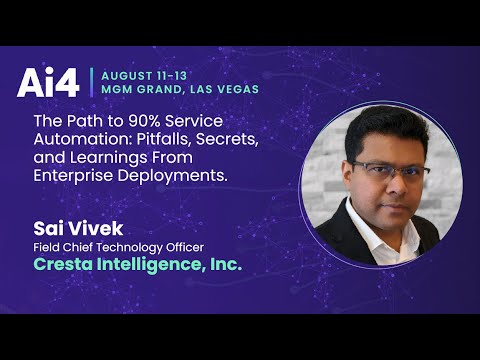
This presentation was published by Ai4 on YouTube on August 29, 2025. It features Sai Vivek, Chief Customer Officer and Field CTO at Cresta, discussing how organizations can navigate service automation, leverage conversational analysis, and combine automation with human augmentation.
## TL;DR
The presentation explores why contact center automation remains uniquely challenging compared to software development due to unstructured data, emotional outcomes, and complex enterprise environments. Vivek introduces Cresta's dual-dimension view of automation—combining fully AI-led resolutions with subtask automation—powered by a three-pillar flywheel of conversation intelligence, human-AI augmentation, and autonomous resolution. Real-world case studies from United Airlines, Holiday Inn Vacations, and Snap Finance illustrate how real-time insights and agent assists drive significant revenue, efficiency, and retention gains. Ultimately, integrating real-time human feedback with AI creates a self-improving system of intelligence that informs broader enterprise strategy, product development, and risk management.
## Atmosphere & style
The presentation carries an authoritative, professional, and forward-looking tone characteristic of an enterprise technology keynote. Vivek speaks with structured clarity and pragmatic insight, balancing optimistic vision with realistic acknowledgment of organizational complexities and edge cases. The dynamic feels educational and strategic, offering attendees a polished, real-world perspective on AI deployment rather than mere hype.
## Key takeaways
- [00:04](https://www.youtube.com/watch?v=sc9SFepPJnM&t=4s) In 2025, customer service remains largely manual due to unstructured tribal knowledge, disjointed systems, non-technical users, and emotional, subjective outcomes.
- [00:04](https://www.youtube.com/watch?v=sc9SFepPJnM&t=4s) Developer environments are easier to automate than customer service because developers use structured code, standardized tools, and binary execution feedback.
- [02:28](https://www.youtube.com/watch?v=sc9SFepPJnM&t=148s) Contact center automation should be measured across two dimensions: fully AI-led end-to-end resolution and subtask automation alongside human agents.
- [04:25](https://www.youtube.com/watch?v=sc9SFepPJnM&t=265s) A successful high-level automation strategy requires a three-pillar flywheel consisting of Conversation Intelligence, Human-AI Collaboration, and AI Automation.
- [04:25](https://www.youtube.com/watch?v=sc9SFepPJnM&t=265s) Human-AI collaboration is not a temporary stepping stone, but the primary training engine that continually improves AI accuracy through agent feedback.
- [06:39](https://www.youtube.com/watch?v=sc9SFepPJnM&t=399s) United Airlines utilized conversation intelligence to detect real-time trending customer issues during an operational incident and deploy agent guidance within hours.
- [06:39](https://www.youtube.com/watch?v=sc9SFepPJnM&t=399s) Holiday Inn Vacations achieved a 30% increase in revenue per conversation and reduced employee attrition by 50% using real-time agent assist and coaching tools.
- [06:39](https://www.youtube.com/watch?v=sc9SFepPJnM&t=399s) Snap Finance achieved a 4x increase in containment, a 40% reduction in Average Handle Time, and 100% real-time QA monitoring through integrated CX automation.
- [13:18](https://www.youtube.com/watch?v=sc9SFepPJnM&t=798s) Connecting real-time insights, AI assistance, and human feedback creates a self-improving system of intelligence that informs broader enterprise strategy like product and policy.
- [15:53](https://www.youtube.com/watch?v=sc9SFepPJnM&t=953s) When deploying in regulated environments, enterprise automation strategies should prioritize edge cases and compliance risks based on business impact rather than call volume.
- [15:53](https://www.youtube.com/watch?v=sc9SFepPJnM&t=953s) Mitigating AI bias and black-box opacity in contact centers requires combining automated QA frameworks with structured human-in-the-loop oversight.
## Detailed walkthrough
Here is a detailed walkthrough of the transcript:
[00:04](https://www.youtube.com/watch?v=sc9SFepPJnM&t=4s) The Complexity of Contact Center Automation vs. Developer Tools
Sai Vivek, Chief Customer Officer and Field CTO at Cresta, opens by posing a central question: why, in 2025—an era where AI is ubiquitous and rapidly advancing—is the customer service or contact center space still not fully automated? Despite the immense opportunity, fully automating customer service remains elusive. In fact, many organizations are currently hiring *more* human agents to support their contact centers rather than replacing them.
To illustrate why customer service is so difficult to automate, Vivek compares it to the developer ecosystem, where AI tools like copilots have seen rapid adoption:
* **Developer Ecosystem:** Developers deal with structured code syntax, standardized tools, and centralized knowledge bases. The audience is highly technical, and the feedback loop is immediate and definitive: code either runs or it fails.
* **Customer Service Environment:** Information is largely "tribal" and trapped inside individual agents' heads, spread across disparate CRM databases, legacy tools, and disconnected systems.
* **Experiential & Emotional Outcomes:** Unlike binary code execution, contact center outcomes are subjective. Success is defined by whether a customer felt heard, supported, and satisfied.
* **Non-Technical Users:** Contact center staff are business users who operate within rigid organizational ecosystems involving IT, legal departments, policy constraints, and formal change management processes.
[02:28](https://www.youtube.com/watch?v=sc9SFepPJnM&t=148s) Redefining Automation: The Two Dimensions of Automation Rate
Vivek clarifies that automation in the contact center context should not be measured purely by the percentage of total conversations that are fully contained or deflected by a bot. Instead, Cresta views automation through a dual lens:
1. **Fully AI-Led Automation:** Complete end-to-end resolution of a conversation by AI.
2. **Subtask Automation:** For complex interactions that still require human intervention, breaking the workflow down into smaller subtasks and automating those individual components alongside the agent.
While the current landscape remains heavily skewed toward manual agent handling, the goal is to shift the balance toward an AI-led model that combines both fully autonomous resolutions and AI-automated subtasks for human-assisted calls.
[04:25](https://www.youtube.com/watch?v=sc9SFepPJnM&t=265s) The Three-Pillar Intelligence Flywheel
Achieving high-level automation is not about deploying a standalone bot or a single digital user interface; it requires building a continuous feedback loop—a flywheel—supported by three core pillars working together:
1. **Conversation Intelligence (Understanding):** Contact centers handle thousands of unscripted, direct interactions every day. Without intelligence tools, these rich signals get flattened into generic metrics like Average Handle Time (AHT). Advanced conversation intelligence uncovers the "why behind the why"—explaining customer callbacks, agent performance disparities, and friction points to turn conversation data into a strategic decision-making asset.
2. **Human-AI Collaboration (Augmentation):** Human augmentation is not a temporary stepping stone to full automation; it is the engine that trains and refines the AI. When agents accept or reject AI suggestions, they provide real-time training signals that improve model accuracy over time.
3. **AI Automation (Autonomous Resolution):** Combining real-time voice AI, back-office automation, and guardrailed human handoffs creates a safer, smarter system capable of handling complex transactions like troubleshooting or billing inquiries.
[06:39](https://www.youtube.com/watch?v=sc9SFepPJnM&t=399s) Enterprise Deployments: United Airlines, Holiday Inn Vacations, and Snap Finance
Vivek highlights several real-world enterprise deployments that demonstrate the power of combining intelligence, augmentation, and automation:
* **United Airlines:** Implemented conversation intelligence across their entire leadership stack to detect real-time trends and anomalies. During an emergency flight incident in the Washington, D.C. area, leadership used the platform to instantly understand why customers were calling and deployed field guidance to agents within hours—a process that previously took weeks.
* **Holiday Inn Vacations:** Deployed Cresta’s real-time agent assist and AI coaching tools. Providing agents with live hints and knowledge prompts resulted in a **30% increase in revenue** per conversation, along with a **50% reduction in employee attrition**, as agents felt better supported in their roles.
* **Snap Finance:** Deployed an integrated CX automation platform to handle complex workflows and billing inquiries. As a result, Snap Finance achieved a **4x increase in containment**, a **40% reduction in Average Handle Time (AHT)**, and **100% real-time call analysis and QA monitoring**.
[13:18](https://www.youtube.com/watch?v=sc9SFepPJnM&t=798s) Building a System of Intelligence Across the Enterprise
When real-time signals, AI assistance, and human feedback loops operate together, an enterprise builds a self-improving "system of intelligence." Rather than plateauing after initial efficiency gains, this compound learning loop shares customer insights beyond the contact center:
- **Product Development:** Informs engineering and design teams about recurring product issues or feature requests.
- **Operations & Policy:** Identifies policy bottlenecks, compliance risks, and operational gaps.
- **Automation Strategy:** Pinpoints high-value workflows for future autonomous design.
[15:53](https://www.youtube.com/watch?v=sc9SFepPJnM&t=953s) Q&A: Handling Edge Cases, System Failures, and AI Bias
During the audience Q&A session, Vivek addresses technical and operational concerns regarding edge cases and AI transparency:
* **Handling Edge Cases & Regulated Scenarios:** When asked about system failures or un-trained scenarios (especially in regulated industries like healthcare), Vivek emphasizes prioritization based on business impact over sheer volume. In one customer deployment involving outbound compliance risks, Cresta re-sequenced the rollout path to address sensitive edge cases upfront rather than focusing purely on quick containment wins.
* **Mitigating AI Bias & The "Black Box" Problem:** Addressing concerns about algorithmic bias and lack of transparency in customer interactions, Vivek highlights the importance of robust Quality Assurance (QA) frameworks. While standard automated QA tools can miss context, incorporating a structured **human-in-the-loop** mechanism ensures continuous validation, early bias detection, and oversight of automated interactions.
## Notable quotes
> [00:04](https://www.youtube.com/watch?v=sc9SFepPJnM&t=4s) why, in 2025—an era where AI is ubiquitous and rapidly advancing—is the customer service or contact center space still not fully automated? — Sai Vivek
> [00:04](https://www.youtube.com/watch?v=sc9SFepPJnM&t=4s) Developer Ecosystem: Developers deal with structured code syntax, standardized tools, and centralized knowledge bases. — Sai Vivek
> [00:04](https://www.youtube.com/watch?v=sc9SFepPJnM&t=4s) Customer Service Environment: Information is largely "tribal" and trapped inside individual agents' heads, spread across disparate CRM databases, legacy tools, and disconnected systems. — Sai Vivek
> [00:04](https://www.youtube.com/watch?v=sc9SFepPJnM&t=4s) Experiential & Emotional Outcomes: Unlike binary code execution, contact center outcomes are subjective. Success is defined by whether a customer felt heard, supported, and satisfied. — Sai Vivek
> [04:25](https://www.youtube.com/watch?v=sc9SFepPJnM&t=265s) Human-AI Collaboration (Augmentation): Human augmentation is not a temporary stepping stone to full automation; it is the engine that trains and refines the AI. — Sai Vivek
> [04:25](https://www.youtube.com/watch?v=sc9SFepPJnM&t=265s) When agents accept or reject AI suggestions, they provide real-time training signals that improve model accuracy over time. — Sai Vivek
> [06:39](https://www.youtube.com/watch?v=sc9SFepPJnM&t=399s) 30% increase in revenue — Sai Vivek
> [06:39](https://www.youtube.com/watch?v=sc9SFepPJnM&t=399s) 50% reduction in employee attrition — Sai Vivek
> [06:39](https://www.youtube.com/watch?v=sc9SFepPJnM&t=399s) 4x increase in containment — Sai Vivek
> [06:39](https://www.youtube.com/watch?v=sc9SFepPJnM&t=399s) 40% reduction in Average Handle Time (AHT) — Sai Vivek
> [06:39](https://www.youtube.com/watch?v=sc9SFepPJnM&t=399s) 100% real-time call analysis and QA monitoring — Sai Vivek
> [15:53](https://www.youtube.com/watch?v=sc9SFepPJnM&t=953s) incorporating a structured human-in-the-loop mechanism ensures continuous validation, early bias detection, and oversight of automated interactions. — Sai Vivek
## Mentioned
Sai Vivek, Cresta Intelligence, Inc, Cresta, United Airlines, Holiday Inn Vacations, Snap Finance, Washington, D.C., Ai4
## Video description
Sai Vivek, Field Chief Technology Officer, Cresta Intelligence, Inc
Abstracts
With the rapid advance of voice AI and conversational agents, levels of service automation that once seemed unreachable, have now become inevitable. But as organizations race to unlock the incredible operational and CX benefits, they'll need to plot the right path to avoid emergent risks and high profile mistakes.
Join Cresta's Chief Customer Officer, Sai Vivek, to explore: a firsthand look into the near future of customer experiences, how conversational analysis can provide the blueprint for better AI Agents, and why automation and augmentation should be deployed hand-in-hand to effectively manage a hybrid workforce along the way.
Cresta CTO 将 AI 客服增效归因于子任务自动化
由于信息滞留于人工经验与分散的系统中,联络中心实现全面自动化仍面临阻碍,需要企业融合对话智能、子任务自动化与实时座席增强来提升整体效能。
本场演讲探讨了由于非结构化数据、情绪化诉求以及复杂的企业环境,联络中心自动化相比软件开发为何仍具有独特的挑战性。Vivek 介绍了 Cresta 的自动化双维度视角——将完全由 AI 主导的问题解决与子任务自动化相结合,由对话智能、人机协同增强和自主解决构成的三支柱飞轮驱动。来自 United Airlines、Holiday Inn Vacations 和 Snap Finance 的实际案例展示了实时洞察与座席辅助如何显著带动收入、效率与客户留存的提升。最终,将实时人工反馈与 AI 深度融合,可构建起一个能够持续自我改进的智能系统,为更广泛的企业战略、产品开发和风险管理提供有效指引。
与具备确定性反馈与标准化环境的开发者工具不同,客户服务受限于分散的隐性知识、遗留系统及主观的情绪体验,导致其在2025年仍主要依赖人工操作。 (0:04)
联络中心的自动化率应从双重维度衡量,既包括由AI完全主导的端到端自主闭环,也包括在人工座席流程中拆解并实现的子任务自动化。 (2:28)
实现高水平服务自动化需构建由“对话智能、人机协同、AI自动化”构成的三支柱飞轮,其中人机协同并非过渡方案,而是持续训练并优化AI精度的核心反馈引擎。 (4:25)
真实企业落地成效显著:假日酒店度假村借助实时AI辅助实现单次对话收入提升30%,Snap Finance则实现了拦截率提升4倍并使平均处理时长(AHT)缩短40%。 (6:39)
Reading summary
Sai Vivek, Chief Customer Officer and Field CTO at Cresta, argues that achieving enterprise-grade contact center automation requires abandoning standalone deflection bots in favor of an intelligence flywheel that combines autonomous resolution, agent subtask assistance, and continuous human feedback.
Barriers Distinguishing Contact Centers From Developer Tools (0:04)
Vivek observes that despite rapid artificial intelligence advancements in 2025, contact centers remain largely manual, with many organizations actively expanding agent headcount rather than replacing staff. He contrasts this sector with the rapid adoption of developer copilots, which benefit from structured syntax, centralized codebases, technical end users, and definitive binary feedback loops where code either runs or fails.
In contrast, contact centers rely heavily on tribal knowledge trapped inside agents' heads and fragmented across disconnected legacy systems and CRMs. Interactions depend on subjective, emotional outcomes—specifically whether a customer feels heard and supported—while non-technical business users must navigate rigid IT, legal, compliance, and change management constraints.
The Dual-Dimension Model and Intelligence Flywheel (2:28)
Vivek argues that automation rates should not be evaluated solely by deflection or containment metrics. Cresta defines automation across two simultaneous vectors: fully AI-led end-to-end resolution for direct interactions, and subtask automation that assists human agents with complex operational components.
Driving this transition requires a three-pillar intelligence flywheel. First, conversation intelligence analyzes unscripted interactions to identify root causes and performance gaps beyond standard Average Handle Time (AHT). Second, human-AI collaboration treats agent acceptances or rejections of live AI suggestions as continuous training data. Third, AI automation integrates real-time voice models with back-office execution and guardrailed handoffs to handle complex billing and troubleshooting workflows autonomously.
Enterprise Evidence Across Real-Time Operations (6:39)
Vivek presents three enterprise deployments to illustrate operational gains from combining intelligence, agent assist, and automation. During an emergency flight incident near Washington, D.C., United Airlines used conversation intelligence across its leadership stack to identify incoming call drivers instantly, deploying guidance to frontline agents within hours rather than weeks.
In customer-facing performance, Holiday Inn Vacations deployed real-time agent hints and coaching prompts, which Vivek states produced a 30% increase in revenue per conversation and a 50% decrease in agent attrition. Meanwhile, financial services provider Snap Finance achieved a 4x increase in containment, a 40% reduction in AHT, and 100% real-time quality assurance monitoring across workflows.
Cross-Functional Intelligence and Edge-Case Governance (13:18)
When feedback loops run continuously, Vivek asserts that contact center data functions as a company-wide system of intelligence. These signals move upstream to inform engineering teams about recurring product friction, advise operations on compliance risks and policy bottlenecks, and identify viable candidate workflows for future automated design.
To address edge cases and algorithmic bias in highly regulated environments, Vivek cautions against prioritizing simple volume over operational risk. In one deployment involving outbound compliance risks, Cresta re-sequenced implementation to tackle sensitive edge cases first. Furthermore, he emphasizes that automated quality assurance tools must be paired with structured human-in-the-loop verification to prevent context loss and mitigate black-box risks.
Vivek concludes that scaling automation safely depends on moving past isolated deflection tools toward compounding intelligence systems, while noting that regulated environments still demand disciplined human-in-the-loop oversight to manage edge-case failures and transparency concerns.
精炼阅读摘要
Cresta首席客户官兼Field CTO Sai Vivek指出,客服中心无法简单照搬软件开发领域的AI自动化路径;要实现高比例自动化,企业必须建立结合对话智能、人机协同和自主执行的持续反馈飞轮,而非单纯追求单点机器人的对话拦截率。
客服自动化落后于代码助手的根源 (0:04)
Sai Vivek在2025年的背景下提出,尽管AI技术快速演进,许多企业却在为客服中心增聘人工座席而非全面替代。造成这一现象的核心原因在于客服场景与开发者生态存在本质差异。在开发者生态中,代码语法高度结构化,知识库集中,且反馈闭环是非黑即白的二元结果(代码能够运行或直接报错),使用者也均为技术人员。相比之下,客服中心的数据严重依赖非结构化的隐性经验,碎片化地散布在各类传统CRM工具与孤立系统中;同时,客服的成功标准取决于客户是否感到被倾听与满足等主观情感,且业务人员还要受制于法务合规、IT构架及组织变革流程。
双维度重构自动化率考核标准 (2:28)
Vivek认为行业需要重新定义自动化指标,不能仅统计由AI独立拦截或承接的对话百分比。Cresta主张将自动化拆分为两个并行维度:其一是完全由AI主导的端到端全流程自动解决;其二是子任务自动化,即在必须由人工介入的复杂交互中,将完整工作流切分为若干细分步骤,由AI协助座席自动完成特定环节。当下的行业现状仍高度依赖人工处理,企业的目标应是通过整合完全自主闭环与人机协作下的子任务自动化,逐步向AI主导的运营模式演进。
三支柱飞轮驱动系统智能化演进 (4:25)
实现深度自动化的关键并非部署孤立的机器人界面,而是构建一个包含三大支柱的持续学习飞轮。第一支柱是对话智能,旨在穿透平均通话时长(AHT)等粗略指标,从每日成千上万通非脚本化对话中挖掘客户反复致电与座席表现差异的深层原因。第二支柱是人机协同,Vivek强调人工辅助并非通往自动化的临时过渡方案,而是模型迭代的核心训练机制,座席对AI建议的采纳或拒绝直接构成了实时训练信号。第三支柱则是AI自主解决,通过结合实时语音AI、后台自动化以及受控的人工转接,安全承接故障排查和账单查询等复杂事务。
企业落地的量化成效与合规应对 (6:39)
多家企业的落地案例验证了该体系的效果。United Airlines在管理层引入对话智能后,在华盛顿特区发生突发飞行事件时,数小时内便完成了对进线原因的分析并向下派发座席应对指南,而以往该流程需耗时数周。Holiday Inn Vacations部署实时座席辅助与AI教练工具后,单次对话营收提升了30%,员工离职率下降了50%。Snap Finance利用集成的客户体验自动化平台处理复杂工单和账单问题,实现了4倍的拦截率提升、40%的平均通话时长降幅,并达成100%的实时通话分析与质检监控。针对监管行业的边缘案例与模型黑盒问题,Vivek指出应优先按业务影响而非通话量来排定实施路径,并通过引入人机协同质检机制,防止算法偏差并确保透明度。
Vivek总结指出,当实时信号、AI辅助与人工反馈深度融合时,企业将建立起可自我迭代的智能系统;这种沉淀于客服中心的数据资产不仅能优化服务自动化本身,更能反哺产品研发与组织政策制定,但企业仍需在复杂合规场景中依赖严格的人工质检与高影响度边缘案例管理。
Detailed notes — zh
## Background
本视频由 Ai4 频道于 2025 年 8 月 29 日发布于 YouTube 平台,演讲者为 Cresta Intelligence 的 Field CTO Sai Vivek。视频简介指出,内容主要探讨在语音 AI 发展的当下,企业如何绘制正确的路径以避开风险,并通过对话分析与人机协同(Augmentation)构建更完善的 AI Agent 与混合劳动力体系。
## TL;DR
演讲深入剖析了联络中心(Contact Center)在实现全面自动化过程中面临的独特阻碍,并重新定义了 90% 自动化的内涵——它不仅包含完全由 AI 处理的对话,也涵盖复杂任务中子任务的自动化。Speaker 提出了由“对话智能(Intelligence)、人工增强(Augmentation)和完全自动化(Automation)”构成的三大支柱与动态飞轮系统,并通过美联航、Holiday Inn Vacations 和 Snap Finance 等实际案例展示了人机协同带来的显著业务提升。最后,针对现场问答,演讲者解答了如何利用业务价值优先级应对极端边缘案例(Edge Cases)以及通过人机环路(Human-in-the-loop)机制规避 AI 偏见。
## Atmosphere & style
整场演讲呈现出极其专业、务实且充满洞察力的行业分享氛围。演讲者以沉稳自信且逻辑严密的叙述风格,将复杂的企业级技术部署拆解为清晰的战略框架,既有高屋建瓴的理论阐述,又辅以丰富的前线真实案例。在结尾的 Q&A 环节中,面对关于 AI 偏见与黑盒效应等犀利提问,交流过程表现得坦诚而富有建设性,充分体现出对技术落地现实难题的深刻理解与沉着应对。
## Key takeaways
- [00:04](https://www.youtube.com/watch?v=sc9SFepPJnM&t=4s) 客服领域全面自动化面临独特障碍,尽管 AI 普及迅速,信息碎片化与隐形知识使得企业仍需雇用大量真人客服。
- [00:04](https://www.youtube.com/watch?v=sc9SFepPJnM&t=4s) 开发者生态(如 Copilot)易于自动化,而客服领域依赖跨系统数据、非标准决策与体验导向的评估,难以被简单替代。
- [00:28](https://www.youtube.com/watch?v=sc9SFepPJnM&t=28s) 重新定义 90% 自动化:除端到端 AI 对话外,还应涵盖复杂场景中由 AI 完成的各个“子任务”。
- [00:28](https://www.youtube.com/watch?v=sc9SFepPJnM&t=28s) 实现高效自动化的关键在于构建由“对话智能、人工增强与 AI 自动化”构成的动态飞轮系统。
- [08:30](https://www.youtube.com/watch?v=sc9SFepPJnM&t=510s) 对话智能是自动化的第一支柱,旨在将原始对话信号转化为决策资产,识别业务中的深层摩擦点。
- [08:30](https://www.youtube.com/watch?v=sc9SFepPJnM&t=510s) 美联航(United Airlines)部署对话智能,在突发事件发生数分钟内分析出客户核心关注点,并在几小时内下发一线指引。
- [13:28](https://www.youtube.com/watch?v=sc9SFepPJnM&t=808s) 人工增强并非过渡阶段,而是驱动 AI 模型迭代的关键引擎;客服的实时选择能反向训练 AI,形成双向飞轮。
- [13:28](https://www.youtube.com/watch?v=sc9SFepPJnM&t=808s) Holiday Inn Vacations 部署 Cresta 实时辅助与教练系统,促使销售收入提升 30%,同时员工离职率下降 50%。
- [13:28](https://www.youtube.com/watch?v=sc9SFepPJnM&t=808s) Snap Finance 部署现代 CX 系统后,对话拦截率提升至 4 倍,平均处理时间(AHT)降低 40%,实现 100% 质检覆盖。
- [21:58](https://www.youtube.com/watch?v=sc9SFepPJnM&t=1318s) 三支柱有机结合形成自我进化的企业级智能系统(System of Intelligence),通过“监听-执行-学习-优化”闭环持续演进。
- [21:58](https://www.youtube.com/watch?v=sc9SFepPJnM&t=1318s) 客服捕获的实时信号可跨部门无缝分发,为产品改进、运营优化和政策制定提供数据支撑。
- [15:53](https://www.youtube.com/watch?v=sc9SFepPJnM&t=953s) 针对医疗等高监管行业的极端边缘案例,应基于业务价值与合规风险(而非仅按发生频率)进行优先级排序。
- [15:53](https://www.youtube.com/watch?v=sc9SFepPJnM&t=953s) 防范 AI 偏见与黑盒效应不能仅靠纯 AI QA,必须结合“人机环路(Human-in-the-loop)”建立混合质检体系。
## Detailed walkthrough
### [00:04](https://www.youtube.com/watch?v=sc9SFepPJnM&t=4s) 为什么客服中心全面自动化依然困难重重?
在 2025 年,人工智能技术已经无处不在,自动化领域不断迎来突破,但联络中心(Contact Center)或客服领域的全面自动化却依然难以实现。令人惊讶的是,行业中反而出现了相反的趋势——许多企业正在雇用更多的真人客服来支撑联络中心的运营。造成这种现象的根源在于客服领域的特殊复杂性,它与自动化进展顺利的软件开发领域形成了鲜明对比。
在开发者生态中,像 GitHub Copilot 这样的 AI 工具已经成为程序员日常工作的一部分。这是因为代码具有高度的结构性,知识明确储存在代码库中,工具也是标准化的;更重要的是,其评估标准非常直接——代码要么能运行,要么不能运行。然而客服领域截然不同:大部分知识仍然是“部落式”的(存在于老员工的脑海中),信息分散在 CRM、各种内部系统和不同工具中;其结果判定也不明确,带有强烈的感性与体验色彩(如“客户是否感到被尊重或被妥善服务”);此外,客服人员通常是业务人员而非技术人员,极度依赖 IT、法务合规及变更管理(Change Management)团队的配合。因此,客服自动化的核心障碍并非单纯的技术问题,而是整个业务环境的复杂性。
```
开发者生态 (易自动化) 客服联络中心 (难自动化)
┌───────────────────────┐ ┌───────────────────────┐
│ • 高度结构化代码 │ │ • 隐形知识 (存在于脑海)│
│ • 标准化开发工具 │ VS │ • 跨 CRM/系统信息分散 │
│ • 结果明确 (能运行与否)│ │ • 体验/情绪导向评估 │
└───────────────────────┘ └───────────────────────┘
```
- **行业现状**:尽管 AI 快速普及,大部分企业仍需增加人工客服以应对复杂的业务需求。
- **客服领域的固有障碍**:信息碎片化、决策非标准化、极度依赖非技术层面的业务流程与合规要求。
---
### [00:28](https://www.youtube.com/watch?v=sc9SFepPJnM&t=28s) 重新定义 90% 自动化:全流程 AI 与子任务自动化的结合
探讨“自动化”时,行业内通常将其定义为“完全由 AI 处理的对话比例”或“成功拦截/遏制的对话比例”(Containment Rate)。然而,Cresta 的 Field CTO Sai Vivek 指出了一种更现实且全面的视角:自动化不仅包含 100% 由 AI 独立完成的对话,也包含在复杂交易中将任务拆解后、由 AI 完成的各个“子任务”(Subtasks)。
如果将客户对话看作一个光谱,左端是全人工操作,右端是全 AI 自动化,目前绝大部分企业的对话交互依然集中在左侧的模式。未来的目标是将整个体系向右推进,实现 90% 的自动化——这 90% 既可以是 90% 的对话完全由 AI 解决,也可以是复杂对话中 90% 的子任务由 AI 辅助完成。实现这一目标靠的不是简单做一个炫酷的 Bot,而是构建一个包含“对话智能(Intelligence)、人工增强(Augmentation)和完全自动化(Automation)”的动态飞轮系统。
```
┌─────────────────────────────────────────┐
│ 对话智能 (Intelligence) │
│ 理解对话深层信号与摩擦点 │
└────────────────────┬────────────────────┘
│
▼
┌─────────────────────────────────────────────────────────┐
│ 人工增强 (Human Augmentation) │
│ AI 实时辅助客服 ──► 客服反馈训练 AI (双向飞轮) │
└────────────────────┬────────────────────────────────────┘
│
▼
┌─────────────────────────────────────────┐
│ AI 自动化 (Automation) │
│ 安全处理复杂流程与后勤任务 │
└─────────────────────────────────────────┘
```
- **自动化的双重维度**:
- **端到端自动化**:简单的求助直接由 AI 机器人闭环解决。
- **子任务自动化**:在必须由人工接入的复杂场景中,将查询、记录、摘要等子步骤交由 AI 处理。
- **核心理念**:将三者有机结合形成飞轮,而非孤立地部署单一 AI 模块。
---
### [00:510] 第一支柱:对话智能(Intelligence)与美联航案例
联络中心每天接收成千上万的电话,这些对话是企业获得的最真实、未经篡改的业务信号。然而,很多企业没有合适的工具来监听这些信号,反而将其压缩简化为平均处理时长(AHT)等冰冷的 KPI。对话智能的目的在于洞察现象背后的“为什么”——为什么客户反复打来电话?为什么某个话术对特定客服有效而对其他人无效?从而将原始对话转化为企业的决策资产。
以美联航(United Airlines)为例,他们不仅将对话智能用于常规的质检(QA),更将其部署在整个管理层架构中,用于实时检测趋势与异常。在华盛顿特区发生一起不幸的航空事故后,呼叫中心涌入大量咨询,美联航利用 Cresta 平台在几分钟内分析出客户致电的核心原因,并在几小时内(而非数周)向一线人员分发了应对方案,实现了快速响应。
- **美联航(United Airlines)实践**:
- **实时响应**:在突发事件发生后,数分钟内分析出客户关注焦点并下发一线指引。
- **驱动设计**:利用对话智能识别业务摩擦点,以此作为设计 AI 自动化流程的蓝图。
- "You can only automate what you understand."(你只能自动化你所理解的事情。)
---
### [00:808] 第二与第三支柱:人机协同(Augmentation)与完全自动化(Automation)
行业中存在一个误区,认为“人工增强”(实时辅助客服)只是迈向“全自动化”的一个过渡阶段。实际上,人工增强是驱动 AI 的引擎——它是训练 AI、保持输出一致性以及建立信任的关键。这是一种双向奔赴的机制:AI 在对话中向客服提供实时知识提示,而客服在选择采纳或拒绝推荐时,也在反向训练 AI 模型,形成递增的复合效应。
在实际应用中,**Holiday Inn Vacations** 部署了 Cresta 的实时客服辅助与教练系统。AI 能像顶级优秀客服一样在对话中实时导航与提示。这不仅大幅提升了业务绩效——产生高出 30% 的销售收入,还显著改善了员工体验,使客服离职率下降了 50%。当把对话智能、人工增强与自动化三者结合时,企业就能安全地处理复杂的账单查询、故障排查等以往极难自动化的交易。
- **Holiday Inn Vacations 落地成效**:
- **收入提升**:通过 AI 实时指导,对话产生的收入提高 30%。
- **员工留存**:客服人员获得有效支撑,离职率(Attrition)降低 50%。
- **Snap Finance 现代 CX 系统部署成果**:
- **拦截率(Containment)**:提升至原来的 4 倍。
- **平均处理时间(AHT)**:降低 40%。
- **质检覆盖率**:实现 100% 全量呼叫的监控与分析。
---
### [00:1318] 企业级智能系统:跨业务部门的闭环赋能
当对话智能、人工增强和自动化这三个模块有机交织在一起时,企业获得的是一套能够自我学习的“智能系统”(System of Intelligence)。它通过实时监听信号、依靠 AI 与人工执行动作、学习成功与失败经验、进而优化流程与话术,实现持续的自我进化,避免业务提升进入瓶颈期。
这套 90% 自动化的系统其价值远远超出了客服部门本身。联络中心捕获的关于市场、客户和员工的实时信号,可以无缝分发至整个企业:为产品部门提供功能改进建议、为政策制定者提供合规反馈、为运营部门揭示流程缺陷,最终反哺自动化的迭代。
- **闭环运行机制**:监听信号(Listen) ➔ 执行动作(Act) ➔ 学习总结(Learn) ➔ 优化流程(Optimize)。
- **跨部门赋能**:将客服数据转化为推动产品(Product)、运营(Operations)和政策(Policy)升级的决策源泉。
---
### [015:53] 现场 Q&A:边缘案例与 AI 偏见的处理策略
在演讲结束后的问答环节中,现场听众就如何应对系统故障、极端边缘案例(Edge Cases)以及 AI 偏见和“黑盒效应”等棘手问题提出了质问。
针对**极端边缘案例(如医疗等高监管行业)**,Sai Vivek 建议采用基于业务价值的优先级排序策略(Reprioritization)。很多时候,某些边缘案例虽然发生频率低,但对下游业务或合规的影响极大。企业不能仅按调用量或直接收入来排序,而应赋予这些高风险边缘案例更高的权重,提前调整模型构建或重排实施路径(例如某客户因合规问题而优先调整外呼系统路径)。
针对**AI 偏见与黑盒透明度问题**,Sai Vivek 强调不能单纯依赖标准化的 AI 质检(AI QA),因为纯 AI 验证在某些复杂情况下容易失效。必须建立引入“人机环路”(Human-in-the-loop)的强有力 QA 机制,将人工审核与流程监控深度融入,以便尽早捕捉偏见并调整模型输出。
- **问答要点**:
- **边缘案例处理**:打破“仅按发生量排序”的惯例,将高风险/高业务影响的边缘场景优先纳入模型训练与流程设计。
- **偏见与黑盒控制**:纯 AI QA 存在局限,需结合“人机环路(Human-in-the-loop)”机制建立混合质检体系。
## Notable quotes
> [08:30](https://www.youtube.com/watch?v=sc9SFepPJnM&t=510s) You can only automate what you understand. — Sai Vivek
## Mentioned
Sai Vivek, Cresta Intelligence, Inc, Ai4, GitHub Copilot, United Airlines, Holiday Inn Vacations, Snap Finance
## Video description
Sai Vivek, Field Chief Technology Officer, Cresta Intelligence, Inc
Abstracts
With the rapid advance of voice AI and conversational agents, levels of service automation that once seemed unreachable, have now become inevitable. But as organizations race to unlock the incredible operational and CX benefits, they'll need to plot the right path to avoid emergent risks and high profile mistakes.
Join Cresta's Chief Customer Officer, Sai Vivek, to explore: a firsthand look into the near future of customer experiences, how conversational analysis can provide the blueprint for better AI Agents, and why automation and augmentation should be deployed hand-in-hand to effectively manage a hybrid workforce along the way.
[Source](https://www.youtube.com/watch?v=sc9SFepPJnM)
Source quotes
[8:30] Sai Vivek: You can only automate what you understand.
Source quotes
[0:04] Sai Vivek: why, in 2025—an era where AI is ubiquitous and rapidly advancing—is the customer service or contact center space still not fully automated?
[0:04] Sai Vivek: Developer Ecosystem: Developers deal with structured code syntax, standardized tools, and centralized knowledge bases.
[0:04] Sai Vivek: Customer Service Environment: Information is largely "tribal" and trapped inside individual agents' heads, spread across disparate CRM databases, legacy tools, and disconnected systems.
[0:04] Sai Vivek: Experiential & Emotional Outcomes: Unlike binary code execution, contact center outcomes are subjective. Success is defined by whether a customer felt heard, supported, and satisfied.
[4:25] Sai Vivek: Human-AI Collaboration (Augmentation): Human augmentation is not a temporary stepping stone to full automation; it is the engine that trains and refines the AI.
[4:25] Sai Vivek: When agents accept or reject AI suggestions, they provide real-time training signals that improve model accuracy over time.
[6:39] Sai Vivek: 30% increase in revenue
[6:39] Sai Vivek: 50% reduction in employee attrition
[6:39] Sai Vivek: 4x increase in containment
[6:39] Sai Vivek: 40% reduction in Average Handle Time (AHT)
[6:39] Sai Vivek: 100% real-time call analysis and QA monitoring
[15:53] Sai Vivek: incorporating a structured human-in-the-loop mechanism ensures continuous validation, early bias detection, and oversight of automated interactions.
Original transcript
[0:04] I'm S. Vec. I'm the chief customer
[0:06] officer and field CTO at Cresa.
[0:09] Let's dive right in.
[0:11] This is a big question, right? Why isn't
[0:14] the customer service or contact center
[0:16] fully automated yet?
[0:18] It is a fair question. It's it's 2025.
[0:21] AI is everywhere and there have been
[0:23] breakthrough after breakthrough in
[0:25] automation. However, this space uh
[0:28] continues to be pretty elusive.
[0:30] It's not that there is no need or or an
[0:33] opportunity, right? This space is
[0:35] fundamentally complex. We are actually
[0:38] seeing the opposite trend. Many
[0:40] customers are hiring more humans to help
[0:42] them in their contact centers.
[0:44] Why is that? Now, before we answer that,
[0:47] let's look at a domain where automation
[0:50] does work well. If you take the
[0:53] developer ecosystem,
[0:55] AI has made a lot of headway there.
[0:59] Right now, you know, tools like copilots
[1:03] are part of developers daily workflow.
[1:06] Why is that? They deal with code syntax.
[1:11] It's very structured and the knowledge
[1:12] is available in code bases
[1:16] and they use standard tools. And we are
[1:19] talking about a a very technical
[1:23] audience or team that can take a a tool
[1:26] and if it works, it works. They run with
[1:28] that, right? And and the outcomes are
[1:29] pretty straightforward. Either the code
[1:31] works or it does not work. The customer
[1:34] service world is is much more complex.
[1:37] Knowledge and information is still
[1:38] tribal, right? It's still in the heads
[1:40] of many of the agents. Information is
[1:43] stored across multiple systems, CRM
[1:45] systems, tools.
[1:48] The outcomes are also not very
[1:51] clear or cut and dry, right? It's it's
[1:52] it's very emotional. Did we really help
[1:55] the customer? It's experiential. Did the
[1:58] customer feel served?
[2:00] And lastly, the users in the contact
[2:03] center, they are not technologist. They
[2:05] are business users. They rely a lot on
[2:08] their ecosystem. They rely on it. They
[2:10] rely on legal and policy makers and
[2:14] change management as well. So it's not
[2:17] about the technology, right? It's it's
[2:20] not about whether that you you have the
[2:22] systems and tools to help you. It is
[2:23] about the environment. It is about the
[2:25] domain that makes it really hard.
[2:28] Before we go deeper into automation,
[2:32] um what does automation actually mean?
[2:35] Right? And typically you hear automation
[2:39] be used in different context, right? But
[2:41] it's the the use the the generally used
[2:43] term is what percent of your
[2:45] conversations is completely handled by
[2:47] AI or what percent of your conversations
[2:50] is is deflected or contained.
[2:53] There is another way to look at
[2:55] automation. It's not only what% of your
[2:59] conversations is automated fully, but
[3:02] for more complex transactions where you
[3:05] do have humans and you do need humans,
[3:08] you can break down these complex tasks
[3:11] into subtasks and measure what percent
[3:14] of those subtasks are automated.
[3:17] So when we say automation as a person we
[3:21] imply both fully AIled automation and
[3:26] those subtasks that are automated by AI
[3:29] even when a human is involved.
[3:34] Um it's it's either 90% or 90% of the
[3:37] entire conversations or 90% of the
[3:39] subtasks. Right now if if
[3:42] you looked at conversations as a
[3:45] spectrum
[3:46] most and on one hand you have all manual
[3:48] and the other AI still most of the
[3:52] conversation interactions are manual.
[3:55] Customers have done an incredible job at
[3:58] pushing more to the right with with more
[4:00] AI experiences but still majority is is
[4:03] is manual.
[4:05] We envision a future where you have more
[4:09] AI automations, more AIEL interactions
[4:12] and that is both a combination of fully
[4:16] end to end automated interactions and
[4:20] the subtasks that are automated. So so
[4:22] that's how we we look at automation.
[4:25] So what we are talking about is not just
[4:28] building a bot or a slick digital
[4:30] experience.
[4:32] We are talking about creating an
[4:34] intelligence system, right? The system
[4:36] that comprises of intelligence
[4:39] in your conversations, understanding
[4:41] what's happening in your conversations
[4:43] with the human augmentation and
[4:46] automation all working together.
[4:49] What you're talking about is creating
[4:52] not a staircase but a flywheel where you
[4:55] continuously optimize the ecosystem. And
[4:57] these three components don't work in
[4:59] isolation. you need them to be deployed
[5:01] together. And that's what we mean by,
[5:05] you know, an intelligent system that's
[5:07] that's powering automation.
[5:10] Let's look at what those three
[5:11] components are, right? The first one is
[5:15] it starts with understanding what's
[5:16] happening in your ecosystem.
[5:19] Every contact center gets thousands of
[5:21] calls on a daily basis, right? And these
[5:24] are like one of the pure like the most
[5:26] honest and unscripted signals that your
[5:28] business is getting.
[5:30] But if you don't have the right tools,
[5:32] you're not listening into these signals
[5:34] and then worse yet, you're flattening
[5:36] them into KPIs like AHD or um you know
[5:39] or even automation for that matter.
[5:43] These you would like to understand not
[5:45] just the what happened, you would like
[5:47] to understand why it happened and the
[5:49] why behind the why. Why did the
[5:51] customers keep calling us over and over
[5:54] again? what worked for a particular
[5:57] agent but it did not for the others and
[6:00] and what what are the opportunities out
[6:02] there that can help our customers.
[6:05] What we're talking about is taking your
[6:07] conversations and converting it into a
[6:11] decision-m asset.
[6:13] Once you have the clarity on what's
[6:15] happening in the conversations and
[6:17] detect the signals, you now can
[6:21] understand what are the opportunities
[6:23] and you know where are where is the
[6:25] friction in the conversations and also
[6:27] detect what automation opportunities
[6:29] exist
[6:31] without starting with this your rest of
[6:34] your ecosystem kind of falls apart. So
[6:36] this is very critical.
[6:39] Um how are customers using that? One
[6:40] example I can share with you is United
[6:42] Airlines.
[6:44] United has implemented conversation
[6:47] intelligence not just for QA.
[6:50] Their entire readership stack all the
[6:52] way to the top. They use intelligence to
[6:54] detect trends, anomalies and what's
[6:58] happening out there and they use that to
[7:01] act in real time.
[7:03] One example I can give you is when the
[7:05] unfortunate DC area crash that event
[7:07] happened
[7:09] there like calls coming into airlines
[7:11] industries in general and United used
[7:14] the platform to understand why customers
[7:18] are calling and deployed you know the
[7:22] the necessary enablement for the field
[7:24] and they were able to answer the
[7:26] questions and all in a matter of like
[7:28] hours not weeks or months. That's what
[7:32] an intelligent platform gives you. It
[7:34] gives you the ability to go look at your
[7:37] conversations at scale in in seconds and
[7:39] minutes and not in weeks and or days.
[7:43] Um, you can only automate what you
[7:45] understand. And United is a is is a
[7:48] company that does that does a great job
[7:50] at both. They are not only using the
[7:54] intelligence to detect real-time
[7:55] signals, they're also using it to feed
[7:57] their automation design. So they're
[7:59] understanding what's happening, what's
[8:00] the friction areas in their business and
[8:02] then using it to design their digital
[8:04] system. So it's a great example.
[8:08] So we talked about intelligence.
[8:11] Next, it's about the human AI
[8:13] collaboration.
[8:15] It's not about replacing humans.
[8:18] There is a myth in the industry that
[8:20] human augmentation is just another step
[8:22] to automation.
[8:24] It is actually the engine. It is what
[8:28] drives your AI. It is what trains your
[8:30] AI. Makes it more consistent. It builds
[8:34] trust in AI.
[8:36] It is actually a two-way street if you
[8:38] look at it, right? AI helps humans in
[8:41] real time by providing real-time
[8:43] assistant and the humans in turn train
[8:47] the AI. They provide feedback. Every
[8:51] time they do not accept the
[8:54] recommendation, it's actually you're
[8:56] training the AI.
[8:58] It is a flywheel that you're creating.
[9:00] AI helps the humans. Humans train the AI
[9:04] and over time you are pushing
[9:07] intelligence. Over time, you're training
[9:08] the AI, but also you're you're powering
[9:11] your human workforce.
[9:13] It's a compounding effect over time.
[9:17] Now how does how how are companies using
[9:20] this? One great example is holiday in uh
[9:24] vacations
[9:26] holiday in deployed our agent assistant
[9:29] both realtime assistant and coaching
[9:31] capabilities.
[9:33] What we offer is in real time the AI
[9:36] helps the agents guide through navigate
[9:38] the the conversation. It it it it gives
[9:42] uh hints, knowledge assists and the
[9:45] agents also use the tool and they they
[9:50] they go through the the experience and
[9:53] coaching makes every agent perform like
[9:55] their best agent and as a result of that
[9:58] they've actually not only improved in
[10:00] productivity but the performance has
[10:01] dramatically improved at 30% higher
[10:04] revenue out of these conversations.
[10:06] Not only is it improving your business
[10:08] benefits, but employee satisfaction is
[10:11] higher, their attrition is down 50%.
[10:16] When you provide the right tools to your
[10:18] agents, they feel valued and in this
[10:21] instance they there are more agents that
[10:23] that actually stayed back did not leave
[10:25] the company and they were able to drive
[10:27] that experience.
[10:29] So it is it is not about replacing
[10:31] people. It is how humans and AI
[10:34] collaborate and over time
[10:36] improve each other, makes them faster
[10:38] and more scalable.
[10:41] So, we talked about intelligence, we
[10:44] talked about human augmentation.
[10:46] We have the technology to create really
[10:50] slick experiences. Now, you have human
[10:54] like voice experience. We can automate
[10:57] back office tasks. You can also safely
[11:00] hand off a call to an agent.
[11:03] But automation just for the sake of
[11:05] automating a few is only going to get
[11:06] you so far. You need to have the other
[11:09] components, the intelligence and your
[11:12] human augmentation to work together.
[11:15] When you deploy the three together,
[11:18] you unlock something way more powerful.
[11:21] What you have is an AI automation system
[11:23] that is more safer and smarter. You have
[11:27] agents that are more confident and
[11:29] consistent. And leaders also have the
[11:31] ability to listen to signals in real
[11:33] time.
[11:36] What we're trying to build here when
[11:37] when we say activate your automation
[11:40] strategy or activate your autonomous
[11:42] resolution, we mean turn your full AI
[11:45] strategy on. That's what we mean.
[11:48] So when you have the three components
[11:50] working together, what does that look
[11:52] like, right? You now have a system that
[11:56] can take or handle much more complex
[11:59] transactions like troubleshooting,
[12:02] complex decision workflows.
[12:04] You can now automate
[12:09] like billing bill inquiries which tend
[12:11] to be very hard to automate using AI.
[12:14] When you do hand off the call to an
[12:16] agent, the agent is now driven or guided
[12:19] by AI and and they are able to perform
[12:21] as best as your best agent. and you have
[12:24] the insights identifying where friction
[12:26] exists and you can you know improve your
[12:30] automation and the the the cycle
[12:33] continues.
[12:34] Um Snap Finance is a good example of how
[12:37] they've deployed this modern CX system,
[12:41] right?
[12:43] And the results speak for itself. Their
[12:44] containment is up 4x. Their their
[12:48] average handle time is lower by 40%. and
[12:51] 100% of their calls are analyzed and
[12:54] monitored and QAed.
[12:57] So what you're talking about is not just
[13:00] automating a system just for the sake of
[13:02] that but you have created an intelligent
[13:04] system that now understands what's
[13:07] happening and is able to react in real
[13:09] time. That's what the real true power of
[13:13] automation is and that's what a modern
[13:14] CX looks like.
[13:18] So we have talked about the three main
[13:21] pillars. We talked about intelligence,
[13:23] human augmentation and automation.
[13:27] These are don't live alone. These these
[13:30] are not standalone modules, right? What
[13:32] you're actually building is a system of
[13:36] intelligence for your enterprise.
[13:38] Now beneath the system, what you
[13:40] essentially have is the ability to
[13:43] listen to signals in real time and act
[13:47] on those signals using AI and humans and
[13:50] then you learn what worked, what did not
[13:53] work and then use that to go optimize
[13:55] your process. You optimize AI and you
[13:59] optimize the human playbook as well. and
[14:02] then you repeat.
[14:05] Because this is a living
[14:07] learning loop, what you've done is built
[14:11] a system that over time improves and
[14:13] scales and becomes better. Since it
[14:16] compounds over time, you're not going to
[14:18] plateau when it comes to experience or
[14:21] in benefits. That's essentially what
[14:22] you're building.
[14:25] Now, what does the 90% automation unlock
[14:29] for you, right? It is not just building
[14:32] a system that runs faster at a lower
[14:35] cost.
[14:37] What you're essentially building is an
[14:39] intelligence layer for your entire
[14:41] enterprise.
[14:43] Once you start to understand the signals
[14:45] and and learn what's happening in real
[14:48] time,
[14:49] these signals and it signals it could be
[14:51] they could be from the market, from your
[14:53] customers, from your employees. These
[14:56] signals don't just stay within your your
[14:59] service ecosystem.
[15:01] You've now created these signals that
[15:03] can inform how you build products. So it
[15:05] informs your product organization. These
[15:08] signals inform policy makers. This these
[15:12] signals inform operations. You identify
[15:14] operational gaps and you can use these
[15:18] to you know impact your your automation
[15:21] strategy. So what you've done is you've
[15:25] not just created a system that's
[15:27] automating
[15:29] but you're essentially you're creating
[15:31] an intelligent system that powers your
[15:33] business forward and that's our vision
[15:37] and that's the system that we're
[15:38] building at Cresa. Um we are at booth
[15:42] 150. I think we have a couple of minutes
[15:44] for some questions, but would love to
[15:46] hear from you later on what your
[15:48] strategy is and how Crasha can help you
[15:50] in your partnership.
[15:53] >> Yes, please. Uh
[15:59] >> thank you. Excellent presentation. Very
[16:01] interesting. How how do you how would
[16:03] you recommend u we deal with edge cases
[16:07] uh or system failures um which what what
[16:11] are the secrets that you have to share
[16:14] uh because those keep us uh uh some of
[16:17] us uh up at night. So the
[16:20] >> Sure when you say edge cases can you
[16:22] give me an example please if you don't
[16:23] mind
[16:24] >> you're talking about something which the
[16:25] the uh model isn't trained for. Oh,
[16:29] >> or or where there's a system failure,
[16:32] right? And there's a sensitive or or we
[16:35] especially for regulated industries like
[16:37] healthare,
[16:38] >> how would you deal with that?
[16:40] >> What we have seen is um there is
[16:43] definitely a a bias towards
[16:47] getting uh to value sooner. So if there
[16:51] are certain edge cases where we need to
[16:53] kind of focus and and and adapt our the
[16:57] either the model build out you know or
[16:59] we need to cater to the edge scenarios
[17:01] sooner rather than what gets you to
[17:03] value. It's a I I believe it's a
[17:05] prioritization effort, right? And and we
[17:07] need to make sure when you sequence, we
[17:10] sequence it appropriately and if the
[17:12] edge cases I'm assuming although it
[17:15] could be a edge case, it probably has a
[17:18] meaningful impact to your business
[17:20] downstream, right? So, so it's not
[17:22] necessarily just volume or revenue or
[17:24] whatever your key business metrics at
[17:25] that point. Uh we we would generally
[17:28] attach more value to your edge case and
[17:30] then kind of rep prioritize that. Um
[17:34] maybe one example I can think of is as
[17:37] we were talking about automation with
[17:38] the customer, they had a bigger issue in
[17:42] their
[17:43] uh outbound systems because of
[17:45] compliance reasons and we had to
[17:48] resequence the the the path. So that's
[17:50] maybe one example. Um but maybe we can
[17:53] we can maybe take it offline to see what
[17:56] what more you have. Any other questions?
[18:03] >> Sure. We have time for another one, I
[18:05] guess.
[18:08] >> Thank you, Ed. Um, bias and and uh I I'm
[18:14] worried about um the amplification of
[18:16] bias and uh uh the blackbox syndrome
[18:20] where there's no transparency when it
[18:23] comes to service automation, right?
[18:25] How do customers generally deal with
[18:27] situations like bias when it comes to
[18:29] automating for example customer
[18:32] interaction center?
[18:36] >> That's that's an interesting question.
[18:38] Um
[18:39] I believe it starts with having a robust
[18:43] QA process around it. Right. Um
[18:47] sometimes what what we have seen using
[18:50] standard AIEL
[18:53] uh QA and and and validation processes
[18:56] kind of fall apart and we would uh have
[18:59] to have human in the loop to augment the
[19:03] the QA mechanism. So, um, but I I think
[19:08] as it relates to detecting bias sooner
[19:11] and impacting it, maybe we can look at
[19:15] like a like an effective QA strategy
[19:17] that that that involves better processes
[19:19] in the mix and human in the mix. Um, but
[19:23] um, yeah, I haven't come across a
[19:26] particular example, but but yeah, maybe
[19:28] if I have a particular example, I can
[19:30] maybe get back to you.
[19:32] All right. Thank you everyone.