Lilt Replaces 15-Year Agency at Lenovo as Agentic AI Inverts Workflows
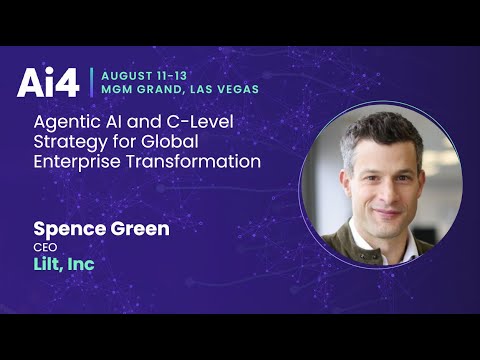
Transforming Cross-Border Business Communication with Agentic AI With Lilt — Ai4

Ai4

Agentic AI is poised to capture the $30 billion localization market by executing enterprise workflows end-to-end and relegating human specialists to exception-handling roles.

AI-assisted summary of Transforming Cross-Border Business Communication with Agentic AI With Lilt — original source. Check the original for full context.

Source published:

Detailed notes

## Background Published by Ai4 on YouTube on August 29, 2025, the presentation features Spence Green, CEO of Lilt, addressing why traditional translation tools and raw frontier models fall short in corporate environments. According to the video description, the session explores how generative and agentic workflows can transform global content strategy, automate complex communication tasks, and drive genuine enterprise AI adoption.

## TL;DR Spence Green analyzes the $30 billion multilingual communication market, highlighting that 99% of it remains dominated by manual professional services due to enterprise quality, governance, and scale requirements. He explains how agentic software overcomes the fractal complexity and non-determinism of business workflows by orchestrating models, generating adaptive user interfaces, and navigating complex software decision trees behind the scenes. Ultimately, this shifts organizations from human-led tasks with AI assistance to an inverted paradigm where autonomous agents run end-to-end workflows and escalate exceptions to human experts, as illustrated by Lenovo's automated ecommerce localization and rapid intelligence analysis in the public sector.

## Atmosphere & style The presentation is crisp, analytical, and grounded in practical engineering realities rather than speculative AI hype. Drawing on his technical background from Stanford, Google Translate, and the mid-1990s Netscape era, Green speaks with authoritative calm, methodically breaking down intricate software paradigms into intuitive structural insights. The pacing is focused and direct, creating an informative, executive-level atmosphere that feels like a masterclass in modern enterprise software architecture.

## Key takeaways - [00:04](https://www.youtube.com/watch?v=tKnQea-lfMA&t=4s) Widespread enterprise AI adoption is bottlenecked by human factors and the organizational challenge of restructuring how cross-functional teams collaborate across shared workflows. - [01:43](https://www.youtube.com/watch?v=tKnQea-lfMA&t=103s) Enterprise workflows are 'fractal problems' with endless edge cases and low mistake tolerance, requiring software architectures that strictly eliminate unuseful non-determinism. - [03:52](https://www.youtube.com/watch?v=tKnQea-lfMA&t=232s) Localization is a $30 billion market within the broader $4 trillion professional services sector, yet only 1% is captured by software due to enterprise demands for certified quality, governance, and scale. - [05:34](https://www.youtube.com/watch?v=tKnQea-lfMA&t=334s) Enterprise multilingual communication splits into outbound distribution and inbound understanding, with raw LLM deployments often falling into an adoption trough without end-to-end workflow governance. - [08:22](https://www.youtube.com/watch?v=tKnQea-lfMA&t=502s) Agentic systems solve traditional enterprise SaaS bloat by autonomously navigating complex underlying decision trees based on natural user intent. - [10:19](https://www.youtube.com/watch?v=tKnQea-lfMA&t=619s) Enterprise agent platforms rely on multi-model orchestration, combining task-specific small models, frontier reasoning engines, RAG, and fine-tuning rather than single-model inference. - [11:10](https://www.youtube.com/watch?v=tKnQea-lfMA&t=670s) Adaptive UX represents a shift from static, heavily configured SaaS forms to software that dynamically generates workflows and user interfaces tailored to each business context. - [13:17](https://www.youtube.com/watch?v=tKnQea-lfMA&t=797s) The agentic paradigm inverts the human-AI loop: AI executes core processes autonomously end-to-end and pulls in human specialists only on exceptions or quality escalation. - [13:55](https://www.youtube.com/watch?v=tKnQea-lfMA&t=835s) Lenovo replaced a 15-year legacy localization agency with agentic AI workflows on Lenovo.com, slashing production costs and accelerating international time-to-market. - [15:22](https://www.youtube.com/watch?v=tKnQea-lfMA&t=922s) In national security and intelligence, agentic pipelines compress 3- to 4-week manual translation and synthesis cycles into a single afternoon, preserving the strategic value of perishable intelligence.

## Detailed walkthrough ### [00:04](https://www.youtube.com/watch?v=tKnQea-lfMA&t=4s) Background and the Enterprise AI Landscape

Spence Green introduces himself as the co-founder and CEO of Lilt. Before launching the company, he was a research scientist in the Stanford AI Lab and spent time working on Google Translate. Lilt was founded on the aspiration to enable enterprises to communicate across languages and borders just as effortlessly as consumers do with tools like Google Translate. Today, Lilt focuses primarily on large enterprise clients in highly regulated industries and government agencies, where cross-border communications carry high stakes and accuracy is non-negotiable.

Looking at the broader enterprise AI landscape, Green reflects on the rapid pace of change across the industry. While certain categories—such as developer coding assistants and customer support automation—have achieved clear success, widespread enterprise adoption is still characterized by heavy experimentation. A major catalyst for change is that almost every employee now has an AI assistant on their desktop, creating a direct distribution channel for deploying agents. However, the primary bottleneck remains human factors: while convincing enterprises to adopt new software has always been difficult, agentic systems require organizations to fundamentally alter how teams collaborate across shared workflows.

- **Founder Background**: Co-founder and CEO of Lilt; former research scientist at Stanford AI Lab; previous engineering work on Google Translate. - **Target Market**: Large regulated enterprises and government sectors requiring certified, high-stakes multilingual accuracy. - **Current AI Milestones**: Proven traction in coding assistants and customer support, alongside ubiquitous desktop assistant penetration across enterprise workforces.

---

[01:43](https://www.youtube.com/watch?v=tKnQea-lfMA&t=103s) The Fractal Nature of Enterprise Workflows and Eliminating Non-Determinism

Extrapolating consumer AI adoption directly to the enterprise is a common mistake. In consumer tools like ChatGPT, individuals explore use cases independently with a high tolerance for error. In a corporate environment, mistake tolerance drops, and work spans interdependent cross-functional teams. Green characterizes enterprise workflows as "fractal problems"—the closer you examine them, the more edge cases, dependencies, and modeling requirements emerge. This complexity creates a steep adoption curve for agentic software.

```mermaid flowchart TD accTitle: Eliminating Unuseful Non-Determinism in Agentic Workflows subgraph S1["Agent Orchestration"] A["Task Definition"] --> B["Deterministic Pipeline Routing"] end subgraph S2["Constrained Tool Execution"] B --> C["Step 1: Code Generation"] C --> D["Step 2: Automated Code Review"] D --> E["Step 3: Security Testing"] end subgraph S3["Verification"] E --> F["Validated Enterprise Output"] end ```

To bridge the gap between individual "shadow AI" usage and enterprise-grade deployment, organizations must convert ad-hoc employee experiments into unified, team-based architectures. A critical engineering hurdle in building reliable agentic systems is managing non-determinism. While non-determinism gives agents their decision-making power, designers must use architectural constraints to eliminate "unuseful non-determinism." Green illustrates this with a software development pipeline: code must be written, reviewed, and then security-tested; allowing an agent the degree of freedom to perform security testing before code is generated is an unuseful permutation that software architecture must structurally prevent.

- **Workflow Complexity**: Characterized as "fractal problems" due to the endless emergence of edge cases under scrutiny. - **Shadow AI to Team Workflows**: The challenge of migrating unmanaged individual AI usage into governed, cross-functional business systems. - **Non-Determinism Architecture**: Eliminating irrational agent degrees of freedom while preserving flexible autonomous decision-making.

---

[03:52](https://www.youtube.com/watch?v=tKnQea-lfMA&t=232s) The Multilingual Enterprise: A $30 Billion Professional Services Market

At the executive level, C-suite leaders are often astonished to discover that their enterprise spends upwards of $5 million annually on localization, multilingual chatbots, and internationalizing codebases. Executives frequently assume that Google solved translation over a decade ago. However, consumer translation engines fail in enterprise contexts due to three core requirements: strict quality certification standards, complex multi-layered approval and review chains, and massive content scale. Agentic AI is now positioned to automate what has historically been outsourced to human-intensive professional services.

The multilingual communication sector forms part of the broader $4 trillion global professional services economy. Within this ecosystem, localization represents a $30 billion market. Remarkably, despite consumer machine translation existing for two decades, only about $300 million—or roughly 1%—of that $30 billion market is captured by software. The remaining 99% is dominated by human labor agencies. Green highlights that this dynamic mirrors other professional service domains—such as accounting, graphic design, legal services, and strategic consulting—all of which are ripe for transformation through agentic workflows.

- **Market Scale**: Multilingual business communications is a $30 billion market, with only ~$300 million (1%) software penetration. - **Enterprise Failure Points of Raw MT**: Lack of certified quality standards, absence of multi-stakeholder governance workflows, and inability to handle large-scale enterprise content updates. - **Target Landscape**: Analogous to the broader $4 trillion professional services industry spanning legal, consulting, accounting, and creative production.

---

[05:34](https://www.youtube.com/watch?v=tKnQea-lfMA&t=334s) Distribution vs. Understanding and Navigating the AI Adoption Trough

Enterprise multilingual communication divides into two primary information flows: 1. **Distribution (Outbound)**: Translating the organization's primary operating language outward across global markets for product rollouts, marketing campaigns, and regional customer support. 2. **Understanding (Inbound)**: Gathering foreign-language data—such as regional social media monitoring or public sentiment—and converting it back into the operating language to inform business decisions. In government and intelligence operations, where the vast majority of raw collected data originates in foreign languages, this inbound flow is critical.

```mermaid flowchart LR accTitle: Enterprise Information Flows and the AI Adoption Trough subgraph Flows["Core Information Flows"] direction TB D["Distribution (Outbound)<br/>Product Launches, Marketing & Support"] U["Understanding (Inbound)<br/>Social Monitoring & Intelligence"] end

subgraph Adoption["The AI Adoption Trough"] direction TB M["Mandate: Apply Generic LLM"] --> F["Failure: Communication Errors & Missed Deadlines"] F --> R["Reactive Mode / Crisis"] R --> E["Turnkey Agentic AI Solution with Built-in Governance"] end

Flows -.-> Adoption ```

When organizations attempt to modernize these workflows, they often fall into an "adoption trough." Companies receive a top-down mandate to modernize using off-the-shelf generative models. Inevitably, the generic system breaks down—introducing critical translation errors, missing production deadlines at scale, or violating information security protocols. Entering a reactive state, leadership still wants transformation but lacks the internal capabilities to engineer it. Lilt bridges this trough by providing an end-to-end agentic solution with integrated governance and reliability, shifting companies from labor-heavy services to reliable AI execution across subsequent communication initiatives.

- **Outbound Distribution**: Translating core operations outward to customers, regional teams, and international supply chains. - **Inbound Understanding**: Ingesting foreign-language intelligence, social media data, and market chatter to drive operational decision-making. - **The Adoption Trough**: The failure cycle occurring when companies apply raw, ungoverned frontier models to complex business processes without workflow wrappers.

---

[08:22](https://www.youtube.com/watch?v=tKnQea-lfMA&t=502s) The Agentic Shift: Navigating Enterprise SaaS Decision Trees

While Green quips that many 2025 "agents" are merely rebranded 2024 retrieval-augmented generation (RAG) applications, he emphasizes that the fundamental architectural transition represents the most profound shift in software development in two decades. Recalling his recent return to coding alongside Lilt engineers, Green compares the experience to the early days of the web when he worked in Netscape around 1995–1996. Agentic architecture solves the single most frustrating challenge in enterprise SaaS: product bloat driven by divergent enterprise business rules.

Traditional enterprise SaaS products become trapped in a usability dilemma. To accommodate varied enterprise requirements, applications evolve into massive, rigid decision trees filled with nested drop-downs, endless forms, and multi-step configurations. Employees generally understand the task they want to accomplish, but they struggle to navigate the complex software decision tree—exemplified by the classic 20-year struggle of getting enterprise sales reps to fill out fields in Salesforce. Agentic systems eliminate this friction by interpreting the user's intent and autonomously navigating the underlying software decision tree.

- **Developer Paradigm Shift**: Green likens the rise of agentic architectures to the birth of the web at Netscape in 1995–1996. - **The Enterprise SaaS Problem**: Applications transforming into impenetrable decision trees to support varied corporate edge cases. - **The Agentic Advantage**: Autonomous systems that allow users to state their goal in natural terms while the software navigates the technical decision tree behind the scenes.

---

[10:19](https://www.youtube.com/watch?v=tKnQea-lfMA&t=619s) Model Orchestration and Adaptive UX

Building a functional enterprise agentic platform rests on three foundational pillars: context-aware models, dynamic agentic workflows with adaptive user interfaces, and deep enterprise connectivity. Enterprise agentic systems cannot rely on a single model or an isolated inference pass. Instead, they depend on model orchestration—coordinating task-specific small models and larger reasoning engines. System builders achieve domain customization by combining retrieval (RAG) with model adaptation (supervised fine-tuning and online reinforcement learning) to produce dependable, business-specific outputs.

```mermaid flowchart TD accTitle: The Three Pillars of Enterprise Agentic Architecture subgraph Pillar1["1. Model Orchestration"] P1A["Retrieval (RAG)"] P1B["Fine-Tuning / RL"] P1A & P1B --> P1C["Context-Aware Specialized Models"] end

subgraph Pillar2["2. Agentic Workflows & Adaptive UX"] P2A["Job to be Done"] --> P2B["Dynamic Workflow Generation"] P2B --> P2C["On-the-Fly UI / Interface"] end

subgraph Pillar3["3. Connectivity & Execution"] P3A["Enterprise Systems (CRM, CMS)"] --> P3B["Autonomous Agent Execution"] P3B --> P3C["Human Escalation On-Demand"] end

Pillar1 --> Pillar2 --> Pillar3 ```

The second pillar replaces static user interfaces with what Green terms "Adaptive UX." In the 1980s, enterprises built bespoke internal software (such as custom payroll tools) that fit their exact needs but required immense engineering overhead. The SaaS revolution of the 2000s standardized applications like Salesforce and Workday, but forced businesses to purchase expensive professional services and hire dedicated administrators just to configure the software to their operations. Agentic workflows solve this tradeoff: enterprises purchase standardized software that autonomously configures its workflow and dynamically generates user interfaces tailored to each specific business context on the fly.

- **Multi-Model Orchestration**: Combining small specialized models and frontier models across multi-step inference chains. - **Context Customization**: Merging retrieval-augmented generation (RAG) with supervised fine-tuning and reinforcement learning. - **Software Evolution**: Moving from 1980s bespoke software to 2000s standardized SaaS (requiring heavy consulting customization), to modern agentic software that self-adapts dynamically.

---

[13:17](https://www.youtube.com/watch?v=tKnQea-lfMA&t=797s) Inverting the Human-AI Workflow: The Lenovo Case Study

The third pillar of enterprise agentic architecture is connectivity. Agentic systems must integrate across all touchpoints in the customer journey—from initial brand awareness and purchasing through post-sales retention. To operate effectively, translation and search agents must link directly into the content management systems, CRM platforms, and data repositories where real enterprise work takes place.

```mermaid flowchart LR accTitle: Inversion of Human and AI Workflow Roles subgraph Traditional["Current Paradigm: Human-Driven"] H1["Human Worker"] -->|"Executes Task & Calls"| AI1["AI Assistant Tool"] end

subgraph Inverted["Agentic Paradigm: AI-Driven"] AI2["Agentic Workflow"] -->|"Executes Core Process & Calls"| H2["Human for Review / Escalation"] end

Traditional -->|"Paradigm Shift"| Inverted ```

This integration enables an inversion of the traditional workflow loop. In the existing paradigm, humans perform the primary labor and occasionally call out to AI tools. In the emerging agentic paradigm, AI runs the overarching workflow end-to-end and autonomously calls out to humans only when quality thresholds, edge cases, or governance approvals demand intervention.

Green highlights Lenovo as a live enterprise deployment. When global consumers visit Lenovo's website to purchase a ThinkPad laptop, all non-English product descriptions and ecommerce content are generated via Lilt's agentic workflows. This automated deployment completely replaced a traditional professional services localization firm that Lenovo had used for 15 years. While Lenovo previously tested raw LLMs like GPT-4 and Google Translate—both of which failed due to brand-specific terminology and real-time knowledge requirements—the agentic workflow slashed production costs, eliminated rollout delays, and accelerated global time-to-market.

- **Workflow Inversion**: Moving from humans executing work with AI assistance to AI running operations and pulling in human experts on exception. - **Lenovo Deployment**: Powers all multilingual ecommerce content on Lenovo.com, replacing a 15-year legacy agency engagement. - **Business Outcomes**: Reduced cost of production, faster international go-to-market speed for hardware launches, and reliable domain-specific output.

[15:22](https://www.youtube.com/watch?v=tKnQea-lfMA&t=922s) Agentic AI in High-Stakes Government Intelligence

Turning to high-stakes public sector applications, Spence Green highlights how government intelligence operations present a massive opportunity for agentic AI. Today, most intelligence agencies still heavily depend on human analysts to manually monitor, translate, and analyze what other countries are communicating. In these environments, raw multilingual information must be systematically gathered, interpreted, and synthesized into actionable decisions designed to keep a nation safe. By deploying agentic systems into these critical workflows, operations that historically dragged on for three to four weeks can now be completed within a single afternoon.

This dramatic acceleration is fundamentally transformational because "intelligence is perishable." Information that takes a month or even a week to analyze loses its strategic utility, whereas rapid processing delivers critical situational awareness when it matters most. Transitioning these traditionally manual, labor-intensive, and sensitive tasks into automated agentic workflows allows intelligence teams to operate at machine speed without sacrificing precision. Wrapping up the session as time expires, Green notes that he may have room for a single question from the audience before expressing his thanks and concluding the talk.

```mermaid flowchart LR accTitle: Transformation of Intelligence Analysis with Agentic AI subgraph Traditional["Traditional Workflow (3-4 Weeks)"] A["Foreign Information Collection"] --> B["Manual Translation & Analysis"] B --> C["Delayed Strategic Decision"] end subgraph Agentic["Agentic Workflow (Single Afternoon)"] D["Continuous Information Intake"] --> E["Agentic Processing & Synthesis"] E --> F["Perishable Intelligence Actioned"] end ```

- **Cycle Time Reduction:** Workflows that historically took between three and four weeks are condensed down into a single afternoon. - **Strategic Impact:** Because intelligence degrades in value over time, converting manual pipelines into agentic workflows ensures high-stakes decisions are informed by real-time insight rather than stale reporting.

## Notable quotes > [01:43](https://www.youtube.com/watch?v=tKnQea-lfMA&t=103s) In consumer tools like ChatGPT, individuals explore use cases independently with a high tolerance for error. In a corporate environment, mistake tolerance drops, and work spans interdependent cross-functional teams. — Spence Green

> [01:43](https://www.youtube.com/watch?v=tKnQea-lfMA&t=103s) A critical engineering hurdle in building reliable agentic systems is managing non-determinism. While non-determinism gives agents their decision-making power, designers must use architectural constraints to eliminate unuseful non-determinism. — Spence Green

> [03:52](https://www.youtube.com/watch?v=tKnQea-lfMA&t=232s) Executives frequently assume that Google solved translation over a decade ago. However, consumer translation engines fail in enterprise contexts due to three core requirements: strict quality certification standards, complex multi-layered approval and review chains, and massive content scale. — Spence Green

> [03:52](https://www.youtube.com/watch?v=tKnQea-lfMA&t=232s) Remarkably, despite consumer machine translation existing for two decades, only about $300 million—or roughly 1%—of that $30 billion market is captured by software. The remaining 99% is dominated by human labor agencies. — Spence Green

> [05:34](https://www.youtube.com/watch?v=tKnQea-lfMA&t=334s) In government and intelligence operations, where the vast majority of raw collected data originates in foreign languages, this inbound flow is critical. — Spence Green

> [08:22](https://www.youtube.com/watch?v=tKnQea-lfMA&t=502s) Agentic architecture solves the single most frustrating challenge in enterprise SaaS: product bloat driven by divergent enterprise business rules. — Spence Green

> [10:19](https://www.youtube.com/watch?v=tKnQea-lfMA&t=619s) Building a functional enterprise agentic platform rests on three foundational pillars: context-aware models, dynamic agentic workflows with adaptive user interfaces, and deep enterprise connectivity. — Spence Green

> [13:17](https://www.youtube.com/watch?v=tKnQea-lfMA&t=797s) In the existing paradigm, humans perform the primary labor and occasionally call out to AI tools. In the emerging agentic paradigm, AI runs the overarching workflow end-to-end and autonomously calls out to humans only when quality thresholds, edge cases, or governance approvals demand intervention. — Spence Green

> [15:22](https://www.youtube.com/watch?v=tKnQea-lfMA&t=922s) intelligence is perishable — Spence Green

> [15:22](https://www.youtube.com/watch?v=tKnQea-lfMA&t=922s) Transitioning these traditionally manual, labor-intensive, and sensitive tasks into automated agentic workflows allows intelligence teams to operate at machine speed without sacrificing precision. — Spence Green

## Mentioned Spence Green, Lilt, Stanford AI Lab, Google, Google Translate, ChatGPT, Netscape, Salesforce, Workday, Lenovo, ThinkPad, GPT-4, Ai4

## Video description Spence Green, CEO, Lilt

Abstracts

The dawn of the superintelligence age is here, but are we truly ready to communicate across borders at scale? In today’s global economy, effective multilingual communication isn’t a luxury; it’s a strategic necessity. In this talk, I’ll explain why traditional tools like Google Translate and ChatGPT fall short for enterprise needs, and how agentic workflows powered by generative AI are transforming global content strategy. You’ll learn how to automate high-level communication tasks, free up your teams for more strategic work, and scale content with unprecedented precision. If you’re ready to move beyond the hype and toward real AI-driven business transformation, this session is for you.

[Source](https://www.youtube.com/watch?v=tKnQea-lfMA)

中文简报

Lilt取代联想合作15年服务商,智能体AI颠覆传统工作流 智能体AI有望通过端到端执行企业工作流并将人类专家转为异常处理角色,从而拿下规模达300亿美元的本地化市场。 Spence Green深入分析了规模达300亿美元的多语言沟通市场,指出受企业对质量、治理与规模化要求的限制,目前该市场仍有99%被人工专业服务占据。他阐释了智能体软件如何通过在后台编排模型、生成自适应用户界面并应对复杂的软件决策树,攻克业务工作流的分形复杂性与非确定性。最终,这将推动组织从“人类主导、AI辅助”转向颠覆性的倒置范式:由自主智能体端到端运行工作流,仅将异常情况上报给人类专家,联想的自动化电商本地化以及公共领域的快速情报分析便体现了这一转变。 企业级 AI 普及的瓶颈不在于模型能力,而在于人类组织因素以及重构跨部门协同工作流的挑战;同时企业业务属于充满边缘情况与极低容错率的“分形问题”,架构上必须严格消除无用非确定性。 (1:43) 在全球 4 万亿美元的专业服务市场中,本地化占据 300 亿美元规模,但由于企业对质量认证、多级审批与规模化的严格要求,目前仅有约 1% 被传统软件替代,仍由 99% 的人力服务主导。 (3:52) 直接使用原生大模型常因缺乏治理而陷入采用低谷,而智能体架构通过根据用户意图自主遍历底层复杂的业务决策树,有效解决了传统企业级 SaaS 软件功能臃肿与配置繁琐的问题。 (8:22) 企业级智能体平台依赖多模型协同编排与动态生成界面的自适应 UX,彻底颠覆了人机协作范式:由 AI 自主端到端执行核心流程,仅在出现异常或质量质检升级时才调用人工专家处理。 (13:17)

Reading summary

Spence Green argues that enterprise cross-border communication cannot be solved by consumer translation tools or standalone language models alone, requiring governed agentic systems that orchestrate domain-specific models and navigate complex operational workflows. By shifting from human-driven tasks to autonomous systems that escalate only edge cases to human experts, organizations can automate workflows historically dominated by labor-intensive professional service agencies. The $30 Billion Multilingual Services Disconnect (3:52) Green observes that while enterprise executives often assume translation was solved a decade ago, corporate localization represents a $30 billion market within the wider $4 trillion global professional services economy. Remarkably, software accounts for only about $300 million—roughly 1%—of this localization expenditure, with the remaining 99% captured by human labor agencies. Consumer translation engines and generic large language models fail in corporate environments due to strict quality certification standards, multi-layered approval chains, and the need to accurately maintain brand terminology across massive, continuous content updates. When enterprises attempt to modernize through top-down mandates using off-the-shelf generative models, Green notes they often fall into an 'adoption trough.' Ungoverned models break down under enterprise scale, introduce critical translation errors, or cause production delays. Overcoming this requires turnkey agentic platforms with integrated governance to manage both outbound distribution—such as global product marketing and customer support—and inbound understanding, such as monitoring foreign-language intelligence and social data to guide strategic decisions. Constraining Non-Determinism in Fractal Workflows (1:43) Enterprise workflows differ fundamentally from consumer AI usage because corporate tolerance for error is minimal and work spans interdependent cross-functional teams. Green characterizes enterprise processes as 'fractal problems,' where closer examination continuously reveals edge cases, dependencies, and complex modeling requirements. This complexity prevents the direct conversion of individual, unmanaged employee experiments into robust enterprise-grade deployments. To build dependable agentic systems, software architectures must systematically eliminate what Green terms 'unuseful non-determinism.' While non-determinism provides agents with flexible decision-making capability, system designers must introduce structural constraints to prevent irrational execution paths. For example, in a software development pipeline, an agentic system must structurally enforce that code is written, reviewed, and then security-tested, preventing degrees of freedom that could allow an agent to run security tests before code generation occurs. Model Orchestration and Dynamic Adaptive UX (10:19) Green identifies three foundational pillars for enterprise agentic architectures: multi-model orchestration, dynamic adaptive user interfaces, and deep enterprise connectivity. Rather than relying on an isolated model or inference pass, enterprise platforms orchestrate task-specific smaller models alongside frontier reasoning engines. System builders achieve domain customization by combining retrieval-augmented generation with supervised fine-tuning and online reinforcement learning. Green argues that agentic architectures resolve a long-standing SaaS dilemma. Standardized enterprise applications historically expanded into rigid, bloated decision trees with nested forms and complex drop-downs to satisfy divergent business rules, causing persistent user friction. Agentic software resolves this by interpreting user intent in natural terms and autonomously navigating the underlying decision tree, generating dynamic 'Adaptive UX' tailored to specific operational contexts without requiring costly bespoke development or extensive administrative configuration. Inverting Workflow Roles Across Enterprise and Intelligence (13:17) By integrating directly into enterprise content management systems, customer relationship platforms, and intelligence repositories, agentic architecture enables an inversion of the conventional human-AI operational loop. Rather than humans performing primary tasks and occasionally consulting AI tools, autonomous agentic workflows execute processes end-to-end and call human experts only when governance thresholds, edge cases, or quality standards require escalation. Green points to Lenovo as a live enterprise deployment, where Lilt's agentic workflows replaced a 15-year legacy agency engagement to generate all non-English ecommerce content on Lenovo.com, reducing production costs and accelerating international rollout after raw models like GPT-4 and Google Translate failed. In the public sector, Green highlights that applying agentic workflows to foreign intelligence analysis condenses translation and synthesis cycles from three to four weeks down to a single afternoon, preserving the operational utility of highly perishable strategic information. Green concludes that the transition to agentic architectures represents the most significant software development shift since the mid-1990s web era, but emphasizes that organizational human factors—fundamentally altering how cross-functional teams collaborate across shared workflows—remain the primary hurdle to enterprise adoption.

精炼阅读摘要

Lilt联合创始人兼首席执行官Spence Green指出,在规模达300亿美元的跨国本地化与企业多语言通信市场中,纯软件渗透率目前仅占约1%;由智能体(Agentic AI)驱动的架构正在颠覆传统严重依赖人力外包的专业服务模式。 企业工作流的分形特征与非确定性治理 (1:43) Spence Green认为,将消费级AI的采用逻辑直接套用到企业端是一种常见误区。在ChatGPT等消费级应用中,个人用户可以独立探索且容错率高;而在涉及跨部门协作的严肃企业场景中,业务工作流呈现出“分形问题”的特征——越深入审视,边缘案例、系统依赖和建模需求就越发繁杂。这种内在复杂性让企业难以直接将员工自发的“影子AI”实验转化为可治理的团队化业务架构。 构建高可靠智能体系统的核心工程挑战在于消除“无用非确定性”。非确定性虽然赋予了智能体自主决策能力,但系统必须通过确定性的架构管道设定边界。例如在软件开发流程中,系统必须在架构层面上强制执行“编写代码、代码审查、安全测试”的时序逻辑,避免智能体获得在生成代码前就去执行安全测试等不合逻辑的自由度,以此确保企业级交付物的严密性。 300亿美元本地化市场的服务外包重塑 (3:52) 跨国企业的管理层往往惊讶于自身每年在本地化、多语言对话机器人及代码国际化上的支出高达数百万美元,且常误以为机器翻译在十多年前就已被Google解决。然而,消费级翻译工具无法满足企业端的三项核心诉求:严格的质量认证标准、多层级的审批与复核链条,以及庞大内容的规模化吞吐。这导致在规模达300亿美元的全球本地化市场中,仅有约3亿美元(约1%)被软件捕获,其余99%的市场份额长期被密集的人力专业服务机构把持。 企业多语言通信涵盖双向信息流:一是由内向外的“分发”(如产品发布、市场营销和客户支持),二是由外向内的“理解”(如境外社交舆情监测与情报收集)。许多企业在自上而下推进现代化时,因直接调用未经治理的通用大模型而遭遇翻译错误、工期延误或数据违规,陷入“采用低谷”。Green指出,这一现状与法律、咨询、会计等规模达4万亿美元的专业服务大市场类似,端到端的智能体系统正逐步替代传统人力外包。 模型编排与自适应用户界面打破SaaS困境 (8:22) 传统企业级SaaS为了满足多样化的业务规则,往往演变成包含层层下拉菜单、复杂表单和繁琐配置的庞大决策树,导致员工因操作繁琐而难以有效使用。智能体架构的出现解决了这一痛点,它允许用户直接以自然语言表述意图,由系统在后台自主遍历并执行底层的软件决策树。Green将这一范式演进比作1995至1996年他在Netscape经历的互联网初期变革。 落地企业级智能体平台依赖三大支柱:上下文感知模型、具备自适应界面的动态工作流,以及深度企业系统互联。在模型层,系统不能依赖单次推理,而是通过编排领域专用小模型与前沿推理大模型,并结合检索增强生成(RAG)、监督微调和在线强化学习来实现业务定制。在交互层,智能体摆脱了固定UI,演变为根据具体业务情境即时动态生成界面的“自适应UX”,消除了企业为适配标准化SaaS而采购昂贵配置咨询的负担。 人机流程倒置与高价值实战应用 (13:17) 智能体系统通过与企业CRM、内容管理系统及数据存储库深度集成,彻底倒置了传统的业务流程。在旧有模式中,人类员工承担核心执行任务,偶尔调用AI工具辅助;而在新型智能体模式下,AI端到端全自动运行整体工作流,仅在触发质量阈值、遇到边缘案例或需要合规审批时才主动上报并介入人工专家。这种模式转变大幅削减了人工等待开销。 在联想(Lenovo)的实际案例中,ThinkPad笔记本在全球电商网站上的多语言商品描述现已完全由Lilt智能体系统生成,直接取代了联想合作长达15年的传统本地化服务商,在解决专有名词准确性问题的同时降低了制作成本并加速全球上市周期。类似地,在高度依赖时效性的政府情报领域,以往需要分析人员耗费3至4周手动收集与翻译的涉外信息,借助智能体系统可在单个下午内完成处理与综合,避免了高价值情报因分析滞后而失去时效。 尽管当前诸多标榜智能体的产品实质仍属于检索增强生成包装,但通过模型编排、动态自适应界面和与核心企业系统的深度互联,AI从辅助工具升级为流程主导者已在联想电商与政府情报等场景中完成验证。如何在保障确定性与安全合规的前提下重构组织协作习惯,仍是企业全面推行智能体面临的核心组织挑战。

Detailed notes — zh

## Background 该内容由 Ai4 于 2025 年 8 月 29 日发布在 YouTube 平台上。根据页面简介,本次演讲由 Lilt 首席执行官 Spence Green 主讲,重点探讨在超级智能时代下,为什么传统翻译工具与 ChatGPT 无法满足企业级需求,以及基于生成式 AI 的 Agentic 工作流如何重塑企业跨国内容策略与沟通效率。 ## TL;DR Spence Green 在演讲中揭示了企业级多语言沟通所面临的严峻挑战,指出高达 300 亿美元的跨国沟通市场中目前仅有 1% 实现软件化。他深入分析了企业在引入 AI 时面临的“分形难题”与消除非确定性的必要性,并阐述了支撑企业级 Agentic 系统的三大核心支柱:上下文感知模型、自适应 UX 及全链路连接能力。演讲结合联想集团 ThinkPad 本地化与高风险政府情报分析等真实案例,展示了 AI 驱动工作流将数周传统分析缩短至半天的颠覆性变革。 ## Atmosphere & style 演讲整体呈现出专业、睿智且充满前瞻洞察的学术与行业干货氛围。Spence Green 凭籍其在斯坦福 AI 实验室及 Google Translate 的深厚技术底蕴,以务实严谨又不失幽默的语言风格引导听众。演讲过程中既有对 90 年代互联网初生时刻的怀旧共鸣,也有对当下企业 AI 落地痛点的深刻剖析,将高深的 Agent 架构理念与真实商业案例有机融合,带来极具启发性与说服力的视听体验。 ## Key takeaways - [00:04](https://www.youtube.com/watch?v=tKnQea-lfMA&t=4s) Lilt 专注于高风险、受严格监管的企业与政府跨语言沟通场景,这些场景对内容准确性有极致要求,是传统消费级翻译工具无法胜任的绝佳企业级 AI 用例。 - [00:41](https://www.youtube.com/watch?v=tKnQea-lfMA&t=41s) 企业引入 Agentic 系统的最大障碍并非技术,而是工作流变革中复杂的人的因素,以及企业业务犹如“分形问题”般层出不穷的边缘情况与低容错率。 - [01:40](https://www.youtube.com/watch?v=tKnQea-lfMA&t=100s) 企业级 Agent 架构设计的关键在于消除“无效的非确定性”,既要赋予智能体必要的决策自由度,又必须通过严谨的软件逻辑约束执行路径,防止违背业务常理的操作。 - [03:52](https://www.youtube.com/watch?v=tKnQea-lfMA&t=232s) 全球 300 亿美元的多语言商业沟通市场中仅有约 1%(3 亿美元)被软件化,因质量认证、多层级审批及大规模交付三大门槛,绝大部分依然依赖昂贵的专业人工外包。 - [05:34](https://www.youtube.com/watch?v=tKnQea-lfMA&t=334s) 企业信息流动主要包含两大方向:将内部语言转化为海外用户目标语言的“对外分发”,以及将外部海量外语信息沉淀为决策参考的“对内理解与情报”。 - [06:10](https://www.youtube.com/watch?v=tKnQea-lfMA&t=370s) 直接将通用前沿大模型生搬硬套到企业业务流程往往会跌入“幻灭低谷”,只有提供内置治理机制与高可靠性的端到端方案,才能真正跨越落地鸿沟。 - [08:22](https://www.youtube.com/watch?v=tKnQea-lfMA&t=502s) 传统 SaaS 软件为了覆盖千差万别的企业场景异化成了臃肿的“决策树”,而 Agentic AI 的革命性在于能够代替业务人员直接穿越并执行这棵复杂的决策树。 - [09:20](https://www.youtube.com/watch?v=tKnQea-lfMA&t=560s) 真正可靠的企业级 Agentic 系统依赖三大支柱:上下文感知模型编排、动态生成界面的自适应 UX 工作流,以及贯穿客户全生命周期的全链路连接能力。 - [14:21](https://www.youtube.com/watch?v=tKnQea-lfMA&t=861s) 人机协作范式正从“人类主导并在需要时调用 AI”转变为“AI 自主运转完整工作流,仅在遇到异常或关键决策节点时呼叫人类介入”。 - [14:40](https://www.youtube.com/watch?v=tKnQea-lfMA&t=880s) 联想 ThinkPad 案例证明,Agentic AI 工作流能够完全替代合作 15 年的传统语言外包商;而缺乏专有业务知识与治理能力的通用前沿大模型在此类任务中必然失效。 - [15:22](https://www.youtube.com/watch?v=tKnQea-lfMA&t=922s) 在关乎国家安全的高风险情报分析中,Agentic AI 将原本耗时 3 至 4 周的多语言研判压缩至单个下午,极大地保全了具有强时效性情报的战略价值。 ## Detailed walkthrough ### [00:04](https://www.youtube.com/watch?v=tKnQea-lfMA&t=4s) 创立 Lilt 的初衷与企业级多语言通信的高风险场景 Lilt 联合创始人兼首席执行官 Spence Green 在演讲开场时回顾了自己的学术与技术背景。在创立 Lilt 之前,他曾是斯坦福大学人工智能实验室(Stanford AI Lab)的研究科学家,并在 Google Translate 团队工作过一段时间。创立 Lilt 的核心愿景,是希望让企业级跨语言、跨国界的沟通变得像今天普通消费者使用 Google Translate 等消费级产品一样轻松顺畅。 不同于普通的日常翻译,Lilt 的业务重心主要聚焦于超大型企业,尤其是受严格监管的行业以及政府机构。在这些高风险(high-stakes)场景中,沟通内容必须保证绝对准确无误,容不得半点差错。Spence Green 强调,这种对准确性要求极高的场景正是企业级 AI(Enterprise AI)能够大显身手的绝佳用例。 ### [00:41](https://www.youtube.com/watch?v=tKnQea-lfMA&t=41s) 企业 AI 的落地现实:工作流变革的“分形难题”与消除非确定性 回顾企业 AI 的整体现状,Spence Green 指出目前企业界仍处于大量实验阶段。虽然代码辅助(coding assistance)和客户支持(customer support)等领域已经取得了显著且成熟的成效,但其他多数领域仍在探索之中。如今,几乎每位员工的桌面上都配备了某种形式的 AI 助手,这为向全员推广部署 Agent(智能体)带来了巨大的契机。然而,横亘在企业面前的最大阻碍并非技术本身,而是工作流变革中的“人的因素(human factors)”。过去企业推行一款新软件就已经非常艰难,而现在引入 Agentic 系统,则要求员工彻底转变跨团队协作的方式。 许多人习惯从消费级场景做简单外推,以为只要把 ChatGPT 扔给员工,他们就能自己摸索搞定。但在企业环境中,各家公司的容错率截然不同,员工害怕犯错,多团队协作更是让流程变得盘根错节。Spence Green 将企业业务工作流形象地比喻为“分形问题(fractal problems)”——就像分形几何一样,你越是凑近细看,冒出来的边界情况(edge cases)就越多,需要专门建模和确保可靠性的细节也随之激增。这也是为什么企业级软件(尤其是 Agentic 系统)的采用曲线异常陡峭。 ```mermaid flowchart TD accTitle: Eliminating Unuseful Non-Determinism in Agentic Workflows subgraph Pipeline["代码提交流程示例"] A["1. 编写代码 (Write Code)"] --> B["2. 代码审查 (Code Review)"] B --> C["3. 安全测试 (Security Testing)"] end subgraph Control["架构控制层"] D["消除无效非确定性 (Prune Invalid Paths)"] E["保留决策自由度 (Useful Degrees of Freedom)"] end Control -. 约束执行顺序.-> Pipeline ``` 针对这一挑战,企业需要化解内部普遍存在的“影子 AI(Shadow AI)”现象,将员工零散的个人工具使用转变为由团队协同支撑的系统级能力。与此同时,企业级落地的关键在于控制“非确定性(non-determinism)”。Agent 系统的强大之处在于其拥有做决策的自由度,但系统的架构设计必须剔除那些“毫无用处的非确定性”。Spence Green 举例说明:在一个标准的代码提交流程中,顺序必须是写代码、做 Code Review,最后进行安全测试;如果系统在代码还没写出来之前就跑去做安全测试,这种非确定性就是无效且有害的。因此,必须通过严谨的软件架构来组织 Agent 与工具的交互逻辑,彻底消除违背现实业务常理的执行路径。 ### [03:52](https://www.youtube.com/watch?v=tKnQea-lfMA&t=232s) 300 亿美元的多语言市场与企业服务软件化缺口 谈及跨国多语言沟通,很多高管层(C-suite)往往存在认知误区。当他们得知自家公司每年要在产品与服务本地化、构建多语言聊天机器人以及多语言代码库维护上花费 500 万美元时,常常感到不可思议,甚至会疑惑:“这难道不是 Google Translate 在十年前、十五年前就已经解决的问题吗?”然而现实并非如此。企业级跨语言沟通无法依赖通用翻译工具,原因在于三大核心门槛: 1. **质量认证标准**:商业传播必须具备严格的质量背书与合规认证; 2. **多层级审批与审查工作流**:涉及企业内部跨部门的层层审核; 3. **海量内容交付的规模化挑战**:需要应对持续涌现的大规模业务资产。 这三大痛点正是 Agentic AI 替代传统专业外包服务(Professional Services)的绝佳切入点。在全球范围内,企业每年在专业服务上的支出高达 4 万亿美元左右,而 Lilt 所切入的多语言商业沟通市场规模约为 300 亿美元。令人震惊的是,在 Google Translate 诞生约 20 年后的今天,这个 300 亿美元的市场中仅有约 3 亿美元被软件化(占比仅约 1%),绝大部分依然依赖高昂的人力外包。Spence Green 指出,这种现象不仅存在于多语言领域,在会计、平面设计、法律服务、战略咨询等各类企业专业服务中同样广泛存在,而 Agentic AI 正在迎来全面重塑这些传统服务、大幅提升运转效率的历史性机遇。 ### [05:34](https://www.youtube.com/watch?v=tKnQea-lfMA&t=334s) 企业的两大信息流与跨越 AI 落地的“幻灭低谷” 在深入企业实际运作时,企业通常存在两种主要的信息流动方向: | 信息流向类型 | 业务特征与典型场景 | 核心目标 | |:--- |:--- |:--- | | **对外发布与分发 (Distribution)** | 企业跨区域进行产品发布(Product Launch)、向海外用户提供本地化客户支持。 | 将企业内部工作语言转化为海外客户、用户或供应商的目标语言。 | | **对内理解与情报 (Understanding)** | 收集特定区域内关于自身品牌的讨论或当地发生的重要事件(如商业舆情监测、政府情报收集)。 | 将外部海量外语信息沉淀并转化为企业工作语言,辅助关键决策。 | 在向客户介绍方案时,Lilt 的初次沟通演示文稿(Deck)中特意包含了一条带有明显“下陷低谷(trough)”的采用曲线。许多企业起初接到管理层“用 AI 全面改造现有业务”的自上而下指令,便匆匆引入通用商业大模型或最新的前沿模型(如 GPT-4 / GPT-5)。但一旦将其直接硬套进实际工作流,系统很快就会崩溃——要么出现严重的信息错误,要么在面临截然不同的业务规模时延误交付节点,甚至引发信息安全问题。 企业随之陷入焦虑的被动应对状态:既想推进智能化转型,又缺乏可落地的路径。Lilt 的定位正是在此切入,提供一套内置治理机制(Governance)与高度可靠性的端到端 AI 完整方案,直接替换掉那些高度依赖人工、成本高昂的专业服务外包。一旦某个核心用例成功跑通,企业内部的思维模式就会发生转变:未来每当遇到新的沟通需求时,团队会本能地优先考虑用 AI 系统解决,而非继续堆砌人力。 ### [08:22](https://www.youtube.com/watch?v=tKnQea-lfMA&t=502s) Agent 带来的软件范式革命与三大核心支柱 针对当前行业对 Agent 的讨论,Spence Green 幽默地调侃道:“2025 年所谓的 Agent,在某种程度上就像是 2024 年 RAG(检索增强生成)应用的重新包装——无非是一个 Prompt 加上一个数据源,然后输出某种结果供人做研究。”但他随即严肃指出,这实际上代表了软件开发近 20 年来最深刻的一场变革。今年春天,当他重新坐下来与工程师一起为产品编写代码时,那种震撼感让他回忆起 1995、1996 年孩提时代在网景浏览器(Netscape)见证互联网初生时的激动体验。 这种变革直击企业级软件中最痛苦的死穴:传统 SaaS 软件为了适配千差万别的企业业务上下文,不得不堆砌海量配置项,最终将产品异化成一棵极其庞大臃肿的“决策树(decision tree)”。用户为了完成一项任务,必须在各种下拉菜单、跳转页面和必填字段之间艰难摸索。例如“让企业销售人员在 Salesforce 里老老实实填写字段,整整折腾了 20 年依然难如登天”。而 Agentic 系统的威力在于,业务人员心里清楚自己想做什么,AI 可以直接替他们去穿越和执行这棵复杂的决策树。 要构建真正可靠的企业级 Agentic 系统,必须依托三大核心支柱: ```mermaid flowchart LR accTitle: Three Pillars of Enterprise Agentic Systems subgraph Pillars["Agentic 系统三大支柱"] A["1. 上下文感知模型<br>(Context-Aware Models)"] B["2. Agentic 工作流与自适应 UX<br>(Agentic Workflows & Adaptive UX)"] C["3. 全链路连接能力<br>(Connectivity)"] end A --> D["模型微调 + 动态检索编排"] B --> E["按需动态生成界面与执行流"] C --> F["打通客户全生命周期软件接触点"] ``` - **上下文感知模型(Context-Aware AI Models)**:现代系统依赖多模型编排(Orchestration),而非单一模型的单次推理。系统混合调用针对特定任务微调(SFT / 在线强化学习)的小模型与通用大模型,并结合 RAG 检索,将二者有机组合以适应具体的业务上下文。 - **Agentic 工作流与自适应 UX(Adaptive UX)**:彻底告别静态固定界面。系统根据用户当下需要完成的具体任务(job to be done),动态生成对应的工作流与交互界面。 - *软件演进对比*:1980 年代企业全靠自建定制软件(高度契合但极耗资源);2000 年代 SaaS 兴起(统一部署但需花费巨资购买配套专业服务进行二次定制,连几百人的小公司都要雇佣专职 Salesforce 管理员);而 Agentic 工作流则兼具两者优势——既能开箱即用,又能针对具体业务上下文自我动态调优。 - **全链路连接能力(Connectivity)**:覆盖从潜在客户认知、购买决策、支付到后期留存的全生命周期,能够无缝挂接企业内部各业务环节所触达的底层系统与数据源。 ### [14:21](https://www.youtube.com/watch?v=tKnQea-lfMA&t=861s) 联想集团 ThinkPad 案例:从“人调用 AI”迈向“AI 驱动工作流” 上述架构正推动企业协作模式发生根本性逆转:过去是人类在主导工作并在需要时偶尔调用 AI(如当前初期的代码辅助);而未来的范式将转变为由 AI 自主运转完整工作流,仅在遇到异常或关键节点时才呼叫人类介入。 在实际业务验证中,联想集团(Lenovo)提供了一个极具说服力的范例: - **场景实践**:消费者在访问 lenovo.com 选购 ThinkPad 笔记本电脑时,页面上呈现的所有非英语多语言内容,全部由 Lilt 的 Agentic 工作流自动生成。 - **业务成效**:该方案直接替代了一家联想合作长达 15 年的传统专业语言服务外包商。不仅大幅缩短了新产品推向全球市场的周期(Time-to-Market),显著降低了内容生产成本,更助力联想触达了更广泛的国际客群。 - **通用模型失效的根源**:联想曾尝试直接使用 Google Translate 或调用 GPT-4/GPT-5 等通用模型,但均以失败告终。因为其业务上下文高度专有,涵盖具体的产品硬件规范、快速更迭的新品知识体系,必须依赖高度定制化、具备治理能力的 Agentic 工作流才能稳定运行。除商业巨头外,政府情报分析等同样面临多语言逆向理解挑战的领域,也正在全面加速该系统的落地。 ### [15:22](https://www.youtube.com/watch?v=tKnQea-lfMA&t=922s) Agentic AI 在高风险情报分析中的变革性应用与结语 在涉及多语言理解的高难度应用场景中,政府情报分析是一个极具代表性的领域。当今绝大多数从事安全与情报工作的政府部门,高度依赖人工分析师去收集、研读并理解其他国家与地区的言论和情报动向。在这个关乎国家安全、需要将海量外部信息快速转化为核心决策的高风险(high-stakes)环境中,Agentic AI(智能体 AI)展现出了巨大的赋能潜力。 通过将智能体系统部署到这类极端复杂的业务流中,原本在历史上往往需要耗费三到四周(three to four weeks)才能完成的跨语言情报梳理与分析任务,如今在短短一个下午(a single afternoon)内即可高效搞定。这种效率跃迁对于情报工作而言是颠覆性的,因为正如演讲者所强调的——“情报具有极强的时效性”(intelligence is perishable),一周之后获得的情报其价值远远不及当下。Agentic AI 正通过将高度人工化、极其耗时且容错率极低的传统工作流重塑为自主智能体工作流,释放出前所未有的战略价值。在分享的最后,演讲者向全场致谢,并简要开放了提问环节。 ```mermaid flowchart LR accTitle: 跨语言情报分析工作流变革对比 subgraph Traditional["传统人工工作流(耗时 3-4 周)"] A["多语言原始情报收集"] --> B["人工多语种研读与翻译"] B --> C["人工汇总与分析"] C --> D["形成决策报告(情报易过期)"] end subgraph Agentic["Agentic AI 工作流(耗时一下午)"] E["自动化多源情报采集"] --> F["Agentic AI 深度理解与提炼"] F --> G["即时高价值决策建议(保障时效性)"] end ``` - **任务周期缩短**:将传统需耗时 3 至 4 周的情报研判工作大幅压缩至单个下午完成。 - **情报时效价值(Perishability)**:情报信息随时间推移会迅速贬值,即时转化多语言数据的能力直接决定了安全决策的有效性。 - **高风险流程自动化**:将以往极度依赖人力的复杂、高风险场景成功转化为精准可靠的智能体协作工作流。 ## Notable quotes > [00:04](https://www.youtube.com/watch?v=tKnQea-lfMA&t=4s) 创立 Lilt 的核心愿景,是希望让企业级跨语言、跨国界的沟通变得像今天普通消费者使用 Google Translate 等消费级产品一样轻松顺畅。 — Spence Green > [00:41](https://www.youtube.com/watch?v=tKnQea-lfMA&t=41s) 横亘在企业面前的最大阻碍并非技术本身,而是工作流变革中的人的因素。过去企业推行一款新软件就已经非常艰难,而现在引入 Agentic 系统,则要求员工彻底转变跨团队协作的方式。 — Spence Green > [00:41](https://www.youtube.com/watch?v=tKnQea-lfMA&t=41s) 企业业务工作流就像分形几何一样,你越是凑近细看,冒出来的边界情况就越多,需要专门建模和确保可靠性的细节也随之激增。 — Spence Green > [00:41](https://www.youtube.com/watch?v=tKnQea-lfMA&t=41s) Agent 系统的强大之处在于其拥有做决策的自由度,但系统的架构设计必须剔除那些毫无用处的非确定性。 — Spence Green > [03:52](https://www.youtube.com/watch?v=tKnQea-lfMA&t=232s) 在 Google Translate 诞生约 20 年后的今天,这个 300 亿美元的市场中仅有约 3 亿美元被软件化,绝大部分依然依赖高昂的人力外包。 — Spence Green > [05:34](https://www.youtube.com/watch?v=tKnQea-lfMA&t=334s) 许多企业起初接到管理层‘用 AI 全面改造现有业务’的自上而下指令,便匆匆引入通用商业大模型……但一旦将其直接硬套进实际工作流,系统很快就会崩溃。 — Spence Green > [08:22](https://www.youtube.com/watch?v=tKnQea-lfMA&t=502s) 2025 年所谓的 Agent,在某种程度上就像是 2024 年 RAG 应用的重新包装——无非是一个 Prompt 加上一个数据源,然后输出某种结果供人做研究。 — Spence Green > [08:22](https://www.youtube.com/watch?v=tKnQea-lfMA&t=502s) 让企业销售人员在 Salesforce 里老老实实填写字段,整整折腾了 20 年依然难如登天。而 Agentic 系统的威力在于,业务人员心里清楚自己想做什么,AI 可以直接替他们去穿越和执行这棵复杂的决策树。 — Spence Green > [14:21](https://www.youtube.com/watch?v=tKnQea-lfMA&t=861s) 过去是人类在主导工作并在需要时偶尔调用 AI,而未来的范式将转变为由 AI 自主运转完整工作流,仅在遇到异常或关键节点时才呼叫人类介入。 — Spence Green > [15:22](https://www.youtube.com/watch?v=tKnQea-lfMA&t=922s) 情报具有极强的时效性,一周之后获得的情报其价值远远不及当下。 — Spence Green > [15:22](https://www.youtube.com/watch?v=tKnQea-lfMA&t=922s) 原本在历史上往往需要耗费三到四星期才能完成的跨语言情报梳理与分析任务,如今在短短一个下午内即可高效搞定。 — Spence Green ## Mentioned Spence Green, Lilt, Stanford AI Lab, Google Translate, ChatGPT, GPT-4 / GPT-5, Salesforce, Netscape, Lenovo (联想集团), ThinkPad, Ai4 ## Video description Spence Green, CEO, Lilt Abstracts The dawn of the superintelligence age is here, but are we truly ready to communicate across borders at scale? In today’s global economy, effective multilingual communication isn’t a luxury; it’s a strategic necessity. In this talk, I’ll explain why traditional tools like Google Translate and ChatGPT fall short for enterprise needs, and how agentic workflows powered by generative AI are transforming global content strategy. You’ll learn how to automate high-level communication tasks, free up your teams for more strategic work, and scale content with unprecedented precision. If you’re ready to move beyond the hype and toward real AI-driven business transformation, this session is for you. [Source](https://www.youtube.com/watch?v=tKnQea-lfMA)

Source quotes

[0:04] Spence Green: 创立 Lilt 的核心愿景,是希望让企业级跨语言、跨国界的沟通变得像今天普通消费者使用 Google Translate 等消费级产品一样轻松顺畅。 [0:41] Spence Green: 横亘在企业面前的最大阻碍并非技术本身,而是工作流变革中的人的因素。过去企业推行一款新软件就已经非常艰难,而现在引入 Agentic 系统,则要求员工彻底转变跨团队协作的方式。 [0:41] Spence Green: 企业业务工作流就像分形几何一样,你越是凑近细看,冒出来的边界情况就越多,需要专门建模和确保可靠性的细节也随之激增。 [0:41] Spence Green: Agent 系统的强大之处在于其拥有做决策的自由度,但系统的架构设计必须剔除那些毫无用处的非确定性。 [3:52] Spence Green: 在 Google Translate 诞生约 20 年后的今天,这个 300 亿美元的市场中仅有约 3 亿美元被软件化,绝大部分依然依赖高昂的人力外包。 [5:34] Spence Green: 许多企业起初接到管理层‘用 AI 全面改造现有业务’的自上而下指令,便匆匆引入通用商业大模型……但一旦将其直接硬套进实际工作流,系统很快就会崩溃。 [8:22] Spence Green: 2025 年所谓的 Agent,在某种程度上就像是 2024 年 RAG 应用的重新包装——无非是一个 Prompt 加上一个数据源,然后输出某种结果供人做研究。 [8:22] Spence Green: 让企业销售人员在 Salesforce 里老老实实填写字段,整整折腾了 20 年依然难如登天。而 Agentic 系统的威力在于,业务人员心里清楚自己想做什么,AI 可以直接替他们去穿越和执行这棵复杂的决策树。 [14:21] Spence Green: 过去是人类在主导工作并在需要时偶尔调用 AI,而未来的范式将转变为由 AI 自主运转完整工作流,仅在遇到异常或关键节点时才呼叫人类介入。 [15:22] Spence Green: 情报具有极强的时效性,一周之后获得的情报其价值远远不及当下。 [15:22] Spence Green: 原本在历史上往往需要耗费三到四星期才能完成的跨语言情报梳理与分析任务,如今在短短一个下午内即可高效搞定。

Source quotes

[1:43] Spence Green: In consumer tools like ChatGPT, individuals explore use cases independently with a high tolerance for error. In a corporate environment, mistake tolerance drops, and work spans interdependent cross-functional teams. [1:43] Spence Green: A critical engineering hurdle in building reliable agentic systems is managing non-determinism. While non-determinism gives agents their decision-making power, designers must use architectural constraints to eliminate unuseful non-determinism. [3:52] Spence Green: Executives frequently assume that Google solved translation over a decade ago. However, consumer translation engines fail in enterprise contexts due to three core requirements: strict quality certification standards, complex multi-layered approval and review chains, and massive content scale. [3:52] Spence Green: Remarkably, despite consumer machine translation existing for two decades, only about $300 million—or roughly 1%—of that $30 billion market is captured by software. The remaining 99% is dominated by human labor agencies. [5:34] Spence Green: In government and intelligence operations, where the vast majority of raw collected data originates in foreign languages, this inbound flow is critical. [8:22] Spence Green: Agentic architecture solves the single most frustrating challenge in enterprise SaaS: product bloat driven by divergent enterprise business rules. [10:19] Spence Green: Building a functional enterprise agentic platform rests on three foundational pillars: context-aware models, dynamic agentic workflows with adaptive user interfaces, and deep enterprise connectivity. [13:17] Spence Green: In the existing paradigm, humans perform the primary labor and occasionally call out to AI tools. In the emerging agentic paradigm, AI runs the overarching workflow end-to-end and autonomously calls out to humans only when quality thresholds, edge cases, or governance approvals demand intervention. [15:22] Spence Green: intelligence is perishable [15:22] Spence Green: Transitioning these traditionally manual, labor-intensive, and sensitive tasks into automated agentic workflows allows intelligence teams to operate at machine speed without sacrificing precision.

Original transcript

[0:04] Yeah. So, I'm Spence Green. I'm uh one [0:06] of the co-founders and the CEO of LILT. [0:08] Um uh before uh starting this company, I [0:11] was a research scientist in the Stanford [0:13] AI lab and uh worked on Google Translate [0:15] for a while. And our aspiration for our [0:17] company was to make it possible for [0:19] businesses to communicate as [0:20] effortlessly across languages and uh [0:24] countries as we do now as consumers with [0:26] consumer products like Google Translate. [0:28] So we work with all very large [0:30] enterprise uh mostly like regulated [0:32] industries and the government for high [0:34] stakes use cases where communication has [0:36] to be right and I think this is an [0:38] awesome uh use case for enterprise AI. [0:41] So um this uh you know I made this slide [0:45] like a couple months ago. I think things [0:46] have changed even pretty radically over [0:48] the course of the summer. Um in the [0:51] enterprise right now there's still a lot [0:53] of experimentation going on. There [0:54] obviously some things that are working [0:56] really well like coding assistance, [0:58] customer support um and areas like that [1:00] but otherwise uh there's still a lot of [1:02] experimentation happening. I think one [1:04] of the big things that has happened is [1:06] every employee has like some type of an [1:08] assistant on their desktop now and [1:10] that's a big opportunity for deploying [1:12] agents and getting them to everybody. So [1:14] I'll talk about that a little bit. Um, [1:16] but the big thing in the enterprise in [1:17] all of our customer conversations and we [1:19] just had like a little executive roundt [1:21] discussion just an hour ago is the human [1:24] factors component of workflow change of [1:26] uh it's been hard for a long time for [1:28] businesses to get employees to adopt new [1:30] pieces of software. Now with Agentic [1:33] systems uh you've got them to adopt new [1:35] ways of working together. So workflows [1:37] are usually ways of doing something [1:39] across teams and that gets even more [1:41] complicated. [1:43] Um so why is workflow change so hard? Um [1:46] and I think you know one of the mistakes [1:48] you often make is like extrapolating [1:50] from consumer use cases like uh you know [1:53] you just give somebody chat GBT and they [1:55] can start figuring out how to do stuff. [1:57] Um when you get into a business where uh [2:01] you know depending on your corporate [2:02] culture like mistakes are not have some [2:04] degree of tolerance people are worried [2:06] about that you have teams of people [2:08] working together suddenly everything [2:10] gets more complicated. So um when you [2:13] start to look at business workflows, I [2:15] like to think of them as like fractal [2:16] problems. Like the more you stare at [2:18] them, the more edge cases you find. Um [2:20] the more things that you find that you [2:22] need to like model out and make sure are [2:25] are reliable. And that's why I think uh [2:28] enterprise adoption for software [2:30] generally, but for agentic systems in in [2:32] particular, is pretty a pretty steep [2:35] curve. Um I do think that in a lot of [2:37] businesses there's sort of this shadow [2:39] IT. You know, shadow it is like a [2:41] 20-year-old term of CIOS of employees [2:44] using tools. There are a lot of [2:45] employees who are using AI systems for [2:47] their own little individual use cases. [2:50] And so, one of the big opportunities is [2:52] to take that, you know, shadow AI usage [2:55] and turn it into team-based systems that [2:57] um that get whole teams working [2:59] together. And I think a big thing in the [3:01] enterprise with adoption is reliability. [3:03] So, Agentic systems introduce [3:06] non-determinism. That's what makes them [3:07] so powerful. um so they can um basically [3:10] make decisions and uh one of the things [3:13] that you have to do in designing these [3:14] systems is eliminate unuseful [3:16] non-determinism. So you can think about [3:18] it as like there are a lot lot more [3:20] degrees of freedom now for what the [3:21] software can do and some of those things [3:23] are not useful. You know like a simple [3:26] example of like a code review pipeline [3:27] you like write the code, review the code [3:29] and uh you know and then do security [3:32] testing or something. it obviously [3:34] doesn't make any sense to do security [3:36] testing before you write the code in the [3:37] first place. So that's where you can use [3:39] architecture to um you know organize how [3:42] tools how agents use tools so that you [3:44] get rid of det non-determinism that uh [3:47] can't actually happen in a real world [3:49] use case. [3:52] Okay. So I'm going to talk about [3:53] multilingual communication. And what's [3:55] interesting about this one is people [3:56] think, you know, if the sea level, they [3:58] will be surprised that like their [4:00] business is spending $5 million a year [4:02] on product and service localization, on [4:05] making multilingual chat bots, on um [4:09] making their code bases multilingual. Um [4:11] sea levels usually think, oh, you know, [4:13] didn't Google solve that 10, 15 years [4:15] ago with Google Translate and it turns [4:17] out not to be the case. And the reasons [4:19] for that is usually you have a quality [4:21] standard. Um so you've got to have some [4:23] certification of quality when you're [4:24] producing business communications. And [4:26] the other reason is that uh with in [4:29] business with these workflows you have [4:31] multiple layers of approval um and [4:33] review. And so if you want to get uh and [4:37] then you have a scale problem as well. [4:38] So you have lots and lots of content [4:40] being produced. So you want to solve the [4:42] quality problem, the workflow problem [4:44] and the scale problem. Uh this is where [4:46] you can bring in Agentic AI to replace [4:49] what is historically done by [4:50] professional services. [4:52] And um this market that we're in and [4:54] there are a bunch of these professional [4:56] services markets. There's something like [4:57] $4 trillion in business professional [4:59] services spent every year. The one that [5:01] we're in is about a $30 billion market. [5:03] Only about 300 billion 300 million of it [5:05] is software right now. So that's like [5:07] kind of shocking. Google Translate's [5:08] been around for 20 years. And this huge [5:10] market that does multilingual business [5:12] communication is only about 1% software [5:14] 20 years on. Um so that shows and I I [5:17] think you can you can apply this to [5:19] accounting, graphic design, legal [5:21] services, you know, strategic [5:22] consulting. There are all these [5:23] different business services that uh [5:26] enterprises use um and you can start to [5:29] really attack them with agentic AI to [5:31] make them faster and more efficient. [5:34] Okay. So, um this can be a little bit [5:37] abstract to think about and I'll give [5:39] you an example when we get into it. When [5:42] we start working with a customer, they [5:43] re usually have like two types of broad [5:46] information flows. One of those [5:48] information flows is when they're [5:49] publishing information out to the world. [5:51] So, this would be like doing a product [5:53] launch in another region um or uh [5:56] serving customers in another region. Um [5:58] and so they have a need to take whatever [6:00] the operating language of their business [6:02] is and communicate to customers or users [6:05] or suppliers in another region in [6:07] another language. So that's the [6:09] distribution use case. The other big use [6:12] case is sort of understanding. So their [6:14] business is being talked about or events [6:16] are happening somewhere in a region um [6:18] and they've got to pull that in and turn [6:20] it into their operating language and [6:22] then usually make decisions on it. This [6:25] bottom one, the understanding one, you [6:26] know, in commercial world, that's like [6:28] social media monitoring and stuff like [6:30] that. With our government customers, [6:32] this is for things like intelligence. [6:34] Um, where most of the information that [6:36] is collected is in another language. [6:40] Okay. So when we talk a little bit about [6:43] adoption, um this is a slide that we use [6:46] in our customer first call deck and it's [6:49] got a little trough in it which is not a [6:51] usual thing to see in an adoption curve [6:54] for like a piece of software. So like [6:56] why would you show this? And the reason [6:58] for this is usually uh one of our [7:00] customers will get like a mandate to [7:03] take what they're doing right now and [7:05] just use AI and make it better. And so [7:08] they'll, you know, get a commercial [7:09] system or use GPT5 or whatever the case [7:12] may be, like a generic system. Um, for [7:15] example, like what the previous speaker [7:16] was talking about, they'll try to apply [7:18] it to a workflow and then something will [7:20] break. And this will usually be there'll [7:22] be some type of error in the [7:23] communication. There'll be a scale [7:25] problem where they start to miss a [7:26] deadline. Um, there could be an [7:28] information security problem. And then [7:31] they get into a reactive mode where they [7:33] still know they want to transform this [7:35] part of their business but they don't [7:36] know how. And so that's usually where we [7:39] come in which is is there a a different [7:41] way of working with AI that's sort of [7:44] like a put together fully endto-end [7:46] solution that has governance built in [7:48] reliability built in. So you can swap [7:50] out a professional service that's highly [7:52] labor based and you rely upon, but you [7:55] can swap it in with an AI solution that [7:58] you don't have to build yourself and is [8:00] thought through all the, you know, all [8:02] the workflow features that you need um [8:04] to run this for a business. And then [8:06] what we find is if we get one use case [8:08] nailed then this starts to become the [8:10] way of thinking that as new [8:12] communications use cases come up you [8:14] think about attacking them with AI first [8:16] rather than um attacking them with uh [8:18] human labor. [8:22] So let me talk a little bit about [8:23] agents. I think you know I quipped that [8:26] um agents in 2025 are like sort of [8:29] rebranded rag apps from like 2024 which [8:32] is you know you have like a prompt and a [8:34] data source and then you get kind of an [8:35] output and people are using them for [8:37] research and stuff but I think actually [8:40] this is like the most profound change in [8:43] software development in the last 20 [8:45] years. Um, I started writing code again [8:48] this spring working uh with some of our [8:50] engineers on the product that I'm going [8:51] to show you. And I swear to you, it was [8:53] like the most amazing experience I had [8:55] had with software since I was a kid [8:57] working in Netscape in like 9596 like [9:00] way back at the beginning of the web. [9:02] And the reason for this is I think when [9:04] you start to think about software this [9:06] way, you can solve like what is the most [9:09] brutally challenging problem in [9:11] enterprise software which is um you take [9:14] like the traditional SAS app and you get [9:16] it up into the enterprise and the [9:18] problem for the product designer is that [9:21] business contexts differ. So you start [9:23] to get all these requirements in the big [9:25] enterprise and this turns your product [9:26] into this like massive decision tree [9:29] where to use the product you've got to [9:30] click here and go there and do this drop [9:32] down and fill this other thing out and [9:34] every interaction is just navigating [9:36] this big decision tree. And I think the [9:38] power of Agentic systems is usually [9:41] people in a business like they know what [9:43] they want to do. They can describe that. [9:45] They just don't know how to navigate [9:46] this decision tree with software. I [9:48] mean, it's like if any of you work with [9:50] enterprise sellers, like getting [9:51] enterprise sellers to fill out fields in [9:53] Salesforce is like stupidly hard 20 [9:56] years on. Um, but now you can build [9:58] systems that will just do that for [9:59] people. They'll navigate that decision [10:01] tree for them. And that like [10:02] fundamentally changes the way you think [10:04] about software design. So I think the [10:06] three big components of agentic systems [10:09] are contextaware models um a workflow [10:11] engine that enables you to build these [10:14] workflows on the fly and then you need [10:16] connectivity into the world. [10:19] So let's talk about each one of these [10:20] and then I'll show you a live example [10:22] about how it works. So um context [10:24] specific AI models are awesome and um I [10:27] think that they're a key part of [10:28] building any type of agentic system. So [10:30] these modern systems, they're built [10:32] through orchestration. And what that [10:34] means is it's not just using one model [10:36] and it's not just using one inference [10:38] pass. So you're going to have lots of [10:40] different models doing different jobs. [10:42] Some of them are going to be customized [10:43] to the task and be small models. Some of [10:45] them are going to be larger models. Um [10:47] and you've got to figure out how to [10:49] orchestrate these to solve a problem for [10:51] the user. Um so there are like basically [10:53] two ways that you can uh customize [10:56] models today. Rag is one that everybody [10:58] knows. uh supervised fine-tuning or [11:00] online reinforcement learning is the [11:02] other way to do it. And then these are [11:04] composable. So you can do um you can do [11:06] model fine-tuning and you can do [11:08] retrieval. Putting these two together is [11:10] the best way to have systems that are [11:12] really uh customized to a specific [11:14] business task and context. Um and to [11:16] make these systems really reliable, you [11:18] got to do this. [11:21] Okay. Part two is agentic workflows and [11:24] what we call adaptive uh UX. So when you [11:28] have the user needs to do something, you [11:30] both generate the workflow and you [11:32] generate the interface. So instead of [11:34] having a static interface and a static [11:36] workflow that they have to click [11:37] through, you take the job to be done and [11:40] you generate a workflow and you generate [11:41] an interface for them to do that job. [11:43] >> One, two. [11:44] >> Okay. And so this is like this is like [11:46] super powerful because if you think back [11:48] to the beginning of software like [11:50] business software in the 80s, every [11:52] business would like build their own [11:53] software. So you'd have like this [11:55] payroll system that was customized to [11:57] your business and that was awesome [11:58] because it did exactly what you needed [11:59] it to do. Um but it also was like really [12:02] uh resource inefficient because you had [12:04] every business like building their own [12:06] payroll software. So in the 80 in the [12:08] 2000s you had SAS which was like a big [12:11] transformation in how software was [12:12] delivered and now instead of everybody [12:14] building their own CRM they all build [12:16] Salesforce you know they just buy [12:18] Salesforce. But I think that the the [12:20] thing that's happened with SAS in the [12:22] enterprise is [12:25] I guess I'll just extemporize for a [12:26] while. Um what's happened with SAS in [12:29] the enterprise is you know if you buy [12:30] Salesforce you always also buy a bunch [12:33] of professional services to like [12:34] customize it to your business. So it [12:36] doesn't like come right out of the box [12:37] working for you. Um and even for a [12:40] business of our size with a couple [12:42] hundred employees. We have like a [12:43] full-time Salesforce person. and it's [12:45] like always customizing it and tweaking [12:46] it and stuff and just like pick any [12:47] piece of software, workday, whatever it [12:49] is, you've got this. So like that's kind [12:51] of lousy um because now you've got to [12:54] buy this piece of software and then [12:55] customize it to your business. So I [12:57] think the real promise for Agentic [13:00] workflows is you get the best of both [13:01] worlds. You can buy a piece of software [13:04] and then it can customize itself to [13:06] whatever business context you have. Um [13:08] and I think that's what we're going to [13:09] see in the next couple years. And I [13:10] think this is really exciting for [13:11] business and it's super exciting for um [13:14] uh for users. [13:17] Um so then there's the last part which [13:18] is connectivity. Um and so in our [13:22] business we connect all the way through [13:23] the customer journey. So for us it's [13:26] communicating with customers from [13:28] becoming aware of a product through [13:30] deciding to buy a product, purchasing [13:32] it, retaining it. And if you think about [13:33] a customer journey in any business, [13:35] there are a bunch of different software [13:37] systems that they touch. And so if [13:39] you're going to build an agentic system [13:40] for multilingual communication or for [13:42] enterprise search, it's got to also be [13:44] able to connect out to data sources and [13:47] uh where um where u you know uh the [13:50] touch points where where work happens. [13:55] And so I think that putting those three [13:56] three things together, model [13:58] customization, agentic workflows, and [14:00] adaptive UX, and then connectivity, you [14:03] start to get to a world, the world that [14:05] we're in right now is people doing jobs [14:06] and they call out on AI when needed. [14:08] This is especially true in software [14:10] engineering, although it's starting to [14:11] change with agents. And we're going to [14:13] move to a world where AI is running the [14:15] workflows and it'll call out to people [14:17] when needed. And I'll show you what that [14:18] looks like in a minute. [14:21] So this really works. Um, we've got lots [14:23] of enterprise use cases. Like if you go [14:25] on lenovo.com and buy a ThinkPad laptop, [14:28] I've got a ThinkPad right here. Um, [14:30] everything that you see that's in a [14:31] language other than English is all AI [14:34] generated through an agentic workflow. [14:36] Um, and that was replacing a [14:38] professional services firm that they had [14:39] used for about 15 years. Um, and the [14:42] savings are profound. You know, they can [14:44] their big thing was getting to market [14:45] faster as they're rolling out um, [14:47] products. Um but the cost of production [14:50] went down significantly and that's [14:51] enabled them to reach more customers. So [14:53] this really really works very well. And [14:56] they also experimented with like well [14:58] why don't we just use Google translate [14:59] or run it through GPT4 or GPT5 or [15:01] whatever and it just doesn't work [15:03] because the business context is so [15:05] specific to the types of products that [15:07] they have the time you know the the [15:09] newness of the knowledge and so they [15:11] needed a workflow like this to go into. [15:16] Okay. And uh another part of our big [15:18] part of our business is government. So [15:20] you flip this around. This is the [15:22] understanding use case. Um most [15:24] governments today that do intelligence [15:26] uh they rely on people to study like [15:28] what other countries are saying. This is [15:30] a big opportunity for agentic AI where [15:32] we collect information um and we then [15:35] have to turn that into decisions to keep [15:38] our country safe. Um and so you [15:40] deploying these systems in these very [15:42] very high stakes environments uh we find [15:45] can turn jobs that take uh have [15:48] historically taken three to four weeks. [15:50] they can now be done in in a single [15:52] afternoon and that's transformational [15:54] especially for this type of application [15:55] because intelligence is perishable. Um [15:58] it's not as useful a week in a week as [16:00] it is today. And so this is a really [16:02] powerful case where we can take very [16:04] manual very very labor intensive [16:06] workflows that are very high stakes and [16:08] convert them to an agentic workflow. [16:13] Okay. Uh and that's it. That's brought [16:15] us to the time. I I think I have time [16:16] for maybe one question but otherwise [16:18] thank you very much.