Unlocking Creative Potential: The Value of AI and Human Creativity for the Long-Term, Getty Images
Ai4
AI-assisted summary of Unlocking Creative Potential: The Value of AI and Human Creativity for the Long-Term, Getty Images — original source. Check the original for full context.
Source published:
Detailed notes
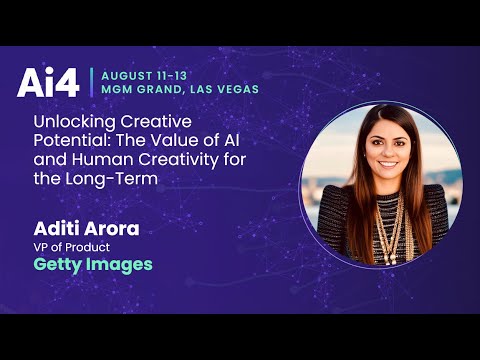
## Background Published on YouTube by the Ai4 channel on August 29, 2025, this session features Aditi Arora, VP of Product at Getty Images. According to the page description, the presentation explores the interplay between artificial intelligence and human creativity, highlighting the critical role of clean training datasets, commercial safety, copyright protection, and recurring creator compensation.
## TL;DR Aditi Arora presents Getty Images' vision for a collaborative AI ecosystem where generative technology amplifies rather than replaces human creativity. She demonstrates how rapidly shifting cultural and visual trends require continuous inputs of fresh, authentic human photography to avoid algorithmic bias and model collapse. To resolve enterprise concerns regarding copyright infringement and unfair labor practices, Getty Images developed a commercially safe AI model trained exclusively on its fully licensed catalog with built-in legal indemnification. Arora emphasizes that maintaining human creator compensation is vital because today's genuine human photography serves as the indispensable foundation for tomorrow's AI models.
## Atmosphere & style The presentation delivers a crisp, pragmatic, and polished keynote tone typical of an enterprise technology conference. Arora speaks with authoritative clarity and pacing, using concrete visual comparisons and proprietary trend data to ground high-level generative AI concepts. The delivery feels educational and reassuring, balancing the commercial momentum of AI adoption with a firm, principled advocacy for creator ethics and legal rigor.
## Detailed walkthrough ### [00:04](https://www.youtube.com/watch?v=OYDbhzmiKeE&t=4s) Introduction and the Scale of Getty Images
Aditi Arora opens the session by welcoming the audience as midday approaches, promising to keep the presentation engaging and fast-paced to leave ample time for audience questions. The core focus of her talk centers on the evolving relationship between artificial intelligence and human creativity. Before diving into the technical and creative implications of generative models, she provides background on Getty Images and its broader portfolio of brands, which includes iStock and Unsplash. The platform serves as a primary marketplace and creator of visual content for both creative and editorial endeavors, spanning news, media, and entertainment coverage.
On the creative side, Getty Images caters to a spectrum ranging from small and medium-sized businesses (SMBs) to major global enterprises, supplying visual assets for multi-channel marketing campaigns, brand identity systems, and outdoor advertising like billboards. She underscores the immense operational scale powering the platform:
- **Editorial Scope:** Covers approximately 160,000 events annually across news, media, and entertainment. - **Contributor Base:** Over 600,000 active contributors worldwide, with 82,000 working exclusively with Getty Images. - **Catalog & Traffic:** More than 625 million visual assets hosted on the platform, fielding roughly 2.7 billion searches each year. - **Visual GPS Research:** A proprietary global research initiative surveying over 7,000 professionals across 25 countries to track shifting cultural trends and visual perception insights.
```mermaid flowchart TD accTitle: Getty Images Ecosystem Architecture accDescr: Visual diagram showing the creator inputs, platform core assets, research, and outputs to business customers.
subgraph Inputs["1. Visual Sourcing"] A["600K+ Global Contributors<br/>(82K Exclusive)"] B["160K Editorial Events<br/>(News, Media, Sports)"] end
subgraph Platform["2. Getty Images Platform Core"] C["Catalog: 625M+ Assets"] D["Search Engine: 2.7B Queries/Yr"] E["Visual GPS Research<br/>(25 Countries / 7K+ Pros)"] end
subgraph Solutions["3. Outputs & Products"] F["SMB & Enterprise Campaigns"] G["Commercially Safe AI Generator"] end
Inputs --> Platform Platform --> Solutions ```
---
[02:13](https://www.youtube.com/watch?v=OYDbhzmiKeE&t=133s) The Generative AI Boom and the Collaborative Ecosystem
Arora addresses why generative AI has rapidly surged to the very top of mind for visual artists, marketers, and enterprise brands alike. Industry research reveals that 68% of creative professionals have integrated generative AI into their workflows over the past six months, while nearly half of global marketers currently rely on AI tools daily to generate images or video. Economically, the generative AI market is on a steep upward trajectory, expanding from an estimated $66 billion today toward $442 billion within the next five years. Moreover, the raw output volume has exploded: in 2024 alone, more than 12 billion AI-generated images were produced worldwide—far surpassing the total annual output of traditional professional photography.
Faced with this volume, Arora introduces Getty Images' core thesis: the future of visual content creation must be structured as a "collaborative AI ecosystem" rather than a zero-sum replacement of human effort. Generative AI models are only as capable as the foundation they are built upon, fundamentally requiring an ongoing stream of authentic, high-quality, and culturally nuanced visual material to produce meaningful and relevant results.
---
[03:47](https://www.youtube.com/watch?v=OYDbhzmiKeE&t=227s) Cultural Evolution and Real-World Visual Shifts
To illustrate why static or automated data pools quickly become obsolete, Arora walks the audience through a visual retrospective of the past decade. Using data from Getty’s Visual GPS program, she demonstrates how real-world visual trends directly mirror rapid societal shifts. At the onset of the COVID-19 pandemic in 2020, top platform downloads shifted abruptly to images of individuals wearing face masks in darkened, isolated home environments. Pre-pandemic, such imagery would have evoked confusion or alarm, whereas by 2022, visual trends normalized hybrid workspaces, digital overlays, and prominent representation of women of color in professional settings. By 2024, corporate visuals evolved further toward casual workplace collaboration and diverse women in executive leadership roles.
Similar generational transitions appear across multiple categories: - **Energy and Infrastructure:** Top visuals evolved from 2014 industrial oil rigs to 2024 imagery of electric vehicles plugged into curbside chargers. - **Mental Health:** Depictions moved away from clinical, isolated clichés of solitary individuals in dark rooms toward nuanced portrayals of employees actively managing stress within modern work environments. - **Family Dynamics:** Visuals diversified from traditional nuclear structures to multigenerational households, LGBTQ+ families, and single parents.
Arora engages the audience with a side-by-side comparison of two images—one shot by a camera and one generated by AI. When asking the audience to vote on which was real, she explains that while the second image was AI-generated, "it doesn't really matter if it's camera shot or AI generated. What matters is the emotion it evokes for the audience." As technology progresses and the visual gap closes, the decisive element becomes human intentionality and understanding the cultural context behind the visual.
---
[06:51](https://www.youtube.com/watch?v=OYDbhzmiKeE&t=411s) Data Quality, Model Collapse, and Creator Incentives
Arora details the mechanics of diffusion models, showing how high-quality, real-world images are transformed during model training through the addition of mathematical noise, which the network subsequently learns to denoise against semantic text captions. Because the model relies on this process to generate new imagery, the downstream output is directly bounded by the caliber of its inputs.
```mermaid flowchart LR accTitle: Generative Training and Ecosystem Feedback Loop accDescr: Diagram illustrating the lifecycle from human capture to training, generation, and contributor compensation.
subgraph Capture["1. Human Creation"] A["Photographers capture<br/>evolving real-world trends"] end
subgraph Training["2. Model Training"] B["High-quality clean data"] C["Noise addition & denoising"] end
subgraph Generation["3. Generative Output"] D["Authentic & unbiased visual output"] end
subgraph Feedback["4. Sustainable Loop"] E["Recurring contributor compensation"] end
A --> B --> C --> D D -.-> E -.-> A ```
Training datasets require accuracy, cultural diversity, and continuous updates to avoid skewed outputs or algorithmic bias. Arora warns against the trap of prioritizing volume over quality, highlighting the acute risk of **model collapse**: when newer generations of AI models are trained predominantly on synthetic, AI-generated content rather than genuine human photography, visual artifacts compound and overall model quality rapidly deteriorates.
This dynamic places human creators at the very center of AI sustainability: - Not paying human photographers disincentivizes them from capturing new, emerging real-world cultural moments. - Without fresh human photography, training data stagnates and AI models lose fidelity with modern society. - As Arora emphasizes: *"Today's pictures are tomorrow's training data set and the future of better models."*
---
[09:17](https://www.youtube.com/watch?v=OYDbhzmiKeE&t=557s) Commercially Safe AI and Legal Protection
Addressing enterprise adoption barriers, Arora outlines the primary friction points reported by Getty Images' corporate customers: legal exposure and copyright infringement lawsuits, lack of visual authenticity, and ethical concerns regarding creator compensation. In response, Getty Images developed a proprietary commercially safe generative AI model built strictly on its fully licensed, clean catalog.
| Feature Area | Standard Scraped Web Models | Getty Images AI Generator | |:--- |:--- |:--- | | **Training Data** | Scraped publicly from the web without consent | Curated, fully licensed, and clean metadata | | **IP Protection** | Produces trademarked logos (e.g., Nike swoosh on shoes) | Filters out infringing third-party intellectual property | | **Legal Security** | High risk of copyright liability for enterprises | Comprehensive commercial legal indemnification | | **Demographic Bias** | Stereotyped outputs (e.g., exclusively white male doctors) | Diverse, culturally accurate, and modern demographics | | **Creator Economics** | Zero revenue shared with original artists | Recurring financial compensation for catalog contributors |
Demonstrating real-world side-by-side outputs, Arora shows that prompting an open web-scraped AI tool for "running shoes" frequently renders copyrighted trademarks like the Nike swoosh because the underlying model scraped unlicensed commercial branding. In contrast, Getty's engine outputs trademark-free designs safe for commercial deployment. Similarly, prompts for medical staff in scraped models often default to stereotypical middle-aged white male doctors, whereas Getty's model produces representative healthcare teams that mirror modern hospital staff.
---
[11:45](https://www.youtube.com/watch?v=OYDbhzmiKeE&t=705s) Key Takeaways for Creators and Brands
Arora wraps up the session by directing attendees interested in deeper technical and commercial discussions to connect with her colleague Bailey, who is in attendance. She summarizes the fundamental guiding principles for working with generative media:
- **Know Your Why:** AI is an assistive amplifier for creative vision, not an outright substitute for human imagination and taste. - **Keep Models Relevant:** Because human culture and societal norms constantly shift, model training pipelines must continuously absorb contemporary human work. - **Know Your Tools:** Understand the provenance of training data, how the models were constructed, and what legal protections apply. - **Demand Fair Compensation:** Creators must receive recurring, fair payment for their work to sustain the underlying creative economy that feeds future generative systems. - **Stay Authentic:** A creator's personal viewpoint, contextual understanding, and unique human perspective remain their single greatest competitive advantage.
## Video description Aditi Arora, VP of Product, Getty Images
Abstract
Join Aditi Anora, VP of Product at Getty Images, for an engaging discussion on the interplay between AI and human creativity. This session will delve into how training data plays a crucial role in the effectiveness and quality of outputs—specifically how AI models can generate more authentic and culturally relevant visual content that is better reflective of modern society today. Aditi will highlight the importance of models being trained on transparent and clean data sets to avoid legal risks and safeguard intellectual property rights, as well as the nuances of developing AI models and tools that are high-quality and commercially safe. Lastly, the session will dive into the imperative of supporting content creators and recurring compensation to ensure that models are fueled responsibly, and technologies can be harnessed to push the boundaries of AI creativity versus hinder it.
[Source](https://www.youtube.com/watch?v=OYDbhzmiKeE)