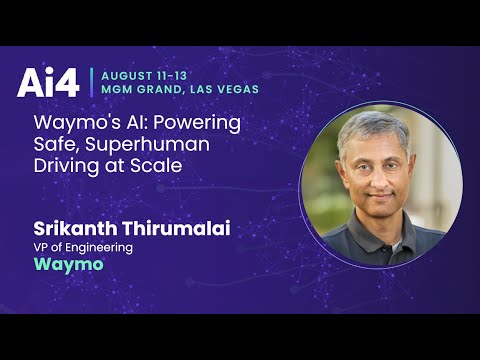
Waymo Distills Giant AI Models to Scale Driverless Fleets Safely
Ai4
Waymo scales its autonomous fleet by distilling massive AI foundation models into lightweight student models that process multi-modal sensor data in real time under strict onboard latency limits.
## Background
This presentation was delivered by Srikanth Thirumalai, VP of Engineering at Waymo, on YouTube via the Ai4 channel on August 24, 2025. According to the page description, it offers a look under the hood at how multi-modal sensing, advanced AI models, and cutting-edge simulation enable the Waymo Driver to deliver safe, superhuman driving performance as the company scales.
## TL;DR
Srikanth Thirumalai explains how Waymo tackles the challenges of real-world embodied AI using its 5th-generation multi-modal sensor suite and the Waymo Foundation Model. He details the company's dual-path vision-language approach and its teacher-student distillation pipeline, which converts massive models into low-latency onboard system components and cloud simulators. The talk highlights how Waymo uses rigorous simulation test beds to mathematically quantify safety, citing dramatic crash-reduction metrics and real-world edge-case examples to demonstrate the system's readiness at scale.
## Atmosphere & style
The presentation maintains a highly technical, authoritative, and deeply earnest tone as Thirumalai skips generic marketing pitches to dive straight into engineering substance. Driven by the urgent global reality of traffic fatalities, the narrative builds a compelling, logical progression from complex real-world sensor data to cutting-edge AI architecture. Watching the talk feels like a masterclass in autonomous safety, blending cool analytical precision with impactful real-world demonstration videos that underline human lives being saved.
## Key takeaways
- [00:04](https://www.youtube.com/watch?v=jrSNcEPWuhE&t=4s) Srikanth Thirumalai introduces the Waymo Driver, an autonomous driving system built to address the global crisis of over one million annual road fatalities.
- [00:04](https://www.youtube.com/watch?v=jrSNcEPWuhE&t=4s) Waymo operates at scale with over 100 million driverless miles logged across major US cities and in extreme weather conditions.
- [00:28](https://www.youtube.com/watch?v=jrSNcEPWuhE&t=28s) Embodied AI in autonomous driving faces three main obstacles: extreme real-world complexity, high safety risks, and sub-second latency requirements.
- [00:28](https://www.youtube.com/watch?v=jrSNcEPWuhE&t=28s) The 5th-generation Waymo vehicle uses a multi-modal sensor suite comprising 29 cameras, 5 LiDARs, 6 radars, and 4 audio receivers for full 3D perception.
- [04:55](https://www.youtube.com/watch?v=jrSNcEPWuhE&t=295s) The Waymo Foundation Model uses an encoder-decoder architecture paired with a driving VLM in a dual-path paradigm for high-level reasoning and low-level control.
- [11:02](https://www.youtube.com/watch?v=jrSNcEPWuhE&t=662s) Waymo fine-tunes its foundation model into three massive Teacher Models: Driver Teacher, Simulator Teacher, and Evaluator Teacher.
- [11:02](https://www.youtube.com/watch?v=jrSNcEPWuhE&t=662s) Through knowledge distillation, heavy Teacher Models are compressed into lightweight Student Models for real-time onboard execution and cloud simulation.
- [15:26](https://www.youtube.com/watch?v=jrSNcEPWuhE&t=926s) Waymo relies on a data-driven readiness framework to mathematically quantify residual risk before releasing any software candidate.
- [15:26](https://www.youtube.com/watch?v=jrSNcEPWuhE&t=926s) Across 71 million driverless miles, Waymo demonstrated an 85% reduction in serious injury crashes compared to human drivers.
- [20:25](https://www.youtube.com/watch?v=jrSNcEPWuhE&t=1225s) Multi-modal sensing like LiDAR enables early detection of hidden hazards, such as seeing reflections under a bus to predict occluded pedestrians.
- [20:25](https://www.youtube.com/watch?v=jrSNcEPWuhE&t=1225s) Earning trust at scale requires an end-to-end ecosystem combining foundation models, distillation, and rigorous safety validation.
## Detailed walkthrough
Here is a detailed, faithful walkthrough of the provided transcript segment:
[00:04](https://www.youtube.com/watch?v=jrSNcEPWuhE&t=4s) Solving the Urgency of Autonomous Driving at Scale
Srikanth Thirumalai introduces himself as the head of the onboard engineering team at Waymo, which develops and refines the "Waymo Driver"—their fully autonomous driving system. Bypassing a marketing video to dive straight into the technical substance, Thirumalai presents a staggering global statistic: over one million people die in road accidents every year, with the vast majority caused by human error. This urgent safety problem drove the effort that began 15 years ago as a Google project before spinning off eight years ago into an independent company aimed at building the world's most trusted autonomous driver.
Today, Waymo operates at immense scale:
- Logged over **100 million miles** on public roads in fully driverless mode.
- Serves paying customers across five major US cities: San Francisco, Los Angeles, Phoenix, Austin, and Atlanta, with plans for further expansion next year.
- Testing internationally and across extreme weather conditions, including heavy snow, torrential rain, and dry desert heat (such as in Las Vegas).
[00:28](https://www.youtube.com/watch?v=jrSNcEPWuhE&t=28s) The Challenges of Real-World Embodied AI
Operating an autonomous vehicle relies on "embodied AI" running directly inside the car, presenting three primary challenges:
1. **Real-World Complexity:** The driving environment is inherently messy, unpredictable, and cluttered with edge cases—such as stray cyclists, toddlers on the loose, falling truck debris, fallen trees, flooded roads, and distracted human drivers.
2. **Safety-Critical Nature:** Unlike low-stakes software, the cost of an error in physical traffic is extremely high.
3. **Sub-Second Latency:** Cloud-based generative AI systems can take seconds to generate answers, but embodied driving AI must compute safe driving decisions within milliseconds.
To handle this messiness, Waymo uses a multi-modal hardware architecture paired with state-of-the-art AI. The 5th-generation Waymo vehicle equips:
- **29 cameras**
- **5 LiDARs**
- **6 radars**
- **4 audio receivers**
Together, these sensors deliver a complete, real-time 3D view of the surroundings. In one illustrative scenario, two dogs chase a ball into the street followed by two humans running after them; the combined sensor suite detects the chaos early, allowing the vehicle to brake safely.
[04:55](https://www.youtube.com/watch?v=jrSNcEPWuhE&t=295s) Vision-Language Models and the Waymo Foundation Model
While popular AI relies on the "bitter lesson" (scaling compute and data), achieving autonomous driving at scale requires more than just a driver—it demands a robust simulator to test edge cases, a critic to evaluate performance, and a quantitative framework to prove safety readiness.
Standard Vision-Language Models (VLMs) possess vast world knowledge and strong chain-of-thought reasoning—such as analyzing a complex street sign to determine that parking is allowed for one hour at 4:00 PM on a Wednesday. However, off-the-shelf VLMs cannot handle raw LiDAR/radar inputs, cannot natively output low-level control actions (steering, acceleration, braking), and are far too slow for real-time onboard driving.
To bridge this gap, Waymo built the **Waymo Foundation Model**, an encoder-decoder architecture:
- **Encoder (Sensor Fusion Network):** Fuses spatial and temporal data across camera, LiDAR, and radar feeds into tokenized embeddings.
- **Action Decoder:** Functions similarly to a transformer decoder, translating embeddings into physical action sequences while predicting the behavior of surrounding road agents.
- **Driving VLM Integration:** Operates alongside the sensor fusion network to provide high-level reasoning. In a "thinking fast and slow" dual-path paradigm, the driving VLM interprets complex scenarios—such as recognizing a stalled vehicle with hazard lights as being in distress and deciding to safely nudge around it rather than wait indefinitely.
[11:02](https://www.youtube.com/watch?v=jrSNcEPWuhE&t=662s) Distilling Teacher Models into Onboard Students
To deploy the Waymo Foundation Model across operational needs, Waymo fine-tunes it into three specialized, high-capacity **Teacher Models**:
1. **Driver Teacher:** Fine-tuned on human driving demonstrations and annotated logs from 100 million autonomous miles (including human-curated corrections). It utilizes behavioral cloning and reinforcement learning as post-training steps to generate safe, smooth action sequences.
2. **Simulator Teacher:** Functions as a closed-loop "world model" fine-tuned on driving logs to simulate how the world evolves step-by-step. It generates challenging, edge-case scenarios like near-misses, highway spin-outs, severe weather, and chaotic intersections.
3. **Evaluator (Critic) Teacher:** Analyzes simulation and real-world logs using supervised fine-tuning on annotated human feedback, internal documentation, and bug reports to catch instances of improper driving behavior.
Because these massive teacher models are too computationally heavy to run real-time in the car or across hundreds of millions of simulated miles in the cloud, Waymo uses **knowledge distillation**. They distill the teachers into compact **Student Models** optimized to meet strict onboard latency constraints and off-board simulation budget limits.
[15:26](https://www.youtube.com/watch?v=jrSNcEPWuhE&t=926s) Quantifying Safety and Real-World Impact
To determine if a software release is safe for public deployment, Waymo relies on a data-science-driven readiness framework developed over more than a decade. Rather than guessing, Waymo mathematically quantifies the "residual risk" of any software update across key vectors:
- Collision and near-miss frequency
- Improper stops, strandings, and software crashes
- Cybersecurity vulnerabilities and overall passenger comfort
By running software candidates through standardized simulation test beds and extrapolating failure rates to real-world driving frequencies, Waymo objectively validates software readiness.
This safety-first approach is backed by performance metrics evaluated across 71 million driverless miles:
- **88% reduction** in crashes resulting in serious injuries compared to human drivers.
- **79% reduction** in crashes where airbags were deployed.
- **78% reduction** in overall injury-causing crashes.
Thirumalai highlights two real-world examples demonstrating the system's safety in action:
- **Nighttime K-rail obstruction:** In pitch darkness, two pedestrians jumped over a concrete K-rail partition into the street. Though visually unidentifiable to the human eye and cameras, Waymo's LiDAR detected them instantly, allowing the vehicle to adjust its path and avoid a collision.
- **San Francisco intersection:** Near a SF Muni bus blocking an intersection, the driver green-lighted forward movement but slowed as its peripheral sensors detected a pedestrian walking out from behind the occluding bus.
<ElicitationsGroup message="Where would you like to explore next?">
<Elicitation label="Summarize the core technical architecture" query="Summarize the core technical architecture of the Waymo Driver foundation model and teacher-student pipeline."/>
<Elicitation label="Break down the 5th gen sensor suite" query="Break down the sensor suite of Waymo's 5th generation autonomous vehicle."/>
</ElicitationsGroup>
[020:25] Spotting Shadows and Earning Trust at Scale
Demonstrating the precision of multi-modal sensing in real-world edge cases, Srikanth Thirumalai highlights an example where LiDAR sensors pick up a person's reflection from underneath a bus. Even with only sparse scan information available, the Waymo Driver is able to predict that a pedestrian is obscured on the other side of the vehicle and likely about to step out into the road. Recognizing this hidden danger prompts the autonomous vehicle to proactively slow down and avoid a potential collision with the human.
Reflecting on these real-world scenarios, Thirumalai emphasizes that such videos serve as powerful reminders of what is truly at stake for embodied AI on the roads—human lives. Achieving the vision of building the world's most trusted driver requires far more than standalone AI algorithms. It demands an end-to-end operational and technological ecosystem: training massive foundation models, adapting them specifically to the unique nuances of self-driving, distilling those capabilities into efficient student models that can operate both onboard the vehicle and in the cloud at lower cost, and establishing a rigorous validation framework to continuously quantify safety. Ultimately, this complete process enables Waymo to affirmatively answer its two core business questions: whether the Waymo Driver is safe, and whether it can scale.
- **Key Perception Capability:** LiDAR sensors can detect sparse reflections underneath obstacles (such as buses) to anticipate occluded pedestrians before they come into direct view.
- **System Architecture Requirement:** Successfully deploying embodied AI requires a full pipeline consisting of foundation models, domain adaptation, lightweight student models for on-car and cloud deployment, and quantifiable safety assurance processes.
- **Core Business Milestones:** Waymo's technical architecture and safety validation pipeline prove that the autonomous system is both fundamentally safe and capable of scaling.
## Notable quotes
> [00:04](https://www.youtube.com/watch?v=jrSNcEPWuhE&t=4s) over one million people die in road accidents every year, with the vast majority caused by human error. — Srikanth Thirumalai
> [00:04](https://www.youtube.com/watch?v=jrSNcEPWuhE&t=4s) Logged over 100 million miles on public roads in fully driverless mode. — Srikanth Thirumalai
> [00:28](https://www.youtube.com/watch?v=jrSNcEPWuhE&t=28s) The driving environment is inherently messy, unpredictable, and cluttered with edge cases — Srikanth Thirumalai
> [00:28](https://www.youtube.com/watch?v=jrSNcEPWuhE&t=28s) Unlike low-stakes software, the cost of an error in physical traffic is extremely high. — Srikanth Thirumalai
> [00:28](https://www.youtube.com/watch?v=jrSNcEPWuhE&t=28s) Cloud-based generative AI systems can take seconds to generate answers, but embodied driving AI must compute safe driving decisions within milliseconds. — Srikanth Thirumalai
> [04:55](https://www.youtube.com/watch?v=jrSNcEPWuhE&t=295s) while popular AI relies on the "bitter lesson" (scaling compute and data), achieving autonomous driving at scale requires more than just a driver — Srikanth Thirumalai
> [04:55](https://www.youtube.com/watch?v=jrSNcEPWuhE&t=295s) Off-the-shelf VLMs cannot handle raw LiDAR/radar inputs, cannot natively output low-level control actions (steering, acceleration, braking), and are far too slow for real-time onboard driving. — Srikanth Thirumalai
> [11:02](https://www.youtube.com/watch?v=jrSNcEPWuhE&t=662s) Because these massive teacher models are too computationally heavy to run real-time in the car or across hundreds of millions of simulated miles in the cloud, Waymo uses knowledge distillation. — Srikanth Thirumalai
> [15:26](https://www.youtube.com/watch?v=jrSNcEPWuhE&t=926s) Rather than guessing, Waymo mathematically quantifies the "residual risk" of any software update — Srikanth Thirumalai
> [15:26](https://www.youtube.com/watch?v=jrSNcEPWuhE&t=926s) 88% reduction in crashes resulting in serious injuries compared to human drivers. — Srikanth Thirumalai
> [15:26](https://www.youtube.com/watch?v=jrSNcEPWuhE&t=926s) 79% reduction in crashes where airbags were deployed. — Srikanth Thirumalai
> [20:25](https://www.youtube.com/watch?v=jrSNcEPWuhE&t=1225s) LiDAR sensors pick up a person's reflection from underneath a bus. Even with only sparse scan information available, the Waymo Driver is able to predict that a pedestrian is obscured on the other side of the vehicle — Srikanth Thirumalai
> [20:25](https://www.youtube.com/watch?v=jrSNcEPWuhE&t=1225s) Achieving the vision of building the world's most trusted driver requires far more than standalone AI algorithms. — Srikanth Thirumalai
## Mentioned
Srikanth Thirumalai, Waymo, Waymo Driver, Google, San Francisco, Los Angeles, Phoenix, Austin, Atlanta, Las Vegas, 5th-generation Waymo vehicle, LiDAR, Vision-Language Models, Waymo Foundation Model, Driver Teacher, Simulator Teacher, Evaluator (Critic) Teacher, Student Models, SF Muni
## Video description
Srikanth Thirumalai, VP of Engineering, Waymo
Abstracts
Get a peek under the hood of the Waymo Driver as we share about the technology that enables our rapid growth. Autonomous driving is uniquinely challenging, and this presentation will show how multi-modal sensing, advanced AI models, and cutting-edge simulation deliver superhuman driving performance. At Waymo, our mission is to build the world's most trusted driver. Discover how we go about earning that trust by pushing the boundaries of AI for the future of transportation.
Waymo head of onboard engineering Srikanth Thirumalai argues that deploying safe autonomous driving at scale requires more than standalone AI algorithms; it demands an integrated ecosystem combining multi-modal sensing, domain-adapted foundation models, knowledge distillation, and mathematical risk quantification.
Embodied AI and Multi-Modal Perception (0:28)
Addressing a global crisis where over one million people die annually in road accidents—primarily due to human error—Waymo operates "embodied AI" directly inside its vehicles. Thirumalai notes that unlike cloud-based generative AI, which can take seconds to respond, autonomous driving software must navigate messy, safety-critical environments and compute decisions within milliseconds. It must handle unpredictable edge cases ranging from toddlers and stray cyclists to falling truck debris, fallen trees, flooded roads, and distracted human drivers.
To perceive this environment, Waymo's fifth-generation vehicle pairs AI with 29 cameras, five LiDARs, six radars, and four audio receivers to build a real-time 3D view. Thirumalai illustrates the value of this multi-modal suite through several real-world encounters: braking safely for two dogs and two humans chasing a ball into the street; using LiDAR in pitch darkness to spot two pedestrians jumping over a concrete K-rail partition when cameras and the human eye could not see them; and detecting the sparse LiDAR reflection of a pedestrian underneath an occluding San Francisco Muni bus to predict their movement and slow down proactively.
Adapting Foundation Models for Physical Control (4:55)
While standard Vision-Language Models (VLMs) offer broad world knowledge and chain-of-thought reasoning—such as deciphering a complex street sign to confirm parking is permitted for one hour at 4:00 PM on a Wednesday—they cannot process raw LiDAR or radar inputs, output low-level steering and braking controls, or meet real-time onboard latency requirements.
To overcome these limits, Waymo developed the Waymo Foundation Model using an encoder-decoder architecture. A sensor fusion encoder converts spatial and temporal data from cameras, LiDAR, and radar into tokenized embeddings, which an action decoder translates into physical driving sequences while predicting the behavior of surrounding road agents. Alongside this network, an integrated driving VLM operates in a "thinking fast and slow" dual-path paradigm, providing high-level reasoning in complex situations—such as recognizing a stalled vehicle with hazard lights as being in distress and deciding to safely nudge around it rather than wait indefinitely.
Distilling Teacher Models for Car and Cloud (11:02)
Thirumalai emphasizes that scaling autonomous driving requires not only a driver, but also a simulator to test edge cases and a critic to evaluate performance. Waymo fine-tunes its foundation model into three specialized, high-capacity "Teacher Models." The Driver Teacher uses behavioral cloning and reinforcement learning on human demonstrations and curated logs from 100 million autonomous miles to generate smooth action sequences. The Simulator Teacher acts as a closed-loop world model to generate challenging scenarios like near-misses, highway spin-outs, and severe weather, while the Evaluator (Critic) Teacher uses supervised fine-tuning on human feedback, internal documentation, and bug reports to flag improper driving.
Because these massive teacher models are too computationally heavy to run in real time inside a car or across hundreds of millions of simulated cloud miles, Waymo relies on knowledge distillation. The company compresses the teachers into compact "Student Models" optimized to meet strict onboard latency constraints and off-board simulation budgets.
Quantifying Residual Risk and Real-World Safety (15:26)
Having begun as a Google project 15 years ago before spinning out into an independent company eight years ago, Waymo has logged over 100 million fully driverless miles on public roads. It currently serves paying customers in San Francisco, Los Angeles, Phoenix, Austin, and Atlanta, with further expansion planned next year alongside international and extreme-weather testing in heavy snow, torrential rain, and Las Vegas desert heat.
Before deploying any software release, Waymo uses a data-science readiness framework developed over more than a decade to mathematically quantify "residual risk." By running software candidates through standardized simulation test beds and extrapolating failure rates to real-world frequencies, Waymo evaluates collision and near-miss probabilities, improper stops, strandings, software crashes, cybersecurity vulnerabilities, and passenger comfort. Across 71 million evaluated driverless miles, Thirumalai reports that the system achieved an 88% reduction in crashes with serious injuries, a 79% reduction in airbag-deployment crashes, and a 78% reduction in overall injury-causing crashes compared to human drivers.
Thirumalai concludes that because human lives are at stake on public roads, embodied AI cannot rely solely on scaling raw compute and data. Proving that an autonomous driver is both fundamentally safe and commercially scalable requires unifying foundation models, domain-specific adaptation, cost-efficient student distillation, and continuous mathematical safety validation into a single operational pipeline.
[0:04] Srikanth Thirumalai: over one million people die in road accidents every year, with the vast majority caused by human error.
[0:04] Srikanth Thirumalai: Logged over 100 million miles on public roads in fully driverless mode.
[0:28] Srikanth Thirumalai: The driving environment is inherently messy, unpredictable, and cluttered with edge cases
[0:28] Srikanth Thirumalai: Unlike low-stakes software, the cost of an error in physical traffic is extremely high.
[0:28] Srikanth Thirumalai: Cloud-based generative AI systems can take seconds to generate answers, but embodied driving AI must compute safe driving decisions within milliseconds.
[4:55] Srikanth Thirumalai: while popular AI relies on the "bitter lesson" (scaling compute and data), achieving autonomous driving at scale requires more than just a driver
[4:55] Srikanth Thirumalai: Off-the-shelf VLMs cannot handle raw LiDAR/radar inputs, cannot natively output low-level control actions (steering, acceleration, braking), and are far too slow for real-time onboard driving.
[11:02] Srikanth Thirumalai: Because these massive teacher models are too computationally heavy to run real-time in the car or across hundreds of millions of simulated miles in the cloud, Waymo uses knowledge distillation.
[15:26] Srikanth Thirumalai: Rather than guessing, Waymo mathematically quantifies the "residual risk" of any software update
[15:26] Srikanth Thirumalai: 88% reduction in crashes resulting in serious injuries compared to human drivers.
[15:26] Srikanth Thirumalai: 79% reduction in crashes where airbags were deployed.
[15:26] Srikanth Thirumalai: 78% reduction in overall injury-causing crashes.
[20:25] Srikanth Thirumalai: LiDAR sensors pick up a person's reflection from underneath a bus. Even with only sparse scan information available, the Waymo Driver is able to predict that a pedestrian is obscured on the other side of the vehicle
[20:25] Srikanth Thirumalai: Achieving the vision of building the world's most trusted driver requires far more than standalone AI algorithms.
Original transcript
[0:04] Hello everyone. Uh my name is Shriant
[0:06] Dumalai and I lead the onboard
[0:08] engineering team at Whimo. My team
[0:11] develops and improves the Whimo driver
[0:13] which is what we call our fully
[0:16] autonomous driving system. And today I'm
[0:18] here to talk about how we're using AI to
[0:22] power um driving at scale safely and
[0:26] effectively.
[0:28] I'll skip this marketing video so I can
[0:31] spend more time on the actual content.
[0:33] So, let's start with this number. Why
[0:36] are we solving the self-driving car
[0:38] problem? Because this number tells us
[0:42] it's urgently needed. Every year, over a
[0:45] million people lose their lives in road
[0:49] accidents around the world, and the vast
[0:52] majority of them are due to human error.
[0:55] Now this is a saddening and staggering
[0:58] statistic and we should do better. We
[1:01] think we can do better and that's why 15
[1:05] years ago we started the Google we
[1:08] started off as the Google project before
[1:11] spinning off into a separate company
[1:14] about eight years ago with the lofty
[1:16] mission of building the world's most
[1:20] trusted autonomous driver. Now in this
[1:23] talk I'll share some details about how
[1:25] we do that at large scale using AI.
[1:31] So what kind of scale are we talking
[1:32] about? As of today, the Whimo driver has
[1:35] logged over 100 million miles on public
[1:38] roads
[1:40] in driverless mode and paying customers
[1:44] across five cities are able to hail
[1:47] rides in a Whimo in SF, in LA, in
[1:51] Phoenix, Austin, and Atlanta. Now, we
[1:54] have plans to expand our service to many
[1:56] more cities next year. And we're also
[1:59] testing our driver in even more cities,
[2:03] including internationally, under some
[2:05] really extreme weather conditions. Heavy
[2:08] snow, dry heat of the kinds we have here
[2:11] in Vegas and torrential rains. Now, the
[2:15] scale is huge as you can see from the
[2:17] number, but it's not daunting because we
[2:20] think we have the right approach to
[2:22] building our product to scale safely.
[2:24] And today, I'd like to share that
[2:26] approach with you.
[2:30] So first what makes this AI problem so
[2:33] challenging?
[2:35] Our AI first off our AI runs in the car
[2:40] in the real world. In that sense it's
[2:42] embodied AI and that presents three
[2:46] challenges that I've listed here. First,
[2:49] the real world is complex. It's
[2:51] unpredictable and it's just downright
[2:53] messy.
[2:54] Second, this autonomous driving problem
[2:58] is a safety critical problem. The cost
[3:00] of a mistake, as you can well imagine,
[3:03] is very high. And third, unlike
[3:06] generative AI that runs in the cloud, we
[3:09] don't get seconds to make driving
[3:11] decisions. Our embodied AI has to make
[3:15] decisions in a matter of milliseconds.
[3:19] And here are some examples of the
[3:22] messiness that we have to deal with on
[3:24] the roads. You know, stray cyclists,
[3:27] toddlers on the loose, debris falling
[3:30] off of trucks, fallen trees, flooded
[3:34] roads,
[3:35] distracted drivers, you name it. So, how
[3:39] do we deal with all of this complexity?
[3:43] The short answer is with powerful
[3:46] sensors and state-of-the-art AI. You
[3:49] know, our cars are outfitted
[3:52] with sensors of multiple modalities. The
[3:55] current generation Whimos, our fifth
[3:57] generation car, have 29 cameras, five
[4:02] LARs, six radars, and four audio
[4:06] receivers that give us a comprehensive
[4:09] and accurate 3D view of the world around
[4:12] the car. And here's a scene
[4:16] of two dogs chasing after a ball and two
[4:18] humans chasing after the dogs. And all
[4:21] of this is happening in front of us, but
[4:23] our sensors are able to pick all of this
[4:25] up and give the software the information
[4:28] which leads the car to stop.
[4:31] Now, the video on the bottom shows you
[4:34] what our cameras pick up, and the video
[4:37] on the top kind of shows you what our
[4:40] lightars and radars pick up. But just
[4:43] having good, powerful multimodal sensing
[4:46] isn't enough. We need great software.
[4:50] And I'll go over that in the upcoming
[4:52] slides.
[4:55] Now, a lot of people think, well, how
[4:57] hard can this be? Just build a great
[5:00] driver using the latest AI and throw a
[5:03] lot of training data at it and we'll be
[5:05] done, right? After all, isn't that what
[5:08] the bitter lesson in AI is all about? I
[5:11] mean, I'm here to say, yes, you need a
[5:13] great driver. You need a great AI
[5:15] driver, but there's a whole lot more
[5:17] that you need. You need a good simulator
[5:20] to test the driver's performance in
[5:23] challenging situations. You need a good
[5:25] critic to evaluate how well the driver
[5:28] performed. And finally, you need a way
[5:32] to tell if your driver is ready for full
[5:36] autonomy. And to scale successfully, you
[5:39] need to have solved all these problems.
[5:41] Well, in the next slides, I'll share
[5:45] with you how we're leveraging AI to
[5:47] solve these problems.
[5:50] Now, let's start off with vision
[5:52] language models. You know, everyone
[5:54] knows them. They're all the rage these
[5:56] days. You probably use it in your
[5:59] personal lives every day. They're
[6:00] amazing and they're getting better by
[6:03] the day.
[6:04] Many of you in this room are also
[6:06] building products powered by them and
[6:09] they're trained on all of the data
[6:11] available on the internet and as a
[6:14] result they have broad world knowledge
[6:17] and some of these frontier VLMs are also
[6:19] very good at chain of thought reasoning.
[6:23] These VLMs are multimodal in that they
[6:26] take videos, images, and text as input
[6:30] and produce those modalities as outputs.
[6:32] And they're foundation models. They're
[6:34] incredibly flexible and can be adapted
[6:37] to various tasks. So, we decided to look
[6:40] at vision language models and see how
[6:43] good they are and whether we could use
[6:44] them for self-driving. Um, and so here's
[6:47] an example
[6:49] uh that showcases their abilities.
[6:52] Now, let's say it's Wednesday at 4 p.m.
[6:56] and you want to know whether you can
[6:58] park at this sign. For humans, you have
[7:01] to read each sign carefully, parse what
[7:03] it's trying to say, reason across all of
[7:05] the information present in all of the
[7:07] signs before you actually decide whether
[7:08] you can park. But these VLMs are pretty
[7:10] good. You know, they can take that image
[7:12] and they can tell you that, yeah, it's 4
[7:14] p.m. on a Wednesday. You can park here
[7:15] for one hour. That's pretty impressive.
[7:19] Now, now what? So, can we use this for
[7:24] self-driving? The answer is not quite.
[7:28] Not without a lot of um me a second. Not
[7:32] without a lot of fine-tuning to adapt
[7:35] them to the problem of self-driving.
[7:38] Now, some of these, you know, of course,
[7:40] some of these are obvious, like what are
[7:42] the what do we need to do? As I said,
[7:45] Whimo uses multiple sensing modalities.
[7:48] We use lightars and radars. Certainly,
[7:50] these VLMs have not been trained with
[7:51] that data. Um, they certainly can't
[7:54] right out of the box
[7:56] convert that sensory information about
[7:59] the environment into action sequences
[8:02] like acceleration, steering, and braking
[8:04] that the car can execute. And most
[8:07] importantly, they can't do this in real
[8:09] time. Like I just mentioned now, they
[8:12] need a lot of work to adapt them to the
[8:14] complexities of real world driving.
[8:19] So the first step is to do precisely
[8:22] that adapt them to the self-driving
[8:24] task. So we built a foundation model to
[8:28] solve all of the challenges that I told
[8:29] you about which is that you need a good
[8:31] driver, you need a good simulator, and
[8:34] you need a good evaluator if you want to
[8:37] use cutting edge AI to solve the
[8:38] self-driving problem. And so we built
[8:41] this foundation model which we call the
[8:43] Whimo foundation model. And basically
[8:46] it's an encoder decoder model. On the
[8:48] encoder side, you know, we have the
[8:51] sensor fusion network, which is really
[8:53] an encoder, a multimodal encoder that
[8:56] takes camera, LAR, and radar as three
[8:59] inputs and then fuses information across
[9:02] those three modalities and also fuses
[9:04] that information over time to produce
[9:08] tokenized embeddings, which is then I
[9:11] mean these tokenized embeddings are then
[9:12] sent to an action decoder, which is very
[9:16] much like a regular transformer decoder
[9:19] that you have in some of these vision
[9:21] language models. And what that action
[9:23] decoder does is it decodes, you know,
[9:26] that input into action sequences that
[9:30] the car can execute. Um the decoder also
[9:34] predicts the behavior of other agents on
[9:36] the road and makes a few other
[9:39] predictions. Now these two models, the
[9:41] sensor fusion network and the action
[9:43] predict action decoder, they have access
[9:46] to some but not all the world knowledge
[9:49] that a VLM might have. And they also
[9:53] don't have the reasoning abilities,
[9:54] right, that VLMs have. And so the thing
[9:58] to do is to add a driving VLM, you know,
[10:01] to this to the setup. And what this
[10:04] driving BLM is able to do because it's
[10:06] adapted to the driving problem is that
[10:08] it's able to understand complex
[10:09] scenarios that unfold on the road and
[10:11] also reason about highle actions that
[10:14] the car needs to take in response. For
[10:17] instance, let's say the car sees another
[10:20] vehicle stranded on the roads with its
[10:22] blinkers on. Now it might reason the
[10:25] vehicle is in distress and can't move
[10:28] and what it has to do instead is to
[10:31] rather than wait for the car to proceed,
[10:33] it has to nudge around it and make
[10:35] progress. Now that's what these driving
[10:38] VLMs can do with their reasoning
[10:39] ability. And so these BLM tokens when
[10:42] used along with the sensor fusion
[10:44] network tokens improve the quality of
[10:48] the Whimo Foundation model and its
[10:50] predictions. sort of like thinking fast
[10:53] and slow where the upper path is
[10:55] thinking fast the lower path is thinking
[10:57] slow it's thinking slow but doing that
[10:59] simultaneously
[11:02] now having built this Whimo foundation
[11:05] model and it is a foundation model it's
[11:08] versatile it's flexible um we'd like to
[11:11] build our tech stack on top of it to
[11:13] solve the challenges that I alluded to
[11:15] earlier a good driver a good simulator
[11:19] and a good evaluator and the way we do
[11:21] that is we adapt the Whimmer Foundation
[11:23] model to these three specific tasks to
[11:26] produce large highquality teacher models
[11:30] that are adept at their respective
[11:32] tasks. And the teacher models of course
[11:35] are too big to run in the car or in the
[11:38] cloud to simulate um and evaluate the
[11:42] hundreds of millions of miles of driving
[11:44] that we need to. And so we use
[11:46] distillation. We distill those teacher
[11:49] models into smaller models that we call
[11:52] student models uh that are practical for
[11:56] us to run in the car or in the cloud in
[12:00] our simulation and evaluation
[12:03] so that they meet our latency and cost
[12:05] needs.
[12:06] So here it is at a 30,000 ft level. This
[12:10] is how we're leveraging cutting edge AI
[12:13] to solve our problem.
[12:19] Now, in the next three slides, I'll deep
[12:21] I'll dive deeper into the three teacher
[12:24] models and what they do.
[12:26] This is our first teacher model, the
[12:28] driver teacher. And the goal of this
[12:31] teacher model is to generate safe and
[12:33] compliant action sequences for the car
[12:36] to execute so that the car can move
[12:39] smoothly and comfortably as it makes
[12:42] progress towards its destination.
[12:46] And this model is fine-tuned with human
[12:49] driving demonstrations. We have human
[12:51] drivers that drive the car that provide
[12:52] it with training data. And so it's
[12:54] fine-tuned on those driving
[12:56] demonstrations. It's also fine-tuned on
[13:00] the 100 million miles that I just
[13:02] referred to in the past of autonomous
[13:04] driving that we have annotated with
[13:06] humans and algorithms
[13:09] um for when the car got it wrong and
[13:12] what it needs to do instead if it did.
[13:15] Now we're leveraging training techniques
[13:18] like behavior cloning and reinforcement
[13:20] learning as post-training steps. uh when
[13:22] we produce this uh teacher.
[13:26] The second teacher model is a simulator
[13:28] model and this model's goal is to
[13:31] generate realistic diverse scenarios in
[13:35] challenging situations
[13:37] uh including accidents, you know, near
[13:39] misses, inclement weather, complex
[13:42] intersections,
[13:44] even vehicles losing control, you know,
[13:47] on freeways.
[13:49] And this teacher model is also
[13:52] fine-tuned on all our driving logs, but
[13:55] it's fine-tuned on the simulation task
[13:58] of predicting how the world evolves with
[14:01] every time step. You may have heard the
[14:02] term world model. That's what this is
[14:04] trying to achieve.
[14:06] Now, this model is post-trained with
[14:10] very similar sort of, you know, post-
[14:12] training techniques, state-of-the-art
[14:14] techniques, closed loop training and
[14:15] reinforcement learning.
[14:19] And the final model, the final teacher
[14:20] model is the critic model or the
[14:22] evaluation teacher. And this model's
[14:25] goal is to analyze, understand, and
[14:29] detect notable events that may indicate
[14:33] bad driving.
[14:35] Among other things, you know, this model
[14:37] is trained with driving runs that humans
[14:40] have annotated with information on what
[14:42] the car did poorly or other events of
[14:45] note, what the car should have done in
[14:48] those situations.
[14:50] You know, other sources of information
[14:52] like way more internal docs and bugs
[14:54] also provide rich information to these
[14:57] models. And the teacher is kind of
[14:59] fine-tuned on that evaluation task which
[15:01] is different from the simulation task
[15:03] and the driver task which is detecting
[15:06] bad behavior uh when you analyze
[15:08] simulation logs or driving logs and
[15:11] again it uses supervised fine-tuning.
[15:16] So now you've seen the three teachers
[15:18] for the three different tasks and we
[15:20] also talked about how these teachers are
[15:22] distilled into smaller models that run
[15:24] in the car or in the cloud. Let's talk
[15:27] about the last challenge which is how do
[15:29] we tell if the Whimo driver is ready for
[15:33] the road
[15:35] because scaling safely needs more than
[15:39] just great AI models. We need a
[15:42] framework to determine the readiness of
[15:45] the driver. And we've developed a very
[15:49] comprehensive readiness and safety
[15:52] framework over the years thanks to our
[15:56] more than a decade long uh experience in
[16:00] this space and we follow this readiness
[16:03] and safety framework
[16:05] for any software update to the Whimo
[16:07] driver. We put it through this process
[16:09] to quantify the driver's readiness.
[16:13] Now the word quantify is really
[16:16] important because you can build a
[16:18] powerful AI. You can to drive the car.
[16:21] You can run it through a great
[16:22] simulator. You can build a powerful
[16:24] critic to detect poor performance.
[16:28] But how do you tell how much safety risk
[16:30] you're carrying in any given driver
[16:33] version?
[16:35] In other words, how often do you expect
[16:38] this model to perform poorly in the
[16:41] normal course of driving on the roads?
[16:44] That's a really important question. And
[16:46] in order to quantify the residual risk
[16:48] in the driver, first you need to know
[16:51] what to look for. collisions,
[16:54] rear uh near misses, improper stops and
[16:58] strandings, software crashes,
[17:01] security vulnerabilities,
[17:04] overall drive quality, and a whole lot
[17:06] more which I can't cover here. And then
[17:09] you need to build driving sets that you
[17:11] can simulate and use the occurrences of
[17:14] poor driving in simulation and
[17:18] extrapolate from that
[17:20] um to get some sense of the frequency
[17:23] with which these events are likely to
[17:25] occur on the road. And all this needs
[17:30] expert judgment
[17:32] and years of experience to know what to
[17:34] look for, how to construct these driving
[17:37] sets, and how to extrapolate this
[17:40] information to rates that you're likely
[17:42] to observe, right, in real world
[17:44] driving. And this requires cutting edge
[17:46] data science. It's a rigorous and
[17:49] comprehensive process that quantifies
[17:52] the residual safety risk in the car at
[17:55] any given operating scale. So let's
[17:57] reflect on the whole picture. Foundation
[18:00] model teachers, foundation models,
[18:03] teachers that adapt adapted from those
[18:05] foundation models, students that are
[18:07] distilled from those teachers and this
[18:09] readiness framework and process. We do
[18:12] all this to create that safe um and
[18:15] scalable driving experience.
[18:18] So, let's see if we're actually doing
[18:20] it. Now, I'm happy to say that the Whimo
[18:23] approach to scaling safely is working.
[18:26] I'm very proud of our safety record and
[18:29] the positive impact we've made on public
[18:31] roads. We analyzed 71 million miles of
[18:36] driving data
[18:38] and found that the Whimo driver reduced
[18:41] the amount of crashes involving serious
[18:44] injuries by 88%. It reduced the number
[18:48] of crashes where airbags were deployed
[18:51] by 79%
[18:53] and it reduced the overall injury
[18:56] producing crashes by 78%. Now these just
[19:00] these are just statistics. Let me
[19:02] actually show you actual events of the
[19:05] Whimo driver protecting people like you
[19:07] and me.
[19:09] Now, in this scene, you'll see our LAR
[19:12] sensors see two people jumping over a K
[19:16] rail partition on the road onto the road
[19:18] in the dead of night. It's dark and you
[19:22] can't see them with a naked eye and our
[19:24] cameras also don't quite pick them up,
[19:25] but our light are able to see them. And
[19:28] using that information, the car nudges
[19:29] away from the car rails, anticipating
[19:31] the trajectory of these two humans, and
[19:33] safely avoids them. And you'll see our
[19:36] LAR picking up those two people that are
[19:38] trying to jump over the the KRL.
[19:41] Now, this is how our LAR
[19:44] helping us improve the safety of uh the
[19:46] Whimo driver. Now, here's another
[19:48] example in broad daylight. You know,
[19:51] there's this is an this is an image of a
[19:54] a busy a street intersection in San
[19:56] Francisco, and you see this MUN bus um
[20:00] blocking the intersection. And so the
[20:02] question is what will the Whimo driver
[20:04] do as it approaches this intersection?
[20:06] You know, our light turns green and we
[20:08] have to proceed. So let's see how this
[20:10] unfolds.
[20:12] As you can see, you know, as the bus as
[20:15] the bus proceeds, we detect a a a person
[20:21] oluded by the bus. And the way we detect
[20:23] this person is because our peripheral
[20:25] LAR sensors pick up this person's
[20:27] reflection uh from underneath the bus.
[20:30] And so we use that sparse scanned
[20:33] information to predict that there's a
[20:35] human on the other side of the bus who's
[20:37] likely to come around. And that causes
[20:39] us to slow down um and avoid the human.
[20:42] Now these videos are powerful reminders
[20:45] of what's at stake for embodied AI on
[20:48] the roads. It's people, its lives. And
[20:51] AI alone is not enough to build a
[20:54] trusted driver. You need this whole
[20:56] process. You need to build powerful
[20:58] foundation models. adapt them to the
[21:00] self-driving problem, build students so
[21:02] they can run in the car and in the cloud
[21:05] at at lower cost and then put a process
[21:07] around it to ensure you can quantify the
[21:10] safety of the car. And using this
[21:12] process, we can answer the two most
[21:15] important questions for our business. Is
[21:17] the Whimo driver safe? And can we scale
[21:20] it? And the answer to both questions is
[21:24] yes.
[21:26] That's my talk. Thank you.