FHLB Topeka Uses Wall Street Model Framework to Police Generative AI
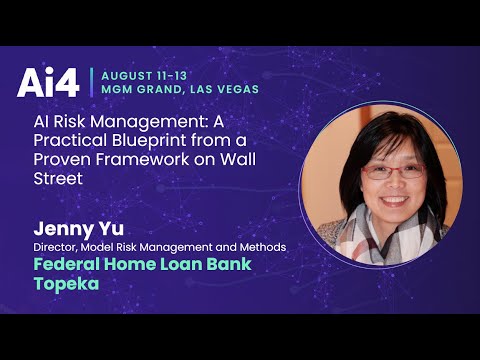
Ai4
Post-crisis banking rules provide all necessary controls to govern generative and agentic AI without building new regulatory systems from scratch.
AI-assisted summary of AI Risk Management: A Practical Blueprint from a Proven Framework on Wall Street With FHLBT — original source. Check the original for full context.
Source published:
Detailed notes
## Background Published on YouTube by Ai4 on August 28, 2025, this presentation features Jenny Yu, Director of Model Risk Management and Methods at the Federal Home Loan Bank of Topeka. According to the page description, the talk provides a practical blueprint for managing modern AI risks across industries by adapting Wall Street's time-tested three-pillar model risk management framework—governance, owner's responsibility, and independent validation.
## TL;DR Jenny Yu demonstrates how the financial sector's two decades of black-box model risk management under SR 11-7 provide an actionable framework for governing modern AI systems. She breaks down AI into traditional, generative, and vendor categories, showing how targeted controls reduce inherent risk to acceptable residual levels across modular agentic architectures and LLM workflows. Using practical analogies—such as playground guardrails that enable free exploration and bathroom scales that establish reliable relative benchmarks—she details strategies for stress testing, vendor due diligence, and prompt-injection mitigation. Throughout the talk, Yu emphasizes that regardless of technological complexity, human-in-the-loop accountability, risk-tolerance tiering, and tone at the top remain essential to safe AI adoption.
## Atmosphere & style The presentation strikes a pragmatic, authoritative, and reassuring tone, opening with self-deprecating humor about standing between the audience and their lunch. Drawing on twenty years of hands-on financial engineering experience, Yu demystifies complex mathematical and regulatory concepts through relatable, visual metaphors like playground fences and bathroom scales. The delivery feels collaborative and empowering rather than restrictive, transitioning smoothly from high-level enterprise risk philosophy to granular technical oversight while instilling confidence in practitioners navigating modern AI governance.
## Key takeaways - [00:04](https://www.youtube.com/watch?v=fKXJhDljLTc&t=4s) Model risk management frameworks developed over decades in the financial sector serve as strategic business enablers, establishing guardrails that allow organizations to deploy innovative AI tools safely and confidently. - [03:13](https://www.youtube.com/watch?v=fKXJhDljLTc&t=193s) AI risk can be demystified and managed through the foundational equation Residual Risk = Inherent Risk - Controls, isolating specific failure modes to bring total exposure within corporate risk appetite. - [05:39](https://www.youtube.com/watch?v=fKXJhDljLTc&t=339s) AI systems require differentiated verification strategies across three operational categories: automated backtesting for traditional predictive AI, human-in-the-loop review for generative AI, and specialized due diligence for third-party vendor AI. - [07:10](https://www.youtube.com/watch?v=fKXJhDljLTc&t=430s) The SR 11-7 regulatory standard establishes a proven three-pillar governance structure: executive oversight with model inventory tiering, model owner accountability for testing and documentation, and structurally independent mathematical validation. - [07:10](https://www.youtube.com/watch?v=fKXJhDljLTc&t=430s) Model risk fundamentally stems from two primary failure points across the model lifecycle: incorrect algorithmic development or inappropriate business use. - [12:16](https://www.youtube.com/watch?v=fKXJhDljLTc&t=736s) Effective model governance requires decomposed backtesting against ground truth and setting clear quantitative risk tolerance thresholds to detect and manage performance drift. - [14:56](https://www.youtube.com/watch?v=fKXJhDljLTc&t=896s) Complex agentic AI architectures cannot be governed as opaque monoliths; risk teams must monitor, benchmark, and track performance across each individual autonomous agent independently. - [15:41](https://www.youtube.com/watch?v=fKXJhDljLTc&t=941s) Generative AI introduces novel threat vectors including hallucinations, internal data leakage, and malicious prompt injections that exploit conversational interfaces, requiring specialized protective interceptor tooling. - [17:14](https://www.youtube.com/watch?v=fKXJhDljLTc&t=1034s) Due diligence for external foundation models must focus on the business domain relevance of training data, sector-specific benchmark performance, and strict guarantees against vendor harvesting of proprietary queries. - [18:34](https://www.youtube.com/watch?v=fKXJhDljLTc&t=1114s) Through the bathroom scale analogy, consistent relative benchmarking across models provides reliable decision-making data for model selection and drift tracking even when absolute evaluation precision is impossible. - [20:31](https://www.youtube.com/watch?v=fKXJhDljLTc&t=1231s) Ultimate professional accountability cannot be delegated to automated systems; human ownership remains essential across all workflows, complemented by using modern AI tools to oversee and benchmark other AI systems.
## Detailed walkthrough ### [00:04](https://www.youtube.com/watch?v=fKXJhDljLTc&t=4s) Introduction and the Playground Analogy for AI Risk
Jenny Yu opens her presentation with a touch of humor, acknowledging that she is the only thing "standing between you and your lunch." Drawing on more than twenty years of experience in the financial industry developing and managing models, she introduces the core premise of her talk: the financial sector has spent over two decades developing robust frameworks to manage black-box risk. Rather than viewing risk management as an administrative bottleneck, she positions a practical, effective AI risk management framework as a "strategic enabler" designed to empower business leaders to adopt cutting-edge tools.
```mermaid flowchart LR accTitle: Playground Metaphor for AI Risk Management subgraph Playground["Playground Guardrails Metaphor"] A["Strong Guardrails / AI Risk Framework"] --> B["Safe Exploration & Free Movement"] B --> C["Confident Business Innovation"] end ```
To illustrate this philosophy, Yu presents an image of a playground. Children are able to run around "freely and happily" precisely because strong perimeter guardrails protect them from danger. In the exact same way, robust risk guardrails give business executives the confidence to deploy AI safely without fear of catastrophic fallout. She notes that while Wall Street began building black-box model management frameworks twenty years ago, these practices were not strictly enforced across the industry until the aftermath of the 2008 global financial crisis. Today, the mature lessons learned by large financial institutions provide an actionable blueprint for modern AI risk across all sectors.
[03:13](https://www.youtube.com/watch?v=fKXJhDljLTc&t=193s) The Core Risk Equation and Demystifying AI Risk
Reflecting on her career path from hands-on data scientist to model risk leader, Yu emphasizes her role in bridging the gap between mathematical algorithms, data pipelines, and overarching business strategies. She anchors AI risk assessment in the foundational risk equation:
$$\text{Residual Risk} = \text{Inherent Risk} - \text{Controls}$$
Inherent risk reflects the baseline complexity of the model, its operational footprint, and the potential consequence, magnitude, and likelihood of failure. By designing targeted controls and guardrails, organizations reduce that exposure down to a tolerable residual risk level that aligns with corporate risk appetite.
Yu demystifies the anxiety surrounding modern artificial intelligence. While many executives treat AI risk as an unprecedented, unmanageable monolith, she argues that breaking it down reveals familiar risk dimensions. Even with the rise of generative AI, the underlying operational and statistical failure modes are manageable using established governance principles once practitioners isolate the specific new mechanisms at play.
[05:39](https://www.youtube.com/watch?v=fKXJhDljLTc&t=339s) Categorizing AI: Traditional, Generative, and Vendor Systems
Because "not all AIs are created equal," risk management cannot take a one-size-fits-all approach. Yu segments artificial intelligence into three distinct operational buckets based on their architectural mechanics and verification pathways:
```mermaid flowchart TD accTitle: AI Categorization and Verification Approaches subgraph Categories["AI Categorization Architecture"] T["Traditional AI<br/>(ML, Statistical, Stochastic)"] G["Generative AI<br/>(LLMs, Content Gen)"] V["Vendor & Third-Party AI<br/>(Black-Box Solutions)"] end
subgraph Controls["Verification & Risk Controls"] T --> TC["Automated Backtesting &<br/>Benchmark Modeling"] G --> GC["Human-in-the-Loop &<br/>Direct Verification"] V --> VC["Targeted Due Diligence &<br/>Independent Replication"] end ```
- **Traditional AI (Machine Learning, Statistical, and Stochastic Models):** Typically applied to predictive tasks, complex forecasting, and pricing. Because human operators cannot manually verify complex statistical outputs at scale, they require automated backtesting and benchmark models to measure performance against ground truth. - **Generative AI:** Predominantly used to enhance human workflows and operational efficiency. Because these systems produce human-readable content or intermediate drafts, human reviewers can inspect and verify the outputs directly before execution. - **Vendor and Third-Party AI:** Packaged software and embedded vendor algorithms where internal weights or training data may be proprietary and opaque, requiring specialized third-party risk management and pointed questionnaire frameworks.
[07:10](https://www.youtube.com/watch?v=fKXJhDljLTc&t=430s) The Holistic Modeling Process and the Three-Pillar Framework (SR 11-7)
Yu outlines the lifecycle of a model as a holistic process that strictly begins with a "business purpose" and concludes with "business use." Across this pipeline, risk stems primarily from two root causes: incorrect development or inappropriate business use. Modelers must navigate data preprocessing, architectural tradeoffs between bias and variance, output calibration, and the explicit disclosure of operational limitations.
```mermaid flowchart TD accTitle: Three-Pillar Model Risk Management Framework subgraph Framework["SR 11-7 Three-Pillar Framework"] P1["Pillar 1: Governance & Oversight<br/>• Tone at the top & risk tolerance<br/>• Model inventory & tiering<br/>• Quarterly Board ERM reporting"] P2["Pillar 2: Model Owner Responsibilities<br/>• Development & implementation testing<br/>• Ongoing performance tracking<br/>• Comprehensive documentation"] P3["Pillar 3: Independent Validation<br/>• End-to-end conceptual soundness<br/>• Replication of vendor algorithms<br/>• Stress testing & limitation disclosure"] end P1 --> P2 P2 --> P3 ```
To govern this lifecycle, the financial sector relies on the supervisory guidance established under Federal Reserve SR 11-7 (and OCC Bulletin 2011-12), which Yu distills into three core pillars:
1. **Governance and Oversight:** Sets the "tone at the top," defining the organization's overarching risk tolerance and balancing operational gains against potential exposures. It establishes formal policies, roles, responsibilities, and maintains a centralized model inventory. Model tiering (categorizing models by complexity and business impact) dictates validation frequency and scrutiny. Model risk is integrated into Enterprise Risk Management (ERM) and reported quarterly to the Board of Directors. 2. **Model Owner's Responsibility:** The model owner—whether an internal developer or a business unit managing an external vendor—holds accountability for tracking model health. This includes implementation testing, establishing performance baselines, maintaining technical documentation for transparency, and intervening when performance drifts. 3. **Independent Validation:** A mathematically qualified team, structurally independent of model development and ownership, evaluates everything from input data integrity to algorithmic soundness. At Topeka and peer institutions, internal data scientists and computer science engineers independently replicate vendor models to uncover hidden sensitivities, stress-test underlying assumptions, and communicate boundary conditions clearly to senior leadership.
[12:16](https://www.youtube.com/watch?v=fKXJhDljLTc&t=736s) Practical Application: Interest Income Forecasting and Agentic AI
To make the framework concrete, Yu presents a banking use case: modeling net interest income. While the high-level math appears straightforward (for example, lending \$100 at a 6% interest rate yields \$6 in income), forecasting enterprise-wide interest income across volatile interest rate environments and shifting balance sheet volumes is mathematically complex.
```mermaid flowchart LR accTitle: Interest Income Model Validation and Agentic Decomposition subgraph Traditional["Traditional Validation Pipeline"] M["Income Forecast Model"] --> BT["Backtesting vs. Ground Truth"] BT --> EV["Component Evaluation:<br/>• Balance Sheet Volume<br/>• Interest Rate Trajectory"] end subgraph Agentic["Agentic AI Decomposition"] A1["Agent 1: Balance Sheet Analysis"] --> Calc["Consolidated Income Engine"] A2["Agent 2: Rate Discovery & Forecasting"] --> Calc end ```
The bank manages model risk in this scenario through systematic validation and monitoring: - **Inventory & Tiering:** The interest income model is cataloged in the institutional inventory and subjected to rigorous validation based on its critical financial impact. - **Decomposed Backtesting:** Validators compare model projections against historical actuals (ground truth), evaluating the aggregate income error alongside specific forecast drivers, isolating whether variance stemmed from interest rate fluctuations or balance sheet volume shifts. - **Tolerance-Linked Monitoring:** Model drift is governed by quantitative risk tolerance thresholds set by executive leadership. For instance, management may establish that a 5% overall income forecast error or a 1% interest rate deviation is within acceptable risk appetite given the operational utility of the model.
Yu extends this foundational paradigm into modern multi-agent systems. A complex calculation can be decomposed into specialized agentic AI modules—such as one autonomous agent evaluating balance sheet dynamics and a second agent retrieving and projecting market interest rates—demonstrating that multi-agent architectures can be governed and validated using the exact same modular risk principles.
[14:56](https://www.youtube.com/watch?v=fKXJhDljLTc&t=896s) Agentic AI Architecture and Granular Performance Monitoring
In complex financial workflows, critical outputs rely on intricate internal calculations rather than simple figures pulled off the public internet. Managing these pipelines requires breaking tasks down across multiple specialized components—for instance, using one agentic AI to handle rate calculations, alongside another agentic AI orchestrating subsequent processes with large language models. While framing this multi-agent setup is an intentional oversimplification to explain how modular frameworks interact with LLMs, it underlines a fundamental supervisory principle: balance and granular oversight.
When establishing performance monitoring for complex AI, practitioners cannot treat the pipeline as an undifferentiated monolith. It is not enough to evaluate the end-to-end outcome; teams must evaluate, benchmark, and continuously monitor the performance of each individual agentic component independently to detect where degradation, drift, or calculation errors enter the chain.
```mermaid flowchart TD accTitle: Modular Agentic AI Architecture and Monitoring subgraph MultiAgentPipeline["Multi-Agent Processing Pipeline"] A["Input / Raw Data"] --> B["Agentic AI 1: Rate Management"] B --> C["Agentic AI 2: Calculation & Processing"] C --> D["Large Language Model: Output Generation"] end subgraph GranularMonitoring["Granular Risk & Performance Oversight"] M1["Monitor Agent 1"] -.-> B M2["Monitor Agent 2"] -.-> C M3["Monitor LLM Output"] -.-> D end ```
[15:41](https://www.youtube.com/watch?v=fKXJhDljLTc&t=941s) The Generative AI Black Box: Hallucinations, Inaccuracy, and Prompt-Driven Breaches
Transitioning from traditional analytical models to generative AI means moving into "an even blacker box." When organizations utilize off-the-shelf foundation models without injecting proprietary enterprise data, internal control over the system's inner workings is minimal. Generative AI introduces distinct threat vectors that traditional model risk teams rarely had to confront at this scale: hallucinations, contextual inaccuracy, and novel avenues for data breaches.
Organizations do not need to invent every control from scratch, as established enterprise policies already mitigate standard risks. Traditional data governance and cybersecurity divisions exist specifically to safeguard information assets from conventional breaches. However, generative AI fundamentally alters the attack surface through interactive chat interfaces:
- **Malicious Prompt Injections:** Interactive prompt interfaces create opportunities for adversarial inputs designed to extract sensitive operational or proprietary data. - **Internal Data Leakage:** Implementing advanced architectures that feed internal institutional data into model workflows introduces fresh internal breach risks if boundaries are porous. - **Targeted Protective Tooling:** Once security teams clearly recognize that conversational interfaces represent an active vector for data breaches, they can deploy targeted guardrail tools to intercept and neutralize malicious prompts before they execute.
[17:14](https://www.youtube.com/watch?v=fKXJhDljLTc&t=1034s) Evaluating Third-Party Foundation Models and Vendor Data Integrity
When engaging external vendors for specialized LLM solutions, model risk managers must conduct rigorous technical due diligence rather than accepting generic performance claims. The foremost question enterprise buyers must ask involves the relevance of the underlying training data:
> "A very critical question you want to ask: what training data did they use, and how is it relevant to your business? For example, if they use the model to extract financial data from PDF files, it might not be good at drafting a lease for you."
Beyond business-task alignment, risk practitioners must demand granular performance transparency. While a vendor may advertise stellar aggregate benchmark scores across general benchmarks, model performance must be proven specifically within the enterprise's targeted operational sector. Furthermore, vendor data privacy controls require explicit verification: institutions must ascertain whether the vendor retains corporate interactions, whether client queries are harvested for continuous model training, and what safeguards exist to guarantee customer data remains compartmentalized and insulated against external exposure.
[18:34](https://www.youtube.com/watch?v=fKXJhDljLTc&t=1114s) Practical Tooling and the Bathroom Scale Analogy for Relative Accuracy
Evaluating generative models requires specialized risk tooling, but organizations must select solutions that match their specific operational exposure. Effective risk and validation tools should be lightweight, accessible, and easily integrated through APIs to provide automated, timely feedback. Crucially, as the AI domain rapidly transforms, validation tooling must evolve at a matching pace while remaining strictly non-invasive—evaluating performance externally through black-box testing without requiring intrusive access to the model's proprietary internal weights.
Addressing the challenge of benchmarking accuracy in generative systems, a pragmatic distinction exists between absolute precision and relative comparison:
> "If I try to find my weight, I can stand on a scale and get 130. That number cannot be used for medical purposes, because I don't know how accurate the scale is. But there's one thing I know: if you stand with me using the same scale and you weigh 150, you are heavier than me... and if my weight is 130 today and tomorrow is 150, it means I gained weight."
Even if an evaluation metric lacks perfect, ground-truth precision, establishing an identical, consistent measurement instrument across different vendor models provides dependable relative benchmarking. Model risk teams can confidently determine whether Model A outperforms Model B, or track whether a fine-tuned version is drifting over time, utilizing relative comparison to make informed selection and deployment decisions.
[20:31](https://www.youtube.com/watch?v=fKXJhDljLTc&t=1231s) Tone at the Top, Contextual Threat Modeling, and Human Accountability
A successful AI risk framework ultimately depends on executive leadership setting the right "tone at the top." Managing risk requires assessing both the magnitude and the realistic likelihood of potential harms against expected business returns. For instance, in specific regional banking contexts, raw public figures might theoretically be scraped, but adversary computing costs to mount an attack could far exceed the value of the target, rendering the realistic risk negligible.
Risk teams must view model oversight as an ongoing discipline blending art and science, informed by deep hands-on development experience. Regardless of technological advancements, foundational professional responsibility remains constant:
- **Accountability Transcends Tooling:** "As an individual, it doesn't matter if I use pen and paper, or I use Excel, or I use generative AI—if you provide the number, I hold the responsibility. I need to verify that." - **Human-in-the-Loop:** Automated outputs must never bypass direct personal ownership; human validation must anchor every operational handoff. - **AI to Oversee AI:** Rather than relying exclusively on manual testing, risk teams must actively harness modern AI tools to monitor, benchmark, and control underlying AI risks across the enterprise.
## Notable quotes > [00:04](https://www.youtube.com/watch?v=fKXJhDljLTc&t=4s) standing between you and your lunch — Jenny Yu
> [00:04](https://www.youtube.com/watch?v=fKXJhDljLTc&t=4s) strategic enabler — Jenny Yu
> [00:04](https://www.youtube.com/watch?v=fKXJhDljLTc&t=4s) freely and happily — Jenny Yu
> [05:39](https://www.youtube.com/watch?v=fKXJhDljLTc&t=339s) not all AIs are created equal — Jenny Yu
> [07:10](https://www.youtube.com/watch?v=fKXJhDljLTc&t=430s) business purpose — Jenny Yu
> [07:10](https://www.youtube.com/watch?v=fKXJhDljLTc&t=430s) business use — Jenny Yu
> [07:10](https://www.youtube.com/watch?v=fKXJhDljLTc&t=430s) tone at the top — Jenny Yu
> [15:41](https://www.youtube.com/watch?v=fKXJhDljLTc&t=941s) an even blacker box — Jenny Yu
> [17:14](https://www.youtube.com/watch?v=fKXJhDljLTc&t=1034s) A very critical question you want to ask: what training data did they use, and how is it relevant to your business? For example, if they use the model to extract financial data from PDF files, it might not be good at drafting a lease for you. — Jenny Yu
> [18:34](https://www.youtube.com/watch?v=fKXJhDljLTc&t=1114s) If I try to find my weight, I can stand on a scale and get 130. That number cannot be used for medical purposes, because I don't know how accurate the scale is. But there's one thing I know: if you stand with me using the same scale and you weigh 150, you are heavier than me... and if my weight is 130 today and tomorrow is 150, it means I gained weight. — Jenny Yu
> [20:31](https://www.youtube.com/watch?v=fKXJhDljLTc&t=1231s) As an individual, it doesn't matter if I use pen and paper, or I use Excel, or I use generative AI—if you provide the number, I hold the responsibility. I need to verify that. — Jenny Yu
## Mentioned Jenny Yu, Federal Home Loan Bank Topeka, Ai4, Wall Street, Federal Reserve SR 11-7, OCC Bulletin 2011-12, Enterprise Risk Management (ERM), Board of Directors, Microsoft Excel
## Video description Jenny Yu, Director, Model Risk Management and Methods, Federal Home Loan Bank Topeka
Abstracts
Not all AIs are created equal—and neither is AI risk management. This talk provides a practical blueprint for risk leaders and AI practitioners to build robust AI risk management programs by leveraging a trusted source: the proven framework of Wall Street.
Drawing on 20+ years of experience in model risk management within the highly regulated financial industry, Jenny will use the time-tested three-pillar framework—governance, owners' responsibility, and independent validation—to demonstrate how to adapt these principles to today's complex AI systems.
Attendees will leave with actionable strategies and a clear framework to help them embrace AI safely, confidently, and effectively, cutting through the complexity and hype to focus on the most impactful and measurable approaches to managing AI risk across all industries.
[Source](https://www.youtube.com/watch?v=fKXJhDljLTc)