Domino Deploys MCP to Automate Regulated Model Training in Cursor
Ai4
Vibe coding fails enterprise compliance because machine learning requires continuous data lineage and dynamic runtime tracking that static code generation cannot deliver.
AI-assisted summary of From Vibe Coding to Vibe Modeling: Audit‑Ready GenAI the Model Context Protocol With Domino Data — original source. Check the original for full context.
Source published:
Detailed notes
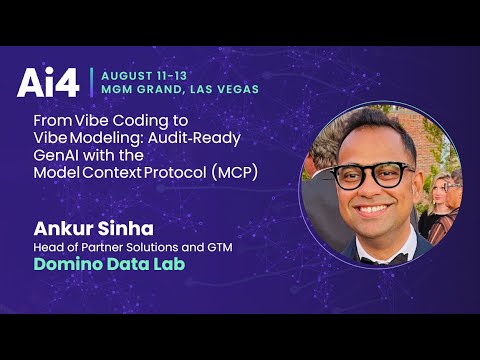
## Background Published on YouTube by Ai4 on August 29, 2025, this presentation features Ankur Sinha, Head of Partner Solutions and GTM at Domino Data Lab. According to the page description, the session explores moving from social-media-hyped 'vibe coding' to enterprise-ready 'vibe modeling,' using the open Model Context Protocol (MCP) and Domino's governed platform with NetApp snapshots to deliver auditable, reliable GenAI.
## TL;DR Ankur Sinha presents 'vibe modeling' as a disciplined evolution of vibe coding, designed to meet the complex, non-linear, and auditable requirements of enterprise data science. Through a live technical demonstration, he shows how the Domino Modeling Assistant pairs Cursor IDE and Claude 3.7 with Domino platform APIs via MCP to automate iterative neural network training, architecture tweaks, and hyperparameter tuning while capturing complete lineage. The presentation also highlights key platform capabilities across data preparation and RAG debugging, bolstered by high-performance NetApp storage integrations. Concluding with a Q&A, Sinha emphasizes why dynamic, retraining-heavy ML lifecycles require dedicated systems of record rather than static code versioning tools.
## Atmosphere & style The presentation carries a pragmatic, polished, and engineer-friendly conference tone that cuts through GenAI hype with real-world enterprise discipline. Sinha delivers a steady, authoritative walkthrough, shifting smoothly between conceptual comparisons and a concrete terminal-and-IDE workflow. It feels like watching an insightful technical briefing where rapid agentic autonomy is carefully anchored by governance, reproducible infrastructure, and live audience interaction.
## Key takeaways - [00:05](https://www.youtube.com/watch?v=burzxvDJ22c&t=5s) Vibe coding enables rapid, natural-language software development in modern IDEs, but is largely optimized for conventional applications and web interfaces. - [01:46](https://www.youtube.com/watch?v=burzxvDJ22c&t=106s) Enterprise machine learning requires moving beyond vibe coding because rapid-fire prompting produces unverified, untraceable outputs that fail regulatory and risk standards. - [01:46](https://www.youtube.com/watch?v=burzxvDJ22c&t=106s) Machine learning lifecycles diverge fundamentally from traditional software engineering due to non-linear experimentation, dynamic data dependencies, and complex multi-artifact deliverables. - [03:46](https://www.youtube.com/watch?v=burzxvDJ22c&t=226s) Vibe modeling bridges the gap between development speed and scientific rigor by automatically capturing model lineage, parameters, datasets, and execution environments. - [03:46](https://www.youtube.com/watch?v=burzxvDJ22c&t=226s) The Domino Modeling Assistant leverages the open Model Context Protocol (MCP) to connect IDE agents directly to enterprise compute clusters and governance systems. - [04:47](https://www.youtube.com/watch?v=burzxvDJ22c&t=287s) In a live demonstration, an MCP-connected Cursor agent running Claude 3.7 autonomously orchestrated remote Domino training jobs on a diabetes classification dataset. - [04:47](https://www.youtube.com/watch?v=burzxvDJ22c&t=287s) The AI agent iteratively diagnosed overfitting and modified the neural network architecture and optimizer settings directly in code to achieve over 97% accuracy. - [07:56](https://www.youtube.com/watch?v=burzxvDJ22c&t=476s) The platform supports three core production use cases: automated data preparation, model hyperparameter tuning with MLflow tracking, and RAG application debugging. - [07:56](https://www.youtube.com/watch?v=burzxvDJ22c&t=476s) Domino integrates with NetApp intelligent data infrastructure, including Amazon FSx for NetApp ONTAP, to deliver snapshot-backed storage with enterprise role-based access control. - [11:40](https://www.youtube.com/watch?v=burzxvDJ22c&t=700s) While Domino remains infrastructure- and storage-agnostic, its partnership with NetApp delivers an optimized native experience for shared enterprise customers. - [11:40](https://www.youtube.com/watch?v=burzxvDJ22c&t=700s) Unlike static software code, machine learning systems require specialized systems of record to manage ongoing model drift, historical lineage, and continuous retraining in production.
## Detailed walkthrough ### [00:05](https://www.youtube.com/watch?v=burzxvDJ22c&t=5s) Introduction: Moving from Vibe Coding to Vibe Modeling
Ankur Sinha, Head of Partner Solutions and GTM at Domino Data Lab, welcomes attendees to the session. While the talk is titled *"From Vibe Coding to Vibe Modeling: Audit-Ready GenAI via the Model Context Protocol With Domino Data"*, Sinha clarifies that the core emphasis is on enhancing data science productivity through "vibe modeling." He introduces the presentation roadmap: understanding the fundamentals of vibe coding versus vibe modeling, breaking down how modeling diverges from traditional software engineering concepts, presenting a live demonstration of Domino’s Modeling Assistant, and highlighting the strategic enterprise partnership between Domino Data Lab and NetApp.
Sinha reflects on the emergence of vibe coding as a developer trend. For software engineers who began their careers writing manual code line by line, having the ability to open an Integrated Development Environment (IDE), prompt in natural language, and rapidly translate raw concepts into functional software feels like "a real blessing." However, the current vibe-coding paradigm remains intensely focused on building standard software applications and web interfaces quickly.
```mermaid flowchart LR accTitle: Comparison of Vibe Coding versus Vibe Modeling subgraph VC["Vibe Coding (Software Focus)"] A["Natural Language Prompts"] --> B["Rapid-Fire Code Generation"] B --> C["Flashy Front-End / App Output"] C -.-> D["Risks: Hallucinations, Untraceable State"] end subgraph VM["Vibe Modeling (ML & Data Focus)"] E["Agentic IDE (Cursor / MCP)"] --> F["Automated Compute & Training Jobs"] F --> G["Tracked Artifacts & Lineage"] G --> H["Audit-Ready & Reproducible Models"] end ```
[01:46](https://www.youtube.com/watch?v=burzxvDJ22c&t=106s) The Limits of Vibe Coding in Regulated Machine Learning
While vibe coding produces flashy social media demos and rapid-fire outputs, Sinha emphasizes that its results are often unverified, untraceable, and prone to hallucinations. Enterprise machine learning requires an approach that pairs high velocity with scientific rigor. Vibe modeling bridges this gap by combining speed with trust, enabling data science teams to deliver AI that meets the stringent reproducibility, transparency, and compliance standards demanded by business owners, risk teams, and regulators.
The fundamental reason vibe coding falls short in regulated enterprise environments lies in the structural differences between software development and machine learning lifecycles:
* **Non-linear and Asynchronous Workflows:** Unlike linear software engineering pipelines, model training and experimentation are highly non-linear, experimental, and asynchronous. * **Complex Deliverables:** The final deliverable in data science is not merely an isolated binary or script; it is the entire auditable history, data lineage, hyperparameters, and environment context behind the artifact. * **Requirement for Domain-Specific AI Agents:** General coding assistants know how to complete syntax, but ML workflows require AI agents capable of orchestrating infrastructure, executing remote jobs, and capturing full lineage without trading away developer flexibility.
[03:46](https://www.youtube.com/watch?v=burzxvDJ22c&t=226s) Introducing the Domino Modeling Assistant
Sinha introduces the Domino Modeling Assistant, an integration that augments modern IDE coding assistants to execute end-to-end data science tasks—such as iterative experimentation and hyperparameter tuning—while automatically enforcing enterprise governance. It provides full reproducibility, tracking data, code, metrics, and compute artifacts behind the scenes. As Sinha notes, "Coding assistants are definitely increasing the productivity, but data scientists do more than just write code. They build models, and hence modeling assistants are really multiplying the impact for business."
- **Unified Lineage:** Captures model weights, parameters, datasets, and execution environments automatically. - **Enterprise Governance:** Integrates compliance into rapid prototyping without interrupting the data scientist's natural interactive flow. - **Agentic IDE Integration:** Connects local or cloud IDEs directly to scalable enterprise compute clusters via the open Model Context Protocol (MCP).
```mermaid flowchart TD accTitle: Domino Modeling Assistant Architecture subgraph IDE["Developer Environment"] User["Data Scientist"] --> Agent["Cursor IDE Agent (Claude 3.7)"] end subgraph Protocol["Integration Layer"] Agent --> MCP["Domino MCP Server"] end subgraph Backend["Domino Platform & Infrastructure"] MCP --> API["Domino Platform APIs"] API --> Comp["Distributed Compute / Training Jobs"] API --> Reg["System of Record (Lineage, Metadata, MLflow)"] API --> Storage["NetApp Intelligent Data Infrastructure / Volumes"] end ```
[04:47](https://www.youtube.com/watch?v=burzxvDJ22c&t=287s) Live Demonstration: Automated Training and Hyperparameter Tuning via MCP
A recorded technical demonstration illustrates how the Domino Modeling Assistant works in practice. The setup pairs the Cursor IDE agent—running Claude 3.7 with reasoning/thinking enabled—with the Domino platform API via an MCP server. The objective is to train and optimize a classification model on a diabetes CSV dataset. The model architecture consists of a configurable four-layer neural network, and the training script accepts standard command-line arguments including epochs, batch size, learning rate, and hidden layer dimensions.
``` +-----------------------------------------------------------------------------------+ | ITERATIVE MODEL OPTIMIZATION DEMO | +---------+------------------------------------+---------------+--------------------+ | Attempt | Architectural & Parameter Changes | Accuracy Rate | Platform Action | +---------+------------------------------------+---------------+--------------------+ | Run 1 | 10 epochs, batch 32, lr 0.0001 | ~96% | Domino Job logged | | Run 2 | More epochs, larger model, lower lr| >96% | Overfitting noted | | Run 3 | Increased dropout rate in PyTorch | Improved | Architecture edit | | Run 4 | Added Adam optimizer weight decay | >97% | Final model chosen | +---------+------------------------------------+---------------+--------------------+ ```
Guided by Cursor system rules, the AI agent automatically reads the local training script, inspects the neural network architecture, validates Domino project settings, and checks Git synchronization between the local IDE and the Domino workspace. It then executes a sequence of automated optimization steps: 1. **Initial Job Execution:** The agent submits a remote training run on Domino configured with 10 epochs, a batch size of 32, small model dimension, and a learning rate of 0.0001, yielding an initial accuracy of 96%. 2. **Experiment Tracking:** The agent monitors job completion, pulls logs, and exposes the specific experiment run in the Domino web UI, ensuring the job is reproducible and accessible to team collaborators. 3. **Overfitting Mitigation:** Noting the performance, the agent initiates a second run with more epochs, a larger model, and a reduced learning rate. Observing risks of overfitting, Claude modifies the neural network architecture directly in code to increase the dropout rate. 4. **Optimizer Adjustment:** On the subsequent iteration, the agent adds weight decay regularization to the Adam optimizer. 5. **Convergence:** The final run reaches over 97% accuracy. The agent presents a structured summary of all iterations and tags the run as a validated candidate model.
[07:56](https://www.youtube.com/watch?v=burzxvDJ22c&t=476s) Core Platform Capabilities and the NetApp Partnership
Sinha returns to break down the architectural building blocks of vibe modeling within Domino. The ecosystem relies on three integrated pillars: the IDE/coding assistant running over Domino MCP servers, Domino APIs that orchestrate compute and secure data access, and Domino's centralized system of record that logs all artifacts, metrics, and dependencies.
Beyond classical tabular optimization, Sinha outlines three primary production use cases for the assistant: * **Data Preparation:** Interactive dataset exploration, automated transformation script generation, summary profiling, and programmatic dataset updates. * **Model Tuning:** Automated architectural iterations, dynamic training configuration updates, and unified metric tracking within MLflow. * **RAG Application Debugging:** Automatic retrieval of execution logs, inspection of failure modes, and instant spinning up of isolated diagnostic workspaces.
Sinha highlights the underlying infrastructure partnership with NetApp. The Domino platform integrates with NetApp intelligent data infrastructure, including Amazon FSx for NetApp ONTAP and high-performance NetApp volumes. This integration provides data science teams with scalable, snapshot-backed data access directly through Domino Volumes, pairing elastic GPU/CPU compute orchestration with enterprise Role-Based Access Control (RBAC) and data governance.
[11:40](https://www.youtube.com/watch?v=burzxvDJ22c&t=700s) Q&A: Enterprise Agnosticism and ML vs. Software Lifecycles
During the audience question-and-answer session, attendees ask about platform compatibility, corporate structure, and the fundamental differences between software and model engineering:
- **Storage and Cloud Agnosticism:** Addressing a question regarding hardware lock-in, Sinha clarifies that while Domino is fundamentally infrastructure- and storage-agnostic, the deep strategic partnership with NetApp delivers an optimized, native experience for customers running NetApp storage. He confirms that Domino Data Lab and NetApp remain separate independent companies collaborating on joint solutions. - **Why Model Governance Differs from Code Versioning:** An attendee asks why traditional software engineering tools cannot simply handle data science lifecycles. Sinha explains that software code is largely static once deployed into production, whereas machine learning models are dynamic and intrinsically tied to changing data distributions. "The work starts really after that—the retraining and being able to track all the history," Sinha notes, highlighting why AI development requires specialized systems of record that capture runtime environment state, data drift, and iterative training histories over time.
Sinha invites attendees to review Domino’s open-source MCP server repository on GitHub, read their technical blog posts on vibe modeling, and visit Booth 415 to see live interactive demonstrations of the Domino and NetApp integration.
## Notable quotes > [00:05](https://www.youtube.com/watch?v=burzxvDJ22c&t=5s) From Vibe Coding to Vibe Modeling: Audit-Ready GenAI via the Model Context Protocol With Domino Data — Ankur Sinha
> [00:05](https://www.youtube.com/watch?v=burzxvDJ22c&t=5s) a real blessing — Ankur Sinha
> [03:46](https://www.youtube.com/watch?v=burzxvDJ22c&t=226s) Coding assistants are definitely increasing the productivity, but data scientists do more than just write code. They build models, and hence modeling assistants are really multiplying the impact for business. — Ankur Sinha
> [11:40](https://www.youtube.com/watch?v=burzxvDJ22c&t=700s) The work starts really after that—the retraining and being able to track all the history — Ankur Sinha
> building AI that not only works fast but also feels right to business owners, risk teams, and regulators. — Ankur Sinha
> turns hyped speed into audit‑ready reliability. — Ankur Sinha
> Watch an engineer generate a first answer, trace a hallucination through MCP’s chat‑with‑context logs, fix it, trigger scripted validation, and redeploy—all in minutes. — Ankur Sinha
> No theory—just a repeatable checklist to help your own team start vibe modeling tomorrow. — Ankur Sinha
## Mentioned Ankur Sinha, Domino Data Lab, Ai4, NetApp, Model Context Protocol (MCP), Cursor, Claude 3.7, PyTorch, Adam optimizer, MLflow, Amazon FSx for NetApp ONTAP, Domino Volumes, Domino Modeling Assistant, GitHub
## Video description Ankur Sinha, Head of Partner Solutions and GTM, Domino Data Lab
You’ve heard of vibe coding—rapid‑fire prompting that wows on social feeds but wilts under scrutiny. What’s next is vibe modeling: building AI that not only works fast but also feels right to business owners, risk teams, and regulators. In this 20‑minute session we’ll unpack a real‑world regulatory‑assistant built on the open Model Context Protocol (MCP)—and show why running MCP inside Domino’s governed platform (backed by NetApp snapshots) turns hyped speed into audit‑ready reliability. Watch an engineer generate a first answer, trace a hallucination through MCP’s chat‑with‑context logs, fix it, trigger scripted validation, and redeploy—all in minutes. No theory—just a repeatable checklist to help your own team start vibe modeling tomorrow.
[Source](https://www.youtube.com/watch?v=burzxvDJ22c)