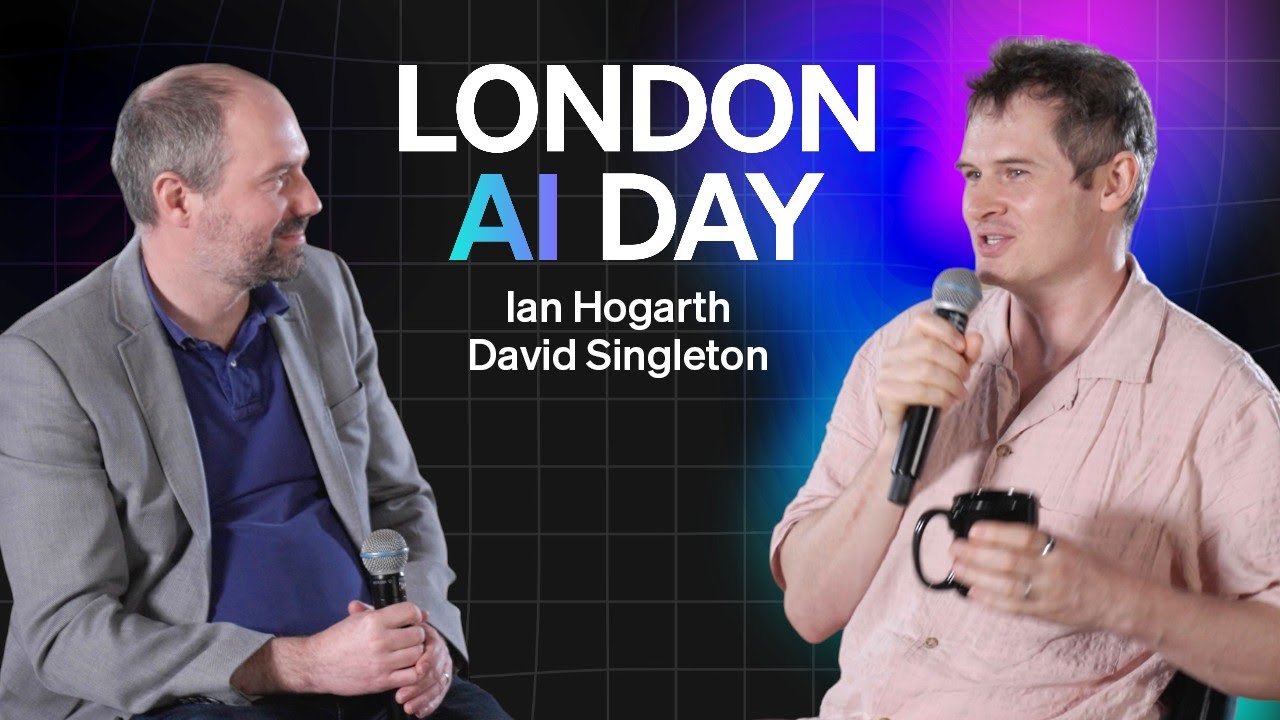
UK AI Task Force Chair Says Giant Tech Compute Risks Dragnet Regs
Stripe
Ian Hogarth warns that massive GPU clusters at tech giants create systemic risk, threatening heavy regulation that could stifle narrow medical and legal AI startups.
## Background
This fireside chat was published on YouTube by Stripe on May 22, 2024. The video's show notes state that it features Plural partner Ian Hogarth sitting down with Stripe CTO David Singleton for a discussion at London AI Day.
## TL;DR
In this discussion, Plural partner Ian Hogarth shares insights from his journey from founding Songkick to chairing the UK government's AI Foundation Model Task Force. He examines how modern artificial intelligence tools enable founders to scale massive global impact with leaner, smaller teams, and explores upcoming frontiers in domestic robotics and creative generation. Hogarth also outlines his strategy for evaluating AGI timelines and managing systemic risk, advocating for localized startup infrastructure and specialized regulation over heavy-handed dragnet policy.
## Atmosphere & style
The conversation carries a deeply reflective, intellectually vibrant, and collaborative tone, feeling like an intimate meeting of minds between two veteran operators. Hogarth balances technical pragmatism with visionary enthusiasm, shifting smoothly from fond, localized reminiscences of early tech struggles to high-stakes discussions on global AI governance. The dialogue moves with a natural, unhurried rhythm, leaving the listener with a sense of sharp foresight and contrarian conviction as the speakers analyze the friction points of modern innovation.
## Key takeaways
- [00:00](https://www.youtube.com/watch?v=6I-kKybv2kU&t=0s) Ian Hogarth began his career in AI with early computer vision work at Cambridge in 2004, but shifted to building the music platform Songkick because the AI technology was not yet ready for practical consumer use.
- [00:00](https://www.youtube.com/watch?v=6I-kKybv2kU&t=0s) Despite being a consumer platform, Songkick integrated machine learning early on to parse unstructured web data, hiring specialists with deep ML backgrounds to maintain technical innovation under the hood.
- [00:00](https://www.youtube.com/watch?v=6I-kKybv2kU&t=0s) Hogarth notes that building a competitor to Songkick today with LLMs is non-viable due to the entrenched ticketing and live music monopoly of Ticketmaster and Live Nation, which resists pure technological innovation.
- [00:00](https://www.youtube.com/watch?v=6I-kKybv2kU&t=0s) Modern AI tools enable founders to prolong high-leverage, small-team phases (ideally 5-10 people), allowing startups to achieve massive global scale with fewer engineers.
- [04:59](https://www.youtube.com/watch?v=6I-kKybv2kU&t=299s) Robotics is predicted to be the next frontier to surprise the public, driven by theories like Carl Friston's 'free energy principle', with simpler domestic automation succeeding commercially before humanoid robots.
- [04:59](https://www.youtube.com/watch?v=6I-kKybv2kU&t=299s) While AI can easily generate short-form creative outputs like music loops, it remains far away from mastering high-end, complex narrative writing like hit television shows due to a severe shortage of high-quality training data.
- [09:59](https://www.youtube.com/watch?v=6I-kKybv2kU&t=599s) Hogarth subscribes to the 'bitter lesson', expecting continuous technological shocks as long as scaling laws for compute and data continue to hold true without saturation.
- [09:59](https://www.youtube.com/watch?v=6I-kKybv2kU&t=599s) To evaluate AGI timelines and technical predictions, Hogarth utilizes an expert weighting strategy that favors early deep learning pioneers over recent commentators who joined during the current AI hype cycle.
- [14:59](https://www.youtube.com/watch?v=6I-kKybv2kU&t=899s) The primary risk for narrow, specialized AI systems is societal over-conservatism and delayed deployment, whereas the true systemic risk stems from unguided frontier models trained by tech giants with massive GPU scale.
- [14:59](https://www.youtube.com/watch?v=6I-kKybv2kU&t=899s) AI policy regulation should target large tech conglomerates capable of bearing heavy scrutiny, rather than creating a dragnet regulation that inadvertently stifles small, innovative startups.
- [14:59](https://www.youtube.com/watch?v=6I-kKybv2kU&t=899s) A disconnect exists where the general public feels deep anxiety regarding job security and out-of-control AI risks, while the political and economic ruling class remains far less concerned.
- [19:59](https://www.youtube.com/watch?v=6I-kKybv2kU&t=1199s) London provides a unique geographical and cultural synthesis for startups by concentrating scientific, creative, financial, and political talent within one adjacent urban ecosystem.
- [19:59](https://www.youtube.com/watch?v=6I-kKybv2kU&t=1199s) The European venture capital landscape is hindered by the fact that 90% of VCs have no actual founder experience, a gap that Plural addresses by ensuring 100% of its partners are former founders.
- [24:59](https://www.youtube.com/watch?v=6I-kKybv2kU&t=1499s) The most successful AI companies initially look like terrible ideas to mainstream investors; early breakthroughs like DeepMind, OpenAI, and Anthropic relied heavily on non-traditional funding sources.
- [29:59](https://www.youtube.com/watch?v=6I-kKybv2kU&t=1799s) The defense tech company Helsing illustrates the massive value of being 'uncomfortably early' on a non-consensus idea that mainstream investors initially reject universally.
- [31:55](https://www.youtube.com/watch?v=6I-kKybv2kU&t=1915s) AI founders are encouraged to adopt a 'human-in-the-loop' go-to-market strategy, using human operators to ensure high-quality outputs while capturing tight feedback loops to iterate the underlying AI technology.
- [34:59](https://www.youtube.com/watch?v=6I-kKybv2kU&t=2099s) Less mature startup ecosystems outside Silicon Valley are frequently held back by severe administrative and regulatory friction, such as Germany's archaic physical notary processes.
- [34:59](https://www.youtube.com/watch?v=6I-kKybv2kU&t=2099s) Stripe is challenged to expand its mission beyond payment optimization by building infrastructure that levels up regional ecosystems and eliminates local operational bottlenecks for global software companies.
## Detailed walkthrough
### [00:00](https://www.youtube.com/watch?v=6I-kKybv2kU&t=0s) From Songkick to Machine Learning Roots
Ian Hogarth's journey into artificial intelligence began long before his current roles as co-founder of Plural Platform and chair of the UK government's AI Foundation Model Task Force. His "love affair with AI" started in 2002 when he built his first robot—a rite of passage for many in the field. By 2004, he was working on early computer vision systems at Cambridge. However, he quickly realized the technology "wasn't ready for prime time," noting that the practical applications of computer vision at the time felt predominantly military. Wanting to build something different, he channeled his passion for music and the internet into founding the consumer music platform Songkick.
Even though Songkick was a consumer internet company rather than a pure-play AI startup, machine learning was utilized under the hood from its earliest days. The platform ingested massive amounts of unstructured text from across the web, using smart parsing to identify band names, venues, and dates within sentences. Hogarth intentionally hired people with deep machine learning backgrounds "maybe just to keep the dream alive a bit." This included Songkick's earliest CTO, Phil Cowens, who held a PhD in machine learning and had worked on Stephen Hawking's Dasher system at Cambridge, as well as Dan Quine, who later went to Google.
When asked if he would build Songkick differently today using Large Language Models (LLMs), Hogarth admits he simply wouldn't build it at all. He reflects on his youthful naivety with gratitude but points out the brutal structural challenges of the live music market, which is dominated by Ticketmaster and Live Nation. "It's a very, very challenging market to innovate in that has largely repelled all innovation for the last 30 years," he explains, adding that AI alone isn't enough to break that monopoly. If someone were to attempt it today, they would need to raise far more capital and pursue a highly aggressive rights-disruption strategy.
- **First Robot Built:** 2002 by Ian Hogarth.
- **Early Computer Vision Work:** Cambridge, 2004.
- **Key Early Songkick Engineers:** Phil Cowens (PhD in ML, worked on Stephen Hawking's Dasher system) and Dan Quine.
- **Market Monopolist:** Ticketmaster / Live Nation, which Hogarth identifies as the primary structural barrier to innovation in the ticketing space.
---
[00:00](https://www.youtube.com/watch?v=6I-kKybv2kU&t=0s) Building Leaner Startups and the Magic of Small Teams
For founders starting new consumer internet companies today with LLMs, Hogarth advises focusing on doing more with fewer people. He highlights the "magic period" of a startup when the team is under 20 people—ideally between five and ten. During this phase, everyone can hold the entire company's operations in their head, fostering a unique sense of camaraderie and intimacy as a group of outsiders trying to prove themselves.
Hogarth believes modern AI tools allow founders to prolong this high-leverage, small-team phase. He points to Instagram's early days of leveraging the cloud and Midjourney's incredibly small team relative to its massive global scale and impact as prime examples. "I think probably the cultural thing I would do differently is try to hire fewer engineers and see what happened," he muses. Furthermore, if he were starting a company today, he would bypass traditional internet applications entirely to focus on cyber-physical systems, such as fusion energy or materials discovery.
---
[04:59](https://www.youtube.com/watch?v=6I-kKybv2kU&t=299s) Unlocking Robotics and the Dream of Domestic Automation
Reflecting on ideas from 2004 that are finally becoming viable due to modern AI, Hogarth expresses immense excitement for robotics. He recalls being inspired around 2006 by "BabyBot," an academic project in Italy designed to emulate how a baby's sensory experiences expand to help them learn motor control and ground themselves in the physical world. He highlights the work of Carl Friston at UCL on the "free energy principle" as a foundational pillar for the future of embodied AI. Hogarth predicts that robotics will be the next frontier to surprise the public, noting that while ChatGPT was a massive wake-up call for digital capabilities, "wait till you have like robots doing like consumer tasks."
When discussing what these robots will look like, Hogarth admits a personal fondness for domestic, labor-saving machines. He shares an anecdote about telling his son to imagine a world without dishwashers, washing machines, or stoves, and how much less time parents would have to spend with their children without those automated tools. However, he is skeptical about humanoid robots entering homes in the immediate future due to the massive engineering and financial overhead required to make a machine walk up stairs. Instead, he expects simpler, cut-down robotic systems to succeed commercially over the next decade before humanoids become mainstream.
- **BabyBot Project:** Italy, circa 2006, focused on sensory development and motor control.
- **Key Academic Figure:** Carl Friston (UCL), pioneer of the free energy principle.
- **Robotics Outlook:** Humanoids are currently too expensive; simpler, specialized domestic robots will likely succeed first.
---
[04:59](https://www.youtube.com/watch?v=6I-kKybv2kU&t=299s) AI and the Limits of Creative Generation
The conversation shifts to recent leaps in creative AI, such as OpenAI's Sora for video and Suno V3 for audio. Hogarth, who writes an annual blog recap of his favorite books and films, contemplates what it would take for a wholly AI-generated work to make his list. He believes AI could successfully produce a "dirt off my shoulder quality beat" by analyzing sample-based production. By training a model on data from platforms like *WhoSampled*—which tracks the samples used in rap tracks over the last few decades—an AI could identify unused YouTube audio that matches the style of genius producers.
However, Hogarth is highly skeptical of AI's ability to generate complex, high-quality narratives. "We are so, so far off like Succession being written by an AI," he says. While he believes that achieving Artificial General Intelligence (AGI) means AI will eventually match human creativity, he argues we will see AI solve novel mathematical proofs and make strategic breakthroughs (similar to AlphaGo's famous moves) long before it writes a masterpiece TV show. This is primarily a data problem: there is a clear path to generating synthetic data for mathematics, but there are only about ten truly great television shows in history—such as *The Sopranos* or *The Wire*—to serve as training data. While "Muzak" and hold music will be disrupted rapidly, high-end creative writing remains a distant frontier.
- **Creative Tools Mentioned:** Sora (video) and Suno V3 (audio).
- **Music Sampling Concept:** Training AI on *WhoSampled* data to generate high-quality rap beats.
- **Narrative Benchmarks:** *Succession*, *The Sopranos*, and *The Wire* represent the pinnacle of human narrative design that AI cannot easily replicate due to a lack of high-quality training data.
---
[09:59](https://www.youtube.com/watch?v=6I-kKybv2kU&t=599s) Navigating Uncertainty and the Path to AGI
Addressing the rapid pace of AI development, Hogarth explains that he subscribes to the "bitter lesson"—the philosophy that clever algorithmic design will ultimately be trumped by simple algorithms paired with massive compute and data. Because society has not yet saturated the available data or compute, and because the economic engine driving AI has immense free cash flow, he expects continuous "shocks to the system" as scaling laws hold strong.
To make decisions amidst this uncertainty, Hogarth balances his two professional roles: his day job at Plural Platform supporting ambitious founders, and his government role providing an empirical basis to help the UK Prime Minister manage AI risk. In his government work, Hogarth navigates predictions by calculating a weighted average of expert opinions. He weights experts based on the historical accuracy of their high-conviction bets. For instance, Demis Hassabis and Shane Legg of DeepMind, or Dario Amodei of Anthropic, receive high weightings because they made bold, successful bets on deep learning and reinforcement learning back in 2012. Conversely, he heavily discounts the opinions of people who had nothing to do with AI for the last five years but have suddenly developed strong, loud viewpoints.
Hogarth acknowledges the risk of his weighting system, noting that in any bubble, those who are right early on can become blinded by hubris. He maintains wide error bars, noting that while Shane Legg's prediction of AGI by 2027 is highly plausible, AGI could also be decades away due to unforeseen technical limits. Ultimately, Hogarth advocates for democratic oversight and transparency. "The thing that I just think is unacceptable is like for the conversation around these incredibly powerful systems that can affect everyone on Earth to be happening behind closed doors," he asserts. For narrow AI applications, like Chiron Medical's breast cancer detection systems, Hogarth believes founders should focus on building rather than worrying about existential risk.
- **The Bitter Lesson:** The concept that compute and data scale-up consistently outperform human-designed algorithmic cleverness.
- **AGI Timeline:** Shane Legg (DeepMind) has consistently predicted AGI around 2027, which Hogarth views as a real possibility, though he maintains high humility and wide error bars.
- **Expert Weighting Strategy:** High weight given to early pioneers (DeepMind, Anthropic) who made prescient bets in 2012; low weight given to recent commentators who entered the space during the current hype cycle.
### [14:59](https://www.youtube.com/watch?v=6I-kKybv2kU&t=899s) The Risk of Dragnet Regulation and the Reality of AI Policy
The biggest risk with "narrow, tall AI"—such as software designed to analyze five breast cancer biopsy images over time—is not that it is unsafe, but that society is too conservative and does not deploy it fast enough. Every year of delay carries a massive human and financial cost. While high-stakes domains like the judiciary, police, or hospitals require a much higher standard of quality and risk mitigation, the builders of these narrow systems should advocate for appropriately sized regulation that evolves existing regulatory bodies. However, this should not be conflated with letting the largest companies off the hook. The real systemic risk is being created by massive tech giants like Meta, who have acquired an astonishing number of GPUs. When they train models using that scale of compute, "I don't think anyone at Meta can tell you what that model is going to be capable of."
Because these incredibly large companies have the resources to bear heavy scrutiny, regulation must target them specifically. The worst-case scenario is a "dragnet regulation" that is light-touch on tech giants but incredibly heavy-touch on small, novel startups like Kiron. Such a dragnet would slow down innovation without putting meaningful guardrails around the companies actually driving the risk. Reflecting on a prediction made four years ago that AI policy would become the single most important area of government policy, it is clear that while the topic has risen in prominence—evidenced by the UK hosting the first global AI Safety Summit at Bletchley Park—it is still not the number one issue for global political leaders, who remain focused on the cost of living, inflation, and immigration.
Beneath the surface, however, there is a disconnect: the general public is far more concerned about AI than the people who hold power in society, whether those leaders are in technology, government, banking, or media. Polling and focus groups reveal deep public anxiety, first regarding job security, and second regarding "getting out of control risks." Historically, when the average person is highly concerned and the ruling class is not, a political entrepreneur eventually "figures out a short circuit." The UK is uniquely positioned to navigate this because London's AI ecosystem is physically adjacent to its political ecosystem, allowing someone to cycle from Westminster to DeepMind and have two highly relevant conversations in the span of an hour. This proximity led to the creation of the UK's AI task force and the subsequent Safety Institute.
- **Bletchley AI Safety Summit:** The first global summit on AI safety, chaired by the UK Prime Minister, which secured a risk agreement between China, the US, and Europe.
- **The UK AI Task Force:** Chaired by the speaker, which evolved into the Safety Institute to evaluate frontier model risks.
### [19:59](https://www.youtube.com/watch?v=6I-kKybv2kU&t=1199s) The Bull and Bear Cases for UK Startups
The bull case for London is its unique geographic and cultural synthesis; it acts as "Boston, New York, LA, San Francisco, and D.C. all in one city." For startups attempting to blend hard science with global scaling and go-to-market strategies, London offers pockets of talent that can be synthesized in ways other geographies cannot match. In the US, these talents are geographically fragmented—LA has aerospace, Boston has biotech, and Silicon Valley has software. Furthermore, while the UK has historically possessed world-class science and engineering talent, it lacked "founder talent." Founding is a craft developed over time. For example, when the founders of Stripe were running their previous company, Automatic, they were brilliant, but the business itself was terrible. They had to learn the craft of market selection—realizing you cannot build a company of Stripe's scale by targeting a thin, undifferentiated market like eBay power sellers.
The Silicon Valley ecosystem has been refining this founder craft since the days of Fairchild Semiconductor. The UK is finally developing its own multi-decade depth, but the bear case is that the US is accelerating so much faster that Europe may simply get left in the dust. Building a company like OpenAI is nearly impossible because it required raising astronomical sums of money and waiting eight years for monetization to work. Such a feat was highly contingent on unique figures like Elon Musk, Sam Altman, Ilya Sutskever, and Dario Amodei. Had OpenAI not succeeded, DeepMind would currently be "the most important company on the planet." While an amazing team in London partnered with ambitious former founders could theoretically produce an OpenAI-level success, it remains an incredibly heavy lift due to a persistent "low ambition mindset" outside of the Valley.
Accelerating this ecosystem requires time and direct exposure to experienced founders who have built substantial companies. In Silicon Valley, this mentorship is a historical cornerstone. Apple's success is often mythologized as just Steve Jobs and Steve Wozniak in a garage, but it likely would not have succeeded without the seasoned guidance of Mike Markula. Similarly, Meta would probably have sold for $1 billion early on if Sean Parker hadn't stepped in to establish a governance structure that allowed Mark Zuckerberg to maintain control. In Europe, 90% of venture capitalists have never actually built a company, which does a disservice to the incoming generation of founders. To combat this, the VC firm Plural features a partnership where 100% of the partners are former founders, bringing real "scar tissue" and operational judgment to their investments.
- **Plural's New Fund:** Raised 400 million euros to invest in European startups.
- **Taavet Hinrikus:** A partner at Plural who co-founded Wise, which became a £10 billion public company and the largest listing on the London Stock Exchange.
- **European VC Landscape:** 90% of European VCs have no founder experience, contrasted with Plural's 100% founder-partner makeup.
### [24:59](https://www.youtube.com/watch?v=6I-kKybv2kU&t=1499s) The Red Ocean of AI and Going Against the Grain
There is a global movement to value startups and technology as vital pillars of the economy, a trend visible across the UK, France, and Germany. This shift has been heavily accelerated by Y Combinator's global storytelling. In the UK, this tech-forward mindset reaches the very top of government. Prime Minister Rishi Sunak, who spent time in the Bay Area, is genuinely interested in the sector. During a discussion about jailbreaking LLMs, the Prime Minister compared the concept to video game "cheat codes," even referencing the classic Doom invulnerability code "IDDQD." This shared cultural reference highlights a generational shift in political leadership.
When looking at the 50 AI startups that Plural or the speaker have invested in, the most exciting founders are those comfortable going against the grain. AI has become the ultimate "red ocean," making it a very difficult place to build. The most successful AI companies initially looked like terrible ideas to mainstream investors. In 2012, Demis Hassabis had to leave London to find seed funding for DeepMind, securing backing from Li Ka-shing in Hong Kong, and Peter Thiel and Elon Musk in the Bay Area because local VCs wouldn't touch it. Similarly, the early rounds of OpenAI and Anthropic were funded by non-traditional sources like FTX and Jaan Tallinn, rather than the mainstream VCs who now host endless podcasts about AI.
The founders worth backing are those with a highly distinct, carefully formed view of the world that differs from daily tech headlines. An example of this contrarian approach is the cohort of startups emerging from the work of neuroscientist Carl Friston. Rather than following the standard deep learning playbook, Friston's work focuses on a universal theory of how learning works in both biological and computational contexts, centered around the principle of "minimizing surprise."
- **Doom Cheat Code Reference:** Prime Minister Rishi Sunak referenced "IDDQD" to explain LLM jailbreaking.
- **DeepMind's 2012 Seed Round:** Rejected by local UK investors; funded by Li Ka-shing, Peter Thiel, and Elon Musk.
- **Anthropic's Early Funding:** Backed by non-traditional investors like Jaan Tallinn and FTX rather than mainstream Silicon Valley VCs.
[29:59](https://www.youtube.com/watch?v=6I-kKybv2kU&t=1799s) The Power of Being Uncomfortably Early
The discussion shifts to the kind of deep, unconventional ideas that truly excite investors who are willing to look past current trends. One such profound concept is the work of Karl Friston, whom the speaker notes is "the most cited neuroscientist of all time or something crazy like that." Friston's work on the free energy principle—which involves creating robots whose learning function is simply to be less surprised as they navigate their environment—is the exact type of "weird" idea that venture capitalists might hesitate to fund today, but which represents the frontier of intellectual excitement.
To illustrate the value of being "uncomfortably early," the speaker shares the origin story of the European defense tech company Helsing. Back in 2020, the speaker and co-founder Torsten Reil strongly believed that Europe needed a sovereign AI defense capability. They tracked down an incredible team in Germany and co-led a pre-seed round as angel investors. At the time, the reaction from the broader investment community was overwhelmingly negative; the speaker recalls trying to convince everyone they knew to invest, only to have it "universally viewed as a really terrible idea." Fast forward to the present day, and Helsing has raised over 300 million euros, secured massive defense contracts, active operations on the front lines in Ukraine, and has successfully recruited top-tier talent from Meta. Now, "every VC has now got a blog or podcast about defense tech." The speaker emphasizes that founders must be even more uncomfortably early than investors, and that waking up feeling intellectually alive and possessing a unique perspective is the ultimate proxy for being onto something important before the rest of the world.
- **Karl Friston:** Highly cited neuroscientist whose theories on minimizing surprise in robotics serve as an example of exciting, non-consensus AI research.
- **Helsing:** European defense AI company co-founded/scaled by Torsten Reil; initially rejected by almost all investors in 2020, it has now raised over €300 million.
- **The Early Adopter Proxy:** Feeling a deep sense of intellectual vitality and a belief that "I would not want to be doing anything else in my time" is the best indicator of future significance.
[31:55](https://www.youtube.com/watch?v=6I-kKybv2kU&t=1915s) The Case for Human-in-the-Loop Go-to-Market
When asked to give practical advice to the roughly 100 AI founders in the audience, the speaker strongly advocates for a "human in the loop" go-to-market strategy. While many investors discourage this approach because they pattern-match against traditional, asset-light SaaS models, the speaker argues that it is a highly effective, albeit painful, way to scale. He points to Robin AI, a portfolio company that applies large language models to legal work. Instead of just selling software, Robin AI targeted private equity firms dealing with fast-moving NDAs and deal documents. They utilized paralegals to review and edit the AI's drafts to guarantee the high-quality output that corporate lawyers demand.
This contrarian approach is highly compelling because it performs the integration work on behalf of the customer, rather than forcing them to buy software and figure out how to hire and train humans to run it. Over time, the technology improves, making the human operators vastly more productive. Eventually, "you need the same number of humans to serve 10 times the number of clients." Furthermore, having humans directly interacting with the product creates an incredibly tight feedback loop, allowing the company to see exactly where the AI is failing and iterate rapidly.
- **Robin AI:** A portfolio company utilizing LLMs for legal contracts, scaling successfully by employing paralegals to review AI outputs.
- **The Integration Advantage:** Selling a complete, high-quality service rather than raw software saves the customer from complex integration work.
- **SaaS Pattern Matching:** The common investor bias that pushes founders away from human-in-the-loop models due to outdated ideas about software margins.
[34:59](https://www.youtube.com/watch?v=6I-kKybv2kU&t=2099s) Leveling Up the Global Startup Ecosystem
In a closing discussion about Stripe's product and mission, the speaker reflects on what Stripe represents: a deep dedication to infrastructure that removes developer friction. Recalling his days building Songkick in London, he describes the immense, localized pain they faced just trying to get basic internet access—hurdles that a San Francisco-based startup would take completely for granted. Even today, less mature startup ecosystems outside of Silicon Valley are held back by administrative and regulatory friction. The speaker points to Germany's "absolutely insane" notary processes and the lingering reliance on wet ink signatures over digital solutions like DocuSign as prime examples of things that stifle angel investing and company creation.
The speaker challenges Stripe to look beyond payments and focus on closing the operational gap between San Francisco and the rest of the world, whether in London, Bangalore, or Paris. While Y Combinator historically solved this by physically moving founders like the Collison brothers out of Ireland, the goal today should be to level up local ecosystems so founders do not have to leave. If Stripe can tackle these systemic regional headaches, they will do more for the global economy than any minor payment optimization. As the speaker notes, "if stripe can do something about german notaries you're probably gonna do more for the gdp of the internet than the next incremental thing on on payments."
- **Songkick Reminiscence:** The early struggle of securing basic office internet in London, highlighting the historical disparity between US and European startup environments.
- **German Notary System:** A major bottleneck for European angel investing, requiring physical wet ink signatures and extensive administrative overhead.
- **The Challenge to Stripe:** To expand its mission of increasing the "GDP of the internet" by building infrastructure that eliminates regional administrative friction for software companies outside the Bay Area.
## Notable quotes
> [00:00](https://www.youtube.com/watch?v=6I-kKybv2kU&t=0s) wasn't ready for prime time — Ian Hogarth
> [00:00](https://www.youtube.com/watch?v=6I-kKybv2kU&t=0s) It's a very, very challenging market to innovate in that has largely repelled all innovation for the last 30 years — Ian Hogarth
> [00:00](https://www.youtube.com/watch?v=6I-kKybv2kU&t=0s) I think probably the cultural thing I would do differently is try to hire fewer engineers and see what happened — Ian Hogarth
> [04:59](https://www.youtube.com/watch?v=6I-kKybv2kU&t=299s) wait till you have like robots doing like consumer tasks. — Ian Hogarth
> [04:59](https://www.youtube.com/watch?v=6I-kKybv2kU&t=299s) We are so, so far off like Succession being written by an AI — Ian Hogarth
> [09:59](https://www.youtube.com/watch?v=6I-kKybv2kU&t=599s) The thing that I just think is unacceptable is like for the conversation around these incredibly powerful systems that can affect everyone on Earth to be happening behind closed doors — Ian Hogarth
> [14:59](https://www.youtube.com/watch?v=6I-kKybv2kU&t=899s) I don't think anyone at Meta can tell you what that model is going to be capable of. — Ian Hogarth
> [14:59](https://www.youtube.com/watch?v=6I-kKybv2kU&t=899s) dragnet regulation — Ian Hogarth
> [19:59](https://www.youtube.com/watch?v=6I-kKybv2kU&t=1199s) Boston, New York, LA, San Francisco, and D.C. all in one city. — Ian Hogarth
> [19:59](https://www.youtube.com/watch?v=6I-kKybv2kU&t=1199s) the most important company on the planet. — Ian Hogarth
> [19:59](https://www.youtube.com/watch?v=6I-kKybv2kU&t=1199s) low ambition mindset — Ian Hogarth
> [19:59](https://www.youtube.com/watch?v=6I-kKybv2kU&t=1199s) scar tissue — Ian Hogarth
> [24:59](https://www.youtube.com/watch?v=6I-kKybv2kU&t=1499s) red ocean — Ian Hogarth
> [29:59](https://www.youtube.com/watch?v=6I-kKybv2kU&t=1799s) universally viewed as a really terrible idea. — Ian Hogarth
> [31:55](https://www.youtube.com/watch?v=6I-kKybv2kU&t=1915s) you need the same number of humans to serve 10 times the number of clients. — Ian Hogarth
> [34:59](https://www.youtube.com/watch?v=6I-kKybv2kU&t=2099s) if stripe can do something about german notaries you're probably gonna do more for the gdp of the internet than the next incremental thing on on payments. — Ian Hogarth
## Mentioned
Ian Hogarth, Plural Platform, AI Foundation Model Task Force, Cambridge, Songkick, Phil Cowens, Stephen Hawking, Dasher, Dan Quine, Google, Ticketmaster, Live Nation, Instagram, Midjourney, BabyBot, Carl Friston, UCL, ChatGPT, OpenAI, Sora, Suno V3, WhoSampled, Succession, The Sopranos, The Wire, AlphaGo, Demis Hassabis, Shane Legg, DeepMind, Dario Amodei, Anthropic, Chiron Medical, Meta, Kiron, Bletchley Park, Safety Institute, Stripe, Automatic, eBay, Fairchild Semiconductor, Elon Musk, Sam Altman, Ilya Sutskever, Apple, Steve Jobs, Steve Wozniak, Mike Markula, Sean Parker, Mark Zuckerberg, Taavet Hinrikus, Wise, London Stock Exchange, Y Combinator, Rishi Sunak, Doom, Li Ka-shing, Peter Thiel, FTX, Jaan Tallinn, Karl Friston, Helsing, Torsten Reil, Robin AI, DocuSign, Collison brothers
Plural partner and UK AI Foundation Model Task Force chair Ian Hogarth argues that capturing AI's transformative potential requires backing contrarian, frontier bets while preventing misdirected regulatory dragnets from burdening lean startups. He asserts that while compute-driven scaling continues to shock the technology landscape, durable commercial value will emerge from high-leverage teams, cyber-physical systems, and operationally grounded distribution.
Scaling Laws, AGI Horizons, and Creative Boundaries (9:59)
Hogarth endorses the "bitter lesson" of artificial intelligence—that general compute and data scale reliably outperform human-crafted algorithmic cleverness. Because neither data reserves nor computational scaling have plateaued, he anticipates persistent technological shocks driven by substantial cash flows from major technology companies. In navigating AGI timelines, Hogarth places high weight on early deep learning pioneers, viewing DeepMind co-founder Shane Legg’s forecast of AGI arriving around 2027 as plausible, while maintaining broad error bars for unforeseen technical limits.
However, Hogarth draws a sharp boundary between analytical synthesis and complex narrative generation. While AI can successfully generate music by analyzing sample-based patterns from sources like WhoSampled, or leverage synthetic data to resolve mathematical proofs, he argues it remains far from writing masterpiece television like Succession or The Sopranos. This limitation is fundamentally driven by training data constraints: history offers only a small cluster of truly elite dramatic narratives, compared to vast corpora of audio and mathematical structures.
Targeted Frontier Scrutiny Versus Startup Dragnet Regulation (14:59)
In public policy, Hogarth warns against broad "dragnet" regulations that impose heavy compliance burdens on narrow, specialized AI systems, such as oncology software evaluating breast cancer biopsy scans. He argues that the primary societal danger for narrow tools is excessively cautious adoption that delays human and economic benefits, suggesting they should instead be overseen by evolving existing sectoral regulators.
Conversely, Hogarth emphasizes that systemic and existential risks are concentrated in massive frontier models trained on enormous GPU clusters by hyperscalers like Meta, where even internal developers cannot predict emerging capabilities. He cautions that poorly designed rules risk letting tech giants off the hook while penalizing novel startups. Noting a divergence between ruling elites and the public over automation and control, Hogarth credits London's geographic concentration of political and technical institutions for enabling the UK's AI Safety Summit at Bletchley Park to address frontier risk directly.
European Venture Maturity and Non-Consensus Investing (19:59)
Hogarth observes that the most impactful AI ventures typically emerge from contrarian theses that mainstream investors initially reject. Demis Hassabis had to seek seed funding in 2012 from Peter Thiel, Elon Musk, and Li Ka-shing after UK investors declined to participate, while European defense AI firm Helsing was universally dismissed across venture capital in 2020 before securing over €300 million and operational deployment in Ukraine. Hogarth identifies alternative research directions, such as neuroscientist Karl Friston’s "free energy principle" of surprise-minimizing robotics, as the type of uncomfortably early work poised to challenge standard paradigms.
To foster such companies, Hogarth argues Europe must resolve a historic founder-mentorship deficit. While Silicon Valley was shaped by experienced company builders such as Mike Markkula at Apple and Sean Parker at Meta, roughly 90% of European venture capitalists have never built a company. Plural seeks to counteract Europe's low-ambition mindset through an investment partnership composed entirely of former founders possessing direct operational experience.
Lean Teams and Human-in-the-Loop Distribution (31:55)
For early-stage execution, Hogarth advises software founders to leverage generative AI to keep headcount between five and twenty people, preserving the operational clarity and cohesion demonstrated by Midjourney and early Instagram. If founding a business today, he would bypass traditional web applications in favor of cyber-physical systems—such as fusion energy, materials discovery, and simple domestic labor-saving appliances—noting that expensive humanoid robotics remain years away from practical domestic viability.
On go-to-market execution, Hogarth rejects rigid SaaS pattern-matching in favor of "human-in-the-loop" service models. Highlighting portfolio company Robin AI, which deploys paralegals to review LLM contract drafts for private equity clients, he explains that delivering a finished outcome removes adoption friction for buyers. This approach establishes tight internal feedback loops that accelerate technical improvements, allowing the same staff to service tenfold more clients as the underlying models mature.
An unresolved challenge is whether Europe can close the operational and ambition gap with Silicon Valley, or if structural friction—such as conservative capital markets and administrative bottlenecks like German notary rules—will continue to constrain regional talent despite world-class research foundations.
[0:00] Ian Hogarth: wasn't ready for prime time
[0:00] Ian Hogarth: It's a very, very challenging market to innovate in that has largely repelled all innovation for the last 30 years
[0:00] Ian Hogarth: I think probably the cultural thing I would do differently is try to hire fewer engineers and see what happened
[4:59] Ian Hogarth: wait till you have like robots doing like consumer tasks.
[4:59] Ian Hogarth: We are so, so far off like Succession being written by an AI
[9:59] Ian Hogarth: The thing that I just think is unacceptable is like for the conversation around these incredibly powerful systems that can affect everyone on Earth to be happening behind closed doors
[14:59] Ian Hogarth: I don't think anyone at Meta can tell you what that model is going to be capable of.
[14:59] Ian Hogarth: dragnet regulation
[19:59] Ian Hogarth: Boston, New York, LA, San Francisco, and D.C. all in one city.
[19:59] Ian Hogarth: the most important company on the planet.
[19:59] Ian Hogarth: low ambition mindset
[19:59] Ian Hogarth: scar tissue
[24:59] Ian Hogarth: red ocean
[29:59] Ian Hogarth: universally viewed as a really terrible idea.
[31:55] Ian Hogarth: you need the same number of humans to serve 10 times the number of clients.
[34:59] Ian Hogarth: if stripe can do something about german notaries you're probably gonna do more for the gdp of the internet than the next incremental thing on on payments.
Original transcript
[0:00] Let's get started with our first guest. After founding Songkick, which was based right here in East London, he founded Plural Platform, which is an early stage fund, and he's also chair of the UK government's AI Foundation Model Task Force. Please welcome Ayn Hogarth. Welcome, Ayn. Thanks for joining us today. Thanks so much. Nice to be here. Cool. Well, Ian, let's get to know you a little bit. Your first claim to fame was finding Songkick. Why did you move into AI? And is there anything that you learned as a founder in the Songkick experience that you're still using today? So I guess my love affair with AI started in 2002 when I built my first robot, which is always a rite of passage, I think, for people who fall in love with AI. And then I worked on early computer vision systems at Cambridge in 2004. And I think basically I just knew it wasn't ready for prime time. The applications of computer vision felt like they were mostly military. And I knew I wanted to build something and so ended up building a consumer internet company because it felt like another of my love of theirs was with music and with the internet And so although I didn build an AI company then Songkick did have like sort of we got to use A under the hood from very early on because we were basically taking in all this unstructured text from the internet and trying to figure out in a given sentence what the name of a band what the name of a venue what the date and basically doing smart parsing of large amounts of unstructured text. And so I had a background in machine learning. Our kind of earliest CTO, Phil Cowens, he had a PhD in machine learning, worked in the Dasher system at Cambridge for Stephen Hawking. Dan Quine, who you know from HitTime at Google, also had a kind of PhD in background in machine learning. So we always sort of had it as like, I think I just basically hired people who like machine learning, maybe just to keep the dream alive a bit. But, yeah, it was sort of like a consumer internet company that every now and then tried to find an application of machine learning. Very cool. Well, if you were building Songkick today with LLMs, is there anything you would do differently? I think, honestly, if I was given – I just wouldn't build Songkick again. You know obviously like I glad I did because I think it important to follow your youthful naivety and dreams But like the structural challenges we face were mostly just down to the fact that the market has one of the most dominant monopolists on the planet And so, you know, Ticketmaster's Live Nation just has incredible, incredible control over the market. And it's a very, very challenging market to innovate in that has largely repelled all innovation for the last 30 years. so I'm not sure that AI is enough to do something about that right now I think honestly if you were going to try to do Sunkey again you'd basically raise a lot more capital and have a much more aggressive rights disruption strategy Okay, well let me ask the question slightly differently If you were starting some other consumer internet company today with LLMs how do you think you might approach it differently than you did back then? I think the first thing I think is just trying to do more with fewer people I think there's that magic period of a startup when there's like five to ten of you and I always tell founders like when they're in the kind of sub 20 people range just like you will look back and be like that was the best bit. And I think obviously there amazing amazing things about scale but like I think the sheer sense of fun and intimacy when everyone holds the whole company in their head and you have this like camaraderie because you usually in a bunch of outsiders that no one is really believing can do anything yet that period is just i think exceptionally magic and i think you can prolong it with access to these tools i think you could you know there a engineer that i know who has basically just every time he thought about making a hire has just tried to automate more of the stuff and it just has really pushed this idea of like the instagram i think kind of found you know got going with the idea of like leveraging the cloud more uh mid journeys obviously like really tiny company relative to the scale and impacts of the business so i think that would be the that probably the cultural thing i would do differently is try to hire fewer engineers and see what happened um and i think in terms of what you build like i think i would personally be going after like cyber physical systems like not not an internet company because i just love fusion materials discovery you know that kind of thing cool well talking about um real world application of technology. You shared how you've been working with AI or alongside AI for 20 years. I heard that you built a vision system to analyze radiology images back in 2004, but you just didn't have enough imaging data or the kind of technology wasn't quite there. But with today's technology, there's another London-based company, Chiron Medical, that were able to make the idea work to detect breast cancer just last year. Are there any other 20-year-old ideas that you worked on?
[4:59] back in 2004 that you think are going to be unlocked with AI this year or in the coming 18 months? I'm very excited about robotics. I remember one of the projects that I was most inspired by was this project called BabyBot and it was like in Italy around 2006, so I guess close to 20 years, and they were really trying to sort of emulate how a baby's kind of sensory experience expands and then how they learn motor controls, like, you know, sense of, like, sense of kind of being grounded in the world. And so I think there's some really interesting stuff just to be done around, like, embodied systems. There's this incredible, you know, world-in-the-academic, Carl Friston, who's done a lot of work on this idea of the free energy principle. And, you know, there's teams at UCL that have kind of grown up under him who are really thinking about this idea of, like, embodied AI as a fundamental challenge. So I think that robotics is probably the one that feels the most like it might happen in the next few years in a way that will surprise people. And I think like if ChatGPT was a really big update for a lot of people around the capability of these systems like wait till you have like robots doing like consumer tasks What are they going to be Are they going to be humanoids that are in your house doing your cleaning and your cooking Or how is that going to come to pass I very I personally very inspired by domestic robots just because like you know I tell my son like, you know, kind of, you know, imagine if we didn't have a dishwasher and a washing machine and a stove and an oven, all these tools that we take for granted, the number of hours that I would be spending doing things that I can now spend with you or other things we, you know. And so there's something kind of magic about like domestic labor saving tasks. And I so I'm personally that's the one that excites me the most. I think, though, that humanoids are just incredibly expensive. Right. You've got this like massive overhead of having something that can walk upstairs or whatever. And that just doesn't seem, it seems like the sort of thing that like will work in a decade, but I would be looking to like slightly more cut down simplified things before that that just exploit like simpler systems. Thinking about some other areas of innovation, we've seen some real leaps forward in content generation just in the last few weeks. Think about Sora for videos and Suno V3 for audio. If you haven't checked that out, check it out. on your blog you have a great annual recap for the best books and films and so forth of the past year what do you think it would take for a wholly AI generated creative work to end up on that list i think we might get it with like um sample based production so like if you think about what kanye did or like a classic sort of like like very like like genius sampler i think somebody who could take like there's a website called who sampled that looks at like all of the uh rap tracks of the last couple of decades and all of the tracks they sampled. I think if you fed that in as training data and then try to be like, make me, you know, find me a sample that has been not being used, but on YouTube or whatever, right? The, that matches the style of the kind of sample that the following 10 genius producers used. I reckon you could make a kind of dirt off my shoulder quality beats. So like, I think that I don't think you'll have an, uh, an, uh, you know, so I think I think that's probably the one where like I believe it could happen. I think the one where I don't really believe it will happen is like complex like narratives. I think that like we are so, so far off like succession being written by an AI. So yeah like a really good really dope rat track So very good example I think of how you could apply the technology in a practical way still kind of drawing on human inspiration through sampling and so forth Do you think we ever get to a point where an artificial system generates a creative work at the same level as a human artist I think if you believe in AGI, you believe in that, right? So like, yes. And I think that the I believe that we will see. Areas of human endeavor where it requires like. Deep system to thinking produce like amazing creative output, like the the famous move that AlphaGo made or like a novel mathematical proof, I think we'll see that stuff. but i think we'll see that before we success see succession because i think that like i think it's like a we're just going to be it's gonna be so much easier to generate synthetic data for what like a novel piece of mathematics proof looks like than it is going to be to generate training data of like truly incredible television arcs because honestly like how many even are there like there's maybe like 10 truly great television shows of all time so like and successions on the list no i don't think it even is like that's like the next level down right But yeah, to do like Sopranos or The Wire or something like that, it's like, feels like it's a long way off still. But like most of Netflix isn't that good, so like that doesn't
[9:59] I mean, we won't see... Hopefully there's no one from Netflix here today. We won't see... We will see stuff. And I think we'll see Muzak get disrupted very rapidly. It seems crazy you pay for a human to make music that just plays when you're waiting on hold or whatever, right? But the stuff which is like... You know, like an AI is not going to make Ulysses before... That's going to be like right next to AGI. Cool. Well, even people who are working in AI and have worked in AI for decades are, I think, quite surprised by the progress we've seen in the last couple of years. What would you say is your own confidence score in some of the things you just talked about or any predictions about what's coming next? Assuming that your confidence is less than 100%, and we talked a little bit about this right before, how do you personally make good decisions about what we might do in this space amidst uncertainty? So I think, I basically think the kind of bitter lesson is right. So the prediction that like all of our sort of clever, you know, our clever algorithmic design will be trumped by simple algorithms and more compute and more data So I basically do buy that thesis And I believe that we haven saturated the data available to us and we haven even got close to saturating the compute available to us. And I think we have an economic engine running now that means there'll be even more compute and like the incentives to invest in the next iteration of compute are just like so obvious at this point. So, and it really has a lot of free cashflow to work with. So I think we will see some, you know, continuing like shocks to the system in terms of the capabilities of these systems um and i think like i would i would personally anticipate like that the scaling laws don't bend for a while um but that's you know uh just my point of view uh in terms of how i make predictions like i i guess i wear two hats like so i have a you know a sort of day job which is trying to find the highest ambition founders working on really you know amazing things and trying to support them deeply And then I have the job where I'm working for the prime minister trying to provide an empirical basis for helping make sure that these systems aren't introducing, you know, unacceptable amounts of risk. And in the latter the thing I done I learned to do is I basically tried to do a weighted average of the experts I know and I weight it based on the quality of their historical predictions so like if somebody has made a bet with their life with their money with their effort and they they made a conviction convicted bet in 2012 for example to start an AGI company and to bet on on a bunch of things working around reinforcement learning a bunch of things working around deep learning like Demis and Shane did at DeepMind you know they get a higher weighting in that in that sort of calculation because they've made bets and they've incorrect same would be true of like dario amodi and the the core team around um around anthropic who you know when they were open ai led gpt1 two and three and so anyone who's made bets that have turned out to be prescient and right i weight them higher um and so like and anyone who is kind of actively bet in the wrong direction like they were doing something completely nothing to do with ai for the last five years and suddenly have very strong opinions about it i weight them lower um I think the risk of my approach is that like in any bubble, the people are right early on can often become the most wrong later because they get attached to their own hubris and sense of confidence. So like I have like just massive error bars on it and like I think we could have AGI, you know I think Shane Legg public prediction has been pretty consistent around 2027 Like I think that possible he been right a lot right But I also think it could be like decades away and really really hard because there some things that we some limits we hit that we don expect And so I think I try to approach that question with a high degree of humility. The thing that I just think is unacceptable is like for the conversation around these incredibly powerful systems that can affect everyone on Earth to be happening behind closed doors. I just think this has to be sort of a, I guess I'm just like fundamentally quite like committed to the democratic process and having, I think, transparency and openness is very good in general. And I think we all kind of deserve a say in what we're building here. Cool. Let's talk about those two hats that you wear a little bit more and maybe what it might mean for some of the folks in the room. So, as you said, you're balancing, you know, thinking a lot about safety and then also helping encourage founders to kind of innovate using the latest technology. Should everyone who's building with AI in the room be worrying about safety and existential risk, or should they be leaving that to you? I don't think so. I think if you're building a sort of narrow AI tool, I think it's – I guess my view on where the risk lies is with narrow tools like the Kieron Medical, who you mentioned, right? They're building systems that can help classifications.
[14:59] five breast cancer biopsy images and other images over time. And I think that there's an existing regulator looking at that software who will judge if it's safe. And actually, the biggest risk we have on that kind of software is we don't deploy it fast enough, that we're too conservative because I think these are... Every year, there's just huge cost to not adopting these systems. And so with narrow, tall AI, I'm really pro going fast and trying to be sort of as light touch as possible when you can. And obviously, you know, if you go into, you know, the judiciary or the police or the hospital, it requires a much higher standard of quality and attention to risks. But I think it's not, I think the people building that stuff should be making the case that we need to have appropriately sized regulation and to evolve the current regulators. And I think that's a useful thing to engage with. I think what I would not do though is conflate that into not paying attention to the biggest companies because I think the risk is actually being created by the very largest companies who are, you know, like Meta have got an astonishing number of GPUs now and if they train a model using all those GPUs like I don think anyone at Meta can tell you what that model is going to be capable of and so they deserve more scrutiny as a function of that And I think that that reasonable And these are incredibly large companies who can actually I think bear that scrutiny And what we've got to be incredibly careful of is that we end up with regulation that is actually light touch on the large companies and incredibly heavy touch on the small startup building a new novel like Kiron, right? That would be a dragnet regulation that slows down Kiron and doesn't do anything to put more guardrails around large technology companies, I think, would just be misguided. That makes sense. Four years ago, which I guess was before the current generative AI boom, I guess maybe Dario was working on GPT-2, you predicted that AI policy will become the single most important area of government policy, prescient, I think. Number one, do you still agree with that? and assuming that you do, what should we all be doing about that? So I don't think it has become that yet, actually, which is interesting. Like I would say like cost of living crisis or immigration seem like far more salient, like inflation, far bigger issues in the eyes of political leaders around the world. I think it's shifted a lot. Like, you know, we hosted the Bletchley AI Safety Summit, the first global summit on AI safety which the prime minister chaired and you know world leaders did come to it CEOs did come to it and talk about these issues And we got an agreement to between China the US Europe across these risks So I think it's happened, but it's definitely not the number one issue, I would say, facing politicians. I think what's tricky, though, is I think beneath the surface, the public is more concerned than is being captured by the sort of the discourse of kind of people in power and i you know whether that's you have power in technology because you work at a company like stripe or you have power because you have a senior position in government or you have power because you work at a big bank or you're the editor of the economist right i think the people who have power in society are less concerned than the people who don't have power in society and if you look at focus groups, you look at polling, there's actually like some really quite considerable concern around AI. And the first concern is around their job. And the second concern is around these kind of like getting out of control risks. And I think that's, you know, I've got theories as to why that is the way it is. But generally, whenever you've had the average person be pretty concerned and the average person in a position of power, not that concerned you know I think usually things someone figures out a short circuit that a political entrepreneur does And we are actually pretty fortunate in this country I think in that like the you know the AI ecosystem in London is next to the political ecosystem in London And, you know, you know, I can cycle from Westminster to DeepMind and have two conversations right in the space of an hour. And so there is something about that that allows for a little bit more convergence. and I think that what the UK government has done in establishing the AI task force which I chair and then the safety institute which has become hosting the AI safety summit I think we've done a bunch of stuff that means that we that the UK is actually taking this quite seriously but it's definitely not like the number one most salient topic amongst like the political class globally let's talk about your other hat so you started your VC firm plural platform when startup valuations were riding high back in 2021. Things are obviously a little bit different now, but you just raised a huge new round, 400 million euros to invest in European startups. Since we're here in the UK, what's the bull case and the bear case for startups in the UK right now? Okay, the bull case is that London is kind of enough of Boston, New York, LA,
[19:59] And San Francisco and D.C. all in one city. And so, you know, there's obviously ball cases beyond London. But like just looking at London specifically, the deepest kind of startup ecosystem we have in Europe, the ball case is like if you are a company that's trying to blend some really, really hard science with some sort of company scaling stuff, but also a global go to market. Like you actually have like the you have the pockets of talents that you can syndicate, you know, you can synthesize together to create something really special. and a lot of the companies that do that kind of marriage of deep technology and scaling you know they often have one foot in you know two different geographies like there's you know like LA has a bunch of the aerospace stuff Boston has a lot of biotech stuff and so I think there's something interesting at that intersection where London can produce very unique companies the next part of the ball case is just we have a lot of talent and historically we've had science and engineering talent but not founder talent and I very very strongly believe that founding is a craft that you develop as you get better and like you know I remember meeting you know the Stripe founders when they were at their previous company Automatic and you know they were clearly brilliant and their co are brilliant but Automatic was a terrible business and I don think they might be saying that I don think they would And ultimately like you know the big thing that they probably learned is market selection really matters You can't build and accompany the scale of Stripe if you pick like eBay power sellers as you go to market and kind of it's too thin a product. Not not not original enough and not differentiated enough. And so I think there's founding as a craft. the valley has been has been learning how to have an ecosystem that understands that craft that has now been running since Fairchild Semiconductor and we've got one that's now been running for decades and I think that we'll start to see the companies come through that embody that that ecosystem depth that's now emerging and so that that's the the other the kind of other half of the bull case I think the bear case though is that Silicon Valley accelerates kind of that same ecosystem depth and the US in general accelerates so much faster than Europe that even though we've caught up, we're now just in a phase where we just we get left in the dust. And I do feel like there's an element of that happening at the moment with AI. I think that OpenAI, you know, was almost an impossible company to build because you had to raise so much money and then wait like like eight years for monetization to work and you probably couldn have done that if you weren like you know Elon Musk and Sam Altman and if they hadn't got Ilya and they hadn't got Dario they're like it's very very very contingent it couldn't have been done by any normal founder and I think if that hadn't happened then DeepMind would be the most important company on the planet and so there's kind of a you know there's a bunch of these ways in which things are quite contingent And I think it is possible that, you know, an amazing team in London, you know, really, really partnered up with like some of the most ambitious former founders from this ecosystem and as investors can produce something like OpenAI. But it's like it's a it's a heavy lift. And so I think the bear case is just the value is so good still. And we, you know, consistently can get trapped in a sort of low ambition mindsets outside of outside of the valley. Is there any particular way that we can, like this group of people in the room can address that in London over the course of the next six months? I think these things just take time. I think it can be very, very inspiring to spend time with people who have built really substantial things. You know like all my partners at Plural they all former founders and CEOs and like you know like Tarvit Hinricus who one of my partners he built Wise It was like it now like a I think 10 billion dollar public company It was the largest listing on the on the London Stock Exchange And, you know, I get the benefit of his judgment and wisdom and experience in every conversation I'm having about a potential investment or a company I'm working with. And so I think there's I think this just like exposure to people who've done it. And I think we I'm excited about the idea of how do you take founders who've got experience and have them accelerate the development and learning of a founder that's kind of just finding their craft. And if you look at the history of Silicon Valley, this is what's so special about it. Like look at the history of Apple. Right. And everyone thinks, oh, it's like, you know, Steve Jobs and Steve Wozniak. And it's like this kind of classic story of like two young people just doing it off their own bats. But like if Mike Markula hadn't come into the frame from, you know, with all of the experience that he had, I don't know if it would have become quite the same thing. I certainly can. Like, I feel very confident in saying that Meta wouldn't exist if Sean Parker hadn't got involved because the governance structure that he created, the guidance he set early on. I think Facebook would have sold for a billion. And I think that like he wouldn't have had the choice he had as a result of maintaining control of the company. And there's tons and tons of other examples of this where.
[24:59] this kind of experienced person in the mix can actually really change the scale and trajectory of the of the thing that's being built um so i i think that's the that's the big thing and i don't think it's a fast fix though unfortunately i think it's just something that you know happens over time and in europe it's still the case that like 90 of all vcs have never built a company and like i just don't think that like is doing justice to generations of founders that are coming through and so at plural we have 100 of the partners have built companies and you know my company was never that successful. So like, you know, you'd be the judge of like whether that you can actually, how much scar tissue I have to pass on, but I think it's better than someone who's been a, just been a banker for their, for their career. People often say that the UK values entrepreneurship kind of culturally less than the US, but at the same time, you're a highly technical entrepreneur and you've been strongly embraced by kind of the establishment, if you think about politics and so forth. Do you think that's a one-off or is there an emerging trend here? I think there's just a global movement to understand and value startups and technology more that like i've just been lucky to be carried a lot carried up by and i think that like um i think it i think that just in every country it feels like people are more engaged with the with startups as a with technology as just a much more important part of the economy and the way in which the world works So I think it's kind of happened everywhere. And I think you're seeing that happening in France and happening in Germany. And so I feel like it's a global phenomenon and it's been running since sort of the last big sort of... It's really, I think YC was a big part as well of just like telling that story globally and scaling it globally. How do you think that kind of story got from YC into the corridors of power in Westminster? Are there individuals that are helping that spread or is everyone just listening to the same podcasts? How is it happening? I think in Westminster today, I think that it is important to note that the prime minister did spend time in the Bay Area. And so he's just got a funny story. It's like we're talking about jailbreaking LLMs. and the Prime Minister was like, oh that's like cheat codes in games was an analogy and he was like, he was describing one of the cheat codes. IDDQD. Yeah, yeah, exactly. He described one of the cheat codes and I was like, I had this moment, I was like, oh he's actually my age. You know, like, and I think that it's a youth thing, it a historically he just is interested in it You know like his idea I think of like something he would just like to do with his time is is talk to people from tech about what going on and what what the opportunities are so i think it i think it a bit that the probably the most contingent bit of the story here and then like you know london is it is that magic thing where london is london doesn't have the depth of any u.s city uh it doesn't have the depth of san francisco and tech or the depth of entertainment and as hollywood or aerospace but it's all it's We've got a bit of everything, and it's all here, and that's our opportunity. Cool. Well, you personally or your company has invested in 50 AI startups, so presumably you're pretty bullish on them. If you were to feed all you learned about those bullish propositions into an LLM, what's its summary? What are the commonalities you're noticing in how founders are building their businesses and the ones that you're most excited about? i i think there's something about ai where it's a very hard place to build as a founder because it's sort of become the ultimate red ocean and so the founders that like historically that i have invested in have often been doing things that were that just didn't really look like very good ideas so like i mean to be honest a lot of ai looked like that for a while like i remember So if you look at the seed round of DeepMind 2012 it was Demis had to basically leave London to find investors right because it was so non and no one would consider doing something like that so he had to go to hong kong to lee karshing and he had to go to the bay area to find like you know um peter teal and people like that elon musk and um uh and if you look at the seed round of open ai again really weird the seed ran anthropic was like ftx and yan talin right so it's like none of the vcs that are currently like doing endless podcasts about ai invested in anthropic right at then that in that that stage and so um i think there's something about going into being being comfortable to go against the grain are the founders that i'm most excited about investing in where they have a very very distinct carefully formed view on the world that is not the same as what you're reading about every day on tech crunch and so uh like i gave the example of the uh the teams that are coming out of Carl Friston's work. I think it's really interesting. It's not what everyone else is doing. I think the same is true of like... Tell us about Carl Friston's work for folks who might not be familiar. Well, it's sort of this like universal theory of how learning works, both in a biological context and in a... that they can be then transferred into a computing context. And it's sort of... One way of thinking about it is almost like minimizing surprise.
[29:59] It's sort of this very deep profound idea. I think he's like the most cited neuroscientist of all time or something crazy like that. But it's basically like about trying to create like, for example, robots that like the learning function is how to be surprised less when they navigate their environment. Like doesn't really sound like the sort of thing that VCs would actually fund right now because it's a bit weird. But that's the sort of thing that I personally find exciting. Another example is like Anthropic, no not Anthropic, Helsing. uh i believed it was really important in 2020 that europe had some kind of sovereign ai defense capability and uh torsten ryle and who's a great founder in europe he and i like went to fight try to find a company working on that and we found this amazing team in germany uh and we you know we led a pre-seed round in it together as angels and i remember going around and trying to get everyone i knew to invest in it and no one wanted to do it it was like just universally viewed as a really terrible idea and you know you fast forward to today you know Helsing has now raised like 300 million euros and it like got these really big defense contracts it kind of on the front lines in Ukraine Torsten has actually become the CEO of the company to scale it up and they ripped talent out of meta and every VC has now got a blog or podcast about defense tech right and so I think there just this thing about like being willing to be uncomfortably early and the founders have to be more uncomfortably early than investors do like you know like the i intercepted hels helsing before like you know probably a year after or two after the original founders you know got working on it and so i think there's just it's very exposed but if you personally wake up feeling more intellectually alive by what you're doing and more just that sense of I would not want to be doing anything else in my time. I've always found that to be the best proxy to being onto something important ahead of the rest of the world. And so, yeah, I would do that rather than doing, you know, the thing that it just you can kind of see there's going to be 10 other companies doing it, try to have a more unique perspective, I suppose I'm saying. Cool. Great insight. Great advice. I think speaking of advice, there are probably 100 founders here in the audience today, and most of them are applying AI, with all of what you just said in mind, what advice do you have for folks literally in the room? So I guess one piece of advice is I generally do really rate human in the loop go to market. So I think it painful to have a human in the loop because I give a quick example So there a company in our portfolio called Robin AI and they been working on applying large language models to legal work And what they do is they basically, they go to a company and they say, you're spending a lot of money on legal right now. And that costs a lot, but it's also sometimes actually slow. And so they started off in a sector of the economy where people are willing to spend money, but want something that's very fast and that was like basically private equity firms doing NDAs and other legal documentation around deals that move quickly and what they did is they said this was kind of around the time of GPT-3 they said we're going to actually have paralegals in the team reviewing what the AI produces and making edits and corrections so that we know that it's a high quality product we're delivering and the reason for that is because lawyers like you know actually do produce very high quality work and companies expect that and so if you give them some contract that exposes them to a new legal risk they're just not going to want that so that go to market that approach is still contrarian i still meet founders who are doing it and they've been told by like 10 investors they shouldn do it because that investor looks at it and they say hang on a second this doesn scale blah blah blah but the whole point is that over time the humans become more and more productive and you need the same number of humans to serve 10 times the number of clients And in the process, because you actually sell the service to the company and not selling, hey, buy some AI and then buy some humans and you figure out how to integrate them. They're doing integration work on behalf of the customer. And I think that's a more compelling value proposition. And as a company, you learn how to be you learn how your eyes is failing and you have a much faster feedback cycle for getting getting smarter. So I would say that that's the number one thing that I think that founders often should do. And unfortunately, investors still encourage founders not to do because they're pattern matching against SaaS where, you know, you wanted to have this extremely, you know, services light approach to things. Thanks. I think it's really practical advice that we can all use. My last question. The team at Stripe will not be surprised that I'll be asking this question. I'm not sure when the last time you used Stripe was. I know that you used it at Songkick. But if you can remember using the product or maybe you've been using it more recently, do you have any feedback for us? We'd really like to learn how we can serve companies like Songkick and anyone in the room better. And if you don't have product advice, maybe you have some, or product feedback, maybe you have some advice for what we could be doing to help everyone
[34:59] SQL system right now? I think that the thing that, when I think about what does Stripe represent to me, I think it's this kind of dedication to infrastructure that makes developers more productive. And I think that like, you've obviously done a huge amount within the sort of payments and payments vertical, but it just feels like the set of things that are a pain to deal with as a developer are quite large. I mean, even in AI, it's, you know, there's just all these things. And I think there's something about it's still really hard to build companies. And I would say that in London, we kind of when I was building Songkick, I remember like just the amount of pain that we had to go through to just get Internet. And I hope that's not the case for any of the startups in this in this room. But like it really was just like there are all these things that a San Francisco company just took for granted that we had to deal with. And I think that's still the case, that there are loads of ways in which less mature ecosystems are held back from innovation compared to mature ones like the Bay Area. And look at Germany's notary processes. It's insane, absolutely insane how much time you have to spend to be an angel investor in a German company. And wet ink signatures compared to DocuSign just completely changed the game Yeah And so I think that like I think the thing that Stripe could do for customers outside of the Bay Area is look at all the ways in which the founder life in London or in Bangalore or Paris actually still sucks compared to the founder life in San Francisco and try to close that gap and like you know you wise combinator largely i think you know imported a lot you know why combinator closed the gap for the collison brothers in some ways by just getting them out of ireland um but like that's i don't think that's actually like the thing that that should happen now i think it's more that we need to just like level london up to be as good as it is to build a company in san francisco so i think i think stripe can play a role in that because ultimately we're talking a lot of these companies are software companies and i'm sure almost all the companies in this room are software companies and so uh for software companies there's just still a pain to be based in in in europe compared to the us and if stripe can do something about german notaries you're probably gonna do more for the gdp of the internet than the next incremental thing on on payments i think cool well and thank you that's very thought-proofing very generous uh feedback and ideas and thank you for sharing um all of your thoughts and wisdom here uh so thank you very much Thanks a lot. Thank you. Thanks.