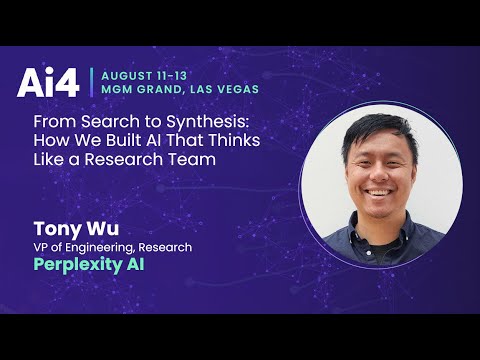
From Search to Synthesis: How We Built AI That Thinks Like a Research Team With Perplexity AI
Ai4
AI-assisted summary of From Search to Synthesis: How We Built AI That Thinks Like a Research Team With Perplexity AI — original source. Check the original for full context.
Source published:
Detailed notes
## Background Published on YouTube by Ai4 on August 29, 2025, this session features Tony Wu, VP of Engineering and Research at Perplexity AI. According to the page description, the talk examines the architectural principles behind building autonomous, multi-modal research agents like Deep Research and Labs to replace traditional search workflows with expert-level synthesis.
## TL;DR Tony Wu outlines how Perplexity AI transitioned from conventional answer engines to autonomous research agents with products like Labs and the Comet browser. He details Perplexity's post-training infrastructure, LOTUS, which combines supervised trajectory fine-tuning with on-policy reinforcement learning guided by user Elo pairwise preferences. Wu also explains Perplexity's heterogeneous serving stack, highlighting the Iris routing system that decouples prefill from decode phases to optimize KV-cache reuse. The session concludes with technical discussions on mitigating context bloat through compaction versus sub-agent delegation, selecting open-weight embedding models, and using evaluator models for trajectory reward modeling.
## Atmosphere & style The presentation carries the polished, measured, and pragmatic tone of a frontier systems engineering breakdown. Wu speaks with understated authority, methodically walking through concrete architectural diagrams rather than relying on marketing hype. The atmosphere shifts into an engaging, technical dialogue during the Q&A, where Wu candidly discusses the operational trade-offs, bottlenecks, and failure modes of production-scale agentic AI.
## Key takeaways - [00:04](https://www.youtube.com/watch?v=hs49d_LTkRc&t=4s) Perplexity's core product ecosystem spans direct answer search (Ask), exhaustive investigations (Deep Research), autonomous artifact generation (Labs), and agentic web browsing (Comet). - [01:40](https://www.youtube.com/watch?v=hs49d_LTkRc&t=100s) Agentic systems fundamentally shift research paradigms by compressing dozens of disjointed searches and 40 to 50 hours of human labor into autonomous 10-minute agent runs. - [06:01](https://www.youtube.com/watch?v=hs49d_LTkRc&t=361s) Perplexity built LOTUS (Learning Optimization and Tuning System) to support rapid researcher experimentation and arbitrary model architectures, including dense, MoE, GQA, and MLA setups. - [06:01](https://www.youtube.com/watch?v=hs49d_LTkRc&t=361s) The primary competitive bottleneck in reinforcement learning scaling is the cluster speed and compute efficiency of generating environment rollout steps. - [07:58](https://www.youtube.com/watch?v=hs49d_LTkRc&t=478s) Transforming conversational LLMs into autonomous agents begins with supervised fine-tuning (SFT) on curated multi-step traces to ground structured tool-calling syntax and execution loops. - [09:54](https://www.youtube.com/watch?v=hs49d_LTkRc&t=594s) Human preference data is collected through side-by-side product comparisons and modeled via a chess-style Elo rating framework to provide grounded reward distributions. - [09:54](https://www.youtube.com/watch?v=hs49d_LTkRc&t=594s) Perplexity trains agent policies predominantly on-policy using explicit Kullback-Leibler (KL) divergence penalties rather than standard surrogate clipping heuristics to stabilize training. - [12:25](https://www.youtube.com/watch?v=hs49d_LTkRc&t=745s) Inference serving handles a heterogeneous stack, routing traffic with fast classifiers for specialized UI widgets while using Expert, Tensor, and Pipeline Parallelism for trillion-parameter models. - [14:24](https://www.youtube.com/watch?v=hs49d_LTkRc&t=864s) Perplexity developed Iris to disaggregate generative inference, intelligently routing requests to dedicated prefill nodes for KV-cache prefix reuse before transferring state to decode nodes over InfiniBand. - [15:10](https://www.youtube.com/watch?v=hs49d_LTkRc&t=910s) Future engineering priorities center on scaling reinforcement learning for Comet's complex web actions and implementing infinite context memory to eliminate multi-turn conversational drift. - [16:05](https://www.youtube.com/watch?v=hs49d_LTkRc&t=965s) Embedding systems rely exclusively on open-weight architectures fine-tuned with in-house contrastive learning on proprietary search distributions rather than proprietary third-party APIs. - [18:14](https://www.youtube.com/watch?v=hs49d_LTkRc&t=1094s) To manage context bloat in long-running agent loops, Perplexity favors in-trajectory compaction over sub-agent delegation, avoiding compounding errors caused by poorly specified subtask prompts. - [20:26](https://www.youtube.com/watch?v=hs49d_LTkRc&t=1226s) Dense reward signals for complex, multi-turn agent trajectories are generated by secondary evaluator judge models that grade the entire execution trace against the initial objective.
## Detailed walkthrough ### [00:04](https://www.youtube.com/watch?v=hs49d_LTkRc&t=4s) Introducing Perplexity and the Core Product Ecosystem
Tony Wu introduces himself and sets the stage for how Perplexity built what he describes as "the world's leading AI answer engine." Perplexity was founded roughly three years prior and has grown to 250 global employees, spearheaded by its three co-founders. Wu highlights that the company's defining mission has remained constant since day one: "to cater to the world's curiosity by rewriting the fabric of the internet." The company's vision centers around four core consumer and enterprise products:
- **Ask:** Perplexity’s flagship search and answer engine that replaces traditional search link pages with direct, synthesized answers. - **Deep Research:** Launched earlier in the year, designed to conduct exhaustive, multi-step investigations to help users thoroughly master a topic at length. - **Labs:** Shipped mid-year, functioning as an agentic project builder and AI code creator that generates complete artifacts, tools, and apps. - **Comet:** Perplexity’s latest release, billed as the world's first truly agentic browser designed to partner with users by actively reasoning and executing tasks on their behalf.
Wu shares his personal background, noting that he studied at Stanford and held engineering roles at Uber, Meta, and OpenAI before leaving OpenAI six months prior to lead the AI organization at Perplexity. His organization oversees end-to-end AI development, spanning post-training infrastructure, inference optimization, product-focused AI engineering behind Deep Research and Labs, as well as classical machine learning systems responsible for core ranking and recommendations.
---
[01:40](https://www.youtube.com/watch?v=hs49d_LTkRc&t=100s) Compressing Days of Work into Minutes: Demos of Labs and Comet
To illustrate what agentic AI looks like in practice, Wu plays a promotional showcase of Perplexity Labs, an autonomous research agent built to tackle deep, open-ended tasks. He grounds the motivation behind Labs in the everyday friction of knowledge work. In conventional search paradigms, complex tasks demand massive amounts of cognitive overhead and time. For example, planning a trip to Japan or traveling to a conference in Las Vegas often requires firing off 50 to 60 disparate Google queries across airline sites, hotels, reviews, and travel guides, eating up 40 to 50 hours of human labor.
Perplexity Labs fundamentally alters this workflow by consolidating dozens of disjointed search sessions and multi-day research loops into an autonomous, 10-minute agent run that outputs fully synthesized artifacts. Wu follows this up with a presentation of Comet, the company's fully agentic web browser, and rolls a clip from NVIDIA's GTC Paris where Jensen Huang spotlights Perplexity on stage to showcase the frontier of agentic AI.
---
[06:01](https://www.youtube.com/watch?v=hs49d_LTkRc&t=361s) LOTUS: The Post-Training Infrastructure for Agentic Models
Turning under the hood, Wu explains that enabling models to run autonomous, multi-step trajectories requires a massive engineering effort across both high-throughput infrastructure and reinforcement learning (RL). To power this, Perplexity built an internal post-training platform called **LOTUS**, a backronym for the **Learning Optimization and Tuning System**. The team designed LOTUS to meet two primary demands: model architecture flexibility and rapid researcher velocity.
Because the open-source model ecosystem moves at breakneck speed, LOTUS was architected from the ground up to support arbitrary architectures without engineering rewrites. It natively accommodates dense models, sparse Mixture-of-Experts (MoE) networks, and modern attention variants such as Grouped-Query Attention (GQA) and Multi-Head Latent Attention (MLA). For researchers, LOTUS provides a lightweight, modular sandbox to hack quickly, iterate on supervised fine-tuning (SFT), and experiment with reinforcement learning algorithms like PPO (Proximal Policy Optimization) and GRPO (Group Relative Policy Optimization).
```mermaid flowchart TD accTitle: LOTUS Post-Training Architecture
subgraph INGEST["Model Ingestion & Parallelism"] direction TB M["Open-Source Base Models<br/>(Llama, DeepSeek, Qwen, Kimi)"] P["Distributed Strategies<br/>(FSDP, TP, EP)"] M --> P end
subgraph LOTUS["LOTUS Framework Engine"] direction TB A["Attention & Model Agnostic<br/>(Dense, MoE, GQA, MLA)"] R["Researcher Experimentation<br/>(Rapid Prototyping & Hacking)"] A --- R end
subgraph OPT["Training & Alignment Loop"] direction TB SFT["Supervised Trajectories<br/>(Token & Batch Loss)"] RL["Reinforcement Learning<br/>(PPO, GRPO with KL Penalty)"] SFT --> RL end
INGEST --> LOTUS LOTUS --> OPT ```
- **Distributed Parallelism Support:** LOTUS supports Fully Sharded Data Parallel (FSDP), Tensor Parallelism (TP), and Expert Parallelism (EP) to handle large parameter scales efficiently. - **Cross-Ecosystem Deployment:** The system has been leveraged to post-train and deploy leading open-weights model families, including Kimi, Qwen, DeepSeek, and Llama. - **Rollout Step Efficiency:** Wu emphasizes that algorithmic design is only half the battle; the real competitive advantage lies in how fast and cheaply the cluster can generate environment rollout steps to reach designated RL checkpoints.
---
[07:58](https://www.youtube.com/watch?v=hs49d_LTkRc&t=478s) Transitioning from Conversational Chat to Agentic Trajectories via SFT
Transforming an LLM from a typical conversational chatbot into an autonomous agent introduces profound systems and modeling challenges. Rather than generating text solely for human reading, an agent must translate conversational intent into valid, deterministic tool executions and API function calls. Perplexity frames this setup as a classical reinforcement learning problem where an agent's policy $\pi(a | s)$ maps the environment state $s$—defined by the incoming context and running chat history—to an action $a$, represented by the emitted tokens that specify either thoughts, answers, or structured function calls.
```mermaid flowchart LR accTitle: Agent Trajectory Rollout and Optimization Loop
subgraph TRAJ["Trajectory Rollout"] direction TB S["State Context (s)"] --> PI["Policy π(a|s)"] PI --> ACT["Emitted Action (a)<br/>(Tool / Function Call)"] end
subgraph EVAL["Preference & Reward"] direction TB ACT --> ENV["Execution & User Facing"] ENV --> PREF["Side-by-Side ELO Rating<br/>(Pairwise Wins / Losses)"] PREF --> REW["Reward Formulation"] end
subgraph OPT["Policy Optimization"] direction TB REW --> LOSS["KL-Divergence Loss"] LOSS --> GRAD["On-Policy Gradient Update"] GRAD --> PI end ```
The prerequisite to successful RL alignment is seeding the model with high-quality representations of what a multi-step agent trajectory looks like. Perplexity uses Supervised Fine-Tuning (SFT) over curated, ideal end-to-end agentic traces. Because an agentic trajectory—interleaved with environment tool calls and tool responses—still preserves the standard autoregressive structure of token generation, Perplexity applies the same token-level cross-entropy loss functions used in conversational LLMs:
- The model calculates standard cross-entropy loss at the token level across the valid action steps. - Individual token losses are accumulated to compute total trajectory-level sample loss. - Sample losses are subsequently aggregated over the batch to perform gradient updates, stabilizing the base model's tool-calling syntax and reasoning cadences before introducing reinforcement learning.
---
[09:54](https://www.youtube.com/watch?v=hs49d_LTkRc&t=594s) Preference Modeling, Elo Pairwise Scoring, and On-Policy RL
Once models have established strong trajectory fundamentals through SFT, Perplexity turns to reinforcement learning to refine the subtle qualities of answers—especially formatting, tone, thoroughness, and synthesis quality. To gather high-fidelity human preference signals at scale, Perplexity incorporates side-by-side answer comparisons directly into its consumer product. Users frequently encounter an interface prompt revealing two candidate completions side by side, allowing them to select the superior answer.
Perplexity treats these user preference pairs using an Elo rating framework identical to the scoring system used in competitive chess. When one candidate completion wins out over another, its Elo rating adjusts accordingly, yielding a mathematically grounded probability distribution over which trajectory or model variant performs better.
Equipped with these Elo-backed preference models, the AI team runs on-policy reinforcement learning loops to maximize cumulative rewards across agentic executions:
- **Policy vs. Environment:** The agent samples multi-step trajectories in an on-policy regime, deciding when to search the web, execute code, or make downstream tool calls. - **KL Divergence over Clipping:** Wu notes that while standard PPO relies heavily on surrogate clipping heuristics, Perplexity's RL formulation deviates by utilizing an explicit Kullback-Leibler (KL) divergence penalty to constrain policy drift and maintain training stability. - **On-Policy Rationale:** Perplexity trains predominantly on-policy because modern open-weights foundation models are already remarkably capable, meaning that sampling directly from the current policy distribution produces rich, high-reward trajectories without requiring off-policy replaying schemes.
[12:25](https://www.youtube.com/watch?v=hs49d_LTkRc&t=745s) Serving Heterogeneous Models: From Lightweight Classifiers to Trillion-Parameter MoEs
Deploying models to production and turning them into real-world consumer products requires handling vastly different inference workloads. At Perplexity, the serving stack hosts everything from lightweight embedding models and fast classifiers up to massive, one-trillion-parameter large language models. The small models perform critical front-line triage; for example, intent classifiers determine where to route specific queries so the interface can display specialized experiences. A sports-related search surfaces interactive sports widgets, while a travel-related query activates a dedicated suite of travel tools and booking experiences.
```mermaid flowchart TD accTitle: Perplexity Serving Architecture and Parallelism subgraph Routing["Front-Line Triage"] Q["User Query"] --> C["Classifiers & Embeddings"] C -->|"Sports Intent"| SW["Sports Widgets"] C -->|"Travel Intent"| TW["Travel Suite"] C -->|"Complex Generation"| LLM["Trillion-Parameter LLM"] end
subgraph Parallelism["Distributed Inference Techniques"] LLM --> DP["Data Parallelism<br/>(Request routing across nodes)"] LLM --> EP["Expert Parallelism<br/>(MoE MLPs sharded across nodes)"] LLM --> TP["Tensor Parallelism<br/>(Split weight matrices)"] LLM --> PP["Pipeline Parallelism<br/>(Layer stages across GPUs)"] end ```
While smaller embedding and classification models require minimal scaling optimizations, serving massive models demands sophisticated distribution techniques across clusters of GPUs:
- **Dynamic Batching:** Grouping incoming token streams to maximize compute saturation on hardware during inference. - **Data Parallelism:** Distributing query throughput by routing requests effectively across independent compute nodes. - **Expert Parallelism (EP):** For Mixture of Experts (MoE) architectures, separating standard attention layers from feed-forward networks (MLPs) and sharding individual expert MLPs across dedicated nodes. - **Tensor and Pipeline Parallelism (TP/PP):** Slicing large weight matrices intra-node and segmenting layer pipelines inter-node to fit massive models across GPU memory boundaries.
---
[14:24](https://www.youtube.com/watch?v=hs49d_LTkRc&t=864s) Disaggregated Prefill and Decode with Iris
To optimize inference efficiency at scale, Perplexity decouples the two phases of generative inference: the compute-bound prefill step and the memory-bandwidth-bound decode step. Rather than forcing a single GPU to handle both phases with suboptimal hardware utilization, Perplexity developed an internal routing infrastructure called **Iris**.
```mermaid flowchart LR accTitle: Disaggregated Prefill and Decode with Iris subgraph Ingestion["Ingestion & Routing"] Req["Incoming User Request"] --> Iris["Iris Front-End Service"] end
subgraph DisaggregatedServing["Disaggregated Compute"] Iris -->|"Prefix-aware routing<br/>(Maximizes KV reuse)"| PFN["Dedicated Prefill Nodes"] PFN -->|"Transfers KV cache<br/>via InfiniBand"| DCN["Dedicated Decode Nodes"] DCN --> Gen["Token Generation Stream"] end ```
Iris operates as a front-end routing service rather than a database. It inspects incoming requests and directs them to the optimal prefill node that maximizes prefix matching and reuse of the existing Key-Value (KV) cache. Once the prefill phase completes, the resulting KV cache states are transferred over high-speed InfiniBand directly to dedicated decoding nodes to stream the final tokens back to the user.
---
[15:10](https://www.youtube.com/watch?v=hs49d_LTkRc&t=910s) The Perplexity Roadmap: Comet RL Scaling and Infinite Context
Looking forward, Perplexity is focusing engineering efforts on advancing autonomous agent workflows and conversational memory:
- **Scaling Comet:** Further developing Comet by scaling out reinforcement learning infrastructure to run high-fidelity RL workloads on complex, multi-step agent trajectories. - **Infinite Context:** Implementing mechanisms to overcome conversational drift across long session threads. Users frequently pivot between diverse topics within a single conversation; infinite context will allow the model to seamlessly retrieve and reference facts established dozens of turns prior without degrading output quality.
---
[16:05](https://www.youtube.com/watch?v=hs49d_LTkRc&t=965s) Q&A: Clarifying Iris, Data Stores, and Open Embedding Choices
Opening the floor to audience questions, Tony Wu first clarified an audience member's misconception regarding the storage layer: **Iris is strictly an intelligent routing layer for KV cache prefix matching**, not a key-value data store. Perplexity relies on industry-standard platforms like Databricks and Snowflake for general analytics and data warehouse infrastructure.
Addressing another question about model selection for embeddings (such as BERT derivatives versus models like Qwen or proprietary options), Tony explained their core requirements:
- **Openness for Domain Tuning:** Models must be open-weight to allow in-house contrastive learning and fine-tuning on Perplexity's specific search and retrieval query distributions, ruling out closed proprietary APIs like OpenAI embeddings. - **Empirical Architecture Selection:** Perplexity tests a wide range of architectures—including legacy architectures like BERT and newer alternatives like Qwen—choosing winners strictly based on empirical benchmark evaluations and internal retrieval signal.
---
[18:14](https://www.youtube.com/watch?v=hs49d_LTkRc&t=1094s) Q&A: Taming Context Bloat in Long-Running Agent Loops
An audience member asked how Perplexity prevents context bloat in single-agent loops capped at standard context windows (such as 128k tokens) without losing critical details, and whether they rely on multi-agent decomposition. Tony contrasted two core architectural approaches:
```mermaid flowchart TD accTitle: Strategies for Context Window Management subgraph Compaction["Strategy 1: Trajectory Compaction"] A["Raw Search Results"] --> B["Summarize & Discard Raw Dumps"] B --> C["Inject Compact State into System Prompt"] C --> D["Continue Single Trajectory"] end
subgraph SubAgents["Strategy 2: Sub-Agent Delegation"] M["Parent Agent"] -->|"Formulates subtask query"| S["Sub-Agent"] S -->|"Independent context execution"| S S -->|"Returns distilled answer"| M end ```
1. **In-Trajectory Compaction:** When an agent conducts an exploratory search loop, retaining raw web scrapes rapidly exhausts context space. The model compacts prior turn outputs into concise, synthesized summaries, inserts them back into the system message or history, and drops the raw intermediary dumps before proceeding down the trajectory. 2. **Sub-Agent Delegation:** Tasks can be partitioned out to temporary sub-agents operating within clean, independent context windows. However, Tony highlighted a crucial failure mode: "one of the drawbacks to this is that you're relying on the original agent to formulate the request effectively." If the parent agent under-specifies requirements or miscommunicates context, small misunderstandings compound into compounding errors as tasks traverse multiple agent boundaries.
---
[20:26](https://www.youtube.com/watch?v=hs49d_LTkRc&t=1226s) Q&A: Reinforcement Learning and Trajectory-Level Reward Modeling
The session concluded with an inquiry into where reinforcement learning is applied within Perplexity, specifically regarding recommendation systems (like suggested follow-up queries) versus agent behaviors:
- **Search Suggestions vs. Agents:** Perplexity does not currently train query suggestion models using RL; reinforcement learning is reserved for training complex agent search trajectories. - **Trajectory Reward Modeling:** For multi-turn tasks (such as an agent traversing LinkedIn to retrieve contact data or send messages), rewards are generated by secondary evaluator models. These judge models inspect the initial prompt alongside the final execution trace to grade whether the trajectory achieved the desired objective, providing dense, scalable reward signals for RL training.
## Notable quotes > [00:04](https://www.youtube.com/watch?v=hs49d_LTkRc&t=4s) the world's leading AI answer engine — Tony Wu
> [00:04](https://www.youtube.com/watch?v=hs49d_LTkRc&t=4s) to cater to the world's curiosity by rewriting the fabric of the internet. — Tony Wu
> [16:05](https://www.youtube.com/watch?v=hs49d_LTkRc&t=965s) Iris is strictly an intelligent routing layer for KV cache prefix matching — Tony Wu
> [18:14](https://www.youtube.com/watch?v=hs49d_LTkRc&t=1094s) one of the drawbacks to this is that you're relying on the original agent to formulate the request effectively. — Tony Wu
## Mentioned Perplexity AI, Tony Wu, Ask, Deep Research, Labs, Comet, Stanford, Uber, Meta, OpenAI, Google, NVIDIA, Jensen Huang, GTC Paris, LOTUS, Llama, DeepSeek, Qwen, Kimi, BERT, Iris, Databricks, Snowflake, LinkedIn, InfiniBand
## Video description Tony Wu, VP of Engineering, Research, Perplexity AI
Abstracts
Hook: What if AI could replace not just individual searches, but entire research workflows—conducting dozens of queries, reading hundreds of sources, and delivering expert-level reports in minutes instead of hours?
Context: As enterprises struggle to extract actionable insights from overwhelming data volumes, traditional search tools fall short of delivering the comprehensive analysis that strategic decisions require. Perplexity's recent launch of Deep Research and Labs represents a fundamental shift from reactive information retrieval to proactive knowledge synthesis, transforming how organizations approach research-intensive tasks.
Key Takeaways: Attendees will discover the architectural principles behind building autonomous research agents that iterate through complex reasoning loops, and learn practical strategies for implementing multi-modal AI systems that generate structured deliverables—from interactive dashboards to comprehensive reports—while maintaining accuracy across diverse enterprise use cases.
Call to Action: Join this session to understand how your organization can move beyond basic AI chatbots to deploy research-grade AI systems that amplify human expertise across finance, healthcare, and strategic planning functions.
[Source](https://www.youtube.com/watch?v=hs49d_LTkRc)