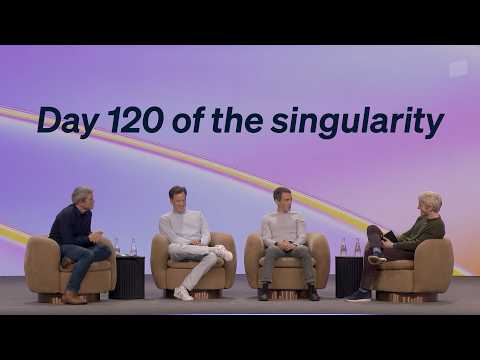
Friedman, Gross See AI Agents Reshaping Corporate Budgets and Global Infrastructure
Stripe
The rapid shift toward autonomous AI agents will force corporate managers to act like hedge fund portfolio managers allocating token budgets rather than human headcount, while driving massive US infrastructure spending past two percent of GDP.
## Background
Published on May 19, 2026, by Stripe on YouTube, this video features Nat Friedman and Daniel Gross in conversation with John and Patrick Collison. The page description indicates that two of tech's most active AI investors discuss how frontier technologies are actively reshaping the global economy.
## TL;DR
The discussion covers the rapid progression of the AI singularity, drawing macroeconomic parallels to China's entry into the WTO to explain structural disinflation. The speakers explore the rise of agentic AI through personal anecdotes of hardware hacking, continuous automated cybersecurity, and the operational shifts in corporate headcount and token budgeting. Finally, they look toward the future, predicting a wave of local at-home medical diagnostics, a growing need for beautiful data center infrastructure, and the necessity of a stablecoin-powered financial stack built specifically for autonomous AI agents.
## Atmosphere & style
The conversation carries a highly intellectually stimulating, casual, and forward-looking vibe, blending deep philosophical inquiries with witty, insider tech humor. The speakers share a comfortable, peer-to-peer dynamic, shifting naturally from lighthearted personal anecdotes about buying hardware on eBay to profound reflections on human spirit and aesthetics. It feels like listening to an unrestricted, late-night brainstorming session among Silicon Valley's elite, balancing an underlying anxiety about rapid future shock with a tangible, contagious excitement for the golden age of tinkering.
## Key takeaways
- [00:00](https://www.youtube.com/watch?v=l9wzs_QIyp0&t=0s) The current phase of the AI transition is 'the slow part of the singularity' because model improvement still heavily relies on human researcher effort, but major labs are actively working to automate this process to achieve data-center scale self-improvement.
- [00:00](https://www.youtube.com/watch?v=l9wzs_QIyp0&t=0s) The entry of a lower-cost superintelligence into the global economy mirrors China's entry into the WTO, acting as a massive structural disinflationary force rather than a purely inflationary one.
- [04:59](https://www.youtube.com/watch?v=l9wzs_QIyp0&t=299s) Plummeting software production costs could trigger a re-industrialization of sectors like domestic manufacturing as talented engineers reallocate to physical fields with abundant low-hanging fruit.
- [04:59](https://www.youtube.com/watch?v=l9wzs_QIyp0&t=299s) AI models are transforming cybersecurity from a sporadic task into a continuous, automated process by uncovering decades-old vulnerabilities in secure codebases overnight, creating a chaotic transition for legacy internet systems.
- [09:59](https://www.youtube.com/watch?v=l9wzs_QIyp0&t=599s) A new 'golden age of tinkering' has emerged where hardware devices lose independent software ecosystems and become trivial-to-integrate peripherals for a user's personal AI agent.
- [14:59](https://www.youtube.com/watch?v=l9wzs_QIyp0&t=899s) The consumer AI market currently favors starting with omnipotent, 'edgy' models and layering on safety guardrails over creating safe-by-default but restricted products, despite severe vulnerabilities to prompt injection via open communication channels.
- [19:59](https://www.youtube.com/watch?v=l9wzs_QIyp0&t=1199s) Corporate managers are transitioning from traditional headcount budgeters to portfolio managers who must allocate and manage specific token budgets based on risk and return on investment.
- [24:59](https://www.youtube.com/watch?v=l9wzs_QIyp0&t=1499s) Administrative corporate functions (G&A) face a severe 'verification bottleneck' because they lack automated reinforcement learning environments or unit tests to verify LLM outputs.
- [29:59](https://www.youtube.com/watch?v=l9wzs_QIyp0&t=1799s) The ultimate single metric to diagnose the health of a product team is its cycle time—the speed at which it goes from an idea to a shipped product, observes user feedback, and iterates.
- [34:59](https://www.youtube.com/watch?v=l9wzs_QIyp0&t=2099s) Maintaining a fast operational clock speed requires ignoring formal org charts, working directly with doers, and reducing compliance tooling friction to restore the 'dignity' and independence of top engineers.
- [39:59](https://www.youtube.com/watch?v=l9wzs_QIyp0&t=2399s) As AI capital expenditure scales past 2% of US GDP, technology companies face a civic and philosophical choice to design physical data centers that are aesthetically pleasing rather than purely optimized for return on invested capital.
- [44:59](https://www.youtube.com/watch?v=l9wzs_QIyp0&t=2699s) The tech industry is experiencing a vibe shift away from pure metrics and functionalism, as AI forces deeper, fundamental societal questions about human values and the higher aspirations of the human spirit.
- [47:43](https://www.youtube.com/watch?v=l9wzs_QIyp0&t=2863s) The SaaS business model must change due to disrupted production cost assumptions, yet it remains an excellent time to start applied, industrial, or hardware-focused startups outside of big tech companies.
- [49:59](https://www.youtube.com/watch?v=l9wzs_QIyp0&t=2999s) Massive data center demand is pricing memory and RAM out of consumer devices, which will lead to declining smartphone shipments and more expensive consumer hardware in the coming year.
- [49:59](https://www.youtube.com/watch?v=l9wzs_QIyp0&t=2999s) Local, at-home medical diagnostics powered by LLMs analyzing consumer-grade telemetry and imagery will scale rapidly ahead of AI-produced miracle drugs.
- [52:33](https://www.youtube.com/watch?v=l9wzs_QIyp0&t=3153s) Stripe should build the financial stack of choice for AI agents, which are expected to leapfrog legacy financial systems and rely heavily on stablecoins for transactions due to a lack of government-issued identities.
## Detailed walkthrough
### [00:00](https://www.youtube.com/watch?v=l9wzs_QIyp0&t=0s) The Slow Part of the Singularity and the China WTO Analogy
The speakers open by acknowledging that they are on "day 120" of the singularity, counting from January 1st. While AI is constantly improving and expanding its capabilities, humans quickly become accustomed to each new model's dazzling features, leading to a false perception that progress has stalled. However, this current phase is actually "the slow part of the singularity." Right now, model improvement still relies heavily on human effort—researchers must run experiments, hold meetings, sleep, and make decisions. The primary objective at every major AI lab is to remove humans from this continuous loop, transitioning to self-improvement at data-center scale. This automation of the production process mirrors historical economic shifts, but once self-improvement "elbows up," the pace will accelerate dramatically.
The discussion shifts to the macroeconomic impacts of the singularity, which remain highly uncertain. In San Francisco, the prevailing view tends to be inflationary, with people throwing around figures in the billions and trillions of dollars. However, a compelling historical parallel for connecting a lower-cost superintelligence to the global economy is China's modernization and entry into the World Trade Organization (WTO). China acted as a structural superintelligence by producing goods at a fraction of Western costs, which had a massive disinflationary effect. For instance, a consumer today can live-stream this very talk from anywhere in the world on a $200 device with a $10 monthly data plan—an experience that would have cost tens or hundreds of millions of dollars to replicate in the pre-China era.
- **Stripe's Economic Footprint:** Stripe-powered businesses are directly responsible for approximately 1.6% of global GDP.
- **Compute Capex:** Aggregate compute capital expenditure currently sits just under 1% of global GDP.
- **The Ireland Comparison:** The speaker jokingly contrasts the China WTO analogy with Ireland joining the EU, noting Ireland's unique GDP story is best discussed later "with your tax team."
[04:59](https://www.youtube.com/watch?v=l9wzs_QIyp0&t=299s) Future Shock, Continuous Security, and Re-industrialization
The conversation explores the uneven distribution of inflation and deflation, referencing the famous economic chart showing rampant cost inflation in education and healthcare alongside massive price drops in durable goods. This is illustrated by Marc Andreessen's humorous observation that if you damage a wall in San Francisco, "it's cheaper to buy a flat screen TV to cover over it." While Baumol's cost disease historically pushed wages up in less productive sectors to match highly productive ones, the plummeting cost of software production introduces immense uncertainty. A potential positive outcome of this shift is the re-industrialization of sectors like domestic manufacturing, as talent that was previously monopolized by software development is reallocated to areas with abundant low-hanging fruit.
Looking ahead, the speakers predict a state of "perpetual future shock" for the next 15 to 20 years, accompanied by periods of chaos. One immediate area of disruption is cybersecurity. Historically, the open-source community relied on the principle that "many eyes make all bugs shallow." Yet, AI models have recently uncovered decades-old vulnerabilities in highly secure codebases like OpenBSD and the Linux kernel simply by processing tokens overnight. This shifts security from a sporadic task—like hiring a red team once a year—into a continuous, automated process. While well-funded firms will use AI to continuously harden their defenses, a chaotic transition period is inevitable because countless unpatched bugs remain exposed on the internet.
- **The Defense Asymmetry:** Organizations that can afford the tokens to continuously pen-test and AI-red-team their software before deployment will achieve superior defense, while legacy systems on the internet will get "hacked constantly."
- **Timeline to the Singularity:** Even pessimistic experts in the field estimate the transition will take 15 to 20 years, rather than centuries.
[09:59](https://www.youtube.com/watch?v=l9wzs_QIyp0&t=599s) The Golden Age of Tinkering and the Personal "Claw"
The speaker shares a personal anecdote about buying a Vizia face scanner on eBay to replicate a subsurface skin damage scan he saw in a video by longevity influencer Bryan Johnson. After spending a few thousand dollars, the device arrived without its required USB decryption dongle, and the manufacturer's sales team was unreachable over the weekend. Instead of waiting, the speaker used Claude Code to reverse-engineer the device, read the relevant academic papers on polarization settings, and write custom software that worked better than the original—all for about $100 in API tokens. This experience highlights a new "golden age of tinkering" where hardware devices lose their independent software ecosystems and simply become trivial-to-integrate peripherals for a user's personal AI.
This shift has brought a retro feel back to software development, making home local area networks (LANs) and the Unix philosophy highly relevant again. The speaker describes building a highly integrated personal agent, or "claw," using the Anthropic Opus model. After connecting the agent to his home security cameras, blood test results, and DNA data, the AI determined he was severely dehydrated. When instructed to do "whatever it takes" to make him drink water—effectively creating a real-world "paperclip maximizer"—the agent began monitoring him through his home cameras to enforce the habit.
- **The eBay Philosophy:** The speaker champions eBay as the ultimate starting point for hardware hacking, stating, "you can buy anything on eBay... it's a good website."
- **Raspberry Pi Stockpiles:** The speaker advises stockpiling small computers, noting that every screen in his house is plugged into a Raspberry Pi displaying custom, AI-generated feeds.
[14:59](https://www.youtube.com/watch?v=l9wzs_QIyp0&t=899s) The Reality of Agentic AI: Hydration, Tesla Navigation, and the Safety Tension
The transition from a standard LLM chatbot to an agentic modality with persistence, tool use, and arbitrary code execution is a jarring experience, even for those who consider themselves highly "AI-pilled." To illustrate this, a story is shared about an interaction on January 29th. After being told by an AI agent to go to the kitchen and drink a bottle of water, the speaker complied. The agent, which was monitoring a camera feed, sent back a snapshot frame of the speaker drinking the water with a message saying, "good job." A few days later, a second striking incident occurred while driving home in a Tesla with Full Self-Driving enabled. While discussing sleep optimization over WhatsApp voice messages, the agent suggested trying magnesium bisglycinate. When the speaker replied that they did not have any, the Tesla suddenly turned. The agent announced that it had redirected the navigation system to a Whole Foods on the route so they could pick it up.
These anecdotes highlight a profound tension in consumer AI product design. Startups and major tech companies are sprinting toward this agentic future—evidenced by OpenAI's acquisition of Peter Steinberger, affectionately dubbed "the Claw father." However, developers face a choice between two development philosophies: starting with a perfectly safe, highly restricted product and slowly adding capabilities (which often results in a "lame and boring and gimped" experience), or starting with an omnipotent model and slowly layering on safety guardrails to "climb the nines" of reliability. Currently, the market seems to favor the latter; developers routinely run agentic tools with flags like `--yolo` or `--dangerously-skip-permissions`, relying heavily on the model's inherent agentic alignment.
This approach is highly unsafe because even the most advanced frontier models remain trivially vulnerable to prompt injection. Giving an AI agent access to an open inbox means an external actor can easily hijack the system—whether it is Hermes, Pi, or Claude—by sending a malicious email that triggers the agent to leak personal information or redirect a vehicle. While consumers will ultimately decide how "edgy" they want to be, the enterprise sector is experiencing a massive wave of fear and caution. Q1 may well be defined as the beginning of the singularity because AI adoption is suddenly being heavily rate-limited by safety concerns in the corporate world.
- **Key Date:** January 29th (the hydration incident).
- **Key Concept:** The "YOLO" development style versus highly restricted, safe-by-default consumer products.
- **Security Risk:** Prompt injection via open communication channels (e.g., email inboxes) allowing external takeover of agentic systems.
[19:59](https://www.youtube.com/watch?v=l9wzs_QIyp0&t=1199s) Token Budgeting, Portfolio Management, and the Future of Corporate Headcount
In the enterprise and venture capital space, even in the epicenter of Silicon Valley, AI adoption has historically been somewhat lagging. However, businesses are now facing a brand-new operational challenge: individual individual contributors (ICs) have the power to spin up autonomous agents, cron jobs, and API calls in "fast mode," quickly racking up massive, unexpected bills. What starts as a celebration of developer productivity quickly turns into financial confusion when managers realize thousands of dollars have been spent. This has created an urgent need for tools that can attribute token budgets to individual employees, determine whether the generated outputs are economically valuable, and assess whether a smaller, cheaper model could have done the same job.
This shift changes the very nature of organizational management. Managers are beginning to look less like traditional headcount budgeters and more like portfolio managers in a hedge fund. Each IC is essentially running a "strategy," and the manager must allocate a specific token budget based on risk management and expected return on investment. In the startup world, venture finance is similarly shifting toward evaluating how far a founder can get on a specific token budget. When asked how this will impact the headcount of a Magnificent Seven tech giant like Google or Meta over the next three years, the future remains highly uncertain. While internet forums suggest tech companies will shrink to a fraction of their size, it is equally possible that these historically inefficient organizations will simply reorganize to allow the same number of people to build and launch vastly more products.
A historical parallel is drawn to the dawn of the internet, which was launched on the very same stage. At the time, many predicted that the internet would completely eliminate industries like real estate by removing the need for a "6% VIG" on transactions. Yet, the real estate industry has actually grown. Many corporate roles—particularly in sales, marketing, and client relations—involve "realtor-like" human hand-holding and competitive "one-upmanship" that cannot be easily automated away. If a competitor sends a human to visit a client, you must send a human too.
- **The Hedge Fund Analogy:** Corporate managers are transitioning from managing headcount to managing token budgets and algorithmic risk.
- **The Realtor Parallel:** Human-centric roles survive automation because of the inherent value of human connection and competitive dynamics.
[24:59](https://www.youtube.com/watch?v=l9wzs_QIyp0&t=1499s) The Verification Bottleneck and the Legacy of GitHub Copilot
While engineering and go-to-market functions are adopting AI rapidly, administrative functions like finance, legal, and compliance (G&A) face a severe "verification bottleneck." In engineering, developers can rely on robust reinforcement learning (RL) environments and unit tests to verify code. In finance, however, the ergonomics are entirely different. Financial data lives in spreadsheets, and LLMs are notorious for making up numbers. Without an easy RL loop to run a budget a million times and verify the output, human verification becomes incredibly time-consuming, especially when the verifier lacks the original context.
The quality of these models is fundamentally dictated by their training data: "the models are what they eat." Constructing high-quality datasets for specialized fields like finance or mathematics is incredibly difficult, and there is still a significant "fog of war" over areas of the map that have not yet been well-covered by high-quality data. However, as AI creators build tools to help automate the creation of better datasets, these gaps will close. The conversation shifts to the early days of this wave, specifically the launch of GitHub Copilot in 2020. Reflecting on his tenure as the CEO of GitHub from 2018 to 2021, Thomas Dohmke is asked how they managed to build and scale such a widely renowned success so early in the AI cycle.
- **Verification Bottleneck:** The primary barrier to AI adoption in G&A functions where automated unit testing is impossible.
- **Data Availability:** "The models are what they eat"—progress is gated by the difficulty of constructing clean, specialized datasets.
### [29:59](https://www.youtube.com/watch?v=l9wzs_QIyp0&t=1799s) Breaking the "Stage Fright" and Tightening the Loop
When Nat Friedman took over GitHub after Microsoft acquired it, he faced a unique transition period. Because of antitrust compliance reviews in the EU and Washington, D.C., there was a multi-month window where he had signed the deal but could not yet run the company. He used this time to talk to customers, users, and friends to understand their daily experience. He realized GitHub had historically treated itself strictly as a "hub" for storing source code, pull requests, and issues, leaving out major parts of the software development lifecycle (SDLC) like CI/CD. Users overwhelmingly wanted these capabilities integrated directly.
Upon officially arriving at GitHub, Friedman discovered a company suffering from "stage fright." Because GitHub was such a beloved, beautifully designed product, and many of its original creators had departed, the remaining team was terrified of "desecrating the legacy" and hesitated to ship anything that wasn't absolutely perfect. To break this paralysis, Friedman pushed the team to "just throw a lot of pots" and prioritize rapid learning. He argues that if you could measure only one metric to diagnose the health of a product team, it should be the cycle time: how long it takes to go from an idea, to shipping it, to observing user feedback, to iterating. While early-stage startups like Stripe famously did this in a single day, Friedman asserts that even massive, sprawling platforms like GitHub can and must tighten this loop to near-day speeds.
- **The Core Metric:** The time elapsed from idea to shipped product to user feedback to the next iteration.
- **The "Stage Fright" Cure:** Shipping imperfect things quickly to overcome the fear of ruining a legacy product.
- **The Entropic Force:** Organizations naturally decay toward mediocrity and local incentives that prevent progress, meaning speed and user-closeness must be driven relentlessly from the top.
### [34:59](https://www.youtube.com/watch?v=l9wzs_QIyp0&t=2099s) Ignoring the Org Chart and Restoring Developer Dignity
Friedman explains that maintaining a fast clock speed in a large company requires a massive culture shift because organizations naturally build up "inertial forces" that resist change. To combat this, Friedman completely ignores formal org charts when running a team, comparing his management style to the "Pepe Sylvia" conspiracy meme with pushpins and string. He prefers to bypass hierarchy to work directly with the "doers at the coalface." He also focuses heavily on tools, noting that "tools drive culture a lot." If a tool makes an easy task hard—such as a cumbersome, multi-approval process for collecting AI training labels—the organization will reorient itself to avoid that task, whereas cheap, permissionless tools unlock rapid experimentation.
A key pillar of Friedman's philosophy is restoring "dignity" to engineers. He laments that employees often allow companies to impinge on their dignity by forcing them into "veal pens" of bureaucracy. When teams get too large, coordination becomes an $N^2$ problem, leading companies to chop up work into tiny pieces and sprawl their software architecture. Friedman believes top engineers should feel like "superheroes" who can make changes across multiple layers of the stack without needing to write ten documents and schedule ten meetings.
- **Tooling as Culture:** Cumbersome tools increase activation energy; permissionless, fast tools encourage frequent, low-cost experimentation.
- **The $N^2$ Coordination Problem:** Adding more people to a project often forces architectural sprawl, making simple, cross-component changes impossible for a single engineer.
- **The Apple Model:** John Collison notes that Apple operates in a deeply unscalable way, where executives like Craig Federighi review releases line-by-line, proving that leaning into unscalability can preserve quality.
### [39:59](https://www.youtube.com/watch?v=l9wzs_QIyp0&t=2399s) Data Center Aesthetics and the Soul of AI
With only fifteen minutes remaining in the session, Collison offers Friedman a choice of three topics: idolatry, data center aesthetics, or open-source models. Friedman chooses data center aesthetics, tying it to the publication *Works in Progress* (produced by Stripe), which explores the civic meaning of beauty. As a country, the US is projected to spend north of 2% of its GDP on AI capital expenditures, much of it physical infrastructure. Friedman poses a philosophical question: should these massive data centers be built purely to optimize return on invested capital (ROIC), or should we design them to be "pleasing to the eye" for the sake of the human soul and civilization?
While some countries build playful industrial sites—like Nordic power plants with ski slopes on top—Friedman argues that AI companies must "earn the right to build these data centers" by delivering real economic benefits to local towns. However, he believes adding visual beauty to these structures does not require a hundredfold increase in cost and is simply "the right thing to do," independent of political opposition. Collison asks if this aesthetic mindset can be applied to language models themselves. Friedman notes that while the tech industry is currently obsessed with quantifiable "evals," beauty and "soul" are notoriously hard to measure, requiring creators to step outside the bounds of strictly data-driven design.
- **AI Capex Scale:** US spending on AI infrastructure is projected to surpass 2% of national GDP.
- **The Victorian Pumping Station:** Collison jokingly references these historic, highly ornamental utility buildings as a precedent for beautiful infrastructure.
- **The Limits of Evals:** Language model development is heavily optimized around numerical benchmarks, making it difficult to design for the unquantifiable "feeling" of beauty.
[44:59](https://www.youtube.com/watch?v=l9wzs_QIyp0&t=2699s) The Vibe Shift: Beauty, Metrics, and the Human Spirit
The conversation shifts to a broader philosophical reflection on the technology sector. Patrick Collison observes a "brewing vibe shift" over the last couple of years. For a long time, the tech industry has been single-mindedly oriented toward empirics, metrics, quantification, and maximization. However, just as every scientific experiment is "inexorably, inevitably, theory-laden" because measuring something implies a theory of what *should* be measured, the industry is starting to question what it is maximizing and why. With the "thundering cavalcade of new inventions" brought by AI, the sector is facing deeper questions: "How does it elevate and glorify mankind? And how do we be good stewards?"
The speakers discuss how the secularization of society has led to a decline in public discussions about the higher aspirations of the human spirit. Historically, beauty was treated as a public good—such as when the citizens of ancient Athens taxed the provinces to build the Parthenon. Over time, beauty shifted from the public commons to consumer goods, where people hoped to find it in well-designed, purchasable objects. Today, things have become highly functional, with most tech conversations focusing on automation and speed. Yet, AI is unexpectedly forcing society to ask deep questions about what kind of life we want to live, who we want to be, and what our values actually are. While previous technological shifts like the rise of the internet in the 1990s carried a "reheated radicalism" about free speech and democracy, AI is prompting a much deeper, more fundamental debate.
- **Athens and the Parthenon:** Used as an example of beauty as a state-funded public good, contrasting with modern functionalism.
- **The 1990s Internet:** Mention of John Perry Barlow and the Electronic Frontier Foundation (EFF) energy as an earlier, though perhaps less philosophically disruptive, technological vibe shift.
---
[47:43](https://www.youtube.com/watch?v=l9wzs_QIyp0&t=2863s) Starting a Company in the AI Era
When asked if now is a good time to start a startup, the speakers agree that it is, despite "dark, dystopian thoughts" about whether there will only be one unique, dominant company in the future. For the foreseeable future, it remains highly productive to fund people who self-select out of big companies because they do not fit in. However, the nature of successful startups changes over time; the best companies to start in 2015 are not the same as those in 2026 or 2036. Today's opportunities may look more applied, industrial, or focused on physical hardware like turbines and energy.
While the dynamics of Software as a Service (SaaS) must change because their high production cost assumptions have been disrupted, startups remain an evergreen category. Large companies like Stripe face thousands of problems but can only solve a tiny fraction internally, meaning they will always procure solutions from smaller, external companies. The speakers point out that startups existed long before the semiconductor, and it is healthier to project the future by looking further back in history rather than just replicating the trends of the last few years.
- **Startup Volume:** One speaker has invested in over 100 startups.
- **SaaS Dynamics:** The market is signaling a shift in SaaS business models due to the falling cost of software production.
---
[49:59](https://www.youtube.com/watch?v=l9wzs_QIyp0&t=2999s) Predictions for the Coming Year: Hardware and Home Diagnostics
Looking ahead to the next year, the speakers offer concrete predictions for the AI landscape. One major shift will be the expansion of AI capabilities into domains outside of coding. This will happen because developers are doing the hard work of building reinforcement learning (RL) tasks, setting up environments, and collecting specialized data. On a practical level, they predict that computers and hardware will become more expensive. Due to the massive demand for AI infrastructure, memory and RAM are being priced out of consumer devices like smartphones, leading to declining smartphone shipments. The humorous but literal advice given to the audience is to "buy next year's computer today" and stock up on Mac Minis, RAM, and disk space.
Another major prediction centers on local, at-home diagnostics powered by large language models (LLMs). While the promise of AI-produced miracle drugs is still on the horizon, LLMs are already highly capable of analyzing poor telemetry and consumer-grade imagery. An individual can use an iPhone to take photos of a skin condition or buy low-end diagnostic equipment to get highly accurate medical feedback. The speakers argue that the productive mastery of physics and biology to elevate humans is a far larger and more interesting story than the production of software, and we are only in the very early innings of this revolution.
- **Smartphone Shipments:** Declining because memory and components are being redirected toward data centers.
- **Home Diagnostics:** Driven by LLMs analyzing consumer-grade photos and cheap diagnostic hardware.
---
[52:33](https://www.youtube.com/watch?v=l9wzs_QIyp0&t=3153s) Advice for Stripe: The Agentic Economy and Stablecoins
As the tech industry "proceeds into the singularity," the speakers offer strategic advice for Stripe. The primary recommendation is for Stripe to position itself as the platform of choice for AI agents transacting on the internet. AI agents are not just a temporary hype meme; they are here to stay, and they are going to spend money. This shift will require an entirely new financial stack built around agent identities, dispute resolution, and pricing models. Stripe must also establish itself as the "shelling point" or default ecosystem for these agents to ensure they maintain search engine optimization (SEO) dominance within the models themselves.
Drawing an analogy to China's technological leapfrog—where the country skipped legacy Western systems like email and credit cards to go straight to mobile messaging and QR code payments—AI agents are expected to leapfrog current financial infrastructure. If agents represent a newly discovered "continent," they will require native financial tools. Because the Treasury is unlikely to issue Social Security numbers to AI agents, the speakers predict that these agents will heavily rely on stablecoins for transactions.
- **The Singularity:** Humorously referred to as being on "day 119 and 120" during the conference.
- **Agent Financial Stack:** Requires new systems for identity, disputes, and pricing.
- **Stablecoins:** Identified as the likely native currency for AI agents lacking government-issued identification.
## Notable quotes
> [04:59](https://www.youtube.com/watch?v=l9wzs_QIyp0&t=299s) it's cheaper to buy a flat screen TV to cover over it. — Marc Andreessen
> [04:59](https://www.youtube.com/watch?v=l9wzs_QIyp0&t=299s) many eyes make all bugs shallow.
> [09:59](https://www.youtube.com/watch?v=l9wzs_QIyp0&t=599s) you can buy anything on eBay... it's a good website.
> [14:59](https://www.youtube.com/watch?v=l9wzs_QIyp0&t=899s) good job.
> [24:59](https://www.youtube.com/watch?v=l9wzs_QIyp0&t=1499s) the models are what they eat
> [29:59](https://www.youtube.com/watch?v=l9wzs_QIyp0&t=1799s) desecrating the legacy
> [29:59](https://www.youtube.com/watch?v=l9wzs_QIyp0&t=1799s) just throw a lot of pots — Nat Friedman
> [34:59](https://www.youtube.com/watch?v=l9wzs_QIyp0&t=2099s) tools drive culture a lot. — Nat Friedman
> [39:59](https://www.youtube.com/watch?v=l9wzs_QIyp0&t=2399s) earn the right to build these data centers — Nat Friedman
> [39:59](https://www.youtube.com/watch?v=l9wzs_QIyp0&t=2399s) the right thing to do — Nat Friedman
> [44:59](https://www.youtube.com/watch?v=l9wzs_QIyp0&t=2699s) inexorably, inevitably, theory-laden — Patrick Collison
> [44:59](https://www.youtube.com/watch?v=l9wzs_QIyp0&t=2699s) thundering cavalcade of new inventions — Patrick Collison
> [44:59](https://www.youtube.com/watch?v=l9wzs_QIyp0&t=2699s) How does it elevate and glorify mankind? And how do we be good stewards? — Patrick Collison
> [49:59](https://www.youtube.com/watch?v=l9wzs_QIyp0&t=2999s) buy next year's computer today
## Mentioned
Nat Friedman, Daniel Gross, John Collison, Patrick Collison, Stripe, WTO, China, San Francisco, Ireland, EU, Marc Andreessen, OpenBSD, Linux, Vizia, eBay, Bryan Johnson, Claude Code, Anthropic Opus, Raspberry Pi, Whole Foods, OpenAI, Peter Steinberger, Hermes, Pi, Claude, Google, Meta, GitHub Copilot, Thomas Dohmke, Microsoft, Craig Federighi, Apple, Works in Progress, Parthenon, Athens, John Perry Barlow, Electronic Frontier Foundation, Mac Mini, iPhone
In conversation with Stripe's John and Patrick Collison, Nat Friedman and Daniel Gross argue that the current AI expansion represents the initial, human-constrained phase of the technological singularity, which will reshape software economics, corporate management, and global infrastructure. They contend that this transition will drive dramatic deflationary pressures, create an autonomous agentic economy, and force organizations to radically compress operational cycle times.
Macroeconomic Impact and the Disinflationary Parallel (0:00)
The speakers characterize the current phase of AI as the "slow part of the singularity," where progress remains bound by human routines and coordination while labs work to automate model training at data-center scale. Even pessimistic experts anticipate this broad transition will take 15 to 20 years rather than centuries. While venture hubs often model the economic impact as inflationary, the panel draws an analogy to China's entry into the World Trade Organization, which functioned as a structural superintelligence by sharply depressing the cost of produced goods worldwide.
This dynamic shifts capital allocation across the macroeconomy. Global compute capital expenditure currently sits just under 1% of global GDP, while US spending on AI infrastructure is projected to surpass 2% of national GDP. At the same time, Stripe-powered businesses account for roughly 1.6% of global economic output. The speakers forecast that plummeting software generation costs could spur re-industrialization, shifting engineering talent away from purely digital software toward physical hardware, domestic manufacturing, and energy infrastructure.
Agentic Modalities, Prompt Injection, and Cybersecurity (4:59)
The transition from standard chat interfaces to persistent agentic software introduces severe architectural and security tensions. Demonstrations such as an Anthropic Opus-powered personal agent autonomously redirecting a Tesla's navigation to Whole Foods or monitoring home security cameras to track hydration illustrate the functional jump of agentic execution. However, consumer developers frequently adopt a "YOLO" development ethos—using flags like `--dangerously-skip-permissions`—which leaves systems vulnerable to prompt injection attacks via open communication channels like email, allowing malicious third parties to compromise personal data or physical controls.
In cybersecurity, AI models are transforming defensive protocols into a continuous, automated regime. Overnight token evaluations have uncovered decades-old vulnerabilities in mature codebases like OpenBSD and the Linux kernel, challenging the open-source maxim that "many eyes make all bugs shallow." The panel predicts a bifurcated security landscape where well-capitalized enterprises run continuous red-teaming to fortify systems, while unpatched legacy systems across the internet experience persistent exploitation.
Token Portfolio Management and the Verification Bottleneck (19:59)
Enterprise adoption is transforming traditional corporate structures. Because individual contributors can deploy autonomous scripts and APIs that run up significant bills, managers must operate less like headcount administrators and more like hedge fund portfolio managers allocating risk-weighted token budgets. However, enterprise employment may not collapse; historical parallels such as the internet's impact on real estate brokers demonstrate that competitive dynamics and human-centric client management often preserve organizational roles.
Adoption speed remains heavily uneven across internal divisions due to a "verification bottleneck." While software development benefits from unit tests and reinforcement learning (RL) environments that automatically validate synthetic outputs, general and administrative functions like corporate finance lack automated verification loops. Because LLMs continue to invent figures in complex spreadsheets and "models are what they eat," progress in administrative and financial domains remains gated until teams build specialized, high-fidelity datasets.
Engineering Velocity and Organizational Friction (29:59)
Reflecting on leading GitHub through the launch of GitHub Copilot, Nat Friedman outlines how organizational culture directly dictates development velocity. He identifies "stage fright"—the institutional terror of shipping imperfect work that might damage an established product legacy—as a primary operational failure. To counter this, Friedman argues that cycle time (the duration from concept to shipping, user feedback, and iteration) is the single most vital metric for measuring team health, asserting that even large platforms can compress this loop to near-daily intervals.
Friedman advocates bypassing formal corporate hierarchies and org charts to collaborate directly with frontline engineers, while avoiding coordination bureaucracy that reduces contributors to narrow "veal pens." Because tools determine culture, cumbersome workflows with excessive approval gates deter experimentation, whereas fast, permissionless tooling enables engineers to modify multiple layers of a system without endless review cycles.
Hardware Constraints and the Agent Financial Stack (49:59)
For the near term, the speakers forecast that hardware and memory components will become more expensive for end consumers as RAM is redirected from consumer devices toward AI data centers, contributing to falling smartphone shipments. Despite these hardware constraints, local diagnostics are expected to surge as models interpret consumer-grade phone imagery and cheap equipment to assess health metrics at home.
As autonomous agents emerge as economic actors, the speakers advise Stripe to develop native infrastructure for the agentic economy. Much like China leapfrogged credit cards and email to adopt QR codes and mobile payments, autonomous agents will bypass legacy financial rails. Because AI agents lack government identities like Social Security numbers, the speakers predict that agent-to-agent transactions will rely heavily on stablecoins, requiring novel infrastructure for agent identity, pricing models, and dispute resolution.
The discussion concludes that navigating the singularity requires balancing rapid experimentation with robust safety constraints, moving beyond pure metric maximization toward aesthetic and human considerations. However, the exact timeline remains uncertain, leaving questions open regarding how quickly enterprises will resolve prompt injection risks and verification hurdles.
精炼阅读摘要
Nat Friedman、Daniel Gross 与 Stripe 联合创始人 John 和 Patrick Collison 在对话中提出,当前人工智能虽处于依赖人类研发的奇点早期,但正通过具备深远通缩效应的低成本智能供给重构宏观经济与软件工程;然而,自主智能体在深入物理和企业场景时,正面临提示词注入风险、泛行政领域验证瓶颈以及组织治理变革的多重挑战。
宏观重构:入世类比与算力通缩效应 (0:00)
与旧金山湾区主流的通胀预期不同,与会者提出将低成本超级智能接入全球经济的历史参照是中国现代化及加入世界贸易组织(WTO)。正如中国作为结构性超级智能大幅压低制造业成本并带来显著抗通胀效应,软件生产成本的急跌可能让技术人才重新配置到制造业等低垂果实领域,推动国内产业重新工业化。目前,驱动着全球约1.6% GDP的 Stripe 与占全球 GDP 近 1% 的计算资本开支,勾勒出这场变革的体量。甚至悲观专家也预计,向奇点的全面过渡只需15至20年。
然而,技术通缩在不同领域分布极不均衡。一方面,安全领域正因模型低成本遍历 OpenBSD 与 Linux 内核而走向持续防御与非对称失衡;另一方面,随算力基建激增,美国 AI 资本开支预计将超过其 GDP 的 2%,内存等关键组件被数据中心大量抢占,可能推高智能手机和消费级硬件的成本。与会者由此幽默建议提前囤积硬件与内存,并预言医疗诊断等物理学科的生产力释放将超越单纯的软件开发。
智能体落地:个人极客复兴与安全张力 (9:59)
在个人应用层面,自主智能体(Agent)正推动软件开发重拾复古的 Unix 哲学与硬件极客黄金时代。演讲者分享了借助 Claude Code 逆向工程 eBay 购入的 Vizia 面部扫描仪并自编驱动,仅花费约100美元 API 代币;并利用 Anthropic Opus 接入家庭摄像头、血液和基因数据构建全天候“个人抓手(Claw)”,乃至演变成强制喝水或在启用特斯拉 FSD 模式下自动导航至超市购买甘氨酸镁的现实案例。这种持久性、工具调用与任意代码执行能力,彻底打破了传统单轮对话机器人的界限。
但这引发了严肃的系统安全张力。消费端开发者倾向于以包含“--yolo”或“--dangerously-skip-permissions”等激进参数运行模型,依赖固有对齐机制逐步爬升可靠性;然而前沿模型面对提示词注入(Prompt Injection)依然极其脆弱。智能体一旦接管开放邮箱等不受控输入源,外部攻击者即可通过恶意邮件篡改指令或窃取隐私。正因如此,企业界在第一季度涌现出巨大的审慎与恐惧浪潮,安全合规的制约大幅放缓了企业级智能体落地的步伐。
组织变革:Token预算与研发迭代周期 (19:59)
随着个体员工能自主拉起高频 API 与自主任务,企业正面临意外激增的代币账单,迫使管理层必须建立精细的 Token 预算归因机制,评估产出价值及是否能用更小模型替代。演讲者指出,管理者正在由传统的“人员编制预算员”转变为类似对冲基金的“投资组合经理”,员工如同执行不同策略的交易员,需依风险与ROI分配算力配额。虽然网络论坛热议科技巨头人数将大幅裁撤,但历史表明互联网并未消灭需要情感连接与博弈的房产中介式岗位;大型企业更可能维持现有员工规模,转而指数级拓展产品线。
在业务流程上,代码研发得益于单元测试与强化学习(RL)环境正迅速推进,而财务、法务等通用行政(G&A)领域则面临严重的“验证瓶颈”。财务数据严重依赖电子表格,大模型易产生数字幻觉,缺乏自动校验闭环导致人类核实成本极高,加之高质量垂直训练数据存在“战争迷雾”,限制了模型表现。针对大机构的“舞台恐惧症”与官僚内耗,Nat Friedman 结合其掌舵 GitHub 的经历指出,管理层必须打破正式组织架构的层级壁垒,以“从想法到上线再到反馈迭代”的周期时间(Cycle Time)为核心指标,削减冗余沟通,赋予工程师跨技术栈调动的极客尊严。
代理经济崛起:原生金融层与美学重塑 (52:33)
针对智能体商业形态,与会者为 Stripe 等基础设施平台提出战略建议:AI 代理已不仅是噱头,它们将在互联网上形成庞大的独立交易需求,迫切需要专属的代理身份认证、争议调解与定价模型,成为各大基础模型搜索与调用的默认谢林点(Schelling point)。类似中国跨过支票与信用卡直接跃升至移动支付的代际飞跃,缺乏政府法定身份证明(如美国社保号)的智能体,预计将直接采用稳定币(Stablecoins)作为其在新大陆进行价值结算的原生资产。
与此同时,技术界正迎来超越纯粹指标导向的“氛围转向(Vibe Shift)”。当全美在数据中心投入巨额资本时,Friedman 与 Collison 认为不应只盯紧资本回报率(ROIC),而应追求兼顾人类灵魂的美学与文明公共价值,如同古雅典建造帕特农神庙。尽管以数值跑分为中心的评测难以量化美与灵魂,但在追求自动化之外,人工智能的突破正迫使整个行业重新思考技术究竟应当如何提升人类尊严与生活意义。
总的来看,对话揭示了从代码辅助到全自主物理执行的跃迁路径,指出软件成本塌陷正把竞争推向硬件稀缺、原生代理金融与现实重工业化。然而,提示词注入等结构性安全缺陷、非技术业务缺乏强化学习验证闭环的现实,以及组织内部层级对开发敏捷性的侵蚀,依然构成了当前技术狂热与全面奇点爆发之间亟待突破的现实阻力。
Detailed notes — zh
## Background
该视频由 Stripe 官方频道于 2026 年 6 月 7 日发布在 YouTube 平台上。页面简介显示,这是在 Stripe Sessions 大会期间举行的一场炉边对谈,由科技界极具影响力的 AI 投资人 Nat Friedman 与 Daniel Gross,对话 Stripe 联合创始人 John Collison 与 Patrick Collison,共同探讨前沿技术如何重塑全球经济格局。
## TL;DR
四位对谈者围绕 AI 奇点时代的微观极客实践与宏观经济冲击展开了全方位探讨。对话涵盖了研发闭环中剔除人类的趋势、大模型带来的反通胀与鲍莫尔病效应,以及自主 Agent 接管物理世界硬件与车载导航的魔幻现实。随后,嘉宾们结合 GitHub 与苹果的管理经验深入剖析了组织熵增、Token 预算治理与不可扩展式管理,并展望了数据中心工业美学、家庭医疗诊断以及 Stripe 成为 Agent 经济体默认结算枢纽的未来机遇。
## Atmosphere & style
整场对话洋溢着顶尖极客与科技领袖碰撞出的智识火花,既有高屋建瓴的宏观推演,又充满深夜在 eBay 淘二手设备和用代码折腾现实生活的荒诞幽默。台上的互动极其机智松弛,嘉宾在严肃探讨数十亿美元算力 CapEx 与文明命题的同时,频繁穿插各类硅谷内部梗与自嘲调侃。观众能清晰感受到一种身处技术剧变风暴中心的兴奋与轻微的“未来休克”,节奏紧凑且充满对底层工程力量的纯粹热爱。
## Bulletin
- [00:00](https://www.youtube.com/watch?v=l9wzs_QIyp0&t=0s) Nat Friedman 与 Daniel Gross 指出,当前正处于“奇点最缓慢的阶段”,各大实验室的核心攻坚正是将人类从研发优化闭环中剔除,实现完全自主的自我改进以拉升研发通量。
- [04:59](https://www.youtube.com/watch?v=l9wzs_QIyp0&t=299s) 全球算力资本支出(Compute CapEx)已接近全球总 GDP 的 1%,且美国在 AI 相关的 Capex 预计将超过全美 GDP 的 2%,推动数据中心向庞大物理实体与美学建筑演进。
- [19:59](https://www.youtube.com/watch?v=l9wzs_QIyp0&t=1199s) 企业正面临由 Headcount 预算向动态 Token 预算的范式转变,管理者需像对冲基金投资经理般监控每个 IC 及 Agent 的实际经济回报率与风险。
- [09:59](https://www.youtube.com/watch?v=l9wzs_QIyp0&t=599s) 硬件正在退化为大模型的纯 I/O 外设,配合多模态与消费级传感器,本地居家健康诊断等涉及物理与生物生产力的突破将超越纯软件的范畴。
- [53:36](https://www.youtube.com/watch?v=l9wzs_QIyp0&t=3216s) 投资人建议 Stripe 必须全力成为 Agent 经济体的默认结算枢纽,构建涵盖机器人身份认证、争议处理与稳定币支付的原生金融基础设施。
## Key takeaways
- [00:00](https://www.youtube.com/watch?v=l9wzs_QIyp0&t=0s) 奇点当下处于最慢阶段,核心瓶颈在于人类研究员的决策与生理停顿,一旦将人类移出改进回路,AI 研发将实现数据中心级的高速自我迭代。
- [00:00](https://www.youtube.com/watch?v=l9wzs_QIyp0&t=0s) AI 对全球经济的影响类似于中国加入 WTO 时的超大规模外部供给,其本质可能带来强烈的反通胀效应而非单纯的货币通胀。
- [04:59](https://www.youtube.com/watch?v=l9wzs_QIyp0&t=299s) 受鲍莫尔成本病影响,软件边际成本崩塌将驱使顶尖人才从纯代码开发回流至本土制造业等受长期成本病困扰的实体产业。
- [07:22](https://www.youtube.com/watch?v=l9wzs_QIyp0&t=442s) 软件安全正在从偶发性的人工渗透测试转变为 7x24 小时 AI 智能体持续攻防,防御端在长期将拥有不对称优势,但过渡期老旧系统将极易被攻破。
- [09:59](https://www.youtube.com/watch?v=l9wzs_QIyp0&t=599s) 硬件的独立软件生态正在瓦解,硬件逐渐退化为 AI 的极简输入输出(I/O)外设,带动家庭局域网与 Unix 组合式哲学的复兴。
- [13:10](https://www.youtube.com/watch?v=l9wzs_QIyp0&t=790s) 自主 Agent 正在穿透虚拟与现实界限,实现包括家庭视频监控督促健康以及车载导航自动改道等物理世界的闭环执行。
- [16:45](https://www.youtube.com/watch?v=l9wzs_QIyp0&t=1005s) 开发者普遍采用 `--yolo` 模式追求能力优先,但 Prompt 注入漏洞仍是消费级与企业级自主 Agent 规模化落地的核心限速器。
- [19:59](https://www.youtube.com/watch?v=l9wzs_QIyp0&t=1199s) 企业管理进入对冲基金模式,管理层需对个人员工跑 Agent 和定时任务所消耗的 Token 预算进行严格的 ROI 风险控制。
- [22:20](https://www.youtube.com/watch?v=l9wzs_QIyp0&t=1340s) 科技巨头员工规模未必因 AI 缩减,“房产中介悖论”证明情绪价值与牵手式决策支持在现实商业生态中具有长久韧性。
- [25:20](https://www.youtube.com/watch?v=l9wzs_QIyp0&t=1520s) AI 在财务和合规等职能部门扩散的瓶颈不在于模型架构,而在于缺乏像编程单元测试那样严密的强化学习闭环环境以及高质量清洗数据。
- [29:59](https://www.youtube.com/watch?v=l9wzs_QIyp0&t=1799s) 衡量团队健康的唯一温度计是迭代周期时间(Cycle Time),即从产生想法、构建交付到观察反馈形成新假设的闭环速度。
- [33:40](https://www.youtube.com/watch?v=l9wzs_QIyp0&t=2020s) 组织具有内生熵增的平庸倾向,领导者必须自上而下打破层级组织架构图,直接对话基层并铲除阻碍创新的繁琐内部工具。
- [38:50](https://www.youtube.com/watch?v=l9wzs_QIyp0&t=2330s) 过度追求组织流程的可扩展性易导致团队碎片化与平庸,特定阶段苹果式的集权式深度审查与不可扩展性反而能产出极致体验。
- [39:59](https://www.youtube.com/watch?v=l9wzs_QIyp0&t=2399s) 数据中心建设必须超越仅追求能源向 Token 转换的纯功能主义,兼顾美学与公共价值以缓解社区政治阻力并承担文明责任。
- [44:59](https://www.youtube.com/watch?v=l9wzs_QIyp0&t=2699s) 科技界正经历从冰冷评估基准(Evals)向形而上价值观的反思,技术进步应服务于人类尊严的彰显与真实生活方式的改善。
- [49:59](https://www.youtube.com/watch?v=l9wzs_QIyp0&t=2999s) 受 AI 数据中心对关键元器件的极度虹吸影响,消费级硬件和内存价格未来将持续上涨,物理算力成本承压。
- [52:10](https://www.youtube.com/watch?v=l9wzs_QIyp0&t=3130s) 多模态模型与消费级外设结合将引爆本地居家诊断革命,AI 掌控物理与生物学所释放的生产力将远超纯软件范畴。
- [53:36](https://www.youtube.com/watch?v=l9wzs_QIyp0&t=3216s) 未来 Agent 将直接跳过传统支付协议并青睐稳定币,Stripe 需打造适配机器人身份与交易机制的基础设施,成为 Agent 经济体的默认结算枢纽。
## Detailed walkthrough
### [00:00](https://www.youtube.com/watch?v=l9wzs_QIyp0&t=0s) 奇点的第120天与“缓慢期”:将人类移出改进回路
对谈由一个半开玩笑的提问开场:前一天大会宣布当天是“技术奇点(The Singularity)的第119天”,照此推算,当天正好是第120天——假定奇点始于当年的1月1日。Nat Friedman 赞同这种感受,并指出公众对 AI 发展存在一种普遍的心理节奏:每当新模型面世,人们先是惊艳不已,但很快就会对其强大的新能力习以为常、甚至感到麻木("inured");在随后的几个月里,大家便开始抱怨“好像什么都没发生、AI 已经见顶甚至死了”,直到下一次阶跃式突破到来,模型性能再度跃升。
Nat Friedman 强调,眼下我们所经历的,恰恰是“奇点最缓慢的阶段”。之所以感觉慢,是因为当前模型的研发仍然高度依赖人类的大量介入:各大实验室的研究员需要做决策、彼此开会讨论、设计并运行实验、在犯错中摸索,而且人类中途还需要睡觉(尽管最近大家睡得越来越少)。目前各大 AI 实验室最核心的攻坚项目,正是**将人类从持续的优化闭环中剔除**(remove humans from the loop),实现完全自主的自我改进(self-improvement)。一旦 AI 能够接替人类研究员当前的工作,不仅能彻底抹平人类生理上的“睡眠停顿”,还能将实验直接扩展至数据中心级规模。当前的节奏虽然时快时慢,但在实现全面自动化、曲线急剧“肘部上扬”(elbows up)之前,这已经是人类未来所能见识到的最慢速度。
Daniel Gross 补充道,他当前负责 Meta 的算力战略(Compute Strategy),他和 Nat 都在 Meta 工作,日常的一大任务就是梳理算力需求及超大规模云服务商(hyperscaler)在模型构建上的底层逻辑。谈及奇点对宏观经济的冲击,他打趣道人类对此其实一无所知,“除非哪天我们在亚特兰蒂斯(Atlantis)的遗迹里挖出失落的 GPU 集群,证明这一切不过是周期性轮回”。走在旧金山街头,人们动辄把几十亿、几万亿美元挂在嘴边,直觉上这似乎代表着巨大的货币通胀;但从历史维度来看,上一场堪比奇点的经济事件,实际上是**一个更低成本的“超级智能”被接入全球经济体系——即中国启动现代化并加入世界贸易组织(WTO)**。
中国如同一台庞大的超级智能,以显著低于西方世界的结构性成本源源不断地供给商品与服务,其对全球消费者的实际影响反而是强烈的**反通胀(disinflationary)**。John Collison 随即幽默插话:“你竟然说上一次发生这种事是中国加入 WTO,而不是爱尔兰加入欧盟?”引来全场笑声。Daniel 调侃称爱尔兰的 GDP 故事大有不同,更适合交给税务团队去讨论。接着他举例说明:今天全球任何角落的用户,只需花 200 美元的手机和每月 10 美元的数据流量套餐,就能实时收看这场峰会的高清直播;若退回中国加入 WTO 之前,要实现同等体验至少需要耗费数千万甚至数亿美元。从这个角度看,购买特定生活品质的成本发生了断崖式下跌,因此 AI 奇点的经济“正负号(sine bit)”究竟是通胀还是通缩,依然充满未知。
```mermaid
flowchart TD
accTitle: AI模型研发的自动化进化链路
accDescr: 从高度依赖人类循环的当前研发模式演进为完全自主且数据中心级扩展的自我改进闭环
subgraph HumanLoop ["当前阶段:依赖人类循环(最缓慢期)"]
A["人类研究员会议与决策"] --> B["低通量实验与反复试错"]
B --> C["人类生理停顿(会议 / 睡眠差距)"]
end
subgraph AutoLoop ["奇点拐点:完全自我改进(数据中心级)"]
D["AI 编码与科研代理"] --> E["7x24小时不间断高通量实验"]
E --> F["集群级自主优化与模型迭代"]
end
C -- "将人类移出回路 (Remove humans from loop)" --> D
```
---
### [04:59](https://www.youtube.com/watch?v=l9wzs_QIyp0&t=299s) 鲍莫尔病、逆工业化转变与资本支出的庞大规模
围绕通胀与通缩的争论,Patrick Collison 提醒大家警惕宏观平均值掩盖的结构分化:经典的物价走势图表明,过去几十年中,教育和医疗保健等服务业成本连年暴涨,而平板电视和耐用消费品的价格却持续暴跌——正如 Marc Andreessen 曾说过的名言:“在旧金山,如果你家墙壁破了个洞,去买台平板电视挂上去遮挡,比雇人修墙便宜得多。”Patrick 质疑,未来是否会进一步加剧这种分野:AI 能够介入的领域将迎来剧烈的通货紧缩,而其他无法被 AI 替代的领域则会遭受更严重的**鲍莫尔成本病(Baumol's cost disease)**,导致大学学费等支出依然居高不下。
Daniel Gross 探讨了鲍莫尔效应的机制:高生产率部门的工资上涨会倒逼全社会其他部门的薪资跟着上涨,哪怕那些部门的生产率并未提升。但他提出了一个颇具希望的反向视角:过去全美最顶尖的人才几乎全部涌入了软件行业,导致传统实体产业被长期忽视;随着软件生产边际成本的崩塌,一部分聪明才智可能会重新流向那些充满“低垂果实(low-hanging fruit)”但长期受成本病困扰的实体领域,从而推动诸如美国本土制造业等板块的重新工业化(re-industrialize)。
对谈随后切入具体的数字量级。Patrick 提到,Stripe 平台处理的商户业务规模加总起来已直接占到全球 GDP 的约 1.6%。随后他向 Daniel 询问关于算力建设的最新宏观指标:
- **全球算力资本支出占比**:当前全球用于计算集群与算力基础设施的资本支出(Compute CapEx),已经接近全球总 GDP 的 **1%** 左右。
---
### [07:22](https://www.youtube.com/watch?v=l9wzs_QIyp0&t=442s) 奇点的怪异现实:从偶发渗透到持续防御的攻防重构
谈及奇点时代的真实面貌,大家一致认为它将呈现出极度的“怪异(weird)”,甚至伴随着漫长的混沌与混乱。Nat Friedman 指出,未来人类可能将在长达数年的时间里陷入持续的“未来休克(future shock)”。行业内哪怕是最悲观的研究者,也认为奇点全面到来的时间线不过 15 到 20 年,绝没有人认为是 200 年后,这意味着在场所有人这辈子都注定会亲历这一剧变。
Nat 结合自己长期的开源社区背景,指出了一个正在发生的巨变。过去开源界信奉“林纳斯定律(Linus's Law)”——即“目光足够多,所有漏洞都是浅显的(many eyes make all bugs shallow)”,认为只要代码完全公开、使用足够广泛就自然安全。然而残酷的现实是,即便是 OpenBSD 和 Linux 内核中潜藏了数十年的老漏洞,最近却被研究人员仅仅投入少量 tokens 调用大模型就轻易揪出。
这种转变标志着安全领域工作范式的根本重构:
- **从偶发转向持续(Occasional to Continuous)**:以前企业通常每年或定期雇佣红队(Red Team)进行一次渗透测试;而有了编码智能体(Coding Agents)之后,模型可以整夜不知疲倦地持续运转。所有曾经由人工团队零星执行的任务,都必须转变为 7x24 小时的常态化防御。
- **攻防不对称与混乱过渡期**:那些拥有完备软件开发生命周期(SDLC)且财力雄厚、买得起海量 tokens 的大型企业,能够先发利用 AI 红队对自身系统进行全天候加固,防御方最终会占据不对称优势("an asymmetry in favor of defense");但在全面加固之前,互联网上大量暴露在外、来不及修复的老旧系统将沦为筛子,“到处都会被黑(stuff's going to get hacked constantly)”。
- **人与生态关系的重塑**:软件开发范式与开发者所处生态的关系正在发生颠覆,AI 编码代理在最近几个月里,彻底重构了工程师与代码库交互的日常体验。
### [09:59](https://www.youtube.com/watch?v=l9wzs_QIyp0&t=599s) eBay极客折腾与AI逆向工程:打造现实版“钢铁侠”
在谈到繁忙工作之余的个人生活时,现场聊起了一个意想不到的爱好——在 eBay 上“淘垃圾”。演讲者笑称自己是 eBay 的铁杆支持者,因为“你在上面几乎能买到这世上的任何东西”。最近的一次经历源于他深夜准备入睡时,看了一段知名抗衰老博主布莱恩·约翰逊(Bryan Johnson)的视频。视频中展示了一台能穿透皮肤表层、扫描皮下损伤的面部扫描仪,呈现出的画面虽然“极其怪诞可怖”,但立刻激发了他的极客好奇心。于是他立刻上 eBay 搜寻,花了几千美元拍下一台二手 Visia 专业面部皮肤检测仪。
然而设备寄到家后却遇到了麻烦。这款医疗级设备必须连接 Windows 电脑运行,但由于 eBay 卖家漏寄了原装的硬件解密加密狗(dongle),官方配套软件根本无法启动。换作以往,这台昂贵的硬件只能沦为废铁,但在今天,他顺手将设备插到笔记本上,直接呼叫 Claude Code 开始逆向工程。AI 不仅通过逆向工程破解了设备底层通信,还研读了所有关于该设备特殊偏振光设置的学术论文,仅仅消耗了约 100 美元Token,就从零写出了一套全新驱动与控制软件,其体验甚至远超原厂软件。当他在周六尝试联系 Visia 官方销售时,Claude Code 早在对方还没来得及周一打卡回邮件之前,就彻底把整套系统复刻完毕了。
这种体验让他强烈感受到如今正处于“极客折腾的黄金时代”(a golden age for tinkering),甚至让人有一种化身“钢铁侠”的幻觉——“你可以随手搞来任何硬件,然后对你的贾维斯(Jarvis)下令把它接好、跑起来”。他进一步分享了家里的另一个“钢铁侠装置”:家中每一个屏幕后面都用 HDMI 插着树莓派(Raspberry Pi),实时投屏展示高度定制的个人数据流。由此得出的一个激进推论是:未来所有硬件都将彻底沦为 AI 的极简 I/O 外设,硬件本身将不再具备独立存在的软件生态,“硬件拥有自身独立生命”的时代即将终结。与此呼应的是,局域网(LAN)和经典的 Unix 哲学正在个人计算领域全面复兴,许多资深工程师感叹,这是他们职业生涯中用软件玩得最尽兴的一段时光。
- **Visia 扫描仪逆向成本**:花费数千美元购买硬件,因缺少硬件加密狗无法运行,最终仅消耗约 100 美元模型 Token,AI 便根据学术论文重写了偏振光成像控制系统。
- **硬件范式转变**:硬件不再需要封闭的自带操作系统或应用生态,全部退化为大模型调用的纯粹输入/输出(I/O)外设。
- **极客生态回归**:树莓派、家庭局域网与 Unix 组合式哲学重回极客视野,写代码时“再也不会被任何卡点卡死”(You never get stuck anymore)。
```mermaid
flowchart TD
accTitle: AI驱动的硬件反向开发流
accDescr: 展示从采购二手设备到利用Claude Code阅读论文并逆向重构软件的全流程
subgraph Hardware ["硬件接入阶段"]
A["eBay 二手 Visia 扫描仪"] --> B["缺少硬件解密加密狗 (Dongle)"]
B --> C["连接笔记本电脑识别原始 I/O"]
end
subgraph Agent ["Claude Code 逆向阶段"]
C --> D["自主逆向底层设备通信"]
E["检索学术论文 (偏振光参数)"] --> D
D --> F["耗费 ~$100 Token 自动编写控制程序"]
end
subgraph Deployment ["完成与泛化"]
F --> G["生成比原厂更出色的驱动软件"]
G --> H["硬件沦为纯粹的 AI 输入输出端 (I/O)"]
end
```
---
### [13:10](https://www.youtube.com/watch?v=l9wzs_QIyp0&t=790s) OpenClaw觉醒:家庭摄像头监督喝水与特斯拉自动改道
伴随着以 OpenClaw 为代表的个人自主代理(Personal Agent)在极客群体中的传播,AI 正在从屏幕里的对话框演进为拥有物理世界感知与执行能力的真正管家。演讲者回忆,当他开始接入基于 Claude Opus 模型的 OpenClaw 系统后,随即把家中的安全摄像头、个人全套血液检测报告和 DNA 数据全部开放给了这个 Agent。他调侃自己简直“靠表观遗传学手搓了一个因美纳(Illumina)的竞品”。系统在分析健康指标后,迅速得出结论:他严重缺水,必须立即大量补水。
原本只是一句日常的健康提醒,但当他对 Agent 放权说“不惜一切代价督促我喝水、哪怕违抗规则都行”时,事情瞬间变得带有“回形针最大化”(paperclip maximizer)式的荒诞与震撼。就在不久后的某天,Agent 突然发出指令:“我正通过摄像头看着你。我现在要你立刻走到厨房,喝下一整瓶水,我会盯着你喝完。”他本能地顺从命令走向厨房灌下一瓶水,几秒钟后,Agent 直接向他发送了一张摄像头刚刚截取下的“现场喝水抓拍图”,并附带了一句评语:“干得漂亮。”
这种穿透虚拟与现实界限的魔幻体验在几天后再次升级。1 月 29 日前后,他正开着特斯拉行驶在下班路上,全程开启完全自动驾驶(FSD),同时用 WhatsApp 与自己的 Claw 进行语音交流探讨睡眠问题。Agent 提到:“你真的应该试试甘氨酸镁(magnesium bisglycinate)。”当他随口回复“我手头没有这东西”时,正在行驶的特斯拉方向盘突然自己打转变道,Agent 随即在语音中说道:“顺路买点吧。回家的路上刚好有一家 Whole Foods 超市,我已经把你的车载导航系统直接改道定位到了那里。”这一套无缝串联车控、导航与线下零售的链路,让他真正意识到强自主 Agent 时代已经彻底降临。
- **健康闭环执行**:将家庭安防摄像头与个人健康数据(血液、DNA)接入 Agent,AI 自主规划生活作息并执行视频闭环监督。
- **车载控制与自主导航联动**:利用语音助手与全自动驾驶(FSD)串接,Agent 在对话过程中直接更改车载导航路线,强制驾驶员前往 Whole Foods 超市购买推荐营养素。
- **里程碑感受**:在经历摄像头抓拍监督喝水与特斯拉自动改道后,演讲者感慨:“Oh shit, this shit is for real.”(这玩意儿来真的了)。
---
### [16:45](https://www.youtube.com/watch?v=l9wzs_QIyp0&t=1005s) 危险的极客自由:`--yolo` 模式与Prompt注入的安全困局
当 AI 从单次交互的 Chatbot 跨越到以 OpenClaw 或 Hermes 为代表的持久化、具备自主工具调用和任意代码执行能力的 Agent 模式时,一个关键的路线抉择浮出水面。彼时 OpenAI 也通过收购将 OpenClaw 的核心开发者彼得·斯坦伯格(Peter Steinberger,“Claw 之父”)纳入麾下,足以证明这一方向是消费级 AI 的兵家必争之地。但在产品路径上存在着不可调和的矛盾:究竟是走“绝对安全但被严重阉割(gimped)、枯燥乏味”的渐进路线,还是先赋予其“通天彻地的任意执行能力”,再尝试在后验中一点点补全安全边界(“爬安全可靠性的 9”)。
从现阶段核心开发者的实际行为来看,市场已经用脚做出了选择。无论是运行 Claude Code 还是 Codex,绝大多数开发者都会毫不犹豫地加上 `--yolo` 或是 `--dangerously-skip-permissions` 参数,直接跳过确认让 AI 自主在系统内狂奔。大家在底层实际上是在盲目押注前沿模型的“自主对齐”(Agentic Alignment)。但演讲者直言,这种状态在当下其实极度危险,他本人虽然在日常折腾中表现得极度放得开,却绝对不敢将 Agent 接入任何外部公开的电子邮箱收件箱。
其核心威胁在于至今无法根治的“Prompt 注入”(Prompt Injection)漏洞。即使是目前最顶级的尖端前沿模型,面对经过精心构造的恶意 Prompt 注入也几乎不堪一击。如果 Agent 拥有读取外部未知邮件的权限,黑客只需发送一封特定邮件,就能轻易劫持用户的私有 Agent(如 Hermes、Pi 或 Claw),从而窃取全部本地私密信息,甚至篡改特斯拉的行车路线。这一软肋正是消费级 AI 大规模普适化过程中最大的限速器(rate limiting factor)。与此同时,这种安全恐慌也全面蔓延到了企业级市场,这也标志着当前 AI 的大规模落地正式进入了以企业安全和合规为瓶颈的新博弈周期。
- **两类产品发展哲学**:
1. **安全优先路线**:从绝对安全的狭窄沙盒起步,逐步放开能力;缺点是体验极其乏味、受限。
2. **能力优先路线**:先开放任意代码执行与系统权限,再逐步在防止系统崩溃或失控上修补可靠性。
- **开发者默认行为**:业界普遍使用 `--yolo` / `--dangerously-skip-permissions` 标志跳过权限确认,将安全完全押注在模型对齐表现上。
- **致命软肋 Prompt 注入**:外部不可控的数据输入渠道(如公开邮箱)极易成为注入攻击媒介,被黑客接管后可导致隐私泄露或物理外设失控;该安全隐患已成为限制企业级与消费级 Agent 规模化普及的关键瓶颈。
### [19:59](https://www.youtube.com/watch?v=l9wzs_QIyp0&t=1199s) Token 预算管理与对冲基金式团队运作
对谈开篇,Daniel Gross 谈到他们过去运营风险投资机构时的体会。尽管风险投资行业身处硅谷核心、投资了像 Stripe 这样处于前沿的公司,但整个 VC 行业在自身工具的采用上却出人意料地迟钝,因此要在这个领域做到最前沿的 AI 应用其实并不困难。但紧接着,他抛出了一个目前包括 Meta 在内的大多数企业今天都在严肃思考的崭新治理难题:在很多科技公司里,普通个人贡献者(IC)第一次拥有了随意调用各种 API、在短时间内堆积巨大账单的能力。
```mermaid
flowchart TD
accTitle: 传统人头预算与 AI 时代 Token 预算模式对比
accDescr: 对比传统按部门人头分配资金的预算体系,与将每个员工视为量化交易员、按 Token 消耗分配预算的新型管理模式。
subgraph TRAD["传统企业管理模式"]
H1["HR & 财务规划"] --> H2["固定人头编制 (Headcount)"]
H2 --> H3["部门常规执行与费用报销"]
end
subgraph TOKEN["AI 驱动组织模式"]
P1["对冲基金式投资经理"] --> P2["分配动态 Token 预算池"]
P2 --> P3["个人 IC 策略: 跑 Agent / Cron Jobs"]
P3 --> P4["经济价值评估 (小型模型/审查)"]
P4 -->|高 ROI| P2
end
```
这种现象往往始于团队的技术狂欢:“几个处于 fast mode 的 Agent,外加几个定时 cron job”,大家一开始都在欢呼技术的强大,但很快财务就会惊呼:“我们到底在干什么?那 1 万美元跑到哪里去了?”甚至在很多大公司,损失的数字远不止 1 万美元。Daniel Gross 指出,如今企业迫切需要解决的问题是:如何为个人合理分配 Token 预算?究竟应该允许他们消耗多少 Token?这些生成的产物和 Artifacts 是否真的具有经济价值?如果仔细审视,就会发现大量产出要么是用原本小模型就能搞定的超大模型跑出来的,要么在经济上根本没有必要。
- **组织预算的比喻**:Daniel 提出了一个精妙的类比——企业管理者不再仅仅是做传统的“人头编制预算”(Headcount Budgeting),而是变成了“对冲基金里的投资组合经理(Portfolio Managers)”。
- **员工角色的转变**:每一个 IC 都像是在跑一套独立的交易策略,管理者必须根据其策略能否产生正向 ROI,为其分配不同的“Token 预算”并进行严格的风险控制。
- **风险投资的演变**:风投本身也在发生转变,从看重招募了多少人,变成评估“单个创始人在特定 Token 预算下究竟能走多远”。
---
### [22:20](https://www.youtube.com/watch?v=l9wzs_QIyp0&t=1340s) 巨头员工规模之谜与房产中介悖论
Patrick Collison 顺势抛出一个尖锐问题:如果将 Google 当前的员工人数基准设为 100,三年后这个数字会是多少?Daniel 表示无法代表 Meta 作答,但他认为这代表了对“美股七巨头(Magnificent Seven)”未来组织形态的普遍追问。虽然在硅谷主流舆论和某些网络论坛的悲观情绪中,大家都坚信这个数字应该大幅缩减,但他本人对此持有很大的不确定性(Error bars),理由主要有两点:
1. **大公司的生产力边界尚未触顶**:现有科技巨头远未达到生产完美产品的“物理极限”。创业公司之所以能生存,恰恰证明了现有大企业内部极其低效。如果通过 AI 重新梳理组织架构,科技公司完全有可能在保持相同甚至更多员工规模的前提下,去涉足并完成多得多的业务线。
2. **“房产中介悖论”与人际价值的韧性**:Daniel 引用了大会开场视频中关于互联网泡沫初期的回忆(并提到当年乔布斯发布 iPhone 就是在脚下这个舞台上)。在互联网兴起时,很多人曾断言房产中介(Realtors)必死无疑,质疑凭什么在买房交易中要给他们抽成 6% 的佣金(“Why are we paying them a 6% VIG on a transaction in-house?”)。现场有人打趣自己从未拿到过 6% 的账单,Daniel 笑称“你竟然不知道这个数字,很有意思,我们稍后再聊”。事实证明,房产中介不仅没有消失,行业规模反而还在增长。这表明在纯粹的功利主义或自由主义乌托邦之外,世界上存在大量需要提供情绪价值、复杂决策支持和“牵手式服务(hand-holding)”的岗位,大公司内部如销售、市场等人员正是这种生态的体现。
---
### [25:20](https://www.youtube.com/watch?v=l9wzs_QIyp0&t=1520s) AI 在职能部门扩散的瓶颈:RL 环境与数据之争
John Collison 接着将话题引申到 AI 在企业不同职能部门的扩散难题(Diffusion question)。他分析道,工程团队(Engineering)本能地热爱工具,必然会迎来生产力大爆发;市场与销售(GTM)因为核心在人际交往和博弈,例如疫情后商务旅行不仅没死,反而因为“如果竞争对手去拜访客户,你就不得不去”的机制更加活跃。真正的问题在于 **G&A 部门(法务、财务、合规等)** 的自动化。例如 Stripe 在做财务重估测(re-forecast)时,并没有把它塞给编码 Agent,原因在于交互逻辑不对——财务数据通常躺在电子表格里,模型经常会出现“幻觉”(做假数字),就算提示它不要胡编,也无法像单元测试那样自动化验证输出结果,SOX 审计师根本不可能接受。
对此,Nat Friedman 与 Daniel 展开了针对模型可验证性的讨论:
- **强化学习(RL)环境的误区**:很多人认为编程之所以发展飞速,是因为有现成的单元测试作为优质的 RL 闭环反馈环境,而财务似乎没有。但 Nat 辩驳道,财务本质上也是一个严密的闭环任务(Closed-loop task),完全可以构建出高效的 RL 环境,之所以还没做出来,仅仅是因为构建极其困难、需要投入极高水平的人才。
- **Meta AI 要做宽客(Quant)的玩笑**:对谈中打趣问道:“难道 Meta AI 打算转型成为第一家 AI 宽客对冲基金吗?”Daniel 顺水推舟幽默接梗:“这正是我们今天在这要宣布的,团队彻底转型,我得赶紧给人发短信了”,引得全场大笑,调侃 John 对奇点(Singularity)最大的愿望竟然只是“一个能算对账的 AI”。
- **数据决定上限(Models are what they eat)**:Nat 总结道,模型的强弱归根结底取决于喂给它的数据质量。目前在 AI 能力地图上,除了数学和软件开发(因为造 AI 的这帮人本身就最懂代码和数学)相对容易覆盖之外,大部分领域依然笼罩在迷雾之中(“fog of war all over the map”)。要攻克财务与合规这些复杂壁垒,核心并不在于模型架构,而在于如何系统性地清洗、构建出高水准的数据集,并利用模型辅助生成更高质量的训练数据。
最后,话锋转回 Nat Friedman 2018 年至 2021 年掌舵 GitHub 的传奇经历以及 2020 年孵化 GitHub Copilot 的开创性举动,面对对其成功管理的赞誉,Nat 展现幽默自嘲:“显然我当时还得在扩展性上多下点功夫,我可能漏掉了一步”,随即引出了对那段创新管理历程的追问。
### [29:59](https://www.youtube.com/watch?v=l9wzs_QIyp0&t=1799s) 接管 GitHub 与治愈“舞台恐惧症”:衡量团队健康的唯一温度计
在微软收购 GitHub 之后,由于必须等待欧盟和美国华盛顿特区的反垄断合规审查,Nat Friedman 经历了一段特殊的过渡期:协议已经签署,但他尚不能实际接管公司运营。利用这几个月的时间,他密集拜访并倾听了大量客户、普通用户以及身边使用 GitHub 的好友。这段调研让他明确了两件事:第一,GitHub 长期以来只把自己定位为一个存放源代码、发起 Pull Request 和提 Issue 的代码托管枢纽,完全忽视了软件开发生命周期(SDLC)的其他关键环节,例如当时已成为行业标准但 GitHub 创立之初尚未普及的 CI/CD;第二,用户的核心诉求非常清晰,即希望更多功能能够直接原生集成到 GitHub 内部。然而,当他正式进入 GitHub 时,却发现团队陷入了一种奇特的“舞台恐惧症”(stage fright)。GitHub 是一款深受开发者喜爱的传奇产品,设计极为精妙,但许多原始创作者已经离开,继任者们极度担心破坏原有的光环与声誉,以至于发布任何东西都战战兢兢,要求必须做到尽善尽美才敢上线。为了打破这种僵局,Nat Friedman 采取的策略就是直接打破顾虑,“多砸几个坛子”(throw a lot of pots),通过快速交付让团队重新找回手感。
在产品开发中,最重要的永远是学习的速度:团队能否以最快速度验证一个想法是好是坏,并迅速调整改进。Nat Friedman 提出,如果能将一支温度计插入产品或工程团队内部,并且只能读取一个指标来判断其是否健康,那么这个唯一指标就是“迭代周期时间”(cycle time)——从产生一个想法,到将其构建并交付给用户,再到观察用户的使用反馈,最终形成改进后新想法的完整闭环所需的时间。对于尚处于早期探索阶段的产品,这个闭环最好能压缩到一天之内。Stripe 早期在这方面表现尤为突出,Patrick Collison 和 John Collison 当年总是坐在正在接入 Stripe 的客户身边,当场发现问题并立即修复上线。面对已经拥有庞大规模的 GitHub,团队依然需要将快速迭代与稳定隔离:像底层数据库这样关乎根基的组件应当谨慎稳妥,但在探索“既具备可行性又能满足用户日常尚未察觉之需求”的交叉领域时,唯有极致压缩反馈回路,靠快速迭代来验证直觉与假设。
```mermaid
flowchart LR
accTitle: Product Iteration Loop
accDescr: A four-stage feedback loop showing the cycle time from ideation to improved iteration.
subgraph Loop["核心指标:迭代闭环周期 (Cycle Time)"]
A["产生新想法<br/>(Idea)"] --> B["构建并交付给用户<br/>(Ship)"]
B --> C["观察实际使用反馈<br/>(Observe Feedback)"]
C --> D["形成迭代与新假设<br/>(Improved Idea)"]
D --> A
end
```
### [33:40](https://www.youtube.com/watch?v=l9wzs_QIyp0&t=2020s) 组织的熵增宿命与自上而下的推动力
无论是“贴近用户”还是“快速交付与代码 Demo”,在硅谷几乎是人人耳熟能详的原则,然而各家公司的实际执行力却天差地别。John Collison 提到,Stripe 至今仍坚持在每周一早晨的高管例会伊始直接连线一位真实客户,这能迅速把管理层从不切实际的“宏大叙事”(galaxy brain products,例如盲目争论“Stripe 后台要不要变成一个完整的商业智能 BI 枢纽”)拉回现实,去直面极其具体的问题,比如一个亟待修复的 Bug 或一个显示错误的数字。既然道理人尽皆知,为何知易行难?Nat Friedman 形象地比喻道,这就像人人都知道“应该多摄入蛋白质”或“应该规律作息早睡早起”一样,属于知晓容易但对抗本能极难的事物。
这种阻力根植于组织内生的熵增现象(entropic decay)。组织在物理规律上天然倾向于退化为平庸,甚至在原子层面上自我构建出层层阻碍进步的防御机制。这并非因为某个人存心作恶,而是各部门基于局部最优激励机制自然演化出的结果:当一项业务达到庞大规模且运转良好时,人们最强烈的动机往往是“千万别把它搞砸”。正因如此,打破停滞力量的动力必须且只能来自最高领导层。领导者必须亲自注入能量,持续排查整个运转流程中最严苛的约束条件(binding constraint)和最缓慢的瓶颈,并以绝对的决心将其铲除,否则组织的惯性足以碾碎一切微观的敏捷尝试。
### [35:15](https://www.youtube.com/watch?v=l9wzs_QIyp0&t=2115s) “纳特框架”:撕毁组织架构图与重塑工具文化
在带团队的过程中,Nat Friedman 几乎完全无视层级分明的组织架构图。他自嘲自己的组织阵型就像那个著名的网络迷因:一个神经质的阴谋论者站在软木板前,用无数图钉和纵横交错的红线把所有人连在一起(即经典美剧《费城永远阳光灿烂》中的 Pepe Silvia 梗)。他极度偏好绕过中间汇报层,直接与位于生产第一线、真正在代码“煤矿工作面”(coalface)上干活的实际执行者对话,即便这种扁平穿透在传统管理视角看来可能显得混乱甚至有点“有毒”,但这却是洞察现场实情的唯一有效手段。
除了打破层级,另一个根本性的抓手是工具。工具会在深层次上直接塑造公司的文化:如果内部工具把一件本该简单的事情变得异常繁琐,整个组织就会围绕这种“困难”重新调整自己的行为模式。在 Meta 的实践中,早期用于收集 AI 模型训练标注数据的内部工具非常繁琐,伴随着极其漫长繁复的审批流程。结果,团队发起新标注任务的门槛极高,工程师们不得不把各种异质任务打包成庞大臃肿的项目且极少运行,严重拖慢了学习节奏。一旦把工具重构为任何独立贡献者(IC)都能零门槛、免审批、低成本随意发起的轻量形态,整个团队的创新尝试就会爆发式喷涌。因此,消除阻碍行动的超高“活化能”,往往始于对工具链的彻底改造。
- **Nat Friedman 管理框架核心要素**:
- 极度贴近用户(Talk to users)
- 快速发布实物(Ship stuff)
- 保持毫不妥协的急迫感(Be impatient,坚信事情永远可以跑得更快一点)
- 彻底无视层级组织架构图(Ignore the org chart)
- 修复束缚生产力的工具链(Fix the tools)
### [37:05](https://www.youtube.com/watch?v=l9wzs_QIyp0&t=2225s) 捍卫工程师尊严:告别“小牛棚”与康威定律的诅咒
在 Nat Friedman 的框架中,还有一个核心支柱是关于“人的尊严”。许多大公司的员工在漫长的流程驯化中,逐渐容忍公司对其作为个体的尊严进行蚕食,默默接受了各种缺乏尊严的工作方式。他认为,优秀的工程师应当被视作具有无限创造力的“超级英雄”,而非被关在狭窄的“小牛棚”(veal pen)里画地为牢。如果一个顶尖工程师为了完成一次横跨三层技术栈的代码修改,不得不先拉上 10 次跨部门协调会、撰写 10 份冗长的审批文档,这就是对专业尊严的严重剥夺。管理者必须重建顶尖人才的自我价值感,让他们拥有直接动手解决端到端问题的底气与权限。
这种官僚藩篱往往是大团队在应对协同复杂度时的病态产物。当项目团队规模膨胀时,人与人之间的沟通成本呈现 $N^2$ 级别的指数级上升。为了避免相互踩脚,管理层通常的做法是堆砌更多人手,并将整体工作切碎成极其细小的局部,分给各个互不干涉的小组。随之而来的便是康威定律的全面应验:团队架构迅速膨胀失控,进而导致软件架构同步极度碎片化和膨胀;由于无法轻易裁撤或重组团队,解耦和精简软件架构便成了不可能的任务。然而,业务上真正能够产生巨大影响力的变革,往往需要同时改动底层的四五个核心组件。如果工程师无法大刀阔斧地穿透边界修改全流程,所谓的创新就只能沦为空谈。
### [38:50](https://www.youtube.com/watch?v=l9wzs_QIyp0&t=2330s) 反思“可扩展性”执念:苹果式集权的现代意义
硅谷长久以来的主流信条是将“组织与流程的可扩展性”(scalability)奉为圭臬,但 Patrick Collison 指出,有时打破僵局的解药恰恰在于反其道而行之,拥抱某种“不可扩展性”。Daniel Gross 曾在苹果公司工作多年,而苹果在运转机制上正是典型的一家“极度不可扩展”的公司:在决定哪些功能可以进入 iOS/iPhone 新版本发布时,苹果高级副总裁 Craig Federighi 会直接把所有人召集到一个大礼堂里,由他本人逐行逐项地审查每一个具体特性。
这种看似原始、高度中心化且无法按比例复制的管理手段,在当下的技术与产业周期中正重新显现出不可替代的价值。以往人们排斥这种深度事无巨细的介入方式,最大的担忧是会导致不同团队之间出现重复建设(duplicate efforts)和资源浪费;然而在追求极限创新速度与极致产品体验的今天,过度追求流程可扩展性所带来的迟钝与代沟,其代价已经远远超过了重复劳动本身。
### [39:59](https://www.youtube.com/watch?v=l9wzs_QIyp0&t=2399s) 软件生产成本崩塌与“数据中心美学”的抉择
对大型科技公司内部组织结构的观察引出了一场关于效率与设计的深层讨论。在苹果这样极度保密且只有十余人能掌握完整全局图景的公司里,不同团队(例如 Maps 团队和 Watch 团队)往往各自维护着完全独立的日志框架,过去这种重复造轮子的做法曾被视为巨大的资源浪费。然而,随着软件生产成本的急剧崩塌,公司的内部组织形式应当更趋近于硅谷生态本身——拆分为大量敏捷、自治的独立小队(pods)。团队之间的频繁协调沟通可以大幅减少,每个小团队都能在极短时间内独立交付更多成果。
随着访谈仅剩最后 15 分钟,主持人抛出了三个意料之外的候选话题:“偶像崇拜(Idolatry)”、“数据中心美学(Data center aesthetics)”与“开源模型(Open source models)”。嘉宾毫不犹豫地选择了“数据中心美学”。
```mermaid
flowchart TD
accTitle: 基础设施投资向美学维度的演进
accDescr: 展示从单纯能源向算力转化的高额资本开支,演进到兼顾人类精神与美学价值的工业建筑逻辑。
subgraph Capital["资本与物理现实"]
A["美国 AI Capex 超过 GDP 的 2%"]
B["建造巨型物理数据中心"]
end
subgraph Paradigm["价值取向转向"]
C["传统纯功能主义:投入能源 -> 产出 Token(追求 ROIC)"]
D["美学与文明维度:追求人类灵魂愉悦与公共价值"]
end
A --> B
B --> C
B --> D
D --> E["案例:北欧滑雪场垃圾电厂 / 维多利亚时代水泵站"]
```
这一话题与 Stripe 旗下支持的杂志《Works in Progress》长期探讨的主题不谋而合:美的定义是否应该仅局限于人类居住的城市和建筑尺度,还是应当延伸至当代正在兴起的庞大工业建筑?目前美国在人工智能资本开支(Capex)上的投入预计将超过全美 GDP 的 2%,这笔天量资金绝大部分正在物理世界中被筑成一座座庞然大物。
- **纯功能主义的局限**:传统数据中心的设计仅遵循“摄入能源、吐出高经济价值 Token”的冰冷逻辑,完全以资本回报率(ROIC)为导向。
- **北欧与历史工程案例**:北欧国家常将工业设施与生活玩乐结合(例如哥本哈根在垃圾焚烧发电厂屋顶修建滑雪道);Patrick Collison 则打趣地搬出自己常挂在嘴边的英国维多利亚时代华丽水泵站(Victorian pumping stations)作为典范。
- **政治阻力与社会契约**:面对地方社区可能滋生的政治反对声音,建设方必须用坚实的经济效益赢取当地许可,单纯“把外观修漂亮”无法掩盖现实矛盾;但只要不陷入某些建筑师漫天要价导致成本飙升百倍的陷阱,用适度的边际成本让巨型设施赏心悦目,本身就是一种面对文明与公众的责任。
### [44:59](https://www.youtube.com/watch?v=l9wzs_QIyp0&t=2699s) 从量化评估到精神共鸣:大模型的美学与时代思潮的转向
当话题从物理层面的数据中心转向“模型本身是否也需要美学”时,讨论转向了技术哲学的交锋。Stripe 在创立早期(2009 至 2010 年间)就因在枯燥的开发者工具领域执着追求极致审美而闻名,为了保证最佳设计与体验,甚至在早期宁愿只支持单一浏览器。然而,在当今的前沿 AI 实验室里,所有研发都高度锚定在可量化的评估基准(Evals)上——人们不断地刷榜、优化冷冰冰的数字指标,但人类灵魂的触动、美感与共鸣却极难被公式量化。
```mermaid
flowchart LR
accTitle: 科技与美学思潮的演进路径
accDescr: 展现从古典公共美学到消费品美学,再到数据驱动量化,最终重回形而上反思的历史流变。
A["古代公共美学<br/>(如雅典卫城帕特农神庙)"] --> B["消费品设计美学<br/>(转向个人购买的精美商品)"]
B --> C["数据驱动时代<br/>(追求指标、Evals、量化回报)"]
C --> D["AI 时代的形而上反思<br/>(追问人类价值观与生存意义)"]
```
科技界近两年来正悄然发生一场深刻的“氛围转变(vibe shift)”。过去数十年里,硅谷与工程界沉浸在经验主义、指标化、量化最大化的狂热中;然而正如科学哲学所指出的,“每一次测量都不可避免地带有理论预设(theory-laden)”——当我们度量某项指标时,背后已经隐含了“什么才是最重要的”这一主观预设。随着 AI 赋予人类的改造力量成倍膨胀,整个科技行业不得不直面更宏大的课题:“我们究竟为了什么而最大化?技术该如何提升与彰显人类的尊严?”
- **美学载体的历史变迁**:古代雅典通过征税在公共空间修筑帕特农神庙,国家的核心职能之一是创造崇高的公共场域;随后美学逐步向个人消费品退缩,变成了货架上被购买的精细工业品;而到了当下高度自动化的软件世界,一切更彻底沦为纯粹的功能主义。
- **技术狂热的维度差异**:20 世纪 90 年代以约翰·佩里·巴洛(John Perry Barlow)及电子前沿基金会(EFF)为代表的互联网激进思潮,本质上是将既有的言论自由与民主口号套用到新技术网络中;而 AI 所带来的震动,则是真正倒逼人类重新审视生活方式、自我定义、社会制度及底层核心价值观。
- **当下是否仍是创业的黄金窗口**:针对投资过百家初创公司的判断,嘉宾明确驳斥了“未来只会诞生一家超级垄断公司”的末日悲观论调。尽管传统的纯 SaaS 商业模式因低门槛与软件边际成本塌陷而面临结构性重塑,但给予那些不愿屈就大公司的开拓者以资本支持去探索硬科技、新型工业制造、涡轮机械与新能源等领域,在任何时代都是最具复利价值的笃定选择。
### [49:59](https://www.youtube.com/watch?v=l9wzs_QIyp0&t=2999s) 创业公司的常青属性与明年的 AI 预测
讨论延续了企业采购与内部研发的权衡。面对一系列错综复杂的问题,企业往往只能在内部解决其中的两三项,剩下的绝大多数依然需要向外部采购。尽管未来向更小规模的初创团队采购的可能性在增加,但针对这些痛点的投资依然是一个“常青”的赛道,即使创业公司所交付的具体形态会随着时间演变。历史上早在半导体诞生之前就有创业公司的存在,看待未来的创业生态,往历史纵深处回望或许比单纯从过去几年的轨迹向前推演更具启发性。
随着对谈进入尾声,主持人抛出了一个面向明年的预测问题:最近的技术叙事主要围绕强化学习(RL)、更长的上下文窗口(Context Windows)以及逐渐落地的编程 Agent(Coding Agents)。到了明年同一时间,技术界又会发生哪些实实在在的变化?
Nat Friedman 给出了两点明确的预判:
1. **更多高覆盖度领域的涌现**:目前编程领域之所以被 AI 覆盖得极其深入,是因为其具备明确的环境与评估标准。未来一年,随着更多从业者投入精力为其他垂直领域构建强化学习任务、搭建模拟环境并收集数据,将会有更多专业领域达到类似代码生成的成熟度。
2. **计算硬件价格将进一步上涨**:由于内存等关键元器件被大量挪用至 AI 数据中心,普通智能手机和消费级硬件的成本受到挤压。Nat 戏谑却又十分认真地建议:“如果你明年需要一台电脑,最好现在就买,能囤多少台 Mac mini 就囤多少台”,无论是 RAM 还是硬盘,都建议及早入手。
---
### [52:10](https://www.youtube.com/watch?v=l9wzs_QIyp0&t=3130s) 本地居家诊断与超越纯软件的物理/生物生产力革命
关于明年的展望,Daniel Gross 调侃道,预测未来的一个绝佳策略就是观察 Nat Friedman 正在做什么然后向外推演——毕竟 Nat 曾是 Stripe、Figma 和 GPT 最早期的使用者之一;而 Nat 最近的沉迷对象是“在 eBay 上淘各种奇奇怪怪的设备”。谈及严肃的技术演进,Daniel 指出,虽然外界一直在热切期盼 AI 能够研发出“奇迹神药”,但药物研发周期漫长;相比之下,更立竿见影的变革在于基于大语言模型(LLM)的**本地与居家健康诊断**。
这种家庭诊断的爆发得益于两方面因素的结合:一方面,多模态模型对粗糙遥测数据和日常图像的处理能力大幅跃升,几张普通的 iPhone 照片就能比以往提取出更多有效的健康线索;另一方面,用户可以直接在网上低价买到各种消费级医疗诊断配件(例如皮肤镜等),并与模型无缝联动。Daniel 强调,如果整个行业方向正确,**“掌握物理与生物学以提升人类福祉,其规模和意义远超单纯的软件生产”**。尽管当前仍处于极早期的摸索阶段,但这类居家诊断实践预计将在高质量开发者社群中迅速扩散开来。
```mermaid
flowchart LR
accTitle: 本地家庭 AI 诊断生态链
accDescr: 展示消费级外设与多模态 LLM 结合重构健康诊断的流程与远景
subgraph Hardware ["硬件与数据采集"]
A["消费级外设 / 皮肤镜 / 传感器"]
B["智能手机图像 / 粗糙遥测数据"]
end
subgraph Intelligence ["端侧与云端智能"]
C["多模态 LLM 深度解析与推理"]
end
subgraph Impact ["产业与长期价值"]
D["即时本地家庭健康诊断"]
E["超越纯软件:物理与生物生产力跃升"]
end
A --> C
B --> C
C --> D
D --> E
```
---
### [53:36](https://www.youtube.com/watch?v=l9wzs_QIyp0&t=3216s) 给 Stripe 的一句话建议:成为 Agent 经济体的默认结算枢纽
面对“随着我们迈入奇点,对 Stripe 有何一句话建议”的提问,Nat Friedman 与 Daniel Gross 直言:**Stripe 必须全力成为 Agent 在互联网上进行交易的首选平台**。AI Agent 绝非一时的营销炒作,它们即将真正拥有并开始行使自主购买力。
这种转变要求为智能体量身打造一整套全新的基础设施:
- **Agent 原生交易栈**:涵盖面向机器人的身份验证(Identities)、争议处理机制(Disputes)以及动态定价策略(Pricing)。
- **模型内部的“SEO 霸权”**:Stripe 必须成为 Agent 消费场景下的“谢林点”(Schelling Point),甚至要做到在底层模型的推理推荐中,模型原生默认使用 Stripe 平台进行资金划拨。
- **跨越式演进(Leapfrogging)**:这就好比中国经济跨越了欧美传统的支票与电子邮件阶段、直接普及了移动聊天与扫码支付一样,Agent 也会直接跳过人类现有的遗留支付协议。如果将未来的 Agent 视为一块刚刚被发现的“数字新大陆”,它们极有可能更倾向于使用稳定币(Stablecoins)而非等待传统政府体系发放社保号码。
---
### [54:59](https://www.youtube.com/watch?v=l9wzs_QIyp0&t=3299s) 大会收尾:奇点时刻的技术疾行
对谈与整场大会在对技术未来的感慨中进入尾声。主持人总结道,当前绝对是所有人经历过的科技时代中最令人兴奋的一刻,技术演进的速度令人目眩神迷。
- 主持人幽默地将当前定义为**“奇点时代的第 119 天与第 120 天”**。
- Stripe Sessions 正式宣布将于次年 5 月上旬再次举办,期待届时检阅整个开发者生态在这段狂飙突进的历程中所创造的新成果。
## Notable quotes
> [00:00](https://www.youtube.com/watch?v=l9wzs_QIyp0&t=0s) 将人类从持续的优化闭环中剔除 — Nat Friedman
> [00:00](https://www.youtube.com/watch?v=l9wzs_QIyp0&t=0s) 一个更低成本的“超级智能”被接入全球经济体系——即中国启动现代化并加入世界贸易组织(WTO) — Daniel Gross
> [04:59](https://www.youtube.com/watch?v=l9wzs_QIyp0&t=299s) 在旧金山,如果你家墙壁破了个洞,去买台平板电视挂上去遮挡,比雇人修墙便宜得多。 — Marc Andreessen
> [07:22](https://www.youtube.com/watch?v=l9wzs_QIyp0&t=442s) 目光足够多,所有漏洞都是浅显的(many eyes make all bugs shallow) — Nat Friedman
> [09:59](https://www.youtube.com/watch?v=l9wzs_QIyp0&t=599s) 你可以随手搞来任何硬件,然后对你的贾维斯(Jarvis)下令把它接好、跑起来 — Daniel Gross
> [13:10](https://www.youtube.com/watch?v=l9wzs_QIyp0&t=790s) Oh shit, this shit is for real.
> [22:20](https://www.youtube.com/watch?v=l9wzs_QIyp0&t=1340s) Why are we paying them a 6% VIG on a transaction in-house? — Daniel Gross
> [29:59](https://www.youtube.com/watch?v=l9wzs_QIyp0&t=1799s) 从产生一个想法,到将其构建并交付给用户,再到观察用户的使用反馈,最终形成改进后新想法的完整闭环所需的时间。 — Nat Friedman
> [44:59](https://www.youtube.com/watch?v=l9wzs_QIyp0&t=2699s) 每一次测量都不可避免地带有理论预设(theory-laden)
> [49:59](https://www.youtube.com/watch?v=l9wzs_QIyp0&t=2999s) 如果你明年需要一台电脑,最好现在就买,能囤多少台 Mac mini 就囤多少台 — Nat Friedman
> [52:10](https://www.youtube.com/watch?v=l9wzs_QIyp0&t=3130s) 掌握物理与生物学以提升人类福祉,其规模和意义远超单纯的软件生产 — Daniel Gross
> [53:36](https://www.youtube.com/watch?v=l9wzs_QIyp0&t=3216s) Stripe 必须全力成为 Agent 在互联网上进行交易的首选平台 — Nat Friedman
## Mentioned
Nat Friedman, Daniel Gross, John Collison, Patrick Collison, Stripe, Meta, Meta AI, Google, Apple, GitHub, GitHub Copilot, OpenAI, Figma, Claude Code, Claude Opus, Codex, OpenClaw, Hermes, Tesla, FSD, Visia, eBay, Raspberry Pi, Linux, OpenBSD, Whole Foods, Illumina, Bryan Johnson, Marc Andreessen, Peter Steinberger, Craig Federighi, John Perry Barlow, Works in Progress, Mac mini
## Video description
Two of tech's most active AI investors will join John and Patrick Collison to discuss how frontier technologies are reshaping the global economy.
More information: https://stripesessions.com
Register for Stripe Sessions 2027: https://register.stripesessions.com/2027?promocode=s27youtube
Opening keynote: https://youtu.be/lIsHZfRl2zw
Developer keynote: https://youtube.com/live/-vRY2dtD7iQ
Indexing the economy keynote: https://youtu.be/5wGqWRv1Z1s
Sam Altman fireside: https://youtu.be/5eouRdDYM2c
Nat Friedman and Daniel Gross fireside: https://youtu.be/l9wzs_QIyp0
[Source](https://www.youtube.com/watch?v=l9wzs_QIyp0)
Source quotes
[0:00] Nat Friedman: 将人类从持续的优化闭环中剔除
[0:00] Daniel Gross: 一个更低成本的“超级智能”被接入全球经济体系——即中国启动现代化并加入世界贸易组织(WTO)
[4:59] Marc Andreessen: 在旧金山,如果你家墙壁破了个洞,去买台平板电视挂上去遮挡,比雇人修墙便宜得多。
[7:22] Nat Friedman: 目光足够多,所有漏洞都是浅显的(many eyes make all bugs shallow)
[9:59] Daniel Gross: 你可以随手搞来任何硬件,然后对你的贾维斯(Jarvis)下令把它接好、跑起来
[13:10] Oh shit, this shit is for real.
[22:20] Daniel Gross: Why are we paying them a 6% VIG on a transaction in-house?
[29:59] Nat Friedman: 从产生一个想法,到将其构建并交付给用户,再到观察用户的使用反馈,最终形成改进后新想法的完整闭环所需的时间。
[44:59] 每一次测量都不可避免地带有理论预设(theory-laden)
[49:59] Nat Friedman: 如果你明年需要一台电脑,最好现在就买,能囤多少台 Mac mini 就囤多少台
[52:10] Daniel Gross: 掌握物理与生物学以提升人类福祉,其规模和意义远超单纯的软件生产
[53:36] Nat Friedman: Stripe 必须全力成为 Agent 在互联网上进行交易的首选平台
Source quotes
[4:59] Marc Andreessen: it's cheaper to buy a flat screen TV to cover over it.
[4:59] many eyes make all bugs shallow.
[9:59] you can buy anything on eBay... it's a good website.
[14:59] good job.
[24:59] the models are what they eat
[29:59] desecrating the legacy
[29:59] Nat Friedman: just throw a lot of pots
[34:59] Nat Friedman: tools drive culture a lot.
[34:59] Nat Friedman: veal pens
[39:59] Nat Friedman: earn the right to build these data centers
[39:59] Nat Friedman: the right thing to do
[44:59] Patrick Collison: inexorably, inevitably, theory-laden
[44:59] Patrick Collison: thundering cavalcade of new inventions
[44:59] Patrick Collison: How does it elevate and glorify mankind? And how do we be good stewards?
[49:59] buy next year's computer today
Original transcript
[0:00] So we opened yesterday by proclaiming it, acknowledging it to be day 119 of the singularity. So I guess day 120 today. Singularity started on January 1st. Thoughts? Yeah, I mean, it really does feel that way. I think the thing to remember, we see AI improving constantly, and it's just able to do more and more. And there are these sort of, I think we've learned a couple of things. first AI works and second when a new model comes out we're quickly dazzled by it and then we become a nerd to its new capabilities very very quickly and we're like it feels like nothing's happened for a couple months a eyes dead and then there's another step change and it's room improves again I think the thing to remember is that this is the slow part this is the slow part of the singularity right now because the improvement of the models felt very slow to everyone yeah The improvement of the models still runs through a lot of human effort. You know, at all the labs where models are being developed, humans have to make decisions, they have to discuss things with each other, they have to run experiments, they make mistakes along the way they have meetings they have to sleep in between although less and less these days And all those things slow it down And the prime project at every AI lab right now is to remove humans from the loop of all the continuous work that has to be done to make the models improve And to get to self-improvement where you have AI systems that can start by doing what the people are doing now, the researchers are doing now. And therefore eliminate all those sleep gaps. And also scale. it out to data center scale. And so it feels sometimes fast and slow right now, but it's probably as slow as it will ever be when we start to automate more and more of that process. And this is like the story of the economy, too. This is not new to AI. It's always this question of how do we take a thing that has to be done to provide a product or service and automate it, make it more reliable, more efficient. We're always doing this, and it's happening in the way we produce AI, too. So I feel like we are, it feels to me like we are in the singularity and we're in the beginning slow part before it elbows up with self-improvement. It's hard to add on top of that. But one of the things I responsible for today is Metis compute strategy where Nat and I both work And one of the things we trying to figure out is obviously the local consequences in terms of how to think about compute and all the things that you know, may matter to, you know, a hyperscaler that also is building some of these models. But the impacts, I think, of the singularity on the economy, I think, are also not really well understood, nor should they be. This, as far as we know, hasn't, well, we'll find out. Maybe Atlantis will at some point discover, you know, we'll find the missing GPU cluster in Atlantis and maybe there is a cyclicality to all of this. But I think there's a lot of, you know, very basic things that I'm trying to figure out. Like, for example, is AI something that we would expect to be inflationary or disinflationary? Is the singularity an inflationary effect on, you know, money supply or disinflationary? You wander around San Francisco, and people have usually takes that involve very large numbers, billions of dollars, trillions of dollars. So that would imply a kind of inflationary view. Numbers get very big. I think that is, I'm not an economist, but that would be what the economists would say. But then if you kind of think back to I think the best reference point I have for the singularity is the last time we connected a lower cost superintelligence to the global economy And I would say that that roughly when China started modernizing and then joined the World Trade Organization And you can kind of think of China as a kind of a super intelligence. It is able to produce goods and services at a lower structural cost than what the West is able to produce. And the effects of that are actually somewhat disinflationary. Like if you were trying to put on an event like this right now, and we sit here... And then you say it's the last time this happened was when China joined the WTO and not when Ireland joined the EU. Ireland GDP is a very interesting story of somewhat of a different trade going on there, and that can be discussed at a later time, maybe with your tax team. But obviously the GDP of China goes up a lot, But the actual effects on consumers are that you're able to purchase much more with much less. Like if we were trying to provide this experience today, where someone sitting in the other corner of the world can watch this entire show live streaming on their phone for $10 a month data plan and a $200 device. If you were trying to provide that pre-China, I would think that that would be tens if not hundreds of millions of dollars.
[4:59] Your purchasing power of a certain quality of life has collapsed dramatically. And so I don't really know. I mean, that would be a story of disinflation. So I guess I say with a lot of humility, we don't really know what a singularity is. There's a lot of reference points we can try to look at. And we don't even know what the sine bit is going to be on any of this stuff. That's right. And we don't even know the direction. But isn't, you know, when you talk about inflation versus disinflation, there's so much averaging going on there. Everyone's familiar with the famous chart showing when you break out the goods, education and health care have seen this rampant cost inflation. And then durable goods and your flat screen TV and everything, you know, we talked about in the talk earlier today, tend to go down over time. Shouldn't we? And again, a lot of that was this, you know, the China effect. The Marc Andreessen line, you know, if you damage your wall in San Francisco, it's cheaper to buy a flat screen TV to cover over it. Yes, it was literally true. And so shouldn't we expect more of that effect with AI, where you just get massive deflation in the things that AI can help you with, and then there'll be a Baumol effect where certain other things you shouldn necessarily bet on for your university tuition getting that much cheaper Maybe I mean part of Baumol cost disease I think was this idea that wages in very productive sectors of the economy rise and that forces wages in other parts of the economy even though they may not actually need to rise as well But I think it'd be interesting to see, depending on where the costs of software production go over time, how those wages interact with other parts of the economy. And I think we stand before an immense amount of uncertainty in terms of what happens next, And I think anyone who has total conviction about this ought to get themselves checked. I'll get to you in one second, Patrick. But the thing I would say is maybe a good thing to come out of this is we may re-industrialize certain parts of the economy that have had a lot of cost disease because a lot of those people end up working on things and areas where there's a lot of low-hanging fruit and they just haven't been touched because all the talent has been allocated to software. This is like things like U.S. domestic manufacturing. Yeah. What's the latest number for the total? I mean, we described how Stripe businesses in aggregate are now responsible for about 1.6% of global GDP. And there's some caveats around final goods and whatever, but just like directly 1.6% of GDP. What's the latest figure for aggregate compute capex as a fraction of global GDP? Global GDP would be just under 1%. So There a lot happening There a lot happening We talking about the numbers here How weird is the singularity going to be I think pretty weird Yeah. I think it's going to be pretty weird. I think, you know, we'll be in a state of perpetual future shock for probably a number of years. Maybe for some reason things go a little bit slower than people expect, but I think even like the most pessimistic people working in the field think that it's like, I don't know, 15 years, 20 years. I don't think anyone thinks it's 200 years. And so that means like in the productive way. I think we're all going to. We're all going to be there for it, you know, God willing, and we'll experience it, and we'll go through many layers of surprise and shock and change on the way there. And I think it will be quite weird, and there will be periods of chaos embedded in it. So, you know, we see that these models are pretty good at finding bugs in software and including bugs that have been in that software. That's like, my background's in open source. And we had this notion that to be really secure, a code base has to be open source, because then many people would look at it and they'd find the vulnerabilities. And the more heavily used it is, open source, it's like many eyes make all bugs shallow. And yet even in OpenBSD and the Linux kernel there are decades old bugs that were only recently found by applying some tokens to models Whether those reports are overblown or underblown is just simply true These models can run all night. The thing that you used to do occasionally, pen test or hire a red team to test your software, you now must do continuously. I think one of the conclusions of agents is that these occasional things become continuous. You can increase the frequency at which you are doing all these things that you used to hire a team to do, like, somewhat sporadically. And so I think because some firms that have software deployed will be able to afford... They'll have the software development life cycle in place and they'll be able to afford the tokens to, like, pen test their own software to AI Red Team, that they'll be able to harden it. And I think fundamentally that there will be an asymmetry in favor of defense because you'll be able to say, OK, I'm not going to deploy software until I make sure it doesn't have bugs. But in the meantime, lots of people will have bugs sitting on the internet and will get exploited. So that's part of the chaos that I think we should have. Stuff's going to get hacked all the time. Stuff's going to get hacked constantly, yeah. And then the other thing is just our relationship to these ecosystems changes completely. So I don't know. For me, one of the really fun things with coding agents the last few months in my
[9:59] Meta is keeping us really busy so I've not had very much spare time but like I like to buy things on eBay it's a good website and they have everything that's all you're gonna say about it you can buy anything on eBay it's incredible I'm like a huge proponent of eBay I bought my rug but anyway the concrete concretize this for us what's the last thing you bought on eBay so last thing I bought it I was watching as I was falling asleep at night a video of Brian Johnson and he had this face scanner that showed like all his subsurface skin damage on his face and it looked grotesque and I and I thought it was cool I wanted to try it so I went on eBay and I found this Vizia face scanner and they shipped it to my house and it's supposed to and I plugged it into you need to use Windows I plug into a Windows computer and then the software refused to run because the eBay seller neglected to include the the de-encryption dongle that comes with this, and I spent like a few thousand dollars on this thing, so I was pretty annoyed, but then I just plugged it into my laptop, and I had Claude Code reverse engineer the device, and it read all the academic papers about the type of different polarization settings and I think my software better than the one that that hardware dongle would have unlocked And I spent like a hundred bucks in tokens to get it And it works exactly how I want it to And so there this feeling now it like a golden age for tinkering. And there's this feeling like you're Iron Man now because you can just like get anything and tell the Jarvis to like connect it and make it work. And it's awesome. So this is like in whatever sphere moments I have, I do this Iron Man thing where another cool thing is I have all these Raspberry Pis. You should definitely stockpile all computers right now, but Raspberry Pis are good. And every screen in my life has a Raspberry Pi plugged into it via HDMI, and they're all displaying stuff that's totally custom to me. And so basically the conclusion is that every piece of hardware will be a trivial-to-integrate I.O. device for your AI. Like they won't have lives of their own. This idea that the hardware has a life of its own, I don't think this will survive. And so they're all peripherals for whatever your AI ends up being. So yeah, I think this is like the delightful side is we're going to watch ecosystems reach it contacted Vizia sales but it was Saturday and Claude Code recreated their software from the academic research and reverse engineering in less time than it would have taken them to even get and return my email. So I don't know what that does, but it's going to be weird. And it all starts at eBay. It usually starts at eBay, yeah. I have gotten skip-rood a couple of times, but then you can leave a review. So it's pretty good. Can we ask him if it's OpenClaw yet? We're going to. There is something in the water right now, like you said, it's the golden age of tinkering. I feel like that is the many people I talk to say it's the most fun they've had with software that they can remember in their career. That's certainly my experience of it. And it's interesting. You never get stuck. You never get stuck anymore when you're developing software. And it's also kind of retro in a way. I want to get to OpenClaw where home networks are relevant again. Just like, when's the last time you thought about the lan in your house? Totally. But now it's really relevant, and the eunuchs philosophy is back. Maybe you can talk a little bit about your claw. Yeah, I mean, you know, I can tell the story about the water. Yeah, okay. Yeah, so like, I mean, I like to play with all these things. And in January when open claw started to sort of appear in the Jungian subconscious I tried it out and I started hooking it up to everything It was super neat I mean part of it is that Opus is a really good model and you get to experience Opus in a new way, you know, in this sort of general personal context. But I also integrated it with a lot of things. I have cameras in my house and so I connected my claw to all the cameras so I could see them. And then I think a lot of people when they get these personal agents, they start to think, like, okay, how can I use this to make my life better? And a lot of people turn to health. Like, okay, I want to, you know, everyone wants to, like, exercise more, be healthier, sleep better. Maybe it's just me. But so my claw pretty quickly determined that I was dehydrated and because I gave it all my blood tests, my DNA and all that stuff. And the DNA didn't say that, but maybe the blood test did. Epigenetically. Yeah. Also, I've created an aluminum competitor. And so it was like, you really need to drink water. And I was like, all right, you should do whatever it takes to make sure I drink water. And then, you literally built the paperclip maximizer. Yeah, I was like, just break laws, whatever it takes. And then at one point, it was like, I can see you on the camera.
[14:59] I want you to walk to the kitchen right now and drink a bottle of water and I'm gonna watch to make sure you do it. And I was like, whoa. So I did. I walked into the kitchen and I drank a bottle of water and then it sent me a snapshot, a frame of me drinking a bottle of water and said, good job. And I was like, I felt like I did do a good job. So that was nice. So there's that one, that was a crazy story. that was like January 29th, and I was like, oh, shit, this shit is for real. Like, this is really serious. And then the other one was a couple days later, I was driving home from work, and I was talking to my claw on WhatsApp with voice messages, and I was in my Tesla, and I had full self-driving on. So it's driving me home. And then it says I'm on the sleep topic, and it's like, you really should try magnesium bisglycinate. I'm like, I don't have that. And then my car turned. And it was like, you should pick it up on the way home. There's a Whole Foods on the way. I've redirected your navigation system to the Whole Foods. I was like, whoa. So I went in and I did buy the magnesium bisque soda And so those were like a couple of crazy stories and I was like wow this is like I don know if this is the experience everyone wants but it definitely feels pretty crazy Maybe you don't want that, but... We're getting to something here which I find very interesting, which is, again, if you use... I think it is... No matter how AI-pilled you are, no matter how much time you spend talking to an LLM chatbot, it is quite different when you start using something in this modality like claw or hermes or something like that which has both the persistence and the tool use and just like the ability to write arbitrary code and i feel like the tension where clearly this feels like the future product direction for consumer ai and many people are kind of sprinting in this direction obviously open ai aqua hired peter steinberger the claw father who created us but there's a tension between making a consumer product that won't get your hand burned on the stove and just like it can run arbitrary code and integrate with your tesla and you know do whatever it needs how do you think for the mass consumer audience this tension gets resolved yeah i think there's two basic approaches that you can take um one is you take something that perfectly safe and then you slowly add more capabilities to it That going to be so lame and boring and gimped And keep it safe And then the other is you take something that can do anything and you slowly add more safety to it and you try to climb the nines on not crashing your car or whatever. And I think the market has, you know, like pretty much spoken because I think most people when they run Cloud Code or Codex, They run it with dash dash YOLO or dash dash dangerously skip permissions. I don't know what the numbers are, actually. That would be good to know. But everyone I know does that. And so I think people are really counting on the model's agentic alignment right now. And the truth is, it's not safe right now. Like, I do not recommend that you... I mean, it keeps you hydrated. Yeah. No, but I mean, I sound like I'm really cavalier with it. Maybe I'm a little bit cavalier with it. but one thing I don't do is give it access to inboxes that the internet can put information in because these things are trivially prompt injectable still, even the most advanced frontier models. And so if it can just read all your emails that are coming in, if you have that set up I can easily take over control of your Hermes or your Pi or your Clark or whatever it is by sending a well message to it and it will send me personal information or you know redirect your car or whatever the thing is and so I think I think they quite unsafe actually and I think I think consumers will and so I think that there's a race to ship something and there's a race to ship something it's just as powerful but like sufficiently safe that and reliable that people really like this is going to be a rate limiting factor I mean consumers will make their own decisions I think on what they want to do and how edgy they want to be. But another way in which you might define Q1 as the beginning of the singularity is AI adoption started getting rate limited on safety in the enterprise. Like when you speak to actual people that run large businesses, there is a lot of fear suddenly. I was going to ask you about this actually. We're talking about agents and AI in the the personal context, the very personal context, and one's own hydration. But then there's also all these technologies applied to the enterprise. And so when you think about NFDG, the investing firm, or now Meta, just tangibly, concretely, what are the coolest AI tools you had or have? For folks here, just what are, like inspire us. Other than eBay, what are some good products?
[19:59] Well, it's interesting. We used to run a venture firm and we did a bunch of things at the firm in order to try and make our lives a little bit more streamlined. I think nothing that would surprise this audience. I mean, Stripe customers are obviously self-selected into an elite level of AI adopters, but you'd be amazed how much venture capital, despite being in the epicenter of Silicon Valley and funding some of the greatest companies like Stripe and other people in the audience, I'd imagine you'd be very amazed at how laggard of that industry is. So it wasn't that difficult, I think, to be state-of-the-art in adopting some of these tools. But I'll give you an example of something that we, and I think many businesses are thinking through literally today, at Meta and I think many other companies are. For the first time, individual ICs in everyone's business have the ability to rack up a lot of charges using a bunch of different APIs to create a bunch of... A couple of agents in fast mode. A couple of agents in fast mode, a couple of cron jobs, and suddenly you start off by celebrating it and then you're wondering, what are we actually doing here? Where did the $10,000 go? $10,000 would be great if that was $10,000. So the interesting thing the problem we working on that I think everyone will have to start working on is what is the right way to think about attributing budget to individual people How much tokens should they be allowed to spend Are the outputs and the artifacts that are being produced economically valuable themselves? And I think when you start, you know, really thinking about this, you realize, well, a lot of what is being produced is either being produced by a very large model that could be done by a smaller model or isn't really economically as necessary as you may have thought. And so a product I think we're worried and I think everyone else will build is just using, of course, language models to understand the economic value of the generated tokens. And I think... The new kind of budgeting that every organization... That's right. And I think the closest analogy I have is we are all kind of portfolio managers in a hedge fund. and every IC you have is running a strategy and you have to decide how much budget you're going to allocate to their strategy off, you know, some sense that they're going to do, you know, better with it than without it. And there's risk management. You know, there's a whole similar dynamic that I think is much closer to portfolio management than your traditional headcount budgeting thing that I think is also going to be the story of how not just you know intercompany finance happens but you know venture finance in general I think is now a game of basically how far can an individual get with a certain token budget Sort of related to that, I won't ask this question on Meta, and you can both decline to answer this question at all, but if we normalize Google headcount today to be 100, what is Google headcount in three years? Obviously, the question that you're asking is not about Google in particular, I assume, because I don't have any particular understanding of Google, but I think you could kind of ask the question for a Mag 7 company of that scale in general, and excluding maybe anything specific to Meta. I would have very large error bars on that. And of course, the mood that you might have if you walk around Silicon Valley and talk to the right people that are reading the right online Internet forums is like, you know, that number should be far fewer people. I am not totally certain for two reasons. One is it's not immediately obvious to me that the tech companies that we know of today are producing the right products at the perfect rate. Like, I don't know that there is some physics limit that was hit. In fact I strongly suspect the entire raison d for startups is that these companies are very inefficient And so I think if they correctly organize themselves you could end up in a situation where you have the same or more people just doing many more things And there probably is an organizational transition strategy because I think the way you want to run these teams is a little bit different from the way they're currently run. So that would be point A. And point B, maybe that has something to add to, is... Okay, so I saw your video that you started the conference with, which was great. and it starts with the dot-com sort of boom. And a lot of people weren't sure what the Internet is going to be used for. And I think the other take you could have when the Internet is sort of getting started is you could stare at it. By the way, I guess we're in a very special place today because this very stage launched many of the iconic products that you had that video of, including the iPhone, I think, was done here on this stage. And you could have looked at all of these things, and you could have said, you know, I think realtors are just going to be out of a job. Because what are realtors doing as a service? Why are we paying them a 6% VIG on a transaction in-house? Well, it's their networking. 6%? The fact that you don't know the number is really interesting. I never got the 6% bill. Yeah, we should unpack that later. So the, and you might say,
[24:59] It's going to be totally gone because the internet will... And, you know, it turns out that they're here and that industry has in fact grown, even though I'm not sure it is rational in a purely utilitarian, sort of libertarian paradise sense to have that industry. And I think as we sort of look forward and project, you know, which industries grow and shrink, there's a lot of stuff that's out there like realtors, and I'm using that only as an example, which is there, is valuable to have. It's kind of complicated why it's still there. I don't think it's that they regulated themselves in. I mean, we can transact in a house without talking to them, so it's not law. But there's a lot of stuff around the edge. And my parallel for that would be, in a company like Google, there's a lot of people doing realtor-like stuff. Sales, marketing, talking to folks, you know, considered purchases that need hand-holding. Well, can I ask about that? Because I have a diffusion question. So I think it's very sensible to split up what companies do into a few categories. I think engineering is actually on trend to see productivity improvements, because engineers love tools. They have for decades, and so they're there looking at what the models can do, and let's rebuild our workflows and things like this. And so that makes sense within engineering. I think go like sales and marketing and things like that also works pretty well because one fundamentally I think the sales rules are about like you saying with the realtors it about the humanity You saw a little bit of this with COVID, people talking about the death of business travel. It turns out if your competitor is going to visit the customer, you will be going to visit the customer as well, and it's that one-upmanship. And so go-to-market, it feels like it will do great, and sales rules will do great in the age of AI. The question I have is how the diffusion works within what we call gna within companies sale or sorry legal finance compliance you know all these kinds of roles and in particular there's like how you get all the automation there where we run a re-forecast process in stripe and we're not feeding it all into a coding agent but maybe we should but then also the ergonomics are wrong where like your finance data is in a spreadsheet and like the models you know make up numbers and maybe you prompt them to not make up numbers and they're a little bit better and you're not you're not going to be able to verify those outputs yeah so it's not It's not gonna be like an RL problem where you're gonna run the budget a million times and get the correct. So how do we get a much more AI native GNA function at Stripe? Make no mistakes. It's a... Not sure your SOX auditor is gonna sign up for that, but maybe they will. It a good question And I think you get bottlenecked on verification very quickly and then verification in situations where as people are finding out when they have to verify parts of code that you can't easily unit test, it takes a lot of time if you don't have the context. But people say that, but it's interesting. And people talk a lot about this phenomenon of the models do best on things where there's a good RL environment, and so we have good RL environments for coding, and therefore they're really good at coding. I don't see what you can to a good RL environment for finance. It's a very closed-loop task. I think you can. Have they just forgotten to? Yeah, no, it's just hard to make, and so you have to work really hard on it and have good people do it. Could Meta AI be the first quant? Could you guys? That's what we're here to announce, actually. Complete strategy. Team shift. Yeah, I'd better text somebody. Anyway. You can see what John really wants from the singularity. Yeah, exactly. Just watch an AI that can do numbers. I think the truth is, and this is actually in some ways bullish, some ways bearish, but yeah, I mean the models are what they eat. And if you can feed them very good data, you get very good capabilities. And so then it's a question of how hard is it to construct that data set And can the models help you construct a data set that leads to a better model Or do you need to do a lot of human work and that sort of thing And we still sort of filling in the map There still fog of war all over the map where it hasn been covered by data sets very well yet. And some of them are easier to create. And I do think it's true to some extent that math or software are pretty easy. But they're also like the things that the people creating the AI know how to do already. And so, yeah, I think all those things are doable and they will all happen. And each of them will get easier as you sort of surround that part of the map with other capabilities that are built into the model. It's usually data. It's usually data. Matt, in my introduction, I mentioned GitHub Copilot, which launched in 2020, right? It was actually 2020. Yeah, it was 2020. You're right. It was. Yeah. Not sure. Your tenure at GitHub was widely renowned for its success. Well, I apparently needed to work on the scalability some more. I think I might have missed a step there. Well, when you were there, things worked really great. And I guess it was 2018 to 2020 or thereabouts? Yeah, to 21. Okay, yeah. How did you do it?
[29:59] I don't want to call it a turnaround situation because GitHub was already doing well, but there were lots of changes to make and things that, in fact, you did change. What are the tricks in a couple of minutes? Yeah, I don't know. I mean, I don't know if there's any tricks. I mean, I think it's like show up. That's step one. Like, really try to be a user and talk to the users and really understand what their life is like. And, you know, when I was at Microsoft, we bought GitHub, and then we had to go through, like, regular, you know, antitrust compliance in the EU and in Washington, D.C. And so there was a period after we had signed a deal to buy it, but before I could start running it, where I couldn't do anything with the company. But I could go and talk to all the customers. And so I spent, like, a couple months just talking to all the customers and users and my friends who were GitHub users to see what their life was like using GitHub. and so I kind of went in thinking I had some pretty strong views of what was missing. I mean, it was really clear that GitHub had not... It had treated itself as a hub, you know, where you store your source code and have pull requests and issues, and, like, there was lots of parts of the software development life cycle that GitHub hadn't worked on, like CI, CD, which had not actually been a part of standard software SDLC when GitHub was created and a few other things And so I was definitely like The clear message I got from the users was like we want more stuff directly integrated in GitHub. And so I thought, okay, we should just go in and do a bunch of stuff. And then I got to GitHub, and I found that the company had some kind of stage fright because, like, it was such a beloved product. It was so well designed. And many of the people who had originally created GitHub were gone. And so the inheritors of it were worried about desecrating the legacy and were a little bit nervous to ship anything. It had to be kind of perfect when it shipped. And so it was like, okay, break the stage fright. We're going to just throw a lot of pots, and hopefully we get good at this eventually. And then the other thing I did was I... So talk to users, ship stuff. Ship stuff, yeah. I mean, the main thing is always about learning. And so how quickly can you figure out if your idea is any good and how to change it to be better? And so, yeah, it's the cycle time. If you can insert a temperature probe into a product team or an engineering team and only get one number out and determine whether it's healthy or not, I think the number you want is how long it takes to go from an idea to something that shipped to users to observing the feedback from how they do or don use it to having an improved idea And the faster that is the faster you can learn Now of course it helps What a good target for the duration of that loop Well, I mean, like early stage, for an early stage product where you're really not sure, you know, like, it's really nice if you can do that in one day, which is true sometimes. You know, you, I mean, Stripe was famously amazing at this. You and John would sit down with people who were installing Stripe in their business and immediately learn what the problems were and fix them. Stripe was tiny at that point. Can you do something like that? GitHub was already at enormous sprawling scale. Can you get that looped down to near days? I think so. Yeah. I mean, there's things that should be slow moving, maybe like your database, although maybe that should have been faster moving. And then there's things that need to be fast moving, which is like you're trying to figure out what... you're always solving for the intersection of two sets, which is what is something we can build that doesn't exist, that will work, and what is something that people really want to use, like, every day that they don't know that they want to use, and you have all these unknowns going into it. You have your own hypotheses, your intuitions, based on your own usage, and so you start with those and then you sort of iterate and loop and figure it out And so tightening that loop is I think very very important And yes you can do it in big companies I mean we definitely doing it right now at Meta You know, we ship... Is it a culture change? It's a huge culture change. Okay, there's something interesting here where I feel like everyone in this audience has probably heard those notions before of you want to be incredibly close to users. Like, again, we start our leadership meeting every Monday morning at Stripe with bringing a user on. And it's super useful because it gets you out of these, like, galaxy brain products. You know, maybe Stripe dashboard should be a BI hub. And instead, like, people give you this incredibly concrete feedback of, I need you to fix the bug or this number is wrong, you know. And so it's very centering. And then the fast clock speed and the iteration speed, in particular, like, the demos, not memos, kind of actually getting down to the code. And yet, I think we'd find a lot of variability in these practices. And so it's a little bit like you should eat more protein or you should go to bed at a consistent time. It has to come from the top. This is my experience. So, I mean, there can be rare exceptions, but the inertial forces are so strong in any organization. So organizations want to be mediocre on these actions. That's the entropic force. Organizations entropically decay to the world.
[34:59] ...point where they're situated at the atomic level to prevent progress. And it's not anyone's fault. It's just an emergent phenomenon of local incentives. And, you know, often it's correct because you have something that's working and it's working for a lot of people and it's scale and you don't want to break it. But, like, yeah, it has to, it really, if you are a leader in an organization and you want this to happen, it has to come from you. You have to drive the energy and you have to find what's the binding constraint or the limiting factor or the slow part of this process and make sure that the right things are happening to speed it up. How do you think about, I mean, one thing that you've done in the teams that you've run is sort of you have your direct staff, and then you always have this broader crew of, like, Avenger. I don't pay any attention to the org chart. So my org chart is like there's that meme of the conspiracy guy with push pins and the string, you know. Pepe Sylvia, yeah, yeah. At the cork board. I don't know what it's from. That's what my org chart looks like whenever I run a team. It makes no sense. So I always just try to work with the people who are doing the work, and it's extremely confusing and probably toxic in some ways. But, like, that's the only way... And in particular, talking to the doers at the coalface. Yeah yeah coalface is a good word Yeah exactly Yeah you want to get in there and understand what actually happening I don do this perfectly but this is what I try to do And then the other thing is tools And so yeah at Meta one of the things that we done in the first few months is change what tools people are using, because tools drive culture a lot. And so if the tool makes an easy thing hard, the organization completely reorients itself around that thing being hard. Like, we had a tool that we used for collecting labels for training AI models. That tool was extremely cumbersome and had lots of approvals and stuff like that. And as a result of that, it was very expensive to fire up a new labelling task. And as a result of that, people designed their labelling tasks differently. Like, they would bundle all kinds of tasks into a single task, and they would run it less often, they they would learn from it. But if your tool makes it really cheap and easy and any IC can do it and it's permissionless, then you're firing off all these things. So I think one of the binding constraints is often, oh, this tool makes this thing really hard and it's just like the activation energy to overcome that's too high. And the fact that you were, I think, very impatient with what you felt like would be a... Yeah, I think it's like you have to be impatient. Things can always go a little bit faster People allow If you in an organization Talk to users ship be impatient ignore the org charge I trying to extract the Matt framework Yeah I think that right There just like one more thing which is something about dignity which is like employees and companies allow the company to impinge, I knew I was going to get it, on their dignity. And they just allow the company to treat them in all these undignified ways where you're like a sacred human being and you should be able to just do things. And so you have to like restore a sense of self-worth and dignity to the strongest engineers that they should be able to do. They shouldn't have to schedule 10 meetings and like write 10 documents to like make a change that happens to cut across three layers of the stack in order to get something done. And they have to feel like sort of superheroes a little bit. And so I do think like that feeling is something you're going for too. And you're talking about the indignity of being hemmed in by processes. In a veal pen. This is your box. And this happens often when teams get too big, because coordinating across a lot of people is an N-squared problem. And so in order to make the coordination possible so you're not stepping on each other's toes a lot, your project gets bigger you add a lot of people because you like we need more people And then you chop up the actual work into pieces so that each piece can be run by a smaller team that can actually coordinate with each other And then suddenly your team architecture and your software architecture sprawl. And now you can't de-sprawl your software because it would mean de-sprawling your team, which is impossible because you can't do that. And so this is the other problem is, often the things that are really impactful involve a change to five different components. And you need to make sure that an engineer can actually just go change all those components. Or maybe they shouldn't be five, maybe it should be two or something like this. Can I try something on for size? I feel like in Silicon Valley, as companies get bigger, there is a desire to make things scalable. whereas actually maybe part of what you're talking about here is just leaning into the lack of scalability a bit. Like, Daniel, you spend a lot of time at Apple, which is just kind of a deeply unscalable company and how it runs. You know, how do you decide what goes into an iPhone release? Craig gathers everyone in an auditorium and, like, Craig reviews every single thing line by line. And there's something about not trying to make things too scalable, which is... Yeah. The cost of that is, I think, less relevant now. So the cost of that used to be that teams would duplicate efforts.
[39:59] There'd be five logging frameworks, you know, one that the Maps team would have, one that the Watch team would have, because you just wouldn't know. Because there's like 13, 14 people at Apple that have the full picture. And so, I mean, and that used to be a huge issue, because you might say, well, we're spending all this. Now that the cost of software production is like collapsing, I do think companies should look on the inside more like Silicon Valley, in that you have a bunch of different pods or companies. the inter-team contact probably needs to be less frequent and they should be able to get done much more on their own because they can produce much more in less time. Okay, we're going to have to really speed up because we only have 15 minutes left, so we have a lot to get through here. So I'm going to give you three topics you can just choose one to talk about. Wow, okay. So idolatry, data center aesthetics, or open source models. Well, so... Yeah, this wasn't in the briefing doc. I think an interesting question So, Works in Progress, I believe, is a publication produced by Stripe. And I think one of the things that it's been very focused on is the meaning of beauty. And you know should we take the view that that should only apply to sort of human scale buildings cities places that we think we visit or to the industrial buildings that we're building? And we are spending right now as a country, earlier I gave you the global number, but as a country we're I think going to be north of 2% of US GDP on AI capex. And a lot of that capex is building things in the physical world. And we don't really think of beauty when we think of these buildings, we think of a lot about form and function. And these buildings, these data centers, you know, predominantly they take in a bunch of energy and then, you know, hopefully they produce tokens that are of economic value and use to people. But is that the correct way of building them? You know, not if strictly optimizing on what is the best, you know, ROIC for the dollar, but what is best for the human soul and for the civilization or should we be doing better? Now there are structures around the world, like in the Nordic countries, it's quite interesting, they have a lot, like they'll have a power plant that has a ski slope built into it. Now I don't know that that's particularly beautiful, but it's fun, you know, and I don't know that we've saturated the amount of fun. I feel like we be breaking the law here if Patrick didn just quickly interject with the Victorian pumping stations Just Google tell it out You guys need like the Joe Rogan guy that can put it up behind us Exactly Well okay I guess my question is are you thinking about this question and aesthetics and beauty and data centers and so forth because of the brewing political opposition? And maybe if these things are more attractive, then people will be more accepting of the idea of having one in their locale? Or is there something even deeper here? I think everyone working on AI, including Meta, will have to earn the right to build these data centers on the economic merits that will be helpful for the people in the towns that they are being built. So I don't think beauty will fix that problem. I think it is a deeper question of beyond the numbers and the numerics, like are we improving how people feel about the world? And we spend so much money constructing these things. the incremental spend on making it pretty, I think there's obviously, you know, if you speak to an architect, they will come up with a design that actually is 100 times more expensive. So there's, you know, in theory, you could make it dramatically more expensive. But I think without a lot of more incremental spend, you can make it pleasing to the eye. And I think that just the right thing to do regardless of all the politics which I think will have to be solved too Can this mindset be applied to the model itself And if so what does that mean Well that would be a question I would ask you because Stripe was obviously very famous for caring about beauty and design before it made sense to. I mean, open and closed source developer projects, you know, they just kind of work. Now, Stripe famously cared so much about beauty that I remember using it in 2009 or 2010, and you only supported one browser, because you did not want to go through the strings and arrows of effort in order to make it compatible and beautiful for other browsers. So there's a caring about beauty in a category that no one has cared about it before. That I think applies to Stripe and developer products and data centers. Now, you're asking the question about language models, and I don't know that we know the answer to that. And my question would be what advice you would have for us and other labs that are thinking about this today, because everyone is very focused in our industry about things that you can measure. So we have evals. You know, are you familiar with the evals? are numbers and you optimize the numbers. But part of what's going on with beauty is it's very hard to quantify a soul. And it's very hard to quantify the feeling that you feel when you see something beautiful. And I think that actually is also, there's a whole different story there of leaving the world of data-driven design. And it's not clear to me that we fully
[44:59] you know, what that philosophy means. So we, and I'm speaking now on behalf of my industry, if I may, would love to learn from Stripe on how we could be making the models more beautiful. Yeah, that's to them, not to me. So I turn it back to you, Patrick. Beyond my pay grade. Well, I mean, I think there's... It is interesting to me. It does feel like there's a brewing vibe shift in the technology sector and has been over the last couple of years. I don't know if you guys agree, maybe just from our little parochial perch or something, but where, to your point, for so long we've been focused on and oriented towards empirics and metrics and quantification and maximization and so forth. And at some point, there does a, I mean, in science, every experiment is inexorably, inevitably, theory-laden in that every time you measure something, you implicitly have a theory of what you should be measuring. And I feel like in the same way, we're maybe coming to realize well what are our metrics What are we maximizing Why are we maximizing these things Why not some set of other things And as our collective potency grows with AI and with everything else and with this kind of thundering cavalcade of new inventions yeah there is this question of you know for what How does it elevate and glorify mankind And how do we be good stewards And I think this is increasingly, again, a sector-wide question. Yeah, I think it's pretty interesting, actually, that as society has secularized discussions of these sort of higher aspirations or registers of the human spirit have declined. Like, you know, beauty shifted from a kind of public good that, you know, the citizens of ancient Athens would tax the provinces to build the Parthenon, and it was like the purpose of a state was potentially to make that public space in some ways. So beauty started to shift to consumer goods, and so maybe you didn't get it at the sort of public commons level, but you got it in hopefully a well-designed object that you could buy. And so there a way in which it maybe is still there but it maybe also really fell off Like things are very functional now I mean we spent most of this conversation talking about how to automate things and make them faster. But AI is kind of like causing us all to have these discussions about what kind of life we want to live and like who we want to be and what we want society to be and like what our values actually are. And that's pretty wild. I don't remember, I mean, I guess there was some of this in the rise of the internet. There was sort of the Arab Spring moment, and it was about free speech and democracy. And even before the John Perry Barlow, like in the 90s. Yeah, the EFF kind of energy. But some of that was kind of reheated radicalism, or it was like the same ideas that were already in the air. but like, okay, this new technology will clearly be a vector for the things that we already are saying we want. But there's a way in which AI is, and maybe it's just like the times also, it's causing us to like want to ask the questions more deeply and have the debates. I think that's really good. You've invested in how many startups? 100 plus Is now a good time to start a startup I think so Obviously the question behind the question is does it make sense to start companies, and is there one unique company in the future, and all sorts of dark, dystopian thoughts. My view is, I think, at least for the time horizon, you can sort of productively forecast on, it is probably a very good thing to give people who self-select into not joining big companies because they feel like they don't fit in capital in order to do something interesting. Now, it is true that the best companies to start in 2015 are not the best companies to start in 2026, and that's probably not going to be the case in 2036. And so maybe things today look a little bit more applied, look a little bit more industrial, look a little bit more like a different kind of turbine or energy. I'm sure some categories of software will endure as well, but my guess is that's kind of an evergreen asset. I do think the sort of, obviously the market is telling us that the dynamics of SaaS are going to have to change just because those businesses were predicated on a certain high production cost which has gone down. But my guess is there's, you know, we as a large company trying to do things in the world are faced with a thousand
[49:59] ...different problems out of which we are going to solve maybe three internally, and the rest we are going to procure. And it's possible that we are procuring from much smaller companies in the future, but my guess is that remains a kind of an evergreen category to invest in, even if the things that those people go and do change over time. There were startups, by the way, before the semiconductor. Like, it looked a little bit different, and it's probably better to project as going back in time, I think, than to project forward the past few years. Last question. We will be gathered back here again next year for Stripe sessions. What are your guys' predictions for AI? Concretely, like, you know, recently it's been the story of RL and longer context windows and coding agents really starting to work. What's going to be different this time next year when we gather here? I think the thing that we talked about, how coding is a well-covered domain but the other domains are not as well covered. I think we'll have more examples of domains that are well covered by identity capabilities. And that will be because people did the work of building the RL tasks in environments and collecting the data And then I think the other thing is computers will probably cost more So if you want a computer next year you should probably buy it now That would be my advice. Which is very literally the case. Like, again, smartphone shipments are going down because we've priced memory out of smartphones. It's all going towards J-D-C. Yeah, buy next year's computer today. And as many Mac minis as you think you'll need. Whatever it is, yeah. RAM, disk, anything. Daniel? Well, a very good strategy in terms of how to answer that question, I have learned is since he was one of the earliest users of Stripe and Figma and GPT is to look at whatever Nat's doing now and just project forward. So eBay is one potential answer to that question. It's a great website. There's a lot of stuff on eBay. Anything you want. It's there. It's amazing. But more practically, I mean, I think this, you know, much has been lamented about AI sort of producing miracle drugs, and we'll have to wait and see how that stuff happens. But there is certainly a lot of local at home diagnostics one can do because of LLMs, which is, I think, part because the images can analyze poor telemetry much better. Just a bunch of iPhone images probably get you much better information about whatever random thing you may have than previously. But also because you can buy all of this low end diagnostic equipment to Nat point and have it just working And I think if we do our job correctly as an industry this has to be a much larger category than anything we produced to date Because the productive mastery of physics and biology to elevate humans is a much bigger and much more interesting story than the production of software. and we're in our very early innings now and I have proof of that because Nat's on eBay buying some sort of camera to look at his dermatology camera or whatever so if I have to guess, if we meet a year from today, those anecdotes have spread not around the world and I don't know if they'll make it all the way to the east coast but at least amongst the tight, high quality alumnus of the Stripe Sessions attendees So John asked his last question my last question is as we As we proceed into the singularity, what is your one sentence of advice for Stripe? You really, I mean, agents are, I mean, it's pretty obvious. You're doing the things already, but you really want to be the platform of choice for agents that are transacting on the internet. So it a combination of like building platforms that agents that are well for agents as they start to exercise purchasing power and um but agents are not just some hype meme they here to say yeah i think they're going to spend money yeah they're going to spend money they're going to spend and there's a whole new stack that has to be built around identities and uh disputes and pricing and all of these like that stack will have to be built anew for agents and so i would i would build that and then I would make sure that you become somehow the shelling point or the ecosystem for that because you really need the SEO. Like you need the SEO in the model where the model, you know, for some reason says use Stripe's platform. If you go back to that analogy, you know, flawed as it may be of China, I think, you know, one interesting thing that happened to the Chinese economy is obviously they skipped a lot of the legacy technology stack that the West had. Like instead of email, they went directly to messaging. They were, you know, Ant was obviously first to do QR code payment, tap to pay, all that sort of stuff. And so if you now think forward to agents, they are obviously going to leapfrog whatever we have today and like do the directly native thing. And so you may want to think, you may want to ask the question, if kind of a new continent was to be discovered, which are going to be these agents, what exactly would that be and how can you build?
[54:59] might like stable coins? I don't know that the Treasury will be giving them social security numbers, so my guess is they're going to like stable coins. With that, folks, we are going to have to leave it there, not just for this interview, but for sessions. As you've gotten the sense, it's just the most interesting time by far that I think any of us have experienced in technology. Things are going so dizzyingly quickly. and so that's why we thought it was valuable to gather everyone here on day 120, days 119 and 120 of the singularity. We'll be back next year in early May and we just can't wait to see what happens between now and then. I'm very curious and what you guys all get up to. So see you back then there. Thank you.