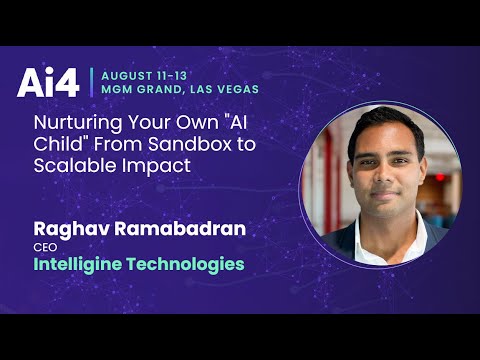
Intelligine Unveils LMaaS Infrastructure for Enterprise Small Language Models
Ai4
Building a custom internal language model on proprietary corporate data delivers superior operational accuracy and compliance compared to relying on public AI models.
## Background
Published on YouTube by Ai4 on August 27, 2025, this talk features Raghav Ramabadran, CEO of Intelligine Technologies. The description introduces a framework for raising an enterprise "AI Child"—a custom small language model trained on proprietary operational data—using Language-Model-as-a-Service (LMaaS) and patented multimodal orchestration.
## TL;DR
Raghav Ramabadran presents a structured blueprint for enterprises to build and retain ownership of their own proprietary AI models instead of relying solely on public LLMs. The approach spans three key phases: defining high-impact use cases within 90 days (Conception & Curriculum), testing model logic safely in an isolated environment (Sandbox & Safety), and orchestrating multiple third-party models alongside the internal single-source-of-truth model (Graduation to Production). Intelligine's anonymized mesh architecture allows companies to leverage over 45 commercial LLMs while keeping confidential operational, financial, and legal data strictly secured inside their own domain.
## Atmosphere & style
The session carries a pragmatic, highly strategic, and authoritative tone, blending executive consulting expertise with athletic and parental metaphors. Ramabadran presents complex AI infrastructure concepts with clear, structured enthusiasm, using relatable analogies—such as comparing early LLM flaws to toddler behavior or sandbox testing to competitive tennis training. Watching the presentation feels like attending an insightful masterclass that demystifies enterprise AI deployment, balancing technical rigor with a strong emphasis on data privacy and business ROI.
## Key takeaways
- [00:04](https://www.youtube.com/watch?v=kUaKxD4m5nQ&t=4s) Raghav Ramabadran frames public AI models as infants in a sandbox that lack organizational context, identity, and an understanding of enterprise nuance.
- [00:04](https://www.youtube.com/watch?v=kUaKxD4m5nQ&t=4s) Public LLMs trained on scraped web data create operational risks for enterprises, such as confusing critical mathematical representations in financial reports.
- [00:04](https://www.youtube.com/watch?v=kUaKxD4m5nQ&t=4s) Intelligine Technologies provides Language-Model-as-a-Service (LMaaS) to build, own, and keep proprietary AI models and data secure inside an enterprise environment.
- [08:28](https://www.youtube.com/watch?v=kUaKxD4m5nQ&t=508s) Phase 1 (Conception & Curriculum) requires identifying 1–3 use cases that deliver measurable ROI within a strict 90-day execution window.
- [08:28](https://www.youtube.com/watch?v=kUaKxD4m5nQ&t=508s) Creating an AI curriculum requires meticulous cleaning, structuring, and annotating of legacy enterprise data rather than raw, uncurated data dumps.
- [13:54](https://www.youtube.com/watch?v=kUaKxD4m5nQ&t=834s) Phase 2 (Sandbox & Safety) uses isolated, stairstep testing with locked-down write and delete access permissions to prevent data corruption.
- [19:00](https://www.youtube.com/watch?v=kUaKxD4m5nQ&t=1140s) Phase 3 (Graduation to Production) scales custom AI models across teams as central automated collaborators and decision advisors.
- [19:00](https://www.youtube.com/watch?v=kUaKxD4m5nQ&t=1140s) Intelligine's patent-pending sequencing engine choreographs inputs across multiple LLMs before passing the output to an internal custom small language model.
- [19:00](https://www.youtube.com/watch?v=kUaKxD4m5nQ&t=1140s) Sequencing specialized AI models reduced content creation timelines for global marketing agency clients from seven days down to 15 minutes.
- [24:15](https://www.youtube.com/watch?v=kUaKxD4m5nQ&t=1455s) The customer's proprietary AI model serves as a centralized single source of truth and an agentic orchestration layer inside the enterprise data mesh.
- [24:15](https://www.youtube.com/watch?v=kUaKxD4m5nQ&t=1455s) Intelligine's architecture anonymizes, encrypts, and routes queries across 45+ commercial LLMs without disclosing corporate identity or leaking sensitive data.
- [28:50](https://www.youtube.com/watch?v=kUaKxD4m5nQ&t=1730s) The Intelligine platform offers out-of-the-box modules, including The Arena for multi-model queries, The Vault for incognito confidential data processing, and The Brain for fine-tuning.
- [28:50](https://www.youtube.com/watch?v=kUaKxD4m5nQ&t=1730s) Intelligine's primary differentiator is orchestrating data structuring, multi-model sequencing, and custom AI development tailored to specific enterprise contexts.
- [31:43](https://www.youtube.com/watch?v=kUaKxD4m5nQ&t=1903s) Commercial off-the-shelf AI models provide broad general knowledge, but enterprise competitive advantage depends on capturing and preserving internal business context.
## Detailed walkthrough
### [00:04](https://www.youtube.com/watch?v=kUaKxD4m5nQ&t=4s) Introduction and the "AI Child" Concept
Raghav Ramabadran, CEO of Intelligine Technologies, frames the current state of enterprise artificial intelligence through the metaphor of an "AI child" in a sandbox. Drawing on his background—which spans a PhD with ten years of research in blood cancer, founding technology companies with ex-founder peers, Wharton network connections, and leading M&A due diligence and growth strategy at McKinsey for top private equity firms—Ramabadran emphasizes that while AI moves at a dizzying pace, models like Grok or ChatGPT still exhibit early-stage imperfections. They struggle to grasp human nuances and organizational identity, behaving very much like infants experimenting with basic tools.
```
+------------------------------------------------------------------+
| THE "AI CHILD" PARADIGM |
| |
| [ Public LLMs ] ----------> [ Intentional Training ] ---------> |
| - Reddit Data - Curated Data Corpus |
| - Generic Knowledge - Strict Guardrails |
| - Foreign Real Estate - Internal "Sandbox" |
| |
| [ Proprietary AI Model ] |
| - Single Source of Truth |
| - Internal Orchestration |
| - Retained IP & Data |
+------------------------------------------------------------------+
```
Rather than feeding public models generic scraped web content like Reddit discussions, businesses must actively nurture their own custom models on internal financial, legal, sales, and operational data built over decades. This internal approach prevents critical operational blunders caused by generic models—such as confusing `0.5` with `50%`, which are mathematical equivalents to an LLM but represent order-of-magnitude differences in enterprise reporting.
- Intelligine Technologies focuses on Language-Model-as-a-Service (LMaaS) to help organizations build, own, and retain proprietary AI models.
- Public LLMs fail to reflect specific business contexts because their training datasets are inherently disconnected from enterprise operations.
- Data privacy is paramount: enterprise data should remain strictly inside the company's controlled environment rather than being broadcast to external vendors.
[00:508] Phase 1: Conception & Curriculum
The journey to raising an enterprise AI model begins with a targeted first step: **Conception & Curriculum**. Ramabadran notes from his strategy consulting experience that throwing vast amounts of capital at AI guarantees no return. Instead, success requires defining one to three immediate-impact use cases where AI augmentation yields measurable return on investment within 90 days. Intelligine treats any deployment failing to establish ROI within 90 days as a failure.
Building the curriculum requires meticulous curation rather than indiscriminately dumping thousands of cold-storage files into a language model. Teams must clean and annotate their legacy data—overcoming the organizational reluctance to pull old records out of storage—to teach the model how to interpret, analyze, and respect confidentiality across its domain. Finally, organizations must establish a controlled sandbox (whether an isolated cloud instance or on-premise servers), select an appropriate foundational base model, and clearly establish evaluation metrics for success upfront.
- **Use Case Selection:** Identify 1–3 high-leverage workflows for immediate ROI within a strict 90-day window.
- **Curriculum Curation:** Carefully clean, annotate, and structure historical data rather than executing unstructured data dumps.
- **Environment Setup:** Establish a secure isolated cloud or on-prem sandbox and set precise evaluation criteria (e.g., time savings, accuracy thresholds, or direct monetary return).
Once an initial dataset is curated, the AI enters its **Sandbox & Safety** phase—analogous to raising a child or training for an elite sport. Ramabadran shares that as a former competitive tennis player, one does not start directly with the main tournament; rather, one builds up through daily drills, sprint sessions, and progressive skill exercises. In the sandbox, early model outputs are closely monitored. When the model strays or generates inaccurate outputs, data engineers step in to correct the logic, providing disciplined feedback that shapes its foundational reasoning patterns.
As the model grows into its "teenager" phase, administrators introduce controlled interactions and increase task complexity via low-stakes trials. Crucially, guardrails are configured so the model can read and process operational data without possessing authority to alter or delete core files. Security compliance (such as HIPAA) is treated as a baseline requirement, while internal operational guardrails dictate specific behavioral rules, system boundaries, and continuous learning feedback loops.
- **Isolated Execution:** Initial testing stays fully isolated within the sandbox to catch errors early.
- **Gradual Complexity:** Operational complexity scales in a stairstep fashion through low-stakes trials.
- **Strict Guardrails:** Write and delete access permissions are locked down to prevent catastrophic data loss or erratic system behaviors.
[11:40](https://www.youtube.com/watch?v=kUaKxD4m5nQ&t=700s) Phase 3: Graduation to Production & Orchestration
The final phase, **Graduation to Production**, marks the transition where the AI model moves out of the sandbox to become an active, trusted team member across the enterprise. Deployment scales incrementally from initial test groups across broader functional teams. Transparent communication ensures staff view the custom model as an automated collaborator—acting almost like a specialized C-suite advisor or manager—rather than an unfamiliar external utility.
By giving every employee access to this internal central "brain," organizations establish seamless knowledge sharing while safeguarding departmental intellectual property. Intelligine's infrastructure underpins this transition by orchestrating multimodal models alongside the client's internal custom model.
```
+------------------------------------------------------------------+
| MULTIMODAL SEQUENCING ENGINE |
| |
| [ Front-end Task ] |
| | |
| v |
| +----------------------------------------------------------+ |
| | Orchestration Sequence Engine | |
| | (Sequences inputs through ChatGPT, Perplexity, Llama) | |
| +----------------------------------------------------------+ |
| | |
| v |
| +----------------------------------------------------------+ |
| | Proprietary Enterprise Small Language Model | |
| | (Single Source of Truth / Final Compliance Check) | |
| +----------------------------------------------------------+ |
| | |
| v |
| [ On-Brand & Compliant Enterprise Output ] |
+------------------------------------------------------------------+
```
Highlighting a patent co-authored with engineer Sar, Ramabadran explains that orchestrating multiple LLMs in a specific *sequence* yields vastly superior results compared to querying any single model in isolation. In live case studies with global marketing agencies, chaining models together alongside a custom model tailored to each individual writer reduced content creation timelines from a full week down to just 15 minutes.
- **Incremental Rollout:** Deployment expands gradually across operational units using automated confidence checks and threshold monitoring.
- **Patented Orchestration:** Intelligine's patent-pending sequencing engine choreographs outputs across multiple large models (text, code, vision, speech) before filtering them through the internal custom model.
- **Proven Efficiency Gain:** Specialized model sequencing reduced high-quality agency content production cycles from 7 days to 15 minutes.
Here is a detailed, faithful walkthrough covering part 2 of the transcript from Intelligine Technologies' presentation at Ai4:
[14:55](https://www.youtube.com/watch?v=kUaKxD4m5nQ&t=895s) sandbox Architecture, Data Ownership, and the AI Child
The speaker details the functional core of the Intelligine sandbox platform. At the center sits the customer's custom AI model—the "AI Child"—which is trained on internal functional data sources, managed by Intelligine, but entirely owned by the client. Ramabadran compares the deployment to a "Trojan horse" sitting inside the organization: it seamlessly integrates with internal and external databases, while orchestrating and governing all the various agents built internally. Humorously noting that "every CEO we talked to now is apparently a data engineer," Ramabadran emphasizes that while executive-built agents are a fantastic development, they rarely work reliably all the time without an overarching AI model providing essential guardrails.
```
+-------------------------------------------------------------------+
| INTELLIGINE MESH |
| +---------------------+ +---------------------+ |
| | Internal Data | | External Databases | |
| +----------+----------+ +----------+----------+ |
| | | |
| v v |
| +-------------------------------------------------------------+ |
| | YOUR CUSTOM AI MODEL | |
| | (Single Source of Truth) | |
| +------------------------------+------------------------------+ |
| | |
| v |
| +-------------------------------------------------------------+ |
| | Agentic AI Orchestration | |
| +------------------------------+------------------------------+ |
| | |
+---------------------------------|---------------------------------+
v
+-------------------------------------------------+
| 45+ Commercial LLMs (Anonymized Queries) |
+-------------------------------------------------+
```
Intelligine acts as an orchestration interface that connects to over 45 commercial language models on behalf of the user. An intermediate agentic AI layer queries multiple models simultaneously, curates the highest-quality information, encrypts all prompts, and relays the synthesized data back into the client's internal model. Because the data mesh strips identifiers and stops leaks before prompts leave the environment, external model providers never know who is asking the questions. The architecture allows organizations to safely process confidential information in a "boundless" way while guaranteeing complete data isolation—offering deployments on private clouds, on-premises, or in fully managed sandboxes tailored to both technical and non-technical teams.
- Supports integration with over 45 large language models via an anonymized agentic mesh.
- Fully compliant with SOC 2, HIPAA, and major enterprise security protocols.
- Flexible architecture supporting customer-owned models, Intelligine-managed models, or zero-model configurations.
[17:30](https://www.youtube.com/watch?v=kUaKxD4m5nQ&t=1050s) Out-of-the-Box Sandbox Modules and Industry Applications
The Intelligine platform features a suite of pre-built "out-of-the-box" modules that function like building blocks or toys in a child's sandbox:
* **The Arena:** An interactive workspace where users can query unlimited third-party language models simultaneously without revealing their identity to the providers.
* **The Vault:** A secure query environment designed for confidential, proprietary data. Described as the "what happens in Vegas stays in Vegas" model of enterprise AI, it operates completely incognito to guarantee no data leaves the system.
* **The Brain:** A dedicated interface where technical teams can fine-tune custom AI models using proprietary corporate data.
* **Brand:** A specialized suite built for generating on-brand marketing materials and communications.
These baseline components enable organizations to construct highly nuanced, domain-specific workflows. Examples include specialized tools for revenue cycle management in healthcare, as well as customized workflows for legal, accounting, and finance departments. Ramabadran notes that while many vendors offer data structuring or basic AI agents, Intelligine's core differentiator is conducting the "grand symphony"—unifying data structuring, orchestration, and model customization around the client's unique business context.
[19:03](https://www.youtube.com/watch?v=kUaKxD4m5nQ&t=1143s) Democratizing AI and Closing Call to Action
Concluding the session, Ramabadran invites attendees to visit Booth 152 at the conference to test live demonstrations of both the Arena and Vault modules. Users can sign up, ingest their own data, test simultaneous model queries, and merge generated outputs.
He highlights Intelligine's broader mission to democratize enterprise AI, asserting that no organization should be locked into a single commercial AI vendor. While off-the-shelf commercial models provide general knowledge, they cannot replicate a company's specific context, culture, or operational knowledge: "They don't offer you. You offer you, and that's something that we want to make sure is preserved within your environment."
- **Booth Location:** Booth 152 at the Ai4 conference.
- **Key Takeaway:** Enterprise value lies in combining general LLM intelligence with proprietary internal data inside a secure, fully owned sandbox.
## Notable quotes
> [00:04](https://www.youtube.com/watch?v=kUaKxD4m5nQ&t=4s) 0.5 and 50% mean the exact same thing to an LLM model, but to your bottom line, 0.5% and 50% is life and death. — Raghav Ramabadran
> [14:55](https://www.youtube.com/watch?v=kUaKxD4m5nQ&t=895s) Every CEO we talked to now is apparently a data engineer. — Raghav Ramabadran
> [19:03](https://www.youtube.com/watch?v=kUaKxD4m5nQ&t=1143s) They don't offer you. You offer you, and that's something that we want to make sure is preserved within your environment. — Raghav Ramabadran
## Video description
Raghav Ramabadran, CEO, Intelligine Technologies
Abstracts
In the next wave of enterprise transformation, competitive advantage will belong to companies that raise their own AI models that grow up fluent in the nuance, context, and risk appetite of the business itself. Here, we will share a blueprint for doing exactly that, from Intelligine’s work delivering Language-Model-as-a-Service (LMaaS) to fast-growing SMBs and global enterprises. You will learn how Intelligine’s patent-pending multimodal AI infrastructure and sequencing engine selects and choreographs the right large models—text, vision, code, or speech—then channels their outputs into your proprietary small language model. That internal model, trained exclusively on your finance, legal, sales, and operational data, becomes the single source of truth and the orchestration layer for specialized agents, ensuring every action remains compliant and on-brand. Importantly, no data leaves your AI model and you own all of it! We will walk through the “AI Child” lifecycle: 1. Conception & Curriculum – identifying high-leverage use cases and curating the first training corpus. 2. Sandbox & Safety – isolating and accessing your AI model inside its very own real estate in the cloud. 3. Graduation to Production – How can your custom AI model graduate and proactively be a member of your organization. Along the way, you will see live case studies where agent-driven redesign and key orchestration from a custom AI model freed human talent for innovation. Lastly, we will adopt a forward look at governance, cost control, and IP protection that can help your business future-proof itself. Whether you are AI-curious or already piloting models and agents, you will leave with a pragmatic roadmap and the conviction that the best time to start raising your own "AI Child" is now.
Intelligine推出面向企业小语言模型的LMaaS基础设施
相比依赖公共AI模型,基于专有企业数据构建定制内部语言模型能够带来更出色的运营准确度与合规性。
Raghav Ramabadran提出了一个结构化蓝图,旨在帮助企业构建并拥有自主专有AI模型,而非单纯依赖公共LLM。该方法涵盖三个关键阶段:在90天内确定高影响力用例(构想与课程体系构建,Conception & Curriculum)、在隔离环境中安全测试模型逻辑(沙盒与安全,Sandbox & Safety),以及在内部“单一真实数据源”模型旁协调编排多个第三方模型(正式投产,Graduation to Production)。Intelligine的匿名网格架构使企业能够利用超过45种商用LLM,同时将机密的运营、财务及法律数据严格安全地保留在企业自身域内。
Intelligine CEO Raghav Ramabadran 提出“AI Child”范式,指出公开通用大模型缺乏组织语境与业务认知,企业应基于内部沉淀数据培育完全私有的专属 AI 模型。 (0:04)
第一阶段“构想与课程”要求对企业遗留数据进行细致清洗与标注,并聚焦于 1 至 3 个核心业务用例,在严格的 90 天执行窗口内验证可衡量的投资回报率(ROI)。 (8:28)
第二阶段“沙盒与安全”采用阶梯式测试与严格的权限护栏,彻底锁定写入与删除权限,在低风险试错中培养模型的推理逻辑并防止数据损坏。 (8:34)
进入投产阶段后,Intelligine 正在申请专利的多模型排序引擎可协同调度外部 LLM 并由企业专属小模型把关合规性,曾将机构的内容生产周期从 7 天缩短至 15 分钟。 (11:40)
Intelligine 架构通过匿名化网格连接 45+ 款主流商业 LLM,配合 The Vault 与 The Arena 等模块对提示词进行去标识化与加密,确保企业核心数据绝对不出域。 (14:55)
Reading summary
Raghav Ramabadran, CEO of Intelligine Technologies, argues that enterprises should avoid over-relying on generic public language models and instead develop, own, and govern proprietary AI models inside secure, isolated sandboxes.
The Operational Limitations of Public LLMs (0:04)
Public foundation models like Grok or ChatGPT are trained on broad internet content such as Reddit, leaving them disconnected from the nuanced operational, legal, and financial realities of individual enterprises. Ramabadran notes that generic systems frequently make critical domain errors—such as treating the number 0.5 and 50% as mathematically equivalent, despite the profound difference this distinction carries in corporate reporting.
To counter these errors, Ramabadran advocates for Language-Model-as-a-Service (LMaaS), enabling companies to train proprietary models on decades of internal data. This approach keeps core intellectual property, customer records, and operational intelligence entirely within the enterprise's private environment rather than routing confidential inputs to third-party AI providers.
Phased Implementation and Sandbox Risk Controls
Drawing on strategy consulting experience, Ramabadran asserts that deploying massive capital into AI without targeted focus yields poor returns. Instead, he advises scoping one to three high-impact workflows designed to demonstrate measurable return on investment within 90 days, treating any project that fails to hit this benchmark as a failure. Execution begins with cleaning and annotating legacy data rather than executing unstructured data dumps from cold storage.
Once curated, models enter an isolated sandbox—hosted either on-premises or within a private cloud. Comparing the process to progressive athletic training, Ramabadran explains that data engineers iteratively supervise early outputs and correct reasoning during low-stakes trials. Crucially, the sandbox restricts write and delete permissions on production databases, preventing data loss or erratic operational shifts while complying with baselines like HIPAA.
Model Sequencing and Production Orchestration (11:40)
Rather than relying on any single foundation model, Ramabadran cites a patent-pending orchestration engine that directs queries through a sequence of external LLMs—including ChatGPT, Perplexity, and Llama—before filtering the synthesized output through an internal, client-owned small language model. This proprietary internal model serves as the final arbiter for corporate tone, brand guidelines, and compliance standards.
Ramabadran claims that sequentially orchestrating multiple models yields results superior to isolated queries. In one cited deployment with a global marketing agency, chaining specialized model sequences reduced agency content creation cycles from an entire week down to 15 minutes.
Anonymized Architecture and Sandbox Modules (14:55)
To prevent data leaks when accessing third-party capabilities, Intelligine implements an agentic mesh connecting to more than 45 commercial LLMs. The intermediate layer strips corporate identifiers and encrypts prompts before querying outside models, ensuring external providers cannot track which organization is requesting information.
The platform deploys modular components for different enterprise functions: the Arena allows side-by-side model testing without disclosing user identity; the Vault acts as a confidential, incognito environment for proprietary data analysis; the Brain allows technical teams to fine-tune custom models; and Brand generates aligned marketing assets. These workflows are tailored for domain-specific tasks across legal, accounting, and healthcare revenue cycle management.
Ramabadran concludes that long-term enterprise AI value lies in preserving company-specific identity rather than accepting lock-in to commercial foundation model vendors. However, the presentation relies on Intelligine's proprietary architecture and internal case studies, leaving open practical questions about the ongoing data engineering overhead required to curate legacy records and manage custom sandbox environments over time.
## Background
该视频由 YouTube 频道 Ai4 于 2025 年 8 月 27 日发布,主讲人为 Intelligine Technologies 首席执行官 Raghav Ramabadran。根据页面简介,本次演讲分享了企业如何通过语言模型即服务(LMaaS)抚育属于自己的“AI 孩子”,并介绍其专利多模态架构与编排引擎如何将外部大模型能力注入企业私有小模型,在保障数据隐私与资产自主权的前提下实现从沙盒测试到生产落地的完整蓝图。
## TL;DR
演讲者指出通用大模型缺乏对垂直业务的精细理解,企业必须守住核心业务数据并建立私有沙盒来培育专属“AI 孩子”。内容系统阐述了专属 AI 的三阶段生命周期:明确 1 至 3 个高价值痛点并在 90 天内跑通 ROI 的“孕育与课程规划”;在隔离受控环境中限制高危权限、台阶式递进纠偏的“沙盒与安全防护”;以及作为正式协作者融入全员日常运作的“毕业并投入生产”。最后展示了 Intelligine 的多大模型协同编排专利架构与匿名安全网格,依托 Arena、Vault 等即插即用套件,使企业在确保数据 100% 留在本地的同时成倍提升业务流转与内容生产效能。
## Atmosphere & style
整场演讲兼具麦肯锡战略顾问的严谨敏锐与科技创业者的务实干练,论述逻辑清晰、直击痛点且节奏紧凑。演讲者巧妙运用“抚养淘气孩童”的生动隐喻拆解复杂的 AI 治理难题,穿插对当下行业狂热现状的幽默调侃,传达出一种既沉着理性又极富号召力的专业气场,让人清晰感受到掌控自身数据资产主权的紧迫感与踏实感。
## Key takeaways
- [00:04](https://www.youtube.com/watch?v=kUaKxD4m5nQ&t=4s) 企业应当构建并掌控专属的 AI 体系,将沉淀的专有业务数据与运营精髓保留在内部沙盒中,避免数据资产与业务主权外流。
- [01:35](https://www.youtube.com/watch?v=kUaKxD4m5nQ&t=95s) 当前主流大模型仍处于摸索工具的“幼年期”,企业需要像抚育孩子一样通过设立明确的业务规则与安全护栏(Guardrails)引导其健康成长。
- [03:05](https://www.youtube.com/watch?v=kUaKxD4m5nQ&t=185s) 通用模型依赖公网数据且缺乏特定业务精度(如数值格式微小差异引发系统故障),企业需从依赖第三方 SaaS 转向内建私有协同大脑。
- [05:07](https://www.youtube.com/watch?v=kUaKxD4m5nQ&t=307s) AI 孩子“孕育与课程规划”阶段应聚焦 1-3 个高杠杆场景,强调在 90 天内跑通明确的 ROI 验证,并进行彻底的数据清洗与高质量标注。
- [08:34](https://www.youtube.com/watch?v=kUaKxD4m5nQ&t=514s) “沙盒与安全防护”阶段采取台阶式渐进测试,在隔离受控环境中尽早发现幻觉并纠偏,同时从底层剥夺删除数据库等破坏性权限。
- [11:40](https://www.youtube.com/watch?v=kUaKxD4m5nQ&t=700s) “毕业并投入生产”阶段主张将成熟 AI 视为团队正式协作成员,打破部门数据孤岛,构建全员共享的内部私有知识大脑。
- [13:44](https://www.youtube.com/watch?v=kUaKxD4m5nQ&t=824s) Intelligine 专利多模型编排引擎通过按序串联调度不同特长的模型,成功将专业营销内容的交付周期从整整 1 周大幅缩短至 15 分钟。
- [14:55](https://www.youtube.com/watch?v=kUaKxD4m5nQ&t=895s) 以企业专属 AI 模型为中央决策中枢,统筹编排内部自建的各类业务 Agent,且模型所有权与沙盒资产 100% 归客户所有。
- [15:58](https://www.youtube.com/watch?v=kUaKxD4m5nQ&t=958s) 通过中间层智能体代理与安全网格匿名对接 45+ 款主流大模型,确保企业私有敏感数据永不离开沙盒,并全面支持 SOC 2 与 HIPAA 合规。
- [17:20](https://www.youtube.com/watch?v=kUaKxD4m5nQ&t=1040s) 沙盒内置 Arena、Vault、Brain、Brand 等开箱即用套件,赋能医疗 RCM、法务合同审查与财务核算等垂直业务深度落地。
- [19:03](https://www.youtube.com/watch?v=kUaKxD4m5nQ&t=1143s) 推进大模型应用民主化,避免绑定单一供应商——外部模型提供通用知识,但唯有内部专属模型才能定义和代表企业自身的独特性。
## Detailed walkthrough
### [00:04](https://www.youtube.com/watch?v=kUaKxD4m5nQ&t=4s) 个人背景与培育企业专属“AI 孩子”的核心愿景
在本次演讲的开篇,Intelligine Technologies 首席执行官 Raghav Ramabadran 提出了“培育企业专属 AI 孩子”(Nurturing Your Own AI Child)的核心理念。面对如今眼花缭乱的模型与技术浪潮,企业最应当思考的核心问题在于:为什么必须构建属于自己的 AI 模型?企业如何才能牢牢守住自身最核心、最独特的资产——业务数据?Intelligine 的核心使命,正是帮助各行各业的企业打造完全属于企业自己拥有、保留在内部且能够沉淀其业务精髓的专属 AI 体系,而不是将至关重要的数据拱手让人。
Raghav 随后简要介绍了自己的学术与职业背景。他拥有博士学位,在血液肿瘤(Blood Cancer)研究领域深耕了近十年,之后投身创业,团队成员也大多是多次成功退出科技公司的前创始人,在产品构建与技术攻坚方面有着极深积淀。此外,依托于沃顿商学院(Wharton)的人脉网络,他又加入麦肯锡(McKinsey),带领团队为全球前十大私募股权(PE)基金提供并购尽职调查(M&A Due Diligence)与增长战略咨询,重点评估软件投资标的,深入指导医疗健康与生命科学等领域的企业如何识别、集成与规模化应用各类前沿 AI 技术。
- **演讲者背景**:医学博士,拥有 10 年血液肿瘤科研经验,连续创业者,曾任麦肯锡核心团队负责人(主导顶级 PE 的软件并购与 AI 落地战略)。
- **核心主张**:企业应当拥有并掌控自己的 AI 沙盒,确保核心业务数据不外流。
---
### [01:35](https://www.youtube.com/watch?v=kUaKxD4m5nQ&t=95s) 认知现状:大模型仍处在沙盒探索的“幼年期”
当前行业普遍充斥着 AI 正在以颠覆性速度重塑一切的论调,但在喧嚣之下,AI 的真实状态更像是一个“在沙盒中摸索着玩弄各种工具的小孩”。市场上每天、每周都有新模型问世,各家厂商争相宣称自己的算法更胜一筹,但整个产业依然处于探索 AI 演进路径的早期阶段。无论是 Grok、ChatGPT 还是其他主流大语言模型,都曾暴露出无法真正理解人类意图与人类本质的缺陷。这种不成熟对于尚在学习阶段的“人造智能”而言十分正常,关键在于人类如何通过科学的抚育与合理的边界规范,引导它健康成长。
就像父母抚养孩子一样,只有通过精心培育、设立明确的规则与护栏(Guardrails),AI 才能逐渐具备独立思考能力,最终成为组织与社会中能够高效协作的“合格成员”。培育企业 AI 孩子的本质,就是用极其明确的目的性与规范,让技术融入企业自身的运行逻辑中。
```mermaid
flowchart TD
accTitle: AI 孩子从幼年到生产环境的成长路径
subgraph S1["第一阶段:孕育与课程规划"]
A["明确核心业务痛点<br/>(聚焦 1-3 个高价值场景)"] --> B["精细清洗与标注数据<br/>(告别冷存储与海量杂质)"]
B --> C["确立评测标准与沙盒边界<br/>(90 天内验证 ROI)"]
end
subgraph S2["第二阶段:沙盒与安全防护"]
D["隔离受控环境试验<br/>(台阶式递进训练)"] --> E["实时纠偏与设立护栏<br/>(严格限制破坏性权限)"]
E --> F["引入真实多变量交互<br/>(持续反馈与迭代)"]
end
subgraph S3["第三阶段:毕业并投入生产"]
G["跨部门透明化渐进部署<br/>(作为协作伙伴融入团队)"] --> H["多模型协同与私有大脑<br/>(全面释放组织生产力)"]
end
C --> D
F --> G
```
---
### [03:05](https://www.youtube.com/watch?v=kUaKxD4m5nQ&t=185s) 通用模型的局限与企业私有数据的独特价值
市面上主流的行业领先模型(如 ChatGPT、Perplexity、LLaMA、Mistral 等)都是基于公网海量数据训练出来的,抓取 Reddit 论坛上的海量杂乱帖子对具体企业的业务运营并无实质助益。企业真正需要的是一个能够理解“我是谁、我做什么、我如何运转业务”的智能体,而企业在过去 20 年运营中沉淀下的专有数据与业务洞察,才是最宝贵的资产。
此外,通用模型对业务精细度的理解往往存在严重偏差。Raghav 举例说明:某企业向通用大模型发送查询,第一次得到的结果是 `0.5`,第二次同样的模型却回答 `50%`。从纯数学角度看二者是相等的,但当企业底层系统在并发处理数百万条数据流时,数值格式与量级定义上的细微差异会导致系统灾难。如果不在 AI 早期就通过私有沙盒对其进行严格训练,模型就无法掌握这种业务层面的本质差异。与其把核心数据发给成百上千家第三方 SaaS 供应商,企业更应该在内部沙盒中构建一个能够自主协同所有既有工具的私有大脑。
- **通用公网数据的弊端**:抓取公开论坛信息对特定垂直业务缺乏针对性与上下文理解。
- **业务精度偏差风险**:通用模型混淆 `0.5` 与 `50%` 这类看似等价但系统逻辑完全不同的数据指标。
- **架构范式转变**:从“数据外送给百家供应商”转向“在本地或私有云沙盒中内建协同智能”。
---
### [05:07](https://www.youtube.com/watch?v=kUaKxD4m5nQ&t=307s) 第一步:孕育与课程规划(Conception & Curriculum)
培育专属 AI 孩子的第一阶段是“孕育与课程规划”。在这一阶段,首要任务是精准定位需要解决的实际问题。正如麦肯锡的咨询经验所示,盲目向 AI 砸钱并不代表能收获相应价值;价值来源于有针对性地挑选 1 至 3 个能产生立竿见影效果的高杠杆场景。"在 90 天内如果无法完成部署并建立明确的投资回报率(ROI),我们就会视其为自身的失败。"
明确场景之后,下一步是梳理针对性的知识语料并进行彻底的数据清洗与标注。很多企业常常因历史数据存放在冷存储(Cold Storage)中堆满“蛛网”而不愿清理,但简单地向大模型中倾倒上千份未经整理的文件并要求它“自己看着办”是注定会失败的。只有清晰告知模型输入数据的含义、解释逻辑以及分析方式,才能确保模型的准确性与保密性。最后,必须搭建一个私有的受控测试环境(无论是专属隔离的私有云实例还是本地私有部署),选定基础模型底座,并预先设定好以准确率、时间节省或财务 ROI 为维度的评估指标。
- **落地周期要求**:必须在 90 天内完成场景落地并跑通清晰的 ROI 验证。
- **数据治理核心**:杜绝盲目倒入海量文件,专注于高质量标注、清洗与样例解释。
- **基础设施选择**:在私有云或本地搭建受控隔离环境,确保数据隐私与主权。
---
### [08:34](https://www.youtube.com/watch?v=kUaKxD4m5nQ&t=514s) 第二步:沙盒与安全防护(Sandbox & Safety)
当模型完成初步训练后,便进入了“沙盒与安全防护”阶段。这一阶段就像管教一个调皮的儿童:必须将其安置在隔离受控的安全环境中,只喂给经过精心筛选的数据,并实时监控其输出。过去媒体曾广泛报道过类似 Replit 代码误删或 ChatGPT 凭空捏造虚假内容的事故,这并非模型本身不可救药,而是因为缺乏及时的安全护栏。当孩子把东西扔在地上时,父母会进行规训;同样地,一旦 AI 模型表现出离谱的行为,数据工程师必须立即纠偏并告知它正确的处理逻辑,越早干预,模型后续的扩展表现就越优秀。
能力的扩充应当采取“台阶式”(Stair-step)逐步升级的策略,类似于网球训练中先从基础击球和冲刺跑练起,再逐步迈向正式锦标赛。在低风险的试验环境中,可以逐步引入真实的客户数据和复杂的业务变量,但必须从底层剥夺其直接删除核心数据库的高危权限。虽然当前各类模型已具备一定的合规认证(如 HIPAA),但企业内部真正的核心挑战在于业务行为边界与数据隐私防线,必须通过闭环的反馈机制持续重训与校准。
- **早期纠偏原则**:在沙盒中尽早发现模型幻觉与异常行为,建立行为奖惩机制。
- **台阶式渐进测试**:限制破坏性系统权限(如删库、不可逆修改),先在低风险场景中引入真实数据交互。
- **安全与合规重心**:在满足 HIPAA 等合规标准之上,进一步强化内部运营边界与数据隔离机制。
---
### [11:40](https://www.youtube.com/watch?v=kUaKxD4m5nQ&t=700s) 第三步:毕业并投入生产(Graduation to Production)
当模型步入成熟期,就像青少年准备离开家庭迈入大学一样,进入“毕业并投入生产”阶段。这一阶段的核心是渐进式跨部门推广。企业应当首先在选定的关键业务线进行受控应用,随后逐步透明地向其他部门扩展,向全员明确 AI 正在成为企业内部长效资产的定位。Raghav 强调,应当把成熟的专属 AI 当作团队的一名正式成员、协作者,甚至是一位经理或高管来对待,只有建立起组织内部的深度信任,人机协同的效能才能最大化释放。
当自动校验机制和置信度阈值达到预定标准后,模型就正式毕业并融入整个组织的日常运作中。这不仅是 IT 部门的技术升级,更是全员共享的“私有大脑”(Internal Knowledge Brain),让财务、法务、销售等不同职能部门的员工都能随时调用经过本企业沉淀的安全数据,将原本属于部门自己的数据与客户服务能力真正盘活,释放规模化的生产力。
- **组织协同文化**:将 AI 视为团队成员与长期协作者,而非冷冰冰的替代工具。
- **私有大脑赋能**:打破部门数据孤岛,让全体员工而非仅限 IT 团队无缝调用内部智力资产。
- **持续进化机制**:依靠内置的置信度检测与自动化校验机制,保障上线后的平稳运行与持续学习。
---
### [13:44](https://www.youtube.com/watch?v=kUaKxD4m5nQ&t=824s) Intelligine 专利技术:多大模型协同编排与内容提效实战
正是基于帮助企业掌控自身 AI 命脉的初衷,Raghav 与团队创办了 Intelligine Technologies。Intelligine 负责提供底层的工程训练、架构管理与沙盒搭建服务,但 AI 模型的所有权与数据主权 100% 归客户所有。
在技术架构层面,Raghav 重点介绍了由他与团队核心工程师 Sar 等人共同研发并提交的一项多大模型协同编排(Multi-LLM Orchestration Sequencing Engine)核心专利。在实践中,单一模型(无论是 ChatGPT、Perplexity 还是 LLaMA)给出的答案往往不够完美或存在偏差;然而,Intelligine 在与全球顶尖营销机构的合作中发现,将不同的大语言模型按照特定业务逻辑进行“有序编排串联”,其产出效果会远超任何单一模型。通过将这种多模型协同编排引擎与为企业每位文案创作者定制的专属语言模型相结合,他们成功将原本产出高质量营销内容所需的整整一周时间,大幅压缩到了惊人的 15 分钟。
- **多模型编排专利**:通过独创的 Multi-LLM 协同调度算法,将不同特长的模型按序组合,产出质量显著优于单一大模型。
- **营销落地战果**:为全球大型营销机构定制内容生成流水线,将高质量专业内容的交付周期从“整整 1 周”缩短至“15 分钟”。
- **资产归属原则**:全套定制模型、编排规则与沙盒资产完全由客户独立拥有。
### [14:55](https://www.youtube.com/watch?v=kUaKxD4m5nQ&t=895s) 企业专属“AI 孩子”:以客户为核心的沙盒与智能体编排
在内容生产流程中,系统仅需数分钟即可完成 80% 的工作量,且生成的内容完全无法被市面上的任何 AI 检测工具识别。这一优势源于多模型的协同架构:外部通用大模型充当计算“大脑”,但它们在产出最终结果前并不能代表企业自身。Intelligine 的核心理念是将客户自身置于沙盒架构的正中央——构建一个真正理解企业业务的专属 AI 模型。该模型由 Intelligine 负责训练与日常运维,但所有权 100% 归客户所有,客户可随时将其整体迁移或导出。
这个内部模型就像一个入驻企业的“特洛伊木马”,深度接入企业所有的内部与外部数据库,并统一编排和管理企业内部自建的各类智能体。Raghav Ramabadran 幽默地调侃道:“现在我们接触的每位 CEO 似乎在一夜之间都成了数据工程师,这很棒,但大家深夜随手搭建的大多数智能体并不能一直稳定运行。”因此,企业需要一个具备合规安全护栏(guardrails)的中央 AI 模型来充当“AI 孩子”的角色,由 Intelligine 协助企业共同抚育并完成“毕业”,使其成为组织内成熟可靠的核心成员。
```mermaid
flowchart TD
accTitle: Intelligine 沙盒与多模型路由架构
subgraph ClientSandbox ["企业专有沙盒 (Sandbox / On-Prem / Cloud)"]
DataSources["内部与外部数据源\n(财务/法务/运营数据)"]
AIChild["企业专属 AI 核心模型\n('AI 孩子' / 决策中枢)"]
CustomAgents["业务智能体编排\n(自建 Agent / 业务工作流)"]
DataSources <--> AIChild
AIChild <--> CustomAgents
end
subgraph SecurityMesh ["Intelligine 智能体中间层与安全网格"]
Anonymizer["提示词匿名化与动态脱敏"]
ModelRouter["45+ 大模型调度与输出融合引擎"]
Anonymizer <--> ModelRouter
end
subgraph ExternalLLMs ["外部通用大模型集群 (45+ LLMs)"]
M1["大语言模型 A"]
M2["多模态模型 B"]
M3["代码/推理模型 C"]
end
AIChild <-->|"加密安全请求 (数据不出沙盒)"| Anonymizer
ModelRouter <-->|"完全匿名交互"| ExternalLLMs
```
---
### [15:58](https://www.youtube.com/watch?v=kUaKxD4m5nQ&t=958s) 45+ 大模型匿名代理与零数据泄露防护网
Intelligine 在底层集成了 45 款以上的主流大语言模型,并作为代理层代表企业与这些模型进行交互。在此过程中,没有任何外部大模型厂商能够获知发起提问的真实客户身份。系统在中间层部署了 Agentic AI(智能体模型),负责向各大模型抓取最优质的信息,并对所有提示词和交互数据进行高强度加密,随后将提炼出的知识回传给企业自身的私有模型进行持续学习。
这一机制确保了“企业数据永不离开本地沙盒”,使企业能够彻底打破顾虑,在内部自由处理高度机密的敏感信息,所有外发流量均会被安全网格(security mesh)拦截并净化。Intelligine 为每家客户提供完全物理/逻辑隔离的独立实例,支持私有云或本地化(On-prem)部署。在模型选择上具有极高的灵活性:企业可以使用自研模型、采用 Intelligine 提供的模型,甚至完全不挂载模型。
- **合规标准支持**:全面支持 SOC 2、HIPAA 等企业级行业安全与合规认证标准。
- **全员可访问性**:深度打通私有云与企业现有存储架构,界面专为技术与非技术团队共同协作而设计,确保组织内各部门都能无门槛使用。
- **存量系统集成**:无论是企业现有的存量工具还是未来新开发的产品,均可无缝嵌入该沙盒环境。
---
### [17:20](https://www.youtube.com/watch?v=kUaKxD4m5nQ&t=1040s) 开箱即用沙盒套件:Arena、Vault 与行业深度落地
为了让企业能够即插即用,Intelligine 沙盒内置了一系列模块化解决方案,就像给在沙盒中玩耍的孩子提供玩具卡车和小铲子等工具一样,帮助企业按需构建垂直场景应用:
| 开箱即用套件 | 核心功能与应用场景 | 数据安全与隐私属性 |
|:--- |:--- |:--- |
| **Arena(竞技场)** | 允许用户同时与市面上所有主流大模型进行无限制对话与效果横向比对。 | 外部模型完全无法探知提问者的真实身份与背景。 |
| **Vault(机密金库)** | 专为深度检索与处理企业绝密数据打造,支持存入并查询任何私密文件。 | 奉行“拉斯维加斯模式”——发生在此处的数据永远留在此处,绝对匿名且永不外泄。 |
| **Brain(中央大脑)** | 供技术人员直接基于自有业务数据训练与微调专属 AI 模型。 | 知识资产沉淀在企业内部,直接赋能组织智能化升级。 |
| **Brand(品牌工坊)** | 辅助市场与营销团队生成高度贴合品牌语调的内容资产。 | 自动适配企业品牌风格规范,输出高质量对外物料。 |
依托这些模块,企业可以在自身的沙盒中训练高度定制化的行业解决方案,例如医疗机构的收入周期管理(RCM)、法务合同审查、财务核算与会计自动化等。Raghav Ramabadran 强调,当前市面上有很多专注于数据结构化的公司,也有大量做单点智能体(Agents)的厂商,但 Intelligine 的核心价值在于将数据、模型、安全与应用编排成一场“宏大的交响乐”,并始终让企业自身站在指挥台的中央。
---
### [19:03](https://www.youtube.com/watch?v=kUaKxD4m5nQ&t=1143s) 民主化多模型应用与展台实操体验
在演讲尾声,Raghav Ramabadran 邀请与会者前往 152 号展台亲自体验新上线的 Arena 和 Vault 功能。现场观众可以现场注册并上传测试数据,同时向多个大模型发起提问,直观对比不同模型的生成质量,并支持将满意的多个模型输出结果进行一键智能合并。
Intelligine 致力于推进大模型应用的民主化,主张任何企业都不应被单一的大模型供应商绑定。外部大模型的核心价值在于提供通用知识,但它们无法替代企业自身的独特性与业务精髓——“外部模型提供的是通识知识,但它们代表不了你;只有你自己才能定义你自己(The power of what they offer is knowledge, but they don't offer you. You offer you)。”演讲在对企业数据主权与未来合作的展望中圆满结束。
## Notable quotes
> [00:04](https://www.youtube.com/watch?v=kUaKxD4m5nQ&t=4s) 培育企业专属 AI 孩子(Nurturing Your Own AI Child) — Raghav Ramabadran
> [01:35](https://www.youtube.com/watch?v=kUaKxD4m5nQ&t=95s) 在沙盒中摸索着玩弄各种工具的小孩 — Raghav Ramabadran
> [05:07](https://www.youtube.com/watch?v=kUaKxD4m5nQ&t=307s) 在 90 天内如果无法完成部署并建立明确的投资回报率(ROI),我们就会视其为自身的失败。 — Raghav Ramabadran
> [05:07](https://www.youtube.com/watch?v=kUaKxD4m5nQ&t=307s) 孕育与课程规划(Conception & Curriculum) — Raghav Ramabadran
> [08:34](https://www.youtube.com/watch?v=kUaKxD4m5nQ&t=514s) 沙盒与安全防护(Sandbox & Safety) — Raghav Ramabadran
> [11:40](https://www.youtube.com/watch?v=kUaKxD4m5nQ&t=700s) 毕业并投入生产(Graduation to Production) — Raghav Ramabadran
> [14:55](https://www.youtube.com/watch?v=kUaKxD4m5nQ&t=895s) 现在我们接触的每位 CEO 似乎在一夜之间都成了数据工程师,这很棒,但大家深夜随手搭建的大多数智能体并不能一直稳定运行。 — Raghav Ramabadran
> [15:58](https://www.youtube.com/watch?v=kUaKxD4m5nQ&t=958s) 企业数据永不离开本地沙盒 — Raghav Ramabadran
> [17:20](https://www.youtube.com/watch?v=kUaKxD4m5nQ&t=1040s) 拉斯维加斯模式——发生在此处的数据永远留在此处,绝对匿名且永不外泄。 — Raghav Ramabadran
> [17:20](https://www.youtube.com/watch?v=kUaKxD4m5nQ&t=1040s) 将数据、模型、安全与应用编排成一场‘宏大的交响乐’,并始终让企业自身站在指挥台的中央。 — Raghav Ramabadran
> [19:03](https://www.youtube.com/watch?v=kUaKxD4m5nQ&t=1143s) 外部模型提供的是通识知识,但它们代表不了你;只有你自己才能定义你自己(The power of what they offer is knowledge, but they don't offer you. You offer you) — Raghav Ramabadran
## Mentioned
Raghav Ramabadran, Intelligine Technologies, Ai4, McKinsey (麦肯锡), Wharton (沃顿商学院), Sar, ChatGPT, Grok, Perplexity, LLaMA, Mistral, Replit, Arena, Vault, Brain, Brand, SOC 2, HIPAA
## Video description
Raghav Ramabadran, CEO, Intelligine Technologies
Abstracts
In the next wave of enterprise transformation, competitive advantage will belong to companies that raise their own AI models that grow up fluent in the nuance, context, and risk appetite of the business itself. Here, we will share a blueprint for doing exactly that, from Intelligine’s work delivering Language-Model-as-a-Service (LMaaS) to fast-growing SMBs and global enterprises. You will learn how Intelligine’s patent-pending multimodal AI infrastructure and sequencing engine selects and choreographs the right large models—text, vision, code, or speech—then channels their outputs into your proprietary small language model. That internal model, trained exclusively on your finance, legal, sales, and operational data, becomes the single source of truth and the orchestration layer for specialized agents, ensuring every action remains compliant and on-brand. Importantly, no data leaves your AI model and you own all of it! We will walk through the “AI Child” lifecycle: 1. Conception & Curriculum – identifying high-leverage use cases and curating the first training corpus. 2. Sandbox & Safety – isolating and accessing your AI model inside its very own real estate in the cloud. 3. Graduation to Production – How can your custom AI model graduate and proactively be a member of your organization. Along the way, you will see live case studies where agent-driven redesign and key orchestration from a custom AI model freed human talent for innovation. Lastly, we will adopt a forward look at governance, cost control, and IP protection that can help your business future-proof itself. Whether you are AI-curious or already piloting models and agents, you will leave with a pragmatic roadmap and the conviction that the best time to start raising your own "AI Child" is now.
[Source](https://www.youtube.com/watch?v=kUaKxD4m5nQ)
Source quotes
[0:04] Raghav Ramabadran: 培育企业专属 AI 孩子(Nurturing Your Own AI Child)
[1:35] Raghav Ramabadran: 在沙盒中摸索着玩弄各种工具的小孩
[5:07] Raghav Ramabadran: 在 90 天内如果无法完成部署并建立明确的投资回报率(ROI),我们就会视其为自身的失败。
[5:07] Raghav Ramabadran: 孕育与课程规划(Conception & Curriculum)
[8:34] Raghav Ramabadran: 沙盒与安全防护(Sandbox & Safety)
[11:40] Raghav Ramabadran: 毕业并投入生产(Graduation to Production)
[14:55] Raghav Ramabadran: 现在我们接触的每位 CEO 似乎在一夜之间都成了数据工程师,这很棒,但大家深夜随手搭建的大多数智能体并不能一直稳定运行。
[15:58] Raghav Ramabadran: 企业数据永不离开本地沙盒
[17:20] Raghav Ramabadran: 拉斯维加斯模式——发生在此处的数据永远留在此处,绝对匿名且永不外泄。
[17:20] Raghav Ramabadran: 将数据、模型、安全与应用编排成一场‘宏大的交响乐’,并始终让企业自身站在指挥台的中央。
[19:03] Raghav Ramabadran: 外部模型提供的是通识知识,但它们代表不了你;只有你自己才能定义你自己(The power of what they offer is knowledge, but they don't offer you. You offer you)
Source quotes
[0:04] Raghav Ramabadran: 0.5 and 50% mean the exact same thing to an LLM model, but to your bottom line, 0.5% and 50% is life and death.
[14:55] Raghav Ramabadran: Every CEO we talked to now is apparently a data engineer.
[19:03] Raghav Ramabadran: They don't offer you. You offer you, and that's something that we want to make sure is preserved within your environment.
Original transcript
[0:04] So today the talk we'll talk you know go
[0:07] through today is nurturing your own AI
[0:09] child right and what that really means
[0:11] and I think some of you may have seen
[0:13] the description but really what we're
[0:14] going to talk about today is what are
[0:16] key things that we need to think about
[0:18] when building your own AI model why is
[0:20] that important and what does I'll finish
[0:22] up with what does intelligent do right
[0:24] and how we've helped folks across
[0:26] different industries really build
[0:28] something that they own they keep and
[0:31] keep the essence of what makes them
[0:33] special which is their own data to
[0:34] themselves right so if we go on just a
[0:38] little bit about myself uh just to add
[0:40] context I'm a PhD by training did a lot
[0:42] of work in the blood cancer space for
[0:45] about 10 years uh spent some time really
[0:48] building companies from ground up uh a
[0:50] lot of my team are ex-founders that
[0:52] we've sold some companies all technology
[0:54] based so we've been really entrenched in
[0:56] how do we build great product and how do
[0:58] we
[0:59] really solve some problems out there.
[1:01] So, it's something that along with the
[1:02] Wharton network as well as several other
[1:04] areas that I've worked at really come
[1:06] together uh to be able to say, "Hey,
[1:08] this is something we can really focus on
[1:10] and really build for folks." Quickly
[1:13] spent some time at McKenzie leading M&A
[1:15] due diligence and growth strategy teams
[1:17] for the top 10 global private equity
[1:19] firms. Uh really helping them think
[1:21] through investments in software. So how
[1:23] do you best identify right types of AI
[1:25] technologies, integrate them into your
[1:27] organization and scale them within but
[1:29] also across healthcare and life sciences
[1:32] companies as well. But enough about me.
[1:35] Let's think about where we are today. I
[1:38] mean every conversation I've had here so
[1:40] far has just been amazing, right?
[1:41] Everyone thinks AI is really moving at
[1:44] this transformative pace, but we really
[1:46] think it's like this, right? So much is
[1:48] happening out there. It's moving so
[1:49] quickly. How do we stay on top of it
[1:51] all? But in a lot of ways, AI is really
[1:54] still this, right? It's a child in a
[1:56] sandbox really trying to figure its way
[1:58] out, playing with a bunch of tools.
[2:01] Every day there's a new model. Every
[2:02] week there's a new model. Someone's
[2:04] trying to say they're better than the
[2:05] others, but we're really all trying to
[2:07] navigate our way through this AI
[2:09] journey, right? And it's really starting
[2:11] with understanding
[2:13] it's still a child. It's still it's in
[2:15] its infancy. And it's okay that we don't
[2:16] know everything about it. And a lot of
[2:19] things we found the current state of it
[2:20] and and how do we know this really
[2:22] right? We've seen Grock come out with
[2:25] certain things. We've seen chat GPT have
[2:27] certain issues. We've seen across a lot
[2:29] of the language models issues with
[2:31] understanding who we are. What makes a
[2:34] human a human? And that's normal. It's
[2:35] an AI. It's still learning. It's
[2:37] artificial. But can we bring elements of
[2:39] who we are back into AI? And I think
[2:42] that starts with nurturing this AI
[2:43] child. And really the idea is how do we
[2:46] bring something that if trained well
[2:48] much like many of folks may have kids
[2:50] much like training your own child and
[2:52] nurturing it giving it the right
[2:54] guardrails to be able to grow up and
[2:56] actually think and be a functioning
[2:58] member of society. Can we get AI to do
[3:00] the same thing in a very intentional
[3:03] way?
[3:05] So really a lot of the industryleading
[3:07] AI models that you guys have heard of
[3:09] chatbt you know perplexity llama mistral
[3:12] we can go on and on but they're trained
[3:14] on these large data sets that are not
[3:16] really relevant to your business or in a
[3:18] lot of ways ourselves right and to
[3:20] really leverage what AI can do for us
[3:24] that really needs to change it really
[3:26] needs to think more not only about the
[3:28] knowledge but who am I what do I do how
[3:31] do I run my business and what part of
[3:33] that knowledge is really relevant to me.
[3:36] Is Reddit data, scraping Reddit data
[3:38] really relevant to me? I don't think so.
[3:40] But a lot of what I have and what I've
[3:42] built over the last 20 years of running
[3:44] a business should be fed somewhere and I
[3:46] should be able to look at insight and
[3:48] build solutions around that insight. And
[3:50] that's really what we're here to talk
[3:52] about.
[3:53] So what we believe at intelligent is
[3:56] really that all these different AI
[3:58] systems require some element of
[4:00] thoughtful and intentional training,
[4:02] right? And this really ensures that they
[4:04] can help your organization work for you
[4:06] rather than you having to always send
[4:07] your data out and hope you get something
[4:09] that makes a lot of sense. We've had
[4:11] some folks in the past say, you know, I
[4:13] sent out this query and uh one of the
[4:15] data points it came back is 0.5 and
[4:17] another time I asked the same model it
[4:19] said 50%. And in a lot of ways that LLM
[4:22] thought 0.5, which in essence is 50%.
[4:26] But those are magnitude different data
[4:28] points for an organization when they're
[4:29] processing millions of different data
[4:31] points all at the same time. And so how
[4:33] do you train a model very early on in
[4:35] its infancy? Something that you own to
[4:37] know the difference between just 0.5 and
[4:40] 50% but so much more. Right? And it's
[4:43] not just about saving costs. It's about
[4:45] understanding about how do you build
[4:47] something that can internally
[4:48] orchestrate amongst all the tools you've
[4:51] built for so long. And that's really
[4:52] what we're talking about today. the
[4:54] sandbox within which you build something
[4:56] that you build internally to your
[4:58] organization, build for yourself and put
[5:00] all the tools in there rather than right
[5:02] now we send our data out to hundreds of
[5:04] vendors.
[5:07] And so let's go through a three-step
[5:09] process really as we think about
[5:10] nurturing this AI child. And we've kind
[5:12] of very at a high level structured it as
[5:14] first this conception and curriculum. So
[5:16] in the first step, we've done this with
[5:18] a lot of folks now, really identifying
[5:20] what is that problem statement you're
[5:22] trying to solve for, right? Especially
[5:24] at Mackenzie at very many other places
[5:26] that I've served, we've really found
[5:27] that we can put a lot of money into AI,
[5:30] but that doesn't mean you're going to
[5:31] end up getting the value of it, right?
[5:33] The value comes from being very
[5:35] intentional about something you're
[5:36] trying to solve and building around that
[5:38] that problem statement. And so what are
[5:41] those one to three cases where
[5:42] augmenting with an AI solution whether
[5:45] it be LLMs whether it be some element of
[5:47] other neural networks can actually make
[5:49] an immediate impact and that's a key
[5:51] part of this immediate you want to see
[5:53] the ROI. Time and time and again we hear
[5:56] yeah one day it'll all pan out but in
[5:58] with a lot of the things that we do in
[6:00] 90 days if we don't deploy and establish
[6:02] some level of ROI there's actually no
[6:04] point to do it. We consider it a failure
[6:06] on our part. So I think that's a key
[6:08] part of this. How do you get immediate
[6:09] impact?
[6:11] Second, when you think about putting
[6:13] together the right type of knowledge and
[6:14] all this is to really understand what am
[6:17] I training this child on? I've started
[6:19] it. I've identified what I'm going to
[6:21] start with it, but what is that data
[6:23] set? And so that's where putting
[6:24] together this knowledge is critical.
[6:26] Really understanding what are these
[6:28] different examples? How do you best
[6:30] interpret these different use cases so
[6:32] that people can start to say or an LLM
[6:35] can start to say okay you said X and
[6:37] therefore this is how I should interpret
[6:39] it and really going through that
[6:40] specific training is way more important
[6:43] than dumping thousand files into an LLM
[6:45] and saying figure it out for me and I
[6:47] think that's part of the intentional
[6:48] nature of this and then last is also the
[6:52] thorough cleaning and annotation
[6:54] everybody hates data everybody at least
[6:56] from the company side everyone hates
[6:58] pulling it out of cold storage because
[6:59] you don't know what cobwebs are there
[7:01] but the ability to use an AI system has
[7:03] been so the the success of it has been
[7:05] so related to the ability to clean and
[7:08] annotate this data in an effective way
[7:10] because you want to train this child on
[7:13] well how should you interpret the world
[7:15] around you what does this data mean to
[7:16] you and what does it mean for you to
[7:18] analyze it a certain way so relevance
[7:21] accuracy confidentiality all those
[7:24] things start to become the element of
[7:25] this sandbox and then the last part of
[7:28] this first step of the journey
[7:30] you know, how do you establish somewhat
[7:32] of a controlled environment where you
[7:34] can start testing, right? Whether it be
[7:36] an isolated cloud environment where you
[7:39] own your own instance and you can, you
[7:41] know, create within or an on-prem
[7:43] environment where you've kind of built
[7:44] your servers and again that's it used to
[7:47] be that more folks are moving cloud and
[7:49] now there's a little bit of a push back
[7:50] and a lot of it comes down to privacy.
[7:52] Can I get a private environment?
[7:54] Then thinking about the foundational
[7:56] model itself. What LM should you use?
[7:58] What is that starting point for
[8:00] customization? And there's no, you know,
[8:02] the best part of this, there's no one
[8:04] right answer here. It depends what
[8:06] you're trying to solve. And it depends
[8:07] how quickly you're trying to solve it.
[8:09] And it depends what type of data you're
[8:10] putting in. And lastly, you don't know
[8:13] you won until you define what winning
[8:15] is. And that's a key part of this. How
[8:18] do you define the evaluation criteria?
[8:20] What is it? Is it accuracy? Is it a
[8:21] specific ROI you're trying to get? Is it
[8:23] that I interpreted the data well? Is it
[8:25] that I've saved my team's time? All
[8:28] these things are important to identify
[8:29] very early on so you can train with
[8:31] purpose and with intention.
[8:34] So now you've started training. You've
[8:35] kind of put some data together. It looks
[8:37] good and your AI child is starting to
[8:38] say, "Okay, this kind of sounds cool.
[8:40] How do you start to grow?" And that's
[8:43] where you think about now the real
[8:44] sandbox and the safety aspect of it. So
[8:47] we start in isolation really initial
[8:50] training that you'd conduct within a
[8:52] secure control environment that only has
[8:55] these specific data sets that you've
[8:56] curated. You monitor these outcomes. You
[8:59] identify when things go crazy. This
[9:01] again coming back to some of those early
[9:03] newspaper articles when replet went and
[9:05] deleted data or chat GPT gave you fake
[9:07] stuff. This isn't a nature of just you
[9:09] know the models themselves failing. It's
[9:11] the fact that the guard rails were not
[9:12] in place to be able to train them
[9:14] effectively. And so that's a key part of
[9:16] what needs to happen here. And so when
[9:18] something when a child, you know, if it
[9:20] throws something on the floor and he or
[9:21] she, you know, does something that you
[9:23] don't like, you discipline them. In
[9:25] essence, this is something to that akin
[9:27] where you can tell a model, hey, that is
[9:29] not how you should be thinking about the
[9:30] data. This is what you should do
[9:32] instead. And then the earlier you do it,
[9:34] the better it learns. This does scale.
[9:36] The more you teach it early on, the
[9:38] better that it knows how to react to
[9:39] what you want, which is a key part when
[9:41] you're trying to build your own model
[9:42] that knows your organization. It starts
[9:45] with a base amount of knowledge, but as
[9:47] you teach it what to do, it starts to
[9:49] learn. Then you expand these
[9:51] capabilities. As you keep going, you
[9:54] fully have to introduce different
[9:55] controlled interactions. This could be
[9:58] people. This could be different
[9:59] variables. Just try to increase the
[10:01] complexity. You know, I grew up playing
[10:03] tennis a lot. And you know, you don't
[10:05] start with the the tournament. You start
[10:07] to work up to that tournament by
[10:09] practicing every day, by training
[10:10] different shots, by running different
[10:12] sprints. And a lot of that comes back to
[10:14] this as well. How do you train this AI
[10:16] child that's now becoming this teenager
[10:18] really and saying let let's think more
[10:20] deeply about what it is you're trying to
[10:22] go to.
[10:23] And a lot of these trials that we've
[10:25] started to see with a lot of the
[10:26] customers we serve, you start doing it
[10:28] in a stairstep way, right? Where these
[10:30] low stake trials, you deploy it in a
[10:32] very controller environment. You see how
[10:33] it tests even with your own customer
[10:35] data, but you limit its ability to go
[10:37] and delete all your data. That's a key
[10:38] part of all this, right? You limit it,
[10:40] give it its own environment, but you
[10:41] monitor these outputs and ensure that
[10:43] it's complying with everything that you
[10:44] felt like. Then third over here is
[10:47] implementing the guardrails. Coming back
[10:49] to security being used to be such a big
[10:52] issue and continues to be, but a lot of
[10:54] these mod sorry a lot of these models
[10:56] are so compliant, HIPPA compliant, and
[10:59] they've got some level of compliance.
[11:00] That's not the issue. The issue is all
[11:02] just privacy as well. How do you keep
[11:04] this data within your sandbox and ensure
[11:06] it's used for the right purposes? So
[11:08] defining you know spec specific
[11:10] operational boundaries looking at the
[11:12] clear behavioral rules that it should
[11:13] act from and then learning from these
[11:15] documented incidents right and helping
[11:17] say hey this is bad behavior and you can
[11:19] actually it's very much funny enough
[11:21] from a data engineer side it actually
[11:23] does work this way and so it's something
[11:25] that we should be more you know open
[11:27] talking open to talk about and then last
[11:29] is the feedback we've talked about this
[11:30] repeatedly feedback is key see how it
[11:33] performs come back retrain and
[11:35] understand what are you getting out of
[11:37] it And is that output match what you
[11:38] want to do?
[11:40] Last step of the process here. Now we
[11:42] graduate. Teenager wants to go to
[11:44] college and move out of the house. What
[11:46] does that look like? We kind of start
[11:49] deploying incrementally. Starting with
[11:51] this targeted controlled usage, but now
[11:53] expanding to different teams.
[11:54] Communicate its different usages across
[11:57] all these different teams. Ensuring that
[11:59] there's this key transparency within the
[12:01] organization that hey, we're building
[12:03] within. This is going to take a little
[12:05] bit of time but it's going to work for
[12:06] us in the long run. And so gradually
[12:08] scale the usage and then from here as
[12:11] you keep going this is an AI model that
[12:14] works for you is alongside your team
[12:16] treat it like a team member treat it
[12:18] like your seuite treat it like your
[12:20] manager whatever it is that works for
[12:21] you treat it like a collaborator in what
[12:23] you do because that's the best way it's
[12:25] going to help augment your work. And so
[12:28] that's really what we came out to say.
[12:29] Once you think about implementing these
[12:32] automated checks and looking at the
[12:33] confidence thresholds that you're
[12:34] achieving, you start to think, is this
[12:36] AI model ready for graduate? And can it
[12:38] actually go and deploy itself within
[12:41] your organization for everybody?
[12:44] And so couple other step did I go
[12:47] backwards? Couple other steps there that
[12:49] will also quickly go, but the idea is
[12:51] that you're always continually learning
[12:53] and there's this element of scalable
[12:55] impact that you want to achieve, right?
[12:57] How do you get to this productivity that
[12:59] can be achieved by everyone in your
[13:00] organization, not just the IT team,
[13:02] right? And that internal knowledge
[13:04] sharing and having access to what we
[13:06] call in our sandbox a brain um is
[13:08] critical for everybody, right? So that
[13:10] no matter what you do in the
[13:12] organization, no matter what function
[13:13] you play, you can really ensure you're
[13:15] touching the data sources.
[13:17] So building this AI model is careful
[13:19] effort. The central intelligence that
[13:22] really amplifies what your organization
[13:23] can offer is critical. But this AI child
[13:26] grows up. It becomes your trusted
[13:28] colleague. It becomes a member of your
[13:30] team. And how do you let it do that is
[13:32] to build the trust within. Right? We
[13:34] want to ensure that every department
[13:36] preserves what made it itself. It's
[13:38] data, it's knowledge, it's the ability
[13:40] to serve their own customers.
[13:44] So that really what led us to create
[13:45] intelligent. A lot of it was about
[13:47] managing and building the DNA of your
[13:50] organization into your own AI model. But
[13:52] the key part of it, you own it, you keep
[13:54] it, you own the sandbox. It's for you to
[13:57] build. We just help you do it because we
[13:59] know how to do it. We train it. We
[14:00] manage it. We help you build for you.
[14:03] And that's a key part of what we do.
[14:06] So one of the earliest patents myself
[14:09] and one of my engineers here Sar oh
[14:10] there he is over there we wrote up
[14:12] really the use of multi-lm orchestration
[14:14] so you guys have used chatgpt perplexity
[14:17] llama but how do you think about when
[14:20] you get responses sometimes they don't
[14:22] make sense sometimes it's not what
[14:23] exactly you wanted but there was a
[14:25] sequence when we started working
[14:26] alongside some of the global marketing
[14:28] agencies we found that having a specific
[14:31] sequence of these LLMs led to a much
[14:33] better output than having any one an
[14:35] individual LM and it was the sequence
[14:38] that determined how good your output was
[14:40] and how relevant it was for what you
[14:42] were trying to do. And we combined this
[14:44] with a large with a custom language
[14:46] model for every single writer in that
[14:48] organization. Taking them down from what
[14:50] used to take a week and producing
[14:52] content high quality content down to 15
[14:55] minutes to get you 80% of the way there.
[14:57] And the best part of it, every piece of
[14:58] content they wrote h was undetectable by
[15:01] every AI checker out there. And it's
[15:04] honestly because we use multiple models.
[15:06] They're the brain, but they don't
[15:07] represent who you are till you get to
[15:09] the final outcome. So this is what
[15:11] intelligent does. The sandbox itself,
[15:14] there are functional data sources. In
[15:16] the center of it all is you, your AI
[15:19] model. It understands you. It's trained
[15:22] and managed by us, but it's owned by
[15:24] you. You can take it up and pick it pick
[15:26] it up and take it out the moment you
[15:27] want. But we ensure that this comes like
[15:29] a Trojan horse sits in your
[15:31] organization. integrates with all your
[15:34] internal external databases,
[15:36] orchestrates and manages all the agents
[15:38] that you one late night on NA and built
[15:40] yourself, right? Every CEO we talked to
[15:43] now is apparently a data engineer and
[15:45] it's fantastic, but most of them don't
[15:47] work all the time. So, how do you have
[15:48] an AI model that ensures the guardrails
[15:50] are in place speaking back to the child?
[15:53] This child is what you grow. We help
[15:55] grow. We help uh graduate. And
[15:58] intelligent actually it sits in this
[16:01] interface where we actually integrate
[16:02] with 45 plus language models and talk to
[16:05] them on your behalf. None of them ever
[16:07] know that you're actually asking the
[16:08] information. We have an Aentic AI model
[16:10] that sits in the middle, creates the
[16:12] best information from all of them,
[16:15] encrypts your data and prompts and
[16:17] brings that data back to you, your model
[16:19] to learn. But your data never leaves
[16:21] your sandbox. It's a way for them to
[16:24] never know you're actually asking
[16:25] questions and for you to be able to in a
[16:28] boundless way share confidential
[16:30] information that we actually stop in our
[16:32] mesh over here that really ensures that
[16:35] data your data is protected. And we do
[16:37] this for many different customers. We
[16:39] silo everybody. Everyone's got their own
[16:41] instance on the cloud or on prem. We can
[16:44] either have your own model, we can have
[16:46] our model, or you can have no model. The
[16:48] idea is it's your sandbox. You decide
[16:50] what goes in there. We make it happen.
[16:53] And we take compliance and security. So
[16:55] we're, you know, SOCK 2, HIPPA, but all
[16:57] the other aspects of security and
[16:59] compliance. We're very much like a lot
[17:00] of other folks. But we integrate with
[17:02] storage, private clouds, made for both
[17:04] technical and non-technical teams. It's
[17:06] a key part of this. Everyone needs to
[17:08] have access to this. Go back one. Sure.
[17:12] Everyone needs to have access to these.
[17:13] And we want to be able to ensure that
[17:15] it's boundless and can really help folks
[17:18] across the organization.
[17:20] And so not only is it products that
[17:23] you've can build with us, even if you've
[17:25] built it before, we integrate into the
[17:26] sandbox. So people are good to go. What
[17:30] we have built, this sandbox is ready to
[17:32] go for people to put into their
[17:34] organization. It comes with out-of-box
[17:36] solutions like the arena where you can
[17:38] talk unlimited amounts to every single
[17:40] language model out there and none of
[17:42] them know that you can talk to them. The
[17:44] vault where you can actually query
[17:46] private confidential data. Anything and
[17:47] everything you put in there. It is the
[17:49] what happens in Vegas stays in Vegas
[17:51] model of today. Nothing goes out of this
[17:54] model. It's incognito. Nobody ever
[17:56] knows. The brain where any technical
[17:58] person can actually train their own data
[18:00] and train their own AI model that helps
[18:02] the organization. things like brand
[18:04] where you can create marketing content.
[18:05] And so we start to build elements of the
[18:07] sandbox just like a kid has a toy, a toy
[18:10] truck, a spade. You we build these
[18:12] elements that you guys can take forward
[18:14] and really be able to build around and
[18:16] start building nuance situ solutions
[18:18] that we built for the healthcare
[18:19] organization like revenue cycle
[18:21] management or for legal or for
[18:22] accounting or for finance. All these
[18:24] tools that come into your own sandbox
[18:26] and isn't built for someone else but is
[18:28] trained on your own data. And so we
[18:30] serve obviously across different
[18:32] industries and really have been able to
[18:35] get into every use case and say a model
[18:38] actually does help you and it's it's
[18:39] intuitive. I mean it's your own data. I
[18:41] mean why wouldn't it? But it's not just
[18:43] about having the data. It's about having
[18:45] someone structure it and understand what
[18:47] it means. Again structuring there's a
[18:49] lot of companies that do that. Agents,
[18:51] there's a lot of companies that do that.
[18:53] But how does it all come together? How
[18:55] does that grand symphony come together?
[18:57] And that's what intelligent really
[18:58] focuses on. But you're at the center of
[19:00] it all.
[19:03] And I will say if you guys do have the
[19:05] time, we're in booth 152. We're
[19:07] releasing both Arena and Vault for folks
[19:10] to try out. The idea is you can sign up,
[19:12] you can put in any data, you can start
[19:13] talking to LMS, you can see simultaneous
[19:16] outputs. You can merge these outputs of
[19:18] the models you do like. The idea is for
[19:20] you to have fun with it. We're trying to
[19:21] democratize the use of AI models. No one
[19:24] organization should be stuck in one
[19:26] because the power of what they offer is
[19:28] knowledge but they don't offer you. You
[19:31] offer you and that's something that we
[19:32] want to make sure preserves is preserved
[19:34] within your environment. So happy to if
[19:37] we have a minute or so take questions
[19:38] but we'd love to chat with any of you
[19:40] that's interested. Um, obviously you
[19:42] have some time if you want to book some
[19:44] time to meet up, but otherwise we do
[19:46] have our executive summary here. And
[19:48] yeah, thank you very much.
[19:49] [Applause]