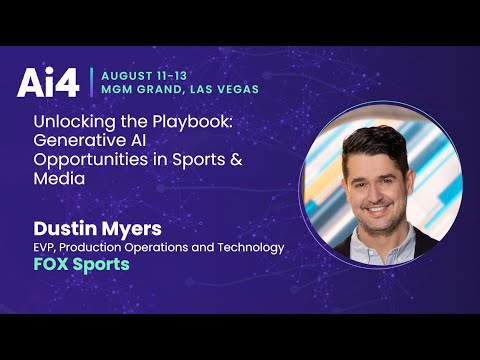
Fox Sports Deploys Agentic AI to Scale Broadcasts Without Adding Staff
Ai4
Broadcasters must integrate autonomous AI workflows to deliver hyper-personalized content to fragmented audiences as budget limits prevent headcount expansion.
## Background
Published on YouTube by Ai4 on August 27, 2025, this presentation features Dustin Myers, Executive Vice President of Production Operations and Technology at FOX Sports. According to the description, the session explores how evolving fan habits require sports media companies to harness generative AI to transform content creation, automate production workflows, and deliver personalized, interactive experiences at scale.
## TL;DR
Dustin Myers outlines FOX Sports' strategic AI journey, tracing its evolution from building a semantic machine learning search engine for its 20-petabyte media archive to deploying generative and agentic workflows in live broadcasts. To satisfy shifting fan demographics—where younger audiences follow individual stars and demand continuous digital content under tight budget constraints—FOX Sports leverages AI for real-time multilingual translation, automated MLB statistical storytelling, and multi-agent video feature creation. Myers emphasizes that prompt engineering functions like code in structured multi-tool pipelines, forecasting a future of hyper-personalized broadcasts where viewers choose their own audio tracks and data overlays.
## Atmosphere & style
The presentation carries an engaging, grounded insider tone that bridges high-level executive strategy with the gritty realities of live broadcast trucks. Myers delivers his insights with self-deprecating humor and candor, readily sharing early generation glitches like football players holding baseball bats to demystify generative AI hype. It feels pragmatic, highly conversational, and technically realistic, capturing both the creative excitement of emerging digital teammates and the unforgiving operational pressure of live sports where execution must be bulletproof.
## Key takeaways
- [00:03](https://www.youtube.com/watch?v=PyJQDWpLAWs&t=3s) FOX Sports began its AI journey by partnering with Google Cloud to index a 20-petabyte, 25-year archive using machine learning for semantic play-by-play visual recognition, fully debuting the engine at the 2022 FIFA World Cup.
- [03:23](https://www.youtube.com/watch?v=PyJQDWpLAWs&t=203s) Modern sports fandom is increasingly fragmented, with 70% of Gen Z fans following individual athletes over entire teams, requiring broadcasters to generate continuous ancillary digital content to supplement traditional linear broadcasts.
- [03:23](https://www.youtube.com/watch?v=PyJQDWpLAWs&t=203s) Because networks cannot expand headcount to produce endless multi-platform content, AI tools serve as essential leverage to scale digital and social output while maintaining high-reach linear broadcasts like the Super Bowl.
- [05:10](https://www.youtube.com/watch?v=PyJQDWpLAWs&t=310s) FOX Sports categorizes AI adoption into content creation, fan engagement, and workflow automation, achieving production velocity gains that compress two-week tasks into two hours.
- [05:10](https://www.youtube.com/watch?v=PyJQDWpLAWs&t=310s) Automated speech-to-text, translation, and synthetic voice pipelines enable live pitch-side foreign language interviews at major tournaments like the UEFA Euro to be translated and broadcast within seconds.
- [08:34](https://www.youtube.com/watch?v=PyJQDWpLAWs&t=514s) An analytical AI engine trained on 150 years of MLB history combined with real-time telemetry empowers production assistants to generate deep, contextual storylines for live broadcast commentary in minutes.
- [11:06](https://www.youtube.com/watch?v=PyJQDWpLAWs&t=666s) Broadcasting is transitioning from standalone Generative AI tools (acting as 'painters') to Agentic AI (acting as 'art directors') capable of autonomously orchestrating multi-part creative workflows.
- [15:02](https://www.youtube.com/watch?v=PyJQDWpLAWs&t=902s) Future sports broadcasting will move beyond one-size-fits-all feeds toward hyper-personalized experiences, allowing viewers to select custom commentary styles, tactical breakdowns, or lifestyle-oriented audio tracks.
- [16:09](https://www.youtube.com/watch?v=PyJQDWpLAWs&t=969s) Generative video production in enterprise media requires structured, multi-page prompt architectures chained through LLMs and storyboarding workflows rather than simple push-button text prompts.
- [18:05](https://www.youtube.com/watch?v=PyJQDWpLAWs&t=1085s) Proprietary automation tools like Foresight ingest live sports data feeds to automatically populate and render on-screen television graphics and starting lineups in real time.
## Detailed walkthrough
### [00:03](https://www.youtube.com/watch?v=PyJQDWpLAWs&t=3s) From Media Producer to AI Pioneer: Solving the 20-Petabyte Search Problem
Dustin Myers, Executive Vice President of Production Operations and Technology at FOX Sports, begins by contextualizing his non-traditional transition into technology. As a traditional broadcaster, his AI journey was prompted by a practical challenge during preparations for the 2017 Super Bowl between the New England Patriots and the Atlanta Falcons. A producer approached him in desperation, unable to locate specific archive footage needed for a feature story on Patriots linebackers. At the time, FOX Sports relied entirely on an on-premise system devoid of machine learning capabilities, requiring staff to manually cross-reference dates on YouTube to narrow down queries from 10,000 potential clips to a manageable few hundred.
To solve this friction, FOX Sports undertook a massive initiative to organize its 25-year sports media archive, which spanned roughly 20 petabytes of footage. Seeking commercial solutions, Myers attended the NAB (National Association of Broadcasters) trade show, only to discover that legacy vendors lacked advanced search tooling and were merely pushing cloud storage. The breakthrough occurred through a serendipitous partnership with Google Cloud. Google proposed training machine learning models to visually recognize semantic sports events—teaching the system to distinguish between a touchdown, an interception, a caught pass, or balls and strikes in baseball. Myers notes that while this underlying technology (pattern-recognition ML) is now considered "old AI," years of iterative development yielded a content discovery engine that debuted globally during the 2022 FIFA World Cup.
```mermaid
flowchart LR
accTitle: Evolution of FOX Sports Asset Search Workflow
subgraph Legacy ["Legacy 2017 System"]
direction TB
A["YouTube Manual Search"] --> B["On-Prem Keyword System"]
B --> C["10,000+ Results Filtered to Hundreds"]
C --> D["Manual Timeline Scrolling"]
end
subgraph AI Engine ["ML Search Architecture"]
direction TB
E["20+ PB Sports Archive"] --> F["Google Cloud ML Models"]
F --> G["Play-by-Play & Visual Recognition"]
G --> H["Instant Targeted Asset Retrieval"]
end
Legacy --> AI Engine
```
- **Super Bowl LI Context:** The problem arose during preparations for the Patriots vs. Falcons Super Bowl in 2017.
- **Archive Scale:** FOX Sports managed a 25-year library comprising roughly 20 petabytes of media assets.
- **ML Capabilities:** The engine interprets live play-by-play NFL and MLB data streams, allowing production staff to search specific game events (e.g., "a curveball in the 3rd inning of a World Series game") and immediately jump to the exact video frame.
- **World Cup Debut:** The production search platform was fully deployed during the 2022 FIFA World Cup, highlighted by Lionel Messi's championship victory with Argentina.
---
[03:23](https://www.youtube.com/watch?v=PyJQDWpLAWs&t=203s) Modern Fan Behavior and the Shifting Broadcast Landscape
Myers emphasizes that media companies must modernize because modern sports fandom has fundamentally transformed. The industry no longer serves a homogenous audience tuning into a single linear event; modern fans hold complex and highly fragmented motivations. Myers quips that around the office, they often acknowledge that "fandom is complicated now." For instance, millions of viewers tune into a Kansas City Chiefs broadcast not to watch Patrick Mahomes or Travis Kelce, but to spot Taylor Swift in the executive suite and track her outfit or arrival.
This behavioral shift is backed by stark demographic data. A massive majority of younger audiences prioritize individual athletes over traditional team allegiances, meaning a standard three-and-a-half-hour television broadcast—which primarily focuses on players actively in the play—fails to capture their interest. To capture these fans, sports organizations must produce a continuous stream of ancillary, digital, and social media content. However, Myers points out the operational reality: media executives cannot simply ask CFOs to add massive headcount to cover these extra channels. AI tools bridge this gap by expanding production capacity without inflating staff budgets, balancing linear broadcast reach with digital personalization.
- **Gen Z Viewing Habits:** 70% of Gen Z sports fans report following individual athletes rather than entire teams.
- **Super Bowl LIX Linear Reach:** Super Bowl LIX in New Orleans reached a record-breaking 127.7 million viewers on television, proving that traditional broadcast remains vital alongside digital expansion.
- **Operational Constraint:** Media teams face strict budget and headcount limits, making automated AI workflows essential for generating supplementary social and digital content.
---
[05:10](https://www.youtube.com/watch?v=PyJQDWpLAWs&t=310s) Tranches of AI Adoption: Creation, Engagement, and Workflow Automation
FOX Sports categorizes its AI deployments across three distinct operational areas: content creation, fan engagement, and workflow automation. In content creation, generative video tools like Google's Veo, OpenAI's Sora, and audio generation tools are utilized to create graphics, promos, and asset sizzle reels. Myers shares a lighthearted warning regarding prompt engineering and model limitations: while preparing a sizzle reel using generative video tools, he repeatedly had to chain inputs through LLMs like ChatGPT and Gemini to avoid wasting generation tokens. He eventually abandoned one sequence after the model generated American football players batting with baseball bats, illustrating the current boundaries of domain-specific generative video.
In fan engagement, gamification and augmented reality (AR) experiences have taken center stage. Interactive fan applications—such as MLB’s *Beat the Streak* game, athlete trivia challenges, and in-stadium AR treasure hunts—leverage AI engines to auto-generate context-aware dynamic gameplay. In workflow automation, AI delivers substantial operational efficiency. Myers highlights a translation and dubbing pipeline developed for the UEFA European Championship (Euro). Previously, conducting post-match pitch-side interviews with international players presented a broadcasting dilemma: translating native speech into English subtitles or voiceover took too long to broadcast before going to commercial break. By deploying automated speech-to-text, real-time machine translation, and synthetic voice generation, FOX Sports translated interviews and aired them within seconds.
- **Production Velocity:** Internal testing showed AI tools reducing content production workflows that previously took two weeks down to just two hours.
- **Generative Video Chaining:** Production teams use LLMs like ChatGPT or Gemini as intermediate prompt-refinement engines before passing complex scene descriptors to video generators like Veo or Sora.
- **UEFA Euro Localization Architecture:** Native audio was captured pitch-side, processed through speech-to-text, translated into English, synthesized into speech, and mixed into the live transmission prior to commercial cutaways.
- **Voice Cloning Pipeline:** Future iterations of the translation workflow focus on voice-cloning models to output translated English speech that preserves the player's natural voice, cadence, and timbre.
---
[08:34](https://www.youtube.com/watch?v=PyJQDWpLAWs&t=514s) Data-Driven Insights and Automated Storytelling in the Broadcast Truck
To enhance live sports analysis, FOX Sports partnered with Google to build a custom analytical AI tool trained on a 150-year statistical archive of Major League Baseball history, combined real-time with live game telemetry. This engine automatically evaluates match-ups and generates contextual storylines—such as predicting Shohei Ohtani's performance against high-velocity curveballs or evaluating team performance with runners in scoring position. Myers shares an example from the 2024 World Series, where the AI model highlighted that the Los Angeles Dodgers were unusually lethal with two outs and bases loaded. That exact scenario played out when Freddie Freeman hit a iconic, game-winning walk-off grand slam.
Traditionally, finding these obscure historical trends fell on entry-level Production Assistants (PAs) working long hours inside broadcast trucks. Myers notes that AI does not replace these PAs; instead, it empowers them. Rather than pulling all-nighters to present a few bleary-eyed ideas to commentators over breakfast, PAs use AI-driven statistical engines to generate ten compelling, fully researched narrative arcs in minutes. This shift allows broadcast talent to deliver deeper, more informed commentary during live games. Myers contrasts this with other league technology trends, such as MLB's debut of the Automated Balls and Strikes (ABS) challenge system at the All-Star Game, noting how computer vision and image recognition are reshaping on-field officiating alongside off-field analytics.
- **Historical Dataset:** The MLB statistical engine ingests over 150 years of historical baseball metrics alongside real-time match data.
- **Broadcast Application:** Storylines and situational statistics generated by the AI tool are fed directly to live commentators and studio analysts prior to game time.
- **Automated Clip Generation:** For regional sports affiliates requesting specific highlights of hometown players in minor games, automated highlight generation models compile clips without requiring dedicated editing teams.
---
[11:06](https://www.youtube.com/watch?v=PyJQDWpLAWs&t=666s) Digital Teammates: Agentic AI and Generative Production
Myers highlights the shift from standard Generative AI to Agentic AI, describing autonomous "digital teammates" as the next major step in broadcast technology. While traditional Generative AI acts like a painter creating isolated media elements (images, text, music, or code), Agentic AI acts as an art director—receiving complex operational objectives, orchestrating tasks autonomously, and pulling together disparate workflows. This capability allows media organizations to pursue creative concepts that were historically discarded due to resource constraints. Myers references a studio philosophy shift: "A media studio used to be a single building. Now it's a network of AI-powered nodes."
To demonstrate this concept, FOX Sports produced a humorous, highly polished segment for their pre-race coverage of the Indianapolis 500 featuring NFL legend and broadcast personality Ndamukong Suh. The piece imagined an alternate reality where Suh pursued his childhood dream of race car driving in Germany rather than playing professional football. Multiple specialized AI agents independently generated different components of the piece—including background scenics, digital elements, script adaptations, and music scores—which were then assembled into a cohesive broadcast feature.
Myers also cautions about the operational risks of using AI-generated scenic imagery (such as B-roll for emotional college football profiles or international World Cup host cities like Mexico City). Audiences on social media quickly spot minor architectural flaws—like a missing door on a specific university dorm wall or an misplaced church—highlighting the need for careful human oversight alongside digital production tools.
- **Generative vs. Agentic Analogy:** Generative AI generates specific raw assets (like a painter), whereas Agentic AI manages multi-step creative goals independently (like an art director).
- **NDamukong Suh Indy 500 Feature:** The creative piece blended AI-generated voiceovers, scenic backgrounds, and synthesized automotive footage to build an irreverent story for the Indy 500 broadcast.
- **B-Roll Generation Use Case:** Generative video tools like Veo are frequently used to synthesize contextual background shots—such as darkened university dorm hallways for emotional feature stories—saving production teams from sending camera crews back to remote locations in winter.
---
[14:36](https://www.youtube.com/watch?v=PyJQDWpLAWs&t=876s) Looking Forward: Personalization and Next-Generation Broadcasts
Looking toward the future of sports broadcasting, Myers envisions hyper-personalized "choose-your-own-adventure" media experiences. As AI systems learn individual viewer preferences, broadcasts will move beyond static one-size-fits-all feeds. Audiences will gain the ability to customize audio commentary tracks, selecting alternative announcer styles or tailored analytical perspectives rather than being restricted to the primary network commentary team.
- **Personalized Audio Feeds:** AI models will allow viewers to dynamically select or synthesize custom game commentary based on personal preferences.
- **Algorithmic Curation:** Future broadcast distribution networks will automatically tailor graphics, statistical overlays, and highlight packages based on a user's tracked favorite players and historical viewing habits.
[15:02](https://www.youtube.com/watch?v=PyJQDWpLAWs&t=902s) Personalized Broadcasts and Tailored Fan Experiences
Broadcasting is rapidly moving beyond one-size-fits-all feeds toward deeply personalized viewing experiences. Future broadcasts will cater to diverse fan preferences simultaneously: dedicated football fans can choose an in-depth "X's and O's" tactical breakdown, casual viewers hosting a Super Bowl party can enjoy lighthearted, entertaining commentary, and lifestyle-focused fans can tune in for sideline culture and game-day fashion. Instead of just offering two or three alternate feeds, media technology is reaching a point where there will be a "unique broadcast for everyone."
[15:27](https://www.youtube.com/watch?v=PyJQDWpLAWs&t=927s) FIFA World Cup Scale and Generative AI Expectations
Addressing the upcoming FIFA World Cup during the Q&A, Dustin explains the broadcast structure and the massive technological scaling underway. Because FIFA produces the match feeds centrally, FOX Sports collaborates alongside roughly 700 licensees to determine what specialized features and technologies can be layered into the coverage.
```mermaid
flowchart TD
accTitle: Tournament Scale Expansion
subgraph Scale["Tournament Expansion"]
C["3 Host Countries"]
T["32 to 48 Teams"]
M["64 to 104 Matches"]
end
subgraph Delivery["Production & Tech Deployment"]
FIFA["FIFA Central Match Production"]
GENAI["Generative AI & Data Layers"]
FOX["FOX Sports Broadcast Delivery"]
end
Scale --> FIFA
FIFA --> GENAI
GENAI --> FOX
```
- **Scale of Expansion**: The tournament expands from 32 to 48 teams and from 64 to 104 matches across three host nations.
- **Flawless Execution Required**: While data layers and generative AI tools are actively being tested with FIFA, live deployments must be bulletproof because "for the World Cup it's got to be perfect."
[16:09](https://www.youtube.com/watch?v=PyJQDWpLAWs&t=969s) The Reality of Prompt Engineering and Multi-Tool Production Pipelines
New talent entering the workforce brings intuitive AI literacy. Dustin notes that younger employees—exemplified by his 13-year-old daughter who is already highly proficient with ChatGPT—arrive with an innate understanding of generative possibilities rather than viewing AI simply as a tool for workforce reduction. When developing specialized production models, FOX Sports partners closely with Google to train and customize their models safely within sports rights parameters.
Prompt engineering in professional media goes far beyond short natural-language queries. High-end generative video assets—such as viral spec ads for IKEA or Liquid Death, or an asset like a "cool shot of Michael Strahan in a race car"—require prompts that resemble structured code spanning two full pages. Production remains a deeply deliberate, iterative process rather than push-button automation. Creative teams still begin by storyboarding in Canva, passing concepts into Gemini or ChatGPT to construct dense prompt architectures, and then rendering images and video.
```mermaid
flowchart LR
accTitle: Generative Creative Pipeline
subgraph Planning["1. Ideation & Planning"]
A["Canva Storyboarding"]
end
subgraph Prompting["2. Prompt Architecture"]
B["Gemini / ChatGPT<br/>Structured Prompts"]
end
subgraph Generation["3. Video & Image Rendering"]
C["Runway / Sora"]
end
A --> B
B --> C
```
Looking ahead, AI tools will need to adopt traditional cinematography and television controls rather than relying solely on descriptive language, allowing directors to specify exact technical parameters such as a "50-millimeter lens" or stopping down an aperture.
[18:05](https://www.youtube.com/watch?v=PyJQDWpLAWs&t=1085s) Live Graphics Automation and Concluding Remarks
FOX Sports utilizes automated workflows to streamline real-time television graphics. Through their proprietary Foresight tool, data across Major League Baseball is monitored continuously. As starting lineups are announced, the system ingests live data feeds from Sportradar and pre-populates the on-screen lower-third graphics and fonting ahead of the broadcast.
When asked about the current core creative tool stack, key platforms evaluated and utilized include:
- **Runway** and **OpenAI Sora** for generative video exploration
- **Canva** for initial conceptual design and storyboarding
- **Gemini** and **ChatGPT** for structured prompt engineering
Dustin gracefully steps around a closing legal/rights inquiry outside his operational purview before concluding the session to audience applause.
## Notable quotes
> [00:03](https://www.youtube.com/watch?v=PyJQDWpLAWs&t=3s) old AI — Dustin Myers
> [00:03](https://www.youtube.com/watch?v=PyJQDWpLAWs&t=3s) a curveball in the 3rd inning of a World Series game — Dustin Myers
> [03:23](https://www.youtube.com/watch?v=PyJQDWpLAWs&t=203s) fandom is complicated now. — Dustin Myers
> [11:06](https://www.youtube.com/watch?v=PyJQDWpLAWs&t=666s) A media studio used to be a single building. Now it's a network of AI-powered nodes. — Dustin Myers
## Mentioned
Dustin Myers, FOX Sports, Google Cloud, Google, National Association of Broadcasters (NAB), Super Bowl LI, New England Patriots, Atlanta Falcons, YouTube, 2022 FIFA World Cup, Lionel Messi, Argentina, Kansas City Chiefs, Patrick Mahomes, Travis Kelce, Taylor Swift, Super Bowl LIX, Google Veo, OpenAI Sora, ChatGPT, Gemini, Major League Baseball (MLB), Beat the Streak, UEFA European Championship, Shohei Ohtani, Los Angeles Dodgers, Freddie Freeman, Automated Balls and Strikes (ABS), Ndamukong Suh, Indianapolis 500, Michael Strahan, IKEA, Liquid Death, Canva, Runway, Foresight, Sportradar, FIFA
## Video description
Dustin Myers, EVP, Production Operations and Technology, FOX Sports
Abstracts
Today’s sports fans expect more than just the game—they want immersive, personalized, and interactive experiences across live and digital platforms. As consumer habits evolve, sports media companies are turning to generative AI to transform content creation, automate workflows, and deliver real-time, tailored experiences at scale.
Attendees will gain insight into key audience trends, emerging AI use cases, and how leading organizations are reimagining production and fan interaction.
FOX Sports部署智能体AI,不增人手扩大转播规模
在预算限制阻碍人员编制扩张的情况下,转播商必须整合自主AI工作流,向碎片化受众提供超个性化内容。
Dustin Myers概述了FOX Sports的战略性AI发展历程,追溯了其从为其20 PB媒体档案库构建语义机器学习搜索引擎,到在赛事直播中部署生成式与智能体工作流的演进轨迹。为了迎合不断变化的球迷群体特征——年轻受众更倾向于追随明星个人,且在预算紧缩的背景下对持续数字内容需求激增——FOX Sports利用AI实现实时多语言翻译、自动化MLB数据叙事以及多智能体视频特写制作。Myers强调,在结构化的多工具管线中,提示工程的作用相当于编写代码,并预言未来将迎来超个性化转播,观众可自主选择音轨与数据叠加层。
FOX Sports 与 Google Cloud 合作,利用机器学习对其 25 年历史、容量达 20PB 的媒体档案进行语义逐球视觉识别索引,并在 2022 年 FIFA 世界杯上全面上线部署。 (0:03)
面对 70% 的 Z 世代球迷更倾向于关注个体运动员而非整支球队的趋势,转播机构借助 AI 工具在不增加员工编制的前提下,规模化输出多平台数字与社交衍生内容。 (3:23)
FOX Sports 将 AI 应用划分为内容创作、球迷互动与工作流程自动化三大领域,不仅将两周的生产流程缩减至两小时,还能通过自动化语音与翻译管线在数秒内完成赛场外语采访的转播。 (5:10)
制作模式正从单点生成式 AI 迈向能自主统筹多步骤创意工作流的智能体 AI(Agentic AI),并借助结合 150 年 MLB 历史数据与实时遥测的分析引擎在数分钟内为现场解说生成深度赛事叙事。 (11:06)
未来的体育转播将打破千人一面的单路信号模式,转向超个性化体验,允许观众自主选择深度战术拆解、娱乐互动或赛场文化等不同风格的定制解说音轨。 (15:02)
Reading summary
Dustin Myers, Executive Vice President of Production Operations and Technology at FOX Sports, outlines how the network leverages machine learning and generative AI to manage massive media archives, automate production workflows, and adapt to increasingly fragmented fan demographics under strict budget caps.
Modernizing Archives and Live Broadcast Storytelling (0:03)
FOX Sports' transition toward machine learning began during preparations for the 2017 Super Bowl, when production teams struggled to locate specific player footage across an on-premise, 20-petabyte archive spanning 25 years. Partnering with Google Cloud, the broadcaster trained models on visual semantics and play-by-play data to recognize specific plays, such as curveballs or interceptions. This discovery engine debuted globally at the 2022 FIFA World Cup, allowing editors to jump directly to exact frames from textual queries.
FOX Sports also integrated a statistical engine trained on 150 years of Major League Baseball history with live game telemetry. The tool surfaces contextual narratives in real time, such as flagging that the Los Angeles Dodgers were historically lethal with bases loaded and two outs during the 2024 World Series—moments before Freddie Freeman's walk-off grand slam. Rather than replacing entry-level production assistants, Myers explains that these tools allow staff to compile ten well-researched narrative angles in minutes rather than spending full shifts searching data.
Automating Production for Fragmented Fan Demographics (3:23)
Shifting audience behavior requires broadcasters to produce content beyond traditional linear feeds. Myers cites data indicating that 70% of Gen Z sports fans follow individual athletes over teams, alongside cultural crossovers such as non-traditional viewers tracking celebrity arrivals. While linear television maintains mass reach—evidenced by 127.7 million viewers for Super Bowl LIX—media companies cannot expand staffing budgets to manually cover every digital and social channel.
To bridge this capacity gap, FOX Sports deploys workflow automation that has reduced certain two-week content cycles to two hours. During the UEFA European Championship, the network used an automated pipeline combining speech-to-text, machine translation, and synthetic voice generation to broadcast pitch-side player interviews in English within seconds, airing them before commercial cutaways. Automated graphics engines such as Foresight also ingest live Sportradar data to pre-populate lower-third graphics as starting lineups are announced.
Agentic Workflows and Deliberate Prompt Engineering (11:06)
FOX Sports is shifting focus from isolated generative tools to agentic systems functioning as 'digital teammates.' Myers contrasts traditional generative models acting as individual creators with agentic AI acting as an art director that orchestrates multi-step creative goals. For an Indianapolis 500 broadcast feature starring Ndamukong Suh, multiple specialized AI agents autonomously generated background scenics, script adaptations, and music scores that were assembled into a cohesive segment.
Myers cautions that high-end generative media is not a push-button operation. Studio pipelines involve structured multi-step workflows, starting with storyboarding in Canva, passing concepts to large language models like ChatGPT or Gemini to write multi-page structured prompts, and rendering assets in Runway or OpenAI Sora. Strict human oversight remains essential: unrefined prompts have generated errors such as football players batting with baseball bats, and social media audiences quickly identify architectural errors in synthetic background B-roll.
Hyper-Personalization and Large-Scale Tournament Execution (14:36)
Looking forward, Myers anticipates broadcasts evolving into individualized, choose-your-own-adventure experiences. Instead of a single static feed, AI-driven platforms will allow viewers to select tailored audio commentary tracks—ranging from tactical breakdowns to casual or lifestyle-oriented commentary—alongside dynamically curated statistical overlays and highlight reels based on their historical viewing habits.
However, scaling these technologies to premier events introduces major operational constraints. With the upcoming FIFA World Cup expanding from 32 to 48 teams and from 64 to 104 matches across three host nations, FOX Sports must coordinate technology layers alongside roughly 700 licensees. Because FIFA produces match feeds centrally, Myers notes that any live generative AI implementations must be completely error-free before going to air.
Myers concludes that while AI tools dramatically expand production capacity without increasing headcounts, their successful implementation depends on bridging generative systems with traditional television engineering standards, maintaining rigorous editorial oversight, and ensuring absolute reliability across high-stakes live sports.
精炼阅读摘要
FOX Sports 制作运营与技术执行副总裁 Dustin Myers 指出,体育传媒正面临受众诉求高度碎片化与内容渠道激增的双重挑战;通过从早期的模式识别检索升级至生成式与代理型 AI(Agentic AI),转播机构在不增加人员编制的前提下重构了制作流程,推动赛事深度叙事与超个性化视听体验的实现。
媒体资产智能检索与历史数据叙事 (0:03)
FOX Sports 的技术转型源于 2017 年超级碗筹备期间人工检索档案素材的严重低效。当时其拥有跨越 25 年历史、体量约 20PB 的素材库,制作团队却只能依赖人工在 YouTube 交叉比对日期并逐一筛选。为此,FOX 与 Google Cloud 合作,利用模式识别机器学习模型训练系统视觉识别达阵、拦截以及棒球的好球与坏球等赛事实体。该内容发现引擎在 2022 年国际足联世界杯期间正式投入实战,实现了按比赛事件数据流秒级定位视频画面的能力。
在实时转播层面,该能力进一步延伸至赛事分析与叙事挖掘。通过将 150 年的 MLB 历史数据与实时比赛遥测结合,AI 系统可自动评估对决场景并生成背景故事,例如在 2024 年世界大赛中提前提示洛杉矶道奇队在两出局满垒时的极端威胁,该场景随后在比赛中被 Freddie Freeman 的再见满贯全垒打验证。Myers 强调,AI 并没有取代转播车内的初级制作助理(PA),而是将原本通宵查阅数据提炼两三个线索的工作,转变为数分钟内生成十套详尽叙事方案,从而赋能解说团队输出更具深度的分析。
粉丝行为裂变与预算约束下的产能扩张 (3:23)
现代体育受众已由传统的同质化电视观众转向多元细分群体。Myers 引用数据指出,70% 的 Z 世代体育迷倾向于追踪特定运动员而非整支球队,传统的单一线性转播视角难以满足其兴趣;同时,大量观众收看转播仅为捕捉特定流行文化现象(例如在堪萨斯城酋长队比赛中关注 Taylor Swift 的包厢镜头与穿搭)。尽管超级碗 LIX 创下了 1.277 亿电视观众的历史纪录,印证了传统大屏转播的基石地位,但媒体机构必须持续供给海量的社交与数字衍生内容来覆盖年轻受众。
在严苛的财务与编制红线下,制作团队无法通过大幅扩招员工来应对多渠道产出需求。AI 工具在此成为平衡传统广播覆盖与数字化个性化触达的桥梁。内部测试显示,引入 AI 工具后,部分原本需要耗时两周的内容制作流程被压缩至两小时,使机构得以在维持现有团队规模的前提下实现高通量分发。
流程自动化、代理型协作与即时本地化 (5:10)
FOX Sports 将其实际 AI 应用划分为内容创作、球迷互动和工作流自动化三大模块。在工作流自动化方面,Myers 重点介绍了欧洲足球锦标赛(UEFA Euro)中的即时翻译与配音管线:针对场边外语采访难以在切入商业广告前完成人工翻译的痛点,系统整合语音转文字、机器翻译与语音合成,在数秒内输出合规的英文配音,后续迭代更计划引入声音克隆以保留球员本人的自然音色与语调。在互动领域,AI 则驱动了 MLB“Beat the Streak”及场馆 AR 寻宝等动态游戏。
在更深层次的内容生成中,技术正由单一的生成式 AI 向代理型 AI 演进。Myers 将传统生成式 AI 比作产出孤立素材的“画家”,而代理型 AI 则充当能够自主协调多步任务的“艺术总监”。例如在印第安纳波利斯 500 赛事的预热短片中,多个专门的 AI 智能体分别独立生成背景风光、分镜头脚本与配乐,最终组装成完整节目。然而 Myers 亦提示了局限与风险:领域模型常出现违背常理的生成错误(如橄榄球运动员手持棒球棍击球),且社交媒体受众对生成背景中的建筑细节瑕疵(如大学宿舍缺失的门或错置的建筑)极其敏感,严格的人工监护仍然必不可少。
工业级提示词工程与个性化转播演进 (14:36)
展望转播体验的演进,Myers 认为未来将超越提供两到三个备选信号源的现状,迈向“千人千面”的自选模式(choose-your-own-adventure)。系统将根据个人偏好合成定制化的解说音轨,无论是注重技战术解析的资深球迷、聚会娱乐型观众,还是聚焦赛场着装与周边文化的受众,均能获取动态匹配的图形、统计叠加层与高光剪辑。
而在当前实际生产环境中,高质量内容生成并非一键式自动化,而是严密的工业化工程。专业级视觉素材往往需要团队先在 Canva 中设计分镜脚本,再经由 Gemini 或 ChatGPT 编写类似结构化代码的长达两页的密集提示词,最后导入 Runway 或 Sora 进行渲染。Myers 指出,AI 工具若要在广播领域真正普及,亟需从纯自然语言描述向传统电影摄影参数演进,赋予导演直接控制镜头焦距(如 50mm 镜头)或光圈等物理参数的能力;面对扩军至 48 支球队、104 场比赛并跨越三国的下一届国际足联世界杯,所有分层部署的生成式数据工具更必须承受住严苛的零容错考验。
FOX Sports 的探索表明,生成式与代理型 AI 在体育媒体中的价值在于放大一线制作人员的叙事与检索产能,而非直接替代人工;然而,模型专业领域的认知边界、视觉细节的真实性偏差,以及对传统影视物理级精准控制工具的缺失,依然是当前技术实现工业级规模化落地的核心制约。
Detailed notes — zh
## Background
本内容由频道 Ai4 于 2025 年 8 月 27 日发布在 YouTube 平台上。页面简介指出,FOX Sports 制作运营与技术执行副总裁 Dustin Myers 在演讲中分享了体育受众习惯的演变、生成式 AI 在体育传媒中的新兴用例,以及领先机构如何利用 AI 重塑赛事制作与球迷互动体验。
## TL;DR
FOX Sports 分享了从 2017 年利用早期机器学习检索 20PB 历史资产,到如今全面拥抱生成式 AI 与 Agentic AI 的转型历程。针对 Z 世代更关注球星个人以及海量碎片化衍生内容的需求,制作团队在欧洲杯中实现了实时多语言采访翻译与声音克隆,并结合 MLB 150 年历史数据打造出自动化叙事与图表预测系统。演讲还展望了未来影视级参数控制、去中心化制作网络以及“自选转播风格”的超个性化观赛体验。
## Atmosphere & style
整场演讲充满了一线电视转播人务实且幽默的叙事风格。Dustin Myers 结合生动的实战糗事(如 AI 生成橄榄球员拿球棒打球)与温情的观赛回忆,将严肃的工程挑战讲得深入浅出、引人入胜。现场氛围既展现了对前沿技术边界的清醒克制与严谨态度,又洋溢着对体育视听未来创新的极高热情与专业底气。
## Key takeaways
- [00:03](https://www.youtube.com/watch?v=PyJQDWpLAWs&t=3s) FOX Sports 的 AI 转型始于 2017 年超级碗,为解决 25 年积累、20PB 海量体育视频资产无法高效检索的痛点,与 Google 合作训练了能够理解达阵、好坏球等体育规则的机器学习发现系统。
- [02:44](https://www.youtube.com/watch?v=PyJQDWpLAWs&t=164s) 体育受众生态发生结构性剧变:70% 的 Z 世代观众更倾向于追随球星个人而非俱乐部,叠加跨界文化关注与传统大屏破纪录收视的双重需求,倒逼制作团队借助生成式 AI 破除预算与编制瓶颈。
- [05:10](https://www.youtube.com/watch?v=PyJQDWpLAWs&t=310s) FOX Sports 将 AI 落地聚焦于内容创作、球迷互动与工作流自动化三大支柱,尽管视频生成仍存在逻辑错乱等局限,但已将数据收集和渲染等日常流程从两周压缩至两小时。
- [05:10](https://www.youtube.com/watch?v=PyJQDWpLAWs&t=310s) 在欧洲杯等国际赛事中,FOX Sports 跑通了“实时切片 → 语音转文字 → 大模型多语言翻译 → 语音合成/音色克隆”的全自动实时转播管线,在切入广告前即可完成播出。
- [08:33](https://www.youtube.com/watch?v=PyJQDWpLAWs&t=513s) 结合 MLB 长达 150 年历史数据与当季实时追踪数据,定制 AI 预测系统精准预判了道奇队在两出局得点圈的极高威胁,并在世界大赛弗雷迪·弗里曼满垒绝杀中得到戏剧性应验。
- [10:06](https://www.youtube.com/watch?v=PyJQDWpLAWs&t=606s) AI 辅助工具彻底重塑了转播车制作流程,初级制片助理(PA)不再需要熬夜翻找散乱资料,而是能在赛前迅速为解说团队生成十余个高质量的深度叙事切入点。
- [11:06](https://www.youtube.com/watch?v=PyJQDWpLAWs&t=666s) 智能体(Agentic AI)正扮演掌控全局的“艺术总监”角色,媒体演播室从实体物理空间演变为去中心化的创意网络矩阵,使过去因预算或人力受限的创意构想成为可能。
- [13:20](https://www.youtube.com/watch?v=PyJQDWpLAWs&t=800s) 生成式补拍与虚拟场景带来了严苛的事实与地理伦理挑战,细微的真实性瑕疵极易被眼尖观众指出,要求制作团队在 2026 世界杯等场景下保持极高精度。
- [13:20](https://www.youtube.com/watch?v=PyJQDWpLAWs&t=800s) 未来体育转播的终极形态是“选择你自己的冒险”式超个性化体验,观众可自主切换解说风格、硬核战术分析流或休闲娱乐穿搭流。
- [15:24](https://www.youtube.com/watch?v=PyJQDWpLAWs&t=924s) 专业级 AI 内容制作依赖两页纸级别的高精度提示词工程(Prompt Engineering)与深度迭代,而非简单的单句指令输入,人类专业审美仍是决定成败的核心。
- [17:31](https://www.youtube.com/watch?v=PyJQDWpLAWs&t=1051s) 生成式 AI 工作流正从“Canva 构图 + LLM 提示词优化 + 视频模型渲染”的多工具协同,逐步向支持镜头焦段、光圈等专业摄影参数的专业影视化控制演进。
- [18:05](https://www.youtube.com/watch?v=PyJQDWpLAWs&t=1085s) 通过 Foresight 工具融合赛事实时数据与阵容信息,转播团队实现了字幕与数据图表的毫秒级自动预填充,大幅减轻导播与制图人员负担。
## Detailed walkthrough
### [00:03](https://www.youtube.com/watch?v=PyJQDWpLAWs&t=3s) 2017 超级碗与 20PB 检索难题:FOX Sports 的 AI 起步之旅
Dustin Myers 自称是一名传统电视广播人,几年前涉足技术领域纯粹是为了“解决一个现实痛点”。FOX Sports 的 AI 探索之旅始于 2017 年新英格兰爱国者对阵亚特兰大猎鹰的超级碗筹备期间(他打趣道那是一场伟大的比赛,除非你是猎鹰队球迷)。当时一位女制作人走过来向他求助:“你能帮帮我吗?我找不到我需要的任何素材。”她当时正在制作一部关于爱国者队线卫(Linebackers)的专题片。2017 年时 FOX Sports 的底层系统仍是纯本地部署(On-premise),没有任何 AI 或机器学习加持,全靠基础的关键词和标签。当时内部寻找素材的“土办法”令人啼笑皆非:剪辑师必须先去 YouTube 上搜索对应事件,找到具体发生的比赛日期,再把日期输入内部系统,将搜索结果从上万条勉强缩小到几百条,最后纯靠人工一条一条滚动翻找。
FOX Sports 意识到必须对累积了 25 年、总量高达 20PB 的庞大体育素材库进行系统化梳理。Myers 调侃说,20PB 在体育界算得上天文数字,但在科技峰会里可能连波音公司一天的产生量都比不上。为了解决问题,他前往参展规模极其庞大的全美广播电视展(NAB),却发现当时市面上的供应商全都在空谈概念,没有任何一家能满足需求,大家不过是把老旧套路机械式地推向云端。转机发生在他与 Google 团队的机缘巧合交流中,Google 提出了一种全新的技术路线:“我们可以教系统理解什么是达阵(Touchdown)、什么是拦截(Interception)、接球与拦截的区别,以及什么是好球和坏球。”尽管以现在的视角来看这属于基于特征识别的“老一代机器学习”,但经过几年的技术攻坚与起伏打磨,FOX Sports 最终成功构建出一套内容发现系统。
- **2017 年检索痛点**:无 AI 辅助,需通过 YouTube 查日期反查本地库,再在数百条结果中人工翻找。
- **历史素材规模**:当时拥有 25 年积累、超 20PB 的海量体育视频资产。
- **早期 ML 训练目标**:教会模型理解复杂的体育专业动作与规则(如好坏球、达阵判定与拦截动作)。
---
### [02:44](https://www.youtube.com/watch?v=PyJQDWpLAWs&t=164s) 变迁的球迷生态:Z 世代偏好、泰勒·斯威夫特效应与传统广播
这套全新的云端智能资产系统在 2022 年卡塔尔世界杯期间正式亮相,见证了梅西亲吻大力神杯的历史性瞬间,如今该库已拓展至 30 年的历史数据。该系统不仅实现了智能检索,还解锁了前所未有的赛况联动能力:在比赛进行时,制作人员点击 NFL 官方的实时比赛数据(Play-by-play),画面就能精准跳转至对应镜头;搜索“世界大赛第三局的曲球”,系统也能秒级调取对应片段。Myers 强调,之所以必须做这样的技术跃升,是因为整个体育娱乐行业的受众行为已经彻底重构——“如今的球迷变得极其复杂(Fandom is complicated now)”。
以堪萨斯城酋长队的比赛为例,如今很多观众守在屏幕前,既不是为了看球队输赢,也不是为了看超级球星帕特里克·马霍姆斯(Patrick Mahomes)或特拉维斯·凯尔西(Travis Kelce),而仅仅是想看看泰勒·斯威夫特(Taylor Swift)有没有坐在包厢里、今天穿了什么衣服。行业调研数据显示,高达 70% 的 Z 世代受访者表示比起球队本身,他们更倾向于追随个别运动员。传统的 3.5 小时电视线性直播只会将镜头对准正在参与攻防的球员,远远无法满足年轻一代对球星个人动态、社交媒体和数字化周边内容(Ancillary content)的需求。与此同时,传统电视大屏并未消亡——新奥尔良超级碗斩获了 1.277 亿的破纪录收视人数。面对既要稳固传统大屏体验、又要疯狂拓展多平台衍生内容的双重压力,去向 CFO 申请增加全职编制(Headcount)通常是不切实际的,生成式 AI 因而成为了 FOX Sports 破解产能瓶颈的核心帮手。
```mermaid
flowchart TD
accTitle: 体育球迷生态演变与内容生产响应
subgraph FanShift["现代球迷行为特征"]
A["Z 世代偏好 (70% 追随球星而非球队)"]
B["跨界文化关注 (如泰勒·斯威夫特观赛效应)"]
C["传统大屏高收视 (超级碗 1.277 亿观众)"]
end
subgraph Challenge["制作团队面临的困境"]
D["常规 3.5 小时直播无法覆盖无球球员"]
E["预算与编制受限 (CFO 难以批准增加编制)"]
end
subgraph Solution["AI 驱动的多维内容矩阵"]
F["实时多视角与个性化数据切片"]
G["社交媒体数字化周边内容规模化生产"]
end
FanShift --> Challenge
Challenge --> Solution
```
- **Z 世代观赛行为**:70% 的 Z 世代观众更关注运动员个人而非所属俱乐部/球队。
- **超级碗收视纪录**:新奥尔良超级碗电视观众达到 1.277 亿人,证明大屏基本盘依然强劲。
- **制作矛盾**:长周期直播视角单一 vs 海量碎片化内容需求,倒逼技术降本增效。
---
### [05:10](https://www.youtube.com/watch?v=PyJQDWpLAWs&t=310s) AI 落地的三大支柱:从视频生成翻车到欧洲杯实时声音克隆
FOX Sports 及其行业同行目前主要将 AI 落地聚焦在三个维度:内容创作(Content creation)、球迷互动(Fan engagement)以及工作流自动化(Workflow automation)。在内容创作与视频生成方面,Myers 分享了一段幽默的亲身体验:他尝试使用 Google Veo 为演讲制作一段宣传片(Sizzle reel),并用 ChatGPT 和 Gemini 进行 Prompt 调优以节省算力 Token。他原本要求生成涵盖橄榄球、足球和棒球三项核心运动的精彩画面,结果 AI 竟然生成了“橄榄球运动员拿着球棒在打击”的荒谬场景,让他哭笑不得地放弃了成片。尽管前沿视频生成模型在时长(如单次仅 8 秒)和逻辑一致性上仍有局限,但在数据收集和图形渲染等日常任务中,AI 已经展现出惊人效能,将原本需要两周的工作流程直接压缩至两个小时。
```mermaid
flowchart LR
accTitle: 欧洲杯赛后采访实时多语言转播流程
subgraph Ingest["赛场瞬时采集"]
A["球员走下球场<br/>(母语赛后采访)"] --> B["实时截取视频片段<br/>(Video Clip)"]
end
subgraph AIProcess["云端实时 AI 链路"]
B --> C["语音转文字 (STT)"]
C --> D["大模型多语言文本翻译"]
D --> E["合成语音生成 (TTS) /<br/>音色克隆 (Voice Imprint)"]
end
subgraph Broadcast["播出分发"]
E --> F["合成英语音轨快速贴合"]
F --> G["进广告前完成电视直播播出"]
end
```
在球迷互动与工作流自动化领域,AI 的价值更加直接:
1. **游戏化与沉浸体验**:利用 AI 自动生成比赛竞猜、球员趣味问答(Trivia),或构建如 MLB "Beat the Streak"(连击挑战)与 AR 球场寻宝(Treasure hunt)等互动项目,大幅削减过去需要庞大 AR 专职团队的前期研发成本。
2. **多语言实时转播管线**:在欧洲杯(UEFA Euro)转播中,欧洲球员走下球场接受采访时通常讲母语。传统的人工翻译或外挂字幕耗时过长,无法赶在节目切入商业广告前的黄金窗口期播出。FOX Sports 跑通了全自动化链路:截取视频片段 $\to$ 语音转文字(STT) $\to$ 实时文本翻译 $\to$ 生成合成语音(TTS)并覆盖音轨,在进广告前成功推流播出。
3. **球员声音印记克隆(Voice Imprinting)**:研发团队正推进下一代技术,通过提取球员真实音色,在翻译成英语解说时直接用球员自己的声音声线说话,提供极其逼真的视听体验。
4. **长尾内容与地方台定制分发**:当地方附属电视台提出特殊需求,想要获取某个大学橄榄球比赛中“家乡英雄(Hometown hero)”球员的集锦时,AI 模型可以在没有专职人手支持的情况下,自动追踪冷门球员并快速完成专属高光切片。
### [08:33](https://www.youtube.com/watch?v=PyJQDWpLAWs&t=513s) 融合百年棒球历史的数据分析:大谷翔平、世界大赛与弗雷迪·弗里曼
FOX Sports 与谷歌深度合作开发了一款以海量数据为驱动的分析工具。团队将美国职业棒球大联盟(MLB)整整 150 年的历史数据资料库全盘导入,并将其与即时的当季比赛数据相融合。这套系统能对赛场上的各种战术对决提供极其敏锐的预判洞察,例如“大谷翔平今晚面对曲球会有怎样的表现?”或是“扬基队今晚迎战强力速球派投手时胜率几何?”。
在去年世界大赛(World Series)打响之前,制作团队要求该模型对比纽约扬基队与洛杉矶道奇队各自的优劣势。分析结果得出了非常引人入胜的结论:道奇队不仅阵容极具爆发力且攻防兼备,更关键的是他们在“两出局且得点圈有人”的关键时刻具备极高的打击成功率。作为道奇队球迷,演讲者对这一数据印象极为深刻——而随后的比赛进程简直像是剧本成真:弗雷迪·弗里曼(Freddie Freeman)在满垒绝境中轰出了制胜一击。
- **数据基础**:完整纳入 MLB 长达 150 年的历史统计数据库,并与实时比赛追踪数据进行动态交叉分析。
- **经典应验**:系统精准预测了道奇队在两出局得点圈的致命攻击力,随后弗里曼在满垒情况下上演逆转奇迹。
---
### [10:06](https://www.youtube.com/watch?v=PyJQDWpLAWs&t=606s) 从熬夜助理到 AI 赋能:转播车故事挖掘与自动化好球带系统
弗雷迪·弗里曼击出再见全垒打的那一刻,演讲者正好带着他 8 岁的孩子在现场观赛,成为父子俩终生难忘的温情记忆。但将视线拉回转播制作本身,这些由 AI 挖掘出的深度数据在赛前就被直接提供给转播解说员与嘉宾,帮助他们发掘过去极易被忽略的叙事线索。任何在电视转播车里干过的人都清楚,挖掘这种背景花絮过去是入门级制片助理(PA)的苦差事;而现在,助理依然在岗,但他手中的武器变成了 AI 工具。他们不再需要整夜不睡、在清晨早餐会上顶着黑眼圈勉强递上两三个点子,而是可以迅速拿出十几个高质量的故事切入点供解说团队挑选。
棒球运动本身的科技演进也在加速。除了其他极限运动论坛中讨论的 AI 裁判判罚外,MLB 在全明星赛中正式亮相了 ABS(自动判定好坏球系统)。该系统利用图像识别技术实时追踪球路。现场一个颇具戏剧性的细节是:当击球手信心满满地轻敲头盔提出挑战时,他们几乎每一次都判断错了——打者以为那是坏球,但高精度的技术回放却证实那确实是一记无可争议的好球。
```mermaid
flowchart TD
accTitle: 体育转播故事生成工作流对比
subgraph Traditional["传统制作流程"]
A1["初级制片助理 PA"] --> B1["熬夜通宵翻阅纸质/散乱数据"]
B1 --> C1["清晨疲惫递交 2-3 个故事线"]
end
subgraph AIAssisted["AI 赋能流程"]
A2["150年 MLB 历史数据 + 实时数据"] --> B2["谷歌合作定制 AI 分析工具"]
B2 --> C2["制片助理利用 AI 快速筛选"]
C2 --> D2["赛前轻松为解说团队提供 10+ 深度叙事选项"]
end
```
---
### [11:06](https://www.youtube.com/watch?v=PyJQDWpLAWs&t=666s) “数字队友”与智能体革命:从单体演播室到去中心化创意网络
在生成式 AI 的基础上,“数字队友”(Digital Teammates)与智能体(Agentic AI)的概念正迅速崭露头角。如果说传统的生成式 AI 是一位能够根据提示词绘制图像、生成视频、谱写音乐甚至编写代码的“画家”,那么具备自主行动能力的 Agentic AI 则更像是一位掌控全局的“艺术总监”——只要给予明确的任务目标,它就能自主规划路径并落地执行。在资源调度与人力分配极为紧绷的体育传媒行业,这一转变具有颠覆性意义。过去许多在选题会上因预算或人力匮乏而被直接否决的创意构想,如今在数字队友的协助下获得了实现的可能。
媒体制作的基础形态已经彻底重构:“以往的媒体演播室是一栋实体大楼,如今它是一个由 AI 驱动的网络节点矩阵。”在为印第安纳波利斯 500 英里大奖赛(Indy 500)制作赛前片时,团队借助去中心化的 AI 智能体完成了一部前所未有的创意短片。片中以退役橄榄球巨星迈克尔·斯特拉汉(Michael Strahan)的自述切入,回溯他在德国长大时的赛车梦想,幻想如果当年没有去美式橄榄球赛场擒杀四分卫、而是追逐赛车初恋的人生分支。这种跨越时空与虚拟场景的制作,在过去仅凭传统实拍资源根本无法成行。
- **比喻解析**:生成式 AI 如同执行创作的“画家”,智能体(Agentic AI)则是具备任务自主分配与执行力的“艺术总监”。
- **制作理念升级**:彻底打破单体演播室物理限制,利用分布式的 AI 节点完成脚本、视觉、声音等多模块并发协作。
---
### [13:20](https://www.youtube.com/watch?v=PyJQDWpLAWs&t=800s) 虚构场景的边界与未来图景:“选择你自己的转播冒险”
在体育纪实片中,团队经常制作被称为“催泪弹”(tearjerker)的情感故事,例如记录大一新生初入大学橄榄球队的艰难挣扎。摄制组在外景采访时往往会漏拍关键的空镜头——比如深夜空旷幽暗的宿舍走廊。过去为了补拍这几秒镜头,制片方必须纠结是否要在大冬天重新派一组人马飞回密歇根;如今利用视频生成工具几秒钟就能生成逼真的走廊场景。然而,这也伴随着严格的事实风险与伦理挑战:观众的眼睛极其敏锐,甚至会截图指出“我当年就住密歇根这栋宿舍,那堵墙上根本就没有门”。同样,在筹备 2026 年美加墨世界杯的空镜素材时,团队对墨西哥城教堂的具体地貌方位打起十二分精神,因为任何 AI 合成出的地理错位都会立刻引来当地观众的公开挑错。
展望未来体育转播,终极愿景在于真正的“选择你自己的冒险”(Choose Your Own Adventure)式超个性化体验。随着 AI 深度掌握每位观众的审美与兴趣,转播将不再千篇一律:
- **解说阵容自定义**:观众如果不想听当家名嘴乔·巴克(Joe Buck)的解说,未来可以自由从数字解说库中切换至心仪的解说风格。
- **内容维度定制**:硬核战术迷可以选择充斥着战术图解(X's and O's)与阵型分析的专业流;而在举行超级碗派对的家庭聚会中,观众则可以切换到幽默轻松的聊天流,甚至是专门讲解球员场外潮流穿搭的娱乐流。
---
### [15:24](https://www.youtube.com/watch?v=PyJQDWpLAWs&t=924s) 现场问答:2026 年世界杯挑战与两页纸的提示词工程
在演讲最后的问答环节,针对即将到来的 2026 年美加墨世界杯,演讲者指出国际足联(FIFA)拥有独立的转播制作体系,全球有约 700 家持权转播商需要与其对接协同。本届世界杯的规模实现了史诗级扩张:跨越美加墨三国,参赛球队从 32 支扩军至 48 支,比赛总场次更是从 64 场激增至 104 场。庞大的赛事体量必然要求更多生成式 AI 与数据技术介入,但鉴于世界杯舞台“绝不允许出现哪怕一丝差错”,相关技术目前正处于极为严苛的测试与部署筹备中。
谈及新老员工的技术适应度时,演讲者幽默地提到新一代年轻人具有天然优势:“我 13 岁的女儿用起 ChatGPT 甚至比我还要熟练。”年轻血液在进入行业时能毫无包袱地挖掘 AI 的创新边界。但构建专业级内容绝非在输入框敲一句简单指令就能一蹴而就。优质模型的定制离不开像谷歌这样的深度伙伴在提示词工程(Prompt Engineering)上的全力支持。
演讲者以网络上爆火的 Liquid Death 或宜家(IKEA)概念广告为例,指出其背后的提示词动辄长达整整两页纸,精密得如同编写复杂的程序代码。制作迈克尔·斯特拉汉开赛车的短片时同样如此,团队绝不可能只输入一句“给我一个迈克尔·斯特拉汉开赛车的酷炫镜头”就完事,而是需要经历长达两页纸的精准约束、多轮参数调优与深度迭代。正如行业共识所言,AI 并不会魔法般凭空把活儿干完,精细化工程与人类的专业审美才是决定最终成败的核心所在。
### [17:31](https://www.youtube.com/watch?v=PyJQDWpLAWs&t=1051s) 生成式 AI 工具链的工作流串联与影视化专业工具展望
在实际的制作实践中,故事板(storyboard)的构思流程展现出一种多工具协同的有趣形态。制作团队通常会先借助 Canva 这样的工具完成初始的故事板布局与视觉雏形,随后将这些构思导入 Gemini 或 ChatGPT 等大型语言模型中,以此生成高度定制化、更精准的 Prompt 提示词,再进一步驱动图像与视频生成模型输出最终视觉素材。目前行业内充斥着各种分散的 AI 工具,但展望未来,生成式 AI 将呈现出更深度的整合趋势,并且会出现更多专为影视及电视转播(TV/Film-friendly)量身定制的专业化功能。
当前大部分基于文本生成视频(如 Veo 等)的工具仍然只支持宽泛的自然语言交互,尚无法直接理解影视工业中的专业技术指令。例如,导演或摄像师目前很难直接在模型中指定“使用 50 毫米镜头拍摄”或“将光圈调小/收缩光圈(stop it down)”这类极为精确的光学与摄影机参数。随着 AI 工具的演进,这种自然语言与影视专业控制之间的鸿沟将被填补,更符合专业制作人员直觉与行业标准的操作界面和控制参数将逐步落地。
```mermaid
flowchart LR
accTitle: 生成式 AI 故事板与视觉制作工作流
subgraph Conceptualization ["创意与构思阶段"]
A["Canva<br/>(初始故事板布局)"] --> B["Gemini / ChatGPT<br/>(优化与生成提示词)"]
end
subgraph Generation ["生成与专业落地"]
B --> C["图像/视频生成模型<br/>(如 Runway / Sora / Veo)"]
C --> D["专业影视化参数控制<br/>(镜头焦段、光圈等未来演进)"]
end
```
### [18:05](https://www.youtube.com/watch?v=PyJQDWpLAWs&t=1085s) 数据驱动的自动化制图与现场答疑收尾
在体育赛事的实际转播中,数据与 AI 的结合已经带来了显著的效率飞跃。以针对 MLB(美国职业棒球大联盟)的数据预测工具(Foresight tool)为例,系统能够自动调取并分析所有球队的数据,实时抓取首发阵容信息。当转播准备切换到特定球员或击球手镜头并需要叠加字幕(font)时,系统可以同步拉取 Sportradar 的实时数据流,并在比赛进行前或镜头切入前自动完成图形字幕的预先填充与渲染(pre-populate graphics),极大地减轻了现场导播与制图人员的即时工作负担。
在探讨生成式视觉制作生态时,诸如 Runway、Sora 和 Canva 等是目前团队探索和试验的核心工具,尽管市面上工具层出不穷,但这几款代表了目前制作端重点评估的方向。在问答环节的最后,当面对涉及更深层次法律合规或跨领域复杂维度的提问时,Dustin 坦率且幽默地表示这类问题牵扯面太广,自己并非最合适的解答人选。演讲在全场热烈的掌声中圆满结束。
- **多工具协同流**:以 Canva 搭建初始构图,配合 ChatGPT/Gemini 提炼提示词,再交给生成模型渲染,形成闭环。
- **专业影视控制诉求**:未来工具亟需支持 50mm 焦段、光圈收缩等专业摄影机控制语言,而非仅依赖泛化的自然语言。
- **实时数据自动制图**:结合 MLB 阵容与 Sportradar 数据,Foresight 系统可实现转播字幕与数据图表的毫秒级自动预填充。
- **重点评估工具**:Runway、OpenAI Sora、Google Veo、Canva 与主流 LLM 构成了目前体育视觉创新的核心试验田。
## Notable quotes
> [00:03](https://www.youtube.com/watch?v=PyJQDWpLAWs&t=3s) 你能帮帮我吗?我找不到我需要的任何素材。 — FOX Sports 制作人
> [00:03](https://www.youtube.com/watch?v=PyJQDWpLAWs&t=3s) 我们可以教系统理解什么是达阵(Touchdown)、什么是拦截(Interception)、接球与拦截的区别,以及什么是好球和坏球。 — Google 团队
> [02:44](https://www.youtube.com/watch?v=PyJQDWpLAWs&t=164s) 如今的球迷变得极其复杂(Fandom is complicated now)。 — Dustin Myers
> [11:06](https://www.youtube.com/watch?v=PyJQDWpLAWs&t=666s) 以往的媒体演播室是一栋实体大楼,如今它是一个由 AI 驱动的网络节点矩阵。 — Dustin Myers
> [13:20](https://www.youtube.com/watch?v=PyJQDWpLAWs&t=800s) 我当年就住密歇根这栋宿舍,那堵墙上根本就没有门。 — Dustin Myers
> [15:24](https://www.youtube.com/watch?v=PyJQDWpLAWs&t=924s) 我 13 岁的女儿用起 ChatGPT 甚至比我还要熟练。 — Dustin Myers
> [15:24](https://www.youtube.com/watch?v=PyJQDWpLAWs&t=924s) 给我一个迈克尔·斯特拉汉开赛车的酷炫镜头 — Dustin Myers
> [17:31](https://www.youtube.com/watch?v=PyJQDWpLAWs&t=1051s) 使用 50 毫米镜头拍摄 — Dustin Myers
> [17:31](https://www.youtube.com/watch?v=PyJQDWpLAWs&t=1051s) 将光圈调小/收缩光圈(stop it down) — Dustin Myers
## Mentioned
Dustin Myers, FOX Sports, Ai4, 新英格兰爱国者 (New England Patriots), 亚特兰大猎鹰 (Atlanta Falcons), 超级碗 (Super Bowl), YouTube, 波音公司 (Boeing), 全美广播电视展 (NAB), Google, 2022 年卡塔尔世界杯, 梅西 (Lionel Messi), NFL, 堪萨斯城酋长 (Kansas City Chiefs), 帕特里克·马霍姆斯 (Patrick Mahomes), 特拉维斯·凯尔西 (Travis Kelce), 泰勒·斯威夫特 (Taylor Swift), Google Veo, ChatGPT, Gemini, MLB, Beat the Streak, 欧洲杯 (UEFA Euro), 大谷翔平 (Shohei Ohtani), 纽约扬基 (New York Yankees), 洛杉矶道奇 (Los Angeles Dodgers), 世界大赛 (World Series), 弗雷迪·弗里曼 (Freddie Freeman), ABS (自动判定好坏球系统), 印第安纳波利斯 500 英里大奖赛 (Indy 500), 迈克尔·斯特拉汉 (Michael Strahan), 2026 年美加墨世界杯, 乔·巴克 (Joe Buck), 国际足联 (FIFA), Liquid Death, 宜家 (IKEA), Canva, Runway, OpenAI Sora, Sportradar
## Video description
Dustin Myers, EVP, Production Operations and Technology, FOX Sports
Abstracts
Today’s sports fans expect more than just the game—they want immersive, personalized, and interactive experiences across live and digital platforms. As consumer habits evolve, sports media companies are turning to generative AI to transform content creation, automate workflows, and deliver real-time, tailored experiences at scale.
Attendees will gain insight into key audience trends, emerging AI use cases, and how leading organizations are reimagining production and fan interaction.
[Source](https://www.youtube.com/watch?v=PyJQDWpLAWs)
Source quotes
[0:03] FOX Sports 制作人: 你能帮帮我吗?我找不到我需要的任何素材。
[0:03] Google 团队: 我们可以教系统理解什么是达阵(Touchdown)、什么是拦截(Interception)、接球与拦截的区别,以及什么是好球和坏球。
[2:44] Dustin Myers: 如今的球迷变得极其复杂(Fandom is complicated now)。
[11:06] Dustin Myers: 以往的媒体演播室是一栋实体大楼,如今它是一个由 AI 驱动的网络节点矩阵。
[13:20] Dustin Myers: 我当年就住密歇根这栋宿舍,那堵墙上根本就没有门。
[15:24] Dustin Myers: 我 13 岁的女儿用起 ChatGPT 甚至比我还要熟练。
[15:24] Dustin Myers: 给我一个迈克尔·斯特拉汉开赛车的酷炫镜头
[17:31] Dustin Myers: 使用 50 毫米镜头拍摄
[17:31] Dustin Myers: 将光圈调小/收缩光圈(stop it down)
Source quotes
[0:03] Dustin Myers: old AI
[0:03] Dustin Myers: a curveball in the 3rd inning of a World Series game
[3:23] Dustin Myers: fandom is complicated now.
[11:06] Dustin Myers: A media studio used to be a single building. Now it's a network of AI-powered nodes.
[14:36] Dustin Myers: choose-your-own-adventure
[15:02] Dustin Myers: X's and O's
[15:02] Dustin Myers: unique broadcast for everyone.
[15:27] Dustin Myers: for the World Cup it's got to be perfect.
[16:09] Dustin Myers: cool shot of Michael Strahan in a race car
[16:09] Dustin Myers: 50-millimeter lens
Original transcript
[0:03] All right. My name is Dustin Meyers. Um,
[0:05] I am traditionally a broadcaster. In
[0:08] fact, uh, I got into technology a few
[0:10] years ago kind of, um, in an effort to
[0:12] solve a problem. Um, my AI journey began
[0:16] actually with a question. Someone came
[0:17] to me as we were prepping for this the
[0:19] 2017 Super Bowl, uh, which was the
[0:21] Patriots and the Falcons, uh, which was
[0:23] great, unless unless you were a Falcons
[0:25] fan. Um, but one of our producers came
[0:27] to me and she asked a really simple
[0:28] question. and she said, "Can you help
[0:29] me?" And in the context of help meant,
[0:32] "I can't find a single piece of footage
[0:34] I'm looking for." And she was doing a
[0:35] piece on linebackers of the Patriots.
[0:37] And how it worked at Fox Sports in 2017
[0:40] is that we had a system that was all on
[0:42] prem. There was no AI, no ML, nothing in
[0:44] behind it. It was just keywords and tags
[0:47] and really simple stuff. But the trick
[0:49] was is that you'd go into YouTube and
[0:51] you'd look for it and if you found the
[0:53] date or you found kind of something
[0:54] there that usually the date you'd put it
[0:56] into our system and then that would help
[0:57] you narrow it down from like 10,000
[0:59] entries to like a couple hundred. Then
[1:01] you'd scroll. So we went on a journey.
[1:03] We decided that we needed to figure out
[1:05] how to sort our at the time 25 year
[1:08] library of sports which is you can
[1:09] imagine is quite a bit. At the time I
[1:10] think it was 20 pabytes. Um and in
[1:12] sports that's a lot. Uh in a lot of
[1:14] these fields I'm noticing sitting in
[1:15] these panels 20 pabytes is not a lot. I
[1:18] think Boeing does that a day. Um, but
[1:20] what we learned was that all the
[1:22] companies in our space, I went to NAB,
[1:23] which if you've ever been to NAB is
[1:25] about 15 times this and it's scary. Not
[1:27] a single company we met with could do
[1:28] what we wanted to do. They basically
[1:30] were all just pushing things in the
[1:32] cloud and it wasn't anything good. And
[1:35] kind of serendipitously, we ended up in
[1:36] a conversation with Google and Google
[1:38] said, "Well, hey, we can do this, but
[1:40] what we want to do is we want to teach
[1:42] this system what a touchdown is, what an
[1:44] interception is, what the difference
[1:46] between an interception and a pass being
[1:48] caught is. We want to teach it balls and
[1:50] strikes." And we were like, "What are
[1:51] you talking about?" So that's where we
[1:53] began our journey into AI. And at the
[1:56] time, and I can't believe I'm saying
[1:57] this, it was old AI, right? ML, teach it
[1:59] some some patterns and it'll recognize
[2:01] them. So we ended up coming out of it a
[2:04] couple years later, a lot of peaks and
[2:06] valleys with a system that did
[2:08] everything we wanted it to do. Now our
[2:10] we it was the content discovery success
[2:13] story. This is where our journey began
[2:15] and a quick little teaser of what we
[2:17] built.
[2:44] So, that was just a teaser to a piece.
[2:46] This is ended ended up one of the screen
[2:47] grabs. Actually, we debuted the system
[2:49] on the World Cup in 2022. appropriately,
[2:52] Lenel Messi finally getting to kiss the
[2:53] trophy he's wanted most of his career.
[2:55] But the great thing about it is now it's
[2:56] a 30-year library. It's cloud-based.
[2:57] It's ML powered, but it also does things
[2:59] we never thought it could do. And I
[3:01] think it's a good place to to to talk
[3:02] about our journey of of where we're
[3:04] getting to where we are now. Uh we never
[3:06] thought we could do play-by-play
[3:07] analysis. So, if you're in the middle of
[3:08] a game, you can click on the playby-play
[3:10] data that comes from the NFL and it will
[3:12] take you to the shot that you want. If
[3:14] you want to do uh a you know, you type
[3:16] in a curveball in the third inning of a
[3:18] World Series game, it'll take you to it.
[3:19] So, it's been a fascinating experience
[3:21] and it's where we began our journey. Why
[3:23] am I telling you this? Because if you
[3:25] are in media and entertainment, fan's
[3:27] different now. We no longer have just a
[3:30] big game or a big show. The fan today is
[3:32] complicated. We actually make a joke
[3:34] around the office. Fandom is complicated
[3:36] now. And what do I mean by that? you
[3:38] have in situations now people who will
[3:41] watch a Kansas City Chiefs game not
[3:42] because they care about the Chiefs or
[3:44] Mahomes or Travis Kelce even though
[3:46] those are two of the top 10 most
[3:47] recognizable players in the NFL. It's
[3:49] because they want to see if Taylor Swift
[3:51] is in the booth and they want to know if
[3:53] what she's wearing or what she came to
[3:54] the game. So, some interesting
[3:56] statistics we learned and I dug into
[3:58] while I was prepping for this. Uh the
[4:00] one in the middle is actually the one
[4:01] that kind of gets me the most. 70% of
[4:04] Gen Z say that they follow athletes more
[4:06] than teams. So what that means is that
[4:09] if you're putting on content on on TV,
[4:12] you're probably missing something
[4:13] because if you're doing three and a half
[4:14] hour broadcast, you're only going to
[4:16] cover the players that are in plays. So
[4:17] what we need now is the ancillary
[4:19] content, the extra things, social,
[4:22] digital, all the different things that
[4:23] we you guys all know about. But this is
[4:24] where AI can help you. Now the other
[4:27] side of this coin isn't so bad because
[4:29] broadcast does still matter. In fact, if
[4:32] you look at the end one, 127.7 million
[4:35] people watched the Super Bowl in New
[4:36] Orleans. It's a TV record. I don't think
[4:39] TV's dying if that's how many people are
[4:40] watching the Super Bowl. But, and I have
[4:43] to be proud. I worked on that game. But,
[4:44] as you can see, the spectrum has gotten
[4:47] broader and that's what's made our lives
[4:49] more challenging. I'm sure if any of you
[4:50] are in here that have ever had to go to
[4:52] your CFO and say, "Hey, I got an idea.
[4:54] Let's add headcount." That usually
[4:56] doesn't go real well. So, as we look
[5:00] through all this, we think we've got to
[5:01] do more. And I think like we talked
[5:03] about in the very beginning with the
[5:05] producer that asked me, can you help me?
[5:07] I think AI can be that help.
[5:10] The locker room, how is Fox Sports and
[5:12] some of my contemporaries at NBC or ESPN
[5:14] using it? Uh, we look across kind of
[5:17] three little tranches. There's probably
[5:18] there's more, but these are the three
[5:19] we're going to focus on today. Content
[5:20] creation, fan engagement, and helping
[5:22] our workflows out, right? So, let's look
[5:24] at that. Sports content creation. These
[5:27] are actually were screen grabs I took
[5:28] from uh from VO. I was making a sizzle
[5:31] reel I wanted to show you guys. And um
[5:33] the reason I gave up on it, even though
[5:34] it is great and look, we do use it.
[5:36] There are plenty of things that we've
[5:38] created. And we're finding that VO can
[5:39] create little things, but I know if you
[5:41] guys have played with it, you're limited
[5:42] to just how many how many 8-second shots
[5:44] you can make. And it's not the cheapest
[5:46] thing in the world. But the reason I
[5:47] didn't get to that didn't get that
[5:48] sizzle reel done, just a moment of
[5:50] caution, is that I was trying I I kept
[5:52] fiddling with um the different prompts,
[5:54] right? And what you learn is it's not
[5:55] just one tool. You're going to use Chat
[5:57] GPT or you're going to use Gemini and
[5:59] you're going to use all those tools to
[6:00] craft the prompt that you put into VO or
[6:02] SOAR or any of those products because it
[6:04] helps you refine it and so you're not
[6:05] wasting tokens. But the reason I didn't
[6:07] finish the scissor reel is because I had
[6:08] asked it to make me a sciss a compelling
[6:10] scissor reel to show an audience like
[6:12] you guys. And I wanted to do three core
[6:14] sports. I wanted to do football, soccer,
[6:15] and baseball. And I gave up when it had
[6:17] the football players batting. I was like
[6:19] that's it. Okay. I can't go any further
[6:21] with that. Um but anyway, back to this.
[6:23] We do use it for data gathering, for
[6:25] graphic generation, and it really has
[6:26] made people's lives easier. It's not
[6:28] replacing anybody, but what it is is
[6:30] it's making them have more time. Um,
[6:32] some of the things we've seen is that is
[6:34] that AI has allowed processes that took
[6:37] two weeks to now take two hours. And I'm
[6:39] sure any business you guys are in, it's
[6:40] a big win. Um, fan engagement. Uh,
[6:43] gamification is one of the things that
[6:44] we've done the most. Uh, I don't know if
[6:46] any of you guys out there have tried
[6:47] MLB's beat the streak. Um, I am
[6:50] personally addicted to it. Uh games can
[6:52] also be created by AI. You give it the
[6:54] parameters. It's a great way to engage
[6:56] with your fans. Like we talked about,
[6:57] they're not just there to watch the game
[6:59] now. They want to engage. They want to
[7:00] do trivia about athletes. AI is we find
[7:03] is that AI can do all of that. Um
[7:05] personalized game feeds is another
[7:07] place. Also, the AR stadium challenges.
[7:09] MLB does a nice treasure hunt. They used
[7:11] AI to create a lot of that concept. Uh
[7:13] it's a good way to do it. You'd have to
[7:15] probably put a team of of AR people on
[7:16] that in the past. Now, this at least
[7:18] gets you a head start. workflow
[7:20] automation. I think we talked earlier if
[7:23] you guys were here for the XG games
[7:24] talk, we're talking about putting out uh
[7:26] events and live sports in different
[7:28] languages. This has been great for us.
[7:30] In fact, we did some stuff on the Euro.
[7:32] I don't know if we got any soccer fans
[7:33] in here, but one of the challenges with
[7:35] soccer is as the players come off the
[7:37] pitch, they talk in their native
[7:38] language. And for us, we'd like to get
[7:40] that on the air before we go to break.
[7:42] Well, the challenge there is if you use
[7:44] the normal translation method or
[7:46] subtitles, it takes too long. But what
[7:47] we started doing on the Euro is we did
[7:49] speech to text. So we took the clip, we
[7:50] clipped it off, we ran it, we we got the
[7:52] text of it, then we translated the text,
[7:54] put a synthetic voice on it, and put it
[7:56] back out. We got it on the air before we
[7:58] had to go off. It was great. But what
[7:59] we're working on now is can you imprint
[8:02] the voice of the different players. And
[8:03] so when they translate the audio into
[8:07] English, it's their voicing it back to
[8:08] you in your native language. And so it's
[8:10] also helped us a lot. a lot of our
[8:12] distribution, a lot of our other places,
[8:14] uh, the automated clips, look, that's
[8:16] nothing new. But the cool thing about
[8:17] automated clips and highlight generation
[8:19] is we now do players that you might not
[8:21] have seen. When we don't have the staff,
[8:23] we don't have the resources do it. So,
[8:25] we get a special request from one of our
[8:26] affiliates for for a guy that's playing,
[8:28] you know, college football game that was
[8:30] a hometown hero. We can use a we can use
[8:32] a model to do it. So, it's great. It's
[8:33] helped us out. And last one, datadriven
[8:35] sports analysis. We uh built a tool um
[8:38] with Google. You probably see a theme
[8:39] here. They've been a good partner of
[8:40] ours. But we built a tool that is data
[8:43] in. So we took the entire 150 year
[8:45] library of Major League Baseball stats,
[8:47] all of them. We also combine it with
[8:49] current stats. And what it does is it
[8:51] give us insights into a game. How's show
[8:53] Otani going to do tonight against a
[8:55] curveball? How are the Yankees going to
[8:56] do tonight against a hard throwing
[8:58] pitcher? And what we've actually h found
[9:01] is that it generates some really
[9:02] interesting things. So last year before
[9:04] the World Series, we asked it to look at
[9:06] the two teams, the Yankees and the
[9:07] Dodgers, and look at their strengths and
[9:09] their weaknesses. And this is some stuff
[9:11] that came up and I thought it was
[9:13] fascinating as a Dodger fan because it
[9:15] showed that the Dodgers are powerful and
[9:17] they're versatile, but they also hit
[9:18] well with two outs and runners in
[9:19] scoring position. And look at lo and
[9:21] behold, Freddy Freeman, his base is
[9:23] loaded, seem to do well. So we'll play
[9:27] this for you.
[9:33] Besieman
[9:41] right here.
[9:51] [Applause]
[10:01] [Applause]
[10:06] Cool moment, right? I happen to be there
[10:08] with my 8-year-old. Something we will
[10:10] never forget. But the cool thing about
[10:11] it is that we do use these insights to
[10:13] talk with our talent before the games.
[10:15] We look at what some story lines that we
[10:18] wouldn't have covered. If any of you
[10:19] have ever worked in a broadcast truck,
[10:20] that used to be a an entry-level PA's
[10:23] job. And that guy's still there, but now
[10:24] he uses an AI tool to come up with these
[10:26] stories. And instead of staying up all
[10:28] night and then meeting with talent in
[10:30] the morning at breakfast all blurry eyed
[10:31] with a couple ideas, they come to them a
[10:33] lot quicker. We've got like 10 to choose
[10:35] from. So next time you watch baseball
[10:37] and you see one of our talent talk about
[10:38] something might have come from there.
[10:39] Um, one thing is as we look forward and
[10:42] baseball was probably a good transition
[10:43] into this. Earlier this morning, they
[10:45] were talking about using AI for judging
[10:46] on action sports, which I think is is
[10:48] cool. And and one thing to notice is
[10:49] that baseball, if you've watched the
[10:51] All-Star game, did debut um the
[10:54] automated balls and strike system. And
[10:56] so they're using image recognition and
[10:58] you know it's interesting I think if you
[10:59] watch the players tap their helmets and
[11:01] I think every time they did it they were
[11:02] wrong so they thought well that was a
[11:04] ball but turned out it wasn't. Um anyway
[11:06] looking forward digital teammates this
[11:08] is a concept that's really something
[11:10] that I've started to look at only in the
[11:11] last few weeks and and it's really look
[11:13] think of genai right geni creates
[11:15] something it can make images it can make
[11:17] video it can make audio it can make
[11:18] music it can make you it can write a
[11:20] script and it could code digital
[11:23] teammates now are a gentic AI which for
[11:25] me is is pretty fascinating because this
[11:27] is autonomous so if if you know if geni
[11:30] was a painter then a gentic AI and
[11:33] agents is like an art director you can
[11:35] give tasks and it will go and do them.
[11:37] And I think that that that's fascinating
[11:40] at least for me in my business where
[11:41] it's all about resource management and
[11:43] helping people again. Can I help you? Um
[11:45] it comes down to look we can do things
[11:47] now that we would have never have tried
[11:49] to do before if we sit in our meetings
[11:51] and we think hey here's an idea. Years
[11:53] ago we probably would have shot that
[11:55] down because we just don't have the
[11:56] resources. But what we're finding now is
[11:58] that AI is opening up whole
[12:00] opportunities for us creatively to try
[12:02] things we would have never tried. Let me
[12:04] let me show you one of those kind of
[12:05] things. Oh, a quote real quick. Uh,
[12:08] media studio used to be a single
[12:09] building. Now it's a network of AI
[12:10] powered nodes. And that's true. So, what
[12:12] I'm seeing now is that the piece I'm
[12:14] about to show you, different people,
[12:16] different agents be built pieces of this
[12:18] and they were all decentralized and we
[12:20] brought them all back together. So,
[12:22] here's a piece that we made that
[12:23] probably would have never happened if we
[12:24] couldn't have tapped into these tools.
[12:28] >> You probably know me as a football guy,
[12:30] but when I was a kid,
[12:33] Growing up in Germany, flying around on
[12:36] I wanted to race cars.
[12:40] Eventually, I moved to the state to find
[12:42] a new kind of crush sacking quarterback.
[12:49] But I've always wondered what if I chase
[12:54] my first love.
[13:12] >> Something tells me you still be seeing
[13:15] me on your TV the day of the ND500.
[13:19] So, a cool piece kind of a reverend for
[13:21] our our pre-race show. And look, but
[13:22] again, something we wouldn't have tried
[13:24] to do. And what I'm noticing is that
[13:26] we're looking now at AI is something
[13:29] that is another digital teammate, but
[13:31] also, you know, scenics is something
[13:32] we've looked at. We've looked at, you
[13:34] know, if you do these, you know, we do a
[13:36] lot of pieces if you watch our college
[13:37] football NFL coverage. We call it the
[13:39] tearjerker, right? It's about a kid that
[13:41] his first year went to college and it's,
[13:43] it was really hard. when we go out and
[13:45] we shoot a lot of these interviews, we
[13:46] don't always remember to shoot the
[13:47] darkened shot of the dorm hallway and
[13:50] it's like, okay, do we send a crew back
[13:52] to Michigan in the winter to shoot this
[13:54] or lately we've been seeing like, well,
[13:55] V could do it and it works. And I think
[13:58] that look, you have to be careful
[13:59] because there's always people out there
[14:00] that will download the image and then
[14:02] they'll be like, hey, I went to Michigan
[14:03] and in that dorm there's not a door on
[14:05] that wall. Something you got to deal
[14:07] with. or you know we we were looking at
[14:08] some some shots actually ahead of the
[14:10] World Cup next year possibly using it
[14:12] and it's like well if you do scenics of
[14:13] a city you got to be really careful
[14:15] where the churches in Mexico City are
[14:16] because there is people out there who
[14:18] will call you out but the point is is
[14:20] that we're moving towards an area where
[14:22] these digital teammates really can
[14:23] impact your business in a positive way.
[14:25] Yes, you have to be careful. This is not
[14:27] a session on ethics but you do have to
[14:28] walk through it carefully but it can do
[14:30] things for you. You can create music,
[14:32] you can create scores, all sorts of
[14:34] things. Um, final message here is what's
[14:37] your next play? Like what's next on the
[14:38] horizon? Um, for me it's I think we're
[14:41] moving towards another level of
[14:43] personalized broadcast. I think we're
[14:45] getting closer and closer to choose your
[14:47] own adventure, you know, and not in the
[14:49] sense we've been hearing about this for
[14:50] years, but literally as as AI learns
[14:52] your preferences, you know, maybe you
[14:55] don't want to watch a baseball game with
[14:56] Joe Buck. Maybe you'd like to pick
[14:58] someone else. And I think over time we
[15:00] will get a catalog of announcers that
[15:02] you want to listen to. Or or maybe you
[15:04] want to listen watch a football game and
[15:06] you're really into the X and O's and
[15:08] that's what you want to hear. Or maybe
[15:09] you're just, you know, you're having a
[15:10] Super Bowl party and you just want to
[15:11] hear casual kind of fun commentary or
[15:14] maybe you want to hear what people wore
[15:15] to the game that day. I think we're
[15:17] going to get to the point where there's
[15:18] not just a couple broadcasts, but
[15:20] there's a unique broadcast for everyone
[15:22] and I think that's exciting. Um, I know
[15:24] we have a couple extra minutes. I can do
[15:26] a Q&A if anyone has any questions. So
[15:27] the interesting thing with with FIFA is
[15:29] that they they produce the matches
[15:31] themselves and as a broadcaster I think
[15:33] there's 700 licences. You you partner
[15:36] with them and you determine what you can
[15:37] do. There are some things to look
[15:38] forward to but they're not fully done
[15:41] yet. So I can't get too far into that.
[15:43] But let's just say this World Cup will
[15:45] be the biggest World Cup we've had yet,
[15:46] right? Three countries. Uh they expanded
[15:49] it. They expanded the teams from what 32
[15:50] to 48. There's nowund 104 matches
[15:53] instead of 64. So with that has come the
[15:55] expansion I think of technology. I last
[15:58] time I talked to FIFA some of the data
[15:59] some of the genai stuff is going to be
[16:01] used. It's just where and how we end up
[16:03] deploying it because you figure for the
[16:04] World Cup it's got to be perfect. So
[16:06] sorry to not give you something but yeah
[16:07] there'll be something you haven't seen
[16:09] before. You know I think that the
[16:11] interesting thing when we bring people
[16:12] in now is that they're so much further
[16:14] ahead of the people that were already
[16:16] there because I think people today grow
[16:17] up using it, right? Like I have a
[16:19] 13-year-old daughter who's probably more
[16:21] proficient with Chachi PT than I am. And
[16:23] I think when they come into a business
[16:25] like that, I think that they see the
[16:26] possibility
[16:28] of what you can do versus reducing
[16:30] somewhere else. I mean, you do a
[16:33] combination, right? Obviously, we need
[16:34] to train it to do what we need it to do,
[16:36] and you don't want to just do iteration
[16:37] after iteration after iteration of it. I
[16:39] think, you know, if you're in the sports
[16:40] world, you kind of have to be careful of
[16:41] what you use to train models, but we do
[16:44] try to customize them. And look, like I
[16:45] said earlier, and this is not a
[16:46] commercial for them, but Google's been a
[16:47] good partner. So they've been helpful in
[16:49] helping us kind of train the models. And
[16:51] I I think that the prompt engineering
[16:52] was probably one of the biggest areas
[16:54] they helped us is because if you've
[16:56] started to see like and I don't know if
[16:58] you look on the internet, you can see
[16:59] some of these spec commercials, IKEA
[17:00] commercials, that the liquid water one
[17:02] or the liquid death one is a really good
[17:03] one to look at. But if you see the
[17:04] prompts that were used, they they look
[17:06] like code. I mean they're two pages
[17:08] long. And I think that's where it was
[17:09] really surprising for me. It is not just
[17:11] like give me a cool shot of Michael
[17:12] Strahan race car. I mean that prompt was
[17:14] literally two pages long. or or you take
[17:17] the first version and you keep you
[17:18] iterate through it. But there's a lot of
[17:20] refinement there. I don't think I think
[17:22] there's a there's an like an idea and
[17:24] someone talked about this in one of
[17:25] yesterday's panels. It's not just like,
[17:27] oh, it just does the AI just does the
[17:29] work. There's a lot that goes into we
[17:31] still storyboarded out and it's it's
[17:33] almost interesting. You find yourself
[17:34] like, well, we're going to use Canva to
[17:35] start here so that we can storyboard to
[17:37] work into Gemini or ChatgPT to create
[17:40] the prompts to get to to the image. And
[17:42] so there's a whole suite and I think
[17:43] that as we look forward I think you're
[17:45] going to start seeing more integrations
[17:47] and I also think you're going to go see
[17:48] more TV or film friendly tools in these
[17:51] like for instance in VO that you can't
[17:52] tell it I want to see this from a 50
[17:54] millimeter lens or I want you know to
[17:56] stop it down. It doesn't communicate
[17:57] that way. It communicates you know in in
[18:00] a in a more you know natural language
[18:01] way. So I think you'll start to see
[18:02] those tools get applied.
[18:05] Yeah. You take um with the foresight
[18:07] tool we have where it looks at the data
[18:09] of all the MLB teams. We can pull in the
[18:11] starting lineups and it starts
[18:12] automatically updating how when we put
[18:14] them, you know, when say say you take
[18:16] the shot of when you're going to font
[18:17] them, we can start pulling in the sports
[18:19] radar data and already start building
[18:20] all those ahead of time. So it helps us
[18:22] basically pre-populate graphics. Runway,
[18:25] Sora, Canva, really where I've started.
[18:28] I mean, look, there's a lot out there.
[18:29] I'm not saying those are the only ones.
[18:30] This is just the ones that we've looked
[18:32] at. That's the question that gets into a
[18:35] whole web that I really am not the right
[18:37] person to answer. So, sorry.
[18:43] >> Thank you so much. Let's give Dustin
[18:44] another round of applause.
[18:46] [Applause]