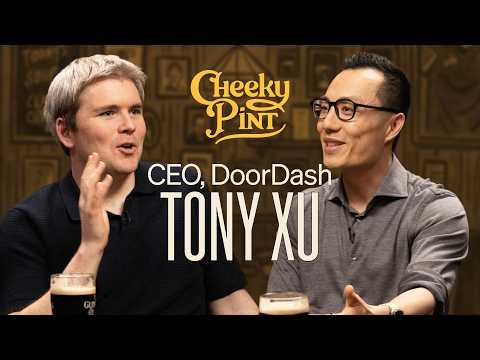
DoorDash Deploys 'Dot' Delivery Robots in Arizona Autonomy Push
Stripe
DoorDash won the food delivery market and aims to sustain profitability by prioritizing organic customer retention over flashy marketing and automating the high-cost logistics of the last two feet of delivery.
## Background
Published on YouTube by Stripe on April 21, 2026, this video features an interview between John and DoorDash cofounder and CEO Tony Xu. According to the page description, they discuss the economics and trends of the restaurant industry, DoorDash's triumph in a crowded market via customer retention, real-world fraud prevention, and the debut of their new autonomous delivery robot, Dot.
## TL;DR
In this comprehensive discussion, Tony Xu reflects on DoorDash's evolution from a cash-strapped Stanford side project to a dominant logistics platform. He breaks down the unique unit economics of modern restaurants, noting how delivery orders yield significantly higher profit margins compared to traditional dine-in service, and outlines regional permitting challenges and labor crises facing US operators. Additionally, the conversation explores the future of automated logistics through DoorDash's custom-built autonomous robot, Dot, alongside an overview of the platform's digital infrastructure for combating offline fraud and managing real-time emergency responses.
## Atmosphere & style
The interview has the relaxed, intimate vibe of a casual conversation over a drink, blending high-level entrepreneurial insights with personal camaraderie. Tony Xu speaks with a grounded, analytical, yet deeply empathetic tone, pairing engineering-minded frameworks like 'state machines' with emotionally resonant memories of cash runway crises and baking cookies for disappointed customers. The dynamic between the speakers shifts from technical deep dives into payments and logistics to genuine enthusiasm and lighthearted banter, culminating in the charming live appearance of the robot Dot.
## Key takeaways
- [00:25](https://www.youtube.com/watch?v=VwvrZphtg2I&t=25s) DoorDash differentiated itself and won a highly competitive market by prioritizing customer retention and usage frequency rather than relying on marketing discounts and coupons.
- [03:30](https://www.youtube.com/watch?v=VwvrZphtg2I&t=210s) During a severe 2013 runway crisis, DoorDash spent over 40% of its remaining cash on customer refunds following a night of delayed orders to preserve its reputation.
- [10:48](https://www.youtube.com/watch?v=VwvrZphtg2I&t=648s) Structural differences including massive eating-out culture, low-cost labor availability, and extreme population density make food delivery significantly larger in China than in the US.
- [17:10](https://www.youtube.com/watch?v=VwvrZphtg2I&t=1030s) The restaurant industry is shifting into a strict bifurcation between human-centric hospitality and highly optimized, factory-like manufacturing production due to an ongoing labor crisis.
- [18:32](https://www.youtube.com/watch?v=VwvrZphtg2I&t=1112s) US consumer spending on food has drastically shifted over the last 75 years, moving from 75-80% on groceries in the 1950s to roughly 60% on takeout and dining out today.
- [21:34](https://www.youtube.com/watch?v=VwvrZphtg2I&t=1294s) The American South, including hubs in Arizona and Texas, represents the fastest-growing restaurant region due to local governments easing construction and permitting processes.
- [24:52](https://www.youtube.com/watch?v=VwvrZphtg2I&t=1492s) Incremental delivery and takeaway orders generate 3 to 5 times the profit margin of an in-person dine-in order because a restaurant's rent and labor fixed costs are already covered.
- [27:59](https://www.youtube.com/watch?v=VwvrZphtg2I&t=1679s) Systematic customer loyalty is exceptionally difficult for individual restaurants to build because the average consumer has 20 to 25 highly fragmented dining moments per week.
- [30:41](https://www.youtube.com/watch?v=VwvrZphtg2I&t=1841s) Standalone ghost kitchens struggle to survive due to the lack of a physical storefront's 'billboard effect' for organic customer acquisition.
- [44:08](https://www.youtube.com/watch?v=VwvrZphtg2I&t=2648s) True logistics and automation require building highly structured systems that fully catalog all physical items inside a city and predict exact merchant readiness.
- [48:28](https://www.youtube.com/watch?v=VwvrZphtg2I&t=2908s) DoorDash is actively testing 'Dot' in Arizona, a custom-built autonomous delivery robot designed to flexibly navigate mixed routes across roads, sidewalks, and bike lanes.
- [56:09](https://www.youtube.com/watch?v=VwvrZphtg2I&t=3369s) To combat offline and 'friendly' fraud, DoorDash built a proprietary mapping system capable of tracking delivery signals down to the 'last two feet' of a specific apartment door.
- [58:31](https://www.youtube.com/watch?v=VwvrZphtg2I&t=3511s) Through its internal 'Tasks' platform, DoorDash leverages its Dasher network to collect real-world, offline data that can be utilized to train AI models and robotics.
- [01:19:30](https://www.youtube.com/watch?v=VwvrZphtg2I&t=4770s) Stripe's new 'Tempo' initiative, developed with DoorDash, is designed to enable autonomous AI agents to seamlessly make crypto payments using stablecoins for web services.
- [01:21:34](https://www.youtube.com/watch?v=VwvrZphtg2I&t=4894s) Google's early attempt at integrated food ordering failed to retain customers because a clean user interface cannot succeed without managing the complex end-to-end logistics after checkout.
## Detailed walkthrough
### [00:00](https://www.youtube.com/watch?v=VwvrZphtg2I&t=0s) The Genesis of DoorDash and the Formula for Winning
Tony Xu, the co-founder and CEO of DoorDash, reflects on the company's founding in 2013. This was an era defined by the rise of the iPhone and "magic wand apps" like Uber, Lyft, and Instacart that allowed users to manipulate the physical world from their screens. While many competitors rushed into the food delivery space, DoorDash ultimately emerged as the dominant player. When asked why they won, Xu offers a deceptively simple answer: "The short answer is we got more customers than other people."
However, digging deeper into the "five whys," Xu explains that food delivery is a highly complex, multivariate challenge. Customers judge the service on multiple dimensions simultaneously: the selection of restaurants, timeliness, food quality, cost, and how customer service handles mistakes. DoorDash succeeded by focusing intensely on customer retention and frequency of use rather than just flashy marketing. By building systems to instrument and repeat these high-retention behaviors early on, they created a highly differentiated product.
- **Founded:** 2013, starting as a Stanford side project.
- **Key Metrics:** Retention and usage frequency served as the ultimate indicators of product differentiation.
- **The Competitive Landscape:** While peers raced to offer discounts, coupons, and freebies, DoorDash focused on organic product-led growth.
### [03:30](https://www.youtube.com/watch?v=VwvrZphtg2I&t=210s) Thriving Under Capital Constraints and True Customer Obsession
Between 2016 and 2018, DoorDash faced severe capital constraints and "barely were able to raise a dollar relative to our peers." This lack of funding forced the team to rely on organic product improvements to drive growth. Once they proved they had superior retention and frequency, they raised capital and put the "pedal to the metal" to acquire customers with an unfair advantage.
Xu defines "customer obsession" not through vague corporate values, but through concrete actions. In the fall of 2013, with less than two weeks of cash runway left, a Stanford football game caused a disastrous night where every single order was late. Despite having trouble raising their seed round, the founders decided to refund every customer. This move cost them over 40% of their remaining bank account. To make amends, they baked cookies and delivered them to around 100 customers at 5:00 AM.
- **Runway Crisis:** Refunded over 40% of their remaining cash during a two-week runway crisis in 2013.
- **Hands-on Culture:** Early employees did deliveries, handled customer support, built menus, and worked inside restaurants.
- **Dasher and Merchant Support:** DoorDash was the only platform to offer gas savings of $1.40 to $1.90 per gallon for Dashers during price spikes, and they cut restaurant commissions by 50% during COVID-19 (costing over $100 million) before the company was even profitable.
- **Restaurant Cash Reserves:** Restaurants have, on average, only 17 days of cash on hand, making consistent order volume a matter of survival.
### [07:48](https://www.youtube.com/watch?v=VwvrZphtg2I&t=468s) Navigating the Lows and the Simple Math of Unit Economics
DoorDash survived multiple near-death experiences, including running out of money in late 2013 and navigating incredibly difficult Series C and Series D financing rounds between 2016 and 2018. Even the onset of COVID-19 was a roller coaster; the business initially tanked 80% in the first week due to total lockdowns, only to double the following week when dining rooms closed but kitchens remained open.
Xu credits early investors like Michael Abramson (formerly of Sequoia) for having steadfast conviction in the company. Abramson looked at the business through a simple framework of three core questions:
1. Would consumers pay a premium for delivery?
2. Would merchants work with them and pay a commission?
3. Would Dashers partner with them for an affordable wage?
Once the math proved that the unit economics worked, it became clear that the superior product experience would ultimately win the market.
### [10:48](https://www.youtube.com/watch?v=VwvrZphtg2I&t=648s) Why Food Delivery is Massive in China vs. the United States
Food delivery is vastly larger in China than in the US, characterized by "wild flocks of mopeds" and dedicated drop-off zones in office buildings. Xu attributes this to three structural differences. First, China has a massive eating-out culture where buying prepared food is as affordable as cooking at home, meaning "nobody cooks." Second, labor market dynamics provide a high availability of low-cost labor, making delivery incredibly cheap. Third, China features extreme population density, with dozens of cities of over a million people that are denser than Manhattan.
Additionally, China's rapid infrastructure development and deeply capitalistic drive have created a highly commercialized restaurant ecosystem. China boasts over 7 million restaurants compared to about 1 million in the US. This environment allows merchants to quickly adapt, utilizing ghost kitchens or selling merchandise like T-shirts, hats, and cookbooks alongside food.
- **Restaurant Count Comparison:** China has over 7 million restaurants, while the US has approximately 1 million.
- **Density Factor:** Dozens of Chinese cities have populations over a million with density exceeding that of Manhattan.
### [17:10](https://www.youtube.com/watch?v=VwvrZphtg2I&t=1030s) Modern Trends and the Labor Crisis in the Restaurant Industry
The restaurant industry remains one of the most popular yet sophisticated businesses to start. US census data shows that over the last 60 years, there are only a couple of years where the number of active restaurants did not grow year-over-year. However, today's operators face a massive hurdle: staffing. "This is the number one challenge," Xu notes, explaining that because the cost of labor only goes up, restaurants are being forced to choose where they sit on the spectrum between "service" (hospitality) and "manufacturing" (production).
This pressure is making the traditional hybrid model—where a local restaurant tries to run a sit-down dining room while simultaneously fulfilling takeout orders—increasingly difficult to sustain, especially in expensive city centers. Restaurants are bifurcating into pure centers of human-to-human hospitality or highly optimized, factory-like production sites.
[18:32](https://www.youtube.com/watch?v=VwvrZphtg2I&t=1112s) The Perennial Trends of the Restaurant Industry
The innovation driving the restaurant industry is fundamentally different from that of software. While software relies on technological shifts, restaurant innovation is fueled by the endless variety of cuisines and food concepts. "You're always going to see the next type of restaurant," which feeds into a perennial trend: the absolute number of restaurants is constantly growing. While specific food trends and "what's hot, what's not" will fluctuate, the consumer's underlying appetite for dining out remains completely unchanged.
A second major trend is the constant push to scale, which manifests differently depending on the size of the business. Large Quick Service Restaurant (QSR) brands—which command nearly 50 cents of every dollar spent on dining out in the United States—focus on leveraging their massive economies of scale to expand their advantage. Conversely, smaller restaurants face immense hurdles when trying to open just their second location. Even the most popular local chefs with highly successful concepts struggle to raise the necessary capital or secure the municipal permits required to begin construction on location number two.
Despite these friction points, the long-term data reveals a highly resilient industry. Over the last 75 years, consumer spending on eating out has increased every single year. In the 1950s, Americans spent roughly 75 to 80 cents of their food dollar on groceries and only 20 to 25 cents on restaurants. Today, those proportions have nearly reversed, with consumers spending almost 60 cents of their food dollar on takeout and dining out, compared to just 40 cents on groceries.
- **QSR Market Share:** Large QSR brands represent nearly 50% of all restaurant spending in the US.
- **Historical Spending Shift:** Food spending has shifted from 75–80% grocery / 20–25% dining out in the 1950s to roughly 60% takeout and dining out / 40% grocery today.
- **Consistent Growth:** Total consumer spending on eating out has risen every single year for the past 75 years.
[21:34](https://www.youtube.com/watch?v=VwvrZphtg2I&t=1294s) The Permitting Crisis and Regional Growth Pockets
The difficulty of securing permits has led to bittersweet workarounds in modern restaurant culture, such as the rise of food truck gardens and collections. While these spaces showcase incredibly cool, creative food concepts, they also represent a societal failure: "we have societally lost the ability to allow people to open restaurants and therefore, we're reduced to a collection of food trucks in a parking lot somewhere." On average, the permitting process across the country has gotten worse, mirroring the broader national slowdown in building physical things.
However, there are distinct regional bright spots. The fastest-growing cities in the country tend to be the easiest places to open a restaurant. This growth is heavily concentrated in the American South, a trend that has been playing out for a couple of decades. In areas like the Arizona tri-city region (including Phoenix, Scottsdale, and Tempe) or Texas hubs like Austin, Dallas, and Plano, local governments make it easier to build. There is a direct correlation between a city's willingness to permit apartment units and general construction and its willingness to issue restaurant licenses.
As DoorDash has grown, the company has embraced a responsibility to advocate on behalf of these small businesses as a collective class, aiming to level the playing field. When engaging with policymakers in Washington, DoorDash champions permitting reform to make opening a second location easier, and pushes for labor law reforms that actively take the unique operational realities of restaurateurs into account.
- **Fast-Growing Restaurant Hubs:** Phoenix, Scottsdale, and Tempe in Arizona; Austin, Dallas, and Plano in Texas.
- **Advocacy Focus Areas:** Permitting reform for multi-location expansion and restaurant-conscious labor laws.
- **Economic Impact:** The restaurant sector remains one of the largest and most consistent drivers of job creation in the US economy.
[24:52](https://www.youtube.com/watch?v=VwvrZphtg2I&t=1492s) How Technology and Delivery Economics Impact the Bottom Line
When analyzing where technology has made the most significant impact on restaurants over the last 10 to 20 years, delivery stands out as a primary driver of profitability. The unit economics of an in-restaurant meal are notoriously tight. For every dollar of food purchased inside a restaurant, roughly 30 cents goes to food and packaging, 30 cents goes to rent, and 30 cents goes to labor, leaving the owner with a modest 10-cent net profit.
Takeaway and delivery orders dramatically alter this equation. While the restaurant still incurs the 30% cost for food and packaging, the rent and labor costs are already paid for by the existing physical footprint. Because these fixed costs are covered, incremental delivery orders generate "3-5x the incremental margin" compared to an in-person diner.
Beyond delivery, a major technological frontier is helping restaurants build direct relationships with their customers. Currently, this space remains highly fragmented and incomplete. While software exists to manage social media or basic customer databases, restaurateurs still lack a unified view of their online and in-store customers. This challenge is compounded by staggering staff turnover, with the average restaurant staff turning over "every other day" rather than every other week. Without technological continuity, a restaurant cannot easily identify and prioritize its most valuable asset: the "regular" customer.
- **In-Restaurant Cost Breakdown:** 30% food/packaging, 30% rent, 30% labor, resulting in a ~10% net margin.
- **Delivery Margin Advantage:** Incremental takeaway orders yield 3 to 5 times the profit margin of an in-house dine-in order.
- **Staff Turnover Rate:** The average restaurant staff turns over roughly every other day, making manual customer relationship management nearly impossible.
[27:59](https://www.youtube.com/watch?v=VwvrZphtg2I&t=1679s) Cracking the Code on Customer Loyalty
Unlike the airline industry, which has engineered highly effective loyalty programs that make it "highly irrational" for frequent flyers to switch brands, the restaurant industry has struggled to build systematic customer lock-in. Loyalty programs typically range from low-tech punch cards (e.g., "10th coffee free") to highly sporadic, manual recognition by an owner who might comp a dessert. If the owner is absent or a new server is on shift, the relationship is lost.
The core challenge of restaurant loyalty is the sheer variety of human eating habits. While a traveler might consistently fly the same airline, a consumer eating 20 to 25 times a week will rarely eat their favorite food every day. Even a beloved local spot might only be visited once every month or two. Because of this high-frequency, high-variety behavior, individual restaurants struggle to build comprehensive profiles of their regulars.
DoorDash aims to solve this problem by leveraging its massive scale of over 100 million annual customers and tens of millions of monthly users. By combining DoorDash's transaction data with SevenRooms—an in-store booking and guest management platform acquired by DoorDash—the company hopes to democratize high-end guest relations for all restaurants. This integration allows the system to programmatically inform a restaurant that a customer is a regular, highlight their specific preferences, and help the business cultivate the retention necessary to survive.
- **Weekly Eating Frequency:** The average consumer has 20 to 25 dining moments per week, making food consumption far more fragmented than coffee or travel.
- **DoorDash Scale:** Over 100 million annual customers and tens of millions of monthly customers.
- **SevenRooms Acquisition:** DoorDash acquired SevenRooms to bridge the gap between online delivery data and in-store dining reservations.
[30:41](https://www.youtube.com/watch?v=VwvrZphtg2I&t=1841s) The Reality of Ghost Kitchens and Restaurant IP
*Editor's Note: This section includes a brief promotional message from the podcast sponsor, Stripe, highlighting Stripe Issuing as a solution for marketplaces like DoorDash to programmatically generate virtual or physical credit cards for couriers making real-world purchases.*
Five to seven years ago, the industry was highly focused on "ghost kitchens"—delivery-only preparation spaces with no retail storefront. While the model seemed highly logical on paper because it eliminated the high capital expenditures and labor costs of running a traditional dining room, ghost kitchens have ultimately remained a relatively small segment of the market. It is extraordinarily difficult for a standalone delivery-only brand to acquire enough customers to survive without the physical "billboard effect" of a main street retail presence.
For a small mom-and-pop restaurant, a ghost kitchen cannot generate the local awareness needed to cover the costs of staffing a kitchen. For a massive QSR brand like Chipotle, which has the brand power to attract customers anywhere, the hurdle is opportunity cost. These brands must evaluate the "next best use" of their capital. Because a physical retail location can capture both high-margin in-store foot traffic and delivery orders, the economics of a physical storefront almost always beat out a delivery-only kitchen.
Ultimately, the most successful and enduring restaurant brands rely on proprietary operational IP rather than real estate gimmicks. For a global giant like McDonald's, the true intellectual property is process innovation: ensuring that a french fry tastes exactly the same in every city around the world while managing massive workforces to maintain consistent service standards. For small, century-old restaurants, the IP is identical to what makes a great startup: a small group of people with an uncompromising commitment to a specific standard of excellence.
[37:14](https://www.youtube.com/watch?v=VwvrZphtg2I&t=2234s) The Secret Sauce of Chick-fil-A and the "American Dream" of QSRs
The discussion turns to the impressive intellectual property and operational standards of top-tier quick-service restaurant (QSR) chains. The host brings up the consistency of McDonald's french fries as a classic example of food IP, prompting a story about Chick-fil-A. Around 2017 or 2018, the speaker went through a hospitality training program at Chick-fil-A. One checklist item that permanently stuck with him was the cleanliness standard: "the floors must be so clean that babies would lick them or could lick them." The host jokes that babies will lick floors regardless of cleanliness, but the point stands as a testament to the brand's rigorous operational standards.
When asked why Chick-fil-A is so incredibly successful and remains at the very top of fast-casual revenue per square foot, the speaker points to the classic ingredients of a great consumer business. It has a highly retentive following that it spends very little money acquiring, and those customers return frequently. Behind the scenes, Chick-fil-A is highly efficient, utilizing custom equipment, specialized service training, and a unique approach to staff treatment.
In an industry notorious for high employee churn, Chick-fil-A boasts remarkable staff retention. The speaker notes that meeting people who have spent two or three decades of their careers at Chick-fil-A is common—a phenomenon that feels like a complete novelty in Silicon Valley or the broader tech sector. The business provides a repeatable path for individuals from modest backgrounds to become general managers, earn a healthy living, and put their families through college. In this way, these restaurant stories still capture the essence of the American dream.
- **Chick-fil-A Cleanliness Standard:** Floors must be clean enough for a baby to lick.
- **Staff Longevity:** It is common to meet Chick-fil-A employees with 20 to 30 years of tenure at the company.
---
[39:45](https://www.youtube.com/watch?v=VwvrZphtg2I&t=2385s) Why There Isn't a "Chipotle of Every Cuisine"
The host asks a common consumer question: why isn't there a "Chipotle" for every type of cuisine? People often wonder why they cannot find a highly consistent, elevated, fast-casual chain for Neapolitan thin-crust pizza, Indian food, or other specialized cuisines in every city. The speaker explains that cooking for a crowd introduces exponential complexity. As the volume of people increases, maintaining standards for taste, temperature, and speed becomes incredibly difficult. While it might be easy to build a single great restaurant for a specific cuisine, scaling that quality control across a massive footprint is a monumental challenge.
Beyond the operational skill required, new concepts face immense competition. For instance, the speaker points out that there are over 1,000 different pizza choices available on DoorDash in the Bay Area alone. A new chain must compete with this massive local variety while simultaneously navigating staffing, permitting, and real estate.
The host counters that making a good Neapolitan pizza is highly process-oriented—requiring precise ingredients, temperature, and humidity control for proofing and baking—and shouldn't be "rocket science." However, the speaker argues that the tiny number of ubiquitous, scaled QSR brands is proof of how hard it actually is. To illustrate, the speaker shares an anecdote about partnering with a brand to launch a healthy-tasting burger. While the initial weekend launch was highly successful and sold a massive volume of burgers, retaining customers proved nearly impossible. Half of the reviews praised the burgers, while the other half complained about inconsistent quality. This "exponential challenge" of maintaining quality at scale is what dooms most concepts.
- **Bay Area Pizza Competition:** Over 1,000 pizza options are active on DoorDash in the Bay Area alone.
- **The Consistency Trap:** A test brand for a healthy burger failed to retain customers because 50% of users experienced inconsistent quality.
---
[44:08](https://www.youtube.com/watch?v=VwvrZphtg2I&t=2648s) The Future of Delivery: Cataloging Cities and the Creation of "Dot"
Looking 10 years into the future, the conversation shifts to the modalities of delivery, including drones, sidewalk robots, autonomous vehicles, and DoorDash's own project, Dot. The speaker argues that before discussing *how* items will be delivered, we must understand *what* is being delivered. Today, DoorDash is known for food, groceries, and household items, but this represents only a fraction of the tens of millions of items physically sitting inside a city.
Currently, these items are not cataloged, and there is no structured data to scrape to find them. Great logistics cannot rely on pulling "magic tricks out of thin air" on the fly; it requires building highly structured systems. This means cataloging every item in a city, positioning inventory close to where people live, and predicting exactly when a merchant will have an order ready. Even a local bar like the "Cheeky Pint" has complex, shifting menus and off-menu items that are difficult to represent digitally.
When DoorDash initiated its Autonomy Project in 2018–2019, they did not intend to build their own hardware. They hoped to find a partner to handle the technology while DoorDash managed the operations. However, they found that most autonomous vehicle companies were focused on Robotaxis, while existing sidewalk robots were far too slow. Because humans are exceptionally good at driving and delivering, the bar for automation is incredibly high.
To solve this, DoorDash designed Dot. Dot had to be fast, but smaller than a car so it wouldn't face parking issues in dense restaurant corridors. Unlike a Robotaxi, where the passenger handles getting in and out, a delivery robot must have automated systems for loading and unloading goods. DoorDash is currently testing Dot in Arizona, focusing on getting the operations, hardware reliability, maintenance, and regulatory compliance right in a single market before attempting to scale.
- **Project Dot Timeline:** DoorDash started its Autonomy Project in 2018–2019.
- **Testing Ground:** Dot is currently being actively tested in Arizona.
- **Drones:** DoorDash has been operating drone deliveries for a couple of years, primarily in international markets like Australia, with plans to expand to Europe and the US.
---
[51:11](https://www.youtube.com/watch?v=VwvrZphtg2I&t=3071s) Trust, Safety, and Managing a "State Machine" of Offline Fraud
The conversation moves to the complex, high-volume challenge of trust, safety, and fraud. The speaker compares DoorDash to a massive "state machine" from an electrical engineering course. The system monitors billions of transactions, keeping operations green, but must gracefully handle exceptions as conditions degrade to yellow, orange, or red. While online credit card fraud is highly sophisticated, DoorDash has become very good at detecting it by partnering with companies like Stripe to leverage massive transaction databases.
However, "offline fraud" remains extraordinarily difficult to verify. This includes scenarios where a consumer claims an order was never dropped off, a Dasher claims a grocery order is already shopped, or an item is reported missing from an apparel store. Because there is no perfect science to verify these physical-world events, DoorDash has to invent its own signal-detection systems.
The speaker highlights that safety goes far beyond financial fraud. For example, DoorDash developed "SafeChat" after realizing that over 90% of physical altercations between users are preceded by a verbal altercation in the app's chat. By detecting verbal escalation, they can intervene before things turn physical.
The speaker also shares a sobering example of real-time emergency response. During a tragic shooting in the lobby of a large Manhattan office building, a Dasher spotted the shooter entering. Within minutes, DoorDash's alert system notified all Dashers, consumers, and merchants in the vicinity, and was the first to report the incident to the NYPD. Operating a platform of this scale means representing the physical reality of entire cities, requiring highly responsive systems that can handle rare, high-consequence events.
- **SafeChat Signal:** Over 90% of physical altercations are preceded by verbal altercations in chat, allowing for early digital intervention.
- **Emergency Response:** DoorDash's real-time alert system was the first to notify the NYPD during a shooting incident in a Manhattan office building lobby.
[56:09](https://www.youtube.com/watch?v=VwvrZphtg2I&t=3369s) Friendly Fraud and the "Last Two Feet" of Logistics
While standard credit card fraud can be combated with vast amounts of data, businesses face a much trickier challenge in what the industry euphemistically calls "friendly fraud." This occurs when a customer purchases an item, receives it, but lies and claims it never arrived. Because companies do not want to aggressively call out their customers without absolute proof, it remains a persistent issue. There is no single silver bullet for fraud; as soon as a system contains risk on one axis, fraudsters immediately pivot to the next.
DoorDash combats this by focusing heavily on the "setup" before an order is even placed—ensuring catalog labeling is highly accurate—and by gathering high-fidelity signals during the delivery itself. While taking photos of receipts or dropped-off orders helps, DoorDash went as far as building its own proprietary mapping system. They did this because third-party maps do not care about the "last two feet" of a delivery, such as the exact door of a specific apartment unit. By tracking whether a Dasher's GPS pin hit that precise location and building behavioral profiles of customers over time, DoorDash can quietly calculate the likelihood of fraud behind the scenes.
---
[58:31](https://www.youtube.com/watch?v=VwvrZphtg2I&t=3511s) DoorDash Tasks and the Offline World
"DoorDash Tasks" is a recently shipped product that grew organically from an internal project started a couple of years ago. DoorDash was trying to solve its own inventory problem: with millions of Dashers frequenting various stores, and consumers constantly moving items around, it is incredibly difficult for any retailer to keep track of real-time inventory. As DoorDash began collecting this data, they started receiving inquiries from unexpected sources, including retailers, consumer packaged goods (CPG) companies, and large Large Language Model (LLM) developers.
While AI companies have built massive repositories of online information, they lack offline, real-world data to bolster their models or train robotics. DoorDash realized they could help these companies while simultaneously giving Dashers more choices to earn money. The resulting platform allows external companies to submit small, physical tasks that Dashers can complete on the ground. When asked if augmented reality (AR) glasses—like Meta's smart glasses—could speed up in-store navigation for Dashers, the response is measured: while it is a cool concept, "the human is pretty good with their eyes," and the bar for AR to truly solve a practical problem in this space remains very high.
---
[01:00:53](https://www.youtube.com/watch?v=VwvrZphtg2I&t=3653s) LLMs as Recommenders and DoorDash's B2B Missions
A major critique of modern consumer products, including DoorDash, is that their recommendation systems feel static and under-personalized compared to what a user can get by simply pasting their order history into an LLM. LLMs make excellent recommenders because they "throw efficiency out of the window," dedicating massive compute and context windows to act as a "world model." While consumer products will inevitably adopt their own ordering agents, the exact modality is still being figured out. "We don't buy things through text," and text is not always how humans get inspired to eat or shop.
Beyond food delivery, DoorDash is pursuing several core product missions:
* **Bringing everything inside the city:** While they are deep in food, they are still "a smaller and smaller drop in the ocean" as they expand into subsequent retail categories.
* **Providing merchant software:** DoorDash wants merchants to build their own omni-channel businesses. They offer B2B products like DoorDash Drive, Storefront, and SevenRooms so merchants can own their customer relationships.
* **Bringing consumers inside physical stores:** DoorDash is expanding into the dine-in space with two restaurant products: "Going Out" and "Reservations."
---
[01:04:37](https://www.youtube.com/watch?v=VwvrZphtg2I&t=3877s) Unseating the Giants in Restaurant Reservations
Entering the reservation space means competing with deeply established players in an industry where restaurants are notoriously hesitant to swap out their core systems. The philosophy guiding DoorDash's approach is that "no restaurant should own their own reservations... technology." Running a reservation book is incredibly complex, and traditional systems are not always designed to help restaurants build "regulars"—which should be their ultimate North Star. Through SevenRooms, DoorDash advocates for a platform-agnostic approach where restaurants can take reservations from any source, focusing instead on optimizing the merchant's specific "objective function," whether that is maximizing profit, expanding locations, or targeting a specific demographic.
The discussion touches on Tock, a reservation platform that carved out a high-end niche by treating restaurant reservations like airline tickets—requiring upfront deposits to eliminate costly no-shows. While this philosophy "makes a ton of sense," its implementation depends heavily on the restaurant's capacity; a small venue with long seatings faces a massive opportunity cost for a cancellation, whereas a larger restaurant has more flexibility. To tackle no-shows and drive demand, DoorDash is focusing heavily on discovery. Today, restaurant discovery is highly fragmented, with people finding spots through Instagram, friends, or LLMs, leaving most restaurants still struggling to generate consistent demand on their own.
---
[01:08:36](https://www.youtube.com/watch?v=VwvrZphtg2I&t=4116s) European Expansion and the Differences in Logistics
DoorDash's expansion into Europe—highlighted by its acquisition of Wolt (referred to in the conversation context as Deliveroo)—reveals fundamental differences in how cities operate. London, for example, lacks the grid-like, hub-and-spoke layout of American cities due to its extreme age. This layout makes the physical logistics and the signals needed for routing algorithms entirely different.
* **Vehicle Types:** Deliveries in European cities like London are predominantly completed using non-automotive transport (bikes, e-bikes, and walking), whereas the US is heavily car-dominant.
* **Regulations:** Regulatory frameworks vary wildly, with each European country maintaining its own local labor and operational laws.
* **Payments:** Payment processing is highly fragmented in Europe, featuring a much wider variety of local card types compared to the US.
* **Retail Concentration:** Unlike the highly fragmented US retail market, which features hundreds of regional brands, European retail (including grocery and pharmacy) is highly concentrated. This concentration leads to higher, more consistent service standards, smaller SKU counts, and different inventory management needs.
---
[01:12:08](https://www.youtube.com/watch?v=VwvrZphtg2I&t=4328s) Feedback for Stripe and the Arrival of "Dot"
Reflecting on the parallel growth of Stripe and DoorDash—both founded around the same time, with DoorDash being an early adopter of Stripe Connect, Radar, and Issuing—the conversation turns to product feedback. The core advice offered to Stripe is to avoid the natural temptation of growing companies to "start imposing what the company wants to do... versus what problem does it solve for the customer." The focus should always remain on solving the client's absolute top problems rather than just pitching a broad range of new products.
The segment wraps up with a live appearance from "Dot," DoorDash's adorable, custom-built delivery robot. Described as looking "kind of like a TARDIS," Dot features an LED screen designed to communicate with pedestrians. The design team put significant effort into the robot's "eyes" on the screen, optimizing eye contact to make its interactions with humans on the street feel natural and friendly.
The speakers introduce "Dot," DoorDash's custom-built autonomous delivery robot. Upon seeing it, John is immediately struck by its physical presence, noting that it is much larger than he anticipated. "It's like a small car, not a big robot," he remarks, comparing its scale to a Smart car. Tony explains that while Dot is roughly one-tenth the size of a standard automobile, it can travel at speeds of up to 20 miles per hour, which closely matches the average speed of typical city traffic.
To welcome Dot, they load its cargo compartment with non-alcoholic Guinness and a bag of Tayto chips, which Tony proudly introduces as "Ireland's preferred" potato chips. The internal compartment of the robot is fully custom and modular. This design allows DoorDash to configure the interior with specialized heating or cooling units depending on the specific requirements of the items being delivered.
- **Speed:** Capable of traveling up to 20 mph.
- **Size:** Approximately 1/10th the size of a standard car.
- **Cargo Bay:** Modular and configurable with heating and cooling systems.
[01:15:00](https://www.youtube.com/watch?v=VwvrZphtg2I&t=4500s) Where Dot Operates and the Autonomous Development Platform
Tony outlines the primary environments where Dot will be most useful, pointing to suburban areas where delivery distances are typically under 5 miles and parking presents a persistent challenge for human Dashers. Certain dense city centers are also prime candidates. Beyond the physical hardware of the robot, Tony highlights that one of the most sophisticated elements they are building is digital: the "autonomous development platform." This routing algorithm dynamically decides which orders should be assigned to which types of vehicles.
Dot is uniquely designed to navigate mixed routes alongside humans. For instance, if a delivery requires a longer journey but features a segment where parking is notoriously difficult, Dot can complete the first leg of the trip and then hand the order off to a human Dasher. Tony notes that Dot is "the only vehicle in the world" designed to transition flexibly between roads, sidewalks, and bike lanes. Managing these complex handoffs is critical to making delivery autonomy viable, contrasting it with Robotaxis where human passengers can easily resolve minor edge cases.
[01:16:45](https://www.youtube.com/watch?v=VwvrZphtg2I&t=4605s) The Technology, Battery, and Sophisticated Sensor Stack of Dot
When asked about Dot's range, Tony reveals that the robot can complete "hundreds" of deliveries on a single charge, though they avoid testing the battery to absolute failure. He explains that a key challenge in autonomous vehicle design is ensuring the platform is ready for mass manufacturing and easy operational maintenance, such as quickly swapping out parts. The robot's base houses its batteries, local compute infrastructure, and additional sensors, meaning all of its autonomy calculations are processed locally on the device.
John is highly impressed by the robot's hardware, observing that "It's not a baby sensor stack." Tony explains that traveling at 20 mph on public roads introduces demanding physical parameters that dictate such a sophisticated array of cameras and LiDAR. They are continuously testing Dot in diverse weather conditions and have engineered a highly specialized braking system. This system is designed to help the robot "stop on a dime," which is especially critical when it makes sudden transitions from a bike lane onto a sidewalk or executes sharp turns.
- **Range:** Hundreds of deliveries on a single charge.
- **Compute:** Fully local, on-device autonomous processing.
- **Navigation:** Equipped with a high-end sensor stack featuring cameras and LiDAR to handle road speeds.
[01:19:30](https://www.youtube.com/watch?v=VwvrZphtg2I&t=4770s) Stripe, Payments, and the Rise of Stablecoins
After dismissing Dot with a friendly "You did great," John tries the Tayto chips, confirming they are indeed delicious and comparing them to the "Lay's chips of Ireland." Tony transitions the conversation to Stripe's long-term trajectory. He recalls how John and his brother Patrick built Stripe with the philosophy that it is "a technology company that happens to be in payments," rather than a traditional financial services firm. Tony asks how businesses should think about leveraging emerging technologies like crypto, stablecoins, and artificial intelligence.
John identifies stablecoins and AI-driven "agentic commerce" as the two dominant topics on the minds of Stripe's customers. While stablecoins might not be the immediate focus for a domestic delivery service like DoorDash, John highlights two areas seeing massive global adoption. First, stablecoins have become highly efficient for cross-border transactions, offering a superior method for sending money across a long tail of over 100 countries. Second, they enable highly scalable crypto payments, which is the focus of Stripe's new "Tempo" initiative. Developed in collaboration with DoorDash, Tempo is designed to allow autonomous AI agents to seamlessly pay for API consumption and other web services.
[01:21:34](https://www.youtube.com/watch?v=VwvrZphtg2I&t=4894s) AI, Natural Language Interfaces, and the Reality of Logistics
The discussion shifts to how consumer commerce will evolve as users increasingly interact with AI assistants like ChatGPT, Gemini, or Siri. John suggests that consumers will expect to make natural language requests, such as asking their AI to "order again what we ordered on Sunday," and have the system handle the entire transaction. He asks Tony whether DoorDash prefers to enable ordering directly inside third-party AI ecosystems or focus on building natural language interfaces within its own app.
Tony acknowledges that while low-friction interfaces are highly appealing, "you only get a right to do this cool UI stuff if the logistics is right." He shares a cautionary tale from 2015 or 2016 when Google launched food ordering directly from Google Maps and Google Search. While the integration successfully drove high initial traffic, it failed to retain customers because Google could not manage the complex logistics that occur after the checkout button is pressed—such as contacting the driver, handling out-of-stock items, or navigating delivery delays. Tony emphasizes that a simple chat interface is not a cure-all; the ultimate success of any commerce platform depends on its ability to solve the end-to-end job.
[01:24:26](https://www.youtube.com/watch?v=VwvrZphtg2I&t=5066s) Cultural Differences in Food and the Passion of Local Businesses
To conclude their conversation, John asks Tony what foods he enjoys when traveling abroad—such as to London—that he wishes were more readily available in the San Francisco Bay Area. Tony admits a fondness for traditional afternoon tea, specifically "little cucumber sandwiches," which he views as an excellent healthy afternoon snack. He fondly recalls taking his children to a proper afternoon tea with three-level platters and cakes, describing it as a wonderful and novel experience for his family.
Tony and John compare the high quality of prepared meals in European and British grocery stores to those in the United States, noting that a grab-and-go sandwich purchased at Heathrow airport is typically excellent, whereas one from JFK airport is best avoided. Tony wraps up by reflecting on his role at DoorDash, describing it as an immense privilege to partner with the local merchants who drive the GDP of their respective cities. He notes that whether a business is a restaurant or a retail shop, "everyone's passionate about something," and getting to collaborate with people who bring that level of dedication to their work every day is the most rewarding part of his job.
## Notable quotes
> [00:25](https://www.youtube.com/watch?v=VwvrZphtg2I&t=25s) The short answer is we got more customers than other people. — Tony Xu
> [03:30](https://www.youtube.com/watch?v=VwvrZphtg2I&t=210s) barely were able to raise a dollar relative to our peers — Tony Xu
> [17:10](https://www.youtube.com/watch?v=VwvrZphtg2I&t=1030s) This is the number one challenge — Tony Xu
> [18:32](https://www.youtube.com/watch?v=VwvrZphtg2I&t=1112s) You're always going to see the next type of restaurant — Tony Xu
> [21:34](https://www.youtube.com/watch?v=VwvrZphtg2I&t=1294s) we have societally lost the ability to allow people to open restaurants and therefore, we're reduced to a collection of food trucks in a parking lot somewhere. — Tony Xu
> [37:14](https://www.youtube.com/watch?v=VwvrZphtg2I&t=2234s) the floors must be so clean that babies would lick them or could lick them — Tony Xu
> [01:00:53](https://www.youtube.com/watch?v=VwvrZphtg2I&t=3653s) We don't buy things through text — Tony Xu
> [01:04:37](https://www.youtube.com/watch?v=VwvrZphtg2I&t=3877s) no restaurant should own their own reservations... technology. — Tony Xu
> [01:12:08](https://www.youtube.com/watch?v=VwvrZphtg2I&t=4328s) start imposing what the company wants to do... versus what problem does it solve for the customer. — Tony Xu
> [01:14:02](https://www.youtube.com/watch?v=VwvrZphtg2I&t=4442s) It's like a small car, not a big robot — John Collison
> [01:16:45](https://www.youtube.com/watch?v=VwvrZphtg2I&t=4605s) It's not a baby sensor stack. — John Collison
> [01:19:30](https://www.youtube.com/watch?v=VwvrZphtg2I&t=4770s) a technology company that happens to be in payments — Tony Xu
> [01:21:34](https://www.youtube.com/watch?v=VwvrZphtg2I&t=4894s) you only get a right to do this cool UI stuff if the logistics is right. — Tony Xu
> [01:24:26](https://www.youtube.com/watch?v=VwvrZphtg2I&t=5066s) everyone's passionate about something — Tony Xu
## Mentioned
Tony Xu, John Collison, DoorDash, Stripe, iPhone, Uber, Lyft, Instacart, Stanford, Michael Abramson, Sequoia, SevenRooms, Stripe Issuing, Chipotle, McDonald's, Chick-fil-A, Silicon Valley, Dot, Cheeky Pint, Autonomy Project, Robotaxis, NYPD, SafeChat, DoorDash Tasks, Meta, DoorDash Drive, Storefront, Going Out, Reservations, Tock, Instagram, Wolt, Deliveroo, Stripe Connect, Radar, TARDIS, Guinness, Tayto, Patrick Collison, Tempo, ChatGPT, Gemini, Siri, Google, Google Maps, Google Search, Heathrow airport, JFK airport
DoorDash co-founder and CEO Tony Xu argues that long-term success in the restaurant and food delivery sectors depends on rigorous unit economics, operational repeatability, and physical execution rather than software or promotional discounting alone. While consumer spending on dining out continues a multi-decade expansion, operators face severe operational headwinds in labor, permitting, and customer retention that technology platforms must solve in the physical world.
Asymmetric Economics of Delivery and Physical Storefronts (24:52)
Xu outlines the tight baseline unit economics of brick-and-mortar dining, where approximately 30% of sales goes to food and packaging, 30% to rent, and 30% to labor, leaving operators with modest 10% net margins and an average cash cushion of only 17 days. Incremental takeaway and delivery orders dramatically alter this equation by generating three to five times the incremental profit margin of dine-in meals, because the fixed costs of rent and baseline staffing are already absorbed by the existing physical footprint.
Conversely, delivery-only ghost kitchens have largely failed to match expectations due to the absence of the retail "billboard effect." Without a physical storefront driving organic foot traffic and local awareness, standalone delivery brands struggle to acquire customers cost-effectively. For major quick-service chains like Chipotle, physical locations almost always deliver a superior return on invested capital by capturing both high-margin walk-in customers and delivery orders simultaneously.
Industry Growth Clashing with Permitting Bottlenecks (18:32)
Over the past 75 years, US consumer spending on dining out has grown uninterrupted, shifting from 20–25% of the consumer food dollar in the 1950s to roughly 60% today. Despite this secular demand, industry expansion is increasingly polarized. Large quick-service restaurant (QSR) brands command nearly 50% of US dining spend by leveraging scale, custom equipment, and operational processes—such as Chick-fil-A’s multi-decade employee retention and strict cleanliness standards—while independent restaurateurs struggle to finance and permit even a second location.
Xu notes that permitting friction mirrors broader slowdowns in physical construction, creating workarounds such as food truck clusters. Restaurant growth has consequently concentrated in municipal bright spots across the American South, including the Phoenix-Scottsdale-Tempe corridor and Texas metros like Austin, Dallas, and Plano, where local authorities link high housing construction with streamlined commercial licensing.
DoorDash's Unit Economics and Product-Led Playbook (3:30)
Recalling DoorDash's founding in 2013 and its capital constraints between 2016 and 2018, Xu attributes the platform’s ultimate market lead to prioritizing customer retention and usage frequency over subsidizing demand through discounts. Early conviction from investors like Michael Abramson focused on three unit-economic proofs: whether consumers would pay a delivery premium, whether merchants would pay a commission, and whether couriers would accept prevailing wages.
Xu contrasts the American delivery landscape with China, where delivery volume is vastly larger. China supports over 7 million restaurants compared to roughly 1 million in the United States, enabled by extreme urban density across dozens of cities larger than Manhattan, low labor costs, and a culture where prepared food is priced competitively with home cooking.
Offline Fraud, Fragmented Loyalty, and Autonomous Logistics (44:08)
As delivery expands beyond prepared meals into cataloging all physical goods across a city, DoorDash faces logistical barriers unique to the offline world. Addressing "friendly fraud" and non-delivery disputes requires proprietary micro-mapping tailored to the "last two feet" of a delivery drop-off. Similarly, because consumers divide 20 to 25 weekly dining moments across many cuisines and restaurants face staff turnover every other day, DoorDash utilizes its SevenRooms acquisition to unify online ordering and table reservations into structured customer profiles.
To automate ground logistics, DoorDash developed Dot, a custom 20 mph autonomous delivery robot operating on local compute with modular climate-controlled compartments. Testing Dot across roads, bike lanes, and sidewalks in Arizona illustrates Xu's core operating principle: conversational AI interfaces and agentic ordering tools will fail to retain users unless the underlying physical logistics and merchant execution are solved first.
Xu emphasizes that digital convenience cannot bypass the physical realities of real estate, municipal permitting, and manual fulfillment. While autonomous delivery, AI recommenders, and omnichannel software provide operating leverage, long-term viability in the food ecosystem remains governed by strict margin math and the complex work of moving physical items across cities.
## Background
本内容由 Stripe 官方频道于 2026 年 5 月 7 日发布在 YouTube 平台的《Cheeky Pint》栏目。视频记录了 DoorDash 联合创始人兼 CEO 托尼·徐(Tony Xu)与主持人 John 一边小酌一边展开的深度对谈,围绕 DoorDash 如何在残酷外卖竞争中凭借留存率胜出、餐饮行业的经济模型与两极分化、早期花费 40% 剩余现金退款的生死时刻、自研自主配送机器人 Dot 的技术细节,以及物理世界反欺诈与智能体商务的未来展开探讨。
## TL;DR
DoorDash CEO 托尼·徐深度复盘了平台从斯坦福副业成长为即时配送巨头的路径,剖析了在资本寒冬下依靠自然增长、留存率和频次跑通单体经济模型的胜出逻辑。对话深入对比了中美外卖在劳动力与城市密度上的差异,拆解了实体餐厅相对纯外卖暗厨的商业优势,并展示了 DoorDash 通过收购 SevenRooms 拓展堂食预订与商户 CRM 的全渠道布局。针对物流自动化,Tony 现场展示了自研无人配送机器人 Dot,详解其传感器堆栈、刹车系统与解决“最后两英尺”的工程挑战。最后,双方探讨了针对物理世界欺诈的状态机风控网络,并以 Google 外卖项目的失利为例,指出无论前端交互形态如何被 AI 重塑,端到端的线下确定性履约才是商业壁垒的终极胜负手。
## Atmosphere & style
整场对话在酒吧式的轻松碰杯与顶级商业操盘手的硬核推演之间取得了绝佳平衡,洋溢着坦诚、求真与彼此高度信任的互动张力。Tony 的叙事既有工程底层的严密逻辑,又饱含对实体小商户真实挣扎的深刻共情,无论是回忆清晨五点烤饼干道歉的窘迫,还是拆解复杂车端散热系统,都展现出极具说服力的现场感染力。自研机器人 Dot 的驶入串场与品尝爱尔兰国民薯片的幽默打趣,更为这场充满密集商业机密与战略思考的硬核对谈增添了生动鲜活的人间烟火气。
## Bulletin
- [02:35](https://www.youtube.com/watch?v=VwvrZphtg2I&t=155s) DoorDash CEO Tony Xu 透露,平台在 2016 至 2018 年遭遇资本严冬近乎零外部融资,倒逼团队放弃补贴买量、深耕产品留存与使用频次,在指标验证超越同行后借后续资本实现非对称反超。
- [24:52](https://www.youtube.com/watch?v=VwvrZphtg2I&t=1492s) 餐饮外卖打破了实体餐厅租金与人工等固定成本结构的束缚,为常规餐厅带来 3 至 5 倍于堂食的增量边际利润率,成为传统餐饮的关键增长杠杆。
- [01:13:25](https://www.youtube.com/watch?v=VwvrZphtg2I&t=4405s) DoorDash 亮相自研无人配送机器人 Dot,具备最高 20 英里/小时时速与机动车道/人行道/自行车道全路权通行能力,并针对最后两英尺装卸难题与短途混合路由进行专项优化。
- [01:22:24](https://www.youtube.com/watch?v=VwvrZphtg2I&t=4944s) 复盘 2015 年 Google 外卖败局,Tony 强调 AI 交互固然是重要流量入口,但外卖本质取决于结账之后的物理调度与端到端确定性履约,无法仅靠前端 Chat 界面构建商业留存壁垒。
## Key takeaways
- [00:25](https://www.youtube.com/watch?v=VwvrZphtg2I&t=25s) 即时配送是一项涉及品类覆盖、时效、餐品品质、定价与失误补偿的多变量系统工程,综合留存率与使用频次是衡量其实际壁垒的唯一硬指标。
- [04:39](https://www.youtube.com/watch?v=VwvrZphtg2I&t=279s) 真正的客户痴迷源于极限压力下的决策记忆,如 2013 年平台宕机后耗尽账面 40% 现金向受影响顾客全额退款并连夜烤制曲奇道歉。
- [11:06](https://www.youtube.com/watch?v=VwvrZphtg2I&t=666s) 中国与美国外卖生态存在结构性鸿沟:中国依托与做饭成本相近的亲民餐饮、低廉且充沛的劳动力以及曼哈顿级的超高城市密度催生出极高渗透率,美国无法简单复制。
- [20:35](https://www.youtube.com/watch?v=VwvrZphtg2I&t=1235s) 全美食品消费迎来 75 年历史大逆转:居民预算从 1950 年代超市生鲜占 80% 逆转为如今餐饮及外卖占近 60%,且由于人力成本持续攀升,餐饮加速分化为高客单体验与高效标准化工厂两极。
- [24:52](https://www.youtube.com/watch?v=VwvrZphtg2I&t=1492s) 外卖订单重构了餐饮单体经济学:在沉没租金与固定人工的前提下,外卖订单仅需额外支付约 30% 的食材包装费,增量边际利润达堂食的 3 至 5 倍。
- [31:24](https://www.youtube.com/watch?v=VwvrZphtg2I&t=1884s) 幽灵厨房(纯外卖厨房)因缺乏临街门面的天然广告牌获客效应、依旧难以解决后厨招工瓶颈且丧失堂食客流对冲风险能力,在现实商业中难以大规模扩张。
- [35:25](https://www.youtube.com/watch?v=VwvrZphtg2I&t=2125s) 长盛不衰的餐饮巨头与优秀创业公司类似,其核心 IP 在于极致的组织流程创新与超强一致性,例如 Chick-fil-A 凭借清洁标准、专有设备与罕见的长期员工向上流动阶梯构筑极高留存护城河。
- [39:45](https://www.youtube.com/watch?v=VwvrZphtg2I&t=2385s) 规模化存在指数级质量失真风险,随着出餐量飙升,维持品质与服务标准的难度急剧加大,餐饮连锁的核心挑战在于端到端系统稳定性和水电般的绝对可靠性。
- [45:00](https://www.youtube.com/watch?v=VwvrZphtg2I&t=2700s) 物流自动化必须遵循“先建系统,再谈技术”的递进原则,在摸清城市数千万未编目商品的物理位置与库存前置之前,盲目推崇先进运载工具毫无意义。
- [56:08](https://www.youtube.com/watch?v=VwvrZphtg2I&t=3368s) 线下防欺诈远比线上盗刷拦截更难,DoorDash 依托自研高精度地图精确定位至公寓单元门的“最后两英尺”,结合历史行为画像防范虚假未送达等“友好欺诈”。
- [58:32](https://www.youtube.com/watch?v=VwvrZphtg2I&t=3512s) DoorDash Tasks 从最初解决内部货架库存失真痛点演变为对外开放的微任务平台,不仅为骑手增收,更成为头部大模型公司采集物理世界真实动态以训练世界模型的重要数据源。
- [01:00:23](https://www.youtube.com/watch?v=VwvrZphtg2I&t=3623s) 大语言模型凭借庞大上下文与通用世界模型展现出超越专有推荐算法的潜力,但未来订购智能体的人机交互最佳形态绝不会仅局限于纯文本聊天框。
- [01:04:52](https://www.youtube.com/watch?v=VwvrZphtg2I&t=3892s) DoorDash 通过 Going Out 和 Reservations 进军线下堂食预订,收购 SevenRooms 的核心在于以“渠道中立”赋能餐厅自身将客流沉淀为熟客,而非传统预订平台对流量的垄断绑架。
- [01:08:36](https://www.youtube.com/watch?v=VwvrZphtg2I&t=4116s) 欧美即时物流环境迥异:伦敦等欧洲古城狭窄路网决定了非机动车运力的绝对主导,叠加多国属地法规与高集中度的零售格局,与美国网格化道路与碎片化零售生态截然不同。
- [01:15:00](https://www.youtube.com/watch?v=VwvrZphtg2I&t=4500s) DoorDash 自研无人车 Dot 采用机载全本地运算、高规格传感器堆栈与强效制动系统,定位于近郊短途及高难取餐点与人类外卖员分段接力的“混合路由”作业。
- [01:22:24](https://www.youtube.com/watch?v=VwvrZphtg2I&t=4944s) 前端入口无法替代后端物流交付闭环,Google 外卖因无法处理结账后的后厨售罄、骑手寻路及出餐延误等物理变量而无法沉淀留存,端到端解决复杂任务才是平台决胜关键。
## Detailed walkthrough
### [00:00](https://www.youtube.com/watch?v=VwvrZphtg2I&t=0s) 斯坦福副业起步与 Dot 配送机器人亮相
在录音现场,门外传来了 DoorDash 最新研发的自动配送机器人“Dot”移动的声响,John 打趣地感叹它就像《神秘博士》里的“塔迪斯”(TARDIS)太空飞船一样充满未来感。两人一边碰杯小酌,一边引出了本期嘉宾——DoorDash 联合创始人兼 CEO 托尼·徐(Tony Xu)。DoorDash 最早始于 2013 年斯坦福大学校园内的一个学生副业项目,如今已成长为全美占据统治地位的即时配送巨头,并正在全面进军生鲜杂货、实体零售、自动驾驶配送以及面向零工群体(Dashers)的金融服务产品。
回顾 2013 年创业初期,John 提到那是移动互联网的黄金分水岭:以 iPhone 为代表的智能手机和移动 App 彻底定义了那个科技时代。以 Uber 和 Lyft 为代表的网约车平台,以及 Instacart 和 DoorDash 等即时配送应用,就像现实世界里的“魔法棒”,只需轻轻一点就能调动外部物理世界的资源。当时涌入外卖赛道的团队数不胜数,竞争远比今天惨烈,iPhone 虽然极大地拓展了餐饮外卖的市场天花板,但绝大多数早期玩家最终都退出了历史舞台。
### [00:25](https://www.youtube.com/watch?v=VwvrZphtg2I&t=25s) 为什么是 DoorDash 赢得了外卖百团大战?
谈到 DoorDash 究竟凭什么在众多竞争对手中胜出,Tony 先是半开玩笑地给出了一个极为朴素的答案:“简而言之,就是我们拿下的客户比别人多。”不过在 John 的追问下,Tony 展开了对这一多维复杂战局的深度复盘。他认为餐饮外卖是一个极度复杂的“多变量难题”(multivariate challenge),用户对一项配送服务的评判并非基于单一指标,而是全方位、多维度的综合审视。
平台所接受的严苛考验贯穿了每一个履约节点:你接入了哪些餐厅(品类与供给覆盖)、餐食是否准时送达、送到时是否保持了顾客预期的品相与温度、整体费用是否合理;甚至更关键的是,一旦平台出现失误,你如何妥善补救?在 Tony 看来,外卖竞争从来不是在某一个单点上做到极致即可,而是“以上所有维度的综合考量”。DoorDash 之所以能拔得头筹,核心就在于他们在这些复杂维度的综合交付上超越了同行,而最真实的试金石就是用户在没有补贴、没有营销优惠券刺激的情况下,是否依然愿意主动打开 App 并持续复购。
### [02:35](https://www.youtube.com/watch?v=VwvrZphtg2I&t=155s) 留存率、资金约束与非对称竞争优势
如果从产品视角将商业模式进行极度归约,Tony 认为衡量任何消费级产品壁垒的唯一标准,就是最原始的“留存率”(retention)和“使用频次”(frequency)。外界很容易陷入主观审美的争论,比如哪家 App 的 UI 更好看、谁抄了谁的设计;但数据不会说谎,当 DoorDash 的用户留存和使用频次远超竞品时,就足以证明平台所做的功能迭代真正触达了用户痛点。
在竞争白热化阶段,大多数外卖平台陷入了疯狂的军备竞赛,竞相向消费者派发大额折扣、免运费券和立减活动。然而,DoorDash 在 2016 至 2018 年间遭遇了极度严峻的资本寒冬,相对于融资百亿美元的巨头竞品,DoorDash 在这三年里“几乎没融到一分钱”。这种极端的资金约束反倒成了一种塞翁失马的制度红利:既然账上没钱去补贴买量,团队就只能硬着头皮打磨产品底盘,依靠内生的自然增长(organic growth)来支撑运转。一旦他们在指标上率先向自己证实了平台的留存率和频次显著优于对手,随后资本活水涌入,他们便果断“把油门踩到底”(pedal to the metal),利用这种被验证过的非对称优势疯狂扩张。
- **极度资本约束**:2016 至 2018 年几乎无法获得外部大规模融资,被迫放弃砸钱买量策略。
- **有机增长闭环**:通过优化端到端履约体验,倒逼出不依赖优惠券补贴的高频使用和高粘性留存。
- **踩下油门扩张**:在内部数据彻底跑通留存与频次壁垒后,利用后续融资全力放大用户获客优势。
### [04:39](https://www.youtube.com/watch?v=VwvrZphtg2I&t=279s) 什么是真正的“客户痴迷”:40% 现金退款与清晨五点的曲奇饼
很多科技公司喜欢把“客户痴迷”(Customer Obsession)当作廉价的公关口号,但在 Tony 眼中,企业文化并非墙上的标语,而是 80% 由你在极端压力下做出的实际行为决定的。早期 DoorDash 团队的每一个人都必须全流程轮岗:亲自上街送外卖、做人工客服、手动把纸质菜单敲进系统、去线下拓展餐厅、做餐厅支持,甚至直接进后厨洗碗打杂。
真正确立这种文化基调的,是一次发生在 2013 年秋天的濒死事件。当时 DoorDash 账上的资金储备已经枯竭到“不足维持两周”,种子轮融资处处碰壁。恰逢斯坦福大学举行主场橄榄球赛,订单瞬间被挤爆,后台调度系统瘫痪,导致当晚平台上的“每一笔订单全部严重超时”。在距离关门破产只有一步之遥的绝境下,团队做出了一个惊人的决定:为当晚所有受影响的顾客全额退款。这一笔退款瞬间划走了当时银行账户里超过 40% 的可用现金。随后,创始团队全员通宵烤制曲奇饼干,并在第二天清晨 5:00 赶在顾客醒来之前,挨家挨户将手作饼干送到了大约 100 多名顾客的门前以示歉意。
Tony 强调,唯有先有真实的肌肉记忆和自然发生的高压决策,后续提炼出来的文化价值观才具备灵魂:
- **油价危机与骑手保障**:在全美通胀引发油价飙升期间,DoorDash 成为业内唯一自掏腰包设立燃油减免计划的平台,帮助 Dasher 每加仑汽油节省 1.40 至 1.90 美元。
- **疫情初期佣金减半**:在 2020 年新冠疫情爆发初期,DoorDash 在自身仍未实现整体盈利的情况下,率先将所有独立餐厅的佣金直接减半,单项支出即超过 1 亿美元。
- **全美公关广告呼吁**:斥资数百万美元在全美主流电视媒体打广告,呼吁所有人“无论通过我们平台还是竞品平台,请务必多点外卖”,因为传统餐饮业账面上的现金流储备平均仅剩 17 天,生死悬于一线。
### [07:35](https://www.youtube.com/watch?v=VwvrZphtg2I&t=455s) 濒死时刻、疫情过山车与红杉资本的核心命题
谈及创业历程中的巨大波动,Tony 感慨真正的创业者总是在极低的高峰与至暗的低谷之间穿行。除了 2013 年秋天那场只剩两周现金的生死时速外,2016 到 2018 年期间,DoorDash 的 Series C 和 Series D 轮融资推进得异常痛苦艰难。到了 2020 年新冠疫情爆发伊始,局势更是坐上了过山车:疫情袭来的第一周,由于社会全面停摆,DoorDash 的整体业务量瞬间暴跌了 80%;然而仅过了一周,随着全美各地出台政策关闭堂食、保留外卖厨房运作,平台的订单量在短短一周内直接翻倍暴增。
在 DoorDash 几度挣扎的至暗时刻,红杉资本(Sequoia)投资人 Michael Abramson 始终保持了极度坚定的信念。Tony 回忆道,Michael 的思考模型其实与 DoorDash 在 Y Combinator(YC)孵化时确立的核心命题如出一辙。当年在 YC,许多创业团队都在为 Demo Day 的估值和融资金额争破头,而 DoorDash 团队从一开始就只专注于验证三个最朴素的商业本质问题。
```mermaid
flowchart TD
accTitle: DoorDash三方市场核心经济模型
accDescr: 展示DoorDash在早期确立的三个本质验证问题,以及由其构建的单体经济模型闭环。
subgraph Questions["验证三大核心命题 (Three Core Questions)"]
direction TB
Q1["消费者端:是否愿意为即时配送支付溢价?"]
Q2["商户端:是否愿意入驻并向平台支付抽成佣金?"]
Q3["配送员端:是否愿意以平台可承受的报酬接单履约?"]
end
subgraph Flywheel["单体经济模型与产品胜出 (Unit Economics)"]
direction TB
UE["健康的单体经济模型 (Unit Economics)"]
Network["充足的 Dasher 弹性运力供给"]
Product["持续打磨多维体验与履约留存率"]
end
Questions --> UE
UE --> Network
Network --> Product
Product -->|"赢得市场规模优势"| Questions
```
Michael Abramson 的核心投资逻辑非常简洁:只要通过数学推导和数据实测证明这三方的单体经济模型(Unit Economics)成立,平台能够撬动并维系充足的 Dasher 配送运力,那么凭借卓越的产品体验和严谨的团队执行力,DoorDash 终将拿下整个市场。事实最终证明了他的预判。对话最后,两人将视线转向了全球即时配送的另一个极度繁荣的样本——中国市场。在中国的各大主要城市街头,穿梭如织的外卖轻骑兵(mopeds)构成了物理世界中完全不同的配送图景。
### [11:06](https://www.youtube.com/watch?v=VwvrZphtg2I&t=666s) 中美外卖市场的底层差异:文化、劳动力与城市密度
对话由中国街头穿梭不息的电动车大军和写字楼、住宅区专门设置的外卖交接区切入。主持人和 Tony 探讨了为何中国外卖业务的体量和渗透率远超美国。Tony 坦言,自己一方面对中国市场的超前用户行为感到叹为观止,但另一方面也清醒地意识到,国情与底层结构存在巨大差异,美国无法直接对中国模式进行简单“克隆”。其中最关键的差异在于文化与餐饮定价结构:在中国,“外出就餐的成本几乎和在家做饭一样便宜”,其结果就是许多年轻人基本彻底放弃了自己下厨。
第二个关键变量在于劳动力市场的供求关系与成本结构。充沛的劳动力供给与较低的配送成本,让平台的履约费用变得极其低廉,使得点外卖的到手价格与消费者自己亲自去店里自提几乎毫无二致。第三个不可忽视的支撑则是城市密度与基建速度。中国外卖的爆发最早始于东南沿海城市,那些超高密度的城市让配送难度降到极低,“就好像每一座城市都是纽约曼哈顿”。而随着中国惊人的基建落地速度——“他们甚至可以在一天之内建好一座火车站”——这种高密度外卖生态迅速从中东部向内陆及西部城市延展。全中国有数十个人口破百万甚至千万的特大城市,其人口密度往往超越曼哈顿,加之过去二十年来居民可支配收入在全国范围内分布得愈发均匀,共同构筑了中国外卖爆炸式增长的土壤。
```mermaid
flowchart TD
accTitle: 驱动中国外卖规模爆发的四大核心支柱
accDescr: 展示饮食文化、极低履约成本、超高城市密度与高速基建如何共同催生中国外卖生态
subgraph S1["成本与供给端"]
A["高性价比餐饮<br/>(外出就餐成本 ≈ 自炊成本)"]
B["充足且低廉的劳动力<br/>(外卖配送费 ≈ 自身自提成本)"]
end
subgraph S2["城市空间与基建端"]
C["极致的城市密度<br/>(数十座人口超百万且密度超曼哈顿的巨型城市)"]
D["极速基建与财富均质化<br/>(从东部沿海迅速扩张至内陆及西部)"]
end
A --> E["中国外卖超级生态"]
B --> E
C --> E
D --> E
```
- **在家做饭 vs. 外出就餐**:由于餐饮定价亲民与供应链成熟,在很多中国大城市中,家庭厨房被极大程度地外包给了餐饮供应链与外卖网络。
- **百万人口城市规模**:美国常把纽约视为独一无二的高密度特例,而中国拥有数十座人口超过数百万且密度不亚于曼哈顿的“超级巨型城市”。
---
### [14:43](https://www.youtube.com/watch?v=VwvrZphtg2I&t=883s) 餐馆的双重属性:温情“第三空间”与工业化“制造工场”
当主持人询问低廉的人工与餐食是否意味着任何类似国家都会诞生庞大外卖市场时,Tony 深入分析了餐饮行业独特的商业基因。他指出餐馆天然具备两极化的双重属性:一端是充满温情的人文服务中心(Center of Hospitality),这里凝聚着人与人之间的连接、细致入微的服务和就餐体验,他笃信“这种人与人的情感羁绊永远不会被 AI 取代”;而另一端,餐馆本质上又是高度标准化的加工制造工场,如同零售业既有重体验的展示厅(Showroom),也有重周转的仓库(Warehouse)。外卖与自动化技术所能大展拳脚的,正是后者的生产与交付环节。
这种对商业机会的极度饥渴在中国市场体现得尤为明显。根据两人的对比讨论,中国拥有超过 700 万家餐馆,而美国大约只有 100 万家。在中国极其活跃的商业氛围下,只要有一丝商机,从业者就会迅速涌入:不仅开实体餐厅、做外卖共享厨房,还会通过售卖周边服饰、帽子乃至食谱来变现客流。尽管餐馆是公认最难维持、阵亡率极高的生意,但美国家庭与商业社会对餐饮的狂热只增不减。Tony 提及全美人口普查数据显示,在过去 60 年的漫长周期里,全美餐馆总数几乎年年都在递增,仅有极个别年份出现停滞,如今餐饮已成为各大购物中心和商业地产最渴望入驻的核心业态。
- **餐馆总量悬殊**:中国目前拥有超过 700 万家餐饮门店,而美国全境仅有约 100 万家左右。
- **抗周期的增长曲线**:在过去 60 年中,全美餐馆数量在几乎每一年都实现了同比增长,餐饮承载的社交属性和情感链接让其需求坚挺。
---
### [17:10](https://www.youtube.com/watch?v=VwvrZphtg2I&t=1030s) 餐饮行业三大核心趋势与两极分化危机
在谈到当前餐饮业的最新动向时,主持人列举了幽灵厨房(Dark Kitchens)、高端餐厅因酒水消费下降而难以维系、快休餐饮(Fast Casual)的快餐碗(Slop Bowls)风潮等现象。Tony 直言,作为深耕行业的从业者,行业永远面临且最致命的头号痛点始终是“如何招募并留住员工”。随着人力成本不可逆转地持续攀升,餐饮品牌被迫做出残酷的抉择:在“极致的人性化服务”与“高效的工厂化制造”这一连续光谱上,究竟站在哪一端?过去那种“堂食坐满街坊邻里、前台顺便打包几单外卖”的传统折中型社区餐馆正变得越来越难以为继,整个行业正加速向两极分化。
Tony 总结了餐饮生态中三个未曾改变的长久趋势:首先是招工难与用工成本的永恒压力;其次是不同于软件迭代的“产品创新”——餐饮业的创新永无止境地体现在新菜系、新口味和新风味的轮换上,消费者的味蕾探索欲永不衰竭;第三则是规模扩张上的极度分化。那些占据全美近半数餐饮支出的连锁快餐巨头(QSR)正在用规模效应构筑更深的护城河,而独立小餐馆与知名主厨在尝试开办第二家分店时,却经常在筹集扩张资本与向地方政府申请施工许可时陷入泥潭。
- **用工成本与定位分化**:人力成本只涨不跌,迫使餐厅要么砍掉堂食服务纯做标准化高效外卖制造,要么转型为高客单、重体验的情感社交第三空间。
- **快餐连锁的统治地位**:在美国,头部大型 QSR 连锁品牌占据了全美近 50% 的餐饮消费支出,依靠规模化供应链不断蚕食市场。
---
### [20:35](https://www.youtube.com/watch?v=VwvrZphtg2I&t=1235s) 75 年消费大逆转:外卖开箱碾压生鲜买菜与城市审批壁垒
Tony 用一组跨越近四分之三个世纪的宏观数据展现了餐饮消费方式的巨变。在 20 世纪 50 年代美国政府最初统计家庭食品开支时,居民在食品上的每一块钱预算中,约有 75 到 80 美分花在去生鲜超市买菜做饭上,外出餐饮仅占 20 美分左右。而如今,这一比例几乎彻底逆转——全美在餐饮及外卖外送上的开支已逼近 60 美分,而在生鲜买菜上的开支退守至 40 美分左右,且这一天平仍在持续倾斜。Tony 动情地回忆起早年间在自己母亲开的餐馆后厨洗碗的艰辛岁月,尽管对单个餐饮创业者而言开店九死一生,但整个大餐饮产业的底盘与总盘子却展现出罕见的韧性与爆发力。
最后,二人探讨了各地市政审批对餐饮创新的制约。主持人谈到,在旧金山等城市,极度严苛繁复的营商审批严重阻碍了实体新餐馆的落地,反而逼出了“餐车集市”(Food Truck Gardens)这一带有些许苦涩意味的折中产物。Tony 证实了这一观察:从全美均值来看,建店和营业许可证(Permits)的办理流程总体在变慢变差,不仅考验着明星大厨的耐性,也扼杀着社区商业活力;但他也指出,全美目前发展速度最快的新兴城市,恰恰是那些大开绿灯、精简审批流程的地区,而这些地方的餐饮增长势头也最为迅猛。
- **食品开支逆转(1950s vs. 现代)**:
- 1950 年代:超市买菜自炊占 ~75%–80%,外出就餐/外卖仅占 ~20%–25%。
- 现代:外出就餐/外卖上升至近 60%,超市买菜自炊降至约 40%。
- **行政审批的反向推动**:繁复冗长的施工与营业许可办理使开实体店成本激增,间接催生了餐车营地等低固定资产的商业实验。
### [22:26](https://www.youtube.com/watch?v=VwvrZphtg2I&t=1346s) 餐饮业的区域增长与为小微商户发声
全美的餐饮业执照审批与开店许可并不均衡,旧金山显然不是一个容易拿许可的地方,而凤凰城和奥斯汀等城市在审批效率上则表现抢眼。在亚利桑那州的三城地区(凤凰城、斯科茨代尔、坦佩),或者得克萨斯州的奥斯汀和达拉斯-普莱诺地区,可以看到大量新兴餐饮聚集地。过去几十年来,美国的许多增长都集中在南部地区。这种增长往往具有高度相关性:如果一个地方容易建造公寓单元、施工审批顺畅,那么获取开设餐厅的牌照通常也会相对简单。在全美许可审批整体趋严、甚至略显负面的大背景下,这些区域成了为数不多的亮点。
身处商业世界,无论是从事餐饮业还是科技平台,从业者必须保持乐观,在艰难前行中去寻找那线希望。随着 DoorDash 逐渐成长为体量更大的企业,Tony 认为公司肩负起了一种责任,那就是代表众多小微企业发声,充当这一群体的“代言人”,帮助拉平竞争环境,减轻小商户的经营负担。当 DoorDash 与华盛顿特区的政策制定者对话时,他们核心倡导的事项包括:
- **牌照审批改革(Permitting Reform)**:大幅降低小微餐饮商户开设“第二家分店”的审批门槛与官僚流程。
- **劳工法律政策的审慎考量**:餐饮业是全美最大且每年持续创造就业的行业之一,这在宏观经济中极为罕见;在调整任何劳工法律法规时,必须充分听取餐厅经营者的真实心声。
### [24:52](https://www.youtube.com/watch?v=VwvrZphtg2I&t=1492s) 外卖的单位经济学与堂食增量利润
回顾过去一二十年科技对餐饮业的深刻影响,虽然快餐与快速休闲餐厅(Fast-Casual)通过自助点餐机、柜台自取等方式重构了人工配比,供应链技术也在幕后悄然演变,但 Tony 认为最具实质性颠覆的依然是外卖(Delivery)带来的经济学重构。对于一家典型餐厅的堂食消费而言,每一美元的收入中,成本结构大致可以拆解为三等分:约 30% 是食材与包装成本,约 30% 是房租等固定租金,约 30% 是人工成本,餐厅最终只能净赚大约 10 美分。
然而外卖彻底打破了这套固定成本模型的枷锁。在接下一单外卖时,餐厅虽然同样需要支付 30% 的食材与包装费用,但房租是已经预付的沉没成本,厨房内的人工也大多是现成的在岗员工。除了少数转型为纯外卖厨房的极端案例外,绝大多数常规餐厅通过外卖能够获得 3 到 5 倍于堂食的增量利润率(Incremental Margin)。正是这种边际效益的飞跃,让外卖成为了驱动实体餐厅利润增长的强力杠杆。
```mermaid
flowchart TD
accTitle: 餐厅堂食与外卖订单利润结构对比
accDescr: 对比传统堂食订单一美元收入的成本拆解与外卖订单带来的3至5倍增量利润
subgraph DineIn["堂食订单(每 1 美元收入)"]
A1["食材与包装 ~30%"]
A2["场地租金 ~30%"]
A3["劳动力成本 ~30%"]
A4["净利润 ~10% (10 美分)"]
A1 --- A2 --- A3 --- A4
end
subgraph Takeaway["外卖订单(边际收益视角)"]
B1["边际食材包装 (~30%)"]
B2["利用既有租金 (无需额外成本)"]
B3["利用既有人工 (无需额外排班)"]
B4["增量边际利润高达 3-5 倍"]
B1 --> B4
B2 --> B4
B3 --> B4
end
```
### [26:44](https://www.youtube.com/watch?v=VwvrZphtg2I&t=1604s) 留存的难题:为什么餐饮业难以建立“熟客”忠诚度
科技改变餐饮的第二个核心领域在于“客户关系”,但这也是目前最不完善、最难攻克的领域。以往餐厅维系客情纯粹依赖老板或领班的脑力记忆和电话沟通;现在的餐厅虽然可以使用社交媒体工具或简单的客户管理后台,但往往无法掌握全局——既看不清线上订单与店内消费的完整画像,又面临极高的人员流动性。餐饮业基层员工的更替频率极其惊人,有些餐厅的员工甚至是“每两天就换一轮”,根本无法指望服务员记住客人的喜好。在消费品商业逻辑中,“留存(Retention)”是唯一的生命线,而对餐厅而言,留存的本质就是把普通客人变成“熟客(Regular)”。
航空业早已将忠诚度锁定做到了极致,高频旅客如果选择非首选航司,在经济和体验上都会极不划算;而餐饮业目前的会员机制却极度割裂:一端是超大众化的“集满 10 杯咖啡送 1 杯”印章卡,另一端则是老牌高档餐厅里老板偶尔现身赠送一份免费甜点的偶发式关照,中间完全缺乏系统化的熟客识别机制。
餐饮业难以照搬航司会员制的核心原因在于“消费频次与多元偏好的冲突”。航空出行或日常咖啡的体验相对标准化,但人每周要吃 20 到 25 顿饭,用户极度渴望口味的丰富度——哪怕是自己最心仪的台湾菜,一个月或两个月也只会去吃一次,绝不可能天天光顾。这种行为模式导致单个餐厅极难独立做出一套高效的熟客系统。DoorDash 目前拥有超过 1 亿的年活跃用户和数千万的月活跃用户,他们在各家商户之间以不同的频次穿梭。DoorDash 近期收购了专注于高端餐厅预订与到店客户管理的 SevenRooms,其核心愿景就是将这种高级的客户洞察能力普惠化:把 DoorDash 的海量跨场景数据与线下预订系统深度打通,让餐厅在客人进门那一刻就知道“John 是一位优质熟客,他偏好某些菜品与习惯”,从而真正帮餐饮商家攻克留存这一终极难题。
### [30:40](https://www.youtube.com/watch?v=VwvrZphtg2I&t=1840s) 商业赞助:Stripe Issuing 与实体世界的即时发卡
在双边网络平台中,跑通骑手与代购员在线下零售场景的即时履约是一项巨大的运营挑战。普通的实体企业信用卡根本无法满足这种需求:管理者不仅缺乏细颗粒度的权限控制,更无法通过编程方式对每一次刷卡进行毫秒级的动态拦截与风控。
Stripe Issuing 正是为此场景打造的技术方案。企业能够通过 Stripe 的 API 即时发行虚拟卡或实体卡,按需设定单次使用、限定特定商户、或完全由代码程序化动态授权额度。无论是像 DoorDash 这样支持庞大骑手队伍在线下即时代付,还是当代用户为自己的 OpenClaw 智能体配一张银行卡让其在互联网上自主消费,Stripe Issuing 都能为连接代码逻辑与现实资金流动提供底层支撑。
### [31:24](https://www.youtube.com/watch?v=VwvrZphtg2I&t=1884s) 幽灵厨房的神话与现实困境
在五到七年前,行业曾掀起一阵关于“幽灵厨房(Ghost Kitchens / 共享厨房)”的狂热讨论,许多人坚信这种纯外卖的工业化生产模式将彻底颠覆传统餐饮。然而现实中幽灵厨房的体量依然非常小,并未如预期般接管市场。
幽灵厨房的逻辑听上去无懈可击:在餐饮的光谱上,一端是注重服务体验的高档堂食,另一端则是纯外卖的食品制造概念。幽灵厨房只需要租用极小的面积,省去昂贵的店面装潢等固定资产开销,也不需要雇佣外场服务人员,仅依靠外卖平台获客或者自建渠道就能运转。然而在实际落地中,这套数学公式却极难成立:
- **获客成本过高**:除非是拥有极强品牌号召力的大型连锁品牌,或者像 DoorDash 这样自身掌控庞大流量的平台,普通独立餐厅(例如 Tony 母亲开的中餐馆)的品牌影响力仅限于方圆几里的实体街区,一旦脱离实体门头,很难在虚拟外卖列表中吸引到足够的客流来摊薄开销。
- **无法规避后厨人力瓶颈**:尽管省去了前厅跑堂服务员,幽灵厨房依然逃不开后厨招工和排班的巨大痛点,而餐饮业的核心死穴恰恰在于人员流动与劳动力短缺。
- **缺乏双向对冲能力**:传统餐厅能够同时消化“店内堂食”与“外卖配送”,两种客流共享厨房与员工产能,经济模型更具韧性;而纯外卖厨房一旦遭遇线上单量波动,其抗风险能力便脆弱不堪。
### [33:29](https://www.youtube.com/watch?v=VwvrZphtg2I&t=2009s) 纯外卖暗厨与实体门店的机会成本博弈
Tony Xu 深入探讨了“纯外卖厨房”(Ghost Kitchen / Delivery-only Kitchen)与传统实体餐厅之间的商业模式差异。他指出,尽管纯外卖厨房可以吸引到可观的订单量,但运营者必须清醒地审视自身的机会成本(Opportunity Cost):“与其将资金和精力投入到只做外卖的中央厨房,为什么不直接去开另一家正规的实体门店?”一家拥有临街门面的餐厅,能够把规模经济同时应用在堂食(in-store orders)与外带订单上,双轮驱动分摊固定成本。但如果是纯外卖厨房,堂食这条变现路径就完全被切断了。正因如此,纯外卖暗厨对于绝大多数餐饮品牌而言,并不是一个容易大规模复制和推广的模式。
很多人最初曾预想像 Chipotle 这样的大型连锁品牌会率先推行这种模式——把零售门店与后台集中烹饪工厂彻底分开。然而现实中这种集中工厂模式极为罕见,偶尔出现也只是个别尝试。Tony 解释道,这类论断往往忽略了关键变量:核心商业地产的高昂机会成本。像 Chipotle 挑选的店址通常处于人流密集、租金昂贵的黄金地段,空间占用成本极高,直接拿去改成纯厨房并不划算。此外,如果引入特许经营(Franchise)机制,利益分配与门店利用率的数学账本就会变得更加严苛复杂。实体店所附带的“街头广告牌效应”(Billboard Effect)具备极低的自然获客成本,消费者在街头走过路过就能建立品牌认知,而暗厨必须掏出真金白银去打广告才能弥补这种认知鸿沟。
```mermaid
flowchart TD
accTitle: 实体餐厅与纯外卖暗厨的机会成本对比
accDescr: 对比传统实体餐厅与纯外卖厨房在客流渠道、获客成本及资产利用效率上的差异。
subgraph RETAIL["传统实体门店 (如 Chipotle)"]
A1["黄金地段商业店面"] --> B1["堂食客流 + 外带外卖"]
B1 --> C1["街头自然广告牌效应"]
C1 --> D1["极低 CAC + 规模经济均摊"]
end
subgraph GHOST["纯外卖暗厨 (Ghost Kitchen)"]
A2["后台专属厨房场地"] --> B2["单一渠道:仅外送订单"]
B2 --> C2["缺乏临街自然曝光"]
C2 --> D2["高获客与认知成本 + 坪效单一"]
end
```
### [35:25](https://www.youtube.com/watch?v=VwvrZphtg2I&t=2125s) 连锁巨头的核心 IP:流程创新与极致的一致性
当主持人问及究竟哪些餐厅真正发明了难以被抄袭的“知识产权”(IP)时,Tony 明确指出:任何能够持续经营 20 年以上的餐饮品牌,背后都必然沉淀着惊人的专有 IP。这些 IP 往往不是公开的技术专利,而是极致的“流程创新”(Process Innovation)与大规模组织管理能力。以麦当劳为例,即便在全球各地的门店中,菜单会因本地化而有所增减,但全球任何一家麦当劳的薯条,其口感与风味几乎在所有国家和城市都保持着惊人的一致。
在 Tony 看来,这种近乎绝对的稳定性是极其难以实现的成就,其背后所涉及的全球供应链精密控制、油温与加工流程调度,就如同 DoorDash 平台必须协调海量后台机制以确保每一单按时送达一样复杂。而在光谱的另一端,能够屹立近一个世纪的独立小餐厅,其长盛不衰的特质与优秀的创业公司如出一辙:由一小群坚信某种理念的核心团队构成,对食物风味、顾客服务或外带品质怀有近乎执拗的卓越标准追求,从而积累了超高的顾客留存率、复购频次与超常的运营效率。
### [37:32](https://www.youtube.com/watch?v=VwvrZphtg2I&t=2252s) Chick-fil-A 的留存密码与餐饮业的美国梦
Tony 分享了一段令他难以忘怀的亲身经历:在 2017 年或 2018 年左右,他曾参加过 Chick-fil-A 的一线服务培训。在众多严苛的规章中,有一条准则令他印象尤为深刻:“地面必须清理得一尘不染,甚至达到婴儿可以直接在地上舔食的标准。”当主持人打趣说“婴儿不管地上脏不脏本来就喜欢舔”时,Tony 笑着赞同,并借此解构了 Chick-fil-A 能够成为全美坪效最高快餐连锁之一的底层逻辑。
Tony 总结道,Chick-fil-A 拥有伟大消费级企业的所有标准基因:
- **极低的获客成本与超高留存率**:凭借深厚的品牌忠诚度,顾客自发、高频次地进店复购。
- **专有设备与服务体系构建的规模经济**:从定制化厨房烹调设备到系统化的一线服务培训,构筑起难以撼动的运营效率护城河。
- **不可思议的员工忠诚度与向上流动阶梯**:在以人员流失率极高而著称的餐饮服务业中,Chick-fil-A 展现出了近乎罕见的员工留存率。Tony 见到了大量在其内部工作了 20 年甚至 30 年的老员工。许多出身贫寒的普通店员通过清晰的晋升路径一路成为总经理(GM),获得丰厚的收入,不仅彻底改变了自己的命运,还能供养全家孩子读完大学。Tony 感慨,这种故事依然闪烁着最纯粹的“美国梦”光彩。
### [39:45](https://www.youtube.com/watch?v=VwvrZphtg2I&t=2385s) 规模化的指数级诅咒与“披萨悖论”
针对主持人提出的疑问——“为什么市面上没有针对各个细分菜系的高品质连锁品牌,比如一家开遍全美的优质正宗那不勒斯薄底披萨(Neapolitan pizza)或高水准印度菜连锁?”Tony 用一个下厨的比喻予以回应。他反问主持人是否曾为一大群人做过饭,并指出:随着需要用餐的人数激增,保持服务标准的难度——无论是食物风味、出餐温度还是上菜速度——会呈指数级飙升。
打造一家口味绝佳的单店并不难,真正难在跨区域、大规模复制时的质量控制。此外,新入局者往往忽视了极为残酷的本地竞争现实:
- 仅在旧金山湾区,**DoorDash 平台上就有超过 1,000 种披萨外卖选择**,这甚至还未囊括未入驻平台的所有商家。
- 尽管像 Chipotle 能够在墨西哥菜馆林立的洛杉矶脱颖而出,但这并非仅靠“配方标准化”。制作优质那不勒斯披萨在技术上看似有法可循(面团温湿度控制、原料配比、极高温快速烘烤),但真正制约其规模化的关键,是在海量订单与扩张节奏中维持端到端系统稳定性的能力。
Tony 举了一个亲身经历的品牌合作案例:他们曾声势浩大地推出过一个概念品牌,试图测试“给健康汉堡贴上品牌效应能否引爆市场”。在周末试运营期间汉堡销量极佳,但随后的用户留存率却惨遭滑铁卢。原因并非汉堡太健康,而是在大规模出餐时品质出现严重波动,一半的用户好评如潮,另一半用户却在抱怨质量不稳定。Tony 强调,大众往往低估了餐饮业对“可靠性”(Reliability)的严苛要求——对于高并发的餐饮网络或像 DoorDash 这样的即时配送服务,维持像城市水电网络一般永不间断、始终一致的可靠性,是一门极其严峻的工程。
### [44:08](https://www.youtube.com/watch?v=VwvrZphtg2I&t=2648s) 展望未来十年:配送品类与运力形态的再思考
谈话过渡到配送领域未来十年的演变。主持人列举了当前的几种主要前沿运力模式:
- **无人机配送(Drone Delivery)**
- **人行道配送机器人(Sidewalk Robot)**,包括 DoorDash 自研的机器人 Dot
- **自动驾驶汽车(Autonomous Vehicles)**,例如适合在郊区住宅区穿梭的无人车
然而,Tony 在探讨具体运力形态之前先抛出了一个更根本的命题:在思考“用什么工具送”之前,首先必须搞清楚“未来到底会配送什么”。虽然大众今天对 DoorDash 的认知依然牢固地停留在送外卖、乃至逐步扩展的杂货生鲜(Groceries)与日常家居百货,但这些品类仅仅只是任何一座现代化城市内所流转的数以千万计商品中的冰山一角。即时履约网络的边界才刚刚拉开序幕。
### [45:00](https://www.youtube.com/watch?v=VwvrZphtg2I&t=2700s) 物流的本质是“先建系统,再谈技术”
在进入自动化履约之前,Tony Xu 强调必须先解决更根本的问题:“物品在哪里?物品究竟是什么?”无论在美国、欧洲还是全球其他城市,线下物理世界存在着数以千万计的商品,但绝大多数根本没有被编目,网上没有任何现成的结构化数据可以抓取。甚至很多时候库存距离用户不够近,平台必须主动建立仓储来暂存调配。
在 Tony 看来,优秀物流的核心在于完善的前期搭建(setup)。如果一家公司每次遇到问题都靠临时应变、凭空变魔术或者依靠个人英雄主义,那绝对称不上一个“系统”,只能算作“特例”——真正的可靠性只能来自于系统化建设。在拥有准确商品目录、将库存部署到离消费者足够近的位置之前,谈论先进运载工具毫无意义。不管是预测餐厅何时出餐、超市货架上究竟有没有某样商品,还是未来为像 Cheeky Pint 这样的酒吧做外送时搞清菜单内外的真实供应,这些复杂的线下数据准备工作,都必须走在真正的履约技术之前。
```mermaid
flowchart LR
accTitle: 物流系统构建的分层路径
accDescr: 展示从线下物理数据构建到前置仓储再到最终自动化运力履约的逐步递进流程。
subgraph Prep["前期数据与库存搭建"]
A["物理世界编目<br/>(商品与货架结构化)"] --> B["前置仓储与暂存<br/>(拉近与用户距离)"]
B --> C["出餐与备货预测<br/>(确定就绪时间)"]
end
subgraph Fulfillment["履约运力落地"]
C --> D["按场景匹配运力<br/>(人力 / 机器人 / 无人机)"]
end
```
### [47:05](https://www.youtube.com/watch?v=VwvrZphtg2I&t=2825s) 自研配送机器人 Dot 与运力场景细分
在探索自动化履约时,DoorDash 始终坚持问一个核心问题:“这项技术究竟解决了什么问题?”例如无人机(drones)速度极快、覆盖广,是长距离订单的绝佳解决方案;但在高楼林立、短距离高密度的核心城区,它就完全派不上用场。这也直接促成了 DoorDash 在 2018 至 2019 年启动自动驾驶项目并研发自研配送机器人 Dot。
起初 DoorDash 并不打算自研硬件,而是希望能像在舞会上找舞伴一样,寻找现成的技术合作伙伴。然而当时整个行业都沉迷于研发 Robotaxi(自动驾驶出租车),少数在做人行道机器人(sidewalk robots)的公司其产品速度又太慢。更关键的是,人类在驾驶和配送上的效率其实极高,替代门槛极高。汽车在繁华商圈和餐厅门口极难停靠,同时 Robotaxi 的上下车问题由乘客自己解决,而外卖配送必须自主解决车辆的装载(loading)与卸载(unloading)。因此,DoorDash 决定自主设计一款体型远小于汽车、行驶速度足够快且专门解决装卸难题的专用机器人 Dot。
- **无人机履约进展**:DoorDash 已在澳大利亚等海外市场进行无人机配送长达数年,未来计划将其逐步引入欧洲和美国本土,重点负责长距离履约场景。
- **Dot 的落地阶段**:目前 Dot 主要在亚利桑那州(Arizona)进行深入测试,策略是在单一边界清晰的市场中彻底跑通,而非盲目扩张规模。
- **全栈能力的挑战**:做无人配送车相当于“在一家公司内部同时运营多家公司”,不仅要解决自动驾驶算法,还涉及硬件设计、自建制造、现场运维、硬件可靠性、牌照合规以及应对地缘政治与供应链中断的长期采购决策。
### [51:11](https://www.youtube.com/watch?v=VwvrZphtg2I&t=3071s) 物理世界的大型状态机:线上与线下反欺诈
谈及与 Stripe 的生态合作,主持人指出外卖平台的黑产对抗远比外界想象的更加复杂。Tony Xu 借用自己大一电气工程课上的“状态机(State Machine)”概念来形容 DoorDash:整个平台就像一台巨大的状态机,各项子系统持续监控运转;当指标从绿色健康滑向黄、橙甚至红色预警时,系统必须优雅降级并立即介入异常处理。由于 DoorDash 每年处理数十亿笔订单,即使是百万分之一的极端异常事件也必然会发生。
在欺诈对抗上,线上与线下存在着清晰的界限:
1. **线上欺诈(Online Fraud)**:例如盗刷信用卡、海外黑客异地消费等经典场景。通过接入 Stripe 庞大的跨平台交易网络与数据库,结合 DoorDash 自身的风控能力,这类线上数字欺诈目前已经能做到极高精度的识别与拦截。
2. **线下欺诈(Offline Fraud)**:这是最具挑战性的领域,缺乏标准化的评估集(eval)。比如顾客声称“外卖从未送达”、外卖员(Dasher)谎称“已在超市采购完成”或声称“服装店内某件商品缺货”。这些行为发生在线下物理空间,难以直接抓取确定性数据,平台必须从零构建信号检测机制。
```mermaid
flowchart TD
accTitle: DoorDash 状态机监控与异常响应架构
accDescr: 展现平台监控状态从正常到异常降级,并分别触发线上风控、线下信号检测与紧急安全响应的过程。
subgraph Monitor["系统监控与状态演变"]
S1["绿色:正常运转"] --> S2["黄色 / 橙色:指标预警"]
S2 --> S3["红色:严重异常 / 危机"]
end
subgraph Handling["多维度异常响应机制"]
S2 -.-> H1["线上风控<br/>(联合 Stripe 拦截盗刷/卡欺诈)"]
S2 -.-> H2["线下信号检测<br/>(未送达/假拣货/缺货核验)"]
S3 -.-> H3["911 紧急安全系统<br/>(SafeChat 预警 / 恶性事件报警)"]
end
```
### [53:53](https://www.youtube.com/watch?v=VwvrZphtg2I&t=3233s) 从欺诈对抗延伸到物理人身安全系统
Tony 指出,平台的责任早已超越了纯粹的防欺诈,而是演化为整座城市物理活动的数字镜像。在线下运营中,保护人身物理安全的响应系统甚至需要在几分钟内与现实世界的 911 级别警力联动。
DoorDash 发现,在线下各方发生肢体冲突之前,超过 90% 的情况下都会先出现言语冲突。基于这一洞察,平台几年前上线了“SafeChat”功能,通过文本信号提前检测并介入潜在的争吵,从而在事态升级前掐断暴力隐患。更极端的一个例子发生在纽约曼哈顿,当时一栋大型写字楼大堂发生恶性枪击案并造成多人死亡。一名 Dasher 在目击枪手进入大楼后,DoorDash 的警报系统在数分钟内被触发——它不仅立刻定向通知了周边区域内的所有外卖员、顾客和商家注意避险,更成为全网第一个向纽约市警察局(NYPD)同步现场险情的报警源。在 Tony 看来,这种覆盖全城的快速响应系统和多维信号捕捉网,正是连接物理实体与数字经济的核心所在。
### [56:08](https://www.youtube.com/watch?v=VwvrZphtg2I&t=3368s) 应对“友好欺诈”:自研高精度地图与最后两英尺定位
商业交易中极其棘手的一类欺诈问题被业内戏称为“友好欺诈”(friendly fraud)——顾客明明收到了商品,却公然撒谎声称“东西从没送达”并申请退款。商家和平台既不想轻易得罪顾客,手中往往也缺乏确凿证据。Tony Xu 指出,反欺诈永远是一场动态博弈,没有一劳永逸的单一解法,因为“一旦你弄清了如何衡量并遏制风险,欺诈者的动机就会立刻转向下一个突破口”。因此,DoorDash 构建系统的核心逻辑在于前置测量,即在订单被点击提交之前就做好充分的“准备工作”(setup),例如确保商品目录(catalog)的精准匹配和正确标记。
在实际履约环节,DoorDash 建立了多层验证机制来追踪外卖骑手(Dasher)与订单的轨迹。除了拍摄送达照片和收据之外,DoorDash 还耗费巨大精力构建了自研地图系统。之所以没有依赖市面上的第三方地图,是因为主流地图通常只能导航到建筑物的大致轮廓,而 DoorDash 极其在乎“最后两英尺”(the last two feet)——精准到某栋公寓楼的特定单元门。当系统记录到骑手的高精度定位大头针完美命中了正确的单元门,平台就拥有了更高保真度的履约证据。结合对用户历史行为模式的持续画像,平台能在后台构建出复合风控信号,精准预测并判定欺诈概率。
```mermaid
flowchart TD
accTitle: DoorDash 履约风控与防欺诈机制
accDescr: 展示 DoorDash 在配送前、配送中及后台画像三个层面构建的多维防欺诈体系。
subgraph PreOrder["事前准备 (Setup)"]
A["商品目录高精度打标"]
B["地址信息精细化校验"]
end
subgraph InTransit["履约与最后两英尺定位"]
C["骑手送达拍照 & 收据存证"]
D["自研高精度地图系统"]
E["定位精细至公寓单元门 (Last Two Feet)"]
D --> E
end
subgraph RiskEngine["综合风控决策"]
F["用户历史行为与画像 (Profile)"]
G["多维信号交叉比对判定欺诈概率"]
end
A --> G
B --> G
C --> G
E --> G
F --> G
```
- 欺诈防范原则:一旦某一维度的漏洞被封堵,欺诈者的获利动机就会迁移到新漏洞上,因此系统必须注重事前风控(setup inputs)而非单纯事后追责。
- 自研地图优势:相比于第三方地图平台普遍存在 20 英尺甚至 200 英尺的误差,DoorDash 必须精确感知最后两英尺的交付细节。
---
### [58:32](https://www.youtube.com/watch?v=VwvrZphtg2I&t=3512s) DoorDash Tasks:从解决库存痛点到为大模型采集线下世界数据
谈到新推出的产品 DoorDash Tasks,Tony Xu 透露该项目最初源于团队试图解决自身的内部难题:摸清整座城市里每家店铺货架上的所有商品。由于店内顾客经常把商品拿起来随手乱放,实体零售店自身往往都很难实时追踪货架库存。DoorDash 拥有数百万名穿梭于各类商店的骑手,他们正是采集线下库存信息的天然触角。而在 DoorDash 着手收集这些线下数据时,意想不到的商业机会随之而来:各大品牌零售商和消费品公司(CPG)纷纷主动找上门,希望获取这些线下真实动态。
更大的需求爆发来自前沿人工智能领域。当前主流的头部大语言模型(LLM)开发商已经抓取了海量的线上互联网数据,但它们极度缺乏真实的线下物理世界信息,实体世界的数据对于强化通用世界模型和训练下一代机器人技术至关重要。DoorDash 敏锐地意识到,原本为自身业务搭建的物理世界目录不仅能赋能 AI 与机器人企业,还能作为平台承接各类微型线下任务(small tasks),为 Dashers 创造更多弹性的增收机会。这一产品便水到渠成地从两年前的内部工具演进为一个开放的任务平台。
- 物理世界数据困境:线下消费者频繁挪动货架商品,导致实体店库存数据常态化失真。
- 数据资产外溢价值:线下货架和商品数据不仅对传统零售商和 CPG 极具价值,更为训练世界模型的大模型公司和机器人研发团队补齐了物理世界的信息拼图。
- 双边平台效应:通过 DoorDash Tasks 发包轻量级线下任务,骑手群体获得了常规送餐送货之外的全新创收渠道。
---
### [01:00:23](https://www.youtube.com/watch?v=VwvrZphtg2I&t=3623s) AR 导航与 LLM 推荐:订购智能体时代的交互模态思考
对于是否看好让骑手佩戴 Meta 智能眼镜等 AR 设备以加速店内寻货导航,Tony Xu 表现得相对务实。他认为人类双眼在店内搜寻商品的能力本身就极强,AR 眼镜要想在这个具体场景中超越肉眼效率,技术门槛其实相当苛刻。不过,当话题转向大语言模型对平台产品形态的重构时,主持人和 Tony 都看到了颠覆性的空间。目前用户在任何电商或外卖软件中看到的依然是千篇一律的固定分类列表,其个性化体验甚至不如直接把历史消费记录丢给一个通用 LLM。
Tony 解释称,传统推荐系统的做法是基于既有数据训练专有的个性化模型;而 LLM 则是“把计算效率抛在脑后”,依靠极其庞大的上下文窗口和海量算力强力推进。当给到足够多的 Token 时,LLM 凭借其通用的“世界模型”(world model)反而展现出了远超专有系统的个性化推荐水平。他坚信消费级产品未来必然会配备专属的“订购智能体”(ordering agents),但真正的未知数在于人机交互的模态——因为人类日常消费与激发灵感的过程极少仅依赖纯文字对话,智能体未来的最佳展现形式绝非简单的文本聊天框。
- AR 货架导航现实考量:人类视力在复杂货架环境中的辨识与应变能力极高,硬件工具要实现正向增益,体验门槛极高。
- 推荐范式转变:传统垂直模型依赖特征工程与局部算法优化,而大模型凭借更宏大的上下文与世界模型,仅依靠在 Prompt 中输入消费历史就能输出更精准的推荐。
- 交互形态演进:外卖与本地电商的下单智能体不会止步于纯文本聊天(chat with text),其多模态交互界面仍处于全行业的探索阶段。
---
### [01:03:04](https://www.youtube.com/watch?v=VwvrZphtg2I&t=3784s) 走向全渠道与线下门店:推出 Going Out 与订座(Reservations)服务
在谈及产品未来的核心愿景时,Tony Xu 阐述了 DoorDash 正在并行的几大关键使命。首先是“将整座城市里的一切送到你手中”,尽管团队在餐饮和生鲜配送领域扎得很深,但一旦迈向更广泛的泛品类(category n+1),平台目前的渗透率依然只是“沧海一粟”(drop in the ocean)。第二大战略是为线下实体商户提供强大的自有软件支持,不仅为其带去线上客流,更通过 DoorDash Drive、Storefront 以及收购的 SevenRooms 等 B2B 产品,协助商家构筑独立自主的全渠道(omni-channel)运营体系。
第三大全新使命则是将消费者从线上直接引流至线下实体门店。针对餐饮商家长期以来“如何打造自身品牌并积累常客”的核心痛点,DoorDash 在过去一年里大力布局,开始尝试为商家建立 360 度全景客户关系管理系统(CRM)。为此,DoorDash 专门推出了针对线下堂食的两个重磅产品板块:“外出就餐”(Going Out)与“餐厅订座”(Reservations),正式吹响了从线上配送平台跨入线下到店消费生态的号角。
- 宏观战略三部曲:
1. 泛品类扩张:突破外卖边界,实现全城任意物理商品的履约。
2. 赋能商家底层:通过 B2B 软件基础设施(如 SevenRooms、Drive、Storefront)帮助商家自主沉淀资产。
3. 闭环堂食消费:通过 Going Out 和 Reservations 引导消费者走进线下实体店。
- 解决商家核心诉求:餐厅最大的经营难题在于建立自有品牌与客户忠诚度,平台通过 CRM 与店内引流协助商家实现全生命周期管理。
---
### [01:04:52](https://www.youtube.com/watch?v=VwvrZphtg2I&t=3892s) 颠覆传统预订体系:以商家为中心构建常客与收益模型
面对 OpenTable、Resy 等深耕餐饮预订领域多年的老牌对手,以及餐厅极其抗拒频繁更换底层系统的现实,Tony Xu 亮出了不同的底层哲学。他认为,“没有任何一家餐厅应该从零开发自己的预订技术”,因为预订管理(reservations book)背后的运筹排位逻辑异常复杂。传统预订平台的局限在于往往绑架了流量分发,而 DoorDash 及旗下 SevenRooms 的核心前提在于“渠道中立”(agnostic to demand generation)——预订系统不应绑定特定流量入口,而必须优先服务于商家的核心目标函数(objective function)。
商家的核心目标在不同经营阶段各不相同:某一年可能是追求利润最大化,下一年可能是加速开新店,再下一年则可能是精准获取特定画像的高净值客群。因此,优良的预订系统应当赋能商家将客流沉淀为“常客”(regulars)。DoorDash 参与竞争的最大优势在于其拥有远超传统订座软件的庞大高频用户基盘,以及深厚的数据洞察,能够切实指导餐厅如何实现收益最优化。访谈最后谈及以高端预订见长的 Tock 平台——Tock 将订座类比为预订机票,坚决推行预付定金以杜绝毁约不来的“放鸽子”(no-show)行为,而 Tony 对这种模式及其在主流大众餐饮中的适配性亦有着深层的权衡与考量。
- 预订系统核心逻辑:真正的北极星指标应是帮助餐厅“把生客变熟客”(build regulars),系统应对各类流量来源保持中立开放。
- 差异化竞争优势:DoorDash 凭借线上高频配送积累的庞大活跃客群与全域数据能力,能够根据餐厅动态变化的目标函数(利润、规模、特定客群)提供全套增收工具。
- 行业痛点机制:线下高端餐厅普遍面临顾客失约(no-show)造成的沉没成本,以 Tock 为代表的定金制模式重新定义了订座规则。
### [01:06:48](https://www.youtube.com/watch?v=VwvrZphtg2I&t=4008s) 餐厅预订的困境:爽约痛点与需求发现
关于高档餐厅与大众餐厅在预订机制上的差异,业内一直存在讨论。Tony Xu 谈到订餐平台 Tock 最初的洞察——即现有的预订模式存在根本缺陷——是非常有道理的,但难点始终在于实际落地。对于那些座位极少、单次用餐时间漫长的高端精致餐饮而言,顾客一旦爽约取消(no-show),餐厅承受的机会成本极高;而对于翻台率高、甚至产能近乎弹性的普通餐厅来说,情况则截然不同。因此,解决方案不能一刀切,执行细节才是决定成败的关键。
针对如何防止顾客预订后爽约的问题,Tony 透露 DoorDash 正在攻坚这一难题,但这绝非单一功能就能解决的。他认为首要任务是帮助消费者精准找到自己真正想去的餐厅,而目前预订领域的发现机制(discovery)仍有巨大的创新空间。当 John 提到自己妻子大多是通过 Instagram 发现新餐厅时,Tony 深表认同。如今用户获取信息的渠道极其分散,社交媒体、大语言模型(LLM)以及朋友推荐各占一部分,但无论渠道多么丰富,绝大多数餐厅依然在“如何自主获取客流”上苦苦挣扎。只要这个基本痛点没有消除,平台就始终拥有创造价值的切入点。
- 高端餐厅因座位受限和就餐时长偏长,遭遇取消和旷约的边际损失极大。
- 解决预订爽约的第一步是做好“发现”机制,匹配用户真正的用餐意向。
- 绝大多数线下餐厅的核心困境依然是难以持续自主创造用户需求。
---
### [01:08:36](https://www.youtube.com/watch?v=VwvrZphtg2I&t=4116s) 欧洲市场与 Deliveroo:伦敦古老街道带来的物流与零售差异
谈到跨国扩张以及收购英国外卖巨头 Deliveroo,Tony 指出两家公司的底层商业逻辑本质上是相通的,但欧洲本土的物理环境和市场规则却截然不同。以伦敦为例,这座古城完全不具备现代城市常见的网格状(grid-like)或轴辐式(hub-and-spoke)道路布局。这种历史悠久的道路形态决定了机动车通行没有任何优势,因此在伦敦市中心,配送运力绝大多数是非机动车(如自行车和轻便工具),这与美国以汽车为主导的配送生态大相径庭。
```mermaid
flowchart TD
accTitle: 欧美外卖与即时零售环境差异对比
accDescr: 对比美国与欧洲市场在城市路网、运力工具、监管支付及零售结构上的主要不同
subgraph US["美国市场 (US)"]
A1["网格化现代城市路网"] --> B1["以机动车 (Auto) 配送为主"]
C1["相对统一的监管体系"] --> D1["高度分散的零售品牌与海量 SKU"]
end
subgraph Europe["欧洲市场 / 伦敦 (Europe / London)"]
A2["古老非网格化狭窄街道"] --> B2["以非机动车 (Non-auto) 运力为主"]
C2["国别各异的本地法规与复杂卡种支付"] --> D2["品类高度集中的零售巨头"]
end
```
除了路网算法与数据信号必须推倒重构,跨国运营还要面对多重系统性差异:
- **运力结构**:伦敦市中心几乎全由非机动车构成,算法收集的物理信号完全不同于汽车路网。
- **监管法规**:尽管英国已脱欧,但无论是英国还是欧盟内部,每个国家都有自己独特的属地监管法规。
- **支付处理**:欧洲各国的支付习惯和本地卡种(card types)远比美国多元且复杂。
- **零售业格局**:美国零售高度碎片化,拥有数百个区域性连锁品牌;而英国、德国、法国等欧洲国家的零售业态则高度集中。
---
### [01:11:05](https://www.youtube.com/watch?v=VwvrZphtg2I&t=4265s) 零售集中度与美英药房之谜
针对 John 提出的疑问——“为何英国的药房连锁(如 Boots)在体验上明显优于美国的 CVS 或 Walgreens”——Tony 从零售集中度的宏观角度给出了解释。在英国、德国或澳大利亚,零售业在各个垂直品类(无论是药房还是服装)都呈现极高的寡头集中特征。这种集中使得龙头企业能够推行更统一、更高标准的服务履约规范。
相比之下,美国拥有数以万计的超级市场和成百上千个大型品牌,竞争极为分散。从更上游的快速消费品(CPG)供应链来看,美国市场充斥着数量庞大的快消品牌同台厮杀。这种生态直接导致单店的库存管理难度剧增、SKU 数量呈爆发式膨胀,门店的形态和运营标准也因此更加复杂多样,难以维持高一致性的服务品质。
---
### [01:12:08](https://www.youtube.com/watch?v=VwvrZphtg2I&t=4328s) 给 Stripe 的产品建议:聚焦客户的核心问题
随着话题转向两家公司的长期合作,John 回顾了 Stripe 与 DoorDash 几乎同时起步的历程。DoorDash 作为早期深度用户,广泛接入了 Stripe Connect、Radar、Issuing 等核心产品,John 顺势让 Tony“反客为主”,为 Stripe 提一些产品层面的改进建议。
Tony 坦诚地给出了一套成熟企业必须警惕的原则:“你究竟在帮我们解决什么问题?”("What problems are you solving for us?")他指出,当一家科技公司规模不断壮大、取得巨大成功并拥有丰富的产品线时,内部往往会产生一种自然的诱惑,即开始强推公司自身“想要做、想要卖”的产品,而不是从客户角度出发去倾听客户当下最亟待解决的痛点。他建议 Stripe 必须始终把精力集中在解决客户最核心的优先级问题上,而不是仅仅向客户推销全家桶式的产品矩阵。
---
### [01:13:25](https://www.youtube.com/watch?v=VwvrZphtg2I&t=4405s) 自主配送机器人 Dot 亮相:外观、交互与硬件设计
对话进行过程中,DoorDash 最新研发的自主配送机器人“Dot”缓缓驶入现场,John 惊喜地赞叹其造型宛如《神秘博士》里的“塔迪斯”(TARDIS),同时又兼具类似 Smart 微型车的体格。虽然实际大小只有普通轿车的十分之一左右,但由于内部空间充裕且底盘扎实,它的体积远大于一般人的想象。
```mermaid
flowchart LR
accTitle: Dot 自主配送机器人系统架构
accDescr: 展示 Dot 机器人的传感硬件、人机交互、内部空间与底盘模块设计
subgraph SensorStack["感知与计算层"]
S1["车顶激光雷达 (LiDAR)"]
S2["多环视摄像头"]
S3["本地机载计算单元 (Local Compute)"]
end
subgraph Interaction["外部交互层"]
I1["前置多功能 LED 屏幕"]
I2["拟人化动态眼神 (Eye Contact)"]
end
subgraph Physical["硬件与货舱"]
P1["高密度底盘电池组"]
P2["模块化货舱 (可选加热/冷藏单元)"]
end
SensorStack --> Interaction
SensorStack --> Physical
```
Tony 现场展示了 Dot 的各项核心硬件特征与设计考量:
- **行进速度与机动性**:最高时速可达 20 英里/小时(约 32 公里/小时),在城市拥堵路段中,这一速度完全能匹敌汽车的通行效率。
- **人机交互设计**:正面搭载了一块向行人展示提示信息的 LED 屏幕,团队还特意为机器人设计了拟人化的“眼睛”,通过眼神交流(eye contact)建立与人类行人的情感连接与意图传达。
- **模块化货舱**:车舱完全支持定制与模块化改装,可根据配送品类灵活搭载加热或冷藏温控单元。现场 Dot 便成功送达了无酒精健力士黑啤(Guinness)与爱尔兰特产泰多薯片(Tayto chips)。
- **感知与底盘**:车顶集成激光雷达(LiDAR)与多目摄像头,底盘集成高能量密度电池组,提供充沛的连续运营续航。
---
### [01:15:00](https://www.youtube.com/watch?v=VwvrZphtg2I&t=4500s) 混合路由与自主平台:Dot 的运行场景与协同机制
在应用落地上,Tony 指出 Dot 最初适用的两大核心场景是:配送距离在 5 英里以内的近郊社区(Suburban environments),以及特定的人流与路况适宜的市中心区域。近郊场景往往存在外卖员(Dasher)停车极为困难、短途往返低效的痛点,Dot 的介入能显著填补这类运力真空。
除了硬件本身,DoorDash 正在倾力打造其核心算法软件——自主开发平台(Autonomous Development Platform)。该平台的核心使命是实现人机无缝协作的“混合路由”(mixed routes):
- **人机接力分段配送**:在长距离配送中,若取餐地点停车极其繁琐,系统可指派 Dot 承担第一段行程(First leg),在开阔节点再将餐品交接给人类外卖员完成后续配送。
- **全球唯一的全路权通行能力**:Dot 是目前全球唯一一款被设计为能够合法且自如地在机动车道(Roads)、人行道(Sidewalks)以及自行车道(Bike lanes)之间切换通行的配送机器人。
- **解决配送边缘极端情况**:与搭载乘客的无人出租车(Robotaxi,乘客可协助刷卡开门或应付意外)不同,无人配送机器人必须全自主应对所有交接(handoff)与末端极端边缘场景。
- **量产与本地计算**:Dot 采用全车端本地运算(Local compute on device),其设计一开始就全面面向大规模工业制造(mass manufacturing)与易维护性,底盘电池及车身零部件均支持快速插拔替换,确保单车每天可轻松连续完成上百次配送任务,并无惧各类极端天气的持续考验。
### [01:17:44](https://www.youtube.com/watch?v=VwvrZphtg2I&t=4664s) 自研无人配送车 Dot 的传感器堆栈与刹车系统
在近距离审视 DoorDash 自研的无人配送机器人 Dot 时,John Collison 惊讶于其传感器的精密程度,直言这远超他的预期,绝非什么“简易的小玩具传感器”("It's not a baby sensor stack")。Tony Xu 解释道,物理层面的客观规律决定了传感器的研发逻辑:当一辆配送车需要在常规道路上以最高每小时 20 英里的速度行驶时,整个系统必须在极短时间内准确识别环境并做出安全决策。他们并非为了追求某种特定技术噱头而堆料,唯一的目的就是让机器人在复杂的真实路况中真正稳定运转。
当被问及车身运行时的风扇声音来自机载冷藏箱还是计算单元时,Tony 明确指出那是车载算力计算单元(compute)的散热系统。由于机载计算负载极高,工程团队目前正在迭代多个不同版本,既要针对车厢内部环境精确调控保温和加热系统,又要确保核心计算硬件在高强度运转下绝不过热。此外,Dot 的机械刹车系统也是研发重点。Tony 强调,车辆在不同行进速度和各种恶劣天气条件下,都必须具备“瞬间急刹停下”(stop on a dime)的能力;尤其当机器人脱离机动车道,从自行车道快速切入人行道或在街角突然转向时,周围行人与路况环境更加敏感脆弱,对制动反应速度提出了极为严苛的要求。在展示完毕后,Tony 笑着对机器人发出了指令:“Dot,你可以退场了,你表现得很棒”,目送这个可爱的机器人平稳驶下舞台。
### [01:19:30](https://www.youtube.com/watch?v=VwvrZphtg2I&t=4770s) 爱尔兰 Tayto 薯片与 Stripe 的底层技术定位
随着 Dot 退场,现场气氛转向轻松的闲聊。John 顺势递上了爱尔兰国民零食 Tayto 薯片,Tony 坦言自己从未吃过,并调侃询问这是否相当于爱尔兰版本的乐事(Lay's),John 自豪地称这是在向 Tony 普及爱尔兰的本土饮食文化。
品尝之余,Tony 将话题引向两家公司共同成长的峥嵘岁月。他回忆起早期与 John 及 Patrick Collison 兄弟俩交流时最受触动的一点:Stripe 始终将自己定位为“恰好在做支付业务的底层技术公司”,而不仅仅是一家平庸的支付中介服务商;Stripe 也总是不断挑战客户去思考——不要仅仅停留在接入支付接口上,而要思考还能在底层做些什么。Tony 借此反问 John:放眼当下,像 DoorDash 这样的企业在加密货币或稳定币等前沿领域,究竟还能有哪些更深层次的探索和布局?
### [01:20:26](https://www.youtube.com/watch?v=VwvrZphtg2I&t=4826s) 稳定币、Tempo 与智能体商务(Agentic Commerce)的兴起
John 指出,当前 Stripe 所有客户最为关切的两个前沿焦点,正是稳定币(Stablecoins)与 AI,尤其是 AI 驱动的“智能体商务”(Agentic Commerce)。对于 DoorDash 这类主打本地物理交付的平台而言,稳定币可能不是首要切入点,但在两个特定领域正在爆发巨大潜力:
1. **跨境资金结算**:向全球上百个国家进行长尾资金分发时,稳定币的清算效率与覆盖广度已显著超越传统法币网络;
2. **AI 智能体的微支付网络**:Stripe 正在研发名为 Tempo 的大规模可扩展加密支付底层协议(DoorDash 也作为合作伙伴参与其中)。未来的 AI 智能体在互联网上频繁调用 API 或自主购买服务时,必须依赖一个具备超高扩展性且低摩擦的区块链支付基建。
与支付机制相伴而生的是人机交互界面的巨变。John 描绘了未来的消费图景:用户越来越习惯于向 AI 发出日常指令(不论通过 ChatGPT、Gemini 还是 Siri),例如随口一句“把我们周日吃的外卖再点一份”,AI 便能通过自然语言解析,直接对接 DoorDash 调取历史订单并自动完成支付。面对这种交互变革,John 询问 DoorDash 更倾向于将点单能力开放给第三方 AI 宿主应用,还是在自家的 App 内部重塑自然语言点单交互。
```mermaid
flowchart TD
accTitle: 外卖交付的端到端全流程
accDescr: 展示从AI或前端界面下单到物理世界履约的全过程,强调结账后的调度与沟通机制。
subgraph FrontEnd["前端交互层"]
A["用户 / AI Agent 交互<br/>(自然语言发起订餐需求)"]
B["一键生成订单与结账"]
A --> B
end
subgraph PostCheckout["后端物理履约层(决定留存的关键)"]
C["商户端处理<br/>(后厨接单、实时库存确认)"]
D["骑手端智能调度<br/>(路径规划、准时取餐)"]
E["动态协同机制<br/>(餐品售罄替换、迷路沟通、延误预警)"]
F["端到端准时履约交付"]
B --> C
C --> D
D --> E
E --> F
end
```
### [01:22:24](https://www.youtube.com/watch?v=VwvrZphtg2I&t=4944s) 履约能力才是胜负手:端到端闭环与 Google 外卖的前车之鉴
针对 AI 交互界面,Tony 表达了极具穿透力的商业思考:用户固然渴望低摩擦的操作体验,但核心诉求始终是“餐品能否准时、完好地送到手中”。正如 John 所总结的,“只有把底层物流做扎实了,你才有资格去玩转酷炫的前端 UI”("You only get a right to do this cool UI stuff if the logistics is right")。在 DoorDash 这种极重线下协同的业务里,前端流量必须与后端的履约沟通网络严密咬合,否则一切承诺都是空谈。
Tony 直言,AI 生态在未来必然会成为 DoorDash 的重要流量漏斗顶层(top-of-funnel),但这绝非成败的终点。他回顾了 2015 至 2016 年间 Google 推出外卖订餐服务的前车之鉴:
- 当时 Google 凭借 Google Maps 和 Google Search 拥有无与伦比的超级流量入口,点击下单的摩擦力极低;
- 然而,Google 的外卖项目最终惨淡收场,根本无法沉淀出用户留存率(retention);
- 核心败因在于他们无法掌控“点击结账按钮之后”(after the checkout button)发生的大量物理世界变量:后厨餐品售罄该如何替换、骑手在楼宇间迷路找不到顾客该如何沟通、制作延误时如何安抚与调度。
在 Tony 看来,外卖交付本质上不是一个单纯靠 Chat 聊天框界面就能彻底解决的单点问题。无论最终产品形态是部署在自家平台还是第三方的 AI 交互载体上,最根本的衡量标准只有一个:系统是否真正解决了从下单到送达的“端到端全流程任务”(end-to-end job)。如果做不到端到端的确定性交付,再便捷的前端入口也毫无商业意义。
### [01:24:26](https://www.youtube.com/watch?v=VwvrZphtg2I&t=5066s) 欧洲预制餐与城市商户的狂热匠心
对谈尾声,John 提出了一个轻松的生活化问题:Tony 每次前往伦敦或其他海外城市时,有哪些心心念念的美食是他在旧金山湾区极度渴望却吃不到的?Tony 坦言自己最留恋的是英式下午茶里的冷餐茶三明治(tea sandwiches),尤其是清爽的小黄瓜三明治。他回忆起几个夏天前曾带着孩子们在伦敦体验正统的英式三层架下午茶,看着孩子们在摆满精致糕点和三明治的茶架前兴奋把玩,留下了极其美好的记忆。
两人随即探讨起欧美日常餐饮的差异。Tony 与 John 都强烈赞同欧洲在便利零售与预制餐(prepared meals)上的水准远超美国。John 风趣地吐槽道:在伦敦希思罗机场(Heathrow)货架上随手买一个三明治,味道通常都相当不错;但若是在纽约肯尼迪机场(JFK)随便拿一个货架三明治,“那千万别去尝试”("don't go there")。无论是曲奇饼干的质感,还是餐厅内琳琅满目的茶饮选择,欧洲在即食便利食品的工艺沉淀上均高出一筹。
在全场对谈的最后,Tony 由衷感叹道,在 DoorDash 工作最大的特权与乐趣,正是能够与世界各大城市成千上万的本地商户打交道。这些小商家构成了城市 GDP 最鲜活的微观基石。他们不仅带来了庞大的经济效益,更将毕生心血投入在各自看似细小的“热爱项目”(passion projects)上——无论是独家配方、制作工艺还是服务细节,每家店铺背后都凝聚着超乎想象的执着与狂热。能与这些日复一日充满激情的人同行,正是这份事业最酷的意义所在。
## Notable quotes
> [00:25](https://www.youtube.com/watch?v=VwvrZphtg2I&t=25s) 简而言之,就是我们拿下的客户比别人多。 — Tony Xu
> [04:39](https://www.youtube.com/watch?v=VwvrZphtg2I&t=279s) 无论通过我们平台还是竞品平台,请务必多点外卖 — Tony Xu
> [11:06](https://www.youtube.com/watch?v=VwvrZphtg2I&t=666s) 外出就餐的成本几乎和在家做饭一样便宜 — Tony Xu
> [14:43](https://www.youtube.com/watch?v=VwvrZphtg2I&t=883s) 这种人与人的情感羁绊永远不会被 AI 取代 — Tony Xu
> [37:32](https://www.youtube.com/watch?v=VwvrZphtg2I&t=2252s) 地面必须清理得一尘不染,甚至达到婴儿可以直接在地上舔食的标准。 — Tony Xu
> [56:08](https://www.youtube.com/watch?v=VwvrZphtg2I&t=3368s) 一旦你弄清了如何衡量并遏制风险,欺诈者的动机就会立刻转向下一个突破口 — Tony Xu
> [01:04:52](https://www.youtube.com/watch?v=VwvrZphtg2I&t=3892s) 没有任何一家餐厅应该从零开发自己的预订技术 — Tony Xu
> [01:12:08](https://www.youtube.com/watch?v=VwvrZphtg2I&t=4328s) What problems are you solving for us? — Tony Xu
> [01:17:44](https://www.youtube.com/watch?v=VwvrZphtg2I&t=4664s) It's not a baby sensor stack — John Collison
> [01:17:44](https://www.youtube.com/watch?v=VwvrZphtg2I&t=4664s) Dot,你可以退场了,你表现得很棒 — Tony Xu
> [01:22:24](https://www.youtube.com/watch?v=VwvrZphtg2I&t=4944s) You only get a right to do this cool UI stuff if the logistics is right — John Collison
> [01:24:26](https://www.youtube.com/watch?v=VwvrZphtg2I&t=5066s) don't go there — John Collison
## Mentioned
DoorDash, Tony Xu, John Collison, Patrick Collison, Stripe, Dot, Uber, Lyft, Instacart, Michael Abramson, 红杉资本 (Sequoia), Y Combinator, Stripe Issuing, Chipotle, 麦当劳 (McDonald's), Chick-fil-A, SevenRooms, OpenClaw, SafeChat, DoorDash Tasks, Meta, Going Out, Reservations, OpenTable, Resy, Tock, Deliveroo, Boots, CVS, Walgreens, Tempo, Google, Google Maps, Google Search, ChatGPT, Gemini, Siri, Tayto, Guinness
## Video description
Tony Xu, cofounder and CEO of DoorDash, joins John for a pint to discuss how they won a crowded market by obsessing over retention and the reality of fighting fraud in the physical world. They cover the harsh economics of the restaurant industry, why DoorDash succeeded where Google failed, and the harrowing story of spending 40% of their remaining cash on refunds to save the company’s reputation. Tony introduces Dot, their new autonomous delivery robot, and explains why true autonomy requires solving for the “last two feet” of delivery. Finally, he shares lessons from the early days, including why customer obsession sometimes means baking cookies.
Full transcript on Substack: https://open.substack.com/pub/cheekypint/p/the-economics-and-trends-of-the-restaurant
Subscribe to Cheeky Pint
Spotify: https://open.spotify.com/show/2IHbGJJ...
Apple Podcasts: https://podcasts.apple.com/us/podcast...
Substack: https://substack.com/@cheekypint/note/p-191214714?r=5su49q&utm_source=notes-share-action&utm_medium=web
Key moments
00:00:25 Why did DoorDash win?
00:10:50 China
00:17:10 Restaurant trends
00:27:59 Loyalty
00:30:40 Stripe Issuing
00:44:09 Delivery modalities
00:51:11 Fraud
00:58:32 New products
01:13:26 Dot
[Source](https://www.youtube.com/watch?v=VwvrZphtg2I)
Source quotes
[0:25] Tony Xu: 简而言之,就是我们拿下的客户比别人多。
[4:39] Tony Xu: 无论通过我们平台还是竞品平台,请务必多点外卖
[11:06] Tony Xu: 外出就餐的成本几乎和在家做饭一样便宜
[14:43] Tony Xu: 这种人与人的情感羁绊永远不会被 AI 取代
[37:32] Tony Xu: 地面必须清理得一尘不染,甚至达到婴儿可以直接在地上舔食的标准。
[56:08] Tony Xu: 一旦你弄清了如何衡量并遏制风险,欺诈者的动机就会立刻转向下一个突破口
[64:52] Tony Xu: 没有任何一家餐厅应该从零开发自己的预订技术
[72:08] Tony Xu: What problems are you solving for us?
[77:44] John Collison: It's not a baby sensor stack
[77:44] Tony Xu: Dot,你可以退场了,你表现得很棒
[82:24] John Collison: You only get a right to do this cool UI stuff if the logistics is right
[84:26] John Collison: don't go there
Source quotes
[0:25] Tony Xu: The short answer is we got more customers than other people.
[3:30] Tony Xu: barely were able to raise a dollar relative to our peers
[17:10] Tony Xu: This is the number one challenge
[18:32] Tony Xu: You're always going to see the next type of restaurant
[21:34] Tony Xu: we have societally lost the ability to allow people to open restaurants and therefore, we're reduced to a collection of food trucks in a parking lot somewhere.
[37:14] Tony Xu: the floors must be so clean that babies would lick them or could lick them
[60:53] Tony Xu: We don't buy things through text
[64:37] Tony Xu: no restaurant should own their own reservations... technology.
[72:08] Tony Xu: start imposing what the company wants to do... versus what problem does it solve for the customer.
[74:02] John Collison: It's like a small car, not a big robot
[76:45] John Collison: It's not a baby sensor stack.
[79:30] Tony Xu: a technology company that happens to be in payments
[81:34] Tony Xu: you only get a right to do this cool UI stuff if the logistics is right.
[84:26] Tony Xu: everyone's passionate about something
Original transcript
[0:00] Oh, wow. We got Dot coming.
[0:02] It's like a TARDIS.
[0:05] Tony Xu is the co-founder and CEO of on-demand delivery giant, DoorDash.
[0:11] He's grown the business from a Stanford side project into America's dominant food
[0:14] delivery platform, and is now pushing into everything
[0:16] from grocery to retail to autonomous vehicles and financial
[0:19] products for gig workers.
[0:20] Great. Cheers.
[0:20] Cheers. Good to see you.
[0:23] Good to see you too, John.
[0:25] As I think back to that era where you guys got started, what year
[0:28] was DoorDash founded? 2013.
[0:30] Okay.
[0:30] As I think back to 2013 and those early days,
[0:34] the iPhone and the apps that were made possible by the iPhone was
[0:40] the defining tech trend of the era.
[0:43] Uber and Lyft in ride-sharing, Instacart, you guys, all of the magic wand apps
[0:48] that made your iPhone useful for bringing things to you and manipulating
[0:51] the wider world.
[0:53] Loads of people were going after food delivery,
[0:58] and way more than are around now.
[1:00] As you look back on that journey from, again, it was really kicked off
[1:05] by the iPhone, in my opinion.
[1:07] Not that there wasn't food delivery before the iPhone, but that really massively
[1:10] increased the market size.
[1:12] As you think about from then to today, why did you guys win?
[1:19] The short answer is we got more customers than other people.
[1:23] Sure, but let's have the five whys here.
[1:25] I think these are very tough things to study because many
[1:29] things are happening in the same moment, but I'll just talk about it
[1:33] from the perspective of things that I think we got right.
[1:35] When you think about something like restaurant delivery,
[1:41] you actually get judged on multiple dimensions as a service.
[1:45] We get judged on what restaurants we bring you, certainly,
[1:48] whether it showed up on time and the quality and condition you expect,
[1:51] how much did it cost, if we screwed up, what did we do about it?
[1:56] It's not one thing that you have to be good at, actually.
[1:59] It's all of the above.
[2:00] Unfortunately or fortunately, this is literally the game that we're
[2:04] playing where customers are judging us in all of these dimensions.
[2:07] I think getting that right better than anyone else as measured by whether or not
[2:12] people are coming back to the app and using us, using us even when we had no
[2:16] money to market to them or discount offers to them, things like that,
[2:20] I think was the tell.
[2:22] Are you saying it was a very complex, multivariate challenge even from early on,
[2:28] and you guys just embraced that complexity and said, "Okay, this is going to be super
[2:32] complex to get right," whereas maybe others took a bit more simplicity?
[2:35] I think if I were to become overly reductionist and purely looked at it—
[2:39] That's what I like to do.
[2:42] From the product perspective, yes, because at the end of the day,
[2:46] any consumer product is judged very simply by its retention and its usage.
[2:52] That's how you know whether you have a differentiated product.
[2:54] I think it's very easy to have differences in opinion about
[2:57] whose app do you like more or whether or not certain apps look
[3:01] similar or different.
[3:02] At the end of the day, though, if our app is performing at a much higher
[3:07] retention and frequency of use than others, that's how we know whether or not
[3:11] the things that we say actually are making a difference to customers.
[3:15] Getting all of that right very, very early and then building the systems
[3:22] to actually instrument that as well as to repeat that over and again,
[3:27] I think was very, very important in the development of the company.
[3:30] Do you think you guys were more focused on retention than others?
[3:34] I don't know if we were more focused.
[3:35] I could tell you, though, one of the things that was happening,
[3:38] especially when you see a competitive fight, is you see
[3:41] everybody race towards it.
[3:43] Everybody is going to try to make offers to customers, try to give discounts,
[3:47] try to give coupons, free this, free that.
[3:51] One of the things that we had looking backwards is we actually
[3:54] did not have a large budget.
[3:55] In fact, between 2016, '17, '18, we barely were able to raise
[3:59] a dollar relative to our peers.
[4:01] As a result of that, that made it a constraint.
[4:05] One of the constraints is, okay, you can grow,
[4:08] but you cannot spend in order to do it.
[4:12] In order to do that, you effectively have to actually come up
[4:15] with ideas in the product to actually stand out and make a difference
[4:18] and have organic growth carry you.
[4:21] Then once we were able to demonstrate to ourselves first that we had a product
[4:26] with higher retention than other people and higher frequency,
[4:30] and then we were able to raise capital, then we actually made the decision
[4:34] to pedal to the metal and actually go and acquire customers because
[4:37] we had an unfair advantage.
[4:39] Were you more customer-obsessed than others?
[4:41] I think it's very difficult to measure us against other people because
[4:46] I didn't really work at those companies.
[4:48] But again, I really just look at the early DoorDash crew and what were the things
[4:54] that we did that were very useful.
[4:56] We all did deliveries. We all did customer support.
[4:59] We all made menus.
[5:00] We all sold restaurants.
[5:02] We all customer serviced restaurants.
[5:04] We all worked inside restaurants.
[5:06] I think at the end of the day, I think the term customer obsession can
[5:12] be fairly generic and vague and applied.
[5:15] It really just goes to show what actions actually demonstrate that?
[5:20] For us, some of the ones that came to mind, and frankly,
[5:23] the story that actually inspired the value in the first place was
[5:26] when our backs were against the wall, and we had, I think,
[5:29] less than two weeks of cash runway, and we had a terrible night where every
[5:35] single order was late—this was a Stanford football game in 2013,
[5:38] and I had trouble raising the seed round—we made the decision
[5:43] to refund everyone.
[5:45] That cost us over 40% of the bank account.
[5:47] When you have 2 weeks of runway, 40% of the bank—
[5:49] You issued a refund that was 40% of your funds' runway?
[5:51] Yeah, maybe a little over that.
[5:53] We baked everyone cookies and delivered them at 05:00 AM before everybody woke up.
[5:59] Look, this was maybe 100-ish customers or something like this.
[6:02] But I think it demonstrates that this was a real value.
[6:07] It's actually my test, really, which is, what are the actions
[6:10] that are naturally occurring?
[6:11] What are the behaviors that are actually occurring inside of an organization?
[6:17] Then how do you actually articulate it versus the inverse,
[6:20] which is you start with maybe some articulation, and maybe some of the times
[6:24] it matches and other times it doesn't.
[6:27] I've always believed that these cultural norms or behaviors are really
[6:31] 80% of what you've done.
[6:32] I think that's the best way to actually find what they are for your company.
[6:36] We're the only platform today to take care of Dashers when there is these increasing
[6:42] gas prices and making sure that we have their back and that we're actually trying
[6:46] to help them save $1.40 to $1.90 per gallon for Dashers.
[6:51] Or in COVID, we were the only company to cut commissions by 50% when we
[6:55] were not yet profitable as a company.
[6:57] That was an expense over $100 million.
[7:00] We then, on top of that, spend millions of dollars buying national
[7:04] TV campaigns to tell people to order, whether it's on us or our competitors,
[7:08] because restaurants have, on average, seventeen days of cash on hand.
[7:13] You need to order.
[7:14] This is do or die for them.
[7:18] I can give you many of those examples where I think at the end of the day,
[7:22] whether the actions first speak, and then you can articulate the
[7:27] actual words and norms and cultural behaviors that the company
[7:31] is trying to speak.
[7:32] That's ultimately, I think, how I think about customer obsession.
[7:35] If I try to draw what these values are, it seems to be
[7:42] a very clear-eyed focus on the best product experience
[7:46] and taking care of Dashers.
[7:48] I didn't realize you guys had a time when you had only two
[7:51] weeks of cash in the bank account.
[7:53] We had several moments where we ran out of money.
[7:57] We had that moment, obviously, in the fall of 2013.
[8:03] We had three very difficult years, 2016, '17, '18,
[8:07] where we had two rounds of financing that were incredibly difficult for us,
[8:10] the Series C and Series D.
[8:12] COVID was interesting because COVID started actually…
[8:17] Again, I think it's easy to forget these things because I think humans,
[8:20] we adjust very quickly.
[8:21] COVID, the first week, actually, the business tanked 80%.
[8:26] It tanked massively because everything was shut down.
[8:31] Then the next week, all of the dining rooms were closed,
[8:35] but the kitchens were open.
[8:37] Boom, we see this massive doubling of the business in a week.
[8:41] There are a lot of these moments.
[8:44] You've seen this at Stripe, obviously, a lot, where you have these moments as
[8:51] an entrepreneur where you have very, very low lows.
[8:55] The highs don't feel as high as maybe they get, but that's what you get.
[9:01] As I think about the funding rounds you mentioned being hard,
[9:06] one of the investors I know who has consistently
[9:10] had the most steadfast belief about DoorDash is Michael Abramson,
[9:14] who was at Sequoia back in the day.
[9:17] Why was he so convicted? What was it?
[9:19] I think you're going to have to have him on the show to ask him.
[9:21] Okay, yeah, we will. That'd be good.
[9:22] But I think Michael always had a fairly
[9:29] simplistic view of the company, where if
[9:32] three things worked, the business works.
[9:36] When I met Michael, it actually reminded me a lot of
[9:41] our journey in Y Combinator, because I think in Y Combinator,
[9:45] I think we were just happy to be there, but a lot of people were really racing
[9:49] towards demo day where the objective function was to raise as much money
[9:52] at the highest possible valuation.
[9:54] For us, actually, the objective function was answering three questions.
[9:58] It was, would consumers pay for this product, pay a premium for delivery?
[10:01] Would merchants actually work with us and pay us commission?
[10:04] And would Dashers partner with us for a wage that we could afford?
[10:08] I think Michael had a very similar set of very simple questions about the company.
[10:14] I think so long as those dimensions looked right to him, he kept on investing.
[10:20] I think he said, "You have to do the math and work out that the economics of this
[10:24] business do work," and they do, therefore, a more compelling product
[10:27] experience will win.
[10:29] Yeah, that he believed that if the unit economics were there,
[10:32] that we could secure enough Dashers.
[10:36] I think his third comment was really that we can continue executing
[10:42] into the market opportunity that things will work out.
[10:46] He turned out to be right.
[10:48] Thinking more about this ecosystem, food delivery is very
[10:51] popular in the United States.
[10:52] It is even more popular in China.
[10:55] I feel like the experience of just being in a major Chinese city
[11:00] is one of seeing food delivery…
[11:01] You go to a restaurant and there's mopeds, you're on the roads and there's just wild
[11:06] flocks of mopeds everywhere delivering food.
[11:10] The apartment buildings and the office buildings have dedicated
[11:14] zones to streamline it.
[11:16] Why is food delivery so much bigger in China than it is in the US?
[11:20] Yeah, there are a few things.
[11:22] This is one where I'm always, on the one hand, so impressed
[11:27] by how far ahead sometimes behavior is in markets like China.
[11:32] Then on the other hand, I have to remind myself that there are
[11:35] differences and why you can't just clone some of these markets.
[11:39] One of the first big differences is the eating out culture in China is very,
[11:46] very high and very, very affordable.
[11:48] Eating out in China is about as affordable as cooking at home.
[11:53] As a result, nobody cooks.
[11:54] As a result, nobody cooks, exactly.
[11:56] There are a lot of reasons for this, and we can go super deep on retail
[12:02] history and grocery history in China.
[12:05] But anyways, that's a huge phenomenon.
[12:07] I think second, because of labor market dynamics, both the availability as well as
[12:13] the cost of labor in the Chinese market, that's allowed a lot of these businesses
[12:19] to make this activity almost as affordable as if you were to pick
[12:24] up the orders yourself.
[12:26] I think third is that, especially it's not every city in China,
[12:31] but more and more, the Chinese…
[12:35] It started really with the Eastern Seaboard cities,
[12:38] where the density just allowed a very easy delivery setup, almost like every
[12:44] city was like New York City.
[12:45] I think in America, we think New York City is very special.
[12:48] There's more mega cities in China. It has millions of people.
[12:50] In China, there are many dozens of cities, over a million in population,
[12:55] and the population density is even perhaps higher than that of Manhattan.
[12:59] Now, that's actually morphed to the Western cities, too.
[13:03] It's not just the Eastern Seaboard cities.
[13:05] If you actually study this over a time series, whether it's the '80s to the '90s
[13:10] and certainly to today, because of how fast China is able
[13:16] to manufacture things, city plan things, deploy things.
[13:20] I mean, literally, they can build a train station in an entire day.
[13:24] Because they can do things like this, the market potential has really expanded,
[13:28] even as people moved now from Eastern Seaboard cities to other cities.
[13:33] You're saying a big part of it is lower labor costs mean
[13:37] food delivery is quite inexpensive.
[13:39] Does that affect then—
[13:40] The cost of the food, I would start with that, is a lot lower.
[13:44] Then you have lower labor costs, and you also have mass availability of labor.
[13:49] Then now you also have rising incomes
[13:55] because of how fast cities are getting developed.
[13:58] It used to be that most of the income for consumer discretionary spend,
[14:02] if you studied as a percent of China's GDP,
[14:04] was along the Eastern Seaboard, say take circa the early 2000s
[14:09] or even up to the 2010s.
[14:11] But if you looked over the last 15, 20 years, that has now become a lot more
[14:15] uniformly distributed, kind of like the US, actually,
[14:19] whereas this is not true in other parts of the world.
[14:23] Where I was going with this is, does that then predict the behavior
[14:25] of other markets where is there also a lot of food delivery in other markets
[14:30] where food is cheap and labor is cheap.
[14:31] And whether or not there are a lot of restaurants.
[14:36] People who can afford delivery, sure, but also the production of food.
[14:43] I think one of the things that I've always thought about is
[14:47] restaurants have two very special properties about them.
[14:51] I do think that more and more, they are almost going towards
[14:54] the ends of these two spectrums.
[14:56] Same thing with retail, and we can talk about that, too.
[14:58] But restaurants, on one hand I think are centers of hospitality.
[15:03] It's incredible, the level of attention to service they have.
[15:07] I think that will never get replaced by AI, that human-to-human connection.
[15:12] On the other hand, where technology and autonomous technology
[15:17] can make a difference is actually restaurants are almost like
[15:19] manufacturing production sites.
[15:21] They're a third space and a factory all in one.
[15:24] It's no different in retail.
[15:25] You have showrooms and warehouses.
[15:28] I think that In the case of, back to your point around China,
[15:33] China has a lot of restaurants.
[15:36] Over seven million restaurants versus what we have here in the US at about a million
[15:41] restaurants in comparison, for example.
[15:43] In China, you also have a very deeply
[15:49] capitalistic society in the sense that wherever there is opportunity,
[15:54] you're going to see lots of people go and fill that.
[15:57] It doesn't have to be a restaurant.
[15:58] It could be a kitchen.
[16:00] It could be coming up with different merchandising.
[16:03] If you're a restaurant, you can sell not just food.
[16:05] You can sell T-shirts, and you can sell hats, and you can sell cookbooks.
[16:10] I think there's a lot of that commercialism also in that industry
[16:16] in a way that is much more advanced than other countries.
[16:19] Yeah.
[16:20] Restaurants are very hard businesses, and they're one of the most
[16:26] common businesses that people start, and yet they're incredibly sophisticated,
[16:29] even on a small scale.
[16:31] Yes, and they are also incredibly sought after.
[16:33] In fact, if you looked at the census data in America now, and this is also true
[16:38] in China, but if you looked in America, in the last 60 years,
[16:42] I think there's only a couple of years where the number of restaurants
[16:45] in the current year didn't exceed that in the previous year.
[16:49] Even though they are such difficult businesses because of our love for food,
[16:54] for socializing, being with each other and what a meal represents and how it can
[16:58] connect different people, it continues to grow.
[17:02] In fact, it's the number one type of establishment that malls and a lot
[17:07] of shopping centers want the most of.
[17:10] Talk to me about the trends in the restaurant industry these days.
[17:13] If I think about what people talk about, there's dark kitchens.
[17:17] That was more a few years ago, people were talking about dark kitchens.
[17:20] There's the fact that high-end restaurants can't make any money these
[17:23] days because no one drinks.
[17:24] There's maybe the emergence of new fast casual trends, but also some criticism
[17:29] of the slop bowls and everything.
[17:31] But that's just what people are… You're in it.
[17:33] Tell me what's actually going on in the restaurant industry.
[17:35] One of the most difficult things is how do you actually staff your restaurant?
[17:39] This is the number one challenge.
[17:41] This has always been the number one challenge.
[17:43] There's no easy ways around this, really.
[17:48] I think because the cost of labor only goes in one direction and only goes up,
[17:53] restaurants are increasingly making this choice of on the continuum
[17:57] of service to manufacturing.
[18:00] Where do I want to sit on that spectrum?
[18:03] I think that is one very big trend that more and more restaurants feel
[18:08] like they have to go towards the ends of the spectrum, whereas before—
[18:11] You have a local restaurant that people were sitting and eating their dinner and
[18:15] also is fulfilling a few takeout orders.
[18:17] You're saying that's becoming less common?
[18:19] Yes, because there's a lot more pressure in order to make sure that everyone
[18:23] deservedly gets paid what is required to actually work there, especially
[18:28] inside some of these city centers.
[18:30] I think that's a perennial trend.
[18:32] I think a second perennial trend, and this is why I think people love
[18:35] restaurants, is the innovation in restaurants is a little
[18:39] bit different than the innovation in, say, software, where innovation in a restaurant
[18:43] is just different types of cuisines and food.
[18:46] You're always going to see the next type of restaurant.
[18:49] I think this is best shown in what I was saying earlier around
[18:53] the number of restaurants.
[18:54] The number of restaurants always grows.
[18:56] That's a perennial trend.
[18:58] That's something that is not changing, even though the types of maybe food is
[19:01] changing or what's hot, what's not, that's changing.
[19:04] What's not changing is the consumer's appetite for actually these restaurants.
[19:10] I would say number three is restaurants are thinking about
[19:16] increasingly how to scale, and this takes on different forms.
[19:21] In the case of some of these large brands,
[19:26] the big QSRs that you've heard of,
[19:28] which represents almost 50 cents on the dollar of restaurant spend
[19:33] in a place like the US, they're thinking about, how do I take
[19:38] my economies of scale and just keep going?
[19:41] Because I have that as a big advantage.
[19:48] You also see smaller restaurants who are trying to figure out,
[19:52] "How do I open up location number two?" It's really difficult.
[19:55] It's actually really, really difficult in a lot of cities,
[19:58] even for the most popular restaurants, the hottest chefs in town
[20:04] who you'd be shocked at how hard it is for them to raise the capital for location
[20:09] number two or even get the permits to start construction on location number two.
[20:14] I think that's another perennial trend that you see happening
[20:19] in the restaurant ecosystem.
[20:21] Those are the ones that I think a lot about, which are what are the things
[20:25] that are not changing that are incredibly difficult
[20:29] that if you can solve these big rocks, you can unlock even more value.
[20:35] I presented a lot of obstacles, but if you actually look
[20:39] at the totality of the data, you would see that the amount spent
[20:44] on restaurants or eating out has increased over the last 75 years, every single year.
[20:50] It used to be, these are rough numbers, but in the 1950s, when the government was
[20:55] measuring this, we would spend in this country,
[20:58] in America, maybe 75–80 cents on the dollar on groceries versus restaurants.
[21:04] In present day, those numbers are almost reversed, where it's
[21:09] almost 60 cents on the dollar on takeout and 40 cents on grocery.
[21:12] That number has only gone in these proportions or this direction.
[21:16] Even though it is so difficult to make it as a single restaurateur,
[21:22] especially when I think about the days of washing dishes in my mom's restaurant,
[21:26] the totality of the industry continues to remain very strong,
[21:30] and they're moving in one direction.
[21:34] When you talk about permits, famously, a lot of cities
[21:41] make it harsh to open a restaurant.
[21:42] San Francisco people have a lot of complaints.
[21:45] One of the innovations that you see these days in restaurant culture is the food
[21:49] truck gardens and food truck collections.
[21:51] I always find those bittersweet, where often you have really cool new
[21:54] concepts and stuff, but we have societally lost the ability to allow people to open
[21:59] restaurants and therefore, we're reduced to a collection of food
[22:03] trucks in a parking lot somewhere.
[22:05] Are permits getting better or worse?
[22:06] I think in general, similar to building things,
[22:10] they've gotten largely worse on average.
[22:13] That doesn't mean there aren't cities who aren't green-lighting
[22:16] and making it a lot easier.
[22:17] In fact, if you look at some of the fastest-growing cities
[22:20] in the country, they tend to also be the fastest-growing
[22:24] cities for restaurants.
[22:25] Not a shock.
[22:26] It's probably not San Francisco.
[22:28] Phoenix and Austin, these places are doing a good job of permits.
[22:30] Yeah.
[22:31] If you look at places in Arizona, like the tri-city area,
[22:35] Phoenix being one of them, Scottsdale and the Tempe area there.
[22:39] You look at the tri-city area in
[22:43] Texas, near Austin, or you look at what's
[22:46] happening in Dallas and the Dallas-Plano area, there's these pockets.
[22:52] In fact, if you look at the country, a lot of this growth is happening
[22:56] in the south of the country.
[22:58] That's been true for a couple of decades now.
[23:01] They tend to be correlated, meaning if it's easy for me to build
[23:04] apartment units and to build just construction in general, it
[23:09] tends to be a bit easier to also get the licenses to open up a restaurant.
[23:13] That's good.
[23:13] That there's some bright spots amidst a nationwide, maybe negative
[23:18] trend when it comes to permitting.
[23:19] I think when you're in any business, certainly the restaurant industry or even
[23:23] our line of work, I would argue, you have to be an optimist.
[23:26] You have to see the silver lining on the way out of how to get
[23:32] there, but it's a slog.
[23:34] I do think that one of the responsibilities we now have as
[23:39] a company, as we're a little bit bigger now, is to help on behalf,
[23:42] particularly of these small businesses, to represent them almost as a class
[23:47] and actually try to even the playing field a bit and make it a bit easier
[23:52] to actually be a small business.
[23:54] What do you argue for on behalf of small businesses?
[23:56] When you talk to someone in Washington, what are you saying?
[24:01] One of the first ones is actually making it easier to actually open
[24:04] up location number two.
[24:06] Permitting reform.
[24:08] Permitting reform is one of those things that we certainly stand for.
[24:13] Making sure that labor laws are
[24:20] changed or when they are changed, that
[24:23] they take into account the restaurants.
[24:26] We're talking about one of the largest sectors of job creation here that is
[24:31] always growing, by the way, every single year, which is a rarity,
[24:34] but a truism in every economy, to take into account
[24:40] what the restaurateurs have to say.
[24:41] Those are some of the big topics.
[24:43] Again, I look at the things that aren't changing in terms of the difficult
[24:47] challenges of being a restaurateur, and we try to fight on their behalf.
[24:52] Where has technology meaningfully changed how restaurants work?
[24:58] A very visible example to people might be in fast-casual restaurants,
[25:03] they have managed to change the labor equation, it seems.
[25:06] You might know the actual number is because it's self-serve ordering and pick
[25:10] up at the counter and stuff like that.
[25:12] That's much more common than it was, and so you need fewer people for the same
[25:16] volume of orders, or you can run much more scale with the same number of people.
[25:20] I'm guessing there's supply chain stuff, but it's less visible to us as people
[25:23] who visit restaurants, but you'd know.
[25:25] As you think about where tech has made the biggest impact
[25:29] versus 10 or 20 years ago with restaurants,
[25:31] what would be your top three list?
[25:35] Not to speak our book, but one of the first things that comes to
[25:37] mind is actually something like delivery.
[25:39] When you look at the economics for a restaurant, rough math...
[25:43] For every dollar of food that if you and I bought inside of a restaurant,
[25:48] from the cost structure, you're going to have 30%
[25:51] of that in the food and the packaging, you're going to have 30% of it
[25:55] in the rent, you're going to have 30% of it in the labor, something like that.
[25:59] Rough math.
[26:00] On that dollar, a restaurant can net 10 cents.
[26:02] On a takeaway order, you're still paying for the food
[26:06] and the packaging, but you're, largely speaking, using the same
[26:09] labor and you're paying the same rent.
[26:12] There are some exceptions where some restaurants have become delivery
[26:15] only and things like that.
[26:16] But by and large, on average, you're going to make 3-5x the incremental margin.
[26:24] I think, number two, I think restaurants recognize that
[26:31] they need to build relationships with customers that are not just over
[26:36] the telephone or over in-person visits where they're relying on their memory.
[26:44] That area is still, I would say, somewhat incomplete,
[26:50] where there are products where you can manage your social media pages and maybe
[26:54] have a database of relationships that you recall.
[26:57] The challenge, however, though, is you don't get to see everything.
[27:00] You don't get to see the full visibility of your online orders,
[27:03] your in-store orders.
[27:04] Another challenge is your staff turns over.
[27:06] The average staff may turn over every other day.
[27:10] Not every other week, every other day.
[27:12] I do think that there's still a long road ahead there in both making that product
[27:18] a lot more robust for restaurateurs to be able to have those relationships.
[27:23] Back to one of the things we talked about in this conversation about the importance
[27:27] of retention in a consumer business, it is so important for a restaurant
[27:30] to build the concept of a regular, which is a retained customer.
[27:35] You and I, I know we travel a lot for work and so we wouldn't always be
[27:39] great customers for a restaurant.
[27:41] What's more important, actually, is if they knew that there was a regular
[27:46] that is actually coming that should be prioritized.
[27:51] Those are the kinds of things that I think, hopefully, we, DoorDash,
[27:56] can help and actually solve.
[27:59] Don't most restaurants do a bad job of recognizing regulars?
[28:04] You think about the airlines as an industry.
[28:06] They've made it where it's highly irrational as a frequent traveler
[28:11] to travel not your preferred airline.
[28:13] They've really created a lot of lock-in there.
[28:15] Whereas as I think about restaurants, there is the super-mass market punch card,
[28:21] 10th coffee free stuff.
[28:23] Then there's the really old-school restaurant where the owner might greet you
[28:27] and might comp your dessert or something, but it's very sporadic and very dependent
[28:33] on the owner being there because as you say, when the new waiter or waitress
[28:37] is there, they don't know you.
[28:38] But there's nothing in between systematic, and it feels like some way
[28:42] of rewarding the regulars is missing.
[28:44] It's a hard problem.
[28:45] Let me ask you, what is your favorite food to eat?
[28:49] Depends.
[28:50] At the weekend, we went and we got good Taiwanese food, and that was fabulous.
[28:54] All right. How often do you eat that?
[28:56] Once a month, once every two months.
[28:58] Once a month, once every two months. That's the challenge.
[29:00] Even your favorite food is probably not something you're going
[29:03] to do every single day.
[29:04] When you're talking about an activity like eating, which is 20–25 times a week—
[29:08] It's not like coffee. Yeah, it's not like coffee.
[29:11] It's even different from travel where the product may be the same every single time.
[29:16] I think it is tough to create what you're describing, which is this program
[29:21] in which you'd be known as regular.
[29:23] But that, I think, is the opportunity that at least we're
[29:26] thinking about at DoorDash, because if you think about it, our product
[29:30] with now over 100 million-plus annual customers,
[29:34] tens of millions of monthly customers, they shop at various frequencies
[29:39] and they're building relationships with all of these businesses,
[29:43] sometimes many times a day, sometimes once every other month, sometimes once a year.
[29:49] I think because there's 20–25 moments per week, I think that there is an opportunity
[29:56] in which we can create that.
[29:58] Now, we recently acquired, last year, a company called SevenRooms that manages
[30:02] a lot of the in-store bookings of restaurants, particularly
[30:05] of higher-end restaurants.
[30:07] If we can democratize that and give that to everybody,
[30:10] and then also layer on the DoorDash data set and actually
[30:15] tell you that John is a regular, and he tends to like the following things,
[30:19] and here's other things that he tends to do, perhaps we can
[30:24] crack open that question.
[30:25] You want to help restaurants take care of regulars?
[30:27] Yeah, because that is how you build a great consumer business.
[30:30] You need the retention.
[30:32] That is true for every restaurant, every consumer business.
[30:36] That's interesting.
[30:41] A core challenge for marketplaces like DoorDash is streamlining
[30:44] courier operations.
[30:45] Like letting their network of couriers and shoppers make specific
[30:47] purchases for customers.
[30:49] Think about it, you can't use a traditional corporate card here.
[30:52] You don't have the right permissions.
[30:53] You don't actually get to interface programmatically with
[30:55] the card in real time.
[30:58] Stripe Issuing is our answer to this problem.
[31:01] With Stripe Issuing, you can use Stripe to create virtual or physical credit cards.
[31:05] They can be single use, single vendor, programmatically controlled,
[31:08] whatever your use case needs.
[31:10] People are even these days giving their OpenClaw a credit card so it
[31:13] can spend money on the internet.
[31:15] If you need to create credit cards to manage spending in the real world, see
[31:19] what you can build with Stripe Issuing.
[31:24] We were talking a lot about ghost kitchens, I don't know,
[31:26] five or seven years ago.
[31:28] You don't really hear about them that much.
[31:30] How big have ghost kitchens become?
[31:33] They're relatively small.
[31:34] People thought the model was going to take over, right?
[31:38] Yeah, the model sounds really reasonable,
[31:41] and I think logical on face value where if
[31:45] you can, on that spectrum of restaurants where you have
[31:48] high-end service on one end and hospitality only to perhaps delivery
[31:53] only or more of a manufacturing concept on the other end,
[31:57] it seems reasonable that you can actually just borrow a small square footage
[32:02] of space, not incur a lot of not just the fixed
[32:05] cost, but also the labor cost of actually running your "restaurant,"
[32:09] and then selling through a delivery platform or acquiring your own
[32:13] customers or doing something like both.
[32:15] It just turns out it's extraordinarily difficult, however, unless you're a large
[32:20] brand or a house of brands, someone like DoorDash,
[32:25] to be able to attract enough customers to make that math work.
[32:31] Is another way of putting it that it's hard for a ghost kitchen to be as
[32:36] efficient as a restaurant that is also churning out orders across both
[32:42] in-restaurant and delivery?
[32:46] It's just hard for them to compete on the economics?
[32:49] Yeah, it's slightly different.
[32:50] Perhaps we can look at two types of examples.
[32:54] You can have one type of example, which is perhaps my mom's Chinese restaurant.
[32:58] It's an SMB where the name value outside of literally
[33:04] its locale isn't that well known.
[33:07] It's very difficult for that restaurant to acquire enough customers to make
[33:12] that math work because they still have to…
[33:14] Remember, I mentioned that staffing was the number one challenge
[33:16] that restaurants face.
[33:19] They still have to staff these kitchens.
[33:21] That's one of the challenges.
[33:23] You go all the way to the other side.
[33:25] Pretend you are a large QSR with a big brand presence.
[33:29] You certainly can attract lots of customers, but you're going to have
[33:32] to think for yourself, "What's my opportunity cost?" My
[33:35] opportunity cost might be to open up another restaurant.
[33:37] Why not do that and take my economies of scale and actually apply it to more
[33:41] orders, in-store orders as well as to-go orders?
[33:44] Because I can do that with a restaurant.
[33:46] Hard to do that with a delivery-only kitchen.
[33:48] I think because of that, it's a tricky model to scale
[33:55] to every type of restaurant brand.
[33:57] I think people maybe thought that big chains were going to do it more,
[34:03] where you're right, the billboard effect for an actual retail
[34:07] presence is hard to compete with, where you get this very cheap customer
[34:11] acquisition from the fact that people know your name from the high street or maybe
[34:14] have been to you, and as a ghost kitchen, you need to make up
[34:17] for that awareness gap.
[34:18] But if you're Chipotle, maybe people thought that the orders get
[34:24] fulfilled out of a dedicated Chipotle central factory, and then
[34:29] the retail space are separate.
[34:30] But also that hasn't really happened that much.
[34:32] That happens occasionally.
[34:37] I think these are not decisions where we're accounting for all of the variables.
[34:42] One variable we're not accounting for is "What else could I do with the space?" You
[34:47] have to remember for businesses like Chipotle who tend to identify real estate
[34:53] in fairly expensive areas, there's high opportunity cost
[34:59] of what you do with that space.
[35:00] Yes, you're right.
[35:01] One choice is to turn it into a kitchen or a delivery-only kitchen,
[35:05] and sometimes that happens, but there's also a massive
[35:09] opportunity to recoup the expense.
[35:11] If you start introducing, for example, franchises.
[35:15] Chipotle is not really franchised, but if you look at other types of brands
[35:18] where it is franchised, I think the economics become even trickier.
[35:23] There's a next best use math.
[35:25] Which restaurants have actually invented something that's hard to copy?
[35:29] I actually think any restaurant that's been around for, let's say, two-plus
[35:34] decades, probably has very interesting IP.
[35:38] Obviously, some of this information is not public.
[35:42] You can imagine when you go into a McDonald's around the world,
[35:47] that french fry, perhaps they don't sell the same exact items in every single store
[35:52] in every country, every city, but the french fry almost
[35:56] always tastes the same.
[35:57] That is an extraordinarily difficult feat to accomplish.
[36:00] There's a lot that goes behind the scenes, just like there's a lot that goes behind
[36:04] the scenes at DoorDash in terms of getting you one order on time
[36:08] to make that sentence true.
[36:10] The same can be said about a lot of other businesses that have been around
[36:15] for very long periods of time.
[36:17] That's on the big brand QSR side where a lot of the innovation, if you will,
[36:23] is in the process innovation.
[36:25] Also, how do you run large groups of people and have very
[36:32] high and consistent standards of service?
[36:35] Extremely difficult.
[36:36] That's the IP, I would argue, for a lot of these large brands.
[36:41] On the other side, there are small restaurants,
[36:43] some of whom have been around for almost a century, actually.
[36:47] There aren't that many of them.
[36:49] But when you look at what makes them special, it tends to be the same things
[36:53] that actually make startups special.
[36:55] It tends to be a small group of people that really believe in a certain idea,
[37:00] some commitment towards some standard of excellence.
[37:02] It could be excellent towards the food, the service, or takeout.
[37:06] There are some takeout-only businesses that have been around for many decades.
[37:09] As a result, they have high retention,
[37:14] high usage, and they're very efficient.
[37:17] Can you speak about any specific examples of the impressive IP that these
[37:22] chains have conducted over the years?
[37:24] It could be the McDonald's french fry, how they actually make it taste
[37:27] consistent, I don't know the answer to that, or any of your favorite restaurants?
[37:32] One of the things that I'll never forget
[37:35] was I went through a hospitality
[37:39] training at Chick-fil-A.
[37:42] I want to say it was 2017, maybe it was 2018.
[37:47] I don't remember everything
[37:50] on the checklist, but one of them that stands out
[37:53] is that the floors must be so clean that babies would lick them or could lick them.
[38:00] The babies will lick them regardless of how clean they are.
[38:03] Exactly.
[38:03] Is Chick-fil-A still the highest grossing fast-casual restaurant per square foot?
[38:08] I don't know, actually, but it's definitely up there.
[38:10] People talk about it. It's up there.
[38:12] It's definitely up there. Why is it so successful?
[38:15] It actually goes back to, I think, the standard ingredients
[38:18] of a great consumer business.
[38:20] It has a highly retentive following, which it spends very little money
[38:24] acquiring, and they come back often.
[38:30] They're extremely efficient with all of the scale economies behind the scenes
[38:35] around equipment, which is quite custom to that company, to the service training,
[38:42] to how they treat their staff.
[38:45] One of the most impressive facts about that business is that many people actually
[38:51] that I met with have spent over two, three
[38:54] decades of their careers at Chick-fil-A.
[38:58] We find that to be a novelty actually here in Silicon Valley or in technology.
[39:02] And in the restaurant industry.
[39:04] In the restaurant industry, one where we described all of the churn
[39:08] and the difficulty of staffing, Chick-fil-A has extremely
[39:11] high retention of staff.
[39:15] It has so many repeatable stories of where
[39:20] it gives somebody who comes from not a lot
[39:24] of means, frankly, to become the general manager of one of these stores
[39:28] and earns a really healthy living, pays their entire family
[39:33] through college and beyond.
[39:37] In many ways, a lot of these restaurant stories, Chick-fil-A being one of them,
[39:42] have a lot of the essence still of the American dream.
[39:45] We're talking a lot about QSR chains here, and people often like to ask the question
[39:50] of, why is there not a Chipotle of my preferred cuisine,
[39:56] where it's slightly elevated versus regular fast food, very good,
[40:01] consistent quality, good execution?
[40:03] There is no chain that serves you really good Neapolitan thin-crust pizza
[40:07] in whatever city you're in or Indian food, or again, pick your favorite cuisine.
[40:11] Why don't we have more chains delivering just a really good
[40:18] standard version of a cuisine?
[40:21] Have you ever cooked for a large group of people?
[40:24] Or do you cook often?
[40:26] Yeah, we cook, but not for huge groups.
[40:28] One of the things I found is that as the number of people you have to cook
[40:32] for grows, the difficulty to keep the standard of service,
[40:36] whether it's the taste, the temperature, the speed in which you receive
[40:41] the food, goes up exponentially.
[40:44] That is what's so hard about exactly what you just said, around keeping
[40:48] that quality control really high.
[40:50] It's maybe easy to build you the Chipotle for one type of cuisine
[40:55] for one restaurant.
[40:58] That's just on the skill perspective.
[41:01] Although I do have some ideas on how perhaps you can do that.
[41:04] But the second reason also is think about who you're competing against.
[41:12] Let's say that you want to make a Neapolitan pizza.
[41:15] You mentioned that. Or any kind of pizza.
[41:16] I do.
[41:17] Great. I can't wait to taste it, John.
[41:21] Did you know that there are over 1,000 different pizza choices
[41:25] in the Bay Area on DoorDash? Just on DoorDash.
[41:30] We don't have all of the restaurants.
[41:33] That is just one of the many things that you're going
[41:37] to have to do to be able to create this concept and actually scale it.
[41:42] Then don't forget all the other challenges we talked about: the staffing,
[41:45] the permitting.
[41:48] What determines whether chains succeed versus whether they don't?
[41:53] Because there's a lot of pizza restaurants in the Bay Area, but at the same time,
[41:56] there's a lot of Mexican restaurants in LA that are really good, and yet Chipotle
[42:01] still has plenty of locations there.
[42:03] It doesn't just seem to be, do there exist local options?
[42:07] Sometimes a chain can break through.
[42:09] I also don't think it's a skill issue because it's very processable
[42:13] to make a good Neapolitan pizza.
[42:15] It's about the ingredients and the temperature and humidity control
[42:18] in proofing the dough and then cooking it at very high temperature,
[42:23] but it's not rocket science.
[42:25] You could make a process around this. Potentially.
[42:28] I think the fact that there only exists so many of these QS...
[42:33] Accountable number of these brands who have actually scaled to the size
[42:38] that we're talking about, where they're ubiquitous, I think
[42:43] should be some evidence—
[42:45] It's harder than you think.
[42:47] That it's a lot harder than you think.
[42:49] Because of what I just said, there's a lot of process skills that you
[42:53] have to be extraordinarily good at.
[42:54] In fact, I remember we partnered with one brand where we launched this brand to
[43:01] great fanfare and sold a lot of burgers actually on a weekend,
[43:09] testing this idea, can you make a healthy-tasting burger
[43:14] if you put a brand name around it?
[43:16] The answer is yes, and the answer is it's really hard to retain
[43:19] any of those customers.
[43:20] Because it's too healthy?
[43:22] No, because half of the reviews said, "Your burgers were great," and the other
[43:26] half said that they were inconsistent in quality.
[43:30] It's because it's extremely difficult.
[43:32] That exponential challenge as you try to grow scale, and keep up the quality
[43:38] is very, very, very difficult.
[43:40] You have to get right the service, you have to get right the production,
[43:45] you have to get right the pricing, the packaging.
[43:48] There's lots of things you have to get right.
[43:50] Do you think reliability is the thing that people underestimate
[43:53] about the restaurant industry?
[43:55] Yes, or about a service like DoorDash.
[43:57] I think when you have high volumes of activity,
[44:00] I think keeping the reliability as reliable as the electricity we have or
[44:05] the water inside of our buildings, that is extraordinarily difficult.
[44:08] Can we talk about the future of delivery and how you see it playing
[44:12] out in 10 years time?
[44:14] There's a few different modalities being discussed.
[44:16] There's drone delivery, there's sidewalk robot delivery, and you guys have Dot.
[44:21] I'd love you to talk about Dot.
[44:22] I don't know how much you're doing in drones.
[44:25] Maybe you can talk about that, too.
[44:26] Maybe there's autonomous vehicles, like autonomous cars.
[44:29] People don't talk about that that much, but maybe in the suburbs,
[44:31] it would kind of work.
[44:33] This is what we have at the moment.
[44:34] Just like, what's the mix in 10 years time?
[44:38] Even before we go there, I think the first question might be what might be delivered?
[44:43] Because I think that's actually still not that well understood.
[44:46] Today, yes, DoorDash is probably most known
[44:50] for food, potentially now increasingly groceries and household items.
[44:55] But that is a fraction of the tens of millions of items
[44:59] inside every single city.
[45:00] One of the biggest things that we're going to have to do before we can just fulfill
[45:05] the items, which is what we'll get to, is where are the items,
[45:10] and what are the items?
[45:12] There's tens of millions of items literally inside these cities,
[45:16] whether it's in the US or different countries within Europe, other parts
[45:19] of the world, they're not cataloged.
[45:22] There's no structured data that you can scrape in order to figure that out.
[45:27] I think that's going to be a long journey.
[45:29] Sometimes the inventory is not even close enough, and so you may have to house
[45:32] the inventory so that you can actually bring those goods and even have the right…
[45:37] A lot of what I believe makes for great logistics is you need a great setup.
[45:42] Because if you're always trying to figure it out on the fly, and you're pulling some
[45:45] magic trick out of thin air, and you have to be the hero, that is not a system.
[45:50] That is an exception.
[45:52] I think great logistics or great reliability,
[45:56] they require building systems.
[46:00] You have the catalog, you got maybe the inventory close enough
[46:03] to where people live, now we can talk about the fulfillment.
[46:07] The entirety of that is what you have to build before we can get
[46:11] into the great technologies.
[46:13] The staging of what it is that you're delivering.
[46:14] Because if you don't know where to get the items or if you can't get the right
[46:20] item, what difference does it make if you have the right vehicle?
[46:25] You're talking about the fact that you don't actually know what's
[46:28] on a supermarket's shelves where the fact that you have to actually be able
[46:33] to predict when the restaurant will have the stuff ready, all that
[46:36] knowing what is ready to be delivered. Yeah.
[46:39] Or take when the Cheeky Pint becomes an established bar, and maybe DoorDash can
[46:44] deliver from one day, what's inside the Cheeky Pint?
[46:48] What's on the actual menu?
[46:50] What's off menu and actually, you can order?
[46:52] These are complicated issues before we even get to the fulfillment
[46:56] of the actual items.
[46:59] Then you can get to fulfillment.
[47:01] I think that's one where we're still exploring.
[47:05] To me, the most important question we always ask on any, frankly, technology,
[47:12] but certainly a technology like this, where there's long cycles of development
[47:15] is, what problem does it actually solve?
[47:18] Obviously, in the case of drones, you mentioned it, it can cover
[47:21] a lot of ground very quickly.
[47:23] Longer distance orders, that seems to be a great job for it to solve.
[47:27] In a busy high-rise area where you got short, dense orders, which is the majority
[47:33] of these orders, maybe not the best solution for such product.
[47:38] This is actually what led us to the creation of Dot,
[47:41] which was when we started the Autonomy Project in 2018, 2019,
[47:47] we actually did not set out thinking that we needed to build
[47:50] anything, that we would…
[47:51] Surely there would be someone who would—
[47:53] We'll just pick the best one, and I'm sure we can buy some tech off the shelves.
[47:57] Yes, we were out there raising our hand, asking for a partner to the dance,
[48:01] so to speak, and someone who could specialize in that,
[48:04] and we could specialize in the operations and things like this.
[48:07] It turned out that no one was that interested.
[48:10] A lot of people were interested in building Robotaxis, and obviously,
[48:14] we've seen that come to fruition.
[48:16] A lot of people did build, to your point, sidewalk robots,
[48:20] but we found those to be too slow.
[48:23] Back to what problems are you solving?
[48:24] Because you got to remember, back to opportunity costs, humans are very
[48:30] good at delivery, actually, it turns out.
[48:32] We're also very good at driving, too.
[48:33] The bar is actually a fairly high bar.
[48:36] It's not as simple as just saying, "We can make the technology, let it rip."
[48:40] Then we said, "It has to be fast enough.
[48:45] It probably doesn't need to be the size of a car because cars aren't very good
[48:50] at parking inside these busy locations where a lot of these restaurants are."
[48:54] We had to think about all these things.
[48:56] We had to think about how to load the vehicle.
[48:59] We had to think about unloading the vehicle because, unlike Robotaxi,
[49:02] the passenger solves all of those problems, but in our case,
[49:05] we have to solve that. That's how we ended up on this.
[49:08] Where are you in rolling out Dot?
[49:10] We're primarily testing right now.
[49:13] We really want to get it right in one market.
[49:16] We're doing a lot of this in Arizona because it's not just the technology.
[49:21] One of the things I've learned and come to appreciate about building
[49:26] something like Dot is that these autonomous vehicle companies are almost
[49:30] many companies inside one company, or certainly many different types
[49:33] of skills you have to be good at.
[49:35] Yes, I think everyone obsesses over the autonomy,
[49:39] but there's also the hardware, there's also the manufacturing,
[49:43] there's also the operations.
[49:44] There's hardware reliability.
[49:45] There's also the maintenance.
[49:47] There's also the regulatory.
[49:49] There are a lot of different components that you actually have to be good at.
[49:53] Then we can talk about the stack required to actually build the inputs
[49:56] to some of these things.
[49:57] For example, there's also understanding how to procure supply when you have
[50:03] sometimes geopolitical tensions or when you have supply chain disruptions.
[50:09] Where do you do assembly versus where do you do construction?
[50:14] Not super obvious answers to some of these questions
[50:18] at times, especially when you have to make these decisions sometimes years out.
[50:22] I think that's the stage that we're in right now, which is,
[50:27] "We got to figure this out correctly before we can actually scale it."
[50:30] Where do drones fit in, if at all? They definitely do.
[50:32] As I mentioned, back to jobs to be done, I think drones obviously can do a lot
[50:38] of these longer-distance orders.
[50:40] We've been doing drone deliveries actually for a couple of years now, mostly outside
[50:43] of the United States, outside of the US. Whereabouts?
[50:45] Places like Australia.
[50:48] We're going to bring them to Europe, bring them to the United States as well.
[50:52] Again, you have all of those problems you have to solve.
[50:56] The autonomy is a little bit easier.
[50:58] You still have a routing problem.
[51:00] You have hardware problems.
[51:02] Obviously, you still have permits and regulation, set up, loading inside
[51:07] different stores, things like that.
[51:10] Very interesting.
[51:11] We're talking a lot about some of these scale tech problems,
[51:14] and one of the ones that people might not think about is fraud, but I feel like
[51:21] Stripe and DoorDash obviously work together in many ways, but one of the
[51:24] things we work together on is fraud.
[51:26] I feel like the number of potential fraud vectors is much more
[51:31] complex than people think.
[51:32] Maybe you can just talk about trust and safety at DoorDash,
[51:35] all the different ways that people try…
[51:37] You're running this complex system that people try to game
[51:39] and what it takes to run that.
[51:42] Many times I think about my freshman-year
[51:48] electrical engineering course on
[51:51] state machines, where DoorDash in some ways,
[51:55] is like a large state machine, where you have many systems in place,
[52:02] and they're observing what's happening.
[52:05] There are things that must happen when things are green to keep them green.
[52:09] But as we start degrading gracefully, from green to yellow to orange to red,
[52:15] something like fraud, as you mentioned, other systems have to kick in and do
[52:19] things like exception handling.
[52:21] Obviously, you're spending most of your time building prevention systems,
[52:24] but of course, it's tricky.
[52:27] You also have to have the 911 response system that literally totally responds
[52:30] within minutes, because sometimes we're talking about physical safety.
[52:34] We're not just talking about fraud.
[52:35] Given the volumes that DoorDash carries, billions of orders per year,
[52:39] the one-in-a-million incident, unfortunately, does occur.
[52:43] That's DoorDash as a system.
[52:47] Now, in fraud, you're right.
[52:49] We partner, for example, a lot on online fraud.
[52:52] You have the largest database of all of these transactions, and therefore,
[52:57] you can give us lots of information that we ourselves couldn't do on our own.
[53:01] On the flip side, there's also offline fraud, which is very tricky to catch.
[53:06] What do you mean by offline fraud?
[53:07] For example, let's say that a consumer suggested that an order
[53:12] was never dropped off.
[53:14] Let's say that a Dasher said that an order at a grocery store was already shopped
[53:20] and picked, but we're not sure.
[53:22] Or let's say that a Dasher said an item is missing inside of a store, any store,
[53:27] maybe perhaps an apparel store.
[53:30] All of those, I would argue, have offline components that are difficult to verify.
[53:35] Building the eval, if you will, for this set of conditions and use cases
[53:41] is actually extraordinarily difficult.
[53:43] A lot of what we're trying to do is we have to build those signals ourselves.
[53:47] There is no perfect science here.
[53:49] I wish there were, but in many ways, we have to invent this.
[53:53] This is actually why…
[53:54] I'll give you a few examples.
[53:56] One of the things that we shipped, this is actually a couple of years ago,
[53:59] was called SafeChat, where we noticed that prior to any
[54:03] physical altercation that may, unfortunately, happen between audiences,
[54:07] 90-something percent of the time, it's always preceded by a verbal altercation.
[54:12] Knowing that alone allows us to prevent a lot of tough situations.
[54:18] Or building alert systems.
[54:20] For example, sadly, there are shootings, particularly in the United States.
[54:27] There was one shooting in Manhattan, where
[54:32] several people died in the lobby
[54:34] of a large office building.
[54:38] Within minutes of a Dasher seeing the shooter walk in to the building,
[54:45] we have an alert system that doesn't just alert all Dashers and consumers
[54:49] and merchants within that vicinity, but also all local law enforcement.
[54:53] Actually, we were the first to report that to the NYPD who try their
[55:00] best to respond in time.
[55:04] There are a lot of those events.
[55:07] It's not always about fraud is what I'm trying to say, and that you have to build
[55:13] extremely responsive systems, and you also have to build as many
[55:19] signal-detecting systems, too.
[55:21] You're running a fairly large slice of the economy, and you're trying to have
[55:25] everything run smoothly, and there's quite a lot of failure modes
[55:27] that people might not think about that are possible when you're just seeing so
[55:31] many economic interactions all day. Exactly.
[55:33] We're trying to be the digital representation of these cities,
[55:38] whether it's a city, a suburb, a neighborhood, a rural area.
[55:42] Sometimes it's not always of what's transacting, but it's just
[55:46] what activities are occurring.
[55:48] One of the hardest
[55:50] kinds of frauds to prevent is the classic,
[55:56] say, credit card fraud, the one that people think about,
[55:58] is your card got stolen, and it's actually someone overseas buying
[56:02] stuff for themselves rather than you buying it for yourself.
[56:05] That we've actually now got very good at detecting.
[56:08] It's quite hard to do.
[56:09] There's just so much data we can bring to bear on that problem.
[56:12] A much harder one that we see that businesses face is the kind you're saying…
[56:17] The industry term of ours, which is funny, is friendly fraud,
[56:20] which is a bit of a euphemism.
[56:23] The customer buys something and just says it never arrived when it actually did,
[56:28] and they're just straight up lying.
[56:30] You don't really want to call them on it.
[56:31] You also don't have proof that they're lying, but it definitely
[56:34] does happen to some degree.
[56:36] How do you deal with…
[56:39] Maybe there's a photo of the Dasher having delivered it, but I'm curious how you deal
[56:42] with people just defecting from the system.
[56:45] There's no one answer, as you know, with fraud, because as soon as you figure
[56:49] out how to measure the risk and contain the risk, obviously,
[56:55] the incentive for the fraudster goes towards the next axis of breaking in.
[56:59] Exactly.
[56:59] And so, I don't think there's a perfect solution to the problems that you're
[57:04] describing, but you're right.
[57:05] A lot of this is about...
[57:06] A lot of how you build systems, where obviously the metric is around
[57:12] reliability and consistency and great customer outcomes.
[57:15] The inputs are a lot of measuring things before things happen.
[57:18] I talked about, I think one of the most important things about
[57:21] logistics is the setup.
[57:22] That happens even before a delivery, if somebody hits place order.
[57:25] The setup is extraordinarily important.
[57:28] Did you get the r ight catalog?
[57:29] Did you actually
[57:30] label correctly the catalog? Blah, blah, blah, blah, blah.
[57:33] A lot of that sort of stuff.
[57:36] In the case that you're describing, we can track several things.
[57:41] We obviously can track what is happening with the Dasher.
[57:44] You mentioned some of these ideas, taking photos of receipts
[57:47] or orders being dropped off.
[57:49] We have our own mapping system, for example, that we built.
[57:52] Why did we build our own?
[57:54] It's because we care much more than any third-party mapping system of exactly
[57:59] where the last two feet, forget, 20 or 200 feet of some apartment
[58:04] unit door is, for example.
[58:06] We know if we reliably deliver to that door and that we saw the
[58:11] pin actually hit exactly where, we have a little bit more fidelity
[58:14] on whether something was dropped off.
[58:16] We build profiles of customers, I'm sure you do, too, of their
[58:19] behavior and what they tend to say.
[58:21] There's lots of things that we're trying to do behind the scenes to build these
[58:25] signals to figure out what is the likelihood here of fraud.
[58:31] Makes a lot of sense.
[58:32] Tell me about DoorDash Tasks.
[58:35] DoorDash Tasks is something that we shipped recently where…
[58:39] Actually it started with a project where we were trying to solve our own problem.
[58:43] It started with trying to figure out where is every item inside the city.
[58:48] We have millions of Dashers,
[58:53] and they're usually frequenting
[58:56] different types of stores.
[58:58] We know that consumers move around items a lot, which makes it extraordinarily
[59:01] difficult for any store to track their own inventory.
[59:05] Dashers sometimes are collecting this information.
[59:08] That was one of the problems that we were solving.
[59:12] Interestingly, while we were doing this, we started getting calls
[59:16] from people you probably would expect—retailers and CPG companies who
[59:22] might be interested in this information.
[59:25] Then especially as companies…
[59:30] I think it's well known at this point that a lot of the large LLM companies have
[59:35] been building lots of repositories of online information.
[59:40] What about the offline information to bolster some of those models,
[59:46] or just to help some of these companies building robotics and things of the sort?
[59:51] We said, "Interesting.
[59:52] We're building a catalog for ourselves, but we ought to be able
[59:56] to help other people, too.
[59:57] If it's an opportunity to help Dashers earn more give them more
[60:00] choices to earn more, great.
[60:02] Why not build that solution?"
[60:04] That's really the story of DoorDash Tasks, which started organically probably
[60:08] a couple of years ago as we were solving our own problem.
[60:11] We started realizing that there may be other people who have similar tasks.
[60:15] It's a platform for having fairly small tasks done?
[60:19] You can give the task to DoorDash and you guys could complete it?
[60:22] Yeah.
[60:23] Do you get excited about an AR angle for DoorDash where…
[60:26] Are you in the best use cases of the Meta glasses, where now you can get directions
[60:31] within the store and everything?
[60:32] You'd actually speed things up quite a bit, rather than wandering around lost.
[60:37] I think we definitely could be.
[60:38] Again, back to the question of asking, "What problem does this solve?" The human
[60:43] is pretty good with their eyes at some of this stuff.
[60:47] The bar is pretty high in order to do some of the things you're talking about.
[60:53] As I think through AI applications for DoorDash, one thing I'm struck by is
[60:57] that the LLMs are pretty good recommenders,
[61:01] just by tossing things into context.
[61:03] You don't need to train a custom model.
[61:05] I don't know if you've ever tried for book recommendations or TV recommendations.
[61:09] You just tell it a bunch of the stuff you like already.
[61:11] Restaurant recommendations, it's like, "Here are 15 restaurants we like to go to.
[61:15] Give us other recommendations," and it'll do a really nice job.
[61:18] Yet within products, if I open DoorDash, it's the same categories,
[61:22] and it's less personalized to me than if I took my DoorDash history
[61:26] and put it into an LLM.
[61:30] Shouldn't we be somehow using the fact that LLMs are pretty good
[61:35] recommenders within products?
[61:37] This is not just DoorDash, it's every product I use, it feels like.
[61:41] Those recommender capabilities are underutilized.
[61:43] No, I think you're definitely right that there's an opportunity here where…
[61:46] There's almost like the traditional school of thought,
[61:49] which is to use the information that you have, and you build the best
[61:53] personalized models that you can.
[61:55] One of the things that LLMs obviously does is they throw efficiency out of the wall,
[62:00] and they throw as much compute towards it.
[62:05] Interestingly enough, one of the things that spits out when you
[62:08] put in enough tokens and have big enough context windows is you're right.
[62:12] It has actually better models because it's just using much larger data sets.
[62:19] And it's a world model.
[62:21] Exactly.
[62:22] I do think there's an opportunity in what you're saying, which is that products like
[62:28] DoorDash, like consumer products, will definitely have their own ordering agents.
[62:34] I think we're all trying to figure out what is that right modality, because
[62:40] it's not obvious to me that everything's going to be done through text.
[62:43] We don't buy things through text.
[62:47] We don't always get inspired through text either.
[62:51] I think it's something that we're all figuring out.
[62:55] What else are you excited about these days from a product point of view?
[62:58] What's the new part of the product that is close
[63:02] to your heart, or where do you want to take things?
[63:04] We have a few missions that we're on, and we talked about several of them,
[63:07] I think, in this conversation.
[63:08] One of them is we got to bring you everything inside the city, and we're
[63:10] a long, long, long ways from that.
[63:12] We can go super deep on restaurants and food, but as you start going
[63:18] into category n+1, we are just a smaller and smaller and smaller drop in the ocean.
[63:23] We got a lot of work to do.
[63:25] A second mission is, obviously, we also want all of the businesses
[63:29] that to have their own software.
[63:32] DoorDash's goal is not just to grow your business by sending you customers.
[63:37] We also want you to learn how to do it on your own—that's why we have products
[63:41] like DoorDash Drive or Storefront or SevenRooms, which are B2B products,
[63:46] which is probably why consumers don't think of us for them—and help you
[63:50] build your own omni-channel business.
[63:52] We have a mission in which we want to actually bring you inside stores.
[63:58] That's actually something that we're trying to do.
[64:01] We started that about a year ago.
[64:03] I mentioned earlier that one of the perennial challenges or trends
[64:07] for restaurants is, how do you grow your own brand?
[64:10] If we can also help you with that, both by helping build
[64:15] for you a CRM of a 360-view of guests where we can also send you customers
[64:21] inside stores, we'd love to do that.
[64:23] We're starting with restaurants with two products.
[64:25] One is called Going Out, the other is Reservations.
[64:28] That's a big mission that we're on.
[64:31] We have several of these missions that I'm pretty excited about.
[64:37] You mentioned reservations.
[64:39] There are a number of quite established companies in that space,
[64:42] and restaurants are famously not exactly eager to wake up and switch
[64:47] all their systems one morning.
[64:48] How do you plan to unseat the existing guys in reservations?
[64:52] I think it starts with the idea that I believe that no restaurant should own
[64:58] their own reservations, ideally, technology.
[65:01] It starts with that.
[65:02] A reservations book, we won't get into super deep here.
[65:04] It's actually quite complicated to run a book, actually.
[65:08] I mentioned earlier this idea that restaurants' North Star really should be
[65:13] to build regulars, but that's not how every reservation system is designed.
[65:20] I think the most important thing is that restaurants can have
[65:23] reservations on any platform.
[65:25] That's what I believe.
[65:28] That's one of the main premises behind SevenRooms, too.
[65:34] It's that it's agnostic to who generates the demand for you.
[65:38] What it's trying to do is to make sure it achieves your objective function.
[65:42] It may be to grow profits one year, it may be to grow locations
[65:47] the next year, or maybe to get a certain type of customer the next year,
[65:50] so on and so forth.
[65:52] I think it starts by building what's best for the merchants.
[65:56] Hopefully DoorDash can make a difference, too, where we just have more customers
[66:02] than people that play with restaurants, and also more information
[66:07] that we can supply to these restaurants on, how do you make more money
[66:12] to achieve whatever outcome you want?
[66:13] If we can help achieve a restaurant's objective function
[66:18] better than anyone else, then hopefully we have a seat at the table.
[66:22] Tock in reservations carved out a successful niche in high-end reservations.
[66:28] I think about one of the beliefs that informed their products most strongly
[66:32] was that no-shows are terrible for restaurants,
[66:35] and a restaurant reservation should be like a flight reservation,
[66:38] where you don't just get to decide you're not going to go to the restaurant.
[66:42] You put a little deposit. Exactly, you put a little deposit down.
[66:44] Do you subscribe to that philosophy?
[66:48] Do you think it's maybe less relevant, they were really dealing
[66:50] with very high-end restaurants?
[66:52] Do you think it's less relevant for regular restaurants?
[66:54] I'm just curious what you think of that viewpoint that we're doing
[66:57] reservations all wrong, which was, I think, one of the founding
[67:00] insights of Tock. I think it makes a ton of sense.
[67:02] The implementation of the idea is what's difficult.
[67:05] Restaurants that have very limited seating and very long seatings,
[67:11] the opportunity cost for a cancellation is very high, versus a restaurant that may
[67:18] have infinite production capacity, if you will.
[67:21] So I think the implementation of the idea is what matters, but I think
[67:27] the idea itself makes a ton of sense.
[67:28] How do you, with reservations, plan to ensure that people
[67:31] aren't no-showing to restaurants?
[67:35] We're working on that problem right now, but I don't think there is one thing.
[67:40] I think the first thing is we have to help you find reservations
[67:44] that you want to go to.
[67:45] I think there's a lot of room left in the space to innovate there.
[67:48] I don't think there's been that much innovation in that area.
[67:52] So discovery is almost a bigger problem?
[67:54] I think discovery is very difficult.
[67:56] How do you find out about restaurants today?
[67:58] I'm curious.
[68:00] My wife finds them on Instagram.
[68:04] I think that's right, because there are so many different sources now.
[68:08] Instagram is one.
[68:08] I'm sure other social channels are another.
[68:10] LLMs, you mentioned earlier about throwing things in there and getting something out.
[68:15] Friends, I'm sure.
[68:17] I think it's really difficult still.
[68:22] No matter the sources of input, most restaurants still struggle
[68:27] generating their own demand.
[68:30] I think so long as that's true, we have a shot at making a difference.
[68:36] You talked about your European expansion.
[68:39] You just acquired Deliveroo.
[68:41] In what ways are the Deliveroo and DoorDash businesses different?
[68:46] Fundamentally, they're more the same.
[68:47] I would start with that. Hence, the acquisition.
[68:50] Instead of the…
[68:54] We talked a lot about systems and logistics.
[68:56] Have you been to London?
[68:58] I'm sure you've probably been there many times.
[69:00] You probably know it better than I do.
[69:02] It is an interesting city in that it doesn't actually have a lot
[69:06] of the grid-like hub-and-spoke properties of a lot of cities.
[69:11] There are a lot of reasons for that.
[69:13] We could go into the history.
[69:15] It's mostly age.
[69:17] No, there are other cities that are actually designed differently
[69:20] in other parts of Europe.
[69:21] We can get into other countries and cities, but age is one of them.
[69:24] Obviously, it's not meant to be a city where you drive a lot of vehicles.
[69:28] No vehicles advantaged.
[69:30] I think it's older than even a lot of other European cities.
[69:32] It is.
[69:33] Even as European cities go, London is really old.
[69:35] Yes.
[69:36] As a result, that alone makes the logistics
[69:39] problem very, very different.
[69:40] The logistics, not just the algorithm,
[69:43] which I think is just one part of the system, but the signals that you'd
[69:46] want to collect are very, very different.
[69:49] Vehicles are very different.
[69:51] We predominantly are non-autos in the City of London, which is very different
[69:56] in the States, as an example.
[69:58] That's very different.
[70:01] The regulatory setup is different.
[70:05] It has parts that rhyme with the US, but as you well know, each country
[70:11] is slightly different.
[70:12] Even though, I guess, the UK is not under the EU,
[70:15] but even within the EU, each country has their own local version of regulation.
[70:19] That's very, very different.
[70:21] You know this probably better than anyone in the world.
[70:24] Payment processing is very different.
[70:25] There are many more card types in parts of Europe than, say, in the US.
[70:32] Industry dynamics on retail are very different.
[70:37] In the US, we have a fragmented retail industry that has a lot
[70:41] of different players.
[70:43] That's more concentrated in the UK?
[70:44] Yeah, in the UK, in Germany, in France, in a lot of European countries,
[70:49] this is more the norm than the exception.
[70:52] Whereas in the US, you have maybe hundreds of different big brands that are
[70:57] strong in certain regions.
[70:58] But in Europe, that's less true.
[71:02] Those are some of the immediate differences that come to mind.
[71:05] A mystery to me is why the pharmacies are so much better in the UK versus the US.
[71:11] You go into a Boots versus you go into a CVS or Walgreens,
[71:15] and it's like night and day.
[71:18] One of the things I would say, just as a standard matter,
[71:20] is because of the concentration.
[71:25] It's really concentrated by category.
[71:27] Pharmacies, it could be a category.
[71:29] Apparel can be another category, et cetera.
[71:31] This is true in Australia, and this is true in Germany.
[71:36] The standards are higher, and they're more
[71:40] consistent of that service.
[71:41] In the US when you have tens of thousands of supermarkets, hundreds of big brands,
[71:46] it's different.
[71:49] If you look even more upper-funnel, say CPG, there are a lot more CPGs
[71:55] in the US market that are competing than in some of these other countries,
[71:59] which make things like inventory management, the SKU counts,
[72:03] the size of the stores, all of that, therefore is different.
[72:08] You referenced some of the stuff we're doing together.
[72:10] I think of Stripe and DoorDash as almost having grown up together,
[72:14] founded very similar times, and then you guys were early users of all
[72:18] manner of products, be it Stripe Connect or Radar or Issuing for cards or things.
[72:22] What would you like to see Stripe do that it doesn't today,
[72:27] either because you guys would like to use it or just because you think it's
[72:30] something we should be doing?
[72:31] I've been giving you all my silly product suggestions.
[72:34] This is where you get to turn the tables and give me yours.
[72:37] I would always start with what our teams would say.
[72:40] Probably the first piece of advice always is, "What problems are you solving
[72:44] for us?" I think especially as companies grow in size, success,
[72:52] variety of products, there's a natural temptation to start
[72:56] imposing what the company wants to do or
[73:01] wants to solve or wants to sell versus,
[73:03] say, "What problem does it solve
[73:06] for the customer?" I am sure one of the things that could be true is
[73:12] making sure that you're solving our top problems, versus just
[73:16] introducing the range of products.
[73:18] The next thing.
[73:19] That's probably one thing that we probably both share as advice for one another.
[73:25] Wow! We got Dot coming.
[73:28] This is the…
[73:30] Awesome. This is Dot?
[73:32] This is Dot.
[73:33] There you go. Wow!
[73:34] It's kind of like a TARDIS.
[73:37] It's very cute, but I can't believe that we actually have Dot with us today.
[73:43] It's traveling backwards, but here you go.
[73:47] You can see it there.
[73:48] The LED screen is for the delivery?
[73:50] Yeah, the LED—Is for person?
[73:52] Exactly, where we can send different messages.
[73:54] We can even give messages through the eyes.
[73:57] We thought a lot about the eye contact between Dot and a human.
[74:02] You see part of the sensing stack there in terms of the cameras,
[74:07] the lighter up there. This is a lot bigger than I expected.
[74:09] It's like a small car, not a big robot.
[74:12] Yes, although it's still— It's like a Smart car.
[74:15] Yeah, it's like one-tenths the size of a car, but it
[74:18] can travel up to 20 miles an hour.
[74:20] When you think about how that compares to what a car travels in traffic,
[74:24] it's about the same.
[74:27] Wow! This is how we load it up.
[74:30] We got you some non-alcoholic Guinness. Have you had Taytos?
[74:33] I actually have not had Taytos. Ireland's preferred.
[74:35] Here, have some of those. These are the chips?
[74:37] These are the Tayto chips. Very good.
[74:38] That's cool. That's awesome.
[74:42] The compartment is totally custom and modular, which means that depending
[74:47] on your needs or what we want to fit, whether it's heating units, cooling units,
[74:52] all of that can be configurable as well as built modularly.
[74:57] But yeah, this is Dot.
[75:00] Where will this first be most useful?
[75:03] There are a lot of deliveries.
[75:06] You can think of almost suburban-like
[75:11] environments, where the deliveries are
[75:13] probably under 5 miles, and there's some challenge for a Dasher,
[75:18] for example, parking. We talked a lot about earlier.
[75:21] So it's just literally suburbs is a great place for it?
[75:24] Yeah, then I think certain city centers, depending on the actual area, though.
[75:32] Those are the two types that we're thinking about, distance and the types of…
[75:37] One of the coolest things that we're actually building in Dot,
[75:41] that's actually not physical, is what we're calling our autonomous
[75:46] development platform, which is basically
[75:51] the algorithm that talks about which
[75:53] orders goes to which type of vehicles.
[75:55] Dot, for example, obviously can also travel mixed routes with humans.
[76:02] For example, if it's a longer distance delivery, but there is a part
[76:08] of that journey where Dot is more advantaged, say, parking,
[76:13] it can do the first leg of the order.
[76:16] First leg and then hand it off to a Dasher?
[76:18] Yeah. Thinking carefully about—
[76:19] Can it go on the roads? Yes.
[76:21] And the sidewalks, too?
[76:23] The sidewalk and the bike lane.
[76:24] It's the only vehicle in the world that does that.
[76:28] Thinking carefully about the handoffs is very,
[76:32] very important to actually making autonomy work because this is very different
[76:35] from Robotaxis, where obviously a passenger can solve
[76:39] a lot of these "edge cases", but we actually have to think about all of it.
[76:45] I actually had no idea. This is cool to see Dot here.
[76:47] How far can it go on a single charge?
[76:51] Or how many deliveries really is it?
[76:52] It could do hundreds. Really?
[76:55] Yeah, it really…
[76:58] We probably wouldn't test it to failure, so to speak.
[77:01] A lot of this is making sure how do you actually build…
[77:06] We talked about one of the skills you have to do in building autonomous vehicles is
[77:10] you have to build it ready for mass manufacturing.
[77:13] You also have to build it for easy operations.
[77:16] The swapping in and out of the right vehicle parts is very important.
[77:21] Where is the battery? All the base is batteries?
[77:23] Yeah.
[77:24] There's some compute in there, there are some batteries in there,
[77:29] and there are some more sensors.
[77:31] The autonomy is all local?
[77:34] Yeah. On the device?
[77:36] Yeah.
[77:36] There are a lot of other things that we're going to have to keep doing to
[77:41] test Dot in different types of weather.
[77:44] This is much more sophisticated sensor stack than I expected.
[77:48] If you're traveling the road, and you're going up to 20 miles an hour,
[77:51] there are some physical parameters that you're solving for,
[77:57] which is what guides the development of the actual stack.
[78:00] You're right in saying that—
[78:02] Just when you see it, it's surprising.
[78:06] It's not a baby sensor stack. It's not a baby sensor stack.
[78:08] I guess we're not trying to build any particular technology.
[78:14] We're just trying to make it work. Is the fan the fridge or the comput?
[78:17] The compute.
[78:18] There are a lot of different versions that we're
[78:23] working right now, both in terms of what the temperature settings could be
[78:27] internally, what the heating systems are,
[78:33] and making sure that we don't overheat.
[78:36] There's some interesting braking systems that we're building as well, too, in Dot.
[78:42] Why is the braking system interesting?
[78:46] A lot of the question is, what type of brake are you going to make
[78:53] that makes sure that at different speeds or in different types of weather,
[78:58] that you can actually make sure that you stop on a dime, especially if
[79:00] you're not going just on the road?
[79:02] For example, if you're going on the sidewalk or when you're making a turn.
[79:06] You need to be able to stop much more suddenly?
[79:07] Yes, because if you're going to move from, say, the bike lane into the sidewalk
[79:13] or any quick turn like that, those are the types of things that are more sensitive.
[79:18] Dot, you're dismissed.
[79:21] You did great.
[79:25] See you, Dot. Good robot.
[79:30] That's so cool. These are really good, by the way.
[79:32] They're good. I've never had Tayto.
[79:33] Yeah, there you go.
[79:35] Wait, you're saying this is like… This is Ireland's…
[79:38] This is like the— This is Ireland's potato chips.
[79:40] Lay's chips? No.
[79:42] Yeah, it's the Lay's chips of Ireland.
[79:46] Delicious. Very good.
[79:48] I'm introducing you to all my culture. We're talking about…
[79:51] What are we talking about?
[79:52] One of the things I'll never forget talking to you and Patrick about is we
[79:55] grew up together in the years of building our companies.
[79:59] You've always had the idea that Stripe is a technology company
[80:06] that happens to be in payments.
[80:08] It's not a payments company.
[80:11] You've always challenged, I remember, your customers to think about,
[80:17] "Don't think about just accepting payments.
[80:18] There's more that you can do." I'm curious, what more can we do?
[80:23] Should we be doing with things like crypto or stablecoins?"
[80:26] Two topics that are on the minds of all our customers today
[80:30] are, yes, stablecoins and then AI, specifically with respect
[80:35] to changing buying, agentic commerce.
[80:38] On stablecoins, I think maybe DoorDash is not where I would start.
[80:43] Two places that we're seeing tons of interesting stuff is, one,
[80:47] any cross-border use case where if you want to send money to 100 countries,
[80:53] it's already the case that stablecoin is a much better way to do
[80:55] that than anything else.
[80:57] That's where we're seeing a ton of adoption where just that long-tail
[81:00] coverage, and they really work for that.
[81:02] The second, and this is where Tempo,
[81:06] our new initiative that you guys were nice enough to work
[81:09] with us on, is coming in, is very scalable crypto payments.
[81:17] Obviously, agents is what we have in mind as we're developing Tempo,
[81:23] where if you want to pay for your API consumption or if your agent wants to be
[81:28] able to pay for things around the internet, you actually need a really
[81:30] good scalable blockchain for that.
[81:31] Okay, so that's on the crypto side of things.
[81:34] The other thing that we're thinking about a lot is just how does commerce change?
[81:40] Now that people's expectations are increasingly, they ask their AI for stuff.
[81:45] It feels like you should be able to ask your AI, whether that's ChatGPT or Gemini
[81:51] or whether that's Siri or whatever your interface is to AI, it's like,
[81:57] "Let's just order again what we ordered on Sunday." You should be able to make
[82:00] that natural language query and have it take care of interfacing with DoorDash
[82:04] and payment and everything like that.
[82:06] I'm curious how you guys think about the interface changing.
[82:09] I mean, you just had a lot.
[82:10] Do you want to enable people to order within the AI apps?
[82:14] Do you want to have just more of a natural language input to DoorDash?
[82:17] How is that going to happen given that that is presumably what people want
[82:21] in terms of the low friction AI experience?
[82:24] Well, I think what people want is definitely low friction,
[82:26] but I think people also want the products to show up on time and think they want—
[82:31] You only get a right to do this cool UI stuff if the logistics is right.
[82:35] Totally.
[82:35] The challenge with the product like a DoorDash is you have to do the whole
[82:40] thing end-to-end, or you have to have great coordination
[82:44] or communication mechanisms.
[82:46] We definitely agree with you that I think there's definitely going to be a place
[82:51] where in the future, as these AIs develop their—whatever we
[82:56] want to call them—app ecosystems, relationships, I think,
[82:59] with companies like ourselves that can, exactly what you just said, do the jobs
[83:03] to be done in their regular life.
[83:05] I think that will be a source of top-of-funnel for us.
[83:08] I think the hard part is making sure that we can actually deliver on the promise.
[83:15] Sometimes, a cautionary tale of the past, I remember services,
[83:22] Google food ordering launched in, I forget, 2015 or '16,
[83:26] and they allowed you to order delivery, for example, from various Google surfaces:
[83:32] Google Maps, Google Search, et cetera.
[83:34] While on the one hand, it was low friction,
[83:37] and they could send lots of traffic, they couldn't get the retention.
[83:40] This is where we're talking about consumer businesses and retention
[83:43] being the name of the game.
[83:45] The reason was because they didn't know how to contact the driver,
[83:49] they didn't know if the driver couldn't find you, if something was taking a little
[83:52] bit longer, if something was out of stock.
[83:55] There's a lot of things that happen after the checkout button.
[83:58] I think this is one thing, back to what we were talking about
[84:01] earlier about what is the correct UI.
[84:04] It's not obvious to me that it's just a chat interface,
[84:07] that there are all of these different components that have to be solved.
[84:12] The way I think about it is, okay, regardless of whatever we ship,
[84:16] whether it's on our own surface, other people's surfaces,
[84:21] are we solving the end-to-end job?
[84:23] If we are not solving the end-to-end job, it's not going to matter.
[84:26] Last question.
[84:26] What is food that you can get in other places when you visit London,
[84:32] when you visit some other city that you wish you could get in the Bay Area,
[84:36] but you can't?
[84:37] Actually, I really like tea sandwiches.
[84:39] I was literally in London—
[84:41] Afternoon tea?
[84:42] Yeah, little cucumber sandwiches.
[84:46] I'm always looking for a healthy snack in the afternoon.
[84:49] Today, I had an awesome, thanks to you— Healthy snack?
[84:52] No, delicious.
[84:53] Have you done the proper afternoon tea with the three-level platters
[84:57] and the little cakes and everything? I did it once.
[85:00] I took my kids a couple of summers ago.
[85:04] That was an experience, I think, in part because it was new to me
[85:07] and my kids, in part because I had kids with me playing with all the different
[85:12] things that they gave us.
[85:14] I think those…
[85:16] One of the things that's really interesting about some of the grocery
[85:20] stores, for example, in European markets is prepared meals
[85:25] is a massive focus, massive.
[85:27] We have some of that here in the US, to be fair.
[85:31] But in London, I just found myself finding that in every store, as I went
[85:35] to shop, you would see so many.
[85:37] There's a few of these things that I find that are so much better back
[85:41] home in Ireland, UK, Europe.
[85:44] Prepared food is one of them.
[85:45] A sandwich you get in Heathrow will probably be pretty good.
[85:48] A sandwich you get in JFK, don't go there.
[85:53] On a shelf in a shop.
[85:56] Some of the stores we have, the cookies, obviously, much better back home.
[86:00] There's some delicious cookies.
[86:02] The teas, there's a lot more choices of teas inside restaurants, I found.
[86:08] I think one of the coolest part and greatest privileges, frankly,
[86:12] that I have at DoorDash is because we get to interface with all the businesses
[86:18] of all these different wonderful cities and really get to meet the people
[86:23] who are building the GDP of those cities.
[86:26] It's not just the cool economic impact that they're having, but you get to find
[86:30] out about all their passion projects.
[86:32] Everyone is passionate about this stuff.
[86:34] Everyone's passionate about something.
[86:35] That's one of the coolest things about my job where I don't just…
[86:39] You asked me a bunch of questions about different IP and process
[86:43] and things like this.
[86:44] I promise you there is that for every single business inside every city.
[86:49] It's a cool job where you get to work with people who are incredibly passionate
[86:54] about what they do all day long. Yes.
[86:56] Well, Tony, thank you. Thanks so much, John.