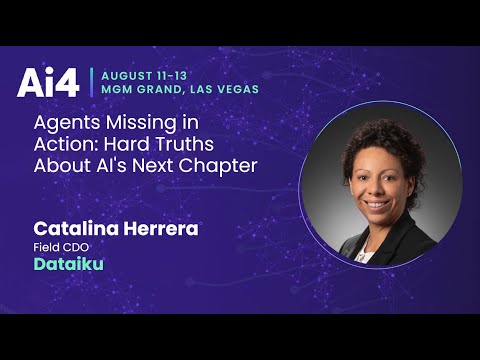
Dataiku's Herrera Warns Scaling AI Agents Requires Top-Down Governance
Ai4
Organizations struggle to scale AI agents beyond single prototypes without unifying fragmented data silos, implementing human-in-the-loop controls, and establishing clear top-down governance.
## Background
This content was published by Ai4 on YouTube on August 24, 2025. According to the page description, Catalina Herrera, Field CDO at Dataiku, breaks down the challenges of developing Gen AI agents at individual and organizational levels, addressing blockers to agentic success and strategies for building scalable agents.
## TL;DR
Catalina Herrera compares AI systems to a musical symphony and a digital intern or sous chef, explaining how agentic AI moves beyond passive generation to active decision-making and micro-automation. She analyzes three emerging agent ecosystems—AI infrastructure providers, off-the-shelf agents, and IT stack wrappers—highlighting their trade-offs regarding governance and data silos. Herrera addresses the hard truths of scaling beyond a single agent, emphasizing that enterprise success requires robust architecture, continuous human-in-the-loop governance, and cross-functional collaboration. Ultimately, she delivers key strategic imperatives for leaders, focusing on top-down alignment, scalable architecture, risk monitoring, and upskilling workforce talent.
## Atmosphere & style
The presentation carries an engaging, energetic, and authoritative tone, blending poetic metaphors with practical enterprise strategy. Herrera creates an interactive and enthusiastic atmosphere early on by polling the audience and playing a original reggaeton track created with 49 prompts. As the talk progresses, the vibe seamlessly shifts from creative demonstration to a grounded, pragmatic discussion on complex organizational realities and governance.
## Detailed walkthrough
### [00:04](https://www.youtube.com/watch?v=0xb8okmDK6U&t=4s) Conducting the AI Symphony and the 49-Prompt Reggaeton Experiment
Catalina Herrera, Field CDO at Dataiku, opens her presentation with an extended metaphor, asking the audience to imagine directing a musical symphony. In this ensemble, every element—data, artificial intelligence, and human talent—plays a distinct instrument with its own tone and timing to create ultimate harmony. She asserts that organizations now stand on the threshold of a brand-new symphony where AI agents take center stage as conductors, orchestrating data and actionable insights to push business forward. Setting the stage for AI's next chapter, Herrera emphasizes the need to navigate this revolution wisely while acknowledging both its immense opportunities and hard realities.
To demonstrate how human creativity guides AI tools, Herrera conducts a interactive experiment with the audience. After polling the room on who has generated images, videos, or music using Large Language Models (LLMs), she plays a unique 47-second audio clip—a upbeat reggaeton song themed around vision, positivity, innovation, and empowerment created by an AI persona named "DJ Kat." Before playing the track, she challenges the crowd to guess how many prompts it took her, as an AI-empowered human, to produce those 47 seconds.
Following the song, she reveals that the clip required exactly 49 prompts to create. This exercise illustrates a core truth about modern technology: AI outcomes are not produced passively. They require a "symphony of prompts, of models, of creativity, of the human judgment." Behind every AI solution lies a conductor shaping raw tools into meaningful outcomes.
- The AI-generated reggaeton track by "DJ Kat" spanned 47 seconds and required 49 explicit prompts to construct.
- Organizations have spent the last 30 to 50 years collecting massive streams of data—from wind turbine sensors and user interactions to social media and hallway conversations.
- Classical AI use cases like predictive maintenance, fraud detection, and route optimization serve as foundational instruments alongside newer Generative AI capabilities (e.g., Retrieval-Augmented Generation or RAG, domain-specific chatbots, and automated product descriptions).
---
[05:49](https://www.youtube.com/watch?v=0xb8okmDK6U&t=349s) The Agentic Layer: Moving from Passive Insights to Active Execution
Transitioning from individual AI techniques to holistic systems, Herrera introduces the "agentic layer." She compares an AI agent to a sous chef in a restaurant kitchen: a sous chef doesn't just chop ingredients; they add extra spices when needed and determine when a dish is ready to be served. Similarly, an agentic AI system moves beyond passively generating data insights—it takes autonomous action at scale, such as scheduling maintenance, dispatching real-time alerts, or adjusting advertising campaign bids.
Taking a wind farm as a concrete example, Herrera shows how agentic systems layer over decades of enterprise data investments. The ultimate goal of this layer is orchestration, micro-automation, and decision-making that scales far beyond human capacity alone. By combining descriptive assets (historical sensor records), predictive assets (failure probability algorithms), and generative capabilities (LLMs), the enterprise gains a conversational user interface where users can directly talk to their data.
Rather than getting bogged down in complex industry jargon, Herrera simplifies the term: "think about it as a digital intern that can help you on your daily basis." This digital intern bridges technology, human judgment, and business processes to yield scalable decisions.
- Descriptive assets cover what happened (e.g., sensor telemetry, logs, and maintenance history).
- Predictive assets calculate what might happen (e.g., probability of equipment failure).
- Conversational interfaces allow managers to ask questions like, *"Which turbines should I prioritize based on predictive outcomes?"* while the agent automatically dispatches maintenance schedules to field crews.
---
[08:50](https://www.youtube.com/watch?v=0xb8okmDK6U&t=530s) Three Emerging Agent Ecosystems and the Need for Enterprise Micro-Automation
Herrera outlines three dominant categories of agentic solutions currently emerging across the market landscape, highlighting the architectural trade-offs inherent to each:
1. **AI Infrastructure Providers:** Traditional, big-name tech giants adding agentic capabilities directly onto their core portfolios. While highly powerful, these frameworks require specialized expertise and niche skills, making them expensive to maintain and prone to governance sacrifices.
2. **Off-the-Shelf Agents:** Specialized startup offerings targeting hyper-verticalized business use cases. They offer fast deployment and high convenience, but businesses risk losing long-term viability, customization, and central governance control.
3. **IT Stack Wrappers:** Features added on top of legacy enterprise systems (CRMs, ticketing systems, HR portals). While convenient, these wrappers merely wrap existing data silos without truly breaking them down.
```
┌─────────────────────────────────────────────────────────────────────────┐
│ EMERGING AGENT CATEGORIES │
├──────────────────────────┬──────────────────────┬───────────────────────┤
│ AI Infrastructure │ Off-the-Shelf │ IT Stack Wrappers │
├──────────────────────────┼──────────────────────┼───────────────────────┤
│ • High power │ • Fast deployment │ • Convenient features │
│ • Requires niche skills │ • Hyper-verticalized │ • Trapped in legacy │
│ • Pricey & ungoverned │ • Risks governance │ data silos │
└──────────────────────────┴──────────────────────┴───────────────────────┘
```
Herrera argues that true transformation demands an "AI-first application" approach that operates cross-functionally across application boundaries. Breaking down data silos enables digital interns to leverage both descriptive and predictive assets to perform micro-automations—such as scheduling routine servicing or optimizing marketing campaigns autonomously.
- Legacy enterprise workflows suffer from "last-mile friction" where linear handoffs between business personas and data science teams stall execution.
- AI decision systems unify descriptive tools, predictive tools, micro-automations, and conversational LLMs into a single operational framework.
- Democratizing data access allows thousands of employees across departments to interrogate enterprise knowledge bases in real time.
---
[14:06](https://www.youtube.com/watch?v=0xb8okmDK6U&t=846s) Hard Truths: Scaling Beyond the Single Agent and Essential Strategy Rules
Addressing the reality of enterprise adoption, Herrera shifts to the "hard truths." While building and deploying a single standalone AI agent is relatively simple, scaling to thousands of active users interrogating enterprise data creates significant friction, complexity, and risk. To succeed at scale, organizations must maintain total visibility, end-to-end traceability, and strict human-in-the-loop controls.
She cautions against staying isolated within departmental bubbles. Analytics teams must actively bring legal, risk, and responsible AI stakeholders into the development lifecycle from day one. Keeping humans firmly in control ensures that outputs are safe, accurate, and aligned with organizational goals, preventing costly hallucinated responses from reaching customers.
Herrera concludes with actionable imperatives for enterprise leaders:
1. **Develop a Top-Down Strategy:** Clear organizational alignment must flow from leadership so every employee understands the overarching mission.
2. **Invest in Scalable Architecture:** Recognize that compute, hardware, and IT stacks continuously evolve—architectures must adapt seamlessly to ongoing change.
3. **Establish Governance & Collaboration Frameworks:** Maintain visibility, traceability, and risk monitoring across cross-functional teams.
4. **Foster a Culture of Continuous Learning:** Upskill and certify staff continuously. Herrera urges leaders: "Do not leave your people behind."
5. **Implement Robust Monitoring & Feedback Loops:** Assign clear ownership for data outcomes, including who validates outputs and manages potential hallucinations.
- Dataiku invites attendees to visit **Booth 406** to continue discussions on scaling agentic AI systems in the enterprise.
<FollowUp label="Would you like a breakdown of how Dataiku's architecture addresses agent governance and human-in-the-loop workflows?" query="How does Dataiku handle AI agent governance, traceability, and human-in-the-loop workflows at scale?"/>
## Notable quotes
> [00:04](https://www.youtube.com/watch?v=0xb8okmDK6U&t=4s) symphony of prompts, of models, of creativity, of the human judgment — Catalina Herrera
> [05:49](https://www.youtube.com/watch?v=0xb8okmDK6U&t=349s) think about it as a digital intern that can help you on your daily basis — Catalina Herrera
> [14:06](https://www.youtube.com/watch?v=0xb8okmDK6U&t=846s) Do not leave your people behind. — Catalina Herrera
## Mentioned
Catalina Herrera, Dataiku, Ai4, DJ Kat
## Video description
Catalina Herrera, Field CDO, Dataiku
Abstracts
A year into the adoption of Gen AI agents, how far have organizations come in building agents? During this session, Catalina Herrera, Field CDO at Dataiku will break down the novel challenges of developing agents at the individual and organizational levels. From the bottom-up technology to the top-down strategy, what are the blockers for agentic success? How can organizations not only build effective agents, but ones intended to scale?
Catalina Herrera, Field CDO at Dataiku, argues that realizing the value of agentic AI requires moving beyond standalone generative tools to integrated systems that execute micro-automations under strict human orchestration and cross-functional governance.
Human Direction in Generative and Agentic Workflows (0:04)
Herrera uses an orchestral conductor metaphor to describe the relationship between enterprise data, machine learning models, and human oversight. To illustrate that AI outputs do not occur passively, she highlights an experiment in which an AI persona, 'DJ Kat,' produced a 47-second reggaeton audio track. Generating that brief clip required 49 distinct, iterative prompts from a human operator, underscoring that human judgment and strategy remain central to guiding raw generative capabilities into coherent business outcomes.
Rather than viewing modern AI as an autonomous replacement for human strategy, Herrera positions tools like Large Language Models (LLMs) and Retrieval-Augmented Generation (RAG) as specialized instruments. These generative mechanisms sit alongside established predictive models and decades of accumulated historical telemetry, requiring deliberate coordination to deliver structured, purposeful enterprise results.
Bridging Descriptive Data and Predictive Micro-Automation (5:49)
Moving past passive dashboards, Herrera outlines the 'agentic layer'—likened to a restaurant sous chef who decides how ingredients are assembled and when a dish is finished. While legacy analytics typically explain what happened using descriptive sensor logs, and predictive models forecast future probabilities, the agentic layer acts as an operational 'digital intern.' It interrogates these underlying assets to execute micro-automations directly, such as updating maintenance schedules, issuing automated alerts, or adjusting ad campaign bids.
Using an industrial wind farm as an operational case study, Herrera explains that conversational interfaces allow operators to query predictive models regarding equipment failure probabilities. The agentic system can then autonomously coordinate logistics—such as routing repair crews to high-risk turbines—bypassing the traditional operational handoffs that often cause last-mile execution bottlenecks.
Structural Trade-offs Across Market Agent Ecosystems (8:50)
Herrera categorizes current market solutions into three distinct architectural models, each presenting specific enterprise trade-offs. AI infrastructure providers offer high computational power but demand niche technical skills, elevated maintenance costs, and frequent governance sacrifices. Off-the-shelf niche agents provide rapid deployment for vertical use cases, yet introduce risks concerning enterprise customization and long-term governance. Meanwhile, IT stack wrappers merely layer agentic features over legacy software without dismantling foundational data silos.
To overcome these limitations, Herrera advocates for cross-functional, 'AI-first applications' that bridge disparate systems. Enabling direct data interrogation across departments prevents execution delays and allows micro-automations to leverage both predictive algorithms and descriptive datasets across enterprise boundaries.
Enterprise Governance and Friction Beyond Single Prototypes (14:06)
Addressing organizational realities, Herrera stresses that while deploying an isolated agent is technically simple, scaling solutions to thousands of active users introduces substantial governance and reliability challenges. Analytics teams cannot operate in departmental silos; they must involve legal, risk, and responsible AI teams from the start to establish total visibility, maintain auditability, and prevent hallucinations from reaching end users.
To manage enterprise-wide adoption securely, Herrera outlines five key organizational mandates: establishing a clear top-down strategy, investing in modular architectures that accommodate hardware shifts, instituting cross-functional governance, maintaining continuous employee upskilling, and establishing strict feedback loops that assign explicit operational ownership over AI outputs.
Herrera concludes that enterprise success with agentic systems depends less on the autonomy of individual models than on organizational alignment, adaptable system architecture, and rigorous human-in-the-loop controls that prevent data silos and governance failures at scale.
精炼阅读摘要
Dataiku 现场首席数据官(Field CDO)Catalina Herrera 指出,企业应用正从被动的数据洞察迈向以 AI 智能体(Agent)为主导的自主执行阶段;然而,构建单点原型虽然容易,要实现企业级规模化扩展,核心在于人类的主导裁决、跨业务孤岛的架构整合以及严格的治理监控。
人类主导与智能体的主动执行层 (0:04)
Herrera 将现代企业数据生态比作交响乐团,强调数据资产、预测算法和生成式工具是各自承担特定音色的乐器,而人类则是整个乐团不可或缺的指挥官。在现场演示中,她展示了由虚拟角色“DJ Kat”制作的 47 秒雷鬼音乐,揭示该音频经历了整整 49 次提示词迭代才最终成型。这一实验印证了关键观点:高质量的 AI 成果无法脱离人类的策略、提示词编排与审美判断而自发产生。过去三十至五十年间,企业积累了大量的描述性数据与以预测性维护为代表的经典算法,如今智能体层的介入正在改变这些资产的应用方式。
Herrera 将智能体比作厨房中的“副主厨”或业务中的“数字化实习生”,其本质是超越被动的报告输出,转向具备上下文理解与自动化决策能力的行动层。以风力发电场为例,传统的描述性资产记录了传感器时序日志,预测性模型评估了组件故障概率,而智能体层结合大语言模型(LLM)的对话接口,不仅允许运维主管直接询问需要优先维护的风机,还能自主调度现场维护班次并下发工单,将分析洞察无缝衔接至微自动化执行。
市场三类智能体架构的局限与权衡 (8:50)
针对目前市场上涌现的智能体产品,Herrera 归纳出三类主流技术路线,并指出了各自内在的架构妥协。第一类来自大型科技巨头的“AI 基础设施提供商”,具备极高的计算与开发能力,但通常需要专业且稀缺的工程技能,维护成本昂贵且易导致治理脱节;第二类是初创公司推出的“现成垂直智能体”,部署速度快且贴合细分业务,但企业难以进行深度定制,长期来看存在丧失集中治理与自主可控的风险;第三类则是构建在既有 CRM、工单系统或 HR 门户之上的“IT 堆栈外壳”,尽管易于融入既有流程,却仅是在原有的数据孤岛外包裹了一层会话界面,未能实质性打破系统壁垒。
Herrera 指出,传统工作流程中业务部门与数据团队之间的线性交接会造成严重的“最后一公里摩擦”,致使数据洞察迟迟无法转化为业务行动。她主张企业应建立跨部门的“AI 优先应用”架构,将描述性工具、预测算法、微自动化流程与会话模型整合在同一运作框架内。消除系统壁垒后,智能体才能跨域调用企业知识资产,使成千上万名普通员工能够实时提问并驱动自动化排程或营销竞价等微小任务。
规模化落地瓶颈与五项核心战略法则 (14:06)
谈及落地现实,Herrera 强调了企业必须面对的客观瓶颈:开发并部署单一独立智能体门槛相对较低,但当系统扩展到成千上万名员工同时调用底层数据时,系统的复杂性、执行阻力与合规风险将呈指数级上升。为防止大语言模型产生幻觉并向客户传递错误信息,企业必须坚持“人在回路”(Human-in-the-loop)的控制原则,确保全流程的可视化与端到端可追溯性。她特别提醒数据科学与分析团队,必须在项目启动的第一天就将法务、风控和负责任 AI 团队纳入研发周期,严禁在部门孤岛内闭门造车。
针对规模化演进,Herrera 为企业决策层提出了五项指导准则:首先,确立自上而下的企业战略,确保全员明确业务愿景;其次,投资能够适应算力与 IT 硬件持续更迭的可扩展架构;第三,建立健全跨职能协作框架,维持全程可见性与风险监控;第四,营造持续学习的文化并为员工提供技能认证,切勿在技术转型中遗落既有人才;最后,落实闭环监控机制,明确数据产出与决策的最终责任归属,设置专人负责校准输出并处理模型幻觉。
Herrera 的核心论述表明,智能体技术的核心价值在于将数据分析直接推向微自动化行动,但企业落地的真正挑战已从“模型能否生成结果”转移到“系统是否具备规模化治理能力”。尽管跨职能协同与人在回路被确立为安全落地的核心防线,但在异构 IT 架构快速演进与企业内部权限割裂的现实限制下,如何在保证集中管控的同时兼顾业务创新的敏捷度,仍需在未来的工程实践中持续摸索。
Detailed notes — zh
## Background
本内容由 Ai4 于 2025 年 8 月 24 日在 YouTube 平台发布。视频记录了 Dataiku 现场首席数据官(Field CDO)Catalina Herrera 在大会上的主题演讲,重点探讨了生成式 AI 智能体(Gen AI Agents)在个人与企业层面落地所面临的新挑战,并从底层技术到顶层战略剖析阻碍智能体规模化成功的瓶颈与应对方案。
## TL;DR
Catalina Herrera 通过生动的比喻指出人类在 AI 时代应扮演“交响乐指挥家”与“主厨”的角色,智能体则是协助决策与行动的“副厨”与“数字实习生”。她深入剖析了市场上基础设施巨头原生、开箱即用垂直型以及传统 IT 封装套壳这三类智能体模式的局限性,揭示了“构建单个智能体容易,但跨组织规模化扩展极难”的残酷现实。为了打破数据孤岛并解决最后一公里摩擦,企业需要向 AI 决策系统转型,并通过自上而下的战略、可扩展架构、严密治理与全流程监控这四大支柱实现安全可控的规模化落地。
## Atmosphere & style
演讲氛围专业且富有感染力,Herrera 巧妙地运用交响乐演奏和现场生成的雷鬼音乐等生动案例开场,迅速调动起观众的好奇心与参与感。叙事风格既有高屋建瓴的宏观战略洞察,又直击企业落地的技术阵痛,在剖析现实瓶颈时犀利务实,在呼吁拥抱人类判断力与持续学习文化时则充满鼓舞人心的力量。
## Key takeaways
- [00:04](https://www.youtube.com/watch?v=0xb8okmDK6U&t=4s) AI 与企业数据的协同如同交响乐:AI 智能体正在成为新的“指挥家”,负责调度企业长期积累的数据与预测模型以驱动业务。
- [00:04](https://www.youtube.com/watch?v=0xb8okmDK6U&t=4s) 人类的判断力与创意依然是核心:通过 49 次 Prompt 迭代生成 47 秒音频的实验表明,人类并非被动的消费者,而是整个 AI 编排体系的主导者。
- [05:50](https://www.youtube.com/watch?v=0xb8okmDK6U&t=350s) 智能体实现从被动洞察到自主行动的跨越:Agent 扮演“副厨”或“数字实习生”的角色,能够自主执行设备维护调度、预警和竞价调整等决策行动。
- [05:50](https://www.youtube.com/watch?v=0xb8okmDK6U&t=350s) 市场现有三类主流智能体架构各有局限:基础设施巨头方案维护成本高、开箱即用方案缺乏扩展性、传统 IT 套壳方案则未能解决数据孤岛问题。
- [05:50](https://www.youtube.com/watch?v=0xb8okmDK6U&t=350s) 构建跨应用与跨功能的 AI 优先架构:企业需要将历史描述性资产与机器学习预测模型融合,通过微自动化推动大规模业务自动化。
- [11:42](https://www.youtube.com/watch?v=0xb8okmDK6U&t=702s) 重塑企业决策系统以消除最后一公里摩擦:利用对话式界面(CUI)让业务人员直接与数据交互,由 LLM 后台编排直接下发业务执行指令。
- [11:42](https://www.youtube.com/watch?v=0xb8okmDK6U&t=702s) 智能体规模化落地的“残酷真相”:部署单个智能体非常容易,但面对全员并发调用时,数据资产粗糙、缺乏可追溯性与治理断层会带来巨大阻力。
- [15:33](https://www.youtube.com/watch?v=0xb8okmDK6U&t=933s) 打破部门高墙并坚持 Human-in-the-loop:在智能体应用早期即引入法务、责任 AI 与业务团队,保障跨部门调用的安全与合规。
- [15:33](https://www.youtube.com/watch?v=0xb8okmDK6U&t=933s) 企业推动智能体落地的四大战略支柱:包含自上而下的顶层战略、高适应性可扩展架构、贯穿开发到生产的治理与学习文化,以及明确的责任监控反馈机制。
- [15:33](https://www.youtube.com/watch?v=0xb8okmDK6U&t=933s) 企业文化与持续学习是落地关键:单靠技术架构不足以成功,量化全员 AI 技能提升并保持全员持续学习才是推动智能体变革的核心秘方。
## Detailed walkthrough
以下是 Dataiku 现场首席数据官(Field CDO)Catalina Herrera 在 Ai4 大会上发表的演讲逐字解析与详细记录。演讲围绕“智能体(Agent)”在企业级 AI 中的应用痛点、演进路径及落地架构展开。
---
### [00:04](https://www.youtube.com/watch?v=0xb8okmDK6U&t=4s) 数据的交响乐与 49 次 Prompt 的启示
Catalina Herrera 开场抛出一个生动的比喻:将企业数据、人工智能与人类比作一场交响乐中的不同乐器。每种元素都有其独特的音色、角色与节奏,只有紧密协调才能奏出和谐的乐章。而如今,企业正站在新交响乐的门槛上——AI 智能体(Agents)将充当“指挥家”,调度数据与洞察以推动业务向前发展。
为了向现场观众展示“人类赋能 AI”的真正含义,她现场播放了一段由生成式 AI 创作的 47 秒雷鬼动(Reggaeton)风格音乐,歌词围绕“愿景、积极性、创新与赋能”。播放结束后,她让现场观众猜测生成这段音频究竟消耗了多少次提示词(Prompts)。在排除低于与高于 49 次的选项后,她透露自己整整调整了 **49 次 Prompt**。
```
[49 次 Prompt 迭代] ➔ [47 秒 AI 生成音乐] ➔ [人类创意与判断的最终整合]
```
这一实验揭示了一个核心真理:AI 技术的本质是 Prompt、模型、创意与人类判断力的协同运作。人类绝非被动的消费者,而是指挥家本身。过去 30 至 50 年间,企业不断从风力发电机传感器、用户交互、社交媒体乃至走廊对话中收集海量数据,如同“从消防水龙头中喝水”。过去建立的传统预测性维护、欺诈检测与路径优化等模型,都是交响乐中的基础乐器,而生成式 AI 与大语言模型(LLM)则为这套体系注入了全新的指挥能力。
---
### [05:50](https://www.youtube.com/watch?v=0xb8okmDK6U&t=350s) 智能体层(Agentic Layer)与市场三类模式剖析
在阐述什么是智能体层时,Herrera 提出了“副厨(Sous Chef)”的比喻:智能体就像一个能干的副厨,它不仅能切菜,还能自主撒香料,甚至直接做出“这道菜可以上桌了”的决策。所谓智能体 AI(Agentic AI),就是一种不再被动输出洞察,而是能主动采取行动的系统——例如自动调度设备维护、发送预警通知,或实时调整广告竞价策略。
在讨论智能体生态时,她建议跳过繁琐的定义争论,将智能体统称为协助日常工作的“数字实习生(Digital Intern)”,并归纳了目前市场上涌现的三大主流智能体构建范式:
```mermaid
flowchart TD
accTitle: 三类企业智能体架构形态对比
subgraph MarketCategories["市场主流智能体模式"]
Cat1["1. 基础设施巨头原生智能体<br/>(高门槛/高维护成本/治理欠缺)"]
Cat2["2. 开箱即用型开箱智能体<br/>(高度垂直/部署快/缺乏可扩展性)"]
Cat3["3. 传统 IT 封装外壳智能体<br/>(基于 CRM/HR 增加套壳/数据孤岛未破)"]
end
Target["目标:突破数据孤岛的 AI 优先 Cross-App 架构"]
Cat1 --> Target
Cat2 --> Target
Cat3 --> Target
```
1. **AI 基础设施巨头(AI Infrastructure Providers)**:由大厂在自身产品线之上构建智能体能力。功能强大,但需要极高的专业技能与昂贵的维护成本,且容易牺牲企业级治理。
2. **开箱即用型智能体(Off-the-shelf Agents)**:多由初创公司提供,针对极度垂直的业务场景。部署极快,但牺牲了长期的可行性与全局数据治理。
3. **传统 IT 架构套壳智能体(Siloed Stack Wrappers)**:在企业既有的 CRM、工单系统或 HR 软件上直接加装智能体层。虽然增加了新功能,但并未解决数据孤岛问题,难以形成跨部门合力。
为了突破上述限制,企业需要构建跨应用(Cross-application)、跨功能(Cross-functional)的“AI 优先”应用,将描述性资产(历史数据)与预测性资产(机器学习模型)融合,实施微自动化(Micro-automation),以推动大规模的业务自动化。
---
### [11:42](https://www.youtube.com/watch?v=0xb8okmDK6U&t=702s) 企业决策系统的架构转型与真实阵痛
过去的企业数据流存在严重的“最后一公里摩擦(Last-mile friction)”:业务人员提出需求,数据科学与分析团队线性地生产数据结果,再层层返回,效率低下。Herrera 强调,企业必须向“AI 决策系统(AI Decision System)”转变。
<Image alt="企业级 AI 智能体架构与数据织物示意图" caption="企业级 AI 智能体架构与数据织物" src="image_agent_tag_14544942113885461905"/>
---
在全新的架构中,智能体以对话式用户界面(CUI)的形式呈现,使业务人员能够直接与企业数据对话。例如,在风电场运营场景中,运维人员可以直接询问:“根据预测结果与历史数据,我今天应该优先维护哪些风力发电机?”大语言模型在后台编排,将描述性资产(传感器历史)、预测性资产(故障概率)与生成能力结合,直接将保养日程表下发给一线工程团队。
在谈到“残酷真相(Hard Truths)”时,Herrera 直言不讳地指出了当前企业落地的核心瓶颈:
- **原料粗糙**:大量的企业数据资产仍处于原始、孤立且未及时更新的状态。
- **扩展陷阱**:**“部署单个智能体非常简单(Single agent is easy),但扩展极其困难。”** 当面对数千名员工同时对企业数据资产发起提问时,系统会产生巨大的摩擦力。
- **缺乏追溯性**:缺乏全局可观测性(Visibility)与可追溯性(Traceability),无法保障跨部门调用的安全与合规。
---
### [15:33](https://www.youtube.com/watch?v=0xb8okmDK6U&t=933s) 企业推动智能体大规模落地的四大战略支柱
面对数千名用户同时交互的复杂场景,企业不能局限于数据团队的内部小圈子,必须打破部门高墙,让法务、责任 AI(Responsible AI)及各业务部门早期接入,确保“人类始终处于环路之中(Human-in-the-loop)”。
最后,Herrera 为企业总结了实现智能体规模化落地的四大核心行动指南:
* **自上而下的明确战略(Top-down Strategy)**:智能体转型必须由管理层统一规划,确保全公司对目标达成共识,而非零散的自发探索。
* **投资可扩展的技术架构(Scalable Infrastructure)**:鉴于算力、硬件及 IT 技术栈处于持续演进中,企业必须选用具备高适应性的底层平台。
* **建立严密的治理框架与持续学习文化(Governance & Learning Culture)**:将治理贯穿开发到生产的全流程,同时建立量化指标提升员工技能(如考核“年底前有多少员工通过 AI 技能认证”),坚决不让任何员工掉队。
* **构建完善的监控与反馈机制(Monitoring & Feedback Mechanism)**:明确数据产出的责任归属。必须有人回答:“谁来负责点赞或点踩?如果面向客户的智能体发生幻觉,谁承担责任?”
在演讲的结尾,她呼吁全场听众拥抱人类自身的判断力与创造力:“技术本身远远不够,企业文化的持续学习与战略才是关键的秘方。现在就是最好的时代,做掌控全局的人类指挥家!”
---
<FollowUp label="想要了解 Dataiku 如何解决智能体扩展中的数据治理与监控难题吗?" query="请详细介绍 Dataiku 针对企业级 AI 智能体(Agents)提出的数据治理、监控与安全管控解决方案。"/>
## Notable quotes
> [00:04](https://www.youtube.com/watch?v=0xb8okmDK6U&t=4s) AI 技术的本质是 Prompt、模型、创意与人类判断力的协同运作。人类绝非被动的消费者,而是指挥家本身。 — Catalina Herrera
> [05:50](https://www.youtube.com/watch?v=0xb8okmDK6U&t=350s) 智能体就像一个能干的副厨,它不仅能切菜,还能自主撒香料,甚至直接做出‘这道菜可以上桌了’的决策。 — Catalina Herrera
> [05:50](https://www.youtube.com/watch?v=0xb8okmDK6U&t=350s) 所谓智能体 AI(Agentic AI),就是一种不再被动输出洞察,而是能主动采取行动的系统 — Catalina Herrera
> [11:42](https://www.youtube.com/watch?v=0xb8okmDK6U&t=702s) Single agent is easy,但扩展极其困难。 — Catalina Herrera
> [11:42](https://www.youtube.com/watch?v=0xb8okmDK6U&t=702s) 当面对数千名员工同时对企业数据资产发起提问时,系统会产生巨大的摩擦力。 — Catalina Herrera
> [15:33](https://www.youtube.com/watch?v=0xb8okmDK6U&t=933s) 必须有人回答:‘谁来负责点赞或点踩?如果面向客户的智能体发生幻觉,谁承担责任?’ — Catalina Herrera
> [15:33](https://www.youtube.com/watch?v=0xb8okmDK6U&t=933s) 技术本身远远不够,企业文化的持续学习与战略才是关键的秘方。现在就是最好的时代,做掌控全局的人类指挥家! — Catalina Herrera
## Mentioned
Catalina Herrera, Dataiku, Ai4, Agentic AI, LLM, CRM, HR
## Video description
Catalina Herrera, Field CDO, Dataiku
Abstracts
A year into the adoption of Gen AI agents, how far have organizations come in building agents? During this session, Catalina Herrera, Field CDO at Dataiku will break down the novel challenges of developing agents at the individual and organizational levels. From the bottom-up technology to the top-down strategy, what are the blockers for agentic success? How can organizations not only build effective agents, but ones intended to scale?
[Source](https://www.youtube.com/watch?v=0xb8okmDK6U)
[0:04] Catalina Herrera: symphony of prompts, of models, of creativity, of the human judgment
[5:49] Catalina Herrera: think about it as a digital intern that can help you on your daily basis
[14:06] Catalina Herrera: Do not leave your people behind.
Original transcript
[0:04] All right. Imagine for a moment that you
[0:06] are a director orchestrating a symphony
[0:10] and that each instrument, the data, the
[0:13] AI, the humans, everybody has its role,
[0:18] its tone, its timing. Together they
[0:21] create harmony. Now what if I tell you
[0:25] that today we are sitting at the
[0:28] threshold of a new symphony. One where
[0:32] AI agents become the conductors
[0:37] orchestrating data and insights to drive
[0:40] our business forward. We are in the next
[0:44] chapter in the journey of artificial
[0:47] intelligence right here right now. And I
[0:50] am here to explore what it means, the
[0:54] opportunities, the hard roots and in
[0:57] general how we can lead this revolution
[1:00] but wisely. So I can barely see you but
[1:04] raise your hand if you have created a
[1:07] cool image with an LLM recently. Come
[1:09] on, raise your hand. Okay, there you go.
[1:12] What about a video?
[1:15] What about music?
[1:18] All right. So, I'm going to welcome you
[1:20] to my session, but I'm going to welcome
[1:22] you to my session on my own way. So,
[1:25] you're going to hear the first regaton
[1:28] that talks about vision, positivity,
[1:31] innovation, empowerment. And I'm going
[1:34] to ask you a favor.
[1:36] You're going to think from your human
[1:39] empowered by I hat. And you're going to
[1:42] think how many prompts it took me to
[1:45] generate the following 47 seconds. Are
[1:49] you guys ready? Okay. How many prompts
[1:52] it took me? Welcome to the session.
[1:53] >> Welcome. How many pounds
[2:03] >> DJ cat
[2:06] innovation
[2:08] empowerment
[2:11] transformation
[2:19] creativity
[2:21] future possibility
[2:24] Possibility
[2:29] creativity
[2:32] future possibility
[2:35] possibility.
[2:39] >> Okay, I'm sure you have a number in your
[2:41] mind. Raise your hand if the number is
[2:45] 49.
[2:47] All right, what about below 49?
[2:51] What about above 49?
[2:54] Okay. Okay. So, it took me 49 prompts,
[2:58] me, the human empowered by I to generate
[3:01] this 47 seconds. So, what is this
[3:04] telling you? This actually illustrates a
[3:06] fundamental truth. Technology has become
[3:08] a symphony of prompts, of models, of
[3:12] creativity, of the human judgment. And
[3:16] you are not just passive consumers. you
[3:19] are actually conductors as well and your
[3:22] ability to guide AI is what actually
[3:26] turns these raw tools into powerful
[3:29] solutions. So every time we think about
[3:32] an AI solution, let's remember that
[3:34] behind every outcome, there is a human
[3:37] touch and a whole lot of creativity. And
[3:40] let's think about the history, the past
[3:43] what 30, 50 years. We keep collecting
[3:46] data and data and data. Every sensor on
[3:49] a wind turbine, every user interaction,
[3:52] every social media, every conversation
[3:55] in the hallway, we are drinking from a
[3:58] fire hose. But what is the good news
[4:00] about this? We have been working with
[4:03] this for the last 30 40 years. So we do
[4:06] have a lot of tools that are helping us
[4:09] create these ingredients, these
[4:12] instruments to this symphony that we can
[4:15] actually orchestrate together. So it
[4:18] doesn't really matter the technique that
[4:20] we are using within this artificial
[4:23] intelligence bubble to create this
[4:26] ingredient. We can talk about the
[4:28] classic predictive maintenance, the
[4:30] classic FR detection, the classic route
[4:34] optimization and whatever else use case
[4:36] you can think of that is using machine
[4:39] learning, deep learning, now generative
[4:42] AI. We have DJ cut generating music by
[4:46] the way regaton positivity innovation
[4:49] and it's very unique. But at the same
[4:51] time we see a lot of generative AI use
[4:53] cases in the field that are super basic
[4:56] structuring or structured data retrieval
[4:59] augmented generation bots with
[5:01] conversations that are very
[5:03] knowledgeable about a domain specific
[5:05] describing products all kinds of use
[5:08] cases and then we have the new ecosystem
[5:11] of these large language models that are
[5:13] part of it. So this continues to bring
[5:17] these ingredients. The large language
[5:19] models are behind the scenes multiple of
[5:23] these chatbots in the industry. But yet
[5:26] everything is an ingredient. Everything
[5:28] is an instrument that is part of this
[5:31] symphony that you as the human can
[5:34] actually orchestrate and define what is
[5:37] going to mean for you. So if we think
[5:39] about the how we produce that yeah we
[5:43] use one or two techniques to do it but
[5:46] the new reality is the chapter for
[5:49] agents and what are these agents and
[5:53] what we can do with these agents. So
[5:55] what is this agentic layer? So think
[5:59] about it as giving a chef a soup chef.
[6:03] So this soup chef not only can shop but
[6:06] also can add a little extra spice. It
[6:10] can also say hey you know what this dish
[6:12] is ready to be served. Yeah that is your
[6:14] subchef. So agentic AI means a system
[6:18] that don't just passively produce an
[6:21] insight but actively act a scal
[6:25] maintenance send an alert to somebody
[6:29] adjust the campaign bits for a real time
[6:34] uh exercise. So picture let's go back to
[6:37] the wind farm exercise and think about
[6:39] all those wind turbines and let's think
[6:41] about this agent as an example on top of
[6:45] those ingredients that we have been
[6:47] producing for the last 23 years that
[6:50] your teams have been producing as this
[6:52] data outcome that can be consumed. So
[6:55] what's the final goal? orchestration,
[6:59] automation, decision making that scales
[7:02] beyond the human alone and go back to
[7:07] landing these two historical layer layer
[7:11] symphony another instrument. Now we have
[7:14] a conductor. So what is going on here?
[7:16] What are the ingredients? So we have
[7:19] descriptive assets what sensors,
[7:22] historical information, maintenance
[7:24] records, all those data outcomes. Then
[7:26] we have predictive assets. What
[7:29] historical information? Can we actually
[7:31] predict when will you have a higher
[7:33] probability of failure? Then we have
[7:35] generative AI adding these LLMs behind
[7:39] the scenes that are helping us
[7:41] orchestrate the symfony. So what is the
[7:44] symfony that we have now? Check out the
[7:46] conversational user interface. Agentic.
[7:50] Now I can talk to my data. Now I can ask
[7:52] a question. Hey, which turbines should I
[7:56] prioritize based on the predictive
[7:58] outcome based on the descriptive
[8:01] outcome? But I have an LLM orchestrating
[8:04] sending the maintenance uh schedule for
[8:07] my crew to go and know exactly what to
[8:10] do. So we have an unbelievable of amount
[8:14] of misinformation I will say information
[8:17] and misinformation coming from the
[8:19] ecosystem from the market. Uh there is a
[8:22] lot on agents, agents, agents. And today
[8:25] I'm not going to sit and define what an
[8:28] agent is. I'm just going to say think
[8:30] about it as a digital intern that can
[8:33] help you on your daily basis when you
[8:36] try to focus on your data outcomes that
[8:38] correlate with your user use case and
[8:40] your own people, technology and
[8:42] processes. So for today, let's think
[8:45] above semantics and let's actually focus
[8:48] on three main categories that I see
[8:52] emerging in the market in the ecosystem.
[8:55] Category number one is going to be the
[8:57] classic AI infrastructure providers. So
[9:01] yes, you're going to have all of these
[9:02] big names that you know and are very
[9:04] aware of that are actually creating
[9:07] their own agentic futures on top of that
[9:11] portfolio. So it's powerful. Yeah, very
[9:14] powerful. But only a subset of people
[9:17] can actually produce it. You do require
[9:21] expertise, very unique set of skills.
[9:23] Therefore, you have expensive
[9:27] maintenance because of that expertise.
[9:29] You are sacrificing a little bit of
[9:31] governance. You have a second category.
[9:33] The second category that I see all over
[9:35] the market, I call them the offtheshelf
[9:38] agents. What are the offtheshelf agents?
[9:41] super verticalized
[9:43] business use cases specific on top of
[9:46] your things. A lot of startups showing
[9:49] right now on this very convenient. Yes,
[9:51] you are up and running. You have this
[9:52] case, you are deployed, you are done.
[9:54] But again, you are losing the ability to
[9:58] have that viability and that governance.
[10:01] And then you have a third category which
[10:03] is your think about your IT stack 25
[10:06] years ago and all the CRM, the systems
[10:10] that you have, ticket, ticketing, human
[10:12] resources, whatever else you have as
[10:14] part of that IT stack. And then you have
[10:16] I see them as wrappers on top of your
[10:20] silo data structures. So yes, you have a
[10:24] new feature in the wrapper that is on
[10:27] top of your silo. So you are connected
[10:29] with an agentic layer, but you are still
[10:32] silo and silo is not going to work on
[10:35] this new layer is not. So we have to
[10:39] think bigger. What are this new class of
[10:41] AI first application and what is the
[10:44] demand coming from the field? So from
[10:46] the field you have to think clo ac cross
[10:49] applications you have to break those
[10:51] silos you empower your friend which is
[10:55] your agent your digital intern to know
[10:58] more about your use case when you can
[11:00] actually give it more ingredients to
[11:03] orchestrate so it knows how to help you
[11:06] better. So it can be crossf functional.
[11:08] You can extend it not only with
[11:10] descriptive assets but with predictive
[11:12] assets. And then you can actually
[11:14] automate which is what you are really
[11:17] targeting this micro automation
[11:19] scheduling a maintenance optimizing a
[11:21] campaign and even more. Just do it in an
[11:25] automated way. And that requires a shift
[11:28] in the way that we think. That requires
[11:31] a shift in the architecture that
[11:33] supports all of these people, technology
[11:35] and processes behind the scenes when you
[11:37] are trying to orchestrate all of these
[11:39] ingredients. So two years ago it was
[11:42] released to the masses a new way to
[11:44] interact with data with example GPT
[11:48] conversational interface realtime access
[11:51] to a phenomenal amount of information.
[11:53] What if we can offer the same within the
[11:55] enterprise? So instead of the left
[11:58] architecture that is the classic last
[12:00] mile friction where it's very linear and
[12:04] you go with business persona and then
[12:07] data science analytics teams trying to
[12:09] produce that data outcome and then it
[12:10] goes back you think differently and with
[12:14] the same team the same people you
[12:17] support an AI decision system like
[12:20] orchestrating the symfony where the
[12:22] ingredients are descriptive predictive
[12:24] generative LLMs
[12:26] but within a framework because today
[12:29] we're going to talk about the hard
[12:30] truths and the hard truths is that a lot
[12:32] of these ingredients are still very row
[12:36] are siloed are not updated. So when you
[12:39] think about orchestrating this, you have
[12:41] to think about the descriptive tools,
[12:44] what happened, the predictive tools,
[12:46] what may happen, the micromission, small
[12:49] tasks that together make a big impact.
[12:52] You have your generative and with LLMs
[12:54] helping you with those conversational
[12:56] user interfaces and then you have very
[12:59] powerful ingredients with the potential
[13:02] to seriously impact your business. So we
[13:05] are talking about thousands of people
[13:08] interrogating your team. How are you
[13:10] going to empower thousands of people
[13:12] interrogating your enterprise
[13:15] ingredients and instruments that in a
[13:19] symphony are creating this harmony and
[13:21] in this harmony is real business impact
[13:24] and business value because who is going
[13:27] to go back to the old way when you can
[13:30] talk to your enterprise data. So this
[13:33] has the potential to really transform
[13:35] your business, every tasks, every role
[13:39] because now let the machine do what the
[13:41] machine is good for and you focus in
[13:43] what the human is good for. So bring
[13:46] your judgment, bring your creativity,
[13:48] but impact your organization across
[13:52] departments. Bring down those silos.
[13:55] Break the walls. Think about the
[13:58] knowledge that this digital assistant
[14:01] needs to help you better so you can
[14:04] actually maximize the transformation.
[14:06] Now let's talk about the hard truths.
[14:08] The hard truths is that a lot of people
[14:10] out there doesn't understand that needs
[14:13] to think outside your bubble. Think
[14:15] outside your bubble. So you if you are
[14:19] part of this framework on the analytics
[14:21] process and you have a role you have a
[14:24] title just consider who else needs to be
[14:27] involved here and where as part of that
[14:30] cycle. So there are going to be many
[14:33] other teams that are going to be asking
[14:35] questions legal responsible AI. How are
[14:38] we keeping the human in the loop? How
[14:40] are we consistent with this? How are we
[14:42] providing a framework that is a scalable
[14:45] and that allow us to deploy these agents
[14:49] with security with control? How are you
[14:52] the human in control that is actually
[14:55] maximizing the opportunity here? Because
[14:58] guess what? Deploying one agent,
[15:01] not that far, not that hard. Single
[15:03] agent is easy. Look at all the
[15:06] components. Look at all the ingredients.
[15:08] Now, think about the thousand users
[15:10] you're going to have asking questions to
[15:12] these components. It's not going to be
[15:13] that easy. It's going to get complex.
[15:16] It's going to be a lot of friction. You
[15:18] need visibility. You need tracibility.
[15:20] You need to ensure that whatever you are
[15:22] producing is part of a framework that is
[15:25] going to allow you to do this with
[15:27] control. You are the creator of the
[15:29] symphony. So own that place. Own that
[15:32] position. What are the three or four
[15:34] things that you need to leave this
[15:36] session with? First of all, regaton can
[15:40] have a lyric that is very positive,
[15:42] optimistic.
[15:44] Second, technology is not enough by
[15:47] itself. What's the secret sauce? your
[15:50] strategy, your culture, your culture of
[15:54] continuous learning, your governance,
[15:56] your framework. So first thing develop a
[16:00] clear strategy. This has to come from
[16:02] the top down. Everybody in the company
[16:04] needs to understand what you guys are
[16:06] trying to accomplish. Number two, you
[16:08] have to invest in a scalable technology.
[16:11] Change is the only constant. There is
[16:14] always going to be better hardware.
[16:16] There is always going to be better
[16:17] compute and body processes. there is
[16:19] always going to be change in your IT
[16:21] stack. The third one, you need to have
[16:23] that governance framework so you can
[16:26] actually collaborate, think across teams
[16:29] and have that opportunity to scale this
[16:31] in production. Culture of continuous
[16:34] learning and development that has to be
[16:36] embedded in your company. This has to be
[16:40] uh measured. What are the metrics that
[16:42] you are targeting? How many people is
[16:44] being certified in blah blah by the end
[16:47] of the year? How are you gonna bring
[16:49] your people up to a speed? Do not leave
[16:54] your people behind. Do not leave your
[16:58] people behind. They need to be part of a
[17:00] process that is going to help them
[17:02] maximize what they can do with the
[17:03] technology that is available today.
[17:06] And then foster that collaboration
[17:08] across the teams. Think outside your
[17:11] bubble. Think outside your color. There
[17:14] are going to be more personas that need
[17:16] to be part of this framework. There are
[17:18] going to be more needs of visibility,
[17:21] traceability, explainability,
[17:23] responsibility
[17:25] and implement a robust monitoring and
[17:28] feedback mechanism. Keep the human in
[17:31] the loop. Who is going to do the thumbs
[17:33] up, thumbs down? Who is going to get in
[17:35] trouble if you have an hallucination
[17:37] that is customerf facing? Who is going
[17:39] to be responsible for that data outcome?
[17:42] Come and visit us booth 406 to continue
[17:46] this conversation. This is the time. The
[17:48] time is now. This is your opportunity.
[17:50] Be the human.