Cisco's Patel Rejects AI Job-Cut Warnings, Defends Entry-Level Roles
Ai4
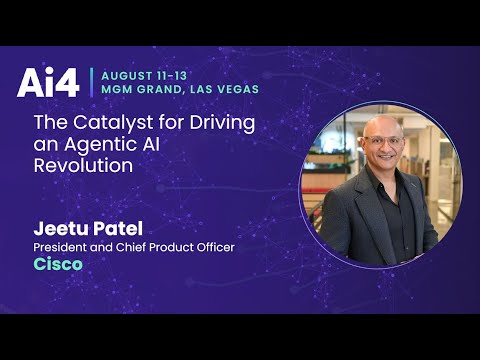
Eliminating junior talent undermines enterprise innovation by removing the unencumbered perspectives needed to force institutional unlearning, according to Cisco Chief Product Officer Jeetu Patel.
AI-assisted summary of The Catalyst for Driving an Agentic AI Revolution - Fireside Chat With Cisco, CNN — original source. Check the original for full context.
Source published:
Detailed notes
## Background Published on YouTube by the Ai4 channel on August 28, 2025, this video captures a fireside chat between Jeetu Patel, President and Chief Product Officer at Cisco, and CNN Senior Reporter Matt Egan. According to the page description, the session explores the transformative landscape of agentic AI, focusing on enterprise adoption, human collaboration, and Cisco's strategies for securing autonomous AI ecosystems at machine scale.
## TL;DR Jeetu Patel frames artificial intelligence as a fundamental civilizational shift from resource scarcity to abundance, dismissing alarmist human obsolescence claims while highlighting the underhyped emergence of original, superhuman scientific insights. As agentic AI advances from short-duration tasks to multi-week autonomous workflows, it faces severe bottlenecks in electrical power, compute infrastructure, and human trust. Patel strongly rejects the notion that AI will eliminate entry-level positions, arguing junior workers are vital for institutional unlearning and fresh problem framing. Ultimately, he stresses that enterprise adoption hinges on solving novel security challenges, calling for runtime guardrails, model validation, and fine-grained agent identity controls to counteract sophisticated adversarial threats.
## Atmosphere & style The fireside chat carries an intellectually rigorous, pragmatic, and conversational tone that cuts cleanly through standard Silicon Valley boosterism. Matt Egan acts as an incisive journalistic foil, raising pressing anxieties around technological displacement and economic shocks, while Patel counters with calm executive realism and vivid personal anecdotes, such as his daughter tapping a physical newspaper. The exchange feels grounded and candid, balancing high-stakes warnings about adversarial cybersecurity risks and power grid deficits with a deeply humanistic, optimistic perspective on adaptability.
## Key takeaways - [00:04](https://www.youtube.com/watch?v=iGd4cJP0ZwA&t=4s) Artificial intelligence marks a profound societal transition from historical resource scarcity to cognitive abundance, unlocking capacity to solve previously intractable problems. - [00:04](https://www.youtube.com/watch?v=iGd4cJP0ZwA&t=4s) Fears of complete human obsolescence within five years are overhyped, whereas the impending ability of AI to generate net-new original insights beyond the existing human knowledge corpus is deeply underhyped. - [02:59](https://www.youtube.com/watch?v=iGd4cJP0ZwA&t=179s) Agentic AI is moving from conversational chatbots toward multi-step autonomous agents, expanding autonomous execution horizons from 20-minute tasks to multi-day and multi-month workflows. - [02:59](https://www.youtube.com/watch?v=iGd4cJP0ZwA&t=179s) Pairing every individual with 10 to 100 autonomous agents could amplify global throughput to 800 billion human-equivalents, creating severe energy, compute, and infrastructure bottlenecks. - [02:59](https://www.youtube.com/watch?v=iGd4cJP0ZwA&t=179s) A pervasive trust deficit remains a primary adoption barrier, as current AI capabilities outpace what humans feel secure delegating without strict safety and reliability guarantees. - [06:35](https://www.youtube.com/watch?v=iGd4cJP0ZwA&t=395s) As intelligence commoditizes, professional value shifts away from raw knowledge accumulation toward the ability to frame nuanced, high-quality questions and challenges. - [06:35](https://www.youtube.com/watch?v=iGd4cJP0ZwA&t=395s) Metaprompting—instructing an AI model to architect the optimal prompt for a given task—delivers a step-function improvement in downstream output quality. - [06:35](https://www.youtube.com/watch?v=iGd4cJP0ZwA&t=395s) Adoption cycles are accelerating rapidly because AI systems understand natural human language rather than forcing humans to master machine programming syntax. - [09:36](https://www.youtube.com/watch?v=iGd4cJP0ZwA&t=576s) Eliminating entry-level white-collar roles would be a critical mistake; junior employees bring fresh perspectives and prompt organizational unlearning of outdated assumptions. - [09:36](https://www.youtube.com/watch?v=iGd4cJP0ZwA&t=576s) Accumulated professional experience can become a liability when leaders dismiss viable innovations based on past failures whose underlying technical conditions have fundamentally changed. - [15:02](https://www.youtube.com/watch?v=iGd4cJP0ZwA&t=902s) Workforce disruption requires tech and public sector partnerships to fund comprehensive reskilling, recognizing that displaced workers cannot simply transition into prompt engineers overnight. - [15:02](https://www.youtube.com/watch?v=iGd4cJP0ZwA&t=902s) Adversaries possess symmetric access to advanced AI models, enabling hyper-bespoke, context-aware social engineering and cyber threats at machine scale. - [17:06](https://www.youtube.com/watch?v=iGd4cJP0ZwA&t=1026s) Securing agentic ecosystems requires moving beyond perimeter defense to securing AI models themselves, implementing runtime guardrails, and enforcing fine-grained agent identity permissions.
## Detailed walkthrough ### [00:04](https://www.youtube.com/watch?v=iGd4cJP0ZwA&t=4s) Shifting from Scarcity to Abundance and the AI Overhype vs. Underhype
Matt Egan opens the fireside chat by recalling Jeetu Patel's assertion that artificial intelligence represents a shift larger than anything seen in our lifetimes. When asked what fundamental assumptions about society and the world must be reconsidered, Patel explains that human civilization has always operated under an organizing philosophy of resource scarcity. For generations, scarcity served as "the mother of invention," requiring humans to constantly balance finite resources. Society is now crossing a threshold into an era where true abundance is possible, unlocking the capacity to solve previously intractable problems—from curing cancer to engineering entirely new materials.
```mermaid flowchart TD accTitle: Evolution of AI Paradigms subgraph S1["Phase 1: Knowledge Aggregation"] A["Chatbots & LLMs"] --> B["Synthesize Human Corpus"] end subgraph S2["Phase 2: Autonomous Agents"] C["Deep Research (~20 Min)"] --> D["Multi-Day/Month Autonomy"] D --> E["Computer Use & Autonomous Tasks"] end subgraph S3["Phase 3: Original Insights"] F["Superhuman Problem Solving"] --> G["Novel Discoveries Beyond Human Corpus"] end S1 --> S2 --> S3 ```
Patel draws a sharp distinction between what is currently overhyped versus what remains deeply underhyped about the technology. What is overhyped is the alarmist notion that human beings will be made obsolete within five years, left with nothing to do while sitting idly on beaches with their creative juices extinguished. While every job will undergo significant reconfiguration, humans have consistently adapted and found new avenues to deliver value.
Conversely, the most underhyped dimension of AI is its impending capacity to produce genuine "original insights." Current large language models function primarily as sophisticated aggregation engines, scouring the existing human corpus of knowledge to synthesize patterns. The next frontier will feature models generating novel insights that have never existed within human records, fundamentally altering how science, material engineering, and broader society function.
- Core philosophical shift: Moving from historical resource scarcity to computational and cognitive abundance. - Overhyped narrative: Complete human obsolescence and displacement within a 5-year timeframe. - Underhyped breakthrough: Generation of net-new original insights beyond the existing human knowledge corpus.
---
[02:59](https://www.youtube.com/watch?v=iGd4cJP0ZwA&t=179s) The Phases of Agentic AI, Autonomous Horizons, and Infrastructure Constraints
Examining the trajectory of agentic AI, Patel contextualizes the industry as being squarely in its second phase. The first phase, spanning the prior two and a half years, centered on intelligent chatbots that answered queries with a sense of magic as users learned prompting dexterity. The second phase introduces autonomous agents capable of conducting end-to-end tasks and multi-step jobs on behalf of human operators. Patel points to tools like Deep Research as early proof points—agents that can currently run autonomously for roughly 20 minutes while a user gets coffee. As that autonomous horizon expands from 20 minutes to two hours, two days, two weeks, and eventually two months, the complexity of solvable problems will grow exponentially.
```mermaid flowchart LR accTitle: Agentic AI Bottlenecks and Enablers subgraph Scaling["Agentic Scaling"] H["1 Human Operator"] --> A["10 to 100 AI Agents"] A --> T["Throughput of 80B - 800B People"] end subgraph Bottlenecks["Critical Constraints"] E["Energy Shortage"] --> DC["Data Centers Moving to Power"] C["Compute & Network"] --> CU["Surge from Computer-Use Agents"] TD["Trust Deficit"] --> HU["Human Gatekeeping"] end Scaling -.-> Bottlenecks ```
This exponential agentic expansion brings severe physical and systemic bottlenecks. If every human is eventually paired with 10 to 100 autonomous agents operating round the clock, a global population of 8 billion could exhibit the economic and computational throughput of 80 billion to 800 billion people. The world currently lacks the power and compute capacity to sustain such demand, forcing data center construction to migrate directly to wherever power exists rather than bringing power to data centers. Furthermore, emerging modalities like "computer use"—where an agent interacts with operating systems and laptop interfaces just like a human—will place unprecedented pressure on network infrastructure and compute clusters.
Compounding these infrastructure limits is a pervasive "trust deficit." Patel emphasizes that the technical capacity of modern AI already outstrips what humans are willing to delegate to it. Until autonomous systems consistently earn user trust through verified safety, reliability, and security, humans will continue to restrict agent permissions and throttle adoption.
- Phase progression: Transitioning from transactional chatbot queries to prolonged autonomous task execution. - Autonomy scaling vector: Expanding continuous execution from 20 minutes to hours, days, and months. - Virtual labor multiplier: A 10x to 100x agent-to-human ratio multiplying global throughput up to 800 billion human-equivalents. - Primary adoption barriers: Severe electrical power/compute deficits and an acute human trust deficit.
---
[06:35](https://www.youtube.com/watch?v=iGd4cJP0ZwA&t=395s) The Art of Prompting, Metaprompting, and Compressed Adoption Cycles
Transitioning to user interactions, Patel explains how the fundamental nature of skill is evolving. Historically, accumulating domain knowledge was the ultimate differentiator for professional success. With intelligence and information becoming abundant, free, and commoditized, the primary differentiator becomes the ability to formulate nuanced, high-quality questions. Patel outlines a counterintuitive dynamic in problem-solving: tackling harder problems actually yields a higher probability of success because difficult challenges inherently attract top-tier talent, and business remains a collaborative team sport.
```mermaid flowchart TD accTitle: Prompting vs Metaprompting Flow subgraph Direct["Standard Prompting"] U1["User Intent"] --> P1["Direct Prompt"] --> O1["Standard Output"] end subgraph Meta["Metaprompting Architecture"] U2["User Intent"] --> MP["Prompt to Generate Optimal Prompt"] MP --> OP["Optimized System Metaprompt"] OP --> O2["High-Fidelity Output"] end ```
Patel highlights "metaprompting" as a transformative technique gaining prominence with advanced models. Rather than asking an AI system directly for an end asset—such as generating an image or complex analysis—the user instructs the model to construct the optimal prompt required to produce that asset, and then runs the refined prompt. This meta-layer produces an asymmetric, step-function improvement in the final output quality.
Engaging the audience with a show of hands on who uses metaprompting, Patel observes how rapidly societal ingestion cycles are compressing. Unlike previous technology cycles where humans had to learn the syntax and programming languages of machines, modern machines are learning natural human language, accelerating the pace of mainstream adoption.
- Value shift: Moving from knowledge accumulation to nuance and precision in problem framing. - Counterintuitive law of difficulty: Harder organizational problems attract superior talent, raising the net probability of success. - Metaprompting mechanics: Prompting the model to architect the query itself to unlock superior downstream fidelity. - Adoption acceleration: Natural language understanding drastically reduces human learning curves.
---
[09:36](https://www.youtube.com/watch?v=iGd4cJP0ZwA&t=576s) Challenging the Demise of Entry-Level Jobs and the Power of Unlearning
Egan references warnings from Anthropic CEO Dario Amodei, who suggested AI could wipe out half of all entry-level white-collar jobs and push unemployment to 10–20% within one to five years. While Patel notes that Cisco is an investor in Anthropic and expresses deep respect for Amodei, he strongly dissents from the thesis that entry-level positions should or will be eliminated, calling the blanket eradication of early-career roles "the stupidest thing a company can do."
To illustrate why, Patel compares how different age groups approach technology. A 28-year-old often utilizes AI in a transactional, task-oriented manner to automate existing workflows, whereas a 20-year-old interacts with AI as a persistent brainstorming partner and cognitive sidekick. Sharing a personal anecdote about his 14-year-old daughter—who grew up scrolling on an iPad from toddlerhood and later tapped a physical newspaper expecting the photograph to zoom in—Patel stresses that younger generations possess a fundamentally different baseline orientation toward modern tools.
```mermaid flowchart LR accTitle: Experience Liability vs Early Career Perspective subgraph Tenured["Tenured Mindset"] EXP["Past Experience"] --> BIAS["'Tried 5 years ago, failed'"] BIAS --> STAG["Institutional Inertia"] end subgraph Early["Early-Career Mindset"] FRESH["Unencumbered Perspective"] --> UNL["Forces Unlearning"] UNL --> INN["Novel Problem Solving"] end Tenured <-->|Symbiotic Coupling| Early ```
Patel argues that accumulated experience can frequently become a "massive liability." Seasoned professionals often dismiss viable ideas because an attempt failed years earlier, ignoring that thousands of underlying technical assumptions have since changed. Early-career workers inject untainted perspectives that force organizations to unlearn outdated mental models. Patel spends considerable time with student interns and junior employees for reverse mentorship, noting that true breakthrough innovation occurs only when fresh perspectives are coupled with seasoned execution experience.
- Rejection of early-career elimination: Discarding junior talent removes essential institutional adaptability and unlearning. - Generational usage disparity: Older cohorts use AI transactionally; younger digital natives use AI as an omnipresent collaborative sidekick. - Experience as a liability: Historical memory often prevents tenured leaders from revisiting previously failed concepts whose underlying conditions have changed. - Core value proposition: AI's true promise lies in tackling brand-new categories of problems rather than mere task-level productivity gains.
---
[15:02](https://www.youtube.com/watch?v=iGd4cJP0ZwA&t=902s) Societal Growing Pains, Reskilling, and Emerging Adversarial Threats
Egan brings up prior comments from Stanford professor Fei-Fei Li regarding unavoidable transitional growing pains during major technology disruptions. Patel agrees that the transition will carry significant friction, cautioning that the technology sector often lives in an insulated bubble where disruption is treated as routine. When industrial workers, such as steel mill employees, face displacement, "they don't become an AI prompt engineer." He calls on the tech sector to accept civic responsibility, partnering closely with the public sector to rebuild education pipelines, close the widening skills gap, and deliver comprehensive workforce retraining.
Beyond workforce displacement, Patel warns that safety, security, and adversarial threats represent catastrophic operational risks if left unmitigated. The identical AI capabilities built to empower enterprises are simultaneously available to nation-states and malicious adversaries. This parity enables bad actors to execute hyper-bespoke, sophisticated cyberattacks at machine scale, rendering legacy spam—such as poorly phrased emails from fictitious foreign princes asking for bank transfers—completely obsolete in favor of highly believable, context-aware threats.
- Macro friction: Workforce transitions require public-private partnerships; displaced industrial workers cannot simply pivot overnight to prompt engineering. - Symmetric adversarial capabilities: Malicious actors and nation-states wield the exact same advanced AI tooling as defenders. - Attack vector evolution: Shifting from rudimentary, typo-filled phishing scams to hyper-targeted, machine-speed adversarial exploits.
[17:06](https://www.youtube.com/watch?v=iGd4cJP0ZwA&t=1026s) Securing AI Itself and Enforcing Fine-Grained Agent Identity
Jeetu Patel illustrates the insidious nature of modern social engineering threats with a hyper-personalized phishing scenario: receiving a message saying, *"was great to see you at our kids' basketball game last night. Here are some pictures. Click to download."* The instant an unsuspecting user clicks the link, malware is dropped onto the endpoint and begins lateral movement across the enterprise network. To combat this reality, safety and security must be addressed aggressively—not merely by leveraging AI for cyber defense, but fundamentally by securing the AI models and systems themselves. AI models introduce novel attack surfaces and failure modes, including hallucinations, toxic outputs, and prompt injection attacks, all of which require dedicated mitigation strategies.
```mermaid flowchart TD accTitle: Securing Agentic AI Workflows subgraph ModelGov["Model Governance & Guardrails"] A["Data Ingestion Visibility"] --> B["Model Validation"] B --> C["Runtime Enforcement Guardrails"] end subgraph AgentSec["Agent Identity & Access"] C --> D["Agent Identity Verification"] D --> E{"Fine-Grained Permissions"} E -->|"Allowed"| F["Draft Emails to Team"] E -->|"Restricted"| G["Block Access: Boss & Board"] end ```
Securing the emerging ecosystem of autonomous agents requires end-to-end visibility into the training and inference data entering models, robust validation frameworks to confirm models behave as expected, and dynamic runtime enforcement guardrails. Furthermore, agents require a novel paradigm of machine identity and authentication when communicating with one another. Patel emphasizes that organizations must enforce fine-grained access controls rather than granting blanket privileges:
> "You don't want to have an agent say, 'Okay, get access to my email and send an email to everyone.' You might say, 'I want to have an agent be able to craft an email on my behalf, but not to my boss and my board of directors, but it's okay to do it to my team.'"
Patel concludes that solving safety, security, and risk mitigation across autonomous AI ecosystems is not just an enterprise imperative, but a broader responsibility that society collectively needs to resolve.
- **Vulnerabilities inherent to AI models:** Susceptibility to prompt injections, hallucinations, toxic outputs, and data poisoning. - **Core defensive layers:** Ingestion data visibility, model behavioral validation, runtime guardrail enforcement, and agent-to-agent identity verification. - **Principle of least privilege for agents:** Granular scoping of agent permissions (e.g., segmenting internal team communications from executive or board interactions) to prevent unauthorized automated actions.
---
[18:25](https://www.youtube.com/watch?v=iGd4cJP0ZwA&t=1105s) Session Wrap-Up
CNN senior reporter Matt Egan closes the fireside chat by thanking Jeetu Patel for sharing his perspectives on the agentic revolution, safety, and security architectures. Patel offers his thanks in return as the session concludes on a high note.
## Notable quotes > [00:04](https://www.youtube.com/watch?v=iGd4cJP0ZwA&t=4s) For the first time, we might be moving into an era of abundance where we can actually solve problems that were previously unsolvable. — Jeetu Patel
> [00:04](https://www.youtube.com/watch?v=iGd4cJP0ZwA&t=4s) The thing that is overhyped is that humans will become obsolete in five years and we won't have anything to do and we'll all be on beaches with no creative juices flowing. — Jeetu Patel
> [00:04](https://www.youtube.com/watch?v=iGd4cJP0ZwA&t=4s) The thing that's deeply underhyped is the capacity for these systems to generate original insights that don't exist in the human corpus today. — Jeetu Patel
> [02:59](https://www.youtube.com/watch?v=iGd4cJP0ZwA&t=179s) If every human has 10 to 100 agents working on their behalf, a population of 8 billion starts behaving like 80 billion or 800 billion people. — Jeetu Patel
> [02:59](https://www.youtube.com/watch?v=iGd4cJP0ZwA&t=179s) Data centers will move to power rather than power moving to data centers. — Jeetu Patel
> [02:59](https://www.youtube.com/watch?v=iGd4cJP0ZwA&t=179s) The technical capability of AI is moving faster than the trust deficit humans have with delegating tasks to it. — Jeetu Patel
> [06:35](https://www.youtube.com/watch?v=iGd4cJP0ZwA&t=395s) Harder problems actually have a higher probability of success because they attract better people, and business is a team sport. — Jeetu Patel
> [09:36](https://www.youtube.com/watch?v=iGd4cJP0ZwA&t=576s) The stupidest thing a company can do is eliminate entry-level jobs. — Jeetu Patel
> [09:36](https://www.youtube.com/watch?v=iGd4cJP0ZwA&t=576s) Experience can be a massive liability because you say, 'I tried that five years ago and it didn't work,' ignoring that a thousand underlying variables have changed. — Jeetu Patel
> [15:02](https://www.youtube.com/watch?v=iGd4cJP0ZwA&t=902s) When steel mill workers get displaced, they don't become an AI prompt engineer. — Jeetu Patel
> [15:02](https://www.youtube.com/watch?v=iGd4cJP0ZwA&t=902s) The same AI capabilities available to enterprises are available to nation-states and bad actors. — Jeetu Patel
> [17:06](https://www.youtube.com/watch?v=iGd4cJP0ZwA&t=1026s) You don't want to have an agent say, 'Okay, get access to my email and send an email to everyone.' You might say, 'I want to have an agent be able to craft an email on my behalf, but not to my boss and my board of directors, but it's okay to do it to my team.' — Jeetu Patel
## Mentioned Ai4, Anthropic, Cisco, CNN, Dario Amodei, Deep Research, Fei-Fei Li, Jeetu Patel, Matt Egan, Stanford University
## Video description Jeetu Patel, President and Chief Product Officer, Cisco Matt Egan, Senior Reporter, CNN Abstracts Join Jeetu Patel, President and Chief Product Officer at Cisco, for a fireside chat with Matt Egan, award-winning CNN Senior Reporter, where they will explore the transformative power of agentic AI. They will discuss how organizations that effectively harness agentic AI will set themselves apart in the near future, while those that don't risk falling behind. Together, Jeetu and Matt will address the evolving landscape of safety, security, identity, and human collaboration with autonomous AI agents. Jeetu will also share Cisco's groundbreaking innovations that secure agentic AI ecosystems at machine scale, turning security from a challenge into a strategic advantage that accelerates AI adoption. Discover how these advancements empower organizations to lead with trust, agility, and resilience in the emerging agentic era.
[Source](https://www.youtube.com/watch?v=iGd4cJP0ZwA)