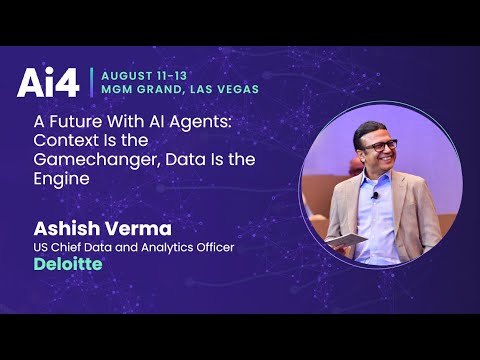
Deloitte Builds Knowledge Graph Agent to Staff 180,000 US Workers
Ai4
Keyword search fails across enterprise silos, forcing firms to build knowledge graphs that power AI agents to contextually match employee skills with project demands.
## Background
Published by the channel Ai4 on YouTube on August 24, 2025, this video features Ashish Verma, US Chief Data and Analytics Officer at Deloitte. The presentation addresses how agentic AI and contextual search are reshaping enterprise work, highlighting the necessity of an effective data strategy and continuous employee monitoring to successfully scale AI agents across an organization.
## TL;DR
In this talk, Ashish Verma outlines Deloitte's 14-month initiative to transition enterprise operations toward an agentic AI architecture. He explains how traditional, transactional enterprise search fails because keyword-based methods lack context, serving as a poor input for modern LLMs and reasoning agents. To overcome these limitations, Deloitte developed an enterprise-wide contextual search framework utilizing structured parsing, content indexing, and knowledge graphs. This approach is demonstrated through their global staffing operations, where AI agents bridge isolated resume data and real-time availability metrics to streamline complex candidate matching.
## Atmosphere & style
The presentation carries an authoritative, executive, and forward-looking tone characteristic of high-level corporate technology strategy. Verma speaks with pragmatic clarity, framing complex architectural challenges around real-world enterprise bottlenecks and concrete operational figures. The narrative moves deliberately from foundational data problems to practical corporate solutions, creating an informative and polished professional experience.
## Key takeaways
- [00:04](https://www.youtube.com/watch?v=em_NHWx4GEI&t=4s) Ashish Verma, US Chief Data and Analytics Officer at Deloitte, outlined a 14-month initiative to define how AI agents and reasoning will transform the future of work.
- [00:04](https://www.youtube.com/watch?v=em_NHWx4GEI&t=4s) Traditional enterprise data repositories rely on transactional applications that lack inherent context, making data search and discovery difficult.
- [00:04](https://www.youtube.com/watch?v=em_NHWx4GEI&t=4s) Enterprise search should function with intuitive, rank-based relevance similar to consumer search engines like Google.
- [00:04](https://www.youtube.com/watch?v=em_NHWx4GEI&t=4s) Keyword-based searches consistently fall short for complex enterprise data curation, pipeline architecture, and consumption patterns.
- [00:04](https://www.youtube.com/watch?v=em_NHWx4GEI&t=4s) In modern enterprise architectures, search is an input layer for action—retrieving contextualized data to feed LLMs or prompt reasoning agents.
- [00:04](https://www.youtube.com/watch?v=em_NHWx4GEI&t=4s) Achieving enterprise contextuality requires structured content parsing, indexing, and underlying knowledge graphs across diverse business domains like finance, HR, and supply chain.
- [00:30](https://www.youtube.com/watch?v=em_NHWx4GEI&t=30s) Matching personnel across Deloitte's global workforce (~455,000 employees, ~180,000 in the US) requires navigating complex combinations of roles, certifications, and technical skill sets.
- [00:30](https://www.youtube.com/watch?v=em_NHWx4GEI&t=30s) Legacy keyword searches on raw résumés cause operational friction, leading to incomplete skill matches and redundant candidate interviews.
- [00:30](https://www.youtube.com/watch?v=em_NHWx4GEI&t=30s) Deloitte implemented an AI agent layer to link contextualized résumé insights directly with real-time staffing availability systems.
## Detailed walkthrough
Here is a detailed, faithful walkthrough of the transcript:
[00:04](https://www.youtube.com/watch?v=em_NHWx4GEI&t=4s) Rethinking Enterprise Data Discovery for the Agentic Era
Ashish Verma, US Chief Data and Analytics Officer at Deloitte, begins by outlining the mandate he set out to fulfill roughly 14 months prior: defining how reasoning and AI agents will shape the future of work. At the core of this transformation is a glaring operational bottleneck—enterprise data repositories, traditionally built on transactional applications, are notoriously difficult to search and completely lack contextuality. Verma draws a contrast with consumer search: when using Google, a user types a query in natural English and receives a ranked list of relevant results to navigate. He posed a fundamental question to his team: why can't enterprise search function with that same Google-like intelligence?
Keywords alone are fundamentally insufficient for modern enterprise architectures and pipeline curation. Verma emphasizes that search is rarely the final### The Challenge of Enterprise Search and Contextuality
Ashish Verma, US Chief Data and Analytics Officer at Deloitte, framing his presentation around Deloitte’s 14-month journey toward agentic AI and contextual search, notes that enterprise data repositories are historically built on transactional applications that naturally lack context. When users perform a standard web search, such as on Google using natural language, they receive rank-based relevant results to navigate. Verma highlights the central question Deloitte asked 14 months ago: why can't enterprise search function with that same intuitive, rank-based relevance? Keyword searches consistently fall short for enterprise data curation and consumption patterns.
In modern enterprise architectures, search is rarely the end goal; it is the discovery mechanism to retrieve data that will subsequently feed an action, such as training a Large Language Model (LLM) or prompting a reasoning agent. Contextuality cannot be achieved by accident. Google built its architecture by parsing content across hosted websites, indexing it on a content store, and utilizing an underlying knowledge graph to enable smooth traversal. Deloitte set out to mirror this capability within the enterprise, allowing seamless cross-domain traversal across finance, sales, staffing, HR, and supply chain data.
- Traditional enterprise repositories rely on transactional schemas that lack inherent context.
- Search acts as an input layer to agentic reasoning rather than a standalone objective.
- True discovery requires structured parsing, content indexing, and knowledge graph structures across enterprise domains.
[00:30](https://www.youtube.com/watch?v=em_NHWx4GEI&t=30s) Solving Enterprise Staffing Complexity at Scale
Deloitte manages roughly 455,000 global employees, with approximately 180,000 based in the US. For every project engagement, resource managers must match and staff personnel based on specific role levels, certifications, technical skill sets, and industry experience. In the absence of contextual search, resource managers resort to keyword searches on résumés—not out of spite, but because raw résumé repositories and current staffing databases are isolated silos not designed to talk to one another.
Relying solely on keyword search creates operational friction, leading to incomplete skill matches and redundant rounds of interviews to verify candidate fit. To solve this, Deloitte built an AI agent layer capable of linking contextualized résumé insights directly with real-time staffing availability metrics.
- Global headcount: ~455,000 overall; ~180,000 US-based professionals.
- Legacy workflow issues: Keyword searching fails to capture nuance across specialized roles (e.g., retail banking wealth management cloud migrations).
- Integrated data strategy: Contextual AI bridges disparate résumé stores and live resource allocation systems.
[05:48](https://www.youtube.com/watch?v=em_NHWx4GEI&t=348s) Live Demonstration
## Notable quotes
> [00:04](https://www.youtube.com/watch?v=em_NHWx4GEI&t=4s) why can't enterprise search function with that same Google-like intelligence? — Ashish Verma
> [00:04](https://www.youtube.com/watch?v=em_NHWx4GEI&t=4s) Keywords alone are fundamentally insufficient for modern enterprise architectures and pipeline curation. — Ashish Verma
> [00:04](https://www.youtube.com/watch?v=em_NHWx4GEI&t=4s) why can't enterprise search function with that same intuitive, rank-based relevance? — Ashish Verma
## Mentioned
Ashish Verma, Deloitte, Google, US Chief Data and Analytics Officer, Large Language Model (LLM), AI Agents, Agentic AI
## Video description
Ashish Verma, US Chief Data and Analytics Officer, Deloitte
Abstracts
Imagine if you had an assistant that would not only answer your questions, digging back into piles of company and public data, but could complete the mundane tasks that used to take you hours to complete… in minutes. AI Agents are about to fundamentally change how we work and the use cases will extend into every department of the enterprise. In this session, you will learn what Agentic AI is all about, why contextual search has changed the game to make it possible, and what you will need to do not only to explore your own use cases, but to scale the technology so it works for everyone in your organization. It can’t happen if your data strategy isn’t working and every AI Agent is going to need to be monitored over time by employees. We will share what’s worked for Deloitte as we implement AI Agents. What’s worked for us, can work for you.
According to Ashish Verma, US Chief Data and Analytics Officer at Deloitte, enterprise search must evolve from keyword querying to contextual discovery via knowledge graphs to effectively power downstream AI reasoning agents. He argues that transactional data silos currently inhibit automated operational actions, such as global workforce staffing, unless unified into a contextualized layer.
Contextual Discovery as an Agent Action Foundation (0:04)
Ashish Verma emphasizes that conventional enterprise repositories are structured around transactional applications that inherently lack context, contrasting sharply with consumer search engines that deliver rank-based, relevant results from natural language queries. In modern enterprise architectures, Verma maintains that search is rarely the ultimate objective. Instead, it functions as a retrieval mechanism to discover the data required to prompt reasoning agents or train large language models.
To overcome the limitations of keyword matching, Deloitte sought to replicate web-scale retrieval capabilities by implementing an architecture based on content parsing, content store indexing, and knowledge graph traversal. This setup is designed to allow seamless context navigation across distinct enterprise domains, including finance, human resources, sales, staffing, and supply chain operations.
Resolving Operational Silos in Enterprise Staffing (0:30)
Deloitte applies this contextual approach to the operational challenge of staffing project engagements across roughly 455,000 global personnel, including approximately 180,000 US-based professionals. Historically, resource managers resorted to keyword searches across résumés because candidate profile repositories and live staffing databases were isolated systems unable to communicate with each other.
Verma notes that this keyword dependency created significant friction, failing to capture nuances required for specialized roles and necessitating redundant interview cycles to verify candidate qualifications. To resolve the mismatch, Deloitte deployed an AI agent layer capable of directly synthesizing contextual résumé data with real-time staffing availability metrics.
While Verma illustrates how integrating contextual knowledge graphs with live databases resolves large-scale resource allocation challenges, the presentation moves into a live demonstration without detailing the technical overhead or governance challenges of maintaining these cross-domain graphs over time.
## Background
该视频由 YouTube 频道 Ai4 于 2025 年 8 月 24 日发布。视频内容由德勤美国首席数据与分析官(US Chief Data and Analytics Officer)Ashish Verma 主讲,探讨了企业如何通过上下文搜索与坚实的数据战略构建、扩展 AI Agent,并分享了德勤在内部落地智能体以及持续实施人机协同监控的实战经验。
## TL;DR
演讲指出传统的关键词搜索在复杂的企业场景中已彻底失效,无法满足 AI Agent 推理与执行所需的数据发现需求。Verma 以德勤全球 45.5 万名员工的复杂人才配置为例,展示了内部 AI Agent 如何通过多轮自然语言交互、多职级穿透以及邻近技能推理精准匹配候选人。德勤通过搭建聚合超过 520 个数据集的类亚马逊“数据市场”与自动化“数据管家”,实现了算力与数据的即时供给。最后,他强调智能体不是在替代岗位而是在重塑人机协同(Human-in-the-Loop)的新分工,并告诫企业数据标注与标签化是智能体能否真正落地的关键底座。
## Atmosphere & style
整场演讲呈现出典型企业高管务实、从容且不失幽默的叙事基调。主讲人通过“深夜赶做 PPT”、“比起咖啡更爱以红酒会友”等轻快风趣的自嘲与现场互动打破了企业技术架构的沉闷感,同时借助清晰易懂的现场交互演示,将抽象的知识图谱与智能体概念直观落地。观众在聆听时能深切体会到一种从剖析庞大组织痛点的真实共鸣,逐步过渡到展示前沿系统落地时的沉稳自信与实战启发。
## Key takeaways
- [00:04](https://www.youtube.com/watch?v=em_NHWx4GEI&t=4s) 传统关键词搜索在企业复杂场景中已彻底失效,构建具备领域上下文感知的搜索能力是驱动 AI Agent 推理与行动的底层基石。
- [00:04](https://www.youtube.com/watch?v=em_NHWx4GEI&t=4s) 企业数据大都沉淀于缺乏上下文能力的传统事务型应用中,不同于通用互联网搜索引擎,企业必须主动构建领域上下文才能打破系统壁垒。
- [03:30](https://www.youtube.com/watch?v=em_NHWx4GEI&t=210s) 德勤全球拥有约 45.5 万名员工(美国约 18 万人),缺乏上下文搜索导致资源经理只能依赖机械关键词筛选简历,极易造成人才错配与效率低下。
- [05:48](https://www.youtube.com/watch?v=em_NHWx4GEI&t=348s) 德勤实机展示了 AI Agent 跨层级多条件筛选与邻近技能(Adjacent Skills)推理能力,能自动发掘具备可替代技术栈的合适候选人。
- [05:48](https://www.youtube.com/watch?v=em_NHWx4GEI&t=348s) 基于上下文的人才调度模式具有高度跨行业通用性,可直接复用到零售门店排班、综合赛事调度以及医院急诊室医护配比等场景。
- [09:10](https://www.youtube.com/watch?v=em_NHWx4GEI&t=550s) 德勤构建了类亚马逊模式的内部数据市场(Data Marketplace),已聚合约 520 个独立数据源,预计年底前扩展至约 1,000 个。
- [10:45](https://www.youtube.com/watch?v=em_NHWx4GEI&t=645s) 数据市场通过“概率匹配引擎”与“自动化数据管家(Data Concierge)”,实现数据集与计算环境的自动调配,解决了传统人工配置的扩展性瓶颈。
- [12:19](https://www.youtube.com/watch?v=em_NHWx4GEI&t=739s) AI Agent 并未剥夺人类工作,而是重新定义了岗位职责;人类从机械的简历检索中解放出来,转向高价值的候选人深度沟通与业务决策。
- [12:19](https://www.youtube.com/watch?v=em_NHWx4GEI&t=739s) 这重塑了“人机协同(Human-in-the-Loop)”的范式,人类不再是系统的基础操作工,而是充当高阶决策与体验赋能的核心角色。
- [13:21](https://www.youtube.com/watch?v=em_NHWx4GEI&t=801s) 在底层技术架构上,德勤跨 AWS、Azure、Google Cloud 三大主流云部署,并通过专门的决策树机制按业务场景智能分发匹配不同的大语言模型(LLMs)。
- [13:21](https://www.youtube.com/watch?v=em_NHWx4GEI&t=801s) 企业推进 Agentic AI 最容易卡壳的致命瓶颈在于“数据标注与标签化(Annotation & Labeling)”,数据战略必须与业务野心保持一致。
## Detailed walkthrough
### [00:04](https://www.youtube.com/watch?v=em_NHWx4GEI&t=4s) 企业数据的痛点:从关键词搜索走向上下文感知
德勤美国首席数据与分析官(US Chief Data and Analytics Officer)Ashish Verma 开启了他的演讲,回顾了大约 14 个月前德勤在探索 AI Agent 与上下文搜索(Contextual Search)时的核心命题:当企业着手构建推理机制、打造重塑未来工作模式的 AI 智能体时,底层究竟需要具备什么样的基础设施?答案显而易见却又异常棘手——在任何大型企业内部,寻找数据或实现具备上下文的搜索都是极度困难的。大多数企业的数据资产都构建在传统的事务型应用(Transactional Applications)之上,而这些系统在设计之初就根本不具备上下文能力。
在互联网世界中,人们早已习惯了 Google 搜索的便利:只需在搜索框中键入普通的自然语言,系统便会返回基于相关性排名的结果集,供用户逐层浏览导航。德勤在 14 个月前向自身发问:“为什么我们不能在企业内部数据上实现如同 Google 一样的搜索体验?”在实际业务探索中,团队清晰地意识到——传统的关键词搜索(Keyword Search)在复杂的企业场景中已经彻底失效。无论是数据架构师还是同行的数据管道治理人员,都会发现用户发起搜索的最终目的从来不是“搜索本身”,而是为了发现数据,并将其传递给下游的行动载体——或是交给具备推理能力的 AI Agent,或是用于大语言模型(LLM)的训练。因此,数据导航的“上下文语境化”是驱动 Agentic(智能体化)行动的绝对基石。
```mermaid
flowchart LR
accTitle: Enterprise Search to Agentic Action Flow
subgraph S1["数据检索层"]
A["自然语言查询"] --> B["企业上下文搜索"]
B --> C["跨系统数据发现"]
end
subgraph S2["智能执行层"]
C --> D["推理型 AI Agent"]
C --> E["LLM / 模型训练"]
D --> F["业务任务执行"]
end
```
- **互联网与企业搜索的底层差异**:Google 爬取全网内容、建立索引,并通过底层的知识图谱(Knowledge Graph)与相关性排序机制支持语义跳转;企业如果想打破财务、销售、人力、供应链等系统壁垒,必须主动构建相似的领域上下文(Domain Contextuality),而这种能力“绝不可能凭空或偶然诞生”("You can't build contextuality by accident")。
---
### [03:30](https://www.youtube.com/watch?v=em_NHWx4GEI&t=210s) 人才配置难题:45.5 万名员工与关键词搜索的局限
为了具体说明上下文缺失所带来的业务困境,Verma 详细剖析了德勤庞大的全球人员配置(Staffing)体系。德勤在全球拥有约 45.5 万名员工,仅美国地区就有约 18 万人。面对不断涌现的客户签约与项目交付,资源经理(Resource Manager)需要从这 18 万人乃至全球网络中,根据员工的职级、技能专长、行业认证及特定行业经验精准匹配角色。然而,在缺乏上下文搜索工具的现实下,要求一个资源经理人工阅读 45 万份简历是完全不可能的人力任务,他们只能退而求其次依赖机械的关键词匹配。
举例来说,当收到一份需要“零售银行(Retail Banking)背景、具备云迁移经验、且针对财富管理(Wealth Management)业务”的人员需求时,由于简历库中的数据没有建立上下文关联,关键词搜索往往会遗漏关键候选人,或仅根据残缺的技能片段草率推选。这种痛点不仅存在于咨询部门,在税务、审计、并购(M&A)等专业领域同样普遍。其直接恶果就是导致人员错配,或者迫使业务团队不得不安排多轮冗长的人工面试与对话来再次确认人选资质。德勤需要解决的核心技术问题,正是如何将员工非结构化的简历数据与底层的实时排期配置(Staffing)系统在语义和上下文层面深度联通。
- **德勤人员规模**:全球约 455,000 人,美国本土约 180,000 人。
- **资源经理的无奈现状**:Verma 强调资源经理使用关键词搜索“绝不是为了惹恼你”("They're not doing a keyword search to piss you off"),而是因为手头的简历数据根本没有结构化和上下文化的导航通道。
- **跨库割裂现状**:人员的履历专长数据与当下的项目派驻(Staffing)状态往往分属完全独立的数据库,彼此割裂,为日常匹配制造了巨大的系统性障碍。
---
### [05:48](https://www.youtube.com/watch?v=em_NHWx4GEI&t=348s) AI Agent 实机展示:多轮限定与技能邻近推理
Verma 现场展示了德勤内部打造的智能交互界面。界面打趣地显示着“晚上好,Ashish”(因为组委会要求前天交幻灯片,他只能在前一天深夜准备)。他首先输入自然语言指令:“能否为我找出 3 位具备零售银行经验的人选?”系统瞬时扫描并穿透全球 45.5 万名员工的专家画像,精准列出了 3 位符合条件的顾问,并在底部交互栏提示是否需要进一步限定条件。
紧接着,Verma 演示了深度追问的上下文追溯能力。他进一步提问:“Maria 此前是否在某家特定银行(代称 XYZ 银行)工作过?”系统准确判断并回答“没有”。系统不仅能够识别银行的具体名称或缩写,还能理解财富管理等细分业务概念。随后,他下达了一个更复杂的跨职级组合指令:在德勤的职级序列中(顾问 Consultant、高级顾问 Senior Consultant、经理 Manager、高级经理 Senior Manager 等),跨越两个不同职级,同时筛选出具备 Python 编程经验的人选。系统不仅返回了姓名与职级,还展现了关键的上下文推理——智能体明确指出,尽管用户要求了 Python,但系统挖掘出了某些具备与 Python 高度邻近或替代性编程语言技能的人选,以便决策者做全盘考量。
- **多职级混合筛选**:一次交互即可在多层级体系中并行穿透不同梯队的专业人才。
- **邻近技能推荐(Adjacent Skills)**:AI Agent 不仅能核对硬性关键词(如 Python),还能依据知识图谱推理出相关联的技术栈,从而为候选人池提供柔性补充。
- **跨行业通用模式**:这种人员排班匹配不仅局限于德勤,零售门店(前台、收银、补货员排班)、大型综合赛事(如奥运会现场调度)以及医院急诊室(ER 驻院护士与会诊医生的配比)本质上面临着完全相同的业务拓扑。
---
### [09:10](https://www.youtube.com/watch?v=em_NHWx4GEI&t=550s) 数据战略的终局:520 个数据集与内部数据市场
在演示尾声,Verma 面向全场(调侃因台灯太亮看不清台下是否有同行 CDAO 举手)总结道:任何首席数据与分析官(CDAO)或企业数据团队都必须清醒地认识到,如果企业级数据本身不具备上下文、无法被智能体轻松发现,那么任何宏大的数据战略或 Agentic AI 项目都将是一场极其艰难的徒劳。你甚至无法预知智能体具体需要哪些数据,更不知道该去哪里抓取。
德勤目前正全速推进企业全域数据源的上下文改造工程。这一布局远远超出了德勤自身的内部运营数据,而是全面覆盖了公共领域数据以及关键的第三方商业数据——包括 Gartner 的行业研报、汤森路透(Thomson Reuters)与标普全球(S&P Global)的金融数据、穆迪(Moody's)的信用与基准评测数据等。目前,德勤运营的内部数据市场(Data Marketplace)已经聚合了大约 520 个互不相同的独立数据集,成为驱动后续所有智能体与高阶分析的战略底座。
### [10:45](https://www.youtube.com/watch?v=em_NHWx4GEI&t=645s) 数据集成的飞速扩张与情境化数据市场
德勤在数据整合上面临着庞大且复杂的来源体系。数据不仅涵盖公有领域公开数据与企业内部私有数据,还通过时间序列与长周期维度纵向拼接合成数据(synthetic data),以支持前沿实验。目前,德勤的数据底座已接入约 520 个独立数据源(distinct data feeds),并且正以极快的速度递增——按照当前的业务节奏,预计在年底前将扩展至约 1,000 个数据源,平均以每期 60 到 80 个新增数据源的速率高速推进。
为了让如此庞杂的数据产生价值,德勤搭建了一个运作方式类似于亚马逊电商平台(Amazon Marketplace)的“数据市场”(Data Marketplace)。用户进入市场后,无需知晓底层技术细节,只需在具体业务语境下提出需求,例如“我需要一个智能体或需要开展某项实验,能否给出与该场景概率匹配(probabilistic matching)的数据集”。平台随即基于概率匹配推选出最契合的数据集,并由背后的“数据管家”(Data Concierge)功能自动调配运算环境(compute environment)与相应数据。
这一自动化流程彻底突破了人工支持的瓶颈。面对德勤全美约 180,000 名员工,甚至全球范围内的 455,000 名员工,如果未来数据集规模扩张到 5,000 或 10,000 个,传统依赖人工数据管家逐个配置环境与数据集的方式将彻底瘫痪。德勤通过将“可发现性”(discoverability)与“计算资源调配”(provisioning)这两个核心机制完全自动化,真正实现了情境化检索与自动化供给。
```mermaid
flowchart TD
accTitle: 德勤数据市场与自动化数据管家供给流程
subgraph S1["数据摄取层 (Data Ingestion)"]
D1["公开数据 (Public Domain)"]
D2["企业内部数据 (Internal Data)"]
D3["纵向合成数据 (Synthetic Data)"]
end
subgraph S2["核心匹配平台 (Marketplace Core)"]
MP["数据市场 (Data Marketplace)"]
PM["概率匹配引擎 (Probabilistic Matching)"]
end
subgraph S3["自动化交付层 (Automated Delivery)"]
DC["数据管家 (Data Concierge)"]
ENV["计算环境与数据集供给 (Compute & Data Provisioning)"]
end
D1 --> MP
D2 --> MP
D3 --> MP
MP --> PM
PM --> DC
DC --> ENV
```
- 当前系统运行着约 520 个独立数据源,预计年底前扩张至约 1,000 个,增长速度约为每批次 60 至 80 个数据源。
- 支持全美 180,000 人及全球 455,000 名德勤员工的数据检索与调配需求。
- 自动化不仅涵盖找数据的过程,还直接打通了底层算力环境与数据集的“一键式”自动化配置。
---
### [12:19](https://www.youtube.com/watch?v=em_NHWx4GEI&t=739s) 重新定义岗位职责:人机协同(Human-in-the-Loop)的新范式
在推动智能体与自动化的过程中,业界普遍存在一种疑虑:这是否在剥夺人类的工作机会?面对“你们是否在裁员消除岗位”的尖锐提问,明确的回答是“不,我们在重新定义角色”("I'm redefining what the role would be")。以人力资源调配(staffing)为例,过去招聘与人员调配经理需要把大量时间耗费在简历的关键词搜索等机械性事务上;而现在,基础的简历筛选与角色匹配已交给情境化搜索去自动化完成。
释放出来的生产力被转移到更高阶的人际协同上。当系统通过关键词与语义检索将候选人筛选出来后,调配经理的核心工作变成了高价值的沟通与引导——判断候选人是否真正契合岗位,并与招聘方深入互动,挖掘并提供简历或调配系统数据中无法体现的深层次信息。
这种变革重新诠释了“人机协同”(Human-in-the-Loop)的定义。在传统认知中,人往往充当系统的基础操作工;而在新的智能体架构下,人类从耗时费力的搜寻任务中解放出来,转而承担更深层的业务决策、洞察补充与体验赋能,真正实现以人为核心的高阶协同。
---
### [13:21](https://www.youtube.com/watch?v=em_NHWx4GEI&t=801s) 企业智能体未来愿景与数据战略的底层约束
企业智能体的未来形态正迅速演进。包括首席财务官(CFO)、首席营销官(CMO)以及首席供应链官在内的各业务高管,在规划未来时纷纷提出明确诉求,希望构建能够具备推理或特定执行能力的智能体,并请求数据团队提供适配的数据集来开展实验。在底层架构上,德勤采取高度中立且全面的布局:
- 运行于全部三大主流超大规模云厂商(Hyperscalers:AWS、Azure、Google Cloud)。
- 部署大多数主流大语言模型(LLMs),并建立专门的决策树(decision tree)机制,根据具体业务场景指引使用最匹配的模型。
- 无论是直接构建智能体、还是微调训练 LLM,都被抽象为底层算力与数据供给的调用模式。
未来是属于智能体的,其核心在于通过情境化自动化发现所需数据集,并将其深度嵌入业务价值链之中。然而,这一切的前提是“数据战略必须与业务野心保持一致”。许多企业雄心勃勃却迅速受挫,核心瓶颈往往在于数据标注与标签化(annotation and labeling)。在规模化落地的过程中,业务部门对标注数据的需求不再局限于企业内部数据,而是跨越壁垒,广泛索求第三方数据、第二方数据甚至是合成数据。如果缺乏坚实的数据资产整理与供给能力,任何智能体蓝图都将无法推进。
演讲在探讨了生态系统合作伙伴的共生价值后轻松收尾。对于后续的交流,现场笑称平时比起咖啡更爱喝红酒,欢迎大家以酒会友、深入探讨,在全场掌声中结束了本次分享。
- 底层支持跨三大云服务商部署,依托模型决策树智能匹配不同大模型。
- 业务需求不仅覆盖企业内部核心资产,更要求对外部第二方、第三方及合成数据进行统一标注与履约。
- 企业在智能体探索中最容易卡壳的致命环节是“数据标注与标签化”(Annotation & Labeling)。
## Notable quotes
> [00:04](https://www.youtube.com/watch?v=em_NHWx4GEI&t=4s) 为什么我们不能在企业内部数据上实现如同 Google 一样的搜索体验? — Ashish Verma
> [00:04](https://www.youtube.com/watch?v=em_NHWx4GEI&t=4s) You can't build contextuality by accident — Ashish Verma
> [03:30](https://www.youtube.com/watch?v=em_NHWx4GEI&t=210s) They're not doing a keyword search to piss you off — Ashish Verma
> [05:48](https://www.youtube.com/watch?v=em_NHWx4GEI&t=348s) 能否为我找出 3 位具备零售银行经验的人选? — Ashish Verma
> [09:10](https://www.youtube.com/watch?v=em_NHWx4GEI&t=550s) 如果企业级数据本身不具备上下文、无法被智能体轻松发现,那么任何宏大的数据战略或 Agentic AI 项目都将是一场极其艰难的徒劳。 — Ashish Verma
> [10:45](https://www.youtube.com/watch?v=em_NHWx4GEI&t=645s) 我需要一个智能体或需要开展某项实验,能否给出与该场景概率匹配的数据集 — Ashish Verma
> [12:19](https://www.youtube.com/watch?v=em_NHWx4GEI&t=739s) I'm redefining what the role would be — Ashish Verma
> [13:21](https://www.youtube.com/watch?v=em_NHWx4GEI&t=801s) 数据战略必须与业务野心保持一致 — Ashish Verma
## Mentioned
德勤 (Deloitte), Ashish Verma, Google, Gartner, 汤森路透 (Thomson Reuters), 标普全球 (S&P Global), 穆迪 (Moody's), 亚马逊 (Amazon), AWS, Azure, Google Cloud, Python
## Video description
Ashish Verma, US Chief Data and Analytics Officer, Deloitte
Abstracts
Imagine if you had an assistant that would not only answer your questions, digging back into piles of company and public data, but could complete the mundane tasks that used to take you hours to complete… in minutes. AI Agents are about to fundamentally change how we work and the use cases will extend into every department of the enterprise. In this session, you will learn what Agentic AI is all about, why contextual search has changed the game to make it possible, and what you will need to do not only to explore your own use cases, but to scale the technology so it works for everyone in your organization. It can’t happen if your data strategy isn’t working and every AI Agent is going to need to be monitored over time by employees. We will share what’s worked for Deloitte as we implement AI Agents. What’s worked for us, can work for you.
[Source](https://www.youtube.com/watch?v=em_NHWx4GEI)
Source quotes
[0:04] Ashish Verma: 为什么我们不能在企业内部数据上实现如同 Google 一样的搜索体验?
[0:04] Ashish Verma: You can't build contextuality by accident
[3:30] Ashish Verma: They're not doing a keyword search to piss you off
[5:48] Ashish Verma: 能否为我找出 3 位具备零售银行经验的人选?
[9:10] Ashish Verma: 如果企业级数据本身不具备上下文、无法被智能体轻松发现,那么任何宏大的数据战略或 Agentic AI 项目都将是一场极其艰难的徒劳。
[10:45] Ashish Verma: 我需要一个智能体或需要开展某项实验,能否给出与该场景概率匹配的数据集
[12:19] Ashish Verma: I'm redefining what the role would be
[13:21] Ashish Verma: 数据战略必须与业务野心保持一致
Source quotes
[0:04] Ashish Verma: why can't enterprise search function with that same Google-like intelligence?
[0:04] Ashish Verma: Keywords alone are fundamentally insufficient for modern enterprise architectures and pipeline curation.
[0:04] Ashish Verma: why can't enterprise search function with that same intuitive, rank-based relevance?
Original transcript
[0:04] You know, one of the things that I was
[0:05] asked to talk about is, you know, what
[0:07] is my mandate when I look at Deoid in
[0:09] the future in agents and contextual
[0:12] search, right? So, we started this
[0:14] roughly about 14 months ago. Think of it
[0:16] as the narrative for
[0:18] we were attempting to figure out when we
[0:21] actually build reasoning or when we
[0:23] build an agents that are fundamental to
[0:25] how we define the future of work. What
[0:27] is it that we needed to have in place?
[0:29] Um,
[0:31] very simply said, it's very hard in any
[0:34] enterprise to find data or contextual
[0:37] search, right? Most of us when we look
[0:40] at our enterprise data repositories,
[0:44] they're built on the back of
[0:45] transactional applications that don't
[0:47] really lend themselves to contextuality.
[0:50] The easiest way to think about this is
[0:52] when you do a Google search and uh you
[0:55] type in English language what you're
[0:56] looking for and you get rankbased
[0:59] relevance result sets that you traverse
[1:01] through until you get what you're
[1:02] looking for. The question that we asked
[1:04] ourselves is why can't we do Google
[1:06] search on our enterprise data? And we
[1:08] asked this question about 14 months ago
[1:10] and said like is there something
[1:12] fundamentally missing
[1:14] for how we need to discover our data
[1:16] sets because it became obvious to us for
[1:18] everything that we did.
[1:20] Key word search does not work for us and
[1:25] it's true for most of you that are sort
[1:27] of you know either my peers or doing
[1:31] some aspect of data pipeline curation
[1:34] for conformance and all the different
[1:36] consumption patterns that you built your
[1:38] architectures for. So
[1:42] more often when you start to search for
[1:45] something, the end intent is not search
[1:47] itself, right? The end intent is that
[1:49] you're going to use search to discover a
[1:52] data set and then you'll do something
[1:53] with that data set. Whether you give it
[1:55] to a reasoning agent like an agent or if
[1:58] you do something along the lines of
[2:01] training an LLM or whatever it may be,
[2:03] right? whatever your architecture
[2:04] pattern is. In essence, you start with
[2:07] how you're going to attempt to
[2:09] contextualize what you're looking for
[2:11] and then feed it to an action which is
[2:14] more often than not agentic these days,
[2:16] right? Um, which is why search is very
[2:21] important for contextuality, right?
[2:23] Which is why even when you do
[2:24] conversations these days,
[2:27] pick your favorite, you know,
[2:29] conversational AI tool or pick your
[2:30] favorite interaction tool. You're in
[2:33] essence attempting to figure out how do
[2:35] I contextualize the navigation aspect of
[2:39] the data sets that we have. And by the
[2:41] way, you can't build contextuality by
[2:43] accident. So if you look at the Google
[2:45] architecture and if you look at what
[2:46] they built for the worldwide web, they
[2:49] started to parse
[2:51] content from most hosted websites and
[2:54] they basically built an index on a
[2:56] content store and the knowledge graph
[2:59] that they have under the hood gives you
[3:00] the ability to traverse these data sets
[3:02] and the rankbased relevance that they do
[3:04] when you query against that data set is
[3:06] the architecture right and that's what
[3:08] we were looking for. Um can we find
[3:10] something like that? So domain
[3:13] contextuality between different data
[3:15] sets you can traverse when you parse all
[3:17] the content whether it's your finance
[3:19] data, your sales data, your staffing
[3:22] data, your HR data, your supply chain
[3:25] data. That's what we were attempting to
[3:27] do. So um let me sort of tell you how
[3:30] the world of Deoid works, right? So we
[3:33] have about 455,000 people globally.
[3:37] um about 180,000 of that is US-based.
[3:41] And for every project that we sell or
[3:44] every client that we serve, you have to
[3:47] staff the equivalent of 180,000 people
[3:51] to a certain role based on their level,
[3:54] their skill set, their certification,
[3:56] their industry expertise. In the absence
[3:59] of contextuality,
[4:01] a resource manager today does a keyword
[4:04] search. So when you send a resource
[4:06] manager role description and say I am
[4:09] looking for such and such retail banking
[4:12] having done a migration to the cloud and
[4:15] by the way it's wealth management
[4:17] humanly impossible for an individual to
[4:20] read through 450,000 resumeums to find
[4:22] the right skill set.
[4:24] So what do they do? They do a keyword
[4:27] search. They're not doing a keyword
[4:28] search to piss you off. They're doing a
[4:30] keyword search because the resume
[4:32] information that we have is not
[4:34] contextualized for them to navigate or
[4:37] traverse this data set which has
[4:38] information about who you are,
[4:42] your level, what city, what
[4:45] certifications and how many times have
[4:47] you done this in retail banking? Right?
[4:49] So imagine this problem being true for
[4:54] the staffing whether you were tax
[4:56] professional, an audit professional, M&A
[4:58] professional, a consultant, right? This
[5:01] is a huge problem for us. And what that
[5:05] entails in essence is things that we
[5:07] don't anticipate. What does that mean?
[5:10] meaning people staffing based on part of
[5:12] the skill sets or there's the individual
[5:15] that's staffing the role going through
[5:18] another conversation or interview
[5:20] process to figure out is this the best
[5:22] fit that is what we're trying to solve
[5:24] for so how can an AI agent help when we
[5:27] contextualize the search on this resume
[5:30] information and we joined it to the
[5:33] staffing information where are you
[5:35] staffed today obviously they're two
[5:37] different data repositories
[5:39] and not built by design so that they'll
[5:41] makes everybody's life difficult but
[5:43] that is how sort of this whole thing has
[5:45] evolved.
[5:48] So this is my navigation screen and this
[5:50] is what it looks like. It says good
[5:52] evening Ashish because I couldn't do
[5:54] this first thing in the morning cuz they
[5:55] wanted my slides day before yesterday.
[5:58] Um so what am I looking for? Can you
[6:02] show me three individuals that have done
[6:05] work in retail banking? Okay,
[6:09] the query now needs to pass through
[6:10] 455,000
[6:13] people's expertise to give me the
[6:14] answer. Okay, and this is what the
[6:17] response looks like. It has found me
[6:20] three individuals that fit the
[6:22] requisition of what I'm asking for and
[6:25] it's prompting me at the bottom of the
[6:26] screen to say, is this what you were
[6:29] looking for or do you want to further
[6:31] qualify it? So, I'm contextualizing
[6:34] from a starting result set. what else do
[6:36] I need? And that contextualization
[6:39] could be has Maria worked at a
[6:43] particular bank before.
[6:45] XYZ is not a bank. I was told not to
[6:47] mention names. Um, so has this person
[6:51] worked at a bank before?
[6:54] And the answer is no. They have not
[6:56] worked at this bank before. Now I can
[6:58] ask further qualifying questions in the
[7:00] context of whether I use you know a bank
[7:04] as a name or a bank as an abbreviation
[7:05] or a bank is like you know wealth
[7:07] management. It understands the context
[7:09] of what I'm navigating. Okay. So let's
[7:13] contextualize this further. What's next?
[7:15] All right. I am going to launch
[7:18] a little bit more contextual
[7:20] information. A little bit more complex
[7:22] than what it was before. This time I'm
[7:24] looking for two different levels of
[7:25] resources in our world. You have
[7:28] different levels. Consultants, senior
[7:29] consultants, managers, senior managers.
[7:32] And I'm looking for two different
[7:34] levels. So I'm looking for two sets of
[7:35] re resumes that traverse two different
[7:37] levels. And I'm asking for Python as a
[7:40] coding experience. Sometimes people tell
[7:43] me, don't all 180,000 people know how to
[7:46] code deoid in Python?
[7:49] Unfortunately not.
[7:51] Should they? I hope not.
[7:54] That's a good skill set to have. So when
[7:56] I start traversing this and I'm asking
[7:58] for the skill set now, you can see it's
[8:01] giving me names. It's giving me level
[8:04] and it's giving me contextuality, right?
[8:06] So it's telling me that look, you're
[8:08] looking for somebody that has Python,
[8:10] but an adjacent skill to Python could be
[8:13] a programming language that I could sort
[8:15] of put this individual in front of
[8:18] irrespective of the fact that I was
[8:20] looking for Python. And this is how our
[8:22] world works. And this is not unique to
[8:24] Deote, right? If you're a retailer and
[8:26] you need to staff the front of a store,
[8:28] the back of a store, the cash register,
[8:31] the shelving, you do the exact same
[8:32] thing every day. Though you don't do it
[8:34] with rums that look like ours.
[8:37] Think about yourself being an event like
[8:39] the Olympics, right? These things happen
[8:41] even in venues and event venues where
[8:44] you're trying to find who should be at
[8:46] this event, who should be at some other
[8:48] event or a hospital for my you know when
[8:50] you look at how hospitals do staffing of
[8:53] ERS and places like that. This is what
[8:55] they do. They find out who's the
[8:56] resident nurse, who's the visiting
[8:58] doctor. So this applicability or the
[9:01] pattern of staffing people looking at
[9:03] what they are specialized for happens
[9:05] outside the world of deoid as well. This
[9:06] is not just a deote thing, right? And
[9:10] what that means for us or what that is
[9:13] was important for us through this whole
[9:15] narrative was that we needed to make our
[9:17] data sets discoverable. Right? And I
[9:19] think that any strategy that any chief
[9:22] data for those of you that are chief
[9:23] data analyics officers, I don't know, I
[9:25] can't see it's too bright. Any cos in
[9:27] here today,
[9:31] guess not.
[9:34] But think of yourself as working in the
[9:36] you know in the data organization in in
[9:39] any enterprise right and you will start
[9:40] to realize that enterprisewide data if
[9:44] it's not contextual and not discoverable
[9:46] it's a very hard journey to do any data
[9:49] strategy very very hard journey to do
[9:51] agent because you don't know what data
[9:53] you need and you don't know how to go
[9:55] get that data set because there's no
[9:56] contextuality built into the enterprise
[9:59] which is a starting point of this
[10:00] dialogue as to why do you need a Google
[10:02] like feel or experience for the
[10:03] enterprise.
[10:05] Um, hence we basically said now that we
[10:08] know how to contextualize, we are well
[10:10] on our way of contextualizing all of our
[10:13] data sources. By all I just mean not
[10:16] just deoid internal data. We basically
[10:18] work with public domain data. We work
[10:21] with third party data. Think of third
[10:22] party data being the the Gartners, the
[10:25] Thompson Reuters, the S&P Global, the
[10:27] Moody's. these data sets required for
[10:31] businesses in our world. Could be
[10:33] benchmarking data, it could be an
[10:35] analyst paper and things of that sort,
[10:36] right? Like so for for us when we run
[10:39] our data marketplace which is roughly
[10:41] about 520 data sets, distinct data sets.
[10:45] So some of it is public domain, some of
[10:46] it is internal data. We also
[10:49] longitudinally stitch synthetic data for
[10:52] this experimentation. Those comprise
[10:54] something to the tune of about 520
[10:56] distinct data feeds. Um the way we're
[10:59] growing will be roughly about a thousand
[11:01] data feeds before the end of the year.
[11:03] We're clipping at roughly about 60 to 80
[11:06] data feeds based on what the deoid world
[11:09] is doing and the kind of data sets that
[11:11] they need. So the strategy for
[11:14] contextualizing all that data. So when
[11:16] you show up to our data marketplace
[11:18] which looks like Amazon marketplace you
[11:21] come and you ask something in
[11:22] contextuality and say I need an agent or
[11:25] I need to experiment for such and such
[11:27] thing can you give me the probabilistic
[11:29] matching for this data set and that is
[11:32] what that's how you end up you end up
[11:34] with a probabilistic data set that says
[11:36] based on what you were looking for
[11:39] here's what we have and the data concage
[11:42] function provisions the compute
[11:44] environment and the data for
[11:47] So if you imagine my future and you
[11:49] think tomorrow my data sets become
[11:50] thousand 5,000 10,000 I'm not
[11:54] constrained by
[11:57] an individual data concage provisioning
[12:00] one data set at a time for about 180,000
[12:02] people or 455,000 people globally. I've
[12:05] automated the con core construct of
[12:07] discoverability and the provisioning
[12:09] right which was sort of the ambition
[12:11] that we set out to for ourselves right
[12:14] can we do this contextual search can we
[12:16] provision it contextually
[12:19] I often get asked this question are you
[12:21] eliminating jobs no I'm not
[12:26] I'm redefining what
[12:28] the role would be for somebody that did
[12:31] staffing meaning I don't need the
[12:34] staffing manager to now do keyword
[12:36] search on résumés. What I want you to be
[12:39] able to do now in essence is when the
[12:41] resumes show up through somebody's
[12:43] keyword search and they're looking for a
[12:45] conversation or a navigation for will is
[12:47] this the be best fit. That's what I want
[12:49] you to do. I want you to interact with
[12:50] the person staffing the role to give
[12:52] them more information that you may not
[12:54] find on the resume or you may not find
[12:56] in the staffing data. So for us, human
[12:59] in the loop now becomes a very different
[13:01] experience where human in the loop is
[13:03] built to sort of deliver the mandate of
[13:07] the experience that takes away sort of
[13:10] like the core aspect of searching for
[13:12] the role, right? The role search, the
[13:14] role discovery shows up. Now we need to
[13:16] figure out what else do you do in the
[13:19] context of that example.
[13:21] So where do we go from here? Like I
[13:25] said, for us the ambition is that all of
[13:28] our use cases, so my business partners,
[13:30] who's my CFO, my CMO, my chief marketing
[13:33] officer, my chief financial officer, my
[13:36] chief supply chain officer, they
[13:37] basically interact with me in my world
[13:39] to turn around and say, I'm envisioning
[13:41] my future to be an agent that can do
[13:45] such and such or or reasoning or
[13:48] whatever it may be, and can we can you
[13:50] basically help us provision the right
[13:52] data set for this experimentation? Now
[13:54] whether you build an agent or you don't
[13:56] build an agent or you train an LM all
[13:58] those are patterns under the hood for
[14:00] what we provision how we provision where
[14:02] we provision right we run all three
[14:04] hyperscalers we run most LLMs from the
[14:07] standpoint of what we intend to do and
[14:10] we have a decision tree in terms of you
[14:11] know which one should you use for what
[14:13] purposes so our future if you ask me is
[14:17] is agent
[14:19] um it is built for sort of being able to
[14:22] automate through contextualization
[14:24] how to discover data sets that you're
[14:25] going to embed for the business value
[14:28] chain that you're trying to traverse.
[14:30] It also is making sure that irrespective
[14:33] of whether you're the marketing function
[14:35] or you're the finance function or you're
[14:37] the customer domain function,
[14:40] you're not constrained by the fact that
[14:42] you don't have the right data. And the
[14:44] reason I say this is if your data
[14:46] strategy is not consistent with your
[14:48] ambition, you're going to pretty soon
[14:50] find out that you cannot proceed to do
[14:53] what you're intending to do because the
[14:55] first place that you get stuck in
[14:57] essence is annotation, right?
[14:59] Annotation, labeling of your data sets.
[15:02] And this is sort of like the big aha
[15:04] moment for me as Deo's US chief data
[15:06] officer when we said, what does it mean
[15:08] to do this at scale? What does this
[15:10] mean? When somebody says, can you give
[15:12] me label data that meets this criteria
[15:14] or can you give me XYZ? And by the way,
[15:17] they're not asking me for my enterprise
[15:18] data. They're asking me irrespective of
[15:21] whether that comes from within the walls
[15:22] of Deoid or comes from the outside,
[15:24] third party, second party, synthetic, I
[15:27] need you to fulfill the mandate. So
[15:28] that's what we set out to do.
[15:32] That's pretty much sort of what journey
[15:34] we're on. And uh fairly excited about
[15:36] what this means for us and where we'll
[15:38] go from here. So I know I often get
[15:41] asked is what choices are you making in
[15:43] you know is there a place for ecosystem
[15:45] provider in this? Yes, there's place for
[15:47] lots of people in this including
[15:48] ecosystem providers. I think we've made
[15:50] some bets but we're going to continue to
[15:52] sort of evolve and um I hope you enjoy
[15:55] the rest of AI4. Um I know I'm headed
[15:58] out. So for those of you that reached
[15:59] out for for coffee next time if you
[16:03] I drink more wine than coffee. So if you
[16:05] want to meet me
[16:08] there there's there's how you get ask me
[16:10] for a conversation right thank you enjoy
[16:14] the rest of your day and looking forward
[16:16] to connecting
[16:17] [Applause]