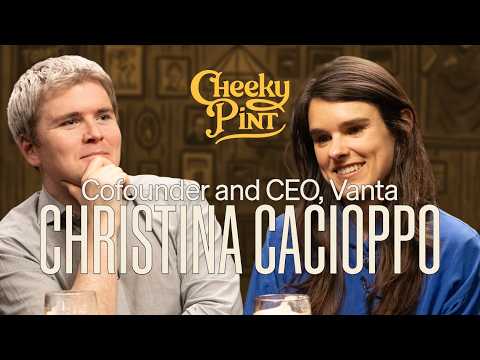
Vanta Targets Global Controls Expansion as Revenue Surpasses 60% Growth
Stripe
Traditional total addressable market calculations are fundamentally flawed because lowering compliance costs drastically expands the actual customer base from early startups to the Fortune 50.
## Background
Published on YouTube by Stripe on March 31, 2026, this episode features Vanta founder and CEO Christina Cacioppo. The page description highlights a deep-dive conversation into building the future of agentic trust, the "vitamin vs. painkiller" dynamic of compliance, their famous 101-billboard campaign, and why traditional market sizing falls short.
## TL;DR
Christina Cacioppo shares Vanta's evolution from an early compliance solution born out of painful engineering bottlenecks at Dropbox Paper to a scaling trust management platform with over 15,000 customers. The walkthrough outlines how compliance serves as a critical startup purchasing trigger, the stark operational differences between downmarket and enterprise compliance models, and the integration of AI to automate security questionnaires and evidence gathering. Looking ahead, Cacioppo details Vanta's product expansion into agentic user interfaces, internal audits, and financial compliance frameworks that leverage their massive historical audit dataset.
## Atmosphere & style
The conversation is intellectually engaging, casual, and highly candid, blending inside-tech humor with serious architectural reflections. Cacioppo brings a transparent, truth-seeking energy to the episode, effortlessly balancing funny operational blunders—like a billboard contract "written in crayon"—with sharp critiques of traditional VC metrics like TAM. The dynamic between the host and guest feels like a meeting of peer experts, resulting in a grounded, reflective atmosphere that values real-world execution and founder humility over polished corporate spin.
## Key takeaways
- [00:17](https://www.youtube.com/watch?v=lPtn-TVi97Q&t=17s) Christina Cacioppo founded Vanta in 2018 to solve compliance, which serves as an immediate startup painkeeper rather than a proactive security vitamin.
- [00:17](https://www.youtube.com/watch?v=lPtn-TVi97Q&t=17s) Startups rarely invest in security on their own; the actual buying moment occurs when an enterprise customer demands a compliance standard like SOC 2.
- [03:56](https://www.youtube.com/watch?v=lPtn-TVi97Q&t=236s) Vanta operates with an annual growth rate exceeding 60% over recent years, scaling from small startups to Fortune 50 enterprises.
- [06:00](https://www.youtube.com/watch?v=lPtn-TVi97Q&t=360s) Compliance manifests as two models: a guided 'TurboTax' experience for downmarket startups and a real-time 'Datadog' control dashboard for upmarket enterprises.
- [07:30](https://www.youtube.com/watch?v=lPtn-TVi97Q&t=450s) Vanta's 'Test' feature functions similarly to software unit tests by pulling code metadata from GitHub or GitLab to continuously verify compliance controls.
- [14:03](https://www.youtube.com/watch?v=lPtn-TVi97Q&t=843s) The cynical market reality of data breaches shows that they rarely impact the long-term stock prices or terminal value of large enterprises due to minimal customer churn.
- [17:14](https://www.youtube.com/watch?v=lPtn-TVi97Q&t=1034s) American and European companies hold a distinct cultural divide regarding compliance, with Americans treating it as a cynical box-checking exercise and Europeans maintaining an internal bar of standards.
- [20:20](https://www.youtube.com/watch?v=lPtn-TVi97Q&t=1220s) GDPR remains comically bad as an engineering specification, meaning that compliance audits under agentic coding focus on checking user IDs on a PR rather than verifying genuine code safety.
- [24:43](https://www.youtube.com/watch?v=lPtn-TVi97Q&t=1483s) Vanta establishes its defensibility and predictive AI capability over generic LLMs through a proprietary dataset of over 20,000 historical audits.
- [29:48](https://www.youtube.com/watch?v=lPtn-TVi97Q&t=1788s) GitHub automates 92% of incoming security questionnaires by using Vanta's AI capabilities.
- [34:43](https://www.youtube.com/watch?v=lPtn-TVi97Q&t=2083s) The compliance industry is experiencing an 'IT collapse' where automated software and AI agents absorb manual GRC labor, pushing out the milestone at which a startup needs a dedicated compliance hire.
- [39:27](https://www.youtube.com/watch?v=lPtn-TVi97Q&t=2367s) Trust centers serve as a powerful ticket deflection mechanism for sales teams by sharing pre-filled security binders proactively with prospects.
- [47:22](https://www.youtube.com/watch?v=lPtn-TVi97Q&t=2842s) Traditional Total Addressable Market (TAM) calculations are fundamentally flawed because they fail to predict how drastically lowering the cost and time of a product can exponentially expand its market.
- [52:16](https://www.youtube.com/watch?v=lPtn-TVi97Q&t=3136s) Exposing a future CEO to a vast dataset of varied founder styles shatters rigid archetypes and helps them learn from a spectrum of successful leadership dimensions.
- [52:16](https://www.youtube.com/watch?v=lPtn-TVi97Q&t=3136s) The primary indicator of failure in early-stage startups is investor updates containing an excess of words with a complete lack of metrics, signaling a refusal to seek the truth.
- [54:19](https://www.youtube.com/watch?v=lPtn-TVi97Q&t=3259s) True product-market fit behaves as an unstoppable force of growth capable of succeeding even when operational attention is highly distracted by non-scalable founder tasks.
- [55:45](https://www.youtube.com/watch?v=lPtn-TVi97Q&t=3345s) Vanta plans to leverage its core controls platform to expand adjacent verticals including internal risk management and integration-heavy financial auditing.
## Detailed walkthrough
### [00:01](https://www.youtube.com/watch?v=lPtn-TVi97Q&t=1s) The Vanta Story and the "Compliance" Painkiller
Christina Cacioppo founded Vanta in 2018 to solve a problem that most founders did not even realize they had: compliance. Under her leadership, the company has defined the "trust management" category, growing to serve over 15,000 customers. Cacioppo explains that Vanta helps companies start or build out their security programs and then "go get credit for that with your customers" through audits, security questionnaires, and trust centers.
When asked why Vanta's billboards prominently feature the word "compliance" rather than "security," Cacioppo points to the classic startup distinction between a "vitamin" and a "painkiller." While security is often viewed as a vitamin, compliance is an immediate painkiller. Startups rarely ask for security, but they frequently demand compliance because their customers require it. "Compliance is like the buying moment for startups," she notes. Even if founders want to implement security best practices, they rarely do so until a customer forces the issue. While some might expect the buyer to split at later stages—with security falling under the Chief Information Security Officer (CISO) and compliance under the Chief Financial Officer (CFO) or General Counsel (GC)—Cacioppo observes that compliance is typically centralized under a unified Governance, Risk, and Compliance (GRC) function within the CISO's organization.
- **Vanta Founded:** 2018 by Christina Cacioppo.
- **Customer Count:** Over 15,000 customers.
- **Core Value Proposition:** Helping companies build security programs and get credit for them via audits and questionnaires.
- **The "Buying Moment":** Startups buy compliance because their enterprise customers demand it (e.g., SOC 2), not because they proactively seek security.
[01:57](https://www.youtube.com/watch?v=lPtn-TVi97Q&t=117s) The Origin Story: From Dropbox Paper to Startup Reality
Joking that her first word as a three-year-old was "compliance," Cacioppo shares the real, twofold origin story of Vanta. Prior to founding the company, she worked at Dropbox on a new product called Dropbox Paper. When trying to take it to market, the team hit a major roadblock: all existing Dropbox contracts legally promised that their systems were secure, compliant, and pen-tested. Because the new Dropbox Paper product had none of these assurances yet, they had to undergo an arduous, year-and-a-half-long process involving 10 engineers just to allow existing Dropbox users to access it.
At the time, in 2015, Cacioppo did not immediately recognize this as a startup idea. It was only a year and a half later, while talking to various startups and founders about security, that the pattern clicked. She encountered two types of companies: those that did nothing for security (and felt bad about it) and those that had robust security in place. The latter group only had security because an enterprise customer had forced them to get a SOC 2 or fill out a security questionnaire. Remembering how onerous that process had been at Dropbox, she realized that solving this pain point was a "Pass Go, Collect $200" opportunity with massive business value.
- **Dropbox Paper Experience:** In 2015, a team of 10 engineers spent 1.5 years getting the new product up to the security and compliance standards promised in Dropbox's enterprise contracts.
- **The Realization:** Startups only invest in security when forced to by enterprise customers requiring SOC 2 or security questionnaires.
[03:56](https://www.youtube.com/watch?v=lPtn-TVi97Q&t=236s) Discovering Big Markets in Unsexy Spaces
The host notes that this journey is incredibly common among successful founders, drawing a parallel to Stripe's early days. He points out that university students who want to start companies often pitch "half-baked" ideas like "Find My Friends" or college textbook exchanges because they lack real-world experience. To discover massive, unsexy markets like SOC 2 compliance, founders usually need to spend five to ten years in the industry observing how value actually flows.
Vanta is now a "proper business" experiencing rapid growth. Its annual growth rate has exceeded 60% over the last few years. Vanta's customer base spans from "two founders on the couch" working on their SOC 2 on a Friday night because a prospect demanded it, all the way up to at least one member of the Fortune 50.
- **Vanta's Growth Rate:** 60%+ annual growth over the last several years.
- **Customer Spectrum:** Ranges from early-stage, two-person startups to Fortune 50 enterprises.
[06:00](https://www.youtube.com/watch?v=lPtn-TVi97Q&t=360s) TurboTax vs. Datadog: Compliance Across Company Sizes
Compliance looks entirely different depending on the maturity of the company. For early-stage startups, Vanta acts almost like a "TurboTax" for compliance. Founders want a high-stakes, guided experience that ensures they do not get things wrong. The product guides them through implementing a set of security rules and controls that are monitored on an ongoing basis, keeping them constantly audit-ready.
For upmarket enterprise customers, the experience is more akin to "Datadog for your compliance controls." These larger companies already have established security programs, but their controls often live statically in spreadsheets or custom Jira tickets. They use Vanta for real-time dashboards, visibility, deviation tracking, and auto-remediation.
- **Downmarket Model (TurboTax):** Guided setup of controls and continuous monitoring to ensure audit readiness.
- **Upmarket Model (Datadog):** Real-time dashboards, visibility, and auto-remediation for existing compliance frameworks.
- **The Two Layers of Vanta:** 1) Defining what your controls should be, and 2) Monitoring and implementing those controls.
[07:30](https://www.youtube.com/watch?v=lPtn-TVi97Q&t=450s) Compliance as "Unit Tests" and the Infamous Billboard
Compliance is not just something a company can buy; it is something they must actively do, such as enforcing code reviews or separating the "doer" and "approver" for key actions. Vanta helps by telling startups exactly which rules apply to them and then verifying that those rules are followed. To do this, Vanta built a feature called "Test," which is modeled after software unit tests. The system pulls data from version control platforms like GitHub or GitLab, looks at every pull request, and runs logic to verify that controls (like code reviews) are being enforced.
The host jokes that Vanta should have put "unit tests for compliance" on their billboards. This prompts Cacioppo to share the dramatic story of Vanta's famous Highway 101 billboard, which featured the punny tagline: "Compliance that doesn't SOC 2 much." While the billboard was highly successful—arguably driving "hundreds of millions of dollars in market cap"—it caused internal tension. The manager of the employee who wrote the tagline was highly skeptical, worrying, "Are we negging our users?" Ultimately, Vanta lost the billboard because of a contract "written in crayon" with their advertising agency. The agency ended up selling the highly coveted ad space to another startup that Vanta had actually introduced to them.
- **The "Test" Feature:** Vanta's first built feature, which acts like a unit test suite for compliance rules by pulling data from GitHub/GitLab to verify controls.
- **The Billboard Debacle:** Vanta lost its famous Highway 101 billboard ("Compliance that doesn't SOC 2 much") because of a poorly written agency contract, and the space was sold to a startup Vanta had recommended.
[10:45](https://www.youtube.com/watch?v=lPtn-TVi97Q&t=645s) Tailoring the Rulebook and the Rise of AI Standards
To help companies navigate massive, thousand-page compliance rulebooks, Vanta originally analyzed and compared actual SOC 2 reports from companies like Salesforce, Slack, and AWS to extract commonalities. Today, with over 30,000 completed audits under its belt, Vanta uses historical data to recommend specific controls based on a company's profile and their chosen auditor. Vanta also recently launched a "commitments" product that scans customer contracts to identify agreed-upon security obligations and turn them into structured data and active controls.
While SOC 2 is the dominant framework in the US, ISO 27001 is its European equivalent. Vanta's mapping between the two frameworks is about 60% to 65% aligned, with the extra requirements for ISO 27001 mostly consisting of documentation. Beyond these core frameworks, Cacioppo is seeing a "thousand flowers bloom" with new AI standards, healthcare-specific frameworks, and PCI compliance. For healthcare, companies can self-declare HIPAA compliance, but they face enormous fines if they suffer a breach after doing so.
- **Audits Completed via Vanta:** Approximately 30,000 audits.
- **New Commitments Product:** Ingests and scans contracts to extract security obligations and turn them into active controls.
- **SOC 2 vs. ISO 27001 Alignment:** Approximately 60% to 65% overlap.
[14:03](https://www.youtube.com/watch?v=lPtn-TVi97Q&t=843s) The Policy Goals of SOC 2 and the Cynicism of Data Breaches
At a policy level, SOC 2 is designed to ensure that customer data is adequately protected by software providers. However, the host points out a strange market dynamic: despite massive, high-profile data breaches at companies like Equifax and AT&T, investors rarely penalize these companies' long-term stock prices.
Cacioppo agrees, noting that the cynical but correct explanation is that customers rarely churn after a breach. Consumers are not going to stop flying Delta or using Equifax over a breach, especially when they are already on their "eighth credit monitoring service." However, the regulatory landscape is shifting. European regulations like GDPR and California's CCPA are imposing much stricter notification requirements and heavier fines for data breaches, which continues to drive waves of demand for Vanta's data privacy compliance offerings.
- **Policy Goal of SOC 2:** Protecting customer data held by third-party software providers.
- **The Market Reality:** Major data breaches rarely impact the terminal value of large enterprises because customer churn is minimal.
- **Regulatory Drivers:** Stricter notification laws and fines (e.g., GDPR, CCPA) are raising the cost of breaches and driving compliance demand.
### [17:14](https://www.youtube.com/watch?v=lPtn-TVi97Q&t=1034s) The Cultural Divide in Compliance: Europe vs. America
Vanta as a product performs exceptionally well in Europe—even better than one might expect for a California-born company without European roots. This success stems from a distinct cultural affinity and a deeper seriousness toward compliance in Europe compared to the United States. In America, compliance is frequently treated as a cynical "box-checking exercise" where companies ask, "You tell me where the bar is, and I'll meet your bar." In contrast, European companies tend to have their own internal bar of standards that they hold themselves to, regardless of external requirements.
Meanwhile, demand for regulations like the California Consumer Privacy Act (CCPA)—the Californian equivalent of GDPR—tends to move in waves. Currently, energy around American regulation is at a total nadir, both at the federal level and the state level. Even in a state like California, national politics cast a massive shadow over local regulatory momentum, leaving the future of state-level privacy rules highly uncertain.
- **The American Approach:** "Tell me where the bar is, and I'll meet it" (box-checking).
- **The European Approach:** "I will meet your bar, but I also have my own internal bar."
- **CCPA & US Regulation:** Currently at a low point in energy and momentum, heavily influenced by national political dynamics.
### [18:24](https://www.youtube.com/watch?v=lPtn-TVi97Q&t=1104s) Modernizing FedRAMP and the "16th Standard" Dilemma
At the federal level, the current US administration is highly focused on streamlining regulation through automation and AI. While compliance might seem too dry to be swept up in reform initiatives, dedicated teams within the General Services Administration (GSA)—specifically one led by Pete Wasserman—are actively fighting to modernize FedRAMP. Broadly understood as "SOC 2 for the federal government," FedRAMP is a notoriously onerous set of controls, requirements, and documentation required to sell software to federal, state, and local governments. Wasserman's team is trying to drag FedRAMP from its current "90s feel" into a modern, 2020s-style framework.
However, even if these modernization efforts succeed, it is highly unlikely that the broader accounting establishment will adopt these federal changes lock, stock, and barrel. Instead, the industry faces further divergence. This situation mirrors the classic *XKCD* comic strip joke: when there are 15 competing standards, someone decides to create a new, unified standard, resulting in 16 standards. Vanta actually has this comic posted on their office wall because it perfectly describes their daily reality. When customers ask if Vanta will ever create its own "better" standard, the answer is a firm no, as it would only worsen the fragmentation.
- **FedRAMP:** The federal government's highly rigorous security compliance framework, often mirrored by state-level programs (e.g., Texas RAMP).
- **Pete Wasserman:** The GSA leader spearheading the effort to modernize FedRAMP.
- **The Standard Proliferation:** The industry is characterized by divergence rather than convergence, making a single unified standard an impossibility.
### [20:20](https://www.youtube.com/watch?v=lPtn-TVi97Q&t=1220s) The Reality of GDPR and the Rise of Agentic Coding
When Vanta was pivoting to its current product iteration in the spring of 2018, GDPR was just going into effect. At the time, founders would eagerly agree to talk about compliance, but the moment the topic of SOC 2 was raised, they would pivot and say, "GDPR is a priority. Next, please." Years later, that initial frantic energy has largely dissipated, particularly in the US. GDPR was written by lawyers at a very high level, making it "comically bad as an engineering spec." The expectation was that court rulings would clarify the law over the next decade, but seven to eight years later, it remains as hand-wavy and difficult for an engineer to implement as it ever was.
This lack of concrete engineering specs becomes highly problematic in the era of agentic coding, where the honest number of human reviewers on a pull request (PR) might be zero. Currently, compliance audits look at user IDs on a PR to verify that a review occurred, treating it as a "two throats to choke" exercise rather than a genuine guarantee that the code is secure. Historically, the primary impetus behind requiring two reviewers was mitigating insider threats. While SOC 2 suggests logging and monitoring controls, it does not prescribe a strict control list like PCI compliance does. Instead, SOC 2 leaves it up to the company to decide what "useful logging" means, which often leaves early-stage startups lost in a maze of ambiguity. Vanta's initial product-market fit came from translating this high-level guidance into prescriptive, actionable engineering steps.
- **GDPR Launch:** Spring 2018; highly lawyer-driven and notoriously difficult to translate into engineering specifications.
- **Agentic Coding Audit Reality:** Audits check for two distinct user IDs on a PR to satisfy the "insider threat" control, regardless of whether those IDs belong to humans or AI agents.
- **SOC 2 vs. PCI:** PCI is highly prescriptive ("you must buy this tool"), whereas SOC 2 is highly subjective ("you must log useful events"), creating a need for Vanta's prescriptive defaults.
### [23:53](https://www.youtube.com/watch?v=lPtn-TVi97Q&t=1433s) Stripe Tax and the Complexity of Global Compliance
In a brief interlude, the host draws a parallel between Vanta's compliance automation and Stripe's own products, such as Stripe Tax. For many businesses, navigating a complex web of global rules is the primary barrier to scaling and selling to enterprises.
- **Stripe Tax:** Automates transactional tax compliance across thousands of jurisdictions.
- **Chicago Lease Tax:** An example of hyper-local tax complexity, which applies a lease tax to SaaS companies because they are technically "leasing out software."
### [24:43](https://www.youtube.com/watch?v=lPtn-TVi97Q&t=1483s) AI, "Vibe Coding," and the Power of Proprietary Audit Data
In the tech community, there is a running joke about "vibe coding" software over a weekend using tools like Claude. While building core product features this way can be risky, compliance frameworks like SOC 2 are actually ideal candidates for LLMs because they rely on highly codified, publicly available rules. However, using a generic LLM to build a compliance program from scratch is a risky "build versus buy" decision. Compliance is not an area where companies want to make mistakes, and as the saying goes, spending time on compliance "does not make your beer taste better."
Where LLMs truly excel is in ingestion and mapping. Vanta is leveraging this by building onboarding flows where a customer can dump a "mess of data"—AWS screenshots, API calls, policy documents, and Jira workflows—and Vanta's AI will automatically map it into a structured compliance program. While a generic LLM might just spit out a folder of files to share with an auditor, Vanta turns that data into a continuously monitored dashboard. Furthermore, Vanta's true defensibility lies in its massive dataset of over 20,000 historical audits. This private, anonymized data allows Vanta to run "AI evidence evaluation," telling a customer exactly whether a specific piece of evidence (like a screenshot lacking a timestamp) will pass muster with a specific auditor. Much like Stripe's Radar uses global transaction data to block fraud, Vanta uses its proprietary audit data to provide a feedback loop that generic AI models cannot replicate.
> "Spending much time on [compliance] does not make your beer taste better. Is this really the place? Even if you really want to vibe code a bunch of stuff, is this really what you want to vibe about?"
- **Vanta's AI Onboarding:** Ingests unstructured data (screenshots, policies, Jira tasks) and maps them directly into the Vanta platform.
- **Continuous Control Monitoring:** Moves beyond static folder sharing to real-time, observable compliance dashboards.
- **The Data Network Effect:** Vanta has processed 20,000+ audits, enabling predictive AI evaluation of evidence before it is submitted to human auditors.
### [29:48](https://www.youtube.com/watch?v=lPtn-TVi97Q&t=1788s) Vendor Risk and the Jevons Paradox of Security Questionnaires
Vanta's core business serves software vendors who need to prove their security to buyers. This is critical because if a vendor loses customer data, the buyer has to send a highly embarrassing notification email to their own clients. To streamline this, Vanta offers a third-party risk product for buyers—ranging from tech companies to traditional businesses like hotel chains—to evaluate their vendors. Vanta uses "reasonable defaults" to nudge these buyer questionnaires away from superficial compliance questions and toward genuine security practices.
This dynamic raises an interesting question about AI productivity and Jevons paradox: if AI makes filling out security questionnaires incredibly easy, will the total volume and complexity of these questionnaires simply explode? Vanta tried to solve the questionnaire problem in 2018 and 2021, but the language models were not ready. Today, they are. For example, GitHub now uses Vanta to automatically answer 92% of the security questionnaires they receive, leaving humans to only review and approve the high-risk sections. Looking forward, Vanta's roadmap includes deploying hundreds of agentic workflows to handle the tedious, repetitive tasks of compliance teams, such as mapping new regulatory regimes to existing controls and eliminating duplicates.
- **GitHub Case Study:** GitHub successfully automates the completion of 92% of incoming security questionnaires using Vanta's AI.
- **Jevons Paradox in Security:** As AI lowers the cost of answering questionnaires, buyers may respond by sending longer, more customized, and more frequent security queries.
- **Compliance Team Workflows:** The future of compliance lies in using LLMs to keep disparate texts in sync and automatically map overlapping compliance frameworks.
[34:43](https://www.youtube.com/watch?v=lPtn-TVi97Q&t=2083s) The Evolution of Compliance and the "IT Collapse"
The conversation shifts to how AI will reshape the compliance profession, drawing a historical parallel to the evolution of IT. In the year 2000, a 10-person company with beige Gateway 2000 workstations required a dedicated IT person to manage servers in the closet, run Microsoft Access databases, and manually clean lint out of mouse balls. Today, a 10-person company does not need an IT person because hardware is highly reliable, data is in the cloud, and everything runs seamlessly on Google Workspace. While IT still exists as a highly skilled profession at scale—such as at Stripe, where shipping laptops to dozens of countries presents complex logistical challenges—the baseline tasks for small companies have been entirely abstracted away.
A similar shift is occurring in compliance. Historically, enterprise startups had to hire a full-time security compliance person or consultant once they reached 50 to 100 employees. Vanta’s goal, even before the rise of generative AI, was to push that hiring point much further out. By providing system-thinking engineering leaders—whom they call "Amelia Engineers"—with the right tools, companies can keep security, IT, and compliance unified under a single thread for longer. This mirrors the collapse currently seen among engineers, product managers, and designers.
- **The GRC Team Collapse:** In larger organizations, traditional Governance, Risk, and Compliance (GRC) teams are expected to collapse into single-threaded owners. Tasks like answering security questionnaires or reviewing new software vendors will be handled by AI agents, overseen by a human spending only a fraction of their time.
- **Automated Evidence Gathering:** Instead of a GRC staff member manually nagging engineers to encrypt a new database, automated software will detect the issue and nudge the responsible party directly.
- **Strategy vs. Hourly Labor:** AI is poised to absorb the hourly labor component of compliance—such as scaling up manual security reviews when sales volume increases—leaving human professionals to focus on high-level risk portfolio strategy.
---
[39:27](https://www.youtube.com/watch?v=lPtn-TVi97Q&t=2367s) Navigating Standards and the Rise of "Trust Centers"
When asked about upcoming changes in the compliance landscape, the speakers discuss the proliferation of new standards. Rather than debating which emerging standards to support—a process that used to cause frustrating prioritization bottlenecks—Vanta built an automated pipeline to easily onboard new ones as customer demand dictates. This approach mirrors how Stripe handles local payment methods.
If pressed to identify a standard with genuine traction, ISO 42001 is highlighted. As the European standards body's framework for AI, it is highly data-privacy focused and high-level. While European enterprises care deeply about it, the speakers note that no AI compliance standard has achieved breakout "product-market fit" or regulatory status yet; they remain frameworks that companies opt into.
The discussion also covers the rise of "trust centers"—public-facing security status pages (e.g., `trust.vanta.com`) that display green, amber, or red indicators for a company's security controls.
- **Ticket Deflection:** Trust centers act as highly effective ticket deflection tools for GRC teams. Sales representatives can share a pre-filled binder of security information upfront, signaling a strong, proactive security posture and reducing follow-up questions.
- **Outbound Sales Dynamics:** In an era where inboxes are flooded with ChatGPT-written spam, traditional outbound emails have lost efficacy. Surprisingly, outbound phone calls and highly curated, small events are currently proving to be more successful channels.
---
[42:51](https://www.youtube.com/watch?v=lPtn-TVi97Q&t=2571s) On-Demand Software and Bespoke Agentic UI
The conversation turns to the concept of "on-demand software"—the idea that instead of using static software coded years prior, computers should render bespoke interfaces in real time based on immediate user needs. Vanta is actively experimenting with this concept internally.
Instead of forcing users to navigate complex SaaS tables, an AI agent guiding a user through a compliance task can dynamically generate a custom user interface on a portion of the screen. This allows the user to render an opinion, make a connection, or view a custom-generated report without needing to learn SQL or navigate complex settings. Vanta plans to roll out these generated UI features to customers by the summer.
---
[44:50](https://www.youtube.com/watch?v=lPtn-TVi97Q&t=2690s) Go-To-Market Strategies and the Power of Podcast Ads
Vanta's go-to-market success has relied heavily on brand spend, including zip-code-targeted billboards. To measure the ROI of physical billboards, Vanta tracks mentions of the word "billboard" on recorded sales calls via Gong, mapping those deals through to closed-won status alongside geographic split testing.
Podcast advertising has also been exceptionally effective, though it was initially met with skepticism. In late 2020, Vanta's first salesperson, Eric, proposed a $60,000 ad buy on *This Week in Startups*. Believing that only mattress companies and self-absorbed founders advertised on podcasts, a deal was struck: the ad buy would be approved only if Eric could close four additional customers (at roughly $15,000 each) to cover the cost. The following month, the podcast ads drove 34 extra sales. This served as a humbling lesson in "founder negative value add," where a founder's strong, intuitive beliefs turn out to be entirely wrong.
- **The "SOC 2" Association:** In its early days, Vanta successfully established a strong call-and-response association between the terms "SOC 2" and "Vanta." However, as cheaper competitors entered the market claiming to offer the same compliance audits, Vanta had to reframe its positioning to avoid pointing customers toward a generic category they did not exclusively own.
---
[47:22](https://www.youtube.com/watch?v=lPtn-TVi97Q&t=2842s) Lessons from Union Square Ventures and Fred Wilson
Reflecting on time spent working with Fred Wilson at Union Square Ventures (USV), the firm is described as a unique institution driven fundamentally by ideas rather than the "great-person" cult of personality common in venture capital. At USV, an idea that is intellectually engaging, networked, and compelling takes precedence over everything else.
A key lesson learned at USV is that "market sizing is bullshit." Traditional Total Addressable Market (TAM) calculations only predict the market as it exists today. In 2018, the global spend on SOC 2 compliance was estimated at a mere $10 million, with virtually zero startups obtaining one. A highly academic, TAM-brained analysis would have concluded that Vanta was not worth starting. However, Vanta's core thesis was that by drastically lowering the cost and time required to get compliant, they could dramatically expand the market.
- **The Fred and Brad Partnership:** The foundational partnership between Fred Wilson and Brad Burnham, who started USV together in 2002 (raising their first fund in 2004), is highlighted as one of the great, underappreciated pairings in venture history, comparable to Khosla-Doerr or Leone-Moritz.
- **Complementary Dynamics:** While Brad was cerebral, philosophical, and academic, Fred possessed an extraordinary ability to articulate those complex, back-and-forth ideas in a way the broader business world could easily grasp.
[51:44](https://www.youtube.com/watch?v=lPtn-TVi97Q&t=3104s) The Origin of "Freemium" and the Power of Coining Terms
The conversation begins with a lighthearted reflection on how venture capitalist Fred Wilson would go back and forth with founders, latching onto concepts and communicating them to the broader world. A prime example of this is the term "freemium," which Fred Wilson famously coined in a blog post around 2008 or 2009. The speakers marvel at how some terms feel so deeply embedded in our vocabulary that it seems as though they have always existed. They joke that it feels like people were already discussing "freemium" in 1952, comparing it to other modern idioms like "saying the quiet part out loud," which actually originated from *The Simpsons*.
[52:16](https://www.youtube.com/watch?v=lPtn-TVi97Q&t=3136s) How Being an Investor Shapes a CEO
When asked how her experience as an investor changed her approach to being a CEO, Christina Cacioppo gives a candid, humorous answer: "I wouldn't have done it." She explains that she was incredibly lucky to have spent two years meeting with approximately 15 founders a week. This massive exposure shattered any singular, rigid model she had of what a founder is supposed to be or do. Seeing a thousand different founders allowed her to witness a vast spectrum of successful styles, helping her find role models who shared her own traits and dimensions.
This deep pool of "training data" also helped her identify patterns of success and failure. She notes that successful founders possess a relentless "truth-seeking" quality. While some founders can occasionally bend reality to their will, the unsuccessful ones often suffer from delusion, fighting immovable objects like gravity. The hosts agree, pointing out that investor updates filled with "a lot of words and no metrics" are a classic anti-pattern and a sure sign of failure, as they reveal a fundamental refusal to seek the truth.
- **Founder Exposure:** Meeting 15 founders a week for two years straight provided a massive dataset of different leadership styles.
- **The Delusion Anti-Pattern:** Unsuccessful founders often fight unchangeable realities rather than adapting to them.
- **The Red Flag of Wordy Updates:** Investor updates that contain many words but zero metrics are a strong indicator of impending failure.
[54:19](https://www.youtube.com/watch?v=lPtn-TVi97Q&t=3259s) Product-Market Fit and the Legend of Rob Kalin's Desks
The discussion shifts to the early days of legendary companies like Etsy and Kickstarter, which helped shape Christina's profound appreciation for product-market fit. She references the classic framing: "if you're asking whether you have it, you don't." To illustrate how powerful true product-market fit is, she shares an anecdote about Etsy's co-founder and former CEO, Rob Kalin.
In the early days of Etsy, Kalin spent roughly 80% of his time hand-making bespoke wooden desks for every new employee because of the company's craft-centric culture. The hosts joke that Amazon had a much more scalable approach by making employees build their own Ikea-style desks. Yet, despite the CEO spending the vast majority of his time woodworking rather than running operations, Etsy's business was on fire in a good way. When a company has genuine product-market fit, it is an "immovable object" of growth that can succeed even when the CEO is busy making desks.
Looking ahead, Christina outlines Vanta's plans for expansion and "taking over the world, making desks along the way." In an era where code has become significantly cheaper to produce, Vanta is looking to expand into adjacent verticals. While the enterprise security market operates on a different scale, there is immense opportunity in serving small and mid-market businesses by expanding into areas like enterprise risk, internal audit, and financial audit.
Because Vanta is fundamentally a "controls platform" designed to help companies decide what they should do and prove they are doing it, moving into internal audit is a natural next step. Instead of packaging compliance data for external auditors, the platform can easily package it for internal ones. Financial audit presents a similar opportunity but requires building out a different set of integrations, such as connecting to ERP and payment systems to parse financial data.
- **Internal Audit Expansion:** Leveraging Vanta's existing controls platform to package compliance data for internal stakeholders.
- **Financial Audit Integration:** Planning future integrations with ERP and payment systems to capture and validate financial data.
## Notable quotes
> [01:00](https://www.youtube.com/watch?v=lPtn-TVi97Q&t=60s) Compliance is like the buying moment for startups. — Christina Cacioppo
> [07:30](https://www.youtube.com/watch?v=lPtn-TVi97Q&t=450s) Are we negging our users?
> [24:43](https://www.youtube.com/watch?v=lPtn-TVi97Q&t=1483s) Spending much time on [compliance] does not make your beer taste better. Is this really the place? Even if you really want to vibe code a bunch of stuff, is this really what you want to vibe about? — Christina Cacioppo
> [47:22](https://www.youtube.com/watch?v=lPtn-TVi97Q&t=2842s) market sizing is bullshit.
> [54:19](https://www.youtube.com/watch?v=lPtn-TVi97Q&t=3259s) if you're asking whether you have it, you don't.
> [55:45](https://www.youtube.com/watch?v=lPtn-TVi97Q&t=3345s) taking over the world, making desks along the way. — Christina Cacioppo
## Mentioned
Christina Cacioppo, Vanta, Stripe, Dropbox, Dropbox Paper, TurboTax, Datadog, GitHub, GitLab, Salesforce, Slack, AWS, Equifax, AT&T, Delta, Pete Wasserman, General Services Administration, FedRAMP, Claude, Stripe Tax, Stripe Radar, Etsy, Kickstarter, Rob Kalin, Amazon, Union Square Ventures, Fred Wilson, Brad Burnham, The Simpsons, Gong, This Week in Startups
营收增速超60%,Vanta目标推进全球合规控制扩张
传统的潜在市场规模计算存在根本性缺陷,因为降低合规成本会大幅扩大实际客群,覆盖从早期初创公司到财富50强企业。
Christina Cacioppo分享了Vanta的发展历程:从最初因Dropbox Paper时期痛苦的工程瓶颈而诞生的合规解决方案,逐步成长为拥有超过15,000家客户的规模化信任管理平台。本次梳理概述了合规如何成为初创公司的关键采购触发点、下沉市场与大型企业合规模式之间显著的运营差异,以及如何通过整合AI实现安全问卷和证据收集的自动化。展望未来,Cacioppo详细介绍了Vanta利用其庞大的历史审计数据集,向Agent(智能体)用户界面、内部审计及财务合规框架等领域的产品拓展。
Christina Cacioppo于2018年创立Vanta以解决合规问题;对初创公司而言,合规是解决燃眉之急的“止痛药”,而非主动预防的“维生素”。 (0:17)
初创公司极少主动在安全上投入;真正的购买契机发生在大型企业客户提出SOC 2等合规标准要求时。 (0:17)
Vanta近年来年增长率超过60%,服务客群已从小微初创企业扩展至财富50强企业。 (3:56)
合规体现为两种模式:针对下沉市场初创企业的向导式“TurboTax”体验,以及针对高端大型企业的实时“Datadog”控制面板。 (6:00)
Vanta的“测试”(Test)功能类似于软件单元测试,通过从GitHub或GitLab提取代码元数据来持续验证合规控制项。 (7:30)
Reading summary
Christina Cacioppo argues that compliance functions as an urgent commercial painkiller rather than an optional security vitamin, enabling Vanta to unlock a market that conventional sizing models severely underestimated. By translating ambiguous regulatory mandates into automated engineering controls, the company aims to compress compliance overhead much like modern cloud infrastructure streamlined corporate IT.
The Compliance Painkiller and Market Expansion (0:01)
Vanta was founded in 2018 after Cacioppo observed at Dropbox Paper in 2015 that certifying a product against enterprise security commitments required 10 engineers working for a year and a half. Cacioppo notes that early-stage founders rarely invest in security as an elective safeguard; instead, compliance serves as an immediate commercial painkiller triggered when prospective enterprise clients demand SOC 2 reports or completed security questionnaires before signing contracts.
This dynamic exposes the flaw in static Total Addressable Market (TAM) calculations. In 2018, the estimated global market for SOC 2 compliance was only $10 million, with almost no startups participating. Cacioppo contends that traditional TAM assessments fail when software drastically lowers the cost and time required to adopt a service, unlocking latent demand. Vanta has since scaled to over 15,000 customers spanning seed-stage startups to Fortune 50 firms, sustaining an annual revenue growth rate above 60%.
Adapting Controls Across Startup and Enterprise Tiers (6:00)
Compliance software diverges significantly based on organizational maturity. For early-stage ventures, Vanta provides a guided experience comparable to TurboTax, establishing baseline rules and verifying adherence through automated, unit-test-style checks on GitHub and GitLab pull requests. For upmarket enterprise buyers, the product functions more like Datadog, ingesting established controls from static spreadsheets and Jira tickets to deliver continuous visibility, deviation tracking, and automated remediation.
Navigating overlapping international and public-sector frameworks presents continuous divergence rather than consolidation. While SOC 2 and Europe’s ISO 27001 share roughly 60% to 65% overlap—primarily diverging in documentation requirements—Cacioppo rejects creating proprietary standards, citing the industry tendency for unified frameworks to merely add to existing fragmentation. Furthermore, she notes a cultural divide: while American companies often treat compliance as a minimal box-checking exercise, European firms typically adhere to an internal bar of standards regardless of external enforcement.
Defensibility via Proprietary Data and Questionnaire Automation (24:43)
While large language models can readily map codified standards or ingest unstructured evidence like AWS configurations and policy documents, Cacioppo argues that generic AI models cannot guarantee audit success. Vanta anchors its primary defensibility in anonymized historical data from more than 20,000 to 30,000 completed audits. This dataset powers automated evidence evaluation, predicting whether specific submissions—such as screenshots lacking timestamps—will pass inspection with particular auditing firms before formal submission.
AI automation has also accelerated third-party risk assessments, enabling organizations like GitHub to automate 92% of incoming security questionnaires through Vanta. However, Cacioppo cautions that this efficiency may trigger Jevons paradox: drastically reducing the cost of answering questionnaires may incentivize enterprise buyers to issue longer, more customized, and more frequent security inquiries, potentially neutralizing productivity gains.
The Structural Contraction of Compliance and New Verticals (34:43)
Cacioppo draws a parallel between modern compliance and the historical trajectory of corporate IT, where cloud infrastructure and standardized SaaS eliminated the need for dedicated IT staff at small companies. Automated monitoring tools now allow startups to delay hiring dedicated Governance, Risk, and Compliance (GRC) personnel well past the historical 50-to-100-employee mark, consolidating oversight under technical leads. Dedicated compliance practitioners are expected to shift from manual evidence collection to overarching risk strategy.
Looking forward, Vanta plans to extend its underlying controls platform beyond technical security into internal and financial audits. Because code generation has become significantly cheaper, Cacioppo anticipates building integrations with enterprise resource planning (ERP) platforms and payment processors to capture, structure, and continuously validate financial data alongside security controls.
Whether emerging frameworks such as ISO 42001 will transition from opt-in guidelines into binding global standards remains an open question, as does whether workflow automation can outpace the proliferation of fragmented compliance regimes and AI-generated vendor questionnaires.
[1:00] Christina Cacioppo: Compliance is like the buying moment for startups.
[7:30] Are we negging our users?
[24:43] Christina Cacioppo: Spending much time on [compliance] does not make your beer taste better. Is this really the place? Even if you really want to vibe code a bunch of stuff, is this really what you want to vibe about?
[47:22] market sizing is bullshit.
[54:19] if you're asking whether you have it, you don't.
[55:45] Christina Cacioppo: taking over the world, making desks along the way.
Original transcript
[0:01] Christina Cacioppo founded Vanta
[0:03] in 2018 to solve a problem most founders didn’t even know they had.
[0:06] Compliance.
[0:07] Under her leadership, the company has defined
[0:09] the trust management category, growing to over 15,000 customers.
[0:13] Cheers. Cheers.
[0:14] Good to see you. Good to see you.
[0:18] Tell the Vanta story.
[0:19] We help companies start or build out their security programs
[0:23] and then get credit for all that work through an audit, through
[0:26] a security questionnaire.
[0:27] A trust center but it's basically do all the work to improve your security,
[0:33] and then go get credit for that with your customers.
[0:35] All the Vanta billboards I see use the word compliance rather than security.
[0:39] What's going on there?
[0:40] It is one of those where you're, well, "vitamin" and "painkiller."
[0:45] I think compliance is…
[0:46] SOC 2 is a word that no one knows what the heck it means until they deeply know,
[0:50] and then they want it.
[0:51] But they know that they have to do it this quarter.
[0:52] Exactly.
[0:54] One of the original founding hypotheses of the company is if you want to start
[1:00] a security company for startups, you should actually start a compliance
[1:03] company because your customers never ask you for security, but they
[1:06] do ask you for compliance.
[1:07] Compliance is like the buying moment for startups.
[1:09] Exactly, and then when you're going through that, you have
[1:12] to implement a bunch of…
[1:13] Do a bunch of best practices, maybe buy some tooling.
[1:16] But even if you want to, you don't do it before that moment because
[1:20] you're doing the thing the customer wants.
[1:22] I guess at a later stage, the buyer would be split,
[1:25] where security would be the CISO versus compliance would be the CFO,
[1:29] GC, something like that.
[1:30] I actually think Stripe is a little, in what I see, which is
[1:33] biased, but different.
[1:35] In that usually, compliance is there's this unified GRC,
[1:38] Governance Risk and Compliance function, and that lives in the CISO org.
[1:42] That will centralize internal audit.
[1:44] It'll centralize enterprise risk.
[1:47] You put those teams together.
[1:49] Third-party risk.
[1:50] Those teams are all together in CISO org. You're mostly selling to CISOs?
[1:54] Yes.
[1:55] How did you...
[1:57] You woke up one morning, and you decided you were passionate
[1:59] about starting a compliance company.
[2:00] When I was three years old, it was my first word.
[2:02] Yes, we joked in the early days.
[2:03] We'd never be able to pull that story off.
[2:05] I don't know. I heard training businesses are good.
[2:09] I've heard more absurd founding myths.
[2:12] I think you could just go for it.
[2:15] The real story is twofold.
[2:16] One, prior to Vanta, I worked at Dropbox.
[2:18] I worked on what at the time was a new product, Dropbox Paper.
[2:22] We were trying to take it to market and didn't take it to market as well as
[2:26] we could have for several reasons.
[2:28] One of which was...
[2:30] It turned out at the time, all the Dropbox contracts had written
[2:32] into them, "We're secure, we're compliant, we're pen-tested, we're XYZ." Our
[2:37] new thing had none of those.
[2:40] In order to talk to someone with a Dropbox account, which was
[2:45] 100 million people or whatever it was, we had to go through this process.
[2:49] This was Dropbox 2015, so the height of its Silicon Valley power,
[2:54] year and a half, 10 engineers, feature building, all that.
[2:59] That all happened.
[3:00] I was not smart enough to then be like, "Aha, startup idea." Instead, this...
[3:05] Dropbox, what are you doing? This sounds bad.
[3:08] It was about a year and a half later, just talking to startups and founders
[3:13] about security, trying to figure out, is there a company to be built here?
[3:18] How do you get more startups to care about security?
[3:20] How do they do it?
[3:22] Kind of came across companies that either did nothing for security but felt really
[3:29] badly about it sometimes, but still did nothing.
[3:31] Then companies that had a lot of stuff in place.
[3:33] The lot of stuff in place was because they'd gotten a questionnaire,
[3:36] they'd gotten SOC 2, because of an enterprise customer.
[3:38] That was the, "Oh, that thing." I remember that being
[3:42] crazy, and onerous, and terrible.
[3:45] But also if you do it, that is like, Pass Go, Collect $200.
[3:51] Huge benefit on the other side.
[3:53] It was the combo of those two things.
[3:56] What you're describing, I think, is just so commonly the experience in
[4:02] founders who start companies.
[4:03] I mean, it was our experience with Stripe as well, where we had just
[4:05] run into the problem before.
[4:06] But it's funny, I often run into people in university
[4:10] who are excited about starting a startup.
[4:12] That's generally…
[4:14] Obviously, there's lots of sexy stories of people who dropped out
[4:17] of college to start something.
[4:18] That's generally a bad time because you talk to university students, often, their
[4:22] ideas for companies are pretty half-baked. Find My Friends.
[4:26] Yeah, it's Find My Friends.
[4:27] It's like a college textbook exchange app.
[4:30] It's like the five apps, whatever.
[4:32] Whereas so frequently, what happens is people go out,
[4:35] and they build successful products in the world, and they do Dropbox Paper,
[4:39] or they get some experience.
[4:41] It turns out there are huge markets available with problem spaces that most
[4:47] normal people have not heard of with things like SOC 2.
[4:50] But you have to spend a while seeing how the value flows in the real world work
[4:53] to discover those big opportunities.
[4:55] How do you feel when you go to YC now, and you have these founders who've dropped
[4:58] out and been like, "My passion is sales enablement."
[5:02] But they actually do know surprisingly much about it.
[5:06] I mean, if you truly manage to learn enough about sales enablement to be
[5:11] able to field a strong product there, then good on you.
[5:13] I just think you're more likely to discover those areas
[5:16] after five or 10 years.
[5:18] What stage is the business at now?
[5:20] We have 15,000 customers.
[5:22] Our growth rate has actually quickened the last couple of years,
[5:25] and quarters, and months.
[5:27] It's been 60% annual plus for the last couple of years
[5:31] since that milestone, so a ballpark number there.
[5:32] That's pretty good.
[5:34] Yeah, it's a proper business. Yeah.
[5:36] You go to market, it's all sold? All sales.
[5:40] Yeah, it's just one of the blessings and curses I've had.
[5:43] With what company sizes?
[5:45] We call them the 'two founders on the couch.' But it's the two founders
[5:49] on the couch who are building their thing and someone ask them for SOC 2,
[5:52] and they're working on it on Friday night because when else are you
[5:55] going to do the thing?
[5:57] All the way up to at least one member of the Fortune 50.
[6:00] I would have thought that compliance is very different for founders
[6:06] who have never even heard of it, versus companies who have a lot
[6:09] of existing teams here with opinions and stuff built out.
[6:13] How does that work? Yeah, it is true.
[6:14] Down market, we're not quite TurboTax but I think that is
[6:19] the experience a founder wants.
[6:21] It's like, "This is high stakes, and I don't want to get it wrong,
[6:24] and I don't really know, but just guide me through."
[6:27] That's more of the product experience.
[6:29] Then the output is like, "Here's a set of controls,
[6:33] security rules you follow that are monitored on an ongoing basis." Because
[6:37] of that, you're constantly audit-ready, you always have everything in place.
[6:41] Great.
[6:42] That's the experience a founder wants, but the output is still a security
[6:47] program that's monitored all the time.
[6:49] Upmarket, especially when I'm talking
[6:51] to an engineer, it's more Datadog for your compliance controls.
[6:54] You're like, "I have my program, I have my thing, but it lives in a spreadsheet.
[6:59] It lives in Jira, custom Jira, it lives in something like that.
[7:02] I want real-time dashboards and visibility, and deviations,
[7:07] and auto-remediation, I want that world."
[7:10] There's almost two layers to Vanta.
[7:12] There is what your controls should be, and then how the controls are
[7:15] monitored and implemented.
[7:16] Early-stage companies want both.
[7:18] Later-stage companies may want more of the latter.
[7:20] Exactly. Then the tie to audit is great.
[7:22] In some ways, its like a controlled direct monitor, you just pass
[7:25] the logs to an auditor.
[7:26] It's more complicated than that, but that's the base model.
[7:30] Okay, you're getting to a question I had, which was,
[7:34] compliance at some level is not a thing you can just buy,
[7:37] it's a thing you have to do.
[7:38] If you actually talk about all these rules, I don't know about SOC 2
[7:42] in particular, but for example, a lot of compliance regimes have this
[7:45] notion of doer and approver being separate for something.
[7:49] It's like the—Code review.
[7:51] Yeah.
[7:52] The nuclear submarine where you have to have the two keys turned simultaneously
[7:56] to launch the PR, I guess, in this analogy.
[8:00] Again, Vanta can't do that for you, you have to do this.
[8:02] What you do is, one, for a startup, you actually just let them know
[8:08] the complete list of things they actually need to do.
[8:11] I presume there's some, maybe you can talk about,
[8:13] there's some logic of only telling them the stuff that actually applies to them.
[8:16] Yeah, exactly.
[8:17] Then there's actually, how do you enforce, say, separate doers and approvers
[8:21] in something like code review? Yeah, so for something like…
[8:24] This was the first thing we built, and we call it Test.
[8:26] It's like modeled after unit tests.
[8:29] You're like, turn each of these controls into a unit test.
[8:32] Pull from version GitHub, GitLab, whatever.
[8:35] Look at every pull request and check these fields or this thing,
[8:39] or run some logic over it.
[8:41] That is our test for the control.
[8:44] That was the first thing we built, were these tests.
[8:48] But tests are just ways to prove control.
[8:49] You're just a test suite.
[8:51] You're the battery of unit tests for the compliance rules.
[8:54] Exactly. Why don't you just say that?
[8:56] Why doesn't your billboard just say that?
[8:58] There was a niche audience in San Francisco that would be like,
[9:01] "Oh, now I understand."
[9:02] Yeah, but I think for the 101 billboards...
[9:04] What's the controversy with your 101 billboard?
[9:07] Oh, my goodness. How much do we want to do this?
[9:10] We had a great 101—
[9:12] Great billboard, I used to drive by it every day.
[9:14] "Compliance that doesn't SOC 2 much." Arguably, hundreds of millions of dollars
[9:18] in market cap attributed to that billboard.
[9:21] It was funny.
[9:22] That was just in the annuals of Vanta and startups.
[9:25] The person who came up with that billboard, very pleased
[9:28] with herself, as she should have been. As she should be.
[9:31] As she should have been, 100% right.
[9:32] Her manager at the time was very skeptical of that billboard.
[9:36] Are we negging our users? That's a Cannes-level tagline.
[9:38] Is this okay?
[9:39] Are we too far over the line?
[9:41] Anyway, you can guess which one of those people is still at Vanta today.
[9:45] Not just because of that, but it was a good—
[9:48] It's a cultural test. Exactly.
[9:50] Anyway, so we had this billboard. It was great.
[9:51] For many years. For many years.
[9:53] I used to joke that we've had it locked up for years.
[9:56] Turns out we didn't, and I'm an idiot.
[9:58] Oh, you forgot to renew it? Not even.
[10:00] You should have had a little Vanta check for that.
[10:02] I know.
[10:02] It was like your domain, and you're just the thing you're not supposed to do.
[10:05] It was slightly better, but still bad.
[10:08] The agency we worked with, one, we should have caught this,
[10:12] our contract was just written in crayon.
[10:16] We got a lot of people asking about our billboard.
[10:18] We introduced them to lots of startups.
[10:20] Some of those startups were also buying with that agency.
[10:23] Wow.
[10:24] A startup you introduced to them went and took your billboard—
[10:27] They didn't even do it on purpose.
[10:28] The agency went to them and was like, "We have this great inventory.
[10:31] Would you like it?" Then we found out.
[10:35] Okay, that's rough.
[10:37] This is the drama of the compliance world.
[10:40] People will learn about Vanta in other ways.
[10:42] We do like to market.
[10:45] Then going back to the other part of the question.
[10:47] How does the layer work for…
[10:49] The rule book might be a thousand pages long.
[10:52] Compiling that rule book into the steps that are actually actionable for me,
[10:55] because I am not a farm, and so all the farm parts
[10:58] of the rule book don't apply to me. Yeah.
[11:00] The initial… The initial version of it actually was…
[11:04] This was back when we were founders on a couch,
[11:07] was getting as many SOC 2s as we could.
[11:11] It was Salesforce, Slack, AWS, whatever, and actually opening them all and just
[11:15] comparing them and trying to extract what was common and doing it that way.
[11:19] That was the first cut.
[11:21] What we do now is, hopefully more advanced, but there's a bit of…
[11:26] Now that we have probably 30,000 audits completed,
[11:30] we can just go back and be like, "Okay, for a company that looks like you,
[11:34] and for this auditor often, what sorts of controls are
[11:38] there?" We have that input in.
[11:41] Then we can also layer in both for a company in particular and in general.
[11:45] You get questionnaires.
[11:47] What are the themes and the questions you're being asked?
[11:49] We just launched a new commitments product that ingests contracts and scans the
[11:54] contracts for things that are contracted.
[11:56] Then you can both pull them out and say, "Hey, this should be a control." And God
[12:02] forbid, something happens, but you're like, "What are my obligations
[12:05] to my customers?" You can just basically have all that structured data.
[12:09] But one of the most important things is they just want to see progression over
[12:12] time and increase maturity over time.
[12:15] You've probably had this at Stripe where you wanted to use some cool new tool that
[12:18] had no security posture and a contingent… Sorry, hack that, maybe.
[12:23] But one part of it was like, "Can you just walk this up over time
[12:27] and show me you're making progress?"Yes.
[12:30] Is SOC 2 the main bible?
[12:35] Basically, it's funny.
[12:37] We don't break it out by framework anymore because they're all just
[12:43] inputs into the system. Sure.
[12:44] But ultimately, you need to comply with some specific thing.
[12:47] Yes, most customers will come to us for that first.
[12:51] Number two is ISO 27001, which is, "Europe SOC 2."
[12:56] Who demands ISO 27001? European enterprises.
[13:00] If you're a European company selling to Europeans, you will start with that.
[13:03] If you're a European selling to Americans, you'll start with SOC 2.
[13:06] How aligned are they?
[13:07] I think our mapping is 60% or 65%.
[13:13] The additional ISO stuff is often documentation, which is a great
[13:16] place for software to help you out. Sounds like Europe.
[13:17] Yeah, exactly.
[13:19] There's less, please implement these six more rules.
[13:22] Is it SOC 2 and its international equivalence, is basically that captures
[13:26] most of what you're doing? It is probably plurality, not majority.
[13:31] We see a lot of growth…
[13:33] There's this whole host, "a thousand flowers bloom" of AI standards right now.
[13:38] It's the whole thing there.
[13:39] There are a bit of healthcare-specific things.
[13:42] There's the PCI piece, which I know you're very familiar with.
[13:44] There's like that.
[13:45] On healthcare, is this…
[13:47] Which—There's HIPAA, which is US law.
[13:50] You can just declare yourself compliant with HIPAA.
[13:53] You get to decide. Yeah, self-declared.
[13:54] Yeah, exactly.
[13:55] The downside of doing that is if you do that and are breached,
[13:58] the fines are enormous.
[14:00] That's the check, the semi-market check there.
[14:03] Can you describe the policy goals that
[14:08] something like SOC 2 seems to accomplish?
[14:11] You might say, "It's simple, it's just security." But as we know,
[14:15] there's many different facets to that.
[14:18] It could be preventing information leaks, or it could be preventing fraud against
[14:24] the customer, or it could be all these different things.
[14:25] If you were to stack rank, what is SOC 2 actually trying
[14:29] to accomplish at a policy level?
[14:31] I would say it is trying to ensure customer data is protected.
[14:37] I think that is what it is trying to do.
[14:40] Just to round out the point to your Java/JavaScript comparison is that
[14:44] Java was a very popular language before the emergence of web
[14:49] browsers with JavaScript.
[14:50] When they invented JavaScript, they wanted to ride off the Java halo as
[14:55] a need-to-use programming language, despite the fact Java and JavaScript
[14:58] share no exactly commonality at all.
[15:01] It was just good branding.
[15:03] What you're saying is that it's similar with SOC 2 here.
[15:05] Okay, so you're saying the primary goal is to ensure that the data that you
[15:09] are giving this company—
[15:11] Your software provider, whatever.
[15:13] ...
[15:14] Is adequately protected.
[15:17] Many companies have had humongous data breaches.
[15:21] Equifax was a great… It's a great easy version.
[15:23] Equifax, AT&T, I believe.
[15:26] Kind of all of them. Exactly.
[15:28] Assume every big company as a SOC 2.
[15:30] Yeah, but there's a difference between some data was leaked in some context
[15:35] versus in the Equifax case, "Sorry, we lost all of your data."
[15:38] Exactly. "We didn't fix the database."
[15:40] "Which data did you lose?" "All of it." It's very hard to find that moment
[15:45] in the Equifax stock price chart.
[15:47] What's going on there?
[15:48] As in, we think society cares, society should care.
[15:52] It's valuable to not lose this data, and yet it does not seem to impair what
[15:57] investors deem to be the terminal value of the company.
[16:00] Yes. What are investors betting on?
[16:02] They're betting on, will anyone churn off of Equifax because this happens?
[16:07] I think the cynical but correct take is no.
[16:10] Sometimes, because you're like, "Equifax or Delta,
[16:13] am I going to stop?" I'm not going to stop flying Delta,
[16:17] especially 10 to 15 years into this where you're like, "Oh, another one.
[16:21] I'll add an eighth credit monitoring service." I think there is
[16:26] a cynicism there that is probably correct. Yeah.
[16:29] The other thing that feels like it's changing in this ecosystem is that
[16:35] the costs of having data breaches
[16:41] are going up because Europe,
[16:45] in particular, is getting very strict about notifications.
[16:50] Sometimes, fines around these breaches.
[16:53] How is that changing your world?
[16:56] We also cover some of the data privacy standards.
[17:01] Your GDPR, your CCPA, there's, again, alphabet soup of acronyms here.
[17:07] Honestly, we see demand for that that goes in waves.
[17:11] It tracks what you expect. It's higher in Europe.
[17:14] I mean, Vanta, as a product, in general, does even better in Europe and better than
[17:21] you would guess for a California company that doesn't have European roots.
[17:25] I do think there's some cultural affinity and just seriousness there,
[17:29] versus the easy critique of Americans in compliance is like, "I'm just checking.
[17:35] You tell me where the bar is, and I'll meet your bar."
[17:37] It's a box-checking exercise. Exactly.
[17:39] Where it's just culturally something that is more important.
[17:42] "You can tell me where the bar is, I'll meet it, but also I have my own
[17:45] internal bar," which is more the European take.
[17:47] But we see demand for, say, CCPA, which is
[17:49] a California version of GDPR, go in waves.
[17:54] Right now, it is definitely…
[17:55] I mean, all the American regulation is at a total nadir, but it's down right now.
[18:02] Well, it's down at a federal level.
[18:04] Is it also down at a state level, the energy around the CCPA type of thing?
[18:08] Yes, it is, even with…
[18:09] It's not clear what California is going to do, and it could go multiple ways.
[18:15] I still think the national politics cast a larger shadow,
[18:20] even over a state like California. That's interesting.
[18:23] Okay. Yeah.
[18:24] On the national side, current administration is very
[18:28] into streamlining regulation through automation and AI.
[18:31] But that is the catchphrase that they deeply believe in and are driving.
[18:36] I would have thought that this stuff is just too boring to be caught up in any
[18:39] reform initiative, or will this be streamlined?
[18:42] I think there's very hard-working folks
[18:45] in DC, across the board, but in GSA
[18:50] in the office trying to do this.
[18:52] The primary lever they're using is FedRAMP.
[18:54] Yeah.
[18:57] Which broadly, I would think of as SOC 2 for the federal government.
[19:00] But basically, a very onerous set of both controls and requirements
[19:06] and documentation, in order to begin trying to think about selling
[19:12] to federal, and often state, sometimes even local governments.
[19:15] I hadn't realized state and local governments also use FedRAMP as their—
[19:19] There's state RAMPs. Yeah.
[19:20] There's literally Texas RAMP—
[19:21] But they conform to FedRAMP. Exactly.
[19:24] There is a part of GSA, and one team in particular led by a guy
[19:30] called Pete Wasserman, who is trying to modernize FedRAMP.
[19:34] They make a like 2020 version of FedRAMP where the current version
[19:39] feels a bit more '90s.
[19:42] It is unclear if he will get the traction to succeed, but he's fighting
[19:47] the good fight and he gets it.
[19:48] But even if they do that, I find it hard to imagine the Society
[19:52] of Accountants just copying the new FedRAMP lock, stock, and barrel.
[19:57] I don't think they will.
[19:59] I think you're just going to have even more divergence between these things.
[20:02] It's like less control over—
[20:04] I feel like your life is the XKCD of we have 15 standards.
[20:08] It is, and the answer is the 16th. Yes.
[20:10] That is also my answer when people are like, "Isn't Vanta going
[20:12] to make a standard?
[20:13] Couldn't you make a better one?" We have that posted on the office wall.
[20:17] Because it is your life.
[20:20] Going back to the effects of the European strictness, it doesn't
[20:24] show up in the form of...
[20:26] Maybe American companies previously were looking to check the SOC 2 box versus now
[20:32] they're like, "Okay, it's really important I don't cross this
[20:35] quite strict European rule."Right.
[20:37] Where they think now, and I think in the…
[20:39] It's funny, when we were starting Vanta—Vanta as what it is now today—in
[20:44] spring of 2018, which is when GDPR was going into effect.
[20:48] I was running around and being like, "Will you talk to me about compliance?"
[20:51] Everyone said, "Yes." I was having this great luck.
[20:53] Then I'd show up, and I'd be like, "SOC 2." They'd be like, "GDPR is a priority.
[20:57] Next, please."
[20:59] That energy has mostly dissipated, especially in the United States.
[21:02] I think because it's like…
[21:05] The theory at the time was GDPR is written by lawyers at a very high level.
[21:09] It's not a spec you can hand to an engineer, comically
[21:12] bad as an engineering spec. But it's fine.
[21:15] We will clarify that in court over the next 10 years.
[21:18] Now we're, whatever, seven, eight years in.
[21:20] It hasn't really happened.
[21:23] It still is hand wavy for an engineer, at least, to go implement as it ever was.
[21:29] How does this work with agentic coding where the honest answer to the number
[21:34] of human reviewers to this code is zero? Yes.
[21:39] How should it work?
[21:40] Because right now it is like, well, somebody needs to be like,
[21:42] "I did code..." I think right now it's like agent writes code,
[21:46] human or agent puts up PR, maybe human or agent reviews it.
[21:51] I think to a naive SOC 2 audit, you're like, "Those seem like two user IDs
[21:56] had that conversation, and so we can go forward."
[21:59] But it's more about having two throats to choke as opposed to we read the code
[22:04] of this ATM software and guaranteed that you didn't introduce a money glitch.
[22:11] Yes.
[22:11] My interpretation from talking to folks is some of the impetus behind that or
[22:15] the primary impetus was insider threat.
[22:17] That's what you're preventing against, which maybe that's my macro answer is,
[22:22] just go through the SOC 2 controls and be like, "What are we trying to do
[22:26] here?" And be like, "Okay, great.
[22:27] Let's design for that." That may or may not be how it's written today.
[22:31] That's a good question because on all the insider threat stuff,
[22:34] having two reviewers is one way to do it.
[22:36] Does SOC 2 mandate a lot of other insider threat stuff?
[22:39] Because presumably, you should be logging a lot of activity,
[22:42] auditing a lot of activity.
[22:43] There should be processes that you have in place.
[22:46] No.
[22:47] I think this is where actually you get to the technical standard
[22:51] made by folks who often aren't as in their depth in engineering, let's say.
[22:56] The controls for…
[22:58] There are a bunch of logging and monitoring controls that are suggested.
[23:02] One thing maybe we also mentioned, unlike PCI, SOC 2 doesn't have
[23:05] a prescribed control list.
[23:07] PCI is different, and it's like, "You must buy this tool, whether or not it's useful
[23:12] to you." I'm sure you have your own story with that.
[23:14] I'm familiar, yeah.
[23:16] SOC 2 is like, "You must log useful events and have a system to look at them.
[23:21] But it is up to you to decide what the heck that means,"
[23:24] which sometimes it's helpful.
[23:25] I think for a startup that's never done this, it is unhelpful because it opens up
[23:31] a maze in a way that's just not great.
[23:33] That's where being prescriptive is part of, I think, Vanta's
[23:38] initial product market fit.
[23:39] I think it's actually largely due to that.
[23:41] In a way, that wasn't the plan.
[23:43] But I think it's like figuring out how to take that high-level guidance,
[23:47] bring it down in some places in a way that actually makes sense.
[23:53] Christina and her team at Vanta are helping their users automate compliance,
[23:57] which for many companies is the thing standing between them and being
[24:00] able to sell to enterprises.
[24:02] We're very familiar with this category of products with Stripe,
[24:04] where you have a complex web of rules that businesses need to be able to comply
[24:07] with so they can move on to actually improving their products.
[24:10] Just take tax compliance and our product, Stripe Tax.
[24:13] As you start selling in more states and more countries, you discover there's
[24:17] thousands of rules you need to follow.
[24:19] For example, did you know Chicago actually has a lease tax, which applies to SaaS
[24:22] companies, too, since you're leasing out software?
[24:25] Stripe Tax is built to automate all of this.
[24:28] With one integration, it knows what you're selling,
[24:30] when and where you have to collect transactional taxes, and how
[24:33] to register and file on your behalf.
[24:35] If you want to sell globally without becoming an expert in tax rules,
[24:38] check out Stripe Tax.
[24:43] The joking reference that everyone makes is
[24:48] they talk about competition from Claude Code for software
[24:53] products is, "You're not just going to vibe code your X in a weekend." But
[24:59] obviously, something like SOC 2 is actually the kind of thing that
[25:04] a Lens or coding agents are good at working with because there's just so
[25:08] much training data out there, and it's a codified set of rules.
[25:13] How is AI helping with what you're doing, and what is your plan for…
[25:18] You were describing some of the scale economies you have and having seen other
[25:21] customers, and I'm curious what the defenses are against…
[25:25] A customer could, in theory, say, "Hey, Claude, give me the plan for our SOC 2
[25:29] compliance, make no mistakes." That is a thing you can contemplate.
[25:33] I think you can do the very defensive thing, but actually,
[25:37] the very defensive thing is like, "Right." But this is a place where
[25:40] you don't want to get stuff wrong.
[25:42] Spending much time on it does not make your beer taste better.
[25:45] Is this really the place?
[25:46] Even if you really want to vibe code a bunch of stuff, is this really
[25:49] what you want to vibe about? Fine, whatever.
[25:50] There's all those rumors. Ignore them all.
[25:52] I think where the LLMs are excellent and a little dangerous in a build versus
[25:57] buy, but then we just need to build better experiences on top of this is like, "Hey,
[26:03] Claude, I'm going to give you a mess of data.
[26:07] You go make sense of it to me and get me ready.
[26:10] I'm just going to give you a bunch of AWS screenshots or API calls.
[26:15] I'm going to give you all my policy documentation.
[26:18] I'm going to give you my existing Jira workflow.
[26:21] Go turn it into a thing." You can go do that today.
[26:24] We are building…
[26:26] This is our onboarding flow or will be our onboarding flow, which is, "Oh,
[26:30] you have an existing program that's already running.
[26:32] Give you all the stuff. We will go map it into the Vanta world."
[26:36] Then in a Claude or an LLM, it's like, "Okay, cool.
[26:40] Now you get files in a folder structure that you then box share that over
[26:45] to EY and call that your audit." Fine.
[26:48] You can do that.
[26:49] In a Vanta world, the outcome is, now, hopefully, we have your program mapped and
[26:54] is observable and monitored and alerted.
[26:56] You have continuous control monitoring.
[26:58] You get your dashboard, you always know what is in place and what is not.
[27:01] Yes, you can go send a share link to your auditor here,
[27:05] too, and they can log in and see everything.
[27:07] We think about it as they have lowered the
[27:12] initial audit prep in a way inside, outside Vanta.
[27:17] Or if they're not inside Vanta, what are we doing?
[27:19] Building that.
[27:21] But the continuous monitoring piece.
[27:23] That you're not going to get out of at least LLM chat.
[27:26] You've got to go vibe code that whole system.
[27:28] Okay, so you're saying that everyone just wants…
[27:31] No one enjoys spending time in SOC 2.
[27:33] Everyone wants to have been SOC 2 compliant as of yesterday.
[27:37] Yes.
[27:38] You're saying part of the advantage here in this new landscape is you can just take
[27:42] a whole bunch of unstructured stuff and just empty it into the Vanta
[27:46] hopper and Vanta will make sense of it.
[27:48] We'll get widgets that…
[27:50] I presume part of the defensibility comes from the fact that preference amongst
[27:55] practitioners, in this case, the auditors that are reviewing your SOC
[28:00] 2 materials, is a very strong effect.
[28:02] That is very true.
[28:04] Both QuickBooks and Xero, to some extent, really grew off accountants becoming
[28:10] familiar with those pieces of software.
[28:13] Companies could have opinions about what they were using, but those opinions were
[28:17] not that strong, and they were overridden by the opinions of the auditors.
[28:22] We have a version of that.
[28:24] I don't think it's as those effects yet, at least.
[28:27] But even again, we've seen 20,000 audits and thousands for particular firms,
[28:33] and so you're like, to control…
[28:35] We now do AI evidence eval.
[28:38] It's like, "Oh, you're going to provide this piece of evidence." We can just tell
[28:40] you, is it going to work for this auditor?
[28:42] Did you upload a cap picture?
[28:44] Did you upload a screenshot without a timestamp on it?
[28:47] You're going to get told to put the timestamp back on.
[28:49] Just that feedback loop.
[28:51] We already have, and we've thought about a lot about doing things
[28:54] for auditors as well with that.
[28:56] But yeah, it moves in the direction of an AI internal audit, at least.
[29:01] It feels like the data you have of anonymized prior audits is
[29:08] an incredibly powerful network effect that cannot be replicated because it
[29:13] doesn't exist in the public interest.
[29:15] The AIs don't have it available to them.
[29:17] It's just private data.
[29:18] Stripe is an advantage because we have all the fraud data.
[29:22] We know what a normal buying pattern looks like versus not.
[29:24] We can offer the best anti-fraud performance just because we're working
[29:28] with a larger data set than other people.
[29:29] Similarly, people are going through an audit, you can tell them
[29:32] that this will work and this won't. This is our Radar.
[29:35] Yeah, exactly.
[29:36] In a way that just you cannot do even if you decided to buy it yourself.
[29:43] That's a big deal. Yeah, that's kind of cool.
[29:46] Where else have you seen that be useful?
[29:48] In relationships between a software vendor and buyer.
[29:56] Vanta core, we think of ourselves as broadly and what we're best known for is
[30:00] serving software vendors, but people who make software
[30:02] and want to sell it to the world.
[30:04] Do you have security work? Is it secure?
[30:07] Then we have this third-party risk product, but it's basically,
[30:10] I think of you're an organization, maybe it's tech, maybe it's not tech.
[30:15] You're buying software, and you're going to go put a bunch
[30:18] of your customers' data in it.
[30:20] You want that software to be secure, because if not, you have to turn around
[30:23] and tell your customers, "I lost your data, but it's
[30:26] actually our email provider.
[30:27] But you don't care about our email provider.
[30:28] You think it's me, and I've sent you the email anyway."
[30:30] No one wants to send that email.
[30:32] There's a whole world of third-party risk or vendor reviews,
[30:36] and we built a product for those folks.
[30:39] But is there a compliance versus security tension here as you're doing this stuff?
[30:43] We haven't seen as much.
[30:45] What we have seen is the person buying software,
[30:48] they might work at a tech company and be quite savvy and up
[30:51] to date on those threats. They might work…
[30:53] One of our customer is literally a hotel chain.
[30:56] They certainly don't get compliance themselves because they don't
[30:59] build software, but they buy it. Fine.
[31:03] What we generally see is some companies will come in with their set
[31:07] of questions they want to ask.
[31:08] Maybe I will read your SOC 2, maybe I will not, but I really want
[31:11] to ask you questions one through 10.
[31:14] Some companies don't have that.
[31:16] Again, there's some part of the Vanta value proposition is,
[31:19] "We'll prescriptively guide you." We have a product principle
[31:23] just around reasonable defaults.
[31:25] It's like, "Can we make the reasonable default questionnaire, in this case,
[31:28] something that leads into security versus compliance?" Or versus,
[31:31] "Do you have a policy to X?
[31:32] Can you just ask them if they X, if you care?"
[31:35] That's a place where we've tried to, on the margin,
[31:38] nudge the buyer questions toward more security, knowing that will change
[31:43] the economic incentive of the vendor.
[31:46] One of the big debates people are having right now is how AI
[31:50] productivity gains show up.
[31:52] I feel like you could have an opinion on this because
[31:56] we have filled out a lot of security questionnaires at Stripe,
[31:59] and I think we'd be very happy if the machines could take over from here.
[32:03] We really don't need to... We filled out enough.
[32:05] We should talk about this, yes. Exactly.
[32:07] One case you could make is the machines are getting quite good.
[32:11] They can understand what Stripe is and isn't and can do and can't do.
[32:14] Every time we get a security questionnaire, AI can fill it out.
[32:19] The counterargument you could say is maybe Jevons paradox will show up and there'll
[32:24] be even more exhaustive and elaborate and custom security questionnaires.
[32:28] The total amount will increase.
[32:30] How do you see AI productivity showing up here in the effect?
[32:34] The questionnaire is actually the great example because
[32:36] the questionnaires do that.
[32:37] We tried to build this product in 2018, actually before SOC 2,
[32:40] because it seems easier, actually, but the language models were not good enough.
[32:44] Then we tried again in early '21, and then BERT came out, and you're like,
[32:48] "Oh, is there more?" It was not good enough.
[32:50] Now it is good enough.
[32:51] To that, actually, GitHub gets 92% of all of the questionnaires
[32:56] they receive answered through Vanta.
[32:58] You're not at 100, but you're like, "It's GitHub.
[33:01] They have AI tools.
[33:02] They have Copilot.
[33:04] It's a lot." We are absolutely seeing this.
[33:06] The models are definitely good enough.
[33:09] Sorry, people ask GitHub to fill out security questionnaires before—
[33:12] Used to fill it, exactly.
[33:13] Using GitHub, and now they can mostly turn around and return those security
[33:17] questionnaires with 92% filled out. Filled out.
[33:22] We have a human, but just it's review and approve.
[33:25] Then the confidence scores on prioritizing even for the reviewer.
[33:29] It's like, "You can look at the section if you want, but you kind of don't have to."
[33:33] Whereas, "Will you really look at these 10." All of that work,
[33:37] our product does that.
[33:39] That's cool.
[33:39] Okay, so where do you think it goes broadly?
[33:41] I think that so much of the work of a compliance team
[33:47] is, again, keeping things in sync, keeping different sorts of text in sync.
[33:54] Adding on new compliance regimes, which is just adding controls.
[33:58] But really, do you want to map the new ones to the old ones and figure
[34:03] out what the duplicates are?
[34:04] That's actually a huge part, classically, of the work of a compliance team.
[34:09] I think there are so many opportunities for LLMs and agentic
[34:13] workflows in Vanta's business.
[34:16] We probably have a couple dozen of them.
[34:19] If I think about our roadmap, knock on all the things, we'll have
[34:23] hundreds by the end of the year.
[34:26] What we've been doing is breaking down what folks do.
[34:30] You're like, "Okay, there's the questionnaire piece." If you
[34:33] send out a questionnaire, someone has to read it on the other side.
[34:36] Then you have to think about it and figure out where does it work, where it doesn't?
[34:40] "Oh, I have this new policy update.
[34:42] I need to put this thing in a policy.
[34:43] We're going to start doing ISO 42001, which is the new AI standard.
[34:48] How do I map that in?
[34:51] I need to rerun a risk assessment.
[34:54] I'm going to change my risk score."
[34:56] Anyway, all of these things, all of these tasks are all just workflows
[35:00] that you could have an AI do, write an eval against with subject-matter
[35:04] experts, and then hill climb until they're quite good.
[35:07] It feels like you can't reason about the
[35:13] number of people in a profession,
[35:14] especially at a certain stage of company changing.
[35:17] If you think back to ancient times, I don't know, the year 2000,
[35:21] if you had a 10-person company with 10 Gateway 2000 beige workstations,
[35:27] they probably would have had an IT person.
[35:30] That IT person would have had—
[35:31] Had the servers in the closet. Yeah, exactly.
[35:33] They had servers in the closet, they had Microsoft Access database,
[35:36] they had to do software updates for all the machines.
[35:38] Occasionally, lint and stuff will get stuck in the mouse
[35:41] ball, and you'd have to take it out and clean it.
[35:42] Oh, yeah, you have to take it out.
[35:43] I haven't thought of that in a long time.
[35:46] IT was a real job.
[35:48] Now, I don't think a 10-person company really
[35:51] has an IT person because the hardware is super reliable.
[35:53] You just buy a new version every now and then.
[35:54] Everything's in the cloud, so there's no porting data over.
[35:57] You just use Google Workspace for everything.
[35:58] It works really nicely.
[36:00] IT still exists as a profession.
[36:02] There's lots of interesting things.
[36:03] But Stripe has a bunch of IT people.
[36:05] You don't need a bunch of IT people.
[36:07] You've got to mail laptops to how many countries in the world?
[36:09] It's actually kind of hard.
[36:11] We have some IT challenges.
[36:13] But again, we're 10,000 people.
[36:14] Again, it naively feels like you will have a similar effect
[36:20] with compliance as we had with IT, where the profession very much stays around.
[36:24] It actually gets more skilled rather than…
[36:26] I think the stuff we do in IT is harder than the basic IT,
[36:29] the 10-person company would have done.
[36:31] Is that basically where compliance is going?
[36:33] I think it's basically true, yes.
[36:34] One model we've thought about with Vanta, even pre-AI, is we will delay the point
[36:39] at which you have to bring on a full-time security compliance person or a
[36:44] consultant who's spending meaningful time.
[36:47] But in the past, if you were an enterprise company, maybe you did that at 50, 100.
[36:51] It's like, "Can we actually push that further out?" Because what we see is
[36:55] then an engineering leader or someone in the engineering org can
[37:00] manage more of this because they have the mental models, and they're
[37:03] usually system thinkers, and they can—
[37:04] They're responsible for it, so they can change the stuff.
[37:07] Exactly.
[37:07] You have this—we call them Amelia Engineers—but the Amelia Engineers
[37:12] just going further here.
[37:14] Then you can bring on a unified security and compliance person versus,
[37:20] you have your security person, your IT person, your compliance person.
[37:23] But it's a little bit of what we're seeing in the engineer-PM-designer collapse.
[37:28] You have the security-compliant IT collapse into one role.
[37:32] You can keep them unified for longer. Exactly.
[37:34] If you can give them good tools, they can do that.
[37:37] Okay, fine.
[37:38] Then again, pre-AI, but then over time, that team starts to grow,
[37:41] and then you have a GRC team, and you have CISO, and all this.
[37:44] What we're talking about now, and we haven't seen yet,
[37:46] but if I had to future cast and guess, is we're going to see
[37:51] those GRC teams collapse a bit more into these single-threaded owners.
[37:57] Because you think of a GRC team today, there's maybe
[38:00] one person answering questionnaires, one person just reviewing
[38:04] new software vendors.
[38:06] You look at those, and you're like, "Okay, I think you can
[38:09] agent the work and then have someone oversee it with 20% of your time." But
[38:13] like, okay, great, you've collapsed two into 40%.
[38:16] You have some person who's
[38:21] responsible for bothering the engineers
[38:25] to get evidence for them for the audit or to get the control in place because they
[38:30] don't own the control, but they own the program,
[38:32] so they have to go to the engineer and be like, "Hello, I noticed you have
[38:34] a new database that is not encrypted. Will you please encrypt it?"
[38:38] You're like, you can just have software go nag that person.
[38:40] Anyway, it collapses.
[38:42] I do think we will seek smaller GRC teams managing agents,
[38:48] but actually in the future.
[38:50] Then they are doing more.
[38:52] I'm not doing the security reviews.
[38:55] I'm thinking about the findings and overall managing this risk portfolio,
[38:59] this vendor risk portfolio, versus being like, "Oh,
[39:02] this vendor doesn't have this thing, and I need to go get it from them."
[39:05] Yeah, I think what you're saying is there's a strategy component to how should
[39:08] we be doing things, and then there's an hourly labor component
[39:11] to compliance, which is like, "Oh, we did 10 times as many sales.
[39:15] We need 10 times as many bodies on the security reviews." You're saying
[39:19] that AI will eat up a lot of the hourly labor part of compliance and leave
[39:23] people doing the strategy work.
[39:24] Yes, I do think that.
[39:27] What changes are coming down the pike in the world of compliance?
[39:30] I think there's, to the XKCD, there's lots of folks both trying to make
[39:35] new compliance standards, but there's a little bit of what's
[39:38] the difference with the 22nd one?
[39:40] From a Vanta perspective, we've taken out like,
[39:42] we will support them all because we have built a machine where it is
[39:45] easy to add a new one in.
[39:47] But obviously, you only want to support ones that customers actually want
[39:50] to comply with, so you're not—
[39:51] Yeah, but what we do...
[39:53] We used to spend a bunch of time debating which ones those would be,
[39:56] and it was honestly so frustrating. Now it's too long to model.
[39:57] Exactly.
[39:58] Now you're just like, build the machine that just lobs them in.
[40:01] The debate and the document you would write—
[40:03] It's like us with payment methods.
[40:03] Do you want to support this payment method?
[40:04] Sure.
[40:06] We did that with compliance standards and integrations because it was just
[40:09] the prioritization debates were just too intense.
[40:13] We can take all of that debate time.
[40:15] Anyway, there's a bunch of those.
[40:19] Would I bet on any of them?
[40:20] If you really pressed me, I would say ISO 42001 just because it's the European one.
[40:25] I don't know that ISO. You got a—
[40:28] 42001? You got to catch me up on this new ISO.
[40:29] It's a good one. I recommend it as bedtime reading.
[40:31] ISO, you know this, is a European standards body,
[40:34] and it is their version of what one should care about with AI.
[40:41] It ends up being pretty data privacy-focused and pretty high level.
[40:46] Those are the counters.
[40:47] The pros are that European enterprises are the ones that care the most about AI,
[40:50] and this is where they return.
[40:52] It's the thing that has the most market traction so far.
[40:55] But again none of these are— But none of these are breakout.
[40:58] None of them have product-market fit.
[40:59] None of them are regulatory. They're all—
[41:01] Correct. You opt into—
[41:03] It is like, this market has roughly agreed, you might need this thing.
[41:08] There's that. I think the…
[41:11] Okay, I'm kind of proud of this.
[41:14] Are you familiar with the trust centers? Mm-mm.
[41:17] They're the security status pages. Sure.
[41:20] Yeah. Trust dot blah, blah, blah.
[41:21] Trust. vanta.
[41:22] com.
[41:22] I didn't know they were called trust centers.
[41:23] It's just a status page.
[41:25] Yeah, but for your security posture.
[41:28] You get the green bars or green traffic lights or yellow traffic lights,
[41:32] but it's for your controls. I see.
[41:35] They all say the same thing.
[41:37] A status page is red, amber, green.
[41:40] Hopefully, the trust center always says, "We're really compliant, boss."
[41:43] Yeah, exactly. There's a version of that.
[41:46] If nothing else, what they actually are, they're ticket deflection
[41:49] for the GRC team. I see.
[41:51] Because one, your sales team sends them out, and you're like,
[41:53] doesn't it look good?
[41:54] Then, if you have any questions, here you go.
[41:58] It's the prefilled questionnaire.
[41:59] Yes, exactly.
[42:01] It's like, here's the binder of information.
[42:02] Please read it.
[42:04] If you have questions for me thereafter, I am here.
[42:06] Does that work? It does, actually.
[42:08] I think part of it is the just show of strength and the show of I'm on top of it.
[42:12] Then there's the like, yeah, read things first.
[42:15] Then, if you want to ask me, go for it.
[42:17] Has outbound selling gotten harder now that everyone has
[42:21] a million AI bots spamming everyone?
[42:23] I think what I have heard is phone calls work in a way that I wouldn't expect.
[42:29] For now, right? For now.
[42:30] But now, emails...
[42:33] A million AI bots.
[42:35] I mean, how many ChatGPT written emails do you get in your inbox a day.
[42:39] But outbound phone calls are currently working.
[42:42] Got it. But again, it's only a matter of time.
[42:44] It's only a matter of time.
[42:45] I think then you're just back to, oh, events.
[42:48] Especially small curated events.
[42:51] A topic we talk about sometimes here is on-demand software.
[42:57] Patrick is taking the thing that software should be like pizza,
[42:59] delivered fresh, piping hot.
[43:00] But why are you using software that someone coded
[43:04] five years ago rather than just the computer deciding what
[43:07] to render to you at that moment? Is that coming to Vanta?
[43:12] It is.
[43:12] It's something we're playing with internally, but really excited about
[43:16] is having an agent that maybe is guiding you
[43:20] through the process or doing something and then needs the user to render
[43:24] an opinion or make a connection or do something.
[43:28] You're like, can the agent just generate UI specific for that task,
[43:31] so the user completes it and then move on?
[43:34] You get this bespoke agent-generated, hand-generated UI just for that.
[43:39] That does not exist.
[43:40] Are you talking about because maybe people have a little bit of experience
[43:44] with agentic UI, an AI chat interface is
[43:48] people's first experience. It has some stuff in it.
[43:49] Maybe there's three options you can choose, for example.
[43:52] That's like agentic UI, but you're talking about a full UI.
[43:55] Maybe you have that agentic chat bar on half of the page or a third
[44:00] of the page, and the other two thirds would be a SaaS app.
[44:03] You can imagine a data table with a view and columns rather than just customizing
[44:07] it, you're like, "No, I just want you to do this thing,
[44:09] and I will take over that right-side canvas of the page, generate the UI
[44:14] for the thing, or generate the report.
[44:15] I think reporting is another great use here.
[44:18] What step of the process would this be?
[44:20] Would this be like you have 14 things you need to fix to get to—
[44:24] We thought about it in two ways.
[44:25] You're setting it up and you're going through.
[44:28] Actually, reporting is another, I think, great case.
[44:31] It's like no one wants more knobs and whistles on their reporting tool.
[44:35] Also, no one really wants to learn SQL.
[44:39] I want to report for this, go, generate it.
[44:43] Not quite right, take this out. That's cool.
[44:45] When will we be seeing generated UI in Vanta?
[44:49] This summer. Wow.
[44:50] What has worked well from a go-to-market perspective for you guys?
[44:53] In a way that we don't…
[44:54] We have tried to…
[44:56] But brand spend, honestly.
[44:57] The billboards, we do all the stuff people do of zip code tracking and all of that.
[45:04] Gong call mentions.
[45:05] Recorded sales, like mentions of the word billboard on recorded sales calls,
[45:10] and then you can track— To measure the billboard.
[45:12] Exactly.
[45:13] Then you track those deals through to closed one and like that.
[45:16] You're ultimately doing a geo split.
[45:17] You're looking at the locations where you had a billboard versus not.
[45:22] Then just does the prospect say the word billboard in a call at some point.
[45:28] Some of that.
[45:29] Podcast advertising has been exceedingly effective for us.
[45:36] It's funny because we started doing it in late 2020 with our first salesperson,
[45:41] Eric, who's still at the company.
[45:42] He really wanted to advertise, I think, on This Week in Startups.
[45:45] I thought it was silly because my model is the only companies that advertise
[45:50] on podcasts are founders who want to hear about themselves.
[45:52] This is just nonsense. Or mattress companies.
[45:54] Exactly. Or mattress companies.
[45:56] But we are neither.
[45:57] Doesn't everybody really need to talk to...
[46:00] Anyway, he came to me and was like, I want to spend $60,000 on this ad.
[46:06] My deal with him was "Fine, but you got to sell four more Vantas"
[46:09] because a Vanta basically cost $15,000.
[46:12] The next month, he sold 34 more Vantas because of the podcast ads.
[46:16] That was when you were like, "Well, I know nothing.
[46:17] You should just keep going."
[46:19] I call this, by the way, I think there's a founder negative value add at times.
[46:23] Yes, exactly.
[46:24] Founders have these incredibly strong views that are wrong.
[46:26] That are just deeply wrong. But it's really hard to remember.
[46:28] It's good that you let them go and do it because sometimes I think some people
[46:31] would have said, "No, we're not doing that, it's silly" and it
[46:33] would have taken many more years to learn.
[46:35] The deal is you have to sell four extras.
[46:37] I feel like I've heard you on the Acquired podcast.
[46:40] We do. We advertise on Acquired.
[46:41] We do Invest Like the Best.
[46:43] I think in the early days, so this was helpful and then deeply
[46:47] unhelpful, but in the early days before we had competitors, we tried to basically
[46:52] make this call response of someone says SOC 2, someone says Vanta.
[46:56] There's really close association, which in the early…
[46:59] Again, when we were just competing against consultant—
[47:01] You wanted to own the term SOC 2, basically?
[47:03] Yes, basically.
[47:03] Which worked really well until we had competitors who were like,
[47:07] "Well, we do a SOC 2. We're Vanta but cheaper.
[47:09] Worse, but better." Then you're like, "Oh, God.
[47:11] Now we're all pointing at a thing we don't
[47:14] own, and that's bad." Then there was
[47:19] a great reframe on that one, I'd say.
[47:22] What did you learn working with Fred Wilson?
[47:24] USV is a very special place in lots of ways, and I think USV is
[47:29] fundamentally about ideas.
[47:32] More so than other venture firms. Yes.
[47:34] I think most venture firms are a herd of great-man, great-person firms.
[47:37] They're about the person, and this person will do the thing.
[47:40] I have no idea what this is, but I like the cut of his jib.
[47:42] Exactly, yes.
[47:43] I think USV is, it's just too black and white,
[47:47] but it's basically the opposite.
[47:50] Whatever person can walk in, but if it is an idea
[47:54] that is interesting and compelling and intellectually engaging and networked,
[47:59] that is classic USV.
[48:01] It matches back some great people.
[48:02] I don't mean that, but it's just first thing...
[48:04] First, second, and third thing is the idea.
[48:06] Really pressing on that.
[48:09] It was that piece that I think was very important.
[48:15] I think the second part is market sizing is bullshit.
[48:20] You can be as academic or whatever,
[48:25] strategy-ish as you want about it.
[48:28] The market size today is only a predictor of the market size today.
[48:34] I think I deeply learned that because if you looked at the SOC 2 market in 2018,
[48:40] my best estimate was there was $10 million spent globally, and you would
[48:44] never start a startup on that.
[48:45] But the theory of Vanta was like, "Well, if we can make this thing easier to get
[48:50] and take down the cost of dollars but really time, more people will get
[48:53] them." That ended up being deeply true.
[48:59] But that was not a market, especially for startups.
[49:02] The market for startups getting SOC 2 in 2018 was zero dollars.
[49:06] Yes. Truly zero.
[49:07] Yes.
[49:08] Vanta is an example of the company that being too TAM-brained—
[49:13] Yeah, you would not come up with it.
[49:15] Now it's like, "Oh, but of course everyone gets it." You're like,
[49:17] "Right." But like, 2017.
[49:20] Again, when did Stripe get a SOC 2?
[49:23] Probably reasonably early on because it's so core.
[49:28] It's not a small part of your stack, but definitely before 2017.
[49:33] It's very interesting framing on USV where I feel like you can see this a little bit
[49:37] in Fred's blog and stuff where it's clear. It's the ideas.
[49:41] Yeah, exactly.
[49:42] Attraction to ideas and a prepared mind for something like crypto.
[49:46] It comes along. You're like, that thing.
[49:48] You're ready to strike.
[49:49] Is that across the firm or is that Fred in particular?
[49:52] It's Fred and Brad, for sure.
[49:54] Brad is the under-sung Fred partner.
[49:58] I mean, they started the firm together.
[49:59] You're talking about the Fred and Brad relationship.
[50:01] Yeah.
[50:02] Brad Burnham is a venture capitalist, mostly retired now, but also
[50:07] excellent and incredible track record.
[50:09] He and Fred started Union Square Ventures in, I think, 2002.
[50:12] First fund was '04.
[50:14] Took them two years to raise that fund.
[50:16] If you go look up USV '04 Vintage, God, we all should have invested in that.
[50:21] But it was the two of them.
[50:23] Then Albert came on as the venture partner, I think in '06.
[50:26] He was on the fund of the partner.
[50:28] Going real deep here, sorry.
[50:30] But it was like the two of them. There is just…
[50:34] It's not Yin-Yang. It's not the right frame.
[50:36] Complementarity. Yeah.
[50:38] Many of the ideas of the firm went back and forth by them.
[50:45] Then Fred was excellent at articulating those ideas in a way the rest of the world
[50:52] could understand, check it on ABC.
[50:52] Which he did on I think one of the under-appreciated
[50:57] things is how much back and forth there was there in the creation there.
[51:03] That pairing, I think, probably should be in the annals of
[51:08] the Khosla-Doerr pairing, maybe like Leone-Moritz.
[51:11] These venture pairings where you had two people who could play off one
[51:15] another, and they were just like that.
[51:17] I think Brad and Fred had that for a decade and a half.
[51:20] What's the difference in person?
[51:22] Because I'd say Doug and Mike Moritz at Sequoia are very different people.
[51:26] Again, I think that's part of how it works.
[51:28] Yeah.
[51:28] I don't think Fred and Brad are as different as those two are.
[51:30] But yeah, Brad is cerebral, philosophical, academic,
[51:36] so interesting to talk to, and you have this wonderful conversation,
[51:39] and you'll be like, "Are there any ties to the business
[51:42] world in that?" But truly, these are…
[51:44] Then one thing Fred could do was go back and forth with him and be like,
[51:48] "Oh, freemium." Then run with freemium.
[51:51] But it wasn't just I'm going to market this term.
[51:54] It was the back and forth and then the communication out.
[51:57] Wait, did Fred coin the term freemium? He did.
[51:59] Yeah.
[51:59] In a blog post in, I don't know, '08, '09, something like that.
[52:03] Doesn't it feel like it was just always a term?
[52:05] Yeah, exactly. That's just what it's called.
[52:07] In 1952, didn't they talk about freemium? Yeah.
[52:10] It's like when you learn those things like, did you know saying
[52:13] the quiet part out loud?
[52:14] That term comes from The Simpsons.
[52:16] In what ways are you a different CEO coming from your
[52:19] experience as an investor? I wouldn't have done it.
[52:21] It's a real answer. That's a good start.
[52:24] I'm really lucky in approximately nine million ways with them.
[52:28] One of the ways was for two years, I just met 15 founders a week
[52:33] for two years straight.
[52:35] I think whatever model I had of what a founder is or does,
[52:39] it was like, "Yeah, that exists." But look at all the ways one can do it.
[52:44] There's some coming out, some more success, but just
[52:47] there's a lot of ways to do this thing.
[52:49] I think that exposure was super helpful for me because you got
[52:55] to see people who I felt more affinity or similarity to in whatever
[53:00] dimension also do it.
[53:03] It was the role model thing, but not one person.
[53:07] You meet a thousand of them, and you can pick out the pieces.
[53:11] Having all that training data, what patterns do you think you see
[53:14] in people who went on to be successful?
[53:16] Or maybe conversely, what anti-patterns did you see in the people who—
[53:19] I think there is a…
[53:21] Someone said this better than me, but there is a totally a truth-seeking
[53:25] piece of it, or just sometimes you can bend reality to your
[53:29] will, but often reality is reality, and you got to embrace it and figure
[53:33] out how to work around it.
[53:34] Reality, sometimes it's an immovable object.
[53:37] I think there was a—
[53:38] It was a delusion to the unsuccessful founders.
[53:40] Exactly. I haven't noticed that.
[53:41] Yeah.
[53:41] They're like, "Oh, no, but I can change this." You're like,
[53:44] "That one, I don't…" Gravity is gravity, isn't it?
[53:47] The version of this I talked about with Des Traynor
[53:50] is, I feel like investor updates with a lot of words and no metrics.
[53:55] Oh, yeah, those are bad. Those are bad.
[53:57] Actually, no investor updates is fine.
[54:00] No, either way.
[54:01] No is either very good or very bad.
[54:03] Metrics is fine, but a lot of words and no metrics is almost a sure sign of failure.
[54:09] Bad, yes.
[54:11] Because, again, I think it gets at that delusion, failure to truth-seek tendency.
[54:16] What else?
[54:19] They're famous, Etsy and Kickstarter.
[54:21] There's a bunch of these companies of this era stories where
[54:25] I think I developed—that's true—this huge appreciation for product-market fit.
[54:31] That sounds so dumb, but now it's the like, "If you think
[54:34] you have it, you don't" framing.
[54:36] Or if you're asking whether you have it, you don't.
[54:38] Etsy, great example.
[54:42] Co-founder CEO spent 80% of his time for years making people desks because
[54:48] they had this lovely cultural thing.
[54:50] When you joined, you were getting homemade bespoke desk because they
[54:53] sold homemade bespoke things.
[54:54] This is the thing, Yancey would make people a desk?
[54:57] I think it was Rob Kalin at Etsy.
[54:59] He would make people a desk.
[55:00] Sorry, I'm getting confused between Kickstarter and Etsy.
[55:03] This is the Etsy version.
[55:04] Now, if you're like, 80% of a CEO's time is making
[55:08] desk and the business is on fire.
[55:10] See, Amazon had it figured out where you had to make your own desk.
[55:13] It's a much more scalable way. Rob made the desks.
[55:15] But you're just like…
[55:17] It's a funny story, but you're like, "The business was fine."
[55:20] There are just these things that have
[55:23] their own immovable objects, and you can
[55:28] be making desks for people all day long. Doing a podcast.
[55:31] It doesn't matter.
[55:32] If you don't have that… It's not that we should all…
[55:36] I mean, maybe we should all go make desks. I don't know.
[55:38] Would you spend time making desks at this stage?
[55:41] I think woodworking is very…
[55:42] I don't do it, but I did it as a kid. It was satisfying.
[55:45] Last question.
[55:47] Does Vanta expand from here beyond security?
[55:50] Do you start helping people apply with everything else?
[55:53] Do you continue taking over the world until all the world runs on Vanta?
[55:57] Yeah. What's the plan?
[55:58] Definitely taking over the world, making desks along the way.
[56:01] No.
[56:02] I think right now we do think about, especially in this world where in theory,
[56:09] code has become much cheaper, actually. Two things.
[56:11] One, it's like, "Can we add different pillars or verticals?" There's a whole lot
[56:16] in security, especially for a small business or a mid-market business.
[56:20] I think enterprise, it's a different ball game there, but there's things there.
[56:23] Then when we really think about parts of the CISO organization
[56:29] versus, for the most part, other parts of an organization.
[56:32] But we would think about enterprise risk or internal audit.
[56:36] Financial audit is adjacent and interesting.
[56:38] What can you do in an internal audit or financial audit?
[56:41] Internal audit is easier for us, given what we've built in a way,
[56:47] is we have all of this, and currently we're packaging material
[56:51] and sending it to the auditor.
[56:52] But you can imagine packaging it sending it to an internal auditor.
[56:55] It's the same thing. It's a controls platform.
[56:57] It's like, "Decide what it is that you should do
[56:59] and then validate that you're doing it." Prove that you are doing it.
[57:01] Exactly. Financial audit is the system is similar.
[57:06] It's a different set of integrations on data.
[57:08] It's thinking through, okay, at what is the right point to start
[57:12] building out those ERP integrations, payments integrations, all of that to get
[57:16] that data to parcel this in.
[57:19] Exciting.
[57:20] Christina, thank you. Thank you.