USC Debuts Professor Labs AI to Turn Course Curricula Into Live Tutors
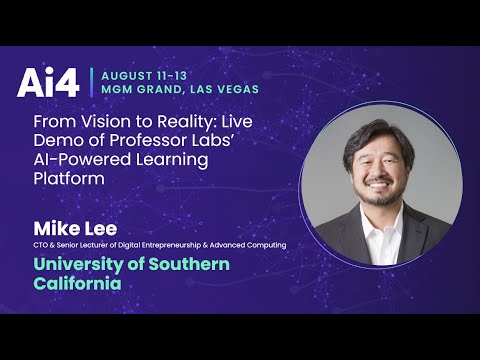
Ai4
Interactive multi-agent AI allows professors to replace easily pirated textbooks with dynamic, un-piratable course subscriptions while democratizing elite one-on-one tutoring for all students.
AI-assisted summary of From Vision to Reality: Live Demo of Professor Labs’ AI-Powered Learning Platform With USC — original source. Check the original for full context.
Source published:
Detailed notes
## Background Published by the Ai4 channel on YouTube on August 29, 2025, this presentation features USC Senior Lecturer Mike Lee and undergraduate research assistant Manuela Berrio showcasing Professor Labs. According to the description, the session demonstrates a working prototype that transforms traditional university lectures into interactive, gamified, and hyper-personalized learning quests powered by course-specific AI agents.
## TL;DR USC educators Mike Lee and Manuela Berrio present Professor Labs, a multi-agent educational architecture featuring Knowledge AI, Student AI, and Tutor AI designed to align with Bloom's Taxonomy. The platform democratizes round-the-clock personalized tutoring and continuous practice assessments while introducing an interactive curriculum licensing model to replace static, pirated textbooks. It supports local, hybrid, and cloud deployment models with purchasing power parity pricing for global accessibility. In the live demonstration, the presenters illustrate automated 15-week syllabus generation, real-time context injection via audience input, automated lecture slide and exam generation, and high-fidelity multilingual translation.
## Atmosphere & style The presentation is energetic, collegiate, and conversational, combining Silicon Valley evangelism with self-deprecating academic humor about tech salaries and early-morning office hours. The dynamic between the veteran industry-executive professor and his sharp undergraduate researcher feels mutually respectful, candid, and pedagogical. Watching the live demo conveys the spontaneous, authentic tension of real-time software trials, enlivened by lighthearted audience banter and passionate advocacy for human-centered experiential education.
## Key takeaways - [00:04](https://www.youtube.com/watch?v=oMgbGd95lSI&t=4s) Despite widespread information access via AI, the primary value of higher education remains direct human-to-human experiential learning and faculty mentorship. - [03:53](https://www.youtube.com/watch?v=oMgbGd95lSI&t=233s) Professor Labs addresses static curricula and uneven student motivation by mapping personalized study materials and dynamic assessments across Bloom's Taxonomy. - [03:53](https://www.youtube.com/watch?v=oMgbGd95lSI&t=233s) In the generative AI landscape, defensible long-term value resides in building proprietary application layers on top of existing frontier foundation models. - [06:28](https://www.youtube.com/watch?v=oMgbGd95lSI&t=388s) The platform's core architecture divides responsibilities across three agents: Knowledge AI (course IP repository), Student AI (digital twin tracking mastery), and Tutor AI (adaptive explainer). - [06:28](https://www.youtube.com/watch?v=oMgbGd95lSI&t=388s) To align with smartphone-first habits, the system structures curriculum into narrative 'Acts' using gamified micro-quests and personalized reminder personas. - [10:12](https://www.youtube.com/watch?v=oMgbGd95lSI&t=612s) The platform democratizes private one-on-one coaching through 24/7 on-demand tutoring and continuous 'Assess Me' exam question generation. - [10:12](https://www.youtube.com/watch?v=oMgbGd95lSI&t=612s) Content knowledge is decoupled from presentation logic, allowing different specialized frontier models to handle tasks like visual rendering or rapid text Q&A without altering course facts. - [13:10](https://www.youtube.com/watch?v=oMgbGd95lSI&t=790s) Interactive course subscriptions ($10–$20) replace easily pirated static textbooks while adjusting globally to local purchasing power parity. - [17:39](https://www.youtube.com/watch?v=oMgbGd95lSI&t=1059s) The open-source, model-agnostic architecture supports Local, Hybrid, and Cloud deployment configurations to balance data privacy, hardware constraints, and uptime. - [19:22](https://www.youtube.com/watch?v=oMgbGd95lSI&t=1162s) Ingesting a single textbook or slide deck automatically parses content into a full 15-week course syllabus with primary and alternative lecture topics. - [21:17](https://www.youtube.com/watch?v=oMgbGd95lSI&t=1277s) Knowledge AI supports real-time context injection, allowing instructors to immediately update the course knowledge base and have Tutor AI answer queries on new material. - [23:38](https://www.youtube.com/watch?v=oMgbGd95lSI&t=1418s) The platform provides exportable slide decks with speaker notes, high-fidelity multilingual translation, and automated generation of 30-to-40-question midterm exams.
## Detailed walkthrough ### [00:04](https://www.youtube.com/watch?v=oMgbGd95lSI&t=4s) Introductions and Background
Mike Lee opens the presentation by introducing himself as a Senior Lecturer of Digital Entrepreneurship and Advanced Computing at the University of Southern California (USC), alongside his undergraduate research assistant, Manuela Berrio. Berrio introduces herself as a rising junior at USC pursuing a dual degree in Computer Science and Business Administration with a specialization in AI applications. Lee commends Berrio as one of his top students who will also serve as a Teaching Assistant for his course on building personal AI agents. He emphasizes that USC students are now actively building custom LLM agents so they can graduate as true "AI natives."
Lee shares his extensive industry background spanning over 20 years, including CTO roles at digital media startups and a technology evangelist position at Netscape. He jokes with the audience about how rare it is for current undergraduate students to even recognize the name Netscape: "Thank God... it's been like five years since a single student knew what that was. So I really appreciate all of you." After spending a decade as a studio Vice President of Technology and building venture technology projects, he chose to take an 80% pay cut to teach at USC. Addressing the educators in the room, he quips that while teachers could easily make five times more in the private sector, they remain in academia because they genuinely care about students. Lee also highlights receiving the student-voted Golden Apple teaching award and serving as the faculty advisor for several innovation initiatives.
Beyond classroom teaching, Lee organizes an annual, fully funded global student startup competition that brings 50 international students from institutions like USC, UC Berkeley, Harvard, Cornell, Oxford, and Aalto University to South Korea to collaborate and compete with 50 local Korean students alongside 20 flown-in faculty mentors. Having just returned from serving as Head of Mentors at the European Innovation Academy with 300 international students, Lee underscores that despite AI making information widely accessible on platforms like YouTube, the irreplaceable value of a university education lies in direct human-to-human experiential learning.
- **Academic Roles**: Senior Lecturer at USC Marshall/Viterbi; founder of global student startup exchange programs. - **Participating Universities**: USC, UC Berkeley (Cal), Harvard, Cornell, Oxford, and Aalto University (Finland). - **Core Philosophy**: Physical universities must pivot toward high-impact experiential learning and mentorship that cannot be replicated by pre-recorded videos or standalone AI tools.
---
[03:53](https://www.youtube.com/watch?v=oMgbGd95lSI&t=233s) The Vision for Professor Labs and Hyper-Personalization
Reflecting on the initial vision introduced at AI4 the previous year, Lee outlines the core structural challenges facing higher education: static, one-size-fits-all curricula and highly uneven student motivation. He candidly describes the typical classroom distribution: one-third of students are self-driven high performers who excel with minimal instruction; one-third leave faculty wondering "how the hell did they get into our university"; and the middle third requires dynamic, tailored motivation to stay engaged. Professor Labs was created to bridge this divide through hyper-personalized learning and gamification.
The platform grounds its progression in Bloom's Taxonomy, mapping foundational understanding (rote memorization and core definitions) to the first half of a semester, followed by application, analysis, and active classroom engagement in the second half. Lee notes that as underlying Large Language Models improve, educational software can infinitely generate tailored study guides, exercises, and assessments at every tier of Bloom's hierarchy. Furthermore, Lee points out that unless an organization is spending tens of millions of dollars a month training frontier models like OpenAI or Google, the defensible value lies entirely in the application layer built on top of foundational models.
```mermaid flowchart TD accTitle: Bloom's Taxonomy Integration in Professor Labs subgraph Progression ["Bloom's Taxonomy Application"] A["Higher-Order: Analyze, Evaluate & Create"] --> B["Intermediate: Apply & Comprehend"] B --> C["Foundations: Remember & Define"] end subgraph Execution ["Platform Capability"] D["Infinite Adaptive Case Studies & Syntheses"] E["Dynamic Interactive Problem Sets"] F["Automated Rote Drills & Flashcards"] end C --> F B --> E A --> D ```
---
[06:28](https://www.youtube.com/watch?v=oMgbGd95lSI&t=388s) The Professor Labs AI Architecture: Knowledge, Student, and Tutor Agents
Lee breaks down the proprietary multi-agent framework powering Professor Labs, which centers on three interconnected AI engines:
```mermaid flowchart TD accTitle: Professor Labs Multi-Agent Core Framework subgraph Inputs ["Instructor Content"] KB["Textbooks, Slide Decks, Papers, Syllabus"] end subgraph CoreEngine ["Professor Labs Engine"] KAI["Knowledge AI\n(Course Brain / Professor's IP)"] SAI["Student AI\n(Digital Twin / Competency Tracker)"] TAI["Tutor AI\n(Adaptive Explainer / Socratic Guide)"] end subgraph Experience ["Student Experience"] GAME["Gamified Mobile Micro-Quests"] VOICE["Adaptive Persona / Tone Engine"] end KB --> KAI KAI <--> SAI KAI --> TAI SAI --> TAI TAI --> GAME TAI --> VOICE ```
The **Knowledge AI** serves as the repository for the instructor's intellectual property. A professor can upload full textbooks, recent research papers, updated slide decks, or lecture transcripts directly into the Knowledge AI, establishing an accurate, course-specific "brain." The **Student AI** operates as a digital twin tracking individual student mastery across every topic (e.g., scoring 20% in module four but 90% in module five), allowing the system to identify knowledge gaps relative to target learning outcomes.
The **Tutor AI** dynamically formats explanations to fit individual learning preferences—whether a student needs an intuitive visual breakdown, an audio summary, or a simplified explanation "as if they're a fifth grader." Lee compares traditional teaching to parenting: students often tune out their own professors while praising an outside guest lecturer who delivers the exact same message. Tutor AI circumvents this dynamic by acting as an objective, customizable study partner.
To boost engagement, the platform integrates gamified micro-learning tailored to smartphone-first habits. Lee illustrates the generational shift with an anecdote about the global K-pop group KATSEYE: when asked to act out the word "phone," older generations mimic holding a telephone handset to their ear, whereas younger members pantomime looking down at a flat rectangular screen. Professor Labs leverages these mobile micro-habits for rote drills and uses adaptive notification personalities reminiscent of Duolingo's persistent, meme-worthy reminders. Course curricula are structured into narrative "Acts" (aligned with midterms) containing individual lecture modules.
---
[10:12](https://www.youtube.com/watch?v=oMgbGd95lSI&t=612s) Pedagogical Methodology: Continuous Assessment and Multimodal Learning
The primary pedagogical objective of Professor Labs is reinforcing and scaling in-person instruction rather than replacing it. Lee contrasts affluent students who grew up with $100 to $200-per-hour private tutors against students whose busy parents could not provide academic coaching. Professor Labs aims to democratize this elite one-on-one tutoring experience for every enrolled student.
The platform provides 24/7 on-demand support through two dedicated modes: a **Private Tutor** that guides students through difficult concepts according to their learning style, and an **Assess Me** feature that continuously generates infinite variations of practice exam questions. This provides round-the-clock help regardless of erratic student study hours:
> "At any time, they could ask this 24/7. Doesn't matter if your TAs don't respond to discussion boards... because students have wacky schedules—midnight, whichever time, etc. Never at 8:00 AM. That's why I make all my office hours 8:00 AM. You must really want to see me."
Lee also shares candid lessons from experimental features, noting that attempting to prompt frontier models to generate interactive vector visualizations (SVGs) of complex physical systems (such as wind turbines) frequently failed in practice. Consequently, Professor Labs decouples content knowledge from presentation, routing tasks to specialized frontier models (like GPT-5/advanced multimodal models for visual rendering and GPT-4 for rapid text Q&A) while keeping the foundational course knowledge constant.
---
[13:10](https://www.youtube.com/watch?v=oMgbGd95lSI&t=790s) Academic Monetization, Democratization, and Platform Architecture
Lee addresses a systemic flaw in academic publishing: professors currently have little incentive to produce dynamic digital materials because textbooks costing hundreds of dollars are routinely pirated into free PDFs. Professor Labs introduces an interactive curriculum licensing model where professors license their Knowledge AI directly to students as required course materials for $10 to $20 per semester. Because the platform offers interactive tutoring and live dynamic assessments, it cannot be pirated as a static PDF.
```mermaid flowchart LR accTitle: Professor Workflow and Licensing Pipeline A["Upload Course IP\n(Slides, Books, Transcripts)"] --> B["Knowledge AI Generates\nStructured Syllabus & Acts"] B --> C["Instructor Refines\n& Customizes Content"] C --> D["Publish Interactive Course\n($10-$20 Student Subscription)"] ```
Lee also focuses on the democratization of AI for faculty and international students. While top-tier US universities have faculty who are technical super-users, instructors worldwide need turnkey tools that abstract technical complexities. Furthermore, student access pricing must adjust dynamically to local economies via purchasing power parity—scaling down from a $50 baseline in the United States to roughly $1.59 in India based on relative GDP per capita.
---
[17:39](https://www.youtube.com/watch?v=oMgbGd95lSI&t=1059s) Deployment Models and Setting Up the Live Demo
To ensure data sovereignty and flexibility, Professor Labs is designed as an open-source, AI platform-agnostic architecture evaluated across three deployment configurations:
| Deployment Mode | Infrastructure & Processing | Key Advantages | Trade-offs & Limitations | |:--- |:--- |:--- |:--- | | **Local** | Runs entirely on a local PC/Mac with local LLMs | Complete data privacy; operates offline without internet | Requires high-end GPU hardware; smaller models lack frontier reasoning | | **Hybrid** *(Demoed)* | Local data storage paired with cloud LLM APIs (e.g., OpenAI) | Keeps source files local while utilizing advanced cloud reasoning | No 24/7 student access when host machine is offline | | **Cloud** | Fully hosted cloud infrastructure with enterprise zero-retention APIs | High availability; 24/7 student access; zero model training on user data | Ongoing cloud compute and API operating costs |
Lee hands the presentation over to Manuela Berrio to run the live demonstration, which will showcase the two-way interaction between the instructor-facing **Knowledge AI** ingestion pipeline and the student-facing **Student/Tutor AI** interface.
[19:22](https://www.youtube.com/watch?v=oMgbGd95lSI&t=1162s) Course Generation and the Professor Labs Interface
The demonstration transitions into the functional platform, illustrating the dual-sided nature of education where faculty interact with one interface and students interact with another. To set up a full 15-week course syllabus, the instructor begins by designating the midterm week—typically set at Week 7 as the midpoint of the term. The professor then uploads course materials, such as a textbook PDF, presentation slides, or reading packet. In this live demo, Professor Mike Lee’s book is uploaded, prompting the underlying large language model to parse and chunk the material into a structured schedule with class meetings mapped out for Mondays and Wednesdays.
The platform architecture centers around two primary pillars: **Knowledge AI** on the instructor side, which allows professors to inject hyper-personalized, topic-specific notes and supplemental slides beyond the baseline textbook, and **Tutor AI** on the student side, designed to serve as an intelligent, round-the-clock teaching assistant. While the production roadmap moves toward a unified cloud-native environment, the current prototype displays these components side by side. Instructors can view extracted lecture topics for each week alongside AI-suggested alternative topics, enabling manual overrides if an educator finds a different concept more relevant to their curriculum.
```mermaid flowchart TD accTitle: Professor Labs Course Generation Workflow accDescription: Flowchart illustrating how course materials are ingested into Professor Labs to generate syllabi, lecture notes, and student interactions.
subgraph Ingestion["1. Ingestion & Setup"] A["Upload Material<br/>(Book / PDF / Slides)"] --> B["Set Midterm Week<br/>(e.g., Week 7)"] B --> C["LLM Chunking Engine"] end
subgraph CourseStructure["2. Course Structuring"] C --> D["15-Week Syllabus<br/>(Mon / Wed Schedule)"] D --> E["Core & Alternative Topics"] end
subgraph KnowledgeAndTutor["3. Personalization & Delivery"] E --> F["Knowledge AI<br/>(Instructor Custom Content)"] F --> G["Tutor AI<br/>(Personalized Student Tutor)"] F --> H["Topic Notes & Slide Decks"] F --> I["Quizzes & Midterm Generator"] end ```
- **Syllabus Automation**: Automatically structures 15 weeks of coursework from a single uploaded document. - **Flexible Topic Selection**: Displays primary extracted topics alongside alternative recommendations for faculty curation. - **Knowledge AI vs. Tutor AI**: Knowledge AI handles instructor-guided context enrichment, while Tutor AI serves personalized student queries.
---
[21:17](https://www.youtube.com/watch?v=oMgbGd95lSI&t=1277s) Live Audience Test with Knowledge AI and Tutor AI
To prove that the platform dynamically integrates new context in real time rather than relying on pre-trained canned responses, the presenters invite the audience to provide an arbitrary, out-of-domain personal fact that could not be found anywhere in Professor Lee's book. Audience members playfully joke about volunteering sensitive details like "social security numbers" or maiden names, before an attendee named Alex volunteers a personal historical anchor: *"When Mount St. Helens blew in 1980, I was five years old."*
The team types this fact into a document, saves it, and uploads it directly into the Knowledge AI module for a specific topic module. The goal is to show that Tutor AI immediately inherits this newly added context and can answer specific factual questions about Alex’s age and the 1980 eruption. As with live software demonstrations, the presenters navigate file saving, local downloads, and uploading constraints in real time before pivoting to showcase topic note generation.
- **Dynamic Context Injection**: Allows real-time ingestion of supplemental text to augment the primary course model. - **Audience Fact**: Alex was 5 years old when Mount St. Helens erupted in 1980.
---
[23:38](https://www.youtube.com/watch?v=oMgbGd95lSI&t=1418s) Topic Notes, Multilingual Capabilities, and Assessment Generation
Moving into the core instructional tools, the presenters demonstrate the automatic generation of comprehensive topic notes. When an instructor triggers this feature, the system generates a ready-to-use lecture outline structured for direct export into presentation software such as Google Slides or Microsoft PowerPoint. Each generated deck includes slide-by-slide content guidelines, detailed speaker notes for the lecturer, and a structured 20-topic breakdown of the selected subject area.
The platform also integrates multilingual learning features designed to assist non-native English speakers. Drawing from her own background growing up in Colombia until age 17, Manuela Berrio highlights how native-language AI support removes comprehension barriers for international students. The translation engine delivers high-fidelity curriculum translations into languages such as Spanish, Korean, and German without degrading technical accuracy. Additionally, the system features interactive gamification modules, automatically creating mini-game quizzes and building comprehensive 30-to-40-question midterm exams containing both standard multiple-choice and complex application-based problem sets.
- **Lecture Slide Generation**: Produces full slide breakdowns with detailed speaker notes and 20-topic conceptual splits. - **Multilingual Learning**: Leverages advanced translation models across languages including Spanish, Korean, and German to support global and ESL learners. - **Assessment Engine**: Generates gamified mini-quizzes and 30–40 question midterm exams combining multiple-choice and scenario-based application questions.
## Notable quotes > [00:04](https://www.youtube.com/watch?v=oMgbGd95lSI&t=4s) Thank God... it's been like five years since a single student knew what that was. So I really appreciate all of you. — Mike Lee
> [03:53](https://www.youtube.com/watch?v=oMgbGd95lSI&t=233s) how the hell did they get into our university — Mike Lee
> [06:28](https://www.youtube.com/watch?v=oMgbGd95lSI&t=388s) as if they're a fifth grader — Mike Lee
> [10:12](https://www.youtube.com/watch?v=oMgbGd95lSI&t=612s) At any time, they could ask this 24/7. Doesn't matter if your TAs don't respond to discussion boards... because students have wacky schedules—midnight, whichever time, etc. Never at 8:00 AM. That's why I make all my office hours 8:00 AM. You must really want to see me. — Mike Lee
> [21:17](https://www.youtube.com/watch?v=oMgbGd95lSI&t=1277s) When Mount St. Helens blew in 1980, I was five years old. — Alex
## Mentioned Mike Lee, Manuela Berrio, University of Southern California (USC), USC Marshall School of Business, USC Viterbi School of Engineering, Professor Labs, AI4, Netscape, UC Berkeley, Harvard University, Cornell University, University of Oxford, Aalto University, European Innovation Academy, Bloom's Taxonomy, OpenAI, Google, KATSEYE, Duolingo, GPT-4, GPT-5, Google Slides, Microsoft PowerPoint
## Video description Mike Lee, Senior Lecturer of Digital Entrepreneurship & Advanced Computing, University of Southern California Manuela Berrio, Undergraduate Research Assistant, University of Southern California
Abstracts
At AI4 2024, we introduced Professor Labs as an academic project aimed at transforming higher education through generative AI and gamified learning. One year later, we return with a working prototype and a live demonstration.
In this session, Mike Lee (Senior Lecturer of Digital Entrepreneurship & Advanced Computing, University of Southern California) and Manuela Berrio (Computer Science & Business Administration major, University of Southern California) showcase how Professor Labs enables professors to transform traditional lectures into interactive, AI-powered learning quests. Built by and for educators, the platform leverages custom large language models trained on course-specific content to deliver hyper-personalized tutoring, continuous assessment, and student-led gameplay.
This live demo will highlight: - The Professor Use Case: Uploading course content, generating assessments, and guiding pedagogy - The Tutor AI: Real-time, personalized feedback and support tailored to individual students
Join us to see how academic research is translating vision into practice—and shaping the future of teaching and learning.
[Source](https://www.youtube.com/watch?v=oMgbGd95lSI)