American University Overhauls Curriculum as AI Breaks Entry-Level Jobs
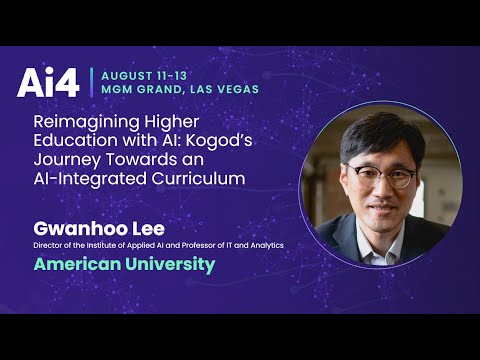
Ai4
Because artificial intelligence is eliminating entry-level corporate tasks, business schools must rapidly embed universal AI fluency and human-centric skills across all coursework to keep graduates employable.
AI-assisted summary of Reimagining Higher Education with AI: Kogod’s Journey Towards an AI-Integrated Curriculum With AU — original source. Check the original for full context.
Source published:
Detailed notes
## Background Published on YouTube by the Ai4 channel on August 29, 2025, this presentation features Gwanhoo Lee, Director of the Institute for Applied AI and Professor at American University's Kogod School of Business. The talk outlines Kogod's comprehensive roadmap for embedding artificial intelligence across higher education curricula, aligning student learning outcomes with workforce shifts, and transforming university operations.
## TL;DR Addressing the reality that entry-level career ladders are fracturing, Gwanhoo Lee shares how American University's Kogod School of Business executed an aggressive, school-wide AI transformation. The strategy combines top-down executive support with bottom-up faculty engagement, rolling out a four-year scaffolded undergraduate model, specialized AI degree tracks, and clear course designations. Beyond technical fluency, the curriculum emphasizes deeply human skills, entrepreneurial agility, and standardized usage accountability while integrating AI directly into campus operations. Ultimately, Lee distills practical lessons for academic leaders, stressing speed over perfection to ensure universities lead rather than fall behind.
## Atmosphere & style The presentation carries an energetic, pragmatic, and candid tone, marked by honest admissions about institutional improvisation and trial-and-error rather than pretending to possess an effortless blueprint. Lee balances sobering workforce statistics and corporate insights with lighthearted anecdotes, creating an engaging and relatable dynamic with the audience. The talk feels like an inspiring yet grounded dispatch from the front lines of academic reform, building toward an urgent, stirring call for institutional leadership.
## Key takeaways - [00:04](https://www.youtube.com/watch?v=acMYFQaK_R4&t=4s) Institutional AI transformation in higher education requires continuous experimentation, adaptation, and improvisation rather than waiting for a perfect blueprint. - [01:10](https://www.youtube.com/watch?v=acMYFQaK_R4&t=70s) With 86% of students already using AI and entry-level career rungs breaking, universities must shift from training for traditional junior tasks to developing advanced AI fluency and human adaptability. - [04:00](https://www.youtube.com/watch?v=acMYFQaK_R4&t=240s) Achieving faculty buy-in relies on a combination of top-down support, bottom-up community forums like 'Second Friday' with over 70% voluntary attendance, and immersive industry visits to AI leaders. - [06:36](https://www.youtube.com/watch?v=acMYFQaK_R4&t=396s) Academia faces severe hiring and retention competition against tech industry compensation, requiring a recruitment focus on mission-driven scholars. - [07:20](https://www.youtube.com/watch?v=acMYFQaK_R4&t=440s) Kogod implemented a four-year scaffolding curriculum spanning Year 1 literacy and ethics, Year 2 functional business AI, Year 3 domain-specific applications, and Year 4 capstone practicums. - [09:54](https://www.youtube.com/watch?v=acMYFQaK_R4&t=594s) Courses are categorized into 'Sage' (>50% AI content) and 'Artisan' (light-touch) integrations, utilizing custom tools like Perplexity Spaces across dozens of sections. - [12:43](https://www.youtube.com/watch?v=acMYFQaK_R4&t=763s) A mandatory two-step disclosure policy requires students to document specific AI tool usage and explicitly state their own human intellectual contributions. - [13:33](https://www.youtube.com/watch?v=acMYFQaK_R4&t=813s) The educational framework for the AI economy is anchored on three pillars: universal AI fluency, deeply human skills (empathy, leadership, integrity), and an entrepreneurial mindset. - [15:07](https://www.youtube.com/watch?v=acMYFQaK_R4&t=907s) Student AI competency is benchmarked against the Digital Education Council's 5-level framework, moving from foundational understanding to domain-specific real-world applications. - [17:20](https://www.youtube.com/watch?v=acMYFQaK_R4&t=1040s) Universities should deploy AI across internal operations, such as admissions chatbots, research translation, PR drafting, and advising, to mirror curricular innovation. - [17:20](https://www.youtube.com/watch?v=acMYFQaK_R4&t=1040s) American University established the Institute for Applied Artificial Intelligence with over 30 faculty members to coordinate campus-wide research and education initiatives. - [19:18](https://www.youtube.com/watch?v=acMYFQaK_R4&t=1158s) Key lessons for university leaders include ensuring executive backing, prioritizing speed over perfection, fostering community engagement, and leveraging external recognition to sustain momentum.
## Detailed walkthrough ### [00:04](https://www.youtube.com/watch?v=acMYFQaK_R4&t=4s) Navigating Higher Education’s AI Disruption at Kogod
Gwanhoo Lee opens his address at the Ai4 conference by welcoming the audience and expressing his gratitude to those who stayed until the final sessions. He introduces an inside look at how the Kogod School of Business at American University in Washington, DC has been actively navigating artificial intelligence—what he frames as one of the most profound disruptions in the history of higher education. Rather than claiming to possess a magic bullet, Lee candidly admits that Kogod’s transformation has been defined by continuous experimentation, trial and error, adaptation, and on-the-fly improvisation.
Despite the unvarnished realities of building the playbook as they go, the school has made bold strategic choices. Lee emphasizes that the lessons and practical insights gathered along the way offer a valuable blueprint for other academic institutions grappling with similar challenges. He sets out to share these hard-won stories in hopes of helping peers accelerate their own institutional strategies.
- **Institution:** Kogod School of Business at American University (Washington, DC). - **Core Philosophy:** Embracing experimentation, trial and error, and improvisation over waiting for a perfect blueprint. - **Key Quote:** "I will not pretend that we have discovered perfect answer for this... In fact, much of our AI journey has involved experimentation, trial and error, adaptation and improvisation to be honest."
---
[01:10](https://www.youtube.com/watch?v=acMYFQaK_R4&t=70s) The Reality of AI in Academia and the Breaking Career Ladder
Lee points out that while saying "AI will change everything" has become a cliché, its truth is undeniable. He surveys the room, asking how many audience members begin their mornings talking to AI rather than humans or find themselves relying on AI for an increasing number of daily tasks. Turning to academia, he acknowledges a well-known vulnerability: traditional universities are notoriously slow to adapt when the world shifts rapidly around them. To avoid being left behind, Kogod made a conscious decision to be proactive and actively reimagine higher education for an AI-driven era.
The urgency is underscored by stark data and shifting workforce dynamics. A 2024 survey revealed that 86% of higher education students are already utilizing AI in their studies, proving that whether faculty welcome it or not, AI is already in the classroom. Furthermore, Lee references an op-ed in *The New York Times* written by a senior executive at LinkedIn, which warned that "the bottom rung of the career ladder is breaking." Because AI is rapidly absorbing entry-level tasks, universities can no longer train students for traditional entry-level jobs; they must instead equip them with high-level AI fluency, practical skills, deeply human capabilities, and adaptability so they can step directly into more complex roles.
- **Student AI Adoption Rate:** 86% of higher education students surveyed in 2024 actively use AI in their studies. - **Workforce Shift:** Entry-level positions are rapidly disappearing as AI capabilities expand, breaking the traditional career ladder. - **Stakeholder Perspectives Shared:** - *Venture Capital CEO:* "AI won't take your job, but someone who knows AI could take your job if you don't know AI." - *Young Alumna:* "AI is doing what I did at 22 as a first-year financial analyst." - *Advisory Board Member:* "Run, do not walk. You cannot afford to walk. We have to run."
---
[04:00](https://www.youtube.com/watch?v=acMYFQaK_R4&t=240s) Winning Over Faculty: Two-Pronged Engagement and the Silicon Valley Reality Check
Integrating AI across an academic curriculum is impossible without genuine faculty buy-in. Kogod adopted a two-pronged strategy combining top-down vision and resources from leadership with bottom-up engagement that listens closely to faculty concerns. To build momentum, the school brought in high-profile industry leaders to spark curiosity and urgency, formed a dedicated faculty committee to keep academic voices at the center of policy decisions, and conducted surveys to pinpoint specific barriers to adoption. They also appointed one of their youngest faculty members as an AI Instructional Faculty Fellow to serve as an accessible, go-to peer resource.
To maintain continuous dialogue, Kogod launched "Second Friday," a monthly online knowledge-sharing forum held every second Friday at 9:00 a.m. In this voluntary space, faculty present best practices, exchange pedagogical ideas, and voice real frustrations. To leadership's surprise, over 70% of full-time faculty have regularly attended these sessions—even throughout the summer break. Additionally, in January, deans and select faculty embarked on an immersive trip to Silicon Valley and the Bay Area, visiting OpenAI, Google, Perplexity, and other tech leaders. Seeing cutting-edge developments firsthand inside AI companies proved to be the ultimate catalyst, converting even the most skeptical academics into enthusiastic champions of AI integration.
```mermaid accTitle: Faculty Engagement Strategy Architecture flowchart TD subgraph TopDown ["Leadership Support (Top-Down)"] A["Vision & Direction"] B["Resource Allocation"] C["Industry Leaders & Advisory"] end
subgraph BottomUp ["Faculty Engagement (Bottom-Up)"] D["AI Instructional Faculty Fellow"] E["Second Friday Monthly Forum (70%+ Attendance)"] F["Faculty AI Committee & Surveys"] end
subgraph Immersive ["Silicon Valley Field Study"] G["Visits to OpenAI, Google & Perplexity"] end
TopDown --> H["Curriculum Transformation"] BottomUp --> H Immersive --> H ```
- **Second Friday Forum:** Monthly 9:00 a.m. virtual session achieving over 70% voluntary full-time faculty attendance, even during summer months. - **Faculty Leadership:** Appointment of a junior faculty member as the AI Instructional Faculty Fellow to provide peer-to-peer technical and pedagogical support. - **Industry Excursions:** January site visits to OpenAI, Google, and Perplexity in the Bay Area to expose faculty to state-of-the-art developments. - **Key Quote:** "Nothing convinces a skeptical academic faster than seeing firsthand what's happening inside AI companies."
---
[06:36](https://www.youtube.com/watch?v=acMYFQaK_R4&t=396s) Recruiting Talent in a Hyper-Competitive Market
To support this ambitious transformation, Kogod actively invested in faculty talent specializing in AI and machine learning. However, Lee shares the harsh reality of competing against tech giants for top-tier expertise. Academia simply cannot match the compensation packages offered by major technology firms. Illustrating this challenge with a touch of humor, Lee reveals that one of their newly hired AI faculty members left the university after just a single semester to launch an AI startup.
Despite these recruitment hurdles, Kogod remains committed to scouting individuals who value the broader societal mission and educational impact of academia. Through persistent efforts, the school has successfully onboarded key talent dedicated to shaping the next generation of business leaders.
- **Recruitment Reality:** Higher education faces extreme competition from tech giants with vast financial resources. - **Retention Challenge:** A recent faculty hire departed after just one semester to found an AI startup. - **Strategic Focus:** Targeting scholars and practitioners who prioritize the mission, teaching, and societal impact of higher education.
---
[07:20](https://www.youtube.com/watch?v=acMYFQaK_R4&t=440s) A Scaffolding Model for AI Integration Across the Curriculum
By the fall semester, Kogod stands as one of the first business schools in the United States to offer a comprehensive suite of specialized AI credentials: an undergraduate AI major, an undergraduate AI minor, a Master’s in Business Analytics and AI, and a dedicated AI STEM track. Beyond rolling out specialized degree paths, the overarching strategy focuses on embedding AI systematically into every level of the standard curriculum.
For undergraduate students, the learning journey is carefully scaffolded across four years. First-year students build foundational AI literacy while learning responsible and ethical usage. Second-year students apply AI tools across core business functions including accounting, finance, marketing, operations, and HR. Third-year students take a deep dive into domain-specific applications—such as environmental monitoring in sustainability, predictive modeling in finance, automated auditing in accounting, or big data analytics. In their senior year, everything culminates in an AI-infused practicum project where students solve real-world industry problems using the full spectrum of AI tools learned throughout their degree. A similar model applies to graduate students, beginning at orientation with core AI concepts and ethics before advancing into discipline-specific master's coursework.
```mermaid accTitle: Four-Year Undergraduate AI Learning Scaffolding flowchart LR subgraph Year1 ["Year 1: Foundation"] Y1["AI Literacy & Ethics"] end
subgraph Year2 ["Year 2: Core Functions"] Y2["Functional Business AI\n(Accounting, Finance, Marketing, HR)"] end
subgraph Year3 ["Year 3: Domain Mastery"] Y3["Specialized Applications\n(Audit Automation, Predictive Finance)"] end
subgraph Year4 ["Year 4: Synthesis"] Y4["AI-Infused Practicum\n(Real-World Problem Solving)"] end
Y1 --> Y2 --> Y3 --> Y4 ```
- **New Degree Offerings:** Undergraduate AI Major, Undergraduate AI Minor, Master's in Business Analytics & AI, and an AI STEM track. - **Undergraduate Scaffolding:** - *Year 1:* Basic literacy and ethical/responsible AI usage. - *Year 2:* Functional business integration (accounting, finance, marketing, operations, HR). - *Year 3:* Deep-dive domain applications (automated auditing, predictive financial modeling, marketing campaigns). - *Year 4:* Hands-on AI-infused practicum tackling real-world business problems.
---
[09:54](https://www.youtube.com/watch?v=acMYFQaK_R4&t=594s) Course Categorization, Classroom Adoption, and Interactive Tools
Kogod classifies its AI-integrated courses into two distinct categories: "Sage" courses, where over 50% of the content is explicitly AI-focused, and "Artisan" courses, which incorporate AI with a lighter, tailored touch. Currently, the school boasts 19 Sage and 39 Artisan courses (58 in total), all with explicitly defined AI learning outcomes. Course adoption has escalated rapidly: over 50% of classes incorporated AI in the spring semester, with adoption projected to reach 75% in the fall.
To provide customized academic support, 15 core courses spanning over 60 sections deployed Perplexity Spaces (similar to Google’s NotebookLM) during the spring semester to deliver class-specific AI assistance to students. Lee highlights innovative classroom implementations across disciplines: - **Negotiation:** Students use AI to simulate complex bargaining scenarios, build distinct negotiator personas, test tactics, and receive instant personalized feedback. - **Digital Marketing:** Group projects require students to craft complete marketing campaign portfolios using more than 10 distinct AI tools. - **Entrepreneurship:** A faculty member completely revamped his course by co-teaching alongside a custom-built AI assistant and creating curated prompt libraries for personalized student exploration.
| Course Category | AI Content Threshold | Current Course Count | Key Target / Benchmark | |:--- |:--- |:--- |:--- | | **Sage Courses** | Over 50% AI-focused content | 19 courses | Identified defined learning outcomes | | **Artisan Courses** | Light-touch AI integration | 39 courses | Identified defined learning outcomes | | **Classroom Adoption** | Active AI usage in teaching | 50% (Spring) | Targeted **75%** adoption in Fall | | **Custom AI Spaces** | Course-level AI support tools | 15 courses / 60+ sections | Expanding dramatically in Fall |
---
[12:43](https://www.youtube.com/watch?v=acMYFQaK_R4&t=763s) Standardized Accountability: AI Usage Forms and Human Contribution
To maintain academic integrity and ensure students remain active thinkers rather than passive consumers, Kogod enforces a clear two-step disclosure policy for assignments involving AI. Whenever students utilize AI tools for coursework, they must submit a standardized school form detailing their usage alongside their final project.
First, students must specify the exact functional stage where AI was employed—whether for initial brainstorming, drafting, data visualization, quantitative analysis, presentation design, or proofreading. Second, and most crucially, students must explicitly document what *they as humans* contributed to the final deliverable. This requirement guarantees that AI acts as an accelerator for human effort rather than a complete replacement for critical thought.
- **Standardized AI Disclosure Form:** Required for any assignment where AI is utilized. - **Step 1 (Tool Mapping):** Categorizing AI use (brainstorming, drafting, data analysis, visualization, presentation, or proofreading). - **Step 2 (Human Audit):** Documenting explicit human contributions, edits, critical reasoning, and oversight. - **Core Objective:** Preventing AI-driven delegation and preserving student ownership of intellectual output.
---
[13:33](https://www.youtube.com/watch?v=acMYFQaK_R4&t=813s) The Three Pillars of Education for the AI Economy
Relying solely on technical AI skills is insufficient to prepare graduates for long-term career success. Citing private conversations with senior executives at LinkedIn, Lee reinforces that the most valuable assets in an AI-driven economy remain deeply human traits. In response, Kogod has structured its overarching student development framework around three core pillars, anchored by solid domain expertise:
1. **AI Fluency for Everyone:** Universal foundational competence in leveraging modern AI tools across disciplines. 2. **Deeply Human Skills:** Cultivating non-automated leadership traits, including empathy, communication, cross-functional coordination, and ethical integrity. 3. **Entrepreneurial Mindset:** Preparing every student—whether joining a multinational corporation or a three-person non-profit—to look beyond static job descriptions, identify novel opportunities, and drive proactive results.
Complementing these pillars, deep domain expertise remains essential; without specialized subject-matter knowledge, professionals cannot effectively evaluate, direct, or apply AI capabilities in meaningful ways.
- **Pillar 1:** Universal AI Fluency. - **Pillar 2:** Deeply Human Skills (empathy, leadership, communication, coordination, integrity). - **Pillar 3:** Entrepreneurial Mindset across all organizational scales. - **Foundation:** Core domain expertise required to harness and evaluate AI meaningfully.
---
[15:07](https://www.youtube.com/watch?v=acMYFQaK_R4&t=907s) A 5-Level Framework for AI Learning Outcomes
Kogod structured its AI learning outcomes hierarchically—starting at the course level, progressing to the program level, and culminating at the school level. For instance, in an advanced quantitative methods and machine learning course within the Finance Department, students learn key AI concepts, build predictive financial models, and perform natural language processing (NLP) on unstructured financial text.
At the broader undergraduate program level, Kogod adopted the 5-level framework established by the Digital Education Council to define student progression:
- **Level 1 (Foundational Understanding):** Grasps fundamental AI concepts, underlying algorithms, and related data processes. - **Level 2 (Critical Thinking & Judgment):** Systematically verifies AI data sources, evaluates competing model architectures, and selects the right model for specific business problems. - **Level 3 (Ethical & Responsible Use):** Identifies potential algorithmic bias, data inaccuracies, and discriminatory risks to ensure responsible deployment. - **Level 4 (Human Centricity & Collaboration):** Demonstrates effective collaboration between human teams and automated systems (such as AI agents), integrating human judgment with machine-generated insights. - **Level 5 (Domain-Specific Application):** Applies specialized, discipline-specific AI tools to solve complex, real-world business challenges.
---
[17:20](https://www.youtube.com/watch?v=acMYFQaK_R4&t=1040s) Industry Partnerships, Operational AI, and The Institute for Applied AI
To support its ambitious academic roadmap, Kogod established strategic industry partnerships with major technology leaders. These collaborations provide students with enterprise access to tools like Perplexity Enterprise, co-develop novel methodologies with Google for assessing AI learning outcomes, and create joint educational programs.
To "practice what they preach," the business school aggressively embeds AI into its own administrative operations. Operational use cases include: - Deploying an AI admissions chatbot to answer prospective student and parent inquiries. - Automating the translation of complex faculty academic research into consumer-friendly blogs, social media posts, and video scripts. - Draft press releases and marketing articles for public relations. - Streamlining alumni fundraising, academic advising, internal policy navigation, and student event planning.
To unify these disparate initiatives, Kogod launched **The Institute for Applied Artificial Intelligence**, directed by Professor Gwanhoo Lee. Bringing together over 30 affiliated faculty members from across the entire American University campus, the Institute serves as a centralized hub to connect, coordinate, and amplify AI research and teaching across disciplines.
- **Key Corporate Partners:** Perplexity (enterprise tools) and Google (learning outcome assessment frameworks). - **Operational AI Implementations:** Admissions chatbots, research translation to media content, PR generation, fundraising support, and academic advising tools. - **The Institute for Applied AI:** Cross-disciplinary research and implementation hub directed by Gwanhoo Lee, uniting 30+ faculty members campus-wide.
---
[19:18](https://www.youtube.com/watch?v=acMYFQaK_R4&t=1158s) External Validation and Strategic Takeaways for Higher Education
Kogod’s comprehensive approach has earned widespread external recognition. Leaders from Microsoft, OpenAI, and *Times Higher Education* have praised the initiative, while publication *Poets&Quants* remarked that Kogod has executed "the most consequential AI transformation in business education." Lee notes that while these accolades are humbling, their true value lies in boosting community confidence, attracting new industry partners, and sustaining momentum.
In closing, Lee distills Kogod’s journey into four critical lessons for university leaders, administrators, and industry policy makers:
1. **Executive Support is Essential:** Institutional transformation fails to take root without direct backing and resource commitments from senior leadership. 2. **Speed Over Perfection:** Waiting for a flawless, polished plan leads to paralysis. Institutions must move quickly, iterate, and refine as they go. 3. **Build an Engaged Community:** Connect faculty, students, and staff into collaborative learning networks to make the transition smoother and more engaging. 4. **Leverage External Validation:** External recognition validates internal efforts, builds momentum, and opens new partnership doors.
Lee leaves the audience with a final, stirring challenge: *"Are you AI ready? Not just your faculty or some students... but as an institution as a whole? If you don't lead this change, someone else will."*
- **Major Recognition:** Praised by OpenAI, Microsoft, *Times Higher Education*, and *Poets&Quants*. - **Key Takeaway 1:** Executive support is non-negotiable. - **Key Takeaway 2:** Bias for action—move fast rather than waiting for a perfect plan. - **Key Takeaway 3:** Foster community through inclusive forums and shared learning. - **Key Takeaway 4:** External validation fuels internal momentum and industry partnerships.
## Notable quotes > [00:04](https://www.youtube.com/watch?v=acMYFQaK_R4&t=4s) I will not pretend that we have discovered perfect answer for this... In fact, much of our AI journey has involved experimentation, trial and error, adaptation and improvisation to be honest. — Gwanhoo Lee
> [01:10](https://www.youtube.com/watch?v=acMYFQaK_R4&t=70s) the bottom rung of the career ladder is breaking. — Senior Executive at LinkedIn (via The New York Times)
> [01:10](https://www.youtube.com/watch?v=acMYFQaK_R4&t=70s) AI won't take your job, but someone who knows AI could take your job if you don't know AI. — Venture Capital CEO
> [01:10](https://www.youtube.com/watch?v=acMYFQaK_R4&t=70s) AI is doing what I did at 22 as a first-year financial analyst. — Young Alumna
> [01:10](https://www.youtube.com/watch?v=acMYFQaK_R4&t=70s) Run, do not walk. You cannot afford to walk. We have to run. — Advisory Board Member
> [04:00](https://www.youtube.com/watch?v=acMYFQaK_R4&t=240s) Nothing convinces a skeptical academic faster than seeing firsthand what's happening inside AI companies. — Gwanhoo Lee
> [19:18](https://www.youtube.com/watch?v=acMYFQaK_R4&t=1158s) the most consequential AI transformation in business education. — Poets&Quants
> [19:18](https://www.youtube.com/watch?v=acMYFQaK_R4&t=1158s) Are you AI ready? Not just your faculty or some students... but as an institution as a whole? If you don't lead this change, someone else will. — Gwanhoo Lee
## Mentioned Gwanhoo Lee, Kogod School of Business, American University, Institute for Applied Artificial Intelligence, Ai4, OpenAI, Google, Perplexity, Microsoft, LinkedIn, Digital Education Council, The New York Times, The Wall Street Journal, Axios, Poets&Quants, Times Higher Education, Perplexity Spaces, NotebookLM
## Video description Gwanhoo Lee, Director of the Institute of Applied AI and Professor of IT and Analytics, American University
Abstracts
Artificial intelligence is transforming the foundation of higher education. I will present a bold, practical vision for how universities can lead in this era by rethinking both teaching and learning. Drawing on my work as Director of the Institute for Applied Artificial Intelligence at American University’s Kogod School of Business, I will share our strategies for embedding AI across the curriculum, aligning learning outcomes with emerging technologies, and preparing students for careers shaped by AI. Our efforts have earned recognition from The Wall Street Journal, The New York Times, Axios, and Poets&Quants, and have been praised by industry leaders. I will provide actionable insights for academics, university administrators, industry leaders, and policymakers to drive AI-driven transformation in higher education.
[Source](https://www.youtube.com/watch?v=acMYFQaK_R4)