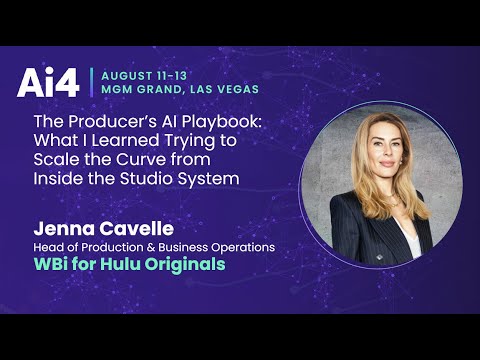
## Background
This presentation by Jenna Cavelle, Head of Production & Business Operations at WBi for Hulu Originals, was published on YouTube by Ai4 on August 28, 2025. Based on the page description, the talk explores the operational challenges of scaling AI inside a legacy studio system, detailing Cavelle's internal AI Taskforce, tools like ContingentAI, and practical strategies for overcoming industry fear and cultural resistance.
## TL;DR
Addressing Hollywood's general AI illiteracy, Cavelle argues that resistance stems from the industry forgetting its roots as a technological storytelling medium. She shares her experience attempting to address production bottlenecks at Hulu, from testing rejected tools like StoryFit to establishing a streamlined internal AI taskforce. After studio restructuring and layoffs left her operating solo, she pivoted to self-taught agentic architectures and developed ContingentAI—an offline, hardware-agnostic local LLM designed for secure film production. Ultimately, she emphasizes that true agency and co-integration require deep technical fluency rather than superficial product dependency.
## Atmosphere & style
The presentation carries a candid, grounded, and deeply pragmatic tone, balancing self-deprecating humor with executive grit. Cavelle frame-shifts her journey not as a polished triumph, but as an honest, unfiltered look at institutional friction and survival inside a shifting studio system. Watching the talk feels like an empowering, insider post-mortem that bridges high-level operational strategy with raw technical curiosity.
## Detailed walkthrough
### [00:04](https://www.youtube.com/watch?v=X29s46LD0GI&t=4s) Introduction and the Reality of AI Adoption in Hollywood
Jenna Cavelle, Head of Production & Business Operations at WBi for Hulu Originals, opens her presentation by lightly addressing the audience size—joking about clearing out the room after a crowded prior session, but resolving not to take it personally. She establishes that her story is not a triumphant case study in successfully scaling the AI adoption curve, as she believes no one in the industry has truly figured that out yet. Instead, her talk is a candid reflection on what she learned while attempting to drive AI adoption within her work and team at the studio level, emphasizing that her insights reflect her own firsthand operational perspective rather than absolute universal facts.
Before diving into her journey, Cavelle provides a "spoiler alert" framing: on the whole, Hollywood remains remarkably AI illiterate. She argues that this illiteracy stems from the industry forgetting its foundational identity—that filmmaking is, at its core, a technological art form. From silent films transitioning to talkies, celluloid giving way to digital, and practical effects evolving into VFX, cinema has always existed at the intersection of storytelling and technology. She invokes a classic philosophical principle: true transformation requires remembering who you are and knowing thyself.
- **Speaker Background**: Jenna Cavelle, studio executive in production operations and film/TV producer.
- **Core Thesis**: Hollywood’s current resistance to AI stems from forgetting that cinema is fundamentally a technological medium.
---
[02:15](https://www.youtube.com/watch?v=X29s46LD0GI&t=135s) Hollywood's Love-Hate Relationship with Big Tech and AI
Cavelle addresses the polarizing "love-hate relationship" that entertainment has developed toward artificial intelligence. While news headlines frequently document prominent industry figures shifting from outspoken AI opponents to founding AI-driven production studios, deep-seated resistance remains widespread. She highlights a recent article by Daniel Kwan (co-director of *Everything Everywhere All at Once*), who urged the creative community to resist big tech pushing AI onto artists.
While acknowledging the thoughtfulness of Kwan's perspective regarding the fear of replacing human creatives, Cavelle pushes back against the prevailing narrative of framing AI as an external "invader." She argues that casting tech as the antagonist and Hollywood as the victim strips filmmakers of their agency. When creatives view themselves as victims of a tech takeover rather than agents of their own transformation, they forfeit the opportunity to co-create integration terms. Achieving true authorship over AI requires becoming fluent in the technology; without literacy, creatives cannot meaningfully participate in setting the rules.
```
TRADITIONAL Hollywood Narrative (Victimhood)
[ Big Tech ] ---> (Invades/Pushes AI) ---> [ Hollywood / Artists ]
(Resists / Denies Agency)
- **Industry Polarization**: Public shifts from vocal anti-AI stances to launching AI studios.
- **Key Critique**: Framing AI as an invader limits agency and prevents creatives from negotiating integration terms from a position of fluency.
---
[05:07](https://www.youtube.com/watch?v=X29s46LD0GI&t=307s) Bottlenecks Inside the Studio: The Script Shortage
Taking the audience back to her time inside the studio system, Cavelle describes the exact moment ChatGPT became consumer-facing. At the time, she was halfway through delivering a feature film slate for Hulu—a short-to-feature pipeline—while concurrently completing her final semester of business school. Applying business school operations theory on bottleneck analysis to her studio slate, she identified her primary constraint: a severe lack of production-ready scripts. She faced a frustrating operational mismatch where financing, distribution, and production slots were locked and ready, but greenlightable scripts were missing.
This bottleneck was not due to developer incompetence, but stemmed from the business model itself. The pipeline focused on up-and-coming, underrepresented filmmakers who required deeper mentorship and longer development timelines. To resolve this, Cavelle sought to introduce an AI platform named StoryFit—a tool that analyzed character arcs, plot structures, and market performance metrics. However, studio leadership rejected the platform, deeming the technology unready and overly expensive (StoryFit subsequently shut down roughly six months prior to her talk). Attempts to engage her development counterparts through playful "GPT mashups" (e.g., prompting "What if *Paranormal Activity* met *Get Out*?") were met with skepticism rather than enthusiasm.
- **Operational Bottleneck**: Production slots, financing, and distribution were secured, but production-ready scripts were unavailable.
- **Rejected Tool**: StoryFit (script structure and audience engagement market analysis platform).
- **Adoption Friction**: Studio leadership cited cost and tech immaturity; development teams showed no interest in speculative GPT ideation sessions.
---
[08:09](https://www.youtube.com/watch?v=X29s46LD0GI&t=489s) The Multi-Curve Adoption Problem and Building an Internal Taskforce
Following the rejection from the development department, Cavelle experienced an "aha moment" regarding organizational dynamics. She realized that development executives were not inherently stubborn; rather, different studio departments operate on vastly different technology adoption curves. While production operations sat on the fastest curve due to immediate logistical pressures, development occupied the slowest.
```
THE STUDIO ADOPTION CURVES
Fast
^ [ Production Operations ] <-- Jenna's Taskforce
|
| [ Line Producers / Scouting ]
|
| [ Finance / Auditing ]
|
Slow [ Creative Development ] <-- Major Bottleneck
```
Realizing she could not drag creative development onto her curve, Cavelle pivoted to focus entirely on her own domain. She quietly formed an internal AI taskforce consisting of her four direct reports. The team focused on eliminating time and financial costs during early production reconnaissance—specifically line producer hiring, location scouting, and regional tax incentive comparisons. Traditionally, analyzing incentive structures required engaging local film commissioners and conducting weeks of discovery meetings with Disney's audit department. Using custom ChatGPT workflows, the taskforce executed these comparative analyses in minutes.
- **Taskforce Composition**: Jenna Cavelle and her 4 direct reports.
- **Process Optimization**: Tax incentive comparative analyses and location scouting reconnaissance reduced from multi-week cross-departmental auditing cycles down to minutes.
---
[10:16](https://www.youtube.com/watch?v=X29s46LD0GI&t=616s) Midpoint Reversal: Studio Dissolution and Going Solo
In what Cavelle humorously terms a classic narrative "midpoint reversal," the studio division was suddenly restructured and dissolved into a first-look deal. While this served as a soft landing financially—preserving their distribution and financing pipeline—it completely stripped away their corporate studio infrastructure.
Shortly after prototyping AI tools to compensate for lost administrative capacity, Cavelle was forced to lay off her team line-item by line-item. First her coordinator, then her manager, and finally her assistant, leaving her entirely alone. Driven by necessity, she continued building solutions independently. She advanced from standard GPT prompts to designing autonomous production agents, completing n8n workflows and SmithOS's Agent Engineering training program well before agentic AI gained mainstream awareness. Craving collaborative feedback and acknowledging her lack of a formal Computer Science degree, she joined a hackathon where she developed an API-driven production disruption scenario planner capable of dynamically recalculating schedules and budgets based on real-time variables like weather.
- **Operational Shift**: Loss of Disney/Hulu corporate infrastructure forced total reliance on lean, automated workflows.
- **Workforce Downsizing**: Layoffs progressed from coordinator to manager to assistant, leaving Cavelle as a solo operator.
- **Technical Skilling**: Self-taught agentic architecture via n8n and SmithOS Agent Engineering; built a hackathon scenario-planning prototype.
---
[13:16](https://www.youtube.com/watch?v=X29s46LD0GI&t=796s) Security Red Flags and the Need for Local, Offline LLMs
Building the hackathon scenario planner highlighted a critical vulnerability: relying on external API calls required endless manual redacting of sensitive movie budgets and actor contracts around the clock. Recognizing that sending proprietary studio data to third-party endpoints was unsustainable for commercial film production, Cavelle established five non-negotiable architectural requirements for an enterprise-ready production tool:
1. **Enterprise-Grade Security**: Complete data privacy without third-party API exposure.
2. **Local Execution**: Data must remain strictly within the local hardware environment.
3. **Hardware Agnostic**: Ability to run on standard off-the-shelf consumer devices without specialized server racks.
4. **Zero API Key Dependencies**: Elimination of recurring token charges and third-party data pipelines.
5. **Offline Capability**: Operational functionality in zero-connectivity environments (e.g., remote shooting sets during severe weather events).
Finding a complete white space in the market for offline-first film production AI, Cavelle experienced intense "AI vertigo." Her direction solidified after attending a Mozilla Foundation think tank, where she met the 28-year-old Head of AI at Moonvalley, who had constructed his own localized Large Language Model (LLM). Realizing that bespoke LLM architecture was accessible without a massive engineering team, she spent seven straight hours on ChatGPT that night designing a localized model framework to serve as an offline, single-source-of-truth "brain" for an individual feature film.
- **Data Privacy Risks**: Manual redaction of production budgets and contracts was required before making external API calls.
- **Production Reality**: Remote filming locations frequently lack reliable internet, making cloud-dependent AI tools unusable during actual physical production.
---
[16:35](https://www.youtube.com/watch?v=X29s46LD0GI&t=995s) Building ContingentAI and the Progression to Fluency
Cavelle secured a development grant from the Mozilla Foundation to build her custom tool, named ContingentAI. She describes reaching stage four of her technical roadmap—the data ingestion and model refinement phase—which engineering advisors warned was the most difficult step. Despite the technical steepness, she found the process deeply empowering, noting that true technical fluency only comes from hands-on building when "scared as hell" at a laptop.
```
THE PATH TO AGENCY
[ Fluency ] ---> [ Literacy ] ---> [ Authorship ] ---> [ Co-Integration ]
| | | |
Owns Model Owns Workflow Owns Story Seats at Table
```
She outlines a conceptual framework for how industry-wide adoption must progress. Personal fluency with the underlying stack leads to digital literacy; literacy grants workflow ownership; workflow ownership secures narrative authorship; and narrative authorship enables filmmakers to negotiate balanced integration terms with major tech firms. Cavelle notes that despite achieving complete delivery of all nine feature films on her Hulu slate—delivering a new movie every three months—her technical achievements did not automatically solve the original cross-departmental development bottleneck.
- **Project Grant**: Received funding from the Mozilla Foundation to build ContingentAI.
- **Production Velocity**: Delivered 9 feature films for Hulu at a cadence of one movie every 3 months.
---
[19:51](https://www.youtube.com/watch?v=X29s46LD0GI&t=1191s) Strategies for Navigating Multi-Curve Bottlenecks
In the closing portion of the transcript, Cavelle addresses the core operational challenge: how to drive production forward when a critical bottleneck exists on another department's slower adoption curve. She outlines tactical strategies for deploying AI across departmental friction points:
- **Map Intersectional Handoffs**: Pinpoint the precise boundary where the fast production curve meets the slow development curve, isolating where friction is highest.
- **Build Bridge Tools**: Develop shared, cross-departmental utility tools (such as AI-enhanced development trackers) rather than isolated single-department optimizations.
- **Push Auto-Generated Deliverables**: Force momentum by auto-generating proactive deliverables using AI—such as generating automated budget scenario variations for existing draft scripts—pushing them to decision-makers in a format too detailed to ignore.
---
<ElicitationsGroup message="Explore related video details or topics:">
<Elicitation label="Watch video or get full transcript details" query="Get full information and transcript details for YouTube video X29s46LD0GI"/>
<Elicitation label="Search for more talks on AI in entertainment" query="Find YouTube videos about AI adoption and production workflows in Hollywood"/>
</ElicitationsGroup>
[022:21] Navigating Legacy Bottlenecks and Working Outside the System
When facing internal resistance and institutional bottlenecks within the studio system, strategic maneuvering becomes essential. Finding internal allies who are eager to embrace new technology is a critical first step; for instance, pulling a forward-thinking development coordinator onto the AI taskforce helped build grassroots momentum from within. However, when an internal bottleneck proves completely unmovable, the only viable path forward is to route around it entirely. In practice, this meant stepping outside the traditional studio pipeline to source script material independently, proving that innovation often requires looking beyond legacy structures to maintain momentum.
- Reassigned a development coordinator to join the internal AI taskforce to cultivate internal allies.
- Bypassed unyielding internal production bottlenecks by sourcing script content outside the traditional studio framework.
[022:43] Achieving True AI Fluency Over Product Dependency
The key takeaway for the entertainment industry is that meaningful AI adoption happens through technical fluency, not merely purchasing off-the-shelf software. There is a widespread temptation to endlessly search for a single commercial product that promises to instantly solve operational problems. However, relying solely on third-party tools only builds superficial market familiarity rather than true understanding. While evaluating existing market products may suit certain roles, Hollywood as a whole will remain at a disadvantage until key decision-makers develop deep AI fluency. Only by understanding the underlying technology can the industry negotiate how artificial intelligence is integrated into entertainment on its own terms.
- True AI adoption stems from deep technology fluency rather than mere product familiarity or purchasing existing market tools.
- Hollywood cannot effectively negotiate the terms of AI integration into the studio ecosystem until executives and creators achieve foundational AI fluency.
## Notable quotes
> [00:04](https://www.youtube.com/watch?v=X29s46LD0GI&t=4s) Hollywood remains remarkably AI illiterate. — Jenna Cavelle
> [00:04](https://www.youtube.com/watch?v=X29s46LD0GI&t=4s) filmmaking is, at its core, a technological art form. — Jenna Cavelle
> [02:15](https://www.youtube.com/watch?v=X29s46LD0GI&t=135s) casting tech as the antagonist and Hollywood as the victim strips filmmakers of their agency. — Jenna Cavelle
> [02:15](https://www.youtube.com/watch?v=X29s46LD0GI&t=135s) Achieving true authorship over AI requires becoming fluent in the technology; without literacy, creatives cannot meaningfully participate in setting the rules. — Jenna Cavelle
> [08:09](https://www.youtube.com/watch?v=X29s46LD0GI&t=489s) different studio departments operate on vastly different technology adoption curves. — Jenna Cavelle
> [13:16](https://www.youtube.com/watch?v=X29s46LD0GI&t=796s) Enterprise-Grade Security: Complete data privacy without third-party API exposure. — Jenna Cavelle
> [16:35](https://www.youtube.com/watch?v=X29s46LD0GI&t=995s) true technical fluency only comes from hands-on building when 'scared as hell' at a laptop. — Jenna Cavelle
> [19:51](https://www.youtube.com/watch?v=X29s46LD0GI&t=1191s) Push Auto-Generated Deliverables: Force momentum by auto-generating proactive deliverables using AI — Jenna Cavelle
> [22:21](https://www.youtube.com/watch?v=X29s46LD0GI&t=1341s) when an internal bottleneck proves completely unmovable, the only viable path forward is to route around it entirely. — Jenna Cavelle
> [22:43](https://www.youtube.com/watch?v=X29s46LD0GI&t=1363s) meaningful AI adoption happens through technical fluency, not merely purchasing off-the-shelf software. — Jenna Cavelle
## Mentioned
Jenna Cavelle, WBi, Hulu Originals, Disney, Daniel Kwan, Everything Everywhere All at Once, StoryFit, ContingentAI, ChatGPT, n8n, SmithOS, Mozilla Foundation, Moonvalley
## Video description
Jenna Cavelle, Head of Production & Business Operations, WBi for Hulu Originals
Abstracts
We keep saying Hollywood is behind the AI curve, but what does it actually look like to try and scale it from the inside?
As a producer and studio executive overseeing Hulu Originals, I launched an internal AI Taskforce to solve real-world production bottlenecks, only to face cultural resistance that stalled adoption at the top. This talk will explore what I learned trying to integrate AI into a legacy system and why that work ultimately had to continue outside the studio.
Attendees will leave with a firsthand look at the operational challenges of AI adoption, the playbook I developed through building tools like ContingentAI and local LLMs, and practical ideas for moving past fear toward action. If you're serious about navigating AI in entertainment, this talk offers a rare, unfiltered view from inside the system, and where we go from here.
前Hulu高管打造离线AI破局制片厂效率瓶颈
好莱坞若仅依赖现成商业工具而非让电影人真正掌握AI技术素养,恐将向科技巨头让渡创意主导权。
针对好莱坞普遍缺乏AI素养的现状,Cavelle指出业界的抵触情绪源于遗忘了电影作为技术叙事媒介的本质。她分享了在Hulu尝试解决制作瓶颈的经历,包括测试StoryFit等被否决的工具以及组建精简的内部AI特遣队。在制片厂重组与裁员导致其不得不单打独斗后,她转向自学智能体架构,并开发出ContingentAI——一款专为安全影视制作设计、完全离线且适配多种硬件的本地LLM系统。她最终强调,获得真正的掌控力与深度融合取决于深厚的技术流利度,而非对商业产品的浅层依赖。
前 Hulu Originals 制作高管 Jenna Cavelle 指出,好莱坞将 AI 视作外部“入侵者”的受害者叙事削弱了创作者的能动性,制片厂内部开发部门的采纳迟缓与制作运营的迫切需求形成鲜明脱节。 (2:15)
Cavelle 在部门内组建了 4 人 AI 特遣队,通过定制工作流将原本需跨部门协调数周的地区税收优惠比对与前期选址分析,大幅压缩至数分钟内完成。 (8:09)
针对调用外部云端 API 导致制片预算和演员合同敏感数据外泄的风险,Cavelle 获得 Mozilla 基金会资助,开发了具备完全离线、本地硬件运行能力的影片全流程中枢工具 ContingentAI。 (13:16)
她强调好莱坞无法仅凭采购现成商业软件走出困境,决策层与创作者必须亲自掌握底层技术流利度,才能在与科技巨头的博弈中掌握叙事所有权与整合主导权。 (22:43)
Reading summary
Jenna Cavelle, Head of Production & Business Operations at WBi for Hulu Originals, argues that Hollywood's resistance to artificial intelligence stems from widespread illiteracy and a victim mindset, asserting that filmmakers must develop hands-on technical fluency to co-create integration terms and maintain narrative authorship.
Moving Beyond the External Invader Narrative (2:15)
Cavelle points out that cinema has always evolved alongside technology, pointing to past shifts from silent films to talkies, celluloid to digital video, and practical effects to visual effects. In response to industry concerns, including director Daniel Kwan's warning against big tech pushing AI onto artists, Cavelle cautions that framing artificial intelligence strictly as an external invader strips creative professionals of their agency. By viewing themselves as passive victims rather than active participants, artists forfeit the ability to negotiate the terms of technological integration. In her view, establishing narrative authorship requires achieving digital fluency rather than retreating into protective illiteracy.
Disparate Departmental Adoption Curves and Script Bottlenecks (5:07)
Applying operations bottleneck theory while overseeing a feature slate for Hulu, Cavelle found that secured production slots, financing, and distribution were consistently stalled by a shortage of production-ready scripts. This delay stemmed from the extended mentorship needed for emerging, underrepresented filmmakers. Studio leadership rejected the StoryFit script analysis platform as immature and costly—a company that ceased operations roughly six months before her presentation—while creative development executives resisted speculative GPT ideation sessions. This resistance revealed an organizational reality: studio departments operate on conflicting technology adoption curves. Production operations moved rapidly under direct logistical pressures, whereas creative development lagged behind.
Infrastructure Loss and Offline Architectural Requirements (13:16)
Following a corporate restructuring that dissolved her division into a first-look deal, Cavelle lost her corporate infrastructure and gradually laid off her coordinator, manager, and assistant. Operating as a solo producer, she built autonomous agents using n8n and SmithOS Agent Engineering, creating an API-driven disruption scenario planner at a hackathon to dynamically recalculate budgets and schedules around variables such as weather. This prototype exposed significant data vulnerabilities: sending proprietary movie budgets and talent contracts through third-party APIs required constant manual redaction. Furthermore, remote filming sets frequently lack stable internet connectivity. Cavelle identified five non-negotiable requirements for film production tools: enterprise security, local execution on off-the-shelf consumer hardware, zero external API key dependencies, and complete offline capability. Supported by a Mozilla Foundation grant, she began developing ContingentAI to serve as a localized, offline source-of-truth model for feature productions.
Operational Tactics for Bypassing Legacy Resistance (19:51)
Although Cavelle delivered nine feature films for Hulu at a pace of one release every three months, technological advances in production did not automatically resolve cross-departmental development bottlenecks. To counter friction between mismatched adoption curves, she advocates mapping intersectional handoffs between departments, building shared utility tools like AI-enhanced development trackers, and auto-generating proactive deliverables—such as multi-scenario script budgets—that decision-makers cannot ignore. When internal roadblocks proved unyielding, Cavelle enlisted a development coordinator onto her AI taskforce to build internal support, and bypassed the studio pipeline entirely by sourcing scripts independently. She concludes that off-the-shelf software creates only superficial market familiarity; true industry agency requires foundational technical fluency.
Cavelle's operational experience highlights an unresolved institutional challenge: individual producers can automate workflows and hit rigorous delivery schedules, but isolated technological solutions cannot dissolve legacy friction across departments with conflicting adoption speeds. Until studio leaders and creative professionals cultivate direct technical fluency, the entertainment industry risks remaining dependent on commercial vendors rather than directing AI integration on its own terms.
## Background
本视频由 Ai4 频道于 2025 年 8 月 28 日发布在 YouTube 平台。内容为 WBi 负责 Hulu 原创项目的制片与业务运营主管 Jenna Cavelle 的主题演讲,记录了她在好莱坞传统制片厂体制内发起 AI 工作组遭遇文化阻力后,转向外部自研 ContingentAI 与本地大语言模型(LLM)的破局经验与实操思考。
## TL;DR
演讲者 Jenna Cavelle 直言好莱坞正深陷“AI 认知文盲”与被动受害者心态,呼吁行业重新忆起电影作为“技术艺术”的本质。她在统筹 Hulu 原创项目期间,曾通过组建 4 人内部工作组利用生成式 AI 攻克前期外景政策调研瓶颈,但在部门编制被解散后,她选择孤身转型深入学习智能体(Agent)工程。针对影视拍摄现场极端断网环境以及财务合同的高敏感隐私要求,她在 Mozilla 资助下全力自研单片级离线私有大模型,以期建立单一事实来源。她总结出从业者从“底层掌握度”到“创作主权与产业整合”的进阶路径,呼吁好莱坞坚决摒弃被动的 SaaS 采购惰性,通过亲自下场掌握技术底座来夺回与科技巨头谈判的核心话语权。
## Atmosphere & style
整场演讲呈现出一种极其坦诚、务实且不加掩饰的复盘气质。Jenna 以自嘲幽默化解开场的冷清,毫无高谈阔论的傲慢,而是以极其接地气的行业内行视角,毫无保留地剖析从组织遇阻、团队解散到孤身一人的挫败与孤独。随着叙事从迷茫转向深夜连续钻研技术架构、亲自上手写代码的硬核突围,现场情绪逐渐升华为充满掌控力的清醒与坚定,让观众深切感受到一位传统制片人在技术剧变冲击下直面恐惧、夺回主动权的坚韧力量。
## Key takeaways
- [01:02](https://www.youtube.com/watch?v=X29s46LD0GI&t=62s) 好莱坞在 AI 领域普遍存在严重的“技术文盲”现象,根源在于整个行业遗忘了电影从诞生起就是一门依托技术的艺术。
- [02:15](https://www.youtube.com/watch?v=X29s46LD0GI&t=135s) 将 AI 塑造成外来技术侵略者,会使好莱坞陷入被动受害者叙事,进而主动剥夺了自身参与制定行业新规则的主观能动性。
- [08:09](https://www.youtube.com/watch?v=X29s46LD0GI&t=489s) 影视工业全链条中不同部门的技术采纳曲线差异巨大:创意开发端处于采纳的最慢端,而制片运营端则处于追求效率的最快端。
- [08:50](https://www.youtube.com/watch?v=X29s46LD0GI&t=530s) 利用 ChatGPT 对各地区拍摄税收激励政策进行比对与综合测算,可将过去耗时数周的前期勘探工作压缩至几分钟内完成。
- [10:16](https://www.youtube.com/watch?v=X29s46LD0GI&t=616s) 在制片厂编制被裁撤后,Jenna 通过自学 Agent 编排、参加黑客松并研发情景规划智能体 ContingentAI,依靠 AI 重建独立运营基建。
- [13:20](https://www.youtube.com/watch?v=X29s46LD0GI&t=800s) 云端 API 模式因敏感数据泄露风险和拍摄现场常态化弱网断网,无法满足影视制作要求,打造完全离线的单片知识大脑成为硬性刚需。
- [14:45](https://www.youtube.com/watch?v=X29s46LD0GI&t=885s) 在 Mozilla 基金会资助下,Jenna 成功推进了针对制片流程的本地专属 LLM 研发,唯有亲自动手写代码才能建立对底层逻辑的真正掌握。
- [17:46](https://www.youtube.com/watch?v=X29s46LD0GI&t=1066s) 好莱坞从业者必须经历“掌握度(Fluency)- 素养(Literacy)- 创作主权(Authorship)- 产业整合(Integration)”的四阶认知跃迁。
- [18:20](https://www.youtube.com/watch?v=X29s46LD0GI&t=1100s) 拥有工具才能拥有工作流,若制片人无法掌握技术底座,就等于在硅谷科技巨头进军娱乐产业时拱手让出叙事权和版权主导权。
- [19:06](https://www.youtube.com/watch?v=X29s46LD0GI&t=1146s) 面对跨部门采纳摩擦,可通过定位交接断点、开发共享桥梁工具、推送不可忽略的预算交付物以及吸纳内部盟友来实现战术破局。
- [22:43](https://www.youtube.com/watch?v=X29s46LD0GI&t=1363s) AI 的真正采纳取决于底层技术掌握度,好莱坞如果仅仅被动采购现成 SaaS 软件,将永远无法在与科技巨头的整合谈判中争取到平等话语权。
## Detailed walkthrough
### [00:04](https://www.youtube.com/watch?v=X29s46LD0GI&t=4s) 开场与坦白:这不是一个成功登顶的案例
Jenna Cavelle 走上讲台时打趣地看着台下,笑称自己好像把大家都吓跑了,上一场这里还挤满了人,不过她自我调侃道“绝不往心里去”。她向观众介绍自己的背景:一名长期深耕于影视制作与业务运营的制片人兼制片厂高管。她随即给整场演讲定下了坦诚而接地气的基调——这绝不是一个讲述自己如何“成功征服 AI 采纳曲线”的傲慢故事,因为在她看来,目前整个行业里还没有任何一个人真正彻底搞懂了这件事。
相反,这次分享是关于她在日常业务与团队管理中试图推进 AI 采纳时的切身体会、碰壁经历与反思。她直言,自己所说的内容既非绝对真理也非普遍事实,纯粹代表她在好莱坞制片体系内部摸爬滚打得出的第一手个人视角。
### [01:02](https://www.youtube.com/watch?v=X29s46LD0GI&t=62s) 好莱坞的症结:遗忘自己本是“技术的艺术”
在正式展开前,Jenna 提前抛出了一个“剧透”(Spoiler Alert)。她直截了当地指出:从整体而言,目前好莱坞在 AI 领域普遍处于相当严重的“文盲”状态。她说出这番话并非出于傲慢的指责,而是一种冷静的行业观察。好莱坞之所以会陷入这种窘境,根源在于整个行业似乎遗忘了电影艺术的核心本质——电影从诞生之日起,就是一门依托于技术的艺术形式。
从无声电影到有声电影,从传统胶片到数字摄影,从实景特效到电脑视觉特效(VFX),电影制作始终稳稳地伫立在“故事讲述与前沿技术的交汇点上”。Jenna 借用先哲与精神领袖们的哲思感叹道:“真正的转变,永远存在于你重新忆起自己是谁、并认清自身的能力之中。”好莱坞如果看不清自己的技术基因,就无法看清眼前的技术浪潮。
### [02:15](https://www.youtube.com/watch?v=X29s46LD0GI&t=135s) 爱恨交织:反思“抵御入侵”的受害者心态
好莱坞对待人工智能的态度呈现出极其割裂的爱恨交织状态。Jenna 观察到,几乎没有哪个行业会像好莱坞这样对 AI 产生如此极端、两极分化的反应。原本公开声讨 AI 的行业大佬们,转眼间又纷纷拥抱 AI、开设自己的 AI 工作室。而在“恨”的一端,恐惧的核心始终在于“AI 会全面取代艺术家与创作者”。
她特别提及了《瞬息全宇宙》(Everything Everywhere All at Once)导演之一关家永(Daniel Kwan)近期发表的观点,呼吁行业必须奋起抵抗科技巨头向影视界强行推销 AI。Jenna 对该文的深思熟虑表示认可,但对其核心逻辑提出了尖锐异议。她指出,将 AI 简单粗暴地塑造成“外来侵略者”,无形中将好莱坞自己放在了被动的“受害者”位置,从而主动剥夺了自身的主观能动性。好莱坞本应与科技界共同制定 AI 融入的行业规则与边界,但现实是大部分影视人连基础的 AI 素养都不具备,根本无法在谈判桌上有意义地发声。“你无法对自己一无所知的东西确立主导权,”她强调,这在本质上就是一个行业性的“认知脱节与读写能力不足”问题。
```mermaid
flowchart TD
accTitle: 好莱坞面对 AI 的两种心态路径
subgraph 被动受害者路径["受害者叙事(现状)"]
A["将 AI 视作'技术入侵者'"] --> B["陷入Us vs Them对立心态"]
B --> C["被动抗拒,丧失主动权"]
C --> D["因AI素养匮乏无法参与规则制定"]
end
subgraph 主动共创者路径["能动者叙事(理想路径)"]
E["正视电影的技术本质"] --> F["提升全行业AI认知素养"]
F --> G["掌握技术工具与底层逻辑"]
G --> H["与科技界共创融合标准与版权主导权"]
end
```
### [05:07](https://www.youtube.com/watch?v=X29s46LD0GI&t=307s) 制片厂内部的瓶颈:当剧本成为全链条的拦路虎
Jenna 将观众带回她在制片厂内部任职的时期。当时 ChatGPT 刚刚面向公众推出,她正带领团队推进 Hulu 原创项目中的一个“短片孵化长片”(short-to-feature)电影管线,整体制片规划已执行过半。巧合的是,她当时正在攻读商学院的最后一个学期,课程正深入探讨运营管理中的“瓶颈理论”(Bottlenecks)。
她蓦然惊觉,自己手头项目最大的产能瓶颈正是“达到开机标准的剧本”(production-ready scripts)。当时制片厂面临着极其荒谬而令人沮丧的局面:资金早已全部到位,流媒体发行排期也已锁定,拍摄档期空闲虚位以待,却根本没有一个能达到绿灯通过标准的成熟剧本可以开拍。她澄清这并非剧本开发团队怠惰,而是商业模式决定的——该项目致力于扶持边缘群体的崭新声音与新兴导演,这类创作者在剧本打磨上需要漫长的周期和密集的前期辅导。
为了借助 AI 破解这一堵点,Jenna 引进了名为 Story Fit 的分析平台(该初创公司在演讲半年前已遗憾倒闭),尝试通过算法分析人物弧光、情节结构乃至受众市场表现。然而高层管理者的反馈极其冷淡,认为“技术尚不成熟,而且收费太贵”。不死心的 Jenna 又尝试拉拢开发部门的同事做一些趣味性的 ChatGPT 拼贴实验(例如将《灵动:鬼影实录》与《逃出绝命镇》的设定做交叉混搭生成新梗概),希望借此激发对方的好奇心。然而对方完全不为所动,甚至不屑一顾。
### [08:09](https://www.youtube.com/watch?v=X29s46LD0GI&t=489s) 认知转折:认清技术采纳曲线与组建四人秘密小组
开发部门的冷漠让 Jenna 备受挫折,但她很快迎来了认知的“顿悟时刻”。她意识到,问题可能不在于开发团队故意抗拒变革,而是不同部门所处的技术采纳曲线截然不同——在整个影视工业门类中,创意开发处于采纳速度的最慢端,而她所负责的制片运营部门则恰恰处在追求效率的最快端。强行把创意端的人生拉硬拽到自己的曲线上是徒劳的,唯一的出路是回到自己的“后院”,在自己的部门内先行开辟道路。
于是,Jenna 在自己的业务条线下悄然组建了一个只有 4 名直接下属的“内部 AI 工作组”(Internal AI Taskforce)。这支敏捷团队专注于切入传统制片前期最耗时、最烧钱的环节:
- **前期取景勘探与比价**:过去为了解各地区拍摄税收优惠与补贴政策(Tax Incentives),制片厂通常需要花费数周时间并支付高昂报酬聘请现场制片(Line Producer)四处踩点。
- **跨部门繁文缛节**:以往制片团队必须反复接洽当地电影专员(Film Commissioner),并与迪士尼审计部门展开长达数周的信息摸底会议。
- **GPT 极速重塑**:工作组改用 ChatGPT 进行跨地区拍摄激励政策的比对与综合测算,原本需要数周推进的调研被压缩至几分钟内完成,产出效率令整个团队震惊并倍感振奋。
### [10:16](https://www.youtube.com/watch?v=X29s46LD0GI&t=616s) 中点反转:编制解散、独力前行与构建首代 Agent
就在内部试验取得突破、全员士气高涨之际,如同好莱坞剧本中的“中点反转”(Midpoint Reversal)突如其来降临:Jenna 所在的业务部门被制片厂正式解散,团队转为优先合作协议(First-look deal)的松散形态。虽然资金与发行渠道保留了下来,算是某种程度的“软着陆”,但背后依靠的庞大企业级运营基建瞬间归零。
更残酷的现实接踵而至,由于预算与架构收缩,她不得不亲手裁撤并目送自己的团队成员一个接一个离开:先是统筹协调员(Coordinator),接着是经理(Manager),最后连助理也离职了,最终只剩下 Jenna 孤身一人。面对失去组织支撑的困局,她选择把 AI 当成重建基础设施的唯一杠杆,咬牙“不停地继续构建”。
从单纯调用 ChatGPT 对话框,她开始自学跃升至更复杂的生产力工具构建:
- **自学 Agent 编排与工程**:早期借助无代码工作流工具 n8n 进行自动化探索,随后系统参加了 Smith OS 的智能体工程(Agent Engineering)培训项目,在 Agent 概念全面走向大众前夕抢先掌握了系统级工程能力。
- **孤身参加 Hackathon 寻求同行者**:由于深感一个人单打独斗的孤立无援,没有计算机科学背景的她主动报名参加黑客松,渴望与真正的技术专家组队,“去了解自己平时甚至都不知道该怎么提问的前沿问题”。
- **研发场景规划智能体**:在黑客松期间,她提出了针对剧组拍摄突发中断的智能情景规划器构想(即后来的 ContingentAI 雏形),旨在通过算法实时根据突发天气恶化等制作不可抗力,动态调整拍摄日程表与预算配比。然而在当时,这一切依然依赖于直接调用 API 密钥(API Keys)展开,也为后续更复杂的系统与安全挑战埋下了伏笔。
### [13:20](https://www.youtube.com/watch?v=X29s46LD0GI&t=800s) 黑客松原型的数据安全隐患与离线生产刚需
在黑客松期间构建的工具本质上是一个强大的任务智能体(Task Agent),仅耗时一周就搭建完成。然而,为了向其提供训练与测试数据,Jenna 必须夜以继日地对大量预算表和合同进行脱敏涂黑处理。由于该工具依赖云端 API 调用,数据泄露风险始终令人担忧,这种人工脱敏的工作流完全不具备可持续性。如果要在真实的影视制作环境中落地,数据安全与隐私保护是必须立刻解决的首要问题。
作为一名从执行制片人(Line Producer)成长起来的行业从业者,Jenna 深刻体会到现场拍摄环境的极端网络限制。在实地拍摄过程中,几乎很难获得稳定网络;如果遭遇恶劣天气等突发中断,现场更是会彻底断网。因此,一个能够**完全离线运行**、自包含且具备企业级安全性的单片知识大脑,成为了不可妥协的刚性需求。然而,市场调研的结果是一片空白(White Space),这种巨大的技术与市场落差让她体会到了前所未有的“AI 眩晕感”(AI Vertigo)。
```mermaid
flowchart TD
accTitle: 从黑客松 API 瓶颈到本地 LLM 演进
subgraph S1["黑客松初代原型痛点"]
A["云端 API 依赖"] --> B["高敏感合同/预算需全天候手动脱敏"]
B --> C["拍摄现场常态化断网导致工具失效"]
end
subgraph S2["单片生产大脑核心诉求"]
D["本地化/离线运行 (Offline)"]
E["端到端数据隐私与安全"]
F["单部电影的单一事实来源 (SSOT)"]
end
S1 --> S2
```
- **黑客松原型痛点**:高度依赖外部云端 API,迫使团队 24 小时连轴转手动抹去预算与合同中的机密信息,无法支撑实际工业化生产。
- **影视现场网络现实**:实地拍摄经常处于无网或弱网环境,遇上暴雨、台风等极端天气中断时更是彻底失联,工具必须支持 100% 离线运行。
- **单片电影大脑愿景**:为单部电影打造完全闭合、可离线、集成了全量制作知识的单一可信数据源(Single Source of Truth),供制片团队随时调用。
---
### [14:45](https://www.youtube.com/watch?v=X29s46LD0GI&t=885s) Mozilla 智库的启发与自研本地大模型的决心
在 Mozilla 基金会举办的一场智库活动中,Jenna 结识了一位来自 Moonvalley 的 AI 负责人。对方透露自己亲手构建了专属的大语言模型(LLM)。Jenna 当时暗下决心:“这小伙子大概也就 28 岁左右;如果他能独立做出来,凭我丰富得多的专业履历和人生阅历,我也一定能搞定。”
当天晚上回到家后,Jenna 在 ChatGPT 上连续钻研了 7 个小时,一步步推演自己从零搭建本地 LLM 的技术可行性。尽管初期内心充满怀疑——“这怎么可能?我真的能自己做出来吗?”——但最终她不仅成功推进了研发,还获得了 Mozilla 官方的技术资助基金(Grant)。
- **Mozilla 资助项目落地**:成功获得 Mozilla 基金会研发资助,全力构建专为制片流程打造的本地 LLM 架构与技术栈。
- **攻克核心技术卡点**:目前研发进度已推进至“第四阶段”(通常被认为是工程实现中最艰难的一环),但实际落地体验远比预期更具掌控力与赋能感。
- **建立技术掌握度**:唯有亲自抱着笔记本电脑直面恐惧、下场写代码调工作流,才能真正建立起对生成式 AI 底层逻辑的技术掌握度(Fluency)。
---
### [17:46](https://www.youtube.com/watch?v=X29s46LD0GI&t=1066s) 从技术掌握到创作主权:制片人的 AI 采纳阶梯
Jenna 总结了一条好莱坞从业者必须经历的 AI 认知进阶路径:从最底层的“掌握度”(Fluency),上升到“素养”(Literacy),再延伸至“创作主权/版权掌控”(Authorship),最终才能在产业“系统集成”(Integration)的谈判桌上拥有话语权。
```mermaid
flowchart LR
accTitle: AI 认知与主权演进路径
F["掌握度 (Fluency)<br/>亲自构建底层工具"] --> L["素养 (Literacy)<br/>理解技术原理与边界"]
L --> A["主权 (Authorship)<br/>掌控工作流与故事主导权"]
A --> I["产业整合 (Integration)<br/>与 Big Tech 平等谈判"]
```
如果制片人无法拥有自己的工具(如本地化私有 LLM),就无法主导自身的工作流程;无法主导工作流,就等于将故事的讲述权与版权拱手让人。随着硅谷科技巨头(Big Tech)大举进军好莱坞,传统从业者若想在未来的技术整合浪潮中保住利益,就必须通过自主掌握技术底座来夺回核心议价权。
- **拥有工具即拥有工作流**:自主构建专属小模型与工具链,是从被动接受科技公司技术输出转向主动制定生产标准的关键。
- **守护故事与主导权**:从优化单点环节切入,逐步实现对整套叙事工作流和创作资产的自主掌控(Authorship)。
- **重构行业博弈格局**:唯有理解代码与模型底层,好莱坞才能在与科技巨头谈判 AI 采纳条款时摆脱被动收割的局面。
---
### [19:06](https://www.youtube.com/watch?v=X29s46LD0GI&t=1146s) 跨部门摩擦与多曲线环境下的破局战术
回到最原始的制片业务瓶颈:如果业务卡点停留在其他部门的采纳曲线上(例如开发部门迟迟交不出可开绿灯的剧本),制片人该如何运用 AI 破局?Jenna 面临着“每 3 个月向 Hulu 交付一部成片”的严苛交付节奏,总共需要完成 9 部电影的交付任务。在开发部门推进滞后导致排期险些失控的危机下,她探索出了一套实用的 AI 破局策略:
```mermaid
flowchart TD
accTitle: 跨部门 AI 协同与破局策略
subgraph M["多曲线交汇点治理"]
A["识别交接摩擦点<br/>(Handoff Friction)"] --> B["构建跨部门桥梁工具<br/>(Bridge Tools)"]
B --> C["主动输出倒逼决策<br/>(Push Unignorable Deliverables)"]
end
subgraph E["组织与业务突围"]
D["发展内部盟友<br/>(招募协调员进 Taskforce)"]
E1["终极绕道策略<br/>(外部锁定成熟剧本)"]
end
M --> E
```
1. **定位摩擦交接点(Handoff Point)**:梳理生产曲线与开发曲线的重叠区域,在阻力最大的交付环节针对性设计 AI 工具。
2. **构建桥梁工具(Bridge Tools)**:不单纯为优化自身部门开发工具,而是打造跨部门共享载体(例如融入 AI 的新型联合开发跟踪看板)。
3. **主动推送不可忽略的交付物**:利用 AI 根据现有素材自动生成多套精细化预算预案(Budget Scenarios),推送到开发部门眼前,倒逼其加快剧本定稿节奏。
4. **在对方阵营中寻找盟友**:将开发部门的一位协调员(Development Coordinator)直接吸纳进 AI 工作组(Taskforce),打破部门壁垒。
5. **绕过无法撼动的瓶颈(Root Around)**:当现有内部管线彻底卡死时,果断从外部采买成熟剧本进组开机,最终顺利向 Hulu 交付了全部 9 部系列电影。
---
### [22:43](https://www.youtube.com/watch?v=X29s46LD0GI&t=1363s) 拒绝被动选型:好莱坞唯有精通技术才能赢得未来
在演讲的结尾,Jenna 向全行业发出呼吁:**AI 的真正采纳取决于技术掌握度,而非被动的工具采购**。当前好莱坞普遍存在一种惰性倾向——总试图在市面上寻找现成的 SaaS 软件来解决眼前的问题。这种做法充其量只是在熟悉软件市场,绝不等于真正理解并掌握了 AI。
如果制片人和创作者始终停留在“工具消费者”的层面,好莱坞就永远无法在技术重塑娱乐产业的历史节点上,以平等的地位与科技巨头谈判合作条款。只有沉下心来掌握底层技术逻辑,行业才能在即将到来的智能化浪潮中守住属于内容创作者的尊严与话语权。
> "I don't ultimately think that Hollywood is going to get to a position where they can really negotiate how AI is integrated into the industry on their terms until this fluency issue is met."
> —— Jenna Cavelle
## Notable quotes
> [01:02](https://www.youtube.com/watch?v=X29s46LD0GI&t=62s) 真正的转变,永远存在于你重新忆起自己是谁、并认清自身的能力之中。 — Jenna Cavelle
> [02:15](https://www.youtube.com/watch?v=X29s46LD0GI&t=135s) 你无法对自己一无所知的东西确立主导权 — Jenna Cavelle
> [22:43](https://www.youtube.com/watch?v=X29s46LD0GI&t=1363s) I don't ultimately think that Hollywood is going to get to a position where they can really negotiate how AI is integrated into the industry on their terms until this fluency issue is met. — Jenna Cavelle
> [00:04](https://www.youtube.com/watch?v=X29s46LD0GI&t=4s) 这绝不是一个讲述自己如何“成功征服 AI 采纳曲线”的傲慢故事,因为在她看来,目前整个行业里还没有任何一个人真正彻底搞懂了这件事。 — Jenna Cavelle
> [01:02](https://www.youtube.com/watch?v=X29s46LD0GI&t=62s) 从整体而言,目前好莱坞在 AI 领域普遍处于相当严重的“文盲”状态。 — Jenna Cavelle
> [14:45](https://www.youtube.com/watch?v=X29s46LD0GI&t=885s) 这小伙子大概也就 28 岁左右;如果他能独立做出来,凭我丰富得多的专业履历和人生阅历,我也一定能搞定。 — Jenna Cavelle
> [14:45](https://www.youtube.com/watch?v=X29s46LD0GI&t=885s) 这怎么可能?我真的能自己做出来吗? — Jenna Cavelle
> [22:43](https://www.youtube.com/watch?v=X29s46LD0GI&t=1363s) AI 的真正采纳取决于技术掌握度,而非被动的工具采购 — Jenna Cavelle
## Mentioned
Jenna Cavelle, Hulu, Hulu Originals, WBi, ContingentAI, Daniel Kwan, Everything Everywhere All at Once, ChatGPT, Story Fit, 灵动:鬼影实录, 逃出绝命镇, Disney, n8n, Smith OS, Mozilla Foundation, Moonvalley, Big Tech
## Video description
Jenna Cavelle, Head of Production & Business Operations, WBi for Hulu Originals
Abstracts
We keep saying Hollywood is behind the AI curve, but what does it actually look like to try and scale it from the inside?
As a producer and studio executive overseeing Hulu Originals, I launched an internal AI Taskforce to solve real-world production bottlenecks, only to face cultural resistance that stalled adoption at the top. This talk will explore what I learned trying to integrate AI into a legacy system and why that work ultimately had to continue outside the studio.
Attendees will leave with a firsthand look at the operational challenges of AI adoption, the playbook I developed through building tools like ContingentAI and local LLMs, and practical ideas for moving past fear toward action. If you're serious about navigating AI in entertainment, this talk offers a rare, unfiltered view from inside the system, and where we go from here.
[Source](https://www.youtube.com/watch?v=X29s46LD0GI)
Source quotes
[1:02] Jenna Cavelle: 真正的转变,永远存在于你重新忆起自己是谁、并认清自身的能力之中。
[2:15] Jenna Cavelle: 你无法对自己一无所知的东西确立主导权
[22:43] Jenna Cavelle: I don't ultimately think that Hollywood is going to get to a position where they can really negotiate how AI is integrated into the industry on their terms until this fluency issue is met.
[0:04] Jenna Cavelle: 这绝不是一个讲述自己如何“成功征服 AI 采纳曲线”的傲慢故事,因为在她看来,目前整个行业里还没有任何一个人真正彻底搞懂了这件事。
[1:02] Jenna Cavelle: 从整体而言,目前好莱坞在 AI 领域普遍处于相当严重的“文盲”状态。
[14:45] Jenna Cavelle: 这小伙子大概也就 28 岁左右;如果他能独立做出来,凭我丰富得多的专业履历和人生阅历,我也一定能搞定。
[14:45] Jenna Cavelle: 这怎么可能?我真的能自己做出来吗?
[22:43] Jenna Cavelle: AI 的真正采纳取决于技术掌握度,而非被动的工具采购
Source quotes
[0:04] Jenna Cavelle: Hollywood remains remarkably AI illiterate.
[0:04] Jenna Cavelle: filmmaking is, at its core, a technological art form.
[2:15] Jenna Cavelle: casting tech as the antagonist and Hollywood as the victim strips filmmakers of their agency.
[2:15] Jenna Cavelle: Achieving true authorship over AI requires becoming fluent in the technology; without literacy, creatives cannot meaningfully participate in setting the rules.
[8:09] Jenna Cavelle: different studio departments operate on vastly different technology adoption curves.
[13:16] Jenna Cavelle: Enterprise-Grade Security: Complete data privacy without third-party API exposure.
[16:35] Jenna Cavelle: true technical fluency only comes from hands-on building when 'scared as hell' at a laptop.
[19:51] Jenna Cavelle: Push Auto-Generated Deliverables: Force momentum by auto-generating proactive deliverables using AI
[22:21] Jenna Cavelle: when an internal bottleneck proves completely unmovable, the only viable path forward is to route around it entirely.
[22:43] Jenna Cavelle: meaningful AI adoption happens through technical fluency, not merely purchasing off-the-shelf software.
Original transcript
[0:04] Hello. How is everyone?
[0:07] Good. I cleared the room out. It was
[0:10] like a lot of people here before. I'm
[0:12] going to not take it personally though.
[0:15] Um, so hello. I'm Jenna Cavll. I am a
[0:20] producer and a studio executive in
[0:23] production operations.
[0:26] So, this is not a story about how I
[0:30] successfully scaled the adoption curve.
[0:33] I have not I don't believe that anybody
[0:36] has figured that out yet. Uh but this is
[0:39] a story about uh what I learned trying
[0:42] to scale adoption in my work and uh with
[0:47] my team. And uh you know what I'm
[0:52] sharing with you today is not true. It's
[0:54] not factual. It's just my experience and
[0:58] and my perspective. Right.
[1:02] So, first up, I'm going to give you what
[1:05] we refer to. Who Who all in here is in
[1:07] Hollywood or entertainment?
[1:09] Okay, good. Great. So, you guys know
[1:11] what a spoiler alert is, right? So, I'm
[1:14] going to go ahead and tell you the end
[1:16] before um we even get started. So, I do
[1:20] not say this as a judgment, right? It's
[1:23] just an observation. But on the whole,
[1:26] my experience is that Hollywood is
[1:29] pretty AI illiterate. And I honestly
[1:33] think that this is because we have
[1:35] forgotten that film making at its core
[1:39] is a technological art form. Right? From
[1:43] silent film to talkies, from celluloid
[1:46] to digital, from practical effects to
[1:49] VFX, filmm has always
[1:53] sat at the intersection of storytelling
[1:55] and technology. And all the great
[1:57] spiritual leaders and thinkers will tell
[2:00] you, they all have the same message,
[2:02] right? Transformation lives in your
[2:06] ability to remember who you are and to
[2:09] know thyself.
[2:11] So
[2:15] with that, uh, I want to talk a little
[2:17] bit about the lovehate relationship that
[2:20] Hollywood has with artificial
[2:23] intelligence. I I would venture to say
[2:25] that perhaps very few industries have
[2:28] experienced the polarizing effects of AI
[2:32] quite in the way that Hollywood has. I'm
[2:34] not in another industry, but you know,
[2:36] I'm paying attention. And it it seems to
[2:38] be pretty polarizing comparatively. And
[2:41] I think this really gets at our uh at
[2:44] our lovehate relationship. So, you know,
[2:47] you guys all recognize these headlines
[2:49] and, you know, that a lot of the people
[2:50] in these headlines originally came out,
[2:53] you know, against AI and now they're
[2:55] starting to embrace AI and and open
[2:58] their own studios.
[3:01] Um,
[3:08] let's talk a little bit about the hate.
[3:11] So, this article came out, I think like
[3:13] a week ago, maybe now. So Daniel Quan,
[3:16] who is one of the directors of
[3:18] Everything Everywhere All at Once,
[3:20] recently spoke on how we have to fight
[3:24] against big tech, right, and them
[3:27] pushing AI on us, you know, and this
[3:30] really, I think, you know, extends from
[3:33] our fears as an industry of AI replacing
[3:37] artists and creatives and that has long
[3:40] been sort of the cornerstone of AI hate
[3:43] in entertainment, right now. This piece
[3:46] was actually quite thoughtful. I really
[3:48] liked it a lot. Actually, I'm not
[3:51] criticizing it, but I do have an issue
[3:55] with it. Um, and I want to talk a little
[3:59] bit about that because I I've been
[4:01] thinking a lot about this since this
[4:03] article came out and this idea that we
[4:06] need to resist textover of our industry.
[4:11] And for me, when we frame AI as sort of
[4:15] an invader, it positions us as a victim
[4:18] rather than an agent of our own
[4:21] transformation, which then limits our
[4:23] agency. Right? So we could be
[4:27] co-creating
[4:29] you know these integration terms with
[4:32] tech but we are not yet fluent enough to
[4:36] meaningfully participate in setting the
[4:40] terms on the whole again on the whole
[4:43] right and to to claim authorship over AI
[4:49] uh you know we have to become fluent
[4:53] right so this is ultimately illiteracy
[4:55] issue for me personally. That's how I
[4:58] see it, right? You can't really make
[5:00] sense of something that you don't
[5:02] understand.
[5:07] Okay? So, you have the status quo,
[5:10] right? In our story, there's a lovehate
[5:12] relationship. It's us versus them sort
[5:14] of dynamic. Tech is the antagonist.
[5:17] Hollywood is the protagonist. And you
[5:19] insert me and my team into this story,
[5:22] right? And we are mere representations
[5:24] of tens of thousands of people who are
[5:26] experiencing
[5:28] this moment in our industry.
[5:32] So let me take you back to to my time
[5:36] inside the studio. So just as chat GPT
[5:40] became consumerf facing, I was actually
[5:43] halfway through the delivery of a
[5:46] feature film slate that was part of a
[5:48] short to feature pipeline for Hulu. I
[5:51] also happened to be in my final semester
[5:53] of business school and we were learning
[5:55] all about bottlenecks
[5:57] and I quickly realized that my
[6:00] bottleneck was production ready scripts.
[6:04] I actually had a situation where I had
[6:07] financing and distribution a production
[6:10] slot ready to go and no scripts to
[6:13] greenlight and it was really
[6:15] frustrating. Now, I don't think that
[6:18] this is the fault of the development
[6:20] team. I think it has a lot to do with
[6:23] our business model. The filmmakers that
[6:26] we were greenlighting are new voices.
[6:27] They're up and coming. A lot of them
[6:29] come from marginalized backgrounds. And
[6:31] so, the development process with them is
[6:34] sometimes slow and requires a lot more
[6:37] mentorship.
[6:39] So in order to try and address this
[6:42] using AI, you know, I wanted to quickly
[6:45] start to adopt, I brought in a company
[6:48] by the name of Story Fit that is
[6:50] unfortunately not around anymore as of
[6:53] like six months ago. Um, but this
[6:56] platform essentially, you know, helped
[6:59] identify character arcs and plot
[7:02] structure and it even did, you know,
[7:05] market analysis. How is the audience
[7:06] going to engage with it? how is it going
[7:08] to perform in the marketplace? That sort
[7:10] of thing. And um the leadership at the
[7:14] time felt, you know, the tech wasn't
[7:17] quite where it needed to be. It wasn't
[7:18] ready and it was too expensive. And so I
[7:22] tried getting my development counterpart
[7:24] to do sort GPT mashups with me, right?
[7:27] So paranormal activity meets Get Out and
[7:31] then kind of iterating from there to
[7:32] just try to kind of get him involved. It
[7:35] was very silly. um and a lot of fun, but
[7:38] I thought, "Oh, maybe this will will get
[7:39] them, you know, interested." Not
[7:42] impressed, not at all. Um I was
[7:45] frustrated to say the least. I was
[7:47] discouraged. Um but, you know, I and I
[7:52] disagreed. I felt like it it was the
[7:55] moment for us to embrace these tools,
[7:57] but what could I do, right? So, I did
[8:01] what I could do, which is simply go to
[8:04] my own backyard and work in my own
[8:07] department, right?
[8:09] And that was sort of my aha moment.
[8:13] I had to kind of reframe things, right?
[8:16] So, maybe it wasn't that the development
[8:19] team was so resistant. Maybe we're just
[8:21] on completely different adoption curves,
[8:24] right? And you know, this slide sort of
[8:28] gives you a bit of a snapshot into the,
[8:32] you know, the ways in which these
[8:34] different categories interact with
[8:36] adoption overall.
[8:39] Um, and I think that they're pretty
[8:40] current. I did some deep research on it.
[8:43] You guys know what I'm talking about.
[8:46] Um, and you know,
[8:50] the takeaway here is that we were on
[8:52] very different curves. And in fact they
[8:54] were on the slowest and I was on the
[8:56] fastest. Right? So
[9:01] I had to stop trying to bring and pull
[9:05] development into my car to my curve and
[9:08] I had to start building myself.
[9:13] So I quietly built an internal AI task
[9:16] force with my direct reports. Right?
[9:19] They can't say no to me. small team of
[9:21] four and we focused on cutting costs
[9:27] early along in the production life
[9:29] cycle. So when you're doing
[9:31] reconnaissance and you have to hire a
[9:32] line producer and you're doing location
[9:34] scouting and you're doing incentive
[9:37] comparisons in different regions, that
[9:39] process usually takes weeks and a lot of
[9:43] money because you're hiring people to do
[9:44] that. So we just started using GPT to do
[9:47] those incentive comparisons and you we
[9:51] we used this you know the way that it
[9:54] used to be is that you would have to
[9:55] engage with the local film commissioner.
[9:58] I'd have to have weeks and weeks of
[10:01] discovery meetings with the audit
[10:03] department at Disney. Uh and now all of
[10:06] this was sort of done in minutes and it
[10:09] kind of blew our minds, right? So we
[10:11] were really excited. Everything was
[10:14] going well.
[10:16] And then
[10:20] I love this slide. It's so hilarious.
[10:23] Midpoint reversal, right?
[10:26] Cheek is out and I is in.
[10:30] So our division was dissolved into a
[10:34] first look. So it was kind of a soft
[10:38] landing, right? because we still had our
[10:42] financing and our distribution,
[10:46] excuse me, but
[10:50] we lost all of our infrastructure,
[10:52] right? We lost all of our corporate
[10:53] infrastructure.
[10:55] And so
[10:59] that was a very shocking moment. Um, but
[11:02] you know, AI provided like an incredible
[11:04] opportunity, right? I can build out my
[11:06] infrastructure using AI now. And so
[11:10] basically we had been prototyping these
[11:13] new AI tools and imagining these new
[11:16] efficiencies and my team was energized
[11:19] and then when this happened I started to
[11:21] lose my team one by one right. I had to
[11:25] lay off my coordinator and then I had to
[11:27] lay off my manager and then eventually I
[11:29] had to lay off my assistant until I was
[11:32] completely alone.
[11:36] So I just kept I just kept building,
[11:38] right? That's all I could do. Just had
[11:40] to keep building. So I continued using
[11:42] GPT.
[11:44] You can kind of see I can't read my
[11:46] slides from over here, you guys. So I
[11:48] apologize. Um but I I just kept using
[11:50] GPT and then I graduated into building
[11:55] out production agents. So I taught
[11:58] myself how to build agents. I think it
[12:01] was first with NADN and then I took
[12:04] Smith OS's agent engineering training
[12:07] program and this is this is like way
[12:10] before like right now where you know
[12:12] agentic AI becoming also consumerf
[12:15] facing in the way that GPT was
[12:17] originally
[12:18] um and I even joined a hackathon I
[12:22] really craved working in a team and I
[12:24] was all alone and so I thought you know
[12:28] I'm not a technologist I you know I
[12:30] don't have a CS degree. I'm just a
[12:32] producer. I'm just an executive trying
[12:34] to teach myself how to build these
[12:36] things. I should probably start teaming
[12:38] up with some people who know what
[12:40] they're doing. I don't even know what
[12:41] questions I should be asking. Um, and I
[12:44] had this idea to build out a scenario
[12:47] planner that uh takes production
[12:51] disruptions
[12:53] and plans the schedule and the budget
[12:57] based on those disruptions. like weather
[12:59] for for example.
[13:02] Um and
[13:05] I did this using API keys, right? We all
[13:08] know the problem there, right?
[13:15] So
[13:16] building outside the system
[13:20] using this hackathon tool which was
[13:23] essentially a robust task agent, right?
[13:26] We built it in a week. I had to supply
[13:29] all the data. I was around the clock
[13:32] redacting budgets and contracts. So that
[13:34] my I knew we were using API calls. So I
[13:37] was worried about all of that. Um it
[13:40] wasn't sustainable, right? So I knew
[13:42] that I was doing for this week in the
[13:43] hackathon, but that ultimately if I was
[13:45] actually going to create a tool that I
[13:48] could use, I needed to address this
[13:51] security issue and and pretty fast if I
[13:53] was going to use it in in the real
[13:55] world.
[14:00] And uh yeah, so that was my big red flag
[14:03] moment, right? I knew that I needed
[14:05] these five things.
[14:08] The last thing offline, it's really
[14:11] important to me because when you're in
[14:14] production,
[14:16] if you actually have physically produced
[14:19] anything, and I came up as a line
[14:20] producer, you like never have internet.
[14:23] the internet is really bad and if your
[14:26] disruption is a weather event then you
[14:28] definitely don't have internet right so
[14:31] this was super important to me so I
[14:34] started looking for this product like
[14:36] does it exist out there complete white
[14:39] space I had AI vertigo unlike anything
[14:42] that I can even articulate
[14:45] to you um and around the same time I
[14:51] attended a Mozilla Foundation think
[14:53] tank.
[14:56] I won't go into the details of what it
[14:57] was, but it a very strange but
[15:01] experience and one of my cohort mates
[15:06] happened to be the head of AI at Moon
[15:09] Valley and he told us that he had built
[15:13] his own LLM
[15:15] and I remember looking at him and
[15:16] thinking, okay, this guy is like maybe
[15:20] 28 years old, right? If he can do this,
[15:24] I can do this. I have a lot more and a
[15:28] lot more life experience and
[15:29] professional experience than he does.
[15:31] So, I'm going to I'm just kind of put it
[15:33] in the back of my head and I went home
[15:36] that night and I spent like seven hours
[15:40] on chat GPT figuring out how I would do
[15:43] this myself.
[15:51] So this was the big question that I
[15:53] asked myself, right? Like is this like
[15:56] as GBT is telling me that I can do this,
[15:58] I'm like there's this can't be right.
[15:59] There's no way I can do this, right? I
[16:01] can just build this thing.
[16:03] So, you know, these are sort of the
[16:05] bullets of what I knew that I needed in
[16:09] order to pull off
[16:11] my problem that I was trying to solve
[16:14] for and and in order to build this
[16:15] product for just a single film, right?
[16:18] That was my goal is like I want to be
[16:19] able to have one centralized source of
[16:23] knowledge for a single film that's
[16:25] completely enclosed, can work offline, I
[16:28] can use it, my team can use it, and it's
[16:30] just like the brain of my movie.
[16:35] [Music]
[16:40] So,
[16:43] sorry, I'm having to do my own slides
[16:45] here.
[16:46] So, I'm currently building.
[16:49] Not only am I building, but I actually
[16:51] received a grant from Mozilla to build
[16:54] one.
[16:56] So,
[16:58] I'm at number four right now, which I'm
[17:01] told is like the hardest part.
[17:04] Um, it's been an interesting process.
[17:08] It's not as hard as I thought that it
[17:10] would be. It's incredibly empowering.
[17:13] you know, this is my stack, my pipeline,
[17:16] my workflow, however you want to call
[17:18] it. Um, but the point is is that I'm
[17:22] becoming fluent, right? And it's only by
[17:27] sitting down with my laptop, digging in,
[17:32] scared as hell,
[17:34] getting my arms around this thing by
[17:37] myself, sometimes with teams, but no
[17:39] matter what, right?
[17:46] So back to one
[17:49] the adoption curve, right? So regardless
[17:52] of the adoption curve,
[17:56] um I've kind of found that adoption sort
[18:02] of flows like this.
[18:05] Once you have fluency, you start to get
[18:08] literacy
[18:09] and then you can have authorship and
[18:12] then you can actually start to
[18:13] participate in the conversation around
[18:14] integration, right?
[18:17] Um,
[18:19] when you own the tool like in my case,
[18:22] my my little LLM that I'm building,
[18:25] then I can own my workflow, right? When
[18:28] I start to own my workflow, then I can
[18:31] start to own my story, right? And then
[18:35] I'm inching towards authorship.
[18:38] And again, I'm getting to a position
[18:41] where I can actually start to
[18:43] participate when it comes to
[18:46] co-integration terms with big tech that
[18:49] is coming to take us over in Hollywood.
[18:53] So,
[18:55] this last little quote on the slide
[18:58] is something that I was thinking a lot
[19:00] about yesterday when I was kind of
[19:03] updating my slides.
[19:06] Uh,
[19:07] you know, because this is all great, but
[19:09] like it still doesn't solve my problem,
[19:12] right? The problem that I originally
[19:14] started out with, which is that my
[19:17] bottleneck was not having a script to
[19:19] green light, right? So, so what do you
[19:22] do right when your bottleneck lives on
[19:26] someone else's curve? Like, you know,
[19:29] you can go to business school to learn
[19:31] that, right? And and if you've been to
[19:33] business school, you might have answers
[19:34] to this, but like I'm asking this
[19:36] question not just in terms of like what
[19:38] do you do, but what do you do
[19:41] while also adopting AI, right? So, how
[19:45] do you do this using AI? That's kind of
[19:48] the question mark, right?
[19:51] And I don't have, you know, the answer
[19:53] to that
[19:55] completely, but here are some things
[19:58] that I have found
[20:00] like I kind of went back and thought
[20:03] through like, well, what did I do?
[20:05] Because I ended up finishing my slate.
[20:09] I ended up completely delivering all
[20:11] nine films.
[20:13] And that moment when I didn't have a
[20:16] script, I fell a little bit behind. like
[20:18] my cadence was that I had to deliver a
[20:20] film to Hulu every 3 months.
[20:23] But the these are some things that I did
[20:26] ultimately I did the final bullet point,
[20:29] but I'll I'll get to that. I tried all
[20:31] of these other things first, right? So,
[20:34] um you know, you're in a multicurve
[20:38] environment, right? And so you always
[20:40] have to to con consider that when we
[20:43] talked about that at the beginning, but
[20:45] you know the mapping the intersection so
[20:49] where your curve and their curve meets
[20:53] and where that bottleneck lives, right?
[20:56] And so you kind of identify sort of a
[20:59] handoff point where the greatest
[21:02] friction is living between you and that
[21:06] department. And then you design using AI
[21:10] where you can from that friction point.
[21:15] The second one is is building bridge
[21:17] tools, right?
[21:19] So don't just build to optimize your
[21:24] curve,
[21:25] but build and create tools that live at
[21:30] that intersection. So a really simple
[21:33] example would be you know like a a
[21:37] shared development tracker right
[21:41] and we know how we would have done that
[21:42] before AI right but how do we do that
[21:46] with AI that is the question so it's
[21:48] like I hate to use this saying again
[21:52] because you've heard it all before but
[21:54] like inviting AI to the table so sort of
[21:57] like at every one of these points asking
[21:59] myself like how can I invite AI to the
[22:02] table in this moment. Um, pushing
[22:05] deliverables to them in a way that they
[22:07] can't ignore. So, autogenerating budget
[22:11] scenarios for the script that you do
[22:13] have and sharing it with them to kind of
[22:15] get them to to move ahead and and using
[22:17] AI to to autogenerate that. Um, finding
[22:21] allies inside their curve. I stole one
[22:24] of the development coordinators and
[22:25] brought her onto my task force. Um, and
[22:28] then ultimately if you can't move the
[22:30] bottleneck then you just root around it.
[22:33] And so for me that meant going outside
[22:35] and finding another script which is
[22:37] ultimately what I did.
[22:43] So this is just sort of my message that
[22:46] I'm leaving you guys with, right? So um,
[22:50] adoption happens through fluency. So, I
[22:53] think it's
[22:56] our tendency to want to find a product
[22:59] and to search for a product and to spend
[23:01] all of our time and thought on finding a
[23:04] product that that solves for our
[23:06] problem.
[23:08] And that's that's not learning AI,
[23:10] right? That's not becoming fluent.
[23:12] That's just becoming familiar with
[23:13] what's in the market. And that that's
[23:15] fine. Maybe that's what your role is.
[23:17] Maybe that's your that's what your job
[23:18] is. But I don't ultimately think that
[23:22] Hollywood is going to get to a position
[23:25] where they can really negotiate how AI
[23:28] is integrated into the industry on their
[23:30] terms until this fluency issue is met.
[23:36] >> Thank you.