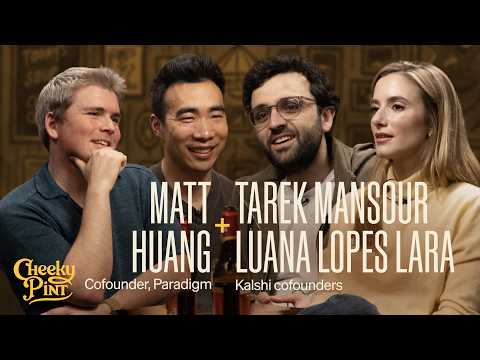
Kalshi Surges to $10B Monthly Volume After Winning CFTC Election Suit
Stripe
Prediction markets will disrupt traditional polling and financial exchanges because financial incentives align participants toward objective truth rather than ideological polarization.
## Background
Published on YouTube by Stripe on March 17, 2026, this episode features Kalshi co-founders Tarek Mansour and Luana Lopes Lara sitting down with John and Matt Huang. According to the page description, the discussion centers on Kalshi's massive 11x revenue growth, their landmark lawsuit against the CFTC to allow election markets, and their overarching vision to build a federally regulated "New York Stock Exchange of events" spanning everything from weather to politics.
## TL;DR
The conversation covers Kalshi's strategic choice to seek regulatory approval upfront rather than following the traditional Silicon Valley approach of asking for forgiveness. The co-founders detail the grueling legal battle to list election contracts, the unique mechanics of peer-to-peer liquidity driven by "superforecasters," and how their transaction-fee business model naturally aligns with financial accuracy over traditional, predatory sportsbook tactics. Looking forward, they discuss expanding into infinite markets for atomic asset metrics, implementing advanced margining systems, and navigating the unique regulatory boundaries of insider trading and political reflexivity.
## Atmosphere & style
The discussion carries a bright, intellectually charged energy, kicked off by a lighthearted toast with Brazilian beer and Guinness. There is an engaging dynamic between Tarek's self-described trader-mindset paranoia and Luana's unyielding, dogmatic optimism, illustrating a deeply balanced partnership. The emotional arc transitions from the low points of corporate downsizing and investor doubt during their regulatory standoff to a triumphant, high-conviction narrative of rapid growth, deep regulatory respect, and the philosophical defense of markets as an objective antidote to social media polarization.
## Key takeaways
- [00:00](https://www.youtube.com/watch?v=LsNmBcDCsq0&t=0s) Kalshi cofounders Tarek Mansour and Luana Lara balance each other with polar opposite personalities, combining dogmatic optimism and trader-minded paranoia to successfully navigate high-stakes risks.
- [01:37](https://www.youtube.com/watch?v=LsNmBcDCsq0&t=97s) Unlike typical Silicon Valley startups that ask for forgiveness later, Kalshi pursued a strict 'regulatory-market fit' strategy from day one, believing that financial services demand absolute compliance to prevent catastrophic failures like FTX.
- [07:01](https://www.youtube.com/watch?v=LsNmBcDCsq0&t=421s) Kalshi survived a company low point and downsizing in late 2022 after the CFTC issued a 'pocket veto' on their highly anticipated election contracts, delaying approval until after the midterms.
- [07:01](https://www.youtube.com/watch?v=LsNmBcDCsq0&t=421s) In an unconventional and risky move for a 25-person company, Kalshi successfully sued its own primary regulator, the CFTC, to list election contracts by proving that elections carry undeniable economic impacts.
- [13:41](https://www.youtube.com/watch?v=LsNmBcDCsq0&t=821s) The cultural rise of algorithmic feeds, social media polarization, and widespread institutional distrust has driven the demand for prediction markets, which leverage financial incentives to provide objective, real-time truth.
- [16:36](https://www.youtube.com/watch?v=LsNmBcDCsq0&t=996s) Kalshi experienced explosive growth, recording $10.4 billion in contracts traded in February alone—an 11x increase over a six-month period, competing with top-tier AI companies as the fastest-growing outside the AI sector.
- [18:38](https://www.youtube.com/watch?v=LsNmBcDCsq0&t=1118s) Kalshi operates a direct-to-consumer model alongside an exchange architecture that allows external brokers like Robinhood or Webull to route massive retail flow directly into its clearinghouse infrastructure.
- [21:07](https://www.youtube.com/watch?v=LsNmBcDCsq0&t=1267s) To engineering market stability, Kalshi actively subsidizes market makers in low-demand 'long-tail' markets while offering fee rebates in high-demand spaces like sports and crypto to ensure tight spreads and robust liquidity.
- [24:15](https://www.youtube.com/watch?v=LsNmBcDCsq0&t=1455s) Over 95% of Kalshi's market liquidity is generated peer-to-peer by a decentralized network of over 2,000 independent 'superforecasters' and individual traders, rather than traditional Wall Street institutional firms.
- [33:42](https://www.youtube.com/watch?v=LsNmBcDCsq0&t=2022s) Unlike traditional sportsbooks that ban profitable 'sharps' and use predatory bonuses to target losing bettors, Kalshi embraces sharps as necessary for market accuracy and monetization via transaction fees.
- [39:33](https://www.youtube.com/watch?v=LsNmBcDCsq0&t=2373s) Kalshi is scaling its global derivatives platform around four key product pillars: broadening topics, evolving market structures (futures/options), implementing capital-efficient margining systems, and deepening liquidity.
- [44:50](https://www.youtube.com/watch?v=LsNmBcDCsq0&t=2690s) Prediction markets act as a disruptive force against legacy industries like traditional sportsbooks, futures exchanges, political polling organizations, and parametric insurance providers.
- [47:00](https://www.youtube.com/watch?v=LsNmBcDCsq0&t=2820s) Kalshi enforces strict federal insider trading guidelines and utilizes a 24/7 surveillance division that recently penalized and banned two internal actors, fining them over five times their illicit profits.
- [51:25](https://www.youtube.com/watch?v=LsNmBcDCsq0&t=3085s) For controversial 'mention markets' that depend on the specific phrasing of a public figure, Kalshi maintains market integrity by completely banning the primary actors and their immediate staff from trading.
- [53:08](https://www.youtube.com/watch?v=LsNmBcDCsq0&t=3188s) The founders envision 'infinite markets' capable of dissecting traditional financial assets into atomic components, allowing users to hedge or speculate on hyper-specific variables like Nvidia GPU shipments.
- [01:05:07](https://www.youtube.com/watch?v=LsNmBcDCsq0&t=3907s) Prediction markets offer a unique 'Iowa-New Hampshire' narrative-shaping effect on politics, serving as a depolarizing mechanism that encourages objective analysis over partisan social media alignment.
- [01:09:13](https://www.youtube.com/watch?v=LsNmBcDCsq0&t=4153s) By forcing participants to put 'skin in the game,' prediction markets drive deeper civic education and offer politicians an immediate, granular feedback loop on individual policy ideas.
- [01:11:36](https://www.youtube.com/watch?v=LsNmBcDCsq0&t=4296s) Due to strict regulatory boundaries requiring a 'separation of church and state' for federal financial exchanges, Kalshi employees face a total ban on trading, rendering traditional Silicon Valley 'dogfooding' impossible.
- [01:12:55](https://www.youtube.com/watch?v=LsNmBcDCsq0&t=4375s) Kalshi aligns as a proudly 'pro-regulation' entity, advocating for fully public trade data audits and a blanket ban on congressional trading while warning that banning prediction markets outright merely drives volume to dangerous offshore entities.
## Detailed walkthrough
### [00:00](https://www.youtube.com/watch?v=LsNmBcDCsq0&t=0s) The Personalities Behind Kalshi
The conversation kicks off with some lighthearted banter as Luana Lara shares that she brought some Brazilian beers for the group to try. While the host opts for a Guinness, he and Luana toast with the Brazilian beer, which she describes as the country's most famous and "very light."
The host asks about the division of responsibilities and personal outlooks between the two cofounders, Tarek Mansour and Luana Lara. Despite having identical backgrounds—both studied math and computer science at MIT and completed the exact same internships—their personalities are polar opposites. Luana describes herself as a highly optimistic risk-taker who always believes things will work out. Tarek, on the other hand, is "very paranoid, more on the negative side." Tarek explains that his mindset comes from his background training to be a trader, which turns a person into an "expected-value calculator" who constantly obsesses over tail risks and worst-case scenarios. They credit this balance of optimism and paranoia as the key to their partnership's success.
- **Cofounders:** Tarek Mansour and Luana Lara, cofounders of Kalshi.
- **Academic Background:** Both studied Math and Computer Science at MIT.
- **Trading Volume:** Kalshi trades more than $10 billion each month in prediction contracts.
- **Regulatory Milestone:** Spent four years pre-launch fighting for regulatory approval to build the first onshore prediction market in the US.
[01:37](https://www.youtube.com/watch?v=LsNmBcDCsq0&t=97s) Regulatory-Market Fit vs. Asking for Forgiveness
The host contrasts Kalshi's approach with the traditional Silicon Valley playbook. Companies like Uber or PayPal famously launched first and asked for forgiveness later, retroactively fitting a regulatory structure over their operations. For Kalshi, this was never an option. Tarek argues that in highly sensitive sectors like financial services or healthcare, "you can't ask for forgiveness" because losing people's money or risking lives has catastrophic consequences, pointing to FTX as a prime example of what happens when things go wrong.
Instead of avoiding the regulatory hurdle, they decided to tackle the hardest problem first: proving they could operate legally in the US. For years, critics and onlookers believed Kalshi had chosen the wrong strategy, pointing to offshore competitors who were growing rapidly without regulatory constraints. However, Tarek and Luana were driven by a principled vision. They did not want to build an offshore entity; they wanted to build "the next generation New York Stock Exchange"—a credible, regulated financial market based in the United States.
- **Company Timeline:** Founded in 2019 (joining the Y Combinator 2019 batch); took three years to get regulated and launch in 2022; won their landmark election lawsuit at the end of 2024.
- **Regulatory Process:** Every single contract must be filed with the Commodity Futures Trading Commission (CFTC), which has a 24-hour window to review and potentially block it.
[05:17](https://www.youtube.com/watch?v=LsNmBcDCsq0&t=317s) The Long Road to CFTC Approval
Tarek recalls the early days of walking into the CFTC building, showing a picture of their first visit. The regulators' heads were spinning because Kalshi was proposing contracts that did not have a traditional financial underlying asset, alongside a volume of hundreds of contracts per week. The process became a highly iterative, collaborative effort to figure out how to regulate this new asset class. Tarek describes this phase as finding "regulatory-market fit"—treating the regulator not just as an obstacle, but as the user they had to design the product for.
Over years of collaboration, Kalshi built a deep level of trust with the CFTC as a self-regulated entity. While they have established clear boundaries—completely avoiding contracts related to war or assassination—the process for standard contracts is now highly streamlined. However, the ultimate test of this relationship came when Kalshi proposed contracts on US elections, which Tarek calls the "holy grail" of prediction markets. The CFTC refused to approve them for two years, leading to a historic standoff.
[07:01](https://www.youtube.com/watch?v=LsNmBcDCsq0&t=421s) Suing the Government and Betting the Farm
When the CFTC issued a "pocket veto" at the end of 2022 by delaying the election contract approval until after the midterms, Kalshi hit its lowest point. The company was forced to downsize and lay off a significant portion of its staff. Morale was at an all-time low, and even their closest investors began to lose faith in the strategy, suggesting they pivot to something else. Yet, Tarek and Luana could not bring themselves to give up. At the next company stand-up, they presented a "new" strategy for 2023: they were going to try the exact same thing again, despite all evidence pointing to failure. Tarek credits Luana's dogmatic optimism for keeping the dream alive when his rational, trader brain wanted to listen to the doubters.
When the CFTC blocked the contracts again at the end of 2023, Luana insisted on the ultimate anti-pattern: suing their own regulator. Tarek initially had cold feet, suggesting they focus on building a clearinghouse or launching other financial products rather than "betting the farm" on a lawsuit. He recalls a late-night call where Luana bluntly asked, "Are you fucking kidding me?" They took the proposal to their board members, Alfred Lin and Michael Seibel. While the board warned them that suing a regulator as a 25-person company is a classic anti-pattern where "even if you win, you will probably lose," they ultimately supported the founders, noting that many great companies are built on unique anti-patterns.
- **Board Members Mentioned:** Alfred Lin (Sequoia Capital) and Michael Seibel (Y Combinator).
- **Company Size at the Time:** Approximately 25 employees.
[10:52](https://www.youtube.com/watch?v=LsNmBcDCsq0&t=652s) Winning the Lawsuit and the Value of Election Markets
Kalshi ultimately won the lawsuit because the law is clear: the government cannot block a contract unless it actively harms the public interest or falls under specific prohibited categories like terrorism, war, or assassination. The CFTC had tried to stretch state-level "bucket shop" laws to argue that election betting was illegal, but Kalshi successfully argued that elections have massive, undeniable economic impacts. Because of this economic impact, they legally belonged on a regulated derivatives exchange. As Luana notes, "the law applies to companies, but it also applies to the government."
The host points out that suing a primary regulator is actually more common in deep tech and govtech than Silicon Valley conventional wisdom suggests, citing examples like Coinbase, SpaceX, Anduril, and Palantir. When asked if Kalshi could have survived without elections, Luana explains that the election market is simply too vital to ignore. It is the ultimate demonstration of a prediction market's utility. During the 2024 election, traditional polls were highly inaccurate, whereas prediction markets proved to be far superior at aggregating and reflecting real-time information, proving they are a genuine "force for good."
[13:41](https://www.youtube.com/watch?v=LsNmBcDCsq0&t=821s) Why Prediction Markets Succeeded Now
The conversation turns to whether Kalshi's success was enabled by recent technological shifts, such as crypto or stablecoins, or if it could have been built 10 to 15 years ago. Tarek estimates that while early decentralized prediction markets like Augur may have contributed about 5% to 10% of the momentum by forcing the CFTC to realize they needed a regulated, onshore alternative, the real driver was a cultural shift.
Tarek argues that the rise of algorithmic feeds, extreme political polarization, and rampant clickbait on social media and traditional news have created a desperate need for objective truth. Prediction markets have succeeded today because they offer a financial incentive for accuracy, cutting through the noise. Interestingly, Luana points out that 80% of Kalshi's users do not actually trade; they use the platform purely to consume highly accurate, real-time information.
[16:36](https://www.youtube.com/watch?v=LsNmBcDCsq0&t=996s) The Rise of Distrust and Kalshi's Rapid Growth
There is a meaningful and accelerating rise of distrust in traditional sources of information, creating a pressing need for a new, reliable source. Prediction markets fill this void because their incentive structure is fundamentally aligned with truth. More volume and more liquidity translate directly to better and more accurate forecasts. While it took a few iterations for people to start trusting the platform, building a solid track record has cemented user trust. Once users experience this superior product, they never go back to traditional alternatives.
The platform is growing at an extraordinary pace. In February, Kalshi recorded $10.4 billion in contracts traded, representing an 11x growth over just six months. The growth is so rapid that looking back a year feels like ancient history; a year prior, Kalshi's sports offerings were limited to just a single market for the Super Bowl. This trajectory makes Kalshi the fastest-growing company outside of the AI sector, and it even competes with the growth rates of top AI companies like Cursor and Anthropic. Because Kalshi is a true marketplace, it benefits from powerful network effects: as liquidity and market diversity increase, user retention improves, driving further participation, volume, and organic sharing.
- **February Volume:** $10.4 billion in contracts traded.
- **Growth Rate:** 11x increase over a six-month period.
- **Market Dynamics:** Network effects drive a "trifecta of factors" where liquidity improves retention, which in turn drives more volume and organic word-of-mouth sharing.
[18:38](https://www.youtube.com/watch?v=LsNmBcDCsq0&t=1118s) The Broker Mix and the Exchange Architecture
At its core, Kalshi functions as an exchange and a clearinghouse, structurally similar to the New York Stock Exchange (NYSE) or the Chicago Mercantile Exchange (CME). This architecture allows external brokers to connect directly to Kalshi's infrastructure. Just as a retail investor might use Robinhood to trade traditional stocks, they can use Robinhood or Webull to trade on Kalshi. When Kalshi began ramping up its operations, partnering with these brokers was a critical distribution strategy. The brokers brought massive retail demand, which in turn attracted institutional market makers eager to trade against retail flow.
This broker-intermediated flow bought Kalshi the time necessary to build and scale its direct-to-consumer product, "Kalshi Direct" (comprising Kalshi.com and the Kalshi mobile app). Today, the direct consumer business has dramatically outpaced the broker business. The Kalshi brand has gone mainstream, becoming synonymous with checking the real-world odds of an event. When people have a difference of opinion, their instinct is now to "pull up Kalshi and see the odds" or place a position directly. Looking forward, Kalshi is expanding its reach by investing in institutional access and partnering with international brokers, which will soon allow users in countries like Brazil to trade on the platform.
[21:07](https://www.youtube.com/watch?v=LsNmBcDCsq0&t=1267s) Engineering Market Stability and Liquidity
In a mature, large-scale exchange like the NYSE, market making happens naturally because the economic incentives are already massive. For a newer prediction market, however, scaling up market making requires deliberate engineering. Kalshi manages two distinct categories of contracts that require very different liquidity strategies. The first is the "long tail" of markets—such as predicting whether the band One Direction will have a reunion. These markets are difficult to price and have lower natural demand, so Kalshi actively incentivizes market makers with liquidity programs to build a sustainable moat. The goal is to scale from their current pool of 10,000 markets to 50,000 or 100,000.
The second category consists of high-demand markets like crypto and sports. Here, pricing is easier and demand is proven, so Kalshi does not pay market makers directly; instead, they rebate fees in exchange for meeting strict performance conditions. These conditions include high uptime, tight spreads, and substantial top-of-book size. This program is designed to ensure "stability of the book," meaning that prices do not fly around wildly in the absence of new information, and liquidity remains robust even during high-stakes moments like a potential touchdown in a live game. This stability is especially critical for broker partners who expect traditional market standards. Even when spreads would naturally blow out wide, market makers absorb temporary losses because the overall benefits of Kalshi's incentive program make it highly profitable.
- **Long-Tail Markets:** Hard-to-price, niche topics where Kalshi actively incentivizes market makers to build liquidity.
- **High-Demand Markets:** Crypto, sports, and politics where Kalshi rebates fees in exchange for strict uptime, spread, and size requirements.
- **Platform Scale:** Kalshi currently hosts around 10,000 markets with plans to scale to 50,000 or 100,000.
[24:15](https://www.youtube.com/watch?v=LsNmBcDCsq0&t=1455s) The Power of Peer-to-Peer "Superforecasters"
The true magic of prediction markets lies in a highly counterintuitive reality: the vast majority of liquidity does not come from traditional Wall Street market makers. Traditional firms are not built to price politics or pop culture on the fly. Instead, Kalshi's liquidity is overwhelmingly peer-to-peer, driven by a highly dispersed community of "internet anons" and "superforecasters." In fact, the single largest traditional institutional market maker accounts for less than 5% of the maker orders on the platform. The remaining 95% of liquidity is provided peer-to-peer by individuals or tiny, two-person funds.
Over 2,000 individuals and small shops actively make markets on Kalshi. These "guys in the garage" drinking Red Bull at 3 AM are the lifeblood of the ecosystem because they monitor situations constantly and price information incredibly fast. For many of these superforecasters, what started as a part-time hobby has transformed into a highly lucrative full-time job because the financial pool has grown so large. For example, the most accurate inflation forecaster on Kalshi over the last few years was not a major hedge fund or academic institution, but a man living in Kansas who had never traded financial markets before; he simply read the news, analyzed the data, and could "feel" where inflation was heading.
- **Liquidity Breakdown:** Less than 5% of matched maker orders come from traditional institutional market makers; over 95% are peer-to-peer or from tiny, independent operations.
- **Active Market Makers:** Over 2,000 individuals or small shops actively provide liquidity on the platform.
[29:08](https://www.youtube.com/watch?v=LsNmBcDCsq0&t=1748s) Esoteric Knowledge and the Ultimate Short
The speakers share stories of their favorite users to illustrate how Kalshi allows everyday people to monetize highly specific, obsessive hobbies. One standout user is an Ariana Grande superfan who discovered Kalshi during election season. Uninterested in politics, he gravitated toward the Billboard music chart markets. By leveraging his deep, compulsive knowledge of music charts, he has made over $150,000 on the platform—using the proceeds to pay off student loans, fund a master's degree, and buy a car.
Another remarkable user, Alan, is a tax accountant who became the subject of a *Wall Street Journal* article. When the Department of Government Efficiency (DOGE) was announced with promises of massive budget cuts, Alan meticulously read through tax codes and federal statutes. He realized deterministically that the proposed budget cut targets were legally and structurally impossible to hit. Armed with this esoteric knowledge, he convinced his wife of his high conviction, went "all in" on a massive short position against the DOGE targets—reminiscent of Michael Burry in *The Big Short*—and won. This case highlights the core promise of prediction markets: anyone can do deep research, get smarter about the world, and be directly rewarded for their accuracy.
[31:32](https://www.youtube.com/watch?v=LsNmBcDCsq0&t=1892s) AI Agents and the Future of Forecasting
The intersection of artificial intelligence and prediction markets is evolving rapidly. While users do not explicitly share their proprietary trading strategies, there is a clear and increasing trend of traders using AI agents, particularly via Kalshi's API. Most sophisticated traders now integrate some form of AI-driven summary and synthesis module into their technology stack to process information.
While it is unclear if there are fully autonomous, closed-loop AI agents successfully running entire market-making operations without any human intervention, AI is heavily utilized for tasks like translating foreign-language documents for international election markets. The evolution of these trading tools mirrors the early days of quantitative giants like Renaissance Technologies, which pioneered early algorithmic trading. To push the boundaries of what these models can do, Kalshi recently launched "Kalshi Research" and is actively collaborating with major AI research labs to establish new benchmarks for machine intelligence and forecasting.
### [33:10](https://www.youtube.com/watch?v=LsNmBcDCsq0&t=1990s) Evaluating Future-Predicting Models
The conversation shifts to how artificial intelligence models can be evaluated on their ability to predict the future. A unique benchmark could emerge around whether these models are developing a genuine understanding of the world that goes beyond simply memorizing historical patterns. When asked how such an evaluation would work, the speakers admit they do not know yet, but suggest a practical approach: letting different models run and make predictions on the same set of markets for a month or two, then comparing their percentage of correct predictions and overall profit and loss (P&L) over time.
---
### [33:42](https://www.youtube.com/watch?v=LsNmBcDCsq0&t=2022s) Sharps, Bookies, and Market Incentives
The discussion moves to a market-making comparison involving sports betting. In the sports betting industry, bookies actively crack down on "sharps"—highly sophisticated bettors who are "too good." For a bookie, the ideal customer is an unsophisticated punter who bets on their home soccer team regardless of the odds. Because bookies offer odds on tens of thousands of different narrow markets, they cannot be right on all of them. Sophisticated players find these mispriced odds and exploit them. Consequently, bookies use behavioral signals to identify and shut down these sharp players, much like casinos banning card counters in Vegas.
When asked if Kalshi faces a similar dynamic with sharps, the response is a definitive no. "The sharps are the market," they explain, emphasizing that Kalshi does not limit winners. "We want all the winners. We need the sharps because how do you get market accuracy without the sharps?" While the interviewer points out that sharps can "snipe" (show up once when odds are wrong, take a big win, and disappear) rather than providing continuous narrow spreads, the speakers explain that many sharps actually transition into providing liquidity to do better.
The fundamental difference lies in the business model. Traditional gambling relies on the house making money from customer losses, creating an incentive to ban winners. In contrast, Kalshi operates like a traditional financial market, monetizing strictly through transaction fees. Their incentive is to foster fairness, transparency, and stable liquidity. To balance the marketplace, Kalshi uses fee structures to incentivize "pro-social behavior." Those who take on risk by providing liquidity receive lower fees, while those who "snipe" pay higher fees to cover the cost of their activity.
- **Pro-social behavior:** Providing liquidity and stable pricing to the market.
- **Antisocial behavior:** Insider trading (which is also illegal) and value-extracting sniping.
- **The appeal of prediction markets:** Unlike traditional financial markets where researching IBM's quarterly earnings might feel dry, prediction markets allow people to monetize their research on highly engaging topics like political elections or internet culture.
---
### [33:48](https://www.youtube.com/watch?v=LsNmBcDCsq0&t=2028s) Sponsor: Stripe Connect
The host highlights Kalshi's marketplace structure, where thousands of participants open, transfer, and settle positions in real time on real-world outcomes—such as whether the US will confirm the existence of aliens before 2027. This complex, multi-party flow of funds and real-time choreography is powered by Stripe Connect, which handles participant onboarding, payment processing, routing funds, and managing payouts.
---
### [39:33](https://www.youtube.com/watch?v=LsNmBcDCsq0&t=2373s) Expanding Market Verticals and the Four Pillars of Growth
The conversation turns to the future of market verticals. While elections, sports, and economic indicators are widely understood, prediction markets act as a broad search function for anything humanity wants to trade. Historically, exchanges like the CME greenlit commodities like wheat, oil, and corn; today, platforms can greenlight thousands of markets a day. Kalshi is expanding into derivatives for collectibles like luxury watches and bags, and is looking closely at compute as a major new commodity.
To become the biggest derivatives exchange in the world, Kalshi focuses on a product roadmap structured around four key pillars:
1. **Breadth of topics:** Expanding from sports and elections to compute, securities, and collectibles.
2. **Market structure:** Moving beyond binary yes/no contracts into traditional financial structures like futures, swaps, and options.
3. **Margining systems:** Transitioning away from requiring 100% collateral upfront, which currently ties up too much capital and makes market-making on long-term events (like whether a hurricane will happen this year) capital-inefficient.
4. **Liquidity:** Ensuring deep, stable liquidity across all offerings.
The speakers discuss the challenge of balancing retail interest with institutional needs. While their mobile app targets retail users, they divide their teams to keep pushing the envelope on both fronts. To attract institutional players, Kalshi recently launched "block trades," allowing parties to negotiate large trades privately before hosting them on the exchange. When institutions express interest in specific topics—such as upcoming tariffs or the petroleum reserve—Kalshi lists them publicly, making them accessible to everyone.
---
### [44:50](https://www.youtube.com/watch?v=LsNmBcDCsq0&t=2690s) The "Grim Reaper" of Legacy Industries
The host asks which legacy industries will feel the disruptive effects of prediction markets as they gain liquidity, drawing a parallel to how Uber eventually disrupted the taxi business. The speakers acknowledge several sectors facing disruption:
- **Traditional sportsbooks:** Challenged by Kalshi's fairer, fee-based trading model.
- **Traditional futures exchanges:** As Kalshi expands its market structures and margining systems.
- **Political polling and news media:** Rather than destroying polling, prediction markets are making it highly competitive. Because traders have "skin in the game," they commission higher-quality, sophisticated polls (such as nearest-neighbors models) to find an edge, aligning incentives with truth rather than telling clients what they want to hear. Similarly, prediction markets complement the news; commentators will still provide opinions, but they will use market forecasts as an objective baseline.
- **Parametric insurance:** Once advanced margining systems are in place, Kalshi can directly compete in natural disaster and hurricane insurance.
---
### [47:35](https://www.youtube.com/watch?v=LsNmBcDCsq0&t=2855s) The Nuance of Insider Trading
The segment concludes with a discussion on the policy and ethics of insider trading in prediction markets. The host notes that drawing the line is highly nuanced. For instance, while the SEC enforces strict rules in stock markets, a hedge fund is legally allowed to use proprietary satellite data of a Walmart parking lot to trade ahead of earnings. In prediction markets, the lines are equally complex: while government officials shouldn't trade on upcoming military actions, it is less clear how to handle someone trading on the length of a Super Bowl halftime show because they have inside information.
Kalshi's current policy is to strictly follow federal laws set by the CFTC and SEC. This means that if an individual has signed a non-disclosure agreement or works for an agency like the Bureau of Labor Statistics, they are legally barred from trading on that non-public data.
[05:30:00](https://www.youtube.com/watch?v=LsNmBcDCsq0&t=19800s) Insider Trading and the Surveillance Division
The line between fair information gathering and illegal insider trading is a major focus for Kalshi. While hedge funds can legally track Starbucks foot traffic or listen to Lady Gaga rehearsing outside the stadium before the Super Bowl, they cannot trade on confidential data they have a duty to protect. Kalshi takes this standard a step further than traditional markets: "For example, if you are a government official, like if you're in Congress, you cannot trade on bills passing." Because this is a highly novel regulatory landscape, Kalshi works closely with regulators and maintains an active, 24/7 internal surveillance division to flag suspicious activity.
Just two weeks prior to the recording, Kalshi's surveillance team caught two insiders and levied heavy penalties. "Because we're also regulated, we're able to charge them a lot of fines. So we charge them over five times what they made," in addition to banning them from the platform. When asked how the Commodity Futures Trading Commission (CFTC) compares to the Securities and Exchange Commission (SEC)—which is famously enthusiastic about enforcing insider trading doctrines—it is explained that Kalshi operates as the first line of defense. Every single trade and case on Kalshi is referred directly to the CFTC for their own review and potential action, though the regulatory process naturally takes time.
- **The Three-Step Enforcement Process:**
1. Kalshi's internal surveillance and enforcement.
2. The CFTC's surveillance and enforcement.
3. The Department of Justice (DOJ).
- **Insider Penalties:** Kalshi fined two recent insiders over 5x their trading profits and banned them.
[05:01:25](https://www.youtube.com/watch?v=LsNmBcDCsq0&t=18085s) The Spectrum of "Mention Markets"
The conversation shifts to the spectrum of market types, ranging from future events that are impossible to insider trade because nobody knows the outcome, to "mention markets" where a single person's words can instantly decide the result. Examples include a sports player hitting a specific number of shots or Coinbase CEO Brian Armstrong mentioning a specific metric during an earnings call. When asked if these markets are inherently too gameable or limited in scale, the hosts argue that mention markets are actually highly valuable.
"Fed meeting minutes are the original mention markets," they point out, noting how hedge funds have long obsessed over whether the Fed Chair tilts his head a certain way or uses specific phrasing. The same dynamic applies to political figures like Donald Trump mentioning tariffs or war. To keep these markets fair, Kalshi enforces strict trading prohibitions on the key actors. "If you are Gavin Newsom, there's a market on what you're going to say, you cannot trade it, and your staff cannot trade it." Rather than banning a market because a few people could theoretically manipulate it—which would logically require banning the stock market as well—the goal is to build a resilient system with the right prohibitions.
[05:03:28](https://www.youtube.com/watch?v=LsNmBcDCsq0&t=18208s) The Sports Betting Debate and Predatory Bookies
A major debate surrounding Kalshi is its push into sports contracts. One host wrestles with his own perspective: on one hand, the legalization of sports betting in the US over the last decade has documented negative societal effects. On the other hand, society tolerates alcohol despite a similar distribution of outcomes (where most enjoy it safely but a small fraction suffers severe harm). Furthermore, online sports betting has been widely available in Europe since the dawn of the internet without causing societal collapse.
Kalshi's founders argue that people are going to bet on sports regardless of prohibition, so the focus should be on providing the safest, fairest vehicle. They make the case that a peer-to-peer market is objectively superior to a traditional sportsbook or casino. Traditional sportsbooks charge a massive "rake" of around 10%, compared to just 1% or a few points on prediction markets. More importantly, sportsbooks employ predatory tactics to hook losing players. "If you start losing... the first thing that they're going to do is give you a bonus... so that they can hook you to keep you coming back because they want to incentivize the losers." Kalshi has no such incentives. If US markets are prohibited, users simply go offshore to unregulated sites that lack self-exclusion features or deposit limits.
- **Rake Comparison:** Traditional sportsbooks charge ~10% rake; prediction markets charge ~1% or a few percentage points.
- **Predatory Tactics:** Sportsbooks actively target losers with deposit boosts and $1,000 return bonuses, whereas Kalshi does not incentivize losses.
[05:08:08](https://www.youtube.com/watch?v=LsNmBcDCsq0&t=18488s) Dissecting Assets and the "Infinite Markets" Theory
Looking toward the future, the founders are highly excited about dissecting traditional assets into their atomic components. Instead of just trading a stock, users will be able to trade specific underlying metrics, such as Nvidia GPU shipments or Tesla vehicle deliveries. This concept ties into a paper by economist Kevin Hassett, which argues that as society grows more complex, our understanding of asset prices naturally decays because the vector of influencing factors becomes incredibly high-dimensional. To solve this entropy, society needs "infinite markets"—individual prediction markets for every single variable ($x_1$ to $x_n$) to accurately price the ultimate outcome ($Y$).
As a real-world example, a research report by "Citrini" regarding a grim "AI 2028" economic scenario recently went viral and triggered a sell-off in public equities like DoorDash. In response to a rebuttal by Citadel, Kalshi launched a prediction market on whether three out of five of Citrini's conditions would actually materialize by 2028. The market priced the probability at just 10%. If investors had been able to look at this clear 10% probability, they might not have panicked and sold off their stocks.
[01:01:09](https://www.youtube.com/watch?v=LsNmBcDCsq0&t=3669s) Is a Fully Priced World a Good World?
The host poses a philosophical question: is a world where everything has a real-time price actually a good place to live? Companies like Stripe arguably benefit from staying private because they avoid the erratic, second-by-second sentiment swings of public markets. While the founders admit their bias as market lovers, they firmly believe that more data is always better than less. "If you don't think the second-by-second stock price is good, you can just choose to ignore it."
They clarify that they draw hard ethical boundaries: Kalshi will never host markets on tragedies like wildfires, war, terrorism, or assassinations. However, in an era of social media where feeds are filled with misinformation, prediction markets serve as an invaluable, unbiased source of truth. Over a long enough horizon, markets act as an excellent capital allocator and a vital feedback loop. A CEO can gauge public reaction to an announcement, and politicians can watch their policy proposals price in real-time. "If we pass this bill, will unemployment go up or down? And you can price these things for better decision-making."
[01:04:27](https://www.youtube.com/watch?v=LsNmBcDCsq0&t=3867s) The Reflexive Impact on Politics
The segment wraps up with a discussion on how technology reshapes culture. Just as social media fundamentally altered the nature of political discourse, the popularity of candidates, and the style of debates, prediction markets are beginning to exert their own reflexive influence on politics. Candidates are already actively tracking and citing prediction market prices as a real-time metric of their campaign's viability.
### [01:05:07](https://www.youtube.com/watch?v=LsNmBcDCsq0&t=3907s) Depolarization and the "Iowa-New Hampshire" Effect
The speakers discuss how prediction markets are uniquely unbiased by party dynamics. Unlike traditional party machines that might try to push an establishment favorite, markets are highly effective at showing the real odds for an underdog whom the public actually favors. This dynamic introduces a degree of depolarization, acting as an antidote to the highly polarized feeds of modern social media. While social media algorithms try to pigeonhole users into rigid "Democrat" or "Republican" boxes to serve them targeted content, prediction markets force participants to step back and ask a more objective question: "What do I actually think is going to happen?"
This shift in perspective can create a narrative-shaping phenomenon similar to the "Iowa-New Hampshire" effect in US presidential primaries. In a typical election cycle, early state results do not just measure sentiment; they actively generate a narrative that can alter the trajectory of the race. While the speakers debate whether prediction markets actually change ultimate outcomes or simply shed light on them, they acknowledge a degree of reflexivity. For example, during the New York mayoral race, establishment voices insisted that Andrew Cuomo was a guaranteed winner, yet prediction markets tracked a steady rise in the odds for progressive candidate Zohran Mamdani, reflecting real-time shifts in voter sentiment that traditional polls missed.
- **Texas Primary Example:** Traditional polls heavily favored one candidate, while prediction markets accurately reflected the higher odds of the eventual winner, offering a fairer view of the race.
- **Mamdani's 94% Odds:** When Mamdani's odds reached 94% on Kalshi, it created a counter-intuitive worry that high odds might cause supporters to stay home rather than show up to vote.
---
### [01:09:13](https://www.youtube.com/watch?v=LsNmBcDCsq0&t=4153s) Skin in the Game and Faster Feedback Loops
A major benefit of prediction markets is how they drive deeper civic engagement. When people have "skin in the game"—even with small dollar amounts—their behavior changes. Instead of posting wild, unverified claims on social media, they are incentivized to do actual research, read up on candidates, and understand the nuances of policy. The speakers compare this to sports betting, where fans suddenly become deeply analytical about player statistics and team dynamics.
Furthermore, prediction markets introduce a rapid feedback loop to politics, similar to how startups iterate on products. Currently, when a candidate campaigns on a platform of ten different issues and either wins or loses, it is incredibly difficult to isolate which specific policy resonated. Traditional polling is too slow and blunt to provide clear answers. Prediction markets, however, allow candidates to see real-time reactions to specific statements or policy proposals.
- **The Brexit Parallel:** Many UK citizens voted for Brexit and only researched what it actually meant after the fact; prediction markets encourage this learning phase *before* the vote.
- **Startup Analogy:** Just as shipping a new feature allows a tech company to track ten different metrics simultaneously, prediction markets give politicians a granular "score" on individual actions rather than a single, delayed poll result.
---
### [01:11:36](https://www.youtube.com/watch?v=LsNmBcDCsq0&t=4296s) Internal Markets and the Struggle of Dogfooding
When asked if Kalshi uses prediction markets internally to make business decisions, the founders explain a unique regulatory hurdle. Because Kalshi is a federally regulated exchange, its employees are legally barred from trading on the platform in any personal capacity. This makes "dogfooding"—a standard practice in Silicon Valley where employees use their own product to improve it—virtually impossible.
To work around this, Kalshi has been collaborating with regulators to see if they can establish small-dollar, internal markets for employees. In the meantime, they rely heavily on their power users and "superforecasters" for product feedback, keeping them on "speed dial" to ensure the platform meets their needs.
- **Employee Trading Ban:** Kalshi employees cannot trade on the platform at all due to the strict "separation of church and state" required of regulated financial exchanges.
- **Superforecasters:** Because founders cannot trade, the highly engaged power users who have been there since day one serve as the primary drivers of product iteration.
---
### [01:12:55](https://www.youtube.com/watch?v=LsNmBcDCsq0&t=4375s) The Future of Prediction Market Policy
When asked about their ideal regulatory landscape, the founders emphasize that Kalshi's philosophy differs from typical Silicon Valley firms. While many tech companies prefer to operate in unregulated spaces, Kalshi is proudly "pro-regulation." Having spent four years securing regulatory approval upfront, they view smart regulation as a form of insurance that protects the market when things go wrong.
Their policy wishlist focuses on fairness, transparency, and consumer protection. They advocate for making all trade data as public as possible so that the general public can audit the market, much like checking the sample size of a poll. They also strongly support banning members of Congress and other government officials from trading on insider information. Finally, they believe that as prediction markets go mainstream, platforms must take on the burden of educating users to ensure they do not overextend themselves financially.
- **Banning Congressional Trading:** The founders support a blanket ban on trading for members of Congress to prevent conflicts of interest.
- **The Risk of Bans:** The founders argue that attempting to ban prediction markets or speculation entirely is counterproductive; it simply drives the activity offshore to unregulated markets where customer protections do not exist.
## Notable quotes
> [01:37](https://www.youtube.com/watch?v=LsNmBcDCsq0&t=97s) you can't ask for forgiveness — Tarek Mansour
> [07:01](https://www.youtube.com/watch?v=LsNmBcDCsq0&t=421s) Are you fucking kidding me? — Luana Lara
> [07:01](https://www.youtube.com/watch?v=LsNmBcDCsq0&t=421s) even if you win, you will probably lose — Alfred Lin or Michael Seibel
> [10:52](https://www.youtube.com/watch?v=LsNmBcDCsq0&t=652s) the law applies to companies, but it also applies to the government. — Luana Lara
> [33:42](https://www.youtube.com/watch?v=LsNmBcDCsq0&t=2022s) The sharps are the market — Tarek Mansour or Luana Lara
> [33:42](https://www.youtube.com/watch?v=LsNmBcDCsq0&t=2022s) We want all the winners. We need the sharps because how do you get market accuracy without the sharps? — Tarek Mansour or Luana Lara
> [45:00](https://www.youtube.com/watch?v=LsNmBcDCsq0&t=2700s) For example, if you are a government official, like if you're in Congress, you cannot trade on bills passing. — Tarek Mansour or Luana Lara
> [45:00](https://www.youtube.com/watch?v=LsNmBcDCsq0&t=2700s) Because we're also regulated, we're able to charge them a lot of fines. So we charge them over five times what they made — Tarek Mansour or Luana Lara
> [51:25](https://www.youtube.com/watch?v=LsNmBcDCsq0&t=3085s) Fed meeting minutes are the original mention markets — Tarek Mansour or Luana Lara
> [51:25](https://www.youtube.com/watch?v=LsNmBcDCsq0&t=3085s) If you are Gavin Newsom, there's a market on what you're going to say, you cannot trade it, and your staff cannot trade it. — Tarek Mansour or Luana Lara
> [53:28](https://www.youtube.com/watch?v=LsNmBcDCsq0&t=3208s) If you start losing... the first thing that they're going to do is give you a bonus... so that they can hook you to keep you coming back because they want to incentivize the losers. — Tarek Mansour or Luana Lara
> [01:01:09](https://www.youtube.com/watch?v=LsNmBcDCsq0&t=3669s) If you don't think the second-by-second stock price is good, you can just choose to ignore it. — Tarek Mansour or Luana Lara
> [01:01:09](https://www.youtube.com/watch?v=LsNmBcDCsq0&t=3669s) If we pass this bill, will unemployment go up or down? And you can price these things for better decision-making. — Tarek Mansour or Luana Lara
> [01:05:07](https://www.youtube.com/watch?v=LsNmBcDCsq0&t=3907s) What do I actually think is going to happen? — Tarek Mansour or Luana Lara
## Mentioned
Tarek Mansour, Luana Lopes Lara, John Collison, Matt Huang, Stripe, Kalshi, CFTC, Commodity Futures Trading Commission, New York Stock Exchange, NYSE, Uber, PayPal, FTX, Y Combinator, Alfred Lin, Sequoia Capital, Michael Seibel, Coinbase, SpaceX, Anduril, Palantir, Augur, Cursor, Anthropic, Chicago Mercantile Exchange, CME, Robinhood, Webull, Kalshi Direct, One Direction, Ariana Grande, Billboard, Alan, The Wall Street Journal, Department of Government Efficiency, DOGE, Michael Burry, The Big Short, Renaissance Technologies, Kalshi Research, Stripe Connect, SEC, Securities and Exchange Commission, Bureau of Labor Statistics, Congress, Department of Justice, DOJ, Brian Armstrong, Donald Trump, Gavin Newsom, Kevin Hassett, Weifeng Zhong, On the Observational Implications of Knightian Uncertainty, AEI, Citrini Research, The 2028 Global Intelligence Crisis, DoorDash, Tesla, Nvidia, Citadel, Andrew Cuomo, Zohran Mamdani
Kalshi cofounders Tarek Mansour and Luana Lopes Lara argue that prediction markets operate as a necessary truth-seeking financial utility in an era of media polarization and inaccurate polling. By choosing onshore compliance over offshore avoidance and successfully suing the CFTC, the exchange established a regulated model that derives market forecasts from decentralized, peer-to-peer liquidity.
Regulatory Strategy and the CFTC Lawsuit (1:37)
Rejecting Silicon Valley's standard playbook of launching first and seeking forgiveness later, Kalshi spent four years working alongside the Commodity Futures Trading Commission (CFTC) before launching in 2022. Mansour contends that operating without regulatory approval in financial markets carries catastrophic systemic risks, pointing to the collapse of FTX. Every contract on the exchange is submitted to the CFTC under a 24-hour review window. When the regulator issued a pocket veto blocking political election contracts ahead of the 2022 midterms, the company was forced to lay off a significant portion of its staff, yet opted to file a lawsuit in late 2023 with the backing of board members Alfred Lin and Michael Seibel.
Kalshi prevailed in federal court at the end of 2024 because statutory law permits the CFTC to prohibit contracts only if they cause demonstrable public harm or involve specific unlawful activities such as terrorism, war, or assassination. Mansour and Lara established that elections exert profound economic consequences, legally placing election contracts under the purview of regulated derivatives exchanges. The founders maintain that the platform's 2024 election forecasts provided an objective baseline of voter sentiment that proved far more accurate than traditional political polling.
Information Utility and Marketplace Growth Dynamics (13:41)
The founders attribute the rise of prediction markets to a cultural deficit of trust rather than crypto or stablecoin technology. With algorithmic feeds and political polarization impairing traditional news and polling, financial stakes incentivize participants to supply accurate information. Lara highlights that roughly 80% of Kalshi's users never trade on the platform, relying on it solely to consume real-time probabilistic data.
Platform trading volume reached $10.4 billion in February, representing an 11-fold expansion across six months. While initial volume was heavily catalyzed by distribution partnerships with brokers such as Robinhood and Webull, direct engagement via Kalshi Direct now constitutes the primary growth channel. Mansour notes that liquidity improvements increase user retention, unlocking network effects that turn prediction contracts into a mainstream reference point for real-world event probabilities.
Peer-to-Peer Liquidity Versus Traditional Bookmaking (24:15)
Unlike traditional equity or futures exchanges dominated by institutional market makers, over 95% of Kalshi's maker orders are supplied peer-to-peer by more than 2,000 retail traders and boutique funds. Institutional makers account for under 5% of maker volume because Wall Street algorithmic firms struggle to price fast-moving pop culture and political developments. The ecosystem relies on specialized independent forecasters—including an individual in Kansas who became Kalshi's top inflation trader and a tax accountant who made a large, profitable short against early Department of Government Efficiency (DOGE) target figures based on statutory research.
This structure diverges fundamentally from sports betting platforms. Sportsbooks operate a house-managed model that charges roughly 10% rakes, bans profitable 'sharp' bettors, and offers deposit bonuses to retain losing customers. Kalshi operates as a pure exchange funded by transaction fees of roughly 1%, actively encouraging sharps to trade to ensure fair pricing. Kalshi manages spreads and market depth by discounting fees for continuous liquidity providers while assessing higher fees on opportunistic snipers.
Surveillance, Ethical Boundaries, and Structural Expansion (47:35)
Kalshi maintains an internal 24-hour surveillance division serving as the first tier of enforcement before referring cases to the CFTC and the Department of Justice. The team recently levied penalties of over five times trading profits against two insiders and banned them from the platform. While the exchange enforces a total ban on trading by members of Congress and individuals with non-disclosure obligations, it defends 'mention markets' regarding corporate calls or political speeches provided the speakers and their staffs are barred from taking positions. The exchange maintains strict ethical boundaries prohibiting contracts on war, assassinations, terrorism, or natural disasters.
Looking forward, Kalshi plans to scale from 10,000 to over 50,000 markets by introducing compute commodities, collectibles, traditional derivative structures like futures and swaps, and advanced margining to replace 100% upfront collateral. Citing Kevin Hassett's 'infinite markets' hypothesis, the founders argue that dissecting complex macroeconomic outcomes into atomic, individually traded variables offers better capital allocation, while giving policymakers real-time, reflexive feedback on public initiatives.
Kalshi's model demonstrates how regulated event contracts can align financial incentives with objective public information, though its long-term viability requires navigating ongoing regulatory oversight, enforcing strict insider trading boundaries, and scaling capital-efficient margining systems for institutional adoption.
[1:37] Tarek Mansour: you can't ask for forgiveness
[7:01] Luana Lara: Are you fucking kidding me?
[7:01] Alfred Lin or Michael Seibel: even if you win, you will probably lose
[10:52] Luana Lara: the law applies to companies, but it also applies to the government.
[33:42] Tarek Mansour or Luana Lara: The sharps are the market
[33:42] Tarek Mansour or Luana Lara: We want all the winners. We need the sharps because how do you get market accuracy without the sharps?
[45:00] Tarek Mansour or Luana Lara: For example, if you are a government official, like if you're in Congress, you cannot trade on bills passing.
[45:00] Tarek Mansour or Luana Lara: Because we're also regulated, we're able to charge them a lot of fines. So we charge them over five times what they made
[51:25] Tarek Mansour or Luana Lara: Fed meeting minutes are the original mention markets
[51:25] Tarek Mansour or Luana Lara: If you are Gavin Newsom, there's a market on what you're going to say, you cannot trade it, and your staff cannot trade it.
[53:28] Tarek Mansour or Luana Lara: If you start losing... the first thing that they're going to do is give you a bonus... so that they can hook you to keep you coming back because they want to incentivize the losers.
[61:09] Tarek Mansour or Luana Lara: If you don't think the second-by-second stock price is good, you can just choose to ignore it.
[61:09] Tarek Mansour or Luana Lara: If we pass this bill, will unemployment go up or down? And you can price these things for better decision-making.
[65:07] Tarek Mansour or Luana Lara: What do I actually think is going to happen?
Original transcript
[0:00] I brought some Brazilian beers.
[0:01] I'm going to try a Brazilian beer then.
[0:03] Do you want a Brazilian beer or Guinness?
[0:05] Well, I think I need to have Guinness.
You need to have Guinness, that is true.
[0:08] Ok.
We lost Tarek already.
[0:09] It's been like one minute.
[0:12] Tarek Mansour and Luana Lara are
cofounders of Kalshi,
[0:15] one of the new prediction market firms
that rose to prominence
[0:18] in the November '24 elections.
[0:19] They spent four years pre-launch fighting
for regulatory approval to build the first
[0:23] onshore prediction market in the US
and now trade more than $10 billion
[0:26] each month in prediction contracts.
[0:29] Cheers.
Cheers.
[0:32] What is this that we're drinking, Luana?
[0:33] It's a Brazilian beer.
Ok.
[0:35] It's our most famous
Brazilian beer, I would say.
[0:38] Very light.
I don't know if you like it.
[0:39] I like it.
So what is the split between you guys?
[0:42] Maybe in terms of responsibilities, but
more interestingly, in terms of outlook?
[0:46] Well, we actually come
from the exact same background.
[0:47] We studied math and CS at MIT,
same internships, everything.
[0:51] But I'm a very, very optimistic person.
[0:54] I love taking risks.
I think everything's going to work out.
[0:57] He's very paranoid,
more on the negative side.
[0:59] So it's always like a very good balance.
[1:02] And I think that,
outside of what we do day-to-day,
[1:04] that's what really the difference
between us that works out.
[1:07] I mean, there's a little
bit of background.
[1:08] So I was going to be a trader.
[1:10] That was really what I was going to do.
[1:12] And you know, when you're
a trader and you probably...
[1:15] I don't know if you've ever met sort of or
spent enough time with the persona,
[1:18] but it's like a very—
John is a secret trader.
[1:22] At heart, yes.
[1:23] But if you're a trader,
you're like an expected-value calculator.
[1:26] I think about these sort of tail,
really bad outcomes all the time.
[1:31] And one oftentimes doesn't.
[1:32] And I think this is the thing
that actually leads to great outcomes.
[1:35] Ok.
So I want to ask about that starting out.
[1:37] This is really interesting.
[1:38] You guys started Kalshi and for several
years were not able to operate
[1:44] until you got CFTC approval.
[1:46] And that's interesting where just, one,
most companies don't start out that way.
[1:51] And secondly,
I feel like the Silicon Valley
[1:54] standard that people sometimes
trot out as a criticism is sort
[1:59] of the PayPal, Uber early days model,
where you start doing the thing and maybe
[2:04] retroactively a structure is put on top
of it, but you do a bit of ask forgiveness
[2:08] rather than permission
in the very early days.
[2:11] And so can you just tell a little bit
of the story of how you started
[2:15] and that approval process?
[2:17] And then I want to get into whether
that generalizes to other companies.
[2:20] Yeah, I think that the approach we took
from the start was that financial
[2:25] services or healthcare,
I think you can't ask for forgiveness.
[2:28] I think there's a big difference
between losing people's money.
[2:31] See what goes wrong with like an FTX
example that can go very wrong.
[2:35] With healthcare, there's a lot of other
massive examples of it going wrong.
[2:38] And we wanted to do things the right way
because also when we look at the market,
[2:41] we thought the biggest question to be
answered was not,
[2:44] "Is this going to grow?" It was "Can we do
this legally in the US?" And we're like,
[2:48] let's just actually address the biggest
problem first and go from there.
[2:53] And I think the strategy for a long time,
people looked at it as the wrong strategy.
[2:57] Up until we won the election lawsuit,
everyone was saying the folks that went
[3:01] offshore, they're doing a lot better,
they're growing a lot more.
[3:04] But I think once we
won the election lawsuit and proved
[3:08] that the legal interpretation we had was
right and we could do the company as we
[3:11] wanted in the US, I think it
just really, really took off.
[3:14] What are the timelines here?
[3:15] So when did you start and when
did you win the election lawsuit?
[3:17] Right.
So we started the company in 2019.
[3:19] We started in YC 2019,
and then it took us three years to be
[3:22] able to get regulated and launch.
[3:24] I think it was 2022 at that point.
[3:28] And then we won the election
lawsuit at the end of 2024.
[3:32] And that's when we really
started ramping up.
[3:35] There were a lot of like elongated...
[3:37] I mean, there's some overlap between
the timelines,
[3:40] but maybe going back to the question
and maybe we can talk a little bit more
[3:43] about the sort of history afterwards, but
I think it was like a twofold,
[3:49] or two-step process.
One, it was a pragmatic thing, which is
[3:56] we felt like to get proper mainstream
[4:00] adoption and institutional adoption,
the elephant in the room was, could we do
[4:03] it in a regulated, credible, and safe way?
[4:07] Because it's a complex marketplace,
you're moving people's money, and we're
[4:11] like, we have to solve that problem first.
[4:13] That is the hard problem to solve.
[4:15] And, you know, that will
be the road to success.
[4:17] The second thing was
a bit more principled.
[4:21] We were...
[4:22] What excited us, like when we
created this doc, one page on Google Docs,
[4:26] and we wrote a set of things like why
should we do this company and why
[4:29] are we so excited about this?
[4:30] We wanted to build the next generation
New York Stock Exchange.
[4:34] We wanted to build
a financial market that is in the US,
[4:38] that is credible, that is regulated.
[4:40] We were not very excited about this
idea of building something offshore.
[4:46] And so that was really important because
it's like, what kind of company do you
[4:49] want to build and why are you
doing this in the first place?
[4:51] There's many paths to success.
[4:53] We just weren't very excited
about the other idea.
[4:55] We wanted it to be here.
[4:57] You're the first CFTC-approved
prediction markets at any scale.
[5:01] Yes.
[5:02] And still to this day, all
the contracts are individually approved.
[5:06] And so—
[5:07] Yeah,
every single contract we file with the
[5:10] CFTC and they have 24 hours to stop it.
[5:13] Ok, so they get kind of a real-time
feed of the contract.
[5:16] Exactly.
[5:17] Yeah.
And it was a kind of...
[5:21] It was a very long journey to get to where
we are in terms of the contract
[5:24] process and how it works.
[5:25] Because you've got to imagine the first
time we walked into the building—actually,
[5:28] the picture is right here.
[5:29] This is the first time we
ever walked into the CFTC.
[5:32] You know, you walk in and you're
talking about this idea and it's...
[5:37] You've got to imagine
the regulator's head starts spinning.
[5:40] You're talking about things that don't
have a financial underlying.
[5:45] And then there's this idea of potentially
hundreds of tens of contracts,
[5:48] hundreds of contracts a week.
And I mean, now we're like...
[5:51] But there's all these things where
the model wasn't really set up for this.
[5:55] So a lot of the process was actually like
this iterative process where you're trying
[6:00] to figure out how to actually regulate
this as you get feedback
[6:03] from the regulators and what can
we do to satisfy the concerns.
[6:06] So it was a bit like building a product,
but you're not building it
[6:10] for a customer, you're actually—
[6:12] Yeah, it's a regulatory-market
fit in a way.
[6:14] And so now you've gotten them comfortable
with you shipping them unless they say no.
[6:20] Yes, right.
Have they said no to anything recently?
[6:23] Well, the biggest they said
no to was the elections.
[6:26] That's why we had to end up suing them.
[6:28] They said no for two years.
[6:30] But at this point, I think
we've worked with them for so
[6:33] long that we know exactly...
[6:34] They trust us as well as a self-regulated
entity to know kind of what
[6:38] we can do and cannot do.
[6:39] So we don't do anything around war,
assassination, those
[6:42] things that we don't do.
[6:43] So within the parameters that we've
worked with them, it's a lot faster.
[6:47] So the election lawsuit was they were
willing to approve contracts generally.
[6:51] They were not willing to approve contracts
around who would win the election,
[6:55] which is a pretty popular contract.
[6:59] It's the holy grail.
The US presidential election.
[7:01] And so you sued the CFTC?
Yeah.
[7:03] Our own regulator.
I mean, and—
[7:05] Which is generally not
considered a best practice.
[7:07] It was.
I mean, ok, so we—
[7:10] It worked out.
[7:11] We started talking about the election
market at the end of '21 and we started
[7:14] engaging with policymakers, talking
with Congress a bunch and the regulator.
[7:19] And they're like, "Yeah,
I think it's a good idea, it's a good
[7:21] idea." But then they weren't moving.
[7:23] We started noticing something is off.
[7:26] By the end of '22,
they delayed the approval till after
[7:30] the election, what we call a pocket veto.
[7:33] That was brutal.
[7:34] So that was one of the hardest times
in the company where we had to
[7:38] lay off a bunch of people.
[7:40] But the harder part of this is that your
team and some of your investors,
[7:44] or majority of investors, kind of stopped—
Believing the idea.
[7:48] Yeah.
[7:49] But believing in the strategy, the idea,
and it's a bit like,
[7:53] "This is getting a little bit unhealthy.
[7:55] You guys should do something else.
[7:57] Clearly it's not going to work out."
But we could not...
[8:02] We couldn't get ourselves
to do something else.
[8:05] We just couldn't.
[8:06] So we're like, "Ok,
we're going to try again." And end of '22,
[8:10] so imagine the team is
at an all-time low on morale.
[8:13] They're waiting for a new strategy.
[8:14] A bunch of people left, a bunch of people
got laid off because we had to downsize.
[8:18] And our message in that next stand-up was
actually, "Guys, here's the '23 strategy,
[8:24] is we're going to try again."
[8:25] We're going to do the same thing,
but this time it'll work.
[8:28] And exactly, but this time it's going
to work, even though every inch
[8:31] of evidence was pointed
in the other direction.
[8:33] And I will say, a lot of this is her.
[8:36] I wanted this to happen so bad,
but my rational brain was like
[8:40] "Got to listen to these people."
And Luana is much more dogmatic.
[8:44] So we try again,
end of '23 they block it again.
[8:47] And I was really at the
point where I'm like—
[8:50] "Ok, this prediction market
thing is just not going to work."
[8:53] It's just...
[8:53] And then Luana was like, "Well,
the only thing we can do right now out
[8:59] of the entire range of possibilities is we
got to sue the government." And
[9:07] at the beginning it was like,
"This is crazy." And we took it
[9:09] to the board and we had Alfred and Michael
at the time and they're all like—
[9:14] Alfred Lin and Michael...
[9:15] Seibel from YC.
[9:17] And I remember that board meeting, it took
a few board meetings, it took a few times.
[9:23] At the beginning, I was like, "Well,
we have to tell you guys it's a bad idea.
[9:26] These are all the ways it's a bad idea."
Because you're a regulator and you're
[9:29] like now a 25-people company.
[9:31] The government can do anything; they
can shut you down, take out the license.
[9:36] I mean, it is true.
[9:37] So rarely does it work.
[9:39] And even if you win,
you will probably lose.
[9:41] You will end up getting
killed in the process.
[9:44] And it took a few times.
[9:45] And I remember very vividly,
there was a meeting we had internally
[9:49] before talking to the board.
[9:50] And this was the night before.
[9:52] We had lined up
the lawyers and everything.
[9:54] And I got cold feet.
[9:56] I was like, "Let's just focus
on getting a clearinghouse.
[10:01] We could focus on financial products.
[10:02] We can focus on all these other things.
[10:04] We don't need to sort of tank it all
on this and really bet the farm on this."
[10:08] And I remember
Luana in that call—I forgot the exact
[10:12] wording, but it was something along
the lines of like,
[10:13] "Are you fucking kidding me?"
[10:15] That sounds like me.
[10:18] And I realized, all right,
I'm not going to win this fight.
[10:22] `But the other part of me is like,
"We got to do this." So we went
[10:25] to the board,
and the response was basically,
[10:28] "It's an anti-pattern, it's a bad idea,
but a lot of great companies
[10:31] are built by an anti-pattern.
[10:33] There's something off.
[10:35] That is weird.
That happens and maybe this is yours."
[10:39] Good way of putting it,
that every company is different in some
[10:43] new way, and so yeah, this could be yours.
[10:46] What was the basis for the decision
where you won the election lawsuit?
[10:52] Was there any interesting policy angle?
[10:54] Right, so the whole
point is that the government cannot stop
[10:59] any type of contract unless it makes
a finding that's against public interest
[11:03] and it has to fall within certain
categories of war,
[11:05] terrorism, assassination.
[11:07] And the CFTC was taking the stance
that they were trying to fit
[11:10] elections into any of these things.
[11:12] They're like, "Oh,
elections might be illegal under state
[11:14] law." Because betting on elections,
there's this one state
[11:18] that in bucket shop law...
[11:19] They try to find something to stop it.
[11:21] And we knew we were very,
very clear on the law,
[11:23] like elections have economic impact.
[11:25] If the elections have economic impact,
they need to be allowed to trade on a
[11:28] futures exchange or derivatives exchange.
[11:31] And it was basically,
I think what the lawsuit did is it told
[11:35] the CFTC that they couldn't
just do whatever they wanted.
[11:37] That kind of like—
[11:39] The categories it prohibited,
it needs to actually fall under
[11:42] one of the prohibited categories.
Exactly.
[11:43] Which elections did not.
Right.
[11:45] Exactly.
[11:45] And I think that's
important because the law...
[11:47] The thing that we always say,
the law applies to companies,
[11:49] but it also applies to the government.
[11:51] But you should make your point about
maybe suing your—
[11:55] Well, I think
certainly in crypto and in prediction
[11:59] markets, it's sort of this unique
thing of suing the government.
[12:02] But I was sort of surprised to
realize that Coinbase has
[12:06] sued their primary regulator.
[12:09] In govtech, SpaceX, Anduril, and Palantir
[12:13] all had to sue for various reasons.
[12:16] So it seems like it's actually more common
than Silicon Valley conventional wisdom.
[12:20] So what advice would you have having dealt
with the government to people out
[12:25] there trying to build businesses?
[12:29] What sort of situation would be,
you think, ripe to actually
[12:32] make that kind of challenge?
[12:35] I think it's a sort of no
other option situation.
[12:39] So it's still painful.
But did you actually have no other option?
[12:42] Couldn't Kalshi have done
fine without elections?
[12:44] I mean, elections are obviously very
helpful because they're such a big shiny
[12:46] thing, but I presume elections are not
a majority of your contracts today.
[12:50] I think it was just too important
and maybe that's the dogmatic or whatever,
[12:54] but it is the holy grail of market.
[12:57] That's the one that you could see the use
case of the data the best
[13:00] and you can see the use of the...
[13:03] And you can see the 2024 election,
the polls were completely wrong
[13:06] and the markets were so much better
at bringing that sort of information.
[13:09] And I think that it's the shining example
of why these markets are a force for good
[13:14] and we need to have them in the US
and regulated, which other
[13:17] markets just won't have.
[13:18] So to John's point on PayPal and Uber
and asking for forgiveness,
[13:22] there were other prediction markets
operating and showing real usage offshore.
[13:29] And so I'm wondering,
how much did that help demonstrate
[13:33] that election markets weren't
against the public interest?
[13:36] Did that factor at all into the court
case, the fact that people
[13:40] are already doing it?
[13:41] I don't know,
but specifically on the court,
[13:45] it was much more grounded in sort of like—
The law.
[13:49] Yeah, the law.
[13:49] Reading our law is
the Commodities Exchange Act.
[13:53] So that's one of the financial statutes.
[13:55] The other one is
the Securities Exchange Act.
[13:57] And reading it and really interpreting
it and is the regulator overstepping?
[14:01] Now, I think for us it was
a good way to learn.
[14:07] Because we could not learn
about our product because we took this
[14:12] regulatory-first approach,
where we will ask for permission
[14:16] first before doing something.
[14:18] And so in some ways it was helpful
that you could have some data,
[14:23] some evidence that could
guide our decisions over time.
[14:27] And I think it also helped educate some
people about the existence
[14:30] of prediction markets.
They are here.
[14:34] Here's how you could use them, etc.
[14:36] But I don't think
unregulated offshore players really
[14:39] help from a policy perspective.
[14:42] Could Kalshi have been started 10 or 15
years prior, or was there some
[14:46] moment of openness in the CFTC?
[14:48] Was there some
tech enablement that was required?
[14:52] Were stablecoins required?
[14:54] I do think that there is a part of it
that crypto at the time was augur
[14:58] and there was like some very
early prediction markets.
[15:01] I think that the existence of that made
the CFTC also be like,
[15:05] "We need a legal regulated alternative
to this." Because before you
[15:09] could just say no to things.
[15:11] I do think that played a role,
but maybe like 5%, maybe 10%.
[15:15] I don't think it's more than that.
[15:16] The broader thing is there's always
intellectual interest
[15:20] in prediction market.
[15:21] And I think that started in the '50s.
[15:22] It is a better source of signal than
most other mechanisms of getting signal.
[15:27] But there wasn't a real pain.
[15:29] I think 10, 15 years ago in the way
that there is pain in the last few years.
[15:33] And that pain, I think,
is the country is more polarized.
[15:37] I would say the world is more polarized.
[15:39] Social media has really
bifurcated social feeds.
[15:43] Clickbait is rampant.
[15:44] Like the incentive structure for most
things that we read these days is
[15:48] clickbait, whether it's a lot of
traditional news or social media or other.
[15:52] So there was more of a pressing problem,
I think, that helped create the wave
[15:58] and this sort of adoption that you're
seeing in prediction markets that I don't
[16:01] think happened or would
have happened 15 years ago.
[16:04] Because the problem wasn't that—
[16:07] Yeah, and that's because most of our
users, like 80% of our users are actually
[16:11] just looking, consuming information.
[16:13] They're just coming in and seeing who's
going to win the Texas primary yesterday
[16:17] and seeing, "Ok,
the polls are saying they're tied, but
[16:20] they're not tied" and all those things.
[16:22] That consumption of information is
way more important and relevant now.
[16:26] So you're saying like algorithmic feeds,
Kalshi markets do very well
[16:31] on algorithmic feeds and just maybe people
wouldn't have been as
[16:34] interested 10 or 15 years ago.
[16:36] Yeah, I just think that sort of there's a
meaningful and accelerating rise
[16:42] of distrust in traditional
sources of information.
[16:47] And so, you need a new one.
[16:50] And this does work, right?
[16:52] Like the incentive structure
for a prediction market is truth.
[16:56] It is more volume.
[16:57] It is more liquidity, which translates
to better and more accurate forecasts.
[17:03] And it took a few iterations
for people to start trusting it.
[17:06] But as you start building a track record,
people start trusting it and they're
[17:10] never going to use a better product.
[17:12] Well, to the point of substance
and volume, can you guys
[17:14] give us the outline of...
[17:16] It seems like it's growing very quickly.
[17:18] So volume in February was $10.4 billion.
[17:21] Dollars of contracts traded.
[17:26] And that's up 11x over 6 months,
[17:31] I think, or a little bit—
[17:33] It's growing so quickly,
you don't even bother to go back a year
[17:36] because that's just ancient history.
Yeah.
[17:38] I mean, a year ago, it really is.
[17:41] It's like we just had,
for example, one sports market.
[17:43] We only had the Super Bowl.
[17:44] In February...
Yeah.
[17:45] I mean, it's growing very fast.
[17:47] Fastest-growing company outside of AI.
[17:49] Yes, I think so.
[17:51] And we compete with, I think,
even some of the top AI companies.
[17:54] I don't know what Cursor and Anthropic's
latest numbers are—
[18:00] I think 11x is very quick, even in AI.
It's quick.
[18:04] And I think because it's an...
[18:05] So we are a marketplace.
[18:07] It's a true marketplace that has all
the attributes of, it has network effects.
[18:13] So what happens in those situations is
that users retain better because there's
[18:17] more diversity and more liquidity.
[18:22] Their participation and volume grows over
time, which obviously grows their usage,
[18:27] but it also grows other people's usage
because there's more
[18:29] liquidity in the system.
[18:31] And then they share it more with other
people because the product
[18:33] is getting better.
[18:34] And so the sort of trifecta of factors
is leading to this sort of growth.
[18:38] When some of your early growth depended
mostly on other brokers,
[18:43] and I think you've evolved that mix today.
[18:46] What's the broker mix and how
do you think about that?
[18:49] Sorry, what's a broker in this context?
Like Robinhood.
[18:51] Ok, like a distribution.
To explain what that is.
[18:54] Which is interesting.
I mean, the—
[18:56] Well, I can explain the broker part,
but I don't know what we want
[18:58] to show in the numbers part.
But basically—
[19:01] That was a tough one.
Ok.
[19:03] We could delete that part.
[19:05] All right.
[19:06] So because we're an exchange
and clearinghouse, we basically function
[19:09] like the New York Stock Exchange.
Another beer for her.
[19:11] Yeah, exactly.
[19:13] The Chicago Mercantile Exchange.
[19:15] So brokers can connect to us.
[19:17] You can go to Robinhood to trade stocks.
[19:19] You can go to Robinhood to trade
on Kalshi, same with Coinbase or whatever.
[19:23] And it's always been part
of how we think about...
[19:26] We always wanted to be an exchange
and a clearinghouse first,
[19:28] and actually connection to a Goldman Sachs
or Robinhood is very important for how we
[19:32] thought about this ecosystem as a whole.
[19:35] In the beginning of last year,
we launched the first broker partner
[19:38] that we had was actually
Robinhood and then Webull.
[19:42] And at the start, actually,
when we were starting to ramp up,
[19:44] the brokers were a very,
very big part of kind of how we started
[19:47] growing, which was actually very great
because the brokers bring so much demand.
[19:51] Then we get all the market makers to come
in because they want
[19:53] to trade against retail flow.
[19:55] And then we could kind of buy ourselves
time to ramp up the direct product a lot,
[19:59] to where it is now.
[20:00] But basically how you think about it is,
well, we really are at the core is
[20:03] an exchange and a clearinghouse,
and then you can access us through our
[20:06] app, website, API, but also any broker.
[20:09] We're investing more into institutional
now, international brokers,
[20:12] so you can be in Brazil and you can
trade on Kalshi, all those things.
[20:15] They're coming soon.
But on the numbers, you can take it.
[20:18] I mean, maybe we won't share numbers,
but what we call direct,
[20:24] Kalshi Direct, which is our Kalshi.
[20:25] com, Kalshi app, the consumer business.
[20:28] That has grown.
[20:29] That has sort of dramatically outpaced
the rest, our other
[20:34] sort of intermediary or broker business.
[20:37] And I think it's just
that the brand has gone mainstream.
[20:40] I think people, when they think about,
have a difference of opinion on something,
[20:45] it's sort of becoming synonymous to like,
"Oh, let me pull up Kalshi and see
[20:48] the odds," or "Let me sort of place
a position on Kalshi." And
[20:53] that's contributing...
There's just a lot of organic growth now.
[20:55] And I think that's going to continue
over the next few months.
[20:58] You're describing how you grow
the individual retail side of the market,
[21:02] whether people are coming through brokers
like a Robinhood or people coming
[21:06] directly to the Kalshi website.
[21:07] There is also,
when you're an exchange like this,
[21:10] you have to spin up market making.
[21:13] And
in the end,
[21:17] the New York Stock Exchange doesn't have
to think too much about market making
[21:20] because just the economic
incentive is there.
[21:23] And so when something is at large scale,
that's not as big of an issue.
[21:26] But I'm curious what that was
like in the beginning.
[21:29] Were you guys doing the market making?
[21:30] Did you work with market-making partners?
[21:32] Now, how do you incentivize
market makers to participate?
[21:35] I'm just curious what the market
making scale-up has looked like.
[21:39] So there's actually
two groups of contracts on markets
[21:43] on Kalshi, and they behave very
differently, and the market-making
[21:46] incentives are actually pretty different.
[21:47] So you have the long
tail of markets, right?
[21:49] The ones like, will One Direction
have a reunion or all those things.
[21:53] And they are actually very hard to price.
[21:56] And because there's not necessarily a lot
of demand, we actually have
[21:58] to incentivize market makers to come in.
[22:01] And there's like liquidity incentives,
all those things for them to come in.
[22:04] And it's actually how we think about how
to build our moat long term is how do we
[22:08] get very sustainable, solid liquidity in
this long tail of markets so we can get...
[22:13] We have like, I think, 10,000.
[22:15] How do we get to 50,000, 100,000 markets?
We've still...
[22:17] But on the other side,
you have the more classic like
[22:20] crypto, sports, all of those guys.
[22:22] And on that side is actually a lot easier
to market because you have very clear
[22:26] proven demand, is a lot easier to price.
[22:28] So the market-making incentives on this
side is actually we don't pay them for it.
[22:32] We just rebate fees.
[22:33] But they have very, very,
very hard conditions to meet.
[22:36] They need to have uptime of a certain
amount, spreads, and top-of-book
[22:40] size and all of those things.
[22:42] Because we see it more as like
incentivizing stability of the book than
[22:45] it is incentivizing them being there.
[22:47] What does incentivizing
stability of the book mean?
[22:49] For example, if you think of a live game
or like if you're
[22:52] trading an hourly crypto—
[22:54] You actually don't want the price flying
around a whole bunch if
[22:58] there's no new information.
Right, exactly.
[23:00] Or even if there is,
if someone is about to sort of touch down,
[23:03] you don't want the book to just
have like no liquidity whatsoever.
[23:05] You want it maybe to go a little bit
wider, but you want people
[23:08] to be able to trade.
[23:08] And actually,
when we go into the intermediated model,
[23:11] the brokers come with expectations
that they have from traditional markets.
[23:14] So they are expecting, "We want this
spread and this size at any point in time.
[23:19] It doesn't matter." So we need to go
to the market makers and we're like,
[23:22] how do we incentivize this?
[23:23] Even though if you think about,
you should just let the markets
[23:26] do whatever they want to do.
[23:27] And if they're going to go way
wider because they need to, it is.
[23:30] But we have to kind of
play with incentives in a way to...
[23:34] For all of our users,
including the brokers.
[23:36] So during those moments when the spreads
would normally blow out wide,
[23:40] are market makers losing money then
and they're cross-subsidizing to the other
[23:45] parts where like it's more stable?
[23:47] Well, now there's so much demand
that I don't think they're...
[23:50] You can make money on spread even
if the spread is a little lower.
[23:52] But that's the point of the program.
[23:54] You have to think about all
the benefits you get in this program.
[23:57] And then even if you're losing a little
bit in this time, having
[24:01] the benefits is worth it.
[24:03] So you want tight spreads all
the time for the major markets.
[24:07] Yes.
That's what market stability is.
[24:08] And that actually takes work to engineer.
It's hard to get there.
[24:11] You have to...
But there's more to it, which is...
[24:15] So I think the magic
and the uniqueness of, I would say,
[24:19] or the special thing about prediction
markets is that a lot of the liquidity
[24:23] is not what you consider a market maker.
Right, right.
[24:27] It's people.
[24:30] And so this goes back to the whole point.
[24:31] So maybe let's just go
back to first principles.
[24:34] There was the regulatory thing that we
figured out, but then there's a liquidity
[24:37] problem, which is historically it's
a bit like we said,
[24:41] the New York Stock Exchange or the CME.
[24:43] They're like, "We're going
to create a green future.
[24:45] We're going to take two years
to figure out what it looks like.
[24:48] And we're going to call all of our
buddies, like the 50 market makers that we
[24:53] all know, we all hang out
at Christmas parties together, etc.
[24:58] We're going to get them ready and they're
going to start helping us
[25:01] get this product launched.
[25:02] And then we're going to market it
for the next three years." And
[25:04] then it's just the same thing.
The liquidity is there.
[25:06] But prediction markets is really different
because now you have to create liquidity
[25:10] in these products on like a weekly,
daily, maybe even hourly basis.
[25:15] How do you do that?
It's much more dynamic.
[25:17] There's new things all the time.
[25:19] I think it's counterintuitive to people
that you have to incentivize market makers
[25:23] to create liquidity because in the stock
exchange, you don't have to incentivize
[25:26] high-frequency trading firms to create
sub-second liquidity.
[25:31] They are very excited to take
on that project themselves and build
[25:35] the high-speed interconnect between
New York and Chicago to accomplish
[25:38] and everything like that.
[25:39] And so is this just the stage
that prediction markets are at, or is
[25:44] there something fundamentally different?
[25:45] I think this is where I was talking about,
which is this idea that you need...
[25:49] So,
so maybe finishing that sort of line
[25:54] of thought and then like
I'll get to the answer there.
[25:56] You now have a model where you need
liquidity built on the fly much
[26:00] faster, much more dynamically.
[26:02] And the market makers,
the traditional Wall Street market
[26:04] makers are not geared up for that.
[26:05] It's not like they can spin up a new desk
to price politics or price
[26:09] culture in an hour.
[26:12] And so,
but this is the part that gets really
[26:14] interesting,
and this goes back to the foundational
[26:17] principles around prediction markets,
is like a lot of these markets,
[26:21] the people that will price them the best
may not actually be the experts or
[26:26] the authority figures that you
usually would think about.
[26:29] It's actually random people that live—
[26:34] Internet anons.
[26:36] Exactly.
The super forecasters, those are...
[26:39] It's like extremely dispersed.
[26:40] You cannot find like a clearly
defined demographic who they are.
[26:45] And I think that the thing where we got
to now, and that took a very long time
[26:49] and you had to incentivize,
is we have the community,
[26:51] a strong community of superforecasters
that are on Kalshi that can help price
[26:55] these things extremely
effectively and fast.
[26:58] Where you don't have...
[26:59] But it took a while to kind of get them
incentivized and come in and spend
[27:03] the time and resources to take it
from a hobby, which is—it was
[27:06] a hobby to for a part-time job.
[27:07] Now it's a full-time job
because the pie is so big.
[27:10] And a metric that we can
share is actually the...
[27:12] When you think about traditional market
makers, the biggest percentage
[27:15] on a platform of a traditional market
maker is less than 5% of the maker
[27:20] orders in that market, of the liquidity.
[27:23] Sorry, say that stat again?
[27:24] Yeah, so less than 5% of the
order—people come and make orders.
[27:29] Less than 5% of the ones that match
actually come from the big institutional
[27:32] market makers you'd think about.
I see.
[27:34] Over 95% are just like—Peer-to-peer.
[27:36] Peer-to-peer or funds that have like
two people that just got set up.
[27:40] Which is unusual for—
[27:41] How many of those small full-time
little shops are there?
[27:45] There's over 2,000 people
that market-making.
[27:48] People/small shops.
[27:49] Yeah, on like a specific—
[27:50] I think what Matt's getting at is like,
who is a market maker on Kalshi?
[27:53] There's all these Jane Street
conspiracy theory memes.
[27:58] Is it like—That's my Twitter feed.
[27:59] Or is it like some guy in his garage,
you know, drinking Red Bull at 3 AM,
[28:04] market-making by himself?
[28:05] The guys in the garage
are the most crucial.
[28:06] And you're saying those are 95%
of the flow?
[28:10] They're extremely crucial to the
ecosystem because they price fast.
[28:13] They're monitoring the situation
all the time.
[28:17] They're the original situation monitors.
[28:20] Yeah, I see.
[28:20] Kalshi is built on people
who are monitoring the situation.
[28:24] And so one example I'll give,
and I've given this in the past.
[28:30] The best inflation forecaster on Kalshi
over the last few years is not— none
[28:34] of the institutions or
the big-name hedge funds.
[28:38] It's this guy who lives in Kansas,
never traded financial markets before,
[28:42] just likes to read the news
and just knows how to predict inflation.
[28:47] He can feel it.
[28:49] And you have so many of these people.
[28:51] Now you have a few thousand
that are formally committed.
[28:55] But there's tens of thousands of these
people that know a bunch about
[29:02] a bunch of different topics.
[29:03] And they're sort of actively
pricing these things.
[29:05] And they do it as a full-time job.
[29:07] And they get rewarded for that.
[29:08] You need to talk about my favorite user.
Oh, yeah.
[29:12] Or—
[29:12] Well, I have a new
favorite user, by the way.
[29:14] Ok, each of you can tell
us your favorite user.
[29:16] I was thinking about it this morning.
What's your new favorite user?
[29:18] The Washington Journal article tax guy.
[29:20] Oh, yeah, that's true.
[29:22] He's a good candidate.
[29:23] But no, my favorite user is
this Ariana Grande superfan.
[29:26] And he found Kalshi during the election
season, and he's like,
[29:29] "I don't like the elections,
whatever." Then he found our Billboard
[29:32] ranking markets of like charts.
[29:34] He's going to work on important markets.
Important markets.
[29:37] To me, very important.
And he's made over $150,000.
[29:40] He's getting every single thing.
[29:42] He paid back student loans.
[29:44] He put himself through
a master's degree, bought a car.
[29:46] And all those things.
And he just like loves these markets.
[29:49] And he's never really traded,
never done anything like that before.
[29:52] But it's the first time that he actually
has a way to monetize this very compulsive
[29:57] hobby that he had on music charts.
[29:59] And he's able to do it.
[30:00] And he's also very,
very nice to us on Twitter.
[30:02] So I like him.
[30:04] So I had many over the years,
but maybe I shift a lot.
[30:09] But like the—He's not loyal.
[30:10] See, I'm loyal to my guy.
[30:12] Well, you know, I love all of our users,
But
[30:16] there was an article last week
in the Washington Journal about
[30:21] a tax accountant who was
very active on Kalshi, Alan.
[30:25] And
when DOGE came around and like there was
[30:30] a lot of talk about how much they could
cut,
[30:34] he actually read
a bunch of tax codes and a bunch of
[30:41] statutes, just dug extremely deep,
and then realized there is no
[30:46] way they could hit the targets.
[30:48] And even if...
[30:49] He really deterministically realized.
[30:51] And then he basically talked to his wife
and he's like, "I have extremely
[30:56] high conviction in this trade.
[30:59] I know I..." It's a bit like
Michael Burry with The Big Short.
[31:04] So this guy put a big short
but on DOGE this time.
[31:08] And it was big, he really went all in.
[31:11] And he won.
[31:13] And it's just like one of those amazing
sort of showcases of what this can do.
[31:17] Now you have a market that if you have
that sort of knowledge,
[31:20] which maybe oftentimes is esoteric,
like I'm assuming none of us have read all
[31:23] these tax codes,
you can actually go out in the world,
[31:27] do research, get smarter about the world,
and then get rewarded for that.
[31:31] And that's awesome.
[31:32] You know, an early field
of AI was poker bots.
[31:35] Are you seeing any good AI market makers?
[31:38] When you say no one's read all these
tax codes, I mean, no one except Claude.
[31:45] That's fair.
We should ask.
[31:46] We are seeing more, increasingly
more people using agents to trade.
[31:49] So that's definitely—
[31:50] Especially on the API side.
[31:51] On the API side, it's very big.
And, you know, like—
[31:54] But do you have users who are successfully
running market-making businesses
[31:57] that are mostly agentic?
[31:58] Users don't exactly
tell us their strategy.
[32:01] But you talk to them, you know, you just—
Generally, yes.
[32:04] But the way I think about it is
[32:10] like, do we think RenTech back
[32:11] in the days was using agentic models?
[32:14] I'm talking about
Renaissance Technologies to trade.
[32:16] Like, yeah, the early versions of them.
[32:18] And so I think they're just
evolving and they're getting better.
[32:21] And like most of our traders in their
stack have some sort of summary
[32:26] and synthesis module that's AI-driven.
[32:30] I guess what I'm curious about is,
fully autonomous, no human in the loop,
[32:35] consuming information and providing
a market based on that?
[32:38] That feels like it's coming quite soon, if
it's not like your Claw making a market.
[32:43] Yeah, I don't know if there's a full...
[32:45] I know that, for example, there's a lot
for international elections,
[32:48] just on translating all documents
posted in English to do all of that.
[32:53] But I don't know if it's all fully—
We're doing...
[32:56] So we don't know if
the models are there yet.
[32:59] So we launched Kalshi Research recently.
[33:03] And one of the
threads that we want to work on is we're
[33:07] talking to some of the research labs
to create a new benchmark
[33:10] around which models actually predict
the future better,
[33:13] which could be a unique benchmark around
are these models
[33:17] developing some understanding of the world
that goes beyond memorizing old patterns?
[33:23] And I'm honestly excited
to see how it goes.
[33:25] And what's the eval for that?
[33:27] We don't know yet, but I think you could
roughly let the models run for,
[33:32] make predictions on same set of markets
for a month or two and see which ones
[33:36] perform that percentage of predictions
that were correct, P&L over time, etc.
[33:40] Right.
[33:42] Ok.
Another market-making question.
[33:46] So sports bookies
have this need to crack down on what
[33:52] in their industry is called sharps,
you know, people who are too good.
[33:56] Where,
I think people don't think so much about
[33:59] this dynamic, but for a sports bookie,
the best possible punter is someone who is
[34:05] kind of unsophisticated, bets on,
like, their home soccer team's game.
[34:10] Irrespective of the odds.
[34:12] Exactly, and just wants the home
team to win or whatever.
[34:15] And the worst kind is someone who's
super sophisticated,
[34:20] finding the narrow markets,
because for a bookie, maybe they're
[34:23] making odds on 10,000 different markets.
[34:26] They only need to be wrong once or twice
for people get to choose
[34:30] which they play on.
[34:31] And so they can't be right on all
the odds that they're offering.
[34:34] And these sophisticated people
go find those.
[34:38] And so what happens is
they basically use behavioral signals
[34:42] to identify if you are just signed up
and you're betting on your home
[34:46] sports team's game, that's good.
[34:48] And if you appear to be really
sophisticated with all the signals
[34:52] that they would use, they shut them down.
But it's interesting, right?
[34:55] You think, I'm just booking on the bets
that, on the odds that you're offering.
[35:00] But if you're too good,
they'll shut you down.
[35:02] It's maybe like card counting in Vegas.
[35:04] Do you have this dynamic with sharps?
[35:05] I would have thought no,
that you just are fine with it.
[35:08] But do the market makers worry about
too sophisticated counter-parties
[35:13] on the other side?
The sharps are the market.
[35:15] I mean, to be clear,
we don't limit any winners.
[35:18] We don't have any of the...
[35:19] We want all the winners.
[35:23] We need the sharps because how do you
get market accuracy without the sharps?
[35:26] This is the difference of the—
[35:29] Well, yes and no, right?
[35:30] Because what you want is different because
the sharps can snipe.
[35:35] They can just turn up once when the odds
are wrong, grab a big win,
[35:40] and then disappear.
[35:41] Whereas what you're describing is you want
during the game or during the election,
[35:45] You want narrow spreads all the time.
[35:47] And so I feel like providing good
market-making is different
[35:50] than being right.
[35:51] But a lot of the sharps can actually do
better if they provide market making and
[35:55] become part of the liquidity.
[35:56] So this is the main difference,
which is very important, the
[36:02] maybe disclaimer—I don't gamble, I trade,
which I've always found the difference.
[36:07] And I think gambling is this idea where
the business model is
[36:11] you are the house and your
revenue is your customer's losses.
[36:15] So a lot of dynamic that you describe has
to be true because your incentive is like,
[36:19] well, if somebody's making money,
I got to stop them because
[36:22] they're making me lose.
[36:23] That's just going straight
from my bottom line.
[36:25] And the opposite is true.
[36:26] If somebody is losing money, I got
to figure out how to bring them back.
[36:29] That's a very different model
from traditional financial markets where
[36:32] the structure is you have to incentivize
fairness and transparency.
[36:37] That's the structure.
[36:38] You want to create fair rules
of the game for people to participate.
[36:41] Maybe Matt is better than Luana,
and maybe Luana is better than Matt,
[36:44] and they can battle it out.
They can figure it out.
[36:46] But you think the incentive system is very
different, where you do not,
[36:49] like a casino or something,
you do not monetize on some
[36:52] zero-sum other person losing.
[36:54] You monetize just on transaction fees.
[36:56] The best outcome for us is
that people are like, "This is fair.
[36:58] They have good prices.
They have stable liquidity.
[37:00] I'm going to go there." But of course,
for us to get there, we also need to
[37:02] incentivize different players differently.
[37:04] So that's why, for example, a lot of
the liquidity programs come into effect.
[37:07] They're like, for providing liquidity,
you're taking a lot more risks because
[37:10] you're putting yourself out to be sniped.
[37:12] Then we're going to lower your fees.
[37:13] But if you're taking and you're going
to snipe, you're going to have higher
[37:16] fees so you can pay for that activity.
[37:18] So in a lot of ways, you use fees
to incentivize pro-social behavior.
[37:21] Exactly.
[37:22] And I think that that's actually how we
see a lot of how financial
[37:24] markets actually do the same.
Financial markets are the same.
[37:26] The same thing.
[37:27] But it's more balancing out
the marketplace so that people are
[37:29] providing value to the marketplace.
[37:31] Have a little bit more tilt.
[37:33] And then people that are taking
away value have a little bit less.
[37:36] What behavior is pro-social
and what behavior is antisocial?
[37:39] Well, insider trading is antisocial.
Right.
[37:42] That's a big one.
Yeah.
[37:43] And illegal.
[37:46] But it's...
[37:49] And look, sniping is part of it, right?
[37:52] You need people that all of a sudden have
gained some information edge and they do
[37:56] it in traditional financial
markets all the time.
[37:58] But to have liquidity and make sure
that people are there and they're
[38:02] investing the resources, they have to get,
as you said, some incentives.
[38:06] But the interesting point,
and I think this is part of why prediction
[38:11] markets are being adopted so much, is
people like this idea that if
[38:17] your edge is proportional to your
research, how informed you are, how
[38:21] much time and energy you put into this.
[38:24] And I think that only exists in prediction
markets or traditional financial markets,
[38:28] except that for a lot of people,
traditional financial markets,
[38:30] they're just less interesting.
[38:32] Like in here, you're researching about
DOGE and what's going to happen or what
[38:35] the election and how people think
about elections and how they vote.
[38:39] That, at least to me,
feels a little bit more interesting than,
[38:42] let me think about IBM's
quarterly earnings every quarter.
[38:48] Kalshi has built a new kind of marketplace
where real-world outcomes are traded,
[38:52] like whether the US will confirm
whether aliens exist before 2027.
[38:56] You have thousands of participants
opening, transferring, settling
[38:59] their positions all in real time.
[39:01] And underneath it, as you can imagine,
there's a complex
[39:03] multi-party flow of funds.
[39:05] That choreography on Kalshi is powered
by Stripe Connect—onboarding participants,
[39:09] processing payments,
routing funds, managing payouts.
[39:12] When money movement becomes programmable,
new products or even new market
[39:16] structures become possible.
[39:18] So, if you're building something new
with complex money flows,
[39:21] Stripe Connect was built for you.
[39:26] Sorry, guys.
No, you're good.
[39:33] Let's talk different market verticals.
[39:36] And I think today everyone gets elections,
they get sports,
[39:40] they get economic indicators.
[39:42] But I think you can look at prediction
markets as this kind of search function
[39:45] across the set of interesting
markets humanity wants to trade.
[39:50] And it's kind of a weird artifact
that like the CME used to greenlight
[39:54] like wheat and oil and corn.
[39:58] But now you get to greenlight
1,000 markets a day.
[40:02] So what do you think we're
going to find as we do that?
[40:05] One thing that we're very excited for,
we're actually starting to go
[40:08] in the direction of, for example,
things like
[40:11] watches and bags and all of those things
are more going to the collectible side.
[40:15] They're actually able to do
derivatives on those things.
[40:17] One thing that you
should talk about is the—
[40:19] Yeah, I feel like compute
could be a huge one.
[40:22] And I think the compute that...
[40:24] What we're thinking a lot about is
that there's a lot of these types
[40:27] of things that they function better
as a more traditional future.
[40:30] So things that don't have a binary,
"Will it be at this price?
[40:34] Yes/no." But it's more
like an actual future.
[40:36] You can have margin,
you can have more like institutional
[40:39] grade liquidity and all of that.
[40:41] And I think that that's a great example
of like when we start going more
[40:44] in outside of binary markets and more
into the traditional ones,
[40:49] then what we're doing is expanding
kind of that from grain to compute.
[40:53] Because it strikes me that obviously the
futures markets that have worked best
[40:58] are these large commodity categories.
[41:00] But we're sort of in an era where humanity
is spending more money than it's ever
[41:05] spent before on a specific
new kind of commodity.
[41:10] And so, and the other traditional markets
don't seem to be attacking compute.
[41:15] So the way that we think about—we want
to be the biggest derivatives
[41:18] exchange in the world.
[41:18] And for that, when we think about product
roadmap, there's four things that matter.
[41:22] The first one is breadth
of topics of markets.
[41:24] So we think about compute,
we think about sports,
[41:26] think about elections, think about
securities, we think about all of that.
[41:29] The second bucket is
really market structure.
[41:31] So right now we only
have the binary yes/no.
[41:34] We want to have things like futures,
like swaps, options, all of that.
[41:37] The third one is really margining systems.
[41:39] Right now it's very bad.
[41:41] You have to put all the money up front—
You have to tie up all the capital.
[41:44] Which makes a lot of, for example,
will a hurricane happen this year, very,
[41:48] very bad for you to be actually like
market making or selling those contracts.
[41:50] Doesn't make almost any sense,
like capital-wise.
[41:53] And then the last one is liquidity.
[41:54] And when we think about it,
it's like if we win these,
[41:57] we have the broadest set of markets,
we have the broadest set of market
[42:00] structures, we have great and very...
[42:04] I don't want to say cheap margin,
but in a way around that and then good
[42:07] liquidity, we're going to win
on everything that we do.
[42:09] So everything that we do in the company is
like, it needs to be in one
[42:12] of these four buckets.
[42:13] And I think a lot of the topic side is
like, how do we actually match the right
[42:17] topic with the right market structure,
the right margining, and how do we make
[42:20] sure that it's all coming together?
[42:22] But you're completely right.
[42:23] I think that being able to build
all the margining systems,
[42:27] all those things from scratch,
we're going to be able to do margin models
[42:31] a lot faster and list a lot of these
kind of new markets a lot faster.
[42:36] Because of your direct mobile app
interface and the fact that you target
[42:41] a lot of retail,
do you worry that sort of the markets
[42:46] you're going to gravitate towards are
the ones that are most
[42:49] interesting to just retail?
[42:50] And how much do you think about—
As opposed to like the pro markets?
[42:53] Yes, the kind of institutional markets.
[42:54] Like I think of compute as much more
of an institution-to-institution market.
[42:58] How do you think about building
liquidity and interest upmarket?
[43:01] Yeah, we almost divide
the company again, in a way.
[43:06] We divide the markets and like sports,
crypto and everything else.
[43:08] But in how do we make what we
have great but very new things?
[43:12] Because I think what got Kalshi here
was not the regulatory side, was not...
[43:17] It was really that we're just really
pushing what is the next thing.
[43:20] It was elections and then
after election, sports.
[43:22] And for us it's like,
we need to be pushing what the next
[43:25] thing is and doing that very well.
[43:26] And I think that if we stop doing that,
we're not going to win.
[43:29] The company is kind of structured that we
[43:30] have the market operations,
[43:32] we have the engineering side,
all of that that's set up for maintenance
[43:35] and improvement of what we have.
[43:36] And then the new teams like institutional,
the margin team, international
[43:40] that are kind of pushing forward.
[43:42] And we just try to kind of find a balance
on those teams and then a platform layer
[43:47] that is like the core exchange
and compliance and all of that.
[43:50] But it is tricky because we're
still like 120 people to do it.
[43:55] Are you seeing pull already on the
institutional side and certain topics?
[43:59] Yeah, for sure.
[44:01] And I think that we are...
[44:03] We actually just launched a week
ago this thing called block trades.
[44:06] I don't know if you know,
it's a very institutional way to do it
[44:09] that I can call you and negotiate a trade.
[44:11] And then we go and put it on the exchange
versus trying to do everything that way.
[44:14] So we're trying to build a lot of features
to start getting more institutional side.
[44:18] Are they trading the same things that are
on the Kalshi retail or are you
[44:21] offering new types of products?
Yes and no.
[44:24] So whenever they're interested
in something like the...
[44:26] There was a lot of interest
on the tariff situation.
[44:29] Is there going to be a tariff or not?
[44:31] A lot now with the petroleum,
like the reserve and kind
[44:34] of how that's going to go.
[44:36] So whenever we hear,
"We want to trade this market." We just
[44:39] list it directly and then
it's accessible to everyone.
[44:41] But I do think there's going to be a very
big gap on what the institutions are
[44:45] going to end up trading versus not.
But we just list it to everyone.
[44:47] It's very cheap for us at this
point to list new markets.
[44:50] In the early days of Uber,
it wasn't bad for the taxi business
[44:54] because it was just excess capacity and,
you know, it was serving unmet needs.
[44:58] But then after a while,
it was bad for the taxi business.
[45:02] Are there existing businesses that will
feel the effects of Kalshi and other
[45:07] prediction markets because it's
a bigger market, there's more liquidity.
[45:11] Like, I can think about
the just existing futures exchanges.
[45:14] Maybe Kalshi is a better place to hedge
your soybean prices or what have you.
[45:20] There's sports bookies, obviously.
[45:22] There's political polling firms where
maybe you can get kind of the same
[45:26] information way cheaper.
[45:28] So who do you think will start feeling
the effects of prediction markets?
[45:32] Because they have been
in some way superseded.
[45:34] Yeah, there's that funny meme of like
the guy knocking on the door
[45:37] and it's like, "Who's the next one?"
The grim reaper.
[45:39] So you don't want to do that.
[45:40] But I think that a lot of what you
mentioned, that just traditional
[45:46] betting that we talked about,
all the issues that industry has
[45:49] that we're very different from.
[45:51] There is a traditional futures,
now we're going way more into their space.
[45:54] So I think there's going to be
a difference there.
[45:57] There is the political polling that I
think since the last election,
[45:59] there's just a lot of campaigns
are using our data and all of that.
[46:02] There's parametric insurance.
[46:03] Once we have margin,
we can start going to more hurricane,
[46:06] natural disaster insurance,
all of that side.
[46:09] Is there a tragedy of the
commons with the polling?
[46:11] Like,
part of the reason the prediction markets
[46:14] are accurate is because they
interpret the polls, right?
[46:17] So like, if people stop using polls,
in some sense, polls are the sensor
[46:22] that you get of what people's opinions
are, and then the prediction markets are
[46:28] like the mathematical
interpretation of the polls?
[46:31] Yeah, my take is that polls are just going
to get a lot better because what people
[46:35] are going to be is like, "Ok,
I can make money if my polls are right,
[46:38] so I'm just going to commission this poll
and I'm going to do this." And now you can
[46:41] actually compete a lot of polling
models into one market.
[46:44] It's like FiveThirtyEight did,
kind of a meta-poll interpretation.
[46:47] Exactly.
[46:47] And you can have one number
that's aggregating all of that.
[46:50] And even in the last election,
there was someone that actually did this.
[46:54] They commission a specific poll to do
nearest neighbors type of thing.
[46:57] It's like it was...
[46:59] I don't know how it was,
but a different type of poll.
[47:01] And then they were able to make
a lot more money in the markets.
[47:03] And that's the whole point of like having
money and skin in the game
[47:07] aligns the incentives with truth.
[47:09] And then the polls are not just paid
for tell me what I want
[47:12] to hear but the real numbers.
[47:14] So I think it's complementary.
Same with the news.
[47:16] A lot of people are like prediction
markets will destroy the news.
[47:18] I think it's way more complementary.
[47:20] It's like when you're talking about
an election,
[47:22] you're going to give your opinion.
[47:23] The market is not going
to give you an opinion.
[47:25] You still need the commentators,
but they're going to be able to show
[47:28] a number and be like, this is what the
forecast is and this is my opinion on it.
[47:32] I don't think the opinions
are going to disappear, but—
[47:35] You guys referenced
insider trading earlier,
[47:38] and there's just the policy question as
to what the right policy should be around
[47:44] insider trading when it
comes to prediction markets.
[47:47] I think it's pretty nuanced, like it's
nuanced in the stocks case, right?
[47:49] Where famously there's lots of,
you see SEC enforcement actions all
[47:55] the time against the things
that aren't allowed.
[47:57] But there are cases like a hedge fund can
have proprietary satellite data
[48:02] of the Walmart parking lot
and use that to trade earnings.
[48:06] And that is information
that only that hedge fund has.
[48:09] But that is permissible.
[48:11] And so similarly,
I think there's a complex set
[48:13] of line-drawing exercises
here, where presumably we don't think
[48:18] government officials should be trading
in advance of military actions.
[48:22] What about leading up to the Super Bowl,
you know, predicting the Bad Bunny
[48:26] halftime show length?
[48:27] I mean, you know, people
have that information, right?
[48:29] And so where do you think the lines
should get drawn on insider trading?
[48:33] Yeah.
[48:34] And as you said it perfectly,
it's a very complicated question, and it's
[48:38] a complicated question for stocks.
[48:41] Way more into a bigger scale
than it is in prediction markets.
[48:43] The line that we take now is that we
follow what the federal law is.
[48:47] So it's basically if you have—
[48:49] And these are CFTC rules.
[48:50] Well, CFTC and SEC, they both have it.
[48:52] So basically,
if you have signed an agreement that says
[48:55] you cannot share some part of data.
[48:57] So if I work at the Bureau
of Labor Statistics and I have
[49:00] in my confidentiality that I'm not able
to say what the inflation number is
[49:03] before, then you cannot
be sharing that data.
[49:07] But if you know
that they're going to be rehearsing
[49:09] the Thursday before the Super Bowl
and you're outside and you're like,
[49:12] "I hear Lady Gaga singing," that's fine.
[49:15] And that's the same thing that
a lot of hedge funds do with Starbucks
[49:19] and people noting, ok, there's more
people, fewer people in the store.
[49:23] And that's the point.
[49:24] Markets are very good
at incentivizing information.
[49:26] We want information to come
to the markets, but we
[49:28] don't want it to be unfair.
[49:29] And if you have access to it in an unfair
way, you should not be trading on it.
[49:33] Ok, so you cannot trade on information
where you have some duty to hold
[49:37] that information confidential.
[49:38] We actually take it even a step further.
[49:40] For example, if you are a government
official,
[49:43] like if you're in Congress,
you cannot trade on bills passing,
[49:46] even though I don't know
if they have an agreement.
[49:48] Famously, congresspeople
can trade on stocks.
[49:50] Right, right.
[49:50] So we're actually like
taking a step further there.
[49:53] And we're working a lot
with the regulators because obviously it's
[49:56] a very new problem for them and for us.
[49:58] But we have an entire...
[50:00] Part of being regulated,
we have an entire surveillance division
[50:03] that is looking at every single flag.
[50:05] They pretty much don't sleep and they
just try to figure out everything.
[50:08] And we put out two cases
two weeks ago of two insiders that then...
[50:13] Because we're also regulated,
we're able to charge them a lot of fines.
[50:16] So we charge them over five times
what they made and all those things.
[50:19] They're banned and all that.
[50:20] What's very interesting to me about these
stories is that you guys were doing
[50:24] that where
with the public equities markets,
[50:29] the SEC is extremely enthusiastic about
enforcing their insider trading doctrine.
[50:34] Just what has the CFTC
been like on this topic?
[50:37] It's a great question.
[50:38] So obviously the CFTC, you can think
about it at three steps, right?
[50:42] The first step is our own
surveillance and enforcement.
[50:45] Then the next step is it goes to the CFTC
and their own surveillance
[50:48] and enforcement.
[50:48] The last step, if you go
to the Department of Justice.
[50:52] And I think the biggest difference is when
people look at the SEC cases,
[50:57] most of the time they take a long time
because the exchanges did their
[51:01] research and their investigation and they
put some fine, they block someone,
[51:04] and it kind of goes through the process.
[51:06] So it's still like that.
[51:07] Every single trade
on Kalshi goes to the CFTC.
[51:10] They have every single thing, every single
case goes to the CFTC for them to review.
[51:14] So they might take action.
We don't know.
[51:16] But now the—
Ok, so you refer cases to them?
[51:18] We refer cases to them.
[51:20] But we kind of do our first step
of our first level of protection there.
[51:25] I'm curious, there are clearly markets
where nobody knows the answer yet
[51:29] of some event in the future, so like
it's sort of impossible to insider trade.
[51:33] And then there are markets where a single
person can change the outcome,
[51:38] like the mention markets in a speech or
maybe a sports player doing
[51:42] a specific number of shots.
[51:45] So how do you think about that spectrum?
[51:48] Like, are mention markets a bad idea
because they're just
[51:51] so inherently gameable?
[51:51] Yeah, or are they like limited in scale
fundamentally because—
[51:56] Mention markets like the
Brian Armstrong Coinbase earnings thing.
[52:01] Yes, I think that,
well, inherently I think major markets are
[52:05] actually great if you think about the Fed.
[52:07] The amount of hedge funds that are just
sitting down being like, "Is he going
[52:10] to tilt his head this way or this way?
[52:11] And if he does that,
it means he's not very sure."
[52:13] Fed meeting minutes are
the original mention markets.
[52:15] Exactly.
[52:16] And it was because
we just know that specific words being
[52:21] used mean very specific things,
and you can move the market so much.
[52:25] The same thing with Trump.
[52:26] If Trump says we're going to war,
that's going to move the markets a lot.
[52:30] Or if he says a lot of things like tariff,
everyone knows moves the market a lot.
[52:36] Even in...
[52:37] Yeah, just a lot of everywhere,
things that people say move markets
[52:41] and move a lot of different things.
[52:43] So I think the mainstream
market is very important.
[52:45] Obviously, the person
that is working on the speech or
[52:49] that is saying the speech cannot trade.
[52:51] And that's kind of how we enforce it.
[52:52] If you are Gavin Newsom,
there's a market on what you're going
[52:56] to say, you cannot trade it,
and your staff cannot trade it.
[52:58] That's part of the political kind of cuts
that we do there that they cannot trade.
[53:03] But I think the point is like,
if there is a way
[53:07] to restrict some players in the market so
that the market's fair
[53:10] and the market's positive and there's
an economic utility for it,
[53:13] the market should exist.
[53:13] We shouldn't say "Ok,
there are five people that could
[53:16] manipulate the market and the market
shouldn't exist." Then you say
[53:19] the stock market shouldn't exist, right?
[53:20] So I think it's more about how do we build
a system that is strong and resilient
[53:24] enough and with the right prohibitions
that you can have the market.
[53:28] The other big debate you guys are
in the middle of is just that about
[53:33] sports contracts generally.
[53:34] And I was trying to reason about my own
thoughts here on this debate, where
[53:42] on the one hand,
the criticism is that with more
[53:48] sports gambling comes proven bad effects.
[53:52] You can measure some of the bad
effects that it has on people.
[53:57] And, you know, we have this especially
in the US, where there was a lot
[54:00] of legalization of sports betting over
the past 10 years,
[54:02] and there's some data on that.
[54:04] On the other hand,
I have no real issue with alcohol,
[54:08] despite the fact that it has kind
of a similar distribution where many
[54:10] people enjoy it and then there's a very
bad set of outcomes for a small
[54:14] fraction of the population.
[54:15] And so I feel like the societal discussion
of, you know, the morals of alcohol
[54:19] and the morals of betting are different,
despite the fact that, again,
[54:24] it's a similar shape to the distribution.
[54:26] And, you know, also just
thinking from my experience,
[54:30] online sports betting has been
legal in—well, legal is a complex term—has
[54:37] been available in Europe
for a very long time, basically
[54:41] since the start of the internet.
[54:42] And there was all these
cross-border hacks in Malta.
[54:44] And now it's a bit more regularized.
[54:46] But it's been available to people
who want it for a long time.
[54:48] And life goes on.
[54:50] And it hasn't led to any kind
of major societal collapse over there.
[54:55] But clearly, this is one of the big
debates that raged around Kalshi.
[54:59] And so I'm curious how you guys think
about increasing access to sports
[55:03] contracts and the effects there.
[55:06] Well, there's a lot of parts
to what you're saying.
[55:09] I think that the way that we think about
sports, how we decided to first list
[55:14] sports, is obviously something
that a lot of people are interested in.
[55:16] That's unquestionable.
[55:18] But also there's something that a lot
of people do a lot of research
[55:20] and know a lot about.
[55:21] And there aren't traditional ways
for you to make money on that.
[55:24] That are actually good,
or we talk about the winners,
[55:27] they get cut and all those things,
and it doesn't really work.
[55:30] And regardless of whether people like
that some people bet or dislike
[55:34] that some people bet, people bet.
[55:36] And it's just about what is the best way
for them to have access to something
[55:39] that they can get exposure to sports.
[55:41] And I think that the whole point
of markets versus a bookie is
[55:44] that markets are just objectively better.
[55:47] I think that it's almost...
[55:49] I'd never heard someone make a
case that a state-by-state regulated
[55:52] casino is actually a good thing.
[55:55] I'm actually hearing nowadays that a lot
of the paid propaganda by the gambling
[55:59] guys trying to say that.
[56:03] And just to put numbers on that,
the order of magnitude rake for sports
[56:06] betting companies is around 10%
and the order of magnitude for prediction
[56:10] markets is, you know, 1% or a few points.
Right.
[56:13] But the predatory part
doesn't even come from that.
[56:15] Like for sports betting, if you start
losing—because they want the losers,
[56:19] they don't want the winners—if you start
losing, the first thing that they're
[56:22] going to do is give you a bonus.
[56:23] They're going to be like, "Oh,
here it is." Oh, look at that.
[56:26] Welcome back.
[56:28] We were talking about sports,
and what they do is you start losing
[56:33] and then they're going to give you $1,000
for you to come back or a deposit
[56:36] boost and all those things.
[56:37] So that they can hook you to keep you
coming back because they want
[56:40] to incentivize the losers.
We don't do that.
[56:42] The people losing the most money are
the most profitable for sports bookies,
[56:48] which creates a bad incentive.
[56:51] Yeah, and we don't have that at all.
[56:53] And I think that the whole point's like,
there's a moral question.
[56:55] Like, some people are going to go
into Robinhood or Coinbase or whatever
[56:59] and speculate on stocks and speculate
in crypto and whatever they want to do.
[57:03] And some people want to speculate
on sports, and they should have the best,
[57:07] the access to the best
possible thing for that.
[57:08] And right now it's
just the sportsbooks are just not it.
[57:12] And we really firmly believe that what we
do in our markets are significantly
[57:16] safer for all of that.
[57:17] And if you just take a stance
of prohibiting, it's like same
[57:20] what you said with alcohol.
It didn't change.
[57:22] People just went to a speakeasy and drank.
[57:25] And people are just going to go offshore
when there's way less protections.
[57:28] There's none of the self-exclusion,
deposit limits,
[57:30] all those things that we do.
[57:32] Don't have any information about them.
[57:33] And they're going to actually...
[57:34] It's actually very bad.
Bad for them.
[57:36] So I think it's just this prohibition
concept just never really works.
[57:40] It's also the whole policy discussion
around this stuff is also very interesting
[57:45] when it kind of reminds me of,
in Canada all the liquor stores are run
[57:49] by the government,
or at least in British Columbia.
[57:53] And you have the government saying this
must be very carefully controlled,
[57:56] but also we will sell it to you
and have the revenue source.
[57:58] And obviously that's much more of a factor
in lotteries and things like that.
[58:02] It's all about money
at the end of the day.
[58:03] The states want their money,
the casinos want their money.
[58:06] It's just, yeah, it is what it is.
[58:08] Speaking of sports,
one thing we were talking about while you
[58:10] were gone was just what interesting
new verticals are there going to be?
[58:14] And so I'm just curious,
which ones are you most excited about?
[58:18] Well, I think that anything
around dissecting like a stock
[58:25] into its more atomic components.
[58:29] So this would be like betting
directly on Nvidia GPU shipments—
[58:34] Versus Tesla deliveries or whatever.
[58:36] Their earnings...
[58:37] Because
then you can expand that to things like
[58:42] dissecting the macro economy and what are
the main sort of like factors are
[58:47] influencing the economy broadly, like AI.
[58:49] And I have a series of questions
to price what's going on with AI.
[58:53] Things like health scares
like COVID and so on.
[59:00] But the sort of where things get really
interesting is this idea where...
[59:03] So there was a paper written by Kevin
Hassett around this idea that like as
[59:08] society gets increasingly more
complex, our asset prices,
[59:15] our understanding of asset
prices will naturally decay.
[59:19] Entropy will go up because the things that
influence or the vector
[59:26] that, the number of factors—
[59:28] Much higher dimensional vector.
[59:29] Becomes very high dimensional.
[59:31] And if those dimensions you don't have
a good understanding of x1 to
[59:36] xN, you cannot get a good estimate of Y.
[59:41] And so the paper basically
says you need infinite markets.
[59:44] And prediction markets started this notion
of infinite markets,
[59:47] which is like you have to have a market
for each one of these Xs so that you can
[59:51] then take that back into pricing
traditional asset, getting
[59:56] good traditional asset prices.
[59:57] And an example of that this last
week, so you know that there was
[60:02] the Citrini put out a research report.
[60:05] And it got a surprising amount of—
[60:07] People got obsessed with it.
[60:08] Yeah, I would say it got a surprising
amount of love and interest.
[60:11] This is the AI 2028 we're all doing.
[60:13] Yeah, 38% on a bull run.
[60:16] I think there's a little bit of like our
society wants to believe
[60:18] that AI is going to end us all.
[60:20] I think right now there's a bit of that.
[60:22] But this is where...
[60:23] And that impacted markets.
[60:25] Like the stocks got, there was a sell-off.
[60:28] And so we launched
a prediction market on that.
[60:30] And well, before that,
Citadel came out with a rebuttal and we
[60:33] launched a prediction market on that.
And, you know, the odds are 10%, right?
[60:37] Of the economic scenario that they
predicted being true as of 2028.
[60:41] It's three out of five things.
[60:42] So they have like five conditions.
If three hit, we—
[60:44] Yeah, if three out of these five
conditions hit, you could reasonably say
[60:47] that, ok, this outcome has somewhat
materialized.
[60:50] And it's just 10%.
[60:51] Five out of five is much lower.
[60:54] So that is important.
[60:55] If you can put that back into pricing
models, maybe the markets wouldn't have
[60:58] reacted, maybe people wouldn't
have sold off DoorDash.
[61:03] Because at least I believe,
but you don't have to trust me,
[61:05] maybe you should trust markets,
that this sort of analysis around
[61:08] DoorDash was actually quite poor.
[61:09] So one thing you're sort of envisioning is
this world where everything
[61:13] has a price all the time.
[61:15] And I'm curious,
is that a good world to live in?
[61:19] And I would note that Stripe, I think,
benefits from being private and not having
[61:23] the real-time price and smoothness
for employees and comp and all that.
[61:29] I think there's some noise
in the sub-second pricing.
[61:30] Right.
[61:31] Because clearly sentiments
swings publicly.
[61:33] Like there's on average in the long run,
it's a truth-telling machine,
[61:37] but in the short run can be a panic.
[61:40] So just curious for you guys to think
about, yeah, is that the
[61:43] world we want to live in?
[61:45] I mean, we are obviously
biased because we love markets.
[61:48] We think markets are good,
so we're definitely biased here.
[61:52] But I think our view on this is that it's
always better to have
[61:55] more data than less data.
[61:57] If you don't think the data is good,
if you don't think
[62:00] the second-by-second stock price is good,
you can just choose to ignore it.
[62:04] It might...
[62:05] The world might not just ignore it,
but you could use it.
[62:07] I think CEOs of public companies would say
it is not always possible
[62:09] to choose to ignore it.
[62:11] That's fair.
[62:11] But in a way, it's like it's better
to have the data and then use it
[62:16] as an input to something than not.
[62:18] But when we say we want to have prices
on a lot of things,
[62:22] it doesn't mean everything.
[62:22] There are a lot of things that we
wouldn't do, like wildfires we don't do.
[62:26] War, terrorism, assassination.
Those things are bad.
[62:28] There's a moral side of these markets
and we're not going to ever go there.
[62:32] But in general, it's in a world of social
media is like, you don't
[62:36] know what's true anymore.
My feed is like, is it real?
[62:38] Is it not real?
Did this happen?
[62:40] It's just better to have a source,
an unbiased source of information that you
[62:43] can kind of use it for other things.
[62:45] And I think that that value is there.
[62:49] I think that
maybe the simple frame for this is you
[62:58] are increasing market
efficiency for all these questions.
[63:03] That's what's happening.
[63:05] It's including potentially some events or
things that relate
[63:09] to maybe private companies.
[63:10] And I was just thinking about
the question, it's an interesting
[63:12] question, why do companies go public?
[63:18] Why is it important to get
a real-time market price?
[63:22] Because there are downsides.
[63:24] Sometimes markets are erratic.
[63:25] Sometimes they overshoot
in either direction.
[63:29] But the market on the long enough time
horizon is a good sort of allocator.
[63:33] It's a good weighing mechanism.
[63:34] It's a good allocator of capital.
[63:36] And I don't really see that...
[63:38] I just think that pricing a lot of these
questions will just increase efficiency.
[63:44] Make our function, our allocating
function better over time.
[63:47] And there will be some net losers.
[63:49] Like some people that maybe
capital shouldn't be allocated to.
[63:53] It's also a good feedback loop.
[63:55] If you're a CEO of a public company
and you announce something and it just
[63:58] keeps going down, you're like, "Maybe I'm
wrong." And I think the same thing you see
[64:02] with politicians where you can see
in the live debate,
[64:04] if they say some answers and they see
their prices going lower, they're like,
[64:08] "Well, maybe the answers aren't
great." And I think a lot of these things,
[64:12] when we see even the, for example,
the use case of prediction markets
[64:14] in government, a lot of it
is conditional markets.
[64:16] They can say, if we pass this bill,
will unemployment go up or down?
[64:19] And you can price these
things for better decision-making and just
[64:23] like a tighter feedback
loop tied with good incentives.
[64:27] Do you guys feel like we
have started to see...
[64:29] Like, clearly we have
seen the effects of social
[64:34] media on politics,
where politics is a different game now.
[64:37] And different politicians are popular
and the political discourse is changed
[64:42] by the existence of first Twitter
and now to some extent short-form video.
[64:47] Do you guys feel like we have
seen the effects on politics
[64:52] of prediction markets yet?
Definitely.
[64:54] I mean, the—What are they?
[64:56] Well, the candidates
are using the prediction market prices.
[65:00] Sure, but that could just be like a handy
thing, whereas again,
[65:01] I think with social media, the candidates
are different, the debates are different.
[65:05] Reflexive.
[65:07] I do think that what the markets are good
at is that they are more
[65:12] unbiased by party dynamics.
[65:14] So if there is an underdog that the public
really likes, there's a lot of...
[65:19] Maybe there's like a party that's like,
"We don't like this guy,
[65:21] we like this guy from the establishment."
But the markets are very good at actually
[65:25] showing the real odds for that person.
[65:26] Ok, so you think the party machines
have lost a little bit of power?
[65:29] I think you can shine more light
into what people really want,
[65:33] which might not be necessarily what
the parties want to put forward.
[65:37] I don't think we've seen that necessarily
yet, but I feel like if I were to say,
[65:40] there was a, for example,
the Texas primary,
[65:43] and I think that the polls were saying one
person was really going to win,
[65:46] another person that was way
higher in prediction markets won.
[65:49] I think a lot of it was more of like,
they give a more,
[65:53] a fairer view of the state
of the race than a lot of the party polls.
[65:58] I think that we do see
this a lot with also...
[66:01] There's sort of the piece where people use
it and that's sort of reacting
[66:04] in real time to certain things.
[66:05] But I think there's some degree
of depolarization, and that's
[66:08] what Luana's alluding to.
[66:10] And in some ways,
it's an antidote to social media.
[66:12] Social media has really polarized.
[66:15] When you have two candidates running
for a Senate race, we're sort of set.
[66:22] Your feed is set.
[66:22] Either your feed is saying the Republican
candidate is awesome, or the feed is
[66:26] saying the Democrat candidate is awesome.
[66:29] Prediction markets don't really have that.
[66:31] Because the people that are engaging in
this are not in the sort of like
[66:36] who's great and who's, you know—
[66:38] I think what you're saying is social media
feeds ultimately try to resolve upfront.
[66:43] They're like, "I need to figure you out.
Are you a Democrat?
[66:45] Are you a Republican?
[66:46] Like what post should I show to you?" And
pretty quickly, and you know,
[66:49] people have complained about this,
of this phenomenon where you end up down
[66:52] a particular rabbit hole because they
have pigeonholed you as kind of this type.
[66:56] And you're saying just prediction
markets do not have that phenomenon.
[66:58] There's a little bit
of a reverse phenomenon.
[67:00] It's like, are we feeling too
certain about this person?
[67:02] And I think that depolarizes things
because the dimension is
[67:06] not, we're not one-dimensional anymore,
which is like Republican, Democrat.
[67:09] And that's what you're seeing
and what you're hearing about.
[67:11] Now it's like, "Well, this guy's kind of
cool." And that's Talarico,
[67:16] and maybe he might do good in Texas
even though he's a Democrat.
[67:20] The same thing happened
with the New York mayor situation.
[67:23] Everyone was like Cuomo was going to win
100%, 100% Cuomo was going to win,
[67:26] there's not even a chance.
[67:27] And we were just seeing
Mamdani's odds going up.
[67:29] And I think it's just the progressive
message was really working
[67:32] with New Yorkers and the markets
were really seeing that uptick.
[67:35] And that decrease in polarization really
comes from people taking a step back
[67:39] and being like, "What do I
actually think is going to happen?"
[67:43] So there's a bit of like
an Iowa-New Hampshire Iowa-New Hampshire
[67:45] effect here, where in presidential
elections in the US, there's like some
[67:49] big name leading into the election.
[67:51] You know, maybe it was
Hillary Clinton in '08.
[67:53] And then Iowa and New Hampshire
are measurements of the sentiment of
[68:00] those two states,
but they also create narrative.
[68:03] And I think what you guys are saying is
prediction markets create this
[68:06] Iowa-New Hampshire effect,
where they can create narrative in a way
[68:10] that changes the ultimate outcome.
[68:11] I don't know if it changes, though.
[68:13] I wouldn't say it changes
the ultimate outcome.
[68:14] I think it sheds light into what
the ultimate outcome is going to be.
[68:18] But it potentially changes it.
[68:20] There clearly is some reflexivity, right?
[68:22] I mean, there's always,
but it's like with the polls too.
[68:24] Like, yes, I mean, there's polls—
[68:26] Aren't you guys hiding your
lamp under a bushel here?
[68:28] You're like, "Well,
we're not changing anything here."
[68:31] I just think that the one thing I would
say, the reason why we're like—
[68:35] Prediction markets are a big deal.
[68:37] It's ok to say they'll
change things a little bit.
[68:38] High odds don't always correlate
to like a good outcome.
[68:43] So you saw Mamdani when his odds were 94%
on Kalshi, the thing that he was
[68:47] mentioning pretty consistently,
and I think there was a little bit
[68:49] of worry there, it's like
you've got to show up.
[68:52] Because if you're very high odds,
that could also lead people to be like,
[68:55] "Ok, this isn't it." So it's not as clear.
[68:58] And I don't think this changes
things more than polls changes.
[69:01] Does that make sense?
So the response is more like in a vacuum.
[69:04] If you had nothing else If you didn't have
social media, if you didn't have news,
[69:07] if you didn't have any of that, yes.
[69:09] But because we have all these other things
and you add prediction market to it,
[69:12] like the impact model...
[69:13] But I want to make one point that I think
is actually very interesting,
[69:16] and we're seeing this often.
We'll be the judge of that.
[69:18] Ok, you can judge that.
[69:19] Let me know if it's interesting.
[69:21] But a lot of times when you see people
start participating in prediction markets,
[69:26] they get more engaged in the underlying.
[69:29] They legitimately just get more informed.
[69:31] It pulls people in.
[69:32] It pulls people in, but to do research.
Now you have...
[69:34] Because you have some skin in the game,
or you're about to put some skin
[69:36] in the game, you read, everything changes.
[69:39] You're not just like saying
something crazy on Twitter anymore.
[69:42] You're putting money.
[69:43] And now it's like, "Let me read,
let me actually figure out, oh,
[69:45] who's this person, what's happening?"
[69:46] It's like, are they pro this,
are they against this,
[69:48] what's their view on everything?
And you go...
[69:49] It's amazing because this happened
a bit in the New York race.
[69:53] Or it happened a bit with Brexit.
[69:56] People voted for Brexit.
[69:59] And after they voted for it, they're like,
"Oh God, wait, I don't think
[70:01] we wanted this.
[70:02] Wait, we didn't even understand what we
were voting for." And I think this
[70:06] heightened engagement,
it engages people further
[70:10] to learn and understand.
[70:11] You know, in sports, basically,
if you ask a lot of the leagues,
[70:14] they would tell you the same thing,
but people got more engaged
[70:16] with the statistic,
which player is good, what's happening.
[70:18] And I think that will happen,
is already happening, it's sentiment
[70:21] in politics, which is a good thing.
[70:22] I think that
the I'm going to say something and then
[70:26] I'm going to qualify what I'm saying.
[70:27] I think that politics are going to get
better because you're going to have a way
[70:32] faster feedback loop on the
messaging and the policies.
[70:35] Right now, when a candidate says 10
things and they win or they lose,
[70:39] you're trying to make one assessment
of so many things that the candidate did.
[70:43] And did that go well or not?
And which point was it?
[70:46] And even if you do a poll,
it's like always delayed.
[70:48] It's a very specific example.
[70:50] But now you can have real-time of
they said this, what was the response?
[70:54] And you can get that and that faster
feedback loop, which I
[70:57] think makes startups great.
[70:58] You're able to iterate very fast.
[71:00] And I think if candidates are
able—everyone wants to win at the end
[71:02] of the day,
and if they're able to optimize their
[71:04] message to what really people want
and what policies people want,
[71:07] I think they're going to end
up being better because they're just
[71:09] going to know what people want better.
[71:11] It's like you get a score on all of them,
all the different things you've done,
[71:14] not one score that encompasses
the good and bad.
[71:16] Which is basically like when you ship
a new feature, you're able
[71:19] to have like 10 metrics.
[71:19] And you're like, "This went up,
this went down." And you're able to,
[71:23] markets can kind of contribute to that.
[71:25] But also I think to a lot
of other things as well.
[71:29] Music charts.
[71:30] When someone listens to the song
and they're like, "Definitely not going
[71:32] to hit number 1," you're like,
"Ok, that was that song.
[71:34] So we should do something else."
[71:36] Do you guys try to use prediction markets
in any way internally to make decisions?
[71:41] Every single decision we
make is always probability.
[71:44] Even the election lawsuit, right,
when we were doing it, it's like—
[71:46] But that's you guys
evaluating the probability.
[71:48] Do you ever think about creating markets
for your employees to participate in?
[71:52] So we have one nit.
[71:55] Which is, as a regulated
exchange, we can't trade.
[71:59] But we do it like internal markets.
[72:01] There's like a separation
of church and state thing.
[72:03] Exactly, exactly.
[72:04] And so we've been asking,
we've been working with regulators,
[72:07] could we do something small?
[72:08] We do small dollars where, so that,
you know, because obviously that's
[72:13] one that we really want to do.
[72:14] And you can't even dogfood
the product, I guess.
[72:15] And then dogfooding the product.
Right.
[72:17] Which has been hard.
[72:18] It's hard.
[72:20] Sorry, employees cannot trade
in their personal capacity?
[72:23] They can't.
Not at all.
[72:24] Oh, interesting.
Yeah.
[72:25] But yeah, that makes it very hard when
you, as you say, you just can't dogfood
[72:27] your—People at Facebook use Facebook
and that's how you make the product good.
[72:32] So that's why it's so important for us
to you should just be asking
[72:35] the users all the time.
Yeah.
[72:37] Oh, that's so interesting.
Yeah.
[72:38] It sucks.
[72:39] But the power users, the superforecasters,
are a lot of what influences sort of where
[72:43] it goes because they're very engaged.
[72:44] You guys must presumably spend a lot
of time with those power user,
[72:48] superforecaster types.
Yeah.
[72:49] Just have them on speed dial.
Yeah.
[72:51] They were there day one.
[72:52] So, we want to make sure they're happy.
[72:55] Last question.
[72:56] Where do you guys want to see
prediction markets policy go?
[73:01] Like when you're talking to someone
in government or if you had a magic wand,
[73:04] what are you arguing for?
[73:07] So our stance as a company,
and I think this may differ a little bit
[73:10] from I would say like your average tech
[73:14] company or big tech company.
[73:18] So we are pro-innovation and innovation
needs to happen in America.
[73:22] You know, we have to lead and we have
to do it right, and we have to win.
[73:26] We have to be, you know,
all the things that Americans want to do
[73:29] or we need to win as a country,
we should have here.
[73:32] But we're also pro-regulation.
[73:34] And so at a high-level principle,
there's usually this tension that
[73:39] generally it's like
the policymakers want to regulate—
[73:42] And I think you're maybe more like
a traditional financial
[73:44] firm in that way, right?
[73:45] Where maybe Silicon Valley,
a lot of firms grew up in an unregulated
[73:49] way, but financial firms have
always had a regulator.
[73:52] And that's just a fact of life.
[73:55] Yes.
So it's part of the culture.
[73:56] And I mean, again, we spent four
years getting regulated up front.
[73:59] So, so it's part of...
[74:00] But we believe in regulation.
[74:01] I think it's important because,
regulation is a bit like insurance.
[74:05] It's like it's protecting you
from things going wrong at bad times.
[74:09] And so when I think about where this
lands, I think anything that is oriented
[74:14] around preserving these in America
and making sure we win,
[74:17] but then elevating the fairness
and transparency of the market.
[74:21] Anything that's oriented like
how do we make it more fair?
[74:23] Ban insider trading, add more restrictions
on, for example, government officials,
[74:28] members of Congress trading on like, you
know, information they shouldn't trade.
[74:31] You know, I'm obviously a big fan of like
banning insider trading
[74:33] for members of Congress.
That's what we talked about.
[74:35] Yeah.
[74:36] But presumably you mean just
banning trading period for members?
[74:39] I think it's not a bad idea.
[74:42] That's how we kind of—
[74:43] But I think...
[74:44] And then things around like
creating also social fairness and
[74:51] transparency because of all the questions
that we asked, if people are basically
[74:53] trading on politics,
let's have all the trade data be as public
[74:56] as possible so anyone can audit it,
anyone can see it, which is a good thing.
[74:59] You don't, now you don't know,
imagine a poll where you can check every
[75:04] single person that basically got,
the general public can check who was
[75:07] polled and what the sample was like.
[75:09] And then anything around
customer protection.
[75:12] And because that is important long
term in the sense that
[75:16] when you build a consumer product and it
goes mainstream, there is a massive
[75:21] burden on the other companies to educate.
[75:24] And you've seen it over and over.
[75:28] And in our case, you want to make sure
that people know what
[75:31] they're getting into.
[75:32] They're not overextending themselves in
terms of how much they're sort of trading.
[75:38] They're not getting
into an area of discomfort.
[75:40] And how do you,
we can do as much as we can do
[75:43] on the marketing and on the product side,
but like we need policymakers
[75:46] and regulators' help to basically make it
an industry standard,
[75:49] but also help us elevate ours.
[75:50] And by the way, we're pro that.
[75:51] I think that like even the classic retail
brokerages should also be adopting a lot
[75:55] of these customer protections that we're
talking about that they don't.
[75:58] I think that every retail trading platform
should be taking a lot of these steps.
[76:04] Yeah, I mean, that's our general view,
and we hope that this is sort
[76:07] of the direction that things take.
[76:09] Because there's kind of...
[76:10] You can have a variety of views.
[76:13] And some people believe that
any type of speculation should be banned,
[76:17] whether it's in the stock market
or crypto or prediction market.
[76:20] We don't believe that.
[76:21] We think that would be a bad outcome
for all the reasons, because there's a lot
[76:24] of upside to having liquid markets
and a variety of different things.
[76:28] But also because if you ban
it, you're actually
[76:30] heightening the risks that you're trying
to prevent because now that activity is
[76:34] going offshore where you cannot monitor it
or police it or do anything to protect it.
[76:40] Awesome.
Cool.
[76:41] Tarek, Luana, thank you guys.
Thank you.