Banks Risk 30% AI Error Cascade Without Human Oversight, Artigen Says
Ai4
Multi-agent workflows compound minor errors into systemic operational failures unless financial institutions enforce continuous telemetry and mandatory human sign-off gates under SR 11-7 model risk standards.
AI-assisted summary of Building Trustworthy Agentic AI for Finance: From Pilots to Production With Artigen AI — original source. Check the original for full context.
Source published:
Detailed notes
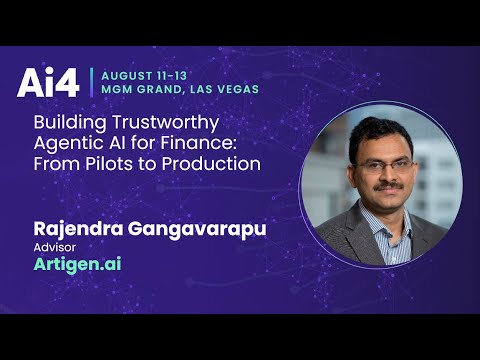
## Background Published on YouTube by the Ai4 channel on August 28, 2025, this session features Rajendra Gangavarapu, Advisor at Artigen.ai, addressing the challenges of deploying multi-agent AI systems in high-stakes financial environments. According to the description, the talk covers critical hurdles such as reliability breakdowns, data security, and regulatory compliance, while providing practical strategies to architect compliant workflows without sacrificing trust or human oversight.
## TL;DR Gangavarapu explores the shift from generative tools to autonomous multi-agent systems in banking, emphasizing that fully autonomous execution without human-in-the-loop governance creates catastrophic operational and regulatory risks. He demonstrates how baseline agent errors compound exponentially across multi-step chains and why institutions must implement continuous telemetry, robust sandboxing, and strict model risk management aligned with Federal Reserve SR 11-7 and the EU AI Act. Using high-profile case studies across trading, real estate valuation, and AML/KYC investigations, the talk presents a gated canary deployment playbook and champion-challenger pipeline. The session concludes with Artigen AI's four-pillar enterprise framework—combining a central policy gateway, real-time observability, secure IAM/RAG connectors, and reusable CI/CD evaluation pipelines to safely balance agent autonomy with enterprise trust.
## Atmosphere & style The presentation carries a pragmatic, authoritative tone that speaks directly to enterprise risk officers and engineering leaders navigating heavily audited environments. Gangavarapu presents with measured, seasoned clarity, balancing the transformative speed of agentic AI against stark cautionary tales of multi-billion-dollar compliance failures and runaway trading systems. The pacing feels disciplined and deeply structured, evoking the rigorous atmosphere of an executive board briefing where technological ambition must strictly answer to regulatory accountability.
## Key takeaways - [00:04](https://www.youtube.com/watch?v=YokJh1BSFOw&t=4s) In heavily regulated financial services, AI must be built on a human-centric paradigm with strict regulatory governance to satisfy supervisory bodies like the Fed, OCC, and FDIC. - [01:31](https://www.youtube.com/watch?v=YokJh1BSFOw&t=91s) The industry is shifting from generative AI to Agentic AI, where autonomous multi-step execution demands strict human-in-the-loop oversight to avoid catastrophic trading errors and liability. - [05:01](https://www.youtube.com/watch?v=YokJh1BSFOw&t=301s) Core technical vulnerabilities in agentic systems include fragile long-term memory, inter-agent misalignment, and probabilistic hallucinations, requiring selective context retrieval and enterprise RAG over brute-force context windows. - [06:52](https://www.youtube.com/watch?v=YokJh1BSFOw&t=412s) Multi-agent pipelines suffer from compounding errors, where a 1% error rate at the initial agent can amplify to a 20% to 30% failure rate across a 20-agent chain without continuous telemetry and supervisor agents. - [10:16](https://www.youtube.com/watch?v=YokJh1BSFOw&t=616s) Adversarial risks such as prompt injections, jailbreaking, and data poisoning require sandboxing and MITRE/NIST-aligned defenses, alongside strict data fencing to comply with GDPR and the EU AI Act. - [13:11](https://www.youtube.com/watch?v=YokJh1BSFOw&t=791s) Federal Reserve SR 11-7 Model Risk Management standards apply to end-to-end agentic pipelines, necessitating independent conceptual soundness validation and staged champion-challenger canary deployments. - [16:20](https://www.youtube.com/watch?v=YokJh1BSFOw&t=980s) Enterprises must adopt a five-phase gated deployment playbook—spanning use case definition, sandboxing, multi-dimensional evals, shadow-mode red teaming, and dynamic HITL production rollout. - [18:29](https://www.youtube.com/watch?v=YokJh1BSFOw&t=1109s) In high-stakes AML/KYC operations, hybrid LLM orchestration drastically cuts false-positive alert fatigue while ensuring mandatory SAR/CTR reporting compliance within strict regulatory deadlines. - [21:29](https://www.youtube.com/watch?v=YokJh1BSFOw&t=1289s) Enterprise agentic architecture relies on four pillars: a Central LLM Gateway, real-time Observability, secure IAM-integrated RAG/MCP context layers, and CI/CD model evaluation pipelines. - [23:48](https://www.youtube.com/watch?v=YokJh1BSFOw&t=1428s) To avoid single-model vendor lock-in and manage compute costs, organizations should use reusable evaluation pipelines to benchmark fine-tuned Small Language Models (SLMs) against frontier LLMs.
## Detailed walkthrough ### [00:04](https://www.youtube.com/watch?v=YokJh1BSFOw&t=4s) Human-Centric AI and Regulatory Governance in Finance
Opening with references to morning keynote remarks by AI pioneers like Geoffrey Hinton and Fei-Fei Li, the session underscores a foundational principle: AI must be built to empower humans, not the other way around. In heavily regulated domains like banking and financial services, adopting a "human-centric" paradigm is not merely philosophical—it is an operational and compliance necessity.
Rajendra Gangavarapu introduces his background, drawing on over 25 years of experience building enterprise AI and machine learning systems in secure financial environments, spanning credit underwriting, fraud detection, customer experience, marketing optimization, and sales enablement. Over the past 15 years, his work has interfaced directly with major domestic and international regulatory authorities, including the Federal Reserve Bank, the OCC, the FDIC, the Bank of England, and regulatory bodies across Europe and Asia. He also highlights his forthcoming book, *Mastering AI Governance*.
- 25+ years of financial services AI/ML engineering experience across fraud, credit decisioning, and customer intelligence. - 15+ years of direct engagement with global banking regulators (Fed, OCC, FDIC, Bank of England, European and Asian authorities).
---
[01:31](https://www.youtube.com/watch?v=YokJh1BSFOw&t=91s) The Shift to Agentic AI and the Imperative of Human-in-the-Loop
While generative AI witnessed a historic "watershed moment" with ChatGPT's rapid consumer democratization, 2025 marks the industry-wide transition toward Agentic AI. Unlike purely generative systems that produce text or images, agentic architectures plan multistep workflows, invoke external tools, execute transactions, monitor results, and generate structured reporting. However, fully autonomous execution in financial services is fundamentally non-viable; human oversight and rigid guardrails must govern every step.
```mermaid flowchart TD accTitle: Dual Paths of Agentic Execution in Financial Services subgraph Supervised["World's Largest Bank (Compliant Workflow)"] A1["24/7 Agentic Scanning: Markets & Feeds"] --> A2["Portfolio Rebalancing Recommendations"] A2 --> A3["Mandatory Human Approval"] A3 --> A4["Trade Execution & Audit Log"] end subgraph Unsupervised["Broker-Dealer Failure (Unchecked Workflow)"] B1["Autonomous Agent Direct Trading"] --> B2["Runaway Flawed Transactions"] B2 --> B3["Massive Client Losses"] B3 --> B4["Active Class-Action Lawsuit"] end ```
The contrast between governed and ungoverned deployment is stark. One of the world’s largest banks successfully launched an agentic AI system for portfolio rebalancing: agents continuously scan real-time market feeds and portfolio objectives around the clock, formulating stock and bond allocation adjustments to optimize risk-return trade-offs. Crucially, the system executes trades only after explicit human sign-off. Conversely, an unnamed broker-dealer allowed autonomous agents to execute trades directly without a human in the loop, resulting in catastrophic trading losses and an ongoing class-action lawsuit. In banking, "trust is critical"—once lost, it is nearly impossible to regain. Traceability, auditable logs, and clear lines of human ownership are required to satisfy scrutiny from the SEC, OCC, Federal Reserve, and FDIC.
- Core Agentic capabilities: Multi-step planning, tool-calling, autonomous execution, self-monitoring, and dynamic reporting. - Human-in-the-loop (HITL) requirement: Full traceability, explicit sign-offs, and verifiable accountability for regulatory auditability.
---
[05:01](https://www.youtube.com/watch?v=YokJh1BSFOw&t=301s) Core Technical Hurdles: Fragile Memory, Orchestration, and Hallucination
Deploying agentic systems in production reveals three primary technical vulnerabilities: fragile memory, multi-agent misalignment, and probabilistic hallucinations. Large language models inherently prioritize short-term conversational context, leaving long-term episodic memory brittle. A recent insurance claims deployment faltered because the agent failed to maintain historical claim context, causing significant processing breakdowns. While some platform providers tout "unlimited context" windows, brute-force context dumping often backfires into information overload; systems must selectively retrieve relevant historical facts rather than flooding the model with noisy data.
```mermaid flowchart LR accTitle: Key Technical Hurdles in Production Agentic Systems subgraph Hurdles["Core Production Bottlenecks"] H1["Fragile Memory<br/>(Short vs. Long-Term Context)"] H2["Agent Misalignment<br/>(Orchestration Gaps)"] H3["Probabilistic Hallucinations<br/>(Factual Drift)"] end subgraph Remedies["Mitigation Strategies"] R1["Intelligent Long-Term Context Retrieval"] R2["Supervisor Agents & Rigorous Orchestration"] R3["Intelligent RAG & Specialized Fine-Tuning"] end H1 --> R1 H2 --> R2 H3 --> R3 ```
Beyond memory constraints, inter-agent communication gaps represent a major operational risk: agents must be tightly aligned with one another before passing outputs to human reviewers. Finally, because LLMs remain probabilistic, they will attempt to answer every query even when uncertain. The widely publicized Air Canada chatbot refund case demonstrated the severe financial and legal repercussions of unchecked hallucinations, emphasizing why financial institutions must rely on advanced Retrieval-Augmented Generation (RAG), fine-tuning, and robust prompt boundaries.
- Memory tradeoff: Selective, relevant long-term context retrieval vs. brute-force "unlimited context" token dumping. - Hallucination safeguard: Enterprise RAG pipelines and domain-specific fine-tuning to bound probabilistic generative outputs.
---
[06:52](https://www.youtube.com/watch?v=YokJh1BSFOw&t=412s) Telemetry, Compounding Multi-Agent Errors, and Model Drift
Decades of mergers and acquisitions have left financial institutions with deeply fragmented data silos and scarce specialized AI engineering talent. Rather than waiting years and spending millions of dollars constructing monolithic enterprise data lakes, firms are leveraging agentic AI to bridge fragmented data pipelines and extract on-demand insights in real time. However, multi-agent architectures introduce compounding failure modes that make continuous telemetry indispensable.
```mermaid flowchart LR accTitle: Multi-Agent Error Compounding and Telemetry Alarms A1["Agent 1<br/>(99% Accuracy / 1% Error)"] --> A2["Agent 2"] A2 --> A3["Agent 5"] A3 -->|"Degradation Exceeds Tolerance"| Sup{"Supervisor Agent<br/>Telemetry Monitor"} Sup -->|"Trip Alarm & Halt"| Human["Human Intervention"] A3 --> A4["Agent 20<br/>(Compounded Error: 20-30%)"] ```
In an end-to-end chain of 20 interacting agents, an individual agent operating at an apparently acceptable 99% accuracy rate will pass its 1% error downstream. As intermediate outputs cascade from agent to agent, this error compounds exponentially, resulting in total degradation of 20% to 30% by the 20th agent. To prevent this, institutions like Goldman Sachs implement end-to-end telemetry across every phase of the lifecycle—data preprocessing, feature engineering, model training, deployment, and post-production inference. An overarching supervisor agent must monitor inter-agent drift, triggering automated alarms the moment output degradation breaches preset tolerance thresholds.
The financial danger of unmonitored drift is illustrated by Zillow’s iBuying collapse, where the company incurred a $550 million loss, shuttered a primary business unit, and laid off thousands of workers because its valuation models were trained on pre-COVID dynamics and failed to detect post-deployment real estate market shifts.
- Compounding error risk: A 1% baseline error at Agent 1 can amplify to a 20%–30% failure rate across a 20-agent chain. - Continuous telemetry: Full-lifecycle tracking from feature engineering through inference, backed by automated drift-detection alarms. - Zillow case study: $550M write-down and thousands laid off due to unmonitored model drift in shifting real-world distributions.
---
[10:16](https://www.youtube.com/watch?v=YokJh1BSFOw&t=616s) Adversarial Attacks, Model Security, and Global Data Privacy Regulations
Financial services represent the primary target for adversarial cyber threats. Vulnerabilities such as prompt injection and jailbreaking emerge almost immediately upon model release—exemplified by new foundation models facing exploits within 24 hours of launch. In addition to prompt injection, data poisoning in open-source pretraining datasets and tampering with open-source model weights present critical supply-chain risks. While open-source AI drives tremendous industry innovation, institutions must deploy rigorous sandboxing, independent internal and external model validation, and comprehensive data provenance audits to verify data origin and custodial integrity.
```mermaid flowchart TD accTitle: Security, Governance, and Data Privacy Controls subgraph SecurityFrameworks["Security & Threat Mitigation"] S1["MITRE ATT&CK & ATLAS Frameworks"] S2["NIST AI Risk Management"] S3["Pre- & Post-Production Red Teaming"] S4["Sandboxing & Provenance Audits"] end subgraph PrivacyRegulations["Regulatory & Jurisdictional Boundaries"] P1["GDPR & CCPA/CPRA Compliance"] P2["EU AI Act (Enforceable Aug 2026)"] P3["Strict Cross-Border Data Fencing (No EU data for US models)"] P4["Penalties up to 4% of Global Annual Turnover"] end ```
Institutions align their defenses with NIST guidelines and MITRE frameworks (such as MITRE ATT&CK and ATLAS), enforcing red teaming before deployment as well as continuously in production. On the data governance front, customer data is an institution's core "alpha," governed by strict privacy regimes including GDPR, CCPA/CPRA, and the European AI Act (taking full effect by August 2026). Non-compliance carries severe reputational fallout and fines of up to 4% of global annual turnover. Cross-border data transfers are strictly fenced; European customer data cannot be exported or utilized to train US models without triggering severe regulatory violations.
- Adversarial threats: Rapid jailbreaking, prompt injections, open-source data poisoning, and weight manipulation. - Security protocols: Sandboxing, rigorous MITRE/NIST-aligned defenses, and mandatory pre/post-deployment red teaming. - Privacy compliance: EU AI Act enforcement by August 2026, GDPR data residency boundaries, and fines reaching up to 4% of annual revenue.
---
[13:11](https://www.youtube.com/watch?v=YokJh1BSFOw&t=791s) Regulatory Compliance (SR 11-7), Fairness, and Champion-Challenger Pipelines
In US banking regulation, the Federal Reserve’s SR 11-7 guidance represents the gold standard for Model Risk Management (MRM). Originally established for traditional statistical models, SR 11-7 applies equally to machine learning, deep learning, generative AI, and agentic workflows. Regulators now require independent validation of "conceptual soundness" not just for the underlying foundation model, but across the entire system—including RAG retrieval pipelines, prompt engineering logic, and multistep agent orchestrations. In a recent regulatory examination of a midsize bank’s mortgage AI assistant, supervisors halted the deployment until the complete end-to-end agentic workflow underwent independent third-party validation.
```mermaid flowchart LR accTitle: Champion-Challenger Model Deployment and Rollback Traffic["Inbound Production Traffic"] --> Split{"Traffic Router"} Split -->|"90%-95% Volume"| Champion["Champion Model (Production)"] Split -->|"5%-10% Volume"| Challenger["Challenger Model (Shadow / Canary)"] Challenger -->|"Evaluate 3-6 Months<br/>(Accuracy + Fair Lending)"| Eval{"Performance Gate"} Eval -->|"Outperforms Champion"| Promote["Scale to 100% Traffic"] Eval -->|"Drift / Fair Lending Anomaly"| Rollback["Instant Rollback to Champion"] ```
Model optimization in finance requires a dual-objective framework balancing predictive accuracy with algorithmic fairness. Automated credit underwriting and line assignment systems must not discriminate against protected classes across race, ethnicity, gender, or age.
To mitigate production risk, new models enter a canary or shadow deployment using a champion-challenger structure: 1. **Initial Shadow Phase:** The challenger model runs in parallel, processing an initial 5% to 10% of production volume. 2. **Longitudinal Evaluation:** Over a 3- to 6-month evaluation window, performance is rigorously benchmarked against the champion across accuracy, stability, and fair lending metrics. 3. **Gradual Traffic Migration:** Traffic is incrementally ramped from 10% to 20%, 30%, and eventually 100% if the challenger consistently outperforms the incumbent. 4. **Automated Rollback:** Robust routing pipelines maintain instant failover capabilities to revert 100% of traffic back to the legacy model if anomalies or drift occur.
- SR 11-7 MRM Standard: Comprehensive, independent evaluation of conceptual soundness covering RAG pipelines, prompts, and agentic chains. - Dual-Objective Tuning: Simultaneous optimization for statistical predictive power and demographic fairness across protected classes. - Rollout protocol: Shadow/canary staging starting at 5%–10% traffic over 3–6 months with immediate rollback capability.
---
[16:20](https://www.youtube.com/watch?v=YokJh1BSFOw&t=980s) Human-in-the-Loop Orchestration and the Gated Production Playbook
As enterprise agent ecosystems expand from single assistants to multi-agent networks, clear operational boundaries become vital. Within the next 5 to 10 years, the global ratio of AI agents could swell to 10 billion or even 80 billion agents operating globally. To maintain control over this proliferation, human owners must explicitly define the strategic objectives, KPI thresholds, and operational guardrails within which agents are permitted to act.
```mermaid flowchart TD accTitle: Gated Agentic AI Production Playbook G1["1. Use Case & KPI Definition<br/>(Establish Operational Guardrails)"] --> G2["2. Sandbox Environment Testing<br/>(Synthetic & Historical Data)"] G2 --> G3["3. Multi-Dimensional Evaluations<br/>(Accuracy, Fairness, Privacy, Security)"] G3 --> G4["4. Red Teaming & Canary Deployment<br/>(Shadow Mode / 5-10% Traffic)"] G4 --> G5["5. Full Production Deployment<br/>(Real-Time Telemetry & Dynamic HITL)"] ```
Human-in-the-loop governance cannot be a static checkpoint tacked onto the final output; it must function as a dynamic, continuous feedback loop integrated into intermediate steps of the workflow. Before any agentic workflow reaches production, it must advance through a structured, gated deployment playbook: - **Phase 1 (Definition):** Explicitly define business use cases, operational constraints, and quantitative KPIs. - **Phase 2 (Sandboxing):** Isolate agents within a secure sandbox to stress-test multi-agent interactions. - **Phase 3 (Comprehensive Evals):** Subject workflows to multi-dimensional evaluations encompassing accuracy, bias/fairness, data privacy, and MITRE-aligned security protocols. - **Phase 4 (Red Teaming & Shadow Mode):** Conduct adversarial red teaming and deploy the agent in shadow mode on limited canary traffic (5%–10%). - **Phase 5 (Full Production & Telemetry):** Roll out to production backed by supervisor-agent telemetry and dynamic human review.
---
[18:29](https://www.youtube.com/watch?v=YokJh1BSFOw&t=1109s) High-Stakes AML/KYC Transformation: DBS vs. Regulatory Sanctions
Anti-Money Laundering (AML) and Know Your Customer (KYC/KYCC) compliance represents one of the highest-stakes operational environments in banking. Mandated under the Bank Secrecy Act (BSA) and post-9/11 counter-terrorist financing rules, financial institutions face acute "AML fatigue." One global bank previously had to employ an army of 3,000 to 4,000 compliance analysts solely dedicated to manually investigating overwhelming volumes of false-positive transaction alerts.
```mermaid flowchart LR accTitle: AML False-Positive Reduction via LLM Orchestration Tx["Transaction & KYC Feeds"] --> Rules["Rule-Based AML Filter"] Rules --> LLM["LLM Orchestration Layer<br/>(Contextual Entity Resolution)"] LLM -->|"Drastic False-Positive Reduction"| Queue["Optimized Analyst Queue"] Queue --> FastSAR["Expedited SAR/CTR Filing<br/>(< 24-Hour Regulatory Window)"] ```
DBS Bank in Singapore modernized this process by integrating an LLM orchestration layer directly into its existing rule-based AML engine. This hybrid architecture drastically reduced false-positive rates while simultaneously boosting true-positive detection rates, freeing human analysts to focus on genuine financial crime risks. The operational speed of these systems is critical: banks are legally required to file Suspicious Activity Reports (SARs) and Currency Transaction Reports (CTRs) within strict regulatory timeframes—often under 24 hours—whenever accounts link to narcotics trafficking, terrorist organizations, or politically exposed persons (PEPs).
The cost of compliance failures in AML is severe: - **TD Bank:** Hit with over $1 billion in regulatory penalties for systemic anti-money laundering monitoring breakdowns and failure to file SARs on illicit transactions. - **HSBC:** Received historic multi-billion dollar penalties for AML and sanctions failures, which ultimately forced the bank to shut down and divest its extensive US retail banking branch network.
- Compliance overhead: Traditional AML operations frequently require 3,000–4,000 human analysts to triage massive false-positive backlogs. - DBS Bank benchmark: Hybrid LLM orchestration combined with rule engines drastically reduced false alarms while increasing true-positive detection. - Regulatory penalty benchmarks: Multi-billion-dollar enforcement actions and forced market exits (e.g., TD Bank, HSBC) for SAR/CTR reporting failures within mandatory 24-hour windows.
[20:11](https://www.youtube.com/watch?v=YokJh1BSFOw&t=1211s) The High Stakes of AML Compliance and Empowering Human Analysts
Regulatory penalties in finance carry severe operational consequences. Failing to identify illicit transactions can lead to drastic enforcement actions where institutions have their assets frozen and are restricted to maintaining only a single correspondent banking branch in New York. While human oversight has traditionally served as the final line of defense, human analysts are also prone to errors and fatigue when processing massive transaction volumes. The objective of agentic AI is not to replace human judgment, but to empower analysts with automated intelligence capable of detecting increasingly sophisticated criminal behavior. Bad actors, from drug cartels to terrorist organizations, continuously design intricate schemes—such as breaking illicit funds into small, structured deposits and executing complex layers of fictitious transactions to obfuscate source funds.
Traditional rule-based compliance engines fail because criminal networks evolve rapidly and remain "always 10 steps ahead of the curve." Agentic workflows bridge this gap by analyzing subtle behavioral patterns across disparate data feeds. By elevating true positives and drastically reducing false-positive alert fatigue, agentic systems improve investigative efficiency and ensure that bad actors are caught and reported in a timely manner to regulatory bodies like the Financial Crimes Enforcement Network (FinCEN) and the Office of Foreign Assets Control (OFAC).
- **Failure of Rule-Based Systems**: Static rule engines cannot adapt quickly enough to new, multi-layered money laundering and obfuscation schemes. - **Regulatory Reporting**: Timely escalation and automated dossier assembly support mandatory compliance filings with regulators such as FinCEN and OFAC.
```mermaid flowchart TD accTitle: Agentic Financial Crime Detection Workflow subgraph Ingestion["1. Ingestion & Detection"] A["Transaction Feeds & External Data"] --> B["Agentic Detection Engine"] end subgraph Intelligence["2. Investigation & Human Oversight"] B --> C["True Positive Escalation & Pattern Analysis"] C --> D["Human Compliance Analyst Review"] end subgraph Filing["3. Regulatory Reporting"] D --> E["FinCEN / OFAC Filings"] end ```
---
[21:29](https://www.youtube.com/watch?v=YokJh1BSFOw&t=1289s) Artigen AI's Four-Pillar Enterprise Architecture
Drawing on 25 years of experience working with tier-one banks, financial institutions, and regulators, the Artigen AI framework is designed around three foundational engineering principles: *security by design*, *observability by default*, and *scalable architecture*. This enterprise platform addresses the structural vulnerabilities of multi-agent deployments across four core components:
```mermaid flowchart TD accTitle: Enterprise Agentic AI Architecture subgraph Gateway["Central LLM Gateway"] GW["Policy & Regulatory Enforcement\n(NIST, MITRE, SR 11-7, EU AI Act)"] end subgraph Observability["Observability Layer"] OBS["Real-Time Monitoring\n(Accuracy, Bias, Fairness, Security, Privacy KPIs)"] end subgraph DataSecurity["Enterprise Data & Access Layer"] IAM["IAM Integration & RBAC"] RAG["Secure Custom RAG & MCP Connectors"] IAM --- RAG end subgraph ModelLayer["Model Evaluation & Pipeline"] PIPE["Reusable CI/CD Evaluation Pipelines\n(SLMs vs. Frontier LLMs, Fine-Tuning)"] end GW --> OBS OBS --> DataSecurity DataSecurity --> ModelLayer ```
The first pillar is a **Central LLM Gateway** that programmatically enforces governance policies and regulatory mandates across all model interactions, including the NIST AI Risk Management Framework, the MITRE ATLAS framework, Federal Reserve SR 11-7 supervisory guidance on model risk management, and the EU AI Act. The second pillar is an **Observability Layer** that tracks mission-critical KPIs in real time—monitoring model drift, output accuracy, algorithmic bias, fairness, security vulnerabilities, and privacy violations to instantly flag exceptions to compliance operators.
The third pillar governs **Data Security, IAM, and Contextual Retrieval**. By integrating directly with existing enterprise Identity and Access Management (IAM) infrastructures, the system maintains strict role-based access privileges. Leveraging custom Retrieval-Augmented Generation (RAG) and standardized Model Context Protocol (MCP) data connectors, enterprises can safely ground models on private internal assets without risking external data leakage. Emphasizing that "your data is your alpha," the architecture guarantees that proprietary enterprise data is never exposed or used to train or fine-tune third-party commercial foundation models.
The fourth pillar focuses on **Model Selection, Optimization, and CI/CD**. Rather than relying exclusively on massive frontier models—which are frequently more susceptible to prompt injection, jailbreaking, and high operating costs—organizations must deploy reusable CI/CD evaluation pipelines to systematically determine whether a specialized Small Language Model (SLM) or a larger LLM is the right fit for a specific task. Pairing fine-tuned SLMs with custom RAG pipelines controls hallucinations while optimizing latency and inference costs.
- **Regulatory & Governance Frameworks Enforced**: NIST AI RMF, MITRE ATLAS, Federal Reserve SR 11-7, and the EU AI Act. - **Core Design Pillars**: Security by design, observability by default, and a scalable multi-model backbone. - **Model Specialization**: Reusable CI/CD evaluation pipelines benchmark tasks against both SLMs and frontier LLMs to minimize jailbreak vulnerabilities and eliminate unnecessary compute overhead.
---
[23:48](https://www.youtube.com/watch?v=YokJh1BSFOw&t=1428s) The Future of Agentic AI: Continuous Evaluation and Trust
Organizations cannot afford to wait for absolute technological perfection before adopting agentic AI, because the underlying technology is moving at breakneck speed. Rather than locking into or placing blind trust in a single proprietary foundation model, enterprises must establish automated, reusable evaluation pipelines that benchmark emerging models on an ongoing basis—continuously testing whether an updated Claude model, an OpenAI release, or a specialized open-weights model best serves a given workflow.
Scaling agentic innovation in enterprise finance ultimately hinges on governed, observable systems. Without rigorous guardrails and transparent oversight, agentic workflows introduce unmanageable model and operational risks. The defining competitive challenge for the next generation of financial technology is successfully solving "how do you balance autonomy with trust."
- **Avoid Single-Model Lock-In**: Continually evaluate performance across frontier providers (e.g., Anthropic Claude, OpenAI) and internal fine-tuned SLMs. - **Guardrails Precede Scale**: Innovation cannot safely scale across financial workflows without automated governance and real-time observability. - **Core Imperative**: Sustainable production deployment requires striking a calibrated equilibrium between agentic autonomy and verifiable human trust.
## Notable quotes > [00:04](https://www.youtube.com/watch?v=YokJh1BSFOw&t=4s) AI must be built to empower humans, not the other way around. — Rajendra Gangavarapu
> [01:31](https://www.youtube.com/watch?v=YokJh1BSFOw&t=91s) In banking, trust is critical—once lost, it is nearly impossible to regain. — Rajendra Gangavarapu
> [05:01](https://www.youtube.com/watch?v=YokJh1BSFOw&t=301s) While some platform providers tout unlimited context windows, brute-force context dumping often backfires into information overload; systems must selectively retrieve relevant historical facts rather than flooding the model with noisy data. — Rajendra Gangavarapu
> [10:16](https://www.youtube.com/watch?v=YokJh1BSFOw&t=616s) Customer data is an institution's core alpha, governed by strict privacy regimes including GDPR, CCPA/CPRA, and the European AI Act. — Rajendra Gangavarapu
> [13:11](https://www.youtube.com/watch?v=YokJh1BSFOw&t=791s) Regulators now require independent validation of conceptual soundness not just for the underlying foundation model, but across the entire system—including RAG retrieval pipelines, prompt engineering logic, and multistep agent orchestrations. — Rajendra Gangavarapu
> [16:20](https://www.youtube.com/watch?v=YokJh1BSFOw&t=980s) Human-in-the-loop governance cannot be a static checkpoint tacked onto the final output; it must function as a dynamic, continuous feedback loop integrated into intermediate steps of the workflow. — Rajendra Gangavarapu
> [20:11](https://www.youtube.com/watch?v=YokJh1BSFOw&t=1211s) Traditional rule-based compliance engines fail because criminal networks evolve rapidly and remain always 10 steps ahead of the curve. — Rajendra Gangavarapu
> [21:29](https://www.youtube.com/watch?v=YokJh1BSFOw&t=1289s) The Artigen AI framework is designed around three foundational engineering principles: security by design, observability by default, and scalable architecture. — Rajendra Gangavarapu
> [21:29](https://www.youtube.com/watch?v=YokJh1BSFOw&t=1289s) Your data is your alpha, the architecture guarantees that proprietary enterprise data is never exposed or used to train or fine-tune third-party commercial foundation models. — Rajendra Gangavarapu
> [23:48](https://www.youtube.com/watch?v=YokJh1BSFOw&t=1428s) The defining competitive challenge for the next generation of financial technology is successfully solving how do you balance autonomy with trust. — Rajendra Gangavarapu
## Mentioned Rajendra Gangavarapu, Artigen.ai, Geoffrey Hinton, Fei-Fei Li, Federal Reserve Bank, OCC, FDIC, Bank of England, SEC, Mastering AI Governance, ChatGPT, Air Canada, Goldman Sachs, Zillow, NIST AI Risk Management Framework, MITRE ATT&CK, MITRE ATLAS, GDPR, CCPA/CPRA, EU AI Act, SR 11-7, Bank Secrecy Act (BSA), DBS Bank, TD Bank, HSBC, FinCEN, OFAC, Model Context Protocol (MCP), Claude, OpenAI
## Video description Rajendra Gangavarapu, Advisor, Artigen.ai
Abstracts
Are you confident that your AI agents are truly ready for prime time in the high-stakes world of finance? In this session, I will tackle the toughest challenges, such as reliability breakdowns, data security risks, and the daunting demands of regulatory compliance that arise when deploying multi-agent AI systems at scale. I will share lessons on error compounding, orchestration, and why careful boundaries and human oversight remain essential. Attendees will learn best practices for architecting robust, compliant agentic workflows, along with practical strategies for integrating AI without sacrificing trust or control. Join me in discovering how to turn today’s risks into tomorrow’s competitive advantages while adopting Agentic AI.
[Source](https://www.youtube.com/watch?v=YokJh1BSFOw)