US Labor Dept Rejects AI Job Doom, Pushes 1 Million Apprenticeships
Ai4
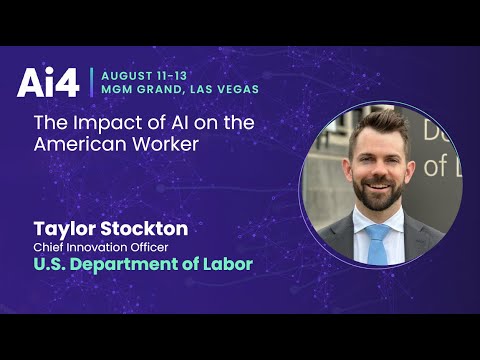
Department of Labor Chief Innovation Officer Taylor Stockton argues AI expands net employment, urging a pivot from traditional college degrees to one million debt-free apprenticeships to meet tech labor demands.
AI-assisted summary of The Impact of AI on the American Worker With US Department of Labor — original source. Check the original for full context.
Source published:
Detailed notes
## Background Published on YouTube by the Ai4 conference channel on August 28, 2025, this presentation features Taylor Stockton, Chief Innovation Officer at the U.S. Department of Labor. According to the video description, Stockton addresses the department's perspective on how artificial intelligence will reshape the labor market and details the Trump administration's strategy to accelerate research, eliminate regulatory barriers, and expand economic opportunity for the American workforce.
## TL;DR Taylor Stockton outlines the U.S. Department of Labor's proactive, worker-centric strategy for navigating the rise of artificial intelligence across four guiding pillars. Rejecting alarmist forecasts of technological unemployment, he presents evidence showing net job expansion in AI-exposed roles and explains why human oversight and institutional frictions prevent end-to-end autonomous displacement. Stockton introduces federal agility initiatives, including the DOL's new AI Workforce Research Hub and accelerated talent pipelines for physical infrastructure workers like data center technicians and lineworkers. Finally, he calls for dismantling outdated 'train and pray' education programs in favor of universal AI literacy and an expansion of debt-free, employer-driven registered apprenticeships tied to verifiable wage outcomes.
## Atmosphere & style The session kicks off on an engaging, self-deprecating note as Stockton laughs off a chaotic 60-second hotel-room scramble to make the stage alongside a hoarse voice from a late night in Las Vegas. From there, the delivery transforms into a disciplined, confident, and bullishly optimistic policy briefing infused with administration-level momentum. The talk balances empirical labor market statistics with an impassioned, populist critique of traditional higher education, creating an urgent yet reassuring tone designed to rally industry leaders away from apocalyptic narratives and toward practical workforce mobilization.
## Key takeaways - [01:10](https://www.youtube.com/watch?v=FnUJVYhvscA&t=70s) The Trump administration's AI strategy places the American worker directly at the center of the nation's push for global AI leadership and economic competitiveness. - [03:12](https://www.youtube.com/watch?v=FnUJVYhvscA&t=192s) The Department of Labor views AI as an unprecedented opportunity multiplier that will create new job categories, enrich existing occupations, and enhance physical workplace safety. - [04:00](https://www.youtube.com/watch?v=FnUJVYhvscA&t=240s) High-paying emerging AI roles, such as prompt engineering and synthetic data management, provide viable pathways to middle-class mobility without requiring a four-year college degree. - [05:00](https://www.youtube.com/watch?v=FnUJVYhvscA&t=300s) Federal workforce development programs are systematically aligning funding streams to support a presidential executive order mandating universal domestic AI literacy. - [06:35](https://www.youtube.com/watch?v=FnUJVYhvscA&t=395s) Concerns over mass technological displacement are overstated; economic data from PwC shows occupations most exposed to generative AI experienced a 38% increase in net job growth. - [07:30](https://www.youtube.com/watch?v=FnUJVYhvscA&t=450s) End-to-end automation remains impractical because human oversight is essential at both ends of the workflow: framing context and strategy at the start, and evaluating output at the conclusion. - [09:00](https://www.youtube.com/watch?v=FnUJVYhvscA&t=540s) Full AI adoption faces significant real-world friction, including consumer preference for human contact, legal oversight, and multi-year organizational restructuring timelines. - [10:39](https://www.youtube.com/watch?v=FnUJVYhvscA&t=639s) The greatest structural risk in the AI economy is the unprecedented velocity of skill evolution rather than aggregate job loss, requiring public institutions to cultivate systemic agility. - [11:30](https://www.youtube.com/watch?v=FnUJVYhvscA&t=690s) The newly launched AI Workforce Research Hub will track occupational task shifts in real time to rapidly translate market data into responsive federal workforce policies. - [12:15](https://www.youtube.com/watch?v=FnUJVYhvscA&t=735s) Federal initiatives are prioritizing accelerated pipelines for foundational technical and blue-collar roles, such as electricians and data center technicians, to support the AI infrastructure buildout. - [13:06](https://www.youtube.com/watch?v=FnUJVYhvscA&t=786s) The DOL is rejecting the legacy 'train and pray' model—where only 34% of trainees find jobs in their field—and challenging the 'college-for-all' movement after 52% of 2023 graduates faced underemployment or unemployment. - [15:00](https://www.youtube.com/watch?v=FnUJVYhvscA&t=900s) The administration aims to surpass 1,000,000 registered apprenticeships by expanding the debt-free model into modern tech fields and enforcing pay-for-performance standards on federal training grants. - [16:39](https://www.youtube.com/watch?v=FnUJVYhvscA&t=999s) Leadership emphasizes shifting the national conversation from defeatist fear to workforce empowerment, preparing the next generation of American workers to design, manage, and govern AI systems.
## Detailed walkthrough ### [00:04](https://www.youtube.com/watch?v=FnUJVYhvscA&t=4s) Conference Scramble and Introductory Remarks
Taylor Stockton opens his address with humor and a pair of self-deprecating apologies. First, he explains a chaotic scheduling scramble: having assumed his session was slated for 3:00 p.m., he was sitting in his hotel room when he received an urgent call from the AI4 conference organizers at 11:29 a.m. asking where he was, only to be told his presentation was starting in 60 seconds. Grateful that the session could be moved to an extended slot and that attendees showed up despite the confusion, he also warns the audience about his strained vocal cords, quipping that his hoarseness is definitely "not from a late night at casino last night."
Stockton notes that because the reshuffled schedule offers a slightly longer window, he intends to deliver prepared remarks before opening the floor to audience questions. He explicitly sets the ground rules for the interactive portion, requesting that questions stay focused on his address regarding labor, the workforce, and technology, noting that any broader administrative or political inquiries can be directed to the Department of Labor’s dedicated communications team.
[01:10](https://www.youtube.com/watch?v=FnUJVYhvscA&t=70s) The Trump Administration's Worker-Centric AI Vision
Formally introducing himself as the Chief Innovation Officer at the United States Department of Labor (DOL), Stockton outlines his core mandate: spearheading how the agency interprets artificial intelligence’s influence on the broader labor market, assessing its impact on the daily experience of American workers, and modernizing departmental operations to better equip citizens for an evolving economic reality. AI is no longer a distant theoretical technology on the horizon; it has become an active, structural force transforming production, enterprise, and employment across every major domestic industry.
Stockton situates the Labor Department's efforts within the broader industrial and geopolitical policy of the Trump administration. Under President Donald Trump, the administration's stance is that winning the global race in artificial intelligence requires advancing both research development and domestic deployment so that productivity radically improves, economic opportunity widens, and American competitiveness is fortified on the world stage. Crucially, Stockton underlines the foundational tenet outlined in the administration's AI action plan released the prior month: the path to AI supremacy must be built by American workers and must place workers directly at the center to improve their livelihoods. The Department of Labor refuses to adopt a passive or reactive posture in the face of the fastest-moving labor shift in modern history, aiming instead to guide the American workforce system toward proactive, real-time agility.
[03:12](https://www.youtube.com/watch?v=FnUJVYhvscA&t=192s) Pillar 1: AI as a Frontier of Opportunity and Job Quality
Stockton lays out the first of four guiding pillars: artificial intelligence represents an unprecedented frontier of economic opportunity rather than an existential workforce catastrophe. While public discourse routinely fixates on disruption and catastrophic downside risks, the Department of Labor approaches the shift through the lens of upside potential. This opportunity manifests across three primary dimensions: the creation of brand-new job categories, the enrichment of existing occupations, and the physical modernization of workplace health and safety.
In the realm of job creation, fields that scarcely existed just a few years earlier—such as AI prompt engineers, synthetic data specialists, and AI governance analysts—are rapidly scaling across sectors. Stockton points out that many of these lucrative, high-paying positions do not require a traditional four-year college degree, unlocking viable pathways into the middle class and upward mobility for everyday workers. Meanwhile, for existing roles, AI serves as a capability multiplier. Small teams and individual workers can now execute tasks that formerly required entire corporate departments, fostering a resurgence in entrepreneurship and small-business agility.
```mermaid flowchart TD accTitle: Dimensions of AI Opportunity in the Workforce subgraph Opportunities["AI Expansion of Opportunity"] A["New Job Architectures<br/>Prompt Engineers & Governance Analysts"] B["Workforce Augmentation<br/>Human Capability Multipliers"] C["Workplace Safety<br/>Real-Time Hazard Detection"] end subgraph EconomicOutcomes["Tangible Outcomes"] D["Upward Mobility Without 4-Year Degrees"] E["High-Value Human Focus (Empathy & Strategy)"] F["Injury Prevention in Heavy Industry"] end A --> D B --> E C --> F ```
Beyond sheer scale, AI removes administrative drudgery, making work inherently more human. In clinical healthcare, automated tools that draft clinical notes, summarize patient records, and recommend treatment avenues liberate doctors to spend dedicated time on patient bedside interaction, empathy, and relationship building. On industrial worksites—including mining, heavy construction, and advanced manufacturing—AI-driven visual and sensory hardware identifies immediate environmental hazards, preventing fatal workplace accidents before they materialize. To support this wave of capability, Stockton references an April executive order signed by President Trump mandating AI literacy across America, which the DOL is operationalizing across all federal workforce training funding streams.
- Generative AI is projected by McKinsey estimates to inject up to $4.4 trillion annually into global productivity. - High-paying AI jobs (e.g., synthetic data specialists and prompt engineers) bypass traditional credentialing barriers to create non-degree mobility pathways. - Departmental education and workforce funding streams are being systematically aligned with the April executive order on universal domestic AI literacy.
[06:35](https://www.youtube.com/watch?v=FnUJVYhvscA&t=395s) Pillar 2: Debunking the Myth of Mass Technological Displacement
Stockton tackles the pervasive public anxiety regarding technological unemployment, asserting that predictions of mass job displacement are deeply overstated and divorced from empirical labor market realities. Historical transitions—from agricultural mechanization to factory automation and the rise of the commercial internet—consistently triggered alarmist warnings about permanent unemployment, yet each technological wave ultimately generated significantly more jobs than it made obsolete.
Current economic data confirms a similar pattern for artificial intelligence. Citing PwC findings, Stockton notes that occupations with the highest exposure to generative AI have seen a 38% increase in net job growth, propelled directly by the productivity gains those tools unlock. He breaks down three core structural reasons why AI transforms roles rather than eliminating them:
```mermaid flowchart TD accTitle: Human-in-the-Loop Workflow and Adoption Bottlenecks subgraph HumanWorkflow["The Operational Workflow"] A["Human Worker:<br/>Frame Goals, Context & Strategy"] --> B["AI Engine:<br/>Task Generation & Processing"] B --> C["Human Worker:<br/>Evaluate Output, Review & Decide"] end subgraph RealWorldBottlenecks["Societal & Operational Guardrails"] D["Customer Preferences for Human Interaction"] E["State & Federal Regulatory Oversight"] F["Multi-Year Organizational Restructuring"] end RealWorldBottlenecks -. Constrain Complete Automation.-> B ```
First, rather than cutting payroll to produce static output, companies consistently leverage AI to amplify output with existing headcount—generating more content, shipping products faster, and elevating customer differentiation. Second, autonomous systems cannot independently manage end-to-end organizational workflows; human expertise remains essential at the front end (defining goals and context) and the back end (evaluating accuracy and making authoritative judgments). Third, technological feasibility does not equal marketplace adoption. Real-world implementation faces steep bottlenecks: consumer demand for genuine human interaction (notably in education and healthcare), evolving legal frameworks mandating human oversight, and the multi-year friction of rewiring corporate operations. While acknowledging localized disruptions will occur, Stockton argues the focus must remain on transitions rather than sensationalized narratives of doom.
- PwC research indicates that employment in roles most exposed to generative AI expanded by 38%. - AI adoption is bounded by three non-technical friction points: client preference, regulatory mandates, and organizational restructuring timelines. - DOL's policy focus centers on building rapid transition pathways for impacted workers rather than attempting to artificially preserve stagnant roles.
[10:39](https://www.youtube.com/watch?v=FnUJVYhvscA&t=639s) Pillar 3: Building Systemic Agility to Match the Pace of Change
The third core idea centers on the structural responsiveness of public institutions: the single most critical capability the Department of Labor must cultivate is agility. Stockton asserts that the greatest threat facing the workforce in an AI-driven economy is not the aggregate volume of job destruction, but rather the sheer, unprecedented velocity of skill evolution. If public training apparatuses cannot recalibrate continuously to changing market conditions, workers and employers alike will be stranded by widening talent deficits.
To operationalize agility, Stockton points to specific initiatives within President Trump’s newly unveiled AI action plan. Central among these is the launch of the DOL’s AI Workforce Research Hub. This initiative is designed around three interlocking capabilities: real-time tracking of how AI tools alter occupational tasks, rapid translation of real-time market data into federal education and workforce policy, and agile testing and iterative refinement of regional pilot programs.
Simultaneously, the administration is focusing federal attention on securing the foundational blue-collar and technical talent necessary to power domestic AI infrastructure. The DOL is forging accelerated pipelines for electricians, electrical lineworkers, and data center technicians through coordinated industry partnerships and outcome-based funding. Although designed to address immediate bottlenecks in the compute buildout, Stockton characterizes this infrastructure talent pipeline as an operational blueprint for mitigating rapid-onset labor shortages across any future industrial sector.
[13:06](https://www.youtube.com/watch?v=FnUJVYhvscA&t=786s) Pillar 4: A Paradigm Shift Toward Apprenticeships and Accountability
Turning to his fourth pillar, Stockton calls for a clean break from legacy workforce development methods, decrying what he labels the outdated "train and pray" model. For decades, billions in public subsidies have funded training programs entirely divorced from employer hiring pipelines, leaving trainees with credentials that fail to produce sustainable careers. Stockton cites state-level data showing that a mere 34% of workforce training participants ever secure employment in the specific occupations they were funded to study. In an economy accelerating under AI, he insists that "hope is not a strategy."
To replace this broken paradigm, Stockton champions the findings of *America's Talent Strategy: Equipping American Workers for the Golden Age*, a joint policy report published the day prior by the Departments of Labor, Commerce, and Education. The centerpiece of this strategy is a nationwide revitalization of the registered apprenticeship model, which combines zero student debt with market-aligned, wage-earning experience. Stockton directly challenges higher-education dogmas, declaring that "the college-for-all movement has failed," pointing out that 52% of the college graduating class of 2023 was either unemployed or underemployed a full year after earning their bachelor's degrees.
| Core Workforce Metric | Legacy System / Academic Paradigm | DOL Target / Modern Strategic Model | |:--- |:--- |:--- | | **Training-to-Job Placement** | ~34% secure jobs in their field of study | Employer-led programs tied directly to open requisitions | | **College Class of 2023 Outcomes** | 52% unemployed or underemployed 1 year post-grad | Debt-free apprenticeship earnings from day one | | **Federal Apprenticeship Goal** | Fragmented, heavily bureaucratic legacy system | Surpass 1,000,000 active registered apprentices | | **Program Funding Mechanism** | Unmonitored legacy grant allocations | Pay-for-performance models tied to verified job placements |
To meet President Trump’s explicit mandate to surpass one million registered apprenticeships, the DOL is stripping out regulatory red tape, incentivizing business participation, and expanding the model into nontraditional sectors like advanced manufacturing, clinical healthcare, and high-tech infrastructure. Furthermore, the agency is attaching rigorous transparency standards and pay-for-performance requirements to federal workforce spending, ensuring only programs with verifiable employment outcomes receive taxpayer dollars.
[16:39](https://www.youtube.com/watch?v=FnUJVYhvscA&t=999s) Conclusion: Reframing the AI Narrative from Fear to Optimism
Stockton closes his address with a passionate call to reshape the national cultural and economic narrative surrounding artificial intelligence. While American youth are bombarded daily with dire headlines warning that automation and robotics will render their futures obsolete, Stockton argues the reality is precisely the opposite: the rising generation of American workers will be the ones designing, deploying, overseeing, and managing these advanced systems.
Surrendering to defeatist prophecies of technological decline would guarantee missing a generational window to expand the American middle class. Stockton reiterates the Department of Labor's pledge to lead this cultural shift through actionable reforms: unlocking high-wage opportunities, embedding AI literacy into every federal training pipeline, hardening structural workforce agility via dynamic research, and scaling debt-free, employer-aligned apprenticeships across the nation.
[17:57](https://www.youtube.com/watch?v=FnUJVYhvscA&t=1077s) Delivering on the Vision for American AI Leadership
In his closing remarks, Taylor Stockton emphasizes that the Department of Labor's strategic actions are designed to fulfill the administration's overarching vision of securing global American leadership in artificial intelligence. He stresses that the primary objective of these initiatives is to ensure that the economic benefits and emerging opportunities of the AI-driven economy are broadly accessible to every American worker, revitalizing upward mobility across the nation and ensuring that "pathways to the American dream" remain "more alive than ever before." He concludes the address to applause from the audience.
## Notable quotes > [00:04](https://www.youtube.com/watch?v=FnUJVYhvscA&t=4s) not from a late night at casino last night — Taylor Stockton
> [01:10](https://www.youtube.com/watch?v=FnUJVYhvscA&t=70s) the path to AI supremacy must be built by American workers and must place workers directly at the center to improve their livelihoods — Taylor Stockton
> [13:06](https://www.youtube.com/watch?v=FnUJVYhvscA&t=786s) train and pray — Taylor Stockton
> [13:06](https://www.youtube.com/watch?v=FnUJVYhvscA&t=786s) hope is not a strategy — Taylor Stockton
> [13:06](https://www.youtube.com/watch?v=FnUJVYhvscA&t=786s) the college-for-all movement has failed — Taylor Stockton
> [17:57](https://www.youtube.com/watch?v=FnUJVYhvscA&t=1077s) pathways to the American dream — Taylor Stockton
> [17:57](https://www.youtube.com/watch?v=FnUJVYhvscA&t=1077s) more alive than ever before — Taylor Stockton
## Mentioned Taylor Stockton, Donald Trump, U.S. Department of Labor (DOL), U.S. Department of Commerce, U.S. Department of Education, AI4, McKinsey & Company, PwC, AI Workforce Research Hub, America's Talent Strategy: Equipping American Workers for the Golden Age
## Video description Taylor Stockton, Chief Innovation Officer, U.S. Department of Labor Abstrancts
Taylor Stockton, the Chief Innovation Officer of the U.S. Department of Labor, will speak about the DOL's perspective on how the rise of artificial intelligence will impact the labor market and the overall experience of the American worker.
The Trump administration has taken a bold stance on how it intends to make America the global leaders in the development of AI. By accelerating research and development, dismantling regulatory barriers, and strengthening domestic supply chains, the administration intends to usher in a new era of American innovation. For the Department of Labor, unlocking the power of AI represents a new frontier of opportunity for the American worker.
[Source](https://www.youtube.com/watch?v=FnUJVYhvscA)