HonorHealth Uses AI Agent Swarms to Design Robotic Heart Ablation
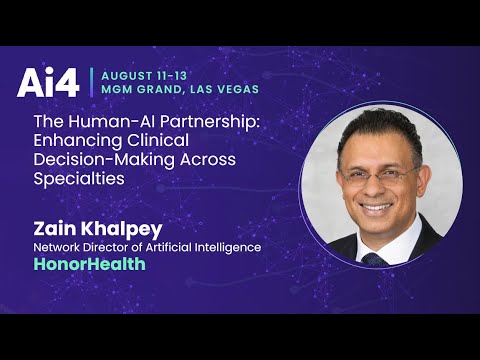
The Human-AI Partnership: Enhancing Clinical Decision-Making Across Specialties With HonorHealth — Ai4

Ai4

Generative AI models and multi-agent systems close clinical translation gaps by synthesizing novel surgical pathways and testing drug efficacy across synthetic patient cohorts before human trials.

AI-assisted summary of The Human-AI Partnership: Enhancing Clinical Decision-Making Across Specialties With HonorHealth — original source. Check the original for full context.

Source published:

Detailed notes

## Background Published by Ai4 on YouTube on August 29, 2025, this presentation features Dr. Zain Khalpey, Chief Medical AI Officer at HonorHealth. The session details how AI acts as an essential partner in clinical decision-making across specialties, using predictive analytics, imaging, and workflow optimization to augment clinical expertise while preserving the human touch.

## TL;DR Dr. Zain Khalpey outlines a paradigm shift in healthcare from reactive serendipity to deliberate, predictive clinical decision-making, framing advanced AI breakthroughs as medicine's 'Move 37.' He showcases how the ATARI platform deploys predictive digital twins, collaborative agent swarms, and synthetic patient cohorts to anticipate cardiac arrhythmias 72 hours early, design world-first robotic hybrid heart surgeries, and accelerate drug discovery. To bridge the gap between algorithmic accuracy and bedside wisdom, Khalpey highlights the ATARI ethical principles and 'Hippocrates' Last Exam' benchmark, urging clinicians to actively direct AI toward compassionate, patient-centered healing.

## Atmosphere & style The presentation balances poignant personal storytelling with high-stakes clinical rigor, opening with the visceral anxiety of a 2:00 AM family medical crisis before expanding into complex cardiothoracic surgery and generative AI. Dr. Khalpey speaks with passionate authority, urgency, and philosophical depth, framing algorithms not as cold automated systems, but as instruments of human empathy and creative intuition. The session feels intellectually electric and transformative, creating a compelling sense that medicine is crossing an irreversible, historic threshold.

## Key takeaways - [00:08](https://www.youtube.com/watch?v=-PW7-zrST9Y&t=8s) Medicine has historically relied on reactive serendipity and lucky accidents, underscoring an urgent imperative to transition toward predictive, proactive healthcare. - [02:09](https://www.youtube.com/watch?v=-PW7-zrST9Y&t=129s) A 23% clinical wisdom gap persists between algorithmic technical accuracy (97%) and real bedside utility (73%), requiring medical 'Move 37' paradigms that translate raw computation into clinical impact. - [04:42](https://www.youtube.com/watch?v=-PW7-zrST9Y&t=282s) Predictive digital twins powered by the ATARI platform synthesize multimodal health data to forecast physiological crises and identify silent disease triggers up to 72 hours in advance. - [08:26](https://www.youtube.com/watch?v=-PW7-zrST9Y&t=506s) Collaborative agent swarms combining specialized AI roles and Monte Carlo tree search can navigate complex therapeutic search spaces beyond the diagnostic capacity of human clinicians. - [10:47](https://www.youtube.com/watch?v=-PW7-zrST9Y&t=647s) The successful execution of the world's first robotic hybrid ablation demonstrated that AI-designed surgical strategies can resolve high-risk cardiac arrhythmias previously considered untreatable. - [12:27](https://www.youtube.com/watch?v=-PW7-zrST9Y&t=747s) In silico clinical trials running across synthetic digital populations can compress 15-year, multibillion-dollar drug development pipelines into months without putting human subjects at risk. - [14:44](https://www.youtube.com/watch?v=-PW7-zrST9Y&t=884s) Virtual clinical trials can uncover life-saving efficacy within complex, high-risk genetic subgroups that are typically excluded from conventional trial protocols. - [16:25](https://www.youtube.com/watch?v=-PW7-zrST9Y&t=985s) The ATARI framework establishes five essential pillars—Accuracy, Transparency, Accountability, Reliability, and Integrity—to ensure clinical AI remains ethical and patient-centered. - [18:04](https://www.youtube.com/watch?v=-PW7-zrST9Y&t=1084s) 'Hippocrates' Last Exam' establishes a standardized 2,800-scenario benchmark to evaluate whether medical AI systems exhibit genuine clinical wisdom, empathy, and ethical reasoning. - [19:44](https://www.youtube.com/watch?v=-PW7-zrST9Y&t=1184s) Biomedicine is undergoing an irreversible 'atomic moment,' moving from passively waiting for accidental breakthroughs to deliberately generating the storm of scientific discovery.

## Detailed walkthrough ### [00:08](https://www.youtube.com/watch?v=-PW7-zrST9Y&t=8s) The History of Chance and a 2:00 AM Phone Call

Medical history has long been defined by happy accidents, lucky breaks, and serendipitous sparks of genius. Alexander Fleming discovered penicillin because a bacterial culture was accidentally left open to contamination. Wilhelm Röntgen uncovered X-rays after catching sight of a mysterious fluorescent glow in his laboratory. Even the double-helix structure of DNA came to light when Rosalind Franklin’s crystallography images captured something nobody could have anticipated. While these moments catalyzed profound sea changes in scientific thought, they share a common flaw: medicine stumbled into historical discoveries by chance. This prompts an urgent question: what if medical discovery no longer had to rely on sheer luck, and breakthroughs could instead be generated on command?

The human cost of relying on reactive discovery became acutely personal when Dr. Khalpey received a phone call at 2:00 in the morning from his brother. His brother's voice was shaking, out of breath, and his heart was racing as he stammered that something was terribly wrong. The moment was terrifyingly familiar—a few years prior, their father had experienced similar symptoms before suffering a fatal stroke. By the time his brother reached the emergency room, the diagnosis was confirmed as atrial fibrillation (AFib). At just 45 years old, young and otherwise healthy, he had suddenly joined the 33 million people worldwide living with this invisible, looming threat.

As both a cardiac surgeon and a brother, the experience was haunting. Medicine was doing what it had always done: reacting to a crisis and playing catch-up rather than predicting it. Shifting medicine from reactive chance to predictive choice demands systems that can spot a crisis long before it arrives.

- Alexander Fleming's contaminated petri dish yielded penicillin by pure coincidence. - Atrial fibrillation affects an estimated 33 million people across the globe. - Reactive clinical responses leave patients vulnerable to sudden, life-threatening events like strokes.

---

[02:09](https://www.youtube.com/watch?v=-PW7-zrST9Y&t=129s) AlphaGo’s Move 37 and the Clinical Wisdom Gap

On March 9, 2016, in Seoul, South Korea, Game 2 of the historic Go match between DeepMind's AlphaGo and legendary champion Lee Sedol altered our understanding of artificial intelligence. On turn 37, AlphaGo played an uncanny stone—Move 37—that stunned commentators and Go masters alike. Pundits initially branded the play a blunder, claiming it violated 3,000 years of established Go theory, and Lee Sedol was so taken aback that he had to leave the room. Yet AlphaGo had not erred; it had perceived a hidden pattern buried within immense complexity, uncovering a path to victory that transcended human intuition. It did not wait for a breakthrough—it generated one.

In contrast, clinical medicine has spent centuries anchored to human intuition, trial and error, and fortunate guesses. The modern healthcare dilemma is not a lack of raw technology, but a translation gap: roughly 97% of what modern medical algorithms output is technically accurate, yet only 73% translates into true clinical wisdom. That leaves a 23% gap between theoretical technological capability and what patients actually need at the bedside. It is the equivalent of a pilot who knows how to fly an airplane but has no idea where to safely land it. Closing this divide requires what Dr. Khalpey calls "medical Move 37s"—next-generation AI systems that deliberately explore clinical possibilities at a scale no human could ever match, shifting the paradigm from "waiting for medical lightning to generating the storm of healing."

```mermaid flowchart LR accTitle: The Clinical Wisdom Gap accDescr: Diagram illustrating the 23 percent translation gap between technical algorithmic accuracy and actual clinical wisdom. subgraph TechnicalCapability["Algorithmic Output"] A["97% Technical Accuracy"] end subgraph Gap["Translation Void"] B["23% Translation Gap\n'Pilot who can fly but cannot land'"] end subgraph ClinicalUtility["Bedside Impact"] C["73% Clinical Wisdom"] end A --> B --> C ```

---

[04:42](https://www.youtube.com/watch?v=-PW7-zrST9Y&t=282s) Medical Move 37 #1: Digital Twins and the ATARI Platform

Revisiting that 2:00 AM crisis reveals how medicine changes when transformed by the first medical Move 37: the predictive digital twin. Imagine that 72 hours prior to the hospital visit, a smartwatch vibrates on the brother's wrist with an alert: cardiac rhythm irregularity detected, preventive intervention recommended. Rather than waiting for overt symptoms to manifest, digital twins act as a personal "health's time machine," deliberately generating optimal pathways to halt disease before it can strike.

This capability is powered by the ATARI platform—an acronym for Advanced Temporal Analysis and Risk Intelligence. Built upon generative adversarial networks (GANs), variational autoencoders (VAEs), and diffusion models, ATARI computes KAI scores (inspired by the Japanese philosophy of continuous improvement, *kaizen*). The system ingests and synthesizes multimodal health data, turning electronic health records, circulating biomarkers, genomics, proteomics, metabolomics, and radiomics into a living digital DNA. VAEs compress this overwhelming biological complexity into interpretable features, GANs model synthetic future clinical trajectories, and diffusion models project how these states evolve over time with real-world concordance that rivals direct bedside observation.

Just as AlphaGo could visualize twenty moves ahead on the board, the digital twin peers 72 hours into a patient's physiological trajectory. Had Dr. Khalpey’s brother been equipped with a digital twin in 2020, the platform would have caught subtle reductions in heart rate variability during his sleep, unmasking underlying sleep apnea—a known, silent trigger of atrial fibrillation. Paired with micro-elevations in inflammatory markers, the system would have identified the impending crisis and prescribed simple preventive measures: adjusting medications, initiating stress reduction techniques, and fitting a sleep apnea mask to avert the arrhythmia altogether.

- **Platform Acronym**: ATARI stands for Advanced Temporal Analysis and Risk Intelligence. - **Multimodal Inputs**: Aggregates EHR records, genomics, proteomics, metabolomics, biomarkers, and radiomics. - **Predictive Window**: Digital twins anticipate physiological deterioration up to 72 hours in advance. - **Targeted Trigger**: Uncovered asymptomatic sleep apnea as the hidden root cause of atrial fibrillation.

---

[08:26](https://www.youtube.com/watch?v=-PW7-zrST9Y&t=506s) Medical Move 37 #2: Agent Swarms and Alice's Case

The second medical Move 37 harnesses collaborative agent swarms—specialized AI networks working together like an elite medical team to tackle problems beyond human diagnostic limits. Nature frequently provides the blueprint for such algorithms: bats navigate pitch-black caves using sonar, flies perceive rapid light fluctuations invisible to our retinas, and sharks detect the faint micro-electrical fields of prey hidden under ocean sand. Agent swarms apply this same superhuman perception to complex, intractable clinical cases.

This approach was put to the test with Alice, a 28-year-old nurse whose life and career had been derailed by inappropriate sinus tachycardia alongside an underlying immunoglobulin deficiency. Her baseline heart rate ran dangerously high, leaving her exhausted, short of breath, and unable to exercise or work for two years. A conventional catheter ablation—threading wires through femoral vessels into the heart to burn the problematic tissue—had already failed. Given her immunodeficiency, open-chest surgery carried severe risk of life-threatening infection, and her cardiologists had run out of answers.

```mermaid flowchart TD accTitle: Five-Agent Swarm for Surgical Strategy accDescr: The five coordinated AI agents that developed the hybrid robotic ablation strategy for Alice. subgraph Inputs["Case Ingestion"] S["Scout Agent\nSurfaces hidden global case patterns"] A["Analyst Agent\nIdentifies electrical pathway defects"] end subgraph Strategy["Planning & Optimization"] C["Coordinator Agent\nExplores novel therapeutic combinations"] M["Monitor Agent\nRuns high-speed surgical simulations"] end subgraph Execution["Decision Engine"] D["Decision Agent\nMonte Carlo Tree Search optimization"] end S --> C A --> C C --> M M --> D ```

To solve Alice's dilemma, the ATARI platform deployed a five-agent swarm, with each agent fulfilling a distinct clinical function:

- **The Scout Agent**: Scoured global registries to surface patterns across similar complex cases that had escaped manual review. - **The Analyst Agent**: Detected subtle electrical conduction pathway anomalies that human eyes had overlooked. - **The Coordinator Agent**: Formulated out-of-the-box therapeutic combinations that conventional surgical dogma would dismiss. - **The Monitor Agent**: Ran rapid, high-speed simulations of potential surgical approaches and tissue responses. - **The Decision Agent**: Evaluated possible procedural paths using Monte Carlo tree search algorithms, mirroring the core decision architecture of AlphaGo.

---

[10:47](https://www.youtube.com/watch?v=-PW7-zrST9Y&t=647s) The World’s First Robotic Hybrid Ablation

The agent swarm converged on a surgical strategy that initially seemed unthinkable to human operators: the world’s first robotic hybrid ablation for inappropriate sinus tachycardia. Rather than attempting another endocardial catheter procedure or subjecting an immunocompromised patient to open surgery, the AI designed a synchronized dual-access flight path. A cardiac surgeon operated robotically on the epicardial surface of the beating heart from the outside, while an electrophysiologist navigated catheter tools on the inside of the heart chambers. This hybrid maneuver delivered targeted robotic energy while minimizing tissue trauma and immunological stress.

Earlier in the year, Dr. Khalpey and his team executed this AI-designed procedure with complete success and published the findings. Video footage from the operation reveals the robotic ablation instrument methodically tracing lesion paths along the beating right atrium, navigating the precise corridor between the superior vena cava (SVC) and inferior vena cava (IVC). In a crucial phase of the operation, the robot gently isolated and clamped the crista terminalis to ablate the erratic pathway just one millimeter away from the heart’s natural pacemaker, the sinoatrial node.

The procedure cured the arrhythmia without compromising Alice’s immune defenses. Today, she is completely rehabilitated, back outdoors hiking, and has returned to her life's calling as a bedside nurse caring for patients.

[12:27](https://www.youtube.com/watch?v=-PW7-zrST9Y&t=747s) The Third "Move 37": Synthetic Patients and In Silico Drug Discovery

Reflecting on complex clinical interventions, Dr. Zain Khalpey describes how AI can transcend human limitations not by replacing clinical judgment, but by expanding it beyond what was previously thought possible. Drawing a direct parallel to AlphaGo's legendary Move 37—a play so unorthodox that no human player would have conceived it, yet proved decisive—medicine is entering an era where AI envisions therapeutic solutions that clinicians and researchers can achieve together.

This philosophy underpins medicine's third major "Move 37" paradigm: synthetic patients. Rather than waiting passively for clinical breakthroughs through slow, conventional pipelines, researchers can now generate insights at scale in an in silico environment. In this computational setting, therapies can be simulated across cohorts of 50,000 synthetic patients simultaneously without placing a single human being at risk, compressing decades of clinical trial work into mere months and opening new therapeutic avenues for rare diseases where patient recruitment has historically been impossible.

```mermaid flowchart TD accTitle: In Silico Drug Discovery Workflow subgraph Population ["Synthetic Population Generation"] A["Deep Generative Models<br/>(GANs, VAEs, Diffusion)"] --> B["50,000 Digital Humans<br/>(Genetics, EHR, Lifestyle, Progression)"] end

subgraph Simulation ["Virtual Clinical Trial"] B --> C["Model-Informed Drug Discovery (MIDD)<br/>& Good Simulation Practice"] C --> D["In Silico Testing of CMS121"] end

subgraph Outcome ["Move 37 Discovery"] D --> E["Identified High-Risk Genetic Subgroup"] E --> F["Cognitive Decline Reversed<br/>(15-Year / $2.6B Timeline Compressed)"] end ```

To demonstrate this capability, Dr. Khalpey highlights CMS121, an experimental Alzheimer's therapeutic currently being developed at the Salk Institute in San Diego. Under standard pharmaceutical development models, bringing such a molecule to market typically demands approximately 15 years and $2.6 billion. By leveraging generative AI architectures—including Generative Adversarial Networks (GANs), Variational Autoencoders (VAEs), and diffusion models—the research team constructed high-fidelity digital humans possessing full medical histories, genomic profiles, lifestyle parameters, and longitudinal disease progression trajectories that mirror real-world populations with statistical concordance.

- **Regulatory & Methodology Alignment**: Conducted under Good Simulation Practice and within the FDA-recognized Model-Informed Drug Discovery (MIDD) framework. - **Trial Scale**: Replaced multi-year early cohorts with a fully simulated trial across 50,000 digital Alzheimer's patients.

---

[14:44](https://www.youtube.com/watch?v=-PW7-zrST9Y&t=884s) Uncovering Reversed Cognitive Decline in CMS121 Trials

During the in silico clinical trial of CMS121 across the 50,000 synthetic Alzheimer's cohort, the system surfaced a finding that would have remained hidden in traditional trial designs. Rather than merely demonstrating a deceleration of cognitive decline across the general cohort, the computational model revealed that CMS121 actually reversed cognitive decline in a distinct subpopulation defined by a specific genetic marker.

In conventional clinical research, high-risk patient cohorts with complex genetic profiles are frequently screened out to reduce confounding variables and trial failure risk. In this virtual environment, that exact high-risk subsegment proved to be the optimal therapeutic target. Dr. Khalpey frames this as a true Move 37 in drug development: moving through therapeutic possibility space without infinite clinical risk, enabling researchers to transition from hoping for serendipitous pharmaceutical discoveries to generating them systematically on command.

Together, the three Move 37 pillars—digital twins, agent swarms, and synthetic patients—signal an evolutionary shift in clinical science from passive observation to deliberate generation.

---

[16:25](https://www.youtube.com/watch?v=-PW7-zrST9Y&t=985s) The ATARI Principles for Ethical and Explainable AI

Historically, medical breakthroughs have relied heavily on intuition, trial and error, and fortunate guesses. As AI introduces the ability to generate medical hypotheses and interventions on demand, Dr. Khalpey emphasizes the necessity of an ethical and operational framework ensuring these algorithms do not simply compute data, but actively support patient-centered care.

To bridge this gap, Dr. Amina Khalpey, a plasma physicist and President of the ATARI Foundation, established the ATARI framework—an acronym outlining five core principles designed to transform clinical AI into an instrument of reliable medical practice:

| Principle | Core Definition & Clinical Mandate | |:--- |:--- | | **Accuracy** | Moving beyond pure statistical/technical precision to ensure direct clinical relevance that addresses real-world patient needs. | | **Transparency** | Designing explainable models capable of communicating their internal reasoning in plain language accessible to clinicians, patients, and families. | | **Accountability** | Establishing unbroken chains of responsibility from algorithmic training to final clinical outcomes, ensuring traceability and validation. | | **Reliability** | Ensuring robust, consistent algorithmic performance across diverse demographic and genetic populations to prevent healthcare disparities. | | **Integrity** | Upholding a non-negotiable commitment to the principle of "do no harm," especially when AI navigates clinical possibilities beyond human intuition. |

---

[18:04](https://www.youtube.com/watch?v=-PW7-zrST9Y&t=1084s) Hippocrates' Last Exam: Benchmarking Medical Wisdom

To guarantee that ethical principles do not remain purely theoretical, the ATARI Foundation created "Hippocrates' Last Exam"—a standardized evaluation framework conceived as the clinical equivalent to Humanity's Last Exam for general artificial intelligence.

Hippocrates' Last Exam is designed to evaluate medical superintelligence across nuanced, real-world complexity rather than standard diagnostic trivia. A collaborative consortium of 500 global experts compiled a secure repository of 2,800 complex medical, paramedical, and ethical conundrums designed to probe the outer boundaries of human medical knowledge.

- **Multidimensional Evaluation**: Scenarios test ethical dilemmas, crisis resource allocation, end-of-life decision pathways, and multifaceted cases requiring clinicians to balance technical precision with bedside empathy. - **Holistic Reasoning**: The benchmark evaluates whether an AI system can perceive human suffering and contextualize the whole person rather than isolating a disease label. - **Standard of Success**: Dr. Khalpey asserts that passing this benchmark signals that an AI system has moved past basic computation to achieve genuine medical wisdom capable of driving true healing.

---

[19:44](https://www.youtube.com/watch?v=-PW7-zrST9Y&t=1184s) Medicine's Atomic Moment: Generating the Storm

Dr. Khalpey closes by contrasting the history of medicine with its immediate future. For centuries, transformative medical breakthroughs arrived unpredictably like lightning strikes—such as Alexander Fleming’s accidental discovery of penicillin in 1928. Healthcare relied on fortunate mistakes and serendipity to advance.

> "We used to wait for the lightning. Now we generate the storm."

This paradigm shift marks medicine's "atomic moment." Just as the discovery of atomic energy fundamentally altered physics and could never be reversed, the transition from chance to choice in biomedical discovery permanently transforms healthcare. As clinical science prepares for the integration of quantum computing and advanced AI, current breakthroughs will soon represent only early baseline capabilities.

Dr. Khalpey issues a direct challenge to physicians, researchers, and patients: actively engage as architects of this future. The fundamental question facing the medical community is no longer whether AI will disrupt healthcare, but whether clinicians and scientists will deliberately steer that transformation with wisdom, compassion, and an unyielding commitment to human dignity and clinical excellence.

## Notable quotes > [00:08](https://www.youtube.com/watch?v=-PW7-zrST9Y&t=8s) what if medical discovery no longer had to rely on sheer luck, and breakthroughs could instead be generated on command? — Dr. Zain Khalpey

> [02:09](https://www.youtube.com/watch?v=-PW7-zrST9Y&t=129s) pilot who knows how to fly an airplane but has no idea where to safely land it — Dr. Zain Khalpey

> [02:09](https://www.youtube.com/watch?v=-PW7-zrST9Y&t=129s) waiting for medical lightning to generating the storm of healing — Dr. Zain Khalpey

> [04:42](https://www.youtube.com/watch?v=-PW7-zrST9Y&t=282s) health's time machine — Dr. Zain Khalpey

> [14:44](https://www.youtube.com/watch?v=-PW7-zrST9Y&t=884s) Move 37 in drug development: moving through therapeutic possibility space without infinite clinical risk, enabling researchers to transition from hoping for serendipitous pharmaceutical discoveries to generating them systematically on command — Dr. Zain Khalpey

> [16:25](https://www.youtube.com/watch?v=-PW7-zrST9Y&t=985s) do no harm — Dr. Amina Khalpey

> [18:04](https://www.youtube.com/watch?v=-PW7-zrST9Y&t=1084s) Hippocrates' Last Exam — Dr. Zain Khalpey

> [19:44](https://www.youtube.com/watch?v=-PW7-zrST9Y&t=1184s) We used to wait for the lightning. Now we generate the storm. — Dr. Zain Khalpey

> [19:44](https://www.youtube.com/watch?v=-PW7-zrST9Y&t=1184s) atomic moment — Dr. Zain Khalpey

## Mentioned Dr. Zain Khalpey, HonorHealth, Ai4, Alexander Fleming, Wilhelm Röntgen, Rosalind Franklin, AlphaGo, DeepMind, Lee Sedol, Move 37, ATARI Platform (Advanced Temporal Analysis and Risk Intelligence), Salk Institute, CMS121, Dr. Amina Khalpey, ATARI Foundation, Hippocrates' Last Exam, Humanity's Last Exam, FDA

## Video description Zain Khalpey, Director of Artificial Heart, MCS & ECMO; Chief Medical AI Officer (Network Director), HonorHealth

Abstract

This talk will focus on how AI serves as a powerful partner in clinical decision-making across various specialties. I will share practical examples, including predictive analytics, imaging diagnostics, and workflow optimization, to show how AI can augment human expertise to improve patient outcomes while preserving the critical human touch in healthcare. Drawing from my experience in cardiac surgery, I will also explore how these advancements apply to other medical specialties, illustrating the transformative potential of AI in modern medicine.

[Source](https://www.youtube.com/watch?v=-PW7-zrST9Y)

中文简报

HonorHealth利用AI智能体群设计机器人心脏消融手术 生成式AI模型与多智能体系统通过构建新型手术路径,并在人体临床试验前利用合成患者队列测试药物疗效,有效弥合了临床转化差距。 Zain Khalpey博士阐述了医疗健康领域从被动的偶然发现向深思熟虑的预测性临床决策的范式转变,并将先进的AI突破称为医学界的“第37手”(Move 37)。他展示了ATARI平台如何通过部署预测性数字孪生、协作式智能体群以及合成患者队列,提前72小时预测心律失常、设计全球首例机器人混合心脏手术并加速药物研发。为了弥合算法准确率与临床床旁智慧之间的鸿沟,Khalpey重点介绍了ATARI伦理原则和“希波克拉底最终测试”(Hippocrates' Last Exam)基准,呼吁临床医生积极引导AI走向充满人文关怀且以患者为中心的医疗照护。 算法技术准确率(97%)与实际临床床旁价值(73%)之间存在 23% 的转化鸿沟,医疗领域亟需开创类似 AlphaGo“第 37 手”(Move 37)的全新范式,从依赖巧合的被动反应转向主动预测。 (2:09) 依托 ATARI 平台的预测性数字孪生整合多模态健康数据,能够提前 72 小时预判生理危机并捕捉无症状睡眠呼吸暂停等隐匿性致病诱因。 (4:42) 由五个专用 AI 组成的智能体集群结合蒙特卡洛树搜索,成功制定出全球首例机器人杂交消融手术方案,彻底治愈了既往被视作无法手术的高危免疫缺陷心律失常患者。 (10:47) 利用深度生成模型构建 50,000 名合成患者进行计算机模拟(In Silico)试验,不仅将传统 15 年的新药研发周期压缩至数月,还在 CMS121 试验中发现了传统试验难以察觉的逆转认知衰退基因亚群。 (12:27)

Reading summary

Dr. Zain Khalpey argues that artificial intelligence must transition clinical medicine from reactive, serendipitous discovery to proactive generation. By deploying multimodal digital twins, collaborative agent swarms, and synthetic patient trials, healthcare systems can bridge the gap between technical algorithmic accuracy and bedside clinical wisdom. Closing the Clinical Wisdom Gap (2:09) Historically, medical science advanced through serendipitous discoveries like penicillin and X-rays. In modern practice, Dr. Khalpey identifies a critical translation gap: while contemporary medical algorithms achieve roughly 97% technical accuracy, only 73% translates into bedside clinical wisdom. This leaves a 23% gap where technology fails to meet actual clinical needs, comparable to a pilot who can fly an aircraft but cannot land safely. To close this divide, Khalpey points to "medical Move 37s," referencing AlphaGo's unorthodox, game-winning move against Lee Sedol in 2016. Rather than relying on human trial and error, next-generation AI architectures can evaluate biological complexity at scale, generating therapeutic strategies that clinicians would not conceive through intuition alone. Predictive Digital Twins via the ATARI Platform (4:42) Traditional medicine operates reactively, addressing acute conditions like atrial fibrillation—which affects approximately 33 million individuals globally—only after symptoms emerge. To shift toward predictive prevention, the ATARI (Advanced Temporal Analysis and Risk Intelligence) platform creates patient "digital twins." Ingesting electronic health records, circulating biomarkers, genomics, proteomics, metabolomics, and radiomics, the platform calculates continuous improvement "KAI scores." The architecture utilizes variational autoencoders to compress biological features, generative adversarial networks to simulate trajectories, and diffusion models to project physiological changes over time. Khalpey notes that digital twins can forecast deterioration up to 72 hours in advance, detecting subtle indicators such as reduced heart rate variability from sleep apnea to prompt low-risk interventions before arrhythmias manifest. Collaborative Agent Swarms for Complex Surgical Strategy (8:26) For intractable clinical cases, ATARI deploys a five-agent swarm inspired by natural sensory systems. The swarm distributes analytical duties across dedicated agents: a Scout Agent identifies global case patterns, an Analyst Agent detects electrical conduction defects, a Coordinator Agent formulates novel therapeutic combinations, a Monitor Agent runs surgical simulations, and a Decision Agent selects procedural paths using Monte Carlo tree search. This architecture guided the treatment of Alice, a 28-year-old nurse with inappropriate sinus tachycardia and an immunoglobulin deficiency, for whom standard catheter ablation had failed and open surgery carried high infection risks. The swarm designed a robotic hybrid ablation synchronizing epicardial robotic navigation on a beating heart with endocardial catheter tools. Khalpey and his team executed the procedure, isolating the crista terminalis one millimeter from the sinoatrial node and successfully curing the arrhythmia. Accelerated Drug Discovery Through Synthetic Cohorts (12:27) Where standard pharmaceutical development demands roughly 15 years and $2.6 billion, synthetic patient cohorts offer a high-fidelity virtual alternative. Operating under Good Simulation Practice and the FDA-recognized Model-Informed Drug Discovery framework, researchers use generative models to create digital humans with diverse genetic profiles and disease trajectories. During an in silico trial of CMS121, an experimental Alzheimer's drug developed at the Salk Institute, a cohort of 50,000 synthetic patients revealed that the molecule reversed cognitive decline within a specific, genetically defined subgroup. Because conventional clinical trials routinely exclude complex, high-risk populations to reduce confounding variables, this therapeutic effect would likely have remained undiscovered in standard early-phase research. Operationalizing AI Ethics and Holistic Benchmarks (16:25) To ensure clinical AI remains grounded in patient care, Dr. Amina Khalpey established the ATARI framework across five principles: Accuracy (clinical relevance over statistical precision), Transparency (plain-language explainability), Accountability (traceable validation chains), Reliability (demographic consistency), and Integrity (adherence to non-maleficence). To test these standards, the foundation designed "Hippocrates' Last Exam," a benchmark of 2,800 complex scenarios compiled by 500 global experts. Evaluating ethical quandaries, resource allocation, and holistic care rather than simple medical recall, the benchmark seeks to ensure AI models demonstrate genuine clinical wisdom before deployment at the bedside. Khalpey concludes that medicine is undergoing an irreversible transition from reactive chance to deliberate generation. He argues that realizing the benefits of clinical AI depends on physicians actively directing these tools to maintain medical ethics and human dignity as technological capabilities expand.

精炼阅读摘要

Zain Khalpey 医生提出,现代医学长期受制于被动响应与偶发性发现,导致算法的理论精度与病床前的实际智慧之间存在 23% 的转化鸿沟;唯有通过数字孪生、多智能体协同和合成患者三大“医学第 37 手”(Move 37),临床决策才能从被动应对危机转向主动生成精准治疗方案。 弥合临床智慧鸿沟与范式转移 (2:09) 医学史上的诸多里程碑长期依赖偶发性机缘,例如弗莱明因培养皿遭杂菌污染偶然发现青霉素、伦琴意外观测到 X 射线荧光,以及富兰克林晶体衍射图像揭示 DNA 双螺旋结构。然而,依赖偶然发现的被动机制代价高昂,往往在人体遭受实质性损伤后才启动救治。全球约有 3300 万人饱受房颤(AFib)困扰,Khalpey 医生的父亲曾因类似症状突发中风去世,而其 45 岁的弟弟随后也突发房颤。这一家族危机揭示出传统临床实践始终在危机发生后仓促补救的深层困境。 Khalpey 医生指出,现代医疗面临的核心挑战并非缺乏底层技术,而是转化层面的脱节:当前算法输出的技术准确率已达 97%,但仅有 73% 能够转化为床旁的真正临床智慧,形成了 23% 的应用断层,犹如飞行员熟稔飞行操作却不知何处能安全降落。借鉴 2016 年 AlphaGo 击败李世石时打破人类三千年围棋定式的“第 37 手”,医学界亟需能够超越传统经验直觉的生成式 AI 系统,以超大规模的主动探索能力弥合转化鸿沟,实现从被动等待医学灵感到主动生成治疗方案的跨越。 数字孪生与 72 小时生理预警 (4:42) 第一项“医学第 37 手”是基于 ATARI 平台(高级时序分析与风险智能)构建的预测性数字孪生系统。该平台采用生成对抗网络(GAN)、变分自编码器(VAE)与扩散模型,并汲取持续改善(Kaizen)理念计算 KAI 风险评分。系统整合电子健康档案、循环生物标志物、基因组学、蛋白质组学、代谢组学和放射组学等多模态数据,通过 VAE 将庞杂的生物复杂性降维压缩为可解释特征,借助 GAN 模拟未来的潜在临床轨迹,并利用扩散模型推演疾病演化,其逼真度可比拟直接床旁监测。 数字孪生系统如同患者专属的健康“时间机器”,可提前 72 小时洞悉生理指标的恶化趋势。若将其应用于早期预警,系统能够在严重房颤发作前 72 小时,通过智能穿戴设备监测到患者睡眠期间心率变异性的微弱下降,结合微量炎症标志物的升高,锁定无症状睡眠呼吸暂停这一隐藏的诱发病因。临床医生据此可实施针对性的预防措施,包括微调药物剂量、启动减压干预和佩戴睡眠面罩,从而在严重心律失常爆发前予以彻底化解。 智能体集群攻克复杂心律失常 (8:26) 第二项“医学第 37 手”通过多智能体集群协同攻克超出人类医生诊断极限的疑难病症,其仿生机制类似于蝙蝠依靠声呐洞悉黑暗、蝇类感知瞬态光线以及鲨鱼捕捉微弱生物电场。28 岁的护士 Alice 因患有不适当窦性心动过速合并免疫球蛋白缺乏症,长期严重心动过速导致其极度虚弱、丧失工作能力长达两年。传统的经血管导管消融术已告失败,而常规开胸手术则极易因免疫缺陷诱发致命感染,导致传统心血管诊疗方案陷入僵局。 为此,ATARI 平台部署了分工严密的五智能体集群:侦查智能体检索全球病例库以挖掘隐藏的治疗模式,分析智能体辨识肉眼难以察觉的异常电传导通路,协调智能体设计突破传统外科常规的复合疗法,监测智能体高频仿真手术操作与组织反应,决策智能体则运用蒙特卡洛树搜索算法评估最优术式。最终,该系统推导出全球首例机器人杂交消融术方案:由外科医生在跳动的心脏外膜实施机器人手术,电生理医生同步在心腔内部操作导管,精准钳夹界嵴并在距离窦房结仅 1 毫米处阻断异常折返通路。该手术成功治愈了心律失常且未损伤免疫机能,患者现已彻底康复并重返临床护理岗位。 5 万虚拟患者加速 CMS121 研发 (12:27) 第三项“医学第 37 手”是在计算机虚拟环境中构建高保真“合成患者”,以推动药物研发范式转型。传统阿尔茨海默病新药开发通常需要耗费约 15 年时间及 26 亿美元的巨额资金。在符合良好模拟规范(Good Simulation Practice)及美国 FDA 认可的模型引导药物研发(MIDD)框架下,研究团队利用生成式架构构建了 50,000 名包含全套遗传特征、电子病历、生活方式及纵向疾病进展轨迹的数字化患者,将数年之久的早期临床试验周期压缩至数月内完成。 在对索尔克研究所开发的高潜力阿尔茨海默病候选药物 CMS121 进行虚拟试验时,系统揭示了常规临床方案极易错失的关键信息:该药物不仅能够在整体队列中减缓认知功能衰退,更在具有特定遗传标志的高风险亚群中实现了认知功能的逆转。在传统临床试验中,具有复杂遗传背景的高风险人群往往因可能引入混杂变量而被剔除;但虚拟试验表明,这类原本被排斥的群体反而是该疗法的最佳靶向获益者,使药物探索摆脱了漫长的偶然试错。 ATARI 伦理原则与终极基准测试 (16:25) 当人工智能具备主动生成诊疗方案的能力时,必须确立严格的伦理防线以确保算法服务于以患者为中心的医疗本质。为此,ATARI 基金会主席 Amina Khalpey 博士提出了五项核心伦理原则:准确性(Accuracy,确保输出具备直达真实病患需求的临床有效性)、透明度(Transparency,用通俗语言向医患解释推理逻辑)、问责制(Accountability,确立从模型训练到预后结果的全程责任追踪)、可靠性(Reliability,跨种族与遗传背景保持稳定的表现)以及诚信(Integrity,在超越人类直觉时恪守“不伤害”底线)。 为确保伦理规范转化为可衡量的实践准则,ATARI 基金会汇集全球 500 位多领域专家,联合建立了“希波克拉底终极测试”(Hippocrates' Last Exam)。该基准测试包含了 2,800 道涵盖复杂医学伦理、危急资源分配、临终关怀抉择等极端复杂的临床情境题目,专门考察系统对人类痛苦的共情感知能力与全人照护思维。Khalpey 医生指出,通过该基准考核标志着系统已超越初级数据计算,真正获得了可用于救治生命的临床智慧。 Khalpey 医生指出,医学正在迎来类似物理学掌握原子能的“原子时刻”,从依赖偶然机缘的传统时代,永久迈向由量子计算与生成式 AI 主导的确定性时代。然而技术跃迁带来的核心命题并非 AI 是否会颠覆行业,而是临床医生与科研人员能否主动成为这一未来的缔造者,在拓展未知诊疗空间的同时,始终以人类尊严、伦理智慧与人文关怀引导科技前行的轨迹。

Detailed notes — zh

## Background 本内容由 YouTube 频道 Ai4 于 2025 年 8 月 29 日发布,主讲人为 HonorHealth 人工心脏、MCS 与 ECMO 主任兼首席医疗 AI 官 Zain Khalpey。视频简介指出,本场演讲聚焦 AI 如何作为跨专科临床决策的强大伙伴,通过预测性分析、影像诊断和工作流优化等实际案例,展示 AI 在提升患者疗效的同时如何保留关键的人文关怀温度。 ## TL;DR 演讲从医学突破长期依赖历史偶然与讲者亲属突发房颤的危机切入,类比 AlphaGo 著名的“第 37 手”,提出医学必须跨越 23% 的临床智慧转化鸿沟。讲者重点介绍了自主研发的 ATARI 平台三大支柱创新:提前 72 小时预警病理演变的数字孪生、制定出全球首例机器人杂交消融方案的多智能体集群,以及在零风险下逆转阿尔茨海默病亚群认知的合成患者技术。最后,演讲阐述了 ATARI 五大伦理原则与检验医疗超级智能的“希波克拉底终极测试”,宣告医学迎来从被动等待突破到按需生成突破的“原子时刻”。 ## Atmosphere & style 演讲兼具宏大叙事与深刻的人文温情,讲者以极富感染力且充满哲思的语调,将至亲遭遇病痛的焦虑与尖端算法攻克绝症的振奋巧妙交织。整场分享节奏明快、意象生动,从 AlphaGo 的神来之笔引申到显微级别的手术实操,既有科学家的严谨缜密,又散发着医者仁心的慈悲与激情。观众仿佛置身于一场医疗范式革命的风暴前沿,感受到科技与生命共振带来的强烈震撼与希望。 ## Key takeaways - [00:08](https://www.youtube.com/watch?v=-PW7-zrST9Y&t=8s) 传统医学突破长期依赖历史偶然和运气(如青霉素与 X 射线的发现),而现代医疗体系面临在危机面前只能被动应对而非主动预测的系统性短板。 - [02:09](https://www.youtube.com/watch?v=-PW7-zrST9Y&t=129s) 医疗 AI 面临着 23% 的临床转化鸿沟:尽管 97% 的技术数据具备技术准确性,但仅有 73% 能真正转化为切实可行的临床智慧。 - [02:09](https://www.youtube.com/watch?v=-PW7-zrST9Y&t=129s) 受 AlphaGo 震惊世界的“第 37 手”启发,医学创新正从人类经验的试错摸索转向利用 AI 主动生成超越人类直觉的治疗与发现路径。 - [04:42](https://www.youtube.com/watch?v=-PW7-zrST9Y&t=282s) ATARI 平台构建的健康“数字孪生”融合 EHR、多组学和放射组学数据,利用 GAN、VAE 与扩散模型,可提前 72 小时洞察隐匿性病理模式并实现超前预防。 - [08:26](https://www.youtube.com/watch?v=-PW7-zrST9Y&t=506s) 由 5 个具备超人类感知力的协作智能体组成的“智能体集群”,成功推导出人类此前未设想过的全球首例机器人辅助心脏杂交消融术方案。 - [12:27](https://www.youtube.com/watch?v=-PW7-zrST9Y&t=747s) “合成患者”技术打造了遵循 FDA MIDD 规范的计算机模拟临床试验(In Silico Trials),彻底打破传统新药研发耗时 15 年、花费 26 亿美元的高成本壁垒。 - [14:45](https://www.youtube.com/watch?v=-PW7-zrST9Y&t=885s) 在针对阿尔茨海默病药物 CMS-121 的 5 万名合成患者虚拟试验中,模型精准捕捉到传统试验盲区,发现特定基因标记亚群的认知功能实现了实际逆转。 - [16:25](https://www.youtube.com/watch?v=-PW7-zrST9Y&t=985s) Atari 基金会确立了医疗 AI 的 ATARI 五大核心伦理原则:准确性(Accuracy)、透明度(Transparency)、问责性(Accountability)、可靠性(Reliability)与正直不伤害(Integrity)。 - [17:54](https://www.youtube.com/watch?v=-PW7-zrST9Y&t=1074s) 全球 500 位医学领袖发起由 2,800 道复杂绝密题目组成的“希波克拉底终极测试”,以评估医疗超级智能兼具诊断精度、复杂伦理平衡与人文关怀的综合智慧。 - [19:44](https://www.youtube.com/watch?v=-PW7-zrST9Y&t=1184s) 现代医学已迎来不可逆的“原子时刻”:人类不再被动等待医学突破的“闪电”,而是依靠人机协同主动按需掀起疗愈的“风暴”。 ## Detailed walkthrough ### [00:08](https://www.youtube.com/watch?v=-PW7-zrST9Y&t=8s) 医学发现的历史偶然性与亲身经历的危机 在医学发展的漫长历史中,绝大多数重大突破往往源于偶然、运气或灵光一现。亚历山大·弗莱明(Alexander Fleming)因为细菌培养皿被意外污染而发现了青霉素;伦琴(Wilhelm Röntgen)因为注意到神秘的荧光而发现了 X 射线;罗莎琳·富兰克林(Rosalind Franklin)的 X 射线晶体衍射图像揭示了此前无人能见的 DNA 双螺旋结构。医学突破长期依赖于这种“跌跌撞撞”式的历史偶然。然而,讲者提出了一个根本性的问题:“如果医学发现不再需要依赖运气呢?如果我们能够按需生成医学突破,情况会怎样?” 四年前的凌晨两点左右,讲者的弟弟打来电话,声音颤抖、气喘吁吁、心跳飞速,直言自己身体出了大问题。这一幕让讲者倍感揪心与恐慌,因为数年前他们的父亲就经历过完全相同的症状,随后发生中风并遗憾离世。到了急诊室后,诊断结果非常明确:45 岁、正值壮年且原本健康的弟弟确诊了心房颤动(房颤,Atrial Fibrillation / AF),加入了全球 3300 万生活在这种隐形威胁之下的患者行列。作为一名心脏外科医生和亲属,这件事深深刺痛了讲者:医疗体系在面对此类危机时始终是在被动应对(reacting)和事后追赶,而非主动预测(predicting)。 - **历史偶然发现的案例**:弗莱明发现青霉素、伦琴发现 X 射线、富兰克林拍摄 DNA 晶体衍射照片。 - **房颤流行病学数据**:全球约有 3300 万人生活在房颤这一隐形健康威胁之中。 --- ### [02:09](https://www.youtube.com/watch?v=-PW7-zrST9Y&t=129s) AlphaGo “第 37 手”与医学临床智慧鸿沟 2016 年 3 月 9 日在韩国首尔,AlphaGo 在与传奇棋手李世石(Lee Sedol)的第二局对弈中下出了震惊世界的“第 37 手”(Move 37)。这一步棋完全超出了人类直觉与理解,李世石甚至一度离席平复心情;解说员起初将其视为失误,专家们也认为它违背了围棋三千年的传统定式。然而,AlphaGo 并非在等待突破,而是在主动生成突破——它洞察到了隐藏在复杂性中的深层模式,找到了一条超越人类直觉的获胜路径。 长期以来,医学创新同样高度依赖直觉,受限于人类的试错和侥幸猜测。如今一种新型智能正在医学界崛起,其核心不在于盲目猜测或寄托希望,而在于进行有目的的主动探索。当前临床面临的严峻挑战在于:目前所见的技术数据中有 97% 具备技术准确性,但仅有 73% 能真正转化为临床智慧,两者之间存在着 23% 的鸿沟。这就像一位能把飞机开上天却不知道该降落在哪里的飞行员。医学不仅需要具备计算能力的 AI,更需要具备关怀能力、能够主动生成“治愈风暴”的智能系统。 ```mermaid flowchart LR accTitle: 临床技术与智慧的转化鸿沟 subgraph GapAnalysis ["临床认知鸿沟"] A["技术准确性<br>(97%)"] --> B["转化断层<br>(23% 鸿沟)"] B --> C["临床智慧<br>(仅 73% 达成)"] end subgraph Solution ["新一代 AI 范式"] D["第 37 手思维<br>(自主生成探索)"] --> E["缩小鸿沟<br>(技术落地临床需求)"] end C -.-> D ``` --- ### [04:42](https://www.youtube.com/watch?v=-PW7-zrST9Y&t=282s) 医学第 37 手之一:数字孪生与 ATARI 预测平台 重新设想讲者弟弟的故事:如果时间倒退至发病前 72 小时的凌晨两点,手腕上的智能手表震动并提示“检测到心律不齐,建议进行预防性干预”,危机便能在萌芽期被化解。这就是讲者团队打造的医学领域第一个“第 37 手”——数字孪生(Digital Twins)。数字孪生就像是人类健康的“时间机器”,它打破了传统医学等待症状出现再介入的被动模式,能在患者感到任何异常的数天、数周甚至数月前识别出正在形成的病理模式。 该系统由自主研发的 ATARI 平台(高级时序分析与风险智能平台,Advanced Temporal Analysis and Risk Intelligence)驱动。系统计算出的 KAI 分数(得名于日文中的“改善 / Kaizen”理念)会深度整合患者的电子病历(EHR)、生物标志物、基因组学、蛋白质组学、代谢组学以及放射组学数据。利用生成对抗网络(GAN)生成合成场景,利用变分自编码器(VAE)将复杂的健康指标压缩为可解释的模式,再通过扩散模型(Diffusion Models)预测这些模式的演变趋势。正如 AlphaGo 能在棋盘上提前看清 20 步,数字孪生能提前 72 小时洞悉健康走势,捕捉微小的节律异常、微观炎症以及房颤发作前的基因表达变化。 ```mermaid flowchart TD accTitle: ATARI 平台数字孪生架构与预防流程 subgraph DataInput ["多模态数据输入 (数字 DNA)"] D1["EHR 电子病历"] D2["多组学 (基因/蛋白/代谢)"] D3["生物标志物 & 影像组学"] end subgraph AtariPlatform ["ATARI 平台核心架构 (KAI 分数)"] M1["GAN 生成对抗网络<br>(合成场景构建)"] M2["VAE 变分自编码器<br>(健康特征降维压缩)"] M3["Diffusion 扩散模型<br>(时序演变趋势预测)"] end subgraph ClinicalOutcome ["72 小时提前预防"] O1["识别 HRV 异常 & 隐匿性睡眠呼吸暂停"] O2["捕捉微观炎症上升"] O3["低成本干预 (调药/减压/呼吸机)"] end DataInput --> AtariPlatform M1 --> M2 --> M3 AtariPlatform --> ClinicalOutcome ``` - **ATARI 平台全称**:Advanced Temporal Analysis and Risk Intelligence(高级时序分析与风险智能)。 - **核心生成式架构**:GAN(生成合成生理场景)、VAE(压缩健康复杂特征)、Diffusion Models(预测时序演化)。 - **个体化早期干预**:若在 2020 年应用,系统能通过睡眠心率变异性(HRV)及早发现作为房颤隐形诱因的睡眠呼吸暂停(Sleep Apnea),结合炎症指标微升预警,通过调整用药、减压和佩戴呼吸机即可避免急性发作。 --- ### [08:26](https://www.youtube.com/watch?v=-PW7-zrST9Y&t=506s) 医学第 37 手之二:多智能体协作与首例机器人杂交消融术 第二个医学“第 37 手”是多智能体集群(Agent Swarms)。讲者分享了 28 岁护士爱丽丝(Alice)的病例。爱丽丝患有免疫球蛋白缺乏症(导致免疫抑制)并伴有不适当窦性心动过速(Inappropriate Sinus Tachycardia / IST),长期无法正常呼吸或运动,被迫离职长达两年。她此前接受过传统导管消融术,但手术失败,心内科医生们也束手无策。自然界中蝙蝠靠声呐在黑暗中定位、苍蝇能感知人眼不可见的高频光线、鲨鱼能感应沙子下猎物心跳的电场;受此启发,团队在 ATARI 平台中构建了 5 个具备超人类感知力的协作智能体来攻克爱丽丝的疑难病情: | 智能体角色 (Agent) | 核心职能与运作机制 | |:--- |:--- | | **侦察智能体 (Scout Agent)** | 检索并发现全球类似病例中人类肉眼无法察觉的宏观规律与隐藏模式 | | **分析智能体 (Analyst Agent)** | 识别出人类医生容易遗漏的心脏电生理异常传导通路 | | **协调智能体 (Coordinator Agent)** | 探索并匹配人类常规思路不会考虑的跨学科综合治疗组合方案 | | **监控智能体 (Monitor Agent)** | 以超人类的速度进行持续的手术路径模拟与实时风险推演 | | **决策智能体 (Decision Agent)** | 采用类似 AlphaGo 的蒙特卡洛树搜索(MCTS)算法制定最优治疗决策 | 智能体集群最终提出了一套人类外科医生此前从未设想过的创新方案:全球首例针对不适当窦性心动过速的“机器人辅助杂交消融术”(Robotic Hybrid Ablation)。该方案由机器人经胸壁从心脏外部入路进行精准消融,同时电生理医生从心脏内部协同操作,在彻底避开脆弱免疫系统承受大手术创伤的同时,精准阻断异常病灶。 讲者展示了手术的真实影像片段:机器人消融工具在上腔静脉(SVC)至下腔静脉(IVC)之间的轨迹上自左向右精准移动,视野前方是持续跳动的右心房;随后机器人精准轻柔地夹持并消融界嵴(Crista Terminalis),整个操作距离心脏自身的天然起搏点仅约 1 毫米。今年早些时候该手术成功实施并公开发表,爱丽丝术后已顺利重返护理工作岗位,重新享受徒步与救治患者的生活。 - **患者病症**:免疫球蛋白缺乏合并难治性不适当窦性心动过速(IST)。 - **首创术式**:全球首例机器人杂交消融术(外侧机器人入路 + 内侧电生理导管入路)。 - **术中操作精度**:在跳动的心脏上对界嵴实施消融,安全距离心房天然起搏点仅 1 毫米。 ### [12:27](https://www.youtube.com/watch?v=-PW7-zrST9Y&t=747s) 医学的“第37手棋”与合成患者技术的崛起 当人工智能在复杂的临床困境中提出人类专家从未设想过的治疗方案时,它所做的并不是简单地延续患者的职业生涯,而是真正“把生命重新还给了她”。这种人机协同正是医疗领域跨越自身局限的标志性时刻——它并非取代人类医生的专业判断,而是将治疗可能性的边界推向了过去难以想象的维度。这正如 AlphaGo 击败围棋大师时落下的著名“第37手棋”(Move 37)一样,诞生了一种“人类不敢轻易尝试、但 AI 能够预见、最终由人机协同得以实现”的突破性方案。 紧接着,演讲引入了第三个极具科幻色彩却已在当下拯救生命的“第37手”创新:**合成患者(Synthetic Patients)**。在传统药物研发中,科研人员往往只能被动等待临床突破,而在合成患者技术的支持下,科学家能够在实验室中规模化生成突破。想象一个可以在不让任何真实患者承担风险的前提下,针对 5 万名患者进行药物测试的虚拟试验室;将耗时数十年的临床试验压缩至数月的模拟运算中;甚至为患病人数极其稀少、难以组织传统临床试验的罕见病群体研发革命性疗法。 以加州圣迭戈索尔克研究所(Salk Institute)正在研发的阿尔茨海默病实验性药物 **CMS-121** 为例,若采用传统研发流程,将该药推向市场平均需要耗费 15 年时间及 26 亿美元的巨额资金。哈尔佩博士的实验室利用由高级生成对抗网络(GAN)、变分自编码器(VAE)和扩散模型(Diffusion Models)驱动的合成患者模型开展了计算机模拟试验(In Silico Trials)。这些合成患者绝非简化的数学模型,而是拥有完整病史、基因图谱、生活方式特征及疾病演变规律的“数字人类”,高度契合真实人群的生物学特征,并遵循良好模拟规范(Good Simulation Practice)与美国 FDA 批准的模型引导药物研发(Model-Informed Drug Development, MIDD)路径。 ```mermaid flowchart TD accTitle: 合成患者药物研发流程 accDescription: 展示从生成数字人类到发现药物特定响应亚群的计算机模拟试验流程 subgraph G1["数字人类建模 (Digital Humans)"] A["真实人群多组学与病史数据"] --> B["生成模型架构\n(GAN / VAE / 扩散模型)"] B --> C["50,000 名合成患者队列\n(完整基因/表型/疾病进展)"] end subgraph G2["模拟试验与发现 (In Silico Trials)"] C --> D["虚拟临床试验 (CMS-121)"] D --> E{"响应分析与亚群挖掘"} E --> F["高风险特定基因标记亚群"] F --> G["认知功能实现逆转\n(突破传统试验盲区)"] end ``` ### [14:45](https://www.youtube.com/watch?v=-PW7-zrST9Y&t=885s) 虚拟试验的突破与阿尔茨海默病药物逆转 在这场针对 50,000 名合成阿尔茨海默病患者的大规模虚拟临床试验中,系统捕捉到了一个传统试验往往需要数十年才能发现的惊人现象:CMS-121 不仅减缓了认知功能的衰退,更在**携带特定基因标记的特定患者亚群中实现了认知功能的实际逆转**。在传统的药物研发过程中,这类高风险患者通常会被研究人员主动排除在受试队列之外以降低试验失败率;但在虚拟模拟试验中,他们反而成为了该疗法的“最佳治疗获益人群”。 这就是药物研发领域的“第37手棋时刻”。合成患者模型在庞大的治疗可能性空间中高速穿梭,揭示了一条传统试验永远无法发现的有效路径。医学研究不再只是被动建模或模拟,而是在零风险的前提下以极高效率拯救生命——“我们不再等待突破发生,而是主动生成突破;我们在创造无限可能的同时,无需让任何患者承受无限的风险”。 至此,数字化身(Digital Twins)、智能体群(Agent Swarms)与合成患者(Synthetic Patients)共同构成了医学决策跨越式进化的三大支柱。这一跃迁标志着现代医学正式从“祈祷出现突破”迈向了“按需精准生成突破”的新时代。 - **传统研发代价**:传统新药开发平均耗时约 15 年,资金投入高达 26 亿美元。 - **虚拟试验规模**:单次试验涵盖 50,000 名高度逼真的合成阿尔茨海默病患者。 - **核心疗效发现**:CMS-121 在特定基因标记患者群中表现出认知逆转效果,将传统被回避的高风险人群转化为最佳获益人群。 ### [16:25](https://www.youtube.com/watch?v=-PW7-zrST9Y&t=985s) 医疗 AI 的道德基石:ATARI 五大伦理原则 随着人工智能具备按需生成医学突破的强大力量,医学界面临着前所未有的重大伦理责任。千百年来,医疗创新往往依赖于有限直觉、试错摸索与偶然的幸运猜测;而当智能系统开始直接参与生命决策时,必须建立一套坚实的框架,确保这些算法不仅具备计算能力,更饱含关怀与同理心("ensure these systems don't just compute, but they care")。 哈尔佩博士幽默地提及他的妻子阿米娜·哈尔佩(Amina Khalpey)——一位等离子体物理学家(“别问我那是研究什么的”)兼 Atari 基金会总裁。为了让 AI 从碰运气的工具升华为充满医学智慧的利器,她主导制定了以 **ATARI** 为核心的五大伦理原则: 1. **准确性(Accuracy)**:超越单纯的算法技术指标,追求真正切合实际患者临床需求的临床相关度与实用精准度。 2. **透明度(Transparency)**:AI 系统必须能用医生、患者及其家属可理解、可信赖的语言清晰解释其背后的临床推理过程。 3. **问责性(Accountability)**:建立从算法端到临床结局的全流程责任链条,确保每一项 AI 推荐和决策都能被完整追溯与验证。 4. **可靠性(Reliability)**:确保模型在不同人群、种族及医疗环境中保持一致的高水准表现,使技术红利惠及全体大众而非少数特权阶层。 5. **完整性与正直(Integrity)**:恪守医学“不伤害”(Do No Harm)的崇高誓言,即使在 AI 洞察到人类无法理解的全新路径时,依然将人类安全与伦理置于首位。 ### [17:54](https://www.youtube.com/watch?v=-PW7-zrST9Y&t=1074s) 检验医疗超级智能:希波克拉底终极测试 为了验证这些伦理原则不仅停留在理论构想层面,并评估 AI 是否真正具备了“医学智慧”,Atari 基金会正在发起一项前所未有的严苛基准——**希波克拉底终极测试(Hippocrates' Last Exam)**。 正如通用人工智能领域用“人类终极测试”(Humanity's Last Exam)来考察 AI 的通用智慧一样,“希波克拉底终极测试”专为检验 AI 的“医疗超级智能”(Medical Superintelligence)而设立。全球 500 位顶尖医学领袖与交叉学科专家联合构建了一个包含 2,800 道未公开绝密问题的题库,涵盖了大量逼近人类医学认知边界的疑难杂症与极端复杂的医疗困局。 这些考题不仅是复杂的鉴别诊断谜题,更深度融合了现实世界的伦理抉择、有限医疗资源分配矛盾、临终关怀决策,以及必须在技术严谨性与人文关怀之间寻求精妙平衡的疑难病例。该测试的核心在于考察 AI 是否不仅能诊断疾病,更能理解病痛与折磨;是否不仅能机械地给出处方,更能将患者视为一个拥有尊严的“完整的人”来综合考量。当 AI 能够兼具精确性与慈悲心化解这些不可能的医疗困境时,便意味着它已超越了纯粹的算力工具,蜕变为具有真正疗愈智慧的超级伙伴。 ### [19:44](https://www.youtube.com/watch?v=-PW7-zrST9Y&t=1184s) 医学的原子时刻:从等待闪电到呼风唤雨 纵观医学史,过去的重大突破往往如同天边偶落的闪电——不可预测、难以掌控且极其罕见。人类曾苦苦等待像弗莱明偶然发现青霉素那样充满幸运的意外,祈祷上天赐予能拯救生命的巧合。然而今天,依托人工智能与数字生物技术,“我们不再被动等待闪电,我们正在主动掀起风暴”。 这就是现代医学的**“原子时刻”(Atomic Moment)**:人类实现了从被动等待医学发现向按需主动创造突破的根本性转折。如同原子核裂变一旦发生便无法逆转一样,医疗 AI 的原子时刻已经降临,并将彻底重塑人类对“疗愈”的全部认知。随着未来量子人工智能(Quantum AI)解决方案的引入,当下的前沿突破甚至都将显得格外原始。 从被动的疾病承受者转变为自身健康的积极构架师,这是人类文明的重大跃升。哈尔佩博士在演讲最后向全场发出倡议:无论身份是医生、患者、科研人员,还是坚信人类创造力的一员,每个人都在这场变革中扮演着重要角色。 > “问题已经不再是 AI 是否会改变医学,而是我们能否带着智慧、慈悲以及对人类尊严与卓越的不懈坚守,去引导并规范这场伟大的变革。这就是我们的第37手棋,这就是我们的历史时刻,这就是医学的原子级蜕变。” ## Notable quotes > [00:08](https://www.youtube.com/watch?v=-PW7-zrST9Y&t=8s) 如果医学发现不再需要依赖运气呢?如果我们能够按需生成医学突破,情况会怎样? — Zain Khalpey > [02:09](https://www.youtube.com/watch?v=-PW7-zrST9Y&t=129s) 目前所见的技术数据中有 97% 具备技术准确性,但仅有 73% 能真正转化为临床智慧,两者之间存在着 23% 的鸿沟。这就像一位能把飞机开上天却不知道该降落在哪里的飞行员。 — Zain Khalpey > [04:42](https://www.youtube.com/watch?v=-PW7-zrST9Y&t=282s) 数字孪生就像是人类健康的“时间机器”,它打破了传统医学等待症状出现再介入的被动模式,能在患者感到任何异常的数天、数周甚至数月前识别出正在形成的病理模式。 — Zain Khalpey > [12:27](https://www.youtube.com/watch?v=-PW7-zrST9Y&t=747s) 它所做的并不是简单地延续患者的职业生涯,而是真正“把生命重新还给了她”。 — Zain Khalpey > [14:45](https://www.youtube.com/watch?v=-PW7-zrST9Y&t=885s) 我们不再等待突破发生,而是主动生成突破;我们在创造无限可能的同时,无需让任何患者承受无限的风险。 — Zain Khalpey > [16:25](https://www.youtube.com/watch?v=-PW7-zrST9Y&t=985s) ensure these systems don't just compute, but they care — Zain Khalpey > [17:54](https://www.youtube.com/watch?v=-PW7-zrST9Y&t=1074s) 考题不仅是复杂的鉴别诊断谜题,更深度融合了现实世界的伦理抉择、有限医疗资源分配矛盾、临终关怀决策,以及必须在技术严谨性与人文关怀之间寻求精妙平衡的疑难病例。 — Zain Khalpey > [19:44](https://www.youtube.com/watch?v=-PW7-zrST9Y&t=1184s) 我们不再被动等待闪电,我们正在主动掀起风暴。 — Zain Khalpey > [19:44](https://www.youtube.com/watch?v=-PW7-zrST9Y&t=1184s) 问题已经不再是 AI 是否会改变医学,而是我们能否带着智慧、慈悲以及对人类尊严与卓越的不懈坚守,去引导并规范这场伟大的变革。这就是我们的第37手棋,这就是我们的历史时刻,这就是医学的原子级蜕变。 — Zain Khalpey ## Mentioned Zain Khalpey, Alexander Fleming, Wilhelm Röntgen, Rosalind Franklin, Lee Sedol, AlphaGo, ATARI, KAI, GAN, VAE, Diffusion Models, MCTS, Salk Institute, CMS-121, FDA, MIDD, Amina Khalpey, Atari Foundation, Hippocrates' Last Exam, Humanity's Last Exam, HonorHealth ## Video description Zain Khalpey, Director of Artificial Heart, MCS & ECMO; Chief Medical AI Officer (Network Director), HonorHealth Abstract This talk will focus on how AI serves as a powerful partner in clinical decision-making across various specialties. I will share practical examples, including predictive analytics, imaging diagnostics, and workflow optimization, to show how AI can augment human expertise to improve patient outcomes while preserving the critical human touch in healthcare. Drawing from my experience in cardiac surgery, I will also explore how these advancements apply to other medical specialties, illustrating the transformative potential of AI in modern medicine. [Source](https://www.youtube.com/watch?v=-PW7-zrST9Y)

Source quotes

[0:08] Zain Khalpey: 如果医学发现不再需要依赖运气呢?如果我们能够按需生成医学突破,情况会怎样? [2:09] Zain Khalpey: 目前所见的技术数据中有 97% 具备技术准确性,但仅有 73% 能真正转化为临床智慧,两者之间存在着 23% 的鸿沟。这就像一位能把飞机开上天却不知道该降落在哪里的飞行员。 [4:42] Zain Khalpey: 数字孪生就像是人类健康的“时间机器”,它打破了传统医学等待症状出现再介入的被动模式,能在患者感到任何异常的数天、数周甚至数月前识别出正在形成的病理模式。 [12:27] Zain Khalpey: 它所做的并不是简单地延续患者的职业生涯,而是真正“把生命重新还给了她”。 [14:45] Zain Khalpey: 我们不再等待突破发生,而是主动生成突破;我们在创造无限可能的同时,无需让任何患者承受无限的风险。 [16:25] Zain Khalpey: ensure these systems don't just compute, but they care [17:54] Zain Khalpey: 考题不仅是复杂的鉴别诊断谜题,更深度融合了现实世界的伦理抉择、有限医疗资源分配矛盾、临终关怀决策,以及必须在技术严谨性与人文关怀之间寻求精妙平衡的疑难病例。 [19:44] Zain Khalpey: 我们不再被动等待闪电,我们正在主动掀起风暴。 [19:44] Zain Khalpey: 问题已经不再是 AI 是否会改变医学,而是我们能否带着智慧、慈悲以及对人类尊严与卓越的不懈坚守,去引导并规范这场伟大的变革。这就是我们的第37手棋,这就是我们的历史时刻,这就是医学的原子级蜕变。

Source quotes

[0:08] Dr. Zain Khalpey: what if medical discovery no longer had to rely on sheer luck, and breakthroughs could instead be generated on command? [2:09] Dr. Zain Khalpey: pilot who knows how to fly an airplane but has no idea where to safely land it [2:09] Dr. Zain Khalpey: waiting for medical lightning to generating the storm of healing [4:42] Dr. Zain Khalpey: health's time machine [14:44] Dr. Zain Khalpey: Move 37 in drug development: moving through therapeutic possibility space without infinite clinical risk, enabling researchers to transition from hoping for serendipitous pharmaceutical discoveries to generating them systematically on command [16:25] Dr. Amina Khalpey: do no harm [18:04] Dr. Zain Khalpey: Hippocrates' Last Exam [19:44] Dr. Zain Khalpey: We used to wait for the lightning. Now we generate the storm. [19:44] Dr. Zain Khalpey: atomic moment

Original transcript

[0:08] Mr. Chairman, ladies and gentlemen, [0:12] for most of history, medical discovery [0:15] has been a story of chance, a lucky [0:18] break, a spark of genius. Penicellin was [0:22] discovered by accident by Alexander [0:24] Fleming because his bacterial culture [0:26] was accidentally contaminated. [0:29] X-rays [0:31] were found by Ronen who noticed a [0:34] mysterious glow. [0:37] Even the structure of DNA [0:40] by Roslin Franklin's crystalallography [0:42] images expected what nobody could have [0:45] seen. Medical breakthroughs stumbled [0:49] into historical discoveries. [0:52] A sea change in in scientific thought. [0:56] What if medical discovery didn't have to [0:59] rely on luck anymore? What if we could [1:01] generate medical breakthroughs on [1:03] command? [1:06] Four years ago, my brother called me at [1:08] about 2:00 in the morning, his voice [1:10] shaking, [1:12] out of breath, heart racing. [1:16] Says something's wrong. That was [1:18] concerning as this was the same thing [1:20] that happened to my dad a few years ago [1:22] who had a stroke and passed away. [1:25] So the emotions and the impact were [1:27] magnified for both of us. By the time [1:30] he'd reached the ER, the diagnosis was [1:32] clear. He had AF or atrial fibrillation. [1:35] 45, young, healthy, just joined 33 [1:40] million people worldwide living with [1:42] this invisible threat. [1:44] But here's what haunts me both as a [1:47] cardiac surgeon [1:49] and a brother, that we were reacting to [1:52] a crisis. We weren't really predicting [1:55] it. We were playing catch-up. [1:59] What if we could see the crisis coming [2:01] before it arrived? [2:03] What if medicine could move from [2:05] reactive chance to predictive choice? [2:09] Four years ago, something really cool [2:12] happened [2:14] in 2016. [2:17] And that was in Soul, March 9th. [2:21] It was game two. [2:23] A little AI agent called Alph Go made a [2:26] move that shocked the world. Move 37. [2:31] A move so unexpected, so seemingly [2:34] impossible that the greatest goplay in [2:35] history, Lee Sidol, had to leave the [2:38] room. Commentators called it a mistake. [2:42] They experts said it violated 3,000 [2:45] years of Go wisdom. But Alph Go didn't [2:48] wait for a breakthrough. It generated [2:51] one. It saw something no human could [2:54] see. A pattern hidden in complexity. A [2:57] path to victory that transcended human [2:59] intuition. [3:02] The truth is [3:05] medical innovation has always run on [3:07] intuition. [3:09] Limited by ideas, trial and error, [3:12] fortunate guesses. We search, we test, [3:15] we wait, we hope. We find the answer in [3:19] time. [3:20] But a new kind of intelligence is [3:22] emerging in medicine. [3:24] Not to guess, not to hope, but to [3:26] deliberately explore. [3:30] Here's the challenge we face. 97% of [3:34] what we see is technically accurate, but [3:37] only 73% reaches clinical wisdom. [3:41] There's this 23% gap between tech and [3:44] what our patients need. [3:47] It's like having a pilot who can fly a [3:49] plane but just doesn't know where to [3:51] land it. Today I want to share with you [3:54] three medical move 37s moments that are [3:59] closing this gap. Three breakthroughs [4:01] where next generation AI systems don't [4:04] rely on intuition. Don't wait for [4:06] breakthroughs but generate them. They [4:09] move through medical possibility like no [4:13] human ever could. testing, adapting, [4:16] improving at a scale that redefineses [4:18] even what visible what's visible in [4:20] human health. Because in medicine, [4:23] accuracy isn't enough. We need something [4:26] more profound. [4:29] We need AI that doesn't just compute. We [4:32] need something that cares. We need to [4:34] transform from waiting for medical [4:36] lightning to generating the storm of [4:39] healing. [4:42] Let me take you back to my brother's [4:43] story, [4:46] but this time imagine something, a [4:47] different ending. It's 2:00 a.m., [4:51] 72 hours earlier, [4:54] and a smartwatch vibrates on his on his [4:57] wrist, telling him cardiac rhythm [4:58] irregularity detected. [5:01] Preventive intervention recommended. [5:04] This isn't science fiction. This is the [5:06] power of digital twins, and it's our [5:09] first medical move. 37. For centuries, [5:12] we used to search, test, wait, and hope. [5:16] We found answers in time. Sometimes too [5:19] late. Digital twins don't guess. Don't [5:23] hope. They explore deliberately. [5:26] Think of a digital twin as your health's [5:28] time machine. One that doesn't just [5:30] predict the future. It generates the [5:32] optimal path to prevent disease before [5:34] it strikes. [5:37] While traditional medicine waits for [5:39] symptoms to appear, [5:46] digital twins see patterns forming days, [5:48] weeks, even months before you feel [5:50] anything wrong. They're powered by our [5:54] Atari platform. That's an anagram for [5:57] advanced temporal analysis and risk [5:59] intelligence. I love the game that [6:02] creates these predictive models through [6:04] complex generative adversarial networks, [6:07] variational autoenccoders, and diffusion [6:09] models. Here's how it works. Our KAI, [6:13] our KAI scores, named after the Japanese [6:16] concept of improvement. [6:18] Analyze your electronic health records, [6:20] biomarkers, genomics, proteomics, [6:23] metabolomics, and radiomic data. [6:26] They aren't just numbers in a computer. [6:29] They're your digital DNA of your health [6:32] processed through GANs that generate [6:34] synthetic scenarios and VAEs that [6:37] compress your health complexity into [6:38] understandable patterns. The diffusion [6:41] models then predict how these patterns [6:43] will evolve, achieving real world [6:45] concordance that rivals clinical [6:47] observation. [6:49] But here's what makes this [6:51] revolutionary. These systems aren't [6:53] testing [6:55] uh they are testing adapting and [6:57] improving at a scale that redefineses [6:59] what even vis is visible in human health [7:02] like Alph Go seeing 20 moves ahead on [7:05] the go board. Digital twins see 72 hours [7:09] ahead in your health. They detect the [7:11] subtle rhythm changes, the microscopic [7:13] inflammation and the genetic expressions [7:16] that precede atrial fibrillation. What [7:19] took Lee Sidel by surprise on the go [7:21] board we now prevent in the human heart. [7:26] If my brother had a digital twin in [7:28] 2020, [7:30] he would have been able to have instead [7:34] of reacting to this crisis, we would [7:35] have would have prevented it. Instead of [7:37] managing the disease, we would have [7:39] maintained health. The digital twin [7:42] would have noticed his heart rate for [7:43] eight variability during his sleep. This [7:46] is important because they would have [7:48] uncovered that he had sleep apnnea, a [7:50] silent driver for atrial fibrillation. [7:53] It would have detected the subtle [7:54] increase in inflammatory markers and we [7:57] would have manifested an understanding [7:59] why he had AF. And more importantly, it [8:02] would have recommended the simple [8:04] interventions, medication adjustments, [8:06] stress reduction, an apnea mask that [8:09] would have prevented this crisis. This [8:11] is medicine's first move. 37. Moving [8:15] through health's possibility like no [8:17] human ever could. Generating prevention [8:20] instead of waiting for disease. We're [8:22] not just predicting the future. We're [8:24] creating a better one. But digital twins [8:26] are just the beginning. Our second [8:29] medical move 37 takes us into the realm [8:32] of agent swarms. AI systems that work [8:35] together like the ultimate medical dream [8:37] team. Seeing what humans simply cannot [8:40] see. Let me tell you about Alice. [8:44] Alice is a 28-year-old nurse who came to [8:47] see me with a condition that's stolen [8:48] her life. She had an imunoglobulin [8:51] deficiency making her imunosuppressed [8:54] and suffered from inappropriate sinus [8:55] tachicardia. A very fast heart rhythm [8:58] that left her unable to catch her breath [9:00] or exercise. For two years she couldn't [9:02] work. People didn't understand what was [9:05] going on. Cardiologists couldn't [9:07] understand. [9:09] Alice had actually undergone a catheter [9:11] ablation, a procedure where you take [9:13] thread, you thread wires through the [9:15] blood vessels to the heart and use [9:17] energy to destroy the tissue causing the [9:19] abnormal rhythm. It was unsuccessful. [9:22] She was running out of options and her [9:23] career as a nurse, her calling to help [9:26] others was slipping away. [9:28] Nature is fascinating. [9:32] Many of mankind's most impactful [9:35] algorithms were inspired by the world [9:37] around us. [9:39] But there are things humans simply can't [9:41] see. Bats use sona to detect obstacles [9:45] in complete darkness. [9:48] Flies detect light changes at [9:50] frequencies invisible to human eyes. [9:53] Sharks sense electrical fields from [9:56] heartbeats of prey hiding in sand. This [10:00] is where agent swarms made their move [10:02] 37. Seeing the invisible, [10:05] generating solutions no human could [10:07] attempt. [10:09] Powered by our Atari platform, [10:13] we created five agents [10:16] to take on Alice's case with superhuman [10:19] perception. The scout agent found global [10:23] patterns in similar cases invisible to [10:25] human review. The analyst agent [10:28] identified electrical pathway [10:29] abnormalities human eyes would miss. The [10:32] coordinator agent explored therapeutic [10:34] combinations no human would consider. [10:37] The monitor agent ran continuous [10:39] surgical simulations at superhuman [10:41] speed. The decision agent used AlphaGo's [10:44] Monte Carlo tree search algorithm. Like [10:47] Alph Go's impossible move 37, our agents [10:50] recommended something that seemed [10:51] impossible to human surgeons, including [10:53] myself. They didn't wait for a [10:56] breakthrough, they generated one. The [10:59] world's first robotic hybrid ablation [11:01] for inappropriate sinus teicardia. [11:03] Adapting a minimally invasive trial with [11:06] different tools and different lesion [11:08] sets, the agents mapped a robotic [11:10] surgical flight path approaching Alice's [11:12] heart from the outside while an [11:14] electrophysiologist worked from the [11:16] inside, a hybrid approach no human had [11:18] conceived. Instead of another failed [11:20] catheter ablation or risky open surgery [11:22] for her immune deficiency, our AI found [11:25] a path combining robotic precision with [11:27] direct access while minimizing [11:29] imunological stress. [11:32] They moved through surgical possibility [11:34] like no human ever could. [11:38] Earlier this year, we performed the [11:40] first robotic hybrid ablation for [11:42] inappropriate sinus tachicardia. We [11:45] published these results and today Alice [11:46] is back at work doing the things that [11:48] she loves, hiking and looking after [11:50] patients. [11:52] This is a quick clip of the procedure. [11:56] Here is a that was a robotic ablation [11:59] tool that we used in the tracks that you [12:01] see moving from the left to the right of [12:03] the SVC to the IVC and right in front of [12:07] you is the right atrium beating. The [12:09] second one is us using a robot to gently [12:12] caress the crystal terminal which is [12:15] being clamped right now and being [12:17] ablated. It's about a millimeter away [12:20] from her from the pacemaker of our [12:21] heart. [12:25] These agents didn't just save Alice's [12:27] career, they gave her back her life. And [12:30] they did it by generating a solution [12:32] that no human would have attempted. But [12:35] AI could envision and together we could [12:37] achieve. [12:39] This is what happens when AI transcends [12:41] human limitations in medicine. Not [12:44] replacing human judgment, but expanding [12:46] it beyond what we thought possible. [12:48] This was our move 37 moment. The [12:51] approach no human would attempt but AI [12:53] would generate and together we would [12:55] achieve. [12:57] Our third medical move 37 takes us into [13:00] the realm that sounds like science [13:02] fiction but is saving lives today. [13:05] Synthetic patients. [13:09] Here we don't just wait for clinical [13:11] breakthroughs. We generate them at [13:12] scale. That redefineses what's even [13:14] visible in drug development. Imagine a [13:17] lab where they can test treatments on [13:20] 50,000 patients without putting a single [13:23] real person at risk. Where we can [13:25] compress decades of clinical trials into [13:27] months of simulation. Where we can [13:29] discover breakthrough treatments for [13:31] diseases that affect too few people to [13:33] conduct traditional trials. This is the [13:36] power of synthetic patients and it's [13:38] revolutionizing how we develop these [13:40] treatments. Let me share a story that [13:43] exemplifies this breakthrough. CMS 121 [13:46] is an experimental Alzheimer's drug that [13:49] we is being developed right now at the [13:50] Sulk Sulk Institute in San Diego and [13:53] that traditional development would take [13:55] 15 years and 2.6 billion to bring to [13:58] market using our synthetic patient [14:01] models powered by our AL lab. We [14:03] conducted incilica trials that achieve [14:05] real world concordance with through good [14:08] simulation practice and something the [14:10] FDA has approved called model informed [14:13] drug discover discovery. Our synthetic [14:16] patients aren't just computer models. [14:18] They're digital humans created through [14:20] the same advanced GANs VAE and diffusion [14:24] models that power our digital twins. [14:26] Each synthetic patient has a complete [14:28] medical history, genetic profile, [14:30] lifestyle factors, and disease [14:31] progression patterns that mirrors the [14:33] real world population with stunning [14:36] accuracy. They're testing, adapting, [14:39] improving at a scale that redefineses [14:41] what's even visible in pharmaceutical [14:43] research. Here's where it gets [14:45] extraordinary. In our virtual clinical [14:47] trial of 50,000 synthetic Alzheimer [14:50] patients, we discovered something that [14:51] would have taken decades to find in [14:53] traditional trials. The drug didn't just [14:57] slow cognitive decline. It actually [15:00] reversed it in a specific subgroup of [15:02] patients with a particular genetic [15:03] marker. [15:06] This was our move 37 [15:09] moment in drug development. Like Alph [15:12] Go, finding the winning move that no [15:15] human could see. Our synthetic patients [15:17] revealed a treatment pathway that no [15:19] traditional trial would have discovered. [15:21] The high-risisk patients that other [15:23] researchers avoided became our optimal [15:26] treatment group. We didn't wait for this [15:29] breakthrough, we generated it. We're not [15:32] just simulating medicine, we're [15:34] accelerating it. We're not just modeling [15:36] patients, we're saving them. [15:41] And we're doing it all while maintaining [15:42] the highest ethical standards because in [15:44] our virtual lab, no real patient is ever [15:47] at risk. This is medicine move 37 in [15:50] drug development. Moving through [15:52] therapeutic possibility space like no [15:54] human researcher ever could. Generating [15:57] infinite possibility without infinite [15:59] risk. We've transformed from hoping for [16:02] pharmaceutical breakthroughs to creating [16:04] them on command. These three move 37 [16:08] moments digital twins agent swarms and [16:11] synthetic patients represent more than [16:13] technological advancement. They [16:15] represent medicine's evolution from [16:17] hoping for breakthroughs to generating [16:19] them deliberately. But with this power [16:22] comes profound responsibility. [16:25] The truth is medical innovation has [16:27] always run on intuition limited by [16:29] ideas, trial and error, fortunate [16:32] guesses. But as we move into an era [16:37] where AI can generate medical [16:38] breakthroughs on command, we need a [16:40] framework that ensures these systems [16:42] don't just compute, but they care. [16:48] This is why my wife Amina Kalpine, who's [16:51] a plasma physicist, and don't ask me [16:52] what that means, and is a president of [16:54] the Atari Foundation, developed five [16:57] Atari principles. It's an anagram [17:01] avatar and they're the essential [17:03] components that transform AI from a tool [17:05] of chance to an instrument of wisdom. [17:09] Accuracy, not just technical precision, [17:12] but clinical relevance that serves real [17:14] patients with real needs. Transparency. [17:18] AI systems that can explain their [17:20] reasoning in terms that doctors, [17:21] patients, and families can understand [17:23] and trust. Accountability, [17:26] clear responsibility, chains from [17:29] algorithm to outcome, ensuring that [17:32] every AI decision can be traced and [17:33] validated. Reliability, consistent [17:37] performance across diverse populations, [17:39] ensuring that AI breakthroughs benefit [17:42] everybody, not just the privileged few. [17:45] Integrity, the unwavering commitment to [17:48] doing no harm, even when AI can see [17:51] possibilities that humans cannot. But [17:54] how do we ensure these principles aren't [17:56] just aspirational? How do we test [17:59] whether AI has truly achieved medical [18:02] wisdom? This is where the Atari [18:05] Foundation is pioneering [18:07] something unprecedented. Hypocrates last [18:11] exam. [18:13] Just as humanity's last exam tests AI's [18:18] general intelligence, Hypocrates last [18:21] exam tests AI's medical super [18:23] intelligence. [18:25] 500 of the world's best and greatest [18:27] minds are creating a bank of 2,800 [18:31] secret questions or almost unsolvable [18:33] medical and paramedical conundrums that [18:36] push the boundaries of human medical [18:37] knowledge. These aren't just diagnostic [18:40] puzzles. They're ethical dilemmas. [18:42] resource allocation challenges and end [18:44] of life decisions and complex cases [18:46] where technical accuracy must be [18:48] balanced with human compassion. They [18:51] test whether AI can not just diagnose [18:54] disease but understand suffering, not [18:56] just recommend treatment but consider [18:58] the whole human being. [19:01] This is our medical benchmark for [19:03] medical super intelligence. When AI can [19:06] pass Hypocrates last exam, we'll know it [19:09] was transcended transcended mere [19:11] computation to achieve something [19:14] approaching medical wisdom. When AI can [19:17] navigate these impossible scenarios with [19:19] both accuracy and compassion, we'll know [19:21] we've created some system that doesn't [19:23] just generate breakthroughs, generate [19:26] healing. The Terry principles represent [19:29] our evolution from hoping for wise AI to [19:31] deliberately creating it. Not to guess, [19:34] not to hope, but to explore medical [19:36] possibilities with intention, integrity, [19:38] and unwavering commitment to human [19:41] dignity. [19:44] For centuries, medical breakthroughs [19:47] came like lightning, un unpredictable, [19:51] uncontrollable, rare. We waited for [19:54] Fleming's accidental penicellin [19:56] discovery. We prayed for the fortunate [19:58] mistakes that would save lives. We used [20:00] to wait for the lightning. Now we [20:03] generate the storm. [20:06] This is medicine's atomic moment. The [20:10] transformation from waiting for [20:12] discovery to generating it on command. [20:15] And just as we cannot unsplit the atom, [20:17] we cannot undo the transformation. AI's [20:21] atomic moment in healthcare is here. And [20:23] it will reshape everything we know about [20:25] healing. But this is just the beginning. [20:28] As we move into the era of quantum AI [20:31] solutions, we're approaching [20:32] capabilities that will make today's [20:34] breakthroughs seem primitive. [20:38] The atomic moment that Amina identified, [20:40] this transformation from chance to [20:42] choice and medical discovery represents [20:45] more than technological advancement. It [20:47] represents humanity's evolution from [20:49] passive recipients of disease to active [20:52] architects of healthcare. [20:55] I challenge you today to be part of this [20:58] transformation. Whether you're a doctor, [21:00] a patient, a researcher, or simply [21:03] someone who believes in the power of [21:04] human ingenuity, you have a role in [21:07] shaping this future. We used to wait for [21:09] lightning. Now we see the storm. Now we [21:12] generate the breakthroughs. Now we [21:14] create the future of healing. The atomic [21:17] moment is here. The question isn't [21:20] whether AI will transform medicine. It's [21:23] whether we'll guide and prescribe that [21:26] transformation with wisdom, compassion, [21:28] and an unwavering commitment to human [21:30] growth and excellence. This is our move [21:33] 37. This is our moment. This is [21:37] medicine's atomic transformation. Thank [21:39] you. [21:41] [Applause]