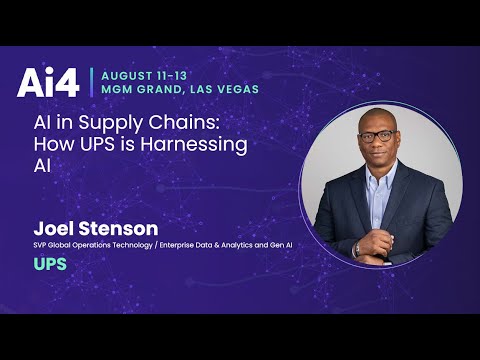
UPS Slashes 100 Million Fleet Miles in Shift to Autonomous Agentic AI
Ai4
UPS eliminated 100 million miles of driving by unifying plant engineering with IT, cleansing 70 petabytes of telemetry to transition from human-directed dispatching to autonomous agentic networks.
## Background
Published on YouTube by Ai4 on August 28, 2025, this fireside chat features Andrew Seaman, Editor at Large for LinkedIn News, in conversation with Joel Stenson, Senior Vice President of Global Operations Technology, Enterprise Data & Analytics, and Gen AI at UPS. According to the video description, the session explores real-world insights into how AI transforms UPS's supply chain operations by driving efficiency, cutting costs, and providing senior executives with a roadmap for gaining a competitive edge.
## TL;DR
Joel Stenson outlines how UPS bridged the divide between physical plant automation and enterprise IT to build a data-driven operational technology organization. He details real-world AI applications, including ORION's door-level route dispatching that eliminates 100 million miles annually, international customs classification, and tracking four billion annual RFID tags. Stenson also explains the rigorous infrastructure work required to sanitize 70 petabytes of telemetry down to 20 petabytes of cloud-ready data, alongside employee upskilling and strict ROI filtering. Looking forward, he identifies agentic AI decision-making and cross-facility robotic learning networks as the next operational frontiers to secure market share.
## Atmosphere & style
The discussion has a grounded, executive fireside feel that balances technical rigor with conversational ease and operational humor. Stenson brings seasoned humility to the stage, speaking candidly about the challenges of 'rebuilding the plane in flight' and tearing down the organizational barriers he spent decades helping create. Seaman's personable interviewing style invites practical storytelling rather than corporate buzzwords, resulting in an engaging, relatable dialogue that wraps up with warm laughter over personal delivery packages.
## Key takeaways
- [00:04](https://www.youtube.com/watch?v=8d6bw6DQ7eI&t=4s) UPS broke down the internal "blood-brain barrier" between plant-floor engineers and IT software developers by consolidating both groups under a single Operations Technology division.
- [03:06](https://www.youtube.com/watch?v=8d6bw6DQ7eI&t=186s) The proprietary ORION navigation and dispatch platform eliminates 100 million miles driven per year by mapping exact micro-location GPS coordinates for delivery bays and loading docks instead of basic street addresses.
- [05:06](https://www.youtube.com/watch?v=8d6bw6DQ7eI&t=306s) UPS leverages AI to balance dual customer needs, using machine learning to classify complex Harmonized Tariff Schedule codes for shippers and processing 4 billion RFID tags annually to track packages for recipients.
- [07:26](https://www.youtube.com/watch?v=8d6bw6DQ7eI&t=446s) AI change management follows a strict "do no harm" mandate, which executive leadership compares to rebuilding an airplane mid-flight without risking customer delivery commitments.
- [10:03](https://www.youtube.com/watch?v=8d6bw6DQ7eI&t=603s) The company-wide "InnovatIOn Challenge" barred technologists from submitting proposals, forcing ideas to originate from business units and resulting in four winning projects moving directly into production.
- [12:01](https://www.youtube.com/watch?v=8d6bw6DQ7eI&t=721s) UPS evaluated hundreds of decentralized AI initiatives to eliminate novelty experiments and concentrate capital solely on projects delivering measurable operational ROI.
- [12:01](https://www.youtube.com/watch?v=8d6bw6DQ7eI&t=721s) To establish a clean foundation for enterprise AI, UPS sanitized and compressed 70 petabytes of raw operational telemetry into 20 petabytes of structured, cloud-hosted data.
- [15:09](https://www.youtube.com/watch?v=8d6bw6DQ7eI&t=909s) Strategic AI implementation requires executive humility, centralizing data onto robust cloud platforms like GCP, setting strict governance policies, and anchoring directly to existing business pain points.
- [18:34](https://www.youtube.com/watch?v=8d6bw6DQ7eI&t=1114s) The near-term roadmap shifts from human-in-the-loop recommendation systems to Agentic AI, where diagnostic models autonomously command operational systems in real time.
- [18:34](https://www.youtube.com/watch?v=8d6bw6DQ7eI&t=1114s) Embodied physical automation is transitioning to fleetwide neural learning, enabling robots across multiple facilities to share operational weights and learn from one another instantly.
## Detailed walkthrough
### [00:04](https://www.youtube.com/watch?v=8d6bw6DQ7eI&t=4s) Bridging the "Blood-Brain Barrier" Between Engineering and IT
The fireside chat opens with Andrew Seaman introducing Joel Stenson, highlighting his remarkable 31-year career at UPS. When asked how he transitioned from traditional operations into becoming the company's leading AI figure, Stenson explains that the journey evolved organically out of his background in Buildings and Systems Engineering. For the bulk of his career—working as a programmer, project manager, and eventually global president of the division—his team was responsible for ideating, designing, building, and commissioning every UPS facility across all global business units.
In early 2023, UPS recognized a cultural and operational divide inside the enterprise. To break down what Stenson terms the *"blood-brain barrier"*—where plant-floor engineers assumed IT knew nothing about physical plant operations, and IT assumed engineers knew nothing about data—the company merged the two disciplines into a single division called Operations Technology. This organization unified physical problem solvers (deploying robotics, Autonomous Mobile Robots [AMRs], Automated Guided Vehicles [AGVs], and hard automation) with the software technologists running the business infrastructure.
```mermaid
flowchart TD
accTitle: UPS Operations Technology Integration
accDescription: Merging physical automation engineering with IT and enterprise data under Operations Technology.
subgraph PhysicalOps["Physical Plant Engineering"]
A["Hard Automation"]
B["Robotics & AGVs / AMRs"]
end
subgraph SoftwareIT["IT & Enterprise Software"]
C["Software Engineering"]
D["Data & Analytics Infrastructure"]
end
subgraph Combined["Operations Technology & GenAI"]
E["Unified Facility & Machine Design"]
F["Real-Time Optimization & GenAI"]
end
A --> E
B --> E
C --> F
D --> F
```
As the new group relied increasingly on software to optimize machinery, facility blueprints, and processes, data and artificial intelligence became foundational prerequisites. Consequently, Stenson was appointed to lead Enterprise Data & Analytics and Generative AI. Joking about the organizational shift, Stenson quips that he was tasked with *"breaking down a wall that I was very instrumental in building."*
[03:06](https://www.youtube.com/watch?v=8d6bw6DQ7eI&t=186s) ORION and Dispatch Optimization: Saving 100 Million Miles
Turning to operational AI deployments, Stenson highlights UPS’s proprietary navigation and dispatch engine, ORION (On-Road Integrated Optimization and Navigation). While consumers often wonder why UPS does not rely on off-the-shelf platforms like Google Maps or Apple Maps, Stenson explains that package delivery demands micro-location intelligence. UPS vehicles do not navigate to front driveways; they route specifically to loading docks, delivery bays, and receiving doors, with individual GPS coordinates mapped for every commercial door and facility access point across the network.
Beyond spatial accuracy, ORION continuously recalibrates routes based on live traffic patterns, incoming weather, and shifting delivery commitments—such as dynamically rerouting a package whose service priority has been upgraded mid-route. AI has similarly transformed driver dispatch planning. Historically, teams of industrial engineers combed through volume forecasts on paper and spreadsheets the night before to determine staffing, vehicle loads, and delivery loops. Today, AI models automate these daily operational allocations end-to-end.
- **Routing Optimization Scale:** AI routing and dispatch systems eliminate **100 million miles** driven per year across the fleet.
- **Dynamic Precision:** Pinpoints specific GPS locations for receiving doors rather than standard street addresses, incorporating real-time package prioritization.
[05:06](https://www.youtube.com/watch?v=8d6bw6DQ7eI&t=306s) Balancing the Dual Customer: Harmonized Codes and 4 Billion RFID Tags
Addressing customer impact, Stenson reflects on the unique dynamic of logistics: UPS serves two distinct customer groups on every shipment. One customer is the commercial shipper who contracts and pays for the transit; the other is the recipient whose delivery experience drives feedback and reviews. Satisfying both requires distinct AI-driven solutions across the supply chain lifecycle.
```mermaid
flowchart LR
accTitle: Dual Customer AI Pipeline
accDescription: AI touchpoints across the shipper and recipient logistics lifecycle.
subgraph ShipperSupport["Shipper Experience"]
S1["Harmonized Code AI"]
S2["Tariff & De Minimis Compliance"]
end
subgraph InTransit["Network Operations"]
N1["4B Annual RFID Tags"]
N2["Real-Time Flow Decisions"]
end
subgraph RecipientSupport["Recipient Experience"]
R1["Granular Tracking"]
R2["On-Time Visibility"]
end
S1 --> S2 --> N1 --> N2 --> R1 --> R2
```
For international shippers navigating regulatory hurdles, tariffs, and de minimis policy changes, AI assists in classifying merchandise into complex Harmonized Tariff Schedule codes—disambiguating nuanced terminology such as whether an apparel item constitutes "pants," "trousers," or "jeans." On the recipient side, UPS applied approximately **4 billion RFID tags** to packages over the prior year. This sensor data feeds AI networks that function like real-time air traffic control, providing visibility and enabling in-flight sorting decisions to keep packages moving without bottlenecks.
[07:26](https://www.youtube.com/watch?v=8d6bw6DQ7eI&t=446s) Rebuilding the Plane in Flight: Operational Change Management
Implementing advanced AI into an enterprise with hundreds of thousands of employees cannot come at the expense of daily execution. Stenson emphasizes that UPS operates under a strict *"do no harm"* policy: customers expect packages on time and at fair prices, regardless of the technological "gymnastics" happening behind the scenes.
The greatest challenge often lies in operational culture change. Introducing automated systems into facilities run by veteran operators who have managed their hubs comfortably for three decades—often relying on legacy habits or basic Power BI dashboards—inevitably sparks disruption. Stenson describes the transformation using an aviation metaphor: *"Look, we're on a plane. That plane is in flight. We have to rebuild this plane that we're currently flying on. We're not allowed to land. God forbid we crash. So, we just have to get it done while everything else is going on around us."* As UPS broadens its AI adoption beyond technologist-driven software development to its varied frontline workforce—including pilots, meteorologists, mechanics, and drivers—managing this operational shift remains an active, ongoing effort.
[10:03](https://www.youtube.com/watch?v=8d6bw6DQ7eI&t=603s) Business-Driven "InnovatIOn Challenge" and Democratizing AI Across UPS
To ensure artificial intelligence is deeply embraced throughout the company rather than confined to technical silos, UPS launched a company-wide initiative branded as the "InnovatIOn Challenge"—deliberately styling the "AI" within "innovation" to highlight its core mission. In a deliberate structural twist, technologists were barred from submitting recommendations; every single proposal had to originate directly from the business side. Business leaders convened with their operational teams to brainstorm how AI could help build new products or streamline existing operational processes. The initiative culminated in an "Innovation Day" on campus where employees brought their families to see UPS's technology in action, and the finalists presented their ideas directly to the CEO.
```mermaid
flowchart LR
accTitle: UPS AI Adoption and Scaling Framework
subgraph Ideation["Business-Led Sourcing"]
A["Business Teams Identify Needs"] --> B["InnovatIOn Challenge"]
end
subgraph Evaluation["Executive Alignment"]
B --> C["Presentation to CEO"]
C --> D["4 Winning Projects to Production"]
end
subgraph Enablement["Enterprise Upskilling"]
D --> E["Layered AI Competency Training"]
end
```
Joel Stenson explains that true democratization and federation mean making AI accessible to all tiers of the organization. To support this, UPS is deploying an educational roadmap tailored across different management layers, establishing what AI literacy looks like for general staff, middle managers, and the senior executive leadership team. Addressing Andrew Seaman's question on whether these competition concepts will see the light of day, Stenson emphasizes that the process was not an academic exercise: all four winning projects are currently in active technical development to be deployed straight into live production.
- **Innovation Challenge Rule**: Submissions were strictly limited to business units; technologists were not permitted to submit proposals.
- **Production Pipeline**: All four winning projects from the challenge received development commitments to go live into operational production.
- **Tiered AI Competency**: Education programs are tiered across general employees, middle management, and senior leadership to establish tailored enterprise fluency.
---
[12:01](https://www.youtube.com/watch?v=8d6bw6DQ7eI&t=721s) The Economics of AI, Data Repositories, and Cleansing 70 Petabytes
Addressing the shifting economics of AI, Stenson notes that while early industry sentiment favored throwing capital indiscriminately at experimental ideas, mature enterprises like UPS must evaluate solutions through rigorous return on investment (ROI). UPS recently conducted a comprehensive internal AI inventory, discovering hundreds of isolated AI modules under active development across various teams. This discovery spurred an effort to prioritize projects delivering tangible operational paybacks while retiring disconnected novelty projects that were simply "a neat thing that somebody was working on."
```mermaid
flowchart TD
accTitle: UPS Enterprise Data Pipeline for AI Readiness
subgraph Ingestion["Raw Operational Telemetry"]
Raw["70 PB Raw Enterprise & GPS Data"]
end
subgraph Processing["Data Refinement"]
Clean["Sanitization, Deduplication & Cleansing"]
end
subgraph Repository["Centralized AI-Ready Storage"]
Cloud["20 PB AI-Capable Cloud Data (GCP)"]
end
Raw --> Clean --> Cloud
```
The prerequisite for unlocking AI value—and often the most substantial upfront capital cost—is enterprise data infrastructure. UPS manages colossal amounts of telemetry, including extensive vehicle GPS locations, totaling roughly 70 petabytes of raw data. In comparison, the entire digital repository of the U.S. Library of Congress contains approximately 20 petabytes. UPS sanitized, structured, and cleansed its 70 petabytes down to 20 petabytes of high-quality, AI-capable data hosted in central cloud environments, making data hygiene and cloud storage optimization critical operational deliverables.
- **Data Volume Comparison**: UPS holds roughly 70 petabytes of operational data; the digital repository of the U.S. Library of Congress represents approximately 20 petabytes.
- **AI-Ready Cleansed Data**: UPS cleansed and condensed its 70 petabytes of raw telemetry down to 20 petabytes of structured, AI-ready data.
- **Portfolio Prioritization**: Enterprise inventory uncovered hundreds of decentralized AI modules, leading to strict ROI filtering between high-payback solutions and non-essential experiments.
---
[15:09](https://www.youtube.com/watch?v=8d6bw6DQ7eI&t=909s) Executive Upskilling and Strategic Advice for AI Implementation
Reflecting on his personal journey leading enterprise AI, Stenson stresses the importance of executive humility. Recognizing that technical practitioners possessed deeper domain knowledge than himself, he initiated an intensive week-long immersion session with the AI team, asking them to "put me in a room and... download what is useful for me to have." Stenson views his role not as an execution-level algorithm expert, but as an operational strategist responsible for applying AI to transform workflows, eliminate friction, and unlock organizational efficiencies.
```mermaid
flowchart TD
accTitle: Strategic Foundations for Enterprise AI Adoption
subgraph Foundation["Core Infrastructure & Expertise"]
D1["1. Centralize Cloud Data (e.g., GCP)"]
D2["2. Engage Specialized AI Partners"]
end
subgraph Control["Governance & Application"]
D3["3. Enforce Data Governance & Risk Policies"]
D4["4. Anchor on Concrete Business Problems"]
end
Foundation --> Control
```
When advising business leaders embarking on their own AI roadmaps, Stenson outlines four foundational imperatives:
1. **Centralize Data in the Cloud**: Avoid rudimentary setups like isolated on-premises servers and move data to robust cloud environments such as Google Cloud Platform (GCP).
2. **Partner with Domain Experts**: Collaborate with specialized external partners to upskill internal teams and architect proper data foundations.
3. **Establish Robust Governance**: Create clear guidelines for generative AI usage to prevent confidential enterprise data exposure while empowering employees safely.
4. **Solve Real Business Problems**: Anchor every implementation to an existing operational pain point rather than pursuing "AI for AI's sake."
---
[18:34](https://www.youtube.com/watch?v=8d6bw6DQ7eI&t=1114s) The Next Horizon: Agentic AI and Multi-Unit Robotic Learning
Looking ahead over the next 6 to 12 months, Stenson highlights two technological frontiers that will redefine logistics: Agentic AI and embodied physical intelligence in robotics. Current enterprise AI architectures remain predominantly human-in-the-loop: algorithms analyze systems, generate insights, and surface recommendations, but a human operator must evaluate the menu of options and trigger execution. The transition to Agentic AI links autonomous agents together, enabling one AI model to analyze operational data and directly instruct a downstream operational AI to execute production decisions in real time without manual mediation.
```mermaid
flowchart LR
accTitle: Shift from Human-in-the-Loop to Agentic Multi-Robot AI
subgraph Legacy["Traditional Human-in-the-Loop"]
AI1["AI System Analyzes Data"] --> Rec["List of Options"]
Rec --> Human["Human Decision Maker"]
Human --> Exec1["Execution"]
end
subgraph Future["Agentic Autonomous AI"]
AI2["Diagnostic AI"] -->|Direct Machine Command| AI3["Operational Execution AI"]
AI3 --> Fleet["Distributed Robotics Fleet Cross-Site Learning"]
end
```
The second major unlock lies in physical automation and collaborative robotics. Rather than programming individual machines in isolation, neural networks allow one robotic unit to be trained on physical tasks and instantly share those learned weights and operational telemetry across fleets deployed at multiple facilities. This shared intelligence network enables all robotic units to learn from each other's physical interactions, continuously improving handling and sorting efficiency across UPS's global infrastructure.
- **Agentic AI Workflow**: Moves beyond recommendation engines by allowing diagnostic AI systems to autonomously instruct operational AI systems to execute decisions directly.
- **Fleetwide Neural Learning**: Robotic systems share operational telemetry across multiple facility sites, allowing an entire fleet to instantly benefit from lessons learned by a single robotic unit.
[20:08](https://www.youtube.com/watch?v=8d6bw6DQ7eI&t=1208s) Closing Remarks and Driving Market Share
Wrapping up the fireside chat, Joel Stenson emphasizes that the AI transformation at UPS fundamentally centers on gaining a competitive edge and driving business growth, framing the overarching strategy as "a market share conversation" focused on answering: "How can we do it better than everybody else?"
Andrew Seaman brings the session to a lighthearted and warm conclusion, expressing personal gratitude for the operational efforts behind the scenes—joking about his appreciation for "all the packages I get." Stenson cheerfully responds with "Thank you for all those orders," prompting shared laughter before both speakers thank the audience and conclude the panel.
## Notable quotes
> [00:04](https://www.youtube.com/watch?v=8d6bw6DQ7eI&t=4s) blood-brain barrier — Joel Stenson
> [00:04](https://www.youtube.com/watch?v=8d6bw6DQ7eI&t=4s) breaking down a wall that I was very instrumental in building. — Joel Stenson
> [07:26](https://www.youtube.com/watch?v=8d6bw6DQ7eI&t=446s) do no harm — Joel Stenson
> [07:26](https://www.youtube.com/watch?v=8d6bw6DQ7eI&t=446s) Look, we're on a plane. That plane is in flight. We have to rebuild this plane that we're currently flying on. We're not allowed to land. God forbid we crash. So, we just have to get it done while everything else is going on around us. — Joel Stenson
> [12:01](https://www.youtube.com/watch?v=8d6bw6DQ7eI&t=721s) a neat thing that somebody was working on — Joel Stenson
> [15:09](https://www.youtube.com/watch?v=8d6bw6DQ7eI&t=909s) put me in a room and... download what is useful for me to have. — Joel Stenson
> [15:09](https://www.youtube.com/watch?v=8d6bw6DQ7eI&t=909s) AI for AI's sake — Joel Stenson
> [20:08](https://www.youtube.com/watch?v=8d6bw6DQ7eI&t=1208s) a market share conversation — Joel Stenson
> [20:08](https://www.youtube.com/watch?v=8d6bw6DQ7eI&t=1208s) How can we do it better than everybody else? — Joel Stenson
> [20:08](https://www.youtube.com/watch?v=8d6bw6DQ7eI&t=1208s) all the packages I get. — Andrew Seaman
> [20:08](https://www.youtube.com/watch?v=8d6bw6DQ7eI&t=1208s) Thank you for all those orders — Joel Stenson
## Mentioned
Joel Stenson, Andrew Seaman, UPS, LinkedIn News, Ai4, ORION (On-Road Integrated Optimization and Navigation), Google Maps, Apple Maps, Harmonized Tariff Schedule, InnovatIOn Challenge, U.S. Library of Congress, Google Cloud Platform (GCP), Power BI
## Video description
Joel Stenson, Senior Vice President Global Operations Technology / Enterprise Data & Analytics and Gen AI, UPS
Andrew Seaman, Editor at Large for Jobs & Career Development, LinkedIn News
Abstracts
Join us for a fireside chat on how AI is transforming UPS’s Supply Chain Operations. In this fireside chat, you'll hear firsthand from industry leader, Joel Stenson, Senior Vice President of Global Operations Technology / Enterprise Data & Analytics and Gen AI at UPS as they share real-world insights into how AI is driving efficiency, reducing costs, and streamlining operations. This session is ideal for senior executives and decision-makers seeking to harness AI for a competitive edge. Don't miss this opportunity to learn from one of the world’s most innovative logistics leaders.
UPS向自主智能体AI转型,车队行驶里程减少1亿英里
UPS通过整合工厂工程与IT、清洗70PB遥测数据,从人工主导调度转型为自主智能体网络,成功减少了1亿英里的行驶里程。
Joel Stenson概述了UPS如何弥合实体工厂自动化与企业IT之间的鸿沟,构建起数据驱动的运营技术组织。他详细介绍了多项实际AI应用,包括每年减少1亿英里行驶里程的ORION门级路线调度、国际海关归类,以及每年追踪40亿个RFID标签。Stenson还阐释了将70PB遥测数据清洗提炼至20PB云就绪数据所需的严谨基础设施建设,以及员工技能提升和严格的ROI筛选机制。展望未来,他指出智能体AI决策与跨设施机器人学习网络将是确保市场份额的下一个运营前沿。
UPS 通过将车间自动化工程师与 IT 软件团队合并为统一的运营技术(Operations Technology)部门,打破了两者之间长期的内部隔阂。 (0:04)
自研的 ORION 导航与调度系统通过精准映射装卸台和接收门的微位置 GPS 坐标,每年为车队减少 1 亿英里的行驶里程。 (3:06)
在客户体验端,UPS 利用机器学习对托运人的复杂海关税则号进行智能归类,并每年处理 40 亿个 RFID 标签以实现包裹的实时路由和追踪。 (5:06)
UPS 将 AI 变革管理比作“飞行中维修飞机”,在坚守“不造成损害”的前提下,要求业务部门主导创新挑战赛,确保方案直击实际业务痛点。 (7:26)
为构建坚实的 AI 基础设施,UPS 梳理并清理了 70 PB 的原始运营数据,提炼出 20 PB 高质量结构化数据托管至云端(如 GCP)。 (12:01)
Reading summary
UPS is overhauling its global logistics operations by merging physical automation engineering with enterprise data, structuring tens of petabytes of telemetry to power predictive routing, and laying the groundwork for autonomous agentic networks.
Merging Physical Engineering with Enterprise IT (0:04)
In early 2023, UPS consolidated physical plant engineering and enterprise software into a single division called Operations Technology. Joel Stenson, who leads Enterprise Data & Analytics and Generative AI, explained that this reorganization aimed to dismantle an internal operational divide where plant engineers and IT technologists worked in isolation. The merged group couples physical hardware—such as autonomous mobile robots, automated guided vehicles, and facility machinery—with centralized software infrastructure. Managing this operational shift required a strict "do no harm" approach to avoid disrupting live package deliveries while retraining veteran personnel across facilities.
Business-Driven Innovation and Tiered Upskilling (10:03)
To prevent artificial intelligence initiatives from being trapped in technical silos, UPS launched its internal "InnovatIOn Challenge," which required all project proposals to originate exclusively from business and operational units rather than technologists. The competition culminated in business leaders pitching concepts directly to the chief executive officer, resulting in four winning projects being moved directly into operational production. Stenson noted that broad organizational adoption also depends on tiered education roadmaps that establish defined AI literacy benchmarks for frontline staff, middle management, and senior executives.
Micro-Location Routing and Supply Chain Visibility (3:06)
UPS relies on its proprietary ORION navigation engine rather than standard consumer mapping tools because commercial delivery requires micro-location accuracy. Stenson stated that ORION navigates vehicles directly to designated loading docks, delivery bays, and receiving doors using custom GPS coordinates, while continuously recalibrating routes based on traffic, incoming weather, and upgraded delivery commitments. Stenson reported that these routing and dispatch optimizations eliminate 100 million miles driven per year across the fleet.
Operational AI also addresses distinct requirements for shippers and recipients across the supply chain lifecycle. For international commercial shippers, AI models categorize merchandise into complex Harmonized Tariff Schedule codes—resolving ambiguous regulatory classifications such as distinguishing pants from trousers or jeans. For package recipients, UPS applied approximately 4 billion RFID tags in the prior year, generating sensor telemetry that acts as real-time air traffic control to guide automated sorting and prevent network bottlenecks.
Telemetry Cleansing and Capital ROI Discipline (12:01)
Addressing capital allocation, Stenson reported that an internal portfolio inventory uncovered hundreds of isolated AI modules across UPS, prompting leadership to retire disconnected experiments and enforce strict return-on-investment criteria. Unlocking viable machine learning models required substantial investments in enterprise data hygiene. UPS holds approximately 70 petabytes of operational and GPS telemetry—more than triple the 20-petabyte digital repository of the U.S. Library of Congress. The company sanitized, deduplicated, and condensed this volume down to 20 petabytes of AI-ready structured data hosted in centralized cloud environments like Google Cloud Platform.
Stenson advised that enterprise AI strategies must rest on four principles: centralizing data in modern cloud architectures, partnering with external domain experts to accelerate upskilling, enforcing strict data governance policies, and anchoring every project directly to an existing operational bottleneck.
Agentic Autonomous Systems and Shared Robotic Learning (18:34)
Looking ahead over a 6-to-12-month horizon, Stenson forecast an industry transition from human-in-the-loop recommendation engines to Agentic AI workflows. Under current deployments, models present a list of diagnostic options for human operators to execute; agentic architectures will allow analytical models to directly instruct operational software to make real-time production decisions autonomously.
In physical automation, UPS is monitoring collaborative robotics linked by shared neural network learning. Stenson explained that instead of programming automation units in isolation, robotic fleets can share learned physical weights and telemetry across multiple facilities. This shared intelligence network allows an entire multi-site robotic fleet to instantly adopt operational improvements discovered by a single unit.
Joel Stenson framed UPS's ongoing data and AI investments as a market share strategy designed to secure competitive operational advantages, though long-term success remains tied to managing operational culture change and deploying autonomous agents without disrupting existing delivery commitments.
## Background
该视频由 Ai4 于 2025 年 8 月 28 日发布在 YouTube 平台上。视频记录了 LinkedIn News 特约编辑 Andrew Seaman 与 UPS 全球运营技术、企业数据分析及生成式 AI 高级副总裁 Joel Stenson 的炉边对话,深入探讨了 UPS 如何在万亿级复杂供应链中 Harness AI 来提升运营效率、降低成本并建立竞争优势。
## TL;DR
UPS 通过打破传统工程与 IT 壁垒组建运营技术(OT)部门,利用 Orion 导航算法与智能排班每年削减 1 亿英里无效里程,并借助 40 亿个 RFID 标签及 HS 编码解析全面赋能收发件两端。在推进全员 AI 转型的过程中,UPS 坚持“在飞行中重构飞机”且“不造成伤害”的原则,通过业务驱动的创新挑战赛推动方案落地,并将 70 PB 原始运营数据清洗提炼为 20 PB 的云端 AI 核心资产。面对未来,UPS 重点布局智能体 AI(Agentic AI)与仓储机器人跨站点协同进化,以此作为持续赢得市场份额的核心驱动力。
## Atmosphere & style
整场对话兼具工业老兵的沉稳务实与技术探索的开拓锐气。对谈气氛轻松融洽又不失深度,嘉宾用“在万米高空重构客机”等生动形象的隐喻,坦率剖析了巨型物流网络在拥抱 AI 时的阵痛与清醒克制。两位对话者在专业探讨与幽默互动的节奏转换中,为观众呈现了一场兼具宏观商业洞察与微观落地细节的高密度交流。
## Key takeaways
- [00:04](https://www.youtube.com/watch?v=8d6bw6DQ7eI&t=4s) 打破工程与IT壁垒组建OT部门:UPS将车间硬件自动化工程与IT软件团队整合为统一的运营技术部门,以此为底座全面推进企业数据分析与生成式AI应用。
- [02:57](https://www.youtube.com/watch?v=8d6bw6DQ7eI&t=177s) Orion与智能调度每年削减1亿英里行驶里程:通过精准测绘每个装卸门坐标并实时动态重排路线,AI全面替代了传统依赖复杂电子表格的人工排班派车流程。
- [05:02](https://www.youtube.com/watch?v=8d6bw6DQ7eI&t=302s) 平衡发件人与收件人的双端体验:前端利用AI自动化解析跨国海关HS编码,末端年均铺设40亿个RFID标签结合AI实现如空中交通管制般的秒级网络调度。
- [07:28](https://www.youtube.com/watch?v=8d6bw6DQ7eI&t=448s) 在全速运转中重构系统并坚持“不造成伤害”:AI转型犹如在万米高空飞行中拆装飞机,必须在确保物流网络稳定运行并安抚基层员工适应性的前提下稳步推进。
- [10:03](https://www.youtube.com/watch?v=8d6bw6DQ7eI&t=603s) 业务驱动的AI创新挑战赛与全员技能普及:硬性规定仅限业务团队提报痛点方案,所有最终获胜的AI项目均直接获得资源投入实际生产。
- [12:01](https://www.youtube.com/watch?v=8d6bw6DQ7eI&t=721s) 70 PB原始数据治理与AI项目ROI清盘:从约为国会图书馆3.5倍的70 PB海量运营数据中提炼出20 PB清洁数据上云,并梳理叫停缺乏商业价值的自嗨型AI模块。
- [15:09](https://www.youtube.com/watch?v=8d6bw6DQ7eI&t=909s) 领导者的自我浸润与外部生态合作:高管需以谦逊姿态沉浸于技术底层寻找业务赋能切入点,并借助外部顶尖伙伴加速全员技能重塑(Upskilling)。
- [16:46](https://www.youtube.com/watch?v=8d6bw6DQ7eI&t=1006s) 企业落地AI的四大核心实操法则:必须依托现代云原生架构集中数据、善于借力成熟合作伙伴、制定清晰的安全合规治理红线,且所有立项必须严密锚定业务痛点。
- [18:34](https://www.youtube.com/watch?v=8d6bw6DQ7eI&t=1114s) 演进趋势聚焦Agentic AI与实体机器人自主协同:未来的AI将跨越“人在回路”的建议模式迈向智能体间自主闭环调度,仓储物流机器人也将通过共享数据实现跨站点协同进化。
- [20:08](https://www.youtube.com/watch?v=8d6bw6DQ7eI&t=1208s) 技术与效率升级的本质是市场份额竞争:AI在供应链中深耕的终极目标在于以更优的成本与履约体验拉开同业差距,赢得全球物流市场的主导地位。
## Detailed walkthrough
### [00:04](https://www.youtube.com/watch?v=8d6bw6DQ7eI&t=4s) 破除工程与IT的壁垒:从传统基建到掌舵全球运营技术与AI
主持人 Andrew Seaman 在开场时热情地引出了本次对话的主题——复杂的供应链系统运作。在 UPS 工作了整整 31 年的 Joel Stenson 承担着业内少有的重任。当被问及一个传统物流老兵如何成为掌管 AI 的负责人时,Joel 坦言这是一场顺理成章的自然演进。在职业生涯的大部分时间里,他都在 UPS 的“建筑与系统工程”(Buildings and Systems Engineering)部门,历经程序员、项目经理直至全球总裁,带领团队负责全球所有业务单元中所有实体设施的构思、设计、建造和调试。
转折点发生在 2023 年初。UPS 决定打破传统工程师与 IT 人员之间长期存在的“血脑屏障”——在过去,车间工程师总觉得 IT 部门根本不懂现场作业,而 IT 团队则认为工程师对数据一无所知。为了消除这种隔阂,UPS 组建了“运营技术”(Operations Technology, OT)部门,将利用机器人、自主移动机器人(AMR)、自动导引车(AGV)等硬件自动化解决物理车间问题的工程团队,与开发支撑业务运转软件的技术专家整合在一起。随着这两个团队的合并,Joel 跨入了 IT 领域。在利用软件提升运营效率、优化设施与机器设计的过程中,团队越来越依赖海量数据与 AI。最终,Joel 顺理成章地接管了全公司的企业数据、分析与生成式 AI 业务。他幽默地调侃道,自己现在必须亲手拆除那堵“当年我也曾亲手参与搭建的高墙”。
```mermaid
flowchart TD
accTitle: 运营技术部门融合架构
subgraph Past["原有壁垒体系"]
A["现场工程团队<br/>(机器人 / AMR / AGV / 设施建造)"] -.->|隔阂| B["IT 与软件团队<br/>(业务系统开发 / 数据处理)"]
end
subgraph OT["运营技术融合平台 (Operations Technology)"]
C["统一软硬件研发与数据底座"]
C --> D["企业级数据分析 & 生成式 AI"]
end
Past ==> OT
D --> E["物理网络效率与智能调度提升"]
```
---
### [02:57](https://www.youtube.com/watch?v=8d6bw6DQ7eI&t=177s) Orion 导航与智能调度:每年节省1亿英里的算法引擎
当谈到 AI 在 UPS 庞大体系中的具体落地场景时,Joel 首先举了著名的 Orion 导航系统为例。外界常好奇 UPS 为什么不直接使用 Google Maps 或 Apple Maps 等消费级地图,Joel 解释称,UPS 货车去的地方与普通车主完全不同——司机不是开到正门口,而是必须精准停靠在特定货运接收门(Receivables Door)。为此,UPS 精准测绘并标记了全球所有设施每个卸货门、每一个取派件点的独立 GPS 坐标。Orion 算法需要实时综合考量动态交通路况、天气变化以及包裹时效优先级;一旦某辆车上的某个包裹被系统临时加急提升优先级,算法就会即刻对整条路线进行动态重规划。
除了行车途中的路径规划,AI 还在司机排班与派车调度环节发挥了颠覆性作用。在过去,需要由大批工业工程专家夜以继日地对着纸质单据、随后是对着庞大的 Excel 电子表格,在前一天晚上根据货量预测艰难拍板:明天需要出动多少司机?哪辆车装载哪些包裹?哪位司机跑哪条线路?如今,这套高度繁复的决策流程已全部由 AI 自动化完成。
- **行车里程大幅削减**:通过 Orion 导航系统与 AI 路线优化调度的协同运作,UPS 每年直接减少了 1 亿英里(约 1.6 亿公里)的无效行驶里程。
- **动态派送重构**:不仅能在出车前实现包裹与车辆的最优配比,还能在运输途中根据紧急程度实时变道重排。
---
### [05:02](https://www.youtube.com/watch?v=8d6bw6DQ7eI&t=302s) 平衡发件人与收件人:HS编码识别与40亿个RFID标签的实时网络
针对智能化升级如何传递到客户体验层面,Andrew 探讨了背后的关键绩效指标(KPI)。Joel 指出,物流行业的客户体验具有多维且特殊的“双端属性”:出资下单将包裹托付给 UPS 的是发件人(Shipper),但在社交网络上评分评价履约质量的往往是收件人(Recipient)。因此,UPS 必须运用 AI 分别满足两端截然不同的诉求。
在国际发件人端,海关分类极为繁琐。一件衣服在不同国家到底该归类为“Pants”、“Trousers”还是“Jeans”,直接决定了其协调制度编码(Harmonized System Code / HS Code)的判定。尤其是在当前全球关税政策频密调整、小额豁免(De Minimis)规则剧烈变动的环境下,UPS 借助 AI 模型自动化解析货品属性并匹配合规编码,大幅简化了跨境发件流程。而在收件人端,UPS 全力推进物理网络的数字化感知升级——仅去年一年就在包裹上铺设了约 40 亿个 RFID(射频识别)电子标签。结合 AI 对货流节点数据的实时推演,UPS 得以像空中交通管制系统(Air Traffic Control)一样,全天候不间断地洞察包裹流向并在网络拥堵前做出实时疏导决策。
| 客户角色 | 业务痛点与诉求 | AI 与数字化赋能方案 | 核心业务价值 |
|:--- |:--- |:--- |:--- |
| **国际发件人 (Shipper)** | 跨国海关 HS 编码极其繁琐;关税及小额豁免政策多变 | 利用 AI 自然语言与图像识别辅助判断商品分类与编码 | 降低跨境清关门槛,加速货品合规通关 |
| **末端收件人 (Recipient)** | 关注包裹到达时效与全链路物流透明度 | 全网年均部署约 40 亿个 RFID 标签,结合 AI 实时全局调度 | 动态疏导网络拥堵,提供秒级包裹轨迹与准时送达保障 |
---
### [07:28](https://www.youtube.com/watch?v=8d6bw6DQ7eI&t=448s) 飞行中重构飞机:在“不造成伤害”的原则下推进全员AI转型
将如此庞大的 AI 与自动化技术注入一个日夜不停运转的巨型物流网络,其难度不亚于在万米高空拆装零件。Joel 坦言:“这个房间里没有人真正在乎 UPS 内部是如何‘制作香肠’的,大家只在乎准时甚至提前收到包裹,并且价格公道。”但对后台而言,要完成这种复杂的运作,就必须贯彻一条铁律——“不造成伤害”(Do no harm)。
这种“不伤害”既针对外部客户服务稳定性,也针对内部员工的心理适应。在 UPS,许多基层运营经理已经工作了三十余年,他们习惯了自己一套行之有效的管理方式,有些人对数字工具的接受极限可能仅停留在 PowerBI 图表。当总部突然派人告知他们“过去依赖的老同事 Jimmy 和 Jane 负责的工作,现在要改由 AI 来辅助提高效率”时,必然会引发巨大的震荡与不安。
面对拥有气象学家、飞行员、货车司机、一线工程师和 IT 极客等跨度极大的人员构成,Joel 形象地比喻道:“我们正身处一架正在飞行的客机上。我们必须在飞行途中完成飞机的全面重构,我们既不能降落,更绝不允许坠毁,只能在周遭一切全速运转的同时把事情做成。”他透露,UPS 现阶段的 AI 赋能主要由技术人员自顶向下驱动,首先在软件编写与开发效率等技术端实现了显著突破,而更广泛的全员协同转型仍在持续深化探索中。
### [10:03](https://www.youtube.com/watch?v=8d6bw6DQ7eI&t=603s) 业务驱动的 AI 创新挑战赛与全员能力普及
为了让整座企业真正拥抱人工智能,UPS 意识到必须让所有人都在思考 AI,而不仅仅是技术人员。为此,UPS 举办了一场别出心裁的“AI 创新挑战赛”(Innovation Challenge)。这项赛事最核心的硬性规则是:**禁止任何技术人员提交方案**,所有建议必须由业务线团队发起。各业务负责人带领团队深入思考:AI 如何帮助我们打造新产品?AI 如何优化现有的操作流程?两周前,UPS 还在园区举办了盛大的“创新日”,不仅邀请了员工家属前来参观公司前沿的技术成果,还安排获胜团队直接向公司 CEO 进行项目汇报。
这种“民主化与联邦化”(Democratized and Federated)的 AI 理念意味着技术必须赋能每一个人。UPS 正在全公司推行分层培训体系,从普通员工的基础认知、中层管理者的应用管理,一直到高级领导团队必须具备的 AI 胜任力。针对主持人关于这些提案是否会沦为“空想”的疑问,乔尔·斯坦森(Joel Stenson)明确表示,所有 4 个获胜项目都已正式进入开发阶段并即将投入实际生产,它们将为企业带来切实的业务价值。
- **参赛限制**:仅限业务团队提案,技术人员不得提交方案,确保需求源于真实业务场景。
- **高管汇报**:获胜团队在全员家庭开放日上直接向首席执行官汇报。
- **落地承诺**:大赛评选出的 4 个最终优胜项目全部获得资源支持,进入投产研发阶段。
---
### [12:01](https://www.youtube.com/watch?v=8d6bw6DQ7eI&t=721s) AI 经济学与 70 PB 的海量数据基座
在谈及 AI 的投资回报率(ROI)与经济效益时,斯坦森指出,大型企业在追求回报的同时也必须具备远见,明确何时需要先行投资以释放未来的产能与潜力。UPS 近期对其内部资产展开了全面的“AI 清盘”,惊讶地发现各团队正在开发的 AI 模块多达数百个。为此,管理层当前的核心任务是重新梳理优先级,甄别哪些项目能够带来真正的财务回报,哪些仅仅是“某人觉得很酷但缺乏商业价值的小玩具”。
然而,AI 背后最昂贵的先期成本是数据。许多企业往往低估了数据存储与清洗的开销。斯坦森分享了一组惊人的对比数据:美国国会图书馆(Library of Congress)收录了全美几乎所有出版物的数字资产,其数据体量约为 20 PB(Petabytes);而 UPS 仅日常运营和车辆 GPS 等轨迹产生的数据总量就高达约 70 PB。为了让这些庞杂的数据达到“AI 可用”(AI-capable)的标准,UPS 进行了全量治理与清洗,最终提炼出 20 PB 的高价值核心数据并统一迁移至云端。
```mermaid
flowchart TD
accTitle: UPS 数据治理与 AI 投产链路
subgraph S1["数据底座建设"]
A["70 PB 原始运营与 GPS 数据"] --> B["数据清洗与合规治理"]
B --> C["20 PB AI 可用核心数据集"]
C --> D["云端集中存储仓库 (如 GCP)"]
end
subgraph S2["业务价值转化"]
D --> E["业务驱动创新方案"]
E --> F["投入实际生产并衡量 ROI"]
end
```
- **数据体量悬殊**:UPS 原始数据量高达 70 PB,约为美国国会图书馆数字化馆藏(20 PB)的 3.5 倍。
- **高标准数据清洗**:经过治理后沉淀出 20 PB 具备 AI 训练与推理能力的清洁数据。
- **资产盘点**:梳理出内部正在开发的数百个 AI 模块,集中资源砍掉自嗨型项目,聚焦高 ROI 场景。
---
### [15:09](https://www.youtube.com/watch?v=8d6bw6DQ7eI&t=909s) 高管的自我赋能:从技术“浸泡”到生态合作
谈及技术领导者自身的 AI 学习路径,斯坦森坦言必须保持谦逊,承认技术团队在算法底层往往比管理者懂得更多。当 AI 浪潮初起时,他的第一步做法是把自己“关”进技术团队的房间里,进行了为期整整一周的封闭式深度浸润学习(Immersion Session)。他向团队坦诚要求:“你们是专家,我的任务不是坐在这里成为执行算法的专家,而是从管理者的角度,搞清楚如何将 AI 应用于业务变革与效率提升,你们需要帮我成为这方面的业务级领域专家。”
除了向内汲取养分,UPS 还在外部与顶尖的技术伙伴深度协同。斯坦森强调,企业应用 AI 无法闭门造车,必须借助外部生态伙伴的能力完成全员技能重塑(Upskilling)。这一培训过程首先从负责落地的核心骨干团队启动,随后层层扩散至整个组织体系。
> “你必须具备这种谦逊的姿态,清楚何时该向他人请教。我的职责不是去写算法代码,而是找准应用切入点,通过 AI 撬动整个组织的效能与变革。”
---
### [16:46](https://www.youtube.com/watch?v=8d6bw6DQ7eI&t=1006s) 企业落地 AI 的核心建议:治理、数据与业务导向
对于正在摩拳擦掌推进 AI 转型的企业管理者,斯坦森给出了四个循序渐进的实操法则。首先必须将数据集中存储,坚决避免将“集中化”误解为“在单台笔记本电脑上跑一个 SQL Server 实例”,而是要真正迁移到 Google Cloud Platform (GCP) 等现代化云环境中;其次要寻找具有深厚 AI 经验的高水平合作伙伴;第三是建立明确的安全合规与治理框架,尤其是当员工热衷于用生成式 AI 处理公司数据时,必须规范“可为与不可为”的红线;最后则是始终扎根于实际业务痛点,坚决不做“为了 AI 而做 AI”的面子工程。
主持人对此深表赞同,并透露领英(LinkedIn)内部也常有类似的讨论——许多点子听起来确实很酷很诱人,但大家坐下来复盘时总要严厉地反问一句:“我们到底为什么要这么做?”
- **集中化存储**:借助现代云原生基础设施(如 GCP)归集数据,而非局限于本地单机数据库。
- **生态引智**:携手成熟的外部 AI 专家团队快速建立核心能力。
- **构建治理红线**:针对 Gen AI 设定企业数据隐私防护与合规机制,明确使用规范。
- **锚定真实痛点**:严格杜绝技术自嗨,所有 AI 立项必须服务于切实的业务指标改进。
---
### [18:34](https://www.youtube.com/watch?v=8d6bw6DQ7eI&t=1114s) 未来展望:Agentic AI 与机器人分布式自主协同
展望未来半年至一年的人工智能演进,斯坦森指出他最为关注的两个前沿方向。其一是**智能体 AI(Agentic AI)**。他解释道,目前的 AI 架构绝大多数仍高度依赖“人在回路”(Human-in-the-loop)——AI 负责分析系统、挖掘洞察并生成候选方案列表,最终依然需要人类来决策执行哪一项;而下一代的发展方向则是让“一个 AI 直接调度并指令另一个 AI”,自主下达指令并将其无缝推向生产运营闭环。
另一个引人瞩目的突破点是 **AI 对物理实体系统(尤其是仓储物流机器人)的重塑**。通过先进的神经网络,企业可以仅训练一个机器人单元,便能将学到的技能泛化迁移至多个机体;更重要的是,分布在不同站点的多套硬件系统可以通过共享运营数据实现跨站点协同进化与互相学习。斯坦森总结道,对于 UPS 而言,技术探索的终极归宿就是要在激烈的供应链竞争中“赢得胜利”(Winning)。
```mermaid
flowchart LR
accTitle: 从人机协同到智能体协同演进
subgraph HumanLoop["传统模式:人在回路"]
direction TB
A1["AI 算法分析洞察"] --> A2["生成备选方案"]
A2 --> A3["人工评估与决策"]
A3 --> A4["手工下发执行"]
end
subgraph AgenticLoop["未来模式:Agentic AI 自主协同"]
direction TB
B1["决策智能体 A 产生洞察"] --> B2["调度执行智能体 B"]
B2 --> B3["实体系统/机器人自主运行"]
B3 -. "跨站点数据回传学习".-> B1
end
```
- **从建议到执行**:跨越“AI 提建议、人类做决定”的瓶颈,迈向 AI 系统之间自主协作与自动触发业务流程。
- **物理 AI 协同进化**:仓储机器人通过单一神经网络训练、跨站点多终端共享经验,实现集群智能持续自我迭代。
### [20:08](https://www.youtube.com/watch?v=8d6bw6DQ7eI&t=1208s) 市场份额竞争与炉边谈话致谢收尾
在谈及 AI 与运营效率提升的终极目标时,乔尔·斯坦森(Joel Stenson)指出这归根结底是一场关于市场份额的较量("it's a market share conversation"),核心命题始终在于 UPS 如何能够比其他所有人做得更好("How can we do it better than everybody else?"),以此建立无可替代的竞争优势。
安德鲁·西曼(Andrew Seaman)对此表示赞同,并向斯坦森以及 UPS 团队表达了由衷的感谢。西曼还幽默地打趣道,尤其是要感谢 UPS 送来的所有属于他个人的包裹。斯坦森随即笑着回应:“不客气,也感谢你下了这么多订单。”在两人轻松愉快的互动笑声中,西曼与斯坦森先后向现场及线上的所有观众致谢,为整场探讨 AI 赋能全球供应链运营的炉边对谈画上了圆满的句号。
## Notable quotes
> [07:28](https://www.youtube.com/watch?v=8d6bw6DQ7eI&t=448s) 这个房间里没有人真正在乎 UPS 内部是如何‘制作香肠’的,大家只在乎准时甚至提前收到包裹,并且价格公道。 — Joel Stenson
> [07:28](https://www.youtube.com/watch?v=8d6bw6DQ7eI&t=448s) 我们正身处一架正在飞行的客机上。我们必须在飞行途中完成飞机的全面重构,我们既不能降落,更绝不允许坠毁,只能在周遭一切全速运转的同时把事情做成。 — Joel Stenson
> [12:01](https://www.youtube.com/watch?v=8d6bw6DQ7eI&t=721s) 某人觉得很酷但缺乏商业价值的小玩具 — Joel Stenson
> [15:09](https://www.youtube.com/watch?v=8d6bw6DQ7eI&t=909s) 你们是专家,我的任务不是坐在这里成为执行算法的专家,而是从管理者的角度,搞清楚如何将 AI 应用于业务变革与效率提升,你们需要帮我成为这方面的业务级领域专家。 — Joel Stenson
> [15:09](https://www.youtube.com/watch?v=8d6bw6DQ7eI&t=909s) 你必须具备这种谦逊的姿态,清楚何时该向他人请教。我的职责不是去写算法代码,而是找准应用切入点,通过 AI 撬动整个组织的效能与变革。 — Joel Stenson
> [16:46](https://www.youtube.com/watch?v=8d6bw6DQ7eI&t=1006s) 我们到底为什么要这么做? — Andrew Seaman
> [20:08](https://www.youtube.com/watch?v=8d6bw6DQ7eI&t=1208s) it's a market share conversation — Joel Stenson
> [20:08](https://www.youtube.com/watch?v=8d6bw6DQ7eI&t=1208s) How can we do it better than everybody else? — Joel Stenson
> [20:08](https://www.youtube.com/watch?v=8d6bw6DQ7eI&t=1208s) 不客气,也感谢你下了这么多订单。 — Joel Stenson
## Mentioned
Joel Stenson, Andrew Seaman, UPS, LinkedIn News, Orion 导航系统, Google Maps, Apple Maps, Google Cloud Platform (GCP), 美国国会图书馆 (Library of Congress), PowerBI, Excel, SQL Server, RFID, AMR (自主移动机器人), AGV (自动导引车)
## Video description
Joel Stenson, Senior Vice President Global Operations Technology / Enterprise Data & Analytics and Gen AI, UPS
Andrew Seaman, Editor at Large for Jobs & Career Development, LinkedIn News
Abstracts
Join us for a fireside chat on how AI is transforming UPS’s Supply Chain Operations. In this fireside chat, you'll hear firsthand from industry leader, Joel Stenson, Senior Vice President of Global Operations Technology / Enterprise Data & Analytics and Gen AI at UPS as they share real-world insights into how AI is driving efficiency, reducing costs, and streamlining operations. This session is ideal for senior executives and decision-makers seeking to harness AI for a competitive edge. Don't miss this opportunity to learn from one of the world’s most innovative logistics leaders.
[Source](https://www.youtube.com/watch?v=8d6bw6DQ7eI)
Source quotes
[7:28] Joel Stenson: 这个房间里没有人真正在乎 UPS 内部是如何‘制作香肠’的,大家只在乎准时甚至提前收到包裹,并且价格公道。
[7:28] Joel Stenson: 我们正身处一架正在飞行的客机上。我们必须在飞行途中完成飞机的全面重构,我们既不能降落,更绝不允许坠毁,只能在周遭一切全速运转的同时把事情做成。
[12:01] Joel Stenson: 某人觉得很酷但缺乏商业价值的小玩具
[15:09] Joel Stenson: 你们是专家,我的任务不是坐在这里成为执行算法的专家,而是从管理者的角度,搞清楚如何将 AI 应用于业务变革与效率提升,你们需要帮我成为这方面的业务级领域专家。
[15:09] Joel Stenson: 你必须具备这种谦逊的姿态,清楚何时该向他人请教。我的职责不是去写算法代码,而是找准应用切入点,通过 AI 撬动整个组织的效能与变革。
[16:46] Andrew Seaman: 我们到底为什么要这么做?
[20:08] Joel Stenson: it's a market share conversation
[20:08] Joel Stenson: How can we do it better than everybody else?
[20:08] Joel Stenson: 不客气,也感谢你下了这么多订单。
Source quotes
[0:04] Joel Stenson: blood-brain barrier
[0:04] Joel Stenson: breaking down a wall that I was very instrumental in building.
[7:26] Joel Stenson: do no harm
[7:26] Joel Stenson: Look, we're on a plane. That plane is in flight. We have to rebuild this plane that we're currently flying on. We're not allowed to land. God forbid we crash. So, we just have to get it done while everything else is going on around us.
[12:01] Joel Stenson: a neat thing that somebody was working on
[15:09] Joel Stenson: put me in a room and... download what is useful for me to have.
[15:09] Joel Stenson: AI for AI's sake
[20:08] Joel Stenson: a market share conversation
[20:08] Joel Stenson: How can we do it better than everybody else?
[20:08] Andrew Seaman: all the packages I get.
[20:08] Joel Stenson: Thank you for all those orders
Original transcript
[0:04] Hi everyone. Um, hopefully you can hear
[0:06] me. Uh, so as you heard, my name is
[0:08] Andrew and I'm here with Joel. And I'm
[0:10] really excited for this conversation
[0:12] because one of the things I love about
[0:14] operations is just the idea of these
[0:16] systems and making them work. And I
[0:18] don't think there is a company or person
[0:21] who has probably a larger task in front
[0:23] of them than Joel. Uh, so we're going to
[0:26] dig into that. And um Joel, I guess the
[0:28] first question I have for you, and I I
[0:31] should say you've been at UPS 31 years.
[0:33] >> 31 years.
[0:34] >> That's incredible. So you really know
[0:36] the system. And how did you become the
[0:38] AI guy?
[0:40] >> Well, to be honest with you, it it just
[0:42] kind of evolved is, you know, when I for
[0:45] most of my career, I was in what we call
[0:48] buildings and systems engineering. Um
[0:50] and really what that means is is the
[0:52] team that I was either part of as a
[0:54] programmer, as a project manager. Um
[0:56] eventually as the global president that
[0:58] that group was responsible for uh
[1:01] ideulating, designing, building and
[1:05] commissioning all of the facilities that
[1:07] we have in the world. So across all of
[1:09] our business units, that was our
[1:10] responsibility. Um, however, what we did
[1:14] about about two years ago, early 2023,
[1:17] we decided that we kind of wanted to to
[1:19] break that blood brain barrier between
[1:22] engineers and IT where the engineers
[1:25] think the IT guys don't know anything
[1:26] about the plant floor and IT guys think
[1:28] engineers don't know anything about
[1:29] data. Um, so we created what what we
[1:33] call operations technology. So
[1:35] operations technology combines
[1:38] engineering. So the people that are
[1:39] responsible for solving physical
[1:42] problems on the plant floor using
[1:44] robotics or AMR or AGVs or you know any
[1:48] of that hard automation
[1:49] >> combined with the technologists that are
[1:52] responsible for developing all of the
[1:54] software that make the B make the
[1:56] business run. Yeah. So we combined those
[1:58] teams and when we combined those teams
[2:00] that basically put me into the IT area
[2:04] as compared to an engineering area and
[2:07] then as we started to expand you just
[2:08] start to naturally say as we use
[2:11] software to make things more efficient
[2:14] as we use software to give us greater
[2:17] insight on how we should design a
[2:19] facility or a machine or a process we
[2:22] started to use more and more and more
[2:24] data and AI. It all required data. It
[2:27] all leveraged AI. So it kind of it kind
[2:30] of blossomed into what it is now. So I
[2:32] was I was given the responsibility for
[2:35] leading the company's uh enterprise data
[2:37] and analytics and genai because it was
[2:40] such a critical uh component to us
[2:43] delivering what we were already
[2:44] responsible for delivering.
[2:45] >> Are they getting along now the IT and
[2:46] engineering?
[2:46] >> They're getting along now. They're
[2:48] getting I told them so I said we got to
[2:50] said we got to break down a wall that I
[2:52] was very instrumental in building.
[2:53] >> Yeah. Yeah. Yeah.
[2:55] So, I got to break down my own wall.
[2:57] >> Got it. And how how have you leveraged
[3:00] AI because I I assume you know UPS
[3:04] there's so many possibilities.
[3:06] >> Yeah. So, uh if you if you think about
[3:08] something as simple as the navigation
[3:11] system that we use, um it's called
[3:13] Orion. And what that navigation system
[3:15] does is that is how we um get drivers
[3:19] from one stop to another, from the
[3:21] facility to another. And most people
[3:22] would say, well, why don't you just use,
[3:24] you know, you know, Apple Maps or Google
[3:26] Maps or something like that. And what
[3:28] you notice within our organization is we
[3:31] don't go to the door that you guys go
[3:33] to.
[3:33] >> Yeah.
[3:34] >> We're going to the to the delivery door,
[3:36] the receivables door. We have um GPS
[3:40] locations for every single drop off
[3:43] pickup point. We have GPS locations for
[3:46] every door at every facility. So as you
[3:49] are mapping, how do I get the driver
[3:52] considering traffic, active traffic
[3:55] pattern, considering u weather,
[3:57] considering how we want a package to be
[4:00] delivered, maybe a driver had had a
[4:03] group of packages on his or her car and
[4:05] one of them got accelerated in its
[4:07] urgency.
[4:08] >> So now we have to reroute them to a
[4:10] different location. So that is just
[4:12] that's just one example. Well, I think
[4:13] if if I if I thought of another one, it
[4:15] would really be if you think about how
[4:17] we dispatch drivers is there was a time
[4:21] where there were a very large group of
[4:23] industrial engineers that looked at all
[4:25] of the first it was paper and then it
[4:28] became a a spreadsheet of some type, but
[4:30] they looked at all of the volume
[4:32] forecasts for the day and they had to
[4:34] make a decision the night before. How
[4:36] many drivers do I need tomorrow? Of the
[4:39] drivers I need tomorrow, what volume am
[4:40] I going am I going to put on which car?
[4:42] which driver am I going to send on,
[4:44] which route? That is all done now with
[4:45] AI.
[4:46] >> And I assume that just increases
[4:47] efficiency kind of across the board.
[4:48] >> It does. It does. When you think about
[4:50] what we did with the Orion um um
[4:53] navigation system and what we do with uh
[4:56] optimizing driver routes, we save 100
[4:59] million miles per year. Wow, that's a
[5:02] lot. Um and how does this show up for
[5:06] customers? because I assume like
[5:08] obviously for them you almost don't want
[5:11] them to notice anything but possibly
[5:12] being like wow I'm you know getting
[5:14] these a little faster you know I'm I'm
[5:16] not having delays or things like that so
[5:18] what is the customer experience now and
[5:20] like what are the KPIs behind that
[5:22] >> yeah I think the customer experience is
[5:24] is multiaceted so if you think about it
[5:27] generally speaking we have we can have
[5:29] hours conversations on who the customer
[5:31] is
[5:31] >> you know from a from a UPS perspective
[5:34] one person paid us Yeah.
[5:37] >> to carry a product to a location.
[5:40] Somebody else is going to be the one to
[5:42] post and review how well we did it
[5:44] because they're the recipient. So, you
[5:46] ordered something and whoever you
[5:47] ordered it from, that is who contracted
[5:50] us to carry that item to your address.
[5:54] But how we show up, the the receiver,
[5:57] the recipient is the person that
[5:59] responds to it. So what we what we
[6:01] always have to figure out is how do we
[6:03] balance um delighting both ends of that
[6:07] process and both ends of the process
[6:10] really look for different solutions. So
[6:13] if you think about an international
[6:15] customer, a international shipper,
[6:18] >> you know, we a then we use AI to aid
[6:20] them in understanding, okay, what is the
[6:22] um what is the harmonized code that goes
[6:24] to this particular thing?
[6:26] >> And that is that can be very
[6:29] complicated. Which country are you
[6:31] shipping it from? Do you call it pants
[6:34] or trousers or jeans? Um how do you
[6:38] figure out what that is? So as we use AI
[6:40] to make those processes more simple for
[6:43] the shipper that allows them to get
[6:45] product into the country easier and that
[6:48] is especially critical right now with
[6:50] everything that's going on with tariffs
[6:52] with the changes to the minimus those
[6:54] types of things just make that process
[6:56] more complex our receiving customers
[6:59] because now we are also moving to to
[7:01] play to apply RFID labels to our
[7:03] packages. So last year we put about 4
[7:05] billion RFID tags on packages. What that
[7:09] allows us to do is give better
[7:10] visibility to our customers that are
[7:12] going to receive the product. So using
[7:14] AI to understand how these pieces are
[7:16] making their way through the network, we
[7:18] can make real-time decisions on how can
[7:21] we improve the flow of something.
[7:22] >> Wow. And yeah, and I assume that is it's
[7:26] sort of like real-time air traffic
[7:27] control that doesn't stop them.
[7:28] >> Yes. And speaking of that, I know when
[7:30] we talked we were was the idea was okay,
[7:33] you you have these enhancements, but
[7:35] it's not like UPS can like shut down at
[7:37] the end of the day. Yeah.
[7:38] >> And so you have to basically introduce
[7:41] all of these different changes without
[7:43] causing chaos.
[7:45] >> How do you do that?
[7:46] >> So nobody in this room cares how the
[7:49] sausage gets made inside UPS. You just
[7:52] want what you ordered. You want it on
[7:54] time. You prefer to have it early. You
[7:56] want a decent price. Yeah. So you want
[7:58] those things, but nobody really cares
[8:01] how we have to the gymnastics we have to
[8:03] do to make it happen.
[8:04] >> Um, so what we have to always understand
[8:06] is as we're rolling out these new
[8:07] technologies is what I tell my team is
[8:10] we have to at least have a do no harm
[8:12] policy.
[8:13] >> Is we're going to make a lot of people
[8:15] very uncomfortable. You know, when we
[8:17] show up to a facility that's been run by
[8:20] a person like me who's been with the
[8:23] company for three decades, they are very
[8:26] comfortable running that facility the
[8:27] way they have always run that facility.
[8:29] They are they are they might be on
[8:32] PowerBI. That's about as complex as some
[8:35] of them want to be. Yeah. Well, when we
[8:37] show up and we're saying, "Okay, what
[8:39] you have been relying on Jimmy and Jane
[8:42] to help you do, we're now going to put
[8:44] AI in its place to help you with
[8:46] efficiencies." Um, that can be
[8:48] disruptive.
[8:49] >> Yeah.
[8:49] >> So, we have to ensure that we do no harm
[8:52] within the organization, but we also
[8:54] have to ensure that we do no harm with
[8:56] customers and the service we provide.
[8:58] So, we typically say, "Look, we're on a
[9:00] we're on a plane. That plane is in
[9:02] flight. We have to rebuild this plane
[9:04] that we're currently flying on. We're
[9:06] not allowed to land. God forbid we
[9:08] crash. Yeah. Yeah. So, we just have to
[9:10] get it done while everything else is
[9:11] going on around us.
[9:12] >> I don't envy you. Uh and and obviously I
[9:16] think there is the question of like for
[9:18] your workforce because obviously you
[9:20] have so many different and this is one
[9:23] of the things I love about companies
[9:24] like UPS is that you know you have
[9:26] probably meteorologists, you have
[9:27] pilots, you have drivers, you have
[9:29] engineers, IT people like people that I
[9:31] I probably wouldn't even expect. what
[9:34] does this mean for your workforce and
[9:35] how do you prepare them for it because
[9:37] you have so many different people with
[9:38] different um interests?
[9:41] >> It's a great question and it's really
[9:42] one that is still in flight for us.
[9:45] >> Um so what we have we we've we've been
[9:47] able to take advantage of AI up until
[9:50] this point primarily technologist
[9:53] driven. So, it's been a bunch of
[9:56] technologists that are saying, "Okay, we
[9:58] can use these AI models to improve the
[10:01] way we write software or we can use
[10:03] these other AI models to improve our
[10:05] efficiencies." Um, but what we're now
[10:07] doing is saying, look, we we know that
[10:09] to really have the embrace of AI, we
[10:12] need everybody thinking about AI.
[10:14] >> So, what we recently launched is we
[10:17] called it the innovation challenge with
[10:18] the A was AI. So, we thought that was
[10:20] real cool. So innovation challenge and
[10:22] what we said is this is a
[10:24] business-driven innovation challenge. So
[10:27] this was not technologist no
[10:28] technologists were allowed to submit um
[10:32] any of the recommendations. Okay. All of
[10:34] the recommendations had to come from
[10:35] business. So business leaders got with
[10:38] their teams to say okay how might AI
[10:42] help us uh produce a new product? How
[10:45] might AI help us improve some of our
[10:47] processes? and we had a competition and
[10:50] we had all of these submissions and then
[10:52] two weeks ago we had a a big uh
[10:54] innovation day where we where we brought
[10:57] families in to our campus to let them
[11:00] see all of the things that we do with
[11:01] technology but we brought the winning
[11:03] teams there to present to the CEO. How
[11:06] nice.
[11:06] >> Just as a way to say okay look we
[11:08] understand
[11:09] >> democratized and federated AI means that
[11:12] it has to be for everyone.
[11:14] >> Yeah. So now what we're doing is we're
[11:16] rolling out a model to say how do we
[11:18] teach AI to the organization? What is AI
[11:21] for everyone? What is AI for middle
[11:24] management? What is AI for the
[11:25] leadership team? What AI competency does
[11:28] the does the senior leadership team need
[11:30] to have?
[11:30] >> Yeah. What would you say and just out of
[11:33] curiosity th those winning projects like
[11:36] do you think they will actually result
[11:39] in changes that get implemented or
[11:41] >> Yeah, absolutely. So we committed to to
[11:44] ensuring that the projects that won were
[11:47] projects that we wanted to actually put
[11:49] into production. Got it.
[11:51] >> So these all four of those efforts that
[11:52] won we have four winning efforts. All
[11:54] four of them are being developed to go
[11:56] into production and they bring value.
[11:58] >> Okay. And and I think we we talked about
[12:01] this a little bit earlier, but to get
[12:03] more into it, how do you view and UPS
[12:06] view the economics of AI? cuz I feel
[12:09] like that's always a shifting
[12:11] perspective. Like when AI was new, it
[12:12] was like let's throw everything at it
[12:14] and then I think now we're getting to a
[12:15] more nuanced area.
[12:17] >> Yeah. I think when you have a a company
[12:19] like ours, uh we we always consider the
[12:22] return on the investment.
[12:23] >> Um so I think what you have to also have
[12:26] is uh a bit of vision to understand
[12:30] sometimes you have to invest in
[12:32] something in order to unlock its
[12:35] capability and its capacity. Um so we we
[12:38] absolutely interrogate each individual
[12:41] solution to say okay what is the payback
[12:43] for this? Now one thing that we were
[12:44] really kind of surprised on is we
[12:47] recently said okay now that we want to
[12:49] ensure that AI is democratized and
[12:50] federated we did an AI inventory. So
[12:54] within the organization we found that we
[12:55] have hundreds of different AI modules
[12:59] that are being developed by certain
[13:00] teams. So really what we're now saying
[13:02] is how do we prioritize that work? what
[13:05] what part of that is is actually giving
[13:09] a payback to the organization versus
[13:11] what part of that is just a neat thing
[13:13] that somebody was working on that that
[13:15] maybe we maybe we shouldn't. Um but I
[13:17] think the first piece of that which
[13:19] costs money
[13:21] >> is data is how do you really invest in
[13:24] ensuring that your data is in a central
[13:28] repository? How do you ensure that your
[13:30] data is in a cloud very much like what
[13:32] we talked about on a couple other
[13:33] sessions before? Um that becomes the
[13:35] critical um deliverable upfront.
[13:38] >> Got it. And and I assume also
[13:42] I think for a lot of people in the
[13:43] audience they're probably thinking like
[13:44] buy versus build where I'm assuming UPS
[13:46] does a lot of building. So you don't
[13:49] probably have as much data concerns in
[13:52] that area, right? Because you can
[13:53] control it. Well, we have a the pro the
[13:55] the challenge with ours is we have a lot
[13:58] of data.
[13:58] >> Yeah.
[13:59] >> Like all those GPS locations I talked
[14:01] about is it's cool to say it, but you
[14:02] got to store all that information
[14:03] somewhere. So, we have roughly 70
[14:06] pabytes of data. And to kind of put that
[14:09] in perspective, the Library of Congress,
[14:12] the digital repository and the li the US
[14:15] library of congress is 20 pabytes of
[14:17] data. So we took our 70 pabytes of data
[14:20] and we have cleansed it so that it is AI
[14:23] capable and that became 20 pabytes of
[14:26] data. So when you have that much data
[14:29] yeah you know just managing the data
[14:31] sanitizing the data paying for the
[14:34] storage of the data cuz you know unless
[14:36] you're one of the a very few companies
[14:38] you're paying somebody to store all that
[14:40] data somewhere.
[14:40] >> Yeah. Yeah. Yeah. Yeah. I Yeah. I can
[14:42] imagine. And the Library of Congress has
[14:43] literally every book that has basically
[14:46] ever been published. So that's
[14:47] incredible. Um, and then I guess for you
[14:52] out of curiosity, like when AI was
[14:55] coming on the scene, how did you sort of
[14:58] educate yourself on it to say like,
[14:59] okay, I I need to lead these teams. I
[15:01] need to be able to sort of decide, okay,
[15:05] we're going to go this way, not that
[15:06] way. You know, what was your personal
[15:08] education AI like?
[15:09] >> So the first thing I did is, you know, I
[15:11] I took the AI team, and the AI team
[15:14] obviously knew a lot more about AI than
[15:15] I did. So the first thing I did is I
[15:17] went to the AI team and said, "Look, I
[15:19] want an immersion session. I want to
[15:21] spend a week with this team. I want you
[15:23] to put me in a room and I want you to
[15:24] download what is useful for me to have
[15:27] to help unlock opportunities for the
[15:30] team to be able to execute. So
[15:32] >> I I won't sit here as the AI expert on
[15:35] execution. My job is to figure out how
[15:38] do we use AI in application? How do we
[15:40] change the organization through AI? How
[15:43] does AI unlock opportunities and unlock
[15:45] efficiencies? So for me the first thing
[15:47] was sitting with my team number one
[15:49] saying look you are the experts I need
[15:52] you to make me a subject matter expert
[15:55] from an executive perspective. Uh so you
[15:57] have to have that humility to know when
[15:59] to go to someone else. Uh the other
[16:01] thing we did is we we have certain
[16:02] partners. So when you have when you're
[16:04] using AI there are partners that you're
[16:06] going to partner with outside. So we
[16:08] spend time with those partners to say
[16:09] okay help help upskill the organization.
[16:12] The upskilling starts with the people
[16:14] that are going to have to be responsible
[16:16] for it but it also continues out to the
[16:18] rest of the organization.
[16:19] >> And you know for people who are here who
[16:23] are saying like okay I'm I'm really
[16:25] going to start you know leaning into AI
[16:28] and obviously they're doing a great job.
[16:30] They're already here. um what is your
[16:33] advice for them to say you know okay you
[16:37] all operation systems are different what
[16:40] is the lesson you would want people to
[16:42] like walk away with when it comes to
[16:43] implementing AI and really harnessing it
[16:46] >> so what I would I would first say is is
[16:50] centralize the storage of your data step
[16:53] number one I would say find a partner
[16:55] that actually has skill set advanced
[16:58] skill set in using AI So that you know
[17:02] what centralizing your data really does
[17:04] mean. You know somebody thinks
[17:05] centralizing their data is putting it on
[17:07] a single laptop running one version one
[17:10] SQL server license. Yeah. Versus is this
[17:12] going into GCP or you know some other
[17:15] some other cloud environment. So
[17:17] centralize your data partner with an AI
[17:19] expert develop governance. So especially
[17:23] as we start to talk about AI most people
[17:25] get attracted to the gen AI side of AI.
[17:29] Um, and everybody wants to ask questions
[17:31] about company data. Well, there are ways
[17:34] to do that that protect the company and
[17:36] there are ways to do that that put the
[17:38] company at risk. So, you have to develop
[17:40] some governance to just educate u the
[17:43] rest of your employees about okay the
[17:44] dos and don'ts of using AI and how to
[17:48] get the most of it. And then the last
[17:49] piece I would say is you have to work on
[17:51] a business problem is is not AI for AI's
[17:55] sake, but what is a business problem
[17:57] that exists within the organization that
[18:00] can be enhanced um with the use of AI.
[18:02] >> Got it. Yeah. No, and I I think that's
[18:04] because even internally at LinkedIn, I
[18:06] there's been so many ideas where we have
[18:08] to have a sit down and say, "Yeah, this
[18:10] would be fun to do, right?" Like
[18:11] >> it's real cool.
[18:12] >> Yeah. Why?
[18:14] >> Right. And um and I guess then you know
[18:17] to close out you know when you look
[18:20] because AI evolves so rapidly and and
[18:22] you know things unexpectedly there's
[18:24] kind of an arms race all around.
[18:27] >> What are you watching like what over the
[18:29] next like year 6 months are you saying
[18:31] like oo I'm really interested in this
[18:33] specific area?
[18:34] >> So I would say for me is two areas. One
[18:37] of them is agentic AI.
[18:38] >> Yeah. is is how so most of the AI that
[18:42] we've developed to this point it still
[18:45] requires a person in the middle.
[18:47] >> So AI analyzes systems AI analyzes data
[18:52] it develops insights and then it gives a
[18:54] list of options to to somebody and now
[18:57] somebody has to say okay which one of
[18:59] these which one of these are we going to
[19:01] run?
[19:02] >> Yeah. Well, now we want the AI to start
[19:05] telling another AI, this is the one that
[19:08] we're going to run. Go ahead and put it
[19:10] into operation. So, we're we're just
[19:12] starting to to do that piece now where
[19:14] you start tying those platforms
[19:16] together. So, Agentic AI, I believe, is
[19:18] going to be a real capability unlock
[19:20] when we start to allow them to tell each
[19:24] other what to do. And I think the other
[19:26] piece is the the ability for AI to
[19:29] really change what we can do using
[19:32] physical items like robotics. Those
[19:36] types of things are really getting
[19:37] unlocked by AI. So what does AI allow us
[19:40] to do? How do you train one unit and
[19:42] allow one unit to use a neural network
[19:44] and train train multiple? How do you
[19:47] share data across multiple solutions
[19:50] running across multiple sites so that
[19:52] they all learn from each other and they
[19:54] all get better? Yeah,
[19:55] >> that is where I see AI going.
[19:56] >> That no, that's incredible and I I can't
[19:59] imagine sort of what that'll do to your
[20:01] infrastructure and and sort of system.
[20:03] So,
[20:03] >> yes, for us it's it's all about it's all
[20:05] about winning. That's how that's what it
[20:06] is for everybody else. So, yeah, it's a
[20:08] it's a market share conversation. How
[20:10] can we do it better than everybody else?
[20:11] >> Well, thank you for everything you do,
[20:12] especially all the packages I get. Uh,
[20:14] >> you're welcome. Thank you for all those
[20:16] orders.
[20:16] >> Of course. No, thank you. And thank
[20:18] thank you everyone.
[20:19] >> Thanks a lot, everybody. Yeah, thank
[20:20] you.