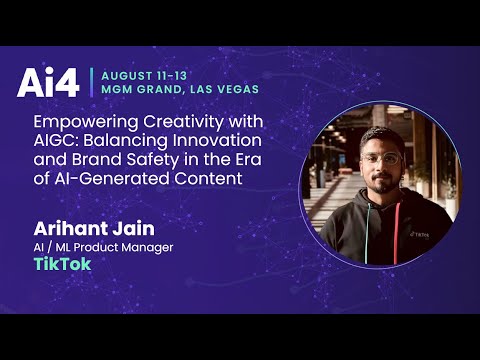
TikTok's Jain Outlines Strategy for AI Content and Brand Safety
Ai4
Enterprise adoption of AI-generated content requires a first-principles framework to capture rapid efficiency gains while preventing catastrophic brand safety risks.
## Background
This presentation was delivered by Arihant Jain, an AI/ML Product Manager at TikTok, and published on YouTube by Ai4 on August 27, 2025. According to the page description, the session explores the intersection of cutting-edge AI technology and creative industries, focusing on how brands can harness AI-Generated Content (AIGC) while ensuring brand safety, authenticity, and ethical control over their messaging.
## TL;DR
Arihant Jain outlines how AIGC is rapidly shifting from a niche innovation to a mainstream enterprise necessity, projecting massive market growth driven by demand for speed, scale, and personalization. He highlights real-world brand campaigns from Heinz, Nutella, Nike, and Virgin Voyages that showcase how AI can augment human creativity and engage audiences in novel ways. Finally, Jain framing the evolving challenges of brand safety, emphasizing that organizations must establish clear foundational principles to mitigate risks like misrepresentation, bias, and off-brand AI output.
## Atmosphere & style
The presentation carries a professional, authoritative, and educational tone suitable for industry executives, marketers, and creative professionals. Jain presents complex enterprise AI strategies through structured, logical insights and concrete real-world case studies, creating a forward-looking yet practical atmosphere. The narrative feels clear, strategic, and balanced, encouraging innovation while maintaining a grounded focus on risk mitigation and responsibility.
## Key takeaways
- [00:04](https://www.youtube.com/watch?v=ZXlZXSScIYQ&t=4s) Arihant Jain outlines first-principles foundational criteria for evaluating AIGC solutions responsibly without sacrificing brand safety.
- [01:04](https://www.youtube.com/watch?v=ZXlZXSScIYQ&t=64s) The presentation roadmap covers AIGC adoption, creative case studies, brand safety challenges, and a strategic balancing framework.
- [01:21](https://www.youtube.com/watch?v=ZXlZXSScIYQ&t=81s) AIGC encompasses text, images, video, and audio created or augmented by artificial intelligence.
- [02:01](https://www.youtube.com/watch?v=ZXlZXSScIYQ&t=121s) Enterprise adoption is accelerating, with 85% of marketers using AI content tools in 2025 and 80% of enterprises expected to integrate AI soon.
- [02:01](https://www.youtube.com/watch?v=ZXlZXSScIYQ&t=121s) The digital content market is projected to reach $90 billion by 2033, heavily driven by AI capabilities.
- [02:01](https://www.youtube.com/watch?v=ZXlZXSScIYQ&t=121s) AIGC offers massive efficiency gains by creating hundreds of creative variations in the time it takes a human to draft one, reducing physical production costs.
- [02:53](https://www.youtube.com/watch?v=ZXlZXSScIYQ&t=173s) AI functions best as an 'on-call creative assistant' that augments human creativity in a closed-loop system informed by analytics.
- [02:53](https://www.youtube.com/watch?v=ZXlZXSScIYQ&t=173s) Heinz created a viral campaign generating over 1 billion impressions by showing that AI image generators render iconic Heinz bottles for abstract ketchup prompts.
- [02:53](https://www.youtube.com/watch?v=ZXlZXSScIYQ&t=173s) Nutella leveraged AI algorithms to produce 7 million unique jar label designs that preserved distinct brand identity and sold out quickly.
- [02:53](https://www.youtube.com/watch?v=ZXlZXSScIYQ&t=173s) Nike utilized AI data modeling to simulate a match between young and mature Serena Williams to portray athletic evolution.
- [02:53](https://www.youtube.com/watch?v=ZXlZXSScIYQ&t=173s) Virgin Voyages featured an AI-themed virtual Jennifer Lopez campaign to deliver a satirical message about brand innovation.
- [06:01](https://www.youtube.com/watch?v=ZXlZXSScIYQ&t=361s) Brand safety concerns have expanded beyond external ad placement to include risks from AI-generated or AI-mimicked content harming brand reputation at scale.
## Detailed walkthrough
Here is the detailed walkthrough of the transcript:
[00:04](https://www.youtube.com/watch?v=ZXlZXSScIYQ&t=4s) Introduction and Session Objectives
Arihant Jain, a Product Manager on the AI/ML product management team at TikTok for almost three years, introduces the session focused on AI-Generated Content (AIGC). He outlines how AIGC is reshaping creative workflows and how organizations can adopt these cutting-edge capabilities without sacrificing brand safety. The presentation is tailored for creatives, marketers, brand managers, and executives seeking to leverage AI creativity responsibly. Rather than recommending specific tools, Jain focuses on first principles to provide foundational criteria for evaluating AIGC solutions.
- **Audience:** Creatives, brand managers, marketers, and executives.
- **Presentation Roadmap:**
1. The rapid rise and adoption of AIGC.
2. Inspiring examples of AI empowering creativity.
3. Brand safety challenges associated with AIGC.
4. Strategic framework to balance innovation with safety.
---
[01:21](https://www.youtube.com/watch?v=ZXlZXSScIYQ&t=81s) The Rapid Rise and Drivers of AIGC
AIGC refers to text, images, video, and audio produced or augmented by artificial intelligence. AIGC has transitioned rapidly from a niche novelty to a mainstream enterprise standard driven by exploding content demands across digital and social channels.
- **Enterprise Adoption:** 4 out of 5 enterprises are expected to integrate AI into content creation soon.
- **Marketeer Adoption:** 85% of marketers report using AI content tools in 2025.
- **Market Growth:** The digital content market is projected to reach $90 billion by 2033, heavily propelled by AI capabilities.
- **Efficiency:** AI generates hundreds of creative variations in the time it takes a human team to produce a single piece, significantly cutting down expensive physical production shoots.
---
[02:53](https://www.youtube.com/watch?v=ZXlZXSScIYQ&t=173s) Augmenting Creativity: Case Studies and Brand Campaigns
AI should be viewed as an "on-call creative assistant" that augments human creativity rather than replacing it. By analyzing engagement analytics, AI creates a closed-loop system that informs future creative strategies, producing a human-AI synergy far more effective than either operating independently.
- **Heinz Ketchup ("Heinz A.I. Ketchup"):** Heinz used an AI image generator to visualize ketchup across abstract concepts (e.g., "ketchup in outer space," "ketchup as a tarot card"). The AI consistently rendered images resembling an iconic Heinz bottle. Heinz turned these generated artwork pieces into a viral campaign asserting that "even the most unbiased AI knows that Heinz is ketchup," leading the public to submit their own prompts and generating over 1 billion worldwide impressions.
- **Nutella ("Nutella Unica"):** Nutella utilized AI algorithms to generate 7 million unique, abstract jar label designs. Every jar retained Nutella's distinct brand identity and sold out rapidly due to its consumer appeal for exclusivity.
- **Nike ("Never Done Evolving"):** Nike used AI data modeling to simulate a tennis match between a 17-year-old Serena Williams and her 35-year-old self, creating a gripping narrative on athletic evolution.
- **Virgin Voyages:** Introduced a campaign featuring a virtual "Jennifer Lopez" as Chief Celebration Officer, which was later revealed in the ad to be an AI fake played by an actor named Kyle to deliver a tongue-in-cheek message on brand innovation.
---
[06:01](https://www.youtube.com/watch?v=ZXlZXSScIYQ&t=361s) Confronting Brand Safety and AI Risk Areas
Brand safety has evolved from ensuring ads do not appear next to harmful external content to ensuring that AI-created content—or AI content generated by third parties mimicking the brand—does not harm the brand's reputation. AI acts as a double-edged sword capable of generating off-brand or problematic material at scale.
## Notable quotes
> [00:04](https://www.youtube.com/watch?v=ZXlZXSScIYQ&t=4s) Empowering Creativity with AIGC: Balancing Innovation and Brand Safety in the Era of AI-Generated Content — Arihant Jain
> [02:53](https://www.youtube.com/watch?v=ZXlZXSScIYQ&t=173s) even the most unbiased AI knows that Heinz is ketchup — Arihant Jain
## Video description
Arihant Jain, AI / ML Product Manager, TikTok
Abstracts
Empowering Creativity with AIGC: Balancing Innovation and Brand Safety in the Era of AI-Generated Content" explores the intersection of cutting-edge AI technology and the creative industries. As AI-Generated Content (AIGC) becomes a game-changer, it offers unprecedented opportunities for brands, artists, and marketers to innovate, streamline content production, and engage audiences in new ways. However, as AI becomes more integrated into the creative process, it raises important questions about brand safety, authenticity, and ethical considerations.
This discussion delves into how brands can harness the power of AIGC while maintaining control over their messaging and protecting their reputation. It emphasizes the need for a balanced approach—one that encourages creative freedom and innovation, while mitigating the risks associated with AI-generated content, such as misrepresentation, bias, or unintentional harm to brand values.
TikTok的Jain阐述AI内容与品牌安全战略
企业采用AI生成内容需要基于第一性原理的框架,以便在快速实现效率提升的同时,防范灾难性的品牌安全风险。
Arihant Jain概述了AIGC如何迅速从小众创新转变为企业的主流刚需,并预计在对速度、规模和个性化需求的推动下,该市场将迎来巨大的增长。他重点介绍了Heinz、Nutella、Nike和Virgin Voyages的实际品牌营销案例,展示了AI如何增强人类创造力并以新颖方式吸引受众。最后,Jain梳理了品牌安全不断演变的挑战,强调企业必须建立明确的基本原则,以化解虚假陈述、偏见以及偏离品牌调性的AI输出等风险。
TikTok 的 AI/ML 产品经理 Arihant Jain 探讨了 AIGC 在创意产业的应用,强调组织应从第一性原理出发建立评估体系,在加速创新的同时严格守住品牌安全底线。 (0:04)
AIGC 正在迅速走向主流,预计到 2033 年数字内容市场将达到 900 亿美元;目前已有 85% 的营销人员使用 AI 内容工具,AI 可在人类起草一个方案的时间内生成数百种创意变体。 (1:21)
AI 的最佳定位是赋能人类创意的“随叫随到创意助手”,例如 Heinz 利用 AI 图像生成工具发起趣味营销,证实即便无偏见的 AI 生成番茄酱也形似 Heinz,从而斩获超 10 亿次曝光。 (2:53)
随着 AI 大规模生产能力的提升,品牌安全已从防止广告出现在有害外部内容旁,扩展到防范 AI 自身生成偏离调性或引发公关危机的内容风险。 (6:01)
Reading summary
TikTok AI/ML Product Manager Arihant Jain outlines that artificial intelligence-generated content (AIGC) has rapidly shifted from a novelty into an enterprise standard that enhances creative scale. However, harnessing this creative velocity requires organizations to actively balance experimental production against emerging brand safety risks.
Enterprise Adoption and Scaled Production Drivers (1:21)
AIGC—encompassing AI-augmented text, images, video, and audio—is increasingly integrated into standard commercial workflows. Presentation figures indicate that 85% of marketers report utilizing AI content tools in 2025, with four out of five enterprises expected to adopt AI for content creation in the near term. Driven by expanding digital channel demands, the digital content market is projected to reach $90 billion by 2033.
Jain emphasizes that adoption is primarily accelerated by speed and scale. AI tools can produce hundreds of creative iterations in the timeframe typically required for a human team to craft a single draft, significantly lowering the expenses associated with physical production shoots.
Creative Augmentation Through Real-World Brand Campaigns (2:53)
Rather than supplanting human staff, AI operates effectively as an 'on-call creative assistant' that pairs human ideation with engagement analytics to guide ongoing creative strategy. High-profile campaigns illustrate how enterprises leverage this dynamic: Heinz launched 'Heinz A.I. Ketchup,' prompting image generators with abstract queries like 'ketchup in outer space.' Because the system consistently output Heinz-like bottles, the brand crowdsourced prompts into a viral initiative yielding over 1 billion impressions worldwide. Similarly, Nutella applied AI algorithms to generate 7 million unique label variations for its 'Nutella Unica' run, preserving core branding while selling out through product exclusivity.
Narrative modeling and synthetic personas also illustrate the medium's creative versatility. Nike modeled performance data to stage an artificial tennis match between Serena Williams at age 17 and age 35, highlighting athletic progression. Virgin Voyages featured a synthetic version of Jennifer Lopez as Chief Celebration Officer, using tongue-in-cheek messaging when the ad ultimately revealed the avatar was driven by an actor named Kyle.
Evolving Brand Safety and Reputation Risks (6:01)
The scope of brand safety has broadened beyond conventional concerns about where ads are placed. Previously focused on avoiding adjacency to inappropriate external material, brand safety now includes monitoring AI-generated outputs for off-brand messaging or problematic imagery produced at scale. Furthermore, enterprises must navigate third parties using generative tools to mimic brand assets, transforming AI into a potential vector for reputational harm.
Generative AI enables rapid production and personalization, but its scaling capacity also magnifies risks of reputational harm and unauthorized mimicry. While Jain advocates evaluating solutions using first principles rather than software-specific recommendations, the source notes conclude prior to detailing the specific strategic framework for mitigating these risks.
## Background
本视频由 Ai4 频道于 2025 年 8 月 27 日发布在 YouTube 平台。内容为 TikTok 的 AI/ML 产品经理 Arihant Jain 带来的主题分享,重点探讨生成式人工智能(AIGC)在全面赋能创意与营销领域的同时,品牌应如何在技术创新、品牌安全及声誉保护之间建立平衡。
## TL;DR
演讲从第一性原理出发,剖析了 AIGC 凭借速度、规模与成本优势重塑内容生产的爆发式浪潮,并通过亨氏、Nutella、耐克等经典营销案例展现了人机协同的无限创意潜能。随着技术普及,品牌安全的内涵已从传统的广告投放位置演变为对 AI 生成内容本身的全面把控,直面调性失控、AI 幻觉、版权争议与信任危机四大风险维度。主讲人强调人类监督(Human Oversight)是不可妥协的底线,主张结合严格的数字资产管理流程与“以 AI 监管 AI”的技术防御体系,实现创新突破与自律管控的动态平衡。
## Atmosphere & style
整场演讲兼具专业深度与幽默感,主讲人以敏锐清晰的产品逻辑和富有洞察力的比喻层层展开论述。叙事节奏在令人振奋的先锋创意案例与冷静严谨的风险剖析之间自如切换,尤其在剖析人类“偷懒天性”与把关必要性时既妙趣横生又发人深省。观众能深切感受到主讲人对 AIGC 商业潜力的敬畏,以及对建立负责任内容治理体系的迫切倡导。
## Key takeaways
- [01:21](https://www.youtube.com/watch?v=ZXlZXSScIYQ&t=81s) AIGC 正在从新奇技术全面步入主流商业应用,速度、规模化与成本节约是推动其爆发的核心动力。
- [01:21](https://www.youtube.com/watch?v=ZXlZXSScIYQ&t=81s) 调研显示,80% 的企业正在或计划将 AI 引入内容创作,预计到 2025 年有 85% 的营销人员使用 AI 工具,到 2033 年相关市场规模将超 900 亿美元。
- [02:53](https://www.youtube.com/watch?v=ZXlZXSScIYQ&t=173s) AI 不应被视为人类创意的替代品,而是全天候协同的创意副驾驶;人机协同与数据分析闭环能产生远超单一一方的效能。
- [04:28](https://www.youtube.com/watch?v=ZXlZXSScIYQ&t=268s) 亨氏、Nutella、耐克等标杆案例表明,AIGC 在极致个性化包装、虚拟历史场景重现及激发大众共创方面具备巨大商业价值与流量爆发力。
- [05:57](https://www.youtube.com/watch?v=ZXlZXSScIYQ&t=357s) 品牌安全的内涵已从传统的“广告展示位置安全”转变为“确保 AI 生成内容及用户交互内容不对品牌声誉造成反噬”。
- [07:12](https://www.youtube.com/watch?v=ZXlZXSScIYQ&t=432s) AIGC 潜藏四大核心风险维度:偏离品牌调性、质量与事实准确性缺陷(如 AI 幻觉)、法律版权归属灰色地带,以及透明度不足引发的信任危机。
- [08:45](https://www.youtube.com/watch?v=ZXlZXSScIYQ&t=525s) 面对 AIGC 时必须防范人类为了省力而放弃把关的“偷懒陷阱”,人类监督(Human Oversight)是绝对不可妥协的安全底线。
- [08:45](https://www.youtube.com/watch?v=ZXlZXSScIYQ&t=525s) 企业需建立数字资产管理系统(DAM)与严格的内容治理政策,明确圈定“AI 绝对不能创作的内容”,并坚守未获最终审批严禁发布的铁律。
- [10:36](https://www.youtube.com/watch?v=ZXlZXSScIYQ&t=636s) 以 AI 治理 AI 是应对安全风险的高效途径,可借助 NLP 文本审核、计算机视觉(CV)、零信任架构与数字水印技术构筑规模化技术防御体系。
- [10:36](https://www.youtube.com/watch?v=ZXlZXSScIYQ&t=636s) AIGC 治理是一场持续演进的动态博弈,唯有在大胆拥抱技术创新与保持自律严谨管控之间找到平衡的品牌,才能赢得长久的消费者信任。
## Detailed walkthrough
### [00:04](https://www.youtube.com/watch?v=ZXlZXSScIYQ&t=4s) 开场与演讲路线图:从第一性原理审视 AIGC
在 TikTok 担任产品经理近三年的 Arihant Jain 开启了本场分享。他明确指出,本次演讲专为创意人员、营销人员、品牌经理以及企业高管量身打造,核心探讨生成式人工智能(AIGC)如何彻底重塑创意工作流,以及如何在拥抱技术创新的同时坚守“品牌安全”(Brand Safety)。Arihant 强调,本次分享不旨在推销或推荐具体工具,而是聚焦于底层的第一性原理(First Principles),帮助大家建立一套清晰的评估维度,以便未来选择最适合自身业务的解决方案。
随后,他梳理了整场演讲的推进脉络:首先剖析 AI 在内容创作领域的爆发式增长及其背后的驱动力;接着通过一系列富有启发性的行业前沿案例展示 AI 如何赋能创意;随后直面 AIGC 带来的品牌安全与声誉风险;最后给出兼顾创新与安全的实用策略,引导大家建立负责任的 AIGC 实践体系。
### [01:21](https://www.youtube.com/watch?v=ZXlZXSScIYQ&t=81s) AIGC 的爆发式崛起与核心驱动力
Arihant 将 AIGC 定义为由人工智能生成或增强的各类内容,涵盖文本、图像、视频及音频等多种形式。AIGC 已经从最初的技术新奇事物全面迈入主流商业应用,其普及速度令人瞩目。随着社交媒体和数字化渠道对内容产出的需求呈爆炸式增长,传统的人工产能已无法满足这一规模化诉求,而 AI 恰好补足了这一缺口。
驱动这场 AIGC 变革的核心动力可以总结为“速度、规模化与成本节约”。AI 能够在人工团队构思单个方案的时间内生成数百种变体,甚至可以直接用 AI 虚拟模特替代成本高昂的实地拍摄。此外,AI 带来了深度的个性化定制能力,并催生出虚拟品牌代言人等全新内容形态;与此同时,激烈的行业竞争也倒逼各大品牌必须加速拥抱 AI,否则便面临被时代淘汰的风险。
- 调研显示,80%(五分之四)的企业即将或正在将 AI 应用于内容创作。
- 预计到 2025 年,将有 85% 的营销人员使用 AI 内容工具。
- 在 AI 技术的强劲驱动下,内容市场规模预计到 2033 年将突破 900 亿美元。
### [02:53](https://www.youtube.com/watch?v=ZXlZXSScIYQ&t=173s) 创意赋能与人机协同:亨氏(Heinz)经典营销案例
Arihant 指出,理解 AI 的正确视角并非将其视作人类创意的“替代品”,而是将其当作全天候待命的“创意副驾驶”或智能助手。更重要的是,AI 不仅能执行创作,还具备持续学习与分析能力。许多现代平台内置了 AI 分析功能,能够反哺哪些内容效果最好,并指导创作者迭代优化创意策略,形成闭环。人类与 AI 协同组成的团队,其效能与创意爆发力远超任何单一一方。
```
+------------------+ +------------------+
| 人类创意策略 | ------> | AI 快速生成 |
| (Human Strategy) | | (AIGC Generation)|
+------------------+ +------------------+
^ |
| +----------------+ |
+---- | 数据洞察闭环 | <----+
| (Analytics/Loop|
+----------------+
```
为了具象化展示这种人机协同的力量,Arihant 分享了亨氏番茄酱(Heinz Ketchup)的经典 AI 营销战役。亨氏为了与年轻一代建立更紧密的连接并巩固其标志性品牌地位,团队尝试使用当时前沿的 AI 图像生成模型绘制番茄酱。有趣的是,无论提示词给得多么离谱——比如“太空中的番茄酱”或是“塔罗牌风格的番茄酱”——AI 生成的图像瓶身上总是带有辨识度极高的亨氏标志与瓶型。亨氏敏锐地抓住这一“梦幻结果”,顺势发起营销战役,向全世界宣告:"看吧,连最客观中立的 AI 都认定番茄酱就是亨氏。" 随后,他们还邀请全球网友自由输入疯狂的提示词参与共创并在网络上分享,最终在全球范围内斩获了超过 10 亿次的曝光量。
### [04:28](https://www.youtube.com/watch?v=ZXlZXSScIYQ&t=268s) 行业标杆案例:Nutella、Nike 与维珍邮轮的创意突破
除了亨氏,Arihant 还列举了多个展示 AIGC 商业潜力的标杆案例:
在极致个性化方面,Nutella 推出了“Unica”营销活动,利用 AI 生成了 700 万款独一无二的包装瓶图案。尽管每个瓶身上的抽象纹理各不相同,但整体视觉依然保有鲜明无误的 Nutella 品牌特征。这批限量包装上市后迅速被抢购一空,印证了消费者对专属感与独特性设计的狂热追求。
在叙事与技术融合方面,耐克(Nike)在《Never Done Evolving》战役中借助 AI 实现了以往不可能完成的构想:让网坛传奇塞雷娜·威廉姆斯(Serena Williams)与年轻时的自己同场竞技。耐克通过深入分析威廉姆斯职业生涯的海量比赛数据和击球风格,模拟并生成了一场 17 岁的塞雷娜对阵 35 岁的塞雷娜的虚拟球赛,将技术突破与震撼人心的运动员成长史诗完美结合。
维珍邮轮(Virgin Voyages)则打出了一张充满幽默感的创意牌。他们推出了一位所谓的虚拟代言人——“首席庆祝官”詹妮弗·洛佩兹(Jennifer Lopez),但随后在广告中主动揭穿这是一个由一位名叫 Kyle 的普通员工操控的 AI 深度伪造(Deepfake)形象。这种意料之外的反转不仅引爆了网络笑点,更以一种自嘲和玩世不恭(tongue-in-cheek)的姿态树立了品牌敢于创新的先锋形象。Arihant 总结道,AIGC 固然能制造引人入胜的优质内容并带来巨大流量,但关键在于“聪明地使用它”,确保创意始终契合品牌调性,并顺应公众的情感预期。
### [05:57](https://www.youtube.com/watch?v=ZXlZXSScIYQ&t=357s) 重新定义品牌安全:从“展示位置”到“内容生成本身”
在享受 AIGC 带来的无限创意可能时,品牌声誉的护城河建设刻不容缓。Arihant 强调,在传统数字营销语境中,品牌安全主要意味着“别让我的广告出现在某些令人不适或违规的不良网页旁边”。然而在生成式 AI 时代,品牌安全的内涵发生了质的变化:它演变为确保“我们自己使用 AI 生成的内容,或者外部公众借助 AI 与我们品牌互动产生的内容,绝不会对品牌声誉造成反噬”。
AI 是一把锋利的双刃剑,它在赋予团队规模化创作能力的同时,也在成倍放大潜在的风险敞口。试想一下,当营销团队借助 AI 工具在短时间内生成数百张海报或社交媒体文案时,如果缺乏严密的人工审核与把控,夹带偏离品牌调性或存在致命问题的内容流向市场的概率就会急剧攀升。此外,深度伪造与虚假信息的泛滥使品牌极易被外部恶意模仿——竞争对手或恶搞者只需动动手指,就能利用 AI 工具秒级复制品牌的视觉风格与专属 IP 形象,炮制出真假难辨的恶搞甚至抹黑内容。因此,当下的品牌安全核心在于对内容本身及其生产全流程的把控。
### [07:12](https://www.youtube.com/watch?v=ZXlZXSScIYQ&t=432s) 拆解 AIGC 的四大核心风险维度
Arihant 进一步将 AIGC 带来的潜在危机拆解为四个具体领域:
第一是**偏离品牌调性或输入输出失控(Off-brand Outputs)**。AI 本质上并不天生懂得某个品牌的具体视觉规范与语气调性(Brand Guidelines),除非经过精细的调优与训练,否则极易生成事实错误或语调荒谬的内容。正如 TikTok 内部团队常说的:“界定什么是‘坏内容’,往往比界定什么是‘好内容’要困难得多。”Arihant 分享了一起内部团队的真实经历:某营销团队利用 AI 批量生成了多达 16 个版本的 Banner 广告,但在发布前夕险些误发了一条包含错误核心主张的文案。一旦违背品牌核心价值观的图像或标语公之于众,后果不堪设想。
第二是**内容质量与准确性缺陷(Quality & Accuracy)**。大语言模型常常会极其自信地输出虚假事实,即众所周知的“AI 幻觉”(Hallucinations);而在图像生成领域,多长一根手指等诡异细节 artifact 屡见不鲜,虽然可能偶尔引发病毒式传播,但从宏观品牌形象来看却是严重的品质瑕疵。
第三是**法律合规与版权归属(Legal & Ownership)**。AI 生成内容的版权归属目前在法律上依然处于巨大的灰色地带,企业在商用层面对优质与违规内容的界定仍在摸索中。
第四是**透明度与消费者信任(Transparency & Trust)**。在虚假新闻与合成图片泛滥的当下,公众对于 AI 虚假信息高度敏感。调查显示,高达 94% 的受众对 AI 驱动的虚假信息感到担忧。如果一家品牌被发现利用 AI 欺瞒消费者,哪怕仅仅是暗中隐瞒 AI 的使用,都会瞬间摧毁长期建立的用户信任。
### [08:45](https://www.youtube.com/watch?v=ZXlZXSScIYQ&t=525s) 人机协同的防线:严谨治理与防范“偷懒陷阱”
针对如何兼收 AI 的高效与创意、同时规避潜在深坑的问题,Arihant 坚定地指出:“人类的监督(Human Oversight)是绝对不可妥协的前提。”
随后,他幽默地剖析了人类的天性:“从进化论的角度来看,我们天生倾向于选择阻力最小的路径——只要能省力,大脑就会千方百计地偷懒。这也是为什么人类发明了椅子、自动扶梯,以及邮箱里那个‘全部标为已读’的按钮。”然而,在面对 AI 时,为了省力而忽略细节无异于“看都不看就直接在一份法律合同上签字”。这种做法在当下可能让人感觉高效,但直到某一天 AI 意外发布了一条“全场商品一折大促销(99% off)”的乌龙公告时,灾难便已无法挽回。
为此,Arihant 提出了几条行之有效的内容治理策略:
1. **拥抱真实性与透明度**:在大量使用 AI 生成内容时,积极考虑向公众主动披露,守护用户的知情权。
2. **构建严格的数字资产工作流**:引入数字资产管理系统(DAM),对所有 AI 生成的初稿进行结构化存储、打标分类与人工复核,形成严密闭环,坚决执行“未获最终审批标记(Marked Final and Approved),一律严禁对外发布”的铁律。
3. **制定清晰的内容治理政策**:尽管制定边界极其繁琐且具有挑战性,但企业必须提前明确圈定“AI 可以创作什么”以及更为关键的“AI 绝对不能创作什么(What AI cannot create)”。
4. **建立应急响应预案**:针对面向用户的交互式 AI 工具,即便内置了安全过滤机制,依然存在被恶意滥用的风险。企业必须进行主动监控并制定完善的公关危机预案,绝不能等到事故发生后再仓促应对。
### [10:36](https://www.youtube.com/watch?v=ZXlZXSScIYQ&t=636s) 技术防御体系与总结:以 AI 治理 AI
在技术防御层面,Arihant 提出了一个颇具哲理的观点:应对 AI 风险最有效的武器之一,恰恰是“把 AI 本身当作监管守门犬(Watchdog)”。在实际落地中,可以通过多层次的技术防线来规模化保障品牌安全:
- **自然语言处理(NLP)**:用于实时扫描与检测文本中的仇恨言论、违规语调及事实性错误。
- **计算机视觉(CV)**:用于筛查图像和视频中的违规视觉元素与视觉畸变。
- **零信任架构(Zero Trust)**:将网络安全领域的“持续验证、永不信任”理念全面复刻至 AIGC 内容生产与审核流水线中。
- **数字水印技术(Watermarking)**:通过前沿的隐形水印追踪内容的原始出处,精准辨别原创资产与二次修改内容。
Arihant 总结道,内容治理是一场持续演进的动态博弈,企业必须定期更新安全过滤器、审核规则与底层模型,将硬核技术防线与敏锐的人工裁决深度结合,以敏捷适应不断变化的合规环境与公众意识。
在演讲尾声,Arihant 强调,AIGC 的浪潮已不可逆转,它正在深刻重塑人类创造与连接的方式。前方蕴藏着巨大的商业机遇——从充满魔力的创意战役到极致的个性化触达,但随之而来的责任也同样重大。唯有那些在“大胆拥抱创新”与“保持自律管控”之间找到完美平衡的品牌,才能不仅收获眼前的流量,更能赢得消费者持久的忠诚与尊重。最后,Arihant 还不忘为母公司字节跳动(ByteDance)的内部技术产品进行推介,呼吁感兴趣的同行与团队代表 Sean 进一步接洽交流。
## Notable quotes
> [00:04](https://www.youtube.com/watch?v=ZXlZXSScIYQ&t=4s) 本次分享不旨在推销或推荐具体工具,而是聚焦于底层的第一性原理(First Principles),帮助大家建立一套清晰的评估维度 — Arihant Jain
> [02:53](https://www.youtube.com/watch?v=ZXlZXSScIYQ&t=173s) 理解 AI 的正确视角并非将其视作人类创意的“替代品”,而是将其当作全天候待命的“创意副驾驶”或智能助手 — Arihant Jain
> [02:53](https://www.youtube.com/watch?v=ZXlZXSScIYQ&t=173s) 看吧,连最客观中立的 AI 都认定番茄酱就是亨氏 — Arihant Jain
> [04:28](https://www.youtube.com/watch?v=ZXlZXSScIYQ&t=268s) AIGC 固然能制造引人入胜的优质内容并带来巨大流量,但关键在于“聪明地使用它”,确保创意始终契合品牌调性,并顺应公众的情感预期 — Arihant Jain
> [05:57](https://www.youtube.com/watch?v=ZXlZXSScIYQ&t=357s) 我们自己使用 AI 生成的内容,或者外部公众借助 AI 与我们品牌互动产生的内容,绝不会对品牌声誉造成反噬 — Arihant Jain
> [07:12](https://www.youtube.com/watch?v=ZXlZXSScIYQ&t=432s) 界定什么是‘坏内容’,往往比界定什么是‘好内容’要困难得多 — Arihant Jain
> [08:45](https://www.youtube.com/watch?v=ZXlZXSScIYQ&t=525s) 人类的监督(Human Oversight)是绝对不可妥协的前提 — Arihant Jain
> [08:45](https://www.youtube.com/watch?v=ZXlZXSScIYQ&t=525s) 从进化论的角度来看,我们天生倾向于选择阻力最小的路径——只要能省力,大脑就会千方百计地偷懒。这也是为什么人类发明了椅子、自动扶梯,以及邮箱里那个‘全部标为已读’的按钮 — Arihant Jain
> [08:45](https://www.youtube.com/watch?v=ZXlZXSScIYQ&t=525s) 在面对 AI 时,为了省力而忽略细节无异于“看都不看就直接在一份法律合同上签字” — Arihant Jain
> [08:45](https://www.youtube.com/watch?v=ZXlZXSScIYQ&t=525s) 未获最终审批标记(Marked Final and Approved),一律严禁对外发布 — Arihant Jain
> [10:36](https://www.youtube.com/watch?v=ZXlZXSScIYQ&t=636s) 把 AI 本身当作监管守门犬(Watchdog) — Arihant Jain
> [10:36](https://www.youtube.com/watch?v=ZXlZXSScIYQ&t=636s) 唯有那些在“大胆拥抱创新”与“保持自律管控”之间找到完美平衡的品牌,才能不仅收获眼前的流量,更能赢得消费者持久的忠诚与尊重 — Arihant Jain
## Mentioned
Arihant Jain, TikTok, 字节跳动 (ByteDance), 亨氏 (Heinz), Nutella, 耐克 (Nike), 塞雷娜·威廉姆斯 (Serena Williams), 维珍邮轮 (Virgin Voyages), 詹妮弗·洛佩兹 (Jennifer Lopez), Kyle, Sean, Unica, Never Done Evolving
## Video description
Arihant Jain, AI / ML Product Manager, TikTok
Abstracts
Empowering Creativity with AIGC: Balancing Innovation and Brand Safety in the Era of AI-Generated Content" explores the intersection of cutting-edge AI technology and the creative industries. As AI-Generated Content (AIGC) becomes a game-changer, it offers unprecedented opportunities for brands, artists, and marketers to innovate, streamline content production, and engage audiences in new ways. However, as AI becomes more integrated into the creative process, it raises important questions about brand safety, authenticity, and ethical considerations.
This discussion delves into how brands can harness the power of AIGC while maintaining control over their messaging and protecting their reputation. It emphasizes the need for a balanced approach—one that encourages creative freedom and innovation, while mitigating the risks associated with AI-generated content, such as misrepresentation, bias, or unintentional harm to brand values.
[Source](https://www.youtube.com/watch?v=ZXlZXSScIYQ)
Source quotes
[0:04] Arihant Jain: 本次分享不旨在推销或推荐具体工具,而是聚焦于底层的第一性原理(First Principles),帮助大家建立一套清晰的评估维度
[2:53] Arihant Jain: 理解 AI 的正确视角并非将其视作人类创意的“替代品”,而是将其当作全天候待命的“创意副驾驶”或智能助手
[2:53] Arihant Jain: 看吧,连最客观中立的 AI 都认定番茄酱就是亨氏
[4:28] Arihant Jain: AIGC 固然能制造引人入胜的优质内容并带来巨大流量,但关键在于“聪明地使用它”,确保创意始终契合品牌调性,并顺应公众的情感预期
[5:57] Arihant Jain: 我们自己使用 AI 生成的内容,或者外部公众借助 AI 与我们品牌互动产生的内容,绝不会对品牌声誉造成反噬
[7:12] Arihant Jain: 界定什么是‘坏内容’,往往比界定什么是‘好内容’要困难得多
[8:45] Arihant Jain: 人类的监督(Human Oversight)是绝对不可妥协的前提
[8:45] Arihant Jain: 从进化论的角度来看,我们天生倾向于选择阻力最小的路径——只要能省力,大脑就会千方百计地偷懒。这也是为什么人类发明了椅子、自动扶梯,以及邮箱里那个‘全部标为已读’的按钮
[8:45] Arihant Jain: 在面对 AI 时,为了省力而忽略细节无异于“看都不看就直接在一份法律合同上签字”
[8:45] Arihant Jain: 未获最终审批标记(Marked Final and Approved),一律严禁对外发布
[10:36] Arihant Jain: 把 AI 本身当作监管守门犬(Watchdog)
[10:36] Arihant Jain: 唯有那些在“大胆拥抱创新”与“保持自律管控”之间找到完美平衡的品牌,才能不仅收获眼前的流量,更能赢得消费者持久的忠诚与尊重
Source quotes
[0:04] Arihant Jain: Empowering Creativity with AIGC: Balancing Innovation and Brand Safety in the Era of AI-Generated Content
[2:53] Arihant Jain: even the most unbiased AI knows that Heinz is ketchup
Original transcript
[0:04] Good morning all. Um I'm Arian Jen, part
[0:06] of the product management team at Tik
[0:07] Tok where I've been there for almost
[0:09] three years now. Um today we are
[0:12] exploring AI generated content also
[0:14] known as AIGC. Um how it's transforming
[0:17] creative workflows and how we can
[0:19] embrace this innovation while
[0:20] safeguarding brand safety.
[0:23] This talk is for creatives, marketers,
[0:26] brand managers, and executives who want
[0:29] to leverage AI creativity without
[0:31] compromising brand safety. We'll focus
[0:33] on first principles
[0:35] um not big on recommending specific
[0:37] tools right now. So, you'll leave with
[0:39] key considerations you need to choose um
[0:42] the solutions that best fit your needs.
[0:45] I'll share some examples of AIG in
[0:46] action and discuss strategies to balance
[0:48] cutting edge creativity with brand
[0:50] protection.
[0:53] So
[0:57] uh here's our road map. We'll start with
[0:59] rapid rise of AI and content creation.
[1:02] Then highlight how it empowers
[1:03] creativity with some inspiring examples.
[1:06] Next, we'll confront the brand safety
[1:08] challenges that come with AI generated
[1:10] content. Finally, I'll outline
[1:12] strategies to balance innovation with
[1:14] safety. So you leave with practical
[1:16] insights of responsible AIGC.
[1:21] So the rise of AIGC
[1:25] AIGC is mostly defined as content
[1:28] created or augmented by AI producing
[1:31] text, images, video, audio, etc.
[1:35] AI generated content um has moved from
[1:38] being a novelty to mainstream. Um when
[1:42] we say I AIGC, we mean any creative
[1:44] output where AI plays a role.
[1:47] The adoption is staggering. Studies show
[1:50] that four out of five enterprises will
[1:51] soon use AI in content creation.
[1:53] Marketers are jumping on board in 2025.
[1:57] 85% of market um um marketeers use AI
[2:01] content tools.
[2:03] But why why why exactly right? Because
[2:05] the content demands of social media and
[2:07] digital channels have exploded and AI
[2:10] helps meet that scale. The content
[2:13] market is growing fast, projected to hit
[2:16] 90 billion by 2033, largely thanks to AI
[2:19] capabilities.
[2:23] So what's driving this AIGC revol
[2:25] revolution? Speed, scale, and cost
[2:27] savings. AI can create hundreds of
[2:30] variations in the time it takes human
[2:32] team to create one. Even replacing
[2:35] expensive shoots with AI generated
[2:37] models. It also enables deep
[2:41] personalization entirely in new formats
[2:43] like virtual brand ambassadors while
[2:45] competitive pressure pushes brands to
[2:47] adopt it before you know they're left
[2:49] behind.
[2:53] So empowering creativity think of AI not
[2:56] as replacing your creativity but as
[2:58] augmenting it. It's like having an on
[3:00] call creative assistant.
[3:02] Moreover, AI doesn't just create, it
[3:04] learns. Many platforms offer analytics
[3:06] where AI examines what content works
[3:09] best and can guide you to refine your
[3:11] creative strategy. A creative loop per
[3:13] se.
[3:14] The result is a human AI team that's
[3:17] more creative effective
[3:19] than either alone.
[3:22] Quickly going through a case study, the
[3:24] Hines SketchUp campaign. Um,
[3:28] Hines wanted to stay relevant with
[3:30] younger consumers and highlight iconic
[3:33] status
[3:34] uh of their brand. Their team had a
[3:37] brilliant idea. Use a cutting edge AI
[3:39] image generator to visualize ketchup.
[3:42] They found that no matter what prom they
[3:44] gave ketchup
[3:45] um such as ketchup in outer space,
[3:47] ketchup as a tarot card, the AI kept
[3:50] producing something that looked like a
[3:52] Hines bottle. This was this was a dream
[3:55] outcome. Hines turned these AI artworks
[3:57] into a campaign and basically saying see
[4:00] even the most unbiased AI
[4:03] knows that Hines is the ketchup.
[4:07] They didn't stop there. They engaged
[4:08] with public asking them to come up with
[4:10] their own crazy ketchups, prompts,
[4:13] shares
[4:14] and and promoting those AI results
[4:16] online. This campaign then resulted in
[4:19] you know having more than a billion
[4:21] impression worldwide for a brand like
[4:23] Hindus that
[4:28] other notable examples of AIGC um we are
[4:31] seeing AIdriven creativity bloom across
[4:34] the board. Nutella's unika campaign
[4:37] leverage AI to tap into consumers love
[4:39] for personalization that produced 7
[4:41] million unique jar designs uh abstract
[4:44] patterns generated by AI. Yet every jar
[4:47] still looked unmistakably, you know,
[4:49] like Nutella. They sold out fast,
[4:52] proving people, you know, love
[4:54] exclusivity.
[4:56] Um, and Nike took a different angle with
[4:58] never done evolving. They actually used
[5:01] AI to do something previously
[5:02] impossible. Pit Serena Williams against
[5:05] her younger self. By analyzing her style
[5:08] um of play through data, they generated
[5:10] a simulated match between the
[5:11] 17-year-old Serena and the 35-year-old
[5:13] Serena.
[5:15] It was gripping um it was a gripping
[5:17] narrative on athletic evolution and
[5:20] technical feat. Same with Virgin
[5:22] Voyages, you know, had a fun campaign
[5:24] where um they introduced virtual
[5:27] Jennifer Lopez as their chief
[5:29] celebration officer. Then revealing um
[5:32] in that ad that it was an AI fake played
[5:35] by a guy called Kyle. The twist not only
[5:38] got laughs but also suddenly showed that
[5:40] Virgin Voyages is innovative and tongue
[5:41] and cheek. The key point here is AIGC
[5:44] can produce engaging content, drive huge
[5:47] engagement, but using it smartly is
[5:50] crucial to stay on brand and on the
[5:52] right side of public sentiment.
[5:57] So now alongside all this excitement, we
[6:01] have to talk about brand safety.
[6:03] Basically protecting your brand's
[6:04] reputation in this wild west of content.
[6:07] Traditionally, brand safety meant don't
[6:10] let my ads show up next to some horrible
[6:13] stuff online. Now, in AIG era, it's also
[6:17] means making sure the content we create
[6:19] or that others create with AI doesn't
[6:21] backfire on us. AI essentially is a
[6:23] double-edged sword. It empowers content
[6:25] creation, but also produces risky
[6:27] content at scale. Think about the volume
[6:30] your team might generate um you know,
[6:32] let's say hundreds of AI images or posts
[6:34] for a campaign without careful
[6:36] oversight. the chances of off-brand or
[6:38] problematic piece getting out there is
[6:40] higher.
[6:42] Again, the problems of defakes and
[6:43] misinformation is very very uh wellnown.
[6:49] Moreover, uh AI makes it easier for
[6:51] others to mimic your brand. A competitor
[6:53] or a prankster could use an AI tool to
[6:55] copy your ad style or brand characters
[6:57] and create spoof content within seconds.
[7:01] Um and hence, so brand safety now isn't
[7:04] just about where your ads appear. It's
[7:06] also a lot more about the content itself
[7:08] and how to control it in AI era.
[7:12] So let's break down the specific risk
[7:14] areas with EIGC.
[7:18] First off brandand or wrong in or
[7:20] outputs or inputs. AI doesn't inherently
[7:22] know your brand's guidelines. Unless you
[7:25] teach it, it might crack out content
[7:27] that's way off in tone or facts. As we
[7:30] say, you know, within our teams in Tik
[7:32] Tok, it's much harder to define what is
[7:34] bad content versus a good content.
[7:38] Our marketing team made um one marketing
[7:41] team made 60 versions of AI versions, 60
[7:44] versions, 16 AI versions of banner ad
[7:46] and almost published the wrong one with
[7:48] incorrect messaging. Imagine a slogan or
[7:51] image going out that contradicts your
[7:53] brand ethos. Quality and accuracy. We we
[7:56] very well know AI text can sometimes
[7:58] generate false information confidently.
[8:01] Those are called hallucinations
[8:04] in a very subtle way. AI images can have
[8:06] weird artifacts like an extra finger on
[8:09] a hand can help you go viral but also
[8:12] not look good in a bigger picture.
[8:15] So legal issues a huge ownership of AI
[8:17] generated content is a gray area. gray
[8:19] area which is good content, bad content
[8:22] but something in between which we are
[8:23] still struggling to define.
[8:25] Finally, transparency and trust. We live
[8:27] in a time of fake news and altered
[8:28] images. Nearly 94% of the people are
[8:31] concerned about AI misinformation. If a
[8:33] brand is found to be using AI to deceive
[8:35] or even just using it secretly, it can
[8:38] break consumer trust.
[8:45] So, how do we get the best of both
[8:46] worlds? AI's creativity and efficiency
[8:49] without the pitfalls. Well, it starts
[8:51] with acknowledging that human oversight
[8:53] is non-negotiable. And I get it.
[8:55] Evolution has wired us to take the path
[8:57] of least resistance. If there's a way to
[9:00] save energy, our brains will find it.
[9:02] That's why we've invented chairs,
[9:03] escalators, and mark all as red button
[9:06] in email. But here's the thing. When it
[9:08] comes to AI, skipping the details to
[9:10] save energy is signing a legal contract
[9:12] without reading it. It feels efficient
[9:15] until AI accidentally announces a flash
[9:17] sale of 99% off on your products. Don't
[9:20] skip the details.
[9:24] Let's get some practical um u with some
[9:27] let's get practical with some
[9:29] strategies. Sorry for the intendation.
[9:32] Authenticity and transparent
[9:33] authenticity and transparency are key
[9:35] audience value uh are are key drivers
[9:38] that audience value. If you you've used
[9:42] AI heavily considering you know
[9:43] disclosing it
[9:46] enforce rigorous workflow use digital
[9:49] asset management DAM systems to store
[9:52] tag review all AI generated drafts this
[9:55] creates a loop nothing should be
[9:58] published unless it is marked final and
[10:00] approved.
[10:01] Again clear content governance policies
[10:04] very hard to define very tricky uh can
[10:06] be very stressful but decide in advance
[10:09] what AI can and cannot create cannot is
[10:11] very very very important.
[10:14] Um again foster culture of responsible
[10:16] AI use
[10:18] for userf facing AI tools you know embed
[10:20] with with embedded filters and you know
[10:22] whatever modernization it has come with
[10:24] there is a chance of misuse. So actively
[10:26] monitor it and plan for incidents which
[10:29] is very important. Don't wait for it to
[10:31] happen and then take your time to
[10:33] respond. Be prepared.
[10:36] So on the tech side, there are useful,
[10:38] you know, there are some powerful tools
[10:39] to enforce brand safety at scale. Um,
[10:42] ironically, one of the best ways to
[10:43] manage AI risks is to use AI as a
[10:45] watchdog.
[10:48] For text, we have modern natural
[10:50] language processing that can detect head
[10:52] speech. For images and videos, we have
[10:53] computer vision. Then we have DAM
[10:55] systems. We have zero trust approaches
[10:57] which we have been using in in the space
[10:59] of cyber security should be replicated
[11:01] in space of AIGC as well. And there's
[11:04] something called as watermarking which
[11:06] has also explored which has which has
[11:10] experienced great innovations in terms
[11:13] of detecting what your original content
[11:14] is versus repurposed.
[11:18] It's an ever evolving challenge. Update
[11:20] filters, policies, AI models regularly.
[11:23] Pair technology with human oversightes.
[11:25] um to to adapt as risks and norms
[11:28] change.
[11:31] So in closing, AI generated content is
[11:33] here to stay, reshaping how we create
[11:35] and connect. The opportunity is massive,
[11:38] magical campaigns, deep
[11:40] personalizations, and unprecedented
[11:42] efficiency. But so is the
[11:44] responsibility.
[11:46] Brands that balance bold innovation with
[11:48] discipline
[11:49] control will know not only to inspire
[11:53] but learn lasting loyalty.
[11:57] Thank you. I can't wait for you uh you
[11:59] know to use your time and energy to be
[12:02] creative with AI and do it safely and
[12:04] authentically. One unapologetic shout
[12:07] out to you know um a key product that
[12:10] Bite Dance is working on right now which
[12:12] is Tik Tok's parent company. uh please
[12:14] talk to Sean. Um we are on an endeavor
[12:18] to produce a lot of key innovations
[12:20] internally and sell it out as service
[12:22] and Sean Sean here can help you out.
[12:24] Thank you.
[12:26] [Applause]