McDonald's AI Chief Deploys Autonomous Agents to Fix Store Outages
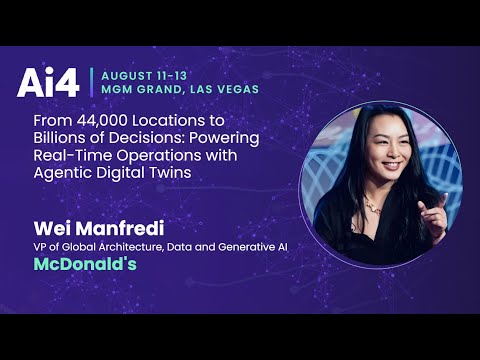
The Future of Retail Operations: Agentic AI Twin That Never Sleeps With McDonald's — Ai4

Ai4

McDonald's is deploying agentic digital twins that automatically reorder inventory, adjust digital menus in real time, and dispatch technicians to prevent operational failures.

AI-assisted summary of The Future of Retail Operations: Agentic AI Twin That Never Sleeps With McDonald's — original source. Check the original for full context.

Source published:

Detailed notes

## Background This talk was published on YouTube by Ai4 on August 27, 2025. Based on the page description, Wei Manfredi, VP of Global Architecture, Data and Generative AI at McDonald's, explores the future of retail operations through agentic digital twins that actively intervene in real time to optimize store workflows, prevent hardware downtime, and manage supply chain disruptions.

## TL;DR Wei Manfredi presents how traditional retail's slow, reactive operational model can be transformed using agentic digital twins. Drawing on personal experiences from food service and McDonald's vast global scale of nearly 44,000 restaurants, she outlines an evolution from passive digital twins to active, autonomous AI agents. Specialized 'Super Agents' monitor equipment, manage kitchen prep, dynamic menu boards, and inventory in real time to keep service times under tight thresholds like 90 seconds even during unexpected surges.

## Atmosphere & style The session begins with a warm, empathetic, and lighthearted tone as Manfredi connects with an audience sitting in a Las Vegas casino after a long day of conference presentations. She blends reflective personal storytelling about a chaotic student waitressing shift with forward-looking technologist insight. The presentation feels inspiring, practical, and visionary, shifting from the emotional helplessness of human operational errors to the modern empowerment offered by AI 'superpowers.'

## Key takeaways - [00:04](https://www.youtube.com/watch?v=h9Mnak6Tk7Y&t=4s) Wei Manfredi presents AI as a technological superpower capable of providing end-to-end visibility across complex, global retail systems. - [00:23](https://www.youtube.com/watch?v=h9Mnak6Tk7Y&t=23s) Traditional retail suffers from a 'broken nervous system' where sensing is localized, analysis relies on static BI dashboards, and enterprise-wide action is nearly impossible. - [00:23](https://www.youtube.com/watch?v=h9Mnak6Tk7Y&t=23s) McDonald's operates roughly 44,000 restaurants globally, generating over 200,000 daily decision points that exceed human manual capacity. - [00:41](https://www.youtube.com/watch?v=h9Mnak6Tk7Y&t=41s) Operational failures in QSR environments carry high human and business costs, especially when target service times are under 2 minutes. - [08:02](https://www.youtube.com/watch?v=h9Mnak6Tk7Y&t=482s) Retail technology has evolved from standard digital twins ('rearview mirrors') to agentic AI ('self-driving systems') capable of autonomous analysis and execution. - [08:02](https://www.youtube.com/watch?v=h9Mnak6Tk7Y&t=482s) Agentic digital twins operate on a closed-loop system: edge signal capture, agent analysis, human-in-the-loop validation, and remote action execution. - [11:19](https://www.youtube.com/watch?v=h9Mnak6Tk7Y&t=679s) Domain-specific 'Super Agents' (Kitchen, Maintenance, Service, Supply) manage distinct aspects of QSR operations independently and collaboratively. - [11:19](https://www.youtube.com/watch?v=h9Mnak6Tk7Y&t=679s) Agentic AI can automatically handle unexpected operational surges by placing automated replenishment orders and summoning off-duty crew members. - [13:48](https://www.youtube.com/watch?v=h9Mnak6Tk7Y&t=828s) McDonald's China serves as the primary benchmark market for integrating agentic AI into store systems and unified Super App ecosystems. - [13:48](https://www.youtube.com/watch?v=h9Mnak6Tk7Y&t=828s) Agentic systems enable instant dynamic menu updates to turn off unavailable items, replacing legacy software processes that took hours to refresh. - [13:48](https://www.youtube.com/watch?v=h9Mnak6Tk7Y&t=828s) Deploying agentic autonomy helps high-volume locations maintain stringent sub-90-second service targets during unexpected customer rushes.

## Detailed walkthrough Here is a detailed, faithful walkthrough of the transcript.

---

[00:04](https://www.youtube.com/watch?v=h9Mnak6Tk7Y&t=4s) Introduction and Childhood Superpower Dreams

Wei Manfredi, VP of Global Architecture, Data, and AI Engineering at McDonald's, opens the session with a lighthearted check-in with the audience. Acknowledging that after a long day of sessions in a warm room their brains might be near capacity, she invites everyone to relax, enjoy some storytelling, and take a breather. Clarifying her role, she explains that while she leads McDonald's data and AI engineering function and global architecture, she is presenting as a technologist sharing industry-wide observations and learnings accumulated over years in retail.

Setting the stage inside a Las Vegas casino surrounded by flashing slot machines, Manfredi asks the audience how many of them still harbor the dream of changing the world. She shares her own childhood dream: wanting to become a "superwoman" who could see everything regardless of distance or obstacles. Today, she realizes that modern artificial intelligence provides technologists with the exact capability to achieve that kind of superhuman visibility and impact.

- **Speaker Role:** Wei Manfredi, VP of Global Architecture, Data, and Generative AI at McDonald's. - **Audience Hook:** Reflection on childhood dreams of changing the world while walking through an Ai4 conference venue inside a casino. - **Key Theme:** Leveraging AI as a technological "superpower" to see through complex operational systems.

---

[00:23](https://www.youtube.com/watch?v=h9Mnak6Tk7Y&t=23s) The Broken "Nervous System" of Traditional Retail

Manfredi diagnoses a core vulnerability across the retail sector, asserting that the traditional retail industry operates with a "broken nervous system." Drawing an analogy to the human body, she explains that a healthy nervous system must perform three distinct functions seamlessly: **sense** what is happening, **analyze** the situation, and **act** on the information in real time.

In traditional retail, all three components are severely bottlenecked. Sensing is localized to individual physical stores; analysis relies on static Business Intelligence (BI) dashboards providing limited retrospective insights; and taking action across a massive enterprise is virtually impossible. Manfredi illustrates this point through McDonald's scale—which operates nearly 44,000 restaurants globally. In a conventional model, if an operational disruption occurs in a small town in China, enterprise management has no viable way to intervene or adjust operations in real time.

``` Traditional Nervous System: [ Localized Store Signals ] ──► [ Static BI Dashboards ] ──► [ Manual/No Action ]

Agentic AI Twin System: [ Real-Time Edge Sensors ] ──► [ Agentic Analysis ] ──► [ Dynamic Action ] ```

- **McDonald's Global Scale:** ~44,000 restaurants serving 69 million customers daily. - **Decision Volume:** Over 200,000 daily decision points across the organization. - **Core Problem:** Historical retail systems could barely monitor past events, let alone analyze or autonomously execute real-time interventions.

---

[00:41](https://www.youtube.com/watch?v=h9Mnak6Tk7Y&t=41s) Personal Story: The Friday Night Kitchen Disaster

To illustrate why operational failure in food service is so painful, Manfredi recounts a personal memory from her student days in the United States. Working late-night shifts as a waitress in a Chinese restaurant to make ends meet, she experienced a chaotic Friday night when the kitchen refrigerator unexpectedly broke down. The situation escalated quickly: the kitchen chefs spoke only Cantonese while she struggled to communicate in broken English after only a few weeks on the job, and the kitchen ran completely out of eggs during the peak dinner rush.

The most distressing part of the experience was not the broken appliance itself, but the human cost. She vividly recalls an elderly couple in their 80s who visited every Friday night as a family routine. Because of the kitchen breakdown, they waited over an hour before having to leave without being served. At the time, Manfredi felt helpless, wishing she could fix the fridge or run to a store for eggs. In fast-food Quick Service Restaurants (QSRs), where target service times are under 2 minutes, these pressures are even higher when equipment breaks or staff call in sick.

- **Anecdote:** Working as a waitress with limited English during a peak Friday night rush when the main walk-in refrigerator died. - **Operational Blunders:** Running out of essential ingredients (eggs for fried rice) and communication barriers between front-of-house and kitchen staff. - **QSR Target Metric:** Total order-to-delivery service times in QSR environments are under 2 minutes (120 seconds).

---

[08:02](https://www.youtube.com/watch?v=h9Mnak6Tk7Y&t=482s) Evolution of the Digital Twin: From Rearview Mirror to Autonomous Driving

Transitioning to modern technology solutions, Manfredi outlines the evolution from traditional digital twins to agentic AI. A digital twin began as a digital replica of physical equipment or facilities that streamed telemetry signals. Over time, supply chain digital twins expanded during COVID-19, and customer journey twins gained traction. In advanced Asian QSR markets, real-time digital twins of kitchen operations already allow regional managers to see live drive-thru car counts, assembly line status, order backlogs, and dining room queues.

However, Manfredi points out that a standard digital twin is merely a "rearview mirror"—it lets you observe what is happening, but still requires humans to analyze data and manually decide on actions. Comparing the progression to navigation tools, retail operations moved from passive observation to GPS turn-by-turn guidance. Today, combining digital twins with Agentic AI represents the shift to self-driving capabilities: AI agents analyze operational data, generate recommendations with human-in-the-loop validation, and automatically execute commands to resolve problems.

``` +-----------------------------------------------------------------------+ | Agentic Digital Twin Lifecycle | | | | [Sensors & Edge] ──► [Agent Analysis] ──► [Human-in-Loop] ──► [Action] | | Capture signals Evaluate state Endorse decision Execute| +-----------------------------------------------------------------------+ ```

- **Traditional Digital Twin:** Real-time visibility into drive-thrus, prep lines, and order backlogs ("Rearview mirror"). - **Agentic Digital Twin:** Active reasoning that recommends and executes operational fixes in real time ("Self-driving vehicle"). - **Workflow Loop:** Signal Capture (Edge/Cloud) $\rightarrow$ Agent Analysis $\rightarrow$ Human Endorsement $\rightarrow$ Remote Execution.

---

[11:19](https://www.youtube.com/watch?v=h9Mnak6Tk7Y&t=679s) Real-Time Agentic Interventions and Super Agents

Manfredi breaks down how agentic architecture responds to real-world store emergencies. If a sudden influx occurs—such as five school buses pulling into a store parking lot—an agentic system does not wait for a manual supply chain request. The AI agent immediately assesses store inventory, checks delivery schedules, and places an automated replenishment order with the nearest Distribution Center (DC). If extra staffing is required, the agent can automatically trigger call-outs to off-duty crew members on the store roster.

To manage these complex operations, McDonald's utilizes modular "Super Agents" specialized for specific QSR domains:

- **Kitchen Super Agent:** Orchestrates live food preparation workflows, prep line allocations, and equipment loading. - **Maintenance Super Agent:** Monitors machinery telemetry to predict equipment failure, prevent breakdowns, and instantly route dispatch requests to local technicians upon failure. - **Service Agent:** Coordinates drive-thru dynamics and front-of-house order throttling. - **Supply Agent:** Manages inventory thresholds, automatic reordering, and supplier logistics.

---

[13:48](https://www.youtube.com/watch?v=h9Mnak6Tk7Y&t=828s) Regional Advances, Live Operations, and Vision for the Future

Discussing deployment across McDonald's 110 global markets, Manfredi highlights China as the most technologically advanced market. McDonald's China integrated digital twins early on and has fully deployed agentic AI tied into a unified "Super App" ecosystem. In a live agentic store, unexpected disruptions are managed dynamically: digital menu boards update instantly to turn off items if ingredients run out (replacing legacy Windows-based menu management that took hours to refresh), cooking loads are redistributed across assembly lines, and pre-cooking schedules (like e-production notifications for beef patties, typically refreshed every 15 minutes) are automatically shortened.

Reflecting on operational impact, Manfredi notes that while not all 43,000 stores have reached full agentic autonomy, key markets are already proving its viability by maintaining sub-90-second service targets under high load. Closing her address, she circles back to her initial childhood dream: using technology to prevent operational failures so that no customer—like the elderly couple from her student days—is turned away disappointed. She invites conference attendees to connect via LinkedIn and email to collaborate on the future of AI in operations.

- **Market Benchmark:** McDonald's China leads across 110 global markets by linking agentic AI with store systems and a central Super App. - **Dynamic Menu Management:** Legacy menu changes took hours via Windows apps; agentic systems turn off unavailable items instantly. - **Target Performance:** Maintaining a 90-second service time during unexpected surges through automated e-production adjustments.

## Notable quotes > What if your stores could predict and prevent operational failures before they impact a single customer? — Wei Manfredi

> Serving millions of customers across thousands of global locations daily requires more than monitoring—it demands AI agents that make billions of autonomous decisions — Wei Manfredi

> This session explores the next frontier of Retail operations: agentic digital twins that don't just observe but actively intervene to preserve quality, reduce waste, and maximize efficiency. — Wei Manfredi

> [00:04](https://www.youtube.com/watch?v=h9Mnak6Tk7Y&t=4s) I still have that childhood dream... to be like a superwoman who can see everything regardless of distance or obstacles. — Wei Manfredi

> [00:23](https://www.youtube.com/watch?v=h9Mnak6Tk7Y&t=23s) The traditional retail industry operates with a broken nervous system. — Wei Manfredi

> [00:23](https://www.youtube.com/watch?v=h9Mnak6Tk7Y&t=23s) A healthy nervous system must perform three distinct functions seamlessly: sense what is happening, analyze the situation, and act on the information in real time. — Wei Manfredi

> [00:41](https://www.youtube.com/watch?v=h9Mnak6Tk7Y&t=41s) Total order-to-delivery service times in QSR environments are under 2 minutes. — Wei Manfredi

> [08:02](https://www.youtube.com/watch?v=h9Mnak6Tk7Y&t=482s) A standard digital twin is merely a 'rearview mirror'—it lets you observe what is happening, but still requires humans to analyze data and manually decide on actions. — Wei Manfredi

> [08:02](https://www.youtube.com/watch?v=h9Mnak6Tk7Y&t=482s) Combining digital twins with Agentic AI represents the shift to self-driving capabilities. — Wei Manfredi

> [13:48](https://www.youtube.com/watch?v=h9Mnak6Tk7Y&t=828s) In a live agentic store, unexpected disruptions are managed dynamically. — Wei Manfredi

## Mentioned Wei Manfredi, McDonald's, Ai4, China, United States

## Video description Wei Manfredi, VP of Global Architecture, Data and Generative AI, McDonald's

Abstracts

What if your stores could predict and prevent operational failures before they impact a single customer? Serving millions of customers across thousands of global locations daily requires more than monitoring—it demands AI agents that make billions of autonomous decisions, from optimizing store workflows to neutralizing supply chain disruptions in real-time to offering dynamic promotions at scale. This session explores the next frontier of Retail operations: agentic digital twins that don't just observe but actively intervene to preserve quality, reduce waste, and maximize efficiency. You'll discover the strategic roadmap for scaling intelligent agents that drive critical business decisions 24/7, with blueprints for major hardware/equipment downtime reduction and breakthrough drive-through optimization. Join us to master the future of agentic AI in large-scale QSR operations and gain the competitive edge that separates industry leaders from followers.

[Source](https://www.youtube.com/watch?v=h9Mnak6Tk7Y)

中文简报

麦当劳AI负责人部署自主智能体解决门店运营故障 麦当劳正在部署基于智能体的数字孪生系统,可自动补充库存、实时调整电子菜单并派遣技术人员,以防止运营故障。 Wei Manfredi 阐述了如何利用智能体数字孪生技术转变传统零售业迟缓、被动的运营模式。结合在餐饮服务领域的个人经历以及麦当劳全球近44,000家餐厅的庞大规模,她概述了从被动数字孪生向主动、自主AI智能体的演进过程。专用的“超级智能体”(Super Agents)能够实时监控设备、管理后厨备餐、联动动态菜单看板并跟踪库存,即使在客流突增的情况下,也能将服务时间严格控制在90秒等严苛阈值之内。 麦当劳全球架构、数据与AI副总裁 Wei Manfredi 指出,传统零售面临感知孤岛与静态BI分析等“神经系统失灵”问题,而麦当劳全球约4.4万家门店每日产生逾20万个决策点,远超人工处理极限。 (0:23) 零售数字化正从仅供事后观察的“后视镜”式传统数字孪生,演进为具备实时推理、人在回路验证与自动化远程执行的 Agentic AI“自动驾驶”系统。 (8:02) 通过厨房、维护、服务和供应链等领域“超级智能体”(Super Agents)的协同,门店可在客流突增时自主发起DC补货订单并直接调度后备员工。 (11:19) 麦当劳中国作为领跑市场已实现智能体深度落地,不仅可即时在电子餐牌上下架缺料餐品,还能动态缩短备餐周期,确保突发高峰期仍达成90秒内的极速交付目标。 (13:48)

Reading summary

Wei Manfredi, VP of Global Architecture, Data, and Generative AI at McDonald's, argues that traditional retail operates with a broken operational feedback loop that cannot address sudden store disruptions. To bridge this gap, she advocates pairing digital twins with autonomous agentic AI to sense conditions, evaluate options, and execute real-time operational adjustments across global restaurant networks. The Broken Feedback Loop in Traditional Retail (0:23) Traditional retail models struggle with what Manfredi describes as an impaired operational nervous system spanning sensing, analysis, and execution. Sensing remains largely isolated within physical locations, analysis leans on retrospective business intelligence dashboards rather than forward-looking signals, and coordinated execution across vast retail footprints is virtually non-existent. Across a network the size of McDonald's—encompassing roughly 44,000 restaurants, 69 million daily customers, and more than 200,000 daily decision points—headquarters traditionally lacked the mechanism to intervene in real time when disruptions occurred at individual sites. Human and Operational Costs of Restaurant Failures (0:41) Operational interruptions in food service carry high penalties because quick-service restaurants target total order-to-delivery service times under two minutes. Drawing on personal experience working in a restaurant kitchen where refrigeration failure and inventory shortages led to extended delays and turned customers away, Manfredi emphasizes that equipment failures, stockouts, and communication breakdowns disrupt customer trust directly. In high-velocity environments, human staff cannot easily compensate for sudden operational bottlenecks without automated assistance. Moving from Rearview Mirrors to Agentic Action (8:02) While traditional digital twins provide live visibility into drive-thrus, prep lines, and order queues, Manfredi compares them to a rearview mirror or static map: they display events but still depend entirely on human managers to identify fixes and carry them out. Combining digital twins with agentic AI shifts the paradigm toward self-driving operations. In this loop, edge and cloud sensors capture live telemetry, specialized AI agents analyze the operational bottleneck, recommend or prompt human-in-the-loop approvals when needed, and remotely trigger corrective actions across restaurant systems. Domain-Specific Super Agents for Store Emergencies (11:19) To handle disruptions systematically, the architecture deploys modular, domain-focused Super Agents. A Kitchen Super Agent rebalances prep lines and food-assembly tasks, a Maintenance Super Agent monitors equipment telemetry to predict breakdowns and dispatch service technicians, a Service Agent throttles front-of-house and drive-thru demand, and a Supply Agent automates restock orders from distribution centers. For example, if several buses arrive unexpectedly, the system evaluates current inventory, orders restock deliveries, and issues shift call-outs to off-duty crew members without waiting for manual managerial intervention. Field Implementations and Dynamic Menu Management (13:48) Across McDonald's 110 global markets, Manfredi points to China as the most advanced testing ground, where digital twins and agentic AI are linked directly with store workflows and a central Super App. When ingredient shortages occur, agentic stores turn off menu items on digital boards immediately—replacing legacy Windows-based configuration updates that took hours. The system also shortens e-production cooking cycles from standard 15-minute cadences to maintain sub-90-second service targets under sudden traffic surges, though full autonomy remains an ongoing rollout rather than a network-wide standard. While advanced markets such as China demonstrate the viability of maintaining sub-90-second ticket times through autonomous intervention, Manfredi acknowledges that full agentic autonomy has not yet expanded across all 43,000-plus restaurants in McDonald's network, leaving enterprise-wide consistency as an ongoing operational initiative.

精炼阅读摘要

麦当劳全球架构、数据与AI工程副总裁Wei Manfredi指出,传统零售业在“感知、分析与执行”链条上面临严重的结构性脱节;通过将数字孪生与代理型人工智能(Agentic AI)相结合,零售系统正从滞后的人工“后视镜”模式,跨越至能够自主推断并执行实时干预的“自动驾驶”闭环。 传统零售神经系统的断裂与超大规模管理困境 (0:23) Manfredi将健康运营系统类比为人体神经系统,指出其必须顺畅完成感知、分析和行动三项机能。而在传统零售架构中,这一链条存在明显的瓶颈与断点:现场感知通常局限于单个物理门店,分析过程重度依赖静态的事后商业智能(BI)看板,而在庞大的组织内部进行跨层级的即时干预几乎无法实现。以麦当劳在全球110个市场涵盖近44,000家餐厅、每日服务6,900万名顾客的庞大规模为例,企业每天面临超过200,000个运营决策点,一旦特定区域的单店发生突发中断,传统的中心化管理层根本无法实施即时干预。 在快餐(QSR)领域,服务时间的目标通常严控在2分钟(120秒)以内。Manfredi结合自身早年厨房工作中因设备骤停和物料耗尽导致顾客流失的经历指出,当设备损坏或员工缺勤引发连锁反应时,缺乏实时联动能力的传统系统不仅导致高昂的运营损失,更直接恶化了顾客体验。这种无法将感知信息即时转化为具体行动的脱节状态,构成了零售业传统运营模式的根本缺陷。 数字孪生范式演进:从被动后视镜到自主驾驶 (8:02) 在梳理数字孪生技术的演化时,Manfredi指出早期数字孪生主要作为物理设施与遥测信号的数字映射,虽然在供应链管理和厨房动线监控中提供了实时可视性——例如展示得来速车流排队、装配线负荷与堂食积压情况——但其本质仍是一个“后视镜”。这类系统仅能被动呈现既成事实,依然需要人工去理解数据、判断局势并手动寻找解决方案。 代理型AI(Agentic AI)的引入则推动了从“GPS导航指引”向“自主驾驶”的范式跨越。在代理型数字孪生架构中,边缘传感器捕获的信号直接交由AI代理进行实时评估与推理;系统在必要时保留人工确认环节(Human-in-the-loop),并在决策被认可后,能够直接跨系统下发并远程执行操作指令,从而构建起“端侧捕获—智能评估—人工核准—自动执行”的敏捷闭环。 专业超级代理集群与突发运营场景的主动化解 (11:19) 为了在真实快餐场景中化解复杂的运营冲击,麦当劳构建了模块化的专业“超级代理”(Super Agents)体系。该体系由分管核心环节的专职代理组成:“厨房超级代理”实时编排备料工作流、装配线负荷分配与烹饪设备投入;“维护超级代理”监控机器遥测数据以实现故障预测,并在部件失效瞬间自动向本地技术人员派单;“服务代理”调控得来速车道节奏与前台点餐限流;“供应代理”则负责监控库存阈值并衔接供应商物流。 Manfredi以极端客流激增场景说明了多代理协同的工作机制:当五辆学校校车突降门市停车场时,代理型系统不再等待店员手动提交补货申请,供应代理会立即核查店内实时库存与干线物流时刻表,自动向最近的配送中心(DC)下达紧急补货订单;与此同时,系统可直接触发花名册算法,向轮休员工发送增援排班呼叫,从而在数分钟内将单点过载化解在执行前夕。 区域前沿实践:中国市场的动态集成与响应效能 (13:48) 在麦当劳的全球业务布局中,Manfredi将中国市场列为技术集成度最高的标杆区域。中国团队率先将数字孪生与代理型AI深度嵌入其统一的超级应用(Super App)生态,彻底替代了以往依赖Windows系统、动辄需要数小时才能更新完毕的陈旧门店菜单发布流程。一旦特定食材用尽,电子餐牌会通过代理指令瞬间下架售罄单品。 此外,代理系统在中国门店内动态重构了烹饪负载分配机制,并能够实时缩短原本按15分钟固定周期刷新的汉堡肉饼电子预生产通知(e-production schedules),从而在高并发冲击下依然将全流程服务时间压至90秒以内。Manfredi明确说明,目前并非全球所有门店都已达到全自主运行状态,但重点市场的落地成效已充分证明了代理型AI在极端运营压力下的韧性与可行性。 Manfredi总结指出,代理型AI的核心价值在于消除快餐运营中因信息断层导致的履约失败。不过,麦当劳全球44,000家门店在软硬件设施和数字化成熟度上差异巨大,如何将中国等先锋市场的自主闭环模型安全、标准化地推广至覆盖110个国家的多样化运营网络中,仍是企业在迈向全面自动化过程中有待持续验证的技术与治理课题。

Detailed notes — zh

## Background 本内容由 Ai4 频道于 2025 年 8 月 27 日发布在 YouTube 平台。视频由麦当劳全球架构、数据与生成式 AI 副总裁 Wei Manfredi 主讲,探讨如何利用 7x24 小时全天候运转的“智能体数字孪生(Agentic AI Twin)”革新大型快餐与零售运营,在故障影响顾客前实现自主预测、防范和全域调度。 ## TL;DR Wei Manfredi 指出传统零售门店在“感知-分析-行动”神经链条上的断裂,强调被动的 BI 报表与仅作观察的传统数字孪生已无法满足现代快餐严苛的交付时限。麦当劳正推动数字孪生从“后视镜”跨越到具备自主决策与执行闭环的“自动驾驶”Agentic AI 架构。系统通过后厨、维保、供应链及调度等超级智能体协同,不仅能毫秒级下发脱销屏蔽与加急补货指令,还能从容应对突发大客流。目前中国市场凭借 Super App 的深度整合在这一架构落地中领跑全球。 ## Atmosphere & style 演讲兼具轻松幽默与真挚的人文情怀。主讲人以童年“女超人”梦想开场拉近与观众的距离,随后深情讲述早年留美在后厨打工时冰箱断电、原料耗尽让八旬老夫妇失望而归的往事,形成强烈的情感共鸣。技术拆解层层递进、逻辑清晰,将高深的企业级多智能体架构讲得生动接地气,让冷冰冰的自动化方案流露出技术赋能商业温情的感染力。 ## Key takeaways - [00:04](https://www.youtube.com/watch?v=h9Mnak6Tk7Y&t=4s) 传统零售与餐饮的“神经系统”存在断裂,受限于局部感知、滞后的商业智能(BI)分析,以及无法自动闭环执行的行动断层。 - [04:06](https://www.youtube.com/watch?v=h9Mnak6Tk7Y&t=246s) 麦当劳在全球 110 个市场运营近 44,000 家餐厅,日均服务 6,900 万名顾客,每天需产生超 20 万项决策点,运营压力极其严苛。 - [04:06](https://www.youtube.com/watch?v=h9Mnak6Tk7Y&t=246s) 快餐门店(QSR)要求得来速与柜台交付压缩在 2 分钟甚至 90 秒以内,任何设备故障或原料断供都会迅速导致系统性崩溃。 - [07:44](https://www.youtube.com/watch?v=h9Mnak6Tk7Y&t=464s) 零售数字孪生经历了从供应链、全生命周期客户旅程,到如今厨房实时运营数字化镜像的三阶段演进。 - [07:44](https://www.youtube.com/watch?v=h9Mnak6Tk7Y&t=464s) 传统数字孪生仅相当于“后视镜”与“GPS 导航”,只提供被动观察与建议;而 Agentic 数字孪生则进化为具备闭环自主执行能力的“自动驾驶”。 - [11:15](https://www.youtube.com/watch?v=h9Mnak6Tk7Y&t=675s) 在突发客流场景下,供应链智能体能自动连接区域配送中心(DC)触发紧急补货,服务智能体则可自动外呼调集兼职员工。 - [11:15](https://www.youtube.com/watch?v=h9Mnak6Tk7Y&t=675s) 后厨智能体支持秒级下架缺货单品,并能动态调节煎肉备餐节拍与流水线分流,维保智能体则实现设备故障预测与自动派单维修。 - [11:15](https://www.youtube.com/watch?v=h9Mnak6Tk7Y&t=675s) 中国市场在麦当劳全球数字化中处于领跑地位,不仅普及了数字孪生,更率先在 Super App 中实现了多智能体协同落地。 - [16:11](https://www.youtube.com/watch?v=h9Mnak6Tk7Y&t=971s) Agentic AI 的核心价值在于在关键时刻化解运营危机、保障服务体验,让商业与技术更有温度。 ## Detailed walkthrough ### [00:04](https://www.youtube.com/watch?v=h9Mnak6Tk7Y&t=4s) 开场:童年超能力梦想与破损的零售“神经系统” Wei Manfredi(麦当劳全球架构、数据与生成式 AI 副总裁)以轻松幽默的语调开场。面对在赌城赌场穿梭、脑容量已被各类 AI 议题塞满的观众,她打趣道,展厅里闪烁的赌博机和浓厚的 AI 氛围勾起了她一个朴素的问题:“在场还有多少人依然怀揣着改变世界的梦想?”她分享起自己的童年梦想:渴望成为一名无所不能的“女超人”,能够跨越数千里洞悉一切,甚至看穿障碍物背后隐藏的事物。而如今,通过将 AI 深度融入现实工作,这种曾经遥不可及的超能力正一步步变为现实。 从行业视角审视,Manfredi 直言不讳地指出:传统零售业的“神经系统”本质上是断裂的。人体的神经系统具备“感知(Sense)- 思考/分析(Analyze)- 行动(Act)”的完整闭环,但在传统零售与餐饮门店中,这一链条极为薄弱:感知通常受限于单店视线,分析严重依赖滞后的商业智能(BI)看板,而采取行动更是举步维艰。对于在全球拥有近 44,000 家餐厅的快餐巨头(QSR)而言,当中国某个偏远小镇的门店突发异常时,总部的传统管理体系几乎无能为力。然而,生成式与 Agentic AI 的出现正在彻底颠覆这种被动局面。 - **感知局限**:传统门店只能获取局部、滞后的点状信息,缺乏跨系统全域感知。 - **分析滞后**:传统 BI 仅能提供事后洞察报表,无法应对实时动态变化。 - **行动断层**:即使发现问题,也无法将指令实时、自动化地推送到全球数十万个终端并闭环执行。 --- ### [04:06](https://www.youtube.com/watch?v=h9Mnak6Tk7Y&t=246s) 亲历餐馆噩梦与快餐行业的高压时限 谈及现实痛点,Manfredi 并没有直接从企业高管的角度罗列枯燥的 KPI,而是深情回忆起初到美国求学时的打工经历。为了赚取学费,她在一家中餐馆兼职做夜班服务员。在一个客流最高峰的周五夜晚,后厨冷库冰箱突然断电罢工,厨师团队全讲粤语而完全不懂英文,刚工作两周的她只能用结结巴巴的英语安抚愤怒的食客。雪上加霜的是,后厨的鸡蛋突然告罄,炒饭无法出锅,整个厨房彻底陷入混乱。 最令她心碎的不是机器损坏本身,而是一对八十多岁的老夫妇——他们每周五都会准时光临这家餐馆,但在那晚苦苦等待了 30 到 60 分钟后,最终只能饥肠辘辘、满怀失望地空手而归。那种强烈的无力感深深烙印在她的记忆中:当时要是能立刻检测到故障、自动呼叫电工上门、联动就近商超紧急配送鸡蛋,悲剧就不会发生。她指出,麦当劳这类现代快餐门店的运营压力比当年的中餐馆更为严苛:得益于得来速(Drive-thru)和柜台的高标准,从顾客点餐到拿取薯条和汉堡的整套履约时间被严密压缩在 **2 分钟(120 秒)**以内。设备跳闸、原料断供或突发减员,都会在瞬间演变成系统性雪崩。 - **麦当劳全球运营体量**:覆盖 110 个市场,约 43,000 至 44,000 家餐厅。 - **日均服务人次**:每天为全球 6,900 万名顾客提供服务。 - **日常决策密度**:每天需在运营链路中产生 200,000+ 项决策决策点(Design/Decision points)。 - **极限交付时限**:得来速与堂食点单至交付通常控制在 2 分钟以内,高峰期甚至需保持 90 秒的高水准。 --- ### [07:44](https://www.youtube.com/watch?v=h9Mnak6Tk7Y&t=464s) 从“后视镜”数字孪生到“自动驾驶”Agentic 数字孪生 为了化解运营高压,零售业多年来一直在推行“数字孪生(Digital Twin)”技术。Manfredi 梳理了该技术演进的三部曲:疫情期间行业重点构建供应链数字孪生,随后拓展至全生命周期客户旅程(Customer Journey)的数字化镜像,现在则全面迈入餐厅厨房实时运营的数字孪生时代。在亚洲等成熟数字化市场,大屏幕监控仪表盘已非常普遍:管理人员能实时查看车道排队数量、后厨备餐流水线负荷、积压订单数以及堂食等候人数。 ``` 传统数字孪生 (观察层) Agentic 数字孪生 (决策与执行闭环) +-------------------+ +-------------------+ | 传感器 / IoT 信号 | =====> | 边缘 / 云端实时解析| +-------------------+ +-------------------+ | | v v +-------------------+ +-------------------+ | 仪表盘看板 (后视镜)| | AI Agent 决策推荐 | | 仅限人工观察与判断 | | (Human-in-the-loop)| +-------------------+ +-------------------+ | v +-------------------+ | 自主执行 / 闭环联动| | (调配物料/派单/排班)| +-------------------+ ``` 但 Manfredi 强调,传统的数字孪生仅仅相当于汽车上的**后视镜**——你能看到后方堵车或险情,却依然需要人类驾驶员自己去费力分析、决策和打方向盘。随后的辅助系统犹如车载 **GPS 导航**,可以用温和的声音提示你“前方向左转”,但最终操作仍在人工。而结合了 Agentic AI 的**智能体数字孪生(Agentic Digital Twin)**,则直接跨越到了**自动驾驶汽车**阶段:系统不仅能实时捕捉海量底层信号,更能通过边缘计算与云端模型自主分析,生成应对策略,在关键节点引入人类审批(Human-in-the-loop),并在被授权后由 AI Agents 跨系统直接下发指令、闭环执行。 --- ### [11:15](https://www.youtube.com/watch?v=h9Mnak6Tk7Y&t=675s) 端到端闭环架构:超级智能体与实时自主应对 在架构落地层面,Agentic AI 并非去远程遥控修复一台损坏的物理压缩机,而是敏锐感知环境中的突发连锁反应并迅速调配资源化解危机。Manfredi 列举了一个经典场景:突如其来的 5 辆满载学生的校车停靠在门店停车场,而当前门店的常规补货周期定在月底,后厨汉堡肉饼储备严重不足。如果是传统运营流程,店员将面临瘫痪;而在智能体架构下,系统会瞬间识别供需缺口并采取行动: ``` +------------------------------------------------------------------+ | Super App / 统一协同门户 | +------------------------------------------------------------------+ ^ ^ | | +-------v---------+ +-----------------+ +-----------------v------+ | Kitchen Agent | |Maintenance Agent| | Service & Supply Agent | | 后厨智能体 | | 维保与设备智能体 | | 服务与供应链智能体 | +-----------------+ +-----------------+ +------------------------+ - 调控备餐动线 - 预判设备故障 - 自动发起 DC 补货 - 动态缩短煎肉周期 - 联动周边电工维修 - 触发兼职排班呼叫 - 实时屏蔽脱销单品 - 边缘状态遥测 - 预测演唱会/大客流负荷 +------------------------------------------------------------------+ | 边缘执行与数据采集层 (Edge IoT / POS / 车道传感器 / 厨房控制台) | +------------------------------------------------------------------+ ``` 系统内各司其职的“超级智能体(Super Agents)”会迅速启动协同: 1. **供应链智能体(Supply Agent)**:自动校验后厨库存,跨系统直连就近的区域配送中心(DC),自动触发紧急加急补货单。 2. **服务与调度智能体(Service Agent)**:根据预估排队量自动检索花名册,向不在班的兼职轮值员工发起外呼,紧急调集人手到店支援。 3. **后厨智能体(Kitchen Agent)**:实时接管排产指令。若特定原料耗尽,数秒内直接在数字点餐牌上置灰该商品(取代传统在 Windows 客户端配置、需数小时生效的落后流程);同时将负载分流至多条备餐流水线,缩短“电子生产指示(e-production)”的预烹饪节拍,将平时每 15 分钟提示一次的煎肉饼周期缩减,提前出炉保温,从容保住 90 秒的极致出餐时效。 4. **维保智能体(Maintenance Agent)**:负责全天候预测和防止设备故障,设备损坏时毫秒级发出维修工单,直联外部技师。 Manfredi 特别指出,麦当劳在全球 110 个市场中数字化进程各有千秋,而**中国市场(China Market)在这一领域处于领先地位**——不仅早早就全面普及了数字孪生,更率先实现了多智能体架构落地,将所有实时协同无缝集成在“超级应用(Super App)”中运行。 --- ### [16:11](https://www.youtube.com/watch?v=h9Mnak6Tk7Y&t=971s) 结语:科技赋能让商业更有温度 在演讲的最后,Manfredi 坦诚地表示,并非全球全部 43,000 多家餐厅都已达到这一终极自治状态,但在部分领跑的细分市场与先锋门店中,这套基于 Agentic AI 的运营范式已经切实产生了巨大的商业价值与效率突破。无论面对突发的校车客流,还是大型音乐节、演唱会散场后的瞬时订单洪峰,智能体系统都能精准护航。 话锋一转,她再次回归自己的童年梦想和当年的求学往事。她动情地提到,直到今天,自己有时依然会对那对在周五夜晚失望而归的八旬老夫妇感到内疚。如果几十年前就能拥有今日这套不知疲倦、敏锐感知的 Agentic AI 孪生系统,当年的餐馆绝不会陷入原料短缺和机器停摆的窘境,老人们也能吃上一顿热气腾腾的晚餐。这正是技术演进最核心的意义所在:“当人们最需要我们、需要我们的服务时,我们能够提供多大程度的帮助。”演讲在观众热烈的掌声中落幕,Manfredi 公布了个人联系邮箱与 LinkedIn 账号,欢迎同行共同探讨零售与餐饮 AI 的未来。 ## Notable quotes > [00:04](https://www.youtube.com/watch?v=h9Mnak6Tk7Y&t=4s) 在场还有多少人依然怀揣着改变世界的梦想? — Wei Manfredi > [00:04](https://www.youtube.com/watch?v=h9Mnak6Tk7Y&t=4s) 传统零售业的“神经系统”本质上是断裂的。 — Wei Manfredi > [00:04](https://www.youtube.com/watch?v=h9Mnak6Tk7Y&t=4s) 感知(Sense)- 思考/分析(Analyze)- 行动(Act) — Wei Manfredi > [00:04](https://www.youtube.com/watch?v=h9Mnak6Tk7Y&t=4s) 当中国某个偏远小镇的门店突发异常时,总部的传统管理体系几乎无能为力。 — Wei Manfredi > [04:06](https://www.youtube.com/watch?v=h9Mnak6Tk7Y&t=246s) 从顾客点餐到拿取薯条和汉堡的整套履约时间被严密压缩在 2 分钟(120 秒)以内。 — Wei Manfredi > [07:44](https://www.youtube.com/watch?v=h9Mnak6Tk7Y&t=464s) 传统的数字孪生仅仅相当于汽车上的后视镜——你能看到后方堵车或险情,却依然需要人类驾驶员自己去费力分析、决策和打方向盘。 — Wei Manfredi > [07:44](https://www.youtube.com/watch?v=h9Mnak6Tk7Y&t=464s) 结合了 Agentic AI 的智能体数字孪生(Agentic Digital Twin),则直接跨越到了自动驾驶汽车阶段 — Wei Manfredi > [11:15](https://www.youtube.com/watch?v=h9Mnak6Tk7Y&t=675s) 中国市场在这一领域处于领先地位——不仅早早就全面普及了数字孪生,更率先实现了多智能体架构落地 — Wei Manfredi > [16:11](https://www.youtube.com/watch?v=h9Mnak6Tk7Y&t=971s) 当人们最需要我们、需要我们的服务时,我们能够提供多大程度的帮助。 — Wei Manfredi ## Mentioned Wei Manfredi, 麦当劳 (McDonald's), Ai4, Agentic AI, Digital Twin (数字孪生), Super App, Kitchen Agent (后厨智能体), Maintenance Agent (维保智能体), Service & Supply Agent (服务与供应链智能体), 得来速 (Drive-thru), BI (商业智能), IoT, LinkedIn ## Video description Wei Manfredi, VP of Global Architecture, Data and Generative AI, McDonald's Abstracts What if your stores could predict and prevent operational failures before they impact a single customer? Serving millions of customers across thousands of global locations daily requires more than monitoring—it demands AI agents that make billions of autonomous decisions, from optimizing store workflows to neutralizing supply chain disruptions in real-time to offering dynamic promotions at scale. This session explores the next frontier of Retail operations: agentic digital twins that don't just observe but actively intervene to preserve quality, reduce waste, and maximize efficiency. You'll discover the strategic roadmap for scaling intelligent agents that drive critical business decisions 24/7, with blueprints for major hardware/equipment downtime reduction and breakthrough drive-through optimization. Join us to master the future of agentic AI in large-scale QSR operations and gain the competitive edge that separates industry leaders from followers. [Source](https://www.youtube.com/watch?v=h9Mnak6Tk7Y)

Source quotes

[0:04] Wei Manfredi: 在场还有多少人依然怀揣着改变世界的梦想? [0:04] Wei Manfredi: 传统零售业的“神经系统”本质上是断裂的。 [0:04] Wei Manfredi: 感知(Sense)- 思考/分析(Analyze)- 行动(Act) [0:04] Wei Manfredi: 当中国某个偏远小镇的门店突发异常时,总部的传统管理体系几乎无能为力。 [4:06] Wei Manfredi: 从顾客点餐到拿取薯条和汉堡的整套履约时间被严密压缩在 2 分钟(120 秒)以内。 [7:44] Wei Manfredi: 传统的数字孪生仅仅相当于汽车上的后视镜——你能看到后方堵车或险情,却依然需要人类驾驶员自己去费力分析、决策和打方向盘。 [7:44] Wei Manfredi: 结合了 Agentic AI 的智能体数字孪生(Agentic Digital Twin),则直接跨越到了自动驾驶汽车阶段 [11:15] Wei Manfredi: 中国市场在这一领域处于领先地位——不仅早早就全面普及了数字孪生,更率先实现了多智能体架构落地 [16:11] Wei Manfredi: 当人们最需要我们、需要我们的服务时,我们能够提供多大程度的帮助。

Source quotes

Wei Manfredi: What if your stores could predict and prevent operational failures before they impact a single customer? Wei Manfredi: Serving millions of customers across thousands of global locations daily requires more than monitoring—it demands AI agents that make billions of autonomous decisions Wei Manfredi: This session explores the next frontier of Retail operations: agentic digital twins that don't just observe but actively intervene to preserve quality, reduce waste, and maximize efficiency. [0:04] Wei Manfredi: I still have that childhood dream... to be like a superwoman who can see everything regardless of distance or obstacles. [0:23] Wei Manfredi: The traditional retail industry operates with a broken nervous system. [0:23] Wei Manfredi: A healthy nervous system must perform three distinct functions seamlessly: sense what is happening, analyze the situation, and act on the information in real time. [0:41] Wei Manfredi: Total order-to-delivery service times in QSR environments are under 2 minutes. [8:02] Wei Manfredi: A standard digital twin is merely a 'rearview mirror'—it lets you observe what is happening, but still requires humans to analyze data and manually decide on actions. [8:02] Wei Manfredi: Combining digital twins with Agentic AI represents the shift to self-driving capabilities. [13:48] Wei Manfredi: In a live agentic store, unexpected disruptions are managed dynamically.

Original transcript

[0:04] I hope everyone and thanks for being [0:06] here. Um, I hope everyone had uh really [0:09] good experience so far. I'm pretty sure [0:11] at this point your brain is almost want [0:14] to boost, right? So, and it's a little [0:16] bit warm and cozy here. So, I hope we [0:19] can just tell stories and maybe take a [0:22] nap. So, let's relax a little bit here. [0:25] Um again right I'm uh I lead McDonald's [0:30] uh data and AI engineering function also [0:33] lead a global architecture. So but I'm [0:36] not here talk about how McDonald's um [0:41] doing things. I'm just as a technologist [0:44] here to share some of my learnings and [0:47] observations and I think you know being [0:49] in the retail industry many years and [0:52] those learnings can apply to the whole [0:55] retail industry. So that's I'm here for. [0:59] So here we are. Um I'm pretty fascinated [1:04] by this tool. So I'm going to use that a [1:06] lot. First of all, um I'm curious like [1:11] you know I walk into um this casino and [1:15] surrounded by all this blinking money uh [1:18] gambling machine, right? And guess what? [1:21] What idea popped up? I'm pretty sure I [1:25] want to ask you like you know how many [1:27] of you [1:28] still have the dream of changing the [1:31] world? [1:34] >> Awesome. That's exactly the idea popped [1:37] up. I feel like I walk in, I see all [1:40] these sign of AI4. I saw all of you [1:43] excited. I felt like wow, this is the [1:45] opportunity for us resume that dream [1:48] whatever that is. So my dream when I was [1:52] young about changing the world is I want [1:55] to be a superwoman. a superwoman who can [1:58] see everything regardless it's a [2:01] thousands miles away or see something [2:04] hide behind something. So that's my the [2:07] superpower I want to have and guess what [2:11] you know in today's job actually I can [2:14] start to leverage AI to have that [2:17] superpower. So that's the story I want [2:20] to tell you. I'm going to play that. [2:23] Okay. So why it's a retail [2:26] actually is I honestly think the retail [2:30] industries [2:31] nervous uh nerves system is broken. Now [2:35] nervous system think about our body [2:38] right it can sense what's going on and [2:42] uh think what's going on it can analyze [2:45] what's going on and it can act on what's [2:48] going on. But in the traditional retail [2:51] space right [2:53] what you can sense is very limited [2:56] usually limited to the store you have [2:59] right very limited now in terms of [3:02] analysis [3:03] very limited we have a BI tools probably [3:06] we have some insights of that right but [3:09] now think about act right how can you [3:13] act when you see something especially in [3:17] some you know global [3:19] like a QSR space, McDonald's space, [3:22] right? 43,000 restaurant, closer to [3:25] 44,000. [3:26] When something happened in a small town [3:29] in China, right? What do you do? Pretty [3:33] much you can do anything, right? In in [3:37] traditional sense, but guess what? It [3:39] can change. It can change now. So, [3:42] that's the story I want to share. Okay, [3:45] let's go. Um, I'm pretty sure you all [3:48] experience this kind of challenge today. [3:50] So, I don't need to repeat a story here. [3:53] And I also want to be frank. Majority of [3:55] those slides are generated by AI. So, if [3:58] this doesn't make sense, it's okay. It's [4:01] AI. [4:03] All right. [4:05] Um, [4:06] quickly, right, I just wanted, you know, [4:09] everyone here to understand the scale of [4:13] McDonald's. I'm pretty sure other QSR [4:15] leaders are in the same space as well, [4:17] right? So, as McDonald's 43,000 [4:21] restaurant [4:23] and we every day we serve 69 million [4:26] customers [4:28] and every day there's 200k plus design [4:33] points you need to make. So, that's the [4:36] act part right now. A day in the life. [4:41] I I'm not going to talk about McDonald's [4:43] a day in the life but because I have my [4:46] own experience. So when I come to United [4:49] States to study, I had to work at night [4:53] as a waitress in a restaurant, right? To [4:56] make money. So I I I want to tell a [4:59] story there is so one night Friday night [5:04] and uh guess what the chick kitchen [5:08] refrigerator [5:09] suddenly [5:11] stop working and all the chef working in [5:14] the kitchen they speak a Cantonese. None [5:17] of them can speak English and the Friday [5:20] night usually is the most busy night. So [5:25] I as a student and I worked there in a [5:28] restaurant only work you know in that [5:30] restaurant for a couple weeks I supposed [5:32] to handle all the things all the [5:33] customer comes in with my broken English [5:36] right and then the kitchen is a mess [5:40] right and then then suddenly we're out [5:42] of eggs then what do you do with the [5:45] fried rice without eggs right so it's a [5:49] mess it's a mess and that was the most [5:52] frustrating situation in my life it's [5:55] Not because the refrigerator was not [5:58] working. It's because I saw people come [6:01] in with their families right and you [6:04] know especially a a a friendly couple [6:07] they in their 80s pretty much every [6:10] Friday they came to the restaurant to [6:12] have their meal and they waited for 30 [6:16] minutes for 60 minutes and they had to [6:19] return back. So that was the story at [6:22] that point. I wish I could do something. [6:24] I wish I can run to the store and get [6:26] some eggs. I wish I know how to fix the [6:29] fridge right now. Imagine that someone [6:33] can detect [6:35] the fridge failure right away and [6:39] contact nearby electrician and come fix [6:43] the fridge. That's one. Second is [6:47] calling the nearby grocery, [6:50] right? and get them deliver all the eggs [6:53] to the restaurants. [6:55] But at that time it's not but I'm pretty [6:57] sure even in today's world we cannot do [7:00] that. So that's the story. So that's the [7:04] life a day in the life. And then if you [7:07] work in the McDonald's fast food, that's [7:09] even more stressful because qual the [7:13] service time is under than 2 minutes. [7:17] Meaning you drive through or you walk in [7:19] the restaurant, you place order to the [7:22] time you get the French fries or the [7:24] meal, it's 2 minutes. So imagine how [7:27] stressful it is, right, for the people [7:30] working the restaurant. and they're not [7:32] mentioning if something is not working [7:34] or someone got sick and just couldn't [7:36] come in last minute. So they that's the [7:39] life they are juggling. Okay. [7:44] So here it is right now. How do we [7:48] change that and how are we changing that [7:51] in the uh fast food industry? [7:56] So I just want to you know this may be a [7:59] slide in the later but I want to show [8:02] you a concept that developed many years [8:06] ago but with Agentica AI finally it's [8:10] taking off. So many of you here [8:13] especially you work in the data space [8:15] quite familiar with the concept of [8:17] digital twin. So digital twin [8:19] essentially is the replica of your [8:22] physical equipments or facility right [8:26] because they start to emit signals so [8:29] you will know what's going on so it is [8:32] the digital version of physical object [8:35] that's the digital twin so I think you [8:38] know we talked about a lot of digital [8:40] twin of supply chain during the co right [8:44] and then we start to talk about digital [8:47] trend of customer journey [8:49] So right now I'm talking about digital [8:51] twin of restaurants the kitchen [8:54] operations in real time. So for a [8:57] company like McDonald's or a lot of [9:00] companies especially in s markets [9:02] especially in Asia the digital trend [9:05] concept is realized fully. So meaning [9:09] you have the dashboard you can monitor [9:11] in every restaurant in real time what's [9:13] going on. How many car in your [9:15] drive-thru? How many people how many [9:17] assembly line sort out food prep prep [9:20] line in the in the kitchen and how many [9:23] orders backing up how many people [9:24] waiting in the in your dining room. So [9:26] that is already exist but it's almost [9:31] like you know in the driving case right [9:33] you have the rear mirror you can see [9:35] what's going on right but you still need [9:38] to make your own decision and you still [9:40] need to analyze and not mentioning the [9:43] act. [9:44] So imagine the world right you you think [9:47] about us right you used to look you [9:49] can't do not do much right then we have [9:52] a GPS it would tell you turn left turn [9:55] right go ahead right in a nice voice but [9:59] now move forward I'm pretty sure you [10:02] know many of you had experience of a [10:04] self-drive car what if it can self-drive [10:08] right in the restaurant space not only [10:11] you know what's going on in each [10:12] restaurant can frustrate it but cannot [10:15] do much right but also the AI start to [10:19] analyze [10:21] the situation and try to come up with a [10:24] recommendations with a human in the loop [10:27] and then the AI agents based on that [10:31] recommendations and based on the human [10:34] you know endorsement it can start to act [10:37] right so that's the world we are in [10:41] okay so let's take a work. So it's the [10:44] digital twin plus agent AI. That's our [10:49] topic here. [10:52] All right. So now what's the difference [10:54] between the traditional digital twin and [10:58] agentic digital twin? Since you take a [11:01] picture, I I I feel like I can skip this [11:03] now. So and I think I pretty much [11:06] explained the difference here, right? [11:09] It's the twin that can take actions in [11:13] real time. [11:15] All right. So, how are we doing? Okay. [11:19] All right. How do how does this work? [11:22] So, one is all the sensors capture the [11:25] signals, right? And it start to either [11:29] processing your edge or send to the [11:32] clock. So, then next steps analyze, [11:36] right? And then you have a human in the [11:39] group. Agents give a recommendations and [11:42] the human in lot of case can decide what [11:45] to do or in the simple case agent can [11:49] decide what to do right and then you can [11:51] execute. [11:53] So execute you can send command remotely [11:56] to the restaurant level. So that's what [11:59] we do. Now it's not about like a [12:02] refrigerator sensor, right? I can send a [12:04] command to it and make that work. It's [12:07] broke. It's not like that way. It is [12:09] about, hey, suddenly I have a five [12:12] school bus stop in my parking lot. Guess [12:15] what? My replenishment window is end of [12:18] the month. I don't have enough beef [12:20] patty in the back room. What do we do? [12:24] So the agent can quickly check the [12:26] inventory and calling the nearby DC [12:31] initiate replenishment order. That's [12:34] what we talking about. It is about [12:37] suddenly we have these five school bus [12:40] kids coming in. We need a more staff. [12:43] Right now the agent can start initiate a [12:46] phone call to the crew member on the [12:50] roster and having them come in to help [12:53] out. So that's what we talking about is [12:56] the act part, executor part. [13:00] All right. So then now talk about [13:04] agents, right? We created some super [13:07] agents. So what are the super agents? [13:10] The kitchen agents. super agents, right? [13:13] That's orchestrates food prep and [13:16] equipments. [13:17] And we also, this is just a sample of [13:19] the super agents and we also maintenance [13:22] agents, right? This is more about [13:24] equipments predicts and prevents [13:27] breakdowns, but also when something [13:30] broke, it can send signal right away. So [13:33] someone knows it, right? And then then [13:36] we also have a service agents and a [13:38] supply agents. So those are just some [13:41] example of the super agents we're [13:43] creating. [13:45] All right. So this is a sample of [13:48] architecture diagram. Now I have to say [13:52] probably you can detect right is [13:56] McDonald has 110 markets. Certain [13:59] markets are way ahead of the rest of [14:02] markets. So China market actually is our [14:05] most advanced market. Not only they [14:08] adopt digital twin concept a while back [14:11] but they also fully leveraged agents [14:14] already and everything actually tied to [14:18] a super app that's the concept usually [14:21] it's pretty popular in China everything [14:23] tied to super app okay [sighs] [14:26] so then all right so think think about [14:30] what right now with that right the [14:33] Friday night the disaster [14:36] is totally in different stories, right? [14:40] So, five school bus stop there. Guess [14:43] what, right? [14:46] You know, the menu can be adjusted [14:48] automatically, right? If you really run [14:52] out of certain ingredients, you can turn [14:54] that off immediately. As of today, you [14:58] have your supermarkets, you have a goal [15:01] using a Windows app, start to change the [15:03] menu, it takes couple hours to be [15:06] effect, right? So that's the difference. [15:09] And then cooking loads can be [15:11] redistributed, right? So you can have a [15:13] different food prep line and allocate [15:16] more people. You can open up more food [15:19] line, right? Then some of the high [15:22] demand item pre-cooked for example beef [15:25] patty. So in average every 15 minutes we [15:30] have we have a product called e- [15:31] production right uh basically notify [15:34] shift manager hey get those beef patty [15:37] out start to prepare for it every 15 [15:40] minutes but in this case you may need to [15:42] shorten it right and then um 90 second [15:47] service uh time or uh maintain so that [15:52] is what's going on so want to really [15:55] share [15:57] of this um you know another case right [16:00] if in the case of a music concert some [16:03] event happens that is also the agents [16:07] can start act on that to be more [16:09] efficient [16:11] okay so this is really some of the good [16:15] results now I won't say 43,000 [16:19] restaurant we have all reached that goal [16:23] but I can share some of the markets, [16:26] some of restaurant already reached this [16:28] goal. So that's the power of agentic AI. [16:33] And then back to my dream, right? [16:36] Childhood dream. I feel like each of you [16:40] probably had a similar dream, right? I [16:42] still feel guilty sometime. I think [16:44] about that older couple come to the [16:47] restaurant when I work in that, you [16:49] know, Chinese restaurant. And I felt [16:52] like if at that time we had this [16:56] technology things will be very [16:58] different. So imagine how much people [17:02] especially when they need us when they [17:04] need our service how much we can help [17:06] them. So that's my dream. I feel like [17:10] we're almost there. [17:13] Okay. Thank you. I think I'm pretty much [17:16] it. And if you love to connect with me, [17:20] here's my email and you can find me on [17:22] LinkedIn. Happy to share anything I'm [17:25] allowed to share with you. [17:27] Thank you. [applause]