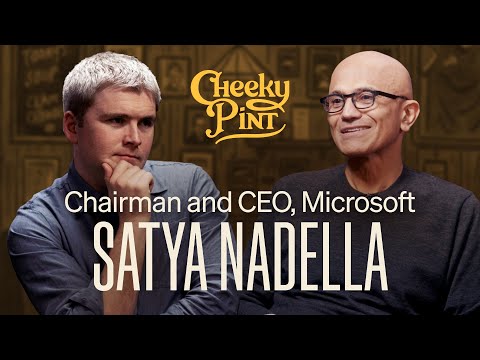
Nadella Secures Microsoft Infrastructure to Avoid Fiber Bubble
Stripe
The current tech boom differs from the dot-com crash because global artificial intelligence demand leaves cloud computing data centers severely supply-constrained rather than underutilized.
## Background
Published on YouTube by Stripe on November 18, 2025, this video features a detailed conversation with Microsoft CEO Satya Nadella. According to the show description, the interview explores the diffusion of AI in the enterprise, the differences between the current AI CapEx cycle and the dot-com bubble, product bundling strategies, and Nadella's vision for 'agentic commerce'.
## TL;DR
In this extensive discussion, Satya Nadella connects Microsoft's rich historical patterns to the ongoing AI revolution, emphasizing how massive compute power has replaced rigid data schemas to finally unlock 'information at your fingertips'. He breaks down the operational realities of scaling global AI infrastructure, managing a 200,000-person workforce via modern tools like Teams, and navigating the evolving layers of the AI stack. The conversation highlights the future of agentic commerce, the merging of customer service and sales into unified natural language interfaces, and the durability of approachable environments like Excel. Ultimately, Nadella outlines Microsoft's strategy to balance open, cross-platform modularity with integrated platform value while fostering a 'learn-it-all' corporate culture.
## Atmosphere & style
The conversation carries a deeply reflective, intellectual, and high-level corporate vibe, balancing a heavy dose of technology history with a forward-looking vision. The dynamic between the speakers feels collaborative and collegial, moving naturally from granular technical architectures to lighthearted banter about cricket, literature, and school days. It feels like stepping into a private executive briefing room where decades of industry memory are mapped directly onto cutting-edge software paradigms, leaving the listener with a sense of measured optimism and deep strategic depth.
## Key takeaways
- [00:00](https://www.youtube.com/watch?v=L2OPYYthw4c&t=0s) The long-standing software challenge of enterprise information management is being solved by scaling deep neural networks with massive compute rather than rigid, hand-designed data schemas.
- [01:07](https://www.youtube.com/watch?v=L2OPYYthw4c&t=67s) The Microsoft 365 graph acts as a critical database that maps semantic connections across unstructured corporate activities like emails, documents, and Teams calls to preserve ad-hoc business context.
- [02:52](https://www.youtube.com/watch?v=L2OPYYthw4c&t=172s) Enterprise AI adoption faces significant change management and structural hurdles, requiring deep integration with data governance platforms like Microsoft Purview to enforce compliance and security at runtime.
- [04:15](https://www.youtube.com/watch?v=L2OPYYthw4c&t=255s) Moving past the historical limits of enterprise data access requires three external components at runtime: memory (including long-term credit assignment), strict user entitlements, and an open action space across multiple model providers.
- [08:53](https://www.youtube.com/watch?v=L2OPYYthw4c&t=533s) Satya Nadella leverages Teams channels as a modern alternative to 'wandering the hallways' to bypass corporate hierarchies and discover grassroots engineering projects directly.
- [11:33](https://www.youtube.com/watch?v=L2OPYYthw4c&t=693s) Microsoft strategically uses its developer relations focus and the stewardship of GitHub to stay closely aligned with startup workflows, which require low friction and rapid time-to-value.
- [14:52](https://www.youtube.com/watch?v=L2OPYYthw4c&t=892s) The software industry is shifting from static 'Gold Master' delivery toward real-time generation of custom user experiences, which dissolves historical boundaries between documents, websites, and applications.
- [15:55](https://www.youtube.com/watch?v=L2OPYYthw4c&t=955s) The AI era introduces a new workflow metaphor of 'macro delegation' to fleets of autonomous agents paired with 'micro steering' via highly sophisticated IDE canvases to avoid notification fatigue.
- [27:04](https://www.youtube.com/watch?v=L2OPYYthw4c&t=1624s) The current massive AI infrastructure buildout differs from the dot-com telecom bubble because Microsoft's capacity is severely supply-constrained and sold out, rather than resulting in unused 'dark fiber'.
- [30:00](https://www.youtube.com/watch?v=L2OPYYthw4c&t=1800s) Long-lead bottlenecks in the global AI infrastructure expansion have shifted away from chips toward securing 'warm shells'—fully powered, permitted, and data-sovereignty-compliant data center buildings.
- [33:05](https://www.youtube.com/watch?v=L2OPYYthw4c&t=1985s) Future corporate sovereignty and IP moats will depend on a company's ability to capture its unique, tacit knowledge in a proprietary intelligence layer combining custom weights, specialized memory, and unique action spaces.
- [38:57](https://www.youtube.com/watch?v=L2OPYYthw4c&t=2337s) Excel has remained exceptionally durable for over 40 years as an approachable, Turing-complete programming environment because it leverages the natural human workflow of lists and tables without requiring programmatic change management.
- [43:28](https://www.youtube.com/watch?v=L2OPYYthw4c&t=2608s) Microsoft is developing 'NLWeb' (Natural Language Web) to provide a natural language interface for merchant catalogs, allowing AI agents to perform deep reasoning-based discovery and unlock conversational social commerce.
- [52:07](https://www.youtube.com/watch?v=L2OPYYthw4c&t=3127s) The artificial boundaries separating customer service, product discovery, and inside sales are collapsing into unified natural language interfaces that replace traditional org chart silos.
- [54:13](https://www.youtube.com/watch?v=L2OPYYthw4c&t=3253s) To balance cognitive capability and cost of goods sold (COGS), modern AI architectures must use intelligent agent-intermediated routers to run an ensemble of multiple models in production behind the scenes.
- [01:01:13](https://www.youtube.com/watch?v=L2OPYYthw4c&t=3673s) Over-packaging and coupling products can severely restrict a company's total addressable market (TAM), prompting Azure to support open ecosystems like Linux, MySQL, and Postgres to remain competitive on its own merits.
- [01:07:44](https://www.youtube.com/watch?v=L2OPYYthw4c&t=4064s) Microsoft's open, cross-platform strategy under Nadella is a intentional return to the company's 1980s 'software factory' DNA rather than the tight client-server lock-in that characterized its 1990s era.
- [01:09:46](https://www.youtube.com/watch?v=L2OPYYthw4c&t=4186s) To drive cultural transformation and combat negative external narratives, modern organizations must foster internal resilience by anchoring themselves in a consistent framework like Carol Dweck's growth mindset.
- [01:13:41](https://www.youtube.com/watch?v=L2OPYYthw4c&t=4421s) Scale-dependent leadership at a 200,000-person level requires shifting away from a single founder's working memory toward structural modularity, team building, and synthesizing the outside world in a 'refounder mode'.
## Detailed walkthrough
### [00:00](https://www.youtube.com/watch?v=L2OPYYthw4c&t=0s) The Messiness of Information and the Rise of AI
The dream of perfect information management has long captivated software pioneers. In the 1990s, Microsoft co-founder Bill Gates famously declared that there is only one true category in software: "information management." His vision was to schematize people, places, and things into an elegant, structured system. Gates harbored a deep dislike for unstructured file systems, wishing instead that everything could exist within a SQL database that could be queried cleanly. However, human behavior is inherently messy, and enterprise data has historically resisted being neatly indexed into a single, unified data model.
For decades, the tech industry obsessed over designing increasingly complex data models to capture the essence of an enterprise. No one anticipated that the ultimate solution to this challenge would not be a rigid schema, but rather a deep neural network scaled with massive compute power. Instead of forcing messy human data into structured boxes, modern AI models use billions of parameters to naturally discern patterns across unstructured corporate information.
- **Bill Gates' Software Philosophy:** "There's only one category in software. It's called information management. You got to schematize people, places and things, and that's it."
- **The Limits of SQL:** Gates wanted everything to be a SQL database to enable elegant, universal queries, but human messiness made this impossible in the old paradigm.
- **The AI Shift:** Massive neural networks and compute power have replaced complex, hand-designed data schemas as the primary way to index and understand enterprise information.
---
### [01:07](https://www.youtube.com/watch?v=L2OPYYthw4c&t=67s) Diffusing AI into the Enterprise at Ignite
Microsoft's Ignite Conference focuses heavily on the practical diffusion of AI throughout the enterprise. Rather than simply admiring external AI breakthroughs, companies are looking for ways to build their own "AI factories." The most complicated part of this transition is organizing the underlying data layer so that it can effectively feed the intelligence of modern models.
A major step forward in this effort is leveraging the Microsoft 365 graph, which sits beneath a company's emails, documents, and Teams calls. While employees do not work in a perfectly structured way, their daily activities are always semantically connected to specific business events. Historically, these connections lived only in people's heads and were lost over time. Copilot aims to capture this context, offering a "killer feature" of near-perfect recall for unstructured corporate history.
- **The Goal of Ignite:** Shifting enterprises from admiring AI to building their own "AI factories."
- **The Most Important Database:** The Microsoft 365 graph, which maps the relationships and semantic connections across emails, documents, and Teams calls.
- **The Lost Context:** Capturing the ad-hoc, unstructured relationships between business events that previously existed only in employees' heads.
---
### [02:52](https://www.youtube.com/watch?v=L2OPYYthw4c&t=172s) Overcoming the Hurdles of Enterprise AI Adoption
Despite the popularity of consumer LLM tools, many companies have not yet fully integrated their entire corporate context into their everyday AI workflows. This slow penetration is largely a matter of change management, data governance, and architectural limitations. In an enterprise setting, AI cannot simply retrieve information freely; it must respect strict data discovery, compliance, and security protocols. Microsoft has had to deeply integrate its Purview data governance platform into Copilot to ensure that confidential or information-rights-managed (IRM) files remain secure during retrieval.
Furthermore, connecting AI to external systems like ERPs remains a bottleneck. Traditional connectors act as "two thin straws" that fail to pass rich context. To solve this, enterprises need a superior data architecture that semantically embeds all disparate systems into a single, unified layer.
- **The Speed of Adoption:** Despite the hurdles, this transition is the fastest Microsoft has ever seen for any office suite in its history.
- **Data Governance Integration:** Microsoft Purview is plumbed directly into Copilot to handle confidential labels and IRM at runtime.
- **The ERP Bottleneck:** Current connectors to ERP systems are too limited; a unified semantic embedding layer is required to bridge the gap.
---
### [04:15](https://www.youtube.com/watch?v=L2OPYYthw4c&t=255s) The Evergreen Pitch of "Information at Your Fingertips"
The promise of having all company data instantly accessible has been pitched by tech executives for decades. In the late 1990s, Oracle's Larry Ellison pitched executive briefing centers on this exact vision, and Bill Gates coined the phrase "information at your fingertips" during a COMDEX speech in the same era. Historically, this pitch remained evergreen because companies rarely "eat their data infrastructure vegetables," leaving executives to rely on analysts to investigate questions rather than retrieving answers themselves at the touch of a button.
To move past this limitation and achieve true "continual learning" in an enterprise context, three critical components must exist outside of the AI model's cognitive core at runtime: memory, entitlements, and action space.
- **Memory:** The system must support short- and long-term memory, including "long-term credit assignment"—the human-like ability to intuitively reward or punish past actions based on long-term outcomes.
- **Entitlements:** The AI must strictly respect user permissions and roles at runtime to prevent unauthorized data access.
- **Action Space:** The model must be able to execute tasks across different environments and model providers, such as running OpenAI models alongside Anthropic's Claude within the same system.
---
### [08:53](https://www.youtube.com/watch?v=L2OPYYthw4c&t=533s) Satya Nadella’s Day-to-Day and "Virtual Hall Wandering"
As CEO of Microsoft, Satya Nadella balances his time between customer engagement and internal collaboration. A typical day includes two or three remote Teams calls with customers to stay grounded in real-world needs. When it comes to internal meetings, Nadella categorizes them into two types: those where he needs to learn, decide, or communicate, and those where his role is simply to convene the group and "keep my mouth shut" because the real work happens before or after the meeting itself.
To stay connected to the ground-level engineering work at Microsoft, Nadella uses Teams channels as a modern alternative to "wandering the halls." By lurking in various channels, he makes direct connections with engineers working on specific projects, such as an Excel agent or a new evaluation framework. While he occasionally wishes he had fewer permission barriers to drop into even more channels, he finds that today's workforce is highly collaborative and "not shy of sharing their opinion."
- **Customer Grounding:** Nadella participates in at least one to two customer Teams calls daily to remain connected to market needs.
- **Two Meeting Types:** Convening meetings (where the CEO's presence is the main catalyst) and active decision/learning meetings.
- **Teams as the New Hallway:** Lurking in Teams channels allows Nadella to discover grassroots projects and bypass traditional corporate hierarchy.
---
### [11:33](https://www.youtube.com/watch?v=L2OPYYthw4c&t=693s) Developer Relations, Startups, and the Acquisition of GitHub
Nadella is known for staying exceptionally close to the startup ecosystem, a habit he formed early in his career. Even before becoming CEO, back when he ran Azure, he visited early-stage startups like Stripe when they were still "pip-squeak" companies. This focus stems from a deeply ingrained developer relations gene. Nadella believes that to build a relevant technology platform, a company must follow where developers are going and understand the new workloads they are creating.
This philosophy directly influenced Microsoft's acquisition of GitHub. Beyond being a strategic asset, GitHub is the place where every startup hosts its repositories. Being in that loop allows Microsoft to learn from the friction-free aesthetic of startups, who have the least amount of patience and require the fastest time-to-value.
- **The Startup Gene:** Nadella indexes heavily on startups to understand emerging workloads and platform requirements.
- **Stripe's Model:** Stripe proved that building for the cutting-edge needs of startups (like stablecoins or usage-based billing) eventually translates to enterprise success, as those startups grow and enterprises adopt their patterns.
- **GitHub Stewardship:** Microsoft acquired GitHub to remain close to the developer loop and learn from the high-velocity, friction-free expectations of modern software creators.
---
### [14:52](https://www.youtube.com/watch?v=L2OPYYthw4c&t=892s) The Future of Generated User Interfaces
The traditional paradigm of software delivery—where code is compiled, finalized as a "Gold Master," and shipped statically—is giving way to real-time generation. With AI capable of generating code on the fly, the industry is moving toward generating custom user experience (UX) scaffolding in real time based on user needs.
This shift blurs the historical lines between different digital mediums. At Microsoft, teams have spent decades debating the precise differences between a document, a website, and an application. In an AI-driven future, these distinctions largely disappear, as a model can generate and render any of these formats instantly depending on how a user wants to interact with the information.
- **Dynamic UX:** Moving away from static, pre-built user interfaces toward real-time, personalized UI generation.
- **Collapsing Form Factors:** The historical boundaries between a document, a website, and an application are dissolving, as AI can render information into any of these formats on demand.
### [15:55](https://www.youtube.com/watch?v=L2OPYYthw4c&t=955s) The Rise of the Professional IDE and "Micro Steering"
The concept of the Integrated Development Environment (IDE) is making a massive comeback, expanding far beyond its traditional home in software engineering. Whether it is Excel or VS Code, the core reality of the AI era is that models generate vast amounts of output that humans must make sense of, edit, and iterate upon. This requires highly refined IDEs that act as "heads up displays" to help users manage the "telemetry loop" of thousands of autonomous agents running in the background.
This shift introduces a new workflow metaphor: "macro delegation" paired with "micro steering." A user can give high-level instructions to a fleet of agents that might go off and work for hours or days. However, as these agents check in, the user needs a sophisticated interface to steer them without getting trapped in "notification hell"—where a five-word mobile alert lacks the context needed to make a decision. To solve this, software is evolving into a unified canvas featuring an inbox, a messaging tool, and a blinking screen.
- **The Productivity Suite Ratio:** Historically, the core productivity suite settled on three major applications (Word, Excel, and PowerPoint) rather than one or forty. A similar consolidation is expected for AI-driven workflows.
- **Human-Agent Interfaces:** While agents will eventually build their own highly efficient production environments to communicate and run reinforcement learning (RL) loops with each other, humans still require familiar, linear interfaces like spreadsheets, tables, and documents to interact with them.
- **GitHub Copilot Mission Control:** Microsoft is actively experimenting with this workflow in GitHub Copilot, allowing developers to spin up autonomous agents across five or six different branches and then triage the incoming pull requests (PRs) in a centralized "mission control."
---
### [19:52](https://www.youtube.com/watch?v=L2OPYYthw4c&t=1192s) The Gap Between Vision and Readiness: From 1994 to Today
There is a recurring pattern in technology where the excitement and vision for a paradigm shift occur decades before the underlying technology is actually ready. A classic example is the 1968 film *2001: A Space Odyssey*, which depicted a voice-activated AI with tool-use capabilities—a vision that took over 50 years to become a high-quality reality. Similarly, speech-to-text and text-to-speech technologies were highly anticipated in the 1980s, but tools like Superwhisper only became truly viable very recently.
This lag between vision and execution was highly apparent at Microsoft in 1994. Working on "Interactive Television" and the "information superhighway" from an apartment right next to the old Microsoft campus, the team was backed by an extraordinary amount of intellectual horsepower. The management chain ran from Rick Rashid to Craig Mundie, Nathan Myhrvold, and ultimately Bill Gates. Yet, despite all this brainpower, they famously missed the immediate rise of the open internet because they were focused on building proprietary, high-quality-of-service alternatives.
- **The John Malone Demo:** A high-stakes moment involved demonstrating Microsoft's first redundant distributed file system and video streaming server to cable tycoon John Malone and Bill Gates. The demo required physically pulling out a hard drive while the video stream continued uninterrupted over an ATM switched network.
- **Early Streaming Limitations:** Despite the advanced infrastructure, the interactive TV setup only had five movies available to watch, which the team ended up viewing repeatedly.
---
### [21:50](https://www.youtube.com/watch?v=L2OPYYthw4c&t=1310s) Lessons from the Internet Tidal Wave and the Open Web
In the mid-1990s, Microsoft recognized the impending internet wave, culminating in Bill Gates's famous 1995 "Internet Tidal Wave" memo, which declared the internet as the company's absolute top priority. However, the initial vision was slightly off-target. Because very few homes had computers or internet access at the time, the prevailing, highly logical theory was that high-bandwidth cable TV lines and set-top boxes would be the primary gateway to the internet.
Between 1993 (when the Mosaic browser was released) and 1995, there was a two-year period of intense uncertainty. Microsoft initially doubted that the TCP/IP protocol could deliver the necessary quality of service, leading them to compete against dial-up providers like AOL using proprietary protocols, such as the X.25 network that powered the first version of MSN. Once it became clear by 1995 that the open TCP/IP stack would win, Bill Gates executed a massive, rapid pivot.
- **The Illusion of the Open Web:** While the open web seemingly defeated proprietary portals like AOL and MSN, it was quickly organized by new proprietary layers. "There's no such thing as the open web, there's the Google web," because search engines and app stores emerged as the dominant, centralized organizing layers.
- **The Power of Organizing Layers:** Category power in any open ecosystem inevitably shifts to the organizing layer. In the PC and mobile eras, it was search engines and app stores; today, it is chatbots like ChatGPT, though the future of agentic marketplaces and e-commerce remains to be fully litigated.
---
### [27:04](https://www.youtube.com/watch?v=L2OPYYthw4c&t=1624s) The Dot-Com Bubble vs. The AI Infrastructure Buildout
Many observers compare the current massive capital expenditure (CapEx) in AI to the dot-com bubble of the late 1990s and early 2000s, when Microsoft's stock price peaked and did not recover its previous high until around 2016. While the dot-com era was characterized by "irrational exuberance," the underlying secular trend and ideas were real and eventually persisted. However, there is a fundamental difference between the telecom bubble of 2000 and the current AI buildout.
The dot-com crash was largely a "fiber bubble" characterized by massive amounts of "dark fiber"—infrastructure that was laid in the ground but left unlit and unused for years. In contrast, today's AI infrastructure is anything but dark. Microsoft is severely supply-constrained, with lines out the door of customers wanting to buy capacity. "There is not a thing that I have that's not sold out," making the current environment fundamentally different from a utilization perspective.
- **Supply Chain and Capital Assets:** Microsoft manages its CapEx by distinguishing between long-term assets (like land and data center shells, which last 20 years) and short-term assets (like servers, which last 4 to 5 years).
- **The "Warm Shell" Strategy:** Having an empty, cold data center shell is a minor balance sheet issue. The real risk is not having "warm shells"—fully powered and permitted buildings—ready to quickly roll in server racks as demand spikes.
- **The Current Bottleneck:** The primary bottleneck is no longer just chips, but rather powered-up shells. Securing land permits, power allocations, and navigating global data sovereignty regulations are the longest-lead challenges in building out a global fleet for training, data generation, and inference.
[33:05](https://www.youtube.com/watch?v=L2OPYYthw4c&t=1985s) The Future of the Corporation and "Company Sovereignty"
The conversation shifts to how artificial intelligence is redefining the concept of sovereignty. While policymakers and countries are deeply concerned with national sovereignty, a different kind of sovereignty is emerging at the corporate level. This is rooted in the Coase theorem, which historically explained that companies exist because the transaction costs of coordinating work internally are lower than doing so in the open marketplace. However, if an AI model "knows everything," the traditional justification for a corporation's internal tacit knowledge is challenged.
The future of a company may depend on its ability to maintain its own "company sovereignty" through a proprietary intelligence layer. Rather than relying entirely on someone else's foundation model, a company must possess its own foundation model that captures its unique, tacit knowledge. This allows the organization to accrue and diffuse knowledge internally at a much faster rate.
- **The Shift in Intellectual Property:** Traditionally, corporate IP has been scattered across emails, documents, and individual employees' heads. In the AI era, this IP will increasingly compound as weights in a unique LoRA (Low-Rank Adaptation) layer or embedding.
- **Alternative Corporate Structures:** The speakers discuss whether this shift will lead to "weird looking companies," such as highly distributed internet companies, Decentralized Autonomous Organizations (DAOs), or the highly anticipated "one-person billion-dollar company."
---
[36:45](https://www.youtube.com/watch?v=L2OPYYthw4c&t=2205s) Stripe's Payments Foundation Model and Preventing Leakage
Stripe's evolution illustrates this concept of proprietary corporate intelligence. When Stripe started, it was a "single player API experience" with no strong network effects. Over time, as it scaled, it transformed into a trust and reputation network. Because Stripe has seen the vast majority of internet users, it has developed a deep knowledge of what "good and bad" transactions look like. Even the absence of a user's history is a signal, making the system function similarly to Google's reCAPTCHA.
To leverage this data, Stripe is currently training its own "payments foundation model" using its network data to build a highly capable fraud detection layer. This raises a critical question: how can a company protect its proprietary intelligence from "leaking over" to base foundation models? If a base model is only "one capability hop away" from learning how to perform advanced fraud detection on its own, companies must find ways to defend their unique action spaces.
- **The Future of Corporate Moats:** The ultimate corporate moat will combine multiple models with a highly specialized memory, tool-use capability, and action space unique to that specific company.
- **The "Models Eat the World" Argument:** While some argue that base models will eventually learn all patterns and render specialized layers obsolete, the speakers believe that custom, model-forward action spaces will remain the defining feature of successful corporations.
---
[38:57](https://www.youtube.com/watch?v=L2OPYYthw4c&t=2337s) The Durability of Excel and the World's Most Approachable Programming Environment
After a brief pause to celebrate a new high score in an unspecified game, the speakers reflect on the user interfaces of the future. They predict that the next decade will yield a revolutionary UI for finance professionals that, in hindsight, will seem completely obvious—much like the spreadsheet did when it first appeared. This prompts a discussion on why Microsoft Excel has remained so incredibly durable for over 40 years.
Excel's staying power lies in the "power of lists and tables" combined with the sheer malleability of software. Crucially, Excel is Turing complete, making it "the world's most approachable programming environment." Users can build incredibly complex systems in Excel without ever consciously realizing they are programming.
- **No Change Management Needed:** Unlike AI, which currently mystifies users and requires extensive "change management" programs, spreadsheets were adopted organically. People simply started using them to upend and evolve their workflows from the ground up.
- **The Fax Machine Era Transition:** A story is shared about the CEO of Generali, who joined the company during the fax machine era. He recalled how the sudden arrival of email and Excel completely upended and modernized the entire workflow of insurance agents.
---
[41:38](https://www.youtube.com/watch?v=L2OPYYthw4c&t=2498s) Post-Pandemic Cloud Growth and Step Changes in E-Commerce
The tech landscape has shifted dramatically from five to ten years ago. In 2019, the focus was heavily on cloud databases, with Microsoft highlighting Cosmos DB as a "regionless," multi-format database. When the pandemic hit, cloud adoption went into hyper-drive, and platforms like Microsoft Teams became essential.
Coming out of the pandemic, there was a brief eight-month period of uncertainty where tech companies worried they had "overbuilt" infrastructure. However, the expected decline in digital activity never materialized. Instead, both Microsoft and Stripe observed a permanent "step change." E-commerce and cloud utilization spiked in March 2020 and remained at that elevated level even as physical offices reopened.
---
[43:28](https://www.youtube.com/watch?v=L2OPYYthw4c&t=2608s) Conversational Commerce and the "NLWeb"
The collaboration between Stripe and Microsoft aims to merge "merchant-friendly" and "customer-friendly" rails into a seamless, conversational commerce experience. While previous attempts at social commerce (such as buying directly on Twitter or Instagram) struggled, two factors make the current era different: the integration power of AI and a highly compelling end-user experience. Early data from Stripe's recent integration with ChatGPT bears this out.
AI-driven commerce excels at both undirected, open-ended discovery (e.g., finding an outfit for a specific occasion based on "vibes") and highly directed, parameter-specific searches (e.g., finding a highly specific bike component). The only area of commerce relatively unaffected by this shift is recurring staples, such as reordering pet food. To support this new paradigm, Microsoft is working on a project called the "NLWeb" (Natural Language Web).
- **The NLWeb Concept:** The goal of the NLWeb is to take the product catalog of every merchant and give it a natural language interface. This allows AI agents to directly interrogate the catalog and perform "deep searches" using advanced reasoning.
- **Etsy as a Partner:** Etsy has served as an ideal early partner for this technology because its catalog consists of unique, custom products that rely heavily on discovery rather than standardized search terms.
- **Unlocking Social Commerce:** By making merchant catalogs remotely discoverable and purchasable through a unified protocol, platforms like Pinterest and Instagram can successfully execute commerce strategies that failed a decade ago.
[50:02](https://www.youtube.com/watch?v=L2OPYYthw4c&t=3002s) Building a Platform in Agentic Commerce
Stripe is currently building out a platform in agentic commerce, utilizing open-source protocols like their agentic commerce protocol alongside standard Stripe products. This presents unique payment challenges, as it requires an AI application to execute payments on behalf of users across various websites without exposing sensitive payment details everywhere. When asked for advice on building in this nascent but high-potential space, Satya Nadella emphasizes the importance of defining what it means to participate in an agentic workflow for every merchant. He suggests that merchants will want to easily onboard and say, "Hey, I have a catalog, I have a checkout, please get me to meet agents" in a friction-free, tasteful manner.
Nadella points out that while ChatGPT is currently the dominant player, there will be intense competition from Google, Meta, Perplexity, and others acting as front-door aggregators. Crucially, merchants will also want to support natural language queries directly on their own websites and mobile apps. The key challenge is creating an "easy button" for small merchants so they do not have to manually set up complex protocols like Model Context Protocol (MCP) servers.
- **The Merchant Onboarding Challenge:** The long tail of merchants needs a simple, one-click way to enable agentic commerce.
- **Aggregator Competition:** Multiple front doors will exist, including ChatGPT, Google, Meta, and Perplexity.
- **Natural Language Integration:** Merchants will want their own digital properties to support natural language queries for direct agent interrogation.
[52:07](https://www.youtube.com/watch?v=L2OPYYthw4c&t=3127s) The Convergence of Agentic Experiences
The conversation shifts to how various agentic experiences are beginning to merge. Des Traynor from Intercom recently discussed how AI-mediated customer service is replacing human agents, which has induced a massive wave of demand. Users who initially visit a site for help desk queries quickly realize that interacting with an AI is a far superior way to navigate the entire website, effectively acting as a "command line" for the business. Nadella and the host discuss how the traditional boundaries between customer service, discovery, and buying are dissolving.
Nadella notes that "inside sales is also, or rather customer service is also inside sales." In an agentic world, these previously siloed experiences can be stitched together seamlessly. The historical distinctions—where a user with a non-commercial query is routed to customer service, while another is routed to a Sales Development Representative (SDR)—were merely "random accidents of software and org charts" that are now poised to be thrown away.
- **Fashion Industry Example:** The fashion space is highlighted as a prime candidate for interactive AI. Current websites rely on poor keyword-based search and manual tagging, whereas users want an aesthetic, interactive experience similar to prompting Midjourney (e.g., "I'm looking for something like that, but a little more fancy").
- **Dissolving Silos:** The artificial boundaries between customer support, sales, and product discovery are collapsing into unified natural language interfaces.
[54:13](https://www.youtube.com/watch?v=L2OPYYthw4c&t=3253s) Model Loyalty vs. Brand Loyalty
The host brings up the debate surrounding model quality and user loyalty, noting that some users develop intense preferences for specific models. He shares a personal anecdote: "I use o3, my wife uses GPT-5. I'm always horrified 'cause I'm like, 'You deserve more intelligence than that.'" He asks whether users have loyalty to a specific model or to an overall AI brand, referencing the user revolt that occurred when OpenAI tried to phase out GPT-4.0. Nadella explains that consumer AI products have shown that model changes are not uniform; they impact users differently based on personality, style, and tone, which introduces a new dimension of product differentiation beyond raw IQ.
For product builders, Nadella's strategy is to have the most capable model available but run multiple models in production. He highlights GitHub's "auto" model picker as a favorite new feature. Rather than relying on a "dumb model router," the system must possess the intelligence to evaluate the complexity of a repository or pull request (PR) task and route it to the model that offers the best balance of cognitive capability and cost of goods sold (COGS).
- **Ensemble of Models:** The future of agents lies in using an ensemble of models intermediated by agents to meet specific user needs.
- **The Power of Defaults:** While power users might manually select high-intelligence models like o3 for simple queries out of habit, defaults matter immensely because users "don't love the cheese to be moved."
- **Trust-Based Handoff:** The ultimate goal is to build enough user trust so that the application can automatically select the most appropriate model behind the scenes.
[58:00](https://www.youtube.com/watch?v=L2OPYYthw4c&t=3480s) Microsoft's AI Stack and "Must-Win" Verticals
Nadella outlines Microsoft's comprehensive AI strategy, conceptualizing it across distinct layers. At the core is the infrastructure layer, which he calls the "token factory." The goal here is extreme efficiency, measured in "tokens per dollar per watt." Above that sits the "agent factory," which focuses on the "value per token" by using tokens efficiently to drive specific business or consumer outcomes. This layer serves as the new application tier or "AI cloud" of this platform era.
Microsoft is also building its own "systems of intelligence" under the Copilot family. Nadella identifies three primary horizontal domains where Microsoft must be a leader: information work (Microsoft 365), software development (GitHub Copilot), and cybersecurity. Beyond these horizontals, Microsoft is deeply invested in vertical applications, particularly in healthcare and science.
- **Healthcare (DAX Copilot):** Following the acquisition of Nuance, Microsoft developed DAX Copilot, an automated clinical documentation tool. It acts as a "notetaking diarization for physicians," allowing doctors to focus on patients while the AI handles clinical notes and coding. This is deeply integrated into Epic systems.
- **Scientific Discovery:** Microsoft is building an "outer loop orchestration" tool chain for the scientific method. This system allows scientists to generate hypotheses, run thousands of experiments *in silico*, and refine them. It acts as a hybrid of GitHub Copilot and Microsoft 365, interfacing directly with wet labs via protocols like MCP.
[01:01:13](https://www.youtube.com/watch?v=L2OPYYthw4c&t=3673s) Platform Strategy: Modularity vs. Coupling
The host asks Nadella how Microsoft decides when to bundle and couple products versus when to sell them as modular, independent components. He traces Microsoft's history from its highly open early days in 1985—when most revenue came from Macintosh applications—to the tight coupling of Office and Windows, and finally to Azure's evolution from "Windows Azure" to fully embracing Linux. Nadella explains that companies often overstate how many market battles are truly zero-sum.
When Azure started, many questioned if there was room for a second cloud behind AWS. Microsoft's structural understanding of enterprise customers told them that buyers would demand multi-cloud options. Nadella warns that over-packaging products can severely reduce a company's total addressable market (TAM). For Azure to succeed, it had to drop the "Windows" prefix and support Linux, MySQL, and Postgres as first-class citizens. While Microsoft is a single firm with a theory of integration benefits and platform effects, each layer of its stack must remain competitive on its own merits.
- **Bare Metal Azure:** Customers must be able to buy Azure solely for bare-metal Kubernetes management while bringing their own software. Winning that workload open doors for them to adopt other services, like Cosmos DB, later on.
- **Internal Tensions:** Modularity always creates internal debates. When Azure embraced Linux, it caused tension with the Windows Server team, but it was necessary to maximize the overall stack's market opportunity.
- **Strategic Exceptions:** Some products remain tightly coupled for strategic reasons; for example, *Microsoft Flight Simulator* is kept exclusive to Xbox and PC rather than being released on PlayStation, which fits the natural console platform dynamics.
[01:05:50](https://www.youtube.com/watch?v=L2OPYYthw4c&t=3950s) Bundling, Modularity, and the Architecture of the AI Stack
The conversation turns to the age-old debate of bundling versus modularity. The interviewer points out that Microsoft Teams Chat and Teams Video are not sold separately; they are packaged together to make the bundle more compelling. This raises the question of whether the cost of bundling ever outweighs its benefits. Satya Nadella explains that Teams was born as a product designed to bring multiple elements together, much like Outlook did in its early days. Outlook was the first scaffolding to combine a personal information manager (PIM), an email client, and calendaring to get a single job done. Similarly, Teams brought chat, channels, and video into one unified experience. In these cases, "the bundling was the product to some degree."
However, Nadella emphasizes that modularity must still be thought through at an atomic level. A product must have an open marketplace and integrate with other systems to remain competitive. He shares a classic counterexample: if Microsoft had built an unbelievable public cloud that only ran Windows or SQL workloads, it would have captured only a tiny sliver of the market. To meet customer needs, Microsoft must ensure its AI stack is highly modular. Nadella simplifies their approach into three distinct layers: an infrastructure business, an application server business, and an applications business. While Microsoft benefits from the feedback loop across all three layers, customers and partners must be free to choose "which door they enter through."
- **Outlook's Precedent:** Outlook was the original scaffolding that integrated separate tools (PIM, email, and calendaring) into a single product.
- **Teams' Integration:** Teams integrated chat, channels, and video as its core product definition rather than as an arbitrary bundle.
- **The Three Layers of Microsoft's AI Stack:**
1. Infrastructure business
2. Application server business
3. Applications business
---
[01:07:44](https://www.youtube.com/watch?v=L2OPYYthw4c&t=4064s) Returning to the "Software Factory" DNA of the 1980s
The interviewer suggests that when Nadella took over as CEO, he shifted Microsoft's culture away from a highly bundled, tightly packaged ecosystem—where customers bought Windows machines running Microsoft Access and SQL Server—toward an open, interoperable strategy. Nadella refines this observation, explaining that his goal was actually to return to the Microsoft of the 1980s. He points out that the extreme lock-in and dominant bundling of Microsoft products was largely a phenomenon of the 1990s, when "there was Microsoft and there was pretty much nothing else."
In contrast, the 1980s were defined by cross-platform software development; Microsoft built Office on the Mac before Windows even existed. Bill Gates's original concept was that Microsoft was a "software factory" unattached to any single category. The company was ready to churn out whatever software was needed, whether it was a basic interpreter, a flight simulator, or an operating system. Nadella realized during his time running the Cloud business and upon becoming CEO that the market had grown much larger and more diverse. Because Microsoft lacked a dominant mobile platform at the time, they had to stay relevant by bringing their products to other platforms in configurations that made sense for customers. This open approach was not a departure from Microsoft's identity, but rather a return to its core DNA.
- **1980s vs. 1990s Microsoft:** The 1980s focused on cross-platform software (e.g., Office on Mac), while the 1990s brought the tight client-server lock-in of Windows and Windows NT.
- **The "Software Factory" Concept:** Bill Gates's early vision of Microsoft as a flexible producer of diverse software, from BASIC interpreters to flight simulators.
---
[01:09:46](https://www.youtube.com/watch?v=L2OPYYthw4c&t=4186s) Cultural Transformation and Resisting Social Media Memes
Addressing the cultural shift under his leadership, the interviewer brings up the famous cartoon of Microsoft divisions depicted as gangs pointing guns at one another, asking how Nadella managed to tweak the culture when getting down to "brass tacks." Nadella, describing himself as a "consummate insider" who lived through all the good and bad of Microsoft over the last 35 years, explains that the company had partially lost its own belief because it lost control of its narrative. He notes that the cartoon is a prime example of an outside perspective defining a company's cultural narrative to the point where employees began to identify with it.
Nadella warns that losing the narrative is a major risk in today's reflexive social media zeitgeist. While divisional tensions are real and sometimes even necessary—because "social cohesion is not a goal, winning in the marketplace is a goal"—managing how employees perceive their own company is a massive leadership challenge. He emphasizes that power is highly distributed within an organization, and employees often shape their experience through micro-cultures led by individual managers. To guide this, leadership must provide a consistent narrative. For Microsoft, adopting Carol Dweck's growth mindset framework—specifically the contrast of being a "learn-it-all" versus a "know-it-all"—offered a well-understood concept that resonated with people both inside and outside of work. The ultimate challenge for modern organizations is finding the "inner strength" to resist being defined by social media memes.
> "The growth mindset or learn-it-all versus know-it-all has been super helpful for us as just a frame because nobody thinks of it as my dogma... it's a well understood child psychology thing that appeals to people outside of work."
---
[01:13:41](https://www.youtube.com/watch?v=L2OPYYthw4c&t=4421s) Scale-Independent Leadership and "Founder Mode"
The conversation shifts to the differences in managing companies of varying sizes, comparing Microsoft's roughly 200,000 employees to Stripe's 10,000, or a smaller company of 500. While many activities like talking to customers, holding offsites, and managing budgets are scale-independent, the interviewer asks what unique effects appear only at a "city-state size" of 200,000 people. Nadella reflects on being the first "non-founder" CEO to scale the company after Bill Gates, Paul Allen, and Steve Ballmer. He realized early on that he could not rely on a single person's working memory and desperately needed a cohesive team to manage the massive scope.
Nadella references A.G. Lafley's framework on the role of a CEO, which involves synthesizing the outside world, setting standards for culture, deciding which businesses to enter or exit, and balancing short-term and long-term performance. While a founder or a leader of a 500-person company might personally know every line of code or the exact person who wrote a specific module, a leader at scale must rely on modularity and team building. Nadella notes that founders possess a unique, singular working memory because they grew up with the company from day one. Professional or "mere mortal" CEOs cannot simply replicate that, even if they have long tenures at the company. He concludes that while the "founder mode" and the powerful culture of personality should be maximized, subsequent leaders can operate in a "refounder mode" without pretending to be the original founders.
- **Microsoft Employee Count:** Approximately 200,000 employees.
- **Stripe Employee Count:** Approximately 10,000 employees.
- **A.G. Lafley's CEO Framework:** Synthesizing the outside, deciding what business the company is in/out of, setting cultural standards, and balancing short- and long-term performance.
---
[01:17:47](https://www.youtube.com/watch?v=L2OPYYthw4c&t=4667s) The Hyderabad Connection and Samuel Beckett's Cricket Career
In the final minutes, the interviewer asks about the remarkable concentration of global business leaders coming out of Hyderabad, India. He notes that Nadella, Shantanu Narayen (CEO of Adobe), Ajay Banga (President of the World Bank), and several top chess players all share roots in Hyderabad and southern India. Nadella jokes that it is "kind of a cabal," pointing out that the current CEO of Procter & Gamble (Jon Moeller) also attended his same high school.
Nadella attributes this local outperformance to the unique environment of his high school in the late 1970s and early 1980s. Located "in the middle of nowhere" at the time, the school offered students the space and room to discover their passions rather than forcing them into a highly tracked academic race. For Nadella, that passion was cricket. He shares a favorite piece of trivia about the Irish avant-garde novelist and playwright Samuel Beckett, who is the only Nobel Prize winner to have also played first-class professional cricket (having played for Dublin University). The interview wraps up with lighthearted banter about Beckett's dual achievements, with the interviewer joking that in another life, Nadella might have achieved the same.
- **Hyderabad High School Alumni:**
- Satya Nadella (CEO of Microsoft)
- Shantanu Narayen (CEO of Adobe)
- Ajay Banga (President of the World Bank)
- Jon Moeller (CEO of Procter & Gamble)
- **Samuel Beckett Trivia:** The Nobel Prize-winning author is listed in *Wisden Cricketers' Almanack* as having played first-class cricket for Dublin University.
## Notable quotes
> [00:00](https://www.youtube.com/watch?v=L2OPYYthw4c&t=0s) There's only one category in software. It's called information management. You got to schematize people, places and things, and that's it. — Bill Gates
> [21:50](https://www.youtube.com/watch?v=L2OPYYthw4c&t=1310s) There's no such thing as the open web, there's the Google web — Satya Nadella
> [27:04](https://www.youtube.com/watch?v=L2OPYYthw4c&t=1624s) There is not a thing that I have that's not sold out — Satya Nadella
> [54:13](https://www.youtube.com/watch?v=L2OPYYthw4c&t=3253s) I use o3, my wife uses GPT-5. I'm always horrified 'cause I'm like, 'You deserve more intelligence than that.' — John
> [52:07](https://www.youtube.com/watch?v=L2OPYYthw4c&t=3127s) inside sales is also, or rather customer service is also inside sales — Satya Nadella
> [01:09:46](https://www.youtube.com/watch?v=L2OPYYthw4c&t=4186s) The growth mindset or learn-it-all versus know-it-all has been super helpful for us as just a frame because nobody thinks of it as my dogma... it's a well understood child psychology thing that appeals to people outside of work. — Satya Nadella
> [01:09:46](https://www.youtube.com/watch?v=L2OPYYthw4c&t=4186s) social cohesion is not a goal, winning in the marketplace is a goal — Satya Nadella
## Mentioned
Satya Nadella, John, Bill Gates, Microsoft, Ignite Conference, Copilot, Purview, Larry Ellison, Oracle, COMDEX, OpenAI, Anthropic, Claude, Teams, Excel, Azure, Stripe, GitHub, VS Code, Word, PowerPoint, 2001: A Space Odyssey, Superwhisper, Rick Rashid, Craig Mundie, Nathan Myhrvold, John Malone, AOL, MSN, Google, ChatGPT, Coase theorem, LoRA, reCAPTCHA, Generali, Cosmos DB, Twitter, Instagram, NLWeb, Etsy, Pinterest, Meta, Perplexity, Model Context Protocol, Des Traynor, Intercom, Midjourney, o3, GPT-5, GPT-4.0, Nuance, DAX Copilot, Epic systems, Macintosh, Windows, Linux, AWS, MySQL, Postgres, Kubernetes, Microsoft Flight Simulator, Xbox, PlayStation, Outlook, Microsoft Access, SQL Server, Windows NT, BASIC, Carol Dweck, Paul Allen, Steve Ballmer, A.G. Lafley, Shantanu Narayen, Adobe, Ajay Banga, World Bank, Jon Moeller, Procter & Gamble, Samuel Beckett, Dublin University, Wisden Cricketers' Almanack
纳德拉布局微软基础设施以规避光纤泡沫
当前的科技繁荣与互联网泡沫破裂截然不同,因为全球人工智能需求使得云计算数据中心严重受限于供应,而非产能过剩闲置。
在这场深入的探讨中,Satya Nadella 将微软深厚的历史脉络与当前的人工智能变革联系起来,强调庞大的算力如何取代僵化的数据模式,最终实现“信息触手可及”。他深入剖析了扩展全球 AI 基础设施的运营现实、借助 Teams 等现代工具管理 20 万名员工,以及驾驭不断演进的 AI 技术栈各层级。对话重点探讨了智能体商业的未来、客户服务与销售向统一人然语言界面的融合,以及 Excel 等亲民环境的持久生命力。最终,Nadella 阐述了微软的战略布局:在倡导“无所不学”(learn-it-all)企业文化的同时,平衡开放、跨平台的模块化与集成平台的独特价值。
企业信息管理这一长期存在的软件挑战,正在通过海量算力扩展深度神经网络来解决,而非依赖僵化、人工设计的数据模式。 (0:00)
Microsoft 365 图谱作为一个关键数据库,梳理电子邮件、文档和 Teams 通话等非结构化企业活动之间的语义关联,以保留临时的业务上下文。 (1:07)
企业级 AI 的落地面临巨大的变革管理与结构性障碍,需要与 Microsoft Purview 等数据治理平台深度集成,以便在运行时强制执行合规与安全要求。 (2:52)
要打破企业数据访问的历史局限,运行时需要三个外部组件:记忆(包括长期信用分配)、严格的用户授权体系,以及跨多个模型提供商的开放行动空间。 (4:15)
Satya Nadella 利用 Teams 频道作为现代版的“巡视走廊”,绕过繁琐的公司科层制,直接发掘基层的工程项目。 (8:53)
Reading summary
Microsoft CEO Satya Nadella argues that modern AI resolves long-standing enterprise data management bottlenecks through neural networks rather than rigid schemas, while sustaining technological leadership requires balancing modular architectures with integrated bundles inspired by Microsoft's 1980s cross-platform origins.
Resolving Enterprise Data Chaos Through Neural Networks (0:00)
In the 1990s, Bill Gates characterized software entirely as "information management," attempting to schematize corporate entities into structured SQL databases. Enterprise workflows, however, proved inherently unstructured. Modern artificial intelligence departs from rigid schemas by deploying billions of parameters across deep neural networks to recognize patterns directly within unstructured corporate communications, documents, and meetings mapped via the Microsoft 365 graph.
Nadella emphasizes that enterprise adoption is constrained by compliance rather than raw model capabilities. Enterprise AI must enforce data security at runtime through governance platforms like Microsoft Purview to safeguard permissions and sensitive files. To enable sustained enterprise learning, Nadella argues systems require three external runtime components: contextual memory capable of long-term credit assignment, strict entitlement enforcement, and an execution action space supporting multiple model providers.
AI Infrastructure Buildout Versus the Dot-Com Bubble (27:04)
Addressing comparisons between current AI capital expenditures and the 2000 telecom bubble, Nadella argues that the structural dynamics are fundamentally different. The dot-com crash was characterized by vast amounts of "dark fiber" that sat unlit and unused. In contrast, current AI infrastructure faces severe supply constraints, with Nadella stating that all available Microsoft capacity remains sold out.
Microsoft manages its balance sheet by separating capital assets into 20-year infrastructure (land and facility shells) and 4-to-5-year equipment (servers). Nadella identifies the primary operational bottleneck as no longer semiconductor supply, but the availability of "warm shells"—permitted buildings equipped with high-capacity power allocations capable of immediate server integration while satisfying regional data sovereignty laws.
Reimagining Interfaces Through Micro Steering and IDEs (14:52)
The convention of shipping static software is giving way to real-time interface generation, eroding historical boundaries between documents, websites, and applications. Rather than eliminating human interaction, Nadella anticipates an expanded role for the Integrated Development Environment (IDE) model across all knowledge work, serving as a operational dashboard for managing autonomous agents running background telemetry loops.
This workflow relies on "macro delegation" paired with "micro steering," where users issue high-level instructions to autonomous agents and triage incoming updates in a centralized canvas—analogous to reviewing pull requests in GitHub Copilot. While software agents will eventually communicate among themselves in specialized runtime environments, Nadella expects human interaction to remain anchored in structured, approachable formats like spreadsheets and tables.
Modular Architecture and the Software Factory Legacy (61:13)
Nadella frames Microsoft’s contemporary cloud and AI strategy not as an extension of 1990s Windows-centric lock-in, but as a return to its 1980s "software factory" heritage, when the company developed cross-platform applications such as Office on Macintosh. While bundling provides utility when multiple capabilities define a single product category—such as Outlook combining mail and calendaring, or Teams uniting chat and video—excessive coupling restricts total addressable market.
To compete effectively, Nadella structures Microsoft's AI operations into three modular tiers: an infrastructure tier ("token factory"), an application server tier ("agent factory"), and an applications layer (Copilot). Each layer is designed to compete independently, allowing enterprise customers to adopt specific services without committing to the full proprietary ecosystem.
Company Sovereignty and Agentic Marketplaces (33:05)
Referencing the Coase theorem, Nadella observes that if base foundation models internalize all general business knowledge, the traditional rationale for corporate boundaries weakens. To preserve "company sovereignty," enterprises must capture their proprietary institutional knowledge inside specialized model layers, as illustrated by Stripe developing its own foundation model for fraud detection based on proprietary payment network signals.
Simultaneously, commerce interfaces are transitioning toward conversational models. Microsoft’s "NLWeb" initiative aims to map merchant inventories into natural language formats that autonomous agents can directly interrogate. Nadella notes that this evolution dissolves traditional boundaries separating customer support, marketing, and sales, requiring open onboarding protocols so merchants can interface with aggregator platforms without proprietary lock-in.
While the shift toward agentic interaction promises to collapse traditional enterprise software silos, the ultimate trajectory depends on solving lingering friction: securely delegating payment credentials across web environments, establishing standardized natural language discovery protocols for merchants, and securing sufficient power allocations to meet unyielding data center demand.
精炼阅读摘要
微软首席执行官 Satya Nadella 认为,当前人工智能热潮的本质是用大规模神经网络取代人工设计的结构化模式来组织杂乱的企业信息,而这一波技术扩散需要在基础设施供应瓶颈、模块化平台架构与企业数据主权之间取得平衡。
企业信息模式重构与落地瓶颈 (0:00)
Bill Gates 在1990年代曾主张软件的唯一范畴是“信息管理”,并希望将所有人、地点和事物规整到可清晰查询的 SQL 数据库中,但人类行为的杂乱性使得结构化统一模型难以奏效。Nadella 指出,现代 AI 模型凭借数十亿参数和算力规模,直接在非结构化数据中识别模式,从而替代了繁琐的人工设计模式。微软正通过覆盖邮件、文档和 Teams 通话的 Microsoft 365 图谱来捕获散落于员工脑海中的业务上下文,推动 Copilot 成为企业历史信息的召回工具。
尽管这一办公套件普及速度创下微软历史新高,但全面落地的阻力依然存在。企业环境下的 AI 必须遵守严格的数据合规与权限限制,微软为此将 Purview 数据治理平台直接接入 Copilot,在运行时动态处理机密标签与信息权限管理(IRM)。此外,现存连接 ERP 系统的传统连接器如同“细吸管”,无法传递丰富上下文,企业仍需在底层构建语义嵌入层以打通异构系统。
算力供给瓶颈与互联网泡沫之别 (27:04)
针对当前 AI 领域的巨额资本支出(CapEx)是否重蹈2000年互联网泡沫覆辙的疑问,Nadella 明确反驳了这一类比。他分析称,互联网泡沫破裂很大程度上源于“暗光纤泡沫”,即大量光纤埋入地下后长年闲置未被激活;而当前的 AI 基础设施处于极度供不应求的状态,微软面临“无物不售罄”的局面,属于利用率驱动的高负荷运转。
微软在资本管理上将20年寿命的土地与数据中心机房外壳等长期资产,与4至5年生命周期的服务器硬件区分开来。Nadella 指出,核心风险并不在于闲置外壳,而在于缺乏已经通电并完成许可审批的“暖外壳”(warm shells)。随着芯片供应逐步缓解,拿地许可、电力配额以及跨国数据主权合规,已成为制约构建全球模型训练与推理网络的最长周期瓶颈。
人机交互演进与微操协作界面 (14:52)
AI 实时生成代码的能力正在打破软件交付中传统的“金盘母带”静态编译分发模式,静态界面逐渐让位于根据需求动态生成的 UX 骨架,文档、网站和应用程序之间的历史边界开始模糊。在此背景下,集成开发环境(IDE)的概念正向更广泛的工作流扩散,用户面对海量自主 Agent 的后台运行,需要类似抬显(HUD)的界面来承载“宏观委托与微观操控”(macro delegation with micro steering)的工作模式,避免陷入上下文匮乏的通知干扰。
尽管代理之间未来能通过自建环境高效协同与运行强化学习闭环,但人类仍高度依赖线性与结构化界面。Nadella 举例称,Excel 历经40年仍具强大生命力,原因在于其图表结构具有极高延展性且具备图灵完备性,让用户在无意识间完成编程任务且无需复杂的变革管理。而在 GitHub Copilot 场景中,类似“任务控制台”的集中界面正在帮助开发者并行调度多个 Agent 分支并统一审查拉取请求(PR)。
企业主权、模型防护与商业融合 (33:05)
AI 正在对基于科斯定理构建的传统企业存在理由发起挑战。Nadella 指出,如果通用基座模型掌握所有公开知识,企业必须将自身独特的隐性知识沉淀为专属智能层(如定制的 LoRA 层或嵌入向量),以此维护“企业主权”。例如 Stripe 利用全网交易与信誉网络训练专属支付基座模型用于反欺诈,并通过结合特定记忆和专有操作空间(action space),防止自身核心能力被基座模型轻易覆盖吸收。
在商业端,微软正推进“自然语言网络”(NLWeb)项目,旨在将商户的产品目录转化为自然语言接口,让 AI 代理能够直接执行深度推理搜索与跨平台交互。Nadella 强调,传统由组织架构划分的客服、内部销售与产品发现功能纯属软件系统的“历史偶然”,未来正被统一的对话界面缝合。为此,Stripe 等平台需为长尾商户提供无痛接入协议,并在 ChatGPT、Google、Meta 等多重流量入口之间建立无需暴露敏感支付信息的代理商务体系。
平台架构的模块化与文化重塑 (58:00)
在平台战略层面,Nadella 将微软 AI 体系划分为基础设施(代币工厂)、应用服务器(代理工厂)与系统智能应用(如 M365 Copilot、GitHub Copilot 及医疗端的 DAX Copilot)三层架构。他认为必须坚持模块化解耦,每个层级均需具备独立市场竞争力,避免重蹈过度绑定而缩减潜在市场(TAM)的覆辙,正如当年 Azure 剥离“Windows”标签转而原生支持 Linux、MySQL 和开源生态。
Nadella 澄清,这一开放路线并非背离微软基因,而是回归1980年代比尔·盖茨将微软定义为生产跨平台软件的“软件工厂”本质。针对庞大跨国组织的治理,作为掌舵约20万名员工的非创始人首席执行官,Nadella 放弃单一个体全知全能的思维,借由卡罗尔·德韦克的“成长型思维”(终身学习者而非无所不知者)对抗社交媒体外在刻板叙事,以“二次创业者模式”(refounder mode)推动组织依靠模块化协作运转。
微软展现了将 AI 全面注入企业工作流、打通底层算力与上层应用的清晰路线,但这一愿景的全面落地依然受制于高昂的基础设施电力与土地审批周期,且跨异构系统的语义数据治理在实际落地中仍充满不确定性。
Source quotes
[0:00] Bill Gates: There's only one category in software. It's called information management. You got to schematize people, places and things, and that's it.
[21:50] Satya Nadella: There's no such thing as the open web, there's the Google web
[27:04] Satya Nadella: There is not a thing that I have that's not sold out
[54:13] John: I use o3, my wife uses GPT-5. I'm always horrified 'cause I'm like, 'You deserve more intelligence than that.'
[52:07] Satya Nadella: inside sales is also, or rather customer service is also inside sales
[69:46] Satya Nadella: The growth mindset or learn-it-all versus know-it-all has been super helpful for us as just a frame because nobody thinks of it as my dogma... it's a well understood child psychology thing that appeals to people outside of work.
[69:46] Satya Nadella: social cohesion is not a goal, winning in the marketplace is a goal
Original transcript
[0:00] Bill was always obsessed.
[0:01] I remember him distinctly saying this in the '90s,
[0:04] he said, "There's only one category in software.
[0:06] It's called information management.
[0:07] You got to schematize people,
[0:09] places and things, and that's it."
[0:10] The problem is people are messy.
[0:12] Do people have loyalty to a model
[0:14] or do they have loyalty to an AI brand?
[0:16] You want an ensemble of models.
[0:18] You have agents intermediating that ensemble
[0:22] so that it meets your needs.
[0:23] Will everyone's preference
[0:24] not just be for more intelligence?
[0:25] Like, I'll go into the picker
[0:27] and manually select o3
[0:28] for like, "Where should I go get ice cream," query?
[0:32] It's like a rite of passage for certain software companies
[0:35] to try to take on Excel.
[0:37] Why is it so durable?
[0:38] We sort of don't give it enough credit.
[0:39] It's like, "I can make it
[0:41] do anything." I think the world's
[0:42] most approachable programming environment.
[0:43] 100%.
[0:44] And Pieter here is who?
[0:46] Pieter is Pieter Levels.
[0:47] He's like an indie— Oh, yes, I know him.
[0:48] Yeah, you know Pieter Levels.
[0:49] I know him, yeah. Course yes.
[0:50] You're so online.
[0:51] See, Satya knows who Pieter Levels is.
[0:52] This is why Microsoft is like an $14 trillion company.
[0:57] Was there anything good to see at the data center?
[1:02] Or is like— There's always—
[1:03] "That's a lot of racks."
[1:03] It's the most fun place to go, man.
[1:05] Yeah.
[1:07] Satya Nadella took over as Microsoft CEO in 2014,
[1:10] but he's been with the company
[1:11] for more than 30 years and has seen a lot.
[1:13] Microsoft has grown by 10X
[1:15] in the time that Satya has been running it.
[1:17] And he's credited with Microsoft's success
[1:19] first in cloud and now in the AI boom.
[1:21] Cheers, John. This is great.
[1:25] So what should people be excited about at Ignite?
[1:28] The Ignite Conference for us, more than anything else,
[1:31] is about making sure that AI is getting diffused
[1:35] inside of the enterprise, right?
[1:37] I mean, if there is one thing,
[1:38] it's more about, hey, what does it mean
[1:41] not to just admire somebody else's AI factory or AI agent,
[1:45] but how to build your own AI factory.
[1:47] So organizing the data layer
[1:49] turns out to be probably the most complicated thing,
[1:52] which spans the enterprise
[1:54] such that it can meet the intelligence.
[1:56] And so that's the stuff
[1:57] that I think we'll probably do a lot of.
[1:59] We still don't really have Deep Research
[2:03] in a corporate context.
[2:05] We do, that's what Copilot is about.
[2:07] But most people day-to-day do not have this.
[2:09] So are they just underusing AI that exists?
[2:11] Yes, and in fact, it's interesting you brought that up
[2:13] because to me that is the killer feature, right?
[2:16] So the biggest thing we did was we took this graph
[2:22] that is underneath what is what I think
[2:24] is the most important database in any company, right,
[2:27] which is underneath your email,
[2:29] your documents, your Teams calls, what have you.
[2:32] It's the relationships that...
[2:34] By the way, people are not working in an ad hoc fashion
[2:38] in an unstructured way, but you know,
[2:40] they're all doing it in relation of some business event.
[2:43] Yes.
[2:43] That semantic connection
[2:45] is in people's heads and it's lost.
[2:48] And for the first time,
[2:50] there's much better recall of that.
[2:52] Why do you think this is underpenetrated
[2:53] than the enterprise?
[2:54] Because I feel like people are using lots of, you know,
[2:57] LLM tools.
[2:59] They are uploading individual documents maybe,
[3:02] but I don't think most companies
[3:03] have the all singing, all dancing,
[3:06] all of the company's context
[3:08] is plugged into their everyday AI.
[3:10] Yeah, in fact, I would say there are two sets of things.
[3:11] One, it's starting, right?
[3:13] I mean, you know, what I always say,
[3:15] at least compared to anything we have done
[3:17] in terms of all the office suites over our history,
[3:20] this is the fastest in that sense,
[3:23] because it's change management, right?
[3:24] At the end of the day, you've got to get it in,
[3:26] people have to use it.
[3:27] Oh, by the way, in the enterprise setting,
[3:30] it has got to mean all the discovery has to work.
[3:33] All of the data governance has to work.
[3:36] We have had to plumb this purview into Copilot
[3:39] such that anytime I'm trying to retrieve something
[3:41] that's confidential, it's labeled confidential,
[3:43] it's IRM'd and so on.
[3:45] So there's been significant amount of work,
[3:47] and that I think is where we're starting to see the uplift.
[3:50] The other thing I'd say is,
[3:52] you know, it's one thing to have it work
[3:54] across the Microsoft 365 graph, right?
[3:57] But then the next thing is, oh, what about your ERP system?
[4:00] The connectors kind of work,
[4:02] but they don't really
[4:04] because they're two thin straws, right?
[4:06] You just need a much better data architecture
[4:09] where you have to essentially semantically embed
[4:13] all of these into one layer.
[4:15] Okay.
[4:15] There's been a vision for decades
[4:20] of your company's data at your fingertips.
[4:23] My favorite example of this
[4:24] is I read like the book "Softwar" on, you know,
[4:26] the history of Oracle,
[4:27] and it talks about Larry Ellison doing EBCs,
[4:30] I think they're talking about one in Japan, in the 1990s.
[4:33] So it's the late 1990s.
[4:34] And he is pitching executives
[4:36] on all your company's data in one place.
[4:38] Part of the reason this is an evergreen pitch
[4:41] is because companies don't actually
[4:43] have all their data at their fingertips.
[4:44] Companies do not eat their data infrastructure vegetables.
[4:47] And, you know, the pitch to executives is always,
[4:49] "You can go answer your questions yourself
[4:51] at the touch of a button,"
[4:52] as opposed to sending a request to an analyst
[4:55] who goes and does an investigation for you.
[4:57] Will we finally this time eat our data plumbing?
[5:01] You can push back on the premise, but that's my question.
[5:02] No, I think that, in fact, I think, if I'm not mistaken,
[5:05] Bill coined this term, information at your fingertips,
[5:09] at a COMDEX speech, I think in the '90s.
[5:10] I think that's right, yeah.
[5:12] And that is kind of where it, you know,
[5:14] and for the longest time, Bill was always obsessed
[5:17] about, like, he felt, in fact,
[5:18] I remember him distinctly saying this in the '90s,
[5:21] which I picked up in one of the reviews I was in
[5:23] as a junior guy sitting around,
[5:25] and he said, "There's only one category in software.
[5:27] It's called information management.
[5:28] You got to schematize people, places and things,
[5:31] and that's it.
[5:32] You don't have to do anything anymore
[5:33] because all software..."
[5:33] And that was the dream Bill always had,
[5:35] which is he wanted, like for example, he hated file systems
[5:38] because they were unstructured.
[5:40] He would've loved it if everything was a SQL database
[5:43] and he could just do SQL queries
[5:44] and program against all information.
[5:46] Like, that to him was like a elegant solution
[5:49] to information at your fingertips.
[5:51] The problem is people are messy,
[5:54] and even if data is structured,
[5:56] it sort of is not truly available in one index, right,
[6:00] or one SQL query that I can run against all of that.
[6:04] So that has been the fundamental challenge
[6:07] of the old world, I would say.
[6:09] I would've not thought, none of us thought
[6:11] that somehow this AI thing
[6:14] and a deep neural network at some scaling
[6:18] will suddenly become the thing
[6:19] that figures out the patterns, right?
[6:21] Not some schematized data model, right?
[6:24] In fact, for the longest time
[6:26] we used to always obsess about, oh, how complex
[6:29] do the relationships have to be,
[6:31] or the data model needs to be
[6:32] to capture the essence of an enterprise, right?
[6:36] And it turns out it's lots of parameters
[6:38] in a neural network with a lot of compute power.
[6:41] Dwarkesh talks about this really smart remote employee
[6:44] who started five minutes ago, getting at the point
[6:46] that the models can be arbitrarily smart
[6:48] and they can do RAG and they can have access
[6:50] to everything in your enterprise,
[6:52] but it's not quite the same
[6:53] as the model actually knowing something as a model.
[6:57] And so the models, unless you train custom models
[7:00] inside your company, cannot actually get smarter
[7:02] at what it is that you do and, you know,
[7:05] the thousandth query is not any smarter than the first.
[7:08] Where do you think that goes?
[7:09] I think there're two things there,
[7:10] I mean, I think if I understand his thing,
[7:13] it's all about in context learning
[7:15] or continual learning, right?
[7:16] I mean, that's sort of the ultimate thing.
[7:19] And it sort of speaks to the thing I was saying,
[7:21] which is if you kind of have the models cognitive core
[7:25] separated from its knowledge,
[7:26] then you have essentially the continual learning, you know,
[7:29] formula, so to speak, or the algorithm,
[7:32] and then you just unleash it.
[7:34] At least there are three things to me
[7:36] that are outside of the model at runtime
[7:39] that I think you kind of have to crack, right?
[7:41] One is memory, and all forms of memory, right?
[7:45] Short, long, right?
[7:47] Even like these big challenges of, you know,
[7:49] humans are great at long-term credit assignment, right?
[7:52] Which is how does intuitively, like somebody said to me,
[7:55] "Hey, the day, you know,
[7:57] AI models can both reward and remember
[8:01] that you, you know, how to punish
[8:04] for some mistake because they have the ability
[8:06] to do long-term credit assignment,
[8:07] that's when you'll know that you have real memory."
[8:09] But in any case, memory is one.
[8:11] The second one is entitlements, right?
[8:13] So, which is they have to really respect
[8:17] all of the permissioning system at runtime, right?
[8:20] Because this is where we put their roles,
[8:22] what access do I have,
[8:24] and so the model needs to meet that.
[8:26] And then the action space all has to work.
[8:29] So if you bring those three things,
[8:31] because after all, that's the environment.
[8:32] So if I have actions, entitlements, and memory
[8:35] with these models, and they by definition
[8:37] have to be outside of the model,
[8:39] but be built into the model.
[8:41] And so for example,
[8:43] in Copilot today, you use OpenAI models,
[8:45] you use even Claude, right?
[8:47] I need the system to work across both of those.
[8:49] And that I think is where the frontier has to move to.
[8:53] Yes, yes.
[8:53] I have many more AI questions,
[8:55] but I want to ask you some questions
[8:56] about your way of working.
[8:59] So, what does your day-to-day look like?
[9:02] And in particular, how are you managing by walking around?
[9:05] What virtual corridors are you wandering,
[9:09] to just get a sense for what's going on in Microsoft?
[9:12] What do your customer engagements actually look like?
[9:14] Just for a normal day, not earnings
[9:16] or not a board meeting or something.
[9:17] Interestingly enough, my normal day,
[9:21] it's the two ends of it, right?
[9:23] Which is the customer stuff,
[9:25] so there's not a day that I would say I'm not having...
[9:29] Many of them are remote.
[9:30] I mean, there's Teams calls for me most of the day,
[9:32] at least two or three of them with some customer.
[9:34] It's sort of the most helpful way
[9:36] for me to stay most grounded, I would say.
[9:40] So I have at least one or two of those each day.
[9:44] And then I would say
[9:46] there is a lot of meeting time.
[9:52] You know, as a CEO, one of the things I've recognized
[9:55] is there are two types of meetings, right?
[9:56] One meeting is where I'm just supposed to convene
[9:59] and, you know, keep my mouth shut
[10:01] because convening was the real thing, right?
[10:03] It is like, don't over perform and just sit,
[10:06] because all the work would've either happened
[10:09] or will happen after.
[10:10] So that's kind of one.
[10:12] And then the other meeting, which are the important meetings
[10:14] where I do need to learn or I need to make a decision
[10:17] or communicate something.
[10:18] So meetings is another spot.
[10:21] Then I must say, it's kind of like all over for me,
[10:24] Teams channels, right?
[10:25] I am lingering around Teams channels
[10:29] and they're most helpful.
[10:30] In fact, if anything, I learn the most there,
[10:33] I meet most people that...
[10:35] So wandering the halls,
[10:37] I wish I could tell you that, you know,
[10:39] that is the form.
[10:40] No, but I think Teams
[10:41] is the new wandering the halls, right, you know,
[10:44] lurking around those channels.
[10:45] 100%, and then I meet...
[10:47] So the most beautiful thing
[10:48] is for me to be able to...
[10:49] That's where I make the most connections, right?
[10:52] I get to know, wow, here's the person
[10:53] working on Excel agent,
[10:55] or that's the eval that they're looking...
[10:56] I mean, I learn so much out of it
[10:59] than anything else I've done.
[11:00] So are Teams at Microsoft
[11:02] just working away on their product
[11:03] and then Satya pops up and, you know,
[11:05] has a question on their product?
[11:06] Some of it, like, I wish—
[11:07] They give a little yelp. I wish—
[11:08] Yeah, well, I wish, you know,
[11:10] sometimes I feel like we are way too permissioned too.
[11:12] You know, I wish I had more access sometimes.
[11:15] In fact, my biggest complaint
[11:16] is that I can't drop in everywhere I want to.
[11:19] But, yes, it's fun to be able to just go in there
[11:24] and it sort of normalizes it.
[11:26] And then people are also, like today's workforce
[11:29] is not shy of sharing their opinion with you.
[11:32] I've noticed, yeah.
[11:33] You are famous, at least in small corners of the valley,
[11:38] speaking of being methodical, for staying very connected
[11:41] to what's going on in tech here.
[11:44] And I remember you came and visited the Stripe office.
[11:47] Remember that one in the Mission, yeah,
[11:49] when we were a pip-squeak company.
[11:50] I mean, it was probably
[11:52] right after you took over as CEO, I'm guessing.
[11:55] But Stripe was very small and Microsoft was very big.
[11:58] Actually before,
[11:59] I think the first time I came to your offices
[12:01] was when I was running Azure first.
[12:02] Okay. Yeah, yeah, yeah.
[12:03] Okay, so it was even before that.
[12:04] So that would've been very early in Stripe's journey.
[12:07] Why do you think you do this much more than most other CEOs?
[12:11] Because other CEOs should want to meet all the startups too.
[12:14] I've always grown up, in some sense, I grew up,
[12:17] even in a Microsoft, which had...
[12:18] I have that developer relations evangelism
[12:24] sort of gene in me, I kind of approach,
[12:26] I think a lot of it
[12:27] as, hey, if you don't follow developers...
[12:29] There are two sort of things that are ingrained in me.
[12:31] One is if you don't follow where developers are going,
[12:34] it's hard to sort of be relevant in terms of tech platforms.
[12:38] And then you really need to understand the new workload
[12:41] in order to build a tech platform.
[12:42] Those are the two things that at least I've kept.
[12:45] And so therefore, the only way,
[12:47] if you're not following startups, it's very hard
[12:50] to know what is either the platform or the workload.
[12:52] So that's sort of a thing that I've indexed towards.
[12:55] The other thing is it's just, you know,
[12:57] I derive so much energy out of it, right?
[12:59] I mean, I've always thought
[13:00] founders are just magical people
[13:02] who create something from nothing.
[13:04] I mean, it's just sort of feels like a magic trick.
[13:05] So I always like, "How the heck does one do that?"
[13:08] Yeah, no, it is funny you say that
[13:09] about following what the startups are doing.
[13:12] We always conceived of what Stripe was building
[13:17] as it was important to build for startups
[13:19] both because today's small startups
[13:21] are tomorrow's public companies.
[13:22] And we've seen that again and again on Stripe.
[13:24] But we just felt at an intuitive level
[13:26] and we felt this before we could prove it,
[13:28] that what the startups were interested in
[13:31] were often better product experiences.
[13:33] And so if the startups want stablecoins
[13:36] or usage based billing or what have you,
[13:40] we should build for those needs.
[13:42] Not just 'cause we'll have a good startup business,
[13:44] but the enterprises will come around.
[13:46] And it took us, I would say, many years
[13:47] to kind of prove out that model.
[13:49] But now we're really seeing—
[13:51] Yeah, in fact, I think you guys
[13:52] are a bit of a gold standard on that.
[13:54] In fact, one of the things that I learned from you guys
[13:56] was rediscovering at some level
[13:59] what Microsoft was very good at,
[14:01] which is following the developer,
[14:02] being where the startups are.
[14:04] And so that's what sort of led me even to GitHub
[14:08] and NAT and all of the rest,
[14:10] which is to some degree the GitHub asset, right?
[14:13] Obviously it is a great asset.
[14:15] We needed to, one, be good stewards
[14:16] of an open source ecosystem.
[14:19] But it also the place where every startup,
[14:21] like the one thing that everybody does have
[14:23] is their repos in GitHub.
[14:24] And I felt like, hey, being in that loop
[14:28] was important for us.
[14:30] Not just "oh it's strategically great
[14:33] to have some position there," to learn simply
[14:37] and to build better product, I think, is sort of well said.
[14:39] Because you lose sometimes the aesthetic
[14:43] of what is required,
[14:44] what's that friction-free way to deliver
[14:46] because the least amount of patience is there
[14:49] and the time to value, for example, has to be maximized.
[14:52] Is Microsoft thinking about generated UIs
[14:55] that are personalized to...
[14:57] Like, when you think about it,
[14:58] software is stuck in the old paradigm of, you know,
[15:01] we write a bunch of software and it goes to Gold Master
[15:03] and as you know, goes out on discs
[15:05] and now that same kind of software,
[15:06] it's delivered in the cloud,
[15:07] but the UI you want is probably, you know,
[15:10] we can render that exact UI in real time.
[15:13] Is that a direction you guys are going?
[15:15] I think that, for sure, like at some level
[15:17] what's happening is on one side our ability to generate.
[15:20] I mean, if you sort of say you can generate all code,
[15:23] so therefore you can generate some UX scaffolding
[15:26] around anything that's a lot more custom, right?
[15:29] So especially, in fact for the longest time,
[15:32] one of the things at Microsoft
[15:34] was what's the difference between a document,
[15:37] a website and an application, really?
[15:41] And so, to some degree, yeah, exactly.
[15:43] So you can generate any one of those
[15:46] at any time depending on what format you want to present it.
[15:49] But, interestingly enough for all the talk
[15:52] of, hey, all these apps go.
[15:55] Take even our good old IDEs,
[15:58] in some sense IDEs are back, right?
[16:01] Whether it's Excel or VS Code.
[16:05] Because the reality is AI generates output,
[16:09] I need to make sense of that output.
[16:11] In fact, I need a fantastic editor
[16:15] that lets me do diffs and iterations on it with AI.
[16:20] So I think the IDE, I think in fact
[16:22] one of the most exciting things
[16:24] is new classes of highly refined IDEs
[16:27] that have even a sort of a telemetry loop
[16:30] with the intelligence layer, but also
[16:32] they kind of act more like heads up displays, right?
[16:35] I have thousands of agents going off.
[16:37] How am I going to make sense
[16:39] of the micro steering of thousands of agents.
[16:43] And that is what IDEs/inboxes
[16:46] and messaging tools will be, right?
[16:47] Which is, I'm not messaging one, you know,
[16:50] or dealing with triage the way I deal with it today,
[16:53] but it's going to be different.
[16:54] Okay, interesting.
[16:55] So you think right now
[16:56] programmers spend all their time in an IDE,
[16:58] but they're one of the few professions that does that.
[17:01] And your vision is the accountant IDE,
[17:03] the lawyer IDE, and—
[17:05] What is the metaphor
[17:06] of how I will work with agents, right?
[17:08] So it's kind of like massive macro delegation, right?
[17:11] So there's lots of agents
[17:12] I go give a bunch of instructions to and they go off
[17:15] and work sometimes for hours, days, let's say, you know,
[17:18] as the models get better, but they are checking in
[17:21] and so it's macro delegation, micro steering.
[17:24] So if you take that,
[17:26] how does one do micro steering with context, right?
[17:28] It can't come back like my...
[17:30] It can't be in the next notification hell, right?
[17:32] Which is, it sort of notifies me.
[17:34] It has like five words.
[17:35] I don't know exactly what the real context is
[17:38] or what have you.
[17:39] That I think is where,
[17:41] and that has to be multi app like, right?
[17:44] So that's where I feel like all software finally,
[17:46] when it grows up, it looks like an inbox
[17:48] and a messaging tool
[17:50] and a canvas with a blinking screen.
[17:51] Except this time around a lot of work got, you know,
[17:54] went and happened.
[17:55] Is that one app, is that 10 different apps?
[17:58] Like, it's kind of interesting
[18:00] if you think about the productivity suite that emerged,
[18:03] there was, you know,
[18:04] three big apps in Word, Excel, and PowerPoint.
[18:09] But it's interesting that that number
[18:11] was not 1 and was not 40, it was 3.
[18:14] And so how do you think about this in the—
[18:16] I think that that's right.
[18:17] I mean, to me, it will be a few, I think.
[18:21] And in fact, the reductionist, you know,
[18:24] in me, it says, "Man, they'll be the same things."
[18:26] Except the job they do is going to be different
[18:29] because I think, you know,
[18:30] a table, at least at the human level, right?
[18:33] Because we can all talk about,
[18:35] like what tools will agents use
[18:37] to communicate with each other, right?
[18:38] That's a different thing, right?
[18:40] Right now for the RL loop,
[18:43] they are simulating our production environment,
[18:45] but they will ultimately be more efficient
[18:48] in creating their own production environments
[18:50] to kind of RL themselves, so...
[18:52] But let's just leave that aside.
[18:53] But in order to communicate with us,
[18:56] I feel like we have discovered
[18:58] some good things that we like.
[19:00] We like spreadsheets and tables
[19:02] and we like documents in sort of linear form.
[19:07] We like inboxes or messaging tools.
[19:09] So these are like reasonable UIs,
[19:12] except the question I think you asked
[19:14] is how does this thing have, when it shows up
[19:17] in an IDE with like a set of changes,
[19:21] you have to help me more than just say, "Okay,
[19:24] now here is a file, go to that file."
[19:26] Like, that directed plan, not just to execute,
[19:30] but for me to do my workflow.
[19:32] And like, one of the things
[19:33] that we are experimenting with
[19:34] is mission control and GitHub Copilot is that.
[19:37] The idea is you go have five, six different branches
[19:40] in which you fire off all these autonomous agents.
[19:43] They all do their work, they come back
[19:46] and then your ability to do PR triage
[19:49] is where I think the next IDE is born.
[19:52] I'm struck by in technology
[19:53] how frequently you see the pattern of excitement for,
[19:58] and a vision around a technology being so much earlier
[20:02] than the technology actually being ready.
[20:05] Like the movie "2001: A Space Odyssey,"
[20:06] which is in the '60s,
[20:08] like that was a voice activated AI
[20:10] with tool use, you know, capabilities.
[20:12] It's true. And, you know,
[20:13] it just took 50 years
[20:15] and then, you know, people were excited about the idea
[20:18] that you could speak to your computer and, you know,
[20:20] text to speech, speech to text.
[20:21] People were excited about that in the '80s.
[20:23] And like only now, I don't know if you use superwhisper
[20:26] or anything like that, but it's finally really good.
[20:30] But like it wasn't good three years ago, you know,
[20:32] 40 years after the vision.
[20:34] Yeah, it's crazy that you bring that up.
[20:35] In fact, I used to have an apartment
[20:37] right next to the Microsoft campus, that old campus,
[20:40] and I was working on Interactive Television.
[20:42] This was in '94.
[20:44] The information superhighway.
[20:45] That's right.
[20:47] You know, and there were multiple things that were stunning.
[20:50] My management chain was Rick Rashid and, you know,
[20:54] who reported to Craig Mundie,
[20:55] who reported to Nathan Myhrvold
[20:57] and there was Bill Gates
[20:58] and I was saying, "Man, that's a lot of IQ .
[21:00] And of course we all missed the internet.
[21:02] That was the only thing that happened.
[21:05] But I had interactive television,
[21:07] switched ATM, I think, to my home in my apartment.
[21:11] So I remember doing this demo,
[21:13] one of the high stakes things I did
[21:15] as a young guy at Microsoft
[21:17] was a demo of our first redundant file system,
[21:21] which was a video server
[21:23] where John Malone was the one who came
[21:25] and Bill was sort of saying,
[21:27] "Hey, here's the future of interactive television."
[21:29] And guess what?
[21:30] It's even great because the disc can go, you know,
[21:33] haywire and still stream.
[21:35] And so my job was to remove the disc drive
[21:37] and have the stream continue.
[21:39] But we built essentially a distributed file system
[21:42] and a streaming server
[21:44] and had an ATM switch network to the house.
[21:47] And I had like five movies I could watch.
[21:49] And I watched them all multiple times.
[21:50] Okay, so I want to ask you about this,
[21:51] 'cause I've thought a lot about this
[21:53] and you're the perfect person to ask,
[21:55] which is, Microsoft saw the internet future
[22:01] that was coming in the '90s,
[22:04] and in particular the famous Bill Gates
[22:05] Internet Tidal Wave memo
[22:07] said, "The internet is the one big thing
[22:10] Microsoft needs to focus on."
[22:11] It wasn't like, "We're not thinking about the internet."
[22:13] It wasn't that it was priority number 7 of 15.
[22:15] It was like, "Hey, guys, listen up.
[22:17] The only thing Microsoft should be thinking about
[22:18] is the internet."
[22:20] But the vision for the internet at the time
[22:23] was this information superhighway,
[22:25] which was subtly different from the internet
[22:27] because the thinking was, and it was very sensible thinking,
[22:29] no one has internet to the computer in their home.
[22:31] Like, a lot of people don't have a computer in their home.
[22:33] So what people do have is a TV
[22:35] and what they have is cable,
[22:36] which is a high bandwidth connection.
[22:37] And so we're going to do these set top boxes on the TV
[22:41] and that is how people will use the internet.
[22:43] Like, paying a huge amount of attention to this coming wave.
[22:47] Pretty sensible, well thought out solution,
[22:50] and yet not the right approach.
[22:52] And so obviously bring that up
[22:53] in the context of the giant AI.
[22:55] Like, what should one take away from that?
[22:57] It's great one.
[22:58] See, if I look at even my interpretation,
[23:00] it'll be actually interesting.
[23:01] I've not spent as much time talking to Bill about that era.
[23:05] But I felt there were at least...
[23:06] As someone, as a sort of an entry level employee
[23:09] at that time even,
[23:11] my reading of history
[23:13] was that we kind of got the internet,
[23:17] but we didn't.
[23:19] Because we wanted to deliver, remember the quality...
[23:22] Like, I don't think we believed that TCP/IP would work.
[23:25] I mean, at some level the information highway,
[23:29] when I look at what we were trying to do
[23:31] was, man, this quality of service is a thing.
[23:33] This TCP/IP just is not going to work.
[23:37] And so therefore we were competing against AOL, on dial up
[23:41] and even that sort of...
[23:43] You remember like MSN was an X.25 network.
[23:46] Yes, yes. The first version of it.
[23:48] Yes. And so then...
[23:49] But that's when Bill like pivoted, right?
[23:51] So the thing that Bill did was in '95, I guess...
[23:57] In fact, it's funny that, right,
[23:58] Windows 95 was launching,
[24:00] and then he says, "You know what?"
[24:02] It's all going to change."
[24:04] So I feel between '92,
[24:06] which is when I think all of us,
[24:08] maybe who'd got our first demo,
[24:09] right, '93, November is when Mosaic...
[24:12] Right? Yeah, that's right.
[24:13] I think something like that.
[24:14] And so we all, you know,
[24:15] were kind of dancing around it.
[24:17] So from '93 to '95,
[24:19] there was that two year period where it was unclear
[24:24] whether this was going to be the protocol
[24:27] and the stack emerged.
[24:29] And by '95 it was clear, and then we pivoted.
[24:32] Interesting.
[24:33] Okay, so just at that time it wasn't actually clear
[24:36] that the open internet would win.
[24:37] Yes.
[24:39] And in fact, there's one more lesson that...
[24:40] You know, the interesting thing that I've always watched,
[24:42] and because I think we can parlay this into AI,
[24:44] one is to get the paradigm right.
[24:47] Then, it's not clear, even if you get the paradigm right,
[24:51] that you may not get what is the killer app
[24:54] or even the business model,
[24:56] like, that's always been the case, right?
[24:57] Which is, you know, with the internet,
[25:00] who would've thought that, you know,
[25:02] for the open web, an organizing layer
[25:05] would be one proprietor
[25:06] or one network effect search engine, right?
[25:09] Because the organizing layer of the web,
[25:12] you know, I always say like, "There's no such thing
[25:14] as the open web, there's the Google web."
[25:17] And just because they just dominated it.
[25:19] Should one reflect on the fact
[25:21] that maybe there was some motivated thinking
[25:28] around our proprietary solution, you know,
[25:31] the Liberty Media, Microsoft joint venture will win?
[25:34] Whereas the open web is what won
[25:38] and you should maybe caution organizations
[25:41] where if they're following two possibilities, you know,
[25:44] our information superhighway proprietary system
[25:47] or the open web, companies will somehow
[25:51] have happy thinking towards the proprietary solution.
[25:55] It's an interesting one, I think the way, you know,
[25:57] when I look back again, it's interesting, right?
[26:00] So AOL and MSN kind of, you know,
[26:02] lost out, let's call it, to the open web,
[26:06] except they were replaced by new forms of AOL and MSN.
[26:11] They're called search engines.
[26:13] They're called app stores.
[26:14] Like, the mobile web in fact is fascinating.
[26:17] Yeah, the open web was a moment in history.
[26:18] A moment in history, and then...
[26:20] And so the thing that, maybe the meta thing for me
[26:23] is organizing layers will always emerge
[26:27] even in an open ecosystem
[26:29] and a lot of the category power
[26:32] moves to that organizing layer.
[26:34] And it's always unclear, like the last paradigm
[26:36] or this last time it was search engines,
[26:38] today it's chat bots.
[26:40] How long lasting is that?
[26:42] No one knows, but it's definitely,
[26:44] today, I mean, ChatGPT's success cannot be denied
[26:47] in terms of what it means as an aggregation point.
[26:51] Marketplaces/app stores have been a thing.
[26:54] What comes next, you know?
[26:57] What happens to e-commerce
[26:58] in an agentic marketplace or an agent e-commerce?
[27:01] I think these are the interesting things
[27:03] that need to be litigated.
[27:04] Well, I want to talk about that
[27:05] and I want to talk about commerce, but actually first,
[27:07] while we're on the topic of, while we're still in the '90s,
[27:10] everyone is making comparisons
[27:11] to the dot-com bubble right now, it's almost a cliche.
[27:14] And I think it's actually a reasonable comparison.
[27:17] You know, it's a cliche for a reason,
[27:19] which is, it is a very CapEx intensive build out
[27:24] for a new paradigm that is in fact a big deal
[27:27] and yet there's an awful lot of CapEx.
[27:30] You were there at Microsoft during the 2000 dot-com bubble
[27:35] and it really was, you know,
[27:36] Microsoft's share price peaked
[27:38] in the late '90s, early 2000s,
[27:39] and then didn't surpass it until 2016, I want to say.
[27:45] What did it feel like in 1999?
[27:46] In particular, did you know you were in a bubble?
[27:49] Or was it like, "Oh, this time it's different."
[27:53] It's interesting. Yeah.
[27:55] Yeah, in fact, I remember, I think, you know,
[27:56] we probably became the largest market cap company in 2000,
[28:00] we crossed GE, I remember that.
[28:03] Yeah, we were capital-light, let's say, right?
[28:05] That time around, it was like...
[28:07] I guess I was more like Sam at that time,
[28:09] which is somebody else's capital was being spent.
[28:12] It is, quite honestly, when I look back at it,
[28:16] at that time too, the financial cycle aside,
[28:21] it was clear, the secular trend was clear
[28:25] that this is going to.
[28:27] Because even by then,
[28:29] the business models were also emerging.
[28:32] Even for Microsoft, the biggest lesson at that time
[28:35] was, oh, my God, like even our first order play,
[28:39] or, oh, we got to build a browser,
[28:41] we got to build a web server.
[28:43] We've got to, you know, have internet protocols everywhere.
[28:47] You know, we had a website builder
[28:49] inside of office with front page.
[28:51] We did all the obvious things,
[28:53] but we realized that just doing the obvious things
[28:55] didn't make sense.
[28:56] We needed to reinvent what we were doing,
[28:59] plus what are the new business models, was clear.
[29:01] So in an interesting way,
[29:03] that cycle kind of came out of nowhere.
[29:08] I mean, it came out of, you know, what was just, you know,
[29:11] whatever rational exuberance or what have you,
[29:13] but the correction in some sense
[29:16] washed away a bunch of stuff.
[29:20] But I would say the ideas persisted.
[29:22] Totally. Right?
[29:23] And so, to me, I think about what's happening here.
[29:26] I mean, there are two things, right?
[29:27] The infrastructure itself that's getting laid out,
[29:29] I think it's got a lot more immediate.
[29:34] Like, it's not like even the, you know, the gestation period
[29:37] of okay, I built up, you know, dark fiber,
[29:40] and you know, some internet company will first scale
[29:43] to a billion users and use.
[29:45] This time— There are lines
[29:46] out the door to buy this stuff.
[29:46] Exactly, and so this time around,
[29:48] quite frankly, we are behind, right?
[29:51] Like when I look at our infrastructure build, right,
[29:54] and demand today.
[29:55] That's the thing that when people say
[29:57] it's all a, you know, there's a bubble.
[29:58] Like, when I look at my earnings, I can have...
[30:00] Like, I mean, that was the last time
[30:02] I was so supply constrained on PowerShells.
[30:05] I haven't heard that comparison before,
[30:07] which is, let's not forget that the dot-com bubble,
[30:11] which again was a telecoms bubble,
[30:12] it was a fiber bubble in a big way.
[30:15] Like, it was dark fiber, the clue's in the name,
[30:18] it was dark, it was not lit up yet.
[30:20] And this is anything but dark fiber.
[30:22] Yeah, it's not like any one of us is sitting there
[30:24] and saying, "Hey, I have all the GPUs wired up
[30:27] and nobody's using them."
[30:29] I don't have a utilization problem.
[30:31] I may have a PUE, like, I mean,
[30:32] I want higher utilization
[30:34] because it's mostly because it's memory bottleneck
[30:36] or what have you, but that is a different...
[30:38] But like there is not a thing
[30:40] that I have that's not sold out.
[30:41] In fact, my problem is I got to bring more supply.
[30:45] And in that, will we perfectly get it?
[30:48] No one does, right?
[30:49] There's no supply chain operation
[30:51] that perfectly matches demand and supply.
[30:54] But this time around the build out, you know,
[30:57] given the long lead, like for example,
[30:59] one of the things we study a lot is,
[31:01] even when we talk about our capital,
[31:03] we try to describe it even to the Street.
[31:05] Hey, you got to remember these assets.
[31:07] Some of these assets are 20 years.
[31:09] Some of these things are four years or five years.
[31:13] And in fact you kind of have to make the decisions
[31:16] on those things differently, right?
[31:18] Having a cold shell that's unused is nothing, right?
[31:24] Yeah. it's kind of like having a campus with five buildings.
[31:26] It's not sort of going to be a problem
[31:28] on Microsoft's balance sheet.
[31:29] What is a real problem would be,
[31:31] hey, not having warm shells
[31:35] that we can kind of light up.
[31:37] Where is the bottleneck these days?
[31:39] Like, is it electricians, is it shells?
[31:41] Is it turbines. Yeah, I mean, so...
[31:43] Yeah, the product that is the bottleneck
[31:46] is just a bunch of powered up shells.
[31:50] So if I don't have enough shells that are powered,
[31:54] that I can then roll in my racks
[31:57] and then make them operational.
[31:59] And that's the long lead part, right?
[32:00] Which is you kind of have to have the land permits,
[32:04] the power permits, get all that done in time.
[32:08] And by the way, location, right?
[32:09] So I think one of the things that's glossed over,
[32:12] of course stateside, United States, we are building a lot,
[32:16] but we have to build all over the world.
[32:19] And there are data regulations, in fact, more every day.
[32:23] People care about sovereignty in a major, major way.
[32:27] And so therefore for us, we have to make sure
[32:29] that the fleet is a global fleet,
[32:32] a fleet that kind of can deal with all types of workloads,
[32:36] training to DataGen, to inference.
[32:39] And so it's sort of a complex, multi-variable thing.
[32:42] Who should care about data sovereignty?
[32:44] Where, you know, Ireland has a bunch of data centers
[32:49] but is not particularly wound up on the idea that, you know,
[32:51] data should only be in Ireland.
[32:53] And I don't think it should be super wound up
[32:55] about that fact, but, well, I guess,
[32:57] do you guys just go with whatever the country wants
[33:00] or do you try to advise
[33:01] on whether you should want data sovereignty or not,
[33:04] and who should?
[33:05] Yeah, so I think it's obviously a topic that's top of mind
[33:09] for pretty much every country,
[33:10] every policy maker, and they care.
[33:12] And there's obviously real legitimate reasons.
[33:15] The thing that I would say, in the AI age,
[33:17] I'm now thinking a little bit differently
[33:19] even about sovereignty.
[33:20] What I mean by that is the ultimate sovereignty question
[33:23] is more of what's the future of a corporation, right?
[33:27] Like, I mean, if you sort of start by, you know,
[33:28] if you go to the core of the Coase theorem,
[33:32] you say, "Wow, what the heck?
[33:34] You know, if the model is the thing that knows everything,
[33:38] why do I even...
[33:39] Like, I'm supposed to have some tacit knowledge
[33:41] that makes the transactional costs inside my organization
[33:45] lower than just being in the marketplace."
[33:48] So that's a mind bender.
[33:50] So in fact, one of the ways I think
[33:52] is the sovereignty that matters
[33:53] is your company's sovereignty
[33:55] in a age where there are continual learning,
[33:57] increasing returns to a model.
[34:00] So I'm increasingly thinking that hey, company's ability
[34:03] to have that intelligence layer that's a scaffold
[34:07] or even weights embedded in the model.
[34:10] Like, so it's not somebody else's foundation model.
[34:13] It's about do you have sovereignty in your foundation model?
[34:17] So my new concept is the future of a company
[34:19] is that company has its own foundation model
[34:22] that captures essentially that passive knowledge
[34:25] that makes the transactional costs
[34:28] of how knowledge gets accrued and diffused
[34:31] inside the organization faster.
[34:33] So that's sort of a long speech on sovereignty.
[34:36] Well, there's two versions of...
[34:38] That's very interesting, the idea that AI
[34:43] maybe just changes the nature of companies.
[34:46] And you are saying that if companies,
[34:49] some companies are already collections of IP, right?
[34:51] You know, Disney, we just had Dave Ricks
[34:54] from Eli Lilly here, that is an IP company in a big way.
[35:01] And some companies are already collections of IP.
[35:03] But right now that IP is in all the emails and documents
[35:07] and people's heads most importantly.
[35:09] Whereas maybe the IP could be in a single model over time.
[35:16] Where I thought you were going to go with that
[35:18] is just maybe the, you know, people point out a lot
[35:22] that current companies are modeled after, you know,
[35:25] manufacturing companies and Alfred Sloan type stuff,
[35:30] despite the fact that, you know,
[35:31] we're doing knowledge work today
[35:32] and not running a little manufacturing line.
[35:34] And do you get more just weird looking companies,
[35:37] do you get the, you know, the famous,
[35:39] really tiny billion dollar company?
[35:41] Do you get more highly distributed internet companies?
[35:42] Do you get some DAOs?
[35:44] I thought that's where you're going to go with that.
[35:45] I think that those are also possibilities.
[35:47] So the structure itself could change
[35:50] and it's going to be more possible for, you know,
[35:52] whatever the few, you know,
[35:53] the one person billion dollar company, what have you, right?
[35:55] Make that happen or DAOs could happen.
[35:59] But the interesting question, at least for me is,
[36:02] where does tacit knowledge reside, right?
[36:06] Clearly it resides in people's heads
[36:09] and it's the classic knowhow that accrues in compounds.
[36:14] I think it will also reside
[36:17] and compound as weights in some LoRA layer
[36:22] that is unique to your company.
[36:24] So that's kind of my...
[36:25] So in fact, I feel like, hey, you know,
[36:28] the new intellectual property at Eli Lilly or at Microsoft
[36:32] or at Stripe at some point
[36:35] can be also be besides all the humans,
[36:38] besides all the other artifacts we have,
[36:40] I think we'll also say, "Oh, they are in some embedding."
[36:44] Yes. Well, okay.
[36:45] It's funny you say this because Stripe,
[36:48] Stripe is interesting 'cause it does not really
[36:50] have strong network effects as a company.
[36:53] You know, when we started building up Stripe,
[36:55] it was very much a single player API experience
[36:58] and we make it easy to start using Stripe,
[37:01] but ultimately you'd never know
[37:02] that anyone else was using Stripe.
[37:04] What's happened as we've scaled up
[37:05] is we now just have a trust network
[37:08] where we can prevent fraud by virtue of the fact
[37:11] that we've seen most internet users.
[37:14] And so we have a knowledge for what good and bad looks like.
[37:17] And even the fact that we haven't seen you before
[37:20] is inherently a little bit suspicious
[37:22] because we've seen most people
[37:24] and so it becomes a reputation network,
[37:26] kind like reCAPTCHA for Google
[37:28] simply became kind of a reputation network.
[37:30] Anyway, what we're now doing
[37:32] is training a payments foundation model
[37:34] where we're using all the data that we have
[37:35] in the Stripe network
[37:36] and you have a much larger, more capable model
[37:39] taking into account...
[37:40] So anyway, we are trying to do exactly what you're saying.
[37:42] And so one of the questions for all of us,
[37:44] then how do you protect that
[37:47] from sort of essentially leaking over
[37:49] to the base foundation model?
[37:52] Is it just like one capability hop away
[37:55] because it learned how to even do fraud detection?
[37:58] Is it just some other multidimensional or not?
[38:01] And that I think is the key question, right?
[38:02] To me, I think, there are two arguments, right?
[38:06] One argument is it's that, you know,
[38:08] argument that, hey, the models are going to eat the world.
[38:11] You can kind of easily see, oh yeah,
[38:13] after all, everything is just a pattern
[38:15] and I'll learn it all and what have you, so.
[38:17] But then the thing though is,
[38:19] you could, to your point about Stripe
[38:21] can take multiple models,
[38:23] build this unbelievable sort of, I'll call it
[38:27] fraud detection layer that is, you know, model forward.
[38:33] And then there is this memory and tools use
[38:37] and action space that's all unique to Stripe.
[38:40] That to me is the future of a corporation.
[38:42] Whether it's a pharma company, a payments company,
[38:45] or a software company.
[38:46] That I think is the work that we all are doing
[38:49] and will do, and I think that that's, to me,
[38:51] that is sovereignty, right?
[38:57] Alright.
[38:59] Oh, man.
[39:00] Alright.
[39:01] Woo. Wow.
[39:03] Okay, this could be a new high score.
[39:04] And 4, 74.
[39:06] So, new high score. There you go.
[39:13] I'm still thinking about this discussion
[39:14] we're having about
[39:17] the IDE for people who aren't software engineers.
[39:20] And again, I feel like there could be a product
[39:23] in the next 10 years for finance people
[39:25] where, in hindsight, it is obviously the correct UI,
[39:29] but just like the spreadsheet
[39:30] kind of came out of nowhere as a UI,
[39:33] it may feel like it came out of nowhere at that time.
[39:37] I'm really struck by that.
[39:38] Speaking of the spreadsheet,
[39:39] it's like a rite of passage for certain software companies
[39:42] to try to take on Excel
[39:44] and it's seems to be doing pretty well
[39:48] 40 years in or what have you.
[39:50] Why is it so durable?
[39:52] Yeah, it's unbelievable, right?
[39:54] I mean, at some level, you know,
[39:58] the idea that a tabular for...
[40:03] I mean, I think it's the power of lists and tables.
[40:07] It's just a perfect,
[40:08] and the malleability of software, right?
[40:11] That was I think the combination.
[40:13] So I think that's where the, what's the durability of a,
[40:16] that's why a blinking canvas, right?
[40:18] It's sort of like it's always going to be there.
[40:20] We may add lots of bells and whistles to it.
[40:24] And the same thing with spreadsheets.
[40:25] The other thing about the spreadsheet is,
[40:27] it's Turing complete, right?
[40:28] I mean, that's the other, you know,
[40:31] Yeah, We sort of don't give it enough credit.
[40:33] It's like I can make it
[40:34] do everything. I think it's the world's
[40:35] most approachable programming environment.
[40:37] 100%, I mean, it's kind of like, you know,
[40:39] and you get into it without even thinking your programming.
[40:42] And that is the other beauty, right?
[40:44] Which is like, you know, like AI still, we're mystified it.
[40:47] You and I talked about, oh, my God,
[40:49] we need change management.
[40:50] When spreadsheets came,
[40:51] nobody talked about change management.
[40:53] They were just using it.
[40:55] And that to me is the other thing which is...
[40:58] You know, like somebody was describing to me,
[40:59] I was meeting the CEO of Generality,
[41:02] he joined Generality during the fax machine era
[41:05] and he was managing all their insurance agents
[41:09] and he said to me like, "Look,
[41:10] I still remember the day when emails showed up,
[41:13] Excel showed up and the entire workflow
[41:17] of how things happen completely were upended
[41:21] and evolved and changed ground up."
[41:24] And so to me, I think that that's, to your point,
[41:27] what are those things of this era that will discover,
[41:31] that'll allow the ground up relitigation of the work,
[41:34] the work artifact and the workflow.
[41:36] It's such an interesting time to be in software.
[41:38] I mean, compared to, you must feel this,
[41:40] like, it's just a much more interesting time now
[41:42] than 5 or 10 years ago.
[41:44] You know, it is interesting, right?
[41:45] Which is what happened was we were like, you know,
[41:49] Cloud, Cloud, Cloud.
[41:50] And, you know, if you had to ask me
[41:52] what is the hottest thing in, you know, 2019,
[41:56] we had built this fantastic multi region
[41:59] or regionless database that was multi-format, right
[42:04] Cosmos DB, which was like, ah, we had, you know,
[42:08] basically a JSON database.
[42:10] We had a SQL in there,
[42:13] it was the everything database and we were thinking,
[42:15] oh, and it's regionless and blah, blah, blah.
[42:17] And then the pandemic happened
[42:20] and then Cloud went into another hyper drive.
[42:23] I mean, Teams, thank God, just became like the thing.
[42:29] So that was the exciting thing,
[42:31] and lo and behold, you come out of it
[42:33] and you sort of say, "Oh, I thought, oh, after the pandemic
[42:36] we're going to get to some stable state."
[42:39] In fact, I remember a forecast of the Cloud, you know,
[42:42] we were saying, "What do we do?
[42:44] We overbuilt during the pandemic,"
[42:47] and there was a good eight months
[42:49] where we were, "Oh, what..."
[42:50] And then this thing now has come to.
[42:53] There's a lot of charts of the shape at Stripe.
[42:56] I don't know if it was this way at Microsoft,
[42:57] where obviously March 2020
[42:59] you saw this discontinuity, right?
[43:01] Much more eCommerce activity happening
[43:03] and we saw the rate of online business creation.
[43:06] 'Cause, you know, you had businesses that were offline only
[43:08] saying, "Oh, you know, we got to switch to selling online."
[43:10] And it just stayed at that elevated level forever
[43:12] obviously since, it's gone up from there.
[43:13] But there was no matching decline
[43:17] as people went back to, you know,
[43:19] into physical offices and things like that.
[43:21] It was just a step change
[43:23] and then it stayed at the elevated level forever.
[43:25] I'm sure you saw some of the things
[43:26] in Azure and things like that. Yeah, 100%.
[43:28] It never came down.
[43:29] We're talking about commerce, so we might as well
[43:30] talk about what we're working on together.
[43:32] So we are very excited about it.
[43:34] I mean, I think the idea that has always been there is,
[43:39] which is what's the best way
[43:41] for a merchant friendly set of rails
[43:46] and what is a customer friendly set of rails, right?
[43:49] Is there a perfect matching?
[43:52] Conversational sort of commerce
[43:54] is a thing that people have talked about.
[43:56] And now I think with the work that you all have done
[43:59] and others have done,
[44:00] we kind of can really bring the merchant and the end user
[44:04] and have this agentic sort of experience.
[44:06] So it's early days, it has to be tastefully done,
[44:10] it has to be done in a way that you earn the user's trust.
[44:13] And so I'm very excited about it.
[44:15] Yeah, we see two differences here
[44:18] because there have been previous attempts as, you know,
[44:21] buying on Twitter, buying on Instagram
[44:22] and, you know, these kinds of things.
[44:24] But what's different here is one, you have AI,
[44:28] so all the integrations for the merchant are much easier.
[44:30] It's much less of a lift than previous times
[44:33] when things like that just have been tried.
[44:37] But then secondly, I just think the experience
[44:42] is so compelling as an end user.
[44:44] We're already seeing this in the early data
[44:46] from the super early customers that we have.
[44:48] You know, we launched a few weeks back in ChatGPT as well
[44:52] that just, it has to work.
[44:55] And again, the data's already bearing that out,
[44:57] because it's so much easier as an end customer.
[44:59] Yeah, I've been talking about it like, you know,
[45:00] I'm a bit of a cricket nut so I kind of,
[45:02] I'm always searching for something and, you know,
[45:05] the problem is, you know,
[45:06] whether it's Amazon or Walmart or what have you,
[45:09] the search experience sometimes is hard on the site.
[45:12] So interestingly enough,
[45:14] these chat experiences first are fantastic, right?
[45:17] And the fact that they point back to the catalog,
[45:19] I mean, the catalog is still king.
[45:22] But now if I can marry the checkout and the catalog
[45:25] and that to me is where I think the seamlessness.
[45:28] Well, and do you have any experiences,
[45:30] I've found versions of this,
[45:30] I'm curious if you've had experiences
[45:32] where for product research,
[45:34] using an AI app is so much better
[45:37] than, you know, keyword based search.
[45:39] It's amazing that up to last year
[45:41] we thought keyword based search was an acceptable way
[45:44] to hunt for anything. Yeah, in fact, that's...
[45:46] Yeah, and the seller, like the bottom line
[45:48] is it's kind of like it is creating
[45:50] a custom catalog for you, right?
[45:52] I mean, the response is not like a SERP, right?
[45:56] No, we were buying furniture in our house
[46:00] and we were just saying, "Oh, yeah,
[46:02] we have this much space available in this spot.
[46:05] What do you think is a good, you know, piece
[46:08] that would look good in that spot
[46:10] that meets these dimensions," and things like that.
[46:12] But it's crazy that we weren't doing that
[46:14] previously, you know what I mean?
[46:15] And so all this kind of customization,
[46:17] being able to give vibes, general aesthetics,
[46:20] "I'm looking for like something slightly higher end
[46:22] but not super fancy."
[46:23] You know, it's crazy that you weren't able to...
[46:26] By the way, that's just the other crazy, crazy thing.
[46:28] I know my wife's who's an architect
[46:30] and so she sort of has this notebook, you know,
[46:34] Copilot notebook in which she has all these
[46:35] architectural pictures and so on.
[46:37] And you can ask it quite high level reasoning questions
[46:41] on what I should put in there.
[46:42] It's able to take an architectural sketch,
[46:45] a drawing, and then take a public catalog of furniture
[46:49] and put those things together and reason about it.
[46:51] And that type of stuff is pretty magical.
[46:54] Like, our view on this, we are, as you know,
[46:56] really AI pilled when it comes to commerce at Stripe.
[47:00] And we think a huge amount will move here.
[47:02] And all the merchant conversations we're having
[47:05] are bearing that out.
[47:06] And the way I think about it
[47:07] is that if you are doing open-ended discovery,
[47:12] "Oh, I'm interested in an outfit to buy for this occasion,
[47:15] don't know exactly what I want,"
[47:17] AI will be so much better at helping you with that
[47:20] than the current experiences where, you know,
[47:22] you're clicking through a list of search results
[47:24] or something like that.
[47:25] And then if you're doing targeted search
[47:27] where I'm looking for a specific object
[47:29] that meets these needs,
[47:30] "I want this component for my bike."
[47:32] Then also being able to specify with AI
[47:35] the exact parameters of the search you have,
[47:37] will be much better.
[47:38] You're like, "Wait, if you're taking
[47:41] all of the undirected discovery
[47:43] and if you're also taking all of the highly directed search,
[47:45] isn't that just like all the commerce
[47:47] that happens on the internet?"
[47:48] I think the only thing that's left
[47:49] that's out of that is like recurring staples.
[47:52] "I need to order more pet food."
[47:54] That feels to me like the least affected.
[47:57] Though, of course you have to discover the brand
[47:58] of pet food at some point originally.
[48:00] But yeah, that's kind of how we're thinking about it.
[48:03] And again, Etsy has been an awesome first partner
[48:06] because all the products are custom, right?
[48:08] There's no...
[48:09] Yeah, that makes a ton of sense to me.
[48:10] I mean, the discovery part,
[48:14] which obviously people like Instagram
[48:15] and others have done a great job.
[48:17] So the question is what's the discovery layer.
[48:21] We have, like, that's one of the, you know,
[48:23] obviously personalized discovery layer inspiration
[48:27] for a product, you know,
[48:28] what Pinterest has done is interesting.
[48:29] So some layer like that
[48:31] married with this conversational interface.
[48:35] Well, and of course it'll be a rising tide
[48:36] that lifts all boats
[48:37] where part of what we're doing with this
[48:40] is making merchant's product catalogs remotely discoverable
[48:46] and inventory and everything like that.
[48:48] And then remotely purchasable
[48:50] where you don't necessarily
[48:51] have to go through the whole flow on their side
[48:52] and everything like that.
[48:53] You can just do it inside the magic wand Copilot experience.
[48:57] And so that is at like the raw nuts and bolts level
[48:59] what we are doing and what we're wiring up.
[49:01] I think then what's exciting is that, again,
[49:03] Pinterest played with commerce quite a few years back,
[49:07] maybe 10 years back.
[49:08] It hasn't taken off as a huge thing.
[49:10] But now if you have all the merchants
[49:12] who are offering their product catalogs
[49:15] as part of this protocol, then social sites like, you know,
[49:19] Pinterest and Instagram and Twitter
[49:21] get another run at this kind of commerce experience
[49:24] because you've way more merchant support and adoption for it
[49:27] than you had the first time around.
[49:28] Yeah, and we have a project called the NLWeb
[49:30] and the idea is that,
[49:31] and which is to really take every catalog of every merchant
[49:35] and give it like essentially a website,
[49:38] an NLWeb interface,
[49:41] that then an agent can talk to, to be able to interrogate
[49:45] and get the deep search, so to speak.
[49:48] Yes, yes, yes. Because today in some sense,
[49:50] one of the biggest challenges is the quality of the catalog
[49:53] and the ability to use reasoning to do a deep search.
[49:57] And if you can solve that, then to your point,
[49:59] every product will find its query.
[50:02] Yes, so we're building out this platform
[50:07] in agentic commerce where we have, you know,
[50:09] some open source protocols
[50:10] like our agentic commerce protocol.
[50:12] We obviously have the regular Stripe products, you know,
[50:14] people are using us for, you know,
[50:16] and it's particularly kind of tricky
[50:18] from a payments point of view
[50:19] because you're looking to have an AI app
[50:22] do payments on behalf of other people
[50:25] across all these different sites on the web
[50:27] without probably sharing all your payment details
[50:29] like all across the web.
[50:29] It's interesting payment things that we're doing.
[50:31] Anyway, we're looking to build a platform business
[50:34] in agentic commerce.
[50:35] You guys seem to know a thing or two.
[50:37] What advice would you have for us
[50:40] as we build in this very nascent space,
[50:43] but when there clearly is product market fit?
[50:44] I mean, I think...
[50:45] I mean, you have done that, right?
[50:47] Which is one of the things
[50:48] that I would think is what does it mean
[50:51] to participate in this agentic workflow, right?
[50:54] For every merchant, right?
[50:55] Like, so every merchant now
[50:56] will have to sort of come to someone like Stripe
[50:59] and say, "Hey, I have a catalog, I have a checkout,
[51:03] please get me to meet agents,"
[51:07] in the most friction-free way.
[51:09] And that's done tastefully is why
[51:11] I would think I would hire Stripe for.
[51:13] And I think the merchant onboarding,
[51:15] because I'm assuming the long tail of merchants
[51:19] being able to click and say, "Hey,
[51:21] enable me for agentic commerce,"
[51:23] is going to be the thing that's going to drive.
[51:25] Because the good news here is there is going to be multiple,
[51:27] I mean, obviously ChatGPT is the big one,
[51:29] but there's going to be, I mean, you know,
[51:31] Google's going to be there, we're going to be there,
[51:32] Meta will be there, Perplexity,
[51:34] there's going to be a lot of competition.
[51:36] There's going to be a lot of front doors
[51:39] as aggregators. Yes.
[51:40] But the more interesting thing is they themselves,
[51:43] will on their website or on their mobile app,
[51:47] will want to support natural language queries.
[51:51] And so all of that being enabled for,
[51:53] or my own agents will go interrogate those things.
[51:56] So I think that that's the key thing
[51:58] to be challenged, you know, or rather really solve well.
[52:01] Because going to a small merchant
[52:02] and saying, "Hey, you go stand up an MCP server,
[52:05] do this protocol, that protocol," what's the easy button?
[52:07] I think the other thing that's we're going to see is,
[52:11] and you're probably seeing this already,
[52:12] a merging of a bunch of the agentic experiences.
[52:14] So we're talking about agentic commerce here.
[52:17] And we had Des Traynor from Intercom,
[52:21] they're now doing customer service AI mediated
[52:24] and just like replacing humans,
[52:26] doing customer service with AI.
[52:28] But what they're seeing obviously
[52:28] is a huge amount of induced demand
[52:30] where people initially come for the help desk type queries
[52:33] and it's like, "Wow, this is honestly a much better way
[52:35] to navigate the website."
[52:36] And it's almost like a command line for...
[52:38] Anyway, it can't quite take as much actions now
[52:40] as it will be able to.
[52:41] But I also wonder how much all these experiences merge
[52:45] where like, we're doing the buying stuff over here
[52:47] that is growing and expanding and, you know,
[52:50] maybe there's some discovery and things like that.
[52:51] They're doing the customer service stuff over there.
[52:53] It's universal.
[52:54] Yeah, that's a good point.
[52:55] When does it become a command-line application?
[52:57] Like, again, my example of this
[52:58] is I find the fashion space interesting
[53:02] where, how incredibly poor the tech is
[53:05] with a lot of websites out there where people are trying
[53:09] to do this very aesthetic vibe space.
[53:11] "I'm looking for something like that,
[53:13] but like a little more fancy," you know, whatever.
[53:16] And it's all keyword based search
[53:18] and manual tagging and things like that.
[53:20] And things like that feel to me perfectly set up
[53:23] for having an interactive AI based experience where, again,
[53:27] like your Midjourney prompts,
[53:28] you're like, "No, the image wasn't quite right.
[53:29] Change it in this way."
[53:30] Just doing that with commerce, I think,
[53:32] will be really interesting. Makes sense.
[53:33] And I also think intuitively like, I mean, all of us
[53:35] our inside sales is also, or rather customer service
[53:38] is also inside sales.
[53:39] Exactly. Yeah, yeah.
[53:40] And so intuitively that makes sense, you know,
[53:43] and definitely in the agentic world,
[53:45] you can stitch these things together
[53:47] so that the seams are not like to what they are today.
[53:51] Maybe what we're describing
[53:52] is a bunch of swim lanes have been established
[53:58] by random accidents of software and org charts
[54:03] and everything like that.
[54:04] You do customer service, when people come with a query
[54:06] is of a non-commercial nature, you are an SDR.
[54:09] That's right. You know, you do whatever.
[54:10] And all those distinctions
[54:12] are probably going to get thrown away.
[54:13] We're talking lot about kind of the AI apps that people use
[54:16] and Copilot and ChatGPT and Gemini
[54:18] and all these kind of things.
[54:19] There's a debate about how much model quality matters
[54:24] and is it the case that people pick a brand and, you know,
[54:27] they've been drinking, you know, Coke for the longest time
[54:30] and even if Coke's, I mean, Coke's a bad example,
[54:32] because there was a revolt about the change in the formula.
[54:33] But, you know, even if they change the formula, you know,
[54:36] people, they still have a preferred brand.
[54:38] You know, I use o3, my wife uses GPT-5.
[54:40] I'm always horrified 'cause I'm like, you know,
[54:42] "You deserve more intelligence than that."
[54:43] And, you know, you can take o3 from my cold, dead hands.
[54:47] Where do you stand on the debate
[54:48] of do people have loyalty to it?
[54:50] And there was also the revolt
[54:50] when they tried to take away
[54:51] 4.0, was it? Yeah, that's right.
[54:53] And people were really attached to that model.
[54:55] Do people have loyalty to a model
[54:57] or do they have loyalty to an AI brand?
[54:59] And how does this affect your business strategy?
[55:00] I think that in the consumer products,
[55:04] this was the first time we saw that, right?
[55:06] When you changed models, they're not sort of uniform changes
[55:12] and they impact people differently, right?
[55:15] And personality is one such thing
[55:18] or style or what have you.
[55:19] And so it just sort of is a new dimension.
[55:22] So in other words, it's also an argument
[55:25] that, "Oh, wow, this is a new dimension
[55:28] of perhaps differentiation," right?
[55:31] People will, you know,
[55:32] it's sort of, there's the IQ side of it,
[55:34] there's the EQ side of it,
[55:37] and then there is all these style points.
[55:39] And maybe that's kind of one of the things
[55:41] that people will steer things towards.
[55:43] But long term, for me,
[55:46] I think you have to kind of make sure
[55:49] that the models are most capable
[55:51] for the hardest high value tasks.
[55:54] And then you continuously optimize,
[55:58] after you have access to that,
[56:00] for what the task had had is, right?
[56:02] So as a product builder for us,
[56:05] and my thing is have the model drop
[56:07] which is the most capable,
[56:09] but then what's in production is multiple models.
[56:13] And my favorite, like, new thing in GitHub for example,
[56:17] is auto, which is I want to keep, you know,
[56:20] people still obviously love sonnet whatever,
[56:22] they want to use it.
[56:24] But at the end of the day, I really want the model picker
[56:27] and it just can't be a dumb model router, right?
[56:29] It has to basically have the intelligence
[56:33] to know that this task deserves this kind of cogs
[56:37] or this type of intelligence
[56:39] and this is my complexity of my repo or my PR task.
[56:43] That ultimately is where, you know,
[56:46] the future of agents would be, right?
[56:49] And so therefore you want the model,
[56:51] in fact, you want an ensemble of models
[56:54] that then, you know, you have agents
[56:57] intermediating that ensemble so that it meets your needs.
[57:02] And then you'll have preferences.
[57:03] Will everyone's preference
[57:04] not just be for more intelligence?
[57:05] Like, I'll go into the picker and manually select o3
[57:08] for like, "where should I go get ice cream" query?
[57:11] Like I always want the most—
[57:13] That's habit, don't you think?
[57:14] But that is, you know— Maybe.
[57:16] But it's also an important considered decision.
[57:19] But it is true.
[57:20] I mean, like, it's very hard for any of us
[57:23] to take our, that's why defaults matter
[57:25] and we love our defaults.
[57:27] We don't love the cheese to be moved.
[57:29] You know, even the model selection stuff, you know,
[57:31] it's kind of like, wow,
[57:32] if you now took away the model selection, you know,
[57:34] it's a problem and so therefore you got to be careful.
[57:37] But I do think in the long run, if I can trust,
[57:40] that's another one, right?
[57:41] Which is if I can trust something
[57:44] to always do something for me while it's making a selection
[57:48] that somehow is delightful,
[57:50] then that's when I'll hand off.
[57:52] Okay, and so you think that's what you need to get to,
[57:55] is me trusting that you'll pick an appropriate model?
[57:58] Exactly. Yeah. Yeah.
[58:00] And then, I mean, my mental model of Microsoft
[58:02] is that you just play at every part of the stack
[58:05] in that there's the, you know,
[58:07] you have Copilot, you have your stake in OpenAI,
[58:10] you have, well, we can get to vertical applications in AI.
[58:14] You have the Azure layer, you have chips, everything.
[58:16] I leaving out a whole bunch of stuff.
[58:18] Are some more important to you than others?
[58:20] What is the must win?
[58:21] Will you do verticals?
[58:22] Yeah, I mean, at some level— What's the nuance to that?
[58:24] Yeah, well, at the core,
[58:25] the way I kind of conceptualize it
[58:27] is our infrastructure business.
[58:28] We have to be fantastic at building
[58:30] what I'll call the token factory, right?
[58:32] This is the tokens per dollar per watt.
[58:35] Really being super efficient in that.
[58:38] Then I'll say we have another layer of it,
[58:41] which is the agent factory.
[58:43] And the difference between the token factory
[58:45] and the agent factory is use the tokens most efficiently
[58:49] to drive a business outcome,
[58:51] or a consumer preference outcome, which is about—
[58:54] That's the value per token or something?
[58:56] Yeah, the value per token.
[58:57] And as evaled by sort of the specific domain
[59:00] that people care about.
[59:01] And that is, to your point, it has tooling around it.
[59:04] It has a whole host.
[59:06] It's kind of the new app tier
[59:08] or the app server, right?
[59:09] Every new platform has always had,
[59:11] there was the web and there was a web server.
[59:13] This is the AI server in some sense, or the AI cloud.
[59:16] Then we will definitely want to build our own,
[59:19] I'll call it systems of intelligence or AI systems,
[59:23] that is the family of Copilot, right?
[59:25] Whether it's for information work,
[59:26] that's kind of what we have done.
[59:27] For coding or software development,
[59:29] that's the GitHub Copilot.
[59:31] Security's another domain
[59:32] where we are absolutely going to be a primary.
[59:35] Those would be the three horizontal.
[59:38] We will also have business applications.
[59:41] The other one that is,
[59:43] we're doing a lot in health and science.
[59:46] So in health the, you know, we had bought nuance
[59:49] and now we have something called DAX Copilot
[59:50] and this is the notetaking diarization
[59:53] for physicians, right.
[59:54] So the ability to be able to have a doctor
[59:57] spend more time with their patients
[59:59] and then the AI do everything else
[60:01] in terms of everything from coding to taking the notes.
[60:04] So that's one place we are, you know,
[60:06] have a great close partnership with Epic.
[60:09] It's embedded part of Epic.
[60:10] So that's kind of what we are doing in health.
[60:12] And then we are also doing stuff in Copilot
[60:16] for consumer health that sort of docks to it.
[60:18] But the other one is science.
[60:20] And the science, it turns out it's a big domain
[60:24] for what I'll call the outer loop orchestration, right?
[60:27] Which is the scientific method in some sense
[60:30] requires you to create the hypothesis,
[60:33] then run these multiple experiments in silico,
[60:38] come back, refine and so on.
[60:40] So that to me is another tool chain.
[60:43] It's kind of like we're trying to discover some combination
[60:46] of the GitHub Copilot meets
[60:51] Microsoft 365 Knowledge work,
[60:53] if you will, for the scientist
[60:56] where they have the authoritative sources of knowledge.
[61:00] They have even the interfaces tools used
[61:02] could even be, hey, the MCP server
[61:04] for the wet labs, so to speak.
[61:06] Can I interface with it?
[61:08] And then how do you orchestrate all of this
[61:10] such that the scientific loop can go faster.
[61:13] As a platform company, you always have decisions
[61:18] around when should you try and bundle products together,
[61:22] when should you try and staple them
[61:23] and mandate they be used together and when should you not.
[61:27] And, you know, I think the classic example
[61:28] for some reason that everyone talks about,
[61:31] despite it being quite minor,
[61:32] is the fact that Apple originally
[61:36] only let you use an iPod with a Mac
[61:39] and try to use it to drive Mac sales
[61:41] and then gave up and, you know,
[61:42] shipped iTunes for Windows.
[61:43] And my understanding reading the "Apple in China" book
[61:45] is it was like a totally random decision
[61:46] that someone just made it, you know, one day.
[61:48] But it's often held up as one of these examples.
[61:50] Obviously Microsoft, the entire history
[61:52] is full of these interesting examples.
[61:54] I don't think people realize how open Microsoft was
[61:59] in the early days where in 1985
[62:03] most of Microsoft's revenue was from Macintosh applications.
[62:07] And then for the Microsoft operating systems,
[62:10] most of the applications were third party, you know,
[62:12] like Lotus 1-2-3 and things like this.
[62:14] And so it was like a fully open strategy.
[62:16] And then you had the Windows era of the tight coupling
[62:20] between Office and Windows
[62:23] and those kind of mutually reinforcing each other.
[62:25] Then early on, I get the sense
[62:27] Azure and Cloud was, you know,
[62:29] oh, it's a place you can run your SQL server.
[62:31] And then fully embracing Linux later on
[62:32] and things like that.
[62:33] I'm curious just to, 'cause again,
[62:36] we think about this as a platform company
[62:38] and we've been of late embracing much more modularity
[62:40] where Stripe Radar, you can use it
[62:42] even if you're not using Stripe for payments
[62:43] and things like that.
[62:44] How do you in general think about your framework
[62:47] for when products should be coupled
[62:49] versus when you sell them independently?
[62:51] That's a great point. And then, I have
[62:52] AI specific versions of that question.
[62:54] So the way I reason about it is,
[62:57] I think we overstate many times
[63:02] how many of these battles are quote, unquote, "zero sum."
[63:06] So at some level, one of the pieces of analysis
[63:08] that I think that you want us to be sharp at is,
[63:11] what are by definition going to be multiplayer.
[63:14] Like Cloud is a classic example, right?
[63:16] Which is, I remember even back in the day
[63:18] when I got started, and obviously
[63:19] Azure got started much later than AWS,
[63:22] people would tell me, "Oh, God, isn't AWS so far ahead?"
[63:25] Whereas is there a room for a second Cloud?
[63:27] And having competed against Oracle and IBM
[63:29] on all the middle tier servers and so on,
[63:32] I felt like, no, this enterprise customer
[63:34] and commercial customers by and large
[63:36] are going to demand sort of a multiple.
[63:40] And so that was the structural understanding
[63:44] that drove us to even just be at it.
[63:47] And the rest is history.
[63:48] So a little bit of, to me, if you over package things,
[63:52] you might in fact sort of reduce your TAM,
[63:56] and not compete.
[63:58] Like for example, if we built Azure,
[64:00] in fact Azure's, you know,
[64:01] we just called Windows Azure, right?
[64:03] Oh, well, that's a problem.
[64:04] Because Azure makes no sense just for Windows.
[64:07] It's sort of got to support Linux as first class.
[64:09] It's got to support MySQL and Postgres as first class.
[64:13] And so that's what sort of allowed us to make sure
[64:16] that you have to actually
[64:18] have to do a great job with SQL Server.
[64:20] But you got to do as bang of a job as like, you know,
[64:24] Amazon would do with Postgres or MySQL.
[64:26] And so it was driven primarily by, hey, that's the TAM.
[64:30] That's what customers expect us.
[64:31] And we are going to have tough competition.
[64:33] But, so to me that's kind of
[64:35] how I define my modularity, right?
[64:38] What's the thing
[64:39] that maximizes my stack's market opportunity,
[64:44] then yes, we are a firm,
[64:46] and the reason we we're not a conglomerate.
[64:49] And so therefore there should be a theory
[64:51] of some integration benefits
[64:53] and platform effects.
[64:55] And so therefore, what is that
[64:57] and how do we do a great job of it?
[64:59] But each layer of the stack,
[65:00] right, even in, let's say in Azure, the token factory,
[65:03] somebody should be able to come
[65:04] and say, "I just want to use Azure
[65:06] for its bare metal services.
[65:07] I just need Kubernetes, you know, clustered all over,
[65:11] but I just need to you to do the management part
[65:13] and I'll bring all my software."
[65:15] No problem, we got to win that workload.
[65:17] Maybe then after that we'll at least have a shot someday
[65:19] when it becomes a real pain
[65:21] to manage sort of your multi-region database on your own
[65:24] that you'll say, "Oh, let me just use Cosmos."
[65:27] But it's a separate decision.
[65:28] But isn't there always a debate
[65:30] between if we have Linux and Azure, we'll sell more Azure.
[65:35] But then the Windows people say, "Yeah,
[65:36] but you're a hamstringing, you know, Windows server."
[65:39] And there are some places like you're describing
[65:41] where Microsoft's open, there are other places, you know,
[65:45] Microsoft Flight Simulator is not available
[65:46] on the PlayStation, it's available on the Xbox.
[65:48] And that makes sense, you know, it feels kind of natural
[65:50] to be integrated that way.
[65:51] I know this might be a bit of a stretch, but, you know,
[65:53] Teams Chat and Teams Video are not sold separately.
[65:55] They're just part of one thing, and that makes sense.
[65:57] It makes the bundle more compelling.
[65:59] And so don't you always end up in these debates
[66:01] as to does the bundling cost outweigh the bundling benefits?
[66:05] Yeah, and I think some of those, like for example,
[66:07] Teams thing is, it's a classic one,
[66:09] which is Teams was born as a product
[66:12] that brought those four things, like Outlook, right?
[66:14] Outlook was brought, you know, there was a PIM before,
[66:18] there was an email client
[66:20] and calendaring was separate.
[66:22] And Outlook was the first scaffolding
[66:24] that said, "Hey, we bring these three things
[66:26] to get a job done," right?
[66:27] So that was, and same thing with Teams, right?
[66:29] We brought chat and channels and video
[66:32] and what have you into one.
[66:34] So the bundling was the product to some degree, right?
[66:37] That was the product scaffolding.
[66:40] And so then of course you can then say, "Hey,
[66:42] that needs to have an open marketplace
[66:45] and it needs to integrate with other things,"
[66:46] or what have you.
[66:47] So the modularity has to be thought through
[66:49] in ways that make sense at the atomic level.
[66:53] Then you don't want to overthink about the synergies
[66:58] or sort of integration effects
[67:00] and you're not competitive, right?
[67:02] A classic thing would be
[67:03] if you built an unbelievable public cloud,
[67:05] except it only ran Windows workloads or SQL workloads,
[67:09] that'll be essentially a very small sliver of the market.
[67:13] So it was in our sort of interest
[67:15] and definitely in the interest
[67:16] of meeting the customer needs.
[67:18] And so being able to sort of really click in the AI stack,
[67:21] that's kind of how I look at it, right?
[67:22] We have an infra business, we have an app server business,
[67:25] and we have an apps business.
[67:27] It's just simplifying.
[67:28] I want those three things to stand
[67:31] for them
[67:34] on their own merits.
[67:35] We ourselves of course want to have the feedback loop
[67:38] across these three layers,
[67:39] but customers and partners will choose
[67:43] which door they enter through.
[67:44] This impression I have
[67:46] is that when you took over Microsoft,
[67:48] you shifted the culture from a highly bundled,
[67:51] you'll buy your Windows machines
[67:54] and they're running Microsoft Access
[67:56] and you know, they're a SQL server
[67:58] and everything is like neatly packaged together
[68:00] in this Microsoft life to moving towards
[68:03] more of an open and interoperable strategy.
[68:06] I think that the way I would say
[68:07] is my thing was to go back even
[68:10] to the Microsoft of the '80s perhaps, right?
[68:14] Because most of what happened was really in the '90s
[68:17] there was Microsoft.
[68:18] and there was pretty much nothing else.
[68:20] And so there was sort of a lot more
[68:23] of our things coming together,
[68:24] whether it was on the client or on the server.
[68:27] The '80s were like to your point, right?
[68:29] You know, we built Office on the Mac.
[68:32] Windows came later.
[68:33] In fact, the concept that Bill had
[68:36] when he started Microsoft was it's a software factory.
[68:39] I'm not in love with any one category.
[68:40] I'm just like going to build the best software factory
[68:43] and it's going to churn out whatever,
[68:44] flight sim— Interpreters.
[68:45] Flight sim, you want, you know,
[68:46] a basic interpreter.
[68:48] No problem, we have one.
[68:49] You want an operating system, we have one too.
[68:51] So in some sense that was the idea.
[68:54] And at what point we got into a lock
[68:56] between four or five parts of that, that became the Windows
[68:59] and Windows NT and client server and what have you.
[69:02] And so I sort of realized that when, you know, I became CEO
[69:06] and even when I was running our Cloud business,
[69:09] that, hey, this is a time where, you know,
[69:11] the market's going to be a lot bigger and a lot different.
[69:14] And we didn't, like, we didn't have the mobile platform
[69:16] at that time and so therefore we really needed to make sure
[69:19] we would stay relevant in the largest markets
[69:22] that we could address
[69:24] by bringing our products together in configurations
[69:26] that made sense.
[69:27] So it is actually a lot more less dog...
[69:29] There was not that much dog...
[69:31] In fact, I would say, you know,
[69:32] if it was not in the core DNA of the company,
[69:35] I don't think just because I showed up as a CEO
[69:38] and I said, "I want to do this," we would've executed well.
[69:41] It was in the core DNA of the company
[69:43] that we can in fact take our software to every platform.
[69:46] Yes, speaking of the core DNA of the company,
[69:47] there's the famous cartoon of, you know,
[69:50] Microsoft with all the guns pointing at each other.
[69:53] How much cultural tweaking did you have to do?
[70:00] And how do you actually do that
[70:03] when you get down to brass tacks?
[70:04] 'Cause you can see all the nice things,
[70:05] the all hands and things like that,
[70:07] but ultimately culture comes down to
[70:09] what you will and won't tolerate
[70:10] and how decisions are made and things like that.
[70:12] Yeah, I mean, I'd say there are two things
[70:13] that I learned from that entire episode
[70:15] because I always say, look,
[70:16] I'm a consummate insider, right?
[70:18] Anything good and bad about Microsoft
[70:19] of the last 35 years,
[70:21] I lived through them all and I'm part of it, right?
[70:23] So I can't deny any of it.
[70:25] The thing that I felt was, a little bit of that
[70:29] was just we lost our own belief
[70:33] because we lost the narrative.
[70:35] That cartoon is a great example of someone else
[70:39] defining what became the cultural narrative
[70:43] more so than reality, right?
[70:46] The people started to identify with the cartoon.
[70:48] That's right, I mean, that's kind of one of the...
[70:49] I think that one of the fundamental issues
[70:51] of today's social media and the zeitgeist
[70:53] is you can absolutely lose narrative.
[70:56] It's reflexive Yeah,
[70:57] it's completely reflexive.
[70:59] Like, so one of the interesting things is,
[71:01] of course all of these things have signal, right?
[71:03] So this doesn't mean, oh, wow, we were all perfect divisions
[71:07] and we were all sort of, you know, in greater harmony.
[71:09] That is not the case.
[71:10] But you know, in some sense,
[71:11] some of these divisional tensions are real issues
[71:14] that need to have tension, right?
[71:15] You can't have...
[71:17] Like, social cohesion is not a goal,
[71:21] Winning in the marketplace is a goal,
[71:24] but at some level you have to orchestrate
[71:28] these large organizations.
[71:29] In fact, you may even have two competing teams
[71:32] by design.
[71:34] And just because somebody sort of said, "Hey,
[71:36] I'm going to read the New Yorker
[71:37] and there's going to be a cartoon,"
[71:38] like, that's the type of stuff
[71:40] that I think leaders,
[71:42] and how to communicate in today's world
[71:45] where your employees read about you outside
[71:48] and form opinions about you
[71:50] is one of the toughest leadership challenges, I think.
[71:54] Which is how do you earn the trust?
[71:57] How do you really make sure
[71:59] that they can in fact feel the reality, shape the reality?
[72:04] Like the other thing is everybody thinks it's the system.
[72:07] It's that guy at the top or, you know, my VP
[72:11] and they have all the power and I have none.
[72:13] The reality is the power is a lot more diffused
[72:16] and distributed and so therefore
[72:19] how do you really help people
[72:22] especially get hold of that and reshape.
[72:26] Like, you know, one of the other famous things
[72:28] people say is, "Hey, I never leave companies,
[72:30] I leave managers."
[72:31] And, you know, I believe that, right?
[72:33] And so it's kind of micro cultures and they can be shaped.
[72:38] In fact, when I look back at my Microsoft career,
[72:41] I was lucky to fall into these people
[72:43] who created these unbelievable environments
[72:46] in the company, right?
[72:47] And that's kind of why I stayed
[72:48] and that's how I thrived.
[72:50] And so to some degree, you know,
[72:52] I feel that the more culture...
[72:55] You need at the top, a narrative
[72:58] that you have to live and be consistent, right?
[73:00] So that's where this growth mindset
[73:02] or learn-it-all versus know-it-all
[73:05] has been super helpful for us as just a frame
[73:08] because nobody thinks of it as my dogma, right?
[73:10] Thank God it's not, you know,
[73:12] it's a well understood child psychology thing
[73:15] that appeals to people outside of work.
[73:19] And so cracking something like that and then living it,
[73:22] but also somehow I would say the challenge
[73:25] for all of us in today's world is,
[73:27] let the social media memes not define us.
[73:31] What's that inner strength that is there in an organization
[73:35] that can in fact resist the social meme?
[73:40] That I think is the key.
[73:41] How many people is Microsoft?
[73:42] I think around 200,000.
[73:43] Okay, so rough number is, you know,
[73:45] Microsoft is 200,000 people, Stripe is 10,000 people.
[73:50] Maybe there's someone who's listening to this
[73:52] who runs a company that's 500 people or something like that.
[73:55] A lot of the things that we do
[73:57] are probably fairly scale independent
[74:00] where you're trying to make sure
[74:01] that you're talking to customers,
[74:02] you're holding a leadership offsite.
[74:04] We're looking at the numbers for '26.
[74:05] We want the revenues to be a bit higher
[74:07] and the cost to be a bit lower.
[74:08] You know, there's a lot of activities in companies
[74:10] that are kind of the same regardless of the size.
[74:14] That said, there's also probably things
[74:16] that only show up at the, you know, 200,000 person,
[74:20] you know, city state size
[74:25] that, you know, I wouldn't be aware of
[74:26] at the 10,000 person size.
[74:28] What effects only show up when you're that big?
[74:31] There are two things I would say.
[74:35] Quite honestly, having only worked at Microsoft,
[74:37] it's not that I'm like an expert.
[74:39] But the one thing I would say, taking over for a founder,
[74:43] you know, Steve and Bill built the company,
[74:46] I mean, Paul and Bill started
[74:48] and Steve and Bill scaled it
[74:50] and I was the sort of the first, quote unquote,
[74:52] "non-founder person."
[74:54] The thing I realized quickly, or in fact I got into the job
[74:58] and I realized that I need a team.
[75:02] And just to have the ability to manage the scope.
[75:08] But then, you know, that A.G. Lafley thing
[75:11] that we put out there, which I think is a great one.
[75:13] Like what is this, being clear about
[75:16] what does the CEO clearly need to do though in that, right?
[75:19] Which businesses are you in?
[75:20] Which businesses are you out synthesizing the outside,
[75:24] having the standards, setting the standards for culture,
[75:27] and then the ability to your point
[75:29] about having that performance culture
[75:31] that you can't say, "Hey, I'm only about the long term,
[75:34] or I'm only about the short term."
[75:35] You've got to deliver both.
[75:37] Getting a real grip of the four or five things
[75:41] that only you can do.
[75:43] And then building the team, building the team.
[75:47] You'd say, "Even at a 500 person, that's what you do."
[75:50] But quite frankly,
[75:51] you can keep in your working memory, right,
[75:53] growing up as a developer, right?
[75:54] There was a set of things everybody would talk about.
[75:56] How many lines of code do you know, right, personally?
[76:00] At some point you sort of say, "Oh, that's the person
[76:02] who knows that module or that library."
[76:05] That becomes more, like,
[76:06] and everybody starts where they know every line of code.
[76:09] At some level then you have to get to the person
[76:12] who knows, "Oh, I know the person who wrote that."
[76:15] And I think that that modularity
[76:18] and team building
[76:19] and the cohesiveness is, I think they most important.
[76:21] So am I understanding you correctly
[76:22] that maybe at the Stripe scale
[76:25] or at a smaller scale,
[76:26] you can still reason about the product as a product
[76:28] and know everything
[76:30] that you're shipping and everything like that—
[76:31] But I also think founders are unique in that sense.
[76:33] because the founders are, you know,
[76:36] that's kind of what is singular about them, right?
[76:38] Because they've grown up with it from day one.
[76:42] See, it's kind of hard
[76:44] to take the working memory of a founder
[76:47] and say, "Oh, let me take it and imprint it."
[76:52] Sort of a professional CEO.
[76:54] It just doesn't work
[76:56] because the...
[76:57] You know, even for me,
[76:58] I joined the company in '92,
[77:00] I was not there in the early '80s, right, you know?
[77:04] And so to some degree it was a continuous scale
[77:08] that only the, quote unquote, "the founder, CEO"
[77:11] or the founders see it.
[77:13] And so that's why I think having respect
[77:15] for what founders can do uniquely
[77:17] and founders having respect for whoever comes next,
[77:21] that they can't be like we're doing exactly
[77:24] the same thing that they did, right?
[77:26] So that's why I think this founder mode thing
[77:27] is interesting, which is that clearly there is, you know,
[77:30] the culture personality of a founder is unbelievable, right?
[77:33] And you use it, maximize it.
[77:35] Then mere mortal CEOs like us
[77:38] have to sort of also be, you know,
[77:40] you can sort of be in the refounder mode
[77:42] but don't think you are a founder.
[77:44] And that nuance I think is an important one.
[77:47] Last question, because we're running up against time,
[77:52] as we talk about cultures and building them,
[77:56] what's going on in the water in Hyderabad where, you know,
[78:00] the school that you went,
[78:03] also Shantanu went there, Ajay Banga went there.
[78:07] A bunch of good chess players are similarly from there
[78:11] and southern India more broadly and things like that.
[78:13] But do you have any theory on the local outperformance?
[78:17] Yeah, the high school we went to in fact, yeah.
[78:21] Until I would say NVIDIA and Jensen,
[78:24] because Jensen has it now covered for all of us.
[78:28] Yeah, between me and Ajay and Shantanu.
[78:31] In fact the CEO of Procter & Gamble today
[78:34] is also from my high school.
[78:35] See, it's cabal.
[78:37] It's kind of a cabal.
[78:40] I would say one of the fascinating things
[78:41] growing up in Hyderabad and going to that school
[78:44] in the middle of nowhere at that time in the late '70s
[78:46] and the early '80s, I would say,
[78:48] I think it gave us a lot more space.
[78:51] If you look at even each of us, right?
[78:54] Academics was a thing,
[78:55] but quite frankly, we, mostly all of us
[78:57] had things which we excelled at
[78:59] a lot of other things beyond academics in fact.
[79:02] That was a pretty rare thing at that time in that country.
[79:07] And so I attribute it a lot to my high school
[79:11] because I feel that it is a place
[79:13] where it gave us a lot more space and room
[79:18] to follow what really became your passion.
[79:23] But you were able to take your time to discover it
[79:25] versus sort of feeling that, "Hey,
[79:27] I had to join some kind of a race."
[79:29] It wasn't as tracked. That's right.
[79:31] Yeah. That's right.
[79:32] What was your passion in high school?
[79:33] Cricket.
[79:34] In fact, this, by the way, the Samuel Beckett.
[79:36] Yeah, so I want to know the story.
[79:38] Sure, you know who...
[79:39] So if you asked the question,
[79:41] who is the one sports person
[79:42] who played actually professionally?
[79:45] I guess he played one or two matches
[79:47] for I guess the Dublin University
[79:49] and he played first class cricket.
[79:51] And so he's the only person who played professional cricket
[79:54] and won a Nobel Prize.
[79:56] Really?
[79:57] That's really funny.
[79:59] So you can have it all is the—
[80:00] There you go.
[80:01] The chess, boxing of its day or something, you know,
[80:04] merging the— A Nobel Prize winner
[80:05] and he's a professional cricketer.
[80:07] That's awesome.
[80:08] Well, you know, you, you came close
[80:11] but in another life, you know, that could have been you.
[80:14] Alright. Thank you so much.
[80:15] Thanks, Satya. It's such a pleasure.