Netafim Deploys AI Irrigation to Halve Farm Water Use, Double Yields
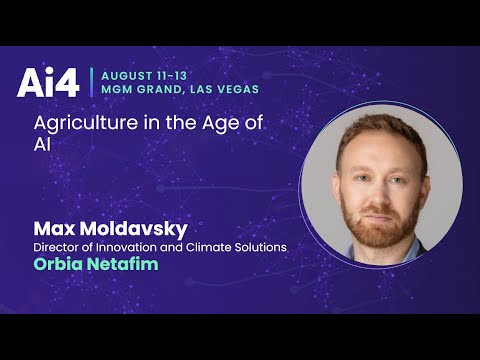
Ai4
Digital farming and predictive crop modeling must replace legacy flood irrigation to satisfy a 70% surge in global food demand as arable land vanishes.
AI-assisted summary of Presentation by Max Moldavsky, Netafim — original source. Check the original for full context.
Source published:
Detailed notes
## Background Published on YouTube by the Ai4 channel on August 28, 2025, this talk features Max Moldavsky, Director of Innovation and Climate Solutions at Orbia Netafim. The presentation description highlights how agtech pioneers are applying artificial intelligence through intelligent irrigation, predictive analytics, and data-driven resource management to shape the future of food, water, and climate resilience.
## TL;DR Max Moldavsky addresses the critical agricultural paradox of needing to produce 60% to 70% more food by 2050 despite depleting arable land, worsening freshwater scarcity, and climate instability. While precision irrigation dramatically reduces water waste, Moldavsky argues that agriculture must now transition to digital farming by optimizing 'every drop of data' through closed-loop systems like Netafim's GrowSphere. By combining six decades of agronomic domain knowledge with real-time sensor telemetry, hyper-localized AI models, and conversational agents, the platform automates crop management from planning to execution. This data-driven transformation democratizes expert agronomy for smallholders worldwide, stabilizes commercial food supply chains, and unlocks fairer agricultural financing.
## Atmosphere & style The presentation carries a professional, urgent, yet pragmatic and tech-forward tone characteristic of an executive agtech keynote. Moldavsky speaks with steady authority and clarity, shifting smoothly from sobering global resource statistics to practical, real-world field applications. The pacing is efficient and optimistic, using concrete operational vignettes to ground complex data architectures in the everyday realities of farmers. It feels like an engaging, high-level briefing on how physical hardware and artificial intelligence converge to address one of humanity's core existential challenges.
## Key takeaways - [00:04](https://www.youtube.com/watch?v=rra9m3VS6e0&t=4s) Global agriculture faces an 'age of less' characterized by the loss of one-third of arable land in 40 years and shrinking freshwater supplies, even as food production must surge 60% to 70% by 2050. - [02:17](https://www.youtube.com/watch?v=rra9m3VS6e0&t=137s) Agriculture accounts for 70% of global freshwater consumption, yet that water is concentrated on only 24% of farmed land—where 75% still relies on ancient, inefficient flood irrigation. - [02:17](https://www.youtube.com/watch?v=rra9m3VS6e0&t=137s) Precision drip irrigation delivers water and nutrients directly to root zones, reducing water consumption by an average of 50% while increasing crop yields by 50% to 100%. - [04:36](https://www.youtube.com/watch?v=rra9m3VS6e0&t=276s) Physical water optimization alone is no longer enough to resolve the food crisis; agriculture must advance into digital farming by optimizing 'every drop of data'. - [04:36](https://www.youtube.com/watch?v=rra9m3VS6e0&t=276s) Operating systems like GrowSphere establish a closed-loop lifecycle that integrates planning, real-time sensing, dynamic AI recommendations, and automated field execution. - [06:02](https://www.youtube.com/watch?v=rra9m3VS6e0&t=362s) The core agricultural AI engine combines decades of empirical agronomic models with plot-level hyper-localization and conversational AI agents that assist or automate field tasks. - [09:17](https://www.youtube.com/watch?v=rra9m3VS6e0&t=557s) Real-time telemetry and remote sensing eliminate manual field scouting friction, dynamically adapt schedules to unexpected rainfall, and benchmark performance against global crop datasets. - [11:46](https://www.youtube.com/watch?v=rra9m3VS6e0&t=706s) AI democratizes professional agronomic expertise for smallholder farmers cultivating single-digit acreages who cannot afford dedicated agronomists. - [11:46](https://www.youtube.com/watch?v=rra9m3VS6e0&t=706s) Data integration stabilizes procurement and processing capacity for food manufacturers while providing end-to-end farm-to-table traceability for consumers. - [14:00](https://www.youtube.com/watch?v=rra9m3VS6e0&t=840s) Objective, AI-derived farm telemetry unlocks fairer crop insurance and financing terms for underserved growers by providing verified risk data to financial institutions. - [14:00](https://www.youtube.com/watch?v=rra9m3VS6e0&t=840s) Hyper-localized predictive modeling overturns rigid, legacy farming calendars by discovering microclimate-optimized planting and harvesting schedules. - [14:00](https://www.youtube.com/watch?v=rra9m3VS6e0&t=840s) The impending data-driven agricultural revolution is poised to exceed the scale of the 20th-century agricultural revolution that expanded global food production tenfold.
## Detailed walkthrough ### [00:04](https://www.youtube.com/watch?v=rra9m3VS6e0&t=4s) The Paradox of Scarcity and Demand in Global Agriculture
Max Moldavsky, Director of Innovation and Climate at Netafim, introduces his presentation by shifting the focus from standard tech conference fare to how artificial intelligence is actively reshaping agriculture. He establishes the stakes by describing modern humanity as living in an "age of less." First, the world is grappling with shrinking freshwater resources, suffering depletion even in regions traditionally considered climatically secure. Second, arable land suitable for cultivation is vanishing at an alarming rate; over the past 40 years alone, the planet has lost one-third of its arable land. Third, climatic stability has deteriorated, marked by an escalating cadence of extreme weather events—ranging from droughts and catastrophic floods to wildfires and severe storms—that disrupt standard farming cycles.
Against this backdrop of resource depletion lies a striking paradox: while critical inputs are diminishing, the demand for output is surging. Driven by population expansion and shifting socioeconomic dynamics, global food production must increase by 60% to 70% by the year 2050. As Moldavsky emphasizes, conventional farming methods are not only incapable of sustaining this surge under diminishing resources, but they have also become "part of the problem."
- **Arable land depletion:** One-third of global arable land has been lost in the last 40 years. - **Future food demand:** Global agriculture must generate 60% to 70% more food by 2050 to meet population needs. - **Climate volatility:** Intensifying droughts, storms, floods, and wildfires are directly reducing predictable crop yields.
---
[02:17](https://www.youtube.com/watch?v=rra9m3VS6e0&t=137s) Inefficiencies in Global Water Use and the Case for Precision Irrigation
Moldavsky illustrates the structural inefficiency of global food systems by breaking down the mechanics of water allocation. Agriculture accounts for 70% of all global freshwater consumption, leaving residential and industrial usage with the remaining 30%. However, that massive 70% slice of freshwater is applied to only 24% of total cultivated agricultural land. The remaining 76% of farmed land relies entirely on natural rainfall, leaving growers critically vulnerable to weather anomalies: "If it's a good season, that's great. If it's a bad season, they're in trouble. We're in trouble. Everyone is in trouble."
```mermaid flowchart TD accTitle: Global Freshwater and Agricultural Land Allocation subgraph Freshwater["Global Freshwater Distribution"] FW_AG["Agricultural Use<br/>(70% of Freshwater)"] FW_IND["Municipal & Industrial<br/>(30% of Freshwater)"] end
subgraph Land["Cultivated Land Irrigation Methods"] L_RAIN["Rainfed Land<br/>(76% of Cultivated Land)"] L_IRR["Irrigated Land<br/>(24% of Cultivated Land)"] L_FLOOD["Traditional Flood / Inefficient<br/>(75% of Irrigated Land)"] L_PREC["Precision Irrigation<br/>(25% of Irrigated Land)"] end
FW_AG --> L_IRR L_IRR --> L_FLOOD L_IRR --> L_PREC ```
Even more critically, 75% of the irrigated 24% still relies on ancient, inefficient methods—such as flood irrigation—virtually unchanged from practices used thousands of years ago. Precision irrigation addresses this disconnect by delivering water and nutrients directly to plant root zones. By optimizing every drop, precision systems routinely reduce water consumption by an average of 50% while simultaneously increasing crop yields by 50% to 100% on the exact same land footprint. Additional benefits include reduced expenditure on inputs like field labor, pumping energy, and crop protection chemicals. Moldavsky notes that Netafim pioneered this space in 1965 out of sheer necessity in the arid Israeli desert, eventually expanding into a global provider serving millions of growers.
---
[04:36](https://www.youtube.com/watch?v=rra9m3VS6e0&t=276s) From Every Drop of Water to Every Drop of Data: Digital Farming with GrowSphere
Despite decades of hardware innovation in drip and precision irrigation, Moldavsky argues that physical water optimization alone is no longer sufficient to solve the global food crisis. Agriculture must advance into digital farming, expanding the mandate from optimizing "every drop of water" to optimizing "every drop of data." Digital farming equips farmers to synthesize vast streams of on-farm and off-farm data to achieve optimized, autonomous operational decision-making across the entire cultivation lifecycle.
```mermaid flowchart LR accTitle: GrowSphere 360-Degree Closed-Loop Lifecycle subgraph Plan["1. Planning"] P1["Crop & Resource Plans"] end subgraph Monitor["2. Monitoring"] M1["Field & Crop Sensors"] M2["Satellites & Drones"] end subgraph Decide["3. AI Recommendation"] D1["Dynamic Agronomic Models"] D2["Weather Adjustments"] end subgraph Execute["4. Operation"] E1["Automated Controllers"] E2["Valves & Fertigation Units"] end
Plan --> Monitor Monitor --> Decide Decide --> Execute Execute --> Plan ```
To deliver this capability, Netafim developed **GrowSphere**, an end-to-end irrigation and fertigation operating system. GrowSphere manages a 360-degree closed loop: it establishes crop plans, monitors field conditions in real time via heterogeneous sensor networks, generates dynamic operational recommendations for water and fertilizer dosing, and directly executes those commands through automated field controllers.
---
[06:02](https://www.youtube.com/watch?v=rra9m3VS6e0&t=362s) Two-Layer System Architecture and the Core Pillars of Agricultural AI
The GrowSphere system operates across two core layers: 1. **The Hardware Layer:** Encompasses physical hydraulic infrastructure (drip lines, automated valves, filters, dosing units) alongside telemetry sensors measuring soil moisture, plant stress metrics, and localized weather indicators. 2. **The AI-Driven Software Layer:** Ingests real-time field telemetry, remote sensing feeds from satellites and drones, and localized meteorological forecasts into dynamic crop models.
These models generate continuously updated, real-time recommendations. For instance, if an irrigation event was scheduled two days prior but unexpected rain fell overnight, the system dynamically postpones irrigation by three days to prevent saturation and waste.
```mermaid flowchart TD accTitle: GrowSphere Two-Layer System Architecture subgraph HardwareLayer["Layer 1: Field Hardware & Sensing"] H1["Hydraulic Equipment<br/>(Valves, Filters, Pumps)"] H2["In-Field Telemetry<br/>(Soil, Plant & Weather Sensors)"] end
subgraph DataIngestion["Layer 2A: External & Remote Data"] S1["Remote Sensing<br/>(Satellites & Drones)"] S2["External Weather Forecasts"] end
subgraph AIPlatform["Layer 2B: AI Agronomic Intelligence Engine"] M1["AI Crop Models<br/>(60-Year Agronomic Baseline)"] M2["Hyper-Localization Engine<br/>(Plot-Level Soil Calibration)"] M3["AI Conversational Agent<br/>(Autonomous Execution & Q&A)"] end
H2 --> AIPlatform DataIngestion --> AIPlatform AIPlatform --> H1 ```
Moldavsky highlights three key pillars powering their agricultural AI engine: - **AI-Enhanced Crop Models:** Combines Netafim's 60 years of empirical agronomic domain knowledge with predictive machine learning to evaluate complex multi-variable interactions in real time. - **Hyper-Localization:** Overcomes broad agronomic generalizations by tailoring irrigation to specific soil variations and microclimates across distinct plots—even between adjacent fields separated by only a few hundred meters. - **Built-in AI Agents:** Alleviates the cognitive burden on farmers by providing natural language interfaces to explain technical charts, clarify system logic, and autonomously manage field controllers when authorized.
---
[09:17](https://www.youtube.com/watch?v=rra9m3VS6e0&t=557s) GrowSphere in Action: Eliminating Guesswork and Field Fatigue
A short operational video dramatizes the daily friction farmers encounter without automated systems: team members debating conflicting field observations, noting a 3.4°F temperature spike, arguing over whether specific plots (such as plots 12, 15, and 33) are over- or under-irrigated, and dreading a five-hour round trip just to inspect a remote northern section.
The vignette demonstrates how GrowSphere resolves these inefficiencies in real time: - Provides immediate status visibility across all plots from any smartphone, tablet, or PC, removing the need for manual field scouting trips. - Surfaces actionable issue alerts—such as an interrupted irrigation cycle and dry soil readings on Plot 7—and automatically adjusts the following day's schedule to compensate. - Dynamically integrates sudden rainfall events into ongoing irrigation schedules. - Features a **Crop Advisor** module that provides instant operational guidance for newly introduced crop varieties by leveraging performance datasets from identical crops grown worldwide.
Moldavsky follows the clip by recalling feedback from a commercial grower who credited a single automated system alert with identifying a critical plot anomaly that would have otherwise gone completely unnoticed under standard visual inspections.
[11:46](https://www.youtube.com/watch?v=rra9m3VS6e0&t=706s) Multi-Stakeholder Impact: Planet, Smallholders, and the Food Industry
Intelligent irrigation and predictive analytics deliver an all-around positive impact across the entire agricultural ecosystem. For the environment and soil, resource efficiency prevents degradation and actively maintains long-term soil health. For growers, improved yields and profitability provide economic sustainability, which is especially critical given the structure of global farming. The vast majority of the world's farmers are smallholders cultivating plots on a single-digit number of acres. These growers typically lack the financial resources or direct access to hire professional agronomists to guide decisions on water allocation, fertilization, and crop protection. Deploying AI models decouples agronomic expertise from physical, in-person consulting, driving a true "democratization of knowledge and skills" that levels the playing field for growers worldwide.
```mermaid flowchart TD accTitle: Value Chain Impact of Agricultural AI subgraph Core["AI & Data Platform"] A["Hyper-Localized AI Models"] end
subgraph Beneficiaries["Stakeholder Impacts"] B["Planet & Soil<br/>Resource efficiency & soil health"] C["Smallholders<br/>Democratized agronomy & higher yields"] D["Food Industry<br/>Predictable supply & capacity planning"] E["Consumers<br/>Farm-to-table traceability"] end
A --> B A --> C A --> D A --> E ```
Beyond individual growers, commercial food processors and agribusinesses benefit from increased predictability across their procurement networks. A core operational KPI for food manufacturers is keeping processing facilities running at full capacity with minimal overhead; real-time visibility into contracted farms stabilizes supply chains and mitigates disruptions. Furthermore, these integrated data streams enable complete farm-to-table traceability, giving end consumers transparent visibility into how their food was grown and handled throughout its lifecycle.
- **Agronomic Access**: Bridges the knowledge gap for smallholder farmers managing single-digit acreage without access to dedicated agronomists. - **Supply Chain Optimization**: Enables food companies to optimize processing plant utilization and procurement planning. - **Consumer Traceability**: Facilitates end-to-end transparency across the food supply chain from harvest to consumption.
---
[14:00](https://www.youtube.com/watch?v=rra9m3VS6e0&t=840s) The Broader Frontier: Smarter Finance, Rewriting Farming Dogmas, and the Next Revolution
While precision irrigation serves as a prime proof point, the potential applications of AI across agriculture extend into broader structural domains. Financial and insurance institutions have historically struggled to underwrite small or non-standard agricultural operations due to lack of verifiable risk data. AI-driven predictive modeling provides credible, objective farm-level data that enables financial institutions to offer improved financing terms and fairer insurance premiums to growers who were previously uninsurable or underserved.
AI also has the potential to challenge and overturn deeply entrenched agricultural dogmas. Traditional farming calendars often rely on broad regional heuristics—such as the standard rule of thumb to plant corn in March or April and harvest in September or October. Hyper-localized AI models can evaluate microclimates, soil dynamics, and shifting weather patterns to discover entirely new cultivation cycles that maximize productivity beyond legacy practices.
This impending transformation is poised to surpass the scale of the early 20th-century agricultural revolution, which expanded global food production tenfold. By harnessing data-driven decision-making, the next agricultural revolution will center on empowering millions of farmers to optimize "every drop of data" alongside every drop of water.
- **Financing and Risk Underwriting**: High-fidelity AI farm models allow insurers and lenders to offer lower premiums and accessible capital. - **Challenging Conventional Calendars**: Hyper-local modeling can replace rigid seasonal conventions (e.g., standard spring-planting and autumn-harvest corn windows) with optimized, data-backed schedules. - **Historical Scale**: Anticipated to exceed the tenfold production gains achieved during the 20th-century agricultural revolution.
## Notable quotes > [00:04](https://www.youtube.com/watch?v=rra9m3VS6e0&t=4s) age of less — Max Moldavsky
> [00:04](https://www.youtube.com/watch?v=rra9m3VS6e0&t=4s) part of the problem — Max Moldavsky
> [02:17](https://www.youtube.com/watch?v=rra9m3VS6e0&t=137s) If it's a good season, that's great. If it's a bad season, they're in trouble. We're in trouble. Everyone is in trouble. — Max Moldavsky
> [04:36](https://www.youtube.com/watch?v=rra9m3VS6e0&t=276s) every drop of water — Max Moldavsky
> [04:36](https://www.youtube.com/watch?v=rra9m3VS6e0&t=276s) every drop of data — Max Moldavsky
> [04:36](https://www.youtube.com/watch?v=rra9m3VS6e0&t=276s) GrowSphere — Max Moldavsky
> [09:17](https://www.youtube.com/watch?v=rra9m3VS6e0&t=557s) Crop Advisor — Max Moldavsky
> [11:46](https://www.youtube.com/watch?v=rra9m3VS6e0&t=706s) democratization of knowledge and skills — Max Moldavsky
## Mentioned Max Moldavsky, Netafim, Orbia Netafim, GrowSphere, Crop Advisor, Ai4
## Video description Max Moldavsky, Director of Innovation and Climate Solutions, Orbia Netafim
Abstracts
AI is transforming agriculture, enabling precision, prediction, and resilience at scale. In this talk, we’ll explore how agtech pioneers like Orbia Netafim are applying AI through intelligent irrigation, predictive analytics, and data-driven resource management to shape the future of food, water, and climate.
[Source](https://www.youtube.com/watch?v=rra9m3VS6e0)