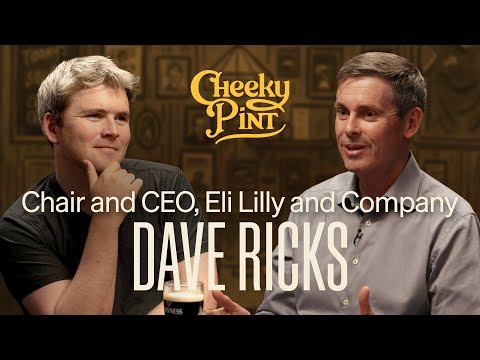
Eli Lilly Outpaces Rivals as Self-Pay Patients Drive GLP-1 Surge
Stripe
Eli Lilly captures over 70% of new US GLP-1 starts by bypassing traditional insurance systems through direct-to-consumer platforms and investing a record 25% of sales back into automated, AI-driven drug discovery.
## Background
Published on YouTube by Stripe on November 11, 2025, this page features an interview with Eli Lilly CEO Dave Ricks, hosted by John and Patrick. The video description highlights a rare, candid look into the strategies, science, and future of pharma, exploring the complex business of drug development, GLP-1 origin stories, pricing controversies, and clinical trial enrollment challenges.
## TL;DR
In this extensive interview, Eli Lilly CEO Dave Ricks discusses how the pharmaceutical giant reinvests up to 25% of its sales into R&D, leveraging advanced NVIDIA-powered supercomputers and AI to accelerate drug discovery. The conversation details the profound physiological and financial impacts of GLP-1 medications like tirzepatide, explaining their potential to treat broader inflammatory conditions and addiction while igniting a self-pay consumer revolution. Ricks also critiques the structural flaws of US healthcare, detailing the perverse incentives of Pharmacy Benefit Managers, the rise of a 'shadow generic' industry exploiting patent disclosures, and Lilly's direct-to-consumer pivot with LillyDirect. Finally, he outlines the internal talent mobility and flat-headcount operational philosophies that have sustained Lilly's 150-year corporate legacy and premium market valuation.
## Atmosphere & style
The dialogue feels like an elite masterclass in corporate strategy, balancing deep technical insight with a relaxed, engaging camaraderie. Dave Ricks comes across as a sharp, remarkably articulate, and self-taught leader who rejects bureaucratic jargon in favor of direct, real-world analogies, famously comparing healthcare pricing transparency to a deceptive restaurant wine bill. The tone is intensely forward-looking and intellectually rigorous, vibrating with a sense of high-stakes momentum as the hosts probe the intersection of modern tech-stack scaling and the notoriously slow, complex realities of human biology.
## Key takeaways
- [00:00](https://www.youtube.com/watch?v=-FmVCDx_kFw&t=0s) Eli Lilly scales its medical R&D to a nation-state level, investing roughly $14 billion annually (25% of sales), which surpasses Germany's entire medical R&D budget.
- [00:54](https://www.youtube.com/watch?v=-FmVCDx_kFw&t=54s) The company has partnered with NVIDIA to build the pharmaceutical sector's largest on-premise, biologically-focused supercomputer to drive proprietary drug discovery.
- [02:16](https://www.youtube.com/watch?v=-FmVCDx_kFw&t=136s) AI-driven drug discovery is currently bottlenecked by human biological knowledge, as only 10% to 15% of human biology is understood well enough to accurately predict toxicity.
- [10:11](https://www.youtube.com/watch?v=-FmVCDx_kFw&t=611s) Clinical trial costs in the US have escalated to a median of $40,000 per patient due to fragmented regulatory requirements and a 'regulatory ratchet' that rarely removes old rules.
- [29:51](https://www.youtube.com/watch?v=-FmVCDx_kFw&t=1791s) Traditional 'shrinkwrap' pharmaceutical unit pricing is challenged by advanced genetic therapies, which offer one-and-done cures but lack an amortization model within current insurance systems.
- [37:33](https://www.youtube.com/watch?v=-FmVCDx_kFw&t=2253s) The Gross-to-Net bubble and Pharmacy Benefit Managers (PBMs) create perverse financial incentives, driving up drug list prices while manufacturer net returns remain flat.
- [41:06](https://www.youtube.com/watch?v=-FmVCDx_kFw&t=2466s) The US market effectively funds global pharmaceutical R&D, leading to proposals like 'One Fair Price' to index US price floors to foreign GDP per capita and eliminate rebates.
- [57:40](https://www.youtube.com/watch?v=-FmVCDx_kFw&t=3460s) Eli Lilly enforces 'The 400-Person Rule' to maintain a tight-knit culture in specialized research hubs, fostering a 'Let Them Cook' school of unsanctioned, creative scientific innovation.
- [01:07:04](https://www.youtube.com/watch?v=-FmVCDx_kFw&t=4024s) Chinese biotech has grown to command 30% of the global drug pipeline, mastering iterative derivatives and prompting calls for enhanced patent inspection confidentiality.
- [01:10:43](https://www.youtube.com/watch?v=-FmVCDx_kFw&t=4243s) A 'shadow generic industry' uses computational design to create minor atomic variations in published patents, bypassing data exclusivity without producing primary clinical trial data.
- [01:16:35](https://www.youtube.com/watch?v=-FmVCDx_kFw&t=4595s) The US generic drug market offers the lowest prices in the OECD, but aggressive cost-cutting has offshored manufacturing and created fragile supply chains vulnerable to shortages.
- [01:22:42](https://www.youtube.com/watch?v=-FmVCDx_kFw&t=4962s) GLP-1 medications like tirzepatide correct an evolutionary biological mismatch, reducing daily intake by 800 calories while yielding systemic anti-inflammatory benefits.
- [01:27:35](https://www.youtube.com/watch?v=-FmVCDx_kFw&t=5255s) GLP-1s exhibit powerful dopamine downregulation, signaling satiety to the brain stem and noticeably reducing patient desires for alcohol, smoking, gambling, and shopping.
- [01:33:00](https://www.youtube.com/watch?v=-FmVCDx_kFw&t=5580s) The self-pay market has unlocked a healthcare revolution, with Zepbound's out-of-pocket option becoming Lilly's top prescription format and bypassing insurance frameworks.
- [01:37:31](https://www.youtube.com/watch?v=-FmVCDx_kFw&t=5851s) LillyDirect disintermediated traditional PBMs to sell low-priced insulin and weight-loss medications directly to consumers using fintech payment infrastructure like Stripe.
- [01:42:22](https://www.youtube.com/watch?v=-FmVCDx_kFw&t=6142s) Wall Street grants Eli Lilly a massive premium and an $800 billion market cap, driven by its GLP-1 franchise and its inclusion in the highly exclusive corporate 'Rule of 80' club.
- [01:51:11](https://www.youtube.com/watch?v=-FmVCDx_kFw&t=6671s) Eli Lilly targets 'zero-value' markets—entirely unaddressed diseases with no pre-existing commercial treatments—and aggressively front-loads multi-million dollar clinical trials.
- [02:01:26](https://www.youtube.com/watch?v=-FmVCDx_kFw&t=7286s) Lilly's 150-year legacy relies on an institutionalized internal succession model, having had only 11 CEOs who master an 'unspoken operating system called culture' through deep internal mobility.
## Detailed walkthrough
### [00:00](https://www.youtube.com/watch?v=-FmVCDx_kFw&t=0s) AI, Science, and the "Nation-State" Scale of R&D
Eli Lilly and Company is currently operating at a "nation-state level" when it comes to medical research and development, spending an estimated $14 billion this year alone. To put this massive scale into perspective, CEO Dave Ricks notes that Eli Lilly spends more on medical R&D than the entire nation of Germany. While the National Institutes of Health (NIH)—the largest spender on Earth—stands at $40 billion, Lilly is rapidly closing the gap.
To navigate the complex scientific decisions required at this level, Ricks relies heavily on artificial intelligence. He keeps "at least one or two AIs running every minute of every meeting" to ask real-time science questions. Rather than using ChatGPT, which he finds "too verbal," Ricks prefers Claude or xAI's Grok. He finds these models to be more terse, with scientific references that "actually check out more often" without requiring tedious cross-referencing.
- **Eli Lilly R&D Spend:** $14 billion annually (approx. 25% of sales).
- **NIH R&D Spend:** $40 billion annually.
- **Average US Caloric Intake:** 3,600 calories per day.
- **Dave Ricks' Tenure:** The 11th CEO in Eli Lilly's 150-year history (one fewer than the number of Popes during the same period).
### [00:54](https://www.youtube.com/watch?v=-FmVCDx_kFw&t=54s) The New Era of Eli Lilly and the NVIDIA Supercomputer
Eli Lilly is a 150-year-old institution that grew to prominence as the first company to mass-produce insulin in the 20th century. Today, under Ricks' leadership, it has transformed into a $700 billion enterprise—the world's most valuable pharmaceutical company—largely driven by its market-leading GLP-1 diabetes and weight loss drugs. The company is also bypassing traditional middlemen by selling directly to consumers online via LillyDirect.
At the recent NVIDIA GTC conference, Eli Lilly announced a major partnership to build an on-premise supercomputer powered by NVIDIA's latest B300 chipsets. Scheduled for completion by the end of the year, it is designed to run proprietary drug discovery models. Ricks believes it is "the biggest biologically-focused supercomputer there is" in the pharma sector, noting that their only constraint in scaling it further is power.
### [02:16](https://www.youtube.com/watch?v=-FmVCDx_kFw&t=136s) AI-Driven Drug Discovery and the Limits of Biology
The primary goal of Lilly's new supercomputer is to assist scientists in co-inventing and co-developing drugs, focusing initially on chemistry. Ricks explains that targets like GLP-1—a hormone peptide that engages G protein-coupled receptors on the outside of cells—are notoriously difficult to drug. Trying to mimic a massive protein with a tiny chemical compound without causing untoward side effects is a highly complex, empirical challenge. AI models can predict these interactions by generating "strange arrangements of atoms" that do not exist in nature and look entirely alien compared to historical drugs.
However, Ricks acknowledges the skepticism of industry commentators like Derek Lowe, who argue that AI cannot easily solve the issues of target selection or human toxicity. Ricks agrees that AI's utility is currently bottlenecked because "we might know 10%-15% of human biology." For AI to solve the hardest systemic prediction problems, the industry must first build a more complete repository of biological knowledge. Ricks suggests this will require 24/7 robotic experimentation to generate massive training datasets—an effort he believes the NIH should be leading.
- **The Drug Target Challenge:** Mimicking large proteins with small chemical molecules.
- **The Data Bottleneck:** Current AI models are trained on only 10% to 15% of human biology; systems must get well above 50% to predict complex human toxicity.
### [05:08](https://www.youtube.com/watch?v=-FmVCDx_kFw&t=308s) From Accidental Employee to CEO: How Dave Ricks Learns
Despite not having a formal background in science—and joking with his hosts about their shared lack of traditional credentials—Ricks is highly comfortable making top-level scientific decisions. He describes himself as an autodidact who stays curious by reading medical journals, attending data conferences, and talking directly with Lilly's scientists.
Ricks originally joined Eli Lilly "accidentally" through the business development and M&A group, where he evaluated the worth of projects by working closely with scientists. The magic of the industry clicked for him when a project he worked on became an approved medicine in the US, and his own mother was prescribed it. "You saw the full end-to-end impact," the hosts observe, to which Ricks replies, "That's what purpose is."
### [07:23](https://www.youtube.com/watch?v=-FmVCDx_kFw&t=443s) The "Moneyball" of Pharma: Making the $4 Billion Decision
When making Eli Lilly's three or four critical scientific decisions each year, Ricks balances a quantitative "Moneyball" approach with qualitative judgment. While the company has implemented a highly rigorous decision-making process to act as "bumpers on the bowling alley" and prevent bad bets, final decisions still rely on leadership debate. Lilly enforces a strict rule to "never decide in one meeting," allowing executives to digest arguments before Ricks makes the final call.
The stakes of these decisions are incredibly high. Developing a single drug costs an average of $3.5 to $4 billion, with over 60% of that cost concentrated in the final Phase III clinical trials. Lilly typically carries five to ten projects in Phase III at any given time, with each program burning over $1 billion a year. Because the financial returns on most drugs that reach this stage are not positive, the ultimate test is whether a drug can produce enough value for society and the company to keep the entire cycle funded.
### [10:11](https://www.youtube.com/watch?v=-FmVCDx_kFw&t=611s) The High Cost and Complexities of Clinical Trials
A major bottleneck in drug development is the staggering cost of clinical trials, where the median cost per enrolled patient in the US has reached $40,000. Ricks explains that this high cost is not an accident; trials recruit the sickest slice of the healthcare system and pay for their entire standard of care to maintain a controlled, standardized experiment. This acts as an inducement for patients who are subjecting themselves to blinded trials where they might receive a placebo or a treatment that could potentially cause harm.
To manage these costs and accelerate enrollment, Eli Lilly runs the majority of its clinical trials outside of the United States. While the US has world-class care, only 4% of cancer patients participate in clinical trials, compared to over 25% in Spain and Australia. Ricks attributes this disparity to the decentralized US regulatory system, which requires separate Institutional Review Board (IRB) ethics clearances for every single healthcare system, whereas countries like Australia offer a single, centralized system for nationwide recruitment.
- **Median US Clinical Trial Cost:** $40,000 per enrollee.
- **US Cancer Trial Participation:** Only 4% of patients (vs. >25% in Spain and Australia).
- **Lilly's Development Timeline:** Under 7 years in the clinic, compared to the industry average of nearly 10 years.
[15:44](https://www.youtube.com/watch?v=-FmVCDx_kFw&t=944s) The Bottleneck of Clinical Trial Enrollment
A major bottleneck in the drug development pipeline is the slow, serial process of clinical trial enrollment. Even when a protocol is open, sites are trained, and researchers are waiting, studies often stall simply because they lack patients. "If Taylor Swift can sell out a concert in a few seconds, why can't I fill an Alzheimer's study?" is the frustrating paradox of modern healthcare.
To bypass this, companies are experimenting with proactive outreach. One approach involves culling existing electronic health record (EHR) databases to contact patients who have previously tested high for a specific biomarker—such as a cholesterol subtype like Lp(a)—back when no treatment existed, and inviting them to join a new study. However, EHR data in the United States remains notoriously poorly organized. A more promising path is going directly to the patients themselves, who hold the ultimate interest in finding a cure, bypassing indifferent physicians or institutions.
- **Lp(a) Program:** A cholesterol subtype used as a pilot for proactive database outreach to recruit patients who previously had no treatment options.
- **EHR Limitations:** Fragmented and poorly organized electronic health records in the US hinder automated patient matching.
[17:54](https://www.youtube.com/watch?v=-FmVCDx_kFw&t=1074s) The Vision of Decentralized and Preventative Trials
The ideal future of clinical trials looks highly decentralized: a patient receives an email based on their health data, a package with the trial drug arrives at their door the next day, and follow-ups are conducted via televisits or home health nurses. While the necessity of physical hospital intermediaries depends on the disease, this vision has already been executed at scale.
Eli Lilly ran a highly successful, fully enrolled Alzheimer's prevention study targeting people with the amyloid precursor protein who had not yet developed dementia. It became the fastest-accruing Alzheimer's study in history. Using just a single investigator in the United States, they screened over 80,000 people. Patients received instructions, participated in televisits, took blood-based diagnostic tests, and went for a confirmatory PET scan before receiving a nine-month course of amyloid-depleting treatment. This model is particularly well-suited for preventative medicines, where motivated, middle-aged patients are eager to protect their long-term wellness before comorbidities set in.
- **80,000+ Screened:** The scale of the pre-dementia Alzheimer's prevention study.
- **Single Investigator:** The trial was managed with only one principal investigator in the US by leveraging decentralized televisits and local testing.
- **9-Month Course:** The duration of the amyloid-depletion treatment evaluated in the trial.
[19:23](https://www.youtube.com/watch?v=-FmVCDx_kFw&t=1163s) Paul Janssen and the Regulatory Ratchet
The clinical trial system can seem torturously expensive and bureaucratic to outsiders, but some argue "that's how it's gotta be." However, historical context reveals this complexity is a societal choice. Dr. Paul Janssen—the "Michael Jordan" of drug discovery who founded Janssen Pharmaceutica in 1953 and was behind the development of roughly 80 approved medications—recounted a time when drug development was vastly more straightforward.
The modern bureaucracy is the result of a regulatory ratchet. Over time, real or perceived drug safety incidents have led global economies to harmonize their systems around increasingly strict requirements, rebalancing the risk-benefit equation. Once a regulation is added, it is almost never taken away.
- **Paul Janssen:** A Belgian pharmacologist widely considered the "MVP of medicine" for inventing and getting ~80 drugs approved.
- **2,000 Manmade Medicines:** The approximate number of approved synthetic drugs in existence, spanning roughly 400 unique biological mechanisms.
[22:21](https://www.youtube.com/watch?v=-FmVCDx_kFw&t=1341s) The Cost of False Alarms: Vioxx and Avandia
The danger of the regulatory ratchet is illustrated by the drug safety panics of the 2000s, specifically Merck's Vioxx (for pain) and GSK's Avandia (for diabetes). Driven by newly available electronic health records, regulatory agencies detected what they believed were traces of cardiovascular risk. Following intense escalation and labeling changes, both companies withdrew the products and faced billions of dollars in product liability lawsuits. Years later, deeper analyses revealed there was actually no statistical risk to be found; the scare was a product of ascertainment bias.
This panic caused a ten-year chill in drug development. For diabetes, it triggered an explicit policy change: companies had to rule out cardiovascular risk *prior* to market entry. While diabetes efficacy can be measured quickly via continuous variables like glucose, cardiovascular events are binary and require waiting years for natural history to play out. This policy instantly added four to five years of development time and massive costs to any new diabetes drug. Ironically, this high barrier to entry now protects incumbents; highly effective new drugs like tirzepatide easily clear the cardiovascular safety bar, creating a moat against low-cost competitors.
- **Vioxx & Avandia:** Two major drugs withdrawn in the 2000s due to cardiovascular safety scares that were later shown to be statistical anomalies.
- **4-to-5-Year Delay:** The additional trial time mandated for new diabetes drugs to rule out cardiovascular risk before approval.
[24:59](https://www.youtube.com/watch?v=-FmVCDx_kFw&t=1499s) The Economics and Biology of Obesity Treatment
A major hurdle for preventative medicines is reimbursement. Insurers and employers often operate on short time horizons, making them hesitant to cover drugs that only pay off economically over decades. However, the Institute for Clinical and Economic Review (ICER)—an organization often critical of drug pricing—recently analyzed the GLP-1/GIP receptor agonists tirzepatide (Zepbound) and semaglutide. They concluded that both are highly cost-effective at current pricing, breaking even on total medical costs within a two-year timeframe. Tirzepatide was found to be twice as effective as ICER's standard threshold of saving $100,000 per person per year in downstream healthcare costs.
The resistance to reimbursing obesity drugs also exposes a deep-seated societal bias that views weight as a failure of personal discipline. In reality, human biology is hardwired for survival in environments of starvation. Our ancestors roaming the tundra of Ireland or crossing the ice bridge from Norway had no genetic code to limit food consumption because such a limit would have been a "wasted piece of code." Today, Americans consume an average of 3,600 calories a day in an environment saturated with food.
GLP-1 medications work by safely correcting this biological mismatch, reducing average intake by about 800 calories a day—essentially cutting out "second breakfast"—without making the patient feel miserable. When people lose weight through crash diets, their biological set point fights back, causing hyperinsulinemia, intense hunger, and irritability. These medications restore balance to the body's counterregulatory incretin system, allowing patients to feel good while losing weight.
- **3,600 Calories:** The average daily caloric consumption of an American.
- **800 Calories:** The average daily reduction in caloric intake for a patient on a GLP-1 medication.
- **ICER Analysis:** Confirmed both tirzepatide and semaglutide are cost-effective under current pricing models.
[29:51](https://www.youtube.com/watch?v=-FmVCDx_kFw&t=1791s) The "SaaS vs. Shrinkwrap" Dilemma of Genetic Medicine
The pharmaceutical industry faces a fundamental business model challenge when transitioning from recurring treatments to one-time cures. Traditional drugs operate on a recurring unit-pricing model, similar to "shrinkwrap software" where all value must be captured on a single invoice. In contrast, genetic medicines represent a "one and done" cure.
For example, a gene-editing treatment currently in development can perform a one-time PCSK9 edit in the liver, permanently knocking down a patient's LDL cholesterol to between 20 and 40 for the rest of their life. This single intervention would displace daily medications that cost $8,000 to $9,000 annually. While a one-time cure is vastly superior for the patient, pricing it to recoup massive R&D costs is incredibly difficult because the consumption and insurance side of the healthcare system has no capability to handle non-traditional, amortized, or subscription-based pricing models.
- **PCSK9 Liver Edit:** A developmental one-time genetic treatment designed to permanently lower LDL cholesterol.
- **$8,000–$9,000/Year:** The annual cost of daily cholesterol-lowering medications displaced by a one-time gene edit.
### [31:54](https://www.youtube.com/watch?v=-FmVCDx_kFw&t=1914s) The SaaS Model for Gene Therapy and the R&D Incentive System
The regulatory framework governing medicine is built around a legacy model: "I buy one unit, I pay X." This transactional structure is poorly suited for modern curative treatments like gene therapy, where a patient receives a single dose but the value is realized over a lifetime. To bridge this gap, a licensing concept borrowed from the software-as-a-service (SaaS) model could be implemented. Under this structure, a pharmaceutical company would perform a gene therapy procedure for free, and as long as the treatment continues to work, the patient or insurer would deposit a recurring fee into the company's bank account. If the treatment stops working, a warranty is invoked, and the payments cease. This model is actively being considered to unlock gene therapies for more common diseases, where the traditional single-payment model is financially unsustainable.
This mismatch in payment structures is downstream of a broader, highly arbitrary R&D and incentive system. The patent time horizon is a fixed, arbitrary number that dictates what pharmaceutical companies can afford to invest in. While off-label use provides a valuable safety valve in the US healthcare system, the overall system remains deeply flawed for those who want to see more new medicines developed. Interestingly, public debates rarely focus on how to incentivize new discoveries; instead, they center on the problem of affordability.
- **US Healthcare Spending:** The US has the most expensive healthcare system in the world, yet only 10 cents on the dollar is spent on medicine. The remaining 90 cents goes toward hospital stays, surgeries, and other care that medicines are designed to prevent.
- **Branded vs. Generic Drugs:** Within that 10% spent on medicine, branded drugs account for 8% of the total spend, while generics make up 2% of the spend despite representing 90% of the volume.
- **Life Expectancy Gains:** Since the creation of Medicare and Medicaid in 1965, US life expectancy has increased by approximately eight years. Studies attribute five to six of those years directly to advances in medicine.
### [35:08](https://www.youtube.com/watch?v=-FmVCDx_kFw&t=2108s) The Collapsing Biotech Investment Climate and the Patent Window
The private market self-funds R&D through capital markets and corporate reinvestment, but this funding relies on price stability and a predictable return period. De facto, the patent window has shrunk because clinical trials and regulatory approval timelines have grown longer. This pressure was compounded by the Biden administration's Inflation Reduction Act (IRA), which introduced government price intervention in the US at "five years plus two"—meaning that around seven years post-launch, a company's ability to recoup its investment is severely curtailed.
This shifting regulatory landscape has triggered a severe contraction in the capital markets. While Eli Lilly remains an exception, the valuation multiples for most large-cap pharmaceutical companies are at their most compressed levels in 20 years. In the biotech sector, the situation is even more stark, with a massive portion of the market trading below cash value and venture capital rounds facing steep declines.
- **Biotech Market Stress:** Approximately half of the SPDR S&P Biotech ETF (XBI) has recently traded below cash.
- **Venture Capital Downturn:** Half of all biotech venture capital funding rounds in the preceding year were down rounds.
- **The Fast-Follower Threat:** Even without regulatory price intervention, the rise of biologics has created a highly competitive ecosystem where fast-followers can quickly develop copycat molecules, reducing the practical value of long patent windows.
### [37:33](https://www.youtube.com/watch?v=-FmVCDx_kFw&t=2253s) The Dynamics of Generic Competition and the "Gross-to-Net" Bubble
In a typical drug class, a "horse race" occurs during the patent window, often resulting in multiple competing therapies. For example, while only two major GLP-1 weight-loss drugs are widely known today, there are approximately 80 in global clinical pipelines, including 11 within Eli Lilly and roughly 70 from competitors. However, true price competition rarely occurs until a generic or biosimilar event. When a patent expires, a drug typically loses 97% of its pricing on the very first day. This is an extraordinary deal for society, but a brutal reality for inventors. Late-entrant competitors who try to compete on price during the patent window find their margins entirely wiped out once the generic event occurs.
To stimulate R&D, the industry must either get drugs to market faster, extend the market exclusivity window, or transition to a "pricing for value" model. In the US multi-payer system, competition does not actually happen on value; instead, it revolves around a complex web of discounts and rebates. Manufacturers launch drugs at a high "list price" that virtually no one pays, and then negotiate lower "net prices" for different buyers.
- **Medicaid Best Price:** By law, state Medicaid programs receive the lowest unit pricing, meaning they spend only about 5% of their budget (a nickel on the dollar) on medicine.
- **The Role of PBMs:** Pharmacy Benefit Managers (PBMs) and group purchasing organizations often take their financial returns as a percentage of the discount off the list price. This creates a perverse incentive where "the higher the list, the better they do."
- **The Ethical Dilemma:** This system results in a highly regressive structure where large insurers get the best deals, while small employers and uninsured individuals are left facing the highest prices.
### [41:06](https://www.youtube.com/watch?v=-FmVCDx_kFw&t=2466s) The Insulin Controversy and the "One Fair Price" Solution
The historical controversy surrounding insulin prices perfectly illustrates the dysfunction of the US commercial environment. For years, the public accused pharmaceutical companies of outrageous price gouging because the list price of insulin had risen to $275, even though the manufacturer's net return remained flat at around $30 to $40. The gap was entirely consumed by middle actors—the PBMs—who ran auctions for employers and insurers. To win these auctions, manufacturers were forced to compete on "the spread," continually raising the list price while keeping the net price low. The ultimate victim was the uninsured patient walking into a pharmacy who had to pay the full, artificial list price.
To break this cycle, Eli Lilly launched its own unbranded biosimilar, Insulin Lispro, priced at a third of the branded version's list price. Initially, insurance companies refused to cover it because a lower list price threatened their margin-spread business model. Today, the biosimilar represents about half of Lilly's insulin volume, effectively defanging the problem.
This dynamic highlights a broader geopolitical issue: because single-payer systems in other developed nations refuse to pay high prices, the entire global cost of pharmaceutical R&D is effectively borne by the US market. Biotech business plans routinely project that 80% to 100% of their revenue will come from the US. Once a drug's R&D is paid for by US patients, companies "margin gather" by selling it cheaply abroad. To solve this politically untenable free-rider problem, a policy of "One Fair Price" (OFP) could be established. Under this framework, manufacturers would set a single price point in the US, but would be required to introduce the drug in other developed nations within a price band tied directly to each country's GDP per capita.
- **The GDP-Tied Price Band:** If a drug is launched in the US for $100, it would be priced at roughly $70 in the UK, reflecting the UK's roughly 30% lower GDP per capita. This ensures that wealthier nations share the global R&D burden equitably based on their ability to pay.
[04:47:30](https://www.youtube.com/watch?v=-FmVCDx_kFw&t=17250s) Fixing the Broken Economics of US Healthcare Pricing
The speakers outline a two-part fix to address the distorted pricing of pharmaceuticals and healthcare. The first fix involves establishing a compact where companies set a firm price they believe their product is worth (e.g., $100) and refuse to sell it below a certain threshold (e.g., $70) in other developed nations, rather than allowing foreign governments to dictate steep discounts. The second fix requires the US reimbursement system—starting with the federal government—to eliminate all discounts and rebates. This would ensure that products move through the distribution channel physically and financially at a single, transparent price.
Under this model, companies would no longer price-discriminate. Instead, they would select a fair price and live with it, much like any other everyday commodity. This would lead to a more equitable distribution of R&D costs globally. If US prices are indexed, companies might actually lower their US prices slightly to remain competitive and capture higher volume in European markets.
One of the most severe critiques of the US healthcare system is that "none of the numbers mean anything" and "they're all lies," which inevitably leads to market failure. To illustrate this absurdity, a speaker shares a vivid restaurant analogy:
> "Could you imagine this? Like, we go to a restaurant tonight and someone gives us the wine list and a bottle of like a hundred dollar Napa Cabernet is like $14,000. But then the waiter says, 'Don't worry, that's not your copay.'... Four weeks later, you get a letter in the mail that starts at the top by saying, 'This is not a bill,' but it says the $14,000 and then there's a number of deductions... And then later you get an actual bill. This is healthcare pricing."
- **The FTC's Role:** While the Federal Trade Commission (FTC) mandates that consumer pricing must be trusted and transparent in other industries, the healthcare system is largely let off the hook.
- **Failure of Price Transparency Regulations:** Recent federal mandates requiring hospitals to post their pricing have resulted in "malicious compliance." Hospital systems either ignore the rules or upload massive, unsearchable flat files filled with incomprehensible ICD-10 codes that are impossible for average consumers to digest.
---
[05:50:58](https://www.youtube.com/watch?v=-FmVCDx_kFw&t=21058s) The Absurdity of Site-of-Care Pricing and the Rise of Private Healthcare
The conversation shifts to the bizarre, counterintuitive experiences patients face when navigating US medical billing. One speaker recounts visiting a physician whose office is attached to a hospital. Federal rules dictate payment differences based on the "site of care," punishing cheaper outpatient clinics with lower reimbursements while rewarding expensive hospital complexes. When the doctor casually suggested a quick blood draw downstairs, the speaker complied, only to discover on the way out that the simple test cost an astronomical $650 because it was run in the hospital's own lab. Because patients are insulated from these costs through complex deductible structures, they are prevented from making informed consumer economic decisions.
The discussion compares this to international systems. Having grown up in Ireland and lived in Canada, the speakers note how foreigners are often shocked by the vibrant, private, for-profit nature of US healthcare, as well as the ubiquity of direct-to-consumer pharmaceutical advertising on television. While outsiders find pharma ads "weird," there is a pro-social defense: clinical trials prove these drugs have significant health benefits, and advertising prompts patients to ask their doctors about them, ultimately driving beneficial utilization.
- **Wait Times:** The US private system results in significantly shorter wait times compared to public, government-run systems due to a higher density of hospitals and specialized outpatient clinics.
- **Standardization vs. Exceptionalism:** Public systems like Canada's offer highly standardized, confidence-boosting primary care, but they struggle with specialty care.
- **Diagnostic Capacity:** The US and China possess roughly 70% of the entire world's diagnostic capacity, meaning the likelihood of detecting a tumor early is vastly higher in these countries than in Ireland or the UK, where systems focus on cost of delivery rather than exceptional care.
---
[05:54:46](https://www.youtube.com/watch?v=-FmVCDx_kFw&t=21286s) The Shift to Chronic Care, Prevention, and Direct-to-Consumer Medicine
Historically, healthcare funding models in both the US and Europe were built around an acute care model designed for accidents and short-term illnesses where patients were treated as best as possible before expiring. Today, acute care represents only about 30% of US healthcare costs, while the remaining 70% is driven by primary care and chronic diseases. These legacy institutional models are poorly suited for chronic disease management, especially when patient behavior is a primary variable.
The speakers discuss how the "therapeutic index" (TI)—the gap between a harmful dose and a helpful dose of a drug—is expanding non-linearly due to new drug technologies. This expansion is driven by genetic and RNA-blocking medicines that target the root causes of diseases. For example, excess proteins can now be pristinely blocked with minimal side effects. These advanced therapies also have a catalytic effect, allowing them to last a very long time.
- **Lp(a) Treatment:** A once- or twice-a-year RNA-blocking treatment is currently being developed for Lp(a)—a type of cholesterol that is untreatable today—with seemingly benign side effects.
- **Bypassing the Healthcare Morass:** With safer drugs and wider therapeutic indexes, clinical trials can be run faster and cheaper. This allows companies to bypass traditional healthcare systems entirely.
- **GLP-1s and Direct Platforms:** The rise of GLP-1 weight-loss drugs serves as a prime example of this shift. Patients do not need a doctor to tell them they are overweight; instead of dealing with insurance companies and "This is not a bill" paperwork, they happily bypass the system using direct-to-consumer platforms, paying $500 out-of-pocket via credit card to get their problems solved.
---
[05:58:23](https://www.youtube.com/watch?v=-FmVCDx_kFw&t=21503s) The Biotech vs. Pharma Landscape and Diseconomies of Scale in Discovery
The conversation turns to the relationship between early-stage biotech companies and large pharmaceutical corporations. Roughly two-thirds of new molecular entities and industry revenues are now attributable to biotechs rather than traditional pharma. This raises the question of whether pharma is transitioning into a "private equity portfolio manager" that simply buys early-stage winners to scale and distribute them, or if it should remain vertically integrated.
Three distinct models have emerged in the modern landscape:
1. The biotech company that attempts to grow up and scale independently.
2. The fully outsourced early-stage model, where pharma acts strictly as a clinical trial and distribution machine, gobbling up smaller companies as they mature.
3. A hybrid model of a fully integrated company that also maintains external outposts.
The speakers argue that running a purely integrated model is akin to having "your head in the sand." While more than half of the medicines approved in the last decade originated in biotech, very few of them traveled all the way through the biotech pipeline independently. Biotech investors are generally unwilling to write the massive, binary checks required for late-stage clinical trials. Large pharma excels at absorbing these portfolio risks and leveraging massive economies of scale in global clinical trials, manufacturing, and distribution.
However, the act of early-stage drug discovery suffers from severe "diseconomies of scale." To combat this, companies like Eli Lilly have intentionally decentralized their research, keeping discovery teams small and nimble.
- **The 400-Person Rule:** Eli Lilly limits its specialized research hubs to around 300 to 400 people to maintain a tight-knit, biotech-like culture.
- **The San Diego Hub:** Lilly established a monoclonal antibody biotech hub in San Diego with only 400 employees. It has successfully produced a third of the medicines the company has made since its inception.
- **Benefits of the Hybrid Model:** Scientists in these small hubs get the cultural benefits of a small "tribe" without having to waste time pitching venture capitalists, raising money, or worrying about market volatility.
- **Unsanctioned Inventions:** A long list of Lilly's most compelling inventions came from projects that were not officially sanctioned by corporate headquarters, proving the value of scientific independence.
[01:02:44](https://www.youtube.com/watch?v=-FmVCDx_kFw&t=3764s) The "Let Them Cook" School of Pharma Innovation
In the pharmaceutical industry, breakthrough discoveries are not always the result of highly structured, top-down corporate mandates. Dave explains that while pointing a team at a specific target with a dedicated budget works, some of the most exciting innovations happen when a scientist quietly works on a side project and eventually reveals, "By the way, I didn't tell you, but I've been working on this thing over here and it seems pretty interesting." At Eli Lilly, they do not manage budgets "down to the nickel" at their research sites. Instead, they embrace what Dave calls "allowable variation"—essentially turning away to see what happens and letting talented people do their thing. The host jokingly dubs this "the let them cook school of pharma innovation."
This iterative, long-term approach was critical to the development of GLP-1s. Eli Lilly launched its first twice-a-day GLP-1 injection back in 2006. When people ask Dave when he knew that a blockbuster drug like Zepbound would be huge, his answer is "2016, 2017." It was a decade-long journey of protein engineering, making better molecules that could be dosed higher, and eventually harnessing dual mechanisms. "It's teams just grinding on a theme," Dave notes, rather than a single scientist having a sudden lightbulb moment in a dark lab.
- **GLP-1 Timeline:** Eli Lilly launched its first twice-a-day GLP-1 injection in 2006, but it took until roughly 2016 or 2017 to realize the massive potential of drugs like Zepbound.
- **Acquisition Strategy:** When Eli Lilly buys biotech companies, they are typically buying the proof of a concept or target rather than the final, perfect solution. They will often take the biotech's "80/20" invention and run it through their own internal refinement loop to turn it into a robust "big pharma asset."
- **Monitoring the Pipeline:** Eli Lilly maintains an ever-growing watch list of external entities, mapping out clinical and preclinical readouts, patent postings, and events worldwide.
---
[01:07:04](https://www.youtube.com/watch?v=-FmVCDx_kFw&t=4024s) The Rise of Chinese Biotech and the Threat to US Competency
The conversation shifts to the shifting geography of biotechnology. While the Bay Area and Boston have historically been dominant hubs, China's share of the global drug pipeline has skyrocketed from near zero a decade ago to approximately 30% today. Dave warns that while cheaper and faster drug development is globally beneficial, the US should "ring the alarm bell right now" regarding its own competitiveness. He argues that biopharma represents the "premier league of the knowledge economy," requiring an extreme diversity of high-level talent and providing high-paying jobs with a significant economic footprint.
Beyond economics, national security is a major concern. During the COVID-19 pandemic, roughly 80% of the effective medicines and vaccines were produced in the United States. Dave points out that if the roles had been reversed, the US would have been in an "extorted position," much like the European Union experienced during its pandemic-era supply chain battles. While it remains to be seen if China can consistently pioneer truly novel, first-in-class concepts, they have incredibly quickly mastered the "iterative derivative" space of refining and replicating existing ideas.
- **Pipeline Statistics:** China's share of the global drug pipeline has grown from single digits (approaching zero) 10 years ago to 30% today.
- **Pandemic Production:** Approximately 80% of the working vaccines and medicines during COVID-19 were produced in the US, highlighting the security risks of offshoring pharmaceutical manufacturing.
---
[01:10:43](https://www.youtube.com/watch?v=-FmVCDx_kFw&t=4243s) How "Clone" Drugs and First-to-File Debase the Patent System
A major driver of China's rapid rise is the growth of "clones"—molecules that are designed to be just different enough from a patented drug to bypass legal protections while maintaining the exact same biological action. Dave explains how this practice effectively erodes the patent system. In 2011, the US shifted from a "first to invent" system to a "first to file" system. Under first-to-file, companies rush to submit patents, which are then published after 12 months. This publication acts as an instruction manual.
With modern technology, copycat companies can feed a published patent into a computer, which quickly designs chemical structures with minor, one- or two-atom differences. These new structures bypass the patent but work identically, creating a "shadow generic industry" that undermines the massive financial investments made by the original innovators. To combat this, Dave proposes a two-part "belt and suspenders" solution:
1. **Data Exclusivity:** Grant a guaranteed 12-year period of data exclusivity to any company that produces primary data all the way through Phase III trials, regardless of patent status. Because a Phase III trial is a "$3 billion ticket," copycats will not be able to replicate it.
2. **Extended Confidentiality:** Establish a league of nations that respect intellectual property to extend the patent inspection confidentiality period from 12 months to six years, keeping the "recipe" secure until the drug is well into clinical development.
- **Patent System Shift:** The US changed its patent system in 2011 from "first to invent" to "first to file," which accelerated the public disclosure of drug recipes.
- **The BioNTech Example:** Highlighting the geopolitical nature of healthcare, China held the rights to the BioNTech-Pfizer vaccine during the pandemic but never approved it, which Dave attributes to "national pride" and a desire not to be beholden to foreign inventions.
---
[01:16:35](https://www.youtube.com/watch?v=-FmVCDx_kFw&t=4595s) Quality Control and Regulatory Gaps in the Generics Industry
The discussion turns to the massive scale of the modern generics industry and the stark differences in how new drugs versus generic drugs are regulated. The host points out that while new molecules undergo incredibly rigorous, scrupulous clinical trials, generic drug validation is heavily reliant on self-certification and plant-level manufacturing audits rather than independent, drug-level testing. This regulatory gap has historically led to severe cases of documented fraud and malfeasance, such as when a major Indian generic manufacturer paid a massive fine in 2013.
[01:17:31](https://www.youtube.com/watch?v=-FmVCDx_kFw&t=4651s) The Reality of the Generic Drug Industry
The conversation shifts to the generic pharmaceutical industry, sparked by reports of rampant fraud, falsification, and the abuse of biosimilarity analyses at major generic manufacturers like Cipla. There is a striking disconnect between the official regulatory stance and the subjective, experiential reality of patients. Many people report online that when they switch from a brand-name medication to a generic, they feel a noticeable difference, only for things to return to normal once they switch back to the branded version. This raises a fundamental question: does the generic industry actually work as well as we think it does, and should consumers exercise caution?
The generic environment in the United States is the most developed in the world in terms of the percentage of medicines consumed, and it offers the cheapest prices in the OECD. This system has been a massive public success because it makes highly effective, life-saving medicines abundant at an incredibly low cost. For example, Prozac—which was researched and developed in the 1980s—remains the standard of care for treating depression today and costs a mere three cents a day. This represents an enormous public surplus that justifies the original high-risk R&D investments.
However, the regulatory framework governing generics has notable loopholes. Under a policy change in the 1980s designed to ease generic entry in exchange for structured patent litigation, generics do not have to prove clinical efficacy. Instead, they only need to satisfy the "5% rule" regarding active ingredients and demonstrate basic pharmacokinetic (PK) absorption in a small group of people. Because dry pills contain excipients—buffering compounds and binders that affect absorption rates—these minor chemical variations can cause highly sensitive patients to experience different real-world effects.
- **Manufacturing Shift:** Virtually no generic drugs are manufactured in the US anymore; production has moved offshore to chemical plants in Eastern Europe, Israel, India, and China due to US environmental regulations and cost pressures.
- **Supply Chain Vulnerability:** The drive for ultra-low costs has made the supply chain fragile, frequently resulting in shortages of complex generic products like injectables.
- **Proposed Solution:** The US should consider paying a small premium for generic resilience and establish a regulatory "dial" to flag medicines with known dosing sensitivities before they transition to generic status.
---
[01:22:42](https://www.youtube.com/watch?v=-FmVCDx_kFw&t=4962s) The Origin and Evolution of GLP-1s
The discussion turns to the massive societal phenomenon of GLP-1 receptor agonists, such as Ozempic and Mounjaro. While popular media often portrays the weight-loss benefits of these drugs as an accidental discovery made during diabetes trials, the true story is one of long-term scientific research and protein engineering. The speaker's company launched the very first GLP-1 drug in the world, tracing the science back to the discovery of the "incretin effect" in 1971. A scientist noticed that ingesting pure sugar orally triggered a much faster metabolic and insulin response than injecting the same amount of sugar directly into the veins, proving that the gut actively signals the brain and other tissues to prepare for nutrients.
These gut hormones, primarily GLP-1 and GIP, naturally have a half-life of only about five minutes in the human body, making them useless as drugs without significant modification. The breakthrough came from nature: a zoologist studying the saliva of the Gila monster discovered a protein that mimicked human GLP-1 but had a four-hour half-life. This was developed into a twice-daily injection for diabetes. By 2006, patients on this early drug were already reporting weight loss. To make these drugs truly effective for obesity, scientists had to engineer flat, long-acting, once-weekly formulations (like dulaglutide and semaglutide) to bypass the severe nausea caused by rapid peak-to-trough hormone spikes.
- **Incretins:** Hormones released by the gut that signal satiety to the brain, instruct fat cells to absorb free fatty acids, and prompt the liver to manage glycogen.
- **Tirzepatide (Mounjaro/Zepbound):** A dual GIP and GLP-1 receptor agonist that achieves superior weight loss and A1C control compared to single-hormone GLP-1s like semaglutide.
- **The Threshold Effect:** High absolute blood levels of the hormone are required to suppress appetite, but a stable, flat release profile is necessary to minimize side effects.
---
[01:27:35](https://www.youtube.com/watch?v=-FmVCDx_kFw&t=5255s) The Broad Systemic Benefits of GLP-1s
Beyond simple weight loss, clinical trials are revealing that GLP-1s offer profound cardiovascular, renal, and anti-inflammatory benefits that cannot be explained by weight loss alone. While many of these benefits target conditions directly adjacent to chronic overweight—such as type II diabetes, atherosclerosis, stroke, sleep apnea, and polycystic ovarian disease—the drugs also exhibit powerful systemic anti-inflammatory properties. Patients taking these medications experience a precipitous drop in C-reactive protein (CRP), a key marker for heart attack risk, within just weeks of starting treatment—long before significant weight loss has occurred.
This rapid anti-inflammatory response suggests that the ancestral stress of overeating (by evolutionary standards) triggers chronic inflammation, which these drugs systematically quiet. This has led to clinical trials exploring GLP-1s for seemingly unrelated inflammatory conditions, such as chronic knee pain, psoriasis, and hidradenitis suppurativa (a severe inflammatory skin disease characterized by painful boils).
- **Hidradenitis Suppurativa:** A highly debilitating skin condition closely correlated with excess body weight; patients using Zepbound have seen the condition disappear, avoiding the need for $4,000-a-month monoclonal antibody treatments.
- **Psoriasis Study:** An upcoming clinical trial combining the psoriasis drug Taltz with Zepbound is expected to show a massive boost in efficacy due to the combined anti-inflammatory and weight-loss effects.
- **Dopamine Downregulation:** By signaling satiety to the brain stem, GLP-1s naturally downregulate the desire for dopamine, leading to anecdotal and clinical reports of patients abruptly losing interest in alcohol, cigarette smoking, gambling, and compulsive shopping.
- **"Biohacking" in Silicon Valley:** Some tech workers are reportedly microdosing Zepbound to maintain a state of mild ketosis and low glucose, claiming it enhances cognitive acuity and allows them to code for longer periods.
[01:33:00](https://www.youtube.com/watch?v=-FmVCDx_kFw&t=5580s) The Expanding Footprint of GLP-1s and the Future of Global Scale
The therapeutic potential of GLP-1 receptor agonists extends far beyond weight loss. Patients taking these medications frequently report feeling sharper, a subjective cognitive benefit that is currently being put to the test. Novo Nordisk is running a clinical trial on the oral form of semaglutide in patients with early dementia, with results expected soon. This cognitive benefit may stem from direct neurological pathways or indirectly through the reduction of strokes, tying back to the cardiovascular benefits of the class. We have stumbled upon a massive "impact zone" for these medicines, which are now being investigated for neurodegenerative diseases, Crohn's disease, psoriasis, cardiovascular disease, and joint disease.
When looking at the future, the scale of adoption is poised to explode. Today, only about 10 to 12 million people in the United States are on a GLP-1, a figure that includes the unapproved compounded market. This is a tiny fraction of the adult population; for obesity alone, the eligible population should be closer to 100 million. While the direct-to-consumer channel has gained massive popularity, paying $500 a month out-of-pocket—equivalent to a car payment—is a steep ask, even if a fair swath of the US can afford it. Interestingly, the self-buy version of Lilly's Zepbound is currently their number one prescribed form, outselling both their insured business and all of Novo Nordisk's Wegovy in new patient starts.
To treat half a billion people globally, the industry cannot rely solely on injectable systems. Eli Lilly has already built six or seven mega-plants capable of producing hundreds of millions of injection systems, but they are capacity-constrained and have largely exhausted the manufacturing learning curve. The future lies in oral formulations. While oral GLP-1s may not be quite as potent as multi-acting injectable hormones, they will allow for patient stratification: injectables can be used for heavy weight loss, while oral versions serve as the primary tool for long-term maintenance. By the time these drugs go generic, a massive proportion of the adult population will likely be on them, easily surpassing the 40 million branded users that statins reached at their peak.
- **Current US GLP-1 Users:** 10 to 12 million (including the compounded market).
- **Target US Obesity Population:** 100 million.
- **Top Seller:** Zepbound self-buy (outperforming Lilly's insured business and all of Wegovy in new starts).
- **Global Scaling Bottleneck:** Injectable systems are too complex to scale to 500 million people; oral formulations are required for global maintenance.
---
[01:36:14](https://www.youtube.com/watch?v=-FmVCDx_kFw&t=5774s) Direct-to-Consumer Advertising and the Speed of Medical Adoption
The pharmaceutical industry's heavy reliance on consumer advertising is a frequent point of public frustration, a sentiment even industry insiders sometimes share. Flipping on the television to see an endless barrage of ads for the exact same drug class "cannot be productive." However, the landscape is shifting: 70% of Lilly's advertising spend has moved away from linear TV toward targeted digital search, and increasingly, generative AI optimization.
Despite the public's distaste for drug commercials, companies continue to advertise because "it works." Beyond consumer ads, promotion to physicians through studies, education programs, and seminars is vital. Historically, medical inventions left to diffuse naturally without active promotion take about 16 years to reach full clinical adoption. With active promotion, that timeline is cut in half to eight years. Lilly's internal goal is to halve that again, aiming for just four years to reach full global adoption. Large language models (LLMs) could theoretically accelerate this educational process, provided they can overcome the hurdle of "convoluting the facts" and are trained on reputable sources like the *New England Journal of Medicine* rather than internet forums like Reddit.
---
[01:37:48](https://www.youtube.com/watch?v=-FmVCDx_kFw&t=5868s) The Wild West of Compounding and "Chinese Peptides"
The massive demand and high cost of brand-name GLP-1s have fueled a shadow market of compounded drugs and unapproved peptides. In places like Silicon Valley, an avant-garde crowd has turned to what are colloquially known as "Chinese peptides." These are unapproved substances, manufactured in Chinese laboratories, that have never been tested in humans. While some compounding pharmacies look like legitimate, publicly traded companies, many operate outside of FDA supervision, violating patents and producing customized formulations that have not undergone safety testing.
Lilly recently submitted studies to the FDA demonstrating that compounding pharmacies are mixing peptides with various vitamins, claiming to boost efficacy but actually creating unapproved, untested new drugs. Even further on the fringe is an industry born out of the bodybuilding and steroid subcultures, often operating under misleading names like "Peptides USA" while sourcing materials from China. These entities sell white powders labeled "not for human use" to protect themselves legally, leaving consumers to reconstitute the drugs with saline and inject them. This practice has led to severe adverse outcomes, including chronic kidney failure and permanent liver damage.
- **Compounding Violations:** Pharmacies bypass patent laws under the guise of "customization," mixing peptides with vitamins to create unapproved drug combinations.
- **Regulatory Action:** Lilly submitted studies to the FDA showing these vitamin-peptide combinations are unapproved new drugs.
- **Severe Risks:** Use of unapproved, self-reconstituted peptides has resulted in documented cases of chronic kidney failure and permanent liver damage.
---
[01:41:31](https://www.youtube.com/watch?v=-FmVCDx_kFw&t=6091s) LillyDirect and Disintermediating the Healthcare System
In response to the friction of the traditional healthcare system, Eli Lilly launched LillyDirect, an accidental experiment born out of leadership changes and a fight with a major Pharmacy Benefit Manager (PBM). When the head of Lilly's US commercial business retired, the CEO stepped back into his old role to run the division directly. Seeking to modernize their "old school" digital presence, the team proposed standing up a direct-to-consumer pharmacy. Though initially shelved due to fears of backlash from the three dominant pharmacy chains, the project was revived when a major pharmacy chain threatened not to carry Lilly's low-priced insulin because they could not extract enough profit from it.
LillyDirect found its "killer app" with the launch of Zepbound. Because weight loss has an incredibly simple diagnostic step—the bathroom scale—and telehealth was widely accepted post-pandemic, Lilly was able to partner with third-party telehealth providers to offer a seamless, direct-to-consumer prescription experience. Today, LillyDirect is annualizing in the billions of dollars and is likely the largest online prescription platform by revenue, utilizing Stripe for payments. This direct-to-consumer leap mirrors the software industry's transition to direct web sales, a model familiar to the tech sector.
- **LillyDirect Origin:** Created to bypass PBMs and pharmacy chains that threatened to block low-priced insulin.
- **The Killer App:** Zepbound's simple diagnostic profile made it perfect for a direct-to-consumer telehealth and pharmacy model.
- **Financial Scale:** The platform is annualizing in the billions of dollars, representing a massive shift toward direct patient relationships.
- **PBM Disintermediation:** Lilly recently moved its own employee PBM services to a transparent, fintech-enabled PBM to escape the rent-seeking behavior of traditional PBMs.
---
[01:46:22](https://www.youtube.com/watch?v=-FmVCDx_kFw&t=6382s) Why Eli Lilly is the Most Valuable Pharma Company in the World
Eli Lilly currently stands as the largest pharmaceutical company in the world by market capitalization. This valuation is driven by a rare combination of high growth, expanding profitability, and being in the early stages of the GLP-1 cycle. In financial terms, Wall Street views Eli Lilly as a "GLP-1 company with a sidecar of some other stuff."
While competitors like Pfizer or Bristol Myers Squibb have comparable revenues and compete in similar therapeutic areas, their market caps hover between $100 billion and $200 billion. Eli Lilly, by contrast, trades around $800 billion. This massive premium—amounting to roughly $600 billion of economic value—is entirely driven by the GLP-1 phenomenon and a market belief that Lilly's R&D productivity is exceptionally high, earning them a "management premium" on every dollar spent.
- **Market Capitalization:** Eli Lilly trades around $800 billion, compared to peers at $100 to $200 billion.
- **Value Driver:** Approximately 80% of the company's economic value is driven by the GLP-1 class.
- **R&D Premium:** Wall Street awards Lilly a premium for superior R&D productivity and capital allocation.
[01:47:45](https://www.youtube.com/watch?v=-FmVCDx_kFw&t=6465s) The Self-Pay Revolution and the "Rule of 80" Club
The conversation shifts to the unique market dynamics of GLP-1 drugs and how they might break the traditional pharmaceutical cycle. Typically, the market assumes that a drug's value is bound to be destroyed once its patent expires. However, there is a growing belief among long-term investors that GLP-1s are ushering in a new era: a highly resilient, self-pay branded business with genuine "franchise value" that can outlast the patent cycle. While Eli Lilly has not yet fully evolved to a mature version of this model—nor have they built a locked-in ecosystem comparable to Apple's—the opportunity is clearly visible. Self-care is an innate human desire, and even if insurance systems do not fully cover these treatments, a massive global population is willing to pay out of pocket.
Eli Lilly is currently experiencing explosive growth, with revenues up 40% year-to-date. The CEO shares a "fun fact" regarding the elite "Rule of 80" club (companies where profit margin plus revenue growth equals 80 or more). Among scaled, large-cap companies, only three meet this metric: NVIDIA (which is the highest, tracking over 90), Broadcom, and Eli Lilly. While the hardware and AI giants trade at higher multiples due to a belief that their cycles are longer, Eli Lilly's tirzepatide US patent extends into the late 2030s, and their oral offering, orforglipron, goes even beyond that.
- **GLP-1 Growth Rate:** Eli Lilly is capturing 70% to 75% of all new patient starts across all GLP-1 forms in the US, outperforming competitor Novo Nordisk (which is growing in the teens) by a ratio of nearly three to one.
- **Market Share:** Eli Lilly holds a 60/40 lead on total carryover business in the GLP-1 space.
- **Valuation Discrepancy:** Eli Lilly trades at a forward P/E multiple of roughly 50, compared to a broader pharmaceutical sector average of just 12.
---
[01:51:11](https://www.youtube.com/watch?v=-FmVCDx_kFw&t=6671s) The Recipe for R&D Success and "Zero-Value" Markets
Pharma is an incredibly difficult business characterized by patent cliffs and intense international competition. To maintain investor confidence, Eli Lilly relies on a 12-year track record of growth that has recently gone "hyperbolic." The CEO explains that winning in pharma is 80% R&D and only 20% policy, commercial strategy, and execution. Eli Lilly focuses on three core pillars: accelerating cycle times, predicting where to allocate capital, and targeting "zero-value" markets—diseases that have no pre-existing commercial medicines.
This strategy of pursuing zero-value markets mirrors NVIDIA CEO Jensen Huang's philosophy of loving "$0 markets." The CEO notes that "there's no limit to human disease," and ironically, the longer medicine helps people live, the more diseases they will eventually develop. This dynamic is similar to AI, where "AI begets more AI" in a self-expanding loop. Eli Lilly balances its R&D portfolio between extending existing franchises, executing incremental clinical trials, and taking massive "moonshots" that could create entirely new categories. For example, they are currently running a study to determine if they can slow Alzheimer's disease before clinical symptoms even start.
- **R&D Reinvestment Rate:** To generate sustained double-digit growth, Eli Lilly aims to reinvest 20% to 25% of its sales back into R&D.
- **Scale of Investment:** With projected sales of around $60-some-odd billion this year, Eli Lilly's R&D budget sits at approximately $14 billion. If revenues scale to $120 billion, a 20% reinvestment rate would approximate the budget of the National Institutes of Health (NIH).
- **Front-Loading Trials:** Rather than running clinical trials serially and securing final indications at the end of a drug's patent life, Eli Lilly is expensive-stacking trials at the very beginning of the product lifecycle to maximize value.
---
[01:56:20](https://www.youtube.com/watch?v=-FmVCDx_kFw&t=6980s) The Virtuous Circle of Drug Pricing and Ecosystem Innovation
Addressing the controversial topic of drug pricing, the hosts note that high GLP-1 revenues act as an economic multiplier, effectively subsidizing broader scientific discovery. When a consumer pays for a GLP-1 drug—even out of pocket—roughly a quarter of every dollar spent goes directly into funding clinical trials and research labs for other diseases, such as cancer or Alzheimer's. "They're paying for medicine that's going to help someone else," the CEO explains, describing this as a "virtuous circle" of shared healthcare value.
To expand their innovation pipeline, Eli Lilly is building a collaborative ecosystem rather than simply acquiring startups at inflated prices. Through initiatives like Catalyze360 and their Gateway Labs in South San Francisco, they host scale-ups and offer them direct access to active Eli Lilly scientists and proprietary AI tools like TuneLab. This "loosely coupled model" allows entrepreneurs to develop their ideas with world-class support, giving Eli Lilly a front-row seat to potential acquisitions if the technology proves successful.
- **Gateway Labs:** Eli Lilly currently operates seven or eight of these shared scale-up facilities across the US, with two in China and one under construction in London.
- **Platform vs. Target R&D:** Early-stage R&D is split between platform technologies (similar to Genentech's historic 30-year run with monoclonal antibodies or Gilead's work in virology chemistry) and targeted drug hunting.
- **Multi-Tool Assault:** For specific targets like Lp(a), Eli Lilly developed multiple modalities simultaneously, advancing both a small molecule and an siRNA candidate into Phase III trials.
---
[02:01:26](https://www.youtube.com/watch?v=-FmVCDx_kFw&t=7286s) 150 Years of Eli Lilly and the Art of Succession Planning
As Eli Lilly approaches its 150th anniversary in May, the discussion turns to how highly tenured, successful companies manage talent. Unlike many Silicon Valley firms that frequently hire external CEOs to solve immediate crises, Eli Lilly relies on a deeply institutionalized system of internal succession planning. The CEO himself is a prime example of this philosophy: he joined the company in 1996 as a new hire in Business Development and M&A, and was systematically rotated through diverse leadership roles—running operations in China, leading the US business, and managing drug development—before taking the helm.
The CEO observes that younger technology companies often struggle with succession because they operate at a different "clock speed" and have not yet lived through full multi-decade business cycles. However, as prominent Silicon Valley companies mature, they too are beginning to see the immense value of retaining and cultivating early, high-performing hires who understand the company's core DNA.
[02:02:51](https://www.youtube.com/watch?v=-FmVCDx_kFw&t=7371s) The 150-Year Legacy and the "Unspoken Operating System"
Reflecting on the long-term trajectory of leadership, the speaker notes that the company has a 150-year history, during which he is only the 11th CEO. He jokes that this is "one less than popes in that period of time," highlighting the extreme stability and long tenure of the role. While it is a special honor, he humbles himself by adding that "it's not a lifetime appointment. I can be fired any day." Interestingly, the first four CEOs were family members, and out of all the subsequent leaders, only one was hired externally.
This heavy reliance on internal succession is credited as a core driver of the company's success. In scaled organizations, a single person cannot lead everything alone; leaders must understand their specific roles and empower those around them. This environment allows people to grow in a unique way, learning to operate within the "unspoken operating system called culture." Internal leaders not only know the technical domain deeply, but they also master the human domain—knowing how to solve complex problems organically without relying on bureaucratic committees.
- **CEO History:** 11 CEOs in 150 years (only one external hire, first four were family members).
- **Culture as an OS:** Internal succession allows leaders to navigate the company's unspoken cultural norms and solve problems without committees.
[02:04:10](https://www.youtube.com/watch?v=-FmVCDx_kFw&t=7450s) Balancing Headcount, R&D Spend, and External Perspectives
As the company experiences rapid growth, the speaker has implemented a highly unpopular policy: keeping headcount flat. While headcount is growing in manufacturing—which is a unit operation business—the approach to R&D is highly disciplined. R&D spending is growing in the high teens to low 20% range, but R&D headcount is only growing in the single digits. When asked where the money goes if not to new hires, the speaker explains that it is channeled into paying existing people well, funding clinical trials, purchasing new equipment, building laboratories, and buying expensive supercomputers from NVIDIA.
Despite the benefits of internal succession, the speaker recognized upon taking over that the company could become too insular. To strike a balance, he has pushed to compete jobs externally at the leadership level and other ranks. Bringing in outside voices—even as a minority voice—stimulates the organization. While these external hires might initially make people uncomfortable because they approach problems differently, they bring invaluable perspectives that challenge the status quo and make excellent points.
- **R&D Spending vs. Headcount:** R&D spend is growing in the high teens/low 20s, while headcount growth is kept to single digits.
- **Capital Allocation:** Excess R&D budget goes toward competitive salaries, clinical trials, laboratory equipment, and NVIDIA supercomputers.
- **External Hiring:** Introducing external talent at leadership levels to prevent insularity and stimulate new ways of thinking.
[02:05:34](https://www.youtube.com/watch?v=-FmVCDx_kFw&t=7534s) Ultimate Risk-Taking on People and Revealed Preference
Looking back at his own career, the speaker recalls four or five times when he was placed in roles he "had no business being in." He expresses immense gratitude that the company's leadership took those risks on him, believing he could learn on the job and ultimately deliver strong long-term performance. He notes that he never would have landed those roles if he had applied as an external candidate. This internal mobility prepared him for the CEO role, which requires a highly horizontal skillset and the ability to touch areas where he had no prior experience. He learned by "graciously reading," doing, and solving real-world problems.
The host concludes by observing that while many companies claim to be long-term oriented, this deliberate approach to talent development and risk-taking is a genuine example of "revealed preference." The conversation wraps up warmly with the speaker thanking the host for the beer and the great discussion.
## Notable quotes
> [00:00](https://www.youtube.com/watch?v=-FmVCDx_kFw&t=0s) at least one or two AIs running every minute of every meeting — Dave Ricks
> [00:54](https://www.youtube.com/watch?v=-FmVCDx_kFw&t=54s) the biggest biologically-focused supercomputer there is — Dave Ricks
> [02:16](https://www.youtube.com/watch?v=-FmVCDx_kFw&t=136s) we might know 10%-15% of human biology — Dave Ricks
> [15:44](https://www.youtube.com/watch?v=-FmVCDx_kFw&t=944s) If Taylor Swift can sell out a concert in a few seconds, why can't I fill an Alzheimer's study?
> [04:47:30](https://www.youtube.com/watch?v=-FmVCDx_kFw&t=17250s) Could you imagine this? Like, we go to a restaurant tonight and someone gives us the wine list and a bottle of like a hundred dollar Napa Cabernet is like $14,000. But then the waiter says, 'Don't worry, that's not your copay.'... Four weeks later, you get a letter in the mail that starts at the top by saying, 'This is not a bill,' but it says the $14,000 and then there's a number of deductions... And then later you get an actual bill. This is healthcare pricing.
> [04:47:30](https://www.youtube.com/watch?v=-FmVCDx_kFw&t=17250s) none of the numbers mean anything — Dave Ricks
> [04:47:30](https://www.youtube.com/watch?v=-FmVCDx_kFw&t=17250s) they're all lies — Dave Ricks
> [01:02:44](https://www.youtube.com/watch?v=-FmVCDx_kFw&t=3764s) By the way, I didn't tell you, but I've been working on this thing over here and it seems pretty interesting. — Dave Ricks
> [01:07:04](https://www.youtube.com/watch?v=-FmVCDx_kFw&t=4024s) ring the alarm bell right now — Dave Ricks
> [01:46:22](https://www.youtube.com/watch?v=-FmVCDx_kFw&t=6382s) GLP-1 company with a sidecar of some other stuff
> [01:51:11](https://www.youtube.com/watch?v=-FmVCDx_kFw&t=6671s) there's no limit to human disease — Dave Ricks
> [01:51:11](https://www.youtube.com/watch?v=-FmVCDx_kFw&t=6671s) AI begets more AI — Dave Ricks
> [01:56:20](https://www.youtube.com/watch?v=-FmVCDx_kFw&t=6980s) They're paying for medicine that's going to help someone else — Dave Ricks
> [02:02:51](https://www.youtube.com/watch?v=-FmVCDx_kFw&t=7371s) one less than popes in that period of time — Dave Ricks
> [02:02:51](https://www.youtube.com/watch?v=-FmVCDx_kFw&t=7371s) unspoken operating system called culture — Dave Ricks
## Mentioned
Dave Ricks, Eli Lilly and Company, National Institutes of Health, NIH, Germany, ChatGPT, Claude, xAI, Grok, NVIDIA, B300, Derek Lowe, Moneyball, Spain, Australia, Institutional Review Board, IRB, Taylor Swift, Lp(a), Paul Janssen, Janssen Pharmaceutica, Merck, Vioxx, GSK, Avandia, tirzepatide, Institute for Clinical and Economic Review, ICER, Zepbound, semaglutide, Ireland, Norway, PCSK9, Medicare, Medicaid, Biden administration, Inflation Reduction Act, IRA, SPDR S&P Biotech ETF, XBI, Pharmacy Benefit Managers, PBMs, Insulin Lispro, One Fair Price, OFP, UK, Federal Trade Commission, FTC, Canada, LillyDirect, Ozempic, Wegovy, dulaglutide, orforglipron, Prozac, Taltz, BioNTech, Pfizer, Bristol Myers Squibb, Novo Nordisk, Cipla, Stripe, Broadcom, Jensen Huang, FDA, New England Journal of Medicine, Reddit, Peptides USA, Catalyze360, Gateway Labs, TuneLab, Silicon Valley, China, London, Genentech, Gilead
Eli Lilly CEO Dave Ricks argues that sustaining biopharmaceutical innovation requires pairing nation-state scale R&D and advanced computing with overhauled clinical trials, direct distribution channels, and stronger intellectual property protections.
AI Supercomputing and Biological Knowledge Bottlenecks (2:16)
Eli Lilly is committing an estimated $14 billion annually to R&D—roughly 25% of sales—rapidly approaching the US National Institutes of Health's $40 billion budget. To accelerate molecular discovery, Lilly is constructing an on-premise supercomputer powered by NVIDIA B300 chips to model chemical interactions. Ricks notes that AI can generate novel atomic structures to target complex proteins like GLP-1, but cautions that computation is constrained because science currently understands only 10% to 15% of human biology.
According to Ricks, AI cannot yet reliably resolve target selection or human toxicity until biological understanding expands significantly past 50%. He contends that closing this gap requires continuous robotic laboratory experimentation to generate massive empirical training datasets, an initiative he argues should be led by public institutions like the NIH.
Clinical Trial Economics and Decentralized Recruitment (10:11)
Bringing a single drug to market costs an average of $3.5 billion to $4 billion, with over 60% concentrated in Phase III trials that routinely burn over $1 billion annually per program. In the United States, patient enrollment costs have reached a median of $40,000 per participant, and cancer trial participation sits at just 4%, compared to over 25% in Spain and Australia. Ricks attributes this lag to fragmented regulatory oversight, such as requiring separate institutional review board approvals across individual US health systems.
Regulatory requirements also accumulate via a one-way "ratchet"; historical safety concerns over drugs like Vioxx and Avandia imposed mandatory pre-approval cardiovascular outcome trials that added four to five years to diabetes drug development. To bypass institutional inertia, Lilly demonstrated the viability of decentralized trials by screening over 80,000 patients for an Alzheimer's prevention study using televisits, local diagnostics, and a single principal investigator.
GLP-1 Systemic Benefits and Prevention Economics (24:59)
While GLP-1 receptor agonists are widely recognized for reducing caloric intake by roughly 800 calories daily, clinical evidence indicates that they provide systemic anti-inflammatory benefits independent of weight loss. Patients experience sharp decreases in C-reactive protein, a key cardiovascular risk marker, within weeks of treatment. Lilly and its peers are currently evaluating GLP-1s across secondary conditions, including sleep apnea, severe inflammatory skin diseases like hidradenitis suppurativa, and neurodegenerative disorders such as early dementia.
Despite historically sluggish insurance coverage for obesity treatments, an evaluation by the Institute for Clinical and Economic Review determined that tirzepatide is cost-effective at current pricing, breaking even on total medical expenses within two years. Ricks attributes payer skepticism to cultural biases that frame weight as a lack of discipline rather than an evolutionary mismatch, noting that modern Americans consume an average of 3,600 calories daily without the ancestral genetic mechanisms required to limit intake.
Reforming Distribution and Bypassing Pharmacy Middlemen (101:31)
The US commercial drug market is distorted by a widening "gross-to-net" bubble where list prices rise while net manufacturer revenues remain flat. In the case of insulin, brand list prices reached $275 even though Lilly's net realization stayed between $30 and $40, because Pharmacy Benefit Managers (PBMs) demanded larger rebate spreads. When insurers resisted covering Lilly's lower-priced unbranded biosimilar, the company responded by launching LillyDirect, an online platform partnering with telehealth providers to sell therapies directly to consumers.
Ricks advocates for federal policy reforms that eliminate rebates and discounts entirely, forcing drugs to clear distribution at a single transparent price. He also proposes that manufacturers establish a firm pricing floor internationally, ending the dynamic where the US market pays 80% to 100% of global drug discovery costs while other developed economies mandate deep price cuts.
Capital Compression and Global Intellectual Property Competition (70:43)
The broader biotech sector faces severe capital contraction: approximately half of the SPDR S&P Biotech ETF has traded below cash value, and the Inflation Reduction Act curtails pricing flexibility roughly seven years post-launch. At the same time, the transition to a "first-to-file" patent system has enabled competitors to use published patents to engineer slightly altered "clone" molecules that replicate drug function while evading patent infringement.
With China's share of the global drug development pipeline expanding from near zero to 30% over the last decade, Ricks warns that US competitive advantage is at risk. To protect innovation incentives, he recommends granting 12 years of guaranteed data exclusivity to any sponsor that funds primary Phase III trials, alongside extending patent publication confidentiality from 12 months to six years.
Ricks highlights that while direct-to-consumer models and high-volume metabolic therapies can fund broader R&D, current healthcare financing remains structurally incapable of handling one-time curative treatments like gene therapies. Without subscription-based payment frameworks or intellectual property reforms, capital will continue shifting away from high-risk, curative discoveries toward lower-risk incremental treatments.
[0:00] Dave Ricks: at least one or two AIs running every minute of every meeting
[0:54] Dave Ricks: the biggest biologically-focused supercomputer there is
[2:16] Dave Ricks: we might know 10%-15% of human biology
[15:44] If Taylor Swift can sell out a concert in a few seconds, why can't I fill an Alzheimer's study?
[287:30] Could you imagine this? Like, we go to a restaurant tonight and someone gives us the wine list and a bottle of like a hundred dollar Napa Cabernet is like $14,000. But then the waiter says, 'Don't worry, that's not your copay.'... Four weeks later, you get a letter in the mail that starts at the top by saying, 'This is not a bill,' but it says the $14,000 and then there's a number of deductions... And then later you get an actual bill. This is healthcare pricing.
[287:30] Dave Ricks: none of the numbers mean anything
[287:30] Dave Ricks: they're all lies
[62:44] Dave Ricks: By the way, I didn't tell you, but I've been working on this thing over here and it seems pretty interesting.
[67:04] Dave Ricks: ring the alarm bell right now
[106:22] GLP-1 company with a sidecar of some other stuff
[111:11] Dave Ricks: there's no limit to human disease
[111:11] Dave Ricks: AI begets more AI
[116:20] Dave Ricks: They're paying for medicine that's going to help someone else
[122:51] Dave Ricks: one less than popes in that period of time
[122:51] Dave Ricks: unspoken operating system called culture
Original transcript
[0:00] You spend more on medical
R&D than Germany does.
[0:02] Yeah, we're at the nation state level.
[0:03] It'll be, yeah, $14 billion this year.
[0:05] Can you imagine this?
[0:07] Like, we go to a restaurant tonight
[0:08] and a bottle of, like, a
hundred dollar Napa Cabernet
[0:10] is like $14,000.
[0:12] But then the waiter says, "Don't worry,
[0:14] that's not your copay."
[0:15] Yeah.
[0:16] I have like at least
one or two AIs running
[0:19] every minute of every meeting I'm in
[0:21] and I just am asking it science questions.
[0:23] Which one do you use for science?
[0:24] Either Claude or the xAI.
[0:28] What would you guess the
average caloric consumption
[0:31] per day in America is?
[0:33] 3,600 calories.
[0:34] Yeah.
[0:35] Isn't that incredible?
[0:36] I'm the 11th CEO of the company.
[0:37] That's one less than popes
in that period of time.
[0:43] Where did you learn to pour?
[0:45] I actually learned in Ireland.
[0:47] Okay, do you want me to leave it down?
[0:48] You're the expert here.
[0:50] Okay, oscillate this way.
[0:52] That's an excellent pint.
[0:53] Yeah.
[0:54] Dave Ricks is CEO of Eli Lilly,
[0:56] which is now a $700 billion company
[0:58] and the world's most
valuable pharma company.
[1:00] Eli Lilly is 150 years old.
[1:02] They grew up as the first company
[1:03] to mass produce insulin
in the 20th century.
[1:06] But today most of the company's business
[1:08] is in the new GLP-1 diabetes
and weight loss drugs
[1:11] where they've become the market leader.
[1:13] Simultaneously, Eli Lilly is
upending the traditional model
[1:16] by selling directly to their
consumers over the internet
[1:18] with LillyDirect
[1:19] rather than through the
traditional middleman.
[1:21] All right, cheers.
[1:23] Cheers.
Cheers.
[1:23] Thanks for coming.
[1:26] Good to be here.
I'm very impressed
[1:27] that you came and you just poured
[1:28] your own pint.
Poured my own pint, yeah.
[1:30] Major flex.
Have glass, will pour.
[1:31] Exactly. Well, actually
a good place to start.
[1:33] Tell us about your NVIDIA
announcement that you just had.
[1:36] Yeah, so today at the, what's it called,
[1:38] GTC conference they have,
[1:40] they unveiled that we're well underway,
[1:42] actually it should be done
by the end of the year,
[1:44] but building a
supercomputer on-prem for us
[1:47] really just to run proprietary
drug discovery models.
[1:51] We think it's the biggest
[1:53] biologically-focused
supercomputer there is.
[1:56] And certainly the biggest pharma's done
[1:59] with B300s, the latest chip set.
[2:01] And, yeah, we're only
constrained by power,
[2:04] like everyone else.
[2:05] But, yeah, we've built a bunch of tools,
[2:07] we'll run them on that,
[2:08] and scientists use it to sort
of co-invent, co-develop.
[2:13] Focus mostly on chemistry to begin with,
[2:14] but we'll expand from there.
[2:16] And so is the idea here
you have some target,
[2:19] you've had some challenges
actually drugging it,
[2:23] and so you give it to one of
these new chemistry models
[2:26] and you ask it whether it
can come up with something
[2:29] totally orthogonal beyond what—
[2:30] Correct, yeah.
A human might have tried.
[2:31] So take a really good popular example
[2:35] is like GLP-1.
[2:37] So that's a hormone peptide
that we all excrete.
[2:40] It engages targets that are what we call
[2:44] G protein-coupled receptors.
[2:45] So they're hard to drug targets
on the outside of cells.
[2:49] And to try to mimic a big huge protein
[2:52] with a very small chemical
[2:54] is a complicated undertaking.
[2:56] And by the way, do only that
[2:58] and not other things that are untoward.
[3:00] And so this is sort of a
frontier of drug discovery
[3:03] that's been tough and very empirical.
[3:05] That's a hot area for
this kind of technology
[3:08] because these strange
arrangements of atoms
[3:11] don't look like other drugs
that have come before,
[3:14] but they do follow the
principles of organic chemistry
[3:16] and seem to engage these
targets effectively.
[3:19] I don't know of one
[3:20] that's come through the
machine-driven discovery process,
[3:23] which is really machine plus human,
[3:25] that's made it to the clinic yet,
[3:26] but they're coming.
[3:27] And I think that's exciting
[3:29] because those have been
structures that are,
[3:31] they don't exist in nature,
[3:33] and yet the machines are alien
[3:36] and they can predict these interactions.
[3:39] I'm always struck by
Derek Lowe's arguments
[3:43] where he's always sounding
this note of caution I guess
[3:48] about the optimism
[3:50] and maybe what he might view as boosterism
[3:53] around AI and biomedicine
[3:55] where, as I see at least, his two claims
[3:57] are, one, it's really
hard to select the targets
[4:01] and AI doesn't help you that much there.
[4:02] No.
[4:03] And then so much fails
at, like, human toxicity.
[4:07] And again, at least so far,
[4:08] AI has not been all that
helpful at that step.
[4:11] Yes.
Do you agree with him
[4:13] or is he overrating, you know,
these particular challenges
[4:16] and maybe underrating the
challenges that AI does help solve
[4:19] or, you know, thoughts on that argument?
[4:20] Probably we need to create the equivalent
[4:24] of what got created with human language,
[4:26] which is a more complete
repository of biological knowledge
[4:30] to train against
[4:32] before the machines get a lot better.
[4:34] And today, I don't know, I would estimate
[4:36] we might know 10%-15% of human biology.
[4:40] So the machine's not
going to be good at all
[4:41] until we get way above 50%.
[4:45] That probably requires,
[4:46] you know, robotic 24/7 experiments
[4:49] just to create training data sets
[4:51] and, you know, sort of this
kind of big lift effort.
[4:54] The kind of thing actually
NIH should be doing right now,
[4:56] I would think.
[4:58] But that effort's not ongoing,
at least in our country.
[5:01] But I think if that gets
going, I think we'll know more
[5:03] and the machines get better
at the harder big problems,
[5:06] system prediction.
[5:08] Patrick and I did not,
[5:10] well, just didn't finish any college.
[5:12] So not only don't have a,
you know, formal training
[5:14] in computer science,
[5:15] but don't have formal
training in anything.
[5:16] You did not come up through
the science side of Eli Lilly,
[5:21] but you seem extremely
comfortable with the science.
[5:23] What has been your method
for ingesting all this stuff,
[5:26] like, and especially as you're essentially
[5:27] making science decisions
at the end of the day
[5:29] with the top-level capital
allocation decisions?
[5:31] Just how do you learn?
No, that's right.
[5:34] I think we probably make three or four
[5:35] important decisions a year
[5:36] and they're all science.
[5:38] I don't know. Stay curious.
[5:39] Mm-hm.
Read.
[5:40] Read what?
[5:41] I read a lot of medical journals.
[5:42] I go to conferences
where data is presented.
[5:44] I spend time with our scientists.
[5:46] Stay curious.
[5:47] Yeah.
Yeah.
[5:48] Now I have like at least
one or two AIs running
[5:51] every minute of every meeting I'm in
[5:53] and I just am asking it science questions.
[5:55] So you found for your learning
ChatGPT or whatever your—
[5:58] I don't use that one for science.
[6:00] ChatGPT's too verbal.
Wait, so which one
[6:02] do you use for science?
[6:03] I tend to use either Claude
[6:07] or the xAI one.
[6:10] I find it more terse
[6:12] and the references actually
check out more often.
[6:14] Sometimes the AIs produce references
[6:16] and they're actually not
the thing that it said
[6:18] and that takes too much
work to go cross reference.
[6:21] So for an autodidact,
presumably the emergence of LLMs
[6:24] has been transformative for you.
[6:26] Yeah, well, I think for learning,
[6:28] that's a whole nother
topic we could talk about,
[6:29] but you have to sort of question
[6:31] the, like, pedagogical
kind of method period.
[6:35] If you can just learn continuously—
[6:37] It's mastery learning for everyone.
[6:37] Yeah, yeah, exactly.
[6:38] So you take advantage of that.
[6:39] But, you know, early in my career,
[6:40] I started in our business
development M&A group
[6:43] and I spent my whole time with scientists
[6:44] looking at little companies
and projects in other companies
[6:47] and trying to understand
what they were worth.
[6:50] Well, then you have to
understand what they do
[6:52] and, you know, I found
that part of the industry,
[6:53] I didn't expect that when I came to Lilly.
[6:56] I came to the company
accidentally by the way.
[6:58] But when I found that, I was like, "Wow."
[7:00] I loved it.
[7:00] This is so interesting.
[7:02] And then I had a moment
[7:03] where one of the projects I worked on
[7:05] became a medicine in the US
[7:07] and my mother was
diagnosed with a condition
[7:09] and she got put on it.
[7:12] And so then that's the magic.
[7:13] It's like, okay, you can work
on things that change people,
[7:16] but the people you care about, that's—
[7:18] You saw the full
[7:19] end-to-end impact.
That's what purpose is.
[7:20] Yeah, exactly.
[7:21] From lab, exactly.
[7:23] So special.
[7:23] Your four big decisions a year
[7:25] that are kind of grounded in science,
[7:26] how quantitative versus
qualitative do these end up being?
[7:30] Are you Rick Rubin, where
it's all taste based
[7:32] and you just like the
feel of this direction?
[7:34] Or are you Billy Beane where
it's a "Moneyball" type,
[7:37] you know, the ROI pencils and—
[7:39] I think the system does
a lot of the Billy Beane.
[7:42] I think that's a change at Lilly
[7:45] that's made us more successful.
[7:46] I think we've actually put
together a decision process
[7:50] that's quite a bit more
rigorous than it used to be
[7:53] and that leads to fewer bad decisions.
[7:55] That's good.
[7:56] So that's sort of like the
bumpers on the bowling alley
[7:59] that you put up.
[8:01] But then within that,
[8:03] whether it's a strike or a single pin,
[8:06] that's a little bit of
the judgment and taste.
[8:09] And there, though, you
know, wisdom of crowds,
[8:10] I think we have a great leadership team
[8:12] and we all come with equal
voice and sort of debate.
[8:16] We actually have a rule to like
never decide in one meeting.
[8:18] So you're asking about the day,
[8:19] but we, like, come back to it,
[8:21] think about what others said
[8:22] and kind of push it again.
[8:24] And are you deciding?
[8:26] Ultimately yes.
[8:27] Nothing happens unless I say go,
[8:28] and if I don't like it, then
it definitely doesn't go.
[8:31] But people will often persuade me
[8:33] and I definitely change my mind.
[8:35] And some of these are
projects within the company.
[8:37] So what's the structure of the industry?
[8:39] We have huge expenditures on R&D,
[8:42] I think more than any other sector,
[8:43] as a percent of revenue,
[8:44] we'll spend almost 25% of sales this year.
[8:47] I like your way—
On R&D.
[8:48] I like your way of putting it
[8:49] that you spend more on
medical R&D than Germany does.
[8:53] Yes, yeah, we're at
the nation state level.
[8:55] It'll be, yeah, $14 billion this year.
[8:57] Total NIH,
[8:58] which is the biggest thing
on earth that spends money,
[9:01] is 40.
[9:02] So that's—
It's up there.
[9:04] It's getting close, yeah.
[9:05] But some of those are projects
[9:07] we've been working on it for a while
[9:08] and now we have a data set,
[9:09] now we need to make a decision
to go to the final stage.
[9:11] The final stage of testing,
[9:13] the average drug costs
$3.5-4 billion to make.
[9:15] More than 60% of that is the last step.
[9:17] So that call is the big one.
[9:20] The earlier ones of, like, go forward,
[9:22] okay, it's a lot of
small things that add up.
[9:24] You can waste a lot of
money if you do that poorly,
[9:26] but, you know, there's a
portfolio, so that's unlikely.
[9:29] But usually we're carrying
five to 10 projects
[9:33] in the latest phase and those are—
[9:35] And so you're saying
like the phase III trial—
[9:36] Phase III, exactly.
That's the question.
[9:38] Yeah, that's the question.
[9:39] What to test it in, how to test it,
[9:41] what's the design of that,
[9:42] go,/no-go, against that criteria.
[9:45] And that stage, yeah,
is going to be burning
[9:49] a billion plus a year.
[9:52] So it's a big investment.
[9:54] Per program.
[9:55] Yeah, and, of course, the returns
[9:57] on most drugs that make it through that
[9:59] are not positive.
[10:01] So it's not just can you get through that,
[10:03] but will you produce
something useful enough
[10:05] to create excess value for society
[10:07] but also the company
[10:09] to keep the whole thing running?
[10:10] That's the exercise.
[10:11] Okay, so to this point, the dynamics
[10:15] and the funding of
clinical trials determine
[10:17] so much of the portfolio dynamics for you.
[10:21] I think anyone who comes across
[10:22] these clinical trial figures
and mechanics asks themselves,
[10:27] "Why?"
How could this be?
[10:28] Yes.
[10:29] So I looked at—
It's a great question.
[10:31] I looked at the numbers.
[10:32] So apparently the median
clinical trial enrollee,
[10:37] it now costs $40,000.
[10:38] You know, the median US wage is $60,000.
[10:42] So we're talking two thirds.
[10:43] Why and why couldn't it
be a 10th or a hundredth
[10:48] of what it is?
[10:50] Yeah, brilliant question,
[10:51] and one we've spent a
lot of time working on.
[10:54] We've done a lot of things
[10:55] to improve the drug development process.
[10:56] So taking a systems approach.
[10:58] And I think one of the reasons
[10:59] Lilly has probably the highest
return on investment in R&D
[11:03] in the industry
[11:04] is because not the picking
of winners and losers,
[11:08] but actually the process
by which we run it.
[11:11] I think that's at least as
valuable as what we've done.
[11:14] And we can come back to that if you want.
[11:15] But the piece we've really not moved
[11:17] is the enrollment of clinical trials,
[11:21] this is going to sound super
arcane when I go through it,
[11:23] and the cost, which is
escalating about 7%-8%
[11:28] over the last decade.
[11:29] That's about the same as
the healthcare system.
[11:31] And that's not an accident.
[11:32] When people go, "Why does
a trial cost so much?"
[11:35] Well, we're taking the sickest slice
[11:38] of the healthcare system
that are costing the most
[11:41] and we're ingesting them,
[11:43] we're taking them out
of the healthcare system
[11:44] and putting them in a clinical trial.
[11:46] Typically we pay for all care.
[11:47] So we are literally running
the healthcare system
[11:49] for those individuals.
[11:52] And that is, in some ways,
[11:55] for control,
[11:57] because you want to have
the best standard of care,
[11:58] so your experiment is properly conducted
[12:01] and it's not just left to the whims
[12:02] of hundreds of individual doctors
[12:04] and people in Ireland versus the US
[12:06] getting different background therapies.
[12:08] So you standardize that, that costs money
[12:11] because you're sort of
leveling up a lot of things.
[12:13] But then also, in some ways,
[12:17] you're paying a premium
[12:19] to both get the treating physicians
[12:22] and having a great care
to get the patient.
[12:26] We don't offer them remuneration,
[12:27] but they get great care,
[12:28] an inducement to be in the study
[12:31] because you're subjecting
yourself quite often,
[12:33] not all the case,
[12:34] but to something other
than the standard of care,
[12:37] either placebo or this,
[12:39] or in more specialized care,
[12:40] often it's standard care plus X
[12:43] where X could actually
be doing harm, not good.
[12:45] So people have to go into
that in a blinded way.
[12:48] And I guess the consideration
is you'll get the best care.
[12:51] Of the $40,000, how much
of that should I look at
[12:54] as inducement and
encouragement for the patient
[12:57] and how much should I look at it
[12:58] as the cost of doing things
[13:00] given the regulatory
apparatus that exists?
[13:02] The patient part is like the level up part
[13:04] and I would say 20%-30%
of the cost of studies
[13:08] typically would be this.
[13:09] So you're buying the
best standard of care.
[13:12] You're not getting something less.
[13:14] That's medicine costs,
[13:15] you're getting more testing,
you're getting more visits.
[13:17] And then there is a premium
that goes to institutions,
[13:21] not usually to the
physician, the institution,
[13:23] to pay for the time of
everybody involved in it
[13:26] plus something.
[13:27] We read a lot about it in the NIH cuts,
[13:29] the 60% Harvard markup or whatever.
[13:33] There's something like that
in all clinical trials too.
[13:35] Overhead, coverage, whatnot.
[13:37] But it's paying for things
that aren't in the trial.
[13:40] US healthcare is famously the
most expensive in the world.
[13:42] Yes.
Do you run trials
[13:43] outside the US?
[13:44] Yeah, actually most.
[13:46] Most of it, yeah.
So, yeah.
[13:47] I mean, we want to
actually do more in the US.
[13:50] This is a problem, I
think, for our country.
[13:52] Like, take cancer care where you think,
[13:54] "Okay, what's the one thing
[13:56] the US system is really good at?"
[13:57] Like if I had cancer, I'd come to the US.
[13:59] That's definitely true.
[14:01] But only 4% of patients
who have cancer in the US
[14:03] are in clinical trials,
[14:05] whereas in Spain and
Australia, it's over 25%.
[14:08] And some of that is because
they've optimized the system
[14:12] so it's easier to run and then enroll,
[14:14] which I'd like to get
to, people in the trials.
[14:17] But some of it is also
that the background of care
[14:20] isn't as good.
[14:21] So that level up inducement
is better for the patient
[14:25] and the physician.
[14:25] Here, the standard's pretty good.
[14:27] So people are like, "Meh,
do I want to do something
[14:29] where there's extra
visits and travel time?"
[14:32] There's another problem in the US,
[14:33] which is we have really
good standards of care
[14:36] but also quite different
performing systems
[14:38] and we often want to place our trials
[14:40] in the best performing
systems that are famous,
[14:43] like MD Anderson or the Brigham,
[14:45] and those are the most
congested with trials
[14:48] and therefore they're the
slowest and most expensive.
[14:50] So there's a bit of a
competition for place
[14:53] that goes on as well.
[14:54] But, overall, I would say,
[14:56] like, in our diabetes and
cardiovascular trials,
[14:58] many, many more patients are in our trials
[15:01] outside the US than in
[15:03] and that really shouldn't be
other than cost of the system,
[15:07] and to some degree, the
tuning of the system,
[15:09] like I mentioned with Spain and Australia,
[15:11] toward doing more clinical trials.
[15:12] For instance, like, here in the US,
[15:15] everywhere, you get ethics
clearance, we call IRB.
[15:18] The US has a decentralized system,
[15:20] so you have to go to every
system you're doing a study in.
[15:23] Some countries, like Australia,
have a single system.
[15:26] So you just have one stop
[15:27] and then the whole country
is available to recruit,
[15:30] those types of things.
[15:31] You said you want to
talk about enrollment?
[15:32] Yeah, yeah, it's fascinating.
[15:34] So drug development time in the industry
[15:36] is about 10 years in the clinic,
[15:38] a little less right now.
[15:39] We're running a little
less than seven at Lilly.
[15:41] So that's the optimization I spoke about.
[15:44] But actually, half of that seven
is we have a protocol open.
[15:48] That means it's an
experiment we want to run.
[15:51] We have sites trained,
[15:52] they're waiting for patients
to walk in their door
[15:54] and to propose, "Would you
like to be in the study,"
[15:56] but we don't have enough
people in the study.
[15:58] So you're in the serial
process, diffuse serial process,
[16:02] waiting for people to show up
[16:03] and you think, "Wow, that seems like
[16:05] we could do better than that.
[16:07] If Taylor Swift can sell out
a concert in a few seconds,
[16:09] why can't I fill an Alzheimer's study?
[16:11] There seem to be lots of patients."
[16:13] But that's healthcare.
[16:15] It's very tough.
[16:17] We've done some
interesting things recently
[16:19] to work around that.
[16:20] One thing that's an idea
that partially works now
[16:23] is culling existing databases
[16:26] and contacting patients.
[16:27] Proactive outreach.
Right,
[16:28] where you have, like,
their lab values from,
[16:31] where before there wasn't a treatment,
[16:32] now there is one being studied,
[16:33] would you like to be a part of it?
[16:34] That's something we're doing now
[16:35] with our Lp program.
[16:37] That's a cholesterol subtype
[16:39] where there was nothing to do about it.
[16:40] A lot of people have had
it tested and it's high.
[16:43] You could say, "Hey, you're high.
[16:44] Would you like to do something now?"
[16:45] But it's still a lot to be done there
[16:47] and the data that's sitting
in electronic health records
[16:50] in our country
[16:51] is very poorly organized.
[16:52] So it would be good to optimize that.
[16:55] I think the other
[16:56] is actually just go
directly to the patients.
[16:58] So who has the most interest?
[16:59] It's usually the patient.
[17:00] And then physicians and their institution
[17:02] may not be in the trial
[17:03] or they might not be interested
[17:04] in spending much time on this and people—
[17:06] That's kind of what I want.
[17:07] I want to get an email, as you say,
[17:11] you know, the system knows,
you know, my health data
[17:14] and what conditions I have and so forth,
[17:16] and be told that a package
will be arriving tomorrow
[17:20] with a drug.
[17:21] I can take the drug if I want to,
[17:22] if I want to participate in this trial.
[17:23] You can include whatever disclosures.
[17:26] And, you know, some nice person
[17:27] will come every month
or whatever and take—
[17:29] Or just telephonically visit you.
[17:30] Yeah.
Take my vitals, exactly,
[17:32] and measure my blood
pressure and what have you.
[17:34] Are all these intermediaries
in the systems
[17:35] in, you know, the hospitals and so forth,
[17:38] are they required intrinsically
[17:40] for the kinds of trials you want to run?
[17:41] Obviously varies a little bit
on the condition or the drug.
[17:43] Depends on the disease.
[17:44] Yeah, yeah. Right, right.
[17:45] Well, I guess, yeah, so how much of it
[17:47] is there in fact intrinsically required
[17:48] given, you know, the
characteristics of the condition
[17:50] and how much is it this
is how things are done?
[17:54] Yeah, what you described
is actually a great vision
[17:56] for where we want to go.
[17:57] We've executed one of these at scale,
[18:00] which is fully enrolled,
[18:00] which was our Alzheimer's
prevention study.
[18:03] It's a more complicated medicine.
[18:04] It's an infused medicine.
[18:06] But we ran this with one
investigator in the United States
[18:09] and we screened over 80,000 people.
[18:12] By the way, it's the fastest accrued
[18:14] Alzheimer's study in history,
[18:15] even though it's pre-Alzheimer's.
[18:17] It's people with the
amyloid precursor protein,
[18:20] but not dementia.
[18:21] It's fully enrolled.
[18:23] We've treated people,
[18:23] actually no one's left on treatment.
[18:25] We're just watching them now,
[18:26] because the treatment's
a nine-month course
[18:27] to deplete amyloid
[18:28] and see if that can prevent the symptoms.
[18:31] So that was a very successful trial.
[18:33] Just what you said.
[18:33] They got instructions to be in the study.
[18:36] There was a televisit.
[18:37] They got some diagnostic
tests, blood-based,
[18:40] that went in and said,
[18:41] "Okay, this is sort of an indicator
[18:44] you might have high amyloid,"
[18:44] then you can go to get a PET
scan, and if that was positive,
[18:47] you could be enrolled in the study.
[18:49] Pretty successful.
[18:50] So we'd like to replicate that.
[18:51] I think one very interesting
thing in the future of medicine
[18:54] is that I think we will have a lot more
[18:57] preventative medicines in the future.
[18:59] And I think this type
of study in particular
[19:01] is well suited to prevention
[19:03] because you have sort of the people
[19:06] who are worried about their wellness,
[19:07] so they're motivated.
[19:08] They have means.
[19:09] They're in the middle of their life.
[19:10] They're working.
[19:12] They don't have complications
of comorbidities and so forth.
[19:14] They want to be in the study,
[19:16] and I think they would like to prevent
[19:17] terrible conditions like Alzheimer's.
[19:19] So that's an exciting
new chapter we can push.
[19:23] So you know Paul Janssen?
[19:24] Yeah.
Yeah, yeah.
[19:26] So-
[19:26] Explain who Paul Janssen is. Come on.
[19:28] Paul Janssen, as I understand it,
[19:29] was behind the discovery,
invention, what have you,
[19:32] of more medications than any other single—
[19:35] I think a Belgian guy.
[19:36] Yeah, exactly, yes, yes.
[19:37] I think it's—
Who invented a number of—
[19:39] 79 or 80 approved—
The MVP of medicine.
[19:42] Michael Jordan of the NIH.
Beyond MVP.
[19:44] Yes.
[19:45] Okay, so amazing guy.
[19:47] When some outsider comes
[19:49] to the clinical trial process and system
[19:52] and just the development pipeline overall,
[19:54] maybe they naively think,
"Wow, this seems so torturous,
[19:58] so expensive, so
bureaucratic," what have you.
[20:00] But that's how it's gotta be.
[20:01] But that's how it's gotta be.
[20:02] You know, or if they
think it can be otherwise,
[20:06] you might think that they're naive, right?
[20:07] There's a video interview
with Janssen from,
[20:10] I think it's from the '90s,
[20:11] it's from, you know, quite a while ago,
[20:12] I mean, he's dead now,
[20:13] where he's recounting the
history of his career.
[20:17] He started the company in 1953.
[21:27] We could go go back to
doing it the way we used to
[21:29] and it's kind of a,
[21:30] it's a societal choice to
make it so bureaucratic.
[21:33] I guess it's an explicit and implicit one.
[21:37] The explicit part is through
time, there have been accidents
[21:41] and nothing is perfect.
[21:42] We probably have 2,000
manmade approved medicines
[21:47] versus natural products or
vitamins or other things
[21:49] and maybe 400 unique mechanisms.
[21:53] So there's clustering.
[21:56] Within those, there have been problems
[21:58] and there's also been problems
[21:59] that turned out not to be problems.
[22:01] And so our detection ability is flawed.
[22:03] Because of that, I think
each time that occurs,
[22:07] there was intervention in the system,
[22:09] which is sort of a global consensus,
[22:11] but mostly the developed economies
[22:13] kind of harmonize their systems
[22:14] either directly or indirectly
[22:16] to say, "Oh, no, let's
require more information
[22:19] or rebalance the risk-benefit."
[22:21] We've had this ratchet.
[22:22] Have we gone too far?
[22:23] I think that it's a function
[22:25] of what the technology is at the moment.
[22:27] And I think in past times, yes.
[22:30] You can take the 2000s in the US
[22:33] where there were two big
controversial drug approvals
[22:37] that were later retracted,
[22:39] the Vioxx situation with Merck
[22:42] and then Avastin from GSK.
[22:44] These were both drugs that
were for different uses,
[22:47] pain and diabetes,
[22:48] but through a detection
requirement that the agencies,
[22:51] because now we have electronic records,
[22:53] we can look at things,
[22:55] picked up what they thought
was a trace of risk for both,
[22:58] cardiovascular risks,
[23:00] and intervened with
labeling and escalation
[23:02] until finally both companies
actually removed the products
[23:05] from the market,
[23:06] withstood billions of dollars
in product liability suits,
[23:09] only to find later under
a different analysis
[23:12] that there was nothing to be seen there.
[23:14] Both of them.
[23:15] And I think there's like an
ascertainment bias problem
[23:19] with these studies.
[23:20] There's also who was looking at this data.
[23:23] But that caused a 10-year
chill in drug development.
[23:26] And the Avandia one we know well,
[23:29] we work in diabetes,
[23:30] actually caused a policy change.
[23:31] And the policy change
[23:32] was you must rule out cardiovascular risk
[23:35] prior to market entry.
[23:37] And as you may know, some
conditions like diabetes
[23:39] have a more continuous
variable you're measuring
[23:42] and so studies can be short
and cheaper, glucose levels.
[23:46] Other studies like
cardiovascular event studies
[23:48] are not a continuous variable,
[23:49] it's a binary variable,
[23:51] and you have to wait for
natural history to occur
[23:54] to pile up enough variables
[23:55] to have a statistical difference.
[23:57] Those are four to five-year undertakings.
[24:00] So there, you just bought four
or five years of extra time
[24:03] before you could get any
new diabetes medication.
[24:05] We got better at doing them,
but that was expensive.
[24:08] Now, has that...
[24:09] That's the explicit.
[24:10] The implicit is the regulatory problem.
[24:13] There must be a name for this problem
[24:14] some smart person's given it,
[24:15] but regulatories are added
but never taken away.
[24:18] So the regulation is still there.
[24:20] Now, by happy accident,
[24:22] we are all now really pleased
[24:24] with, like, incretins like
our tirzepatide to run them
[24:26] because they frequently demonstrate
[24:28] massive benefit on cardiovascular
[24:30] and, in some ways, it
creates a barrier to entry
[24:33] for the next low-cost
Chinese program or whatever
[24:36] 'cause it's this big
expensive thing you have to—
[24:38] As with many regulatory—
[24:39] Yeah, exactly. Right.
[24:41] So is it right?
[24:42] No, we're imperfect as people
[24:45] and certainly as decision-makers
at a collective level.
[24:47] I would also say the technology
for seeing early signals
[24:52] has changed and improved,
including computer technology,
[24:57] and it's probably worth a reassessment.
[24:59] Paying for prevention,
you were going to ask.
[25:01] Yeah, let's talk about that
[25:02] because say with, you know,
GLPs in the weight loss context,
[25:08] they economically pay off
over a very long time horizon,
[25:13] but if you're looking
at a short time horizon
[25:14] of an insurer or an employer,
they don't necessarily,
[25:17] and so that's created this
challenge for reimbursement
[25:19] where, you know, not as many people
[25:21] reimburse GLPs for weight loss
[25:23] as you think would be rational.
[25:24] Yep.
[25:26] That just will always be
the case with prevention.
[25:28] And so how do you actually develop drugs
[25:31] that are commercializable
and reimbursable?
[25:34] Yeah, well, in the obesity case,
[25:36] I'll take a little bit issue
with your first assertion
[25:38] and then add two other problems.
[25:40] The data actually is becoming more clear
[25:43] that within actually a two-year timeframe,
[25:44] and I hope at Stripe, you
reimburse these medicines
[25:46] for your patients, or for your employees.
[25:48] Within two years,
[25:49] you can break even basically
on total medical costs.
[25:52] So there's this group called ICER,
[25:53] which is funded by someone
who hates our industry
[25:55] and the insurance companies,
[25:56] and they analyze all new drugs
[25:58] and usually seeking to prove
that they're not worth it.
[26:01] That's sort of their mission in life.
[26:02] They just analyzed our medicine,
[26:04] tirzepatide and semaglutide,
[26:06] and they said, "Actually,
they're both cost effective
[26:08] at current pricing."
[26:09] In fact, Zepbound, or tirzepatide, was,
[26:12] the threshold they have
[26:13] is to save a hundred thousand
dollars per person per year
[26:16] in downstream health costs,
[26:18] and it was twice as effective as that
[26:20] at the current pricing.
[26:21] And the current pricing
isn't going to stay,
[26:22] let's be honest.
[26:23] There'll be more competition.
[26:25] The government wants to lower our prices.
[26:27] So, you know, I think we're
in a good place there.
[26:29] Now, the two other problems
[26:31] are there's sort of this
incumbency problem in healthcare,
[26:35] like many things, but
particularly in healthcare,
[26:37] where the last thing in
is scrutinized the most
[26:41] and the base stack of
services and products we use
[26:45] is never revisited.
[26:46] It becomes standard of care.
[26:48] But displacing that in
most therapeutic spaces
[26:51] and in the healthcare system in general
[26:52] is extremely difficult.
[26:53] I think we suffer from that here.
[26:55] If the first medicine we had
to treat metabolic conditions
[26:59] was tirzepatide in 1972,
[27:01] I have no doubt it would
be reimbursed everywhere
[27:04] and broadly used in the system.
[27:06] But they get the ratcheting effects.
[27:07] But then you're just stacking on top of it
[27:09] and it's difficult to remove benefits,
[27:11] it's easy to deny new ones,
[27:13] and that's true in
government-funded systems
[27:15] but also, you know, big insurers.
[27:17] I think the other thing
that's going on with this one
[27:20] and why we're spending so much energy
[27:22] exploring, you know, real indications
[27:25] for comorbid diseases
that go with obesity,
[27:27] which is so far pretty successful,
[27:29] is that the idea of just treating someone
[27:32] who's overweight or obese
without any other illness,
[27:36] to many people I think
exposes a bias we have
[27:39] about that particular condition.
[27:41] That if it wasn't something you could see,
[27:43] you might not have.
[27:44] But I think we are conditioned
[27:46] to think of someone who's overweight
[27:48] as someone who's not disciplined.
[27:50] The data does not show that actually.
[27:52] Like our ancestors roaming
the plains of whatever,
[27:56] the tundra of Ireland,
[27:58] walking across the ice bridge from Norway,
[28:01] were in a background of starvation
[28:04] and there are very few humans on earth
[28:06] that have a genetic background
[28:08] that has any limit on food consumption.
[28:11] It's irrational.
[28:12] It's a wasted piece of code.
[28:13] It did no good.
[28:15] Now, today, in today's environment,
[28:16] we're in the flip, the complete flip,
[28:18] especially here in the US,
[28:21] where there's food everywhere we walk.
[28:23] I came across your stat,
[28:24] what would you guess the
average caloric consumption
[28:27] per day in America is?
[28:28] 3,600 calories.
[28:30] Yeah.
[28:31] Yeah.
Isn't that incredible?
[28:32] Yeah, that's a really incredible.
[28:33] And here's an interesting stat.
[28:34] When you're on our medicine,
[28:36] how many fewer calories
do you consume on average?
[28:39] On one of the GLP-1s?
Yeah.
[28:41] You don't need to swing it that much
[28:43] to cause meaningful—
[28:44] 800 calories a day.
[28:45] Oh my God.
800?
[28:45] Which is almost a meal.
[28:47] Yeah.
If you go pull up
[28:48] to In-N-Out Burger—
[28:49] That's second breakfast right there.
[28:50] It's second breakfast. Exactly.
[28:52] So that's why people lose
weight so successfully.
[28:54] No wonder all the food
companies are so worried.
[28:55] And the trick, yeah, yeah.
[28:56] And the trick is people lose the weight
[28:58] and they don't feel miserable, right?
[29:00] So here's the thing about
being obese is people,
[29:03] when you start to gain
a little bit of weight,
[29:05] your set point sort of readjusts.
[29:07] This is the missing code we have.
[29:09] And there's only one direction,
which is up is better.
[29:13] And the more up you have
[29:14] actually the more hunger it creates.
[29:16] Hyperinsulinemia, which is a
hunger-stimulating hormone.
[29:19] And it sort of starts to overwhelm
[29:21] the counterregulatory system,
[29:22] which is incretins, GLP-1, GIP,
[29:25] the ones we are making medicines around,
[29:28] and you're out of balance
and there's no going back.
[29:31] And interestingly, even
when people lose weight,
[29:34] that balance still seems to be off,
[29:37] which is why if you've
ever gone on a crash diet,
[29:40] you feel like shit constantly.
[29:42] You want to hurt people.
[29:43] You're angry.
[29:45] And on these medicines,
that doesn't happen.
[29:47] Yes.
[29:48] Which is the miracle.
[29:50] People feel good and lose weight.
[29:51] If you have a medicine that is recurring
[29:54] and it, you know, presents
some income stream
[29:57] for Eli Lilly,
[29:58] now, maybe nothing is truly recurring
[30:00] in the sense that, you know,
all patent protection ends,
[30:03] but nonetheless, there's
something on an ongoing basis
[30:07] and I guess there are
various ways to extend that,
[30:09] then some genetic medicine comes along.
[30:10] It's one time.
[30:11] Yep, one and done.
Exactly.
[30:13] Is it in practice possible
to charge enough upfront
[30:18] such that as a company
looking at its portfolio—
[30:21] Pays back the R&D?
[30:22] Yeah, you are in fact
neutral as to which it is?
[30:25] Because from first
principles, for the patient,
[30:27] it's way better to do that—
I think you asked
[30:28] about a value perception problem,
[30:30] and I think we need to overcome that.
[30:32] We're doing that by studying
[30:34] and all these other conditions
[30:34] people recognize as conditions
[30:36] and then we'll insure.
[30:38] And because obesity is
sort of this master switch
[30:40] to all these things,
[30:41] that's an achievable thing.
[30:41] It just costs a lot of R&D.
[30:42] I'm talking about perception.
[30:43] I think he's talking about reality.
[30:44] Yeah, you're talking
about actually pricing,
[30:46] which is, why is it that
the industry's evolved
[30:49] to have a unit pricing model?
[30:51] It's back to like a shrinkwrap
software world, right?
[30:54] Where you're basically just shipping a box
[30:56] and all your value has to be captured
[30:58] upon that invoice.
[30:59] Right. Yes.
[31:00] That is how we price all medicines.
[31:01] You're currently, you
know, in the SaaS model
[31:03] and, you know, tech people
know that SaaS is way better
[31:05] than the shrinkwrap
software business model.
[31:07] Yes.
And genetic medicines
[31:09] are shrinkwrapped software.
Exactly.
[31:11] Exactly.
You know,
[31:11] wouldn't you be crazy to go back
[31:13] even though it's better for the patient?
[31:14] Yeah, so I think,
[31:16] so we have some genetic medicines coming
[31:18] and we're thinking actively about this.
[31:19] For instance, we have
a medicine development
[31:21] that will knock down your
LDL if it's safe enough
[31:24] in a one and done PCSK9 edit in your liver
[31:28] and presumably that will
last the rest of your life
[31:30] and your LDLs will be
between 20 and 40 forever.
[31:33] It looks like an amazing drug.
[31:34] Yeah.
[31:35] Of course, there's problems
with these delivery systems,
[31:37] we have to rule out safety,
but let's just say it works.
[31:39] How would one price that?
[31:40] Because you're displacing a medicine
[31:43] that costs, I don't know,
$8,000-$9,000 per year.
[31:45] Right.
[31:46] We need to innovate that pricing model.
[31:48] Why haven't we?
[31:49] It's mostly because the consumption side
[31:51] has no capability to do this.
[31:54] Particularly governments have built all,
[31:56] back to the regulatory incumbency problem,
[31:59] built all this stack of rules
[32:02] around the idea that I
buy one unit, I pay X.
[32:05] Whereas here you buy one unit
[32:07] and we want money over time.
[32:09] What is that?
[32:10] But it's conceivable that one could create
[32:12] like a licensing concept,
[32:13] stealing from the SaaS model,
[32:15] where you say, "We'll do
the procedure for free,
[32:17] and as long as it's working for you,
[32:20] you will deposit X amount
in our bank account
[32:23] and you're getting the value
[32:25] and we're getting paid for our research.
[32:26] If it doesn't work,"
[32:28] you know, so that invokes
a warranty as well.
[32:30] That's an interesting idea
[32:31] and one we're thinking
about for these more common,
[32:34] because so far gene therapy
is mostly for uncommon things
[32:38] where they've just charged
it and someone's paid,
[32:40] but for common gene therapy
to really be unlocked,
[32:42] this has to be solved.
[32:45] It strikes me that we're describing,
[32:47] you know, we're discussing how
people's lives are affected
[32:51] by all these treatments
[32:52] and what pharma companies can produce,
[32:55] which are themselves downstream
[32:56] of what pharma companies
can afford to invest in,
[32:59] which there but for
the grace of God go we,
[33:03] you know, the patent time
horizon is an arbitrary number,
[33:06] that, you know, we have ended up with...
[33:09] I sometimes think about,
you know, off-label use
[33:11] is, you know, very
valuable in the US system.
[33:14] You can imagine another universe
where we hadn't ended up
[33:17] with off-label use being
permissible and things like this.
[33:20] Do you think we need to spend more time
[33:22] trying to discuss and meta edit
[33:27] the R&D system and incentive
system that we have
[33:31] because it just has such a huge effect
[33:34] on people's quality life?
[33:35] Well, yeah, thanks for the question.
[33:37] I love to talk about this.
[33:39] So I think a lot about this
[33:40] and I think if your point of view
[33:43] is that we want more new medicines,
[33:45] like, that would be
[33:46] a better outcome—
I'm from that world.
[33:47] Yeah, yeah, and I am too.
[33:49] Then I think there's definitely many flaws
[33:51] with the current system.
[33:52] Strangely, most of the
discussions I have about this
[33:56] are actually we have,
[33:59] they don't say it out loud, but
there's enough new medicine,
[34:02] and where we really have
a problem is affording it.
[34:05] Now, interesting fact, in the US,
[34:07] the most expensive healthcare
system in the world,
[34:08] we spend 10 cents on
the dollar on medicine.
[34:10] The other 90 cents go to everything else
[34:12] that medicine's trying to prevent.
[34:14] Yep.
[34:15] Go back to 1965—
[34:16] I think it's less than 10 cents.
[34:18] Branded medicines are eight.
[34:19] 2% is generics, which
is 90% of the volume.
[34:22] That's an even better deal.
[34:23] We have to get to generics.
Yeah, yeah.
[34:24] But go back to 1965,
[34:26] Medicare and Medicaid were invented.
[34:28] We've gained, I believe, eight life years
[34:30] of life expectancy since then,
[34:32] and most studies would
say five or six of those
[34:34] are due to medicine.
[34:35] Yet think of the cumulative expenditures
[34:38] by taxpayers since that time.
[34:39] It's not even close.
[34:41] We should be saying,
"Who can we give money to
[34:43] to do more research?
[34:45] Because this is clearly a
better way to get through life."
[34:48] The direct way is the NIH.
[34:50] We could talk about that if you want.
[34:52] That has limitations because
institutional government.
[34:54] But the private market self funds,
[34:56] either through capital markets
or through our R&D line,
[34:59] and there would be a lot more funding
[35:01] if we had an idea of price stability
[35:03] or a longer return period.
[35:06] That is definitely true.
[35:08] The patent system is what it
is because of former rules.
[35:13] Moving it out in time
seems exceedingly difficult
[35:16] in this climate,
[35:17] but actually—
Despite the fact,
[35:18] of course, it's shrunk
[35:19] because of the longer approval timelines.
[35:21] It's de facto shrunk.
[35:23] And then, actually, the Biden
administration passed a rule
[35:26] in the Inflation Reduction Act
[35:28] to actually have government
price intervention in the US
[35:31] at five years plus two.
[35:33] So basically around seven years,
[35:36] you lose that ability to recoup investment
[35:38] in the same way.
[35:39] Government price intervention
always works out well.
[35:41] Yeah, right.
[35:42] It doesn't produce surpluses,
let's put it that way.
[35:45] You don't get more medicines that way.
[35:47] So it's actually, it is collapsing,
[35:49] I think, in investors' mind.
[35:50] And you can see that
in the capital markets.
[35:52] If you look at the large cap pharmas,
[35:55] not Lilly, but the other ones,
[35:57] the multiple is the most
compressed it's been in 20 years.
[35:59] If you look at biotech, the XBI,
[36:02] I think half of the XBI
is trading below cash.
[36:05] Yeah.
[36:06] And then if you look at—
Because of this.
[36:08] Venture, half of the rounds
last year were down rounds.
[36:11] This is not a positive environment.
[36:12] Would extending the patent
duration actually work?
[36:15] Because you referenced
earlier this dynamic
[36:17] where, you know, there are,
[36:18] especially with biologics,
[36:19] there are now so many opportunities
[36:22] for copycat molecules and
therapeutics and so forth.
[36:25] And so, like, does it matter less
[36:28] what happens with patent windows
[36:29] because what actually matters
[36:31] is the competitive ecosystem,
the ability for fast follow?
[36:34] Yeah, I think we end up
[36:36] with two competitive ecosystems.
[36:37] You have the on-patent one,
[36:39] and here I think history would show
[36:41] actually within a 10-year period,
[36:43] which is typical recruitment time.
[36:44] We've solved clinical
trials, you know, separately.
[36:46] So they're now—
Okay, so it could be,
[36:47] that's a way to get there, right?
[36:48] Is we could simplify
the regulatory framework
[36:50] and have longer return periods
[36:52] and increase returns to investors
[36:53] and get more investment.
[36:54] That's actually a real idea.
[36:56] But, typically, in classes
[36:58] by sort of the horse race
and accidents along the way,
[37:02] it's pretty uncommon you
end up with one medicine.
[37:04] Often you'll get many.
[37:06] We can talk about GLP-1s for a minute.
[37:07] We only have two right now,
[37:08] but there's probably 80
[37:10] in clinical pipelines right now globally.
[37:12] We have 11 others,
[37:13] but there's probably 70
others not coming from Lilly.
[37:17] So there will be tons of competition.
[37:19] But the history shows that,
[37:21] back to this medicine incumbency,
[37:23] once two or three sort of
get in the works of things,
[37:26] unless you're kind of different,
[37:28] nobody really uses it
[37:30] and pricing strategies have not worked.
[37:33] Now, they don't work
[37:34] until there's actually a
biosimilar or generic event
[37:37] because here, it's not a,
[37:39] "Hey, I'm a hundred
dollars and you're 90."
[37:42] Typically, a generic event,
[37:43] you'll lose 97% of your pricing
the day your patent expires.
[37:48] So this is a fantastic deal for society,
[37:51] but a terrible situation for an inventor.
[37:54] And if you came along late
hoping to induce competition,
[37:57] you maybe even were
half off the originator.
[38:00] Now you're half off is 90% lower.
[38:05] So there's no return on that at all.
[38:06] Okay, so in order to stimulate
[38:09] and to, you know, catalyze more R&D,
[38:12] you know, one thing we could do
[38:13] is we could extend the 20-year window.
[38:16] What else can we do?
[38:17] Either you can get it quicker to market
[38:18] or extend the market.
[38:19] I think pricing for value
is a good idea to consider.
[38:23] So, today, particularly
in the United States
[38:26] and in many ex-US markets,
[38:28] I would point out a few of the,
[38:29] you know, the Commonwealth
markets are different.
[38:31] They've tried to implement
at a price for value scheme.
[38:33] Beause they're single payer?
[38:34] Well, most are single
payer outside the US,
[38:36] but because they chose that path
[38:38] instead of a negotiated
outcome or something.
[38:40] But the US, we have a multi-payer model,
[38:43] but it's devolved to the situation
[38:44] where actually it's a very
commercial kind of thing
[38:48] where there's a price point
a manufacturer launches at,
[38:51] really nobody pays that price.
[38:53] There are then many, many
price points below that.
[38:57] The lowest is defined by law.
[38:58] It's Medicaid.
[38:59] Actually the law is called
Medicaid Best Price.
[39:01] So state Medicaid,
[39:02] they spend 5% of their dollar,
[39:04] five cents a nickel on
medicine, not 10 cents,
[39:07] because they get lower pricing per unit.
[39:09] Big insurers like
UnitedHealthcare, et cetera,
[39:11] get a very good deal as well,
approximating the government.
[39:15] And then smaller insurers
and smaller employers
[39:17] get a worse and worse deal.
[39:18] That's the way we do it.
[39:21] What it means is that
manufacturers compete
[39:24] mostly not on value,
[39:26] but on the pricing offering,
[39:28] on sort of the difference
between the spread
[39:31] between the list price and
whatever that person got.
[39:34] Making it even worse,
[39:35] a number of intermediaries
in that system that bulk buy
[39:39] take their returns on
the percent off list.
[39:44] So the higher the list,
the better they do.
[39:46] And I think that's a terrible incentive.
[39:47] These PBMs
[39:48] and there's some group purchasing
organizations like this.
[39:52] That should go away.
[39:53] And I think health is different
than other commodities.
[39:56] It's probably has a much
more important social role
[40:01] and deciding that the little
guy gets the worst deal
[40:05] and the big guy gets the best deal
[40:07] to me feels unethical.
[40:09] So I would be for a system
[40:11] that there is one price point.
[40:15] People can say yes or no to that.
[40:17] That's one way to have value.
[40:19] As an employer, you could
say, "That's not worth it.
[40:21] We're not going to pay for that.
[40:22] And this one is worth it."
[40:23] That could be informed by really
independent intermediaries
[40:26] who study these things,
[40:27] look at all the claims records,
[40:29] look at how people do on the medicine,
[40:30] weigh the risks and benefits,
[40:31] and produce pricing.
[40:33] That happens in lots of other markets.
[40:36] Bond pricing, like, lots of
people do this for a living,
[40:38] just not in medicine.
[40:39] And I think that could be a
useful tool in the US system
[40:43] so that if you produced a truly surprising
[40:45] and positive clinical trial result,
[40:47] you could actually charge more,
[40:49] and that would induce other people to say,
[40:50] "Oh, let me go for higher
risk, more valuable indications
[40:55] instead of just do the base
that gets you in the door,
[40:58] now negotiate with a commercial
team to drive more return.
[41:01] Oh, the patent clock's running out.
[41:02] Let's go to the next medicine."
[41:03] I think that's not a
great system right now.
[41:06] There's the much discussed,
[41:08] like, maybe the top
discussed topic in pharma
[41:11] that people know about generally
[41:13] is pharma pricing
[41:14] and the disparity between
the US and internationally
[41:16] where, you know, all the cost is in R&D,
[41:19] the cost of actually producing
the drugs is fairly low.
[41:22] And so single-payer healthcare
systems internationally
[41:26] pay very low prices
[41:27] and so the R&D cost is borne by the US.
[41:29] And the biggest problem is
not only, like, at the margin,
[41:33] maybe you have fewer drugs developed
[41:36] because this phenomenon
[41:38] because, you know, you have fewer returns.
[41:40] I think honestly the biggest problem
[41:42] is the social issues it creates in the US
[41:47] where it turns people against pharma
[41:49] and, you know, the
insulin price disparities
[41:51] between the US and Canada
and things like that.
[41:54] Which no longer exist by the way
[41:55] because we fixed that, but yes.
[41:56] But that was like the hot topic for—
[41:58] Yeah, it was a hot topic.
[41:59] For such a long time.
And it needed to be fixed.
[42:00] And that's a classic example
[42:01] of this commercial
environment I spoke about.
[42:03] I mean, our actual net on
insulin really hasn't changed.
[42:06] It's like $30 or $40,
[42:08] but the list price got up to $275.
[42:09] Why? We were competing on the spread.
[42:12] And so that just drove this huge,
[42:13] and so the individual—
When you say the spread,
[42:14] what do you mean?
[42:16] Okay, so insulin,
[42:18] so the latest versions were
launched in the '90s and 2000s,
[42:21] but they got quite along
in their lifecycle because—
[42:25] As in close to the end of the—
[42:26] Well, they were past their
patent window actually,
[42:28] but there were no competitors.
[42:30] Why? Beause net pricing was pretty low.
[42:33] How could it be so low?
[42:33] Well, the incumbent players,
[42:35] mostly Novo and Lilly,
[42:36] we can come back to that on
GLPs as well, same players,
[42:39] had a lot of CapEx in the ground.
[42:41] And to start a new insulin
company made no sense
[42:45] at the net prices we were achieving.
[42:47] Yet at the same time,
the public viewed this
[42:48] as this outrageous price gouging
[42:50] because list prices,
[42:52] if we were getting about
$40 a month of therapy,
[42:54] were like $270.
[42:56] And so we—
[42:57] So who's getting the 235?
[42:59] Yeah, so middle actors.
[43:02] And so big PBMs like
UnitedHealthcare runs and CVS
[43:06] and Express Scripts were
offering to employers and others,
[43:10] the government as well,
[43:12] "We will create an auction,
[43:13] and in this auction, we will get a take
[43:15] on the percent we save
you off the list price
[43:19] and you'll get a lower price
than you could on your own.
[43:22] And we will create an auction by..."
[43:23] and this is actually a
highly interchangeable class.
[43:27] They're not exactly the same substance,
[43:29] but they are pretty close.
[43:30] And so they could do this more easily
[43:32] and they'll say, "We'll just pick one,
[43:34] and every January, manufacturer,
mail us your best deal,"
[43:39] and the best deals that tended to win,
[43:40] we learned through time,
[43:41] were those that had the biggest spread
[43:42] between the high list
price and a low net price.
[43:45] So we competed on this.
[43:46] What did we do?
[43:47] We kept raising the list price
[43:49] and modestly lowering our net price.
[43:51] That was how the market evolved.
[43:52] And after 10 years, you
had this huge bubble,
[43:55] gross to net bubble,
[43:56] and who was paying?
[43:57] Okay, so you weren't—
No real payers.
[43:59] But the person who walked in
the pharmacy with no insurance,
[44:02] they had to pay that.
[44:03] That's outrageous.
[44:04] That's what I mean. That should not exist.
[44:06] We were able to disarm that
through a number of actions.
[44:09] But the critical first one
was we went to the government
[44:12] and we said, "We don't
want this problem anymore.
[44:14] We're an innovative company"
'Cause it looks bad for you.
[44:16] It looks terrible.
[44:17] And it's also producing
these unfair outcomes.
[44:19] We're going to,
[44:20] because no generic has applied
[44:22] for a copy of our medicine or biosimilar,
[44:24] we will create our own.
[44:25] So we launched our own biosimilar.
[44:28] It says Lilly on the bottle.
[44:29] It says Insulin Lispro,
which is the generic name.
[44:32] And we priced it really cheap,
[44:33] like a third of the regular product.
[44:36] Similar net price actually,
[44:37] but quite a bit less.
[44:39] Interesting fact, that launched,
[44:42] all these insurance companies
and middle people called me
[44:44] and said, "Why'd you do this?"
[44:45] I said, "Well, because we're trying
[44:47] to lower insulin prices."
[44:48] They said, "Don't.
[44:51] This is a threat to our model."
[44:52] It's like, "I don't care."
[44:53] Like, we have a higher calling.
[44:55] And in the first year,
[44:57] no formularies covered this.
[44:59] So it was really only for that cash payer.
[45:00] No insurance company picked it up
[45:02] even though it was dramatically cheaper.
[45:04] Now it's about half of the volume,
[45:06] but still half not,
[45:08] because that model of
this margin spread model
[45:12] is still there.
[45:13] But we largely have defanged that problem
[45:15] by introducing a copy of our own medicine.
[45:18] You know, I think we
can get into differences
[45:20] between the US healthcare system
[45:22] and the rest of the world
[45:23] where the US has a very vibrant
private healthcare system,
[45:27] but it's kind of weirdly unpopular
[45:28] at least in certain parts
[45:30] of the, you know, political discussion.
[45:31] But there's a choice.
[45:32] Yeah, so but taking about R&D.
No, it's amazing.
[45:34] Actually let me just
answer that. So it is true.
[45:36] If you went out and said,
[45:37] "Hey, I want to back some biotechs,"
[45:39] and they sent you their business plan,
[45:41] 80% to 100% of the revenue and
return they'll pitch you on
[45:44] is the US.
[45:46] Meaning there is no return outside the US
[45:49] if you start at the point
of origin of the idea.
[45:51] Now, once we get to the
market with a product,
[45:54] it's not sensical to not
market it in these countries
[45:59] at whatever price you can get
[46:00] because your R&D is paid
for on the US launch.
[46:02] So here you're just margin gathering—
[46:04] But it's the free-rider problem.
[46:05] But it's the free-rider problem.
[46:06] But to John's point,
[46:07] this seems increasingly
politically untenable.
[46:09] Americans are—
I agree.
[46:10] Americans are waking up to this.
[46:12] We should get rid of it.
[46:14] It's actually not good
for our industry either
[46:16] because you get a skewing
[46:18] in addition to the problem,
the social problem.
[46:19] So what does everyone do?
[46:20] They tune the R&D model to
the US healthcare problems
[46:23] when actually we're 5%
of the world population.
[46:26] So shouldn't we tune it to
the global health problems
[46:29] and reward the global health problems?
[46:31] Yeah, well, we're, you know, 25% of GDP,
[46:33] but nonetheless—
Yeah, okay.
[46:35] Okay, 25% would be a
much better improvement
[46:37] over 90.
When you say
[46:38] we should get rid of it,
we should solve it...
[46:39] Yeah.
How?
[46:40] Yeah, so I pitched this idea
[46:42] to this administration actually,
[46:44] which I call the one fair price.
[46:46] So—
Good branding.
[46:47] Yeah, yeah, yeah.
[46:49] We're learning.
[46:50] I need a hat.
One fair price.
[46:52] OFP. That's it, yeah.
[46:54] But the idea would be that
manufacturers introduce
[46:57] at the price they want.
[46:58] They are restricted by
only a couple things.
[47:01] One is that they will need to introduce it
[47:04] in other developed economies
[47:06] in a price band that's sensical
[47:08] to the GDP of those countries.
[47:10] GDP per capita.
[47:12] Because the ability to pay
[47:14] I think should largely be
borne by more wealthy nations.
[47:17] Okay, so you're saying—
That's where the surplus is.
[47:18] You introduce a drug
[47:19] that costs $100 in the US.
[47:21] You're saying it should cost,
[47:21] you know, on the order
of, you know, $70 in—
[47:24] So, say, Britain, $70
in the UK or whatever.
[47:26] Yeah, it's 30% less GDP per capita,
[47:28] we would introduce it at 70.
[47:30] Okay.
[47:31] Those countries can say yes or no,
[47:32] but we would basically sign a compact
[47:34] that would say, "That's our deal.
[47:36] We think it's worth a hundred."
[47:37] We can not sell it there,
[47:39] but not because we're
lowering it below 70.
[47:43] We have to charge them
what we think it's worth.
[47:45] And you could do that today.
[47:47] We could.
[47:47] So, you know, why not just do it?
[47:50] Why do you need a compact?
That's fix number one.
[47:51] Fix number two is that the
reimbursement system in the US,
[47:54] starting with the US government itself,
[47:56] would need to get rid of
all discounts and rebates
[47:58] so that the product moves
through the channel physically
[48:01] at one price
[48:03] and is reimbursed at that same price.
[48:05] You have to select that price.
[48:06] And here you're not price
discriminating anymore.
[48:09] You have to sort of look at
all the equities around that
[48:11] and say, "This is the
fair price that I select
[48:14] and I'm going to live with that,"
[48:16] just like other commodities
and things we buy every day.
[48:19] And there's no skimming of that number.
[48:22] And with that then,
[48:24] I think you would have two good outcomes.
[48:26] You would have a fair decision
[48:30] about who pays for the R&D.
[48:31] Presumably companies would
look at the global opportunity
[48:34] or at least the developed countries
[48:35] and set a price that
might be a little lower
[48:36] in the US than normal
[48:37] because they want to sell to Europe
[48:40] because there's more volume available.
[48:41] And if they price too
high, because it's indexed,
[48:44] they would not be able to do that.
[48:44] What you're describing is an instantiation
[48:47] of what I view as the general phenomenon.
[48:49] One of the biggest shortcomings
[48:51] of the US healthcare system in my view
[48:54] and one of the biggest
critiques you can have
[48:55] is none of the numbers mean anything.
[48:57] Like, just a number that
you see, they're all lies.
[49:00] And that kind of has to lead
to market failure essentially.
[49:04] Yeah, could you imagine this?
[49:05] Like, we go to a restaurant tonight
[49:06] and someone gives us the wine list
[49:08] and a bottle of like a
hundred dollar Napa Cabernet
[49:11] is like $14,000.
[49:13] But then the waiter says, "Don't worry,
[49:15] that's not your copay."
[49:16] Yeah.
[49:17] And so what's my copay?
[49:18] "I can't tell you."
[49:19] We enjoy the wine.
[49:20] We have a nice dinner.
[49:22] Four weeks later, you
get a letter in the mail
[49:24] that starts at the top by
saying, "This is not a bill,"
[49:28] but it says the $14,000
[49:30] and then there's a number of deductions.
[49:32] And it says, "This is not
a bill. Don't pay this."
[49:34] And then later you get an actual bill.
[49:37] This is healthcare pricing.
But it feels like you could
[49:39] pull on this thread quite a bit
[49:40] and, you know, the next admin should,
[49:43] of just the numbers should mean something.
[49:45] Like, the FTC does this a lot.
[49:47] You know, they say that for consumers,
[49:49] numbers should be trusted
[49:50] and yet we kind of let the
healthcare system off the hook.
[49:51] Yeah, there's no pre posting of pricing.
[49:54] Now, with drugs, there is.
[49:55] So one of the things we
get criticism, I push back,
[49:58] is, like, "Well, because you can know
[49:59] a list price of a drug."
[50:00] Actually most every, the other 90%,
[50:03] you mostly can't know the price.
[50:04] Well, we've introduced regulations
[50:06] in the last couple of years
[50:07] mandating some degree of transparency here
[50:09] for healthcare.
Yes.
[50:10] Total failure.
Have those worked?
[50:11] Yeah.
[50:13] Look up in your region
who has actually complied.
[50:15] Compliance is terrible.
[50:17] Most major hospital
systems have not complied.
[50:19] Or if they have, they put
on a website somewhere
[50:22] a coded database that is
impossible to interpret
[50:25] with ICD-10 codes and price points
[50:29] that consumers cannot digest.
[50:30] It's like "The Hitchhiker's Guide
[50:31] to the Galaxy."
It's a non-searchable—
[50:32] Beware of the Leopard.
[50:33] You know, file, flat file,
[50:36] with everything they have.
[50:37] That doesn't work.
It's malicious compliance.
[50:40] Yeah, or facial or whatever.
[50:42] And so that's not working
and we need to have that.
[50:44] I've actually gone to
like an imaging center
[50:46] and I asked, like, "What's this cost?"
[50:49] And the person gets irritated with me.
[50:51] Like, "Why are you asking that?"
[50:52] I'm like, "I don't know."
[50:53] Like...
[50:55] I generally ask that
[50:56] before I consume things.
I want to know what it costs.
[50:58] I had a situation,
[50:59] my physician is like
attached to a hospital.
[51:02] Here's another terrible
thing about US healthcare
[51:04] is that the federal rules
require payment differences
[51:07] based on site of care.
[51:09] So if you're an outpatient clinic,
[51:11] which is theoretically cheaper,
[51:12] the reimbursement is lower,
[51:14] not because it's less valuable,
[51:16] but because it's cheaper to deliver.
[51:18] We punish that.
[51:19] We reward where it's more
expensive in a hospital complex.
[51:22] So my doctor's there,
[51:23] he's like, "Hey, you can
get a blood draw downstairs.
[51:25] Why don't you go do that
now and then come back up?"
[51:27] So I went down there, they drew my blood.
[51:29] Five minutes later, I went to his office,
[51:30] the result was there,
[51:31] and I'm like, "Oh, I should
have asked what that costs."
[51:34] So on my way out, I asked.
They're like, "That was $650."
[51:37] I'm like, "For a blood draw?
[51:38] Like, that's insane."
[51:39] And they ran it in their own lab there.
[51:42] No one asks.
[51:43] And I think that's a major,
major pricing problem
[51:46] we have in healthcare.
[51:47] And then, you know, I
think people are insulated
[51:49] from those costs,
[51:50] but in strange ways.
[51:51] Some things are deductible, some are not.
[51:53] And so it's really very difficult
[51:55] to make informed consumer
economic decisions in health
[51:59] and we need to improve that.
[52:00] The other thing I observe
about the US healthcare system,
[52:02] so Patrick and I both grew up in Ireland,
[52:03] moved here for college,
[52:05] and the US has a very vibrant
private healthcare system,
[52:11] which is different from
kind of many other countries
[52:13] which have, you know,
public government-run
[52:16] and funded healthcare systems.
[52:18] And what I notice is people
just have a weird reaction
[52:23] to private healthcare.
[52:24] Private hospitals people think are weird
[52:26] despite the fact
[52:27] that, you know, you have much
shorter wait times in the US
[52:29] than you have in many other countries
[52:30] because we have more kind of hospitals
[52:32] and all these new private outpatient
[52:34] kind of specialty clinics.
[52:36] But the biggest one is
when people come to the US,
[52:38] they're shocked by pharma advertising.
[52:40] And, you know, they put on a sports game
[52:42] and just, like, the break
comes and it's all pharma ads.
[52:44] And my understanding is that
there's, again, a significant
[52:46] pro-social defense of this,
[52:48] which is many of these drugs are shown
[52:50] through all the extensive trials
[52:51] that, you know, we make you guys do
[52:53] to have a significant health benefit,
[52:56] and then it leads to them being
prescribed more by doctors
[52:59] because people actually ask their doctors,
[53:00] they do in fact do the thing,
[53:01] they ask their doctor about them,
[53:02] and it leads to more usage.
[53:04] But yet people just find
the whole thing weird.
[53:07] You know, private, for-profit healthcare.
[53:09] And so do you have a
view on where this goes?
[53:11] What we can do about it?
[53:12] Yeah.
[53:13] Well, not having grown up
in a system like Ireland,
[53:17] but I lived in Canada for a while,
[53:18] for six years,
[53:19] so I was treated in that
[53:21] and I've seen it, yeah, I
find it weird the other way.
[53:23] Totally.
Because that's
[53:25] your conditioning.
[53:26] I think there's good and bad to both.
[53:29] I think actually, we were
talking about prevention earlier,
[53:31] to some degree primary care,
[53:33] what I experienced in that country
[53:35] was pretty good quality of
care, very standardized,
[53:40] which has a confidence boosting thing
[53:43] when it's the same for everybody.
[53:45] That also, in specialty
care, is implemented
[53:48] but actually to kind of a negative result,
[53:51] because take, like, diagnostics.
[53:55] The US and China have something like 70%
[53:58] of all diagnostic capacity in the world.
[54:01] That's crazy.
Yeah.
[54:02] But your chance of finding
a tumor or something
[54:05] is much, much higher
in those two countries
[54:06] than Ireland or certainly the UK.
[54:09] And that's not a good outcome. Why?
[54:13] Because I think they're focused
[54:14] on cost of delivery and evenness
[54:17] instead of exceptional care.
[54:19] So I think we've moved on that axis
[54:21] of, like, let's offer something
that could be the best
[54:24] and charge for it,
[54:25] yet for common conditions,
[54:28] we've also moved on
that axis unnecessarily.
[54:31] And so here you end up
[54:32] with hard, you know,
oak-floored primary care offices
[54:36] and beautiful drapery and furniture.
[54:39] That's the basis of competition
[54:40] instead of actually, it's
quite a simple thing,
[54:42] "You need your flu vaccine.
[54:45] Like, just get in and get out."
[54:46] And there's a third thing
coming, which you touched on,
[54:48] which is prevention and self-care.
[54:50] And I actually think that if we think
[54:52] of the funding mechanism in our country,
[54:54] but also in Europe,
[54:55] and Europe's system has
problems going forward,
[54:58] it was really built on an acute care model
[55:00] when most illness and death was accidents,
[55:02] you know, things we couldn't solve.
[55:05] It was basically treat
them as best you can
[55:07] and people were going to expire.
[55:09] That's what a hospital did.
[55:10] We've, of course, now
evolved well beyond that.
[55:11] I think that's 30% of US cost.
[55:13] Now 70% is primary care
[55:15] and sort of, you know,
the chronic disease.
[55:18] And those institutions
and those funding models
[55:20] are really poorly suited to that,
[55:23] and particularly so if behaviors
have an input into that.
[55:29] Don't we want people
before they get the disease
[55:31] to modify their behavior?
[55:32] Well, how do you charge for that?
[55:33] And so, you know, there's a little bit
[55:35] of a selection problem
[55:38] that, you know, the
best healthcare systems
[55:40] get the worst behaved people
[55:42] because the coverage is better.
[55:44] So I think it is time for a
rethink of the whole thing.
[55:47] And I would think of those
three different things
[55:49] and try to solve for them differently.
[55:51] Right now, we pretty much have one answer,
[55:53] and the Europe answer has produced
[55:55] kind of an institutional rationing model
[55:58] that seems very fair
[55:59] but actually produces poor
outcomes for acute conditions.
[56:02] And the US, which is very expensive,
[56:05] also is unfair
[56:07] but produces good outcomes
for acute conditions.
[56:09] Probably just the same
for everything else,
[56:11] but costs too much.
[56:13] That's I think needs to be addressed.
[56:15] In the future,
[56:16] and here, medicines plus information
[56:18] I think can play a really big
role in disease prevention.
[56:21] In the past, we haven't
been able to make...
[56:23] the age old problem in medicine
[56:25] is this thing we call therapeutic index.
[56:27] That's the difference between
a dose which is harmful
[56:31] and one which is helpful.
[56:32] And a therapeutic index
that's small is difficult.
[56:36] You have to very precisely dose
[56:37] and people have differences,
[56:39] so it requires a lot of attention.
[56:41] But over time, the techniques
we make drugs with,
[56:44] that therapeutic index, the
TI we call it, is expanding
[56:47] and expanding non-linearly.
[56:49] Because of that—
[56:51] Sorry, why is it expanding?
[56:52] Yeah, because of new drug technologies.
[56:54] Two main ones.
[56:55] One is, going to the root of disease,
[56:58] whether it be genetic or
RNA blocking medicine.
[57:01] So a lot of diseases have excess protein.
[57:03] We can now really pristinely block
[57:06] RNA production of the protein
[57:08] and the disease, without a lot
of side effects, goes away.
[57:12] And by the way, these medicines happily
[57:14] also have sort of this catalytic effect.
[57:16] So they last a really long time.
[57:19] I mentioned Lp earlier.
[57:20] So that's a kind of cholesterol
that's untreatable today.
[57:23] We're developing a medicine
[57:23] that will be a once or twice
a year treatment for this
[57:27] and the side effects look totally benign.
[57:30] That's a really wide
therapeutic index, right?
[57:33] So now when you have that,
[57:34] you can think, "Well, my
trials I can run faster
[57:37] because I don't have
worries about treatment.
[57:39] They can be cheaper.
[57:41] I can charge less and get
it to more people at scale.
[57:45] And I actually don't really
need a healthcare system."
[57:49] And here, maybe back to the GLP-1s,
[57:51] that's giving us a little
bit of glimpse of these.
[57:53] These are more invasive
than what I just described,
[57:56] but pretty safe.
[57:57] People know how to treat themselves.
[57:59] You certainly know if you
have overweight or obesity.
[58:01] You don't need a doctor to tell you that.
[58:02] And platforms like our direct
platform have really taken off
[58:06] because it's self-paid,
[58:08] but people skip all this other morass
[58:10] and getting the, "This is
not a bill," piece of paper.
[58:12] They're just like, "Here's
my visa card number.
[58:15] Yeah, charge me 500 bucks,
[58:16] but my problem's getting solved."
[58:18] I think for prevention,
[58:20] that's an intriguing
future, direct to consumer.
[58:23] We're here in the great
city of South San Francisco,
[58:27] the home of Genentech
[58:30] and to some significant extent
of the US biotech sector.
[58:34] And we're talking a whole bunch
[58:37] here in this conversation
[58:38] about fostering and inducing
[58:40] and creating adequate incentives for R&D.
[58:42] I think the,
[58:44] I mean, to some extent,
[58:44] you can bucket biotech
and pharma separately.
[58:47] Obviously the lines blur,
[58:48] but, you know, there's kind of two poles.
[58:50] And I think it's very
striking the extent to which,
[58:53] as far as I can see at least,
[58:55] the introduction of new medicines,
[58:58] you know, new molecular
entities, whatever,
[59:00] is increasingly dominated by biotechs.
[59:03] And you would know the
numbers better than me,
[59:04] but I think that around two thirds,
[59:06] both of the revenue
[59:07] and also of the, just by count,
[59:10] the introductions themselves,
[59:11] are attributable to biotechs
rather than to pharma.
[59:14] And so I guess I'm just curious
[59:16] how you think about this landscape.
[59:18] I mean, maybe there's some
view where the role of,
[59:22] in an extreme, one role of pharma
[59:25] would be to be a kind of
private equity portfolio manager
[59:30] where you take stock of the landscape
[59:32] and you look at who's doing well,
[59:33] whose approach you believe in, et cetera,
[59:36] and you have the risky innovation be done
[59:38] by earlier stage entities,
[59:40] by venture capitalists, what have you,
[59:42] and then you bet on winners,
you go and scale them,
[59:45] and you distribute them.
[59:46] One model.
[59:47] Traditional model is actually,
[59:48] no, you have all these
internal R&D capabilities
[59:51] and you're vertically integrated
[59:53] and you have economies of scale
[59:54] and so on and so forth.
[59:55] Are we shifting there?
[59:57] You know, where between
those poles ought we be?
[60:00] How is it changing?
[60:01] Just thoughts on that whole landscape?
[60:03] Yeah, well, I think there's three models
[60:05] that have emerged.
[60:06] One is the biotech that grows up.
[60:08] Another is the outsourced
early model you're describing
[60:12] where we just say, "We're
good at clinical trials.
[60:14] Everything before that,
[60:15] just gobble it up as companies mature."
[60:17] You know, because the
capital market is so terrible
[60:19] as I described,
[60:20] it's a liquidity event for the investors.
[60:22] They go back and try something earlier.
[60:23] And then sort of the hybrid
of fully integrated plus.
[60:28] I don't think anyone's really pursuing
[60:29] just fully integrated anymore.
[60:31] I think your head's in the
sand if you're doing that.
[60:34] We're running the third one.
[60:35] The other two are reliable—
That hybrid?
[60:37] Yeah. And why do we make that choice?
[60:39] I think we observe a few things.
[60:41] First of all, while it's
true that the origin of,
[60:44] I think it's a little more
than half of medicines
[60:46] approved in the last 10
years have come from biotech,
[60:49] hardly any of those traveled
all the way through biotech
[60:52] because there are, as
we talked about earlier,
[60:55] huge checks to write and risks to take
[60:58] and the biotech investor base
[60:59] is not interested in those risks,
[61:00] those very binary large checks.
[61:03] Whereas we can absorb them,
[61:04] we can run a portfolio
across many of those.
[61:07] There's also scale economies
in clinical trials.
[61:10] There is no doubt in my mind
we are faster, more robust,
[61:14] probably cheaper than actually
every biotech out there
[61:17] trying to do their own
early phase clinical trials
[61:20] and manufacturing and
distribution globally.
[61:22] So those things benefit scale.
[61:24] What doesn't?
[61:25] It is discovery.
[61:26] It's the early phase.
[61:27] I think that's a more diffuse undertaking.
[61:30] What we've done, starting
with my predecessor
[61:32] maybe 15 years ago,
[61:33] is we started putting diverse,
[61:35] spreading out our labs.
[61:37] Scale's bad.
[61:38] And I think our idea was 300
or 400 people, about right,
[61:44] Allow for some deviation.
[61:45] As in you think the—
Put some outposts out there.
[61:47] The act of invention has
diseconomies of scale.
[61:50] Yeah, so we started in San Diego.
[61:52] We built a monoclonal
antibody biotech hub there.
[61:55] It's produced like a third
of the medicines we've made
[61:57] since we started.
[61:58] Hugely successful.
[61:59] There's 400 employees.
[62:00] So it's like a biotech,
but it has some benefits.
[62:04] They don't have to spend any
time with venture capitalists
[62:06] or raising money or fussing over CapEx
[62:09] and, you know, ups and
downs in the markets.
[62:12] Why is it good to be small?
[62:13] Why is it good to have
the 400-person center
[62:15] in San Diego—
It's interesting, you know?
[62:16] And not the Indiana super center—
[62:17] I don't know.
[62:18] I think it's good to
big on clinical trials
[62:20] because you're doing global reach.
[62:21] It's a scaled operation,
manufacturing, distribution.
[62:24] Discovery, I don't know.
[62:26] Now, we have people look across,
[62:29] and I think there is a
benefit in being in a tribe,
[62:33] but I think it's also good
to have some independence.
[62:36] There's a long list of
pretty compelling inventions
[62:40] that came out of Lilly
[62:41] that were not sanctioned projects.
[62:43] And so that tells you something,
[62:44] that curiosity and sort of
the scientific endeavor—
[62:46] Weren't sanctioned in what way?
[62:48] Meaning it had a budget
[62:50] and had a number and a name
and whatever and it was,
[62:53] or pointed at, like, "Oh, here's a target.
[62:56] Go put a team around that
and come up with a medicine."
[62:58] That does work,
[62:59] but sometimes someone just says,
[63:01] "By the way, I didn't tell you,
[63:03] but I've been working
on this thing over here
[63:05] and it seems pretty interesting."
[63:06] And then we fund it.
[63:07] Have you guys formalized
that, like, Google 20% time
[63:09] where are some people are
just doing curiosity or?
[63:11] It depends on the area,
[63:13] but we have this allowable
variation idea where—
[63:17] Is that the phrase, allowable variation?
[63:19] No, that's my word.
[63:21] But basically you just turn
away and see what happens.
[63:25] And we don't manage the
budgets down to the nickel
[63:28] at these sites.
[63:29] And if you get good people,
[63:30] it's like, "Let them do their thing,
[63:32] let 'em cook,
[63:33] and let's see what happens."
[63:34] And that's certainly worked.
[63:35] We built a big site here—
The let them cook school
[63:37] of pharma innovation.
[63:37] Yeah.
[63:38] Yeah, it's a thing.
[63:39] I can see this as a book.
[63:42] A lot of pharma innovation
is iterative, right?
[63:44] So the other problem is
people quit too soon.
[63:48] So back to GLP-1s, this
story's been going,
[63:51] we launched the first GLP-1
twice a day injection in 2006.
[63:55] People say, "Oh, Dave, when did you know,
[63:57] like, Zepbound would be huge?"
[63:58] I'm like, "I don't know, 2016, 2017?"
[64:01] It was a long time ago.
[64:03] We've been on this story for a long time
[64:04] and it was protein engineering
[64:06] and making better molecules
that could be dosed higher
[64:08] that led us to get to
more weight loss effects
[64:11] and then harnessing two mechanisms.
[64:12] So that's just, that's
not like light bulb,
[64:15] single scientist in a dark lab,
[64:17] like, "I've got it."
[64:19] It's teams just grinding on a theme.
[64:21] And if we had directed that,
[64:23] like, "Oh, make it dual acting.
[64:24] It'll be better,"
[64:25] we wouldn't have gotten the right answer.
[64:27] This is all, like, your
internal innovation essentially.
[64:28] Yes, so that's running.
[64:30] Where do the biotechs appear?
[64:31] And why do we do this? One,
it is productive for us
[64:33] and I do think we've built a capability
[64:35] to, frankly, make molecules
with more drug-like properties.
[64:40] So by the time you get to
that expensive escalation
[64:43] of clinical trials,
[64:44] the drug's behaving like a drug.
[64:46] Some of that we talked
about earlier with AI
[64:48] and other tools we can equip.
[64:50] So these things tend to
work, these things don't.
[64:52] It's pretty empirical still.
[64:53] We don't know all of biology.
[64:55] Some of it's just knowhow
[64:55] of the chemists and the scientists.
[64:57] But I think when we buy biotechs,
[65:00] often we love the target idea.
[65:02] We love the novelty of what they did.
[65:04] It's just rather imperfect.
[65:06] It's an 80/20 they've done.
[65:08] And we will often take
that invention cycle back
[65:11] and do a whole other invention
loop to refine it further
[65:14] so that it is what we call
like a big pharma asset.
[65:15] So what you're buying
[65:18] is the proof that there's something here,
[65:20] but not necessarily
[65:20] the specific solution.
Yeah, exactly.
[65:22] And if they haven't disclosed it
[65:23] and they've got a lead,
that's very interesting.
[65:25] But we actively cultivate
[65:27] kind of a proximate
satellite group of companies
[65:31] that are doing this independent of us
[65:32] but we have ownership stakes in.
[65:34] And then, of course, we have a watch list,
[65:37] ever-growing because of China,
[65:39] of entities we don't have an interest in
[65:42] but are doing interesting things
[65:43] and we want to,
[65:44] we have all their events mapped out
[65:45] and we're watching pretty much
[65:47] every clinical or preclinical readout,
[65:49] every patent posting in the industry,
[65:51] we have a way to monitor.
[65:57] For most of its 150-year history,
[65:59] Eli Lilly's relationship with patients
[66:01] has been through pharmacies
and other intermediaries,
[66:03] but that's changing.
[66:04] As Dave mentions, with LillyDirect,
[66:06] patients can buy treatments,
like Mounjaro and Zepbound,
[66:09] directly from the company
[66:10] and get them delivered
right to their door.
[66:12] And they're not alone,
[66:14] at Stripe, we're seeing
a new playbook emerge
[66:15] where established businesses who used
[66:17] to sell via complex distribution chains
[66:20] are now building direct
digital relationships
[66:22] with their customers.
[66:24] And with Stripe, that's
much more likely to succeed.
[66:27] It's happening across all industries,
[66:29] not just in healthcare.
[66:30] Media companies, like FOX Sports,
[66:32] they used to reach viewers
[66:33] only through traditional cable bundles,
[66:35] but now they've built
[66:36] a global direct-to-customer
streaming platform on Stripe.
[66:39] Or Ford, they're selling cars
[66:40] and trucks online through Stripe,
[66:42] and not just through dealerships.
[66:44] Some companies, they're
creating entirely new products
[66:47] to take directly to their customers.
[66:48] So Fender, the guitar company,
[66:50] they created a tuition marketplace
that has enabled millions
[66:52] of guitar classes already.
[66:54] Large enterprises are creating
better direct offerings
[66:56] than ever before with Stripe.
[66:58] Learn more at stripe.com/enterprise.
[67:04] So we just mentioned
[67:05] we're in South San
Francisco in the Bay Area.
[67:07] The Bay Area, of course,
[67:08] used to have a vibrant
electronics manufacturing industry
[67:11] and—
Yep, it left.
[67:12] Yeah, companies like—
[67:14] There's still the APX sign.
[67:15] Yeah, exactly.
And, you know,
[67:16] some of the old—
Yes, but—
[67:17] Fairchild.
Exactly.
[67:19] But you mention, you know,
Cypress Semiconductor
[67:21] and, you know, people don't really know
[67:22] what you're talking about these days.
[67:23] The biotech sector started
here in the '70s, I guess.
[67:26] Yeah, give or take.
And is, exactly,
[67:27] and is still today reasonably vibrant.
[67:30] Although, to your point,
[67:31] it's had a tough maybe couple of years.
[67:34] The share of the global drug pipeline
[67:36] that was Chinese 10 years ago
[67:38] was I think in the small single digits.
[67:39] Approaching zero.
Yeah, exactly. Right.
[67:41] And now I think it's high 20s,
[67:43] approaching a third.
A third.
[67:44] It's 30%.
Okay. It's amazing.
[67:46] Now is in fact 30%.
[67:47] Where does this go?
[67:49] And is there a US biotech
sector in 20 years?
[67:54] Or like electronics manufacturing,
[67:56] does the whole thing just go to China?
[67:58] I wouldn't predict that outcome,
[67:59] but I think we should ring
the alarm bell right now.
[68:03] Well, I mean, is it bad?
[68:05] It's not great, I would say,
[68:09] I think for two reasons. One—
But if they can do it
[68:12] better and faster and cheaper
[68:13] and we get the drugs,
[68:14] isn't that awesome?
[68:15] That is good, especially
if the last part's true.
[68:18] But I think the economy around biopharma
[68:22] I think has some unique properties
[68:24] that should make us want to own it.
[68:25] One is it is in the knowledge economy.
[68:29] To me is sort of the pinnacle—
[68:31] Paradigmatic knowledge economy.
[68:32] It's the premier league
of knowledge economy.
[68:36] You guys fund and know people...
[68:37] I mean, the diversity of skill
sets needed to do it well
[68:42] at the highest level of
their game is extreme.
[68:45] I don't think it exists,
[68:46] maybe rocketry, maybe there's
a few other things like this,
[68:49] but it requires a lot of talent.
[68:52] So it tells you how you're
doing I think in a way.
[68:55] Can you integrate these,
can you train people,
[68:58] attract them from abroad, like you folks,
[68:59] or train them here
[69:01] and put them together in a
way that produces new value?
[69:03] Okay, so there's a kind of shadow
[69:05] passing over the country if biotech—
[69:07] And it's rewarded.
[69:09] I mean, these are well-paying jobs.
[69:11] There's a big economic
footprint that goes with that.
[69:13] And increasingly we're
putting manufacturing near it,
[69:16] so it actually has a trickle down
[69:17] that's pretty significant as well.
[69:19] And then it invokes
also security concerns.
[69:25] And you can imagine if we
had the COVID pandemic,
[69:29] in that case, basically 80%
[69:31] of the medicines and vaccines that worked
[69:34] were produced in the United States.
[69:35] China produced some of those things.
[69:37] None of them really worked.
[69:38] We didn't import them.
[69:39] But imagine if that was flipped.
[69:41] And we're in—
I mean, the EU saw this
[69:44] with all the battles, yeah.
An extorted position.
[69:45] Yeah, the EU had a huge controversy,
[69:47] and they're friendly
and we had open trading,
[69:49] but they have had a reckoning as well.
[69:53] And there's some things
[69:53] you just want to have a
national competency in.
[69:55] So, anyway, I have a
theory about the industry.
[69:57] I think there are truly novel concepts
[70:00] that require a little more time and work
[70:03] and it is yet to be seen
[70:06] whether China has perfected that
[70:08] in a way where they can
create their own local system.
[70:11] What they've certainly shown now, though,
[70:13] is the iterative derivative,
[70:16] which is a big part of the
substrate of the industry,
[70:19] they are refining
[70:20] and becoming experts
in very, very quickly.
[70:23] I think that's not all bad.
[70:24] There'll be more competition.
[70:26] You know, there's an effect in China
[70:28] where their own sort of price competition
[70:30] defeats their own industries,
[70:32] and you're kind of seeing
that in biotech as well,
[70:34] the race to the bottom on pricing.
[70:36] But I think we want a
national competency here.
[70:39] And I think this has been a hub.
[70:40] Boston is still a big hub.
[70:42] We want to keep those.
[70:43] But there's this new phenomenon where,
[70:46] my understanding, please correct me,
[70:48] is that, you know, traditionally
you develop a molecule,
[70:50] you patent the molecule.
[70:51] Now there's the growth of these clones
[70:54] where you can have the molecule
[70:55] be trivially different
enough for patent purposes,
[70:58] but still the same action
[70:59] and there's a huge amount of that
[71:01] coming out of the Chinese biotech sector.
[71:03] Doesn't that—
But I think also
[71:05] some real, like, I mean
[71:07] that seems real and good
[71:08] and novel—
Also real innovation.
[71:09] That's an interesting one, yeah.
[71:10] But don't the clones effectively
erode the patent system
[71:14] and, you know, we would think shortening
[71:15] the patent life to 15 years
would be bad, and/or 10 years.
[71:19] And this is shortening the
patent life effectively.
[71:21] Yeah, I think that practice
is what I'm talking about
[71:23] with this sort of refine and replicate
[71:26] and our own patent system
forces this, right?
[71:28] So we have a, in 2011, the
US changed the patent system
[71:32] to first to file versus first to invent.
[71:34] You used to be able to
invent and sit on your patent
[71:36] and all you had to do is prove,
[71:38] it was messy court cases
'cause your lab notebook said,
[71:40] "Oh, it was October of 2017
[71:42] and mine says 2018.
[71:43] Well, which was what," right?
[71:45] But now you rush to file.
[71:47] And the government I think has 12 months
[71:49] that they sit on that inspection
[71:51] and then the patent, what is a patent?
[71:54] It's a degree to publish
your finding, right?
[71:57] To make it a public good in
return for that monopoly.
[72:00] But if the monopoly is
debased by 30 Chinese biotechs
[72:06] who feed that patent into a computer,
[72:08] the computer then can
imagine chemical structures
[72:11] that have one or two atom differences
[72:13] that don't fit within the patent,
[72:15] and then make that substance,
test it, works just the same,
[72:18] you've created basically
a shadow generic industry
[72:20] and undermined the patent system itself.
[72:22] I don't think that's a great thing.
[72:24] So was the shadow generic industry
[72:26] basically launched by first to file
[72:28] because we published
the instruction manuals?
[72:30] Yeah.
I hadn't realized that.
[72:31] And do you think, is it your
view if you just switch back?
[72:33] No, what I would do is,
[72:36] if we want a sort of like an
America-first patent system,
[72:39] or Europe first,
[72:41] we should do two things.
[72:42] We should create a belt
and suspenders so that,
[72:45] some patents are tricky to write.
[72:48] So there might've been an
IP space that's been mined
[72:51] and people are around the idea,
[72:52] but you had an insight that
actually unlocked the truth
[72:57] and there's like a thin strip,
[73:00] but you have to carefully
navigate this concept
[73:02] called prior art
[73:03] and get that patent to stick.
[73:05] People tend to constrain it more
[73:07] and you leave room at the edges.
[73:09] Should we make the basis
a reward to investors,
[73:13] the patent filer, the patent writer?
[73:16] That's really the most
valuable step in that case.
[73:18] I don't think so.
[73:19] So a belt and suspenders would be, say,
[73:21] independent of a patent,
[73:22] we'll give you 12 years
[73:24] if you produce primary
data on this product
[73:26] all the way through phase III.
[73:29] That's a $3 billion ticket.
[73:30] These copycats aren't going to do it.
[73:32] They're certainly not
going to do it in US data.
[73:36] And that'll be more or
less constrained in markets
[73:38] that don't care about that issue
[73:40] and don't have this data
exclusivity provision.
[73:43] This already exists in
biologics by the way,
[73:44] so all we have to do
is, in small molecules,
[73:46] and this problem we're talking about
[73:47] is mostly a small molecule problem.
[73:49] The other thing we should do is say,
[73:50] "If you are in a league of
nations that really respect IP,
[73:58] those nations will extend
this confidentiality period
[74:00] beyond the patent inspection period,
[74:03] that society will get
the recipe well in time
[74:06] for a generic company to copy it later,
[74:08] but why does it have to be 12 months?"
[74:11] That's a super short
time in drug development.
[74:13] How about six years?
[74:15] Then that product is well into the clinic,
[74:17] the copycat nation can spin up in China,
[74:21] but it's not going to make a difference.
[74:22] So I think that those
two solutions together
[74:24] would be what I'd recommend.
[74:26] And the electronics manufacturing
industry went to China
[74:30] for pretty straightforward reasons.
[74:32] You know, it's—
[74:33] Cost.
Exactly.
[74:35] It's very labor intensive
[74:37] and I guess raw material intensive
[74:39] and, you know, just lots of reasons,
[74:40] it's cheaper in China.
[74:41] But the software production
industry has not.
[74:43] That is still here.
[74:45] To your point, biotech
is an extremely knowledge
[74:48] and tacit expertise intensive space.
[74:53] Why is that one going to China?
[74:55] Yeah, well, I'm not sure it's going,
[74:58] that's why I say I'm not sure it's,
[75:00] the story's over yet.
Well, it's relevant.
[75:00] We're not eclipsed,
[75:02] but, you know, a significant
share of it has gone to China.
[75:04] I mean, China has a
robust software industry.
[75:07] We have a two internet world
[75:11] and they have their,
[75:12] I don't know how well
Stripe does in China,
[75:13] but I would guess not very well.
[75:15] Well, not domestically.
[75:17] Yeah, okay, well, or Adobe.
[75:19] I'm on the board of that company
[75:20] and I can tell you they have
di minimis sales in China.
[75:23] But a lot of usage.
[75:25] Well, and there are tools domestically
[75:26] that have been built around that
[75:28] that have their own economy.
[75:30] That could be a state
that this is driving into
[75:33] where there's sort of medicines
that grow up in the world
[75:36] where there's perhaps more transparency,
[75:38] where the regulatory systems
are more confidence instilling,
[75:42] and we perhaps reform our
patent system to protect that
[75:46] and China has their own version,
[75:47] and there's good reasons
they would want to do that
[75:49] because if we own all the medicines
[75:51] and there is another crisis,
[75:53] I'm sure they would be
deeply uncomfortable.
[75:54] In fact, they didn't even approve,
[75:56] they had rights to the
BioNTech-Pfizer vaccine
[76:01] for almost the entirety of their pandemic.
[76:03] They never approved it.
[76:04] Why?
[76:05] I think it was a national pride issue.
[76:07] Didn't want to be beholden.
[76:08] It was a German invention actually.
[76:10] But, yeah, so, again, it intertwines with,
[76:14] you know, health emergencies
are social crises
[76:17] that politically are difficult
to navigate, as we saw,
[76:20] and having that competency is important.
[76:22] So I totally respect their
desire to build this.
[76:25] We have brilliant Chinese
scientists in the world
[76:28] and many of them work at our company
[76:30] and were trained in the United States.
[76:32] That's all good.
[76:33] I just think we don't want
it to move all offshore.
[76:35] I don't know when exactly
the generics industry,
[76:38] like, really rose to be such a large share
[76:42] of consumed pharmaceuticals today,
[76:44] but I'm very curious
about the quality control
[76:47] and the attendant regulatory
apparatus around it
[76:50] where, I mean, as we've been discussing,
[76:52] there's such scrupulous and stringency
[76:55] around clinical trials for new molecules
[76:58] and introductions and so forth.
[77:00] My understanding is that for generics,
[77:02] a lot of the external
validation certification happens
[77:06] at the manufacturing plant level,
[77:08] not at the individual drug level.
[77:09] And that for the individual drugs,
[77:11] it is substantially a
case of self-certification
[77:15] and, you know, presentation
of one's own data
[77:17] as opposed to external audits.
[77:19] And there have been many cases
[77:21] of documented fraud and malfeasance here.
[77:25] The largest generic manufacturer in India,
[77:28] I forget its name,
[77:29] paid a half a billion
dollar fine in 2013 for—
[77:31] Yeah, Cipla.
[77:32] Yeah, for rampant fraud and falsification,
[77:34] abuse of the biosimilarity
analysis and so forth,
[77:38] which obviously is bad,
[77:40] but, like, the apparatus
and the FDA regime is such
[77:45] that there are very obvious
incentives for that to happen.
[77:49] And then I'm very struck by
how anecdotally and online,
[77:53] there are so many reports
[77:54] of people switching from
brand name medication
[77:58] to generic medication,
[78:00] finding them to be very different,
[78:02] you know, subjectively and experientially,
[78:05] switching back to the
branded pharmaceutical,
[78:09] and, you know, things going
back to normal as it were.
[78:12] And so there's some some
kind of subjective version
[78:14] of, you know, the generic is, in fact,
[78:15] not, you know, directly substitutable.
[78:18] And so I guess, I mean, I know
nothing about this domain.
[78:21] This is all just observed from afar.
[78:22] I guess I'm curious
for your thoughts here.
[78:24] Like, does the generic
industry actually work
[78:27] as well as we think it does?
[78:28] How much fraud is there in actuality?
[78:30] You know, when your kids or
family or friends or whatever
[78:33] are taking a generic,
[78:35] you know, do you advise them
to exercise some caution?
[78:38] Thoughts in this whole space?
[78:39] I think on the whole,
[78:40] the generic environment in the US,
[78:42] which is the most developed
[78:44] in the sense of percent
of medicines consumed
[78:47] and the cheapest in the OECD,
[78:51] has been largely a positive outcome
[78:53] because it's made effective
medicines abundant
[78:56] at very, very low cost.
[78:57] When you say the generic
industry in the US,
[78:59] do you mean those manufactured in the US
[79:00] or consumed in the US?
There are no generics
[79:01] manufactured in the US really.
[79:03] So those that are licensed
in the US and sold here.
[79:06] That said, and I say that
[79:08] because, you know, take
an invention like statins
[79:12] or HIV drugs or we invented Prozac,
[79:16] still the standard of care
in treating depression,
[79:19] it's like three cents a day.
[79:21] I don't know any product you
can buy for three cents a day,
[79:23] but, you know, that's an
incredible value for the system.
[79:28] And back to the return
on investment thing,
[79:30] somehow we have not
articulated this very well,
[79:33] but the fact that we spent money
[79:34] in the '80s researching Prozac
[79:36] and still today
[79:37] there's tens of millions
of people benefiting,
[79:39] that's a public surplus
[79:41] that should make us want
more of those inventions.
[79:43] But, anyway, digression.
[79:45] So in the '80s also,
[79:46] there was a change in the policy in the US
[79:48] which was a trade to
basically make it easier
[79:52] for generics to enter the
market after patent expiry
[79:55] in exchange for less patent litigation.
[79:59] So there was a structured
path to litigation.
[80:01] It wasn't just a free for all.
[80:02] It used to be in the '70s, '60s,
[80:04] the day you launched, you'd be in court,
[80:07] and by nature, those cases are
you have to defend all comers
[80:11] and if one gets through, you lose.
[80:12] So it's a very asymmetrical
problem and it wasn't good.
[80:16] So we traded that for
certainty in a time window
[80:20] and a structured path
to patent litigation.
[80:23] But the day after the
last valid patent expired,
[80:27] generic could enter freely
[80:30] and could get on the
market with a clearer bar,
[80:35] a lower bar perhaps.
[80:37] There's two deviations that can occur.
[80:39] One is, it's the so-called 5% rule
[80:42] where plus or minus 5%
of the active ingredient
[80:45] and some dosages in some people
[80:47] are more sensitive than that
[80:48] and I think some of those
people have an effect.
[80:50] Also, there's this,
[80:52] particularly in a dry product, in a pill,
[80:54] there's excipients, which
are the other ingredients.
[80:57] Most of what you're taking
[80:58] is not actually the active ingredient.
[81:00] Some of them are buffering compounds,
[81:02] some of them affect absorption rate.
[81:05] So those two things combined
do lead to different effects.
[81:08] And there is no requirement
[81:10] for small molecule chemical medicine
[81:13] to show proof of efficacy of any kind.
[81:16] So you can do pretty simple
laboratory experiments
[81:20] and absorption experiments
in a small number of people.
[81:22] This is due to like PK
[81:23] but not efficacy.
Yeah, exactly.
[81:25] And that is what they all do.
[81:26] None of them do efficacy.
[81:28] So that makes them cheap
[81:29] and it makes them, plenty of them coming.
[81:32] But it has this side effect.
[81:34] I think it might be useful
[81:36] to have a way to flag medicines
[81:38] that before they go generic
[81:39] have this known dosing sensitivity.
[81:43] You know, again, back to
the less binary regulatory,
[81:47] you know, a little more
judgment where there's a dial.
[81:49] I think the manufacturing
problems you mentioned are real.
[81:52] In the quest for low cost,
it all moved offshore.
[81:55] These are basically chemical plants
[81:57] and in the prior iteration of
that technology and our EPA,
[82:01] it became non-economic to
make these medicines in the US
[82:04] or Ireland for that matter.
[82:06] There are some eastern European companies,
[82:09] there's a big Israeli company,
[82:11] there's several Indian companies,
[82:13] and many Chinese companies
that are in this business.
[82:15] That's where these drugs come from.
[82:17] I think that is not so stable either.
[82:20] And we probably should pay a
little bit more for generics.
[82:23] You sometimes read about
injectable generics in particular
[82:26] that run short.
[82:27] That's a more complicated
manufacturing process,
[82:30] so if you do it cheaply,
you run into more problems.
[82:33] We probably should pay a
little premium for resilience.
[82:36] Right now, that's not the situation.
[82:42] So GLPs obviously were
initially researched,
[82:47] the initial R&D was done for diabetes.
[82:49] Yes.
[82:50] And then it was noticed
during the clinical trials
[82:53] that people were losing weight.
[82:54] And so now I think the
big societal discussion,
[82:58] like Patrick and I were talking about,
[82:59] "The Information" is a Silicon
Valley tech publication
[83:01] and they ran a survey about GLP-1s
[83:03] and half of readers of "The
Information" are on GLP-1s.
[83:06] In this part of the country.
Exactly.
[83:08] As you can tell, it's not a normal region.
[83:10] Anyway, so there's the weight loss—
[83:11] But maybe in as much as Silicon Valley
[83:13] is some kind of harbinger
of things to come.
[83:15] Could be, early adopters.
Potentially.
[83:16] So there's this big—
Tech forward.
[83:17] Weight loss discussion
[83:18] and, you know, that's the,
[83:19] Ozempic is obviously, you
know, a different brand name
[83:21] for a different drug,
[83:22] but people are very familiar with it.
[83:24] But now it seems like we
are starting to figure out
[83:27] there are all these other
potential benefits of GLPs
[83:32] that do not seem to be fully
explained by the weight loss.
[83:36] And so there's the
cardiovascular benefits,
[83:38] there's potential Alzheimer's
links, there's fertility,
[83:41] there are all these things
[83:42] that aren't just, "You lost weight."
[83:45] What do you think is going on there?
[83:46] Explain.
[83:47] Yes.
So first of all,
[83:48] it's different from what you
just described as this accident
[83:51] because actually we knew
[83:52] and we were involved with the,
[83:54] we launched the first GLP-1 in the world.
[83:55] You're saying this is the
triumph of rational design.
[83:59] It's not totally rational,
[84:00] but I can tell you that because the,
[84:02] so GLP-1, let's go all the way back,
[84:04] it's a super family of
things we call incretins.
[84:06] These are hormones that signal our brain
[84:10] and other tissues from our gut.
[84:12] We always think about our
brain being in charge.
[84:14] That's not how we work.
[84:16] And it's back to this
basic system of survival,
[84:19] which is nutrition—
John's very aware
[84:21] of this.
[84:21] Nutrition.
It's a joint oversight.
[84:23] When you eat a meal, which
hopefully we'll do later,
[84:26] our gut actually communicates
with the rest of the body,
[84:28] "Hey, food's on board.
[84:30] You don't have to eat as much."
[84:31] Maybe you get a satiation signal.
[84:34] Your fat cells are told to
absorb free fatty acids.
[84:37] Your liver kicks into gear
[84:38] to release glycogen and other things.
[84:41] So all that process is,
[84:42] insulin is released to
absorb the nutrients,
[84:45] is kicked off by incretins.
[84:46] This was discovered in 1971 basically,
[84:50] called the incretin effect.
[84:51] It was a scientist who noticed
[84:53] that if you feed someone an
equivalent amount of pure sugar
[84:57] versus stick it in
their veins or arteries,
[85:01] that their insulin levels,
their metabolic processes,
[85:05] rev up a lot faster.
[85:07] Interesting. It's called
the incretin effect.
[85:09] So that the local process
of ingestion through the gut
[85:13] created this other thing.
[85:14] That scientist and others
then isolated GLP-1
[85:17] and another one called GIP,
actually isolated first.
[85:20] GIP and GLP make up tirzepatide,
[85:22] which is Zepbound and Mounjaro.
[85:23] GLP makes up semaglutide,
which is Ozempic,
[85:26] and was also exenatide.
[85:29] The problem with these
hormones is our own versions
[85:32] have a half-life of like five minutes.
[85:34] So they don't make very good drugs.
[85:36] If you take that protein and sequence it,
[85:38] people did this,
[85:40] you'd have to walk around
with an infusion all day.
[85:42] So the longer-lasting
action was the invention.
[85:45] Was the invention.
[85:46] And the first one that was,
[85:47] before we really knew
[85:48] how to do protein
engineering systematically,
[85:50] which we can do now,
[85:52] it was found in nature actually,
[85:54] famously, in the saliva of a Gila monster.
[85:58] So randomly some zoologist was testing
[86:00] the interesting properties
of Gila monsters and noticed,
[86:03] and profiled all these proteins,
[86:05] and one of them was a
mimetic of human GLP-1.
[86:07] And, you know, did a literature
search and found that.
[86:10] Another scientist found that paper
[86:12] and said, "That's interesting.
[86:13] Let's test that compound,"
[86:14] a few different amino acids,
[86:16] and sure enough, it lasted
about four hours half-life.
[86:19] So we can make it a twice a day injection.
[86:22] We made that into a medicine for diabetes.
[86:25] And on the cover of our
annual report in 2006,
[86:27] there's a woman who was
one of the first patients
[86:29] with a quote, says, "My
diabetes is under control
[86:31] and my friends say I'm
losing a little weight."
[86:34] That was 2006.
[86:36] So this overnight phenomenon
[86:37] of Ozempic and everything else, old story.
[86:40] Why didn't we do it then?
[86:41] Well, we needed to get the dosages higher.
[86:44] And it turns out that this mechanism,
[86:46] which is common for a lot of hormones,
[86:48] has a threshold effect for efficacy.
[86:52] You have to get above a
certain level in your blood,
[86:54] and certainly to lose weight
and really suppress appetite,
[86:56] have to get that number up,
[86:58] but a peak-to-trough
effect on side effects.
[87:01] So the up-down part causes the nausea,
[87:04] but the absolute level causes the effect.
[87:07] So how do you separate those things?
[87:08] You need a flat long-acting.
[87:10] It wasn't just convenience.
[87:12] So we made a once a week
GLP-1 called dulaglutide.
[87:15] We stuck the protein, the native sequence,
[87:17] to the backbone of basically
a monoclonal antibody
[87:20] to extend its life.
[87:22] Novo Nordisk did a similar thing.
[87:23] That became semaglutide and Ozempic.
[87:25] And then we put the original
two hormones together,
[87:28] GIP/GLP, in tirzepatide,
[87:30] which is better than those
in terms of weight loss
[87:33] and A1C control and everything else.
[87:35] And so with those tools, we're
now exploring this terrain
[87:38] of what is linked to this pathway.
[87:41] I would say most of what
we know and have proven
[87:43] is actually right on the obesity target.
[87:46] So if you think overweight
has these untoward,
[87:50] chronic overweight, untoward effects,
[87:52] our ancestors weren't
chronically overweight.
[87:53] They were chronically starving.
[87:55] So we didn't worry about this,
but now we worry about it.
[87:58] Which are diabetes, type II diabetes,
[88:00] not the type I form of children,
[88:03] cardiovascular health, atherosclerosis,
[88:05] stroke, MI, peripheral artery disease,
[88:09] kidney and liver diseases,
fatty liver diseases.
[88:13] These are all sort of
right on that target.
[88:15] Adjacent to that are other conditions
[88:17] we think of more unrelated
[88:19] but actually have a big,
[88:20] not a perfect Venn
diagram, but close enough.
[88:23] One is like sleep apnea.
[88:24] So like 70% of people with sleep apnea
[88:28] actually have overweight or obesity.
[88:30] Polycystic ovarian disease is a,
[88:32] young women get this
and they don't ovulate,
[88:34] they can't have babies.
[88:35] So that's a fertility problem.
[88:37] So the circle widens.
[88:40] I think the two,
[88:41] and there are more of those
[88:43] which are being studied and looked at.
[88:44] The two interesting things
[88:46] which are more incidental to the mechanism
[88:48] but are definitely on the mechanism
[88:50] are the brain things and
the inflammation things.
[88:53] So if you look at people's blood values
[88:56] for cholesterol or glucose,
[88:58] over the course of three
to six, eight months,
[89:01] on the medicine,
[89:02] they fall pretty straight
line with weight.
[89:05] But inflammation markers
drop precipitously early.
[89:09] There's a marker called
CRP, C-reactive protein,
[89:12] which is a marker for heart attack risk.
[89:14] In weeks, that starts to
drop, really like 60%-70%.
[89:19] Why is that happening?
[89:20] It's dislocated from the drug effect.
[89:22] But probably the stress
of effectively overeating,
[89:27] not by our modern definition
[89:28] but by our ancestral definition,
[89:30] is causing inflammation
[89:32] and reducing that by having
more fasting basically,
[89:36] lower calorie levels,
[89:39] reduces inflammation.
[89:40] We have a study reading out
toward the end of this year
[89:41] in chronic knee pain.
[89:43] It's going to work.
[89:45] And that's a weird thing is,
[89:47] "Well, wait a minute, GLP-1, chronic,"
[89:48] but if you follow that logic train,
[89:50] it actually makes good sense.
[89:52] Also inflammation causing
the chronic knee pain.
[89:54] Inflammation plus,
[89:55] and we'll measure the
inflammation in the joint,
[89:57] plus there's a mechanical
loading with being overweight.
[90:00] If you carry around a backpack
of 40 pounds extra every day,
[90:03] your knees will hurt more.
[90:04] So, sorry—
But then the brain ones,
[90:05] sorry, yeah, go ahead.
Well, I was just going to,
[90:06] so you're just saying
[90:07] that being over-sated causes inflammation,
[90:11] which then causes
[90:12] all these ostensibly
unrelated downstream issues.
[90:17] Yeah, and you see this in
chronic inflammatory diseases.
[90:19] So think of, well, the
signature one is a skin disease
[90:22] called hidradenitis suppurativa.
[90:25] A terrible name.
[90:26] But people get basically boils,
[90:29] and it's almost completely correlated
[90:31] with excess body weight.
[90:33] And we have very expensive
inflammatory drugs
[90:36] that have fancy targets
[90:37] and are monoclonal antibodies you inject
[90:40] and they cost $4,000 a month
[90:42] or you can just lose weight.
[90:43] And so people are using
Zepbound our drug in this
[90:46] and they don't have
this condition anymore.
[90:48] Another one which has high correlation
[90:50] is psoriasis actually.
[90:52] So we're doing a study
[90:53] with our psoriasis drug
Taltz and Zepbound.
[90:55] That will read out this fall
[90:57] and I'm certain will
show a boost in efficacy
[91:00] with the weight loss.
[91:01] And that is not because
of the weight loss per se.
[91:04] It's the inflammatory effects.
[91:05] So it's pretty interesting.
[91:07] And there's a lot of these adult diseases
[91:08] that are inflammatory in their root.
[91:12] Of course, we'll study RI.
[91:13] We have studies going in
Crohn's and colitis as well.
[91:15] So the brain stuff.
[91:17] So clearly these drugs go to the brain
[91:20] and they signal the brain.
[91:21] I think the scientists say
the major mechanism of that
[91:25] is actually not in the brain,
[91:26] but there's a part of your brain stem
[91:28] exposed to the blood system,
like your ganglion root,
[91:31] and it is detecting these
hormones on purpose,
[91:35] which are satiety,
[91:36] but the signal being
communicated to your nerve cells
[91:39] isn't as pristine as, like,
"Stop eating pure sugar,"
[91:42] which is what GLP-1 should be saying,
[91:44] or GIP, which is more
of a lipid mechanism.
[91:47] It's just saying, "You are satiated."
[91:49] That signal gets translated
into downregulating dopamine
[91:54] and the desire for dopamine.
[91:56] And so like cigarette smoking drops
[91:58] precipitously.
effects.
[91:59] Yeah, right.
[92:00] And opioid use disorder will test,
[92:02] alcohol drops precipitously.
Shopping, everything.
[92:04] Yeah, your cheeky pint.
[92:06] It'd have to be a zero alcohol pint.
[92:10] Shopping, gambling.
[92:11] These things have been
observed anecdotally.
[92:13] These studies are being
spun up and worked on.
[92:15] The category of brain,
[92:17] which may be related to this axis
[92:19] or there's another theory
of, which is sort of,
[92:21] I know people out here
like to do podcasts about,
[92:24] "Hey, I take microdoses of Zepbound
[92:27] and I feel like I can code
longer," or whatever, right?
[92:31] Back to your pieces of
experimental hacking your body.
[92:35] There is a—
[92:36] I'm sure there are
people in Silicon Valley
[92:37] experimenting abundantly with this.
[92:38] There is a theory of this
[92:40] that, actually, the
glucose lowering mechanism,
[92:42] and your brain only eats glucose,
[92:44] it doesn't eat any other substance,
[92:46] it's unique tissue that way,
[92:48] of having ketonic, kind
of low glucose chronically
[92:54] actually improves brain acuity.
[92:57] And so people are probably
experiencing this.
[92:59] They might be lean already
[93:00] and taking a GLP-1 and getting leaner,
[93:02] but they're actually,
[93:04] they feel their brain
functioning in a sharper way.
[93:07] There's an interesting study
that Novo Nordisk is doing
[93:09] with their oral form of semaglutide
[93:11] that'll read out pretty soon
[93:13] in patients who have early dementia.
[93:16] That may work and it may
work for the same reason.
[93:19] It may also work because
you reduce strokes,
[93:21] which is back to the cardiovascular axis.
[93:24] But, yeah, I think
we've stumbled upon here
[93:27] kind of a broad footprint,
a broad impact zone,
[93:31] of what these types of medicines can do.
[93:34] And there's many more coming.
[93:35] So neurodegenerative
disease, Crohn's disease,
[93:38] psoriasis, cardiovascular disease.
[93:40] Joint disease.
Joint disease, exactly.
[93:41] All the diseases.
[93:43] What fraction of the population,
[93:46] let's say the population over 35,
[93:48] will be on a GLP-1 in 15 years?
[93:53] Well, today in the US,
[93:54] we probably have 10
million people, maybe 12,
[93:57] if we include the compounded market,
[94:00] the non-approved drugs.
I was going to ask about that.
[94:05] That's the official company line.
[94:06] Exactly. Well, yeah.
[94:08] But it's really a fraction
of the adult population,
[94:10] and even if you just take obesity,
[94:12] it should be a hundred million.
[94:14] We have a long, long way to go.
[94:15] And I think we talked
[94:16] at the beginning of the
conversation about coverage.
[94:17] That's, of course, both a
real cost burden on people
[94:21] but also kind of an endorsement thing.
[94:24] And physicians are busy
[94:25] and don't have time to write all the forms
[94:27] to get it covered.
[94:28] So, I mean, the popularity
of the direct channel
[94:31] where people with some means,
[94:32] I mean, $500 a month is a big ask.
[94:34] It's a car payment.
[94:35] But a fair swath of
the US can afford that.
[94:39] Actually, the number one prescribed form
[94:42] of these medications is Zepbound self-buy.
[94:45] We sell more than that
than our insured business.
[94:47] Wow.
New patient starts,
[94:49] and more than all of Wegovy.
[94:50] That's very interesting.
Yeah.
[94:52] So that's why I was,
[94:53] the concept of like,
"Okay, for preventative,
[94:55] maybe it should be on us.
[94:57] And how do we just make that
cost effective and easier?"
[95:01] And certainly there's a cost of your time
[95:03] and shopping online and having
a telehealth appointment
[95:06] is much more convenient.
[95:07] So the number has to go way up.
[95:10] The oral project I mentioned
is a key part of that
[95:12] because we've literally
already made billions of doses
[95:16] and we are capacity
constrained in some sense
[95:18] on the injectable systems.
[95:20] Unfortunately, there's not
a good learning curve left.
[95:24] We've sort of built the scaled plants.
[95:26] We just have to build more of them.
[95:28] We've built six or seven
of these mega plants
[95:30] that produce hundreds of millions
of these injection systems
[95:35] and we're only treating 10
or 12 million Americans,
[95:38] maybe 20, 30 globally.
[95:40] So to get to half a
billion people globally,
[95:43] that's not the path.
The orals have to work.
[95:44] We can't keep stamping out these.
[95:46] It'll take too long.
[95:46] The orals have to work,
they have to be approved.
[95:49] They're not going to be as good
[95:50] as these multi-acting injectable hormones,
[95:53] but we can probably stratify people.
[95:54] If you need to lose a lot of
weight, okay, start there.
[95:56] And maintenance with the oral
is going to be a key segment.
[95:59] I would guess by the time we go generic,
[96:02] it will be a large proportion of adults.
[96:05] Statins got to 40 million people branded.
[96:08] It's a little more than that now.
[96:09] Has to be north of that.
[96:10] It's interesting that all the
growth in statins happened
[96:12] even while it was branded.
[96:14] You know, you'd expect a big
bump after it went generic.
[96:16] Well, you asked about consumer advertising
[96:18] and I think actually,
[96:20] people hate the commercial
part of our business.
[96:22] I have to admit, like,
sometimes I dislike it.
[96:25] I never watch TV except when I'm traveling
[96:27] and I'll flip on CNBC in the
morning while I'm getting ready
[96:30] or especially on the West Coast
[96:31] 'cause I'm up at like 6 or 5:30
[96:33] and I'm like, "Are you kidding me?
[96:34] Like, how many ads are we
running, and everyone else?"
[96:38] And often it's the same
drug class like this.
[96:41] This cannot be productive.
[96:43] I have to say, 70% of our
spend now is not on linear TV.
[96:47] So mostly advertising is more served up
[96:49] and in your search sequence
[96:51] and increasingly we're interested
[96:53] in, like, generative AI optimization.
[96:57] But still you do it. Why do you do it?
[97:00] Because it works.
[97:01] Like, it's still a productive spend.
[97:03] But also promotion to physicians,
[97:05] which consumers don't see,
[97:06] is a big part of what we do.
[97:08] And we do studies and we disseminate them
[97:10] and we run education programs.
[97:12] Mostly if left to their own,
[97:14] and there's been studies on this
[97:15] of medical inventions
that are not promoted.
[97:18] Yeah, they won't actually be adopted.
[97:19] It's about a 16-year
path to full adoption.
[97:22] With the medicine
promoted, it's half that.
[97:25] We have an internal goal
to halve that again,
[97:27] to get to four years to full,
whatever it is, get to it
[97:31] on a global scale.
[97:32] I think it's ambitious
but serves a purpose.
[97:33] LLMs presumably help here.
[97:35] Could be, yeah.
[97:36] If we can get in the,
[97:37] if we can get through the problem
[97:40] of convoluting the facts.
[97:41] Yeah, you need to have education seminars
[97:43] for the LLMs.
For the LLMs, yeah.
[97:44] If they weren't so trained on Reddit,
[97:46] it might be a little better.
[97:48] Let's train them on the New
England Journal of Medicine.
[97:49] Well, okay, you've mentioned Reddit.
[97:51] And you just mentioned the
microdosing of tirzepatide
[97:55] in Silicon Valley.
[97:57] Yeah.
[97:58] Not recommending, not indicated.
[97:59] Understood.
To be clear.
[98:00] This is not a promotional setting.
[98:01] Do not ask your physician.
[98:03] Exactly.
[98:04] But my understanding
[98:06] is the avant-garde
Silicon Valley denizens,
[98:08] you know, the frontier is
really in Chinese peptides.
[98:13] Yeah, frightening.
[98:13] So here we're getting
into the compounding.
[98:15] So, of course, there's
probably always been
[98:18] a segment of society
[98:19] that was comfortable
using unapproved things.
[98:24] We have a large supplement
industry in this country
[98:26] that has some proximity to
this MAHA thing, by the way.
[98:32] Most supplements have no evidence
[98:33] that they're going to help you.
[98:35] I take a multivitamin,
[98:37] but I really don't
believe in anything else.
[98:40] And I think if you're eating correctly,
[98:43] you should be getting better
nutrition through your food
[98:46] than through supplements anyway.
[98:47] And it's embedded in the price at least.
[98:50] I mean, you may have to
buy more expensive food.
[98:52] But that same tranche or the
edge of that is gone to this.
[98:56] What is a Chinese peptide?
[98:57] It's an unapproved medicine
that's never been tested in man
[99:01] and is made in a Chinese lab.
[99:02] It might be what you say.
[99:04] This is basically the same source
[99:06] for the tirzepatide
compounded that people get.
[99:10] People buy that from things
[99:12] that look like legitimate companies,
[99:14] some are publicly traded even,
[99:16] that formulate them and
are violating our patent.
[99:19] And maybe under FDA supervision
or not these plants,
[99:23] most not.
[99:24] I know of one that's been inspected.
[99:26] It had a nasty, what we call 483
[99:28] with lots of inspection findings.
[99:31] I certainly wouldn't do that,
[99:32] but, of course, I run a company
that does this legitimately.
[99:35] My problem with those companies
is less about trying to,
[99:39] I like the fact that people could shortcut
[99:41] the pain in the butt of the
healthcare system and go direct
[99:45] and we see the phenomena
[99:46] of what the internet's done to commerce
[99:47] could apply to health.
[99:49] I think that's net a good thing.
[99:50] What I don't like is
they're stealing my IP.
[99:52] Partly people got in this business,
[99:55] the rule that guides this,
[99:57] actually they technically
should not be doing, some do.
[100:00] The big ones don't.
[100:01] They say, "Oh, we're
not following that rule.
[100:02] We're following a different
rule, which is customization."
[100:05] All these patients who need tirzepatide,
[100:07] even though you can buy
six different dosage forms,
[100:11] they need a dose in between these six,
[100:13] or, oh, the efficacy is
boosted by vitamin XYZ.
[100:18] By the way, we recently sent to the FDA
[100:20] studies of these vitamin combinations
[100:22] that show they actually
augment the peptide.
[100:25] So they're making a new
drug never approved.
[100:28] Not a good idea.
[100:29] And then you have the
folks you're talking about
[100:31] who are served by an industry
[100:34] started when I think
steroids became a big deal
[100:37] and the bodybuilding craze.
[100:39] They're all based in like
Long Beach these places.
[100:43] And it's like Peptides USA,
[100:46] which is the opposite
of what it is, right?
[100:47] It's Chinese peptides.
[100:49] And they'll sell things to you
[100:50] that say, "Not for human use."
[100:51] Literally, that's how they
protect themselves legally.
[100:54] And you're injecting,
[100:55] you're putting saline in
[100:56] and you're putting this
white powder in your body
[100:58] that says, "Not for human use."
[100:59] Really a terrible idea.
[101:01] I know some people find success with it.
[101:02] At some point through that process,
[101:04] you would suggest there are several clues
[101:06] as to how ill-advised it is.
[101:07] Yeah, and it's not going to end well.
[101:09] And there are people who've
had chronic kidney failure
[101:11] and permanent liver damage.
[101:13] And I wouldn't do it.
[101:16] The difference between that
[101:17] and today buying a real thing for $500
[101:19] seems like a relatively large risk
[101:22] for the cost savings we're achieving.
[101:23] And I'm telling you today,
[101:24] we're going to bring these prices down,
[101:27] either through your insurance coverage,
[101:28] which is expanding every day,
[101:29] or just through competition, for sure.
[101:31] And your direct stuff.
[101:32] I mean, we've talked
about it once or twice.
[101:33] You're here in South San Francisco,
[101:35] the headquarters of not only,
[101:37] or, you know, the place of Genentech,
[101:39] but also payments innovation.
[101:40] And so you—
Yes, here we are.
[101:42] We're working together
on the Eli Direct stuff.
[101:45] Maybe you can talk a bit about that.
[101:46] Yeah, I mean, talk about
accidental experiments.
[101:49] So this came out, back
to the insulin story,
[101:52] the person who was
running our US business,
[101:54] commercial business directly, retired.
[101:56] And I didn't have a suitable
candidate internally.
[101:58] So I thought it'd be a good idea
[101:59] to go back to that job I used to do
[102:00] and be the CEO at the same time.
[102:02] The team—
Oh, this is very inspiring.
[102:03] The team in the US
[102:05] didn't find this inspiring or a good idea,
[102:08] but I was, you know, kind
of the business was changing
[102:11] and the rise of the consumer,
[102:15] communication on digital channels.
[102:17] We were pretty old school at that time
[102:18] and I wanted to modernize it.
[102:20] And so I dug in and one of the
ideas that came out of that
[102:22] was, "Hey, why don't we
stand up our own pharmacy
[102:25] and sell directly to patients?"
[102:27] And then people were like,
[102:28] "Well, first of all,
the existing pharmacies,
[102:30] and there's only like three of them,
[102:31] will hate us.
[102:33] And so that seems like a bad idea.
[102:35] And secondly, we know nothing
about running a pharmacy
[102:37] so we're going to make
mistakes and hurt people."
[102:40] So we kind of parked it.
[102:42] A few months later, though,
we were in this process
[102:46] I described in long form earlier,
[102:47] but in short form of, like,
deescalating this insulin bubble
[102:52] and getting to sort of
true pricing in the market.
[102:54] And one of the fights we were having
[102:56] was with a large PBM company
[102:59] that also owns a pharmacy chain.
[103:01] And we were worried that they actually,
[103:04] a different pharmacy
chain actually threatened
[103:05] not to carry our low-price insulin
[103:07] 'cause they couldn't
make enough money on it.
[103:09] So I just looked at him
[103:11] and said, "This is what this was for,
[103:12] this idea that's been on the shelf.
[103:14] We cannot be beholden to this.
[103:15] We have to have a route
to market ourselves,"
[103:18] which we had not had
[103:19] since the company was
founded as a pharmacy,
[103:22] actually a freestanding
pharmacy before any regulation.
[103:25] So it was scary,
[103:26] but we cobbled it together with partners
[103:28] and now we do more of it ourselves.
[103:30] And the first idea was,
like, make sure people
[103:32] who need insulin to survive
[103:33] can get it at the lowest price.
[103:35] We sold a little bit, but not much.
[103:37] Then we launched our migraine medicine,
[103:39] which was having trouble
getting insurance coverage,
[103:40] sold a little bit more.
[103:41] Then we launched Zepbound
[103:43] and we said, "Ah, this
feels like the killer app
[103:45] for a direct-to-patient experience
[103:47] because the diagnosis step is dead easy."
[103:49] Everybody knows,
[103:50] everyone knows the biomarker
tool in their bathroom.
[103:53] It's called the scale.
[103:54] They can know if the drug's working,
[103:56] and we can offer telehealth
post-pandemic at scale,
[103:59] it was out there, a third party,
[104:01] to advise patients if
that was the right choice
[104:03] or if the Novo product was
the right choice or nothing.
[104:06] And so we put that together
[104:07] and, boom, this thing
really grew pretty quickly.
[104:10] Today, we'll annualize,
[104:13] you know, in the billions of dollars.
[104:15] I think it's the largest
prescription platform online
[104:20] in terms of revenue.
[104:21] We run it on Stripe I think.
[104:22] And going north from here.
[104:24] And it's an interesting example
[104:25] of how across so many different sectors
[104:28] and, you know, across every
company scale and stage,
[104:31] there is this interesting way
[104:36] in which all these
ostensibly different models
[104:38] and different businesses are discovering—
[104:40] They leap, right? They leap across.
[104:42] Well, they're discovering the value
[104:43] of having a direct relationship
with the end customer.
[104:46] And, of course, I'm on the board of Adobe,
[104:47] a software company,
[104:48] which is, this is now in
the final stage of evolution
[104:52] in the software industry,
[104:53] but I found it fascinating
when I first arrived
[104:55] that 90% of the revenue was
off a website that they ran.
[104:59] I thought that was, "What?
[105:01] This is a great business."
[105:02] A very low-cost business.
[105:04] Very low-cost route to market, global.
[105:06] We're very in favor of
selling stuff on websites.
[105:08] Yeah, exactly. I'm sure you are.
[105:09] You had this insight even before for me.
[105:11] And so, yeah, you know,
that leap is happening.
[105:14] Now, healthcare has been a
hard problem for tech, I think,
[105:17] which is interesting,
[105:18] because you have all this
bricks and mortar mess.
[105:21] You have a lot of state
level insurance regulation.
[105:23] You'd think FinTech would've
gone after this a lot sooner
[105:26] 'cause it's 20% of the financial
economy in the country.
[105:28] Well, I think this podcast makes clear
[105:30] that there are nuances to the sector.
[105:32] Exactly.
[105:33] I guess so, yeah.
[105:34] But, you know, I think
people with longer money
[105:37] are starting to do it.
[105:39] We actually ourselves just moved our PBM
[105:42] from a traditional one
[105:43] to this sort of new tech, fintech-y PBM
[105:47] and we're switching all our lives
[105:48] and we want more transparency,
better data reporting,
[105:51] and the interoperability
problem that is why PBMs rose,
[105:54] which was that you had a card,
[105:56] like a physical card
[105:57] that had your insurance
number on it in 1992
[105:59] and you went into a pharmacy in Phoenix
[106:01] versus one in LA
[106:02] and you couldn't get
your prescription filled,
[106:04] they solved that problem with old tech.
[106:07] That's a pretty easy problem
[106:08] to solve these days with technology.
[106:10] But what they built on the back of that
[106:12] was a system of negotiating
and capture, rent taking,
[106:17] that's not so popular anymore
[106:19] and we can disintermediate them easily.
[106:22] We've been having this
conversation for quite some time
[106:25] and we haven't asked you—
[106:26] With one beer.
[106:28] Well, we can rectify that,
[106:30] but we haven't asked you maybe
one of the first questions
[106:34] that we ought to have asked you,
[106:35] which is Eli Lilly is the
largest pharma company
[106:38] in the world.
[106:40] Why?
[106:41] Well, in simple terms,
[106:42] we are kind of a rare situation right now
[106:47] in that our growth rate is high
[106:50] and our profitability is expanding
[106:52] and we are in an early
cycle of this invention.
[106:56] I think Wall Street believes—
[106:57] This being?
GLP-1s,
[106:59] which is driving probably 80%
[107:00] of the economic value of the company.
[107:02] Our market cap is about—
You think Eli Lilly
[107:04] is a GLP-1 company
[107:06] with a sidecar—
Sidecar.
[107:09] Of some other of some other stuff?
[107:11] Yeah, that's probably trading like other,
[107:12] okay, so in our sector today,
[107:14] let's pick a company like
Bristol Myers or Pfizer.
[107:17] These are big companies
[107:18] with revenues not so different from ours
[107:21] and we compete with them
in these other spaces.
[107:23] Their market cap's
between $100-$200 billion.
[107:26] We're trading about $800 billion,
[107:28] and that difference is
the GLP-1 phenomena.
[107:32] I think Wall Street also believes
[107:33] that our R&D productivity has been higher.
[107:37] So every dollar we put through
the income statement for R&D
[107:40] or through an acquisition,
[107:41] we get a little bit of a
premium, a management premium on.
[107:45] I think most of the sector
is treated the opposite way,
[107:48] which is that that's
actually probably going
[107:49] to destroy value in some way.
[107:53] And I think the other
thing that's out there
[107:57] is this belief that perhaps,
[107:59] for those that are really long our stock,
[108:01] our belief that perhaps this
cycle could be different,
[108:05] this cycle starting with GLP-1s,
[108:07] but that you could create,
[108:09] back to the route to
market and the consumer,
[108:11] much more of a self-pay branded business
[108:15] that has staying power beyond—
[108:18] Franchise value.
The patent cycle.
[108:19] Franchise value. Thank you.
[108:21] And I think so far, the
evidence is pointing that way.
[108:24] Have we fully evolved to a
mature version of that? No.
[108:27] Have we created like an
ecosystem around ourselves
[108:30] like Apple has done?
[108:31] No, no.
[108:31] Those are all opportunities for us,
[108:33] but you can kind of see them.
[108:35] And self-care is an innate desire,
[108:37] and I don't think the payment system's
[108:39] going to fully cover all this,
[108:41] but a lot of people are willing to pay
[108:42] and it's not just the US.
[108:43] It's a global phenomenon.
[108:45] You said GLPs are one
of the biggest drivers
[108:47] of the business.
[108:48] Eli Lilly's growing at about
30% right now revenues?
[108:52] 40% year-to-date.
Oh, wow.
[108:53] We'll have earnings on,
[108:54] yeah, actually here's a fun fact.
[108:56] There's three scaled large cap companies
[108:59] that have a rule of 80.
[109:02] Can you name them?
[109:05] Stripe's doing pretty well, but—
[109:06] NVIDIA must be—
[109:08] NVIDIA is the highest.
[109:09] I think they're over 90.
[109:11] Margin plus growth.
[109:13] CoreWeave?
[109:14] I think that's,
[109:15] considering you're talking
the CEO of Eli Lilly, please.
[109:18] So top hundred market
small caps out there.
[109:20] Okay, okay, yeah, yeah, yeah.
[109:22] So it's based quite close
to where we're sitting.
[109:25] Genentech?
Broadcom.
[109:27] Of course. Yeah, of course.
[109:29] So the hardware guys
and AI are killing it.
[109:31] But I think what's interesting to me,
[109:32] they're trading at multiples above ours,
[109:35] there's a belief that their cycle
[109:36] is somehow longer than ours.
[109:38] And I think tirzepatide's
US patent is late '30s,
[109:42] orforglipron, the oral, beyond that.
[109:44] So, yeah, that's my pitch to investors.
[109:47] But we're in that club as well.
[109:50] Will we stay there forever?
[109:50] Obviously no,
[109:51] but, you know, I think
that's one of the reasons
[109:54] we're worth more.
Well, I was going to ask
[109:55] some questions about that.
[109:56] So first off, Novo is
growing in the teens.
[109:58] For two companies with GLP
offerings that are working,
[110:01] why are those growth rates so different?
[110:03] We're taking most of the
growth in the market.
[110:06] Okay, so just
[110:07] your product's working better.
It's a share.
[110:08] Right now in the US,
across all forms of GLP-1,
[110:12] on new patient capture,
[110:13] we're basically 70%-75% right now.
[110:17] So almost three to one.
[110:20] And then if you, it's a
high carryover business.
[110:23] I think we're 60/40 on the total.
[110:26] And so we're just getting
most of the growth.
[110:29] What would you guess Eli Lilly's P/E is?
[110:32] Forward P/E?
[110:34] I was using trailing, but.
Most of the time, yeah.
[110:37] 15?
[110:38] 50. 5-0.
Oh my god.
[110:41] So what I was going to ask is,
[110:44] you know, we're talking here about—
[110:45] The sector's like 12.
[110:46] So, yeah.
No, exactly.
[110:47] Yeah, you're correct.
[110:48] Like very close.
[110:50] It was a very good guess.
[110:51] I was thinking high end of the sector.
[110:53] Your priors were good
[110:54] because that is correct for the rest.
[110:55] But where I was going with this
[110:56] is if you were to listen to this podcast,
[110:59] I think you maybe come away thinking,
[111:00] "Wow, pharma is hard.
[111:02] Like, good god." You know,
there's so many things
[111:04] and, you know, things roll off patent
[111:05] and we have the Chinese
competitors and things like that.
[111:07] So what is it that investors
have confidence in?
[111:11] Well, I think the track record of success.
[111:13] We've been on a growth
curve for 12 years or so.
[111:16] It's certainly gone a little
more hyperbolic lately.
[111:19] But I think that builds confidence.
[111:22] I would hope some management piece.
[111:25] But also, you know, the ability
[111:27] to predict where to move.
[111:32] And I think if you say,
"Okay, what's your recipe?"
[111:34] It's an R&D business.
[111:37] Everything else is around the edges.
[111:38] So you have to create
something better for people
[111:41] that improves their health.
[111:42] If you can do that, you're going to win.
[111:44] Policy, this and that,
the commercial strategies,
[111:46] that's the 20.
[111:47] The 80 is this.
[111:48] And I think we do three
things better than others.
[111:51] One we talked about already,
which is cycle time.
[111:53] It's a basic concept,
[111:54] but if you can make software
faster than someone else,
[111:57] you're going to win.
[111:58] And the same in the drug business.
[112:00] The second is prediction of
where to tack the investment
[112:05] and allocating a meaningful part
[112:08] to ideas that may not be obvious today,
[112:11] but actually are big
problems without markets.
[112:15] And we're drawn to those.
[112:17] That is the third box—
[112:18] As in without preexisting markets.
[112:20] Yeah, I mean, there's illnesses,
[112:22] but they're not medicines.
[112:24] And I think a lot of
companies don't work that way.
[112:27] They look at, "Okay, where's our payment?
[112:28] Where can I recoup my investment?"
[112:30] Versus where is there a problem?
[112:33] And maybe our situation
[112:34] allows us to—
Jensen Huang at NVIDIA
[112:35] talks about how he loves $0 markets
[112:38] and you're describing some
[112:39] of the same things.
Exactly.
[112:40] Blue ocean things that are,
[112:42] you know, there's no
limit to human disease.
[112:43] And actually the longer
we help people live,
[112:45] the more diseased they'll be.
[112:47] So in a way, it's alike AI in that way
[112:49] where it's like AI begets more AI.
[112:52] It's just this growing machine.
[112:54] And then I think discipline
of the allocation
[112:57] between the types of R&D that
are extending the franchise,
[113:02] these moonshots we just talked about
[113:03] that could really actually
create a new GLP-1-like category.
[113:08] You know, we're doing this study now
[113:09] that I think will be quite interesting
[113:10] that is going to potentially show
[113:12] you can slow Alzheimer's before it starts.
[113:14] That's the kind of thing
that could be a mega market.
[113:18] And those have to not
just help a lot of people,
[113:20] but they have to save a lot of
money for healthcare systems
[113:23] in order to generate,
I think, shared value.
[113:26] And then you have to do the discipline
[113:28] around the edges of, you
know, the next clinical trial
[113:31] for a cancer drug that's already working.
[113:33] I think being multimodal in that
[113:36] and really kind of balancing your bets
[113:38] has been a key for our success.
[113:40] Capital allocation I guess in a sense.
[113:42] When people are debating drug pricing,
[113:46] and they debate it a lot,
[113:48] obviously the argument made
[113:51] by people in the pharma industry,
[113:53] which to be clear, I
think both of us believe
[113:56] has a lot of legitimacy,
[113:57] is, "Well, if the
returns aren't favorable,
[114:00] we're not going to
pursue the investments."
[114:02] You'll never know if it was too expensive.
[114:04] Exactly. Yeah.
[114:05] Since society wants more
drugs and not fewer drugs
[114:07] and there are many diseases
that have not been cured,
[114:10] et cetera, et cetera.
[114:11] And we've, of course,
discussed these dynamics
[114:13] extensively here just now.
[114:15] In as much as GLP-1s represent
[114:17] this enormous advancement and improvement
[114:21] in Eli Lilly's just
fundamental financials,
[114:24] I mean, it's economically equivalent
[114:27] to a 2x, 3x, 4x increase
[114:30] in the realized drug price
[114:32] of every drug across the board,
[114:36] does that mean that people
should now expect Eli Lilly
[114:39] to be far more able to
fund broad-based drug R&D
[114:43] than it was in the past,
[114:44] such that their estimate
[114:45] for the prospective drug development
[114:48] and, you know, bounties of drug discovery
[114:50] over the next 10, 20, 30
years should be much larger
[114:54] than the pre GLP-1 world?
[114:57] I think so.
[114:58] Although, we have to prove we can.
[115:00] So we're going to try.
[115:02] I have a belief that if
you're not generating,
[115:05] to generate double digit
growth in the sector,
[115:07] you need to invest at
20%-25% of sales in R&D.
[115:10] That's sort of a positive
return R&D stack.
[115:14] And we're doing that.
And you plan to hold
[115:16] that ratio as revenue.
Yeah, and this year,
[115:18] we'll sell 60-some-odd billion.
[115:21] So that's how you get to the 14 billion,
[115:23] and next year, that'll
grow by double digits,
[115:26] and so we should try.
But do you think,
[115:28] if revenue goes to 120, you know—
[115:30] I would try to spend 20% of that,
[115:32] which which would then
approximate the NIH.
[115:35] And I think that's a frightening thing
[115:37] because, well, how many
ideas are out there?
[115:40] So I think, of course, we should do more
[115:42] of what we're good at.
[115:43] We should be bounded by
our own capabilities,
[115:47] and we don't know everything
about every disease,
[115:49] we don't know everything
about every modality,
[115:51] but for the diseases
we know the modalities,
[115:52] we can fund more
[115:54] and pursue a healthy
portion of these bigger bets
[115:58] on zero-value markets.
[116:01] We can expand the franchise.
[116:02] We can do the incremental
things we have to do at scale,
[116:05] and do them earlier actually.
[116:06] I think that's quite an important thing.
[116:09] Often we do serial clinical trials,
[116:11] and by the end of the product lifestyle,
[116:13] you get the final indication.
[116:14] We're trying to stack them
all into the beginning.
[116:16] So that's expensive, but we're
in a position to do that.
[116:18] It's not risky actually.
[116:20] So you're saying anyone who's on this,
[116:21] you know, who's teetering on the brink
[116:24] of purchasing a GLP-1,
[116:26] especially in a self-pay
mode or something like that,
[116:28] and they worry maybe it's
self-indulgent to do so,
[116:31] you know, they should just go to the gym
[116:32] or, you know, exercise willpower
[116:34] and so forth.
They're paying for medicine
[116:35] that's going to help someone else.
[116:35] You're saying that the
purchase of this GLP-1
[116:38] is also a kind of subsidy—
Yeah, I mean,
[116:39] back to the pricing.
For cancer R&D.
[116:41] And just to add on the R&D,
[116:42] the other thing we're doing at some scale
[116:43] is actually trying to create a ecosystem
[116:46] around us of invention
[116:49] that we can aid in a real way,
[116:50] not just own part of it.
[116:52] We have lots of deployed
corporate venture.
[116:54] But we've built these
things called Catalyze360
[116:58] or the Gateway Labs here in
South San Francisco actually
[117:01] where we host scale-ups, not startups.
[117:03] And by host, I mean we offer our services.
[117:06] So rather than hire some consultant
[117:09] who retired five years ago
[117:10] to help you with a particular problem,
[117:12] we'll give you someone
working on it right now.
[117:14] And so it's sort of a
loosely coupled model
[117:17] without buying them.
[117:19] Often the entrepreneurs leave,
[117:21] we cultivate them and then
maybe buy them if they're good.
[117:24] You have to apply to get in.
[117:25] So it's a competitive process.
[117:27] We have I think seven
or eight of these now
[117:29] around the country
[117:29] and even two in China and
building one in London.
[117:33] And we'll create a
virtual version of this.
[117:35] And that TuneLab tool, that
AI tool I talked about earlier
[117:38] is embedded in that as well.
[117:39] So that's another way we
can spend money in R&D
[117:41] with other people
[117:43] and kind of use other brains
to develop what we're doing.
[117:47] But I have to caveat,
[117:49] this may not work actually, right?
[117:51] There could be a frontier
in what's possible
[117:55] and we found it
[117:56] and beyond that it's just waste.
[117:59] I don't rule that out,
[118:00] and I think it's an important caveat.
[118:02] We'll know those signals
in the next couple years
[118:04] 'cause our scale is getting to be bigger
[118:06] than anyone's ever done.
[118:07] Most of those experiments that
have been run ended badly.
[118:10] People mostly bought other
companies at too high a price
[118:14] and then the drug didn't work out.
[118:16] We're not doing that.
[118:17] But, you know, it'll
be interesting to see.
[118:20] And then, you know, if we quit,
[118:22] we'll turn into like an Apple.
[118:24] We'll just start buying back
massive amounts of shares
[118:26] and return cash to
shareholders who invested
[118:28] to create this surplus.
[118:30] But it's important what you're
saying about people buying
[118:33] is that a quarter of
every dollar you spend
[118:36] is going to a research
lab or a clinical trial
[118:40] for a medicine you might not need
[118:41] or for someone you don't know.
[118:43] But that's the system by
which we create new medicines,
[118:46] and we'll try to use that wisely.
[118:48] I don't take that responsibility lightly.
[118:50] That's someone's money.
[118:51] But maybe they'll have Alzheimer's someday
[118:54] and we'll have a solution for that,
[118:55] or maybe someone they know.
[118:56] But that's the virtuous
circle we try to drive.
[119:00] Is it meaningful to talk
about what fraction of R&D
[119:02] is towards specific treatments?
[119:04] Is, like, focused vertical R&D
[119:07] versus I presume you do
a lot of horizontal R&D.
[119:09] Yeah, platforms.
[119:10] Yeah, exactly, platforms.
[119:11] Because presumably it's even harder
[119:13] to reason out the platforms
and the payoffs there.
[119:14] Well, there you need some scale.
[119:16] There's a lot of platform companies
[119:18] that get funded that are biotech.
[119:19] Yeah, we have them in San Francisco.
[119:20] And they are usually
exploring a new platform
[119:24] that's quite helpful.
[119:25] That's important work they do.
[119:26] And often we'll partner with them early
[119:28] and try to develop that
capability ourselves.
[119:32] Basically, in our business,
[119:34] there's two kinds of
questions on early phase R&D.
[119:37] One of them is this,
is there a new platform
[119:39] that can unlock targets
we already know about
[119:41] in new ways or in better ways
[119:43] that create a whole field of drugs?
[119:45] If you think of Genentech,
[119:47] like, that was a company that exploded
[119:49] based on monoclonal antibody technology
[119:50] by tricking cells to make a human antibody
[119:53] that solved disease.
[119:55] 30-year run of spectacular new medicines.
[119:58] Or Gilead Sciences nearby,
[120:00] which really started on
this idea of virology
[120:02] and new virology chemistry
and small molecules.
[120:05] So we want to be there at the early stages
[120:08] because it is like a
catching a wave thing.
[120:11] If you're late, you miss it all.
[120:13] And so that's a kind of investing we do
[120:15] and that's a more scaled project.
[120:17] And then the other kind
is, like, picking targets
[120:20] and looking in the broad
space of biologic discovery
[120:24] and say, "Okay, of the thousand
things uncovered this year,
[120:27] these 15 we think could be highly relevant
[120:31] and we're going to put
a team around those."
[120:33] This isn't the Skunk Works
kind of allowable deviation
[120:37] or whatever I said earlier.
[120:38] But it's a purposeful thing
to say, "Let's drug hunt here.
[120:42] Let's use the tools we have
and assault those targets
[120:45] with multiple ones of those tools
[120:47] and see if we can get a drug out of it."
[120:48] And sometimes we've actually come out
[120:49] with like a small molecule and an antibody
[120:53] and an siRNA.
[120:53] Like we talked about Lp earlier.
[120:56] That was the case there.
[120:57] We discarded the antibody,
[120:58] there is one that's been developed,
[121:00] and we went after the small
molecule and the siRNA.
[121:02] They're both in phase III.
[121:04] And so that was a case of
very purposeful find a target,
[121:07] attack the target, get
a medicine to market.
[121:10] So it's both.
[121:12] And we need to hedge it that way I think.
[121:15] And then, of course, we watch the outside
[121:16] and sometimes we miss those two signals
[121:19] and we end up buying
companies later in their cycle
[121:21] and saying, "Hey, we can add
value through clinical trials
[121:23] or manufacturing scale or something else."
[121:26] Last question.
[121:28] Eli Lilly is more than
a hundred years old and—
[121:31] 150 in May.
Oh, wow.
[121:32] Okay, so coming up on your 150th birthday.
[121:35] And I noticed that often
[121:39] very tenured, successful companies
[121:42] are quite serious about, and good at,
[121:45] internal succession planning.
[121:47] I think about, you know, Royal Dutch Shell
[121:48] or, you know, companies like that,
[121:50] and Eli Lilly.
[121:51] You joined in what year?
[121:53] 1996.
[121:54] Right, you joined in 1996.
[121:55] Not as a hired CEO.
[121:57] No, I was a BD, M&A.
[121:59] Exactly.
New hire.
[122:00] And you were rotated across,
you know, the business.
[122:03] You ran China, you ran the US business.
[122:04] Development.
Exactly.
[122:06] All these kind of roles.
[122:07] What do you think Stripe,
Silicon Valley companies,
[122:10] should learn from Eli Lilly
[122:12] and, you know, companies like Eli Lilly,
[122:14] but that's where you have experience,
[122:16] about talent planning
and talent development?
[122:18] Yeah, fabulous question.
[122:19] I do notice differences,
[122:21] at least on the board I'm on
and observing other companies.
[122:25] Some of that might be just the
clock speed of the industry
[122:27] and the technology
[122:29] and some of it might be
the newness of companies,
[122:31] because if you haven't really
seen the cycles play out,
[122:35] hard to kind of see the value.
[122:37] You got a problem, solve it,
[122:39] you know, work on the next thing.
[122:40] But probably even in your company,
[122:42] which has been around long enough now,
[122:43] I'm sure you have people
[122:44] who are, you know, single-digit hires,
[122:47] you know, first few people,
[122:48] who've really been excellent
[122:50] and what they're doing now
[122:51] is nothing like what they started doing
[122:53] and you should examine,
like, what are those, why?
[122:56] Was it the experience path they took?
[122:57] Was it innate traits they have?
[122:59] Combination of those things?
[123:01] You know, we've had 150 years of that
[123:04] and I'm the 11th CEO of the company.
[123:08] That's one less than popes
in that period of time.
[123:12] So it is a special honor actually,
[123:15] and it's not a lifetime appointment.
[123:17] I can be fired any day.
[123:19] But the first four were family members
[123:21] and then we've had a lot
of long-running successful
[123:24] and only one external.
[123:26] Really?
Yeah.
[123:27] And I think that's part of
the success of the company
[123:32] is that in scaled companies,
[123:33] and we've scaled for a while,
[123:35] you know, not one person cannot possibly
[123:38] really lead the whole thing.
[123:40] You have to know the role you have to play
[123:42] and you have to have others
around you that can do it.
[123:45] By creating that environment,
[123:46] giving up some of that,
[123:48] you actually grow people
[123:50] and you grow people in a special way.
[123:53] A way that they know how to operate
[123:55] in the unspoken operating
system called culture.
[123:58] And so they're more effective
more quickly in new roles.
[124:01] And they just know the domain, right?
[124:03] 'Cause there's so much to know.
[124:04] They know the domain.
[124:05] They also know the human domain
[124:07] of how to solve problems
without committees.
[124:10] And, like, one of my things
now as we grow so fast
[124:13] is, like, keep headcount flat.
[124:15] And that's makes me very unpopular
[124:19] 'cause people are like, "What?
[124:20] Like, how do I get this work done?"
[124:22] We are growing headcount in manufacturing.
[124:23] That's a unit operation business.
[124:25] Are you growing in R&D
as you grow the spend?
[124:27] Slightly but,
[124:28] so we're growing R&D high teens, low 20s.
[124:32] We're growing headcount
in R&D single digits.
[124:34] So where does the money go?
[124:36] So the money goes to projects.
[124:38] Yeah, and salary.
[124:40] Trials and tribulations?
[124:41] I believe in paying people well.
[124:41] Yeah, so there's salary growth,
[124:43] but clinical trials, new
equipment, new laboratories.
[124:47] Supercomputers from
NVIDIA, that's expensive.
[124:50] So we're really trying
to keep that goodness
[124:53] that can come from having most
of the succession internal.
[124:57] What I noticed when I took over, though,
[125:00] was maybe that took over too much.
[125:02] There is a balance.
[125:03] I have tried to bring in
at the leadership level
[125:06] and other ranks, compete jobs externally,
[125:09] and bring in outside voices
that are the minority voice
[125:13] and have to have those innate traits
[125:16] and kind of a culture fit that can work,
[125:19] but it stimulates you in ways
that sometimes you're like,
[125:21] "Yeah, that felt a little uncomfortable
[125:24] 'cause they came at it in a different way
[125:25] or said it in a way that doesn't connect
[125:28] with how we normally,
[125:29] but actually they're making a good point."
[125:31] So that's the blend we've tried to find.
[125:34] And I look at my career
[125:36] and probably four or five
times I was put in a job
[125:38] I had no business being in,
[125:40] but somebody thought I could learn it
[125:42] and that the output of that
[125:43] would be good performance at
the end, not at the beginning,
[125:46] and then a better long-term
thing for the company.
[125:49] I'm so grateful for that
[125:50] because that's like ultimate
risk taking on people
[125:53] and I would not be here
without those successive jobs
[125:56] where I was like, I never
would've gotten them
[125:57] if I applied externally,
[125:59] but the company gave them to me.
[126:00] And as a CEO, you have
to do a lot of things
[126:03] that are very horizontal
[126:05] and I touch things that
I had no experience in,
[126:08] but I learned by graciously reading
[126:11] and doing and solving real problems
[126:13] that has made me more
successful in this job.
[126:16] A lot of companies say
they're long-term oriented,
[126:17] but I feel like this
is a particular example
[126:19] of revealed preference.
[126:21] Yeah.
[126:22] David, thank you.
Awesome conversation.
[126:23] Thanks for the beer.
Yeah, great.
[126:24] Thank you very much.
Yeah.