Puri Warns Big Tech AI Talent Monopoly Starves US Industrial Base
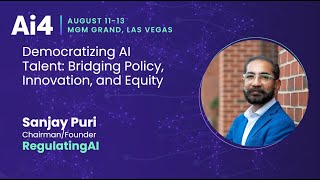
Ai4
Clustering 77% of AI jobs in ten coastal metros threatens critical healthcare and manufacturing sectors, requiring open-source tooling, community college training, and regional workforce mandates to avoid an entrenched economic divide.
AI-assisted summary of Democratizing AI Talent: Bridging Policy, Innovation, and Equity With RegulatingAI — original source. Check the original for full context.
Source published:
Detailed notes
## Background Published on YouTube by Ai4 on August 27, 2025, "Democratizing AI Talent: Bridging Policy, Innovation, and Equity With RegulatingAI" features a keynote address by Sanjay Puri, Chairman and Founder of RegulatingAI. The presentation examines how policy decisions, technical innovation, and an intentional focus on equity can dismantle barriers in AI talent development and ensure career opportunities are accessible to all rather than confined to a privileged few.
## TL;DR Sanjay Puri addresses the severe concentration of AI talent, research, and venture capital within a handful of elite universities and coastal tech giants. This geographic and corporate bottleneck leaves essential sectors like manufacturing, healthcare, and energy starved of the engineering expertise necessary to modernize. To prevent a damaging new societal divide, Puri outlines a framework centered on community college partnerships, public compute access via NAIRR, open-source advocacy, and remote work adoption. He calls on policymakers and industry leaders to cultivate regional AI ecosystems across every state, classroom, and community nationwide.
## Atmosphere & style The talk carries an urgent yet accessible and conversational tone, grounded by a relatable personal anecdote about Puri's own son defaulting to a Big Tech career path. Delivering a pragmatic wake-up call rather than an antagonistic critique, Puri combines sharp statistics with lighthearted humor about Silicon Valley perks to emphasize broad economic realities. The session feels like an earnest, constructive policy briefing that builds toward an inspiring call to action for widespread regional equity.
## Key takeaways - [00:04](https://www.youtube.com/watch?v=mvIsxTTZSpk&t=4s) Next-generation AI talent is hyper-concentrated within a handful of Silicon Valley mega-corporations, narrowing the focus of technological innovation and depriving foundational sectors of diverse problem solvers. - [03:00](https://www.youtube.com/watch?v=mvIsxTTZSpk&t=180s) Geographic and academic concentration remains severe: 40% of top AI researchers reside in four elite universities, 77% of AI jobs cluster in ten metro areas, and over 50% of venture capital flows exclusively to Silicon Valley. - [05:18](https://www.youtube.com/watch?v=mvIsxTTZSpk&t=318s) Astronomical compensation packages and multi-billion-dollar acqui-hires by major tech companies create an elite tier that starves mid-tier institutions and legacy enterprises of vital technical talent. - [05:18](https://www.youtube.com/watch?v=mvIsxTTZSpk&t=318s) Critical non-tech sectors such as manufacturing, healthcare, finance, and logistics face existential talent droughts that threaten their modernization and operational resilience. - [10:12](https://www.youtube.com/watch?v=mvIsxTTZSpk&t=612s) Democratizing the talent pipeline requires expanding beyond four-year elite university degrees into community college curriculums, vocational credentials, and corporate reskilling programs. - [10:12](https://www.youtube.com/watch?v=mvIsxTTZSpk&t=612s) Federal initiatives like the National Artificial Intelligence Research Resource (NAIRR) serve as crucial public utilities, offering free GPU compute and benchmark datasets to underfunded researchers and institutions. - [12:51](https://www.youtube.com/watch?v=mvIsxTTZSpk&t=771s) State-level partnerships, such as Wisconsin's collaboration with Microsoft to train 100,000 residents, alongside K-12 programs like AI4ALL, are vital for cultivating early and diverse AI literacy. - [13:32](https://www.youtube.com/watch?v=mvIsxTTZSpk&t=812s) Platforms like CAIO Connect highlight high-impact enterprise AI deployments in traditional industrial sectors to prove to emerging engineers that meaningful AI careers exist outside Big Tech. - [13:32](https://www.youtube.com/watch?v=mvIsxTTZSpk&t=812s) State and local governments should leverage land and permitting approvals for over $200 billion in hyperscaler data center investments to require firm commitments for local AI workforce upskilling. - [15:59](https://www.youtube.com/watch?v=mvIsxTTZSpk&t=959s) Protecting and advancing open-source AI infrastructure is essential to ensuring baseline foundation models remain accessible to everyone rather than locked behind proprietary corporate monopolies. - [15:59](https://www.youtube.com/watch?v=mvIsxTTZSpk&t=959s) Embracing remote and distributed work models allows organizations to access overlooked talent pools across rural and secondary markets without forcing relocation to expensive coastal hubs. - [17:19](https://www.youtube.com/watch?v=mvIsxTTZSpk&t=1039s) Failing to distribute AI education, talent, and career opportunities across all regions and industries risks spawning an entrenched AI divide far more consequential than the digital divide of past decades.
## Detailed walkthrough ### [00:04](https://www.youtube.com/watch?v=mvIsxTTZSpk&t=4s) A Personal Awakening: The Concentration of AI Talent
Opening the morning session at the AI Policy Summit with a humorous remark about wondering "where is the AI talent this morning," Sanjay Puri sets an urgent stage for why artificial intelligence talent must be democratized across regions, industries, and demographic communities. For the United States to lead responsibly in the global AI race, innovation cannot remain confined to a privileged few. Puri explains that this mission is deeply personal: his own son recently graduated with a degree in AI. When asked where he and his classmates intended to look for work, his son replied "without batting an eyelid" that they were all targeting the same three or four global tech giants. While acknowledging that these are phenomenal companies—and noting with a chuckle that his son did end up taking a job at one of them—the realization struck a serious chord.
If the entirety of the next generation's AI talent converges on a handful of mega-corporations located within two or three zip codes, the broader ecosystem suffers an acute loss of intellectual and geographic diversity. AI is not an isolated consumer app; it is a foundational, general-purpose technology destined to transform disease treatment, childhood education, supply chain logistics, and global commerce. Puri poses a fundamental question to practitioners, founders, and policymakers: can the nation afford to let its technological future be shaped by a narrow group of people working in isolated geographic enclaves on an equally narrow set of problems?
```mermaid flowchart TD accTitle: The AI Talent Concentration Dilemma accDescr: Flowchart illustrating how talent concentration leads to narrowed innovation versus how democratization enables broad societal impact.
subgraph Narrow["Current Concentration Model"] A["Top AI Graduates & Capital"] --> B["3-4 Tech Giants in Silicon Valley Hubs"] B --> C["Narrow Focus & Monolithic Problem Solving"] end
subgraph Inclusive["Democratized AI Model"] D["Regional & Diverse Talent Pools"] --> E["Cross-Industry Distribution: Healthcare, Retail, Manufacturing"] E --> F["Broad Societal Solutions & Responsible Global Leadership"] end ```
---
[03:00](https://www.youtube.com/watch?v=mvIsxTTZSpk&t=180s) The Anatomy of Concentration: Elite Universities, Metro Hubs, and Capital
To underscore the severity of the bottleneck, Puri presents a set of stark empirical metrics illustrating the hyper-concentration of knowledge, employment, and investment capital across the United States. Today, approximately 40% of the top AI researchers in the country are concentrated in just four elite universities. While these academic institutions are undeniably world-class, this centralization creates a self-reinforcing gravity well that siphons prospective talent away from other regional institutions and undercuts academic diversity nationwide.
The geographic disparity is equally pronounced in the workforce and venture landscape. Fully 77% of all AI jobs in the United States are clustered within just ten metropolitan areas, leaving the remaining 300 cities to divide a meager 23% share. Furthermore, during the first half of the year, over 50% of all venture and private AI investment was poured directly into Silicon Valley. Puri emphasizes that this critique is not an attack on Northern California, playfully offering his full blessing to their "free kombuchas" and "nap pods," but rather a pragmatic plea to ensure that the remaining 99% of the nation participates in and benefits from the AI-driven economy.
- **40% of Top Researchers:** Housed within just 4 elite universities nationwide. - **77% of AI Employment:** Clustered within 10 major metropolitan cities, marginalizing roughly 300 other American urban centers. - **50% of H1 Investment:** Flowed exclusively into Silicon Valley startups and corporate labs.
---
[05:18](https://www.youtube.com/watch?v=mvIsxTTZSpk&t=318s) The Broader Impact: An Elite Class and the Industry Talent Crunch
This hyper-concentration has created an ultra-elite compensation tier, where tech conglomerates routinely spend hundreds of millions of dollars on individual researcher packages or deploy $14 billion to execute "acqui-hires" of fledgling AI teams. Puri points out that while high compensation is accepted in sports leagues like the NBA or NFL, artificial intelligence is vastly different because it governs critical societal infrastructure like diagnostic medicine and public education. When a tiny cohort of researchers captures all resources, mid-tier researchers and non-tech enterprises are left completely starved of human capital.
``` +--------------------------+------------------------------------------------+---------------------------------------------+ | Industry Sector | Key AI Applications & Growth Drivers | Consequences of the AI Talent Crunch | +--------------------------+------------------------------------------------+---------------------------------------------+ | Manufacturing | Predictive maintenance, supply chain optimization| Factory downtime and stagnant automation | | Healthcare | Clinical diagnostics, rural transcription notes | Slower medical delivery and regional bias | | Financial Services | Real-time fraud detection, algorithmic trading | Heightened security risk and legacy drag | | Retail & Logistics | Precision targeted marketing, inventory routing | Inefficient distribution and margin erosion | +--------------------------+------------------------------------------------+---------------------------------------------+ ```
Beyond the tech sector, foundational industries face an existential talent drought despite massive Gross Value Added (GVA) projections by 2035. Manufacturing plants require machine learning specialists for predictive maintenance and supply chain resilience; healthcare networks need developers for diagnostic models and transcription workflows; and regional finance needs algorithmic fraud detection. However, because top graduates gravitate almost exclusively toward Silicon Valley, legacy and regional enterprises cannot recruit the expertise required to modernize, creating deep economic vulnerabilities across non-coastal and rural America.
---
[10:12](https://www.youtube.com/watch?v=mvIsxTTZSpk&t=612s) Rebuilding the Talent Pipeline: Alternative Education, Reskilling, and Policy Initiatives
To correct these structural imbalances, Puri outlines a strategic blueprint focused on expanding educational access points, corporate upskilling, and bipartisan policy partnerships. Democratizing talent requires looking beyond traditional four-year computer science degrees and establishing accessible pathways through community colleges, vocational certifications, and online platforms offering specialized credentials. He highlights Nvidia's statewide partnership with California community colleges as a prime model for bringing cutting-edge hardware and curriculum directly to two-year students, as well as corporate upskilling programs like Walmart's internal workforce reskilling initiatives.
At the legislative and federal level, public policy must act as a foundational equalizer. Puri points to the administration's AI Action Plan, which prioritizes national talent pipeline development, alongside the National Artificial Intelligence Research Resource (NAIRR). Because individual researchers, local universities, and small businesses cannot afford expensive GPU clusters or proprietary datasets, NAIRR serves as a vital public utility by providing free, democratized access to high-performance compute and benchmark datasets, enabling innovation outside the major tech corridors.
- **Multi-Tier Education:** Incorporating two-year community colleges, vocational programs, and online nano-degree platforms into mainstream AI training. - **Industry Initiatives:** Replicating programs like Nvidia's California community college partnership and Walmart's internal worker reskilling programs. - **Federal Compute Access:** Leveraging NAIRR (National Artificial Intelligence Research Resource) to supply free GPU compute capacity and rich datasets to under-resourced universities and small enterprises.
[12:51](https://www.youtube.com/watch?v=mvIsxTTZSpk&t=771s) State Initiatives, Hyperscaler Partnerships, and K-12 Education
Individual states are increasingly stepping up to establish their own artificial intelligence ecosystems rather than waiting for federal guidance. A prime example is Wisconsin, which is actively working toward building a dedicated regional AI hub in collaboration with Microsoft. Through this initiative, the state plans to train 100,000 residents in AI skills, demonstrating the massive leverage state governments possess when negotiating and partnering directly with technology providers.
At the foundational end of the pipeline, efforts must start well before higher education. Programs such as the ORISE AI challenges introduce technical problem-solving to primary and secondary school students. Similarly, initiatives spearheaded by Stanford professor Fei-Fei Li—widely recognized as the "godmother of AI"—such as her AI4ALL program, are instrumental in embedding AI literacy directly into K-12 education across diverse and historically underrepresented student populations nationwide.
- **State workforce training:** Wisconsin's partnership with Microsoft aims to upskill 100,000 residents for the emerging AI economy. - **Early pipeline intervention:** Programs like AI4ALL and the ORISE AI challenge target K-12 students to cultivate early technical literacy and broad inclusion.
---
[13:32](https://www.youtube.com/watch?v=mvIsxTTZSpk&t=812s) Showcasing AI Beyond Big Tech: The Role of CAIO Connect
To expand the perception of where AI careers exist, Puri highlights the work of his nonprofit, CAIO Connect (Chief AI Officers Connect). The core mission of the organization is to spotlight enterprise AI leadership outside the handful of massive tech giants or FAANG corporations. Groundbreaking, high-impact machine learning and automation projects are quietly taking place across traditional manufacturing, retail, logistics, and heavy industrial platforms. CAIO Connect brings these leaders onto public stages so they can showcase what their teams are building and explain why emerging engineers and graduates should consider working for them.
Major industrial corporations are already deploying cutting-edge AI in complex physical environments. Johnson Controls uses AI to manage advanced facility climate and temperature control systems; Schneider Electric leverages machine learning across massive electrical and battery infrastructures; Grainger applies predictive tracking and catalog search across millions of office and industrial supply products; and global enterprises such as Michelin and Emerson Electric are transforming their engineering workflows. Puri stresses that students need to realize that cool, transformative AI work is not the exclusive domain of Silicon Valley consumer tech platforms.
Furthermore, with hyperscalers projected to invest over $200 billion across the nation to build the next generation of critical AI data centers, state and local governments must leverage their permitting and land resources. States should require that these massive capital expenditures include firm commitments to train and upskill local workers in applied AI technologies.
```mermaid flowchart TD accTitle: Multi-Sector AI Ecosystem Beyond Big Tech accDescription: Flow diagram showing CAIO Connect bridging diverse traditional industries and tying data center infrastructure investments to local workforce training.
subgraph Industry["Traditional Enterprise AI Applications"] JC["Johnson Controls<br/>Facility & Temperature Automation"] SE["Schneider Electric<br/>Energy & Battery Optimization"] GR["Grainger<br/>Industrial Supply Tracking"] MC["Michelin & Emerson Electric<br/>Manufacturing & Heavy Industry"] end
subgraph Policy["Infrastructure & State Policy"] DC["$200B Hyperscaler Data Centers"] REQ["State Mandates:<br/>Local Workforce AI Training"] DC --> REQ end
subgraph CAIO["CAIO Connect Platform"] HUB["Chief AI Officers Connect"] end
Industry --> HUB REQ --> HUB ```
---
[15:59](https://www.youtube.com/watch?v=mvIsxTTZSpk&t=959s) Actionable Paths: Community Colleges, Open Source, and Distributed Work
Addressing the broader challenge of democratizing AI requires simultaneous interventions across education, software accessibility, and employment practices. Puri places heavy emphasis on community colleges as the primary engine for accessible, affordable workforce retraining, urging strong public-private partnerships to fund curriculum design and lab access.
Equally vital is defending and supporting open-source AI development. Echoing the popular metaphor that "AI is the new electricity," Puri warns that proprietary monopolies risk restricting who gets access to the grid: "well open source makes sure the lights are on for everybody not just for a select few." Keeping foundation models and research tools accessible prevents the concentration of power among a handful of tech conglomerates.
Finally, organizations must intentionally revive remote and distributed work models. Although corporate mandates have pulled many workers back into offices following the pandemic, Puri notes that rigid in-person requirements needlessly alienate qualified individuals in rural areas and smaller towns who cannot or do not wish to relocate to expensive coastal hubs. Because AI development can be executed from anywhere with an internet connection, embracing distributed teams is an essential mechanism for tapping into overlooked geographic talent pools.
- **Community colleges:** Serve as the most effective local vehicle for democratized, low-cost technical education. - **Open-source ecosystem:** Ensures baseline technological access remains universally available rather than locked behind proprietary walls. - **Distributed employment:** Enables talent in rural regions and secondary markets to participate fully in the AI economy without geographic displacement.
---
[17:19](https://www.youtube.com/watch?v=mvIsxTTZSpk&t=1039s) Reversing the AI Divide: A Distributed National Talent Base
Returning to his personal anecdote about his graduating son, Puri envisions a future where the next generation of top engineering and computer science graduates actively choose diverse sectors over the default allure of Big Tech. A healthy national ecosystem is one where graduates say, "we want to work for a manufacturing company in Michigan or we want to work for a energy company in Texas or we want to work for a healthcare company in Ohio." Distributing top-tier machine learning expertise across the Midwest, the South, and every regional industry creates broad-based national productivity rather than localized wealth extraction.
Puri closes with an urgent warning about the social stakes of the transition. Failing to distribute AI opportunities will spawn an "AI divide" far more consequential, damaging, and entrenched than the digital divide of past decades. True democratization demands that AI talent, education, and career paths exist "in every city, every classroom, and every community," urging the audience to actively engage in building an inclusive talent pipeline.
## Notable quotes > [00:04](https://www.youtube.com/watch?v=mvIsxTTZSpk&t=4s) where is the AI talent this morning — Sanjay Puri
> [00:04](https://www.youtube.com/watch?v=mvIsxTTZSpk&t=4s) without batting an eyelid — Sanjay Puri
> [03:00](https://www.youtube.com/watch?v=mvIsxTTZSpk&t=180s) free kombuchas — Sanjay Puri
> [03:00](https://www.youtube.com/watch?v=mvIsxTTZSpk&t=180s) nap pods — Sanjay Puri
> [05:18](https://www.youtube.com/watch?v=mvIsxTTZSpk&t=318s) acqui-hires — Sanjay Puri
> [12:51](https://www.youtube.com/watch?v=mvIsxTTZSpk&t=771s) godmother of AI — Sanjay Puri
> [15:59](https://www.youtube.com/watch?v=mvIsxTTZSpk&t=959s) AI is the new electricity — Sanjay Puri
> [15:59](https://www.youtube.com/watch?v=mvIsxTTZSpk&t=959s) well open source makes sure the lights are on for everybody not just for a select few — Sanjay Puri
> [17:19](https://www.youtube.com/watch?v=mvIsxTTZSpk&t=1039s) we want to work for a manufacturing company in Michigan or we want to work for a energy company in Texas or we want to work for a healthcare company in Ohio — Sanjay Puri
> [17:19](https://www.youtube.com/watch?v=mvIsxTTZSpk&t=1039s) in every city, every classroom, and every community — Sanjay Puri
## Mentioned Sanjay Puri, RegulatingAI, AI Policy Summit, Silicon Valley, Nvidia, California Community Colleges, Walmart, AI Action Plan, National Artificial Intelligence Research Resource (NAIRR), Microsoft, Wisconsin, ORISE AI, Fei-Fei Li, Stanford University, AI4ALL, CAIO Connect, Johnson Controls, Schneider Electric, Grainger, Michelin, Emerson Electric
## Video description Sanjay Puri, Chairman/Founder, RegulatingAI
Abstracts
Understand how to make AI talent development more inclusive and accessible to people from all backgrounds. The discussion will explore how policy decisions, technological innovation, and a strong focus on equity can work together to ensure that AI education, careers, and opportunities are not limited to a privileged few. This discussion aims to bridge the gap between who has access to AI opportunities today and who should, ensuring a future where AI talent development is fair, inclusive, and widespread.
[Source](https://www.youtube.com/watch?v=mvIsxTTZSpk)