Cardinal Launches Chip AI to Automate Site Reliability, Cut Downtime
Ai4
Manual dashboards and reactive alerting fail to prevent outages because continuous software deployments introduce novel failure modes that static monitoring rules cannot anticipate.
AI-assisted summary of Autonomous Resilience: How AI Transforms System Reliability at Scale With Cardinal — original source. Check the original for full context.
Source published:
Detailed notes
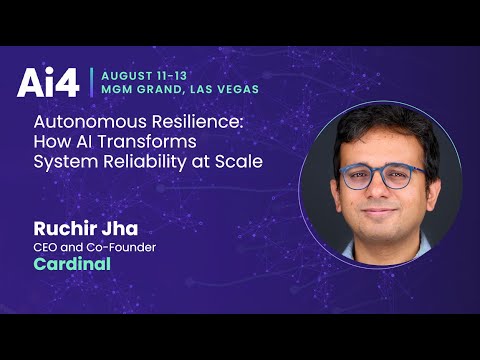
## Background Published on YouTube by Ai4 on August 24, 2025, this presentation features Ruchir Jha, CEO and Co-Founder of Cardinal, addressing the challenge of maintaining system reliability at scale. According to the page description, the talk introduces Chip, Cardinal's AI engine designed to help organizations transition from reactive firefighting to continuous, autonomous incident readiness.
## TL;DR Ruchir Jha highlights the severe staffing mismatch between developers deploying code and the small SRE teams tasked with monitoring uptime, which leads to blind spots and customer-discovered outages. He illustrates the flaws of reactive post-mortems, static dashboards, and costly SaaS 'kitchen sinks' that degrade quickly as codebases evolve. To solve this, Jha presents Chip, Cardinal's AI engine that connects directly to raw OpenTelemetry streams. By mathematically deriving dynamic SLOs, auto-tuning alerts, and synthesizing incident summaries out of the box, Chip eliminates manual configuration toil and enables autonomous system resilience.
## Atmosphere & style The presentation carries a crisp, pragmatic, and persuasive tone, characteristic of an experienced engineering founder speaking directly to peer practitioners. Jha establishes an immediate rapport with the audience by tapping into shared industry frustrations—such as customer-discovered outages and rigid holiday code freezes. The narrative flows smoothly from diagnosing systemic operational breakdowns to showcasing a modern agentic solution, creating an informative, forward-looking, and solution-oriented listening experience.
## Key takeaways - [00:04](https://www.youtube.com/watch?v=qwNa6iGBaUM&t=4s) A severe structural staffing imbalance exists across engineering teams, where roughly 3 to 4 SREs are tasked with monitoring around 100 microservices built by 20 developers. - [00:04](https://www.youtube.com/watch?v=qwNa6iGBaUM&t=4s) Over-relying on small human-in-the-loop SRE teams creates massive operational blind spots, often resulting in customers detecting outages before internal monitoring does. - [01:45](https://www.youtube.com/watch?v=qwNa6iGBaUM&t=105s) The traditional reactive post-mortem cycle only protects against past failure modes, leaving systems vulnerable to novel issues continuously introduced by new code deployments. - [01:45](https://www.youtube.com/watch?v=qwNa6iGBaUM&t=105s) Under purely reactive reliability models, organizations are forced into drastic measures like multi-week holiday code freezes just to survive peak traffic periods. - [03:21](https://www.youtube.com/watch?v=qwNa6iGBaUM&t=201s) Hand-crafted dashboards and alerting rules degrade quickly because static assets cannot keep pace with dynamic code and architectural changes. - [03:21](https://www.youtube.com/watch?v=qwNa6iGBaUM&t=201s) Expecting software engineers to manually manage observability configurations is ineffective, as developers are hired and trained to deliver features rather than SRE infrastructure. - [03:21](https://www.youtube.com/watch?v=qwNa6iGBaUM&t=201s) Legacy SaaS observability tools act as expensive 'kitchen sinks' that incur multi-million-dollar ingestion bills without providing proactive incident prevention. - [05:05](https://www.youtube.com/watch?v=qwNa6iGBaUM&t=305s) Agentic AI can transform production telemetry from static monitoring into proactive, autonomous resilience in the same way AI transformed code reviews. - [05:05](https://www.youtube.com/watch?v=qwNa6iGBaUM&t=305s) Cardinal's AI engine, Chip, connects directly to raw OpenTelemetry streams to statistically derive dynamic SLOs and autonomously tune alerts to eliminate noise. - [05:05](https://www.youtube.com/watch?v=qwNa6iGBaUM&t=305s) Autonomous reliability engines eliminate configuration toil and synthesize root-cause breach summaries out of the box without requiring custom model pre-training on proprietary data.
## Detailed walkthrough ### [00:04](https://www.youtube.com/watch?v=qwNa6iGBaUM&t=4s) The Reliability Imbalance and Staffing Discrepancy
Ruchir Jha, CEO and co-founder of the Bay Area startup Cardinal, opens his talk on autonomous resilience by asking the audience how many of them write code and deploy to production. He points out a glaring structural discrepancy in how modern engineering organizations are staffed. In a representative company with roughly 20 software engineers managing and operating around 100 applications or microservices, there are typically only three to four DevOps or Site Reliability Engineers (SREs).
These few SREs operate essentially as "uptime watchers"—dedicated individuals tasked with constantly monitoring what code is written, how it is deployed, and whether production services remain operational. However, when such a vast drift exists between the large group of people pushing code and the tiny team monitoring it, relying on human-in-the-loop oversight inevitably creates massive blind spots. Reliability suffers, services go down, and organizations often don't realize an outage has occurred until unfortunate customers take to social media to complain or tweet about it.
- **Staffing ratio imbalance:** A typical team of 20 software engineers operating ~100 services is supported by only 3 to 4 DevOps/SRE engineers. - **Human-in-the-loop blind spots:** Relying entirely on manual oversight by a small SRE team leads to undetected downtime and customer-discovered outages.
---
[01:45](https://www.youtube.com/watch?v=qwNa6iGBaUM&t=105s) The Catch-22 of Reactive Alerting and Holiday Code Freezes
When production uptime drops and companies "lose a nine," reliability budgets suddenly balloon. Management and engineering teams react in a predictable cycle: they review every production incident from the previous quarter and attempt to fix them one by one. Teams build new dashboards and write new alert rules under the assumption that SREs will catch identical failures before customers do next time.
Jha highlights the fundamental catch-22 of this approach: while retrofitted alerts protect against past failure modes, they fail completely against new ones. Because developers ship new code constantly, novel failure modes continuously emerge. The only logical way to guarantee reliability under a purely reactive model is to stop shipping altogether. Reflecting on his past experience at Netflix with his Cardinal co-founder Kunal, Jha recalls how engineering teams had to enforce strict two-week code freezes every December, forbidding anyone from pushing changes just to ensure systems would survive the Christmas traffic surge.
```mermaid flowchart TD accTitle: The Reactive Incident Management Cycle subgraph Reactive["Reactive Cycle"] A["Production Outage<br/>(Lost 9s)"] --> B["Post-Incident Review"] B --> C["Build Static Dashboards & Alerts"] C --> D["New Code Deployed"] D --> A end ```
---
[03:21](https://www.youtube.com/watch?v=qwNa6iGBaUM&t=201s) The Flaws of Static Observability and the SaaS "Kitchen Sink"
The core breakdown in modern operations stems from treating observability as a collection of static assets. Dashboards and alerting rules are manually written by humans who hope those configurations remain relevant over time. In practice, they drift rapidly. As developers introduce new behaviors and services, coverage gaps widen, leading to outages that blindside the team. Expecting software developers to maintain these monitors manually does not work because software engineers are hired to build features, not to act as reliability specialists.
```mermaid flowchart LR accTitle: Modern Observability Data Flow subgraph Ingestion["Telemetry Generation"] Apps["Applications / Services"] -->|Raw Logs & Metrics| SaaS["SaaS Observability<br/>(Datadog, Splunk)"] end subgraph Maintenance["Manual Maintenance"] SaaS -->|Config Toil| SRE["SREs & Developers"] SRE -.->|Manual Updates| Assets["Static Dashboards & Alerts"] end ```
At the same time, existing SaaS observability platforms like Datadog and Splunk are used essentially as an expensive "kitchen sink." Applications spew massive volumes of logs, metrics, and traces into these platforms, generating multi-million-dollar vendor bills. Yet, despite astronomical observability spending, teams still find themselves struggling through outages without proactive insight.
- **Static vs. dynamic behavior:** Hand-crafted alerts and dashboards degrade quickly as application architecture evolves. - **Skill mismatch:** Application developers focus on shipping product code, lacking dedicated training in site reliability engineering. - **SaaS cost vs. value:** Organizations spend millions ingesting raw telemetry into SaaS platforms, yet remain stuck in manual, reactive firefighting.
---
[05:05](https://www.youtube.com/watch?v=qwNa6iGBaUM&t=305s) Autonomous Resilience: Introducing Chip and Agentic Telemetry
To break this cycle, observability must shift from manual, reactive maintenance to proactive, agentic resilience. Jha draws a parallel to software development: while having an AI review pull requests and provide constructive feedback before deployment seemed implausible a few years ago, it is now standard practice. The same agentic intelligence can be applied to production telemetry in real time.
Cardinal's AI engine, Chip, connects directly into raw telemetry streams such as OpenTelemetry at the source. Rather than relying on static, human-configured thresholds, Chip analyzes live metrics and logs to determine optimal coverage, statistically derives dynamic Service Level Objectives (SLOs), and continuously tunes alerts to eliminate noise. When a breach occurs, Chip synthesizes automated, context-rich summaries detailing the exact origin and cause of the failure. Crucially, it requires no custom model training on user data and eliminates the manual "config toil" that overwhelms modern engineering teams.
```mermaid flowchart LR accTitle: Chip Autonomous Observability Architecture subgraph Source["Data Layer"] OTel["Raw OpenTelemetry Firehose"] end subgraph ChipEngine["Cardinal's AI Engine: Chip"] OTel --> Direct["Direct Stream Ingestion"] Direct --> StatSLO["Statistical SLO Derivation"] Direct --> AutoTune["Autonomous Alert Tuning"] end subgraph Output["Actionable Output"] StatSLO --> Incident["Synthesized Breach Summaries"] AutoTune --> Incident end ```
- **Direct OpenTelemetry integration:** Connects directly to raw telemetry streams at the source without relying on secondary alerts or making superficial guesses. - **Statistical SLO derivation:** Automatically establishes and tunes SLOs and alerts using mathematical models rather than static human guesses. - **Zero training overhead:** Operates directly out of the box without requiring teams to pre-train models on their proprietary infrastructure data. - **Elimination of config toil:** Transitions monitoring from manual dashboard authoring to an autonomous, agentic reliability platform.
## Notable quotes > [00:04](https://www.youtube.com/watch?v=qwNa6iGBaUM&t=4s) In a representative company with roughly 20 software engineers managing and operating around 100 applications or microservices, there are typically only three to four DevOps or Site Reliability Engineers (SREs). — Ruchir Jha
> [00:04](https://www.youtube.com/watch?v=qwNa6iGBaUM&t=4s) These few SREs operate essentially as 'uptime watchers'—dedicated individuals tasked with constantly monitoring what code is written, how it is deployed, and whether production services remain operational. — Ruchir Jha
> [00:04](https://www.youtube.com/watch?v=qwNa6iGBaUM&t=4s) Reliability suffers, services go down, and organizations often don't realize an outage has occurred until unfortunate customers take to social media to complain or tweet about it. — Ruchir Jha
> [01:45](https://www.youtube.com/watch?v=qwNa6iGBaUM&t=105s) When production uptime drops and companies 'lose a nine,' reliability budgets suddenly balloon. — Ruchir Jha
> [01:45](https://www.youtube.com/watch?v=qwNa6iGBaUM&t=105s) While retrofitted alerts protect against past failure modes, they fail completely against new ones. Because developers ship new code constantly, novel failure modes continuously emerge. — Ruchir Jha
> [01:45](https://www.youtube.com/watch?v=qwNa6iGBaUM&t=105s) The only logical way to guarantee reliability under a purely reactive model is to stop shipping altogether. — Ruchir Jha
> [03:21](https://www.youtube.com/watch?v=qwNa6iGBaUM&t=201s) Expectations that software developers maintain these monitors manually does not work because software engineers are hired to build features, not to act as reliability specialists. — Ruchir Jha
> [03:21](https://www.youtube.com/watch?v=qwNa6iGBaUM&t=201s) At the same time, existing SaaS observability platforms like Datadog and Splunk are used essentially as an expensive 'kitchen sink.' — Ruchir Jha
> [03:21](https://www.youtube.com/watch?v=qwNa6iGBaUM&t=201s) Yet, despite astronomical observability spending, teams still find themselves struggling through outages without proactive insight. — Ruchir Jha
> [05:05](https://www.youtube.com/watch?v=qwNa6iGBaUM&t=305s) Chip connects directly into raw telemetry streams such as OpenTelemetry at the source. — Ruchir Jha
> [05:05](https://www.youtube.com/watch?v=qwNa6iGBaUM&t=305s) Rather than relying on static, human-configured thresholds, Chip analyzes live metrics and logs to determine optimal coverage, statistically derives dynamic Service Level Objectives (SLOs), and continuously tunes alerts to eliminate noise. — Ruchir Jha
> [05:05](https://www.youtube.com/watch?v=qwNa6iGBaUM&t=305s) Crucially, it requires no custom model training on user data and eliminates the manual 'config toil' that overwhelms modern engineering teams. — Ruchir Jha
## Mentioned Ruchir Jha, Cardinal, Kunal, Netflix, Chip, Datadog, Splunk, OpenTelemetry, Ai4
## Video description Ruchir Jha, CEO and Co-Founder, Cardinal
Abstracts As modern systems scale and grow more complex, so does the challenge of maintaining reliability. This talk introduces Chip—Cardinal’s AI engine built for proactive reliability. Chip doesn’t just surface alerts; it understands context, prioritizes intelligently, and constantly prepares your systems for real-world failure modes. We’ll show how leading organizations are moving from reactive firefighting to continuous, AI-driven incident readiness—freeing up teams, reducing downtime costs, and reinforcing customer trust. This is not just observability—it’s autonomous resilience at scale.
[Source](https://www.youtube.com/watch?v=qwNa6iGBaUM)