Foxworthy Blames Executive Cognitive Traps for 85% of AI Failures
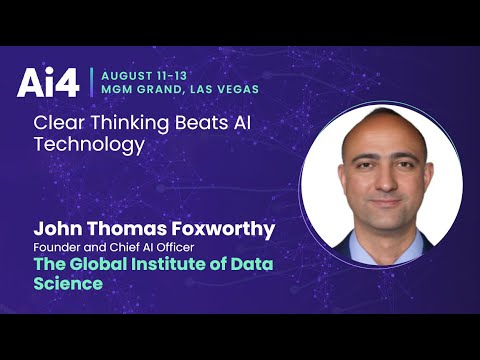
Clear Thinking Beats AI Technology with The Global Institute of Data Science — Ai4

Ai4

Enterprise AI initiatives fail at an 85% rate because leadership cognitive biases, led by pilot-scale overconfidence, derail deployments rather than technical or algorithmic shortcomings.

AI-assisted summary of Clear Thinking Beats AI Technology with The Global Institute of Data Science — original source. Check the original for full context.

Source published:

Detailed notes

## Background Published on YouTube by the Ai4 channel on August 24, 2025, this presentation features John Thomas Foxworthy, Founder and Chief AI Officer at The Global Institute of Data Science. According to the video description, the talk breaks down why 85% of enterprise AI projects fail despite access to sophisticated technology, diagnosing the psychological traps that mislead smart executives and presenting a strategic framework for cognitive clarity.

## TL;DR Despite utilizing the same cutting-edge algorithms and substantial budgets as Big Tech giants, traditional enterprises experience an 85% AI project failure rate driven by psychological missteps rather than technical flaws. Foxworthy details three pervasive cognitive biases that undermine AI return on investment: anthropomorphizing mathematical systems, mistaking statistical confidence for ground-truth accuracy (the precision illusion), and overconfidence bias when scaling localized pilot successes. To resolve these failures, he outlines the three-phase AIR framework—Assess, Implement, Revolve—which embeds deliberate bias-checking audits directly into project management pipelines. By prioritizing cognitive discipline over technological hype, organizations can achieve a 73% reduction in project failures and more than double their financial returns.

## Atmosphere & style The presentation maintains a candid, analytical, and pragmatic keynote atmosphere, blending decades of technical experience with sharp organizational psychology insights. Foxworthy engages the audience with relatable executive war stories and candid post-mortems, transforming widespread frustration over wasted AI investments into structured, actionable clarity. Listening to the talk feels like an empowering reality check that strips away polished vendor hype to refocus artificial intelligence leadership on rigorous, grounded critical thinking.

## Key takeaways - [00:04](https://www.youtube.com/watch?v=qBYBRq0YZ2k&t=4s) Studies from RAND Corporation, McKinsey, MIT, and Gartner show that 85% of enterprise AI projects fail despite access to top data science talent and multi-million dollar budgets. - [00:04](https://www.youtube.com/watch?v=qBYBRq0YZ2k&t=4s) Traditional enterprises fail where Big Tech succeeds not because of inferior algorithms or compute, but due to flawed cognitive processes during planning and execution. - [02:24](https://www.youtube.com/watch?v=qBYBRq0YZ2k&t=144s) Executives frequently abandon their standard financial skepticism and ROI rigor when evaluating polished AI vendor demonstrations. - [04:07](https://www.youtube.com/watch?v=qBYBRq0YZ2k&t=247s) Anthropomorphism creates unrealistic expectations by projecting human cognition onto mathematical pattern recognition systems. - [05:22](https://www.youtube.com/watch?v=qBYBRq0YZ2k&t=322s) The precision illusion trap causes organizations to confuse mathematical confidence with real-world accuracy, leading them to neglect vital human oversight. - [06:57](https://www.youtube.com/watch?v=qBYBRq0YZ2k&t=417s) Overconfidence bias accounts for roughly 67% of AI project failures, often driven by the assumption that success in a controlled pilot guarantees enterprise-wide readiness. - [06:57](https://www.youtube.com/watch?v=qBYBRq0YZ2k&t=417s) Scaling AI models across regions or departments requires treating each rollout independently to account for distinct data standards, IT infrastructure, and operating cultures. - [08:52](https://www.youtube.com/watch?v=qBYBRq0YZ2k&t=532s) The three-phase AIR framework (Assess, Implement, Revolve) systematically counters cognitive biases by integrating bias audits directly into project management tools. - [08:52](https://www.youtube.com/watch?v=qBYBRq0YZ2k&t=532s) Applying cognitive clarity to AI execution delivers a 73% reduction in project failures and increases ROI by 2.3 times. - [08:52](https://www.youtube.com/watch?v=qBYBRq0YZ2k&t=532s) The critical bottleneck in enterprise artificial intelligence has evolved from technical engineering to organizational psychology and cognitive decision-making.

## Detailed walkthrough ### [00:04](https://www.youtube.com/watch?v=qBYBRq0YZ2k&t=4s) The 85% AI Failure Rate Paradox

John Thomas Foxworthy opens his presentation by asking the audience for a show of hands: how many have been involved in an artificial intelligence project that failed to deliver on its promises, exceeded its budget, or dragged on far past its planned schedule? Acknowledging the widespread frustration in the room, he validates their experience: "Well, you're not alone. You're not alone at all." Despite modern enterprises having access to the most sophisticated artificial intelligence technology in human history, 85% of AI projects end in failure. This statistic is consistently confirmed across landmark studies conducted by the RAND Corporation, McKinsey, MIT, and Gartner.

``` ENTERPRISE REALITY BIG TECH BENCHMARK ┌────────────────────────────┐ ┌────────────────────────────┐ │ Traditional Companies │ │ Google, Amazon, Netflix │ │ • Top PhD data science team│ │ • Identical ML/DL code │ │ • Multi-million $ budgets │ │ • Billions of transactions │ │ • Access to same algorithms│ │ • Scaled to 100M+ users │ └─────────────┬──────────────┘ └─────────────┬──────────────┘ │ │ ▼ ▼ 85% FAILURE RATE 15% SUCCESS RATE (Cognitive Traps) (Cognitive Clarity) ```

The paradox lies in the stark contrast between traditional enterprises and Big Tech giants. Companies like Google, Amazon, and Netflix routinely deploy AI systems serving hundreds of millions of users and processing billions of transactions with minimal friction. Traditional organizations—whether in manufacturing, banking, or insurance—operate with the exact same algorithms, employ PhD-level data scientists, and pour millions of dollars into their initiatives, yet watch their projects crash while Big Tech thrives. Foxworthy emphasizes that the root issue is not defective code, but flawed cognitive processes during AI project planning and execution.

- Research from RAND Corporation, McKinsey, MIT, and Gartner establishes a universal 85% AI project failure rate. - Traditional industries possess access to the identical algorithmic toolkits and computational infrastructure utilized by Big Tech firms. - Success and failure diverge not on technical engineering capabilities, but on the psychological and cognitive decision-making of leadership teams.

---

[02:24](https://www.youtube.com/watch?v=qBYBRq0YZ2k&t=144s) The Executive Double Standard and Cognitive Flaws

Expanding on MIT's multi-year research into AI project failure rates, Foxworthy notes that researchers systematically evaluated machine learning, deep learning, and natural language processing initiatives. Their findings revealed no fundamental bottlenecks in algorithmic architecture or computational power. Instead, the failure points stemmed entirely from flawed thinking patterns and systematic cognitive biases.

What makes this pattern striking is that the executives leading these failed projects are highly capable leaders who have built successful business units. In traditional, non-AI contexts, their cognitive discipline remains intact; a Chief Financial Officer will subject standard capital requests to rigorous return-on-investment (ROI) scrutiny. However, the moment that same executive sits through a polished vendor demo for an artificial intelligence product, all typical skepticism vanishes, and the project is greenlit "just like that."

---

[04:07](https://www.youtube.com/watch?v=qBYBRq0YZ2k&t=247s) Cognitive Trap 1: Anthropomorphism

The first major psychological pitfall is anthropomorphism: treating mathematical artificial intelligence systems as though they possess human cognition and conscious thought. Business leaders routinely use misleading phrasing, asserting that their system "understands market trends" or "learns customer preferences." Foxworthy clarifies that this reflects an erroneous projection of human intelligence onto cold mathematical processes, establishing impossible criteria for project success.

To illustrate, Foxworthy recounts working with a Chief Marketing Officer at a major insurance firm who became genuinely convinced that an internal suite of AI tools operated like "little human beings." Foxworthy had to personally intervene and ground the executive's expectations, explaining that the software was merely identifying statistical patterns in historical data rather than forming an understanding of human behavior.

---

[05:22](https://www.youtube.com/watch?v=qBYBRq0YZ2k&t=322s) Cognitive Trap 2: Precision Illusion

The second cognitive pitfall is the precision illusion, defined as confusing mathematical confidence with real-world accuracy. Foxworthy uses the analogy of a student who feels 95% confident in a test answer, noting that subjective or statistical confidence has no direct bearing on whether the answer is factually correct.

``` ┌─────────────────────────┐ ┌─────────────────────────┐ │ Mathematical Confidence │ =/= │ Real-World Accuracy │ │ (Model output certainty)│ │ (Ground-truth validity) │ └────────────┬────────────┘ └────────────┬────────────┘ │ │ └────────► Requires Continuous ◄─────┘ Human Oversight & Dashboard Analysis ```

Foxworthy shares an experience from a decade prior while serving as a senior data scientist at a major global bank. The team built an AI system using a Support Vector Machine (SVM) algorithm to identify financial fraud. Impressed by initial statistical metrics, leadership sought to strip away human verification and rely entirely on raw model outputs. When left unattended without active monitoring, fraud detection degraded rapidly. The organization had to build comprehensive monitoring dashboards and deploy subject matter experts to continually interpret the model outputs, much like how humans must interpret changing weather forecast models on a smartphone rather than accepting automated predictions blindly.

---

[06:57](https://www.youtube.com/watch?v=qBYBRq0YZ2k&t=417s) Cognitive Trap 3: Overconfidence Bias and Pilot Traps

The most destructive trap is overconfidence bias, which Foxworthy identifies as contributing a massive 67% to the overall 85% project failure rate. This trap typically manifests when an organization successfully completes a small, controlled pilot project and immediately assumes it possesses enterprise-wide deployment mastery.

Foxworthy recounts working with a global manufacturing company where a deep learning predictive analytics model performed exceptionally well inside the flagship plant. Buoyed by this isolated success, leadership attempted to scale the exact same setup across regional US plants and international facilities. The deployment turned into a complete disaster due to unaddressed discrepancies in data standards, local IT infrastructure, regulatory environments, and regional operating cultures. He contrasts this misstep with Netflix's international expansion strategy: Netflix recognized that what worked in the US market could not simply be copy-pasted globally without treating each region as a distinct problem. In philosophical terms, falling into this trap represents the "fallacy of determinism"—the flawed assumption that past success in a constrained environment guarantees identical future outcomes.

- Overconfidence bias alone accounts for roughly 67% of the total 85% AI project failure rate. - Scaling failures often stem from unexamined differences in data standards, technical infrastructure, culture, and regulation across sites. - Overcoming deterministic assumptions requires treating every subsequent deployment as an independent operational initiative.

---

[08:52](https://www.youtube.com/watch?v=qBYBRq0YZ2k&t=532s) The AIR Framework and Strategic AI Success

To combat these psychological pitfalls, Foxworthy introduces the copyrighted AIR framework featured in his book *The Augmented Intelligence Revolution*. Rather than serving as another generic project management methodology, the framework is designed specifically to mitigate cognitive biases across three structured phases:

``` ┌──────────────────────────────────────────────────────────────────┐ │ AIR FRAMEWORK │ └──────────────────────────────────────────────────────────────────┘ │ ▼ ┌───────────────────┐ • Organizational readiness (hard & soft). │ 1. ASSESS │ • Surface bias questions in PM tools. │ │ • Audit for anthropomorphism & overconfidence. └─────────┬─────────┘ │ ▼ ┌───────────────────┐ • Evidence-based deployment. │ 2. IMPLEMENT │ • Set realistic operational goals. │ │ • Grounded directly in Assessment findings. └─────────┬─────────┘ │ ▼ ┌───────────────────┐ • Continuous optimization loop. │ 3. REVOLVE │ • Re-evaluate initial assessment questions. │ │ • Identify invalid assumptions & adapt. └───────────────────┘ ```

The Assess phase audits both hard technical infrastructure and soft organizational mindsets, requiring teams to log explicit bias-checking questions directly into their project management software (e.g., assessing whether expectations are anthropomorphic or confusing statistical confidence with accuracy). The Implement phase establishes realistic, evidence-based goals that derive directly from the assessment. Finally, the Revolve phase creates a continuous feedback loop where teams revisit their initial questions, uncover assumptions that proved incorrect, and calibrate the system for subsequent rollout phases.

Applying this cognitive clarity approach yields a 73% reduction in AI project failures and delivers 2.3 times higher return on investment. Reflecting on his career journey since entering the AI field in February 2005—which includes teaching deep learning, natural language processing, and reinforcement learning at elite universities—Foxworthy observes that after two decades, the greatest challenge in AI is no longer technical: "I never in the world guessed that I'd end up becoming an organizational psychologist with AI projects. But that's how life went." He concludes by advising leaders that the next time they plan to build or buy AI, their primary focus must be auditing their own cognitive processes.

## Notable quotes > [00:04](https://www.youtube.com/watch?v=qBYBRq0YZ2k&t=4s) Well, you're not alone. You're not alone at all. — John Thomas Foxworthy

> [08:52](https://www.youtube.com/watch?v=qBYBRq0YZ2k&t=532s) I never in the world guessed that I'd end up becoming an organizational psychologist with AI projects. But that's how life went. — John Thomas Foxworthy

## Mentioned John Thomas Foxworthy, The Global Institute of Data Science, Ai4, RAND Corporation, McKinsey, MIT, Gartner, Google, Amazon, Netflix, Support Vector Machine, AIR framework, The Augmented Intelligence Revolution

## Video description John Thomas Foxworthy, Founder and Chief AI Officer, The Global Institute of Data Science

Abstracts Why do 85% of AI projects fail despite access to sophisticated technology? I will reveal the hidden cognitive traps that cause smart executives to make poor AI decisions, from treating AI systems as human-like intelligence to confusing mathematical confidence with actual accuracy. This talk will demonstrate how the Augmented Intelligence Revolution succeeds not through advanced algorithms, but through cognitive clarity that leads to realistic implementation strategies. You will learn three specific cognitive biases killing your AI ROI and a systematic framework for transforming your approach from statistical failure to strategic success. Attend this session to discover why your next AI project's success depends more on how you think than what technology you buy or build.

[Source](https://www.youtube.com/watch?v=qBYBRq0YZ2k)

中文简报

Foxworthy称高管认知陷阱导致85%的AI项目失败 企业AI项目的失败率高达85%,其根源在于以试点规模过度自信为主的领导层认知偏差阻碍了项目部署,而非技术或算法层面的缺陷。 尽管使用了与大型科技巨头相同的前沿算法并投入了巨额预算,传统企业AI项目的失败率仍高达85%,这一现象主要由心理认知失误而非技术缺陷所致。Foxworthy详细阐述了破坏AI投资回报的三种普遍认知偏差:将数学系统拟人化、将统计置信度误认为实际准确度(即精准幻觉),以及在推广局部试点成果时的过度自信偏差。为解决这些失败,他提出了包含“评估、实施、循环”三个阶段的AIR框架,将审慎的偏差核查审计直接嵌入项目管理流程中。通过重视认知自律而非技术炒作,企业组织可使项目失败率降低73%,并将财务回报提升一倍以上。 RAND、麦肯锡、MIT 与 Gartner 的研究显示,尽管拥有顶尖数据科学团队和数百万美元预算,85% 的企业 AI 项目仍以失败告终;其症结不在于算法或算力落后,而在于领导层规划与执行时的认知缺陷。 (0:04) 高管在面对精美的 AI 演示时往往会放弃严格的 ROI 审查,并容易陷入“拟人化”(将模式识别误判为人类智能)和“精度幻觉”(将数学置信度与现实准确性混为一谈)两大认知陷阱。 (4:07) 过度自信偏差导致了约 67% 的 AI 项目失败,团队常因局部试点成功而盲目进行全企业推广,忽视了不同部门或分支机构在数据标准、IT 架构及运营文化上的实质差异。 (6:57) 通过引入涵盖评估(Assess)、实施(Implement)与循环(Revolve)的 AIR 框架,将偏误审查直接嵌入项目管理流程,可将 AI 项目失败率降低 73%,并将投资回报率提升 2.3 倍。 (8:52)

Reading summary

John Thomas Foxworthy argues that the widespread 85% failure rate of enterprise artificial intelligence initiatives stems from executive cognitive biases and flawed decision-making rather than deficits in algorithmic code or computational power. The AI Failure Paradox and Executive Double Standards (0:04) Landmark research from the RAND Corporation, McKinsey, MIT, and Gartner confirms that 85% of enterprise AI projects fail to deliver promised results, exceed budgets, or run past deadlines. Traditional enterprises in banking, manufacturing, and insurance invest millions of dollars and employ PhD-level data scientists using the same algorithms as Big Tech firms like Google, Amazon, and Netflix. Yet while Big Tech routinely operates reliable AI systems across hundreds of millions of users, traditional corporate projects regularly collapse. MIT's multi-year research found that these failures do not stem from limitations in computational power or machine learning architectures. Instead, Foxworthy attributes the breakdown to an executive double standard. Experienced business leaders who ordinarily enforce strict return-on-investment scrutiny for standard capital expenditures frequently suspend critical skepticism when viewing polished AI vendor demonstrations, approving major initiatives without basic cognitive discipline. Anthropomorphism and the Precision Illusion (4:07) Two prevalent cognitive traps systematically distort AI project management: anthropomorphism and the precision illusion. Anthropomorphism occurs when leaders project human cognition onto statistical processes, claiming an algorithm 'understands' markets or 'learns' behaviors. Foxworthy recounts advising a major insurance company's Chief Marketing Officer who genuinely believed internal AI tools functioned like 'little human beings,' requiring intervention to clarify that the models were merely identifying historical statistical patterns. The precision illusion occurs when decision-makers mistake model confidence for real-world accuracy, falsely assuming high statistical certainty guarantees ground-truth validity. In an earlier role at a global bank, Foxworthy's team deployed a Support Vector Machine algorithm for fraud detection. Seduced by initial statistical metrics, executives eliminated human oversight; the unattended model degraded rapidly. The bank ultimately had to build monitoring dashboards and assign subject matter experts to continuously interpret the model's shifting outputs. Overconfidence Bias and the Scaling Trap (6:57) Foxworthy identifies overconfidence bias as the single most damaging cognitive pitfall, asserting it contributes to roughly 67% of the overall 85% failure rate. This trap is driven by what he terms the 'fallacy of determinism,' where organizations complete an isolated, small-scale pilot and assume enterprise-wide scaling will follow automatically. Foxworthy highlights a global manufacturer whose deep learning predictive analytics model performed well inside a flagship plant. Leadership replicated the identical setup across domestic and international facilities, triggering an operational failure caused by unexamined differences in regional data standards, IT infrastructure, regulatory environments, and operating cultures. By contrast, he notes that Netflix scaled globally by recognizing that international markets required independent, customized problem-solving rather than direct operational duplication. Mitigating Bias with the AIR Framework (8:52) To counter these decision-making flaws, Foxworthy outlines the copyrighted AIR framework (Assess, Implement, Revolve) from his book, The Augmented Intelligence Revolution. In the Assess phase, teams evaluate both technical infrastructure and organizational mindsets, logging explicit bias-checking questions directly into project management software to flag anthropomorphism and false precision assumptions. The Implement phase focuses on executing realistic, evidence-based targets established during assessment. Finally, the Revolve phase introduces a continuous optimization loop where organizations re-examine their original assumptions, isolate invalid projections, and recalibrate deployments. Foxworthy claims that implementing this cognitive clarity process yields a 73% reduction in AI project failures and delivers a 2.3 times higher return on investment. Foxworthy concludes that after two decades in artificial intelligence, the primary obstacle to successful adoption is organizational psychology rather than engineering. He advises leaders that before purchasing or developing AI technology, their first operational responsibility must be auditing their own cognitive processes.

精炼阅读摘要

John Thomas Foxworthy 指出,尽管传统企业拥有与科技巨头同等的顶尖算法和充裕资金,但其人工智能项目失败率依然高达 85%;这一困境的核心症结并非代码或算力不足,而是管理层在立项与推进时普遍陷入了系统性认知偏差。 85% 失败率悖论与管理层双重标准 (0:04) 来自 RAND 公司、麦肯锡、麻省理工学院(MIT)和 Gartner 的系列研究表明,企业级人工智能项目的平均失败率高达 85%。与 Google、亚马逊和 Netflix 等科技巨头稳定支撑数亿用户和数十亿次交易形成鲜明反差的是,制造业、银行业与保险业等传统企业即便投入数百万美元、聘请博士级数据科学团队并使用完全相同的算法工具包,项目依然普遍遭遇进度拖延、超支或未能履约的困境。MIT 对机器学习、深度学习和自然语言处理项目的系统评估证实,技术架构和计算资源并不存在根本性瓶颈。 Foxworthy 强调,问题关键在于决策者的心理认知机制。许多在常规非 AI 业务中对资本回报率(ROI)审查极其严苛的高管,一旦面对供应商华丽的 AI 产品演示,原本审慎的商业批判思维便会骤然消失,在缺乏严密论证的情况下草率予以立项批准。 拟人化投射与精度幻觉诱发的失误 (4:07) 在 AI 实施过程中,首先出现的思维陷阱是“拟人化”,即错误地将人类意识和认知能力赋予冷冰冰的数学过程。商业领袖常宣称系统“理解市场趋势”或“学习客户偏好”,这种对算法的拟人化投射设定了不切实际的成功门槛。例如,某大型保险公司的首席营销官曾误以为内部 AI 工具运作如同“小人类”,最终由 Foxworthy 出面介入,向其阐明系统仅仅是在历史数据中识别统计特征,而非具备真正的人类思维。 第二种常见陷阱是“精度幻觉”,即将模型的统计置信度等同于现实世界的客观事实准确性。Foxworthy 结合十年前在一家全球大型银行担任资深数据科学家的经历指出,团队曾利用支持向量机(SVM)开发金融反欺诈系统,管理层因惊艳于初始统计指标而试图完全取消人工审核。然而系统脱离人工干预后,反欺诈识别能力迅速衰退。最终机构不得不搭建专属监控仪表板并配备业务专家持续研判,如同人类参考天气预报模型但仍需结合现实研判一样,绝不能盲从裸输出结果。 过度自信偏差与单点试点的确定性谬误 (6:57) Foxworthy 将过度自信偏差定性为破坏力最强的认知陷阱,并认为该偏差单独构成了 85% 总体失败率中的约 67%。这种偏差最普遍的表征是“试点陷阱”:企业在局部、受控的单点试点项目中取得成功后,便盲目推定自身已完全掌握全企业范围的规模化推广能力。 以一家全球制造企业为例,其在旗舰工厂部署的深度学习预测分析模型取得了显著成效,管理层随即决定将该系统原样复制到美国其他区域及海外工厂。然而,由于未曾预先解决不同工厂在数据标准、IT 基础设施、法规政策以及地方组织文化上的现实差异,该项目最终以彻底溃败告终。这种陷入“确定性谬误”的粗暴扩张,忽视了历史在受限场景下的成功无法直接预示未来结果。相比之下,Netflix 在全球扩张时将每个区域视为独立问题定制应对,有效规避了机械式套用的陷阱。 AIR 框架与认知校准的战略成效 (8:52) 为从机制上消除上述认知陷阱,Foxworthy 在其著作《增强智能革命》中提出了包含三个阶段的 AIR 框架。该框架聚焦于系统化消除认知偏误:在评估(Assess)阶段,团队需全面审计软硬件就绪度,并将拟人化倾向与置信度混淆等反偏见自查问题直接录入项目管理系统;在实施(Implement)阶段,设定直接源于前期评估的务实目标;在循环(Revolve)阶段,构建闭环持续复盘最初假设,及时调整已被推翻的预设前提。 根据 Foxworthy 提供的数据,实施这套认知清晰度方法论后,AI 项目失败率可降低 73%,投资回报率提高 2.3 倍。回顾其自 2005 年涉足 AI 领域、教授深度学习与强化学习的职业历程,他认为 AI 领域最核心的挑战已不再是底层工程代码,而是领导层能否对自身的认知流程完成有效审查。 Foxworthy 总结认为,企业在决定自主研发或对外采购 AI 系统时,首要任务是审查自身的认知假设与决策逻辑。需要指出的是,关于应用 AIR 框架后失败率降低 73% 及投资回报率提升 2.3 倍等数据均来自演讲者本人的经验与著作主张,传统企业在缺乏独立对照的情况下如何长期维持严格的组织心理自查机制,仍有待更广泛的跨行业实践验证。

Detailed notes — zh

## Background 本视频由 Ai4 于 2025 年 8 月 24 日发布在 YouTube 平台上。视频记录了全球数据科学研究所(The Global Institute of Data Science)创始人兼首席 AI 官 John Thomas Foxworthy 的主题演讲,主要探讨为何 85% 的 AI 项目在拥有顶尖技术的情况下依然失败,并揭示导致高管做出错误决策的隐性认知陷阱及应对策略。 ## TL;DR 演讲指出,权威数据表明高达 85% 的 AI 项目最终折戟,其根源并非算法缺陷或算力不足,而是决策层陷入了拟人化、精准度幻觉以及占据失败原因 67% 的过度自信偏差三大认知陷阱。许多企业盲目信任技术演示或过早撤去人工监督,导致单点试点成功后在跨场景推广中全线溃败。为此,主讲人提出了包含评估(Assess)、实施(Implement)与循环迭代(Revolve)的 AIR 认知纠偏框架,倡导以证据为基础的务实推进与持续反思。该框架能够将 AI 项目失败率降低 73% 并使 ROI 提升 2.3 倍,强调在 AI 时代决定成败的关键在于决策思维而非单纯购买技术。 ## Atmosphere & style 整体氛围犀利、务实且发人深省,散发着拥有 20 年技术积淀的行业老兵直击行业盲点的沉着与坦诚。主讲人通过扎心的现场互动和生动的企业踩坑案例,打破了围绕 AI 的技术神话与浮躁泡沫,将硬核算法讨论巧妙转向深刻的组织心理学剖析。整场演讲节奏紧凑、层层递进,既有对盲目狂热的当头棒喝,又充满了清醒、严谨且极具落地价值的战略指导感。 ## Key takeaways - [00:04](https://www.youtube.com/watch?v=qBYBRq0YZ2k&t=4s) 兰德公司、麦肯锡、MIT 与 Gartner 等权威机构数据一致表明,高达 85% 的 AI 项目最终以失败告终。 - [00:04](https://www.youtube.com/watch?v=qBYBRq0YZ2k&t=4s) MIT 调研发现,AI 项目失败的根源并非算法缺陷或算力不足,而是决策层深层的思维缺陷与系统性偏见。 - [00:04](https://www.youtube.com/watch?v=qBYBRq0YZ2k&t=4s) 许多高管在传统项目上严格审查 ROI,却对 AI 供应商的 Demo 抱有非理性信任,出现明显的决策双标现象。 - [03:46](https://www.youtube.com/watch?v=qBYBRq0YZ2k&t=226s) 拟人化陷阱使团队将统计模式匹配误当成人类智慧与理解,进而制定脱离实际的业务指标与验收标准。 - [03:46](https://www.youtube.com/watch?v=qBYBRq0YZ2k&t=226s) 精准度幻觉导致企业混淆数学置信度与实际准确率,过早剔除人工干预(Human-in-the-loop)导致高风险业务漏判失控。 - [03:46](https://www.youtube.com/watch?v=qBYBRq0YZ2k&t=226s) 过度自信偏差占 AI 项目失败原因的 67%,常表现为单点试点成功后,低估基础设施与数据标准差异而盲目全盘推广。 - [03:46](https://www.youtube.com/watch?v=qBYBRq0YZ2k&t=226s) Netflix 跨国扩张案例表明,企业应避免“过去成功则未来必成”的宿命论谬误,将每次落地视为独立工程重新评估。 - [08:52](https://www.youtube.com/watch?v=qBYBRq0YZ2k&t=532s) AIR 框架通过“评估(Assess)- 实施(Implement)- 迭代演进(Revolve)”三阶段闭环,专用于纠正 AI 决策中的认知偏差。 - [08:52](https://www.youtube.com/watch?v=qBYBRq0YZ2k&t=532s) 落地 AIR 框架可使 AI 项目失败率降低 73%,同时实现 2.3 倍的投资回报率(ROI)提升。 - [08:52](https://www.youtube.com/watch?v=qBYBRq0YZ2k&t=532s) AI 时代项目的成功关键不在于购买或构建多么前沿的算法算力,而在于决策者在立项与落地中保持清晰的认知思维。 ## Detailed walkthrough ### [00:04](https://www.youtube.com/watch?v=qBYBRq0YZ2k&t=4s) 85% 的 AI 项目为何走向失败:算法无罪,认知偏差才是根源 演讲开场,主讲人 John Thomas Foxworthy 向现场观众发起了一次举手表决:“有多少人曾参与过未能兑现承诺、成本超支或者工期严重延误的 AI 项目?”看到台下众多心领神会的反应,他直言:“你们绝不孤单。”尽管当今企业坐拥人类历史上最顶尖的 AI 技术,但各类权威研究机构——包括兰德公司(RAND Corporation)、麦肯锡(McKinsey)、麻省理工学院(MIT)以及 Gartner——的数据一致表明:高达 85% 的 AI 项目最终以失败告终。这绝非笔误,而是残酷的行业常态。 ```mermaid flowchart LR accTitle: Big Tech vs Traditional Enterprise AI Disparity subgraph BigTech["头部科技巨头 (Google / Amazon / Netflix)"] A["共享同类顶尖算法"] --> B["海量用户与交易场景稳定落地"] end subgraph Enterprise["传统行业企业 (制造 / 银行 / 保险)"] C["具备同等算法、PhD 团队与数百万预算"] --> D["受认知陷阱与双重标准干扰"] D --> E["85% 项目最终崩溃失败"] end ``` 这种现象背后存在着一个极其耐人寻味的悖论:Google、Amazon、Netflix 等科技巨头每天处理数亿用户和数十亿笔交易,其 AI 系统运转顺畅;而传统制造业、银行和保险公司同样能够获取这些顶尖算法与算力,配备了名校博士团队,砸下数百万美元的预算,项目却频频暴雷。MIT 历经数年对机器学习、深度学习及自然语言处理项目进行全面评估后发现,问题根本不在于算法缺陷或算力不足,而在于决策层深层的“思维缺陷与系统性偏见”。 令人深思的是,那些带领企业攻城略地的精明高管们,在面对非 AI 项目时往往表现得极其理智与严谨。例如,一位首席财务官(CFO)在审批传统业务支出时,会要求提供详尽严苛的投资回报率(ROI)分析报告;可一旦坐到 AI 厂商的天花乱坠的 Demo 演示面前,这位 CFO 却往往会毫不犹豫地当场亮起绿灯。John Thomas Foxworthy 一针见血地指出:“问题不在于你们的代码,而在于你们 AI 项目中的认知过程(It's not your code, it's your cognitive processes)。” - **行业权威数据**:RAND、McKinsey、MIT 与 Gartner 联合印证,AI 项目的综合失败率高达 85%。 - **核心成因**:MIT 调研证实失败与算法复杂度或算力上限无关,主因是高管在 AI 项目上丧失了常规商业判断力。 - **决策双标现象**:高管在传统项目上严控 ROI,却对 AI 供应商的演示抱有非理性信任并盲目立项。 --- ### [03:46](https://www.youtube.com/watch?v=qBYBRq0YZ2k&t=226s) 杀死 AI 项目的三大认知陷阱 演讲者深入剖析了导致 85% 失败率的三大隐形心理陷阱:**拟人化(Anthropomorphism)**、**精准度幻觉(Precision Illusion)** 与 **过度自信偏差(Overconfidence Bias)**。这些偏差在不同行业普遍存在,成为吞噬企业 AI 投资的核心元凶。 ```mermaid flowchart TD accTitle: Three Cognitive Biases in AI Projects subgraph Traps["AI 项目三大认知陷阱"] T1["1. 拟人化 (Anthropomorphism)<br/>将数学模式识别误当成人类智慧"] T2["2. 精准度幻觉 (Precision Illusion)<br/>将模型置信度误当成真实准确率"] T3["3. 过度自信偏差 (Overconfidence Bias)<br/>单点 Pilot 成功盲目推广 (占失败原因 67%)"] end T1 --> Impact["导致不切实际的项目目标与运维监控缺失"] T2 --> Impact T3 --> Impact ``` 第一个陷阱是**拟人化**,即把数学处理过程当成人脑思维。团队常挂在嘴边的“我们的 AI 深刻理解市场趋势”或“模型正在学习客户偏好”,本质上都是在向冷冰冰的数学模型投射人类情感与智力。Foxworthy 分享了他在一家大型保险公司的经历:当时该公司的首席营销官(CMO)坚信他们构建的一系列 AI 工具就像“活生生的小人儿”。演讲者不得不当面打破他的幻想,明确告知:“模型并没有在理解客户的行为,它仅仅是在数据中寻找统计模式。”将 AI 拟人化会导致企业制定出极其脱离现实、甚至不可能达成的成功验收标准。 第二个陷阱是**精准度幻觉**,即混淆了“数学上的置信度(Mathematical Confidence)”与“现实中的准确率(Accuracy)”。这好比一个人在考试时对某个答案有 95% 的把握,但这个答案在客观上依然可能是错的。演讲者回顾了十年前他在一家全球大型银行担任资深数据科学家时的案例:团队采用 SVM(支持向量机)算法构建反金融欺诈模型,初期运行良好,管理层便急于撤掉所有人工审核与验证机制,完全依赖模型输出。结果模型在后续实操中频频漏判。问题不在于 SVM 算法本身,而在于缺乏持续的人工监控与业务专家解释。演讲者打了个生动的比喻:“这就像看手机上的天气预报,模型给出概率是一回事,天气实际如何变化是另一回事,它始终需要人类的专业解读与介入监督。” 第三个陷阱是破坏力最强的**过度自信偏差**,它单独占据了 85% 失败原因中的 **67%**。许多团队在主厂区或单一场景完成了小规模试点(Pilot),便立刻自封为“部署专家”,试图全盘复刻。Foxworthy 举了他在一家跨国制造企业的惨痛教训:团队在总部主厂区成功上线了一套基于深度学习的预测性分析系统,随后盲目推向全美其他大区及海外跨国工厂,结果演变成一场全线溃败。各分厂在数据标准、基础设施、监管政策乃至地域文化上存在巨大鸿沟。相比之下,Netflix 在从美国本土走向全球扩张时则极为克制,他们没有犯下“过去行得通、未来也必然行得通”的宿命论谬误(Fallacy of Determinism),而是将每一次落地都视作全新的独立工程进行重新评估。 - **拟人化风险**:误把数据模式匹配当成人性洞察,设定出不切实际的项目 KPI。 - **精准度幻觉风险**:过早剔除人类监督(Human-in-the-loop),导致欺诈检测等高风险业务失控。 - **过度自信偏差数据**:占 AI 项目失败原因的 **67%**,主要表现为低估数据标准化、基础设施及跨区域监管差异,强行全盘推广试点方案。 --- ### [08:52](https://www.youtube.com/watch?v=qBYBRq0YZ2k&t=532s) 破局之道:AIR 框架与增强智能革命 为了帮助企业摆脱认知陷阱、跻身 15% 的成功行列,John Thomas Foxworthy 提出了获得美国版权认证的 **AIR 框架**。该框架并非传统意义上的项目开发管理流程,而是一套专门针对 AI 决策认知偏差量身定制的思维纠偏体系,由 **评估(Assess)**、**实施(Implement)** 与 **迭代演进(Revolve)** 三大核心支柱构成。 ```mermaid flowchart LR accTitle: The AIR Cognitive Framework subgraph AIR["AIR 框架闭环"] A["Assess (评估)<br/>梳理软硬件就绪度 / 质询认知偏差"] --> B["Implement (实施)<br/>基于证据设定现实目标与循序落地"] B --> C["Revolve (循环迭代)<br/>复盘错误假设 / 持续优化演进"] C --> A end ``` 在 **Assess(评估)** 阶段,企业需要全面盘点软硬件与组织就绪度,在项目管理系统中明确列出一系列质询清单并展开激烈辩论:我们是否陷入了拟人化幻想?是否混淆了置信度与真实准确度?基础设施与数据标准是否真正达标?在完成严密评估后,进入 **Implement(实施)** 阶段,此时团队应基于充分证据设定务实的目标,前期扎实的评估将使落地难度大幅降低。最后是 **Revolve(循环迭代)** 阶段,团队必须定期回溯最初的评估假设,主动复盘:“哪些原有假设已被证伪?哪些环节的表现超出了预期?下一轮迭代需要针对性调整什么?” | 阶段 | 核心任务 | 关键质性质询 / 行动 | |:--- |:--- |:--- | | **Assess (评估)** | 组织与技术就绪度诊断 | 质询是否存在拟人化倾向、混淆置信度与准确率等认知偏差 | | **Implement (实施)** | 基于证据的务实部署 | 依据评估结果设定符合现实的技术与业务目标 | | **Revolve (迭代演进)** | 持续闭环反思与优化 | 验证哪些前置假设失效、提炼超预期经验并指导后续迭代 | Foxworthy 指出,采用这种“认知清晰(Cognitive Clarity)”的 AIR 框架,能够为企业带来立竿见影的商业价值:**将 AI 项目失败率降低 73%,同时实现 2.3 倍的投资回报率(ROI)提升**。在演讲尾声,主讲人感慨道,自己拥有扎实的技术背景,自 2005 年 2 月入行钻研 AI 至今已超过 20 年,在顶尖名校讲授深度学习、自然语言处理和强化学习课程;但他从未想过,20 多年后自己竟然转型成为了一名专注于 AI 项目的“组织心理学家”。他在即将出版的著作《增强智能革命》(*The Augmented Intelligence Revolution*)中系统阐述了这些理念,并给全场高管留下了最后的警示:“下次在决定采购或自研 AI 项目之前,请务必先审视你们的认知决策流程。” - **AIR 商业成效**:使 AI 项目失败率直降 **73%**,投资回报率(ROI)提高 **2.3 倍**。 - **讲者从业资历**:自 2005 年 2 月深耕 AI 领域逾 20 年,长期于顶尖高校讲授 DL、NLP 与强化学习(Reinforcement Learning)。 - **核心结论**:AI 时代决胜的关键不是购买或构建了多么前沿的算力与算法,而是决策者能否保持清晰的思维认知。 ## Notable quotes > [00:04](https://www.youtube.com/watch?v=qBYBRq0YZ2k&t=4s) 有多少人曾参与过未能兑现承诺、成本超支或者工期严重延误的 AI 项目? — John Thomas Foxworthy > [00:04](https://www.youtube.com/watch?v=qBYBRq0YZ2k&t=4s) 你们绝不孤单。 — John Thomas Foxworthy > [00:04](https://www.youtube.com/watch?v=qBYBRq0YZ2k&t=4s) 问题不在于你们的代码,而在于你们 AI 项目中的认知过程(It's not your code, it's your cognitive processes)。 — John Thomas Foxworthy > [03:46](https://www.youtube.com/watch?v=qBYBRq0YZ2k&t=226s) 我们的 AI 深刻理解市场趋势 — John Thomas Foxworthy > [03:46](https://www.youtube.com/watch?v=qBYBRq0YZ2k&t=226s) 模型正在学习客户偏好 — John Thomas Foxworthy > [03:46](https://www.youtube.com/watch?v=qBYBRq0YZ2k&t=226s) 模型并没有在理解客户的行为,它仅仅是在数据中寻找统计模式。 — John Thomas Foxworthy > [03:46](https://www.youtube.com/watch?v=qBYBRq0YZ2k&t=226s) 这就像看手机上的天气预报,模型给出概率是一回事,天气实际如何变化是另一回事,它始终需要人类的专业解读与介入监督。 — John Thomas Foxworthy > [08:52](https://www.youtube.com/watch?v=qBYBRq0YZ2k&t=532s) 哪些原有假设已被证伪?哪些环节的表现超出了预期?下一轮迭代需要针对性调整什么? — John Thomas Foxworthy > [08:52](https://www.youtube.com/watch?v=qBYBRq0YZ2k&t=532s) 下次在决定采购或自研 AI 项目之前,请务必先审视你们的认知决策流程。 — John Thomas Foxworthy ## Mentioned John Thomas Foxworthy, 全球数据科学研究所 (The Global Institute of Data Science), Ai4, 兰德公司 (RAND Corporation), 麦肯锡 (McKinsey), 麻省理工学院 (MIT), Gartner, Google, Amazon, Netflix, SVM (支持向量机), AIR 框架 (AIR Framework), 《增强智能革命》(The Augmented Intelligence Revolution) ## Video description John Thomas Foxworthy, Founder and Chief AI Officer, The Global Institute of Data Science Abstracts Why do 85% of AI projects fail despite access to sophisticated technology? I will reveal the hidden cognitive traps that cause smart executives to make poor AI decisions, from treating AI systems as human-like intelligence to confusing mathematical confidence with actual accuracy. This talk will demonstrate how the Augmented Intelligence Revolution succeeds not through advanced algorithms, but through cognitive clarity that leads to realistic implementation strategies. You will learn three specific cognitive biases killing your AI ROI and a systematic framework for transforming your approach from statistical failure to strategic success. Attend this session to discover why your next AI project's success depends more on how you think than what technology you buy or build. [Source](https://www.youtube.com/watch?v=qBYBRq0YZ2k)

Source quotes

[0:04] John Thomas Foxworthy: 有多少人曾参与过未能兑现承诺、成本超支或者工期严重延误的 AI 项目? [0:04] John Thomas Foxworthy: 你们绝不孤单。 [0:04] John Thomas Foxworthy: 问题不在于你们的代码,而在于你们 AI 项目中的认知过程(It's not your code, it's your cognitive processes)。 [3:46] John Thomas Foxworthy: 我们的 AI 深刻理解市场趋势 [3:46] John Thomas Foxworthy: 模型正在学习客户偏好 [3:46] John Thomas Foxworthy: 模型并没有在理解客户的行为,它仅仅是在数据中寻找统计模式。 [3:46] John Thomas Foxworthy: 这就像看手机上的天气预报,模型给出概率是一回事,天气实际如何变化是另一回事,它始终需要人类的专业解读与介入监督。 [8:52] John Thomas Foxworthy: 哪些原有假设已被证伪?哪些环节的表现超出了预期?下一轮迭代需要针对性调整什么? [8:52] John Thomas Foxworthy: 下次在决定采购或自研 AI 项目之前,请务必先审视你们的认知决策流程。

Source quotes

[0:04] John Thomas Foxworthy: Well, you're not alone. You're not alone at all. [8:52] John Thomas Foxworthy: I never in the world guessed that I'd end up becoming an organizational psychologist with AI projects. But that's how life went.

Original transcript

[0:04] Okay. Um, show of hands. [0:08] How many of you been involved with a [0:09] artificial intelligence project where it [0:12] didn't really deliver what was promised? [0:18] Um, cost more than expected? [0:22] Uh, took longer than planned? [0:26] Well, you're not alone. You're not alone [0:28] at all. [0:29] Because despite having access to the [0:32] most advanced AI technology in human [0:35] history, 85% of AI projects fail. [0:40] That's not a typo. 85%. [0:44] Uh the Rand Corporation, McKenzie, MIT, [0:49] and uh Gardner research all demonstrate [0:52] this 85% AI failure rate. And here's the [0:56] interesting part. [0:59] at Google and Amazon, they're able to [1:01] process AI projects with hundreds of [1:05] millions of users and um billions of [1:08] transactions without any issues [1:12] or few at all. The algorithms that exist [1:16] within Google and Amazon can also work [1:18] at Netflix and Amazon and and other big [1:21] tech firms. [1:23] In addition, they can also work at a [1:25] manufacturing company, a bank, an [1:26] insurance company and so on. So, [1:29] traditional companies which are not big [1:31] tech firms, [1:34] they have access to the same big techn [1:36] uh technology and algorithms as these [1:38] big tech firms. They also have um smart [1:42] and capable executives who are [1:46] they have PhD teams and multi-million [1:48] dollar projects [1:49] and yet uh their AI projects crash and [1:53] fail while the big tech firms thrive all [1:56] the time. [1:59] So it's not your code, it's your [2:01] cognitive processes within your uh AI [2:04] projects. And today I'm going to show [2:06] you uh three hidden traps, psychological [2:09] traps that occur during AI projects [2:12] where it demonstrates the 85% failure [2:15] rate and how you can be a part of that [2:19] 15% [2:20] success rate for AI projects. [2:24] So let me expand on this problem [2:26] statement with AI projects at 85% [2:30] failing. [2:32] MIT took uh quite a number of years to [2:36] process these failure rates within AI [2:38] projects. They evaluated uh machine [2:41] learning, deep learning, natural [2:43] language processing. It was very [2:44] comprehensive. They did not find any [2:47] issues with algorithms or computational [2:51] power. [2:53] They did find problems with flawed [2:55] thinking and also on top of that uh [2:58] systematic biases. And here's the [3:00] interesting part. [3:02] Um, [3:05] these smart and capable executives who [3:07] built companies and made departments [3:09] whenever they have an a project that has [3:12] nothing to do with artificial [3:13] intelligence. [3:15] Uh, these biases do not exist. [3:20] So for example, a chief financial [3:23] officer will look at a project for a um [3:26] that has nothing to do with artificial [3:28] intelligence and they will demand [3:29] rigorous return on investment analysis. [3:32] But that same chief financial officer [3:37] when they see a vendor demo for an [3:39] artificial intelligence project will [3:41] greenlight it just like that. [3:46] So here are the three cognitive traps. [3:49] Um anthropomorphism, [3:52] precision illusion and overconfidence [3:54] bias. This is based on that research [3:58] and um some of them are more frequent [4:01] than others but it varies from one [4:03] industry to the next. So the first one, [4:07] anthropomorphism. [4:10] Whenever you treat um artificial [4:13] intelligence systems as if they think [4:16] like humans [4:19] um which it doesn't. For example, you'll [4:21] say you'll hear people say things like [4:24] uh our AI um understands market trends [4:28] or learns uh customer preferences. [4:32] What you're doing there is you're taking [4:35] human-like uh intelligence and [4:37] projecting it on mathematical processes. [4:42] This causes a very large problem with AI [4:45] projects because the success criteria [4:48] for artificial intelligence projects to [4:50] be successful are not difficult if not [4:52] they are very much impossible. [4:55] So, for example, um I worked for a major [4:57] insurance firm for a chief marketing [4:59] officer and he was convinced with the [5:02] array of AI products that we created [5:04] that these were like little human [5:06] beings. I had to sit down with him and [5:09] tell him this is not really learning [5:10] what the customers are doing. All it's [5:12] doing is identifying patterns in the [5:15] data. [5:17] It's not like they're small little human [5:18] beings. It doesn't work that way. [5:22] The next one is precision illusion. [5:25] This is when you confuse mathematical [5:27] confidence with accuracy. [5:30] Now, um this problem in particular is [5:34] kind of like um let's say you're taking [5:37] a test and you're 95% confident from the [5:40] answer you give to a question and then [5:43] whether or not it's Zach or not, it's [5:45] completely different. [5:47] This is what's common within the [5:48] precision illusion. I once worked for a [5:51] very large uh global bank about 10 years [5:54] ago as a senior data scientist and we [5:56] had a artificial intelligence project to [6:00] detect financial fraud. [6:03] It worked great. we used the SVM [6:05] algorithm and um he also at the same [6:08] time wanted to take away human oversight [6:11] uh human verification [6:13] put all the reliance on the outputs of [6:15] the artificial intelligence [6:18] and see if it actually continue to [6:20] detect fraud on a regular basis. It did [6:22] not [6:24] and it wasn't really the algorithm. It's [6:26] just that we just didn't look at it. We [6:28] didn't monitor it. So we had to create a [6:29] dashboard and had to do subject matter [6:32] experts to interpret each parts of this [6:34] data. So in a way persistent illusion [6:38] let me give you an analogy. It's kind of [6:39] um it's kind of like the weather you [6:42] know on your phone you look at it you [6:44] decide how much confidence you're going [6:46] to have on it and whether or not [6:47] actually it changes is a separate [6:49] question. In other words it requires a [6:51] lot of human interpretation [6:53] and human oversight. [6:57] The big one, uh, overconfidence bias. [7:02] This contributes a whopping 67% to the [7:07] 85% AI project fail rate. Sometimes it I [7:11] feel like it's everywhere. Um, I'm only [7:14] joking. Um, [7:17] to give you a good example is with an [7:20] implementation. when you have a pilot [7:22] small implementation, you all of a [7:25] sudden declare yourself a deployment [7:26] expertise [7:28] uh across the entire firm. I worked for [7:30] a global manufacturing company where in [7:32] the main facility um we had a fantastic [7:36] deep learning algorithm for predictive [7:38] analytics [7:40] and it worked very well and we wanted to [7:43] replicate that to all the other [7:44] facilities in different countries and [7:46] different regions of the US. [7:49] It didn't really work well. [7:51] It was a disaster uh through and [7:53] through. [7:55] Why? Because we had differences in data [7:57] standards. We had differences in [7:59] infrastructure. We had obviously [8:01] cultural differences in regulation [8:04] and it didn't really didn't uh it was [8:06] pretty much a disaster. A good example [8:07] of this would be Netflix. [8:11] Netflix is very good at detecting bias. [8:14] Initially years ago when Netflix was uh [8:17] successful in the US [8:19] and they wanted to expand globally [8:22] they didn't go oh let's treat the rest [8:24] of the world just like the US. That does [8:27] not work. [8:28] They treated each implementation [8:31] as as unique from the other. In addition [8:36] um you want to have a fresh assessment [8:38] afterwards. [8:40] So for you philosophers out there this [8:42] is the fallacy of determinism. what [8:43] happened in the past will happen in the [8:45] future for example. [8:52] So I've created the air framework here [8:54] that's uh going to be coming out with my [8:55] book. It's a US copyright [8:58] um idea. Assess, implement and revolve. [9:03] Now assess is the organizational [9:04] readiness. Uh implement is the [9:06] evidence-based deployment and then [9:07] revolve is the continuous optimization. [9:11] So it's not necessarily a new project [9:13] methodology. It's based on these [9:15] cognitive issues that we have during um [9:18] AI project development [9:22] assess. [9:24] So this is all the hard and soft subject [9:26] that exists within companies. [9:30] You want to um provide a set of [9:33] questions [9:35] uh and list those questions, put them in [9:37] your project management software, have [9:39] discussions about them, debate them and [9:42] see if they're correct or not. Some of [9:44] them are are you being anthropomorphic? [9:46] Are confusing um confidence with [9:49] accuracy and so on. [9:51] Then you want to implement which is to [9:53] have realistic goals. This is very much [9:56] dependent on assess. Your implementation [9:58] will be a lot easier once you have a [10:00] good assessment. [10:02] Then lastly, you want to revolve. You go [10:05] back to the questions in assessment and [10:07] see if you can answer them. What [10:09] assumptions have been proven wrong? What [10:12] worked better than expected? [10:14] What do I need to do to change in the [10:16] next implementation? [10:19] So [10:20] um based on this research with this [10:22] cognitive clarity approach you'll get a [10:26] 73% reduction in in uh project failures [10:30] you'll get a 2.3 times higher return on [10:32] your investment based on this error [10:35] approach of assess implement and evolve [10:36] which is in my book then lastly I'll put [10:39] together is that [10:41] you know if you look at my background I [10:43] have a very technical background I teach [10:46] at top elite universities ities. I teach [10:48] deep learning, natural language [10:49] processing, reinforcement learning. I [10:52] originally started AI in February of [10:54] 2005. And after more than 20 years, I [10:58] never in the world guessed that I'd end [10:59] up becoming an organizational [11:01] psychologist [11:02] with AI projects. [11:05] But that's how life went. And that's why [11:07] that's coming out in my book. It's [11:09] called the augmented intelligence [11:10] revolution. It involves this air [11:12] framework. So the next time you want to [11:14] build or buy an AI project, um, think [11:18] about your cognitive processes. [11:21] >> Thank you.