SlidesLive Deploys Autonomous RoboCams to Replace Event Video Crews
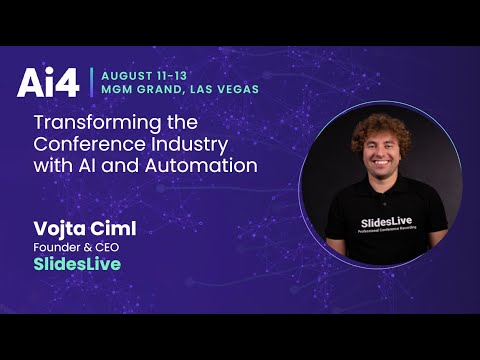
Transforming the Conference Industry with AI and Automation With SlidesLive — Ai4

Ai4

Autonomous camera systems trained on presentation archives eliminate the high labor costs that cause organizations to lose valuable expert insights after live conferences.

AI-assisted summary of Transforming the Conference Industry with AI and Automation With SlidesLive — original source. Check the original for full context.

Source published:

Detailed notes

## Background Published on YouTube by Ai4 on August 25, 2025, this presentation features Vojta Ciml, Founder and CEO of SlidesLive. The video outlines how SlidesLive employs AI, robotics, and proprietary automation—including RoboCams and the NATE automation engine—to produce scalable, studio-quality conference recordings and streams without the high costs of traditional production.

## TL;DR Vojta Ciml addresses the challenge of capturing multitrack events and details SlidesLive's mission to systematically record and preserve global presentations. By replacing large production crews with autonomous, sub-50-pound RoboCam units powered by the NATE Box and trained on over 140,000 presentations, SlidesLive delivers human-like camera tracking and automated real-time editing. The captured video serves as the foundation for downstream AI features, including automated transcription, synthetic voice cloning for translation, and personalized attendee highlight reels. Ciml emphasizes that failing to record event sessions forfeits the massive investment made in bringing experts together, arguing that video capture must become effortless and ubiquitous.

## Atmosphere & style The presentation is pragmatic, energetic, and engaging, opening with relatable humor about the impossibility of catching every talk at a massive multi-track conference. Ciml creates an interactive, 'show-not-tell' environment by gesturing directly to the autonomous robotic camera filming him in the room. The tone transitions seamlessly from a practical technical showcase of integrated hardware and computer vision into an inspiring, forward-looking manifesto on institutional memory and knowledge preservation.

## Key takeaways - [00:04](https://www.youtube.com/watch?v=y-bWkhxY-hQ&t=4s) Multitrack conferences like AI4 feature dozens of simultaneous tracks, making it impossible for attendees to catch every session in person. - [00:04](https://www.youtube.com/watch?v=y-bWkhxY-hQ&t=4s) SlidesLive's mission is to record every presentation in the world to preserve valuable knowledge for remote colleagues and future generations. - [00:04](https://www.youtube.com/watch?v=y-bWkhxY-hQ&t=4s) Traditional event video recording has historically been constrained by prohibitive equipment costs, large camera crews, and complex post-production logistics. - [01:53](https://www.youtube.com/watch?v=y-bWkhxY-hQ&t=113s) Autonomous RoboCams operate without human operators on-site, condensing multi-crew broadcast setups into a single airline-checkable case under 50 pounds. - [01:53](https://www.youtube.com/watch?v=y-bWkhxY-hQ&t=113s) The proprietary NATE Box integrates necessary computer hardware, capture cards, and cabling into a single all-in-one appliance. - [01:53](https://www.youtube.com/watch?v=y-bWkhxY-hQ&t=113s) Computer vision tracking models trained on over 140,000 presentations allow the robotic camera to replicate professional videographer instincts and predictive panning. - [01:53](https://www.youtube.com/watch?v=y-bWkhxY-hQ&t=113s) In blind A/B tests, audience members were unable to distinguish between autonomous RoboCam framing and footage shot by human camera operators. - [04:30](https://www.youtube.com/watch?v=y-bWkhxY-hQ&t=270s) High-quality video capture provides the foundational data needed for downstream AI features like automatic speech-to-text, closed captions, and semantic search. - [04:30](https://www.youtube.com/watch?v=y-bWkhxY-hQ&t=270s) AI-driven localization workflows combine automated translation with synthetic voice cloning to generate natural multilingual voiceovers. - [04:30](https://www.youtube.com/watch?v=y-bWkhxY-hQ&t=270s) Rather than uncurated video archives, AI enables hyper-personalized conference highlight reels tailored to each individual attendee's unique interests. - [06:41](https://www.youtube.com/watch?v=y-bWkhxY-hQ&t=401s) Companies squander substantial ROI when flying in domain experts without capturing their knowledge for long-term organizational retention. - [06:41](https://www.youtube.com/watch?v=y-bWkhxY-hQ&t=401s) Vojta Ciml asserts the core principle 'if you haven't recorded it, it has not happened,' urging video capture to become as ubiquitous as pen and paper.

## Detailed walkthrough ### [00:04](https://www.youtube.com/watch?v=y-bWkhxY-hQ&t=4s) The Challenge of Multitrack Events and SlidesLive's Mission

Vojta Ciml opens with a relatable scenario for anyone attending a large conference: asking how many audience members have missed at least a few minutes of a session. He admits doing the exact same thing, describing how easy it is to get caught up having meaningful networking conversations over lunch, only to suddenly realize the keynote is already underway. With massive gatherings like AI4 running 20 simultaneous tracks, catching every talk in person is practically impossible.

While attendees might comfort themselves knowing sessions are being recorded, Ciml emphasizes that SlidesLive is recording every single session at AI4 with a broader ambition: to record every presentation in the world. SlidesLive views its mission as preserving valuable shared knowledge not only for attendees and absent colleagues, but for future generations. Historically, many events skip recording entirely because traditional video production is prohibitively expensive, time-consuming, and labor-intensive, requiring costly gear, tedious editing, and complex hosting pipelines.

- AI4 features 20 concurrent session tracks running simultaneously, making manual attendance across topics impossible. - SlidesLive's core mission is to systematically capture and preserve global presentations for remote colleagues and posterity. - Traditional event video capture has historically been blocked by high equipment costs, large crews, and complicated post-production logistics.

---

[01:53](https://www.youtube.com/watch?v=y-bWkhxY-hQ&t=113s) Autonomous RoboCams and the NATE Automation Engine

Pointing to the physical setup in the room, Ciml highlights a camera positioned directly in the center of the audience and asks what makes it unique: it operates with no human camera operator behind it. This autonomous setup represents a paradigm shift in capturing live events at massive scale. Production setups that once demanded large transport trucks, heavy equipment crates, and "Hollywood-sized crews" have been consolidated into a single case weighing under 50 pounds that can simply be checked as standard airline luggage and unpacked on-site.

```mermaid flowchart TD accTitle: SlidesLive Autonomous Capture Architecture A["RoboCam & Sensors"] --> B["NATE Box Computer"] B --> C["AI Tracking & Predictive Framing Engine"] C --> D["Real-Time Switching, Recording & Live Streaming"] E["140,000+ Video Training Library"] -.-> C ```

Ciml explains that the RoboCam autonomously tracks the speaker, records, edits, and stores the session footage in real time. The camera rig is driven by an underlying computer called the NATE Box, which integrates all necessary hardware, capture cards, and cabling into a self-contained unit, eliminating the need for tables cluttered with expensive, mysterious hardware converters. To achieve smooth, human-like camera motion, SlidesLive trained its computer vision models on its proprietary library of over 140,000 recorded presentations. This enables the robotic system to predict speaker movement and execute natural panning. In blind A/B testing comparing human camera operators to the autonomous RoboCam, viewers were unable to distinguish between the two.

- Production footprint reduced from multi-crew broadcast setups to a single transportable box under 50 lbs. - The integrated NATE Box replaces complex converter tables with an all-in-one hardware and capture appliance. - Tracking models are trained directly on SlidesLive's 140,000+ video archive to mirror professional videographer instincts and predictive panning.

---

[04:30](https://www.youtube.com/watch?v=y-bWkhxY-hQ&t=270s) Unlocking Downstream Value: AI Search, Translation, and Hyper-Personalization

Quoting Bill Gates's famous maxim that "content is the king," Ciml argues that high-quality captured footage is the foundational asset required to power modern downstream AI tools. Once a presentation is recorded, it is converted into text via automatic speech transcription, unlocking immediate utilities such as closed captioning, semantic search, AI-driven content recommendations, and automated summaries.

Language barriers are further eliminated through automated multi-language translation and synthetic voice cloning, enabling full voiceovers in international languages. However, Ciml stresses that the ultimate goal is not to accumulate unwieldy archives of hundreds of uncurated hours. Instead, the future lies in delivering personalized knowledge on demand. For an event with 8,000 attendees, AI can synthesize personalized conference highlight reels tailored to each person's unique interests, preserving the complete multimedia experience—including vocal tone, physical gestures, presentation slides, and data visualizations—rather than flattening the event into a simple text summary.

- Automatic speech-to-text transcription powers real-time captions, AI summarization, semantic search, and recommendation engines. - Advanced localization workflows include AI translation paired with synthetic voice cloning for automated voiceovers. - Future consumption shifts from static video archives to hyper-personalized highlight reels customized for each of the 8,000 event attendees.

---

[06:41](https://www.youtube.com/watch?v=y-bWkhxY-hQ&t=401s) Ubiquitous Knowledge Capture: "If You Haven't Recorded It, It Has Not Happened"

Ciml laments how organizations frequently squander valuable expertise. Companies invest immense financial and logistical resources to fly high-level domain experts to a single venue, book hotels, and facilitate critical knowledge exchange—only for that shared insight to vanish entirely once the event concludes. He envisions a future where video capture becomes as ubiquitous, effortless, and commonplace as a pen and paper.

Leaving stakeholders, meeting planners, speakers, and attendees with a final guiding rule, Ciml insists: "if you haven't recorded it, it has not happened." Whether at a massive conference like AI4, an internal company town hall, or an intimate working session of 20 research scientists, automated recording ensures insights are permanently retained. He closes by acknowledging SlidesLive's global team of technical specialists who support robotic camera deployments worldwide, noting that their systems have already logged thousands of hours of autonomous event production across the globe.

- Organizations risk losing massive ROI when flying in experts without recording their shared knowledge. - Automated camera systems make comprehensive event capture frictionless across events of any size, from global summits to 20-person scientific working groups. - SlidesLive's robotic camera platform has already delivered thousands of production hours globally.

## Notable quotes > What if a single smart camera—supported by human experts—could deliver studio-quality recordings at scale, anywhere in the world? — Vojta Ciml

> [00:04](https://www.youtube.com/watch?v=y-bWkhxY-hQ&t=4s) record every presentation in the world — Vojta Ciml

> [01:53](https://www.youtube.com/watch?v=y-bWkhxY-hQ&t=113s) Hollywood-sized crews — Vojta Ciml

> [04:30](https://www.youtube.com/watch?v=y-bWkhxY-hQ&t=270s) content is the king — Bill Gates

> [06:41](https://www.youtube.com/watch?v=y-bWkhxY-hQ&t=401s) if you haven't recorded it, it has not happened — Vojta Ciml

## Mentioned Vojta Ciml, SlidesLive, AI4, RoboCam, SmartStream, NATE, NATE Box, Bill Gates

## Video description Vojta Ciml, Founder & CEO, SlidesLive

Abstracts

What if a single smart camera—supported by human experts—could deliver studio-quality recordings at scale, anywhere in the world? As conferences grow in size and complexity, organizers face mounting pressure to deliver professional video content efficiently and affordably. SlidesLive is using AI, robotics, and proprietary automation to rethink how conferences are recorded and streamed—without compromising on quality. Attendees will discover how innovations like RoboCams, SmartStream, and the NATE automation engine enable seamless production, reduce costs, and make global scaling possible. Join us to see how AI isn’t just enhancing video production—it’s redefining what’s possible.

[Source](https://www.youtube.com/watch?v=y-bWkhxY-hQ)

中文简报

SlidesLive部署自主RoboCam替代活动摄像团队 基于演讲归档资料训练的自主摄像系统消除了高昂的人力成本,避免了机构在现场会议结束后错失宝贵的专家见解。 Vojta Ciml探讨了多轨会议拍摄面临的挑战,并阐述了SlidesLive系统化录制与保存全球演讲的使命。SlidesLive用重量低于50磅、由NATE Box驱动且基于超14万场演讲训练的自主RoboCam设备取代庞大的制作团队,实现了媲美人工的镜头追踪与自动化实时剪辑。所录制的视频可作为下游AI功能的基础,包括自动转录、用于翻译的合成语音克隆以及面向参会者的个性化精彩片段生成。Ciml强调,未录制会议内容将浪费汇聚各方专家所投入的巨额成本,他主张视频录制必须变得轻松省力且无处不在。 面对 AI4 等大型峰会多达 20 个并发分论坛的痛点,SlidesLive 致力于系统性录制并留存全球演讲内容,解决传统视频录制成本高昂、设备繁杂及人力密集的难题。 (0:04) SlidesLive 推出无需现场人工操作的自主 RoboCam 与一体化 NATE Box,将庞大转播系统浓缩至 50 磅以内的单件航空行李箱;其模型基于超 14 万场演讲训练,在盲测 A/B test 中镜头运作表现媲美专业摄影师。 (1:53) 高质量视频是下游 AI 的数据基础,可支持实时字幕、语义搜索与语音克隆多语言翻译,未来更能针对数千名参会者不同兴趣自动生成高度个性化的会议精彩集锦。 (4:30) 创始人 Vojta Ciml 提出“如果没有录制下来,它就等于没有发生”,主张让自动化录制如纸笔般便捷,目前该自主摄像系统已在全球累计完成数千小时的会议制作。 (6:41)

Reading summary

Vojta Ciml of SlidesLive argues that high video production costs and multitrack scheduling historically caused vast amounts of conference expertise to be lost, but autonomous camera robotics and generative AI now make ubiquitous capture and personalized distribution viable. The Multitrack Conference Knowledge Gap (0:04) At large events such as Ai4, which run 20 concurrent session tracks, attendees inevitably miss valuable presentations due to overlapping schedules and networking. Ciml notes that organizations routinely spend substantial sums to fly in domain experts, yet fail to preserve their insights because traditional video capture requires costly broadcast gear, large production crews, and cumbersome post-production workflows. As a result, many sessions go unrecorded, preventing absent colleagues and future audiences from accessing the material. Autonomous Hardware and Predictive Camera Tracking (1:53) To lower production overhead, SlidesLive developed the autonomous RoboCam and the NATE Box, an integrated appliance combining capture cards, computer hardware, and cabling. This setup compresses equipment footprints from broadcast trucks into a single case weighing under 50 pounds that can be checked on commercial flights. The robotic camera automatically tracks speakers, edits, and streams footage without an on-site operator. SlidesLive trained its computer vision models on its archive of over 140,000 presentations to simulate natural panning and movement; Ciml states that viewers in blind A/B tests could not distinguish the autonomous system from human camera operators. Downstream AI and Personalized Highlight Reels (4:30) Ciml emphasizes that recorded video provides the raw data required to power modern AI applications. Automated speech-to-text transcription enables immediate searchability, closed captioning, automated summaries, and multi-language translation using synthetic voice cloning. Rather than forcing viewers to navigate unwieldy archives containing hundreds of hours of video, Ciml forecasts the delivery of hyper-personalized highlight reels tailored to the individual interests of each attendee across an 8,000-person conference. This format retains vocal tone, physical gestures, and visual slides instead of flattening presentations into basic text summaries. Ubiquitous Capture as an Institutional Standard (6:41) Ciml contends that failure to document live expert discussions squanders institutional investment, framing his thesis around the rule that "if you haven't recorded it, it has not happened." He argues that automated capture should become as frictionless and commonplace as pen and paper, scaling from 20-person scientific working groups to multi-thousand-person summits. SlidesLive indicates its global technical support teams have already deployed these automated systems for thousands of production hours internationally. Ciml's model demonstrates how autonomous hardware can sharply reduce physical event production footprints, though realizing ubiquitous capture requires organizations to systematically budget for automated recording across both small internal meetings and major multitrack conferences.

精炼阅读摘要

SlidesLive 创始人 Vojta Ciml 指出,传统会议视频录制受制于高昂的人力与设备成本,导致大量专业知识在会议闭幕后流失;该公司利用自主研发的机器人摄像机与 AI 处理架构实现低成本全自动采集,并借由下游 AI 工具将原始影像转化为多语种检索与个性化内容资产。 多轨会议痛点与录制普及化目标 (0:04) 在类似 Ai4 这类拥有 20 个平行分论坛的大型行业会议中,参会者常因商务社交或时间冲突错过关键议程,无法全面获取现场信息。历史上,许多会议组织方直接放弃录制环节,主要原因在于传统视频制作模式成本极其昂贵、工序繁琐且高度依赖人力,需要配备昂贵的专用设备、庞大的摄制团队以及复杂的后期剪辑和托管流程。 SlidesLive 提出系统化采集全球学术与行业演讲的目标,旨在为缺席同事与后代留存高价值的专业见解。Ciml 认为,将现场知识永久数字化的核心障碍在于摄制门槛,只有通过自动化技术压低制作成本,才能打破传统广播制作的经济与操作壁垒,避免专业思想在活动闭幕后自然消逝。 RoboCam 与 NATE 引擎的自动化架构 (1:53) SlidesLive 通过自主运行的 RoboCam 摄像系统替代现场摄影师。在物理部署层面,以往需要货车运输的大型器材箱与摄制组团队被大幅精简,整体系统集成于一个重量低于 50 磅(约 22.7 千克)的便携箱中,可直接作为标准航空行李托运并在现场快速展开。 该硬件的核心驱动平台是 NATE Box,它将计算机、采集卡和线缆高度集成,取代了以往杂乱的转换器连接台。在算法层面,该系统依托专有的 14 万余场历史演讲视频库训练计算机视觉与预测构图模型,使机械云台能够实时预判演讲者的移动轨迹并执行平滑的运镜变焦。在盲测对比中,观众无法分辨机器追踪与专业人类摄影师的拍摄画面,系统能在无人干预下完成实时追踪、录制、剪辑与云端存储。 下游 AI 转化与超个性化分发 (4:30) 高质量的原始视频录制被定位为激活下游 AI 生态的基础资产。通过自动语音识别(ASR)技术,现场演讲内容可即时转录为文本,进而打通实时字幕生成、语义搜索、智能内容推荐与结构化会议摘要等功能。在多语种传播方面,系统结合机器翻译与合成语音克隆技术,能够自动生成演讲者原声音色的外语配音。 Ciml 进一步指出,未来的内容消费重心将不再是堆积数百小时无人整理的静态长视频,而是面向受众提供按需定制的超个性化知识服务。以一场 8,000 人规模的峰会为例,AI 能够根据每位与会者的独特关注点自动生成专属的高光集锦,并完整保留演讲者的肢体手势、语调起伏、演示幻灯片以及图表细节,避免将立体的现场交互扁平化为单纯的文本信息。 知识资产留存的必要性与应用边界 (6:41) 企业与机构每年投入巨大的差旅与会议预算,将各领域的高级专家聚集到同一物理空间进行深入探讨,但若缺乏系统化的记录手段,这些智力成果在活动结束后便无法继续产生复利。Ciml 提出“未被录制即未曾发生”的准则,呼吁各方将视频采集视作如纸笔般普遍且低摩擦的常规工具。 根据 SlidesLive 的实践,这套自动化录制系统不仅适用于数千人参与的超大型科技峰会,亦能灵活降维部署于仅有 20 名研究人员的闭门学术研讨会或企业内部全员大会中。其全球技术支持团队目前已在全球范围内支撑了数千小时的自主现场制作,展示了全自动摄制在不同规模知识场景下的泛化能力。 Ciml 强调会议产业必须转向以 AI 和自动化为主导的全面记录模式以最大化投资回报;不过,该技术方案能否彻底替代复杂的多机位转播体系,仍取决于多变现场环境对单套自主硬件的容错率与网络承载能力。

Detailed notes — zh

## Background 本视频由 YouTube 频道 Ai4 于 2025 年 8 月 25 日发布,记录了 SlidesLive 创始人兼 CEO Vojta Ciml 在大会上的主题演讲。视频简介指出,演讲聚焦于 SlidesLive 如何利用 RoboCam、SmartStream 及 NATE 自动化引擎等 AI 与机器人技术,打破传统会议视频制作的高成本与繁琐壁垒,实现全球范围内演播室级别的规模化录制与分发。 ## TL;DR 演讲指出了多轨并行会议中知识严重流失的痛点,并阐明传统人工摄制高昂繁琐是阻碍录制的主要原因。为此,SlidesLive 研发了由 NATE Box 驱动的 RoboCam 自动化摄录系统,将庞大转播系统压缩至 50 磅便携箱内,并通过基于 14 万多部视频训练的 AI 模型实现媲美专业摄像师的自动平滑运镜。采集到的高质量内容经由多模态 AI 管道处理,可快速完成语音转录、语义检索、原声克隆多语种配音,并为数千名参会者定制专属个性化集锦。演讲最终以“未被录制即从未发生”为核心,呼吁将自动化智能录制打造为各类学术与行业会议的标准基础设施。 ## Atmosphere & style 演讲风格务实且富有感染力,开场以切中与会者赶场痛点的生动互动拉近距离,随后直接引导观众观察现场正在运转的无人机械摄像机,带来了极具说服力的科技实感。主讲人语调从容自信、逻辑严密,将复杂的云台算法与硬件集成化繁为简。整场分享兼具商业实用性与技术理想主义,结尾掷地有声的警句更是将话题升华至保存人类智力资产的宏大愿景,令人深思且振奋。 ## Key takeaways - [00:04](https://www.youtube.com/watch?v=y-bWkhxY-hQ&t=4s) 大规模行业峰会普遍面临多轨(Tracks)并行的痛点,参会者因精力有限往往错失大量精彩主题演讲。 - [00:04](https://www.youtube.com/watch?v=y-bWkhxY-hQ&t=4s) 传统线下活动视频录制因设备笨重、人力成本高昂且后期流程繁琐,导致全球绝大部分会议内容未被有效保存。 - [00:04](https://www.youtube.com/watch?v=y-bWkhxY-hQ&t=4s) SlidesLive 致力于录制并数字化全球高价值演讲,打破知识获取壁垒,实现人类智力资产的永久留存。 - [01:50](https://www.youtube.com/watch?v=y-bWkhxY-hQ&t=110s) 通过模块化与小型化设计,整套专业录制系统被压缩至 50 磅以内,支持航司标准托运并能实现即拆即用。 - [01:50](https://www.youtube.com/watch?v=y-bWkhxY-hQ&t=110s) 专用硬件 NATE Box 高度集成了采集卡与多路转换器,单机即可承担现场线缆汇聚、视频跟踪、录制与网络推流。 - [01:50](https://www.youtube.com/watch?v=y-bWkhxY-hQ&t=110s) 依托 14 万多部专业会议视频训练的视觉预测模型,使无人操作的 RoboCam 具备媲美专业摄像师的平滑运镜质感。 - [04:31](https://www.youtube.com/watch?v=y-bWkhxY-hQ&t=271s) 高质量音视频记录是下游 AI 能力的基础,可无缝衍生出自动字幕、语义检索、智能摘要与跨语言原声配音。 - [04:31](https://www.youtube.com/watch?v=y-bWkhxY-hQ&t=271s) AI 能够根据与会者的不同背景与兴趣,为数千名参会人员全自动定制千人千面的个性化会议精选集(Highlight Video)。 - [04:31](https://www.youtube.com/watch?v=y-bWkhxY-hQ&t=271s) 相比纯文本聊天与摘要,保留原声、手势、图表与 PPT 的多模态视频呈现能提供更完整且具沉浸感的知识传递体验。 - [06:41](https://www.youtube.com/watch?v=y-bWkhxY-hQ&t=401s) 会议举办耗费巨大的人力与差旅成本,若缺乏系统化录制,前沿专家碰撞出的思想火花将在数日内彻底流失。 - [06:41](https://www.youtube.com/watch?v=y-bWkhxY-hQ&t=401s) “未被录制即等同于从未发生”,推动自动化智能录播成为从闭门研讨会到大型峰会的标配基础设施是未来趋势。 ## Detailed walkthrough ### [00:04](https://www.youtube.com/watch?v=y-bWkhxY-hQ&t=4s) 会议知识流失的痛点与 SlidesLive 的使命 在 AI4 大会的演讲开场中,演讲者通过与现场观众互动拉开序幕,询问台下有多少人因为忙着吃午餐、拓展人脉或进行深度交谈,而错过了某场分论坛或主题演讲的开场。面对多达 20 个同时进行的并行分会场(Tracks),参会者根本无法兼顾所有内容。尽管现场每一场演讲都在被实时录制,但放眼全球,绝大多数线下活动往往选择放弃录制。究其历史原因,传统的视频录制不仅极其昂贵、耗时耗力,还需要极其笨重的视频硬件设备,随后繁琐的后期剪辑与视频托管更是让主办方望而却步。 SlidesLive 的核心使命正是要打破这种知识壁垒,致力于录制全球每一场有价值的演讲。这不仅是为了让未能亲临现场的同事能够获取会议精华,更是为了将这些人类共享的宝贵知识永久留存给后代。 - **多轨并行的痛点**:AI4 峰会同时运行 20 个 Track,单凭个人精力无法全面覆盖。 - **历史录制阻碍**:传统视频摄制需要巨额资金、大量人力、复杂转码及昂贵设备。 - **企业核心使命**:完整保存线下分享的高价值知识,使其能够跨越时间与空间持续传播。 ### [01:50](https://www.youtube.com/watch?v=y-bWkhxY-hQ&t=110s) NATE 与 RoboCam:颠覆传统视频制作的自动化革新 演讲者引导观众注意会场中间设立的摄像机——它完全没有人工操作员(Camera Operator),却正在全自动进行平滑运镜与拍摄。过去需要大型转播车、沉重木箱以及“好莱坞级别摄制团队”才能完成的多轨会议录制,如今已被压缩至一个重量不足 50 磅(约 22.7 公斤)、可以直接作为普通行李在机场托运的便携箱中,实现即拆即用的全球化部署。 ```mermaid flowchart TD accTitle: SlidesLive 智能录播系统架构流程 subgraph Capture["现场硬件与智能采集 (RoboCam & NATE Box)"] A["多路信号接入<br/>(音视频/PPT/幻灯片)"] --> B["NATE Box 嵌入式计算单元"] B --> C["AI 运镜算法<br/>(基于 14 万+ 视频训练)"] C --> D["全自动云台跟踪与实时切播"] end subgraph Cloud["云端自动化与多模态处理"] D --> E["自动语音转录 (ASR) 与 字幕生成"] E --> F["AI 语义搜索与摘要提取"] E --> G["多语言翻译与语音合成 (Voiceover)"] end subgraph Delivery["终端个性化交付"] F --> H["千人千面个性化视频剪辑 (8000+ 参会者)"] G --> H end ``` 整套系统由置于三脚架下方的专用计算机——**NATE Box** 驱动。它将以往杂乱无章、令人费解且收费昂贵的各类视频转换器与采集卡完全集成到单台设备中,负责现场所有的线缆汇聚、视频跟踪、实时录制与网络推流。为了达到专业摄像师的人工质感,SlidesLive 基于其视频库中超过 **140,000 部**演讲视频训练了专属的计算机视觉与预测模型,使机械云台能够平滑预判演讲者的走位与肢体动作。在双盲测试中,普通观众甚至完全无法区分视频是由人类摄像师拍摄还是由该机器人摄像机(RoboCam)自动捕捉完成。 - **极致便携性**:单箱重量控制在 50 磅以内,支持航司标准托运,大幅削减差旅与物流成本。 - **高集成计算**:NATE Box 取代传统导播台和繁杂硬件转换器,单机整合全套采集与推流接口。 - **海量数据训练**:借助 14 万多部专业会议视频训练运镜模型,实现平滑预测与媲美人工的镜头质感。 ### [04:31](https://www.youtube.com/watch?v=y-bWkhxY-hQ&t=271s) 内容为王与 AI 赋能:从海量存档到超个性化交付 引用比尔·盖茨的名言“内容为王(Content is the king)”,演讲者强调,将线下演讲转化为数字化内容是一切下游 AI 应用的前提基石。当现场音视频被精准记录后,下游流水线首先将其转换为文本与闭路字幕(Closed Captioning),进而衍生出 AI 语义检索、智能推荐、多维度摘要生成以及跨语言翻译。如今结合最新的人工智能语音合成技术,甚至可以实现演讲者原声的跨语种配音,彻底打破语言壁垒。 然而,单纯建立一个长达数百小时的静态视频归档库并不是终极目标。未来的核心在于“按需提供精准信息”。以本届 AI4 现场的 **8,000 名**与会者为例,每位参会者的行业背景与关注重点各不相同。借助 AI 的全自动化切片与重组,系统能够为每位与会者量身定制专属的个性化会议精选集(Highlight Video),以包含原声、手势、图表及幻灯片的完整多模态体验交付,而非冷冰冰的纯文本聊天或摘要。 - **多模态 AI 赋能链条**:实时录制 $\rightarrow$ 自动转录 $\rightarrow$ 语义搜索/摘要 $\rightarrow$ 跨语言语音克隆与配音。 - **千人千面的内容分发**:为现场 8,000 名与会者生成专属个性化精彩集锦,摆脱繁琐的手动翻找。 - **全感官呈现**:保留演讲者的肢体语言、声音抑扬顿挫及演示图表,提供比纯文本更完整的沉浸体验。 ### [06:41](https://www.youtube.com/watch?v=y-bWkhxY-hQ&t=401s) “未被录制即从未发生”:重塑知识留存的未来 企业与组织为了举办一场高规格会议往往投入巨大——重金聘请顶尖行业专家、承担跨国航班与酒店场地开销,然而专家们在会场碰撞出的前沿洞见,往往在会议结束几天后便彻底随风消逝,造成极大的智力资产浪费。演讲者提出,未来的视频录制应当如同开会时随手拿出的纸笔一样普及与轻便,并将做笔记与录制的繁重任务全权交由摄像头与计算机处理。 在演讲尾声,演讲者向现场所有利益相关方、演讲嘉宾、参会者和会议策划人留下了一句掷地有声的总结:“**如果你没有将它录制下来,它就等同于从未发生过(If you haven't recorded it, it has not happened)**。”同时,他对分布在全球各地、通过自动化机器人系统完成数千小时录制的 SlidesLive 全球技术支持团队表达了感谢。 - **智力资产流失现状**:高额投入的行业专家线下交流若无系统化留存,其知识价值在几天内便会流失。 - **普及化愿景**:推动自动化音视频录制成为各级别会议(无论是万人行业峰会还是 20 人的科学家闭门研讨会)的标准基础设施。 - **规模化验证**:依托遍布全球的专业团队,该套 AI 自动化摄播方案已在世界各地累计完成数千小时的高质量交付。 ## Notable quotes > What if a single smart camera—supported by human experts—could deliver studio-quality recordings at scale, anywhere in the world? — Vojta Ciml > [04:31](https://www.youtube.com/watch?v=y-bWkhxY-hQ&t=271s) Content is the king — Bill Gates > [06:41](https://www.youtube.com/watch?v=y-bWkhxY-hQ&t=401s) If you haven't recorded it, it has not happened — Vojta Ciml ## Mentioned Vojta Ciml, SlidesLive, Ai4, RoboCam, SmartStream, NATE, NATE Box, Bill Gates ## Video description Vojta Ciml, Founder & CEO, SlidesLive Abstracts What if a single smart camera—supported by human experts—could deliver studio-quality recordings at scale, anywhere in the world? As conferences grow in size and complexity, organizers face mounting pressure to deliver professional video content efficiently and affordably. SlidesLive is using AI, robotics, and proprietary automation to rethink how conferences are recorded and streamed—without compromising on quality. Attendees will discover how innovations like RoboCams, SmartStream, and the NATE automation engine enable seamless production, reduce costs, and make global scaling possible. Join us to see how AI isn’t just enhancing video production—it’s redefining what’s possible. [Source](https://www.youtube.com/watch?v=y-bWkhxY-hQ)

Source quotes

Vojta Ciml: What if a single smart camera—supported by human experts—could deliver studio-quality recordings at scale, anywhere in the world? [4:31] Bill Gates: Content is the king [6:41] Vojta Ciml: If you haven't recorded it, it has not happened

Source quotes

Vojta Ciml: What if a single smart camera—supported by human experts—could deliver studio-quality recordings at scale, anywhere in the world? [0:04] Vojta Ciml: record every presentation in the world [1:53] Vojta Ciml: Hollywood-sized crews [4:30] Bill Gates: content is the king [6:41] Vojta Ciml: if you haven't recorded it, it has not happened

Original transcript

[0:04] So, who of you have missed here at AI4 [0:09] at least a few minutes of some session? [0:11] Raise your hand. [0:13] Yeah, I done that, too. I mean, uh, [0:16] you're enjoying lunch and enjoying [0:18] networking, having all those meaningful [0:21] conversations, and then all of a sudden, [0:23] oh, uh, is the keynote starting? Shall [0:26] we head inside? Yeah. And I mean this [0:29] year's conference the size is just [0:32] amazing. That's why we are all here to [0:34] make those connections but with 20 [0:38] tracks running at the same time [0:41] it's quite challenged to catch [0:43] everything isn't it? [0:45] Well some people might say um it's being [0:48] recorded and they are right. Every [0:52] single session here at AI4 is being [0:55] recorded of course by us slides live and [0:59] we actually want to record every single [1:01] presentation not just here but in the [1:03] world that is our mission to preserve [1:07] that valuable knowledge that's shared [1:10] for you guys not just for you for your [1:14] colleagues that couldn't make it here [1:15] today and for all the future [1:18] generations. [1:19] That's what we do. That's our mission. [1:22] So question is why so many events skip [1:27] these recordings? They don't do it. [1:31] Well, of course, historically [1:33] that is something very expensive. It's a [1:36] labor intensive. It's time consuming. [1:39] Video equipment is always very expensive [1:42] and you have to do all the editing and [1:44] hosting and no one knows and it's very [1:48] challenging. [1:50] But not anymore. [1:53] Look around yourself. [1:55] Do you see that camera in the middle of [1:57] the room? It's in the middle of the [1:59] every room. You might have noticed. [2:03] What is special about it? [2:05] Anyone? [2:08] Yes. Yes. There is no operator. [2:12] You're actually looking at a revolution [2:15] happening right now and that is changing [2:18] how we capture content on a massive [2:21] scale. What used to be, you know, big [2:24] trucks and and and heavy crates and [2:27] large Hollywoodsized crews can now be [2:31] packed into a single box under 50 pounds [2:35] that you're going to just check at the [2:36] airport, unpack it somewhere else, and [2:39] you're ready to roll. And in fact, I [2:42] want to show you a glimpse of how it [2:46] works. I like demos. Yeah, I prefer [2:48] demos. And um the the thing is this [2:52] camera tracks me and edits and records [2:56] and stores everything on its own. This [3:00] is the gamechanging thing. It is powered [3:03] by a computer called Nate Box which is [3:06] right under that. that computer is [3:09] having every single cable, every single [3:12] piece of hardware that you need to [3:14] record and stream. So again, what used [3:16] to be, you know, tables and tables of [3:19] these strange converters that no one [3:21] really knew what they are doing and why [3:22] they're appearing on your final bill, [3:25] that is now done with this single [3:27] computer. And because we have over [3:30] 140,000 videos stored in our library, we [3:35] have seen so many speakers and so many [3:37] videographers that we wanted to create [3:40] this to mimic that human perfection to [3:44] have that smooth experience that panning [3:47] that prediction where a speaker goes. So [3:50] we are training our models on our own [3:52] library so we can achieve an [3:55] unprecedented level of quality. That was [3:58] our goal. And in fact when we tested it [4:01] out on you know people um can you tell [4:04] the difference which footage was taken [4:06] by the robotic camera and which footage [4:10] was taken by a human? They couldn't tell [4:13] the difference really. They could not. [4:15] So that is uh a signal to us that this [4:19] is working extremely well. Of course, [4:22] computer vision has been long on the [4:24] forefront of AI research. So neural [4:27] networks are nothing super new, but we [4:30] are not stopping there. In fact, this is [4:34] super exciting era. As Bill Gates said, [4:37] content is the king. And those who have [4:41] content these days, they have incredible [4:44] opportunities in front of them. If you [4:47] have something to say, something to [4:49] present, something to share on stage, [4:53] then once you record it, you can connect [4:56] all the dots that you are studying in [4:58] past two three days because all these [5:01] amazing companies doing services usually [5:04] you need some content for it. So of [5:06] course the video we first transcribe it [5:09] into a text form that you can utilize as [5:13] closed captioning. [5:15] That closed captioning can be used also [5:18] as a search tool. You know AI search, AI [5:20] recommendation, AI summaries. These days [5:24] language is also no more a barrier. You [5:28] can translate it into other languages. [5:30] Today we have even seen examples of [5:33] synthesizing a voice in another [5:35] language. So you can do a voice over and [5:38] that's just top of the iceberg. Those [5:40] options will only increase. But first [5:43] you need to record it. That is the key. [5:46] So the goal is not to just have an [5:50] archive of hundreds and hundreds of [5:52] hours that you have to manually go [5:55] through. No, I believe the future is in [5:59] information that's delivered to you when [6:01] you need it. So, I can almost imagine a [6:04] personalized highlight video out of [6:06] every conference for every attendee. All [6:09] of the 8,000 people here here, they have [6:12] different interests. They want to hear [6:14] different information. And we are [6:16] finally in the age when this is [6:18] possible. when we can serve them the [6:20] pieces, the videos and the elements that [6:23] they need, not just as a boring chat or [6:26] boring text form, but as a full [6:28] experience. You want that voice and [6:31] gestures and visuals and graphs, [6:34] presentations. You can have it in in a [6:36] full package, not just as a text, but [6:39] the full package. [6:41] So, what organizations are doing today? [6:45] Well, they are throwing away this [6:47] valuable knowledge, this expertise. You [6:50] know, you spend vast resources on hiring [6:54] experts and then maybe flying them on [6:58] one place all together and you know, you [7:00] book the venue and hotel and they chat [7:03] and mingle and exchange valuable [7:05] information and in couple days it's just [7:07] gone. So that's a loss. Instead, I see a [7:12] future which is happening now where [7:14] recording is as ubiquitous as piece of [7:19] paper and pen and you can take some [7:20] notes. But uh people are really good at [7:24] taking notes during meetings I think. So [7:27] let camera and computer do the job for [7:29] you. And um I think this is super [7:33] exciting era again. And I would like to [7:35] leave you with a final and important [7:38] thought. No matter whether you're a [7:40] stakeholder, speaker, attendee, or a [7:44] meeting planner, no matter whether [7:46] you're at a giant conference like this [7:48] one, AI4, or if you're hosting a a town [7:52] hall meeting or uh 20 scientists trying [7:56] to figure out something, remember next [7:59] time when you're sitting on that, if you [8:01] haven't recorded it, it has not [8:04] happened. And I also want to say thank [8:08] you to a team of super skilled people [8:12] around the globe that are right now [8:14] recording these events all around the [8:16] globe. And without them, this vision [8:18] would not be possible. And thanks to [8:21] them, robotic cameras already served [8:23] thousands and thousands of ours all [8:26] around the globe. And I promise it's [8:29] going to be short and sweet because uh I [8:32] wish you all safe travels home. And if [8:36] you have any questions, I think I have a [8:37] minute or two for questions. So, thank [8:39] you for attention and safe travels. [8:43] [applause]