Osmo Rolls Out AI Engine to Cut Fragrance Design to Single Minute
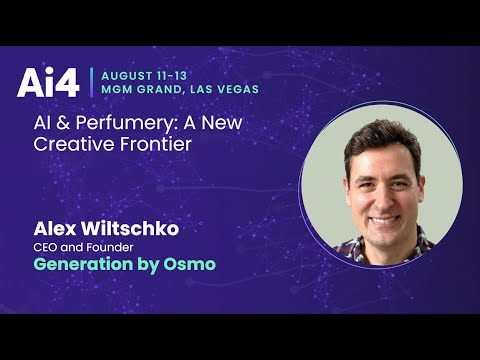
Ai4
By combining graph neural networks with automated liquid-handling robotics, Osmo compresses traditional 18-month perfume development cycles into instant, regulatory-compliant chemical formulas.
AI-assisted summary of AI & Perfumery: A New Creative Frontier With Generation by Osmo — original source. Check the original for full context.
Source published:
Detailed notes
## Background Published on YouTube by Ai4 on August 24, 2025, this video features a presentation by Alex Wiltschko, CEO and Founder of Generation by Osmo. The description outlines how Olfactory Intelligence (OI) serves as a creative power tool for perfumery, transforming emotion and behavioral data into rapid, safe, and transparent fine-fragrance creation.
## TL;DR Former Google Brain neuroscientist Alex Wiltschko outlines Osmo's mission to digitize the sense of smell using a three-tier architecture of spectrometry, graph neural network scent mapping, and robotic compounding. He introduces Generation, an enterprise AI platform that condenses the traditional 18-month fragrance design cycle into minutes. Through a live demonstration, Wiltschko turns an audience prompt for a melancholic luxury perfume into 'Melancholy Bloom,' generating both creative notes and a production-ready, IFRA-compliant chemical formula. The presentation demonstrates how combining large language models with molecular prediction models allows brands to formulate and physically dispense fine fragrances at the speed of culture.
## Atmosphere & style The presentation maintains an engaging, visionary, and intellectually rigorous tone that bridges cutting-edge machine learning with the nuanced elegance of high perfumery. Wiltschko speaks with crisp, dynamic clarity, demystifying complex neurobiology and molecular structures through lucid visual analogies. The live software demonstration delivers a palpable sense of innovation and spontaneity, making the real-time translation of abstract human sadness into a physical aromatic formula feel both poetic and technologically profound.
## Key takeaways - [00:04](https://www.youtube.com/watch?v=z9qcf46vKOM&t=4s) Digitizing olfaction lagged behind sound and vision because human smell relies on over 300 distinct receptors, compared to three color channels for sight and linear frequency for sound. - [00:04](https://www.youtube.com/watch?v=z9qcf46vKOM&t=4s) Advances in graph neural networks allowed researchers at Google Brain to map molecular structures directly to human olfactory perception, publishing the breakthrough in Science. - [00:04](https://www.youtube.com/watch?v=z9qcf46vKOM&t=4s) A complete digital olfaction stack requires three core pillars: reading molecules via spectrometry, mapping perception through Olfactory Intelligence, and writing scent using automated robotics. - [02:01](https://www.youtube.com/watch?v=z9qcf46vKOM&t=121s) Osmo spun out of Google Brain in 2022 with venture backing from Lux Capital, GV, and Two Sigma to build fine fragrances through its enterprise platform, Generation. - [02:01](https://www.youtube.com/watch?v=z9qcf46vKOM&t=121s) Traditional fragrance formulation is heavily resource-intensive, routinely taking 18 months and $250,000 to $1,000,000 in development costs per scent. - [02:01](https://www.youtube.com/watch?v=z9qcf46vKOM&t=121s) Because Osmo's models operate on universal molecular representations, the technology has cross-industry applications in defense inspection, supply chain tracking, and medical diagnostics. - [03:06](https://www.youtube.com/watch?v=z9qcf46vKOM&t=186s) Generation operates as a generative scent design interface, translating natural language prompts and emotional concepts directly into full fragrance briefs. - [03:06](https://www.youtube.com/watch?v=z9qcf46vKOM&t=186s) During a live demonstration, the platform synthesized a winter luxury fragrance brief for 'sadness' into a complete creative profile called 'Melancholy Bloom.' - [03:06](https://www.youtube.com/watch?v=z9qcf46vKOM&t=186s) The engine produces exact raw-ingredient percentages that act as technical source code, ready to be immediately compounded into physical perfume by automated fluid-handling robots. - [05:44](https://www.youtube.com/watch?v=z9qcf46vKOM&t=344s) The platform orchestrates large language models with graph neural networks trained on millions of global sensory data points to predict volatility, blending dynamics, and hedonic appeal. - [05:44](https://www.youtube.com/watch?v=z9qcf46vKOM&t=344s) Safety and regulatory compliance checks are built natively into formula generation, ensuring instant adherence to international standards such as IFRA guidelines. - [05:44](https://www.youtube.com/watch?v=z9qcf46vKOM&t=344s) Compressing formula generation from 18 months down to one minute enables brands to rapidly iterate and launch retail products aligned with dynamic cultural trends.
## Detailed walkthrough ### [00:04](https://www.youtube.com/watch?v=z9qcf46vKOM&t=4s) The Quest to Map Olfaction and Give Computers a Sense of Smell
Alex Wiltschko introduces his life's work at the intersection of neuroscience and artificial intelligence, tracing a career that spans roughly twenty years. With a background as an olfactory neuroscientist who has always harbored a dual obsession with fragrance and computer science, Wiltschko completed his PhD at Harvard, founded several AI ventures, and eventually landed at Google Brain—famously the birthplace of the transformer model. Inside Google Brain, he quietly founded the Digital Olfaction group, a project that operated beneath the public radar until it was spun out into Osmo, an independent company. Wiltschko describes this pursuit as a mission to endow computers with an entirely new human sense, posing a fundamental question: why has sound and vision been digitized for decades, while smell remained analog?
The fundamental obstacle has been the lack of a coordinate system. Vision relies on RGB, a simple three-number representation matching the three color photoreceptor channels in the human eye, while sound is mapped linearly along low-to-high frequencies. In contrast, the human olfactory system relies on more than 300 distinct olfactory receptors, demanding an exponentially more complex map. To resolve this, researchers had to wait for AI and graph neural networks to mature enough to extract latent structures from molecular data. The breakthrough came while at Google Brain, where Wiltschko's team succeeded in mapping scent molecules, publishing their findings in the journal *Science*. Translating olfaction into the digital world requires three interconnected pillars: sensing, mapping, and synthesizing.
```mermaid flowchart LR accTitle: The Three Pillars of Digital Olfaction subgraph Sense ["1. Sensing"] A["Spectrometry (Read)"] end subgraph Brain ["2. Cognition"] B["Olfactory Intelligence (Map)"] end subgraph Act ["3. Actuation"] C["Fluid Handling & Robotics (Write)"] end A --> B B --> C ```
- **Sensory mapping disparity:** The human eye relies on three color channels to construct vision, whereas the human nose utilizes over 300 distinct receptor channels. - **Three-tier technology stack:** - **Reading the physical world:** Uses spectrometry to capture volatile molecular signatures. - **Mapping scent:** Powered by Osmo's proprietary Olfactory Intelligence (OI), predicting perceptual scent qualities from molecular structures. - **Writing scent:** Utilizes precise digital fluid handling and automated compounding hardware to dispense target formulas.
---
[02:01](https://www.youtube.com/watch?v=z9qcf46vKOM&t=121s) Launching Osmo and Generation: Disrupting the Fragrance Industry
Osmo officially spun out of Google Brain in 2022, securing venture capital backing from prominent firms including Lux Capital, GV (Google Ventures), and Two Sigma Ventures. After spending two and a half years engineering the underlying AI and robotics stack, Osmo unveiled its commercial enterprise unit, Generation, designed to craft fine fragrances for consumer brands "at the speed of culture." Historically, the fragrance creation process has been painfully slow and prohibitive, routinely taking brands 18 months and between $250,000 and $1,000,000 in upfront development capital simply to settle on a final scent formula.
While Generation focuses initially on the commercial fragrance and beauty sector, Wiltschko highlights that the underlying scent-digitization technology is already demonstrating cross-industry utility. Because the models operate on fundamental molecular representations, the same core tech stack is being deployed in supply chain authentication, defense and security inspection, and diagnostic human health and wellness applications.
---
[03:06](https://www.youtube.com/watch?v=z9qcf46vKOM&t=186s) Live Demonstration: Formulating "Melancholy Bloom" in Real Time
To demonstrate the platform's agility, Wiltschko presents Generation’s design interface, describing it as an interactive "ChatGPT for scent" currently operating in private beta with commercial clients. He solicits a prompt from the audience, receiving an abstract conceptual challenge: create a perfume that captures the essence of "sadness." Embracing the ambiguity of an emotional vibe, he guides the system through specific fine-fragrance parameters: positioning it as a winter, nighttime luxury fragrance evoking "the highest end of depression and melancholy."
``` [ User Brief ] "Luxury sadness perfume for a winter night" │ ▼ [ Olfactory Intelligence Engine ] (LLMs + Graph Neural Networks + Scent Datasets) │ ┌───────────────┴───────────────┐ ▼ ▼ [ Creative Profile ] [ Technical Formula ] "Melancholy Bloom" (Source code of ingredients) • Top: Metallic, Aldehydic • Material A: xx.x% • Mid: Muguet, Orris, Violet • Material B: xx.x% • Base: Sandalwood, Musk • Material C: xx.x% │ ▼ [ Compounding Robot ] ```
The system generates a bespoke scent concept titled **"Melancholy Bloom."** The description opens with "a whisper of cool metallic air" designed to evoke a solitary, introspective chill: - **Top Notes:** Metallic and aldehydic facets, delivering a crisp, sparkling, soapy, and cooling atmospheric opening. - **Heart Notes:** Muguet (lily of the valley), orris, and wet violet, creating what Wiltschko characterizes as "a bouquet of sad flowers." - **Base Notes:** A grounding dry-down composed of powdery sandalwood and musk.
Beyond the narrative description, Wiltschko displays the actual output: a complete, production-ready fragrance formula that functions as the "assembly code or the source code for a fragrance." The screen reveals a detailed, line-by-line breakdown of raw perfumery materials and exact numerical proportions. Rather than waiting weeks for manual compounding, these instructions can be immediately transmitted over the network to an automated liquid-handling robot that dispenses the concentrate into physical vials within minutes.
---
[05:44](https://www.youtube.com/watch?v=z9qcf46vKOM&t=344s) The Underlying AI Tech Stack and Speeding Up Product Launches
Building a system capable of moving from raw linguistic prompts to stable physical perfumes requires orchestrating dozens of specialized sub-disciplines. The architecture combines large language models (LLMs) trained across digital conversations with proprietary graph neural networks (GNNs) trained on vast scent databases—representing millions of individual sensory evaluations collected across global markets.
Wiltschko explains that turning abstract emotions into compliant consumer goods demands answering intricate physical and chemical questions simultaneously: - **Molecular Structure & Blending Dynamics:** Predicting how disparate organic molecules interact, volatilize, and bind together on skin. - **Perceptual Scent Prediction:** Determining not only how strong or diffusive the compound will be, but also forecasting hedonic appeal—whether consumers will find it pleasant and emotionally resonant. - **Regulatory Compliance:** Automatically verifying that every suggested formulation complies with strict international cosmetic safety and allergen regulations (such as IFRA standards).
By unifying these capabilities into a turnkey engine, brands have already developed products that are currently sitting on commercial retail shelves. Instead of a traditional 18-month timeline, scent architecture and formula generation are condensed into a single minute, giving brands the ability to respond immediately to emergent digital trends and cultural moments.
## Notable quotes > [00:04](https://www.youtube.com/watch?v=z9qcf46vKOM&t=4s) why has sound and vision been digitized for decades, while smell remained analog? — Alex Wiltschko
> [02:01](https://www.youtube.com/watch?v=z9qcf46vKOM&t=121s) at the speed of culture — Alex Wiltschko
> [03:06](https://www.youtube.com/watch?v=z9qcf46vKOM&t=186s) ChatGPT for scent — Alex Wiltschko
> [03:06](https://www.youtube.com/watch?v=z9qcf46vKOM&t=186s) the highest end of depression and melancholy — Alex Wiltschko
> [03:06](https://www.youtube.com/watch?v=z9qcf46vKOM&t=186s) Melancholy Bloom — Alex Wiltschko
> [03:06](https://www.youtube.com/watch?v=z9qcf46vKOM&t=186s) a whisper of cool metallic air — Alex Wiltschko
> [03:06](https://www.youtube.com/watch?v=z9qcf46vKOM&t=186s) a bouquet of sad flowers — Alex Wiltschko
> [03:06](https://www.youtube.com/watch?v=z9qcf46vKOM&t=186s) assembly code or the source code for a fragrance — Alex Wiltschko
## Mentioned Alex Wiltschko, Ai4, Generation, Osmo, Google Brain, Harvard University, Science, Lux Capital, GV (Google Ventures), Two Sigma Ventures, Melancholy Bloom, IFRA
## Video description Alex Wiltschko, CEO and Founder, Generation by Osmo
Abstracts When carpenters gained power tools, they spent less time on manual toil, and more time on developing new creations, with added precision and speed. Olfactory Intelligence (OI) is poised to do the same in perfumery, and will help brand builders push boundaries, explore new ideas, and launch with more confidence. This talk will explore Osmo’s advancements in OI, which allow us to turn behavior and emotion into data and turn that data into fragrance. It will share how OI unlocks deep consumer insights, accelerates fragrance creation without compromising quality or safety, and speeds up development cycles to compete in a world that is only becoming faster and more complex. The future of fragrance is creative, rapid, safe, transparent, and data-driven. The future of fragrance is OI.
[Source](https://www.youtube.com/watch?v=z9qcf46vKOM)