Intercom Shifts to Usage Pricing, Pivots to AI Support Bot Fin
Stripe
The traditional SaaS sales model is dead, replaced by an infrastructure battle where AI products must prove real-world resolution metrics and human labor displacement to close deals.
## Background
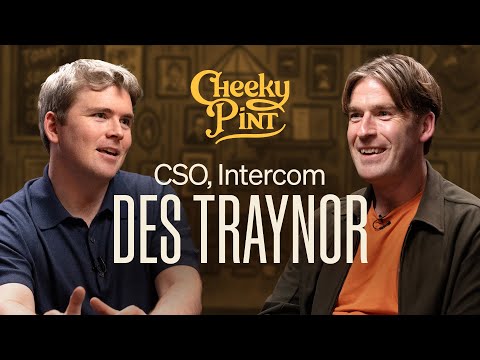
Published on YouTube by Stripe on September 24, 2025, this page features Intercom cofounder Des Traynor sitting down for a "Cheeky Pint" with John Collison. According to the page description, the discussion centers on the rapid growth of Intercom's AI customer service agent (Fin), the unique challenges of marketing and selling AI products, usage-based billing, and the underlying dynamics between company cofounders.
## TL;DR
In this wide-ranging conversation, Des Traynor outlines Intercom's strategic transformation into an AI-first customer service provider, driven by their automated agent, Fin, which now handles over one million resolutions per week at a 65% success rate. The discussion delves into the evolving mechanics of B2B sales, where traditional feature checklists have been replaced by rigorous infrastructure and metric-driven battles over resolution rates and true human overhead. Traynor shares candid product management philosophies, emphasizing deep user empathy over isolated data metrics, while detailing how Intercom overhauled its own complex pricing structures by returning $50 million in revenue to achieve simplicity. Finally, he highlights radical internal productivity shifts, such as mandating that designers ship code and leveraging AI tools like Claude Code to achieve non-linear engineering gains.
## Atmosphere & style
The conversation carries a relaxed, convivial, and distinctly Irish charm, feeling less like a structured corporate interview and more like a fluid, late-night pub discussion over fresh pints of Guinness. There is an authentic, grounded chemistry between the speakers, characterized by sharp wit, mutual respect, and lighthearted banter about cultural traditions like "splitting the G." As the dialogue shifts into business strategy, the tone becomes fiercely analytical and intensely candid; Traynor pairs high-conviction industry insights with self-deprecating humility, laughing off past operational mistakes while expressing genuine amazement at the unprecedented speed of the modern AI landscape.
## Key takeaways
- [03:01](https://www.youtube.com/watch?v=2SEgQiu8XaU&t=181s) Intercom underwent a double-reinvention, evolving from a live visitor-messaging tool with a core CDP into a broad sales, marketing, and support suite, before ultimately pivoting in 2022 to focus exclusively on customer service just prior to the generative AI boom.
- [05:53](https://www.youtube.com/watch?v=2SEgQiu8XaU&t=353s) Following the launch of ChatGPT, Intercom rapidly built and launched its AI agent, Fin, which has grown from a 25% resolution rate at launch to 65%, processing over 1 million conversations a week at a rate of $0.99 per resolution.
- [05:53](https://www.youtube.com/watch?v=2SEgQiu8XaU&t=353s) Fin's architecture is a complex pipeline composed of roughly 27 different components—including custom models, retrieval systems, and rerankers—rather than a basic, single-model wrapper around third-party APIs.
- [07:54](https://www.youtube.com/watch?v=2SEgQiu8XaU&t=474s) A common fallacy in evaluating AI support is comparing it to an idealized, flawless human agent while ignoring real-world human constraints like language barriers, slow response times, and limited availability.
- [12:28](https://www.youtube.com/watch?v=2SEgQiu8XaU&t=748s) Successful AI resolution requires deep user context and grounded inferences to resolve vague, real-world queries like 'this is broken,' making it a complex infrastructure task that defers the simplistic 'weekend build' assumptions of critics.
- [15:56](https://www.youtube.com/watch?v=2SEgQiu8XaU&t=956s) To bypass the friction of forcing companies to migrate their entire help desk platform, Intercom introduced 'Fin Standalone,' allowing their AI agent to run directly on top of competing systems like Zendesk, Salesforce, and HubSpot.
- [20:19](https://www.youtube.com/watch?v=2SEgQiu8XaU&t=1219s) The steady climb in Fin's resolution rate is primarily driven by a grind of 'a thousand lead bullets'—incremental optimizations in prompts, UI, and system architecture—rather than raw upgrades in underlying LLM intelligence.
- [25:13](https://www.youtube.com/watch?v=2SEgQiu8XaU&t=1513s) Selling AI software has shifted from visual feature checklists to infrastructure metric battles focused on resolution rates, response times, and CSAT, making it harder to sell and require deep technical conviction from sales teams.
- [28:55](https://www.youtube.com/watch?v=2SEgQiu8XaU&t=1735s) To counter rational buyer skepticism and intense marketing noise, Intercom uses an aggressive 'Million Dollar Guarantee' and explicitly teaches prospects how to evaluate and identify false claims made by competitors.
- [31:48](https://www.youtube.com/watch?v=2SEgQiu8XaU&t=1908s) Startups often fall into a copycat trap by imitating the visual branding, aesthetics, and advanced marketing messaging of mature companies like Stripe or Salesforce without understanding the underlying strategy or having the brand equity to support it.
- [35:14](https://www.youtube.com/watch?v=2SEgQiu8XaU&t=2114s) Great product managers must possess strong taste in software, a willingness to pick a definitive direction, and the humility to accept direct market feedback over hiding behind complex data dashboards.
- [40:00](https://www.youtube.com/watch?v=2SEgQiu8XaU&t=2400s) Focusing prematurely on features for new prospects while existing users are unhappy turns software into a 'marauding churn bomb,' as companies over-rotate on sales feedback from marginal users at the expense of core product health.
- [42:28](https://www.youtube.com/watch?v=2SEgQiu8XaU&t=2548s) Startups frequently get stuck around $10 million ARR because they stop expanding their core user base and instead attempt to force unwanted add-ons and expansion features down the throats of their existing customers.
- [45:17](https://www.youtube.com/watch?v=2SEgQiu8XaU&t=2717s) A primary reason startups fail to scale properly is a mismatch between fundraising and their actual TAM, whereas world-class companies achieve success by maintaining a harsh discipline to focus on going deep within one core market.
- [52:04](https://www.youtube.com/watch?v=2SEgQiu8XaU&t=3124s) To simplify a highly convoluted and confusing pricing legacy, Intercom voluntarily handed back approximately $50 million in revenue to standardize on a transparent seat-based model with a usage layer.
- [55:58](https://www.youtube.com/watch?v=2SEgQiu8XaU&t=3358s) Intercom aligns its incentives with customers by charging for Fin strictly per successful resolution, turning their AI pricing into an easily justifiable 'painkiller' that directly displaces expensive human labor costs.
- [01:03:44](https://www.youtube.com/watch?v=2SEgQiu8XaU&t=3824s) When assessing AI investments, the 'four horsemen' of success are usage-backed revenue, mission-critical business impact, deep and differentiated technology, and a clear path to positive unit margins by eliminating 'dead tokens.'
- [01:07:31](https://www.youtube.com/watch?v=2SEgQiu8XaU&t=4051s) Healthy co-founder dynamics are driven by productive personality tensions, such as a bold, visionary leader balancing out a grounded, project-oriented operator.
- [01:11:00](https://www.youtube.com/watch?v=2SEgQiu8XaU&t=4260s) The most predictive factor of startup failure is chasing the aesthetic status of being a founder, sending vague investor updates devoid of concrete metrics, and over-indexing on personal branding over product value.
- [01:16:10](https://www.youtube.com/watch?v=2SEgQiu8XaU&t=4570s) Through its '2X' productivity initiative, Intercom mandated that all designers write and ship code to handle UI tweaks and redesigns independently, removing minor visual distractions so engineers can stay focused on deep technical work.
## Detailed walkthrough
### [00:00](https://www.youtube.com/watch?v=2SEgQiu8XaU&t=0s) Guinness, TikTok, and the Irish Stout Landscape
The conversation kicks off with lighthearted banter about pouring pints and the cultural differences in drinking habits between Ireland and America. Des Traynor, co-founder of Intercom, notes that he has a Guinness keg at his house, prompting a discussion on the proper technique for pouring a pint. The host asks Traynor about "splitting the G"—a trend popular among YouTube commenters and TikTok users where a drinker tries to consume exactly enough Guinness in their first gulp to align the beer line with the middle of the "G" in the Guinness logo on the glass. Traynor dismisses this as a modern TikTok phenomenon and a tourist gimmick rather than a genuine Irish tradition. "It's not amongst anyone who you would respect," he jokes, calling it "a waste of good Guinness." He compares American drinking games to the more serious approach to alcohol back home: "Back home, drinking is a very serious activity. I wouldn't make a game out of it."
Turning to the broader stout landscape, Traynor shares his thoughts on competing brands like Beamish, Murphy's, and Kilkenny. While he occasionally enjoys these regional stouts when visiting their respective hometowns, his default is always Guinness. He recalls a brief, six-month period when Heineken attempted to launch a "Guinness killer" called Island's Edge. The product failed so spectacularly that "they were literally giving it away at the end and still couldn't get rid of it."
The speakers also marvel at the historical economic footprint of Guinness in Ireland. The host points out that Guinness once made up the majority of Ireland's stock market and that the nation's canal system was built specifically for its distribution. Traynor adds that this legacy still trickles into modern-day Dublin, noting that large chunks of the Phoenix Park near Castleknock were historically owned by the Guinness family before being donated to the Office of Public Works (OPW).
- **Island's Edge:** A failed stout launched by Heineken to compete with Guinness; it lasted only about six months.
- **Phoenix Park:** Large portions of this Dublin park carry historical ties to the Guinness family's land ownership.
[03:01](https://www.youtube.com/watch?v=2SEgQiu8XaU&t=181s) The Reinvention of Intercom
The host transitions the conversation to business strategy, drawing a parallel between Intercom and Netflix. Netflix famously reinvented itself twice: first from a DVD-by-mail service to a streaming platform for third-party content, and then into a first-party original content studio. The host posits that Intercom has undergone a similar double-reinvention, starting as a tool to talk to website visitors, evolving into a comprehensive customer service company, and now transforming into an AI-first customer service giant.
Traynor agrees with this theory and provides historical context. When Intercom launched in 2011, the tooling to run a SaaS business was virtually non-existent. Companies had to "abuse PayPal for payments" and rely on MailChimp to communicate with customers. Intercom's early product was a general-purpose tool that featured the first live Customer Data Platform (CDP), allowing businesses to see who was active in their product in real time and message them based on custom attributes. Over time, the team adopted the "Jobs-to-be-Done" methodology, analyzing how customers actually used the product. This led them to expand into three distinct areas: sales, marketing, and support.
By 2022, however, the company faced declining net new revenue. Co-founder Eoghan McCabe returned to the company and made the strategic decision to narrow their focus exclusively to customer service. Just ten weeks after this pivot, ChatGPT launched, completely shifting the company's trajectory.
- **Early SaaS Landscape:** In Intercom's early days, Stripe was also in its infancy, forcing businesses to stitch together rudimentary setups using PayPal and MailChimp.
- **The 2022 Pivot:** Following a period of declining net new revenue, Intercom abandoned its broad sales and marketing use cases to focus solely on customer service, just weeks before the generative AI boom.
[05:53](https://www.youtube.com/watch?v=2SEgQiu8XaU&t=353s) Going All-In on AI and the Success of "Fin"
When ChatGPT launched on a Thursday in late 2022, Intercom moved with extreme speed. Traynor had a call with Fergal, their Head of AI, on Friday; spent the weekend strategizing with Eoghan McCabe; and by Monday, the team was actively building the AI version of Intercom. In March 2023, on the same day GPT-4 was released, Intercom launched its AI chatbot, Fin.
Traynor addresses the natural skepticism surrounding companies that suddenly brand themselves as "AI companies." He explains that Intercom's transition is backed by deep technical integration and massive scale. Fin was designed to be "the first chatbot that worked," moving away from the frustrating, rigid bots of the past. At launch, Fin achieved a 25% resolution rate. Today, that number has climbed to 65%. Fin resolves over one million conversations per week and has handled approximately 40 million end-to-end customer service scenarios. Intercom charges $0.99 per successful resolution, making Fin a massive growth engine within a mature SaaS business that already generates hundreds of millions in revenue.
To support this AI-first vision, Intercom has built a dedicated AI lab of 50 people. They have moved beyond simply wrapping OpenAI's APIs; they now run their own models inside Fin, utilizing custom retrieval, custom rerankers, and custom summarization.
- **Fin Performance Metrics:**
- **Resolution Rate:** Started at 25% in March 2023; currently stands at 65%.
- **Volume:** Resolves over 1 million conversations per week; 40 million total end-to-end resolutions to date.
- **Pricing Model:** Intercom charges $0.99 per resolved conversation.
- **AI Lab:** A dedicated team of 50 engineers and researchers working on proprietary models, retrieval, and reranking.
[07:54](https://www.youtube.com/watch?v=2SEgQiu8XaU&t=474s) The Evolution of Chatbots and Human-to-AI Dynamics
The host points out that technology cycles often experience a phase where enthusiasm precedes capability. In 2017, there was a massive hype cycle around chatbots, but the technology was clunky, frustrating for users, and difficult for businesses to set up. Traynor agrees, noting that Intercom's previous AI product, Resolution Bot (originally named Answer Bot before a trademark dispute with Zendesk), was ahead of its time but limited by the underlying technology. However, having that early AI group and a pre-built Retrieval-Augmented Generation (RAG) engine is precisely what allowed Intercom to build Fin so much faster than its competitors when LLMs finally arrived.
The user experience has shifted dramatically. In the past, customers interacting with a bot would desperately type, "please connect me to a human." Today, the reverse is happening. Customers frequently ask human agents to put them back on with Fin because the bot was resolving their issue faster. Traynor attributes this to a broader consumer preference for digitized, low-friction interactions. He compares it to people preferring McDonald's self-service kiosks over ordering from a cashier because they don't want to think out loud, or preferring Waymo to avoid awkward small talk and tipping.
Furthermore, Traynor highlights a common fallacy when evaluating AI: comparing it to an idealized, flawless human that does not exist. While critics demand perfection from AI, they tolerate human customer service representatives who might be hungover, slow to respond, or limited to one language. "A human artisanal handcrafted answer... won't be there in seven seconds. It'll probably be 18 minutes," Traynor points out.
- **Induced Demand:** Because Fin answers questions quickly and without judgment, customers are asking more questions than they ever would have posed to a human agent, turning customer service from a mere cost center into an educational touchpoint.
- **The Human Fallacy:** People expect AI to be flawless while overlooking the natural limitations of human support staff, such as language barriers, slow response times, and limited working hours.
[12:28](https://www.youtube.com/watch?v=2SEgQiu8XaU&t=748s) The Power of Customer Context in AI Support
A major challenge in AI-driven customer support is finding the right level of "interruptive help" without becoming overly annoying or grating to the user. The key is delivering the exact next step a user needs when they appear stuck. For example, if a customer is on a renewal page and encounters an error message, the support system should immediately leverage that context. Rather than starting a conversation from scratch, the AI can pre-populate the query with the user's current state and error details to provide an immediate, highly relevant response.
This level of integration goes far beyond the simplistic view of customer support held by the "Hacker News crowd," who often claim they could "build that in a weekend." These critics assume every support interaction begins with a polite introduction and a user ID. In reality, most real-world support conversations start abruptly with a user saying, "This is broken." Without deep context, a basic reply engine is forced to ask, "What's broken?"—a friction point that causes users to quickly disengage. By knowing that the user is "John," that he is on the "premium plan," and that there is a "big red error box" on his screen, the AI can instantly deduce the problem and resolve it.
- **Fin's Resolution Rate:** Customers who install Intercom's AI agent, Fin, achieve a 65% resolution rate after 30 days.
- **The "Weekend Build" Fallacy:** Naive builders underestimate the depth of context required to resolve vague queries like "this is broken" without frustrating the customer.
---
[14:14](https://www.youtube.com/watch?v=2SEgQiu8XaU&t=854s) Going Deep: Abstraction, Escalation, and the "Armageddon" Dilemma
Achieving a high resolution rate requires solving complex edge cases through advanced reasoning and abstraction. A naive Retrieval-Augmented Generation (RAG) bot is highly literal; if a dentistry office asks if Stripe works for them, a basic bot looking at Stripe's documentation might say, "It doesn't say 'dentist' here, and we are told not to hallucinate, so no, we don't support dentists." A sophisticated system like Fin uses abstraction to recognize that a dentist is a type of business, dentists can run internet businesses, and Stripe is designed for internet businesses, allowing it to make "grounded inferences" safely.
Recreating true customer service requires walking through dozens of these components, from RAG and abstraction to detecting when a customer is threatening escalation. Simple password resets make up only about 0.4% of actual customer service scenarios. This dynamic mirrors a famous joke from the movie *Armageddon*, where Ben Affleck reportedly questioned why NASA spent months training oil drillers to become astronauts instead of simply teaching astronauts how to drill. In the AI era, a similar question arises: "Will AI people learn how to do CS, or will CS people learn how to do AI?"
- **Fin's Architecture:** Fin relies on roughly 27 different components working in tandem, including summarizers, rerankers, retrieval engines, and direct-answer formulators.
- **The Race to Capability:** The ultimate industry battle is whether AI-first companies (like OpenAI) will master customer service faster than legacy customer service companies (like Zendesk) master AI.
---
[15:56](https://www.youtube.com/watch?v=2SEgQiu8XaU&t=956s) The "Bike Shed" of AI and the Build vs. Buy Debate
In 2023, virtually every corporate board demanded a "special deep dive on AI," and almost every company pointed to customer service automation as their quick win. Because customer service seems intuitive, it has become the ultimate "bike shed"—the simple topic everyone has an opinion on, while the highly complex "nuclear power plant" of deep AI architecture goes ignored. This leads many companies to believe they can easily build their own support bots in-house, often insisting their specific industry (such as B2C retail) is too unique for a third-party tool to understand.
When encountering prospects determined to build their own systems, Intercom's strategy is to wish them "Godspeed" and hand them a "torture test" of 100 complex customer service questions to run against their prototype. Typically, internal teams hit a plateau after two weeks of rapid early progress, realize the immense difficulty of handling nuanced conversations and safety guardrails (such as preventing the bot from giving political opinions), and return to buy Fin.
- **Fin's Business Metrics:** Fin currently serves around 6,000 customers, processes 1 million resolutions per week, and charges $1 per resolution, representing an approximate $50 million revenue run rate.
- **Fin Standalone:** To bypass the "nightmare" of forcing companies to migrate their entire help desk platform, Intercom launched "Fin Standalone" (or Fin for Platforms), allowing the AI agent to run on top of Zendesk, HubSpot, Salesforce, and other competitors.
---
[20:19](https://www.youtube.com/watch?v=2SEgQiu8XaU&t=1219s) Inside Intercom's AI Stack and the "Thousand Lead Bullets"
Fin's underlying architecture is not a single model but a highly optimized pipeline of "27 different things." Each sub-task—whether it is reranking, retrieval, or formulating the final response—is paired with the "fastest, cheapest, lightest, most accurate LLM" that can reliably perform that specific job. Intercom's primary model partner is Anthropic, utilizing Claude Sonnet, but the system is designed to be plug-and-play.
When evaluating new models like a hypothetical GPT-5, Intercom does not blindly deploy them. They run upgrades through an arduous evaluation suite of over a thousand real-world customer service scenarios, comparing the new model's output against previous Fin answers and gold-standard human responses. This rigorous testing ensures that higher resolution rates do not come at the cost of "excess hallucinations." Interestingly, the steady climb in Fin's resolution rate from 25% at launch to 65% today is rarely due to raw LLM upgrades. Instead, the progress is a grind of "a thousand lead bullets"—tiny, incremental optimizations in prompts, user interface tweaks, and better architecture that yield 0.7% gains at a time.
- **The Intelligence Plateau:** Raw intelligence is no longer the limiting factor for customer service AI; modern models are already smart enough to pass complex exams, meaning the real breakthroughs lie in system architecture and UI design.
- **Custom Models:** Intercom is heavily investing its highly contested AI engineering resources into developing custom models to find the next competitive edge in resolution quality.
- **The Marketing Challenge:** Because AI chat interfaces look nearly identical across the industry, companies can no longer win on "sexy screenshots" alone. To stand out in a crowded market where everyone claims to have the "best AI agent," Intercom has had to innovate on its sales approach, leading to initiatives like the "Fin guarantee."
[25:13](https://www.youtube.com/watch?v=2SEgQiu8XaU&t=1513s) The Shift in Selling: From Feature Checkboxes to Infrastructure Battles
To stand out in a crowded AI market, Intercom has leaned heavily into backing up its claims, even offering a "Million Dollar Guarantee" if a competitor can outperform them. This aggressive posture is a response to how much B2B sales have changed. In the "olden days" of SaaS—which refers to the pre-2022 era—selling was relatively straightforward. A sales team could win a deal by showing off a beautiful UI compared to a competitor's ugly one, or by presenting a feature checklist: "We've got 24 checks, they've got 17, these seven matter, we're in."
Today, selling AI is much closer to selling infrastructure, resembling classic hardware battles like Intel versus AMD. It has become a "battle of metrics" centered on resolution rates, response times, and CSAT (Customer Satisfaction). Because customers cannot easily trial a product like Intercom's AI agent, Fin, without configuring APIs and turning multiple technical keys, sales teams must possess a deep, familiar understanding of AI to build genuine conviction rather than just asking buyers to "trust us."
Stripe experiences a very similar sales challenge. When businesses switch to Stripe from legacy processors, they almost always see a significant, immediate revenue uplift. This uplift comes from two main areas:
* **Checkout Conversion:** Optimizing the checkout form to prevent abandonment (e.g., offering preferred payment methods or using Link to save payment details).
* **Spurious Declines:** Preventing valid transactions from being incorrectly flagged as fraudulent by banks.
Despite having undeniable data and high-profile success stories—such as Hertz migrating all of its e-commerce payments to Stripe—this revenue uplift is surprisingly difficult to sell. Because every company claims they will increase a buyer's revenue, the message becomes undifferentiated and hard to believe. Even Intercom's leadership initially found the impact of Stripe's Link feature "implausible" until they saw the data.
[28:55](https://www.youtube.com/watch?v=2SEgQiu8XaU&t=1735s) The Procurement Defense and the "Million Dollar Guarantee"
The skepticism from buyers is entirely rational. Procurement officers are subjected to "relentless, absolute nonsense" and marketing "bullshit" all day long. As a result, their default posture is to divide any vendor's claim by ten. If a vendor promises to save them $2 million in customer support salaries, the procurement officer assumes they might see $200,000 in three years. They have developed a strong, adverse reaction to traditional marketing.
To cut through this noise, product marketing must adapt. Intercom's Million Dollar Guarantee has been highly effective at landing the message that they stand behind their product. Additionally, pointing to real customers with real names and job titles—such as "Natalie at Nuuly"—among their 6,000 customers makes the claims believable.
When buying AI, customers are essentially purchasing a replacement for human labor. They care about two things:
1. "How much work are you going to do for me?"
2. "How well are you going to do that work?"
To market this effectively, Intercom actually teaches prospects how to be conscientious buyers. They give prospects specific questions to ask competitors to help them identify when they are being lied to. This approach favors Intercom because a highly informed buyer is always preferable to one who is easily swayed by competitors "jazz-handsing their way to an AI product." The old marketing tricks of five years ago, like putting engaging GIFs and videos on a homepage, no longer work. Selling AI is like selling an iceberg: there is a small, beautiful UI at the tip, but beneath the surface lies a gargantuan pile of automated work that eliminates human toil.
[31:48](https://www.youtube.com/watch?v=2SEgQiu8XaU&t=1908s) Product Marketing Pet Peeves and the Copycat Trap
Over a fresh pint of Guinness, the conversation turns to product marketing pet peeves. The biggest offender is "marketers that love marketing"—those who write vague, high-concept copy like "forget everything you know about email" or "transformation reinvented" instead of explaining what the product actually does. To combat this, a typewriter screensaver on a laptop serves as a constant reminder of the question: "What are you actually trying to say?" Nine times out of ten, the best marketing is simply writing the core message directly, rather than burying it in a 2,000-word Google Document.
This disconnect is illustrated by a famous statistic from David Ogilvy: two-thirds of the winners of the Cannes Ads Awards would lose their client contracts in the same year because the award-winning creative was completely ineffective in the market.
Another common mistake is copycat branding. Startups often look at successful companies like Stripe or Linear and copy their aesthetic, typefaces, and screenshots without understanding the underlying strategy. Every design choice—whether conventional or futuristic—sends a specific message. When startups copy-paste branding, they signal that they do not truly understand what they are doing. This results in a sea of identical startup landing pages featuring a screenshot on the right, three bullet points on the left, and a sign-up button.
Furthermore, startups should avoid copying the marketing strategies of established companies:
* **Stripe** spent years keeping raw code on its homepage to establish credibility with developers. Now that they are established, they have earned the right to market broader platforms.
* **Salesforce** does not need to scream "CRM" on its homepage anymore; after 20 years, they can focus their messaging on newer initiatives like Einstein.
* **Startups** often make the mistake of abandoning their core pitch to promote a minor new feature. They forget that "99.4%" of the world has still never heard of their original product, and introducing nuanced features too early only dilutes their primary message.
[35:14](https://www.youtube.com/watch?v=2SEgQiu8XaU&t=2114s) What Makes a Great Product Manager
At Intercom, the product managers who succeed must possess "decent taste"—not in a lofty, abstract way, but in their ability to recognize and appreciate great software. A favorite interview question to test this is simply asking candidates what their favorite app is on their phone. If a product manager has never thought about what makes an app good, it is a major red flag, equivalent to a musician not having a favorite song.
Great product managers also need the confidence to pick a direction, balanced with humility. At Intercom, "shipping is an act of confidence and humility." PMs must be confident enough to put their work live, and humble enough to take a "slap in the face" from the market when they get it wrong, rather than blaming the customers.
Borrowing Marc Andreessen's philosophy, a product is a continuous conversation with the market. The launch is just the opening line, and the team must adapt to the feedback. The PMs who fail at Intercom tend to be overly "spreadsheety"—they try to hedge every bet with data and refuse to take a stand or make a gamble.
Finally, great PMs must practice deep listening. At Stripe, the first operating principle is "users first," which means paying close attention to both conversations and revealed preferences in user data. To keep this connection strong, Stripe starts every single week with a Monday morning meeting where they host a customer who gives the company a candid, often humbling "report card."
[37:50](https://www.youtube.com/watch?v=2SEgQiu8XaU&t=2270s) The Epidemic of Hiding Behind Data
Des and John discuss a persistent problem in Silicon Valley and the broader tech industry: the tendency to overcomplicate products and under-talk to actual users. Des recalls a "deep cut" from around 2009 or 2010 on an interaction design forum. A user experience designer had posted a long, convoluted explanation of a feature they had shipped, wondering why users weren't interacting with it despite it being "obvious on the screen." Jared Spool, a famous UX pioneer, replied with a simple, revolutionary question: "Have you tried asking them?"
This philosophy remains central to how Des runs product reviews today. He shares that the very first question he asks in every single product review is: "What did our users say about this when you showed it to them?" Des argues that there is a broken culture of "hiding behind your data," where product managers rely on complex Mixpanel dashboards to prove a product *should* be working, while completely ignoring the reality that it isn't.
- **The Jared Spool Lesson:** A simple "Have you tried asking them?" remains the most effective product development advice.
- **The Product Review Rule:** Des's mandatory first question for any new feature or product review is: "What did our users say about this when you showed it to them?"
- **The Data Trap:** Tech companies frequently use instrumentation and dashboards to validate failing products instead of talking to human beings.
---
[40:00](https://www.youtube.com/watch?v=2SEgQiu8XaU&t=2400s) Users vs. Customers: The "Marauding Churn Bomb"
John notes that Stripe’s very first company value is "users first." Des asks if the choice of the word "users" over "customers" or "prospects" was deliberate. John confirms it was highly intentional: they wanted to focus on the people actually using the product day-to-day—such as the developers or fraud managers—rather than the corporate buyers. Des agrees, noting that talking to users helps perfect a product, while talking to prospective buyers helps expand the market.
However, a major trap for startups is prematurely focusing on prospects while they still have a large base of unhappy users. This leads to a "miles wide, inches deep" product that satisfies no one. Startups will build one custom feature for "Johnny" to get him to sign, and another for "Jenny," resulting in a product that has zero happy customers and is instead a "marauding churn bomb." John adds that companies routinely over-rotate on sales feedback from "marginal users" who are a poor fit or only use a fraction of the product, rather than fixing core issues for the loyal users who "grew up" on the product.
- **Stripe's First Value:** "Users first" specifically targets the hands-on practitioners of the software rather than the executive buyers.
- **The "Marauding Churn Bomb":** The result of building disjointed, custom features for prospective buyers while ignoring the complaints of existing users.
- **Sales Feedback Bias:** Sales teams naturally get more internal airtime than account management, leading companies to misprioritize shiny new enterprise features over basic product health.
---
[42:28](https://www.youtube.com/watch?v=2SEgQiu8XaU&t=2548s) Permission to Innovate and the $10M Glue
Des introduces the concepts of "permission to innovate" and "permission to expand." At Intercom, they believe a company only earns the permission to innovate (e.g., building a V3) when the existing product (V2) is in excellent condition. They earn the permission to expand into new categories only when users are highly satisfied with the core product. Too many startups try to solve revenue stagnation by "foie gras style force-feeding" unwanted new features down the throats of their trapped users, convincing themselves they have product-market fit when they are actually just making their product incredibly messy.
This dynamic often manifests around the $10 million ARR mark. While industry figures like Jason Lemkin famously suggested that going from $10 million to $100 million ARR is "inevitable," Des argues this is no longer true. Many startups get stuck in "some sort of glue" at $10 million because they do not know how to acquire the next 10,000 logos. Instead of doing the hard work to scale, they try to milk their existing customer base by forcing adoption of unrequested add-ons, like saying, "Here's your Copilot, I know you didn't want it, but here you go."
- **Permission to Innovate:** The internal discipline of ensuring V2 is highly polished before starting on V3.
- **Permission to Expand:** Earning the right to capture more share of wallet only after the core product is universally loved.
- **The $10M ARR "Glue":** A common sticking point where startups stop growing their customer base and resort to forced upsells on existing accounts.
---
[45:17](https://www.youtube.com/watch?v=2SEgQiu8XaU&t=2717s) The Discipline of Being World-Class
When asked about the path forward for a prototypical $10 million B2B company, Des points to a fundamental mistake: "not aligning your fundraising with your TAM" (Total Addressable Market). During the cloud era, founders were convinced that every business had a right to be a unicorn. Des argues there should be far more small, profitable, $30 million revenue companies, but founders ruin them by raising $20 million on the promise of easily reaching a billion-dollar valuation.
The second major mistake is a lack of focus. Des recalls visiting Stripe's office in 2012, when it wasn't yet obvious that Stripe wouldn't expand into peer-to-peer transfers to compete with PayPal. He praises Stripe's "harsh discipline" to say no to surrounding opportunities and focus strictly on helping businesses charge. Truly great companies—like Linear with its highly efficient project management UI, or Figma with its creative collaboration engine—pick one thing and go incredibly deep. They do not prematurely chase a "second act" that is completely unrelated to their core business.
- **TAM and Fundraising Mismatch:** Startups with niche markets (e.g., "time tracking for dentists in Delaware") destroy their business models by raising venture capital on unicorn expectations.
- **The Power of Focus:** Great SaaS and AI companies succeed by being genuinely world-class at one core thing rather than making 80/20 trade-offs across multiple mediocre features.
- **The "Second Act" Obsession:** Silicon Valley is overly obsessed with finding unrelated second acts (often citing AWS as a cliché), whereas companies like NVIDIA succeeded simply because their core market (GPUs) turned out to be massive.
### [51:05](https://www.youtube.com/watch?v=2SEgQiu8XaU&t=3065s) Brand vs. Logo and the Equinox Hotel
Des Traynor recalls a classic, humorous point made by Seth Godin regarding the power of a "weaponized" brand. Godin compared Nike and Hyatt: if Nike were to open a hotel, you could close your eyes and instantly visualize the corridors, the aesthetic, and the overall vibe. However, if Hyatt were to launch a sneaker, you would have no idea what to expect. This illustrates the fundamental difference between a company that merely has a logo (Hyatt) and one that has a true brand (Nike).
As a real-world parallel, Traynor points to the Equinox hotel launch. It succeeded because its design center was incredibly focused on a single, highly differentiated product promise: "you just want to be able to get a good night's sleep." In a hotel industry cluttered with unnecessary distractions, offering a room free of outside noise and weird light leaks is a powerful, clear value proposition.
---
### [52:04](https://www.youtube.com/watch?v=2SEgQiu8XaU&t=3124s) Unwinding Intercom's Pricing Complexity
The conversation shifts to Intercom's pricing model, with the host noting that Intercom has historically been the "poster child" for transitioning from traditional per-seat SaaS pricing to usage-based pricing. Traynor admits that Intercom's pricing journey has been "long and complex" and was once a highly charged topic. In the past, when Intercom pursued a highly diverse product strategy—simultaneously building sales, marketing, and support software—they ended up with an incredibly convoluted pricing structure. Sales was charged by leads, marketing by contracted people, and support by seats. They falsely reassured themselves that human sales reps would always be there to help customers navigate the complexity, but self-serve users were left staring at the pricing page for seven minutes, completely baffled.
When co-founder Eoghan McCabe returned to the company, he made the hard decision to clean up the pricing. To achieve a fair, transparent, and predictable model, Intercom literally "handed back" about $50 million in revenue. While this was a massive sum, the board and investors supported the move. Traynor notes that people heavily underestimate the value of a happy customer base simply because word-of-mouth referrals do not carry a clean UTM tracking code or attribution link.
- **The $50M Decision:** Intercom voluntarily gave back roughly $50 million in revenue to standardize and simplify their pricing.
- **The Pricing Page Creator Idea:** Years prior, Traynor suggested to Stripe's founders that they build a pricing page creator to keep customers from inventing unsupported, overly complex pricing logic. Stripe has since built this feature.
- **The Danger of "Degrees of Freedom":** Traynor warns software companies against allowing too many custom pricing structures, as it leads to a "quagmire of complexity" that costs tens of millions of dollars and years of engineering to unwind.
---
### [54:56](https://www.youtube.com/watch?v=2SEgQiu8XaU&t=3296s) The Failure Mode of Creative Contracts
The host agrees that companies frequently fall into a dangerous failure mode where they sign highly creative, customized deals negotiated in Microsoft Word. These deals often contain ambiguous clauses—such as adjusting a prior year's billing based on subsequent year events—that are practically impossible to write into clean, automated code. "I call Ricky and he decides what the discount is," the host jokes, describing the manual "time travel" components of these contracts.
Unless a company is content with a massive, manual deal desk using calculators every month, having an opinionated, automated billing engine is crucial. For Intercom, migrating away from Zuora was a major part of this cleanup. Their CTO, Ciaran Lee, returned to the company with the singular mission to "fix billing." It required a monumental effort to deconstruct all the bespoke, "à la carte" legacy deals and transition to a clean, seat-based model with a usage-based layer on top.
---
### [55:58](https://www.youtube.com/watch?v=2SEgQiu8XaU&t=3358s) Charging for AI: The "Fin" Resolution Model
When Intercom launched its AI agent, Fin, they faced a major pricing dilemma. Because Fin was designed to automate customer support, it was highly cannibalistic to Intercom's core seat-based revenue model. If Fin automated 25% of support conversations (a figure that has since risen to 65%), customers would naturally need fewer human seats. To align their incentives with customers and make an aggressive statement in the market, Intercom decided to charge strictly "per literal resolution"—meaning they only get paid when the AI actually does the work.
At the time, this was a massive bet because AI margins were still highly uncertain and potentially negative. However, the market responded incredibly well. The simple promise of "we only get paid when we do work" acted as a powerful product guarantee. While competitors struggled to respond because their products didn't work as well or they were hooked on expensive human resolutions, Intercom became the "cat amongst the pigeons."
- **The 99-Cent Debate:** Some customers still complain that 99 cents per resolution is expensive, which Traynor attributes to an inability to calculate their true human COGS (including office space and overhead).
- **Handling Variability:** To give customers budget predictability, Intercom allows them to contract a base rate and negotiate overages for seasonal spikes (like Christmas or tax season) based on historical data.
---
### [59:42](https://www.youtube.com/watch?v=2SEgQiu8XaU&t=3582s) The Future of AI Pricing: Vitamins vs. Painkillers
The host asks if usage-based pricing is a permanent fixture of the AI era, given that AI inputs scale directly with token usage, or if unlimited plans will return as AI becomes cheaper. Traynor believes some form of usage-based pricing is permanent because, unlike traditional SaaS, running AI means "sending money out the back door" to model providers.
Traynor categorizes AI pricing into "vitamins" versus "painkillers." Painkillers displace expensive human labor, making the business case incredibly easy to articulate: "if we don't do it, a human's going to do it and we know exactly what they cost." In contrast, vitamins—like an AI tool that dynamically summarizes a GitHub issue or generates random newsletter graphics—have no clear human cost equivalent. When AI is not tied to direct business outcomes, companies struggle to price it and often resort to just slapping a flat "$10 AI seat" add-on to their plans, which Traynor warns permits companies to build weak, low-value AI features.
---
### [01:02:57](https://www.youtube.com/watch?v=2SEgQiu8XaU&t=3777s) The Unprecedented Speed of AI Revenue Growth
The host expresses amazement at how quickly modern AI companies are scaling their revenue compared to the SaaS companies of yesteryear. He points to Mati Staniszewski of ElevenLabs, who recently tweeted that the company passed $200 million in ARR just two to three years after founding. "In my day, businesses didn't do that," the host remarks.
Traynor agrees, sharing that Intercom's AI agent, Fin, is on track to hit $100 million in ARR early next year, just about two years after its launch. This rapid ascent represents a massive paradigm shift in how quickly software products can scale today.
### [01:03:44](https://www.youtube.com/watch?v=2SEgQiu8XaU&t=3824s) The Four Horsemen of AI Investing
The threshold for a startup to go public has shifted dramatically over the years. Back when Intercom started, reaching $1 million in Annual Recurring Revenue (ARR) was a massive milestone that used to take about seven years and a significant amount of capital. Today, the acceleration is much faster, as exemplified by companies like ElevenLabs.
When evaluating AI startups, there are "four horsemen" or key pillars to look for, though it is incredibly rare to find a company that possesses all four:
1. **Revenue backed by usage:** Usage-based revenue is highly preferable to "shelfware" or "pilotware" where a product is sold to a couple of people in a corner with a vague promise of going live someday.
2. **Usage tied to real business impact:** The product must be mission-critical. For instance, if a company builds a phone product on top of ElevenLabs and it fails, that is a catastrophic problem for their business.
3. **Deep, differentiated AI:** The technology cannot simply be a thin wrapper around someone else's API.
4. **Positive unit margins:** There must be positive unit margins, or at least a highly clear, realistic path to achieving them.
While this framework is excellent for staying out of trouble, it is highly restrictive. Most AI companies that boast about going from zero to $6 million overnight are doing so on superficial use cases—like "generate JPEGs of a smurf"—which are highly unlikely to renew.
### [01:05:47](https://www.youtube.com/watch?v=2SEgQiu8XaU&t=3947s) The Debate Over Unit Margins and "Dead Tokens"
The requirement for positive unit margins often draws pushback. When Intercom first launched its AI chatbot, Fin, the product was initially losing money and operating "underwater." However, it quickly right-sized as the team optimized the implementation. Focusing too rigidly on current unit margins can cause an investor to miss out on a company that is simply in the early stages of optimization.
This tension is a frequent topic of internal debate with CFOs, who are naturally sensitive to high, preemptive server and token costs. The counter-argument to a worried CFO is that the path to profitability should not rely solely on hoping OpenAI lowers its prices. Instead, it requires engineering optimization. For example, Fin's profitability increases when the team reduces "dead tokens"—tokens spent generating an incorrect answer that cannot be billed to the customer.
- **The "Dead Token" Problem:** If an AI tool (like a code auto-complete assistant) is wrong five out of six times, five-sixths of the operating cost is wasted on unbillable generation. Unless a company's telemetry shows they have a plan to solve this, they will struggle to ever recoup their costs.
- **The "AI Bubble" Counter-Argument:** Skeptics call AI a bubble, but customers are genuinely happy with the tokens they are buying because they deliver real value, whether through automated customer service or creative outlets like Midjourney.
### [01:07:31](https://www.youtube.com/watch?v=2SEgQiu8XaU&t=4051s) Co-founder Dynamics and Personality Tensions
Co-founder relationships are rarely just about a clean division of labor (e.g., "the tech guy" versus "the business guy"). Instead, they are often defined by productive personality tensions. A healthy company strategy usually emerges at the intersection of these opposing forces—such as one founder being visionary and expansionary, while the other is more frugal, grounded, and focused on finishing existing projects. Having a co-founder also keeps you from "going mad by yourself" when trying to solve incredibly knotty problems.
At Intercom, CEO Eoghan McCabe brings a decisive, brave, and resilient leadership style. When he returned to the company, he focused heavily on rebuilding a culture of resilience and open-mindedness. This cultural foundation was vital for navigating the "manic pivots," zero certainty, and high-conviction bets required when the AI wave hit.
To ensure the company didn't settle for superficial AI features like "sparkly buttons" or basic assistants, Eoghan made the brave decision to create "Team Fin." He isolated this new team on a different floor with their own secluded Slack channel to build a brand-new startup from scratch within Intercom. While this move risked offending other employees, it provided the radical clarity and focus needed to build a truly AI-first product. Sometimes, "you just have to go too far to know you've gone far enough."
### [01:11:00](https://www.youtube.com/watch?v=2SEgQiu8XaU&t=4260s) What Predicts Success vs. Failure in Startups
The single most predictive factor of startup success is simple: "Do you have a real product that solves a real problem that really exists and people are really already trying to solve by paying money or time somewhere?" While this sounds trivial, many pitches rely on "jazz hands" routines to distract from a lack of substance.
Conversely, certain behaviors are highly predictive of failure:
- **Chasing the "trinkets" of founder status:** The rise of *The Social Network*, TikTok, and Soho House culture has made being a founder "cool." Many smart people now start companies because they want to be perceived as playing the game rather than actually playing it.
- **Vague investor updates:** Investor updates that tell a fancy story but contain absolutely no metrics are highly predictive of failure. Proactively choosing to omit business metrics suggests a deep denial about what running a business actually means.
- **Over-indexing on personal brand:** Founders who invest heavily in their personal brand over their company's brand, or whose investor updates consist of begging for retweets, usually have not figured out how to actually market their product.
Ultimately, building a successful company relies on a boring, unglamorous playbook: writing code, talking to customers, running an iterative loop, and avoiding distractions. Great founders are married to the problem and the solution, meaning they won't get their heads turned by passing trends like crypto or NFTs. Most businesses simply need time, execution, and a willingness to do the boring work.
[01:16:10](https://www.youtube.com/watch?v=2SEgQiu8XaU&t=4570s) The "2X" Initiative and Designers Who Code
To radically accelerate how they build products, the company launched an ambitious internal initiative called "2X" about four months prior, spearheaded by Darragh. The explicit goal of this initiative is to double the productivity of the R&D department before February 1st. While some might try to "poke holes" in how productivity is tracked, the core metric they rely on is highly concrete and difficult to game: the number of deployments to production involving code that must execute regularly. As the speaker jokingly notes, trying to fake this metric is a serious offense: "If you fake it, it's like we should probably fire you."
This massive productivity boost is not just about forcing engineers to work harder; it has required structural changes across different roles. One of the most impactful shifts came from Emmet, the head of design, who decreed that every designer needed to be shipping code by August 1st. This mandate effectively ended the long-standing industry debate over whether designers should code. By empowering designers to write and ship their own code, the company eliminated a massive source of engineering distraction.
- **Eliminating UI "Paper Cuts":** Previously, minor UI issues—like fixing a button, adjusting padding, changing a border radius, or tweaking a color—resulted in GitHub issues that had to be filed, triaged, and eventually picked up by engineers during their breaks. Now, designers handle these minor visual tweaks directly.
- **Handling Meatier Design Tasks:** Designers are no longer just fixing small details; they are managing entire UI redesigns, flow overhauls, and wizard setups on their own.
- **Keeping Engineers in the Zone:** With minor UI distractions gone, engineers can remain focused on deep work, leveraging AI-assisted development tools like Claude Code, Codex, and Augment to dramatically increase their output.
[01:17:43](https://www.youtube.com/watch?v=2SEgQiu8XaU&t=4663s) AI-Native Engineering and Go-To-Market Workflows
The shift toward an AI-native development process has yielded massive, non-linear productivity gains. A prime example occurred during the development of their "Fin" integration. Instead of manually building integrations for every single messaging platform, the engineering team focused on building one perfect, highly documented Slack solution. They documented all of their core principles and then used Claude Code to write the integrations for Microsoft Teams, Discord, WhatsApp, and every other target platform. While the Slack integration went live to production first, the AI-generated integrations for the other platforms quickly entered public beta.
While many AI integrations result in modest "1.2x wins," these automated workflows occasionally unlock staggering "50x productivity boosts." On the go-to-market side of the business, adoption has been slightly slower but is steadily progressing. The team has trained a custom GPT on all of their marketing copy principles, content guidelines, and visual assets, which they now use to efficiently generate assets like event invitations. The conversation wraps up with warm mutual thanks and a friendly sign-off.
## Notable quotes
> [00:00](https://www.youtube.com/watch?v=2SEgQiu8XaU&t=0s) Back home, drinking is a very serious activity. I wouldn't make a game out of it. — Des Traynor
> [00:00](https://www.youtube.com/watch?v=2SEgQiu8XaU&t=0s) they were literally giving it away at the end and still couldn't get rid of it. — Des Traynor
> [07:54](https://www.youtube.com/watch?v=2SEgQiu8XaU&t=474s) A human artisanal handcrafted answer... won't be there in seven seconds. It'll probably be 18 minutes — Des Traynor
> [14:14](https://www.youtube.com/watch?v=2SEgQiu8XaU&t=854s) Will AI people learn how to do CS, or will CS people learn how to do AI? — Des Traynor
> [25:13](https://www.youtube.com/watch?v=2SEgQiu8XaU&t=1513s) We've got 24 checks, they've got 17, these seven matter, we're in. — Des Traynor
> [31:48](https://www.youtube.com/watch?v=2SEgQiu8XaU&t=1908s) What are you actually trying to say?
> [31:48](https://www.youtube.com/watch?v=2SEgQiu8XaU&t=1908s) 99.4% of the world has still never heard of your product — Des Traynor
> [35:14](https://www.youtube.com/watch?v=2SEgQiu8XaU&t=2114s) shipping is an act of confidence and humility. — Des Traynor
> [37:50](https://www.youtube.com/watch?v=2SEgQiu8XaU&t=2270s) Have you tried asking them? — Jared Spool
> [37:50](https://www.youtube.com/watch?v=2SEgQiu8XaU&t=2270s) What did our users say about this when you showed it to them? — Des Traynor
> [40:00](https://www.youtube.com/watch?v=2SEgQiu8XaU&t=2400s) marauding churn bomb — Des Traynor
> [45:17](https://www.youtube.com/watch?v=2SEgQiu8XaU&t=2717s) not aligning your fundraising with your TAM — Des Traynor
> [51:05](https://www.youtube.com/watch?v=2SEgQiu8XaU&t=3065s) you just want to be able to get a good night's sleep.
> [54:56](https://www.youtube.com/watch?v=2SEgQiu8XaU&t=3296s) I call Ricky and he decides what the discount is — John Collison
> [55:58](https://www.youtube.com/watch?v=2SEgQiu8XaU&t=3358s) we only get paid when we do work — Des Traynor
> [59:42](https://www.youtube.com/watch?v=2SEgQiu8XaU&t=3582s) In my day, businesses didn't do that, — John Collison
> [01:11:00](https://www.youtube.com/watch?v=2SEgQiu8XaU&t=4260s) Do you have a real product that solves a real problem that really exists and people are really already trying to solve by paying money or time somewhere? — Des Traynor
> [01:16:10](https://www.youtube.com/watch?v=2SEgQiu8XaU&t=4570s) If you fake it, it's like we should probably fire you. — Des Traynor
## Mentioned
Des Traynor, John Collison, Intercom, Stripe, Fin, Guinness, TikTok, YouTube, Beamish, Murphy's, Kilkenny, Heineken, Island's Edge, Phoenix Park, Castleknock, Office of Public Works, Netflix, PayPal, MailChimp, Eoghan McCabe, ChatGPT, Fergal, GPT-4, OpenAI, Resolution Bot, Answer Bot, Zendesk, McDonald's, Waymo, Hacker News, Ben Affleck, NASA, Armageddon, HubSpot, Salesforce, Anthropic, Claude Sonnet, GPT-5, Hertz, Link, Natalie, Nuuly, David Ogilvy, Cannes Ads Awards, Linear, Marc Andreessen, Mixpanel, Jared Spool, Jason Lemkin, Figma, AWS, NVIDIA, Seth Godin, Nike, Hyatt, Equinox hotel, Zuora, Ciaran Lee, Mati Staniszewski, ElevenLabs, Midjourney, The Social Network, Soho House, Darragh, Emmet, GitHub, Claude Code, Codex, Augment, Slack, Microsoft Teams, Discord, WhatsApp, Custom GPT
Intercom co-founder Des Traynor argues that winning in the generative AI era requires software companies to abandon superficial feature additions in favor of deeply integrated, labor-replacing infrastructure backed by usage-based pricing and disciplined product execution.
Pivoting Intercom to AI-First Customer Service (3:01)
Facing declining net new revenue in 2022, Intercom narrowed its focus from a broad sales, marketing, and support suite exclusively to customer service shortly before ChatGPT debuted. Recognizing the shift, Intercom established a dedicated 50-person AI lab to build Fin, an AI customer service agent launched alongside GPT-4 in March 2023. Unlike basic wrappers, Fin relies on a pipeline of approximately 27 specialized components—including proprietary models, custom retrieval, rerankers, and summarization engines—to resolve edge cases through abstraction and deep customer context.
Fin's Performance and Cannibalistic Pricing Model (5:53)
Fin's resolution rate climbed from 25% at launch to 65% across roughly 6,000 customers, handling over one million weekly conversations and totaling 40 million end-to-end resolutions. Traynor notes this progress stems not from raw model upgrades, but from incremental system and interface optimizations. To align incentives and disrupt legacy competitors, Intercom prices Fin at $0.99 per successful resolution. While cannibalistic to the company's traditional per-seat revenue model, Traynor notes Fin achieved an approximate $50 million revenue run rate and is on track to reach $100 million in ARR roughly two years post-launch.
Selling Labor Replacement Over SaaS Features (25:13)
Traynor explains that marketing AI has shifted from visual UI showcases to infrastructure metrics focused on resolution rates, response speed, and customer satisfaction. Because procurement teams discount vendor claims, Intercom offers a 'Million Dollar Guarantee' against competing tools and provides prospects with evaluation suites to reveal the fragility of internal builds and basic bot wrappers. In Traynor's view, AI products must act as 'painkillers' that displace measurable human labor rather than unmeasurable 'vitamins' sold via flat per-seat add-ons, making usage-based monetization permanent.
Product Discipline and User-Led Iteration (37:50)
Traynor critiques startups that stall around $10 million in ARR by force-feeding unrequested add-ons to existing customers instead of expanding their user base. He advocates for 'permission to innovate,' where teams must ensure core software is loved before building adjacent features. Drawing parallels to Stripe's strict user-first philosophy, Traynor warns product managers against hiding behind analytical dashboards without directly interviewing end users, stressing that real-world feedback must guide software iteration over speculative investor trends.
Internal AI Workflows and the 2X Initiative (76:10)
To increase development velocity, Intercom introduced the '2X' initiative to double R&D deployment frequency. As part of this push, design leads mandated that designers write and ship their own production code, removing minor UI paper cuts from engineering backlogs. Engineers rely on AI-assisted coding tools like Claude Code to automate repetitive work; for example, the team authored a reference Slack integration and used AI agents to automatically generate subsequent integrations for Microsoft Teams, Discord, and WhatsApp.
Traynor's investment framework prioritizes startups demonstrating deep AI differentiation, usage-backed revenue tied to critical business impact, and viable unit margins. However, managing model costs and eliminating 'dead tokens'—processing spent on failed or inaccurate answers—remains an ongoing engineering and margin challenge.
[0:00] Des Traynor: Back home, drinking is a very serious activity. I wouldn't make a game out of it.
[0:00] Des Traynor: they were literally giving it away at the end and still couldn't get rid of it.
[7:54] Des Traynor: A human artisanal handcrafted answer... won't be there in seven seconds. It'll probably be 18 minutes
[14:14] Des Traynor: Will AI people learn how to do CS, or will CS people learn how to do AI?
[25:13] Des Traynor: We've got 24 checks, they've got 17, these seven matter, we're in.
[31:48] What are you actually trying to say?
[31:48] Des Traynor: 99.4% of the world has still never heard of your product
[35:14] Des Traynor: shipping is an act of confidence and humility.
[37:50] Jared Spool: Have you tried asking them?
[37:50] Des Traynor: What did our users say about this when you showed it to them?
[40:00] Des Traynor: marauding churn bomb
[45:17] Des Traynor: not aligning your fundraising with your TAM
[51:05] you just want to be able to get a good night's sleep.
[54:56] John Collison: I call Ricky and he decides what the discount is
[55:58] Des Traynor: we only get paid when we do work
[59:42] John Collison: In my day, businesses didn't do that,
[71:00] Des Traynor: Do you have a real product that solves a real problem that really exists and people are really already trying to solve by paying money or time somewhere?
[76:10] Des Traynor: If you fake it, it's like we should probably fire you.
Original transcript
[0:00] Did you ever work in a bar?
[0:01] I've never worked in a bar.
[0:02] I have a Guinness keg at my house.
[0:03] Actually. Do you want another pint?
[0:04] Yeah, sure, sure.
[0:05] I was talking to a guy
who runs procurement
[0:06] and he was saying like,
[0:07] you have to understand I'm just
getting bullshit to all day.
[0:10] You know, it's just all day relentless,
[0:12] absolute nonsense in my face.
[0:14] People do not have enough empathy
[0:15] for the procurement person
who just has to endure,
[0:17] nonstop, nonsense.
Absolute garbage.
[0:21] ChatGPT launched, I think on a Thursday.
[0:23] I had a call with, Fergal,
our head of AI on a Friday.
[0:25] Eoghan made the decision, like,
[0:26] on the Sunday I think it was,
[0:28] and we started working
on like the AI version
[0:30] of Intercom on the Monday.
[0:31] It was a lot easier
[0:32] to invest when being a founder was uncool.
[0:34] I blame genuinely The Social Network.
[0:36] I blame just kind of the
entrepreneurial lifestyle.
[0:39] I blame TikTok, I blame all these things—
[0:42] Soho House.
Yeah, yeah, exactly.
[0:45] You just show me your technique
[0:46] and I will learn from you.
[0:48] This will be the first time
[0:49] I've ever poured a pint to
get a Guinness in America.
[0:51] My fellow Irishman, Des Traynor,
[0:52] is the cofounder of Intercom,
[0:53] the customer service
giant turned AI company.
[0:56] He's also a prolific blogger
[0:57] and one of the most respected
voices on product strategy.
[0:59] Cheers.
Cheers.
[1:02] Okay.
[1:05] You are my first Irish guest
[1:08] and so I actually have a
critically important question
[1:10] that has been burning this entire time.
[1:13] Whenever we release these episodes,
[1:15] all the YouTube commenters
are obsessed with people
[1:17] splitting the G.
[1:18] This was never a thing for me growing up,
[1:21] a thing I never saw in Ireland.
[1:22] It's like an invasive
species maybe from TikTok.
[1:25] Is this a thing?
[1:27] No, it's not amongst anyone
who you would respect.
[1:30] It's very much
[1:31] an actual TikTok thing.
[1:32] It's a slight bit of a
tourist thing because of that.
[1:35] But it basically means
like you're drinking,
[1:36] I think it's a quarter a
pint in your first mouthful.
[1:38] And it's like, I don't know, I don't
[1:39] A waste of good Guinness.
[1:40] Yes.
Yeah, okay.
[1:41] It's a little like when
I first came to America,
[1:43] drinking games,
[1:44] it's like back home drinking
is a very serious activity.
[1:45] Exactly.
[1:46] I wouldn't make a game out of it.
[1:47] Exactly.
[1:48] Yeah, yeah, yeah. I was very
confused by that in America.
[1:50] Okay, and then my other
stout related question is,
[1:54] I saw you opining on
like Beamish, Murphy's,
[1:56] everything like this.
[1:57] I don't know, what is your,
[1:59] what is your view on the stout landscape
[2:01] in particular?
[2:02] I probably default to Guinness.
[2:04] There's been, like, there's
been moments when I go Kilkenny
[2:06] Beamish, Murphy's.
[2:07] It kind of, usually it's
like when you're over there
[2:09] at their respective hometowns.
[2:10] I see.
But for the most part,
[2:11] I default to Guinness
[2:12] and for like one brief
day I tried Island's Edge.
[2:15] I don't know if you remember
[2:16] when Heineken launched, it was Heineken.
[2:18] Heineken launched—
Launched a Guinness Killer
[2:20] like, and it lasted
[2:20] all of like six months
or something like that.
[2:22] They were literally
like, I think literally
[2:23] they were giving it away,
[2:24] at the end and still
couldn't get rid of it. Yeah.
[2:26] Have you heard all the
Guinness stats about, you know,
[2:27] the Guinness used to be a majority
[2:29] of Ireland's stock market.
[2:31] Obviously the canal system was built
[2:33] for Guinness distribution,
[2:34] but sometimes when you tell people
[2:35] that Guinness used to be
a very significant part
[2:37] of Ireland's economy.
[2:38] You know, they don't believe you.
[2:40] But the stats are really there
[2:41] And it's weird.
[2:42] Like it trickles into modern day like
[2:43] where I live by Castleknock
[2:45] like a lot chunks of the Phoenix
Park like are owned still—
[2:49] By the Guinness family.
[2:50] Or exactly or used to be there
[2:51] and it's like a, they don't,
[2:53] and then maybe they donated it to OPW
[2:55] or something like that
but it's very much still
[2:56] kind of carries forward.
[2:57] Yes. Okay.
[2:59] We're not actually going
to talk about Guinness
[3:00] the whole time.
[3:01] We should also talk about Intercom.
[3:02] And I was thinking in preparing for this,
[3:04] I'm very impressed by businesses
[3:07] that can reinvent themselves
[3:12] or maybe even reinvent
themselves multiple times.
[3:13] So you think about Netflix,
[3:14] they started with the
original DVD by mail business
[3:18] and then, oh my god, the internet's coming
[3:19] and they had a few abortive
attempts at streaming,
[3:22] like remember the whole Qwikster debacle
[3:24] but then really cracked streaming movies.
[3:27] And so, you know, you
can watch "The Godfather"
[3:29] or you can watch whatever
movie you want on Netflix
[3:32] and then of course as
they got more squeezed
[3:34] by the rights holders,
[3:35] you actually can't go watch
"The Godfather" anymore
[3:37] or you type any movie into Netflix
[3:39] and it's not there
[3:40] because now Netflix is
all first party content
[3:43] that they have developed themselves.
[3:44] And so they've reinvented the
platform once again to be,
[3:47] rather than watching
other people's content,
[3:48] watching Netflix content,
[3:50] they've twice reinvented
the company from DVD by mail
[3:52] to streaming third-party content
[3:54] to streaming first-party content.
[3:56] Intercom strikes me as a business
[3:57] that has similarly been reinvented twice
[4:00] where you guys got started
with the Intercom feature of,
[4:03] you know, you can talk to your
customer through the website
[4:05] and then you guys became a
customer service company,
[4:08] which is actually different
for reasons we can talk about.
[4:10] And now you're becoming an
AI customer service company.
[4:13] That's my theory of Intercom.
[4:14] Is that actually an accurate theory?
[4:16] Yeah, that's true.
[4:19] There's a bit of like
extra context I'd give it.
[4:21] When we started it wasn't really,
[4:23] it was like about like,
[4:24] this is like literally when we started
[4:26] and our initial plan was like, hey, like,
[4:29] you remember internet
[4:30] because like Stripe was in its
early days back then as well,
[4:32] but like there was no tooling
[4:33] to run a SaaS business.
[4:35] There was like literally nothing.
[4:35] It was like you were using,
[4:36] you were kind of abusing
like PayPal for payments
[4:39] and you're using like MailChimp
[4:40] for like talking to your
customers and stuff.
[4:42] You know, we had this idea of like talking
[4:43] to your customers is really important
[4:45] so someone should work on that, you know.
[4:47] And like there was so much stuff
[4:49] in the early releases of Intercom.
[4:50] Like it was the first live CDP,
[4:52] like you can actually see
[4:52] who's live in your product right now
[4:54] and what they're doing
[4:55] and you could store data against them.
[4:56] You could say show me
all my premium customers
[4:57] and weirdly like use cases
like that still exist today.
[4:59] I was in Denmark last week and I was like,
[5:00] oh I should message all my
Copenhagen customers and see you.
[5:03] And like all that stuff
is like you're still
[5:04] kind like who else is doing this?
[5:06] So we sort started out like,
[5:07] with a very, very general purpose idea,
[5:10] which was like let
internet businesses talk
[5:12] to their customers
[5:13] and then we kind of fell
in love with this jobs
[5:15] to be done methodology
[5:17] and like as one of the
things you do in that
[5:18] is you look at how your
product is actually used
[5:20] and then you iterate on it
from that point of view.
[5:22] And that kind of led us down this path
[5:24] of sales, marketing and support.
[5:25] And then I guess to skip
a load of years here,
[5:28] let's just say 2020 things were great,
[5:30] 2022 things weren't as great
[5:32] and then it was like we need to focus
[5:34] A concise—
Yeah, exactly.
[5:36] Let's just cut a lot of the
reasons why or whatever,
[5:38] some sort of disease
as well along the way.
[5:41] But yeah, so 2022, like
it was like hey, you know,
[5:44] Eoghan return, Eoghan
left in 2020 I think,
[5:47] Eoghan returned, you know,
[5:48] business had been like in
declining net new revenue.
[5:50] He said like we need to focus,
[5:51] we're going to focus on customer service.
[5:53] And then a short time later,
[5:54] I think maybe like 10 weeks later,
[5:56] AI happened. ChatGPT launched
I think on a Thursday.
[5:59] I think, I had a call with
Fergal, our head of AI,
[6:01] on a Friday.
[6:02] I spoke with Eoghan
all through the weekend
[6:03] and like we made the decision,
[6:06] Eoghan made the decision, like,
[6:07] on the Sunday I think it was.
[6:09] And we started working
on like the AI version
[6:11] of Intercom on the Monday
and that was like 2022.
[6:13] And I think, like, were it not for that,
[6:14] it's hard to say exactly
[6:16] where things would've gone but certainly
[6:17] that's the reason I'm sitting here, yeah.
[6:18] And obviously people are
naturally wired to be skeptical,
[6:21] you know, when they hear
the AI version of Intercom,
[6:23] you have, you know, everyone
and their mother out there
[6:25] saying we're an AI company now.
[6:27] Yeah but you actually
are an AI company now.
[6:28] Mm-hmm.
And so,
[6:29] describe what the AI version
[6:30] of Intercom actually means.
[6:32] The biggest thing it means
for us is our product Fin.
[6:34] So we launched Fin in March, I think 2023.
[6:38] We launched a few little AI features.
[6:40] We were the first people
to actually build anything
[6:41] on, like, the GPT-3.5
[6:43] and then we launched Fin
in March, GPT-4 launch day.
[6:46] And Fin was, like, basically, like,
[6:49] the first chatbot that worked,
[6:50] was the best way you could think about it.
[6:51] What that really meant
[6:52] was it could actually have conversations
[6:53] and answer questions.
[6:54] And when we launched it,
[6:55] it was doing I think 25% resolution rate
[6:57] and that was like crazy numbers.
[6:59] Today, it's like 65%
[7:00] and today Fin's resolving about a,
[7:02] I think it's over a million
conversations a week.
[7:04] It's handled about 40 million
[7:06] actual end-to-end customer
service scenarios to date.
[7:08] It's you know, growing like
over 200% year over year.
[7:11] It's like, you know, it's,
we charge a dollar per answer
[7:14] so you can work the revenue
out or 99 cent even.
[7:16] It's becoming like just this, you know,
[7:18] AI sort of growth story inside Intercom,
[7:21] which is already like a sort of, you know,
[7:23] a mature SaaS business into
hundreds of millions of revenue.
[7:25] But I think when we think about,
[7:26] like what does it mean to be AI,
[7:27] it's like first of all,
[7:28] what is the future
growth of your business?
[7:30] And the answer is AI.
[7:31] And then over the last, say, six months
[7:32] we've been going hard on being, like,
[7:34] a kind of properly deep AI company.
[7:36] We're now at a point where
we're like, you know,
[7:37] we're using our own models inside Fin,
[7:39] we're using custom reranker
[7:40] or custom retrieval,
summarization, et cetera.
[7:43] And we're doing a lot of this work.
[7:44] We have like an AI lab of 50 people
[7:46] and we really just kind
of have gone all in,
[7:47] on the idea that like,
you know, like obviously,
[7:49] Intercom still has a help desk product
[7:51] but like the entire future of
CS is clearly going to be AI
[7:53] and that's what we're all in on.
[7:54] Yes, yes, maybe there's the
repeated pattern in tech
[7:57] where the enthusiasm for technologies
[7:59] comes before the technology being ready.
[8:01] And so people are excited
about computer games
[8:03] before the wave of like
good computer games.
[8:05] Yeah. Yes.
Or you know,
[8:06] people were pitching mobile internet
[8:08] and you know, you'll buy cinema
tickets via WAP it's like—
[8:10] And J2ME and all that, yeah.
[8:11] Exactly. Yeah, yeah.
[8:12] And you know, we actually
had our version of that,
[8:13] like we had a product
called Resolution Bot.
[8:15] It was originally called Answer Bot.
[8:16] But I think Zendesk tried to sue us
[8:17] Because they had a competitive product
[8:18] but like Resolution Bot was
actually a good AI product,
[8:21] at the time, but it was
just AI wasn't there.
[8:23] And so that was the actual reason
[8:24] why we had such a headstart.
[8:25] Because we actually already
[8:26] had a little AI group ready to go.
[8:27] We'd already built a
RAG engine ready to go.
[8:29] Yeah.
So we were able to jump
[8:30] a lot quicker than a lot of folks.
[8:31] But yeah, like it's, I think
a lot of these products,
[8:33] you're right, like have
kind of two or three stabs
[8:35] before they go mainstream.
[8:36] Yeah, and there was this
whole enthusiasm cycle
[8:38] for bots in 2017 I want to say.
[8:41] And the tech just wasn't there at all.
[8:42] It was a horrible
experience for customers.
[8:44] It was also quite clunky
to set up for businesses.
[8:46] Yeah, yeah, yeah.
And at some point
[8:47] there was a genuine question at times
[8:50] where it was just like,
[8:50] is a web form not just better?
[8:53] I think in a lot of cases it was.
[8:54] Yeah, yeah, yeah.
[8:55] Whereas I think now people are starting
[8:56] to have the experience of, you know,
[8:58] the classic thing is you know,
[8:59] you're talking to a bot,
[9:00] it's like please will you please
just connect me to a human?
[9:02] Whereas now it's like
can you just connect me
[9:04] to a bot and like can we—
[9:05] We see that a lot.
[9:06] We see like, oh hey Jenny,
sorry to bother you.
[9:08] Can you put back onto Fin?
[9:09] It was actually doing a great job.
[9:10] It just thought it wasn't, you know,
[9:11] Because I asked a few too many questions.
[9:12] But I think like there's a general pattern
[9:14] we're noticing which is like,
[9:15] a lot of experiences are
just better digitized
[9:18] Because partially because of
like human considerations.
[9:21] Like one of the reasons people go
[9:22] to like the the kiosk in
McDonald's, I suppose,
[9:24] as opposed to their actual counter
[9:27] is because they don't want
to have to think out loud
[9:28] in front of a human.
[9:29] They're like, oh give me a second,
[9:30] do I want fries?
Yeah.
[9:31] A lot of the reason why
people prefer Waymo,
[9:33] for some people,
[9:34] it's like I just don't want
to have the conversation.
[9:35] I don't know the
awkwardness around tipping
[9:36] or whatever it might be.
[9:37] And I just think with
what we see a lot is like,
[9:40] once Fin answer one question well,
[9:42] people are like oh this
thing's paying out.
[9:43] Let me, now that you're doing
[9:44] that I'm going to ask you all the things
[9:45] I was wondering about.
[9:47] Yeah, yeah, yeah.
Whereas I think
[9:48] they'd feel or probably nearly
weird unloading all that
[9:50] on one poor CS rep, you know?
[9:52] Ah, okay, so you're seeing
a lot of induced demand
[9:53] where people use interactive
customer service more?
[9:57] Which is great, which is interesting,
[9:57] because it turns Fin into
not just being a kind of a,
[10:00] you know, a cost takeout
[10:02] but also it's like how much
better would your business be
[10:04] if everyone knew how to do
everything they wanted to do?
[10:06] Yes.
And like the answer is all,
[10:07] you know, a lot of times it's a lot better
[10:08] and it's not just the whole, like,
[10:10] I don't want burden a human,
[10:11] it's also like people often,
[10:12] one of the biggest fallacies in AI
[10:13] is people compare it with, like,
[10:14] with this perfect human
that does not exist,
[10:17] like the the driver that never crashes.
[10:19] Or like in our case,
[10:20] it's like well a human
artisanal handcrafted answer,
[10:23] and I'm like, yeah, like let's pretend
[10:24] that would be there in seven seconds.
[10:26] It won't be, it'll probably be 18 minutes.
[10:27] It's also not going to be perfect.
[10:29] It might not speak that language.
[10:29] And let's presume you're doing
those handcrafted answers,
[10:31] which you're not.
Yes, exactly.
[10:32] Someone is like trying to close the case
[10:34] before they move on to the next one.
[10:35] So like I think yeah, comparing it like,
[10:36] I know we have this thing
where we expect our AI products
[10:38] to be flawless and we're totally tolerant
[10:40] of like human showing up hung over only
[10:41] speaking one language
[10:42] and only working six hours or whatever,
[10:43] you know, it's just,
it's a funny contrast.
[10:46] Yes, yes. That's interesting.
[10:47] And it's interesting you talk
about product onboarding here
[10:51] because I think of Intercom
as you guys are very,
[10:54] you guys have a house view
[10:55] that product onboarding
should be much better.
[10:56] And I remember a lot of the
use cases you would talk about
[10:58] for the original Intercom
taught your customers
[11:00] through the website, was that,
[11:02] you can have personalized nurture tracks
[11:04] and like it's weird that you
drop people into SaaS products
[11:06] and just expect them to
be able to use them right.
[11:08] And you should see how
people are using the product
[11:09] and then give them kind of specific
[11:11] steers based on their usage.
[11:12] And it sounds like you're
coming to this vision again,
[11:15] which is people should have
better onboarding support,
[11:17] people should be nurtured
along based on their use case,
[11:20] but now kind of interactively AI powered?
[11:22] Yeah, I mean we talk a bit about like,
[11:26] what is ultimately a
customer agent going to be.
[11:28] Like that's what Fin will
be when it, as it grows up,
[11:30] it'll just become like this way
[11:32] in which customer
conversations are handled.
[11:34] And obviously the most direct attack here
[11:36] is like customer service.
[11:37] But you know, I think every
single customer touchpoint
[11:41] can be improved by like,
[11:42] by basically immediate
accurate answers available
[11:45] all the time.
[11:46] Isn't an obvious limitation,
[11:47] like right now you require customers
[11:49] to come up with a prompt
[11:50] and if you look at why
TikTok is so successful,
[11:52] it's like I would never
prompt for, you know,
[11:54] I want to see videos of planes landing low
[11:56] over the beach in St. Maarten,
[11:58] but like it turns out
[11:59] that's what I want to see.
That's what
[12:00] Yeah, yeah, yeah.
[12:01] And similarly people probably
[12:03] have many more things they need
[12:05] than they will actually
come up with a prompt for.
[12:07] And I think the product today
is still mostly prompt based.
[12:10] It's reacting to a customer.
[12:11] Exactly, a customer has to come along
[12:12] and like type things into the box.
[12:13] I mean today that's what
customer service is.
[12:16] It's still like kind of like,
[12:17] here's my problem and then we'll solve it.
[12:18] I think, you know, for sure
there's obvious directions
[12:21] this will go like, you know,
[12:22] hey what does a good customer look like?
[12:24] And maybe we can honestly
infer that as well.
[12:26] But certainly like people like you
[12:28] should do things like this.
[12:29] It's definitely an understandable domain
[12:32] and then I just think
working out the right level
[12:33] of interruptive help,
[12:34] you know, like you don't
want to be too naggy
[12:36] or too pop-upy like, you know,
[12:37] it gets kind of quite grating.
[12:38] But I think if you can get
the first message right,
[12:40] you can sort of say, hey, if you come here
[12:42] you're always going to get
the thing you should do next.
[12:44] Or like the thing that
looks like you're stuck on.
[12:45] Like if someone's on the,
I know the renewal page
[12:47] and they have an error message,
[12:48] we know they're probably
going to open the thing
[12:50] and we know they're probably going to
[12:51] say something that's got,
[12:52] you know, a lot of the
context already there
[12:53] so we can work out the
right things to say and do,
[12:55] I think that's pretty doable.
[12:56] It feels like you could
do a lot around, yeah.
[12:59] You train a model on what
the customer is seeing
[13:02] on that webpage at that moment in time
[13:04] and use it to feed the
answer and things like that.
[13:06] We already do a lot of that already,
[13:08] like as in customer context.
[13:08] So like, so knowing that
they're knowing that it's John
[13:11] and he's on the premium plan
and he's on the playlist page
[13:14] and there's an error on the screen,
[13:15] is all useful information
when it comes to,
[13:17] because like, in people,
a lot of like the,
[13:20] you know, YC I could build that
[13:21] in a weekend type Hacker News crowd.
[13:23] I think one of the things
they often, you know,
[13:26] they're thinking every
customer support query
[13:27] begins with like, hi there,
[13:29] my name is blah and my
user number is blah.
[13:30] But actually like most
support conversations begin
[13:32] with like, this is broken and you're like,
[13:34] what's broken?
[13:35] And like, so to solve that,
[13:36] you need like a reply engine
[13:38] that's just like, hey, let's chat
[13:39] about what's going on here.
[13:40] But like we realize quickly,
[13:41] like people will kind of disengage.
[13:42] So any amount of extra context
[13:44] that when you say this is broken
[13:45] and if someone says this is broken
[13:47] and there's a big red
error box on the screen,
[13:48] we're like, well it's probably that thing
[13:49] that you're talking about.
[13:50] A lot of people just don't
realize how deep you have to go
[13:52] to actually do a great job.
[13:53] And like we're like, we do like say,
[13:55] if you install Fin today,
[13:56] you get like 65% resolution
rate after 30 days,
[13:58] like that's shocking.
[13:59] But like we have had to go
really deep to actually get
[14:02] to those numbers and it
involves like all sorts of,
[14:04] every single smart thing you
can think of we've had to do
[14:07] and then optimize
[14:07] and then find the right
model for all that.
[14:09] But one of them is customer context
[14:10] and that obviously
answers a lot of things.
[14:12] Yes. What are the other smart things?
[14:14] Abstraction.
[14:15] So like, you know, like I
guarantee you've got like no pages
[14:18] on your website that say
Stripe works really well
[14:20] for a dentistry office, right?
[14:21] You probably don't have that in your docs.
[14:23] A very naive RAG bot
will be basically like,
[14:25] well it doesn't say dentist
[14:26] and we're told not to hallucinate.
[14:28] So no we don't do dentists. Sorry.
[14:30] And like the abstraction is
like, you know, in that case
[14:32] as well, what is it dentist,
it's a type of business.
[14:34] Does Stripe work for businesses?
[14:35] Can dentist be internet businesses?
[14:37] Well we say we're great
for internet business.
[14:39] You know, so you're kind of
working out what's the best,
[14:41] what's the best sort of risk tolerant way
[14:44] to make grounded inferences
without going over the cliff.
[14:47] You know, that's one of like 27 different
[14:49] sort of components of Fin.
[14:50] Then you've got obviously your RAG
[14:52] and then you've got like, you're like,
[14:53] hey is this is an escalation
appropriate at this time?
[14:55] Like, hey, have they threatened something
[14:57] or have they, you know,
[14:58] like you have every
single type of problem,
[15:00] it kind of ends up you
have to walk through it all
[15:01] to actually recreate customer service.
[15:03] I think a lot of times
people will compare it
[15:05] with like, how do I reset my password?
[15:07] Huh, I found it and
you're like, right. Cool.
[15:09] That's like 0.4% of the
scenarios you deal with
[15:12] when you're in customer service.
[15:13] There's like the, there's a pattern.
[15:14] Did you ever see the movie
"Armageddon" where like,
[15:17] it's like Bruce Willis and
Ben Affleck or whatever.
[15:19] But the gist of it is
they train a load of,
[15:20] I think it's like oil
drillers to become astronauts
[15:22] and the comedy, the joke at the time
[15:24] that Ben Affleck always says he got drunk
[15:25] and he recorded the voiceover for the DVD
[15:27] and he was like, I always
said, well why didn't we just
[15:29] train the astronauts to drill oil?
[15:31] Like surely that's an easier problem.
[15:32] I think the thing that we're realizing
[15:34] with the AI movement is some version
[15:35] of what's going to happen sooner?
[15:37] Will AI people learn how to do CS
[15:38] or will CS people learn how to do AI?
[15:40] Thankfully as I said,
we kind of started off
[15:42] with CS and AI in our DNA.
[15:45] Oh you say people, you mean
companies in this case?
[15:46] Exactly.
Will OpenAI get better
[15:47] as customer service faster
[15:48] than Zendesk gets better at AI.
[15:49] Yes, exactly.
[15:50] Exactly, then I think we just,
[15:51] we were lucky in that we
kind of had already backed
[15:53] both horses somewhere along the way.
[15:55] So yeah.
[15:56] One thing I find interesting
about what you do
[15:57] is every company is
thinking about AI right now,
[16:00] you know, every company
had a board meeting in 2023
[16:02] where the board is like,
[16:03] can we do a special deep dive on AI?
[16:04] because it just feels
like it's a lot happening
[16:06] and we need to be making sure we're,
[16:07] you know, on the leading edge of AI.
[16:09] And then every company was like, oh,
[16:11] we're actually doing a
lot in AI, for example,
[16:13] we've seen great automation
wins in customer service.
[16:15] Yeah, yeah.
And so,
[16:16] it's kind of like, you know,
[16:17] the joke about the bike shed, you know,
[16:18] versus the nuclear power plant
[16:19] where everyone has opinions
on how to build a bike shed.
[16:22] Similarly kind of, everyone has opinions
[16:24] on how to do AI customer service.
[16:26] And so I'm curious how
you sell, given that,
[16:31] I'm guessing a lot of your customers
[16:32] think, oh we know how to do that.
[16:33] It's not that hard.
[16:34] We hooked it up to a model that,
[16:36] you know, we're actually very
smart on this topic already,
[16:38] how you sell in that environment
[16:39] where everyone has opinions?
[16:40] Yeah. there's like, I've never
seen the like build versus
[16:44] buy thing play out more
often than we do today.
[16:46] Especially with like certain,
[16:48] like a lot of customers are like,
[16:48] you know that meme on Reddit,
[16:50] but I'm not like good or
girls or guys whatever.
[16:51] Like there's a lot of
that where it's like,
[16:52] oh you would never possibly understand is
[16:55] B2C shopping company.
[16:56] And you're like, really, I've
never heard of such a thing.
[16:58] Sometimes honestly we just
be like, hey look, you know,
[17:02] Godspeed, you go and start building this.
[17:04] PS here's a torture test.
[17:05] When you think you've got something good,
[17:07] run these a hundred
questions to us, let us know.
[17:09] Oftentimes that's where
they're like, yeah, okay,
[17:11] we think we need to buy your product.
[17:13] But like, I think there is
a, everyone has this idea
[17:17] of like, in a move to AI,
what can we definitely do?
[17:20] And we can definitely
answer questions like
[17:22] how do I reset my password?
[17:23] And again, this is the back to the hole
[17:24] that's such a small amount.
[17:25] What they can't do is
actually have conversations
[17:27] and all that sort of stuff.
[17:29] We're like what is your
opinion on the president
[17:31] and how they're performing?
[17:32] And like a lot of times, well
you don't want, you know,
[17:34] you don't want anyone
to answer that question
[17:36] on behalf of your company.
[17:37] But I think a lot of times
people like they dip their toes.
[17:41] It's almost like they
fired a tracer bullet.
[17:43] They're like, yep,
[17:43] this seems like we're
making great progress.
[17:45] And every AI product has this problem
[17:47] where you like make epic
progress in the first two weeks.
[17:49] And then you hit this wall, this plateau
[17:52] and like you know, two years
later you're telling people,
[17:54] oh Apple Intelligence is coming
in 26 or whatever, right?
[17:56] So like in this case a lot
of people start the project
[17:59] feel like they definitely
don't need to buy Fin.
[18:01] We just help them
understand the difference
[18:03] between a good bot and a bad bot
[18:05] and then they come back and they buy Fin.
[18:07] So where is the Fin business these days?
[18:09] I'm curious both just how it's
performing on revenue metrics
[18:13] and then are you selling it to
existing Intercom customers?
[18:16] Are you selling it to new accounts?
[18:17] Just how does the whole thing work?
[18:19] We're about 6,000 customers
and growing quickly.
[18:22] Fin does about a million
resolutions a week.
[18:24] We're charging a dollar per resolution.
[18:26] So you can do-
[18:27] That's a 50 million revenue run rate,
[18:28] Give or take.
[18:29] When we launched initially we sold to just
[18:32] to our own customer base.
[18:33] And then as we kind of progressed,
[18:35] we realized, hang on, moving
help desk is a nightmare.
[18:39] Like you've probably done
it once or twice, right?
[18:41] We've done—
It's a big job.
[18:42] One to another, right?
[18:42] It's a whole ordeal and Fin is brilliant.
[18:46] So we're like loads of
people want this product
[18:47] but can't buy it.
[18:48] So we made the decision to launch like
[18:49] what we internally call Fin
standalone or Fin for platforms.
[18:52] So now you can use Fin on
top of Zendesk or HubSpot
[18:56] or Salesforce or any of those as well.
[18:58] So we basically Fin is
available to everyone
[19:00] and that's a relatively new
muscle that we've been growing,
[19:02] but it's actually, you know,
[19:03] that's kind of where we see
a lot of the future growth.
[19:05] And so do you, is Fin like
[19:11] you can connect your iPods
to Windows for you know,
[19:15] iTunes for Windows,
[19:16] but we hope that one day you buy a Mac
[19:17] and it's part of the
whole digital hub strategy
[19:19] or we're actually now
all in on Fin the engine
[19:22] and whatever customer service
platform you use is actually
[19:25] not a topic of huge interest for us.
[19:27] This is such a core question
[19:28] that we kick back and forth quite a lot.
[19:30] This is the offsite debate that just
[19:31] currently had.
Yeah, genuinely like, or
[19:33] at least it's certainly one of them.
[19:34] The way like we think about
it, first and foremost,
[19:36] is like the future is AI.
[19:37] So like Fin just has to win
kind of like at all costs,
[19:40] including our help desk.
[19:42] Weirdly our customers are like,
[19:43] they turn Fin on and are
like, damn, this thing's good.
[19:46] Hey net like 65% of our support volume,
[19:49] maybe we don't need X, Y, Z competitor
[19:52] and maybe we can go all
in on your help desk too.
[19:54] And we're like, okay cool.
[19:56] That wasn't our game plan.
[19:57] But we're happy to help
if you know what I mean.
[19:59] Right, I think like the actual,
[20:00] the battleground we care
most about genuinely
[20:02] has to be the AI agent.
[20:04] That's the one where
like we care about most,
[20:06] but it does produce a lot
of like, you know, demand
[20:09] for the actual help desk product too.
[20:12] Oh my God.
[20:14] Oh dear.
[20:15] Okay, so you've actually played darts.
[20:17] Well I've been around at dartboard.
[20:19] I'm curious what your AI stack looks like.
[20:21] Where concretely, you
know, what are the models
[20:25] or collection of models and prompts
[20:26] and everything that you
are using in production.
[20:29] How do you handle model
upgrades given that you know,
[20:31] the behavior is changing so
much underneath the hood?
[20:34] How deep do you go in terms
[20:36] of developing the stack yourself?
[20:37] And you can talk about the stack.
[20:38] First thing I'd say is obviously
Fin isn't like one thing.
[20:40] It's like 27 different
things or whatever. Right?
[20:42] So every one of those is like,
[20:44] whether it's the summarizer
[20:45] or whether it's like the
reranker or the retrieval engine
[20:48] or any of these, or the direct answer,
[20:49] which is where we actually
go and formulate the answer.
[20:51] Every one of those is paired
with the like the fastest,
[20:54] cheapest, lightest, most accurate LLM
[20:56] that can actually do the job reliably.
[20:58] Like very, very high reliability.
[21:00] So like that means like there's
no one particular model.
[21:03] So our primary partner will be Anthropic
[21:07] for Claude Sonnet.
[21:08] We've architected it such that like,
[21:09] we can plug and play
various different pieces
[21:11] and whenever a new model comes out,
[21:13] or honestly a new idea for a
new architecture is in, hey,
[21:16] we recently launched the ability for Fin
[21:17] to do complex queries,
[21:18] which would be like say
go and issue the refund
[21:20] and update the name on utility builder
[21:22] or something like that.
[21:23] And whenever like we have
to change the architecture,
[21:25] we have this kind of
like arduous torture test
[21:28] of like thousands or at
least a thousand CS scenarios
[21:32] where like we have like,
here's the question,
[21:34] here's the context we're provided,
[21:36] here's what like the current
Fin answer to this question is,
[21:39] here's the best available
human answer that we know of.
[21:41] And then basically here's
what this new version
[21:43] would offer us.
[21:44] And then so like whenever we say like,
[21:46] oh GPT-5 comes out
[21:47] or something like that,
we're like, you know,
[21:50] the reason we're not just
a lot of our competitors
[21:51] are kind of quickly, oh
we never run a GPT-5.
[21:53] And I'm like, ooh, I'd
take a beat on that one,
[21:56] you know, like you shouldn't assume
[21:57] everything's going to be great
[21:58] for your use case always, right?
[22:00] And so we ultimately, we have to run it
[22:02] through this pretty like
expensive test to work out
[22:04] where the edges are,
[22:05] if it's scoring higher resolution, right.
[22:07] We need to understand why,
[22:08] because it could be just
[22:09] that it's like trying more stuff.
[22:10] But that could also, that the shadow side
[22:12] of that could be like excess
hallucinations or whatever.
[22:14] So whenever a model upgrade comes,
[22:15] we have to trigger this whole thing.
[22:16] But when we launch Fin it
was like 25% resolution.
[22:19] Today it's like 65.
[22:21] We've been increasing
at roughly a percentage
[22:23] point a month give or take.
[22:24] But like very little of that is actually
[22:25] because of the upgrades
or the bumps from models.
[22:29] Genuinely, I actually think,
[22:30] and I say this with a lot of respect
[22:32] and love for the CS craft,
[22:33] I actually think we've
had enough intelligence
[22:34] for CS for quite a while.
[22:36] In fact we published some material on this
[22:38] on our research blog read most recently.
[22:40] Like when you look at like, you know,
[22:41] you know people are saying
things like, oh, like the latest
[22:43] whenever you know, Grok can compete
[22:45] at mathematical Olympiad
like level seven or whatever.
[22:48] We're like, right, I think
it can probably do most CS.
[22:52] You know like,
[22:52] so it's often not a lack of intelligence
[22:55] is the reason why we're
not a hundred percent.
[22:57] It's because they're
too distracted by Ani.
[22:59] Exactly.
[23:00] A lot of the wins come from, like,
[23:02] honestly better architecture,
[23:03] better like tailored models
[23:05] or like changing in the
UI can change exactly
[23:06] how things work.
[23:09] And then sometimes you
will get an occasional bump
[23:11] here and there from a model swap.
[23:12] It strikes me that a lot of the,
[23:14] how you include the
amount, the account context
[23:18] and the amount of account
context you include
[23:21] is a big part of the secret sauce.
[23:23] Perhaps.
[23:23] But there like it kind of, it
varies customer to customer.
[23:26] It really is one of these areas
[23:27] where like it's a thousand lead bullets.
[23:28] It's not like a single silver one.
[23:30] Like it's not, if you look
at a resolutionary graph,
[23:32] there's no pop like, give or
take one or two little tweaks.
[23:35] Like it's mostly just, hey
we ground out through like,
[23:39] you know, optimizing this prompt
and changing this handover.
[23:42] We ground out another
0.7% and like, you know,
[23:44] and you see AI team celebrate
[23:46] that on the balcony on
the Friday being like,
[23:47] yay, 0.7 up, whatever.
[23:49] It's hard to work out exactly what bits
[23:51] and then there's obviously
multiplicative benefits.
[23:53] Like you might have a win over here,
[23:54] it cost do something over here as well.
[23:55] Yeah. How deep down the stack will you go?
[23:57] Like what's Intercom's
version of Apple Silicon?
[24:00] That I don't know for sure.
[24:01] I mean like we're going to chase any edge
[24:02] we can get right now.
[24:04] I think custom models is
definitely where we're going
[24:07] and that's like a large
investment from the AI group,
[24:09] which is like the most
contested resource that we have.
[24:11] Every bit of work they're
doing is finding a new edge
[24:14] in resolution rate or resolution quality.
[24:16] So right now it's paying out pretty well.
[24:18] So I think we're going to kind
of place all our chips there
[24:21] until something changes.
[24:22] What does selling AI look like?
[24:24] It's quite difficult.
[24:24] It's difficult in marketing and selling.
[24:26] Because I think like,
[24:27] because it's so crowded and noisy?
[24:28] Well there's that, but
it's also like, it used
[24:31] to be the case and for
sure Intercom used to be
[24:33] one of these companies
[24:34] where we our product looked the nicest.
[24:36] So all we had to do was
to age old, you know,
[24:39] blah blah blah, reinvented
and in a big sexy screenshot.
[24:42] And you can still get away
with that in certain domains,
[24:44] Linear can get away with that
[24:45] because their product
is the sexiest, right?
[24:47] I think with AI, everyone's
chat bots look the same.
[24:49] Everyone's kind of copied our messenger.
[24:50] Everyone, you know, everyone's
kind of like roughly like
[24:53] converging on a certain UI paradigm.
[24:55] And so you have to ask like
then when we say like, you know,
[24:58] we are the best AI agent,
[25:00] like what do you think all
the rest of them are saying,
[25:01] we're the worst?
[25:02] Like, no, of course.
[25:03] So they're all saying this
[25:04] and then everyone has
the same screenshots.
[25:05] Because it's like, look what
we do inside the chat window.
[25:07] So you're like, all
right, how do you actually
[25:08] outmarket and then how do you outsell?
[25:10] And one of the reasons we
launched like the Fin guarantee,
[25:12] this idea that, we'll, like,
[25:13] we'll pay you a million dollars
[25:14] if you find some new outperforms us
[25:15] because like we're trying to
stress to the market this idea
[25:19] that like, we actually
believe in our product
[25:21] to a ludicrous degree such
that you should engage with
[25:24] on any sort of bake off you're doing.
[25:26] But I think from a marketing perspective,
[25:28] it's really hard to stand out.
[25:29] So all that you can really
do is like rely on like
[25:31] backing up your claims as hard as you can.
[25:33] And obviously customer
testimonials, selling is harder.
[25:36] Because I think again, in the olden days,
[25:38] like selling SaaS in the olden
days, meaning like pre 2022,
[25:42] it was kind of like our UI
is nice, theirs is ugly.
[25:45] Here's a feature grade checkbox.
[25:46] We've got 24 checks,
[25:47] they've got 17, these
seven matter, we're in.
[25:50] You know, like, and that was like that,
[25:52] like obviously I'm
skipping over seven steps.
[25:53] Of course sales enablement would kill me.
[25:55] But you get the basic idea, right?
[25:57] And I think now selling AI
[25:59] is closer to selling like
infrastructure in a sense.
[26:01] It's more like, it's—
Our cloud
[26:03] is better than their cloud.
[26:04] Yeah. And our performance
criteria are better.
[26:06] It's like at times it might
feel like, you know, Intel AMD
[26:09] or at times it's like, you know,
[26:10] it's our response times
versus theirs or whatever.
[26:12] But like you're ultimately
coming into it like a,
[26:13] with a battle of metrics
[26:15] and sort of like our resolution rate
[26:16] and our CSAT versus theirs.
[26:18] But then people say, well why?
[26:19] And then you have to then
explain what's actually happening
[26:22] beneath the surface a little bit.
[26:23] So that people can actually
get a bit of conviction.
[26:26] Other than just like, trust us
[26:26] or like please just go
and try our product.
[26:28] Because like it's not
that easy to try Fin,
[26:30] you have to still have to
like turn a lot of keys
[26:32] and open a lot of APIs and stuff.
[26:34] So like the challenge
genuinely becomes like
[26:37] how do you have a sales
team that's actually able
[26:39] to like speak with a good degree
[26:41] of familiarity about like AI.
[26:43] It's funny you mentioned this.
[26:44] We have this specific problem at Stripe,
[26:46] which is invariably when people switch
[26:48] to Stripe from a legacy processor,
[26:50] they see a significant revenue uplift.
[26:53] And you think like businesses
are in the business of,
[26:56] you know, finding ways
to get more revenue.
[26:58] You think they'd be
really interested in this.
[26:59] And we have this thing that
sounds shockingly good,
[27:03] which is if you just move over to Stripe,
[27:05] you start immediately
getting more revenue.
[27:08] And it basically comes from two places.
[27:11] One is conversion on the
actual point of payment
[27:14] that if your mobile app or if
your Webflow is kind of janky
[27:17] or doesn't offer the customer's
preferred payment method,
[27:20] or something they will abandon.
[27:21] And if you just look at the
abandonment rates, you know,
[27:23] if you're seeing a kind of
only 85% conversion rate
[27:27] on that form, then obviously
getting it up to 90%,
[27:29] that's, you know, that's a huge deal.
[27:30] And those would be very high numbers.
[27:31] Most businesses would not
see anything close to a 90%
[27:34] conversion rate on that form.
[27:35] And so there's huge
improvement possible there
[27:37] to make the customer kind
of checkout experience
[27:39] as smooth as possible.
[27:40] And obviously things like Link.
[27:42] Then where you're not asking people
[27:43] to reenter their payment details,
[27:45] that delivers a big uplift.
[27:46] The second one is even crazier is
[27:48] after people enter their
credit card details,
[27:51] frequently charges are
denied kind of spuriously.
[27:55] And so you bank thinks
that it's fraudulent
[27:58] because you know, they
haven't heard of this merchant
[28:00] or whatever and so they'll deny it
[28:02] or they'll think it's fraud
or whatever like that.
[28:04] And we, through many,
many years of optimization
[28:08] have gotten good at ensuring
[28:10] that if it is a valid transaction,
[28:11] that is not denied.
[28:12] So what all that adds up to
is that we can make the claim
[28:16] and we've seen it play
out again and again.
[28:17] You know, we just had Hertz switch
[28:18] for all their e-commerce
payments to Stripe
[28:20] that when people move to Stripe,
[28:21] they see a significant uplift in revenue.
[28:24] That's surprisingly hard to sell.
[28:25] Because everyone is out
there saying, you know,
[28:27] we are the thing that
gives you more revenue.
[28:29] And we've had the exact same thing
[28:30] where despite you can have
all the numbers in all
[28:32] the case studies in the world.
[28:33] It's just, it's hard to sell
[28:35] because it's hard to believe
[28:36] It's undifferentiated as a message.
[28:37] I remember even when we
switched back to Stripe,
[28:40] either you or Patrick was saying like,
[28:41] oh well don't forget to do Link.
[28:42] And I was like, really?
[28:43] I was like, is this really
a thing that like, you know,
[28:45] people have what some businesses
forgotten it's credit card
[28:48] or something like that and you're going to
[28:49] be able to renew it.
[28:50] Right. It feels unlikely.
[28:50] Yeah. It just feels implausible.
[28:52] But like at the same time
the data is not like,
[28:54] not really debatable.
[28:55] I think people like to
be able to explain it
[28:58] to themselves and like not
like, you know, I think yeah,
[29:01] wouldn't, I was talking to
a guy who runs procurement
[29:03] and he was saying like,
[29:04] you have to understand I'm
just getting bullshitted
[29:05] to all day.
[29:07] You know, it's just all day relentless,
[29:09] absolute nonsense in my face.
[29:11] So like if you think that
like you're like, ooh,
[29:13] 65% thing is going to stick.
[29:15] It's not, it's just like
I take, I divide it by 10
[29:17] at this stage, you know,
[29:17] and you tell me, oh, you're
going to save me 2 million
[29:19] in CS salaries or whatever.
[29:20] I'm like, yeah, maybe in three years time,
[29:23] we'll see 200 grand, you know?
[29:24] Yeah. Yeah.
Like that's the kind
[29:25] of the default posture
for a lot of these people.
[29:27] I think it is just, it's
like they've developed
[29:29] quite an adverse reaction
to like, marketing.
[29:31] People do not have enough empathy
[29:33] for the procurement person who just
[29:34] has to endure nonstop nonsense.
[29:36] Absolute garbage.
[29:39] That's funny.
[29:40] I mean, this kind of gets to a topic
[29:40] you and I have discussed a lot,
which is product marketing.
[29:44] How do you effectively product market
[29:47] in a world of everyone making claims?
[29:49] Like one is the guarantee that you guys,
[29:51] Million Dollar Guarantee, has that worked?
[29:53] It's certainly, it's worked
from a point of view of like,
[29:54] I don't know actually know
how many people are actually
[29:56] are in the program right now.
[29:57] But I could say that what has worked
[29:58] is like—
It's landed the message
[29:59] of we stand behind the product.
[30:01] Totally, being able to say
like, here is the reason
[30:02] why you can bank on us.
[30:03] I think that's a strong message.
[30:06] The other, I mean obviously
like being able to point
[30:07] to real customers or real
results sort of like,
[30:10] and you can say, Hey, go
talk to Natalie at Nuuly
[30:13] or who you know, or
whatever company you want,
[30:15] go talk to that person and ask them.
[30:16] Because like that's their
name, that's their job title.
[30:18] They work there.
[30:19] They're saying this, you know,
[30:20] with, with 6,000 customers, it's kind of,
[30:22] it gets more believable as
the numbers kind of tick up.
[30:25] But I so like, I guess either, you know,
[30:27] you can make crazy guarantee claims.
[30:29] You can like just point to a
lot of successful customers.
[30:32] For us, it might be different
depending on your domain,
[30:34] but for us, like, you know, it's not like
[30:35] we can show you,
[30:37] we can show you like, hey,
[30:38] here's a beautiful backend product,
[30:39] here's fancy reporting and all that.
[30:40] But that doesn't speak to the,
[30:41] the courting someone's buying,
[30:43] when they're buying AI off you
[30:44] is to some degree a replacement of work
[30:46] that they have to do.
[30:47] And the two things they care about
[30:48] are how much work are
you going to do for me?
[30:49] And how well are you
going to do that work?
[30:51] And you basically need to product market
[30:52] both of those things.
[30:54] And it's very easy to say,
[30:55] we're going to do all the work
and we're doing really well.
[30:58] So you have to actually
really help them understand
[31:00] how to appraise the scenario.
[31:02] Like sometimes we put time
[31:03] into actually helping people identify
[31:06] when they're being lied to in a sense.
[31:07] So you we will say like, hey,
try this type of question
[31:10] or ask them about this, you know?
[31:12] Help you almost kind of teach them
[31:14] to be much more conscientious buyers.
[31:16] Because we know the more informed buyer,
[31:17] like that suits us.
[31:18] It doesn't suit people who are just kind
[31:19] of like jazz handsing
their way to an AI product.
[31:22] But like yeah. It's a difficult one.
[31:24] It ultimately, like five years
ago I would've been like,
[31:26] well the trick John is gifs.
[31:27] You know, have you ever considered
[31:28] using movies on your homepage?
[31:30] You know, that's really engaging.
[31:31] None of that works anymore, right?
[31:32] Because I just think like
what you're selling is
[31:34] basically it's like an iceberg.
[31:35] Like you're selling this
little bit of like upfront UI
[31:38] of like, here's what actually
happens for your customers.
[31:39] Doesn't that look nice?
[31:40] And you're selling this
like gargantuan pile of work
[31:43] beneath the surface that is like,
[31:44] hey, all of the human toil goes
away if you make the switch.
[31:47] Yeah, I can see that.
[31:48] What are your other pet peeves
[31:50] when it comes to product marketing?
[31:51] Actually, do you want another pint?
[31:52] Yeah, sure, sure, sure.
[31:58] See again this one,
[31:59] did I not let it settle for long enough?
[32:00] And then you have the small
head, like is the settling—
[32:02] I think your one's going
to work out perfectly.
[32:03] Is the settling time load bearing?
[32:05] Okay, so what are your pet peeves
[32:07] when it comes to product marketing?
[32:08] I think the thing that still kills me,
[32:10] and it's still very common,
[32:11] is marketers that love marketing.
[32:13] So like you'll, rather than
actually saying anything useful
[32:15] or specific, you'll get like, you know,
[32:16] forget everything you know about email.
[32:18] You're like, okay, what am I buying?
[32:20] Or like, you know,
transformation reinvented
[32:22] and you're like, cool.
[32:23] Sounds like I'm going to
reinvent some transformers.
[32:25] Like, well, like what's
actually happening here.
[32:27] I think there is a general still type,
[32:29] a type of thing where my screensaver
[32:30] on my laptop is like
literally a typewriter
[32:32] where someone said,
[32:33] what are you actually trying to say?
[32:34] And I keep that there
as a reminder of like,
[32:36] just nine times out of 10,
[32:38] the best marketing comes from
[32:39] just writing the thing you want to say
[32:40] because like the amount of docs,
[32:41] do you ever get into a Google document?
[32:42] Like our goal that is that
[32:44] by reading this document the
reader will know the following.
[32:46] And I'm like, cool.
[32:47] Can we just say that instead of this?
[32:49] Why is there 2000 more words here?
[32:50] So like, I think I guess
like speaking in a way
[32:53] that sounds like great to marketers
[32:57] is like probably the
thing that kills me most
[32:59] because they don't market,
especially in the AI era,
[33:01] they don't really necessarily
understand the depth
[33:03] of what's actually happening
with the AI or whatever.
[33:05] There's a funny stat that
Ogilvy used to quote,
[33:07] which would say something
like, of all the winners
[33:10] of the Cannes Awards
every year something like,
[33:12] two thirds of them would
lose their contract that year
[33:14] because the thing they won the award for,
[33:16] was not actually effective
in market at all.
[33:18] And I think there's such a
repetitive pattern there.
[33:20] You, like, where a lot of people,
[33:23] like they will look at
say a Stripe or a Linear
[33:26] and they'll be like, all
right, we should just do that.
[33:27] And you don't really like,
[33:28] The thing that people don't get
[33:30] is like everything means something.
[33:31] And this is like where our Eoghan,
[33:33] our CEO is like so differentiated.
[33:34] He just like every single
decision we pick here,
[33:37] what photo, what icon,
[33:38] what typeface, whatever.
[33:40] It all sends a message.
[33:41] Are we conventional or not?
[33:42] Are we futuristic or not?
[33:44] And I think whenever I see folks
[33:45] just like copy paste
somebody else's branding
[33:48] and even in the sort of like,
[33:50] oh, we'll change our
homework along the way.
[33:52] I think what they're
really doing is saying,
[33:53] we don't really understand
what we're doing here.
[33:55] And, like, that's why
a classic of this is,
[33:58] you know, whenever an incubator spits
[33:59] out a new batch of startups
[34:00] and they all basically have
right hand side screenshot,
[34:02] left hand side, three
bullets, sign up button,
[34:05] whatever, you're kind of like, okay, cool,
[34:05] but have you actually thought about
[34:06] what you're trying to say to the world?
[34:07] There's also a thing for startups
[34:09] where they probably shouldn't look at
[34:10] what established companies are doing.
[34:12] Because like Stripe for so long,
[34:13] we clung to making sure that
we had code in the homepage
[34:17] and people are like, you know,
[34:18] if you want to accept
credit card web payments
[34:18] for your website,
[34:19] like, we are the place to come.
[34:21] And at a certain point,
most of the relevant people
[34:24] come to your page actually
know that you could do that.
[34:26] They experiment a little bit more
[34:27] and you know, Salesforce
doesn't have to hit CRM
[34:30] so hard on the homepage.
[34:31] Because after 20 years
they've earned the right
[34:33] to talk about Einstein a bit.
[34:34] Oftentimes like a startup has a great idea
[34:35] for a great product and they pitch it
[34:37] and then like six months later,
[34:39] they work on some new feature.
[34:40] And in their heads,
[34:41] the new feature is the big thing
[34:42] that they're so impressed with.
[34:43] Not realizing that 99.49 of the world
[34:46] have not even heard about
the original thing yet.
[34:48] But there they go destroying
their original pitch
[34:49] by being like, and now
we've got blah blah.
[34:51] I'm like, dude, no one's even heard
[34:52] of the original thing yet.
[34:53] And here you're pitching some nuanced
[34:54] take onto some extra feature.
[34:56] Yeah, yeah, yeah.
[34:57] Speaking of David Ogilvy,
[34:58] you've read On Advertising
[34:59] I assume.
Yeah. Yeah.
[35:00] Well it was just like,
[35:02] that's such a beautiful book
[35:03] where all the marketing
copy in is so good.
[35:05] Like the, the Rolls Royce ad of, you know,
[35:06] the only sound you'll
hear at 60 miles an hour
[35:08] is the ticking of the clock.
[35:10] But somehow that, yeah,
[35:12] should be mandatory reading
for all product marketers.
[35:14] Absolutely.
What kind of person
[35:16] succeeds in product at Intercom?
[35:18] When we set up Intercom originally,
[35:21] like we were kind of
like building one thing,
[35:23] once we forked out to
building many different areas
[35:26] like sales, marketing and support,
[35:27] I think we gave a lot of
freedom to product leaders
[35:29] and sort of said, hey,
you own a sales product
[35:31] or a marketing product.
[35:32] And I think the folks who
succeed there are like,
[35:36] they have to have like decent taste.
[35:38] And I don't mean that in
some lofty abstract way,
[35:40] but I mean they have to like,
you know, use good software,
[35:42] identify good software,
[35:43] ultimately know how to like
pick one out of the bunch
[35:46] in a sense, right?
[35:46] Like a very common interview
question I ask people
[35:48] is like, what apps are on your phone?
[35:49] What's your favorite app?
[35:50] And you might have thought
someone's like, oh you know,
[35:51] I never really thought about that.
[35:52] And I'm like, ooh, so like,
like what's your favorite song?
[35:55] Like, you know, like I'm sure
you care about some things.
[35:56] Yeah, yeah, yeah.
[35:57] Certainly if you're
interviewing musicians,
[35:59] they should have a favorite song.
[36:00] Yeah, yeah. You'd like to think that.
[36:01] But they also would be a favorite app too.
[36:02] So I think like taste is
a kind of prerequisite.
[36:04] And then I just think like the confidence
[36:06] to pick a direction
and then the, you know,
[36:08] we say like at Intercom
we often to say shipping
[36:10] is an act of, like,
confidence and humility.
[36:13] And what that means is like, you know,
[36:15] you have to be confident
enough to put it live
[36:16] and then humble enough to
take the slap in the face
[36:18] when you've got it wrong totally.
[36:19] And react to that slap,
[36:20] don't like kind of be like,
[36:21] no, it's not me, it's the
customers or don't get it, right?
[36:24] So I think like we need like high taste
[36:26] and then like confidence
[36:27] and then like ultimately understanding
[36:29] that like in the Marc Adreessen sense,
[36:31] like a product is a
conversation with the market,
[36:33] your launch is like your opening bit
[36:35] and then you have to basically adapt
[36:36] and react to what gets thrown back at you,
[36:38] which might drag you in
different directions.
[36:39] And then you need to have
the, again, the confidence
[36:41] to prune certain things and like, no,
[36:43] we're not building an attribution engine.
[36:44] Yes, we'll take on some
feedback in the CRM side,
[36:46] but I think like the, you
know, a lot of product managers
[36:51] who don't work out for us are
like a lot more spreadsheety
[36:54] and like, you know, they won't take a bet,
[36:57] they won't take a gamble,
they won't take a stand.
[36:58] They'll just be like
forever mired in like,
[37:00] well the data suggests
[37:01] and they're just trying
to hedge their bet.
[37:02] Whereas it's just not the
sort of company we are.
[37:04] I think we kind of believe in having
[37:06] an opinion about a space.
[37:07] Well, and the second part
of what you're saying,
[37:10] if I'm hearing you right,
[37:11] is the good product managers
[37:14] actually can listen to the market.
[37:16] They have to be able to, yeah.
[37:18] And hear what,
Yeah,
[37:20] like I think about this
a lot in the context
[37:22] of tech companies where Stripe's
first operating principle
[37:26] is usually first. We think
that actually paying attention
[37:29] to what users tell us in
every sense, you know,
[37:33] via revealed preferences in the data
[37:35] via just like when we actually
have conversations with them,
[37:38] we start every week with
Monday morning meeting,
[37:41] the first thing we do is we
actually host a, you know,
[37:42] in the Intercom recently, we
host a customer to tell us
[37:46] and give us a report card.
[37:47] And you know, it's not an A, you know,
[37:48] No.
but,
[37:49] it's seldom an A, you know,
[37:50] they always have things they want to fix
[37:52] and they're very pragmatic things
[37:53] that they want us to improve.
[37:55] There's no over complicating.
[37:56] And then when we do our
weekly All Hands fireside,
[37:58] and we also bring customers to that.
[38:00] But I feel like there's a problem
[38:02] of over complexifying things
[38:04] and under talking to users
in Silicon Valley where yeah,
[38:09] it's a bit too much celebration
[38:12] of the individual kind of product vision
[38:15] or a bit too much, as you say,
[38:18] trying to data your way out of it.
[38:20] And if you're a product manager
[38:22] and you're not talking to
many customers each week,
[38:25] something's probably wrong.
[38:26] I bring that up
[38:27] because like the whole
original Intercom product
[38:29] was a way to talk to customers.
[38:31] Like, this is kind of your guys.
[38:33] Absolutely.
But,
[38:34] would you agree with that diagnosis,
[38:35] that a lot of tech
products would be better
[38:38] if people simply talked to customers more?
[38:40] Yeah, I mean like one of the ideas
[38:44] that, like, stuck with me very early on,
[38:46] it was like 2009, 2010,
[38:47] I'm going this like a
deep cut or whatever.
[38:49] But there's a guy called Jared Spool
[38:50] who's like a famous UX guy.
[38:52] And I was on this thread
[38:53] of like interaction design
association type people.
[38:55] And somebody wrote this
really long, like, you know,
[38:57] hey, I've shipped X and I've shipped Y
[38:59] and I can't work this out.
[39:00] Does anyone have any speculation
[39:01] as to why people aren't doing this thing?
[39:03] Even though I make it
really obvious on the screen
[39:05] and he just like replied on
[39:05] and he was like, have
you tried asking them?
[39:08] And I remember like at the
time I was like, right on.
[39:11] Like, it was like it's, it
felt like a revolutionary thing
[39:13] to say, but I find like, you know,
[39:15] I shared this piece a while ago,
[39:16] which was like the questions I ask
[39:18] in every single product review,
[39:19] kind of like, so you can
kind of either get ready
[39:21] to meet me or like, just ideally
other people can replicate.
[39:24] But question one is basically
[39:25] what did our users say about this
[39:26] when you showed it to them?
[39:28] And everyone has to have
an answer to that question,
[39:30] when like when we go in,
[39:31] like I'm like, hey, well
what did the user say?
[39:33] And like, I need to like understand that.
[39:34] Because if you're not
actually asking your users,
[39:36] what are you doing?
[39:37] Like, you know, the only
validation we have is the market.
[39:39] I do think in The Valley does
[39:40] and like, well I, I say The Valley,
[39:42] but like that just basically
[39:43] means in the tech industry.
[39:44] There is this epidemic of
like hiding behind your data
[39:47] and like, you know, what can we instrument
[39:49] and how many different, you know,
[39:50] Mixpanel dashboards can prove to me
[39:51] that this product should be working.
[39:53] Just ignore the fact that
it isn't or whatever.
[39:54] I think there's something kind of
[39:55] just fundamentally broken there.
[39:58] And interesting, you say Stripe's,
[40:00] first value is like users first.
[40:01] I'm just curious, is
that deliberately the,
[40:04] I mean every word you
guys say is deliberate,
[40:06] but that's deliberately users
[40:07] as in do you mean like
pointy click-y users
[40:08] or do you mean customers
[40:09] or do you mean prospects
[40:10] or do you mean like?
[40:11] Yeah, we deliberately chose users
[40:14] because we just meant the
people using the product
[40:16] as opposed to customers, you know,
[40:19] if there's a buyer versus users.
[40:21] Yeah, that's what I was going to ask.
[40:22] We want to focus on the people
[40:23] are actually using the product,
[40:24] people who are, you know,
[40:25] managing fraud within the business.
[40:27] Or actually responsible
for increasing conversion
[40:29] or something like that.
[40:30] So that was why we chose that word.
[40:31] Yeah. No.
It's not perfect.
[40:32] It makes sense.
[40:33] I often, because I just, I find oftentimes
[40:36] if you want to perfect a
product, you talk to the users.
[40:39] And if you want to expand your market,
[40:40] you talk to like prospective buyers.
[40:42] But whenever I, like
even in my own portfolio,
[40:44] when I talk like, what
are you actually doing?
[40:45] Like the businesses that
like are, how would you say,
[40:47] like prematurely talking to more prospects
[40:50] when they have a load of unhappy users
[40:52] are guaranteed this kind
of miles wide inches deep
[40:55] like messy product that doesn't
actually satisfy anyone.
[40:58] But like they'll get their kind of, like,
[40:59] one promise at a time.
[41:01] Oh we'll build that for
Johnny and Johnny will sign
[41:02] and we'll build this for
Jenny and Jenny will sign
[41:04] and like at no point do they
have one happy customer.
[41:07] What they have is like
a marauding churn bomb
[41:09] of a user base.
[41:10] Yes. It's funny you say that.
[41:12] It feels like many tech companies
[41:14] over rotate on sales feedback,
[41:17] which will by definition
be from the marginal user
[41:20] and they're marginal, in two senses.
[41:22] So you have all your
existing users, you know,
[41:23] that you dancing with the
girl that brung you over here.
[41:26] And then you have this
future potential user
[41:30] who firstly by virtue of the fact,
[41:32] they're not already using you,
[41:33] maybe they're slightly
outside your wheelhouse
[41:36] or like the use case isn't
perfect or something like that.
[41:38] So maybe they're not quite
[41:39] as good a fit as your existing customers.
[41:41] And then also by virtue of the fact
[41:43] that they have a whole
existing way of doing things
[41:46] when they migrate over to your product,
[41:47] they'll do so in a bit
worse shape of integration
[41:52] where maybe they'll only
use one of the four features
[41:55] or you know, not everyone
in the org will be bought in
[41:59] versus the people who
grew up on your product.
[42:01] And so maybe just restating
what you're saying,
[42:03] I'm always struck by
people are way too focused
[42:06] on we tried to win this big
new shiny enterprise account
[42:09] and they didn't have, you
know, we didn't have feature X
[42:11] and so therefore we're
going to develop feature X
[42:12] as opposed to you've all these users
[42:14] who grew up in your products
[42:15] and really like it, but they
wish you would fix A, B and C.
[42:20] And just the nature of the fact
[42:21] that sales gets more airtime
[42:23] than account management essentially—
[42:25] Absolutely.
Means
[42:26] people really misprioritize
[42:27] where they spend their time.
[42:28] Yeah, it's, and people
take ARR for granted
[42:30] and think that like
[42:31] that Net New Revenue
is that is hard, right?
[42:33] Like, and I think one of the things
[42:34] that we see a lot of
[42:35] is like in terms of like, you know,
[42:39] working out for your current customers,
[42:40] like we use the phrase
permission to innovate
[42:43] and permission to expand in Intercom,
[42:44] which is basically like
you permission to innovate
[42:46] when your product's pretty good.
[42:47] Like, as in yeah okay let's work on V3.
[42:49] But like is V2 in good condition?
[42:51] Like, or you know, and
then permission to expand
[42:53] is like V3 isn't actually that exciting.
[42:55] Everyone's happy with V2,
[42:57] now, I think we can try to do
something new for customers,
[42:59] like expand our share
of wallet or whatever.
[43:01] But I think a lot of people try
[43:03] to solve revenue growth with
like aimless product expansion
[43:07] to just try and increase the
share of wallet for the people
[43:10] who are stuck with you.
[43:11] And then they convince
themselves they got PMF
[43:13] or like, you know, that they have, like,
[43:14] some sort of a good product
because they're kind of,
[43:17] like foie gras style
force feeding new features
[43:19] down the throat of their trapped users.
[43:21] And they're like, you
know, we're doing great,
[43:23] but they don't realize
what they're actually doing
[43:24] is making their current product so messy
[43:26] that like they're destroying
the hope of future revenue.
[43:28] Because any like, yeah,
[43:29] you can force your current customers
[43:30] into whatever upsells
you have or whatever,
[43:33] but your product marketing along the way
[43:34] is getting really difficult
[43:36] because all these
features don't make sense.
[43:37] And they're just kind of like,
[43:38] you've tried to do this
like land and expand thing,
[43:40] but you're actually just expanding
[43:41] and it's no landing
happening in the new product.
[43:44] And then you end up
[43:45] trying to twisting yourselves in knots
[43:46] and a lot of startups like, you know,
[43:48] Jason Lemkin came up with this thing like,
[43:49] from zero to one's impossible,
[43:50] from one to 10 is hard
[43:51] and from 10 to 100 is inevitable.
[43:53] Like I think a lot of people,
[43:54] I don't think that's proven out to be true
[43:56] as much as it was back when he said it.
[43:58] I think a lot of people get
stuck in some sort of glue
[44:01] around somewhere around
the 10 million mark
[44:03] where they don't know how to
like get the next 10,000 logos.
[44:06] So they just try and milk the revenue
[44:07] out of the existing customers.
[44:09] True, like just forced
product adoption of new stuff.
[44:11] Like, you know, and that you see a lot,
[44:12] here's your Copilot, I know
you didn't want it, you know,
[44:14] but here you go,
[44:15] like that type of thing.
[44:18] Des is describing here
[44:19] how they've transformed
Intercom from a SaaS product
[44:21] to a frontier AI business.
[44:23] And to do so they had to
pivot not just the product
[44:25] but the monetization model as well.
[44:28] Because inference costs
are so significant.
[44:30] AI powered companies tend
to charge based on usage
[44:32] rather than just allowing
for unlimited plans.
[44:34] It gets complicated and
really multidimensional,
[44:37] very quickly.
[44:38] Now fortunately, complicated
and multidimensional
[44:41] is what Stripe Billing specializes in.
[44:44] Our usage based billing
engine can ingest up
[44:47] to a hundred thousand events a second,
[44:49] a hundred thousand events a second.
[44:50] So AI companies can monetize products
[44:53] based on real time customer usage.
[44:55] We're powering consumption billing
[44:56] for companies like Figma, Cognition
[44:58] and tons of other leading AI applications.
[45:01] Our usage-based billing platform has grown
[45:02] 145% so far this year.
[45:05] So whether you're changing your
business model like Intercom
[45:07] or starting a new product from scratch,
[45:08] your business strategy should
dictate the billing system
[45:11] and not the other way around.
[45:13] For usage-based billing,
check out Stripe Billing.
[45:17] As you think about the
prototypical $10 million
[45:20] revenue B2B company.
[45:22] What are the common mistakes you see
[45:24] and what do you think the actual path
[45:26] that more of them should follow is?
[45:27] I mean the biggest mistake
[45:30] is like not aligning your
fundraising with your TAM.
[45:33] I think a lot of folks,
[45:35] like we got a little bit over convinced
[45:38] during the era of cloud
[45:39] that every business had a right
[45:40] to be like a unicorn.
[45:42] And so there's a lot of
businesses whose idea
[45:44] was like totally fine,
[45:45] but actually they should have gone on
[45:47] and base camped it more so than they did
[45:49] because they've raised on the assumption
[45:51] there's an easy path to like
[45:52] hundreds of millions of revenue.
[45:53] There should be more small,
[45:54] profitable 30 billion revenue companies.
[45:56] Well, yeah, exactly.
[45:57] And I think a lot of these businesses
[46:00] would be great if only
they didn't raise 20
[46:02] and tell their investors
[46:03] that you're going to like easily
[46:05] be worth a billion or whatever.
[46:06] So think like there's a
genuine mismatch there
[46:08] where I think people have like overstated,
[46:11] like how big this idea could get.
[46:12] You know, as in, hey I know we, all we do
[46:14] is like time tracking
for dentists in Delaware,
[46:16] but like, believe me,
[46:17] we're going to be a
billion dollar company.
[46:18] And you're like, okay, well
one of your restrictions
[46:20] is going to have to break here.
[46:21] So that's one problem,
[46:22] which is more like kind
of business model like
[46:24] and venture ambition.
[46:25] The other stuff I see is like,
[46:26] it is kind of like not focusing enough
[46:29] on the thing you're the majority
of your customer's value.
[46:31] Like it's easy to say,
[46:33] the best business in the
world is like one line of code
[46:35] that all users execute and you
sell it to all users, right?
[46:38] They're like, you know, the sweet spot.
[46:40] It's hard to do it in
a differentiated way.
[46:41] Because you know, obviously people learn
[46:42] that line of code and that's where you,
[46:44] I think a lot of these
like horizontal products,
[46:46] they say something like
illume or whatever,
[46:48] they're like a brilliant,
[46:49] they're a piece in everyone's workflow,
[46:51] but they're no one's
like end to end workflow.
[46:53] I think they can do well too.
[46:55] But I think the challenge
is like when people,
[46:58] rather than nailing a
specific small thing,
[47:01] come back to kind of the earlier point,
[47:02] like rather than like saying,
[47:03] hey let's get really good to X
[47:04] before we go beyond,
[47:05] when they kind of prematurely expand,
[47:08] I think they forego all
opportunity of, like,
[47:10] kind of being the best.
[47:11] And if they picked a really
important area first,
[47:14] then they don't say it loud
[47:15] what they're saying is,
[47:16] it's okay to not be the best
[47:17] at the most important thing we do.
[47:19] And I remember, like I remember,
[47:20] I think it was 2012, I
was in your office on,
[47:22] you know, in and I remember at the time
[47:25] it wasn't obvious to me that
you weren't going to expand
[47:27] and do some sort of like, you know,
[47:28] peer to transfers and compete with PayPal.
[47:31] And I remember like you
guys had the discipline,
[47:32] you're like, absolutely not.
[47:33] We care about helping businesses charge
[47:35] and like there's a real harsh
discipline you need to have
[47:38] to like just basically say no
[47:39] to all of the surrounding opportunities.
[47:42] And I think a lot of people,
[47:43] that discipline's the first thing to go,
[47:45] when you hear about competitors,
[47:47] you're going to hear
somebody else encroaching
[47:47] on your space.
[47:48] You're going to have this
really weird broad view
[47:50] of all the things you do.
[47:51] Like I know we just do
like whatever it is,
[47:53] gifs and screenshots.
[47:54] But actually when you think about,
[47:56] we're a global creativity platform.
[47:57] And like they have this
premature view of themselves
[47:59] as being massive and then they feel like
[48:01] then they go and raise off that
[48:02] and they need to expand into that.
[48:03] But I think like at the core
of every great business,
[48:07] every great SaaS business,
[48:09] but in the future AI business,
[48:11] is something that they're
just truly world class at.
[48:12] And it's like, it's not some
sort of 80/20 trade off.
[48:15] They've just basically said,
[48:16] we'll be better than
anyone at this, right?
[48:19] And like you take like Linear,
[48:20] it's basically like they have literally
[48:22] the most world's most
efficient UI for like,
[48:24] for product management
[48:25] and they have all sort project management
[48:26] and they've just gone really deep into,
[48:28] like all of the surrounding adjacencies
[48:30] you would need to actually
do that job really well.
[48:32] Figma is just an amazing
creative collaboration machine.
[48:35] Like everyone who like
has done really well,
[48:38] they've picked one thing
and just gone really hard,
[48:40] really deep, really far on it.
[48:42] They haven't like prematurely blown up
[48:44] and gone in seven different directions.
[48:46] And I also think there's an,
[48:48] a weird celebration in The Valley of
[48:52] Act Two, like The Valley's
obsessed with finding
[48:57] second acts that are totally unrelated
[48:59] to the first business.
[49:01] Like the number of people who
bring up like, you know, oh
[49:03] and we like invent like an AWS.
[49:04] It's like okay, you need
to use a non cliche example
[49:07] if you're going to make that argument.
[49:08] And the flip side is, you know,
[49:09] you're mentioning Figma,
which think is a great example
[49:11] where that market proved to be way bigger
[49:14] than people might originally have thought,
[49:17] you know, my favorite
example of this is NVIDIA,
[49:20] where they're the
world's largest companies
[49:22] and they started in the 1990s making GPUs.
[49:25] If you're an investment
banker trying to, you know,
[49:27] make a case for how NVIDIA
can be a really big company,
[49:30] maybe you'd say, oh well
[49:31] and we can expand into maybe
we'll actually, you know,
[49:34] make our own gaming rigs
[49:35] or you know, it was all
gaming at the time originally.
[49:37] You know, maybe we'll make gaming consoles
[49:38] or you know, we'll expand
to some larger markets.
[49:40] Whereas actually what transpired
[49:42] is it turns out the GPU market
[49:44] is quite a lot bigger than people thought.
[49:46] And being, you know, the best at GPUs
[49:49] is a really valuable prize.
[49:51] And you can't rush it, you know,
[49:53] it'll emerge and it's, but yeah.
[49:54] And they could have killed themselves
[49:55] if they had gone in every
other direction like, right.
[49:57] And they would've lost
their edge in some sense.
[50:00] Figma is a great example for
me of like permission to expand
[50:02] and not like they
literally nailed to a point
[50:05] of like no credible competition.
[50:07] This idea of like just, you know,
[50:10] the Photoshop killer
basically, let's just say.
[50:12] And now they can talk about like slides
[50:13] and text to app builders
[50:15] and like every other
dimension they want to go.
[50:17] And everyone's like, yep, that's great.
[50:18] Because you guys make
great software, right.
[50:20] I think you have to
first be known for, like,
[50:22] I'm trying to think
like if Stripe launched
[50:23] a payroll product,
[50:24] it would carry the brand
of Stripe in the sense
[50:27] of like being, well it's
probably really good,
[50:29] really reliable, really fast.
[50:30] It probably has really nice API,
[50:32] it probably works really
well with Workday.
[50:33] You can almost impute like all the ideas
[50:35] that will be carried into it.
[50:36] And I just think like you
have to get to that point
[50:38] before you have permission
to make that bet.
[50:40] Like obviously it's a lot easier,
[50:41] it's like stablecoin or whatever.
[50:42] But like what kills me is
when I'm like, you know,
[50:45] I don't even want to like
name a weak SaaS company
[50:47] but like pick your
favorite like, you know,
[50:49] mediocre SaaS company
[50:50] and any think like, is there
any direction you would
[50:53] allow them expand in your head?
[50:54] No,
[50:55] like this is your short answer.
[50:56] Yeah, that's interesting.
[50:57] Who are you really excited
[50:58] to adopt new products for
[51:00] versus who are you steering
clear of the new products?
[51:02] Like if Linear launched a, I don't know,
[51:03] let's just say a source
control tool, be like,
[51:05] yeah it's probably going
to be really, really good.
[51:07] And like I remember Seth
Godin has this hilarious point
[51:10] where he talks about like the value
[51:11] of brand once it's, once
it's like weaponized
[51:14] and he describes like
Nike and Hyatt hotels
[51:17] and he says if Nike opened a hotel,
[51:19] you can close your eyes and see it.
[51:20] You know exactly what the
corridors are going to look like.
[51:21] You know, the vibe of the whole
place, you know everything.
[51:24] It's going to be, if
Hyatt launched a sneaker,
[51:27] you're like, what?
[51:29] You know, and it's just,
that's the difference though.
[51:30] Because if Hyatt has a logo
[51:31] and Nike is a brand and
that's the difference.
[51:34] A version of this actually
maybe quite literally is,
[51:36] I know saw Equinox launched a
hotel would a pretty good idea
[51:39] because the design center
there for the hotel
[51:43] is you just want to be able
to get a good night's sleep.
[51:46] And it's funny how that's
like a differentiated
[51:49] product—
Exactly.
[51:50] In the hotel space of like,
[51:51] don't gimme any of that other shite.
[51:53] I just want be able to go to my room
[51:55] and not have like a super
loud noise outside the window
[51:58] or like weird light coming into the room.
[52:00] You just want to be able to get sleep.
[52:01] Precisely. Yeah.
[52:02] Yeah. I thought that was funny.
[52:04] And you're mentioning kind
of Stripe's expansions
[52:06] and so this may be a good segue into your
[52:10] pricing model change.
[52:11] You guys are the poster child
[52:13] for the move from per seat SaaS pricing,
[52:16] the old way of doing things
to usage based pricing.
[52:20] Maybe you can describe
a little bit about that
[52:23] and then how you implemented it
[52:23] and what you're doing with Stripe.
[52:25] Yeah, sure.
[52:26] Our pricing journey is long and complex
[52:29] and a lot of your listeners are,
[52:31] viewers will know.
[52:32] Intercom pricing is a charged topic?
[52:33] Yeah.
At Intercom?
[52:34] Not anymore.
[52:35] You know, we've turned a corner,
let me just back up a bit.
[52:38] So like when we had like two diverse
[52:41] or product strategy, we were
trying to do sales software,
[52:42] marketing software, support software.
[52:44] And like sales software is typically sold
[52:46] based on leads created,
[52:47] marketing was charged by like
[52:48] how many contracted
people you want to send
[52:50] and support was sold by seats.
[52:51] So we had this extremely,
[52:53] let's just say detailed
[52:54] but like unnecessarily
complex like pricing setup.
[52:57] And we kind of, we lied to
ourselves and said don't worry
[52:59] because there's always going to be a human
[53:00] to help people navigate this
[53:02] because you're never going
to have to self-serve this.
[53:03] But like ultimately people were just like,
[53:04] I have been refreshing
this for like seven minutes
[53:06] and I can't understand the word of it.
[53:07] And that was just one of
the few things we got wrong
[53:09] in our kind of first move up market.
[53:10] When Eoghan return, one
of the decisions he made
[53:12] was just like, hey, we
need to like, you know,
[53:14] sort our pricing.
[53:15] And we handed back,
[53:17] like truly handed back I think
about 50 million of revenue.
[53:21] I think it's—
[53:22] Was that controversial
like with the board,
[53:23] with investors?
[53:25] Like we had support for it.
[53:26] I think it was like people
don't really under...
[53:29] people massively
underestimate what it means
[53:31] to have a really happy customer base.
[53:34] It's because word of mouth
doesn't have like an attribution
[53:36] or a UTM code, if you know what I mean.
[53:38] So like they don't understand
[53:39] how to think about like happy customers.
[53:41] So making the decision to
basically like, you know,
[53:43] kind of standardize on an
easy to understand pricing
[53:46] that's like fair, transparent,
predictable, et cetera.
[53:49] That was the first decision that we made.
[53:50] This was before AI, right.
[53:52] And that was like us returning
[53:54] to Stripe was a large part of that.
[53:56] In fact, as a small segue, like
[53:58] I think like a couple
years prior I'd said to you
[54:00] or to Patrick like, hey you
guys should actually build
[54:02] as part of your product
offering a pricing page creator.
[54:06] I think at the time though,
[54:07] I probably got one of those
like thumbs up replies
[54:10] or something like that.
[54:11] I was like, yeah, whatever Des.
[54:13] But I think—
It's on the list.
[54:14] I think you've done it since though.
[54:15] We have—
Yeah, yeah, yeah.
[54:17] But like my thinking at the time
[54:18] was basically some version of this, right?
[54:20] You need to not let your customers
[54:21] go wild with pricing, right?
[54:23] You need to like actually put some sort
[54:25] of guardrails onto how
they think about pricing.
[54:27] Otherwise they're going
to go and invent stuff
[54:29] that you guys don't support.
[54:30] And then they're going to
[54:31] move all your business logic across—
[54:31] Pricing is writing checks.
[54:32] Yes, yeah. Exactly.
[54:34] Once, like, and I remember like sitting
[54:36] in a Stripe mini All Hands
[54:37] or whatever explaining like that like,
[54:38] hey, now none of our business
logic runs through Stripe.
[54:41] I think either you or
Patrick was saying like,
[54:42] some version of like,
that's not a good thing.
[54:43] I think, you know, generally speaking,
[54:45] my advice to any software company is like,
[54:46] don't afford yourself too
many degrees of freedom here.
[54:48] Because you'll actually cripple
yourselves in a quagmire
[54:51] of complexity that will take many years
[54:53] and ultimately like many
tens of millions of dollars
[54:55] to get out of.
[54:56] It's a weird failure mode
[54:57] that every single company falls into,
[54:59] which is you start signing deals
[55:01] that have some super
creative pricing structure
[55:04] and the customer negotiates
A, B, C, D and E.
[55:06] And it's like it is
built in Microsoft Word,
[55:09] but it is actually, it's just
not built practically in code
[55:13] because it just exists
with this one customer.
[55:14] And it may not even be possible
[55:16] to building in code.
[55:17] Like sometimes the, you know,
[55:18] it's kind of ambiguous or it's like,
[55:20] and if in the subsequent
year this happens,
[55:23] then we go back to the
prior year and we do adjust.
[55:25] I call Ricky and he decides
with the discount is.
[55:27] Exactly, there's like
a time travel component
[55:29] to the whole thing.
[55:29] And then they obviously have this, again,
[55:32] we see all customers running into it,
[55:33] these kind of manual billing issues
[55:35] where there is a guy who has to deal
[55:37] with all these like contracts,
[55:38] that were agreed during the sales process.
[55:40] And so as you're saying,
[55:42] an opinionated billing engine
is actually pretty important,
[55:46] assuming you believe that
billing should be automated.
[55:48] If you're happy, like manually
getting out the calculator
[55:51] for every single customer month
[55:53] then that's fine.
[55:54] And probably got a
large deal desk function
[55:56] and doing all the work behind the scenes.
[55:58] So anyway, that was like the
first piece of our pricing.
[55:59] And then the second piece was
obviously when we launched Fin
[56:01] then it was like, hey,
how do we charge for this?
[56:02] Because we're replacing
seats and like at the time
[56:05] it hasn't improved out this way fully,
[56:07] but like at the time Fin
looked like it was going to
[56:08] be pretty
[56:09] cannibalistic to Intercom.
[56:10] Because it was like, hey, if
we're automating at the time
[56:12] what we thought was like
25% of your revenue,
[56:14] we assume that means like
25% less seats in the future.
[56:17] Or at the very least
what it would likely mean
[56:19] is the growth rate or the
AONR of the seats model
[56:22] will be affected
[56:23] by the fact that Fin doing all the work
[56:24] and now at 65%, you'd expect
it to be even further true.
[56:27] So it was like, hey, how do we charge
[56:28] in a way that makes sense?
[56:29] And we're, and then also like,
[56:30] how do we be aggressive?
[56:31] Like as in we want really wanted to like,
[56:35] like put a mark on the market
that sort of says like,
[56:37] you know, we're like very AI forward.
[56:40] And I think what Eoghan and
then Darragh came up with
[56:42] was just like, hey, like let's just charge
[56:44] per literal resolution.
[56:45] Like every time we do work, we charge,
[56:47] every time we don't, we don't.
[56:47] And this is at a time
when like AI was like,
[56:49] you know, margin negative
and all that sort of stuff.
[56:50] We were still working out
[56:51] how that whole world plays out.
[56:53] Today, we're, you know, we're, already,
[56:55] really happy with our
margins but at the time,
[56:57] it was like, hey, this could—
[56:58] It was a bet.
Yes.
[56:59] It was deFinitely a bet.
[57:00] We made the decision
[57:02] and I think the market
responded really well
[57:04] because I think it was
very clear that like,
[57:07] the single statement of like,
[57:09] we only get paid when we do work.
[57:10] We don't get paid when we don't do work.
[57:12] It's from the same vein as the guarantee,
[57:14] which is just like,
[57:15] that's how you know that
we believe in our product
[57:17] and that's how, you
know, our product works.
[57:19] And it's been copied
a million times since.
[57:20] But I think like the actual decisions
[57:23] that we made in the run up there
[57:24] were really, really important
from a point of view
[57:25] of backing up our claims.
[57:27] And then obviously for a
lot of our competitors,
[57:29] they were like, ugh, you know,
[57:30] we don't really have a
great way to respond to that
[57:32] because either our product doesn't work
[57:33] or we're kind of hooked on these really
[57:35] expensive resolutions.
[57:36] And we were totally the
cat amongst pigeons there
[57:38] which has been like really
well received by the market
[57:40] and our customers generally do love it.
[57:42] It is funny though, like you
still get people being like
[57:44] 99 cents ridiculously expensive.
[57:46] And then, you know, you're
like, why do you think this?
[57:48] And the answer is because some version
[57:50] of we don't know how to
calculate cogs, you know?
[57:52] Yeah, yeah.
[57:53] Yeah, how much of the humans costing you?
[57:55] Yeah, exactly, and how much
is their office costing you
[57:57] and all the other stuff, you know?
[57:58] Yeah, yeah, yeah, but
people like certainty,
[58:00] how do you get them okay
with the variable component?
[58:02] You know, you can, obviously,
[58:03] you can contract out
whatever you want, right?
[58:07] Like, but what we offered
people is like, hey, like,
[58:09] you know, most of the
time people have like
[58:11] at least one or two years
look back on like what,
[58:12] you know, like with customers
who spike for tax seasons
[58:15] and our customers who spike
for Christmas or whatever.
[58:17] And we can basically say like, hey let's,
[58:19] like let's contract your base rate
[58:21] and let's talk about overages
for the months you need it.
[58:23] And that's like, that totally works.
[58:24] What we're basically saying is like, yes,
[58:25] you don't have predictability in the sense
[58:27] of it not being fixed,
[58:28] but you have like, you
can model it based on
[58:30] what's happened in your history.
[58:31] And it's only really
like brand new startups
[58:33] that don't have a clue
what's going to happen,
[58:34] but like they're not usually
[58:35] worried about this.
[58:36] Yeah. Yeah.
[58:37] So you're using a relatively new product,
[58:38] Stripe usage based billing for this,
[58:39] how has that, you migrated
from Zuora for that?
[58:42] How has that process been?
[58:44] Yeah, I mean I would say, just
to go back to your earlier,
[58:47] like we afforded ourselves
too much complexity.
[58:51] We kind of codified that
complexity in Zuora.
[58:53] I guess the best way to describe it's,
[58:55] we just twisted ourselves
in knots, you know,
[58:56] and it got to a place where we actually,
[58:58] we ended up like Ciaran Lee
who is our CTO, here, yeah.
[59:02] He ended up actually returning
[59:03] to the company one
mission, which was like,
[59:05] I am going to—
Fix billing.
[59:08] Yeah. Exactly.
[59:08] To fix this. Right.
[59:09] And like it worked, right.
[59:10] But it was like, it was a
substantial amount of work
[59:13] to like unwind so much.
[59:15] And then like they were like
to kind of like deconstruct
[59:18] so many of these like ala carte
Microsoft Word style deals
[59:22] into something that was a go
forward, acceptable whatever.
[59:24] And then obviously moving
towards like a clean,
[59:27] transparent seat based pricing
[59:29] and then just layering
on a usage base on top,
[59:31] was actually pretty simple in
the greater scheme of things
[59:33] like, and like all the
stuff that, you know,
[59:35] we needed, you guys were
ahead of us on like, you know,
[59:38] discounts for volume, et cetera.
[59:39] All the sort of obvious
stuff people would push for.
[59:41] Yeah, yeah, yeah.
[59:42] Is this just where pricing
in this new world goes?
[59:45] Because obviously no one buys labor
[59:48] on an unlimited,
[59:51] you know, basis and at
least for the moment,
[59:54] the inputs of AI do actually
scale with usage, you know,
[59:57] for a significant basis.
[59:58] And so it feels like you have to have
[60:00] some usage based pricing.
[60:01] This is certainly the bet we are making
[60:02] again, the reason that billing, kind of,
[60:05] the top thing they're thinking about
[60:06] is kind of making billing work
well in the usage based world
[60:08] is it just feels like many products
[60:10] are becoming much more expensive to serve
[60:12] and therefore have to have
usage based component.
[60:14] But is this permanent?
[60:17] Or I don't know, does
the AI get cheap enough
[60:19] that maybe we go back
to unlimited plans or?
[60:22] I don't know, I don't know
if unlimited plans will ever,
[60:24] well I don't know, I,
here's how I think about it.
[60:27] Like I think ultimately all
AI has like two vectors,
[60:30] just like how much work are you're doing
[60:31] and how well are you doing it?
[60:32] And the volume of work you're doing it,
[60:35] it's almost, well actually both of them
[60:37] are going to be like proportional
[60:38] to how many tokens
you're burning, whatever.
[60:40] So like you're going to
want to factor that in,
[60:42] especially if you're a
consumer app as well,
[60:43] we're going to go nuts.
[60:44] So I think like you have to
like have some, you know,
[60:47] I'm not a fan of like cost plus pricing,
[60:49] But like, but it does place
a kind of a lower band
[60:52] on what you can do here,
[60:53] which is just like, hey, you know,
[60:54] unlike SaaS you are actually sending money
[60:56] out the back door as well.
[60:58] So I think you have to have something
[60:59] that's proportionate to
how much work you're doing.
[61:01] And then I think aside from that,
[61:03] you have to charge consistent with like,
[61:04] how much work are you displacing?
[61:06] I think that's where you
can sort of say, hey, like,
[61:08] you know, for us anyway, like
if you take an average person
[61:11] who sits in a seat to do customer service,
[61:13] if they do, like, let's just say,
[61:15] they do 20 conversations a day,
[61:16] that's what, 400 conversations a month.
[61:19] When we were thinking about how we charge,
[61:21] we're like, hey, well if
that person does 400 a month,
[61:24] you know, Fin does 65% of that seat,
[61:26] we're still up because we're
only charging like whatever,
[61:27] $90 for the seat.
[61:29] So from our point of view,
[61:30] it was like an obvious, an easy swap.
[61:32] I think for a lot of
businesses it might not be,
[61:34] if your AI doesn't work or it's spurious
[61:36] or like its value can't be articulated.
[61:38] Like, isn't it cool that
you can now dynamically
[61:40] summarize a GitHub issue
or something like that.
[61:41] You're like, cool,
[61:42] I don't know how much
people will pay for that.
[61:43] Because they don't know either.
[61:45] Or like, hey, you can now
generate random graphics
[61:48] in your, like in your newsletter
tool, you're like, okay—
[61:50] It's like vitamins versus painkillers.
[61:51] Yeah. Exactly.
AI pricing.
[61:53] Yeah, and like, and it's
specifically like in this case
[61:56] the painkillers have a very
strict, like if we don't do it,
[61:59] a human's going to do it and
we know exactly what they cost.
[62:01] And the vitamins doesn't have
anything approximating that.
[62:04] So not only is it a nice to have,
[62:05] it's like I don't even
know what it's worth,
[62:06] like, you know, I saw a while ago,
[62:08] like someone said, like when,
[62:09] you know, when Studio Ghibli came out
[62:10] and everyone was like using
like that someone said like,
[62:13] hey, the fiverr.com equivalent of,
[62:15] of all these things would've
been like trillions of dollars.
[62:18] And you're like, right.
[62:18] But like no one was ever
going to spend that.
[62:19] So there's no sane way
to actually talk about
[62:21] what what actually happens here.
[62:23] I think it was Byrne Hobart
who said that, you know,
[62:24] when you're tied to business outcome,
[62:26] that business outcome is
usually done by humans.
[62:27] I think it's going to be
really, really easy to join
[62:30] to make a business case
for saying swap this over
[62:31] to AI, it's better, faster, cheaper.
[62:33] I think when your AI is
not tied to business impact
[62:37] or is like debatable
in quality or whatever,
[62:39] I think, you know, you
end up with these people
[62:40] who are just like, oh,
let's just stick a tenor
[62:42] on the seat and see what happens.
[62:43] You know, so it's like, hey,
[62:44] you can have a normal seat or an AI seat.
[62:46] And then you're kind of like,
[62:47] I hope no one uses the AI too much.
[62:49] You're permitting yourself
to build weak AI stuff
[62:52] if you do that.
[62:53] Because you're not pushing selves to say,
[62:54] hey, we need to articulate the value
[62:56] of each incremental usage here.
[62:57] Well, when you talk about
this AI pricing dynamic,
[63:00] one thing that really strikes me is just
[63:02] how fast AI companies grow
from a revenue perspective.
[63:05] So I just saw Mati from ElevenLabs.
[63:09] We actually had a great
session at our customer event
[63:11] in London, but he tweeted
[63:13] that they've just passed
200 million in ARR
[63:15] and that's two years after founding on it,
[63:18] maybe three years after founding.
[63:20] But you know, in my day,
businesses didn't do that.
[63:22] And it's really striking for me,
[63:24] how somehow they seem
[63:26] to climb the revenue ramps much quicker.
[63:28] I know, like, I mean.
[63:29] You guys with Fin is another example.
[63:30] Yeah, yeah, for sure.
[63:32] We forecast like Fin
will be a hundred million
[63:34] probably early next year, whatever.
[63:35] And like back at home—
[63:37] Yeah. From when, like what?
[63:38] Starting from?
[63:39] I don't know, probably about
two years, something that like.
[63:41] Yeah. Yeah. So two years to
a hundred million in ARR.
[63:42] Like when we started
[63:44] and probably when you guys started,
[63:45] like it was like that was
the threshold to go public.
[63:48] Exactly.
[63:48] It used to take a long time
to get to one million ARR
[63:50] Thought it was
[63:51] like seven years.
It used to get
[63:52] a lot of money.
[63:53] Yeah, exactly, back in the day.
[63:54] But yeah, it's the
acceleration is more there.
[63:57] There's like Mati's, you know,
[64:00] Eleven's a fantastic product, right?
[64:01] Like, and it's a great example
It's very impressive.
[64:04] Of like, there's like four kind of,
[64:05] if you like, horsemen of
AI products that I observe,
[64:08] whatever I'm investing.
[64:08] And it's rare you see all four.
[64:10] But the things you want in an AI startup
[64:12] is kind of, one, is like, is
the revenue backed by usage?
[64:15] Like, and that's why I love
usage based revenue, right?
[64:17] As opposed to like, you
know, shelfware or pilotware.
[64:20] You know, like, hey, we sold it
[64:21] to two guys in the corner
[64:22] and they're going to put it live someday.
[64:23] So like, you want, you want
revenue backed by usage.
[64:25] You want the usage tied
to a real business impact.
[64:27] So it has to be mission
critical, you know, as in like,
[64:29] like if you're building a
phone product on top of Eleven,
[64:32] like if that doesn't
work, that's really bad.
[64:34] So they, so it's critical.
[64:36] The third one is obviously
you want deep AI,
[64:38] deep differentiated AI
can't be a thin wrapper.
[64:40] And then the fourth one is
like you, actually, want
[64:41] positive unit margins and all this,
[64:43] or at least a clear path
to positive unit margins
[64:45] if you're not there already.
[64:46] And I think when you look at
so much of the AI landscape,
[64:49] you'll see so few businesses
that have all four,
[64:51] it's such a rare sort of area to be in,
[64:54] to be like actually like,
hey we're doing a real thing,
[64:56] with real differentiated AI,
[64:57] it really matters to businesses
[64:58] and we're making money off it.
[64:59] Most of the time when
you hear about these,
[65:01] well we went from zero
to 6 million overnight,
[65:03] it's kind like, you know,
to generate JPEGs of a smurf
[65:06] or whatever and you're
like, all right cool.
[65:07] I'm not sure that's
going to renew, you know?
[65:08] Yeah, that's the simplest
[65:10] AI investing framework I've heard.
[65:12] I'll tell you why it's simple.
[65:13] Because you're going to
make me write no checks.
[65:16] So like, I guess I'd say most of my,
[65:19] most of the AI companies I've invested
[65:21] in probably three of four, I'd say.
[65:23] The only one I might quibble with there.
[65:24] I think that's very good
for staying out of trouble.
[65:28] And this is where, you
know, I tend to push back
[65:30] when people are saying,
oh it's an AI bubble.
[65:31] It's like, I don't know,
I think people are happy
[65:33] with the tokens they're buying.
[65:34] You know, I think like there's
a lot of tokens happening
[65:36] and just generally they seem
[65:37] to be delivering useful
outcomes that customers
[65:40] because they're actually delivering value
[65:41] on the customer service side
[65:42] or people enjoy their
Midjourney adventure,
[65:44] you know, but like
people are getting value
[65:46] from the products.
[65:47] I used it, so it's a pushback
[65:48] that like doesn't like it.
[65:49] I was going to push back on number four,
[65:50] which is—
Positive unit margins.
[65:51] Positive unit margins
[65:52] because just aren't the underlying costs,
[65:54] like again, when you guys
started Fin it sounds like
[65:58] We were losing—
Underwater money on it,
[65:59] Yeah, yeah.
Right.
[66:00] But then just pretty
quickly it right sizes
[66:02] as you optimize it.
[66:03] And so couldn't one be too focused
[66:05] on the current implementation.
[66:06] Yeah, I mean,
[66:08] this is a conversation we have internally
[66:09] with our CFO quite a bit actually.
[66:11] Like, we're like, because we're good.
[66:12] You can imagine be the kind
of thing the CFO would like.
[66:14] Yeah, yeah.
Hey Des,
[66:15] you have five minutes,
[66:17] money is losing—
That's exactly what's last.
[66:18] Quick chat.
[66:19] I can't help but notice
the team has done this like
[66:21] preemptive like loading or whatever.
[66:23] It's costing us a shitload of money.
[66:25] So like what's my counter to that?
[66:27] I guess like, I prefer if the path towards
[66:31] profitability isn't
just like the, you know,
[66:34] OpenAI is going to figure
this out for me, right?
[66:36] Like an interesting way I'd say this,
[66:37] like with Fin, for example, obviously
[66:40] our profit goes up when we
are firing less dead tokens.
[66:43] A dead token being we've
generated an answer
[66:46] and it wasn't right.
[66:46] So we can't charge money for it.
[66:47] Like if you're like say like guessing
[66:49] the next line of code, right?
[66:50] Or like tab to auto complete
the next line of code,
[66:52] if like five of six of those is wrong,
[66:55] I don't know if you're ever
going to get bailed out by,
[66:57] because you're basically
five, sixths of your costs
[67:00] is like, you know, it's not
something you can resell.
[67:02] So like there's a question there of like
[67:04] how much of your tokens are
actually generating a thing
[67:06] that a user wants,
[67:07] independent of what you charge
[67:09] for as long as the user wants it,
[67:10] I think you're always in good condition,
[67:11] whereas if you're like burning
a million tokens to find one
[67:14] and that one, you're
never going to be able
[67:15] to recoup your cost.
[67:16] Or at least, you know, I'd
love to see your telemetry
[67:18] to make sure that you actually
have thought this through.
[67:20] I suspect you haven't, you know.
[67:25] 45, that's not bad.
[67:27] Yeah, but I was very
impressed by the multiple,
[67:29] clearly deliberate twenties.
[67:31] So I'm curious about the
co-founder dynamic you guys have
[67:34] across all the co-founders
where, let me try this on.
[67:37] My sense is that people want
[67:38] to have a subject matter
area based explanation
[67:43] for co-founder, you know,
collaboration where, you know,
[67:45] I'm the technical guy
[67:46] and they're the business guy, whatever.
[67:47] And in my experience, or at
least, with me and Patrick,
[67:50] it's much more personality, tension based
[67:53] where I would say he's more
visionary and expansionary
[67:57] and I'm more, well, you know,
we have food at home already,
[67:59] you know, you gotta finish the products
[68:00] that you already doing.
[68:01] Yeah. Yeah.
Or you know, I'm more frugal
[68:03] and he always wants to spend all our money
[68:05] or you know, whatever the
tension you're describing is.
[68:07] And then there's a useful,
well one, it's useful
[68:10] to have someone to be able to,
you go bad mad by yourself.
[68:13] Trying to solve all these
fairly knotty problems,
[68:15] but also a good company
strategy probably exists
[68:19] at the intersection of those tensions.
[68:22] Does that describe your
relationship with your co-founders
[68:24] and what would you describe
as the personality tensions?
[68:27] I mean, we're definitely all different.
[68:29] A lot of like key things we all agree on,
[68:32] Eoghan would be like a,
like first and foremost,
[68:35] I mean he's like, he's a very strong CEO.
[68:37] He is very decisive and he is very brave
[68:40] is the best way I could describe it.
[68:41] An interesting thing, like
when he returned to Intercom,
[68:43] one of the things he did was make,
[68:44] like basically rebuild the culture.
[68:46] And one of the things
he focused on was like
[68:47] resilience and open-mindedness.
[68:49] You know, we didn't know AI was coming.
[68:51] He didn't know AI was coming.
[68:52] But like to be able to like react to AI
[68:55] requires a lot of manic pivots.
[68:59] Zero certainty and
ultimately conviction bets.
[69:01] And I can't think of
somebody better to do it.
[69:04] That wouldn't have been me.
[69:05] Like, not in a million years.
[69:06] I would be like, like even
being as AI pilled as I am,
[69:10] I still would've like, and I can even,
[69:12] I even look back at my own
performance in that period
[69:14] and I'm like, you know
what, I wasn't brave enough.
[69:16] Like of the things Eoghan pushed for
[69:17] was the idea of creating
the team Fin, which is like,
[69:19] hey, let's just build a new startup.
[69:21] Let's isolate them from everyone else.
[69:22] Different floor, different
section in the office.
[69:24] No one else is in there.
[69:25] It's just their own Slack
channel, their own everything.
[69:27] They're entirely secluded.
[69:29] And how you not push for that?
[69:30] I don't know if we
would've had the clarity
[69:31] and the focus that we needed.
[69:32] People might be offended.
[69:33] Yeah, yeah. Of course.
[69:34] Like all of the things,
[69:35] all of the downsides you'd
possibly guess are all there.
[69:38] I just, I also think like
that there's no path to like,
[69:41] there's no way, you know,
[69:43] the phrase I've settled
on when I look back
[69:45] on this is like, sometimes
you just, you have
[69:47] to go too far to know
you've gone far enough.
[69:49] You know, and I think a lot of
the mistakes I see in people
[69:51] who are trying to adapt
to AI, for an example,
[69:53] I'll come back to the
co-founder here a sec, is like,
[69:55] they tell themselves that they've not,
[69:57] they've done enough
because they, oh, you know,
[69:58] a few sparkly buttons,
[69:59] the merge features AI.
[70:01] And we're happy—
[70:02] We have an AI assistant to the product.
[70:03] Yeah, exactly. And we've
updated our homepage.
[70:05] You say we're AI first,
so like we're good. Yeah.
[70:06] Like, and I think you need to
be willing, genuinely willing
[70:10] to like make brave hard to undo bets.
[70:14] And I think you need like
sort of obviously, you know,
[70:17] having this sort of moral
authority of a founder
[70:18] and then being CEO kind
of gives you some of that.
[70:20] But still it's a huge decision to make.
[70:23] And I think like I am much more of an,
[70:26] my default DNA is like,
[70:28] I'm more of an operator,
in the sense of like,
[70:30] all right, what are we doing?
[70:30] Okay, well I'll make it work.
[70:31] You know, whatever it is.
[70:32] And I think if it was a
company of like people like me,
[70:34] like what you'd see is probably
like, you know, predictable,
[70:39] reliable, sustainable
performance or whatever.
[70:40] But like, but probably not
enough actual like sort of,
[70:43] well definitely not enough
kind of brave big swings,
[70:45] which is actually where
you need to get to.
[70:47] But I mean it is a
cocktail like as in you,
[70:49] somebody needs to go and
actually do the thing
[70:50] once we've decided what
we're doing as well,
[70:52] the way it ended up, like
I was leading Team Fin
[70:54] after Eoghan decided it.
[70:56] And like that was what ultimately
what led to the creation
[70:58] of like the whole Fin
initiative or whatever. Yeah.
[71:00] You've now worked with so
many different companies,
[71:04] externally you've seen a lot.
[71:05] What is predictive of success
[71:07] and what is predictive of failure?
[71:08] The biggest thing I'll always come back to
[71:10] when I'm talking to anyone
[71:11] who's trying to pitch me to invest
[71:12] or pitch me to introduce John to invest
[71:14] is it's always some version of
[71:17] do you have a real product
that solves a real problem
[71:20] that really exists
[71:22] and people are really
already trying to solve
[71:23] by paying money or time somewhere.
[71:25] It sounds so trivial,
[71:26] but you'll be shocked how
many times you'll fail.
[71:28] Or you'll get some sort
of jazz hands type routine
[71:30] somewhere along the way
[71:31] where it's like, don't
look too much at this,
[71:32] but just trust me.
[71:33] The areas that I end up being
blind to in that is like,
[71:36] you know, the extremely
market expand-y type things,
[71:39] like as in, if someone said to you, hey,
[71:41] like all companies are
going to have a chat room
[71:43] and they're going to all
hang out in an all day
[71:44] and have unproductive
conversations, it's going to be big.
[71:46] I'd be like, oh, I don't see it,
[71:48] like, you know, whereas like the,
[71:49] so you would've missed
out on Slack or whatever.
[71:51] But I think like I can almost, you know,
[71:54] hear from the like what, you
know, what are you building
[71:56] and why and who's it for?
[71:57] And show me what the product does.
[71:59] If it's not a real
solution to a real problem,
[72:01] I'm kind of already out.
[72:02] And then the other big,
[72:03] I'd say prediction is just like,
[72:05] there's one of the things
[72:06] that's happened in the last 10 years,
[72:08] I'm sure you've seen this a lot, is like,
[72:10] it was a lot easier to invest
[72:11] when being a founder was uncool.
[72:15] And I think like combination of like,
[72:16] I blame genuinely The Social Network,
[72:19] I blamed it just kind of the
entrepreneurial lifestyle.
[72:22] I blame like TikTok and
blame all these things.
[72:24] Soho House.
[72:25] Yeah, yeah, exactly.
[72:26] All of that, right.
[72:28] To some degree like remote working,
[72:30] I'd throw into the mix as well.
[72:32] But I think the amount of people
[72:34] who are chasing the trinkets
[72:35] of being a founder of a startup,
[72:37] even if they're quite smart
[72:38] and they can actually kind
of go and build something
[72:40] if their actual motivation
isn't the problem
[72:42] or isn't just some deep like
desire to be quite successful,
[72:45] but it is instead to be perceived
[72:47] like the whole kind of, I
could have been a contender
[72:48] rather than I could have contended,
[72:50] like if you don't really,
really want to be like
[72:53] to actually like play the game
[72:55] instead you just want to be
seen to be playing the game,
[72:57] I think that's probably
the single biggest thing
[72:58] that tells you like, you
know, you're probably,
[73:00] you're like best case scenario
you'll sell at 5 million,
[73:02] but more likely you'll still
be alive in seven years.
[73:04] All your investors will
wonder what you're doing.
[73:06] And you'll be basically
[73:07] sending one investor update
every now and then, you know?
[73:09] Yes, I have noticed investor
updates with metrics
[73:13] don't predict success,
[73:16] but investor updates without metrics
[73:18] that tell a really fancy story
[73:21] but don't have metrics
[73:23] are actually quite predictive of failure.
[73:25] Yeah.
Those companies always fail.
[73:26] I basically 100% agree
[73:28] and honestly you can even tell
[73:29] where the metrics are in the update,
[73:31] like, because oftentimes
like my favorite updates,
[73:33] I mean this company I
actually probably should—
[73:35] And no investor updates are fine.
[73:36] There's like a bunch
of successful companies
[73:38] that just never bought,
[73:38] we never sent investor
updates like, I'm sorry
[73:41] for all the investors but
we're bad communicators.
[73:43] I was curious actually.
[73:44] Yeah, yeah, but if exactly, but if you...
[73:45] I owe you an email.
[73:47] and if you go to the trouble
[73:50] of writing an investor update,
[73:52] and then make a proactive
decision to not say
[73:54] how your business is doing
[73:55] that suggests some deep denial
[73:57] about what running a business means.
[73:58] So there's one company, I can't say
[73:59] but like we're both an investor in it,
[74:00] but like their updates just
one of the most recent ones
[74:03] was just like, here's
performance ARR plus 17%
[74:07] blah plus this blah plus that,
[74:09] you know, something like, you know,
[74:11] I hope you can see from the
numbers we're doing great.
[74:13] Best to luck to see you next quarter.
[74:15] And I was like, yep. Brilliant.
[74:16] Archive, I'll mark it up, you know, like,
[74:18] so something like the, I think in general,
[74:20] if you know the degree to,
[74:22] I think it was Paul Graham
said like the ratio of numbers
[74:24] to words is usually the actual
thing you're looking for.
[74:26] Like, which is like,
[74:26] if the numbers speak then
the words don't have to.
[74:28] Yes. Yes.
[74:30] What else is predictive of success?
[74:32] Numbers is one.
[74:33] I almost kind of want to say the inverse
[74:34] of all the things that I hate seeing.
[74:36] I hate seeing founders
who invest massively
[74:37] in their personal brand
instead of their company brand.
[74:40] I hate seeing like people who
are like obsessed about like,
[74:43] if the first three or four updates I get
[74:44] are like begs for
retweets and quote tweets
[74:46] and all that sort of stuff, that's always,
[74:48] not a great sign, because
it sort of says to me,
[74:50] you haven't worked out
how to market or whatever.
[74:51] Like anything around like, you know,
[74:53] what are the customers saying?
[74:54] Like that's like, you
know, whenever I reply
[74:56] and say like, what do customers
think of this feature?
[74:58] They're like, "Oh, we're
going to ask them."
[74:59] Maybe what you're describing
[75:00] is there's a very boring playbook,
[75:03] boring and unglamorous playbook
[75:04] for making products
work about writing code,
[75:07] talking to customers,
running that iterative loop,
[75:10] and avoiding distractions
[75:12] and people who seem
incurious about that playbook
[75:15] or just are failing to execute on it
[75:18] is kind of a warning sign.
[75:19] Yeah. I would say that's definitely true.
[75:21] Like, so it's basically like,
[75:22] if you got like a decent product,
[75:24] decent area, real solution,
[75:27] and are you just willing to
like work on the boring stuff
[75:30] that needs doing to actually
make that whole thing?
[75:32] And then will you get bored in a year?
[75:34] Or are you still excited by it?
[75:35] Like, and I think to some degree,
[75:37] even successful founders
can get distracted
[75:41] by glamorous opportunities
whether it's like,
[75:43] oh, there's a new wave of whatever,
[75:45] like crypto or like NFTs or whatever.
[75:47] you'll see people get their
head turned quite a bit
[75:49] and I think if you're like
genuinely married to the problem
[75:51] and married to the solution,
[75:52] you'll tend to like sort
of not be as distractible.
[75:54] And then like so many of these
businesses just need time,
[75:56] you know, like they just
need time and execution.
[75:59] Yeah. Totally.
[76:01] Last question, because I've had a lot.
[76:04] In what ways is Intercom itself AI native?
[76:07] The biggest initiatives we've
driven recently has been
[76:10] like around how we actually do R&D.
[76:13] So I think we launched this initiative,
[76:15] Darragh launched it, I
think about four months ago,
[76:17] called 2X, where we basically said,
[76:19] hey, like we're going to
double the productivity
[76:21] of R&D before February 1st.
[76:23] That means the, and we measure this
[76:24] and like everyone's going
to poke holes in this
[76:26] and that's grand, but it
doesn't really matter.
[76:28] The measurement is, I think,
[76:30] it's deployments to
production involving code
[76:34] that has to execute regularly right.
[76:35] So it's a hard thing to fake.
[76:38] If you fake it, it's like
we should probably fire you,
[76:40] you know, because like, so.
[76:41] Now interestingly, everyone says like,
[76:43] is not just the engineers
going really hard?
[76:44] No, like, there's like so many
different elements to this,
[76:46] but one of the biggest
ones that we saw recently,
[76:48] which really has been
like awesome as Emmet,
[76:51] our head of design,
[76:52] he basically said, every
designer by August 1st,
[76:54] needs to be shipping code.
[76:56] This is like the end to the discussion
[76:57] of should designers code, right?
[76:58] Designers should code.
[77:00] So we basically said, hey, like,
[77:02] all designers can now ship code.
[77:04] Weirdly, the win there is that like,
[77:07] the amount of engineering
distraction has just gone away.
[77:09] So every paper cut in
your UI used to result
[77:12] in a GitHub issue that
get filed and triaged
[77:15] and get picked up on a Friday
in between breaks or whatever.
[77:17] And now all that just goes.
[77:18] So now you're like, oh,
I want to fix this button
[77:20] and fix that padding, fix that
thing, change that radius,
[77:22] change that color, all that
just happens automatically.
[77:24] And like it's getting
to much meatier stuff
[77:26] like redesign this entire UI,
[77:28] redesigned this flow, change this wizard.
[77:29] All of that's now being managed
entirely by our design team.
[77:32] What that has resulted
in is like engineers
[77:34] who are now doing far more, like,
[77:35] who are staying in the
zone for far greater
[77:37] using like what it's called,
[77:38] Claude Code or Codex or any of those,
[77:39] or Augment or any of any of
those tools to actually just,
[77:42] you know, be far more productive.
[77:43] And there's some real wins here,
[77:45] like one reason one we had
was like Fin works in Slack,
[77:48] but when we were building that,
[77:50] it was built very firmly from like,
[77:51] how do we use AI here?
[77:53] So it was like, let's build
one perfect Slack solution.
[77:56] Let's document all of our principles
[77:57] and then let's have Claude Code, write
[78:00] Microsoft teams, the
Discord, the WhatsApp,
[78:02] it's every other solution.
[78:03] So we went live to production with Slack,
[78:06] but I think we have like everything else
[78:07] now in like public beta,
like, and it'll all go live.
[78:09] So we're finding all these, like,
[78:10] it's a lot of like 1.2x wins,
[78:13] but then every now and then
[78:14] there's like a 50x productivity
boost that we're finding.
[78:16] So I think that's probably the biggest way
[78:17] in which like the product is been built
[78:19] from an AI native way.
[78:20] On the go to market side of the house,
[78:21] we've been slower, but like,
[78:22] I think we're looking at like,
[78:25] we've trained a GPT, if you like,
[78:27] on like all of our
marketing copy principles,
[78:30] our content, our visuals, et cetera.
[78:31] And we've been using that
to produce a lot of like,
[78:33] you know, stuff like event
invites and things like that.
[78:35] Hmm, well, Des, thank you.
[78:38] Cheers. Thanks very much.
Yeah.