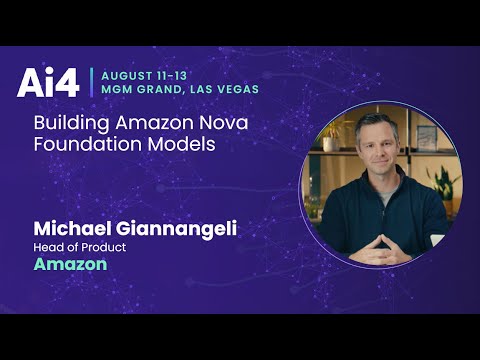
Amazon Deploys Nova Across Alexa+ and Cuts Agent Tool Errors 95%
Ai4
As enterprises shift from small prototypes to at-scale production, constrained decoding and low-latency model distillation are essential to making multi-agent automation economically viable and reliable.
## Background
Published on YouTube by Ai4 on August 28, 2025, this talk features Michael Giannangeli, Head of Product for Agentic AI at Amazon Nova. The presentation offers a behind-the-scenes look at the Amazon Nova family of foundation models, exploring how Amazon built specialized agentic models, coding agents, and the multi-agent architecture powering Alexa+.
## TL;DR
Giannangeli introduces the Amazon Nova model suite—spanning Nova Micro, Lite, Canvas, Act, and Premier—emphasizing low latency, cost efficiency, and responsible AI as core competitive differentiators. He details practical agentic architectures, including browser automation with Nova Act and multi-agent coordination in Alexa+, where Nova orchestrates over 70% of traffic across specialized sub-agents. The presentation also highlights how constrained decoding slashes tool-calling errors by 95%, enterprise code modernization tools like AWS Transform that saved Amazon over $200 million in engineering hours, and the emerging tool ecosystem centered around Model Context Protocol (MCP).
## Atmosphere & style
The presentation strikes an engaging, pragmatic tone, blending authoritative engineering insights with approachable storytelling—evidenced by Giannangeli's lighthearted opening joke about working on voice assistants despite having a speech impediment. The narrative flows smoothly from macro architectural paradigms to concrete enterprise benchmarks, maintaining a brisk, technical pace tailored for developers and AI practitioners. It feels like an insider briefing on cutting-edge production systems, balancing technical depth with clear, real-world case studies.
## Key takeaways
- [00:04](https://www.youtube.com/watch?v=x2SlJifmt60&t=4s) The Amazon Nova portfolio spans specialized models tailored for distinct workloads, including Nova Micro for fast text processing, Nova Act for browser automation, and Nova Premier for complex reasoning and distillation.
- [02:37](https://www.youtube.com/watch?v=x2SlJifmt60&t=157s) Amazon strongly differentiates Nova on low latency and low cost, catering to enterprises shifting from small-scale prototypes to high-volume production deployments where unit economics dominate.
- [02:37](https://www.youtube.com/watch?v=x2SlJifmt60&t=157s) Responsible AI safety measures are built directly into Nova's model architecture from day one rather than treated as an afterthought or final checkpoint.
- [07:20](https://www.youtube.com/watch?v=x2SlJifmt60&t=440s) Model distillation enables developers to transfer high-level reasoning from Nova Premier into Nova Micro or Nova Lite, achieving near-frontier task performance with low latency and lower operational costs.
- [07:20](https://www.youtube.com/watch?v=x2SlJifmt60&t=440s) Nova Act introduces direct browser automation capabilities, autonomously navigating websites, clicking elements, and filling forms from natural language prompts with observable code logging.
- [11:40](https://www.youtube.com/watch?v=x2SlJifmt60&t=700s) The agentic landscape is shifting toward multi-agent architectures, exemplified by Alexa+ using a central Nova routing engine to coordinate over 70% of traffic across hundreds of specialized domain sub-agents.
- [19:02](https://www.youtube.com/watch?v=x2SlJifmt60&t=1142s) Agentic coding transformations automate legacy software maintenance at scale, as proven by Amazon saving over $200 million in developer hours by automating an internal Java 8 to Java 17 migration.
- [22:06](https://www.youtube.com/watch?v=x2SlJifmt60&t=1326s) Constrained decoding for structured outputs enforces strict syntax and schema adherence, decreasing downstream tool-calling errors by 95% in production workflows.
- [25:54](https://www.youtube.com/watch?v=x2SlJifmt60&t=1554s) The future AI ecosystem is converging on tool discovery protocols like the Model Context Protocol (MCP) rather than an 'app store' for foundation models.
- [27:26](https://www.youtube.com/watch?v=x2SlJifmt60&t=1646s) Multi-agent systems handle complex, ambiguous user intents through conversational fallback mechanisms and natural clarification rather than relying on perfect initial classification.
- [29:33](https://www.youtube.com/watch?v=x2SlJifmt60&t=1773s) Executing real-world third-party actions securely requires explicit, just-in-time user authentication and permission delegation to prevent unauthorized agent behavior.
## Detailed walkthrough
### [00:04](https://www.youtube.com/watch?v=x2SlJifmt60&t=4s) Introduction: From Alexa to Agentic AI and Amazon Nova
Foundation models are fundamentally altering how people work and live, possessing the intelligence and tools necessary to complete tangible tasks in the real world—ranging from complex software engineering and trip planning to automated video generation. Michael Giannangeli, Head of Product for Agentic AI at Amazon Nova, introduces the Amazon Nova family of foundation models powering this shift. Giannangeli spent eight years working on Alexa leading up to the rollout of Alexa+, Amazon's flagship super agent. He warmly jokes about the irony of dedicating his career to voice assistants while having a speech impediment, giving credit to the Alexa team for training the assistant on his voice year after year so it could reliably understand him when stuttering.
The Amazon Nova model portfolio is designed to provide specialized models across a wide spectrum of requirements:
- **Nova Micro**: A very fast, highly efficient text-only model.
- **Nova Lite**: A low-latency multimodal model optimized for real-time tasks like chat summarization.
- **Nova Canvas**: A creative generation model for producing images, used in features like "try-it-on" shopping.
- **Nova Act**: An action-oriented model built specifically to navigate and execute workflows inside web browsers.
- **Nova Premier**: The largest, most capable model in the family, serving both as the teacher model for distillation and the engine for complex agentic reasoning.
---
[02:37](https://www.youtube.com/watch?v=x2SlJifmt60&t=157s) Core Pillars: Differentiating on Low Latency, Cost, and Responsible AI
Amazon Nova is built upon six fundamental pillars: frontier intelligence, low latency, low cost, agentic capabilities, responsible AI, and customization. While all six are vital, Amazon heavily differentiates on delivering industry-leading low latency and low cost. Giannangeli emphasizes that responsible AI is woven into the model architecture from day one rather than treated as an afterthought or a final red-teaming checkpoint, acknowledging serious AI safety warnings from pioneers like Geoffrey Hinton.
Pointing to benchmark data from Artificial Analysis, Giannangeli highlights that Nova Micro and Nova Lite rank at the top of the industry for output tokens per second and time-to-first-token. Speed is essential for synchronous, real-time use cases such as customer service interfaces, real-time ad generation, and rapid coding assistance. On the pricing front, competitive input and output token rates have transformed customer adoption. While enterprises four months prior were focused purely on small prototype reliability, they are now moving to production at scale where volume dictates unit economics:
> "When I talk to customers, and I talk to customers literally every day, the feedback that I got or that I heard early on was, 'You know, we want the best model. We want to make sure that it really works. Reliability is everything.' That was the case maybe four months ago. Now that companies have actually proven out these applications and have shown that there is real value that they can add with Gen AI, they're looking to bring this to production. And what that means now is it's no longer a small prototype. This is an at-scale application where volume really matters. And as a result, cost really matters."
---
[07:20](https://www.youtube.com/watch?v=x2SlJifmt60&t=440s) Customization via Model Distillation and Nova Act for Browser Automation
Nova’s customization framework allows organizations to go far beyond standard retrieval-augmented generation (RAG). Developers can fine-tune models on their proprietary datasets or leverage model distillation. By using the flagship Nova Premier as a teacher model, teams can distill high-level reasoning and domain expertise directly into Nova Micro or Nova Lite. This technique delivers near-frontier task performance while retaining the ultra-low latency and low operational cost of smaller models.
To make experimentation accessible, Amazon offers a web interface at `nova.amazon.com`, allowing users to test Nova models interactively without navigating AWS Bedrock API setups. This platform also hosts the SDK for Nova Act, an agentic model explicitly built for browser automation ("browser use"):
```
+--------------------------------------------------------------------+
| Nova Act SDK Workflow |
+--------------------------------------------------------------------+
| User Prompt: "Find a coffee maker under $50, rated >4.2, and buy" |
| | |
| v |
| [ Nova Act Browser Engine: Locates DOM elements / Inputs text ] |
| | |
| v |
| [ Observable Execution: Live code logging & visual UI actions ] |
+--------------------------------------------------------------------+
```
Giannangeli describes Nova Act as "the closest thing to magic that I've seen since these LLMs came out." A user can prompt the SDK with a natural language command—such as navigating to Amazon, locating a coffee maker under $50 with a rating above 4.2 stars, and buying it—and watch the agent independently open the browser, steer the mouse, click UI buttons, enter text, and log each action with full code observability. Current production preview pilots include automated expense report processing and end-to-end web QA testing.
---
[11:40](https://www.youtube.com/watch?v=x2SlJifmt60&t=700s) Three Macro Trends in Agentic AI and the Multi-Agent Architecture of Alexa+
The broader agentic landscape is currently driven by three macro trends: parallel multi-agent systems, advanced memory architectures, and hybrid human-AI collaboration models. While current chat interfaces simulate memory through application-level wrappers, true persistent memory at the foundation model level is still evolving. Similarly, autonomous agents cannot yet run unsupervised indefinitely; they operate best for minutes to an hour before requiring human check-ins, permissions, and oversight.
```
+--------------------------------------------------------------------+
| Alexa+ Multi-Agent Engine |
+--------------------------------------------------------------------+
| Top-Level Router / Orchestrator |
| (Powered by Nova -- >70% of all traffic) |
| / | \ |
| v v v |
| [ Music Sub-Agent ] [ Calendar Expert ] [ Nova Act Service ] |
| (Nova / Claude) (Fine-Tuned) (e.g., Thumbtack/Pay) |
+--------------------------------------------------------------------+
```
The multi-agent design pattern is exemplified by Alexa+. Rather than relying on a single monolithic model, Alexa+ coordinates hundreds of specialized domain sub-agents and experts spanning music, calendar scheduling, rideshare, and household services:
- **Model Agnostic Sub-Agents**: Individual feature teams choose the optimal model for their workload (e.g., Nova, Claude, or Llama) based on their specific latency, cost, and reasoning tradeoffs.
- **Nova Orchestration**: A top-level routing agent powered by Amazon Nova handles intent classification and dispatch, managing over 70% of total utterance traffic across Alexa+.
- **Domain Fine-Tuning**: Internal teams fine-tune Nova on proprietary domain datasets, allowing smaller Nova models to regularly outperform larger off-the-shelf competitors on specific tasks.
- **Complex Multi-Step Execution**: For tasks like scheduling an appliance repair, the master agent coordinates Nova Act on Thumbtack to book a technician, calls a payments agent to settle the fee, and invokes the calendar agent to schedule the appointment.
---
[19:02](https://www.youtube.com/watch?v=x2SlJifmt60&t=1142s) Enterprise Coding Transformations and Tool Use in Agentic Workflows
Beyond voice and browser agents, agentic workflows are delivering massive efficiency gains in enterprise software modernization. Giannangeli highlights code migration tools like AWS Transform, which automate modernization efforts such as language migrations,.NET upgrades, and Java framework updates. While less trendy than "vibe coding," migrating legacy codebases is traditionally a dreaded, labor-intensive chore for software engineers where old dependencies and lost institutional knowledge create major roadblocks.
- **Amazon Internal Migration**: A company-wide Java upgrade from Java 8 to Java 17 saved Amazon over $200 million in software development engineer (SDE) hours, turning multi-year engineering efforts into roughly one week of execution.
- **Parallel Agent Pipelines**: Coding transformation runs on a multi-agent framework where specialized agents execute code analysis, refactoring, documentation generation, and syntax transformation simultaneously.
- **Real-World Tool Use**: Autonomous task completion fundamentally depends on robust tool use. Giannangeli notes that while the ultimate goal is for foundation models to autonomously pick the exact correct tool 100% of the time, structured tooling frameworks are essential for bridging model intelligence with real-world execution.
[22:06](https://www.youtube.com/watch?v=x2SlJifmt60&t=1326s) Constrained Decoding and Structured Outputs for Tool Reliability
To prevent models from failing during complex workflows, Amazon Nova provides explicit tool choice controls, enabling users to specify whether the model must use a tool, select from a restricted list of tools, or execute an exact designated tool. To tackle the frequent failure mode where downstream tools reject malformed data, Amazon recently introduced structured outputs powered by a technique known as constrained decoding. This mechanism restricts token generation exclusively to high-probability tokens that strictly conform to predefined syntactical rules and schemas, ensuring the output format matches the required JSON structure precisely.
Adhering to syntax ensures basic elements like grammar and closing brackets are never omitted, while schema adherence guarantees that the output satisfies all expected data fields. Although simple on the surface, these structural guardrails have fundamentally transformed model reliability:
- **Error Reduction:** Implementing syntax and schema-constrained decoding decreased tool use errors by 95%.
- **Deterministic Tool Calling:** Customers can enforce whether a tool call is mandatory, restricted to a curated subset, or targeted to a single specific tool.
- **Enterprise Reliability:** Eliminating JSON parsing and schema formatting errors enables developers to deploy autonomous agentic workflows with high confidence in production environments.
---
[24:11](https://www.youtube.com/watch?v=x2SlJifmt60&t=1451s) Demo: Multi-Agent Financial Research with Amazon Nova Premier
A practical demonstration illustrates how Amazon Nova Premier streamlines intricate investment research tasks that traditionally require hours or months of meticulous human effort across dozens of data sources, macroeconomic reports, and corporate filings. The multi-agent architecture utilizes a primary supervisor agent that receives high-level user queries, decomposes the prompt into discrete tasks, and coordinates a team of specialized collaborator agents that act like human subject matter experts.
```
+---------------------------+
| User Prompt |
+-------------+-------------+
|
v
+---------------------------+
| Nova Premier Supervisor |
+-------------+-------------+
|
+---------------------+---------------------+
| |
v v
+-----------------------+ +-----------------------+
| Market Sentiment Agent| | Other Collaborators |
+-----------+-----------+ +-----------------------+
|
v (interpolates parameters)
+-----------------------+
| News Aggregation Tool |
+-----------------------+
```
When queried with "What are the emerging trends in the renewable energy sector and how might that impact my portfolio today?", Nova Premier breaks the objective down and assigns targeted assignments across specialist sub-agents. For instance, a dedicated market sentiment analyst agent calls a news data aggregation tool, interpolating search terms, time horizons, and custom parameters based on instructions from the supervisor. The entire multi-agent workflow finishes the deep-dive research within a few minutes, delivering comprehensive insights to augment human financial analysis.
---
[25:54](https://www.youtube.com/watch?v=x2SlJifmt60&t=1554s) Q&A: Model App Stores vs. MCP Tool Ecosystems
During the audience Q&A, an attendee asks whether Amazon Nova will foster an ecosystem akin to the Salesforce AppExchange, creating an "app store" for foundation models. In response, the speaker clarifies that the market is unlikely to develop an app store for foundation models themselves due to the massive capital requirements needed to train frontier models, which naturally keeps the total number of foundation models relatively small.
Instead, the ecosystem is shifting toward discovering and sharing tools and servers. The Model Context Protocol (MCP) is currently emerging as the leading standard for connecting models to external tools and server environments. While platforms like AWS Bedrock and competitors are developing their own discovery mechanisms and search catalogs, a unified, universal store for tooling integrations represents the true equivalent of an agentic app store.
---
[27:26](https://www.youtube.com/watch?v=x2SlJifmt60&t=1646s) Q&A: Orchestrating Sub-Agents and Fallback Mechanisms in Alexa+
An attendee questions how the central orchestrator agent in Alexa+ manages subtle distinctions across hundreds of sub-agents that share overlapping or similar behaviors—such as discerning whether a user wants concert tickets or a music streaming service. The speaker acknowledges that perfecting routing across hundreds of specialized agents required extensive development and rigorous training with high-quality demonstration datasets.
Because users speak in freeform natural language rather than rigid commands, no classifier can achieve 100% precision purely on initial intent. To solve ambiguity gracefully, the architecture incorporates conversational fallback mechanisms:
- **Human-like Clarification:** When routing confidence is low or ambiguous, the system directly asks clarifying questions (e.g., "Did you mean this or that?").
- **Graceful Course Correction:** If a sub-agent takes the wrong execution path, fallbacks enable the supervisor to reorient the session without failing the interaction.
- **Natural Language Tolerance:** Users are freed from memorizing exact syntactic phrases, making conversational interactions feel intuitive and human.
---
[29:33](https://www.youtube.com/watch?v=x2SlJifmt60&t=1773s) Q&A: Third-Party Authentication, Trust, and Retrieval Architectures
Addressing a question regarding how automated workflows securely trigger third-party actions—such as dispatching a service professional via Thumbtack when an appliance breaks—the speaker highlights that user authentication is paramount. Users explicitly grant permissions and authenticate third-party credentials either during initial system setup or just-in-time when a relevant task is first requested. Enforcing explicit user consent and secure token delegation ensures agents never perform unauthorized external actions, preserving end-user trust.
When asked by a Bedrock developer about best practices for choosing between retrieval methodologies—such as Vector RAG versus Knowledge Graph RAG across different agentic patterns—the speaker notes that architectural trade-offs depend heavily on use-case specifics, suggesting deeper collaboration with AWS Bedrock specialist teams before wrapping up the session.
## Notable quotes
> [02:37](https://www.youtube.com/watch?v=x2SlJifmt60&t=157s) When I talk to customers, and I talk to customers literally every day, the feedback that I got or that I heard early on was, 'You know, we want the best model. We want to make sure that it really works. Reliability is everything.' That was the case maybe four months ago. Now that companies have actually proven out these applications and have shown that there is real value that they can add with Gen AI, they're looking to bring this to production. And what that means now is it's no longer a small prototype. This is an at-scale application where volume really matters. And as a result, cost really matters. — Michael Giannangeli
> [07:20](https://www.youtube.com/watch?v=x2SlJifmt60&t=440s) the closest thing to magic that I've seen since these LLMs came out. — Michael Giannangeli
## Mentioned
Amazon, Amazon Nova, Michael Giannangeli, Alexa, Alexa+, Nova Micro, Nova Lite, Nova Canvas, Nova Act, Nova Premier, Geoffrey Hinton, Artificial Analysis, AWS Bedrock, Claude, Llama, Thumbtack, AWS Transform, Model Context Protocol (MCP), Salesforce AppExchange, Ai4
## Video description
Michael Giannangeli, Head of Product, Agentic AI, Amazon Nova, Amazon
Abstracts
This talk will provide a behind the scenes look at Amazon Nova foundation models. From understanding models and creative content generation models to speech-to-speech and specialized agentic models, learn about how we built Amazon Nova from the ground up. This talk will deep dive into the agentic experiences that Nova powers, including Alexa+ and coding agents.
亚马逊在 Alexa+ 部署 Nova,将智能体工具错误减少 95%
随着企业从小规模原型转向大规模生产,约束解码和低延迟模型蒸馏对于实现兼具经济可行性与可靠性的多智能体自动化至关重要。
Giannangeli 介绍了 Amazon Nova 系列模型——涵盖 Nova Micro、Lite、Canvas、Act 和 Premier——并强调低延迟、成本效益以及负责任 AI 是其核心竞争优势。他详细阐述了实用的智能体架构,包括利用 Nova Act 实现浏览器自动化,以及在 Alexa+ 中进行多智能体协同(Nova 在其中调度各专业子智能体之间超过 70% 的流量)。演讲还重点介绍了约束解码如何将工具调用错误削减 95%、为亚马逊节省超过 2 亿美元工程工时的企业代码现代化工具(如 AWS Transform),以及围绕模型上下文协议(MCP)兴起的新兴工具生态。
Amazon Nova 产品组合涵盖针对不同工作负载量身定制的专用模型,包括用于快速文本处理的 Nova Micro、用于浏览器自动化的 Nova Act,以及用于复杂推理和蒸馏的 Nova Premier。 (0:04)
亚马逊着重将低延迟和低成本作为 Nova 的差异化优势,以迎合从小型原型转向单位经济效益主导的大规模生产部署的企业需求。 (2:37)
负责任 AI 的安全措施从一开始就直接构建在 Nova 的模型架构中,而不是被视作事后考虑或最后的检查关卡。 (2:37)
模型蒸馏使开发者能够将 Nova Premier 的高级推理能力迁移至 Nova Micro 或 Nova Lite,以低延迟和更低的运营成本实现接近前沿模型的任务性能。 (7:20)
Nova Act 引入了直接的浏览器自动化能力,可根据自然语言提示自主导航网站、点击元素并填写表单,同时提供可观察的代码日志。 (7:20)
Reading summary
Michael Giannangeli, Head of Product for Agentic AI at Amazon Nova, argues that enterprise adoption of generative AI has transitioned from experimental prototyping to production at scale, where deployment viability depends on unit economics, low latency, and deterministic tool execution.
Aligning Model Specialization with Production Economics (2:37)
Amazon Nova spans specialized tiers, including the text-only Nova Micro, multimodal Nova Lite, creative Nova Canvas, browser-oriented Nova Act, and the flagship Nova Premier. Rather than optimizing purely for monolithic intelligence, Amazon focuses heavily on latency and cost. Citing benchmark evaluations from Artificial Analysis, Giannangeli highlights that Nova Micro and Lite rank at the top of the industry for output tokens per second and time-to-first-token, serving synchronous demands in customer support and real-time generation.
Giannangeli observes that enterprise priorities shifted over a four-month span: while organizations previously focused strictly on prototype reliability, production scale now makes token volume and unit economics decisive. To optimize cost, organizations can use Nova Premier as a teacher model, distilling high-level reasoning directly into Nova Micro or Lite to approximate frontier capabilities at a fraction of the computational expense.
Multi-Agent Architectures and Fallback Routing in Alexa+ (11:40)
The architecture of Alexa+ illustrates an industry shift from monolithic models to parallel multi-agent networks. Alexa+ coordinates hundreds of specialized domain sub-agents across scheduling, media, and household services. A master orchestrator powered by Amazon Nova handles intent classification and dispatches more than 70% of total utterance traffic. Sub-agents remain model-agnostic, allowing individual engineering teams to deploy Nova, Claude, or Llama based on domain-specific latency and cost trade-offs.
Because natural language introduces intent ambiguity, the orchestrator employs conversational fallback mechanisms. When routing confidence falls below acceptable thresholds, the system asks clarifying questions or course-corrects without terminating the user session. A similar multi-agent decomposition applies to complex research workflows, where Nova Premier acts as a supervisor, splitting prompts into parallel tasks executed by specialist collaborator agents and news aggregation tools.
Browser Navigation and Legacy Code Modernization (7:20)
Beyond conversational interfaces, Amazon Nova targets autonomous execution through Nova Act, a specialized model designed for web browser automation. Accessible via an SDK, Nova Act parses DOM elements, navigates user interfaces, and enters text to execute multi-step consumer and enterprise tasks like web QA testing and product purchases, accompanied by live code logs.
Agentic workflows also drive internal enterprise modernization via AWS Transform. Giannangeli reports that Amazon automated a company-wide upgrade from Java 8 to Java 17, reducing multi-year engineering migrations to roughly one week and saving more than $200 million in software development engineer hours through parallel refactoring and transformation agents. For external operations, such as scheduling home repairs, systems enforce explicit user permissioning during setup or just-in-time requests to safeguard authentication.
Constrained Decoding and Tooling Integration Standards (22:06)
Autonomous agent reliability frequently breaks down when foundation models emit malformed outputs rejected by downstream tools. To resolve this, Amazon Nova implements constrained decoding for structured outputs, restricting token generation strictly to syntax rules and predefined JSON schemas. Giannangeli states that schema and syntax enforcement reduced tool use errors by 95%, allowing developers to enforce mandatory, restricted, or single-target tool calls deterministically.
Addressing ecosystem expansion, Giannangeli dismisses predictions of a consumer-style app store for foundation models, arguing that massive training capital requirements will keep the number of base models small. Instead, he expects ecosystem discovery to standardize around external tools and servers, highlighting the Model Context Protocol (MCP) as the leading integration standard for cataloging agentic capabilities.
Giannangeli emphasizes that fully autonomous agents currently operate reliably for minutes up to an hour rather than running unsupervised indefinitely. True persistent memory at the model layer remains unresolved, requiring developers to maintain structured tooling guardrails, human oversight checkpoints, and explicit permission delegation.
精炼阅读摘要
Amazon Nova 代理式 AI(Agentic AI)产品负责人 Michael Giannangeli 阐述了 Nova 系列基础模型的架构定位,强调在企业级生成式 AI 迈向规模化生产时,低延迟、低成本以及基于约束解码的确定性工具调用是决定商业落地的核心驱动力。
Nova 模型矩阵与规模化生产的成本效益 (2:37)
随着企业从最初几个月前关注概念验证原型转向大规模生产,系统部署的单位经济效益成为首要考量。Michael Giannangeli 解释称,Amazon Nova 系列建立在前沿智能、低延迟、低成本、代理能力、定制化以及在架构之初即内置负责任 AI 这六大支柱之上。为了覆盖不同场景,Nova 提供了纯文本超快模型 Nova Micro、多模态实时模型 Nova Lite、图像创意生成模型 Nova Canvas、浏览器自动化执行模型 Nova Act,以及担当复杂推理与蒸馏教师模型的旗舰款 Nova Premier。
根据 Artificial Analysis 的基准数据,Nova Micro 与 Nova Lite 在每秒输出 Token 数和首 Token 响应时间(Time-to-first-token)方面位居行业前列。企业借助模型蒸馏技术,可以将 Nova Premier 具备的深度推理与领域专长传递到参数更小的 Micro 或 Lite 模型中。这种方式使企业既能维持接近顶级的任务表现,又能大幅削减云端推理延迟与 Token 采购成本,适应大规模并发需求。
浏览器操作与约束解码提升工具可靠性 (22:06)
在推动自主代理执行真实任务时,数据格式不合规与工具调用失误是生产环境中的主要瓶颈。Amazon 推出了面向浏览器操作的专用模型 Nova Act,开发者通过自然语言指令即可驱动模型自主识别网页 DOM 元素、移动鼠标并输入文本完成端到端工作流。为消除大模型在下游工具调用中因 JSON 格式错误或字段遗漏而崩溃的问题,Nova 引入了基于约束解码(Constrained Decoding)的结构化输出技术。
该技术在词元生成阶段实施限制,强制输出完全符合预设的语法规则和数据模式(Schema),杜绝缺失括号或类型不符等格式错误。实施该机制后,工具使用错误率直接降低了 95%。此外,系统还允许开发者进行确定性控制,指定模型必须调用特定工具、从预选列表中选择工具或自主决策,从而确保自动化管道在企业级环境中的高可用性与容错能力。
Alexa+ 多代理系统与协同编排模式 (11:40)
以智能语音助手升级版 Alexa+ 为代表的应用展示了从单体模型向分布式多代理编排的演进。在 Alexa+ 的整体架构中,顶层路由代理(Router)由 Amazon Nova 驱动,负责承担并调度超过 70% 的用户自然语言话务流量。底层则由数百个专业子代理构成,各个垂直业务团队根据具体的延迟、算力和成本权衡,自主选用 Nova、Claude 或 Llama 等不同模型,并在专有数据集上完成领域微调。
针对多子代理重叠引起的歧义,编排架构内置了回退与对话澄清机制。当路由分类置信度偏低时,系统会像人类一样向用户主动提问以确认意图;若某一子代理中途偏离预期路径,主控代理亦能介入修正,免除了用户记忆死板命令的负担。在处理跨领域复合任务时,主代理可协同调度 Nova Act 在第三方平台进行预订,同时并行唤起支付子代理与日历管理子代理,实现复杂多步骤执行。
企业代码迁移与工具上下文协议生态 (19:02)
代理式工作流在企业遗留系统改造中展现出显著效益。Giannangeli 以代码迁移工具 AWS Transform 为例指出,通过在代码分析、重构、文档生成和语法转换环节运行并行代理流水线,亚马逊内部将全公司的 Java 代码从 Java 8 升级至 Java 17,把传统长达数年的工程周期缩短至约一周,为公司节省了逾 2 亿美元的软件开发工程师(SDE)工时成本。
在关于未来 AI 生态形态的讨论中,Giannangeli 分析认为,由于前沿模型训练存在极高的资本壁垒,市场不太可能形成基础模型层面的应用商店,竞争与标准化的高地正转移至工具与服务器的连接层。目前,模型上下文协议(Model Context Protocol, MCP)正逐步演进为主流标准,未来跨平台、跨工具集成的目录与服务发现机制,将真正承载起代理生态中应用商店的核心角色。
在安全与治理方面,代理调用第三方服务必须依赖用户显式授权与即时凭证委托以维持信任基础。此外,基础模型层面的持久化记忆架构仍处于演进阶段,目前自主代理通常适宜在受监控状态下运行数分钟至一小时,长时程、无监督的完全自主系统仍面临架构与安全层面的持续考验。
Detailed notes — zh
## Background
该视频由频道 Ai4 于 2025 年 8 月 28 日在 YouTube 平台发布。视频内容为亚马逊 Nova 智能体 AI(Agentic AI)产品负责人 Michael Giannangeli 带来的幕后主题演讲,深入解析了 Amazon Nova 基础模型的构建历程,涵盖多模态生成、语音交互以及支撑 Alexa+ 和代码智能体的 Agent 架构落地实践。
## TL;DR
Michael Giannangeli 全面梳理了 Amazon Nova 模型矩阵及其以低延迟、低成本和智能体能力为核心的六大支柱,并阐述了企业客户从原型验证转向生产规模化时的性价比刚需。演讲重点展示了浏览器自动化工具 Nova Act、基于约束解码(Constrained Decoding)将工具调用错误率降低 95% 的关键突破,以及 AWS 内部通过智能体完成 Java 升级节省逾 2 亿美元工时的实际成效。此外,他详细拆解了 Alexa+ 背后由 Nova 主导的数百个子智能体分层协同架构与回退机制,并深入探讨了 MCP 协议下未来智能体“工具应用商店”的发展前景。
## Atmosphere & style
整场演讲呈现出务实、坦诚且极具工程落地视角的基调。Michael 开场以自身口吃障碍在语音团队深耕八年的幽默自嘲破题,瞬间拉近了与观众的距离,随后迅速切入高信息密度的系统架构与量化数据对比。现场氛围既充满前沿技术探索的兴奋感,又带着对“完全自主 AI 仍需人机协作”的理性清醒,在问答互动中展现出技术老兵对底层工程挑战的敏锐与直率。
## Key takeaways
- [01:39](https://www.youtube.com/watch?v=x2SlJifmt60&t=99s) Amazon Nova 提供了从极速轻量(Micro、Light)到前沿多模态及旗舰级(Canvas、Act、Premiere)的全谱系基础模型家族。
- [01:39](https://www.youtube.com/watch?v=x2SlJifmt60&t=99s) Nova 研发确立了六大核心支柱,其中低延迟与低成本构成关键差异化优势,同时安全对齐与负责任 AI 从第一天起就深度融入架构设计。
- [04:13](https://www.youtube.com/watch?v=x2SlJifmt60&t=253s) 企业客户需求已从前期的顶级能力 PoC 概念验证,全面转向进入生产阶段后的高吞吐、低推理成本与极致响应延迟。
- [07:16](https://www.youtube.com/watch?v=x2SlJifmt60&t=436s) 企业可通过模型蒸馏(Distillation)将 Nova Premiere 教师模型的复杂推理能力浓缩到 Micro 或 Light 等轻量模型中,兼顾精度与极致性价比。
- [08:36](https://www.youtube.com/watch?v=x2SlJifmt60&t=516s) Nova Act 作为专为浏览器端操作训练的智能体模型,支持自主光标控制、点击与输入,并开放免费 SDK 与免配置在线实验平台。
- [13:25](https://www.youtube.com/watch?v=x2SlJifmt60&t=805s) 当前智能体尚无法实现 24 小时全脱缰自主运行,最佳落地形态是人机结对协作(Human-AI Team),人类负责定期 Check-in 与权限管控。
- [14:40](https://www.youtube.com/watch?v=x2SlJifmt60&t=880s) Alexa+ 采用模型无关的分层子智能体架构,顶层 Master Agent 由 Nova 驱动并承载了超过 70% 的核心流量。
- [19:02](https://www.youtube.com/watch?v=x2SlJifmt60&t=1142s) AWS Transform 采用多智能体协同机制自动完成底层代码重构(如 Java 8 升级至 17),在亚马逊内部节省了超 2 亿美元的工时成本。
- [21:24](https://www.youtube.com/watch?v=x2SlJifmt60&t=1284s) Nova 引入 Tool Choice 与基于约束解码(Constrained Decoding)的结构化输出技术,将下游工具调用的格式错误率降低了 95%。
- [26:17](https://www.youtube.com/watch?v=x2SlJifmt60&t=1577s) AI 生态未来的核心“应用商店”并非模型本身,而是围绕模型上下文协议(MCP)构建的标准化 Agent 工具与服务分发市场。
- [27:26](https://www.youtube.com/watch?v=x2SlJifmt60&t=1646s) Alexa+ 顶层路由面对多义指令时引入类人化的回退澄清机制(Fallback),在置信度不足时主动反问确认,大幅提升系统容错率。
## Detailed walkthrough
### [00:04](https://www.youtube.com/watch?v=x2SlJifmt60&t=4s) 基础模型新纪元与演讲者背景
基础模型正在深刻改变人类的工作与生活方式。这些模型不仅具备高度的智能,还拥有在现实世界中完成复杂任务的工具链支持——从全流程软件开发、旅行规划,到创意视频生成,无所不包。亚马逊推出的 Amazon Nova 系列基础模型正处于这场技术变革的核心。作为 Amazon Nova 智能体 AI(Agentic AI)产品负责人,Michael Giannangeli 登台分享了 Nova 的构建历程与技术布局。
在加入 Nova 团队之前,Michael 在 Alexa 团队深耕了整整八年,一路参与并见证了被定义为“超级智能体”的 Alexa+ 的发布。他幽默地调侃道,自己作为一个有语言障碍(口吃)的人,居然在语音助手团队工作了这么多年,这本身就很有戏剧性。他同时向 Alexa 团队致以由衷的敬意,感谢团队年复一年用他的声音训练模型,让系统即使在他结巴时也能准确理解意图。
---
### [01:39](https://www.youtube.com/watch?v=x2SlJifmt60&t=99s) 亚马逊 Nova 模型家族与六大核心支柱
Amazon Nova 旨在为不同用户和各类业务场景提供全谱系的模型支持。产品矩阵覆盖广泛:既有能够以极低延迟进行实时聊天摘要的轻量级模型 Nova Light,也有用于“即买即试”(Try-It-On-Now)电商图像生成的 Nova Canvas,还有专为网页浏览器自动化任务打造的 Nova Act,以及能够胜任最复杂智能体任务的超大旗舰模型 Nova Premiere。从纯文本极速模型 Nova Micro 到充当“教师模型”(Teacher Model)的 Nova Premiere,用户可以根据需求灵活选型。
Nova 的研发牢固建立在六大支柱之上:前沿智能(Frontier Intelligence)、低延迟(Low Latency)、低成本(Low Cost)、智能体能力(Agentic Capabilities)、负责任的 AI(Responsible AI)以及定制化能力(Customization)。在这些支柱中,团队最为注重且形成差异化优势的是“低延迟”与“低成本”。此外,团队从研发第一天起就将负责任的 AI 与安全对齐深度融入系统架构,而非事后才进行红队测试(Red Teaming)和安全修补,积极回应了诸如 Geoffrey Hinton 等前沿学者对 AI 安全风险的严正警告。
```mermaid
flowchart TD
accTitle: Amazon Nova 模型层级与六大支柱
subgraph Pillars["Amazon Nova 六大核心支柱"]
direction LR
P1["前沿智能"]
P2["超低延迟"]
P3["超低成本"]
P4["智能体能力"]
P5["负责任 AI"]
P6["深度定制化"]
end
subgraph Models["Amazon Nova 模型矩阵"]
direction TB
M1["Nova Premiere\n(旗舰级教师模型 / 复杂智能体)"]
M2["Nova Canvas / Nova Act\n(图像生成 / 浏览器端行动智能体)"]
M3["Nova Light\n(极速多模态 / 实时摘要)"]
M4["Nova Micro\n(纯文本 / 超低延迟响应)"]
M1 --> M2 --> M3 --> M4
end
```
---
### [04:13](https://www.youtube.com/watch?v=x2SlJifmt60&t=253s) 速度与成本的量化优势:从原型到生产规模的转变
在衡量模型性能时,数据胜于雄辩。第三方评估机构 Artificial Analysis 的独立测试数据显示,Nova Micro 和 Nova Light 在输出 Token 速率(Tokens per Second)以及首字生成延迟(Time to First Token)两项核心指标上均名列前茅,展现出极强的实时交互性能。这种极致的低延迟对于实时客服、即时代码修复以及动态广告图片生成等场景至关重要。
在成本控制上,Nova Micro 与 Nova Light 的输入和输出定价在行业同级模型中极具竞争力。这一优势精准切中了当前企业客户的刚需:大约四个月前,客户普遍追求最强模型,首要关注的是可靠性与可行性验证;而随着概念验证(PoC)的成功,企业正在将生成式 AI 大规模推向生产环境。进入高并发、大吞吐量的生产阶段后,调用成本成为决定商业闭环的关键,许多此前因成本犹豫的客户正重新拥抱经过持续优化升级的 Nova 模型。
- **核心性能指标**:Nova Micro 与 Nova Light 在每秒输出 Token 数量及首 Token 响应时间上均处于行业领先水平。
- **客户需求演进**:企业客户关注点从数月前的“原型验证与顶级能力”全面转向规模化投产阶段的“高性价比与吞吐量吞吐成本”。
- **定价策略**:亚马逊持续对 Nova 系列进行架构优化并主动下调推理调用成本,进一步降低企业规模化部署的门槛。
---
### [07:16](https://www.youtube.com/watch?v=x2SlJifmt60&t=436s) 深度定制与模型蒸馏:超越传统 RAG
针对企业业务差异化的诉求,Nova 提供了超越传统检索增强生成(RAG)的定制化路径。客户不仅能够利用私有数据对模型进行微调(Fine-Tuning),更可以通过“模型蒸馏”(Distillation)技术打造专有模型。
在该工作流中,企业可以利用功能最强大的旗舰模型 Nova Premiere 作为教师模型,结合专有业务数据进行知识提炼,将高维推理能力浓缩到 Nova Micro 或 Nova Light 体量的紧凑模型中。这样一来,企业既能享受到接近超大模型的精度与表现,又能获得小模型极低的推理成本和毫秒级的响应延迟,在很多实际业务场景中甚至超越了直接采购的现成大模型。
```mermaid
flowchart LR
accTitle: Nova 模型蒸馏工作流
subgraph Inputs["输入与教师模型"]
D["企业私有数据"]
T["Nova Premiere\n(教师模型)"]
end
subgraph Process["定制与压缩"]
DIST["模型蒸馏与微调\n(Distillation & Fine-Tuning)"]
end
subgraph Output["高性能轻量端"]
S["专有定制版 Nova Micro / Light\n(大模型性能 + 小模型低成本/低延迟)"]
end
D --> DIST
T --> DIST
DIST --> S
```
---
### [08:36](https://www.youtube.com/watch?v=x2SlJifmt60&t=516s) 浏览器自动化利器:Nova Act SDK 与实验平台
为了降低开发者的上手门槛,亚马逊上线了免配置的实验平台 `nova.amazon.com`。开发者无需登录 AWS 控制台或绑定 Bedrock API,即可直接在网页端体验所有 Nova 模型的交互,并直接下载使用 Nova Act SDK。
Nova Act 是专门为在网页浏览器中执行操作而训练的智能体模型(Browser-Use Agent)。演讲者将其形容为“大语言模型问世以来最接近魔法的技术”。开发者只需在 SDK 中下达自然语言指令,例如“去 amazon.com 帮我找一台价格低于 50 美元、评分在 4.2 星以上的咖啡机并下单购买”,Nova Act 便会自动接管浏览器,自主移动鼠标、定位按钮、输入表单并完成全流程操作。该系统具备完整的可观测性,左侧会实时展示运行代码与操作日志。目前该工具已开放免费体验,并已在自动化报销审批、自动化 QA 测试等企业生产场景中展开合作。
- **便捷接入**:通过 `nova.amazon.com` 即可零门槛在线体验 Nova 系列模型,无需复杂的云环境配置。
- **Nova Act 能力**:具备自主 UI 定位、光标控制、点击与文本输入能力,支持全自主浏览器端多步任务执行。
- **展示用例**:演示中展示了 Nova Act 在 Google Maps 上自主搜索加州火车(Caltrain)沿线便利位置的全流程。
---
### [11:39](https://www.youtube.com/watch?v=x2SlJifmt60&t=699s) 智能体 AI 的三大宏观趋势
探讨智能体 AI(Agentic AI)的发展,必须拨开概念炒作看清其实质价值。当前智能体技术正在经历三大宏观发展趋势:
第一是多智能体系统(Multi-Agent Systems)的普及。多个专业智能体能够在后台协同并发执行任务,以 Alexa 为例,其后台实际上由数百个分工明确的智能体在协同运转。第二是高级记忆机制(Advanced Memory)。当前包括主流聊天应用在内的记忆功能大多停留在浏览器或应用外层,而非模型本身的内在记忆。真正的模型级长期记忆将带来质的飞跃——例如在制定旅行规划时,模型能主动记住用户带着 10 个月大的婴儿,从而自动过滤掉高强度的徒步路线。第三则是人机协同(Hybrid Human-AI Team)动态机制的建立,推动从完全自主向人机高效协作演进。
### [13:25](https://www.youtube.com/watch?v=x2SlJifmt60&t=805s) 智能体的发展现状与人机协作演进
迈克尔·贾南杰利(Michael Giannangeli)指出,业内经常描绘一种完全自动化的理想愿景——所有事情都在后台默默搞定,系统全自主运行。然而现实是,目前的技术水平尚未达到那种程度。当前的 AI Agent(智能体)通常只能独立思考、推理并执行任务大约一个小时,甚至在很多情况下时间更短,随后就必须依赖人类的介入与输入。演讲者强调,这并不是一件坏事,而是当前技术发展阶段的客观现实。
以编程智能体(Coding Agents)为例,目前它们更像是开发者的“结对编程伙伴(Paired Programming Partner)”。未来的趋势是智能体将直接驻留在代码库中并自主采取行动,但它们绝不可能实现 24 小时脱离监管自主运行。工程师依然需要定期 Check-in,明确告知智能体“这里做对了、那里做错了”,并负责授予权限或收回权限。紧接着,演讲者通过 Alexa+ 和编程智能体两个核心案例,深入拆解了这一理念的具体实践。
---
### [14:40](https://www.youtube.com/watch?v=x2SlJifmt60&t=880s) Alexa+ 的多智能体架构与模型无关策略
在打造新一代 Alexa+ 时,亚马逊采用了分层解耦的“子智能体架构(Sub-agent Architecture)”。整个系统由数百个高度专业化的子智能体(内部常称为 Expert,即专家)组成,覆盖了用户可能遇到的每一个场景——从播放音乐、管理日历到呼叫 Uber,每一个用例都被拆解为独立的子智能体。
```mermaid
flowchart TD
accTitle: Alexa+ 多智能体架构图
User["用户语音指令 (Utterance)"] --> TopAgent["顶层主智能体 (Top-level / Master Agent)<br/>*由 Amazon Nova 驱动 (承载 >70% 流量)*"]
subgraph SubAgents ["专业子智能体集群 (Sub-agents / Experts)"]
Music["音乐 Agent<br/>(关注低延迟 / Nova)"]
Calendar["日历 Agent<br/>(Nova / Claude)"]
Ride["叫车 Agent<br/>(Llama / 第三方模型)"]
Complex["复杂推理 Agent<br/>(高推理能力模型)"]
end
TopAgent -->|意图识别与任务分发| Music
TopAgent -->|意图识别与任务分发| Calendar
TopAgent -->|意图识别与任务分发| Ride
TopAgent -->|意图识别与任务分发| Complex
```
这种架构赋予了团队极高的迭代速度。与苹果 Siri 迟缓的架构演进相比,亚马逊将业务打散到各个专职团队(如音乐团队、日历团队),并赋予他们选择最适合自身用例模型的完全自主权。因此,Alexa+ 在发布时就强调其是“模型无关(Model Agnostic)”的——有的子智能体采用 Amazon Nova,有的采用 Anthropic 的 Claude,还有的采用 Meta 的 Llama。各个团队可以根据核心诉求(低延迟、低成本还是复杂推理)自行抉择。
- **顶层主智能体的核心地位**:最关键的部分在于顶层智能体(Master Agent),它负责精准判断用户意图(例如判断用户是在要求播放音乐,还是在询问关于泰勒·斯威夫特的演出事实并查询演唱会时间),并将请求路由给正确的子智能体。
- **Nova 成为绝对主力**:Amazon Nova 驱动着顶层主智能体,并承载了 Alexa+ 超过 70% 的用户话语(Utterances)与流量。
- **微调超越通用模型**:由于各团队引入了自己的领域数据对 Nova 进行了定制和微调(Fine-tuning),Nova 在实际垂直用例中的表现屡屡超越了开箱即用的商用顶尖模型(如 Claude)。
- **复合任务实战案例**:以“修理烤箱”为例,顶层智能体识别需求后调动多个子智能体:通过 Nova Act 调用 Thumbtack 平台预约上门维修,调用支付 Agent 完成付款,再由日历 Agent 自动排期。数十个智能体在数分钟内并行协同完成整套闭环。
---
### [19:02](https://www.youtube.com/watch?v=x2SlJifmt60&t=1142s) 编程现代化:AWS Transform 与多智能体提效
除了消费级应用,智能体在企业级开发场景中同样发挥着巨大价值。AWS 推出了 AWS Transform 服务,尽管它听起来不如“氛围编程(Vibe Coding)”那样炫酷时髦,但对企业来说至关重要。该服务专注于代码跨语言转换、系统现代化重构、.NET 迁移以及 Java 版本升级等任务。
软件工程师通常极其讨厌处理这类脏活累活——老代码库往往“埋着各种坑(bodies buried)”、原作者早已离职、老语言无人熟悉。这正是 AI 能够创造巨大商业价值的场景。
- **亚马逊内部降本增效成果**:亚马逊内部在将 Java 8 升级至 Java 17 的过程中全面应用了该技术。原本需要软件开发工程师(SDE)耗时数年才能完成的工作,在约一周内全部搞定,直接节省了超过 2 亿美元的工程师工时成本。
- **多智能体并行处理机制**:AWS Transform 同样采用了多智能体框架,将庞大任务拆解为代码分析、代码重构、生成文档和执行转换等多个环节,由各个 Agent 并行协作推进,极大压缩了处理周期。
---
### [21:24](https://www.youtube.com/watch?v=x2SlJifmt60&t=1284s) 智能体开发基石:工具调用与约束解码
工具调用(Tool Use)是所有 Agent 应用能够落地并影响真实世界的核心。大模型本身非常聪明,但如果不连接现实世界的 API 与工具,就无法产生实质动作。为了解决模型选错工具或参数报错的问题,Nova 在工具调用能力上进行了两项关键创新:
```mermaid
flowchart LR
accTitle: 结构化输出与约束解码机制
Prompt["智能体指令与工具列表"] --> Engine["Nova 推理引擎"]
Engine --> CD["约束解码 (Constrained Decoding)"]
subgraph CD_Detail ["可靠性保障机制"]
Syntax["语法约束 (Syntax)<br/>强制 JSON 闭合与正确文法"]
Schema["Schema 约束<br/>严格匹配参数类型与结构"]
end
CD --> CD_Detail
CD_Detail --> Result["高质量结构化输出<br/>(工具调用错误率降低 95%)"]
```
1. **显式工具选择(Tool Choice)**:当前模型尚无法保证 100% 正确调用工具。通过 Tool Choice 机制,开发者可以明确限制模型“必须使用工具”、“从指定列表中选择工具”或“强制调用某个特定工具”,大幅降低了调用偏差。
2. **基于约束解码(Constrained Decoding)的结构化输出**:下游工具通常严格依赖标准的 JSON 格式输入,任何细微格式错误都会导致整个流水线崩溃。Nova 引入了约束解码技术,在 Token 生成阶段直接限制候选 Token 集合,使其严格符合预定义语法(Syntax,如自动补齐闭合括号)和结构定义(Schema),从而确保格式 100% 正确。
这项改进直接让工具调用的错误率**骤降了 95%**,让开发者能够构建高度稳定可靠的企业级 Agent。
---
### [24:11](https://www.youtube.com/watch?v=x2SlJifmt60&t=1451s) 实战演示:Nova Premiere 驱动的金融投研多智能体系统
在演讲结尾,迈克尔展示了一段基于旗舰模型 Nova Premiere 构建金融投研应用的演示视频。传统模式下,分析师调研某只股票或行业时,需要耗费大量时间人工翻阅宏观经济、行业动态、公司财报等数十个数据源;而借助 Nova Premiere,过去需要数月才能开发完成的复杂多智能体应用,现在可以在几分钟到一小时内搭建完成。
在演示案例中,系统设立了一个主主管智能体(Primary Supervisor Agent),并连接了多个各怀绝技的专业协作智能体(Collaborator Agents),每个协作智能体均配备专属工具集。
- **复杂指令分解**:用户提问:“可再生能源领域有哪些新兴趋势,这些趋势目前对我的投资组合有何影响?”
- **自主协作分工**:Nova Premiere 主管智能体在底层将这一宏大目标拆解为多个具体任务,并分派给专家 Agent 团队。例如,“市场情绪分析智能体”接收到任务后,自主调用了新闻数据聚合工具,并结合主管智能体提供的上下文自动推导搜索时间跨度与核心关键词。
- **极速交付决策**:短短数分钟内,Nova Premiere 协同各 Agent 完成了全维度调研并生成综合研报,大幅增强了投资者的分析决策效率。
展示结束后,现场正式进入 Q&A 提问环节。观众首先就 Salesforce 凭借 App Store 取得商业成功与 Amazon Nova 在智能体生态上的布局提出了问题。
### [26:17](https://www.youtube.com/watch?v=x2SlJifmt60&t=1577s) 大模型时代的“应用商店”:从模型市场到工具协议(MCP)
在问答环节中,有现场观众提问:未来 Amazon Nova 是否会出现类似于“应用商店(App Store)”的生态,让用户自由挑选和接入各类模型?Michael Giannangeli 给出了明确的判断——模型本身不太可能出现传统意义上的应用商店,因为预训练基础模型的资金和算力成本极其高昂,市面上真正有能力研发基础模型的团队屈指可数;然而,针对**工具(Tools)**的应用生态正在迅速崛起。
Michael 指出,行业目前正朝向模型上下文协议(Model Context Protocol,简称 MCP)汇聚,MCP 正在成为调用不同工具和外部服务器的主流标准。当前面临的真正挑战在于缺乏统一高效的工具发现与检索机制。各大云厂商和平台都在开发自己的工具搜索与分发方案,例如 AWS Bedrock 平台就提供了相应的工具发现能力。因此,未来最具“应用商店”形态的不会是模型库,而是面向 Agent 调用的标准化工具与服务市场。
- **模型训练成本壁垒**:前沿基础模型训练成本极高,全球主要模型提供商数量有限,难以形成海量长尾的“模型商店”。
- **MCP 的崛起**:Model Context Protocol 逐渐成为大模型连接工具、API 与外部服务器的事实标准协议。
- **工具发现机制**:各大平台(包括 AWS Bedrock)正在积极构建工具发现与检索层,演化出 Agent 工具生态的“App Store”。
---
### [27:26](https://www.youtube.com/watch?v=x2SlJifmt60&t=1646s) Alexa+ 编排中枢:多 Agent 意图识别与类人化回退机制
随后,观众针对 Alexa+ 的多 Agent 架构提出深入问题:当系统背后存在数百个具备相似行为模式的子 Agent 时(例如区分“购买演出门票”与“音乐流媒体播放”),顶层的编排 Agent(Orchestrator / Router)如何精准做出细微判别?Michael 直言解决这个问题历经了漫长的调试与优化,并没有一蹴而就的捷径,核心在于两大法宝:海量高质量数据的专门训练,以及稳健的**回退机制(Fallback Mechanism)**。
Alexa+ 的核心优势在于用户无需使用生硬刻板的指令模板,完全可以用口语化自然语言进行交互。然而,没有任何系统能保证百分之百的分发准确度。为了解决歧义,Alexa+ 引入了贴近人类交流习惯的心智模型:当编排器识别置信度不足或发现路径偏差时,系统不会强行猜测,而是主动向用户确认(“您是指选项 A 还是选项 B?”)。这种“像真人一样在不确定时主动澄清”的设计,既能纠正执行路径,也极大提升了真实交互场景中的容错率与用户信任。
```mermaid
flowchart TD
accTitle: Alexa+ 多 Agent 编排与回退流程图
subgraph Input["用户输入"]
A["用户自然语言指令"]
end
subgraph Orchestration["编排与意图识别"]
B["编排 Agent (Orchestrator)"]
C{"意图置信度评估"}
end
subgraph Execution["路由执行与回退"]
D["精确路由至数百个子 Agent"]
E["主动回退澄清:<br/>'请问您指的是 A 还是 B?'"]
F["获取用户补充意图并校准"]
end
A --> B
B --> C
C -->|"高置信度"| D
C -->|"存在歧义 / 低置信度"| E
E --> F
F --> B
```
- **高质量训练数据**:通过大量真实世界语料与多场景范例反复训练路由 Agent,使其掌握细微上下文差异。
- **免指令词自然交互**:摆脱传统语音助手对固定触发句式的依赖,全面转向自然语言理解。
- **类人化澄清回退(Fallback)**:在遇到多义词或未明需求时主动反问澄清,将错误扼杀在执行之前。
---
### [29:33](https://www.youtube.com/watch?v=x2SlJifmt60&t=1773s) 第三方服务鉴权信任体系与 AWS Bedrock 架构选型探讨
在回答第三方服务调用(如设备损坏时触发 Thumbtack 寻找维修师傅)的账号鉴权问题时,Michael 强调了数据安全与用户信任的基石作用。系统绝不会在未经授权的情况下擅自代表用户操作;用户必须在初始设置阶段或首次触发特定服务时完成明确的 OAuth 第三方授权登录,以确保操作全程合规、可控。
现场最后一位开发者探讨了在 AWS Bedrock 上构建复杂 Agent 时的架构方法论——例如在什么场景下应该选用向量 RAG(Vector RAG),何时更适合知识图谱(Knowledge Graph),以及如何结合受限解码(Constrained Decoding)优化 Token 消耗。Michael 坦诚表示这类架构选型需要根据具体业务形态深入评估,建议与 AWS Bedrock 专家团队进一步交流探讨。分享在现场观众的掌声中圆满结束。
- **第三方鉴权机制**:涉及外部平台(如生活服务平台 Thumbtack)的调用均要求显式鉴权(Setup 阶段或即时授权),坚守用户信任底线。
- **方法论权衡**:构建企业级 Agent 时,需综合考量 Vector RAG、知识图谱与受限解码等多种技术路径的成本与效能平衡。
## Notable quotes
> [01:39](https://www.youtube.com/watch?v=x2SlJifmt60&t=99s) Nova 的研发牢固建立在六大支柱之上:前沿智能、低延迟、低成本、智能体能力、负责任的 AI 以及定制化能力。 — Michael Giannangeli
> [04:13](https://www.youtube.com/watch?v=x2SlJifmt60&t=253s) 企业客户关注点从数月前的‘原型验证与顶级能力’全面转向规模化投产阶段的‘高性价比与吞吐量吞吐成本’。 — Michael Giannangeli
> [08:36](https://www.youtube.com/watch?v=x2SlJifmt60&t=516s) 大语言模型问世以来最接近魔法的技术。 — Michael Giannangeli
> [13:25](https://www.youtube.com/watch?v=x2SlJifmt60&t=805s) 目前的 AI Agent 通常只能独立思考、推理并执行任务大约一个小时,甚至在很多情况下时间更短,随后就必须依赖人类的介入与输入。 — Michael Giannangeli
> [13:25](https://www.youtube.com/watch?v=x2SlJifmt60&t=805s) 目前它们更像是开发者的‘结对编程伙伴’……工程师依然需要定期 Check-in,明确告知智能体‘这里做对了、那里做错了’,并负责授予权限或收回权限。 — Michael Giannangeli
> [14:40](https://www.youtube.com/watch?v=x2SlJifmt60&t=880s) Nova 驱动着顶层主智能体,并承载了 Alexa+ 超过 70% 的用户话语与流量。 — Michael Giannangeli
> [19:02](https://www.youtube.com/watch?v=x2SlJifmt60&t=1142s) 原本需要软件开发工程师耗时数年才能完成的工作,在约一周内全部搞定,直接节省了超过 2 亿美元的工程师工时成本。 — Michael Giannangeli
> [21:24](https://www.youtube.com/watch?v=x2SlJifmt60&t=1284s) 这项改进直接让工具调用的错误率骤降了 95%,让开发者能够构建高度稳定可靠的企业级 Agent。 — Michael Giannangeli
> [26:17](https://www.youtube.com/watch?v=x2SlJifmt60&t=1577s) 未来最具‘应用商店’形态的不会是模型库,而是面向 Agent 调用的标准化工具与服务市场。 — Michael Giannangeli
> [27:26](https://www.youtube.com/watch?v=x2SlJifmt60&t=1646s) 当编排器识别置信度不足或发现路径偏差时,系统不会强行猜测,而是主动向用户确认……这种‘像真人一样在不确定时主动澄清’的设计,既能纠正执行路径,也极大提升了真实交互场景中的容错率与用户信任。 — Michael Giannangeli
## Mentioned
Michael Giannangeli, Amazon, Amazon Nova, Nova Micro, Nova Light, Nova Canvas, Nova Act, Nova Premiere, Alexa+, Alexa, AWS Bedrock, AWS Transform, Artificial Analysis, Geoffrey Hinton, Anthropic Claude, Meta Llama, Apple Siri, Salesforce, Thumbtack, Google Maps, Model Context Protocol (MCP)
## Video description
Michael Giannangeli, Head of Product, Agentic AI, Amazon Nova, Amazon
Abstracts
This talk will provide a behind the scenes look at Amazon Nova foundation models. From understanding models and creative content generation models to speech-to-speech and specialized agentic models, learn about how we built Amazon Nova from the ground up. This talk will deep dive into the agentic experiences that Nova powers, including Alexa+ and coding agents.
[Source](https://www.youtube.com/watch?v=x2SlJifmt60)
Source quotes
[1:39] Michael Giannangeli: Nova 的研发牢固建立在六大支柱之上:前沿智能、低延迟、低成本、智能体能力、负责任的 AI 以及定制化能力。
[4:13] Michael Giannangeli: 企业客户关注点从数月前的‘原型验证与顶级能力’全面转向规模化投产阶段的‘高性价比与吞吐量吞吐成本’。
[8:36] Michael Giannangeli: 大语言模型问世以来最接近魔法的技术。
[13:25] Michael Giannangeli: 目前的 AI Agent 通常只能独立思考、推理并执行任务大约一个小时,甚至在很多情况下时间更短,随后就必须依赖人类的介入与输入。
[13:25] Michael Giannangeli: 目前它们更像是开发者的‘结对编程伙伴’……工程师依然需要定期 Check-in,明确告知智能体‘这里做对了、那里做错了’,并负责授予权限或收回权限。
[14:40] Michael Giannangeli: Nova 驱动着顶层主智能体,并承载了 Alexa+ 超过 70% 的用户话语与流量。
[19:02] Michael Giannangeli: 原本需要软件开发工程师耗时数年才能完成的工作,在约一周内全部搞定,直接节省了超过 2 亿美元的工程师工时成本。
[21:24] Michael Giannangeli: 这项改进直接让工具调用的错误率骤降了 95%,让开发者能够构建高度稳定可靠的企业级 Agent。
[26:17] Michael Giannangeli: 未来最具‘应用商店’形态的不会是模型库,而是面向 Agent 调用的标准化工具与服务市场。
[27:26] Michael Giannangeli: 当编排器识别置信度不足或发现路径偏差时,系统不会强行猜测,而是主动向用户确认……这种‘像真人一样在不确定时主动澄清’的设计,既能纠正执行路径,也极大提升了真实交互场景中的容错率与用户信任。
Source quotes
[2:37] Michael Giannangeli: When I talk to customers, and I talk to customers literally every day, the feedback that I got or that I heard early on was, 'You know, we want the best model. We want to make sure that it really works. Reliability is everything.' That was the case maybe four months ago. Now that companies have actually proven out these applications and have shown that there is real value that they can add with Gen AI, they're looking to bring this to production. And what that means now is it's no longer a small prototype. This is an at-scale application where volume really matters. And as a result, cost really matters.
[7:20] Michael Giannangeli: the closest thing to magic that I've seen since these LLMs came out.
Original transcript
[0:04] Foundation models are
[0:07] changing the way that we work and live.
[0:13] These models have the intelligence and
[0:15] the tools to complete tasks in the real
[0:18] world. From complex software development
[0:22] to planning a trip to generating a
[0:25] video, Amazon Nova is our family of
[0:28] foundation models and it is at the
[0:32] center of this change. I'm here today to
[0:36] talk to you about how we built Amazon
[0:38] Nova and what it is that we offer. So,
[0:43] first my name is Michael Gianley and I
[0:46] lead Agentic AI for Amazon Nova.
[0:50] Prior to joining this team, I spent
[0:52] eight years working on Alexa leading up
[0:55] to the launch of Alexa.
[0:59] Now, Alexa Plus is our super agent. And
[1:04] so, it's very fitting that I'm now
[1:06] working on the agentic AI side of
[1:09] things. It's also ironic that I spent
[1:12] all that time working on a voice
[1:14] assistant when I talk with a speech
[1:19] impediment. So, thank you for bearing
[1:21] with me today.
[1:23] And kudos, by the way, to the Alexa team
[1:25] for training Alexa on my voice year
[1:29] after year so that it was able to
[1:32] know what I was saying when I did did uh
[1:34] start to
[1:38] stutter.
[1:39] All right, let's jump into it. So, our
[1:45] family of models offers something for
[1:47] everyone and every use case from Nova
[1:51] Light to uh for summarizing
[1:56] chats in real time at really low latency
[1:59] to Nova Canvas to generate an image for
[2:02] try it on now shopping to Nova Act to
[2:09] complete a task in a web browser and
[2:11] then all the way to Nova Premiere for a
[2:13] very complex agentic task.
[2:18] We pride ourselves on having a model for
[2:20] every use case and every every person
[2:23] and so there's a wide range to pick
[2:26] from.
[2:28] This will give you an idea of some of
[2:32] the technical
[2:37] specs of the models. So at the at one
[2:41] end you have Nova micro very very fast.
[2:44] It's a text only model and then all the
[2:47] way up to Nova
[2:50] Premiere which acts as the teacher model
[2:53] and is our most um capable model. It's
[2:57] our largest model. We are have six
[3:01] primary pillars on which we have built
[3:05] Nova. You have frontier intelligence.
[3:09] You have low latency. You have low cost.
[3:14] You have
[3:17] agentic
[3:18] capabilities. You have our AI and you
[3:22] have customization.
[3:28] Two of those are really the ones that we
[3:30] lean into and try to differentiate
[3:32] ourselves on low cost and low latency. I
[3:36] also want to just touch on the fact that
[3:40] our AI is a core part of how we build
[3:44] Nova. It's not something that we think
[3:46] about at the end and try to make sure we
[3:47] are are you know red teaming the model
[3:50] and have the safeguards in place. We
[3:52] build with that mindset and that
[3:54] alignment from day one.
[3:57] That's really important. I know you guys
[3:59] have likely heard a lot of the talks in
[4:01] the keynotes from folks like Jeffrey
[4:03] Hinton
[4:05] warning about some of these dangers. We
[4:08] take that very very seriously.
[4:11] But I want to talk more about what
[4:13] differentiates Nova. So let's let's look
[4:16] at the data because
[4:19] talk is cheap, right? Um so
[4:23] one thing I want you all
[4:27] to take away from this is how fast Nova
[4:31] is. This is really important for a lot
[4:33] of use cases, not for all use cases. You
[4:34] know, there are going to be some where
[4:36] it it really requires much more thinking
[4:38] and reasoning and you can, you know,
[4:39] come back later those kind of async
[4:41] tasks. where we're trying to focus is
[4:43] more on those real time um whether it's
[4:47] a customer service application, whether
[4:49] you're you're coding something that that
[4:51] you know needs needs a fix very very
[4:54] fast, whether you're generating an image
[4:57] uh for a real-time ad. U these are all
[5:01] things that we lean into. And so what
[5:06] the top chart is showing are the output
[5:09] tokens per second. And this is an
[5:12] analysis done by artificial analysis
[5:15] showing the Nova micro and nova light
[5:17] were the two fastest models across the
[5:19] board. The second chart is showing the
[5:23] seconds to the first answer token. So
[5:25] these are two ways essentially of
[5:27] measuring latency and it shows
[5:31] Nova Micro and Nova Light again very
[5:33] much to towards the um uh the
[5:37] state-of-the-art
[5:41] So I talked about low latency, low cost
[5:45] is also super important, arguably more
[5:48] important in many cases.
[5:50] This is another data point also from
[5:51] artificial
[5:54] analysis showing the input price and the
[5:57] output price for the state-of-the-art
[6:00] models. And you can see again Nova Micro
[6:02] and Nova Light super super competitive
[6:04] here. And I'll tell you why this really
[6:07] matters.
[6:09] When I talk to customers, and I talk to
[6:10] customers literally every day, the
[6:12] feedback that I got or that I heard
[6:15] early on was, you know, we want the best
[6:16] model. We want to make sure that it
[6:18] really works. Reliability is everything.
[6:21] That was the case maybe
[6:24] 4 months ago. Now that
[6:27] companies have actually proven out these
[6:30] applications and and have shown that
[6:32] there is real value that they can add
[6:34] with with Gen AI. They're looking to
[6:38] bring this to production. And what that
[6:40] means now is it's no longer a small
[6:42] prototype. This is a an at
[6:48] scale application where volume really
[6:51] matters. And as a result, cost really
[6:54] matters. And so I hear over and over
[6:56] again now customers are like, you know,
[6:58] I really want to try out Novaite again.
[7:00] whereas maybe it didn't meet their needs
[7:03] the first time as we have made model
[7:05] updates and improvements and we've kept
[7:06] that cost low. Actually in many cases
[7:08] we've actually lowered the cost even
[7:10] even on where it was. Customers are
[7:13] really really excited to be working with
[7:16] our models. So one of the other pillars
[7:20] I mentioned was the ability to
[7:23] customize a model. So let me ex explain
[7:26] what this means just at a very high
[7:28] level first. Basically you're able to
[7:31] bring your data and go beyond something
[7:35] like rag and actually fine-tune or dis
[7:40] dist dis
[7:42] distill
[7:44] a model to be highly accurate and highly
[7:47] performant on what matters to you. Uh
[7:51] and this is accomplished in multiple
[7:52] ways. So I talked about you know
[7:53] bringing your own data but the other
[7:55] thing that you can do is you can take a
[7:57] larger teacher model. So in this case
[8:00] that's Nova Premiere and you can dis
[8:03] distill that down using your data into a
[8:07] model the size of a Nova micro or a Nova
[8:09] Light. And what that means is that you
[8:11] get many of those performance benefits
[8:14] but at the lower cost and the lower
[8:16] latency of the the micro or light sized
[8:20] model. So, this is a really powerful
[8:21] tool and I'm going to touch on this a
[8:23] little bit later when I get into some of
[8:25] the applications. Um, but it it can make
[8:28] a huge difference in in performance and
[8:31] really allows us to offer better than
[8:33] off-the-shelf models in many cases. I
[8:36] want to talk about a couple more of the
[8:38] things that we offer with Nova. So, many
[8:41] of you, I'm sure, have used chat.com.
[8:44] How many in this room have used
[8:45] chat.com? I would have guessed it was
[8:48] pretty much everyone. And this is chat
[8:49] GPT's website where you can go and you
[8:52] know mess around. I use it a lot myself.
[8:54] This is our version of that. So nova.
[8:56] Aazon.com is where you can go and play
[8:59] around with all of
[9:02] the Nova models. So this is a great way
[9:05] just to ex experiment a little bit, try
[9:08] out the capabilities yourself without
[9:11] having to go to AWS and Bedrock and you
[9:14] know connect the API and do all those
[9:15] things. Um, so this is great for just
[9:18] playing and testing. It's also how you
[9:21] can access the Nova Act SDK. So I
[9:24] mentioned at the be the beginning of
[9:27] this how I lead Agentic AI. Nova Act
[9:32] is our model trained just to perform
[9:35] actions within a web browser. This is
[9:38] browser use. It is incredibly powerful
[9:41] and it's the closest thing to magic that
[9:44] I've seen since these LLMs came out. You
[9:47] can use this SS SDK
[9:50] and say, "Go to amazon.com, find me a
[9:54] coffee maker that costs less than $50
[9:57] and is rated above 4.2 and and buy it."
[10:02] And you will wa It will open up a
[10:03] browser and it will move the mouse. It
[10:07] will find the buttons to click on. It
[10:10] will find the text area to type. And it
[10:12] will do all of that. And it just does it
[10:14] on its own. And you actually watch it.
[10:15] You're able to to see you get the um the
[10:19] log of what's happening. You can see the
[10:20] code running. And it's
[10:23] really really cool. So you're able to go
[10:26] right now to nova. Aazon.com, download
[10:29] the SDK,
[10:31] super easy to use. um and
[10:35] start to to see what you can do with
[10:38] Agentic applications in a web browser.
[10:42] We're already partnering with several
[10:46] companies to to bring this just from a
[10:49] sort of like a research preview to
[10:52] production. Um so things like automating
[10:56] uh ex ex expense reports, things like
[11:02] QA testing. Super powerful, super easy.
[11:07] Highly recommend trying this out as
[11:09] well. And it's all free right now. This
[11:13] is an example of what it what it looks
[11:14] like. Um I think the the prompt here was
[11:18] uh find locations that were within
[11:22] uh easy distance of a Cal Train. Um, and
[11:27] you're able to see it do this work in in
[11:31] Google Maps. You see the observability
[11:34] and the code on the left. Um, again,
[11:37] really really cool. Okay, now let's get
[11:40] in a bit deeper to Aentic AI. This is
[11:43] what I'm super passionate about and I
[11:45] know it's it's a buzzword. Um, but
[11:50] let's get to what it really is and where
[11:52] there's actual value being created. So
[11:55] there there's really like three sort of
[11:57] macro trends happening right now in
[12:00] aentic AI. You have
[12:03] these multi- aent systems where you have
[12:07] agents that are are taking actions in in
[12:09] parallel.
[12:12] One one good example of this is Alexa
[12:14] where it is really hundreds of agents
[12:18] that are working behind the scenes. The
[12:20] second is advanced memory. uh most of
[12:23] these models don't have true memory yet.
[12:26] So even when you use something like chat
[12:29] GPT, the memory is not at the model
[12:31] level. It's it's an extra layer that has
[12:34] been built into the browser. Um, and it
[12:37] it it certainly makes it much more
[12:39] usable when you you don't have to repeat
[12:42] everything that you had said and it
[12:43] remembers details about your preferences
[12:47] or food allergies when you're trying to
[12:50] to to to plan a meal or if you're trying
[12:53] to plan
[12:55] a trip like I do often, it knows that I
[12:58] have a 10-month old baby and so maybe we
[13:01] shouldn't go on that epic hike because
[13:03] that's not going to work very well for
[13:04] my son. uh super useful, but we're we're
[13:08] not quite there yet with the memory. And
[13:11] then third is this hybrid human AI team
[13:18] dynamic. There's a lot of talk about uh
[13:21] how
[13:23] we're going to get these full agentic
[13:25] applications where everything happens
[13:27] behind the scenes.
[13:29] It's all done. It it's all it's all
[13:32] automated. But we're not really there
[13:34] yet. It's still very much like okay the
[13:37] agent can go off for and you know think
[13:39] and reason and do tasks for maybe maybe
[13:43] an hour probably less in many cases and
[13:46] then it needs input from the human. Now,
[13:49] this isn't really a bad thing. It's just
[13:50] there's still this need to give input.
[13:53] Um, where I see things going, especially
[13:58] in the coding agent area where uh, you
[14:00] know, right now it's like more like a
[14:02] paired
[14:04] programming partner. I think we're going
[14:06] to move more to agents that live in the
[14:09] codebase and can take actions, but
[14:11] they're they're not going to just be
[14:12] able to run
[14:15] 24
[14:17] hours a day. They're going to need
[14:18] input. You're going to need to check in
[14:20] and you're going to need to say, "Hey,
[14:21] this is right. This is wrong." Grant
[14:23] access, revoke access,
[14:26] whatever the case is. So, let's take two
[14:29] examples. Alexa, very near and dear
[14:33] to my heart, and then also we'll talk
[14:36] about
[14:37] coding agents.
[14:40] So first with Alexa,
[14:43] the way that we built Alexa plus is it
[14:48] is a series of sub aents. There are
[14:51] literally hundreds of these agents and
[14:53] it's for every use case that you can
[14:55] imagine. So there is an agent or an
[14:57] expert which is what we call but here
[15:00] I'll use the term agent for playing
[15:02] music for your calendar for calling an
[15:06] Uber
[15:08] literally every use case is
[15:13] broken down into this sub aent
[15:16] architecture.
[15:17] Now this helped us move fast. Now you've
[15:20] probably heard about Siri and who knows
[15:23] when that's going to actually improve.
[15:25] It's because it's really difficult to
[15:27] architect this stuff. But the way that
[15:28] we approached it because the the use
[15:32] case between Siri and Alexa is really
[15:34] not that far off. But the way that we
[15:36] approached it is we broke down these
[15:38] teams. So you have the music team, you
[15:40] have the calendar team. They then get
[15:42] the the the
[15:44] autonomy to figure out what model they
[15:48] should use for their use case. So when
[15:52] we launched Alexa plus we talked about
[15:55] how it was model agnostic and what that
[15:58] means really is that some of those sub
[16:01] aents are using Nova, some are using
[16:05] Claude, some might be using Llama. And
[16:09] what's what's really neat about that is
[16:11] that that team then has the ownership to
[16:15] figure out what matters most. Is it is
[16:17] it latency? Is it the cost? Is it
[16:21] something that's really
[16:23] complicated and needs reasoning? That
[16:28] empowers them to figure out what model
[16:31] they should use. At the top of this, you
[16:34] have the agent that figures out which
[16:37] sub agent
[16:39] to call. Now, that's that's arguably the
[16:42] most important part of this. Like, are
[16:43] you asking to play music or are you
[16:45] asking for a fact about Taylor? uh and
[16:49] uh you know you want to know when the
[16:50] concert is. Those are two different
[16:52] agents. Um
[16:54] so what I'm really proud of is that Nova
[16:57] is powering the master or the uh you
[17:00] know whatever we call that the top level
[17:02] agent and it's powering over 70%
[17:08] of all of the utterances and the traffic
[17:11] for Alexa plus. Now, one of the reasons
[17:14] why that's that's that's possible is
[17:16] because we've customized Nova for those
[17:20] use cases. And so, it out performs
[17:23] things like Claude
[17:27] off the shelf many times because they've
[17:30] brought their own data, they've
[17:31] fine-tuned it, and then it is really
[17:34] good at what they care about. They being
[17:37] the music team or the calendar team. So,
[17:40] it's a really powerful thing that we
[17:42] want
[17:43] to bring just um
[17:47] beyond internal Amazon teams and start
[17:50] to offer that to third parties as well.
[17:54] We just had an uh an announcement about
[17:56] that about a month ago, but that's an
[17:59] area where I think you're going to see a
[18:00] lot of growth.
[18:03] So, I'll just give you kind, you know,
[18:04] one example here. So, if you need to get
[18:06] your oven fixed,
[18:09] you have
[18:11] the top level agent that figures out,
[18:13] okay, what it who do I need to call?
[18:15] It's going to be multiple sub aents.
[18:18] It's then able to use Novaact to go to
[18:22] Thumbtac and actually book an
[18:24] appointment. It's able to follow through
[18:27] and then use a payments agent to
[18:30] actually pay the person. it can book an
[18:32] appointment and then use the calendar
[18:34] agent and put that on the calendar. So
[18:36] you have literally dozens of agents
[18:39] working in in in parallel so that all of
[18:43] this can happen in minutes. Very very
[18:46] powerful. And I would encourage you if
[18:49] if you haven't gotten your hands on the
[18:51] new Alexa to
[18:54] try it out because it is night and day
[18:56] different and better than the old Alexa.
[18:59] All right, let's talk about another use
[19:02] case. So this is
[19:05] coding agents. AWS has a service called
[19:08] AWS trans transform
[19:11] which is not as cool or or sexy as vibe
[19:16] coding but it is critical for enterprise
[19:20] use cases. So this is when you're able
[19:23] to transform
[19:25] uh your code from you know one language
[19:29] to another or you are modernizing or or
[19:33] migrating a net migration
[19:37] a Java update whatever it is uh and it
[19:40] is a task that
[19:42] software engineers hate it sucks like
[19:45] it's it is a lot of work often times
[19:48] there are bodies buried people have left
[19:50] the company you don't even know that old
[19:52] language. It's not fun. And this is a
[19:54] great example where AI can add
[19:57] tremendous value. Um, and just within
[20:02] Amazon, we we we did a Java update. So,
[20:06] Java 8 to to to 17. This was a this was
[20:11] about a year ago. Uh, and we saved over
[20:14] $200 million in SDE hours. like it went
[20:19] from what what would have taken years
[20:22] arguably
[20:24] to like a week. So a huge huge savings u
[20:29] and that's just one company. So imagine
[20:31] like how much this can really move
[20:35] the needle. Uh all while also saving
[20:39] saving engineers from having to work on
[20:42] like these menial tasks that no one
[20:44] really really wants.
[20:47] What's cool about this? So the way that
[20:50] it works, this is also a multi-agentic
[20:54] framework,
[20:55] it breaks down the tasks into things
[20:57] like
[20:59] like like analyzing the code,
[21:01] refactoring the code, documentation,
[21:04] and then actually doing that
[21:06] transformation. And all of these agents
[21:09] are working in in in in parallel. So
[21:12] you're not having to wait, you know, one
[21:14] after the other. and you get these
[21:16] things done much much
[21:20] faster. So I want to also touch briefly
[21:24] on some of the capabilities that we
[21:28] offer to make it easier to build agents.
[21:31] So tool use is at the center of these
[21:36] agentic applications. It's really the
[21:37] only way to get anything done in the
[21:39] real world. These models are great.
[21:41] They're they're super intelligent. uh
[21:44] but unless they can access tools in the
[21:47] real world, they're not going to be able
[21:48] to do much. Um so one day it is my hope
[21:54] and goal that these models will know
[21:55] exactly what tool they should call, when
[21:57] to call it, and they'll do that right
[22:00] 100%
[22:01] of the time. We're not there yet. And so
[22:04] we implemented something called tool
[22:06] choice which allows the customer to say
[22:10] either use a tool, use a tool from this
[22:13] list or use this exact tool. And that's
[22:16] been very helpful at uh you know
[22:18] minimizing some of the errors where the
[22:20] model may get it wrong sometimes. We
[22:22] also recently, just about a month ago,
[22:24] introduced the ability to output
[22:29] your results in a uh a very
[22:38] structured way. Um, so this is really
[22:41] important because many of these tools
[22:43] need output or need the input to be in a
[22:47] certain JSON format and if there's any
[22:50] errors it just won't work and it will
[22:51] fail. Um, so we did this using a
[22:54] technique called con
[22:56] constrained decoding. So what that does
[23:00] is it limits
[23:02] the possibility of the tokens that can
[23:05] be outputed so that uh it's using very
[23:08] high high high probability tokens and
[23:12] you don't get things that may you know
[23:15] go off the rails more often. So two ways
[23:19] of doing this one was adhering to the
[23:21] syntax and one was adhering to the
[23:24] schema. The syntax piece um is really
[23:28] just making sure that like the JSON
[23:31] output and the grammar is correct. So
[23:33] like uh something as as as as as
[23:38] basic as as as closing a bracket um it
[23:44] goes a really long way even though it
[23:45] seems like this should be simple. These
[23:48] two
[23:50] changes led tool use errors to decrease
[23:54] by 95%.
[23:56] It's a huge huge increase and it has
[23:59] made it so that
[24:03] our customers are able to build these
[24:07] agentic applications with much higher
[24:09] reliability.
[24:11] So, I want to leave you with a video
[24:14] that wraps this all together and
[24:19] shows you an example of how
[24:23] using Nova, you can build an agentic
[24:26] application. Something that would have
[24:28] taken months can now be done in minutes
[24:31] or at most about an hour. So, check it
[24:35] out. This demo will show how Nova
[24:37] Premiere can transform the way customers
[24:39] can do investment research. Normally
[24:41] this would involve meticulous scouring
[24:43] of dozens of data sources for
[24:44] information on the stock or company, the
[24:47] industry, macroeconomic conditions, etc.
[24:49] A time-conuming process. But with Nova
[24:52] Premier in this seat, we can build
[24:54] complex multi-agent applications that
[24:56] can help do this research for you. In
[24:59] this example, we created a primary
[25:01] supervisor agent and connected it to a
[25:02] series of specialist collaborator
[25:04] agents, each with access to their own
[25:06] set of tools. We asked Nova Premier,
[25:08] "What are the emerging trends in the
[25:10] renewable energy sector and how might
[25:11] that impact my portfolio today?" Under
[25:14] the hood, Nova Premier decomposes this
[25:17] goal into a series of tasks that it then
[25:19] assigns to the various collaborator
[25:21] agents. These agents act much like a
[25:23] team of human experts. One of the agents
[25:26] that the supervisor has assigned a task
[25:27] to is a market sentiment analyst. We can
[25:31] see here that the specialist agent has
[25:32] decided to call a news data aggregation
[25:35] tool and interpolated time horizons, key
[25:38] search terms, and other parameters based
[25:40] on its knowledge from the supervisor
[25:41] agent. In about a few minutes, Nova
[25:44] Premiere has completed its research, and
[25:46] you can see how it's able to augment a
[25:48] user's financial analysis research,
[25:50] enabling them to make informed decisions
[25:52] faster than ever.
[25:54] All right, I left plenty of time for
[25:58] Q&A, so I would love to hear from you
[26:02] guys. Uh, and
[26:05] I'm happy to take questions. Now,
[26:07] >> uh, when Salesforce came, one of the
[26:09] biggest thing that made them like a big
[26:11] success was their app store. Now you
[26:14] have Amazon Nova, very good agentic
[26:17] capabilities. Do you see something like
[26:19] that happening to Amazon Nova? like app
[26:21] store for these uh models.
[26:24] >> That's a good question. I I don't I'm
[26:26] not sure actually how things are going
[26:28] to evolve there. I think there's
[26:30] different like I I don't think you'll
[26:33] get that with the models. I think you'll
[26:35] get that maybe with the tools. So you're
[26:36] already kind of seeing that with MCP. Um
[26:39] and there's not uh like that's looks
[26:41] like that is winning right now as the
[26:44] way to call these different tools and
[26:47] servers. Um, but there's not really a
[26:50] good way yet to find those. So, every
[26:53] platform is building their own version
[26:55] of how to find and search for these
[26:58] tools. Bedrock, which is what we offer,
[27:01] has a version of that. You know, I know
[27:03] uh um many of of the others do as well.
[27:06] So, I think that's that's going to be
[27:08] probably like the closest um I guess
[27:12] version of like trying to find things
[27:14] and have an app store. There aren't that
[27:17] many models out there like there there's
[27:18] a handful really because it it really
[27:20] costs a lot of money to train these
[27:21] models. So I don't think you're going to
[27:23] have anything like that for the models
[27:24] but I think for the tools you will.
[27:26] >> So going back to one of your early
[27:29] points with the Alexa plus
[27:32] you're using
[27:34] a well you called it an orchestrator
[27:37] agent but I guess it's still like a
[27:38] router.
[27:40] You've got hundreds of sub agents and
[27:44] some of them have similar behaviors.
[27:48] Were there any special challenges to
[27:52] making those subtle distinctions like I
[27:55] want uh tickets versus a music streaming
[28:00] service? And if so, can you give us in a
[28:03] nutshell how you dealt with making that
[28:06] distinguish?
[28:07] >> Yeah, there there were many challenges.
[28:09] It took us a long time to get that
[28:11] right. Um,
[28:14] most of that was through training that
[28:16] that agent. So, giving it examples over
[28:19] and over again. Um, high high
[28:23] quality data. Um, and also building in
[28:27] fallback mechanisms. So, we're not going
[28:29] to get it right 100% of the time because
[28:33] you may ask for it in a different way
[28:35] than than than someone else. And one of
[28:38] the benefits of Alexa now is that you
[28:41] don't have to say exactly this set of
[28:44] words. You can use natural language and
[28:46] it will work. Um, but having a a
[28:50] fallback then allows the the agent to or
[28:54] or I should say the system um to get you
[28:57] back to where you want to go. So if it
[28:59] goes down the wrong path or if it
[29:02] doesn't know, it can just ask and say,
[29:04] "Did you mean this or that?" So, it's
[29:06] meant to like the mental model is make
[29:09] it as human as as possible. Um, if you
[29:13] ask me something and I don't know what
[29:15] you're asking, I could try just to
[29:18] answer it or I could say actually tell
[29:21] me what you mean. Do you mean this or
[29:22] this? And and that's the same way that
[29:25] we built Alexa. So that um it's not
[29:28] going to be perfect, but that's
[29:29] something very human and and something
[29:31] that most people I think are going to be
[29:33] okay with. of A1 uh A1 is broken and it
[29:38] it triggers some agent behind the scene
[29:40] to find a someone on Thumbtac. How does
[29:43] it takes care of the authentication of a
[29:45] user as a user? Do I need to sign into
[29:47] my Thumbtac account so that it
[29:50] recognizes my
[29:52] >> Yeah, access and all.
[29:53] >> Yeah, exactly. So for all of those um
[29:57] third third parties, you have to give
[29:59] access and so you do that during setup.
[30:01] you can do that later as well. Like as
[30:03] you ask for something like that, you
[30:05] have to authenticate. So we're not
[30:07] trying to just, you know, do things on
[30:08] your behalf without that access and and
[30:10] and that's also part of like making sure
[30:13] that we earn the trust of the customer.
[30:17] >> So as somebody's building on AWS bedrock
[30:20] and we're looking at not only billing
[30:22] agents, but when to use different
[30:24] methodologies. So when does vector uh
[30:27] vector rag make sense? When does
[30:28] knowledger graph make sense? How might
[30:30] we find the method as we're building
[30:33] those agents in the same way you
[30:34] describe the the benefits of constrained
[30:36] decoding and how that method saved and
[30:38] token usage for for code examples. So
[30:41] would love love some thoughts on that.
[30:43] >> That's a good question. I I I don't know
[30:45] the answer actually offhand. Um
[30:48] would probably be something I need to
[30:50] think about a little bit more or maybe
[30:52] uh to chat with some of my partners on
[30:54] the bedrock side. But it's a great I
[30:56] mean it's a great point. I'm sure you're
[30:58] not the only one who's dealing with
[30:59] that.
[31:00] Yeah, thank you.
[31:01] >> Thanks.
[31:03] >> All right, I think that's it. Thank you
[31:06] everyone. Really appreciate your time.