Goodwill CEO Preston Taps AI Tools to Cut Recidivism, Fill 2.6M Jobs
Ai4
Targeted AI assessments and personalized workforce training deliver asymmetric economic returns over incarceration by steering overlooked populations directly into critical labor shortages.
AI-assisted summary of Fireside Chat with Steve Preston, Goodwill with Thirty Minute Mentors and Goodwill Industries — original source. Check the original for full context.
Source published:
Detailed notes
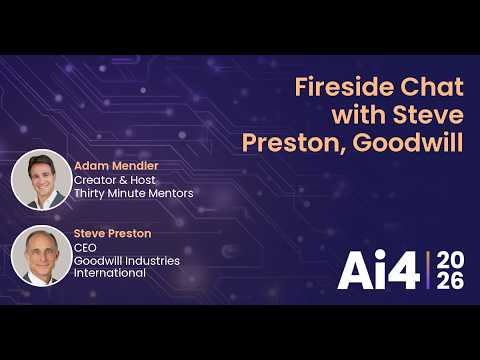
## Background Published by Ai4 on YouTube on August 22, 2026, this fireside chat features Adam Mendler interviewing Goodwill Industries International President and CEO Steve Preston. The session explores the significant AI training and literacy gaps in the modern workforce, Goodwill's operational adoption of artificial intelligence, and how both companies and individuals can navigate transformative career pathways.
## TL;DR Goodwill CEO Steve Preston outlines how AI and data-driven interventions can bridge the divide between more than 40 million underemployed Americans and millions of open jobs in logistics, healthcare, and skilled trades. He explains how Goodwill deploys AI to streamline diagnostic intake, barrier assessments, and personalized learning, freeing frontline career coaches to provide high-touch human mentorship and wraparound social support. Highlighting evidence-based successes—such as reducing recidivism rates to the mid-single digits—Preston urges corporate HR leaders, technologists, and investors to partner with community workforce developers, framing the upskilling of overlooked talent as an extraordinary financial and societal return on investment.
## Atmosphere & style The discussion carries a measured, pragmatic, and purpose-driven tone, seamlessly blending high-level economic analysis with grounded humanitarian empathy. Steve Preston communicates with the sharp financial discipline of an experienced public servant and former investment banker while maintaining a steadfast focus on vulnerable job seekers. The exchange feels both authoritative and deeply inspiring, reframing AI from an intimidating source of labor disruption into an essential diagnostic and developmental catalyst for human mobility.
## Key takeaways - [00:04](https://www.youtube.com/watch?v=dn75IsD4gD8&t=4s) Discussions surrounding AI have evolved beyond technical capabilities into a human-centered workforce transition focused on creating sustainable economic outcomes. - [02:04](https://www.youtube.com/watch?v=dn75IsD4gD8&t=124s) A massive labor market mismatch persists in the United States, with over 40 million underemployed or low-wage workers alongside millions of unfilled roles in healthcare, logistics, and skilled trades. - [04:18](https://www.youtube.com/watch?v=dn75IsD4gD8&t=258s) AI diagnostics can instantly evaluate work readiness and life barriers, enabling tailored learning pathways and automated social service referrals. - [04:18](https://www.youtube.com/watch?v=dn75IsD4gD8&t=258s) Rather than displacing human counselors, AI-enabled administrative automation frees career coaches to focus on high-touch behavioral mentorship and employer readiness. - [08:07](https://www.youtube.com/watch?v=dn75IsD4gD8&t=487s) The workforce development tech ecosystem remains fragmented, requiring scale and connective data infrastructure to determine which interventions work best. - [08:07](https://www.youtube.com/watch?v=dn75IsD4gD8&t=487s) Data-informed wraparound interventions have proven capable of driving justice-involved recidivism down into the mid-single digits compared to the 30% to 40% national average. - [12:05](https://www.youtube.com/watch?v=dn75IsD4gD8&t=725s) A symbiotic economic loop exists where equipping marginalized individuals with career pathways directly addresses acute corporate labor shortages. - [13:02](https://www.youtube.com/watch?v=dn75IsD4gD8&t=782s) Talent and human potential are evenly distributed across society, but access to training, technology, and career opportunities is not. - [13:02](https://www.youtube.com/watch?v=dn75IsD4gD8&t=782s) Technology vendors and business leaders should partner directly with frontline workforce nonprofits to pilot AI solutions on practical, ground-level challenges. - [15:40](https://www.youtube.com/watch?v=dn75IsD4gD8&t=940s) The return on investment for upskilling and rehabilitation dramatically outweighs the compounding public liabilities of incarceration and generational poverty.
## Detailed walkthrough ### [00:04](https://www.youtube.com/watch?v=dn75IsD4gD8&t=4s) Introduction and Expanding AI Beyond Pure Technology
Adam Mendler introduces Steve Preston, highlighting his diverse leadership career spanning both the private and public sectors, including his service as head of the Small Business Administration (SBA) and as a presidential cabinet secretary (leading the Department of Housing and Urban Development), prior to becoming the President and CEO of Goodwill Industries International—the largest workforce development organization in the United States.
When asked about his unique perspective on AI and how Goodwill utilizes it, Preston observes that discussions around AI have matured from early debates about pure technical capabilities to a much deeper conversation about "what it means for people, what it means for humanity, what it means for how we develop ourselves." Managing an organization of 140,000 employees alongside a vast retail network and workforce development infrastructure, Preston explains that Goodwill's core mission is understanding how AI intersects with employers, workers, and society at large. While upskilling people with tactical AI proficiencies is vital, he stresses that the ultimate priority is navigating a massive, multifaceted workforce transition to secure better economic outcomes for communities and families.
[02:04](https://www.youtube.com/watch?v=dn75IsD4gD8&t=124s) Addressing the Macro Workforce Imbalance
Preston frames the AI transition within a broader context of shifting demographics, an aging population, and deep systemic labor market distress. Across the United States, over 40 million people are unemployed, underemployed, or stuck in very low-wage jobs. Simultaneously, severe labor shortages persist in critical sectors, with nearly 2 million open roles across healthcare and logistics, alongside well over 600,000 vacancies in skilled trades and building maintenance.
```mermaid flowchart TD accTitle: AI-Driven Workforce Transition Framework subgraph S1["Workforce Challenges"] A["40M+ Unemployed, Underemployed, & Low-Wage Workers"] B["Demographic Shifts & Aging Population"] end
subgraph S2["AI-Enabled Interventions"] C["Aggregated Diagnostic & Barrier Assessments"] D["Adaptive Learning & Personalized Training"] E["Integrated Wraparound Support (Housing/Childcare)"] end
subgraph S3["Target Outcomes"] F["Filling 2M+ Openings in Healthcare & Logistics"] G["Filling 600K+ Openings in Skilled Trades & Maintenance"] H["Sustainable Wage Growth & Reduced Recidivism"] end
S1 --> S2 S2 --> S3 ```
Preston argues that these vacancies represent high-quality careers capable of changing life trajectories if underrepresented populations can receive the right training. AI can accelerate this transition by equipping individuals with support tools and capturing comprehensive data to measure service efficacy. Beyond macro initiatives, Goodwill has already provided foundational AI tools and skills training directly to roughly 25,000 individuals.
- **40+ million**: Number of Americans currently unemployed, underemployed, or earning low wages. - **2+ million**: Open jobs in healthcare and logistics needing qualified workers. - **600,000+**: Unfilled openings in skilled trades and facility maintenance. - **25,000**: Individuals directly trained by Goodwill in AI tools and core competencies.
[04:18](https://www.youtube.com/watch?v=dn75IsD4gD8&t=258s) Designing the AI-Augmented Career Coaching Journey
To illustrate AI's practical potential, Preston walks through the experience of a typical job seeker entering a Goodwill center. Approximately 85% to 86% of the individuals Goodwill serves have a high school diploma or less, and many navigate severe hurdles, such as long-term unemployment or prior justice involvement. In a standard workflow, a career coach administers multiple assessments evaluating life stability, work readiness, and technical skills, matching those findings against real-time local labor market data to construct a customized development plan.
Under an AI-augmented model, the aggregation of diagnostic assessments, barrier identification, and customized pathway generation happens almost instantly. If an individual struggles with housing instability, childcare gaps, or work-readiness deficits, AI tools can streamline referrals across third-party social service networks and monitor participation. Furthermore, online coursework can incorporate adaptive, one-on-one personalized learning. Rather than replacing human counselors, these automated workflows liberate career coaches from administrative burdens, empowering them to deliver high-touch mentorship, behavioral coaching, and employer-backed job readiness preparation.
[08:07](https://www.youtube.com/watch?v=dn75IsD4gD8&t=487s) Scaling Innovation, Ecosystem Guts, and Predictive Analytics
Addressing how close the field is to realizing this comprehensive vision, Preston notes that while small innovators and major entities—such as Coursera's investments in adaptive learning, alongside philanthropic backing from the Gates Foundation, the Ballmer Group, and Stand Together—are engineering point solutions, the broader ecosystem remains fragmented. Crucial connective tissue between specialized tools is still missing, which is why Goodwill leverages its scale to test and co-develop emerging technologies.
```mermaid flowchart LR accTitle: Goodwill Data Aggregation and Feedback Engine subgraph Input["Population Scale"] A["2M People Touched / Year"] B["200K+ Intensive Cases"] end subgraph Engine["AI Aggregation & Analytics"] C["Cross-Platform Data Integration"] D["Predictive Intervention Modeling"] end subgraph Stakeholders["Ecosystem Beneficiaries"] E["Frontline Coaches"] F["Policymakers & Researchers"] G["Employers & Candidates"] end
Input --> Engine Engine --> Stakeholders ```
Preston emphasizes that Goodwill serves over 2 million people annually, delivering intensive, individualized career support to more than 200,000 individuals. This footprint positions the organization to build data aggregation systems that identify precisely which interventions produce positive outcomes for specific life challenges. Drawing an analogy to clinical medical diagnostics, he notes that data-backed decision support can drastically reshape social outcomes. For instance, while national recidivism rates for justice-impacted individuals typically hover between 30% and 40% within the first two years post-release, Goodwill's dedicated, data-informed justice-involved programs have driven recidivism down into the mid-single digits.
- **2 million**: Total individuals assisted by Goodwill programs each year. - **200,000+**: Individuals receiving dedicated, intensive one-on-one career case management annually. - **30% to 40%**: Typical national baseline recidivism rate within 1–2 years of release from incarceration. - **Mid-single digits**: Recidivism rate achieved within Goodwill's intensively tracked, evidence-based justice programs.
[12:05](https://www.youtube.com/watch?v=dn75IsD4gD8&t=725s) Unlocking Pathways Out of Poverty and Fueling Economic Growth
Reflecting on targeted pilot programs, Steve Preston highlights how combining holistic wraparound services with structured support leads to "astoundingly low recidivism rates." While these successes currently exist within specific program microcosms, scaling that level of insight across all workforce development initiatives would create a fundamentally different pathway out of poverty and hardship. Rather than viewing social support in isolation, Preston stresses that this pathway directly meets the desperate hiring demands of businesses: it fuels the broader economy by supplying critical talent to employers facing acute labor shortages.
This alignment between social support and market demand represents "the most symbiotic thing you can imagine" in contemporary society. To realize this potential at scale, organizations must bridge the gap between emerging artificial intelligence tools and deeper organizational understanding powered by cleaner, comprehensive data. Preston emphasizes that building these analytical bridges creates a massive unlock for workforce providers, job seekers, and the business community alike.
- **The Symbiotic Value Loop**: Supporting vulnerable job seekers concurrently lifts individuals out of poverty and resolves critical talent deficits for growing enterprises. - **Data and AI as Catalysts**: Microcosm-level interventions show dramatic drops in recidivism, demonstrating that scaling these outcomes requires integrating predictive data and modern AI tools across social services.
[13:02](https://www.youtube.com/watch?v=dn75IsD4gD8&t=782s) Actionable Advice for HR, Tech Partners, and Business Leaders
Addressing an audience spanning startup entrepreneurs, corporate executives, independent contributors, and machine learning specialists, Adam Mendler asks how diverse stakeholders can get practically involved. Preston directs his first recommendation to HR leaders and corporate recruiters, urging them to recognize the massive, overlooked talent pool waiting across the nation. Emphasizing that "talent and potential is evenly distributed; opportunity is not," he notes that systemic lack of access and life hurdles prevent capable workers from entering traditional pipelines. Companies must rethink how they source, train, develop, and nurture candidates, intentionally partnering with non-traditional workforce developers like Goodwill to tap into unconventional pipelines.
For technology professionals, IT service providers, and venture investors, Preston advocates actively steering technical resources toward nonprofit and community challenges. Rather than treating social impact as a separate philanthropic silo, organizations should consult with their IT teams and external advisers to explore where AI tools can streamline operations and improve client outcomes. By collaborating directly with local workforce organizations to pilot innovative tools in real-world environments, developers can discover what works on the ground and accelerate the national dialogue on talent development.
```mermaid flowchart TD accTitle: Goodwill Collaborative Talent Model subgraph Partners["Cross-Sector Stakeholders"] HR["HR & Corporate Recruiters"] TECH["Tech Vendors & IT Partners"] INV["Investors & Philanthropists"] end subgraph Pipeline["Nontraditional Workforce Pipeline"] GII["Goodwill & Community Nonprofits"] TRAIN["Targeted Training & AI Tooling"] WRAP["Wraparound Support Services"] end subgraph Market["Economic & Social Impact"] DIV["Equitable Opportunity Access"] LABOR["Skilled Talent for Employers"] end
Partners --> GII GII --> TRAIN TRAIN --> WRAP WRAP --> Market ```
- **Rethinking Candidate Pipelines**: HR departments are encouraged to look beyond standard resume profiles and collaborate with community developers who cultivate resilient talent. - **Engaging Technical Capabilities**: IT departments and technology consultants can partner with local nonprofits to deploy and stress-test operational AI solutions in frontline environments.
[15:40](https://www.youtube.com/watch?v=dn75IsD4gD8&t=940s) Changing the Narrative: The Irresistible ROI of Human Potential
Turning to the broader cultural perception of disadvantaged communities, Preston urges a fundamental shift in the narrative around what marginalized individuals can achieve. It is easy for passersby to look at struggling urban neighborhoods or individuals re-entering society after prison and resign themselves to skepticism. Yet daily operations across Goodwill disprove that pessimism: individuals starting from intensely difficult situations regularly transform their trajectories within months, overcoming formidable barriers to secure positions at "some of the most storied organizations in our country." Realizing this widespread change requires three core commitments: believing transformation is possible, acknowledging that the investment is worthwhile, and actively dismantling systemic obstacles that stall progress.
To substantiate the economic case, Preston—drawing on his past career as an investment banker—frames social rehabilitation in terms of financial return on investment. Incarcerating an individual costs upwards of $40,000 per year, not accounting for the secondary economic devastation of an absent parent, dependent family assistance, and the multi-generational churn of the criminal justice system. Comparing those compounding liabilities against the modest cost of technological and skills-based intervention reveals an extraordinary dividend: individuals gain long-term self-sufficiency, children secure stable domestic foundations, and employers gain loyal workers. Preston notes this constitutes an ROI that "any investment banker or private equity person in New York or in the valley would take any time any day of the week."
```mermaid flowchart TD accTitle: The Societal and Economic ROI of Workforce Reentry subgraph Inaction["Cost of Systemic Inaction"] C1["Incarceration Costs: $40,000+ per Year"] --> C2["Parental Absence & Family Destabilization"] C2 --> C3["Multi-Generational Churn & Lost Economic Output"] end subgraph Reentry["Targeted Intervention & AI Enablement"] I1["Holistic Support & Technological Upskilling"] --> I2["Placement in Resilient, Career-Track Roles"] end subgraph Dividend["Financial & Societal Return"] R1["Self-Sufficient Taxpaying Households"] R2["Stable Upward Trajectory for Children"] R3["Direct Labor Supply for Businesses"] end
Reentry --> Dividend ```
- **Direct Incarceration Costs**: Housing an incarcerated individual exceeds $40,000 annually in public funds, excluding ancillary downstream expenditures. - **Multi-Generational Impact**: Removing a parent creates ripple effects that disrupt child welfare and household financial stability for decades. - **The Financial and Human Bottom Line**: The capital required to upskill a worker delivers asymmetric economic returns compared to the cost of systemic neglect, positioning AI tools as a critical mechanism to unlock human capability nationwide.
## Notable quotes > [00:04](https://www.youtube.com/watch?v=dn75IsD4gD8&t=4s) what it means for people, what it means for humanity, what it means for how we develop ourselves. — Steve Preston
> [12:05](https://www.youtube.com/watch?v=dn75IsD4gD8&t=725s) astoundingly low recidivism rates — Steve Preston
> [12:05](https://www.youtube.com/watch?v=dn75IsD4gD8&t=725s) the most symbiotic thing you can imagine — Steve Preston
> [13:02](https://www.youtube.com/watch?v=dn75IsD4gD8&t=782s) talent and potential is evenly distributed; opportunity is not — Steve Preston
> [15:40](https://www.youtube.com/watch?v=dn75IsD4gD8&t=940s) some of the most storied organizations in our country — Steve Preston
> [15:40](https://www.youtube.com/watch?v=dn75IsD4gD8&t=940s) any investment banker or private equity person in New York or in the valley would take any time any day of the week. — Steve Preston
## Mentioned Steve Preston, Adam Mendler, Goodwill Industries International, Thirty Minute Mentors, Ai4, Small Business Administration (SBA), Department of Housing and Urban Development, Coursera, Gates Foundation, Ballmer Group, Stand Together
## Video description Adam Mendler - Creator & Host, Thirty Minute Mentors Steve Preston - CEO, Goodwill Industries Internationa
As AI transforms industries, organizations, and jobs, what can individuals do to stay relevant, and what role should companies play in ensuring employees are AI literate? A recent report from Goodwill Industries International (GII) indicates that only 22 percent of Americans use AI for career training and upskilling, while 35 percent report not using AI professionally at all. Forty-nine percent of respondents said they cannot keep up with the pace at which AI is moving, and only 40% said their employers provide adequate AI training. As GII President and CEO, Steve Preston leads both the largest nonprofit workforce development provider in the country and the largest network of thrift stores. In this fireside chat, Steve will talk about the current AI gaps in the workforce, the pathways we need to create for individuals to bridge to the AI future, how Goodwill is using AI to improve operations, what companies should do to ensure a competitive workforce in the AI world, and how individuals can leverage this pivotal period to advance their own careers.
[Source](https://www.youtube.com/watch?v=dn75IsD4gD8)