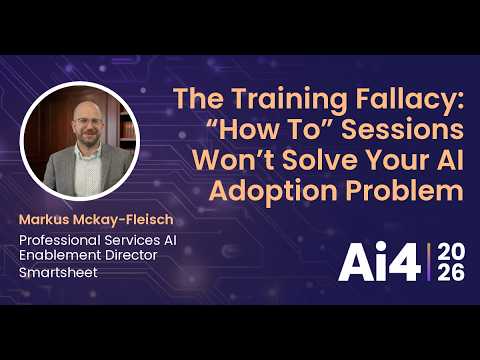
Smartsheet Shifts AI Training from Tool Mechanics to Workflow Redesign
Ai4
Procedural software training fails to drive enterprise AI adoption because natural language eliminates navigational barriers, requiring organizations to overhaul underlying infrastructure and business workflows instead.
## Background
Published on YouTube by Ai4 on August 21, 2026, this presentation features Markus McKay-Fleisch, Professional Services AI Enablement Director at Smartsheet. The session explores why traditional 'how-to' software training fails to drive meaningful enterprise AI adoption and explains how enablement must evolve as natural language replaces rigid platform interfaces.
## TL;DR
Markus McKay-Fleisch argues that teaching point-and-click software mechanics is obsolete because natural language has become the primary interface and AI assistants provide procedural help on demand. The real bottlenecks to adoption are human judgment—specifically business acumen and discernment against unreviewed AI 'slop'—alongside inconsistent technical surfaces. To achieve lasting transformation, organizations must standardize integrations using the Model Context Protocol (MCP) and server-side native skills, while pivoting enablement toward outcome-focused workflow redesign, hands-on AI Labs, and forward-deployed engineering.
## Atmosphere & style
The presentation carries a candid, pragmatic, and authoritative tone informed by two decades of experience in adult education and enterprise technology rollouts. McKay-Fleisch delivers a refreshing, analytical reality check to standard corporate training dogma, using evocative terminology like the 'slop cannon' and 'bite and build' sessions to expose common adoption dysfunctions. It feels like an incisive, fast-paced strategic briefing that replaces passive educational theory with actionable, engineering-aligned operational models.
## Key takeaways
- [00:03](https://www.youtube.com/watch?v=bH3qLyFXS2w&t=3s) High completion rates for mandatory AI training often mask a lack of real-world adoption, while individual power users remain isolated silos whose workflows fail to scale.
- [02:11](https://www.youtube.com/watch?v=bH3qLyFXS2w&t=131s) Human language has replaced platform knowledge as the primary software interface, rendering procedural point-and-click training obsolete.
- [02:45](https://www.youtube.com/watch?v=bH3qLyFXS2w&t=165s) Modern conversational assistants and LLMs can ingest product documentation on demand to guide users through complex workflows in real time.
- [04:45](https://www.youtube.com/watch?v=bH3qLyFXS2w&t=285s) Without organizational business acumen, employees build redundant AI solutions in silos rather than collaborating with appropriate domain owners.
- [05:55](https://www.youtube.com/watch?v=bH3qLyFXS2w&t=355s) Frictionless AI generation creates a 'slop cannon' of unreviewed content unless enablement prioritizes human judgment, discernment, and domain alignment.
- [07:18](https://www.youtube.com/watch?v=bH3qLyFXS2w&t=438s) Enterprises must maintain architectural consistency across native in-app assistants and external chat interfaces connected via Model Context Protocol (MCP).
- [09:20](https://www.youtube.com/watch?v=bH3qLyFXS2w&t=560s) Server-side native skills inject domain context automatically, eliminating the need for end users to perform complex prompt engineering.
- [11:51](https://www.youtube.com/watch?v=bH3qLyFXS2w&t=711s) AI enablement must pivot from teaching software features to outcome-oriented workflow redesign and broader organizational transformation.
- [13:30](https://www.youtube.com/watch?v=bH3qLyFXS2w&t=810s) Interactive delivery models like AI Labs and Forward Deployed Engineers replace passive lectures with customized prompt cookbooks and tailored integrations.
- [15:15](https://www.youtube.com/watch?v=bH3qLyFXS2w&t=915s) Organizations should replace passive 'lunch and learn' sessions with hands-on 'bite and build' workshops where teams construct functional workflows.
- [16:31](https://www.youtube.com/watch?v=bH3qLyFXS2w&t=991s) Modernizing AI strategy requires auditing legacy training curricula, institutionalizing power-user methods, and assigning clear workflow design ownership.
- [17:29](https://www.youtube.com/watch?v=bH3qLyFXS2w&t=1049s) Sustainable AI adoption relies on dedicated workflow redesign leadership to tightly integrate enablement programs with transformed operational processes.
## Detailed walkthrough
### [00:03](https://www.youtube.com/watch?v=bH3qLyFXS2w&t=3s) The AI Adoption Paradox and the Limits of Traditional Training
Markus McKay-Fleisch introduces himself as the Professional Services AI Enablement Director at Smartsheet, an AI-powered work management platform. Having spent two decades in adult education, he notes that he is well into his 40s and has guided organizations through multiple waves of enterprise technology adoption. For the past two years, his work has focused entirely on AI enablement, where his role centers less on simply building courses and more on digging into behavioral data to diagnose why enterprise AI adoption initiatives stall, drift, or completely collapse.
The data reveals a recurring paradox familiar to learning and development professionals. Organizations roll out mandatory AI training, celebrate high completion rates, and assume success, only to find that actual day-to-day usage fails to materialize in meaningful ways. Alternatively, companies encounter the opposite extreme: runaway usage where employees indiscriminately default to the most powerful and expensive frontier models, blowing up token budgets and prompting finance leaders to demand corrective training. Meanwhile, the organic "bright spots"—exceptional power users who radically transform their individual workflows—remain isolated silos whose innovations fail to diffuse across the wider organization. When struggling team leaders inevitably demand "more training," they are operating on an outdated assumption that the primary obstacle is tool mechanics.
```mermaid
flowchart TD
accTitle: The AI Adoption Dilemma
subgraph S1["Traditional Assumption"]
A["Low or Inefficient AI Adoption"] --> B["Leader Request: 'Run More Training'"]
B --> C["Focus on Point-and-Click Tool Mechanics"]
end
subgraph S2["Actual Enterprise Reality"]
D["Training Completion High"] --> E{"Adoption Fractures"}
E --> F["Zero Meaningful Workflow Integration"]
E --> G["Runaway Token Budgets via Expensive Models"]
E --> H["Isolated Bright Spots That Fail to Scale"]
end
```
[02:11](https://www.youtube.com/watch?v=bH3qLyFXS2w&t=131s) The Shift from Platform Knowledge to Language as the Interface
For decades, software training focused on overcoming the barrier of platform knowledge. Software suites like Microsoft regularly update interfaces, relocate buttons, and introduce new menus, requiring users to memorize where features live. In the generative AI era, however, the fundamental interface to software has become human language. Users no longer need to execute rigid sequence steps manually; they describe the desired outcome, and the underlying AI system interprets the intent and assembles the execution steps.
This paradigm shift resolves the classic "how do I" problem that once occupied the bulk of training curricula. Because modern applications integrate conversational in-app assistants trained on internal product documentation, users can ask how to execute any task in real time and receive immediate, context-aware instructions. Alternatively, feeding public help documentation links into general-purpose large language models like Claude, Microsoft Copilot, Google Gemini, or ChatGPT yields instant, conversational walkthroughs. Because procedural instructions are now available on demand, training programs that focus on navigational point-and-click mechanics are effectively obsolete.
- The interface barrier has transitioned from memorizing platform features to articulating clear outcomes.
- In-app AI help agents eliminate the need for procedural software user manuals.
- General-purpose LLMs can ingest documentation URLs and guide users through complex workflows conversationally.
[04:45](https://www.youtube.com/watch?v=bH3qLyFXS2w&t=285s) Critical Human Capabilities: Business Acumen and Combating the "Slop Cannon"
When platform navigation is no longer the bottleneck, the true barriers to effective AI adoption become organizational understanding and human judgment. Organizational understanding, or business acumen, dictates whether employees recognize the appropriate business domains for their solutions. A clear example emerged within Smartsheet's internal Claude workspace data: employees across finance, customer support, sales, and HR had created more than 50 separate Claude projects dedicated to generating on-brand company deliverables, yet not a single project had been created by the marketing team that actually owns the brand. While AI empowered individual contributors to attempt a solution, a lack of business acumen prevented them from collaborating with the rightful domain owners to build a unified, sustainable asset.
The second human skill, human judgment, is critical for countering what is colloquially termed the "slop cannon." Because generative models make content production frictionless, uncritical users often generate low-effort outputs and distribute them immediately without review, effectively offloading the burden of discernment, fact-checking, and editing onto their colleagues. Enablement must move away from teaching button clicks and instead train employees in critical evaluation, descriptive precision, domain alignment, and creative refinement.
```mermaid
flowchart LR
accTitle: The Slop Cannon versus Discernment Workflow
subgraph Bad["The Slop Cannon Pattern"]
A1["Frictionless AI Generation"] --> A2["Zero Review / No Discernment"]
A2 --> A3["Unfiltered Distribution to Colleagues"]
end
subgraph Good["Human-in-the-Loop Pattern"]
B1["Frictionless AI Generation"] --> B2["Human Judgment & Domain Review"]
B2 --> B3["Refined, High-Value Deliverable"]
end
```
[07:18](https://www.youtube.com/watch?v=bH3qLyFXS2w&t=438s) Technical Architecture: Surfaces, MCP, and Native Skills
From an architectural standpoint, enablement teams must evaluate the surfaces through which employees access AI. Users typically interact with AI either through embedded native assistants within specialized applications or via general-purpose LLM chat interfaces connected to enterprise systems through the Model Context Protocol (MCP). To minimize cognitive load and eliminate confusing discrepancies, enterprise platforms must deliver identical results regardless of the entry point. A prompt such as "create a dashboard showing which projects are on track, at risk, or overdue, and group those by portfolio and owner" should execute seamlessly whether it is entered directly inside Smartsheet or typed into Claude via an MCP connector.
```mermaid
flowchart TD
accTitle: Dual Surface Integration via Model Context Protocol
User["User Prompt"] --> S1["In-App Native Assistant"]
User --> S2["General LLM / Claude Chat"]
S2 --> MCP["Model Context Protocol (MCP)"]
MCP --> Data["Smartsheet Business Data & Native Server-Side Skills"]
S1 --> Data
Data --> Out["Unified, Consistent Execution"]
```
Another vital architectural consideration is how platforms inject context through "native skills" or server-side instructions. Because base language models have no inherent understanding of proprietary application schemas, server-side skills supply structured rules and domain context in the background without user intervention. When an enterprise platform embeds these native skills directly into its MCP integration, end users are spared the burden of advanced prompt engineering and context engineering, allowing enablement teams to focus on operational workflows rather than prompt syntax.
- Consistent execution across both in-app interfaces and external LLM surfaces is essential for user trust.
- Model Context Protocol (MCP) acts as the bridge connecting general LLMs to proprietary business systems.
- Native, server-side skills automatically structure data requests behind the scenes, reducing the need for explicit user prompt engineering.
[11:51](https://www.youtube.com/watch?v=bH3qLyFXS2w&t=711s) Redesigning Enablement: Outcome Thinking, AI Labs, and Forward Deployed Engineers
Enablement remains vital, but its scope must pivot from teaching software tools to facilitating workflow redesign and organizational AI transformation. Workflow redesign analyzes how a specific outcome is achieved, while AI transformation addresses the surrounding organizational structures, responsibilities, and skill sets. Instead of accepting requests for generic tool training, enablement leaders should challenge business stakeholders by asking: "What outcome are you trying to achieve?" Once the desired business outcome is defined, enablement teams can engineer the process backward to determine the right AI intervention.
To put this methodology into practice, Smartsheet utilizes two customer-facing delivery models:
1. **AI Labs:** Collaborative discovery workshops that analyze a customer's specific workflows and data patterns, matching them directly to platform capabilities. Instead of generic software workbooks, participants leave with a customized "prompt cookbook" tailored to their team's specific terminology and operating rhythm.
2. **Forward Deployed Engineers (FDE):** Highly technical practitioners who embed with client teams to build custom capabilities, leveraging advanced environments like Claude Code to deploy server-side skills and integrations that everyday business users can interact with purely through natural language.
These strategies align with a guiding principle: "Get the infrastructure right and AI just works. Help your people think differently and the work transforms. Do both and nobody needs a lunch and learn." Rather than passive educational sessions, organizations should host active "bite and build" workshops where teams construct functional workflows over a shared meal.
[16:31](https://www.youtube.com/watch?v=bH3qLyFXS2w&t=991s) Actionable Steps for Enterprise AI Enablement
To modernize enablement strategies, organizations should focus on three immediate operational actions:
- **Audit Existing Training Curricula:** Review current learning modules to determine whether they teach obsolete point-and-click mechanics or modern outcome-oriented workflow redesign.
- **Identify and Leverage Power Users:** Locate internal power users who are already driving transformative AI workflows, capturing their tacit methods to embed proven execution patterns across the entire company.
- **Establish Workflow Design Ownership:** Formally identify who within the organization is responsible for AI workflow design, whether that accountability sits within enablement, operations, or dedicated technical teams.
[17:29](https://www.youtube.com/watch?v=bH3qLyFXS2w&t=1049s) Aligning Enablement with Workflow Redesign and Concluding Remarks
Markus McKay-Fleisch highlights the critical nature of hiring and establishing dedicated leadership to tackle workflow transformation, noting that Smartsheet specifically hired someone into that role because of how monumental the task is. Redesigning organizational workflows to integrate AI effectively represents a massive challenge for modern enterprises. To truly make progress, organizations need to identify who is leading those workflow redesign efforts internally, partner closely with them, and deliberately align ongoing training and enablement initiatives with their strategy. Simply delivering generic how-to sessions in a silo will not move the needle; success comes from anchoring enablement directly to redesigned operational workflows.
Concluding the presentation with around two and a half minutes remaining on the clock, Markus thanks the audience for their time and opens the floor to take questions from the attendees.
- **Workflow Redesign as the True Driver:** Enterprises face a major operational hurdle in modernizing business processes, making dedicated workflow redesign leadership essential for sustainable AI transformation.
- **Enablement Alignment:** Sustainable AI adoption requires training and enablement teams to actively collaborate with workflow leaders and tie learning programs directly to redesigned business processes.
- **Closing & Q&A:** The formal presentation wraps up with approximately two and a half minutes left, transitioning directly into audience questions.
## Notable quotes
> If you think the solution to lagging AI adoption is more training sessions, you're unlikely to move the needle. — Markus McKay-Fleisch
> The real shift of the AI era isn't teaching people to use the tools — it's about rethinking what enablement looks like in today's environment. — Markus McKay-Fleisch
> The interface to software has become language: you describe the outcome you want, and the system assembles the steps. — Markus McKay-Fleisch
> The best AI tools are the ones that don't need any manuals. — Markus McKay-Fleisch
> [07:18](https://www.youtube.com/watch?v=bH3qLyFXS2w&t=438s) create a dashboard showing which projects are on track, at risk, or overdue, and group those by portfolio and owner — Markus McKay-Fleisch
> [11:51](https://www.youtube.com/watch?v=bH3qLyFXS2w&t=711s) What outcome are you trying to achieve? — Markus McKay-Fleisch
> [11:51](https://www.youtube.com/watch?v=bH3qLyFXS2w&t=711s) Get the infrastructure right and AI just works. Help your people think differently and the work transforms. Do both and nobody needs a lunch and learn. — Markus McKay-Fleisch
> [11:51](https://www.youtube.com/watch?v=bH3qLyFXS2w&t=711s) bite and build — Markus McKay-Fleisch
## Mentioned
Markus McKay-Fleisch, Smartsheet, Ai4, Microsoft, Claude, Microsoft Copilot, Google Gemini, ChatGPT, Claude Code, Model Context Protocol (MCP)
## Video description
Markus Mckay-Fleisch - Professional Services AI Enablement Director, Smartsheet
If you think the solution to lagging AI adoption is more training sessions, you're unlikely to move the needle. The real shift of the AI era isn't teaching people to use the tools — it's about rethinking what enablement looks like in today's environment.
In this session I’ll explore how the best AI tools are the ones that don't need any manuals. The interface to software has become language: you describe the outcome you want, and the system assembles the steps. I’ll show what that actually looks like — from spinning up a dashboard just by describing it, to helping you understand how AI can work invisibly in the background to enable users. In this era, the approach to AI upskilling is evolving — and I’ll touch on what we think is coming next.
Smartsheet AI Enablement Director Markus McKay-Fleisch argues that traditional point-and-click software training fails to drive enterprise AI adoption because natural language has made procedural instruction obsolete. Successful adoption instead requires shifting enablement toward business acumen, critical judgment, robust technical architecture, and workflow redesign.
The AI Adoption Paradox and Procedural Training (0:03)
Traditional enterprise learning strategies focus on software mechanics and celebrate high course completion rates, yet organizations frequently find that day-to-day AI integration fails to materialize. McKay-Fleisch observes that companies often face two extremes: minimal meaningful adoption or unmanaged usage where employees default to costly frontier models that drain token budgets. Meanwhile, individual power users discover transformative workflows in isolation, but their methods rarely diffuse across the organization. Because leaders mistake these issues for a lack of tool knowledge, they reflexively request more functional training.
McKay-Fleisch contends that this procedural training model is obsolete. For decades, software training helped users memorize changing menus and button placements. In the generative AI era, natural language serves as the primary software interface. Users need only describe an intended outcome, while in-app assistants and general-purpose large language models—such as Claude, Microsoft Copilot, Google Gemini, or ChatGPT—deliver on-demand, contextual execution steps directly from product documentation.
Business Acumen and Mitigating the 'Slop Cannon' (4:45)
When navigating platform interfaces is no longer the main constraint, effective AI use depends on organizational understanding and human discernment. McKay-Fleisch cites an internal audit of Smartsheet's Claude workspace, where employees across sales, finance, human resources, and customer support created over 50 separate projects to generate on-brand collateral, while the marketing team responsible for the brand had created none. Although the tool allowed decentralized creation, a lack of business acumen prevented staff from partnering with domain owners to build a coordinated solution.
At the same time, enablement must cultivate human judgment to counter unvetted content generation, or what McKay-Fleisch terms the 'slop cannon.' Frictionless content generation leads uncritical users to distribute unreviewed, low-effort outputs, shifting fact-checking and editing burdens onto their colleagues. Enablement programs must therefore move away from teaching prompt syntax and focus on training employees to critically evaluate, refine, and align AI outputs with domain standards.
Dual Surfaces and Server-Side Technical Architecture (7:18)
A durable enablement strategy depends on an architectural foundation that supports consistent user interactions across different interfaces. McKay-Fleisch highlights that employees typically access AI through native in-app assistants or general chat interfaces connected via the Model Context Protocol (MCP). Enterprises must ensure that complex prompts—such as generating a portfolio health dashboard grouped by owner—produce identical results whether initiated within an application like Smartsheet or inside an external LLM chat.
To achieve this consistency without imposing cognitive burdens on users, platforms rely on server-side 'native skills.' Because base foundation models lack innate understanding of proprietary enterprise schemas, server-side instructions supply domain context and data structuring automatically. Embedding these native skills into MCP integrations relieves business users from performing complex prompt and context engineering.
Redesigning Enablement via Outcome-Driven Delivery (11:51)
Modern enablement must transition from passive tool education to active workflow redesign, asking stakeholders to define desired business outcomes before deciding how AI should assist. Smartsheet addresses this through collaborative 'AI Labs' that evaluate specific team workflows to produce customized prompt playbooks, alongside Forward Deployed Engineers who build server-side skills using coding tools like Claude Code.
McKay-Fleisch recommends that organizations audit existing curricula to remove obsolete navigational instructions, identify internal power users to scale their practices, and establish clear operational ownership for workflow transformation. Rather than relying on passive lunch-and-learn presentations, teams should engage in hands-on workshops that construct working solutions around actual business processes.
McKay-Fleisch concludes that enterprise AI adoption cannot succeed through isolated training sessions alone; organizations must appoint dedicated leadership for workflow transformation and align enablement initiatives directly with redesigned business processes.
精炼阅读摘要
Smartsheet 专业服务 AI 赋能总监 Markus McKay-Fleisch 指出,单纯教授界面点击步骤的传统培训无法解决企业 AI 采纳难题,唯有将赋能重心转向业务成果导向的工作流重塑与底层架构整合,才能实现实质性业务变革。
采纳悖论与操作培训失效 (0:03)
结合二十年成人教育与企业技术落地经验,McKay-Fleisch 指出企业 AI 采纳中普遍存在一种悖论:企业推行强制性培训并取得极高完成率,但实际业务中的日常整合却严重停滞;或者走向另一极端,员工随意默认使用高昂的前沿模型导致 Token 预算失控,而少数内部超级用户的局部创新又沦为无法推广的单点孤岛。当管理者习惯性地要求“追加更多培训”时,往往错误地将阻碍归咎于员工缺乏工具操作技能。
在生成式 AI 时代,人机交互的核心界面已转变为自然语言,用户只需表述目标,系统即可自动拆解并执行步骤。现代软件广泛集成了基于内部文档训练的原生智能助手,通用大语言模型(如 Claude、Copilot、Gemini 或 ChatGPT)也能直接解析帮助文档并提供实时的分步指导。随需可得的交互式指引已使传统的按钮导航与步骤记忆类课程彻底过时。
业务洞察与抵御无节制低质输出 (4:45)
当平台操作不再是瓶颈,企业采纳 AI 的真正障碍转变为组织业务洞察力与人类批判性判断力。McKay-Fleisch 援引 Smartsheet 内部 Claude 工作区的数据说明:财务、客服、销售与人力资源等团队累计创建了超过 50 个用于生成品牌规范交付物的独立项目,但真正拥有品牌主权的营销团队却从未创建过类似项目。这种缺乏业务领域全局视角的探索,导致各部门无法协同建立统一且可持续的组织资产。
另一大核心挑战在于人类判断力的缺失与所谓“低质内容炮”(slop cannon)现象。由于生成式模型大幅消除了内容生产的摩擦力,不加审视的使用者往往直接分发未经核查与编辑的低质输出,实质上将鉴别、校对和重写的认知负担转嫁给了同事。因此,AI 赋能必须摆脱按钮教学,转而重点培养员工的批判性评估、精准描述以及业务领域对齐能力。
双界面一致性与模型上下文协议 (7:18)
从技术架构层面考量,赋能团队必须评估员工访问 AI 的两种典型界面:专业应用内置的原生助手,以及通过模型上下文协议(MCP)接入企业业务系统的通用大模型对话界面。McKay-Fleisch 强调,无论用户是在 Smartsheet 内直接下达指令,还是在 Claude 中通过 MCP 调度数据生成项目状态仪表盘,系统都必须输出完全一致的结果,以建立用户对系统的基础信任。
与此同时,底层架构必须解决专有数据模式的理解问题。基础大模型本身并不理解企业专有系统的结构规范,平台需要借助“原生技能”在服务端自动注入业务规则与上下文逻辑。这种后台自动化设计消除了终极用户编写繁复提示词或进行上下文工程的负担,使赋能团队能够专注于实际业务运作而非提示词语法教学。
工作流重塑与工程化落地模式 (11:51)
现代赋能的核心必须由教授软件转变为推动业务工作流重塑与组织 AI 转型。赋能管理者应主动追问利益相关者“期望达成何种业务成果”,进而通过逆向工程推导适配的 AI 介入方案。为此,Smartsheet 推行了两种落地模式:一是举办“AI 实验室”(AI Labs),结合客户工作流与数据模式定制“提示词菜谱”;二是派遣“前置部署工程师”(FDE),依托 Claude Code 等开发环境为客户构建服务端技能与自然语言接口。
组织应倡导以边吃边做的“实战构建会”(bite and build)取代被动听讲的午餐分享会,并落实三项具体举措:全面审查现有培训课程以剔除过时的机械操作内容、挖掘并推广内部超级用户的隐性实践经验,以及在组织内明确设立负责 AI 工作流设计的专属职能领导权。
McKay-Fleisch 总结强调,重构工作流以深度整合 AI 是现代企业面临的系统性工程,Smartsheet 亦为此专设了领导岗位;脱离业务流程重塑的孤立工具培训无法解决采纳困境,企业必须明确流程设计的责任主体,并将赋能体系深度锚定于重塑后的业务流程之中。
Detailed notes — zh
## Background
该视频由 Ai4 频道于 2026 年 8 月 21 日发布在 YouTube 平台上。内容由 Smartsheet 专业服务 AI 赋能总监 Markus McKay-Fleisch 主讲,旨在探讨为何传统的“操作培训”无法解决企业 AI 采用率低下的困境,并阐述在“语言即界面”的 AI 时代如何重塑赋能体系与工作流。
## TL;DR
Markus 指出企业 AI 落地的瓶颈已从“学习软件按钮操作”转向“业务理解力”与“人类判断力”,传统的点选式培训无法驱动真正的业务转化。通过分析多入口一致性与服务端原生技能(Native Skills)的技术架构,他展示了如何将认知负荷沉淀至底层基础设施中。Smartsheet 转向以 AI Labs 定制“提示词秘籍”和前线部署工程师(FDE)为主的新型赋能模式,呼吁企业将赋能重心转移到工作流重构与成果导向的实践中。
## Atmosphere & style
演讲风格务实、幽默且极具颠覆性,讲者凭借 20 年培训老兵的视角自嘲并直面传统培训的失效,瞬间拉近与观众的距离。现场氛围兼具技术洞察与组织变革的启发性,从生动比喻“废话加农炮”到提倡将“午餐学习会”改为“边吃边建”,情绪从反思传统困局平稳过渡到提供清晰实操路径的昂扬节奏中。
## Key takeaways
- [00:03](https://www.youtube.com/watch?v=bH3qLyFXS2w&t=3s) 企业 AI 落地中,高培训完成率往往仅是强制打卡的结果,无法转化为真实的业务采用与产出。
- [00:03](https://www.youtube.com/watch?v=bH3qLyFXS2w&t=3s) 员工滥用昂贵的高级模型容易迅速击穿 Token 预算,暴露出企业缺乏合理的用量管理与场景匹配机制。
- [00:03](https://www.youtube.com/watch?v=bH3qLyFXS2w&t=3s) 业务主管将 AI 采用率不足归咎于员工“不会用工具”并要求增加操作培训,这种传统假设在 AI 时代已经失效。
- [02:45](https://www.youtube.com/watch?v=bH3qLyFXS2w&t=165s) 软件界面的本质已演变为自然语言交互,用户只需描述期望成果,系统即可自动组装执行步骤并交付。
- [02:45](https://www.youtube.com/watch?v=bH3qLyFXS2w&t=165s) AI 时代的采用瓶颈已从平台操作知识转移到了解跨部门边界的业务理解力与商业洞察。
- [02:45](https://www.youtube.com/watch?v=bH3qLyFXS2w&t=165s) AI 降低了内容生成门槛但极易引发“废话加农炮”现象,要求组织重点培养员工的人类判断力与质量甄别意识。
- [07:25](https://www.youtube.com/watch?v=bH3qLyFXS2w&t=445s) 无论员工通过原生应用还是外部大模型(结合 MCP)交互,技术架构必须保障跨入口交付一致的业务结果。
- [07:25](https://www.youtube.com/watch?v=bH3qLyFXS2w&t=445s) 将业务规范与数据结构下沉为服务端原生技能,能有效减少全员学习复杂提示词工程的认知负荷。
- [12:02](https://www.youtube.com/watch?v=bH3qLyFXS2w&t=722s) 赋能团队的核心职责应从按键点选教学转向工作流再造与组织级 AI 转型。
- [12:02](https://www.youtube.com/watch?v=bH3qLyFXS2w&t=722s) 现代赋能交付物应淘汰枯燥的操作手册,转向基于 AI Labs 定制产出的提示词秘籍(Prompt Cookbooks)。
- [12:02](https://www.youtube.com/watch?v=bH3qLyFXS2w&t=722s) 引入前线部署工程师(FDE)通过代码将复杂逻辑固化为服务端能力,让普通业务人员通过自然语言即取即用。
- [14:24](https://www.youtube.com/watch?v=bH3qLyFXS2w&t=864s) 搭建好底层基础设施并引导员工思维模式转型,即可摒弃传统的被动听讲,转为边吃边建的主动实践工坊。
- [17:29](https://www.youtube.com/watch?v=bH3qLyFXS2w&t=1049s) 组织必须明确工作流重塑的责任归属,并将日常培训赋能与具体的业务流程再造深度对齐绑定。
## Detailed walkthrough
### [00:03](https://www.youtube.com/watch?v=bH3qLyFXS2w&t=3s) 传统培训的困境与 AI 时代的采用挑战
Markus McKay-Fleisch 作为 Smartsheet 的专业服务 AI 赋能总监(Professional Services AI Enablement Director),在成人教育领域拥有长达 20 年的丰富经验。他在演讲开场自嘲道:“我这把年纪肯定过 40 岁了。”过去 20 年间他见证了诸多技术落地的挑战,而过去两年他的全部精力都聚焦于企业级 AI 的采用。他的核心职责不仅是制定培训课程,更关键的是深入挖掘数据,弄清楚为什么某些 AI 的落地推广会陷入停滞甚至彻底失败。
```mermaid
flowchart TD
accTitle: 传统培训假设与 AI 现实差距对比
subgraph OldWay["传统旧思维 (功能操作驱动)"]
A1["业务主管反馈:<br/>'员工不会用工具'"] --> A2["推行更多按钮/界面培训"]
A2 --> A3["完成率虽高但无法解决根本问题"]
end
subgraph AIReduction["AI 时代现实 (语言即界面)"]
B1["底层障碍转移:<br/>'想清楚做什么 + 准确描述'"] --> B2["业务理解力 + 人类判断力"]
B2 --> B3["重塑工作流与实际业务产出"]
end
```
在企业 AI 落地过程中,培训与开发(T&D)团队经常遭遇几类极其普遍却又矛盾的怪现象:
- **课程完成率虚高但缺乏有效转化**:培训完成率指标看起来非常漂亮,但这往往是因为课程属于强制性要求,员工实际在工作场景中并没有正确使用 AI。
- **Token 预算失控引发财务干预**:许多员工无节制地滥用 AI,动辄默认调用最顶尖、最昂贵的模型,导致公司 Token 预算瞬间被击穿;财务部门随即找上门,要求开展更多培训以限制使用或纠正使用习惯。
- **优秀业务实践难以规模化复制**:少数走在前沿的员工(Bright Spots)表现极具颠覆性,他们彻底重塑了工作流并取得了巨大成功,但这些亮点实践却无法在整个组织内自发扩散。
- **业务领导者的传统思维定势**:当团队使用率不足时,业务主管往往会跑来求助:“我的团队没有采用 AI,我们需要更多的操作培训来解决问题。”这种“员工不会用工具所以需要培训”的传统假设,把障碍归咎于平台功能知识(Platform Knowledge),但这种模式在 AI 时代已经彻底失效。
---
### [02:45](https://www.youtube.com/watch?v=bH3qLyFXS2w&t=165s) “语言即界面”:从功能认知到商业认知与人类判断的转移
在过往的软件时代,界面的按键和菜单位置极其复杂,例如微软几乎每周都在调整功能按钮的位置,导致培训重点长期集中在“如何操作(How do I)”上。然而在 AI 时代,**软件的交互界面已经演进为语言(Interface is Language)**——用户只需用自然语言清晰描述期望的结果,底层系统就会自动拼装执行步骤并交付成果。
当各大平台内置了经过完整帮助文档训练的对话助手,或者用户可以直接将公开文档链接喂给 Claude、Microsoft Copilot、Gemini 或 ChatGPT 等通用大模型时,“如何操作”这个技术障碍已被 AI 自行消解。真正的采用瓶颈转移到了两大人性核心能力上:
```mermaid
flowchart LR
accTitle: AI 时代两大核心人性能力障碍
subgraph HumanSkills["AI 时代两大核心瓶颈"]
direction TB
subgraph BI["1. 业务理解力 (Business Acumen)"]
BI1["识别业务领域边界"]
BI2["跨部门协同构建资产"]
end
subgraph HJ["2. 人类判断力 (Human Judgment)"]
HJ1["内容真实度与质量甄别"]
HJ2["杜绝未审查内容漫灌 (Slop Cannon)"]
end
end
```
1. **组织理解力与商业洞察(Organizational Understanding / Business Acumen)**:
Markus 分享了 Smartsheet 内部的一个真实案例:通过分析企业内部的 Claude 使用数据,他发现各部门员工创建了 50 多个旨在生成“符合品牌规范交付物(On-brand Deliverables)”的 Claude Projects。这些项目的创建者遍布财务、客户支持、销售以及人力资源部门,大家都在重复造轮子尝试让 AI 输出品牌材料,但唯独真正掌管品牌资产与规范的市场营销团队(Marketing)一个项目都没有建。这体现了业务认知的缺失——员工虽然拥有强大的 AI 工具,但遇到跨领域问题时,正确的做法应是联合该领域的专业团队共同构建可持续、可维护的解决方案。
2. **人类判断力与审慎甄别(Human Judgment)**:
AI 极大地降低了内容生产门槛,导致企业内部出现了 Markus 戏称为**“废话加农炮(Slop Cannon)”**的现象。员工轻而易举地通过 AI 批量生成内容,却完全不进行审核与甄别,便直接将其群发出去。这种行为将信息校验与质量判断的负担转嫁给了接收者。AI 是一种放大器(Amplifier),它会放大优秀的人类技能,但同样会成倍放大缺乏审查的低劣产出。
---
### [07:25](https://www.youtube.com/watch?v=bH3qLyFXS2w&t=445s) 赋能落地的技术架构考量:多入口一致性与原生技能
除了人类技能的转变,AI 赋能团队还必须深刻理解底层的技术架构决策。员工究竟是在原生应用(Native App)内部与 AI 交互,还是通过外部通用大模型(如 Claude)配合模型上下文协议(MCP, Model Context Protocol)来调用业务数据?
```mermaid
flowchart TD
accTitle: 多交互入口与原生技能架构
subgraph EntrySurfaces["交互入口 (Surfaces)"]
App["应用内原生 AI (Native App AI)"]
ExtLLM["通用 LLM (如 Claude) + MCP"]
end
subgraph UnifiedGoal["架构目标: 结果一致性"]
Prompt["提示词: 生成在轨/风险/逾期项目仪表板并按负责人分组"]
end
subgraph TechCore["服务端原生技能 (Native Skills)"]
Skills["Server-side Skills 注入业务上下文与数据结构"]
end
App --> Prompt
ExtLLM --> Prompt
Prompt --> Skills
Skills --> Dashboard["交付一致的业务结果"]
```
- **交互入口的一致性保障**:优秀的企业级平台必须确保无论员工从哪个入口输入相同的指令(例如:“创建一个仪表板,展示哪些项目正常推进、存在风险或已逾期,并按项目组合与负责人分组”),最终获取的结果都应完全一致。如果不同入口的产出存在差异,赋能团队就必须花费额外精力去教育员工“什么任务该去哪个入口完成”。
- **服务端原生技能(Server-side Native Skills)**:通用的基础大语言模型本身对于特定企业的专用数据结构一无所知。Smartsheet 等先进平台通过在服务端将标准化、可重复的指令集(Native Skills)注入到 MCP 连接中。当用户发起提问时,系统在后台自动为大模型补充业务上下文和数据规范,整个过程对终端用户完全隐形。
- **提示词工程与基础设施的权衡**:如果底层平台缺乏原生技能的支持,赋能团队就不得不耗费大量时间去培训全员学习复杂的“提示词工程(Prompt Engineering)”与上下文工程;反之,若技术架构在后台处理了这些认知负荷,用户只需用日常大白话提问即可。
---
### [12:02](https://www.youtube.com/watch?v=bH3qLyFXS2w&t=722s) 重塑赋能体系:从点击教学转向工作流再造与交付提示词秘籍
赋能团队不会被淘汰,但工作职责必须发生根本性的转变:从过去的“系统点选培训(Point-and-click training)”全面转向**工作流再造(Workflow Redesign)**与**组织级 AI 转型(AI Transformation)**。工作流再造关注如何达成特定成果,而 AI 转型则关乎组织架构、角色职责与技能模型的整体重构。
```mermaid
flowchart LR
accTitle: Smartsheet 赋能交付模式转型
subgraph Traditional["传统赋能模式"]
T1["点选操作培训"] --> T2["分发操作手册 (Workbooks)"]
end
subgraph Modern["Smartsheet 现代赋能模式"]
M1["AI 创新工坊 (AI Labs)"] --> M2["定制提示词秘籍 (Prompt Cookbooks)"]
M3["前线部署工程师 (FDE)"] --> M4["服务端技能沉淀 (Server-side Code)"]
end
```
当业务主管再次提出需要培训时,赋能负责人的第一反应不应是安排课程,而是直接追问:“**你们究竟想要达成什么样的业务成果?**”在明确目标后,再反向推导出相匹配的 AI 工作流。
Smartsheet 在客户赋能实践中落地了两种高效的新型服务模式:
- **AI 创新实验室(AI Labs)**:深入调研客户特有的工作流模式与业务语境,将其与 Smartsheet 的 AI 能力深度结合。赋能交付物不再是死板的操作手册(Workbooks),而是为客户量身定制的**提示词秘籍(Prompt Cookbooks)**,客户员工拿到即可直接在日常工作中即时应用。
- **前线部署工程师机制(Forward Deployed Engineers, FDE)**:针对客户提出的复杂技术诉求,前线部署工程师会深入客户现场,利用 Claude Code 等高阶工具进行定制化技术开发,并将沉淀的逻辑部署为服务端技能。普通业务用户无需理解复杂代码,直接通过自然语言即可调用这些强大的后台工程能力。
---
### [14:24](https://www.youtube.com/watch?v=bH3qLyFXS2w&t=864s) 总结与行动倡议:基础设施、人类技能与组织实践
Markus 总结道:“AI 的采用本质上不是一个教育问题。”这一结论对于拥有 20 年培训经验的专家而言是一次深刻的思想颠覆。要实现 AI 的真正落地,企业必须在技术侧与组织侧双管齐下:
| 维度 | 核心关注点与实施路径 |
|:--- |:--- |
| **技术侧要求** | 搞清楚员工在哪些入口接触 AI;确保各交互入口的输出质量一致;将业务专长与数据规范沉淀到基础设施和 Native Skills 中,减少全员提示词工程的负担。 |
| **组织与人才侧** | 坚决淘汰纯工具操作培训;转向工作流重塑与以成果为导向的思考模式;重点投资于人类的判断力与创造力,抑制“废话加农炮”漫灌。 |
他引用了一句精辟的总结:“**搭建好底层基础设施,AI 就会顺畅运转;引导员工转变思维模式,业务就会迎来蜕变;两者兼备,便不再需要传统的午餐学习会(Lunch and Learn)。**”不过 Markus 幽默地补充道,他并不反对一起吃午餐,只是建议把枯燥的被动学习会改成主动动手实践的“边吃边建会(Bite and Build)”。
针对参会者,Markus 提出了三条切实的行动建议:
- **到访展台深入交流**:欢迎前往世博厅的 Smartsheet 735 号展台,与技术团队现场探讨平台能力并预约一对一专家咨询。
- **审查既有培训项目与挖掘超级用户**:立即审视现有的某项培训课程,确认其究竟是在教系统点击操作,还是在引导工作流设计;同时找出组织内的核心超级用户(Power Users),将他们的实战经验沉淀并贯穿到整体赋能体系中。
- **明确工作流设计的归属权**:在企业内部明确到底由谁来主导 AI 工作流再造——在很多组织中,这项职责往往最初就落在了赋能专家自己的肩上。
### [17:29](https://www.youtube.com/watch?v=bH3qLyFXS2w&t=1049s) 协同重构工作流:推动组织 AI 跨越的核心与结语
Markus 强调,他们专门为此设立并聘请了专人来负责这一岗位。对于当今的企业而言,重新设计并重塑业务工作流(Workflow Redesign)是一项极其重大且极具挑战性的核心任务。他强烈建议大家务必在自己的组织内部找出负责这项工作的关键人物,主动与他们建立紧密协作,并将日常的培训与赋能(Enablement)工作与这些人员所推进的业务重构深度对齐。Markus 指出,只有实现这种深度协同,“才是真正能推动大家切实向前迈进的关键所在”。
演讲接近尾声时,现场还剩余约 2 分 30 秒的时间。Markus 向在场的所有参会者表达了由衷的感谢,感谢大家的聆听与支持,并在全场的热烈掌声中宣布开放现场提问互动环节。
- **工作流重构的关键角色**:企业当前面临的核心挑战在于业务工作流的重构,必须明确责任人并建立跨部门联动。
- **赋能策略对齐**:AI 培训与赋能工作不能孤立存在,必须与内部重塑工作流程的核心项目紧密绑定。
- **互动与结语**:演讲在剩余 2 分 30 秒时圆满收尾,进入观众现场 Q&A 问答环节。
## Notable quotes
> [00:03](https://www.youtube.com/watch?v=bH3qLyFXS2w&t=3s) 我这把年纪肯定过 40 岁了。 — Markus McKay-Fleisch
> [00:03](https://www.youtube.com/watch?v=bH3qLyFXS2w&t=3s) 我的团队没有采用 AI,我们需要更多的操作培训来解决问题。 — 业务主管(由 Markus 引用)
> [02:45](https://www.youtube.com/watch?v=bH3qLyFXS2w&t=165s) 软件的交互界面已经演进为语言(Interface is Language) — Markus McKay-Fleisch
> [02:45](https://www.youtube.com/watch?v=bH3qLyFXS2w&t=165s) 废话加农炮(Slop Cannon) — Markus McKay-Fleisch
> [07:25](https://www.youtube.com/watch?v=bH3qLyFXS2w&t=445s) 创建一个仪表板,展示哪些项目正常推进、存在风险或已逾期,并按项目组合与负责人分组 — Markus McKay-Fleisch
> [12:02](https://www.youtube.com/watch?v=bH3qLyFXS2w&t=722s) 你们究竟想要达成什么样的业务成果? — Markus McKay-Fleisch
> [14:24](https://www.youtube.com/watch?v=bH3qLyFXS2w&t=864s) AI 的采用本质上不是一个教育问题。 — Markus McKay-Fleisch
> [14:24](https://www.youtube.com/watch?v=bH3qLyFXS2w&t=864s) 搭建好底层基础设施,AI 就会顺畅运转;引导员工转变思维模式,业务就会迎来蜕变;两者兼备,便不再需要传统的午餐学习会(Lunch and Learn)。 — Markus McKay-Fleisch
> [14:24](https://www.youtube.com/watch?v=bH3qLyFXS2w&t=864s) 边吃边建会(Bite and Build) — Markus McKay-Fleisch
> [17:29](https://www.youtube.com/watch?v=bH3qLyFXS2w&t=1049s) 才是真正能推动大家切实向前迈进的关键所在 — Markus McKay-Fleisch
## Mentioned
Markus McKay-Fleisch, Smartsheet, Microsoft, Claude, Microsoft Copilot, Gemini, ChatGPT, MCP (Model Context Protocol), Claude Code
## Video description
Markus Mckay-Fleisch - Professional Services AI Enablement Director, Smartsheet
If you think the solution to lagging AI adoption is more training sessions, you're unlikely to move the needle. The real shift of the AI era isn't teaching people to use the tools — it's about rethinking what enablement looks like in today's environment.
In this session I’ll explore how the best AI tools are the ones that don't need any manuals. The interface to software has become language: you describe the outcome you want, and the system assembles the steps. I’ll show what that actually looks like — from spinning up a dashboard just by describing it, to helping you understand how AI can work invisibly in the background to enable users. In this era, the approach to AI upskilling is evolving — and I’ll touch on what we think is coming next.
[Source](https://www.youtube.com/watch?v=bH3qLyFXS2w)
Source quotes
[0:03] Markus McKay-Fleisch: 我这把年纪肯定过 40 岁了。
[0:03] 业务主管(由 Markus 引用): 我的团队没有采用 AI,我们需要更多的操作培训来解决问题。
[2:45] Markus McKay-Fleisch: 软件的交互界面已经演进为语言(Interface is Language)
[2:45] Markus McKay-Fleisch: 废话加农炮(Slop Cannon)
[7:25] Markus McKay-Fleisch: 创建一个仪表板,展示哪些项目正常推进、存在风险或已逾期,并按项目组合与负责人分组
[12:02] Markus McKay-Fleisch: 你们究竟想要达成什么样的业务成果?
[14:24] Markus McKay-Fleisch: AI 的采用本质上不是一个教育问题。
[14:24] Markus McKay-Fleisch: 搭建好底层基础设施,AI 就会顺畅运转;引导员工转变思维模式,业务就会迎来蜕变;两者兼备,便不再需要传统的午餐学习会(Lunch and Learn)。
[14:24] Markus McKay-Fleisch: 边吃边建会(Bite and Build)
[17:29] Markus McKay-Fleisch: 才是真正能推动大家切实向前迈进的关键所在
Source quotes
Markus McKay-Fleisch: If you think the solution to lagging AI adoption is more training sessions, you're unlikely to move the needle.
Markus McKay-Fleisch: The real shift of the AI era isn't teaching people to use the tools — it's about rethinking what enablement looks like in today's environment.
Markus McKay-Fleisch: The interface to software has become language: you describe the outcome you want, and the system assembles the steps.
Markus McKay-Fleisch: The best AI tools are the ones that don't need any manuals.
[7:18] Markus McKay-Fleisch: create a dashboard showing which projects are on track, at risk, or overdue, and group those by portfolio and owner
[11:51] Markus McKay-Fleisch: What outcome are you trying to achieve?
[11:51] Markus McKay-Fleisch: Get the infrastructure right and AI just works. Help your people think differently and the work transforms. Do both and nobody needs a lunch and learn.
[11:51] Markus McKay-Fleisch: bite and build
Original transcript
[0:03] My name is Marcus McKay Flech. I am the
professional services enablement director
[0:07] at Smart Sheet. That is a mouthful.
If you haven't heard of Smart Sheet,
[0:11] we are an AI powered work management platform. I'm
not going to get into too many details about that
[0:17] right now. If you want to stop by booth 735 out
there in the expo hall, we've got some really uh
[0:22] talented people who can give you some really cool
demos of what the platform can do. Now, I've been
[0:27] in adult education for 20 years. Been a long time.
Just dated myself. I'm getting I'm definitely in
[0:33] my 40s. So, through that time, um I've seen a lot
of tech adoption and challenges that we face with
[0:38] tech adoption. For the past two years, I've
been focused on AI adoption specifically. And
[0:45] the job's really interesting, right? Yes, I get
to put together training, but more importantly,
[0:48] I get to dig into the data and start to understand
why certain AI adoption stalls or even fails.
[0:56] So today we're going to talk a lot about some
of my learnings and we're going to start with
[1:01] something that's probably pretty familiar to
anybody who's worked in training and development
[1:05] adoption work. You put training out there just
like we did with AI and completion rate looks
[1:11] great mostly because maybe it's required but uh
otherwise people are engaging with it. However,
[1:17] your usage doesn't maybe people aren't really
using it in the right way. On the flip side,
[1:23] what I think a lot of us are dealing with now is
people are using it too much and our token budgets
[1:27] have blown up and finance is knocking at your door
saying we now need more training to actually pull
[1:31] back some of that usage or train people how to use
it correctly because we're seeing people default
[1:36] to the highest most expensive models. All that fun
stuff. Secondarily, we might see that those bright
[1:41] spots, right? Those people who are doing things
really, really well, right? They are crushing
[1:45] it. They're changing workflows. They're truly
transformative. That's not spreading for some
[1:50] reason. So we need to try and figure that out. Now
all that comes together when the leader of a team
[1:56] knocks on your door and says, "Hey, my team is not
adopting AI, so we need more training to fix it."
[2:03] Sounds like challenges that we've always faced
in training and development, right? People have
[2:06] always asked for more and more and more training.
When in reality, that's generally not the case.
[2:11] And the mentality that these leaders have, right?
The assumption they make is kind of an old school
[2:16] model. They say, "Hey, my folks don't know how to
use the tool." So let's run more training. That's
[2:23] the old way of thinking, right? The old way is
that platform knowledge was the barrier. There was
[2:28] somebody in here earlier who mentioned Microsoft
either adds new buttons or changes the location
[2:33] of those buttons in their tool almost every week.
Not blaming Microsoft for that. I love Microsoft
[2:38] tools. But um certainly understanding how to
use a platform is important. But in the AI era,
[2:45] the interface is language. And we're going
to dig into that a bit more. And what that
[2:49] really does is it transitions this idea of
the barrier being platform knowledge to the
[2:54] barrier being knowing what to build and how to
actually ask for it. So what I'm going to talk
[3:01] about now are kind of two human skills that we're
seeing uh that have to kind of shift with this
[3:07] new AI era. We're also going to get into some
technical uh architectural skills that are also
[3:12] need to shift in this uh in this era in order to
build really effective enablement and training.
[3:18] So the first thing to understand about this new
AI era is a lot of training programs in the past
[3:24] were focused on the how do I problem but that's
not the problem anymore. I can ask an AI how do I
[3:32] and it will give me the answer. And the cool thing
is I can ask it in multiple different surfaces,
[3:36] right? I can ask it in an app. Most platforms
ship with some sort of conversational help.
[3:41] Certainly Smart Sheet has that in there. And
I can say hey how do I do this thing? and in
[3:45] context of my work instantaneously I get responses
because that AI has been trained on all the help
[3:51] documentation. So that's pretty cool. Now outside
of the platform, pick your LLM of choice, claude,
[3:58] co-pilot, Gemini, whatever it might be, chat GPT.
I can feed it a public link to help documentation
[4:04] and ask it a question and it'll again give
me a very detailed response of how to get
[4:09] there. And even more importantly, I can further
that conversation and get to actually some real
[4:13] beneficial and interesting outcomes. So if the
how do I problem is solved, what are we supposed
[4:20] to do with our training? Let's keep talking about
uh a couple of additional shifts that we need to
[4:26] take into account. Want to focus a little bit on
this interface being language. The idea is you
[4:34] describe the outcome you want and the system
assembles the steps and even beyond that it
[4:39] obviously starts to assemble the outcome. So if
the barrier isn't platform knowledge anymore,
[4:45] what actually is the barrier? Well, I'd argue that
it's two things. organizational understanding,
[4:50] otherwise known as business acumen and human
judgment. Let's break those two things down. Give
[4:55] you an example of both of them. Organizational
understanding recently at Smart Sheet. Um I've
[5:01] been digging into a lot of data. We use claude so
have tons of data around cloud usage and I can see
[5:07] what types of claude projects are being built. And
what I've noticed is we have about 50 plus various
[5:14] cloud projects that focus on building onbrand
deliverables. And I see the people who've created
[5:21] those cloud projects. Not going to name specific
names, but I see people from the finance division.
[5:26] I see people from customer support, from sales,
from HR. We have 50 plus projects that try to do
[5:33] the exact same thing. Take our brand and build
me materials, right? Whether it's presentations
[5:37] or anything like that. Now, the most interesting
thing that I've seen is there isn't a single cloud
[5:41] project that was built by the marketing team,
the team that actually owns the brand. That's
[5:48] a problem. And to me, that's a business acumen
and organizational understanding issue. There's
[5:53] a problem in front of me. I want to build on
brand materials. And yes, AI gives you the power
[5:58] to solve it, but that's not my domain. My domain
is professional services enablement. I need to go
[6:04] find the people who own that domain and have that
expertise so that they can help me build the right
[6:09] solution that's sustainable and we can continue to
update in the future. So, one example of kind of
[6:15] a business acumen way of thinking that we need to
push people towards. Second, human judgment. Well,
[6:20] that's massive, right? There's tons of stuff
underneath human judgment. I'll focus on one thing
[6:25] that I'm sure a lot of you all have dealt with
as well in your organizations. I like to call it
[6:31] the slop cannon. This idea that people can create
things so easily that and then they just generate
[6:38] stuff and send it out into the world without
reviewing it. That is a human judgment issue,
[6:44] right? The discernment task of understanding the
output you're getting, making sure it's accurate,
[6:48] making sure it's valuable. Uh what's happened with
this slop cannon mentality is that that task falls
[6:55] on the people who it's being sent to and that's
not appropriate. Right? So human judgment, that's
[7:00] one example. Obviously, creativity, description,
right? There's a lot of human-based skills that we
[7:06] need to focus on. All that said, that is not the
tool, right? It's not saying here's how to click
[7:13] inside of Claude and push this button and do that
button because the chat interface is right there.
[7:18] I can just ask. Let's talk a little bit about
some technical architecture decisions as well
[7:25] that have some implications on the way we enable
people in this space. So I think one of the most
[7:32] important things is where are you interacting with
this generative AI uh chatbot? Are you interacting
[7:40] with it inside of the app? Are you interacting
with it through a general purpose LLM tool? Now,
[7:48] that generally means that it might be a different
type of question or different type of prompt that
[7:52] you need to send in. But the platforms that are
doing this really, really well and that save us
[7:57] a bunch of time when it comes to enablement give
you the same outcome regardless of the surface
[8:01] where you're entering it from. So, what do I mean
by that? We've got tons of tools that have native
[8:08] AI inside the app. You can ask questions, you get
answers. We then also have model context protocol.
[8:14] This is probably like the one room where I
don't need to explain what MCP actually means,
[8:18] but in case you don't know, uh it is the
way that LLMs talk to your business data,
[8:23] your business applications. [snorts] So with those
two things, if I go into either service right in
[8:30] the app or inside of uh my like cloud, let's say,
and let's just say for smart sheet, I submit the
[8:36] prompt create a dashboard showing which projects
are on track, at risk, or overdue, and group those
[8:41] by portfolio and owner. I need the result to be
the same regardless of where I go to because the
[8:48] last thing I want to do is have to think about
uh where do I go to get this particular outcome?
[8:55] right? I should be able to go anywhere. So the
platforms that are really doing this well should
[9:00] have the exact same outcome regardless of the
surface where you're entering that platform. Now
[9:05] here's the thing from an enablement perspective
why this is important to understand because
[9:10] if I'm going to build a training program right
around some business context and business data
[9:15] if I'm going to if my employees are going to get
different results if they're coming from the app
[9:20] or going through one of your general purpose
tools, you need to help guide them, right? You
[9:24] need to tell them for this task go here for this
task go here. Hopefully the tools catch up, right?
[9:30] Hopefully MCP connections and the inside kind of
the AI native inside uh the app end up getting to
[9:36] the same outcome eventually. But if it doesn't,
that is a very very important thing that we
[9:39] focused on uh is understanding how the different
surfaces actually arrive at different outcomes.
[9:47] Second kind of technical consideration that um
I've been looking at recently is how do these
[9:54] platforms actually understand your prompt. So if
I am in claude, right, and I haven't connected
[10:02] my business data, it doesn't necessarily know
much about the underlying data. I have to feed
[10:06] it a lot of that context. The really kind of
top-of-the-line platforms out there are doing
[10:12] this thing called native skills. Again, I don't
need to tell you all probably what skills are,
[10:16] but in case you don't know, a skill just a general
set of instructions that are repeatable. You can
[10:22] load it into your LLM and then anybody gets
the benefit of that set of instructions. So,
[10:28] with the Smart Sheet platform in particular,
one thing that we're capable of doing is we can
[10:32] load these native skills or server side skills.
And when we load those, anybody using the Smart
[10:39] Sheet MCP connection is able to leverage those
skills because these LLMs are just kind of dumb,
[10:45] right? They don't understand what Smart Sheet
is or what some of these other applications are.
[10:49] Skills are a way around that. We can provide
more context and give more understanding of
[10:54] you're about to encounter Smart Sheet data.
Here's how the data is going to be structured.
[10:58] Here's what this platform does. And the user
doesn't know any of that is taking place,
[11:02] right? We're doing that all in the background. Now
what does this all mean for enablement? The really
[11:10] important thing that we have to understand from
enablement is how much time do I need to spend
[11:14] on prompt engineering? Because if the platform
doesn't have this native skill mentality, right,
[11:20] where it can explain what's going to happen,
we need to teach our people in order to prompt
[11:26] effectively and give it the right context
effectively so that it can get to the best
[11:30] outcome. But again, this native skills, this
is a place to keep your eye on because a lot
[11:34] of companies and platforms are starting to
build this into their MCP connections, uh,
[11:38] into kind of any way you're interacting with AI.
So, really important to understand from a quality
[11:44] perspective what those prompts need to look
like. Okay, talked about some human side things,
[11:51] right? We've got this interface as language
concept. We've got some technical stuff around
[11:56] uh how this stuff might work. So, enablement,
[snorts] we don't need to do it anymore.
[12:02] No, we still got to do it, guys. So, we still have
jobs. Thank god humans are incredibly important.
[12:06] It's just it has to shift, right? It's no
longer how do I use the tool. It's how do I
[12:12] rethink work around AI? So, workflow redesign and
transformation. Workflow redesign is how do we get
[12:20] to an outcome? AI transformation, my definition of
it is everything that happens around that. So the
[12:26] organizational structures, the roles, the people
skills, everything that has to happen. So the
[12:33] question up here uh that I wrote, I don't honestly
like it anymore. The question I always like to
[12:37] pose to those leaders who come to me and say,
"We need more training is I always like to ask,
[12:42] well, what outcome are you trying to achieve?"
Tell me that and then we can back into that,
[12:47] right? But I'm not just going to launch more and
more and more training point andclick specifically
[12:52] in order to try to drive your outcomes because I
have to know what those outcomes actually are. At
[12:57] Smart Sheet, a couple of things we've done from
the customer training side is we have AI labs and
[13:04] we're building up our forward deployed engineer
practice. In both of those cases, what we're
[13:10] doing is we're using smart sheet AI capabilities.
We're bringing those to the customer. So in an AI
[13:15] lab example, we're trying to understand their
workflows, their patterns, and what we do is
[13:21] we align that to the AI capabilities inside a
Smart Sheet. And the customers get to walk away
[13:27] not just with a workbook or anything like that.
They actually walk away with a prompt cookbook.
[13:31] So design prompts that are built around their
workflows, their data, their team's language,
[13:36] they can start using it right then and there. On
the forward deployed engineer side, we have a lot
[13:41] of customers who say, "I want this crazy thing
to be built, right?" And Smart Sheet platform,
[13:46] while it's really great, they can do a lot of
things, can't handle certain asks. But with the
[13:51] forward deployed engineers, they can come in, sit
with the customer, get really technical, pull up
[13:56] cloud code, do some really cool stuff, and then
they can load whatever they've done server side,
[14:03] and the customer gets to use those skills, those
uh you know, this particular connections and and
[14:09] all that engineering work just naturally, right?
Again, just through language and prompting. So
[14:16] again, the the benefit here is that customers are
walking away with specific cookbooks um instead of
[14:20] just workbooks. So coming towards the end here,
we might have a couple minutes for questions as
[14:24] well. But to kind of sum this up, I don't see AI
adoption as an education problem, which is crazy
[14:32] to me. I never thought I would actually say that.
I think training can handle just about everything,
[14:35] but in this situation, I don't think it can.
I think there's some things we need to do and
[14:40] understand both on the technical side and the
people side. So job one on the technical side
[14:44] as enablement professionals we need to understand
how this technology actually works like where are
[14:50] the employees encountering this technology and
are the outcomes the same based on that surface
[14:55] is expertise baked into the infrastructure or
do I need to leverage those power users in order
[15:00] to help uh get that expertise out there? Do my
users need to understand how to prompt engineer,
[15:07] how to prompt correctly and context engineer
correctly in order to get to those best outcomes,
[15:11] or can the tool just handle it itself regardless
of the prompt. On the human side, we're not doing
[15:18] tool training anymore. We're trying to go for
workflow redesign, continuous improvement,
[15:22] that type of mentality. We need to teach people to
think in outcomes. What are you trying to achieve?
[15:29] And then let's back into it with the AI tools
we have available. And finally, biggest thing,
[15:34] invest in human judgment and creativity. This
is all a people-based thing. That does not go
[15:39] away. Uh the things that that what we've noticed
is that AI is an amplifier. So if you build up
[15:45] those human skills, AI is simply going to amplify
them, right? It's going to make them better. Now,
[15:50] that also works in the negative too, right? So
hence the slop cannon thing again, right? So as
[15:55] people kind of maybe don't like doing the review
step, it's an amplifier. So I like this quote
[16:00] at the bottom here. It's get the infrastructure
right and AI just works. Help your people think
[16:05] differently and the work transforms. Do both and
nobody needs a lunch and learn. I kind of disagree
[16:10] with that last part. I actually like maybe we
reconsider the name. Maybe we call it a bite and
[16:14] build or something, right? But like I still like
to eat lunch with people and do some cool work,
[16:18] right? But instead of just learning something
passively, we're actively engaging them to build
[16:22] towards something. So, wrapping it up here. One
thing to do uh today or through this conference.
[16:31] Three things to do. It says this week, but after
the conference is fine. You guys are busy. Number
[16:34] one, come visit the Smart Sheet booth. I'll
be hanging out there quite a bit. We've got an
[16:38] awesome team ready to answer your questions.
Uh we're booth 7:35. You can book a meeting
[16:44] uh with a Smart Sheet representative to
ask specific questions, get really targeted
[16:48] advice in case you don't have time during uh this
conference. And then on the training side, what I
[16:54] encourage you all to do is go back and look at one
of your training programs. What is it teaching? Is
[17:00] it still point-and-click or is it more workflow
design? Who are your top power users? Find them
[17:06] because if their knowledge isn't embedded in
throughout all the training that you're doing,
[17:12] you've got to get it in there, right? Those power
users are incredibly important to upskilling your
[17:16] entire organization and actually proving workflow
redesign patterns. Third thing is identify who in
[17:24] your org owns AI workflow design. And it very well
might be you because it was me for a bit until
[17:29] we hired somebody into that role. So uh it is a
big role. It's a big challenge for corporations
[17:34] right now to redesign their workflows. Strongly
encourage people to understand who that person is,
[17:40] start working with them, and align the training
and enablement work to the great work that those
[17:45] folks are doing. That's what's really going
to truly move you all forward. So, with that,
[17:49] we've got about 2 minutes and 30 seconds left.
I appreciate y'all's time. Thank you so much for
[17:53] being here. Uh, if you have any questions, happy
to take a couple questions from you. [applause]