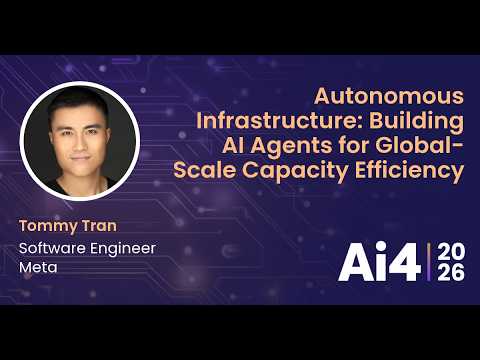
Meta Deploys AI Agents to Fix Fleet Code in Minutes, Saving Megawatts
Ai4
Meta found autonomous infrastructure optimization only succeeds when teams replace monolithic models with modular, engineer-authored domain skills that prioritize patch precision over pull-request volume.
AI-assisted summary of Autonomous Infrastructure: Building AI Agents for Global-Scale Capacity Efficiency With Meta — original source. Check the original for full context.
Source published:
Detailed notes
## Background Published on YouTube by the Ai4 channel on August 16, 2026, this presentation features Meta software engineer Tommy Tran discussing autonomous infrastructure for global-scale capacity efficiency. The session details how Meta transitioned from manual telemetry triage to deploying specialized AI agents that safely optimize production compute resources at scale.
## TL;DR At hyperscale, resolving profiler signals and optimizing resource consumption manually creates a severe engineering bottleneck. Meta addressed this by building an autonomous capacity agent framework that translates raw telemetry into structured efficiency opportunities, cleanly separating raw data retrieval via a Shared Access Layer from modular, expert-authored domain skills. Each generated code patch undergoes rigorous offline checks, staging canaries, and live metric tracking in a closed-loop feedback pipeline designed to prioritize high precision over low-quality AI pull requests. This autonomous workflow compresses deep investigations from several hours down to approximately six minutes while reclaiming megawatts of global data center power.
## Atmosphere & style The presentation has the pragmatic, authoritative feel of an engineering deep dive grounded in real production realities. Tommy Tran maintains an engaging and candid narrative, directly acknowledging developer frustrations with low-quality 'AI slop' and illustrating high-stakes failure modes like broken cache keys with relatable clarity. It comes across as disciplined, sharp, and focused on genuine operational rigor rather than generic generative AI hype.
## Key takeaways - [00:04](https://www.youtube.com/watch?v=ai5GyxE5_nU&t=4s) At hyper-scale infrastructure companies, detecting resource waste is solved by profilers, but translating high-volume telemetry into safe, verifiable code optimizations remains the primary bottleneck. - [00:04](https://www.youtube.com/watch?v=ai5GyxE5_nU&t=4s) Autonomous agents cannot succeed with open-ended prompts; profiler signals must be translated into structured 'efficiency opportunities' with clear behavioral invariants and concrete production metrics. - [00:04](https://www.youtube.com/watch?v=ai5GyxE5_nU&t=4s) Capacity optimization progresses through a three-stage lifecycle: opportunity investigation and diff generation, staging and canary validation, and global rollout with feedback loops. - [02:44](https://www.youtube.com/watch?v=ai5GyxE5_nU&t=164s) A Shared Access Layer uses typed adapters to decouple agent execution workflows from underlying backend services, APIs, and query languages. - [02:44](https://www.youtube.com/watch?v=ai5GyxE5_nU&t=164s) The agent framework strictly separates mechanical data retrieval ('Tools') from expert heuristics and domain judgment ('Skills'). - [05:12](https://www.youtube.com/watch?v=ai5GyxE5_nU&t=312s) Naive automated optimizations risk critical production bugs—such as caching recommendations across different users if memoization keys omit viewer IDs. - [05:12](https://www.youtube.com/watch?v=ai5GyxE5_nU&t=312s) Monolithic optimization agents are unreliable; modular, version-controlled domain skills (e.g., PyTorch precision, model concurrency, data batching) are necessary for safe code transformation. - [08:19](https://www.youtube.com/watch?v=ai5GyxE5_nU&t=499s) Proposed optimizations are validated in staging and canary environments against live production traffic to verify compute reductions prior to merging. - [08:19](https://www.youtube.com/watch?v=ai5GyxE5_nU&t=499s) A closed-loop evaluation system uses successful patches as positive benchmarks while funneling rejected diffs into failure analyses to refine skill rules. - [08:19](https://www.youtube.com/watch?v=ai5GyxE5_nU&t=499s) To prevent developer burnout from low-quality pull requests ('AI slop'), the agent system is deliberately optimized for high precision over recall. - [10:44](https://www.youtube.com/watch?v=ai5GyxE5_nU&t=644s) Autonomous agents reduce the end-to-end investigation and patch formulation time from multiple engineering hours down to approximately six minutes. - [10:44](https://www.youtube.com/watch?v=ai5GyxE5_nU&t=644s) Automated capacity diffs have saved megawatts of data center energy at global scale, shifting performance engineers from manual patching to skill authoring.
## Detailed walkthrough ### [00:04](https://www.youtube.com/watch?v=ai5GyxE5_nU&t=4s) The Bottleneck in Capacity Efficiency and Structuring Agent Tasks
Capacity efficiency engineering at hyper-scale infrastructure companies like Meta traditionally begins when telemetry signals alert engineers to potential waste. A profiler or static analysis tool flags a specific configuration or code path consuming disproportionate CPU cycles or memory. Historically, resolving these flags required an entirely manual, labor-intensive workflow: a performance engineer had to trace the hot execution path, reconstruct the underlying logic, deduce why resource consumption was sub-optimal, determine what modifications were safe without breaking functionality, and hand-craft the code optimization. Profilers provide vast streams of raw diagnostics, but they do not provide actionable remedies. As systems grow, detection is no longer the bottleneck; rather, the challenge is transforming high-volume diagnostic signals into safe, verifiable, and production-ready optimizations.
```mermaid flowchart TD accTitle: Three-Stage Capacity Optimization Lifecycle subgraph S1["1. Investigation & Proposal"] A["Telemetry & Profiler Signal"] --> B["Efficiency Opportunity Definition"] B --> C["Agent Resolution & Diff Generation"] C --> D["Offline Checks & Peer Review"] end subgraph S2["2. Validation & Rollout"] D --> E["Staging / Production Canary"] E --> F["Live Metric Verification"] end subgraph S3["3. Feedback Loop"] F --> G["Capacity Savings Reported"] F --> H["Eval Benchmark & Skill Refinement"] end ```
Automating this process with AI cannot be achieved by simply prompting an agent to *"go and fix this, make it more efficient."* Open-ended instructions lack the boundaries necessary for reliable systems code. Instead, raw profiler signals must be translated into structured, testable hypotheses termed "efficiency opportunities." An efficiency opportunity precisely defines: - The target source code or configuration path. - The technical justification of why the optimization matters. - The critical behavioral invariants that must remain unchanged. - The concrete production metric to evaluate (such as latency or time-per-request).
Once an opportunity is framed, it advances through a three-stage lifecycle: the agent gathers relevant telemetry and proposes a code change for offline metric verification and human review; the change enters staging or canary environments to validate real-world production performance; and, once verified, the optimization rolls out globally to deliver capacity savings.
---
[02:44](https://www.youtube.com/watch?v=ai5GyxE5_nU&t=164s) Architecture: Shared Access Layer and Tools vs. Skills
Building an autonomous capacity agent presents severe integration hurdles. An individual investigation might require querying real-time production profiles, inspecting source repositories, mapping call graphs and upstream callers, and referencing past successful patches. If every optimization workflow directly connects to each underlying service, every pipeline must individually handle distinct authentication protocols, bespoke query languages, and shifting payload schemas. To prevent combinatorial complexity, Meta adopted a **Shared Access Layer**. Each backend infrastructure system is wrapped in a single dedicated adapter hidden behind a stable, typed contract, decoupling the agent's reasoning workflows from underlying API changes.
```mermaid flowchart LR accTitle: Shared Access Layer and Tools vs Skills Architecture subgraph Backends["Backend Infrastructure"] B1["Profilers"] B2["Source Code"] B3["Call Graphs"] end subgraph AccessLayer["Shared Access Layer"] A1["Typed Adapter"] A2["Typed Adapter"] A3["Typed Adapter"] end subgraph AgentFramework["Agent Execution Engine"] T["Tools (Data Retrieval)"] S["Domain Skills (Engineering Judgment)"] end Backends <--> AccessLayer AccessLayer <--> T T --> S S --> P["Reviewable Optimization Diff"] ```
Within this architecture, the agent’s execution engine strictly separates data retrieval from domain intelligence through **Tools** and **Skills**: - **Tools**: Purely mechanical utilities that interface with the Shared Access Layer. They retrieve hot function profiles, extract caller graphs, and fetch code snippets without performing any reasoning on the data. - **Skills**: The core engineering judgment authored by specialized capacity engineers. Skills codify the rules and domain heuristics previously locked in expert engineers' minds. For example, a caching skill evaluates cache invalidation and key completeness, while a numerical precision skill for PyTorch determines acceptable margins of floating-point error.
---
[05:12](https://www.youtube.com/watch?v=ai5GyxE5_nU&t=312s) Resolution Workflows, Memoization Pitfalls, and Domain Skills
The resolution workflow combines tools and domain skills to safely mutate code. A tool gathers source context and profiling evidence, while the domain skill dictates the transformation rules—replicating the precise reasoning steps an experienced performance engineer would execute before generating a reviewable diff.
The necessity of strict domain skills is illustrated by a memoization optimization in a hot path ranking social media stories:
``` // Conceptual Scenario: Story Ranking Function function rankStories(viewerId, stories) { // Hot execution path } ```
A naive agent attempting to optimize CPU usage might blindly wrap the function in a memoization decorator or cache layer. However, if the `viewerId` parameter is omitted from the cache key or null, the cache will serve the first computed user's recommendations to every subsequent user. While the naive fix technically reduces CPU cycles, it causes severe product degradation by serving mismatched recommendations across accounts. A specialized caching skill embeds safety rules to verify that the cache key is fully populated, evaluates cache invalidation, checks data freshness, and verifies invariant consistency.
Meta initially attempted to build a single monolithic efficiency agent to handle all optimizations, but this unified model proved unreliable. The system was re-architected around modular, domain-specific skills that can be plugged into a shared resolution workflow: - **Data Pipeline Optimization**: Stream tuning, batching, and shuffle reduction. - **Model Serving Parameters**: Worker concurrency, dynamic batch sizing, and memory pooling. - **Numerical Precision**: PyTorch quantization and floating-point adjustments tailored to strict tolerance thresholds. - **Independent Versioning**: Each skill is authored by domain specialists, version-controlled, and validated against continuous test suites of positive and negative historical examples.
---
[08:19](https://www.youtube.com/watch?v=ai5GyxE5_nU&t=499s) Production Validation, Feedback Loops, and Combating AI Slop
The final stage of the workflow evaluates generated diffs against real-world workloads. Once a patch passes automated offline checks and engineer review, it enters staging and canary environments to measure compute utilization against baseline production traffic. If the telemetry confirms measurable compute reductions without regression, the optimization is merged; if metrics are ambiguous, the change is flagged for engineer inspection.
```mermaid flowchart TD accTitle: Closed-Loop Evaluation and Skill Refinement A["Proposed Optimization Diff"] --> B["Canary / Staging Deployment"] B --> C{"Production Outcome"} C -- "Verified Compute Savings" --> D["Positive Eval Benchmark"] C -- "Metric Regression / Failure" --> E["Failure Analysis"] D --> F["Continuous Skill Suite"] E --> G["Update Domain Skill / Detector Rules"] G --> F ```
This pipeline forms a closed learning loop: - **Positive Reinforcement**: Successful optimizations are integrated into the agent’s evaluation benchmark as positive regression suites. - **Failure Analysis**: Failures and rejected pull requests expose edge cases in detection logic or skill rules, driving targeted updates and new automated tests.
During the presentation, Tommy polls the audience on developer burnout: *"Who here has received more PR that they could just review and just get overwhelmed by AI slop?"* Acknowledging widespread frustration across engineering teams with low-quality automated pull requests, he emphasizes that Meta’s agent infrastructure is tuned deliberately for **precision** over recall. The objective is not to flood developers with speculative diffs, but to ensure that every pull request delivered to human reviewers has a high probability of acceptance and zero negative side effects, thereby establishing developer trust in autonomous infrastructure.
---
[10:44](https://www.youtube.com/watch?v=ai5GyxE5_nU&t=644s) Impact: From Hours to Minutes and Saving Megawatts at Scale
Deploying autonomous capacity agents has fundamentally shifted performance engineering at Meta from manual investigation to scalable rule-authoring:
- **Investigation Latency**: Deep investigations into profiler data, hot path tracing, and safe patch formulation that previously required hours of an engineer's time are now executed by autonomous agents in approximately **6 minutes**. - **Global Energy & Capacity Savings**: Autonomous optimizations deployed across global fleet infrastructure have reclaimed **"tons of megawatts"** in data center power and computational capacity. - **Elimination of Toil**: Performance engineers no longer spend time on repetitive manual refactoring; once an optimization pattern is proven, engineers codify it into a versioned skill, allowing the autonomous system to execute and land the optimizations at scale.
## Notable quotes > [00:04](https://www.youtube.com/watch?v=ai5GyxE5_nU&t=4s) detection is no longer the bottleneck; rather, the challenge is transforming high-volume diagnostic signals into safe, verifiable, and production-ready optimizations. — Tommy Tran
> [00:04](https://www.youtube.com/watch?v=ai5GyxE5_nU&t=4s) go and fix this, make it more efficient. — Tommy Tran
> [02:44](https://www.youtube.com/watch?v=ai5GyxE5_nU&t=164s) Each backend infrastructure system is wrapped in a single dedicated adapter hidden behind a stable, typed contract, decoupling the agent's reasoning workflows from underlying API changes. — Tommy Tran
> [02:44](https://www.youtube.com/watch?v=ai5GyxE5_nU&t=164s) Skills codify the rules and domain heuristics previously locked in expert engineers' minds. — Tommy Tran
> [05:12](https://www.youtube.com/watch?v=ai5GyxE5_nU&t=312s) A tool gathers source context and profiling evidence, while the domain skill dictates the transformation rules—replicating the precise reasoning steps an experienced performance engineer would execute before generating a reviewable diff. — Tommy Tran
> [08:19](https://www.youtube.com/watch?v=ai5GyxE5_nU&t=499s) Who here has received more PR that they could just review and just get overwhelmed by AI slop? — Tommy Tran
> [08:19](https://www.youtube.com/watch?v=ai5GyxE5_nU&t=499s) The objective is not to flood developers with speculative diffs, but to ensure that every pull request delivered to human reviewers has a high probability of acceptance and zero negative side effects — Tommy Tran
> [10:44](https://www.youtube.com/watch?v=ai5GyxE5_nU&t=644s) Deep investigations into profiler data, hot path tracing, and safe patch formulation that previously required hours of an engineer's time are now executed by autonomous agents in approximately 6 minutes. — Tommy Tran
> [10:44](https://www.youtube.com/watch?v=ai5GyxE5_nU&t=644s) tons of megawatts — Tommy Tran
> [10:44](https://www.youtube.com/watch?v=ai5GyxE5_nU&t=644s) once an optimization pattern is proven, engineers codify it into a versioned skill, allowing the autonomous system to execute and land the optimizations at scale. — Tommy Tran
## Mentioned Ai4, Meta, PyTorch, Shared Access Layer, Tommy Tran
## Video description Tommy Tran - Software Engineer, Meta
Autonomous Infrastructure: Building AI Agents for Global-Scale Capacity Efficiency
[Source](https://www.youtube.com/watch?v=ai5GyxE5_nU)