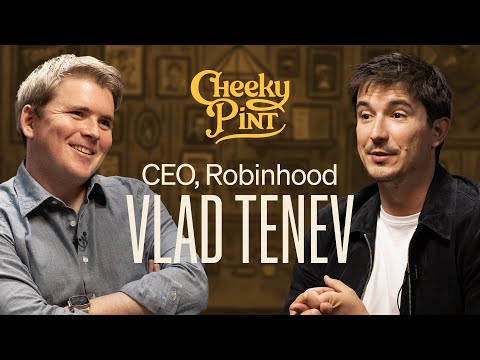
Robinhood’s Tenev Targets Private Markets to Upend Retail Investing
Stripe
Robinhood plans to bypass public disclosure hurdles by tokenizing private equities like OpenAI and SpaceX, arguing that regulatory frameworks barring retail access to premier startups are archaic in the age of artificial intelligence.
## Background
Published on YouTube by Stripe on August 13, 2025, this episode features Robinhood CEO Vlad Tenev pitching John Collison on tokenizing Stripe. According to the page description, the conversation spans Bulgarian hyperinflation, Robinhood Banking, behind-the-scenes GameStop details involving tech leaders, payment for order flow economics, and Tenev's approach to leadership.
## TL;DR
In this conversation, Robinhood CEO Vlad Tenev shares how his childhood experiences with 1990s hyperinflation in Bulgaria shaped his perspective on finance, stablecoins, and international wealth preservation. He defends Payment for Order Flow against critics, addresses the public narrative surrounding the GameStop trading frenzy, and outlines Robinhood's strategic expansion into traditional banking and private asset tokenization. Additionally, Tenev details his approach to rapid product execution through an elite internal community and discusses his mathematical AI venture, Harmonic.
## Atmosphere & style
The conversation carries a relaxed yet intellectually sharp atmosphere, blending lighthearted banter about drinking a pint of Guinness with deeply technical financial and operational debates. The dynamic between Tenev and Collison is that of two seasoned, peer-level tech founders, balancing collaborative exploration with moments of direct skepticism, such as their debate over democratizing Stripe's equity. The narrative arc moves from nostalgic personal histories to high-stakes crisis reflection and future-focused tech optimism, creating a candid and fast-paced listening experience.
## Key takeaways
- [01:20](https://www.youtube.com/watch?v=_F8SfqaYeq4&t=80s) Vlad Tenev's early childhood in 1990s Bulgaria was marked by a severe hyperinflation crisis that peaked at roughly 2,000% in 1997, wiping out his childhood savings account from an initial value of $2,000 down to just $10.
- [01:20](https://www.youtube.com/watch?v=_F8SfqaYeq4&t=80s) Due to a lack of retail investment platforms in 1990s Bulgaria, Tenev's grandfather hoarded copper cookware in his apartment closet as a physical store of value to preserve his wealth.
- [04:08](https://www.youtube.com/watch?v=_F8SfqaYeq4&t=248s) In modern hyperinflationary emerging markets, overseas citizens are gravitating toward stablecoins rather than Bitcoin due to the strong global brand, safety, and familiarity of the US dollar as a unit of account.
- [04:08](https://www.youtube.com/watch?v=_F8SfqaYeq4&t=248s) While a diversified portfolio of US equities could serve as a great store of wealth for international citizens to escape home country bias, global adoption has been bottlenecked by poor legacy financial infrastructure.
- [07:00](https://www.youtube.com/watch?v=_F8SfqaYeq4&t=420s) Robinhood disrupted legacy discount brokerages by eliminating commissions ranging from $7.95 to $9.95, which removed the steep portfolio drag that historically locked out beginner investors with low starting capital.
- [07:00](https://www.youtube.com/watch?v=_F8SfqaYeq4&t=420s) To make a zero-commission model viable, Robinhood leveraged insights from high-frequency trading to build its technology from scratch, automating core processes like account approvals that legacy mainframes couldn't handle.
- [11:24](https://www.youtube.com/watch?v=_F8SfqaYeq4&t=684s) Market makers pay for Payment for Order Flow (PFOF) because retail investors do not possess asymmetric, market-moving information, meaning trading against retail flow carries significantly less adverse selection risk.
- [11:24](https://www.youtube.com/watch?v=_F8SfqaYeq4&t=684s) Robinhood's original pitch decks prioritized API access, margin lending, and premium subscriptions; PFOF only became a massive financial engine later as large volumes of active traders flooded the platform.
- [14:31](https://www.youtube.com/watch?v=_F8SfqaYeq4&t=871s) Tenev asserts that Michael Lewis's 2013 book Flash Boys weaponized a sensationalized narrative that framed slow legacy banks as victims of modern technology and poisoned public perception against PFOF.
- [16:12](https://www.youtube.com/watch?v=_F8SfqaYeq4&t=972s) To establish predictable revenue independent of transaction volume volatility, Robinhood introduced Robinhood Gold, a subscription tier that acts as a comprehensive bundle to leverage a loyalty effect.
- [19:35](https://www.youtube.com/watch?v=_F8SfqaYeq4&t=1175s) Robinhood Banking plans to overcome the structural friction of switching bank accounts by deploying custom migration software and, eventually, utilizing advancing AI models to act as a hands-off family office CFO.
- [22:04](https://www.youtube.com/watch?v=_F8SfqaYeq4&t=1324s) During the 2021 GameStop trading frenzy, Tenev received supportive PR advice from tech figures like Mark Zuckerberg and Marc Benioff, as well as an intense call from Elon Musk urging him to prioritize 100% full transparency.
- [26:41](https://www.youtube.com/watch?v=_F8SfqaYeq4&t=1601s) Retail investors act as a crucial, healthy counterbalance to institutional abstraction and macro-driven sell-offs by stepping in as direct dip buyers for fundamentally strong individual stocks.
- [26:41](https://www.youtube.com/watch?v=_F8SfqaYeq4&t=1601s) Retail proxy voting remains low because standard proxy materials focus on dry administrative matters and retail investors find it easier to simply sell their stock if they are dissatisfied with corporate governance.
- [03:55:44](https://www.youtube.com/watch?v=_F8SfqaYeq4&t=14144s) Tenev criticizes the regulatory juxtaposition where retail investors are free to speculate on highly volatile memecoins but are legally locked out of premier, innovative private companies under the guise of protection.
- [04:05:06](https://www.youtube.com/watch?v=_F8SfqaYeq4&t=14706s) Prediction markets operate as 'truth machines' and derivatives in the ultimate sense, outperforming traditional media by delivering cold, accurate, and unbiased probabilities for sports, popes, and AI milestones.
- [05:51:18](https://www.youtube.com/watch?v=_F8SfqaYeq4&t=21078s) To maintain a rapid shipping cadence, Robinhood reversed its 2022 remote-first decision, transitioning back to an in-office model that requires executives to be in 5 days a week, managers 4 days, and ICs 3 days.
- [05:51:18](https://www.youtube.com/watch?v=_F8SfqaYeq4&t=21078s) Robinhood combats organizational bloat through an exclusive 'Founder's Community' of its top 150 impact-driven employees, acting as a curated core group capable of rebuilding the company in a disaster scenario.
- [57:42](https://www.youtube.com/watch?v=_F8SfqaYeq4&t=3462s) Using a visualization exercise based on Frank Slootman, Tenev identified core vulnerabilities that standard surveys missed, prompting Robinhood to aggressively reinvest in its high-revenue active trader business.
- [01:02:40](https://www.youtube.com/watch?v=_F8SfqaYeq4&t=3760s) Tenev's mathematical AI lab, Harmonic, aims to solve verification issues in natural-language mathematics by translating it into Lean, with the ultimate vision of formally verifying unsolved theorems like the Riemann hypothesis.
## Detailed walkthrough
### [00:00](https://www.youtube.com/watch?v=_F8SfqaYeq4&t=0s) Introduction and the Origins of Vlad Tenev
The episode begins with some lighthearted banter about whether Guinness is a low-calorie drink, with Vlad Tenev noting that it is "a meal in and of itself" before confirming that at 60 calories, the light version is indeed pretty light. Host John Collison introduces Tenev as the co-founder and CEO of Robinhood, the company that revolutionized the consumer finance space by turning zero-commission trading into an industry-wide phenomenon. Tenev's trajectory took him from being a math PhD student to running one of the fastest-growing consumer finance applications to date.
Collison traces Tenev's background from growing up in Bulgaria to moving to the United States as a "math nerd" who eventually dropped out of his PhD program. Tenev's first entrepreneurial venture was a high-frequency trading (HFT) firm, which he describes as a "relatively fast failure" but a highly useful learning experience that ultimately paved the way for the creation of Robinhood.
- **Vlad Tenev:** Co-founder and CEO of Robinhood.
- **Academic Background:** Studied mathematics as an undergraduate and dropped out of a PhD program.
- **First Venture:** A high-frequency trading (HFT) firm that failed quickly but provided crucial industry insights.
[01:20](https://www.youtube.com/watch?v=_F8SfqaYeq4&t=80s) Hyperinflation in 1990s Bulgaria and the "Copper Pot" Store of Value
Collison asks Tenev about a unique family anecdote: the hoarding of copper pots in Bulgaria during the 1990s. Tenev explains that during his childhood, Bulgaria suffered from the unfortunate distinction of having the highest inflation rate in the world, culminating in a massive hyperinflation crisis in 1997. Tenev recalls the inflation rate reaching roughly 2,000% or higher. This economic death spiral was triggered by the country holding massive amounts of debt denominated in foreign currencies; even a minor devaluation of the local currency caused a catastrophic compounding effect.
Following the fall of the Berlin Wall and the collapse of communism in Eastern Europe, Bulgaria's inflation rate was already sitting at around 150% by 1991, when Tenev was just four years old. Recognizing the grim trajectory of the country, Tenev's grandfather urged his parents to find a way out. Fortunately, the lifting of the Iron Curtain allowed Tenev's father to pursue a master's degree at the University of Delaware. His mother eventually followed, while Tenev temporarily stayed behind with his grandparents until his parents saved enough resources to bring him over.
When the 1997 hyperinflation crisis hit, his grandparents' newly commenced pensions were reduced to essentially zero. Tenev shares a poignant discovery he made while visiting Washington D.C. for the Invest America Child Investment Accounts Initiative: he opened an old briefcase belonging to his father and found the slip for a savings account his family had opened for him at birth. The slip showed that his family had deposited the equivalent of $2,000 when he was born, adding to it over time. By 1997, the value of that entire savings account had collapsed to just $10, at which point his parents simply stopped contributing.
Because there were no accessible retail investment platforms like Robinhood in Bulgaria at the time, Tenev's grandfather—who was a doctor for the Bulgarian Maritime forces—had to get creative to preserve what little wealth he had. Using his port connections, he acquired copper cookware. Tenev vividly recalls a closet in his grandfather's apartment in Varna, Bulgaria, where "you just opened the door and copper cookware would fall out" because copper served as their physical store of value.
- **Bulgarian Hyperinflation (1997):** Reached an estimated 2,000% or higher.
- **1991 Inflation:** Approximately 150% when Tenev was four years old.
- **The Savings Account:** A child savings account started with a $2,000 equivalent collapsed to a value of just $10 by 1997.
- **The Copper Standard:** Lacking access to stock markets, Tenev's grandfather hoarded copper pots in a Varna apartment closet as a physical store of wealth.
[04:08](https://www.youtube.com/watch?v=_F8SfqaYeq4&t=248s) Stablecoins, Bitcoin, and the Global Demand for US Dollars
Collison suggests that this childhood experience with hyperinflation must heavily inform Tenev's perspective on cryptocurrency, noting that the desire to escape volatile local currencies has historically driven early product-market fit for crypto in emerging markets. Tenev agrees but points out a surprising divergence from the original narrative of Bitcoin. While Bitcoin was initially envisioned as the ultimate store of value to escape local hyperinflation, Tenev observes that people overseas are actually gravitating toward stablecoins instead.
"Everyone just wants US dollars," Tenev explains, highlighting the incredibly strong global brand of the US dollar as a safe, stable currency. While some of this preference might stem from a lack of education about alternative assets, the familiarity of the US dollar makes it an easy unit of account. Tenev notes that while crypto has become an excellent mechanism to store wealth, it is not the only one. A diversified portfolio of US stocks could achieve the exact same wealth-preservation goal for international citizens. However, the global adoption of US equities has lagged because the legacy financial infrastructure is so poor, making it incredibly difficult for anyone living outside the United States to buy US stocks.
- **The Stablecoin Shift:** Overseas users facing inflation prefer stablecoins over Bitcoin due to the strong, familiar brand of the US dollar.
- **US Equities as a Store of Value:** Tenev views US stocks as an excellent alternative store of wealth for international users, though historically bottlenecked by poor global financial infrastructure.
[05:41](https://www.youtube.com/watch?v=_F8SfqaYeq4&t=341s) Overcoming Home Country Bias in Global Investing
Collison brings up the concept of "home country bias," referencing previous podcast guest Pieter Levels, whose Dutch parents only bought Royal Dutch Shell stock, and his own Irish parents, who bought Irish bank stocks. Historically, investors default to local companies, even though many of those local markets have severely underperformed compared to global indexes like the S&P 500 or the MSCI World Index. He asks if Robinhood's international strategy is designed to help users escape this bias.
Tenev confirms that Robinhood's long-term plan is to grant users access to every asset class, with future integrations planned for major global markets like the London Stock Exchange and Hong Kong. He acknowledges the tension this creates with local governments, which naturally want to incentivize domestic investment to benefit their own citizens. However, from a pure customer-experience standpoint, retail investors simply want the best products available. "If you talk to someone in Europe, they also would like to invest in Tesla, Nvidia," Tenev says, making the access to top-performing US equities a universal consumer demand.
- **Home Country Bias:** The tendency of retail investors to buy local stocks (e.g., Dutch Shell in the Netherlands or bank stocks in Ireland) despite potential underperformance.
- **Robinhood's Global Expansion:** Plans to integrate major international exchanges, including the London Stock Exchange and Hong Kong, to give users seamless global asset access.
[07:00](https://www.youtube.com/watch?v=_F8SfqaYeq4&t=420s) How Robinhood Disrupted Legacy Brokerages
Collison compares Robinhood's market entry to Stripe's, noting that neither was the first mover in their respective spaces. Legacy discount brokerages like E-Trade already existed, meaning Robinhood needed a vastly superior value proposition to capture market share. While a sleek, mobile-first design was a major factor, Tenev attributes their explosive disruption to two key pillars: pioneering zero-commission trading and radically lowering their internal cost structure through automation.
When Robinhood launched, legacy competitors charged between $7.95 and $9.95 per trade. Tenev explains that this pricing model severely penalized two distinct customer segments:
1. **The Beginner:** Someone trying to start investing with $100 would face an immediate 20% portfolio drag just to enter and exit a single position. This fee structure effectively locked out anyone with less than $2,000 (which was also the standard account minimum for most brokerages).
2. **The Active Trader:** High-volume traders were losing tens of thousands of dollars a month purely to commission fees.
By eliminating commissions and account minimums, Robinhood attracted these underserved groups in droves. To make a zero-commission model financially viable, Robinhood had to build its technology from scratch to automate everything—from customer onboarding and account approvals to payment processing and bank linking. Tenev recalls interviewing job candidates from legacy brokerages who were baffled by Robinhood's automated account approvals, asking, "How do you do it? We've been trying to do this for decades."
Tenev explains that legacy firms were running on mainframe computers that were "three technology revolutions behind." Drawing from their experience running a high-frequency trading firm, Tenev and his co-founder realized that if a team of just three engineers could write software to manage a book trading billions of dollars a day, there was no reason for retail brokerages to maintain massive, expensive operations departments and charge customers $9.95 a trade. Combining a highly automated, low-marginal-cost tech platform with a stellar mobile app created an "outlier level of success."
- **Legacy Commission Rates:** Historically ranged from $7.95 to $9.95 per trade before Robinhood's disruption.
- **The Tech Gap:** Legacy brokerages were heavily reliant on outdated mainframe systems, preventing them from automating basic processes like account approvals.
- **The HFT Insight:** Tenev realized that if three engineers could run a multi-billion-dollar HFT book, retail brokerage operations could be radically streamlined.
[11:24](https://www.youtube.com/watch?v=_F8SfqaYeq4&t=684s) The Truth About Payment for Order Flow (PFOF)
Collison steers the conversation toward Payment for Order Flow (PFOF), calling the political and public outrage surrounding it "crazy." He references financial writer Matt Levine's explanations of the "adverse selection problem," explaining that market makers care deeply about who their counterparty is. While trading against a highly sophisticated institutional player like Ken Griffin carries high risk, market makers are eager to trade against retail order flow because retail investors do not possess asymmetric, market-moving information. This lack of adverse selection allows retail orders to get better execution prices, and brokerages can monetize this flow.
Tenev admits that the public narrative "got a little bit away from us." He reveals that in the early days, Robinhood's founders did not care about PFOF and never expected it to be a meaningful revenue stream because the margins were so small. For the first several years, Robinhood was not even self-clearing; they relied on a third-party clearinghouse, Apex, which used Instinet to route orders. Early pitch decks for Robinhood envisioned making money through API access, margin lending, and a premium subscription tier. However, as active traders flocked to the platform, the sheer volume of trades turned this tiny, fraction-of-a-cent revenue stream into a massive financial engine.
Tenev points out that all of Robinhood's competitors were already utilizing PFOF. Before TD Ameritrade adopted zero commissions, they made roughly $12 per trade—$11 from the retail commission and $1 from PFOF. When Robinhood forced the industry to eliminate the $11 commission, TD Ameritrade's stock plummeted 35% in a single day. The legacy discount brokers could no longer survive as independent entities; TD Ameritrade was forced to merge with Charles Schwab, and E-Trade was acquired by Morgan Stanley. Despite Robinhood saving consumers billions in commissions, the public narrative twisted to paint PFOF as a insidious mechanism where brokerages were somehow making more money than they did under the old commission model.
- **The Adverse Selection Problem:** Market makers pay for retail order flow because retail investors do not pose the same toxic, highly informed trading risks as institutional players.
- **Early Revenue Plans:** Robinhood's original pitch decks focused on API access, margin lending, and premium subscriptions rather than PFOF.
- **The Industry Shift:** When competitors matched Robinhood's zero-commission model, TD Ameritrade's stock fell 35% in one day, leading to industry consolidation (Schwab acquiring TD Ameritrade, Morgan Stanley acquiring E-Trade).
[14:31](https://www.youtube.com/watch?v=_F8SfqaYeq4&t=871s) "Flash Boys" and the Poisoning of the Public Narrative
Tenev attributes the public's misunderstanding of PFOF to "unfortunate timing" and the release of Michael Lewis's book *Flash Boys* in 2013, which coincided almost exactly with the launch of Robinhood's initial waitlist. Having worked in high-frequency trading, Tenev immediately recognized the book as a "sensationalized account."
Tenev explains the brilliant narrative "jujitsu" Lewis pulled off in the book: he framed the story as a classic good-versus-evil battle, but cast the massive, legacy Wall Street banks—who were simply too slow to keep up with modern technology—as the sympathetic victims of "evil" MIT graduates writing faster software. To make the story resonate with a broader audience, Lewis tied PFOF into the narrative, creating a "meme" that the retail consumer was the ultimate victim. This narrative "poisoned the well," forcing Robinhood to defend its business model on Reddit and Hacker News from the very day they launched.
- **Flash Boys (2013):** The Michael Lewis book that Tenev argues sensationalized high-frequency trading and framed legacy banks as victims of technological progress.
- **The Meme:** The book popularized the idea that PFOF was actively harming retail investors, creating a persistent public relations challenge for Robinhood.
[16:12](https://www.youtube.com/watch?v=_F8SfqaYeq4&t=972s) Diversifying Revenue and the Rise of Robinhood Gold
Collison notes that while equities and PFOF were once central to Robinhood, the company has successfully diversified its revenue streams. Today, options trading, crypto, and interest income represent massive portions of their business. He asks how Tenev manages the inherent interest-rate sensitivity and volatility that comes with relying heavily on interest income.
Tenev responds that the business is actually less volatile now than it was when it relied solely on transaction volumes. He explains that in financial services, there are only a few fundamental ways to generate revenue:
1. Transaction fees or spreads.
2. Interest on assets (earning a spread on cash or through securities lending).
3. Subscription models.
To build a more predictable revenue stream, Robinhood introduced "Robinhood Gold," a subscription service that was highly unusual for the traditional brokerage industry. Tenev recalls that when they first proposed a subscription model, industry insiders insisted it would never work in brokerage. Tenev's attitude was simply, "Well, let's just see." Today, subscription models have become a highly effective way for modern financial services to segment and serve high-value customers.
- **Revenue Pillars:** Financial services primarily monetize through transactions, interest spreads/securities lending, or subscriptions.
- **Robinhood Gold:** A pioneering subscription model in the retail brokerage space designed to provide stable, recurring revenue and segment high-value users.
### [17:51](https://www.youtube.com/watch?v=_F8SfqaYeq4&t=1071s) The Psychology of Robinhood Gold and the "Costco Effect"
The discussion begins with a comparison to Revolut's multi-tiered subscription model. Unlike competitors that offer various subscription products to segment their users, Robinhood relies on a single subscription tier: Robinhood Gold. This single-tier approach is designed to leverage a psychological "loyalty element." When users pay for a subscription, they feel invested in the platform and actively seek to maximize the value of their purchase.
The typical user journey starts with a simple intent: buying a stock or some cryptocurrency. Once on the platform, Robinhood presents Robinhood Gold as a "no-brainer" bundle of eight distinct features. Even if a user is not initially interested in all eight, becoming a Gold member shifts their consumer behavior. When they later need a financial product in a new category, their first instinct is to check Robinhood because they are already paying for the bundle. This dynamic mirrors the "Amazon Prime" or "Costco effect," establishing Robinhood as the default, go-to home for all of a consumer's financial services.
### [19:35](https://www.youtube.com/watch?v=_F8SfqaYeq4&t=1175s) Launching Robinhood Banking and Frictionless Migrations
With the introduction of the Robinhood Gold card offering 3% cash back, the conversation naturally turns to whether Robinhood is positioned to become its users' primary financial home—traditionally defined as the place where they deposit their paychecks. To capture this market, Robinhood is preparing to launch "Robinhood Banking" in the coming months. The service was announced at a Gold Event and features several highly anticipated offerings, including a high APY and a novel "cash delivery" feature. The speakers joke about the logistics of cash delivery, with the host imagining an armored truck rolling up to a house, while the guest notes that a small Tesla model might handle standard transactions, reserving armored trucks for massive $250,000 deliveries due to the high cost of servicing typical $100 to $200 ATM-style withdrawals.
Beyond cash delivery, the critical hurdle for any challenger bank is the friction of switching. Consumers are hesitant to move because of the hassle of migrating direct deposits, bill payments, and payroll links. Robinhood is developing custom migration software to make this transition a one-button, frictionless experience.
- **The Future of Migration:** Initially, the system will rely on custom software linking directly to payroll providers.
- **AI Family Office:** Over the next one to two years, Robinhood plans to leverage advancing AI models to act as a "family office CFO." Users will simply tell the AI to handle the migration, and the system will execute the entire transition in the background.
### [22:04](https://www.youtube.com/watch?v=_F8SfqaYeq4&t=1324s) Unreported Stories from the GameStop Saga and "Type 2 Fun"
Reflecting on the surreal, remote days of the early pandemic, the conversation shifts to the GameStop trading frenzy of early 2021. A lesser-known piece of backstory dates back to the start of COVID-19 in 2020, when retail investing surged. Robinhood’s bidirectional referral program—where both the referrer and the referee received a free share of stock—frequently distributed GameStop shares, which were highly popular and cheap at the time. Consequently, millions of users who joined in 2020 were welcomed to the platform with GameStop as their very first stock holding.
This historical connection leads to a psychological reflection on the anger some retail investors still harbor toward Robinhood. The guest jokes that he feels "like these people's father in a sense," because they grew up on the product and received their first financial exposure through it. He remarks that while some have rebelled and left home, "it's kind of time for them to just come home... I think it's enough rebelling."
The peak of the crisis brought unexpected, supportive outreach from prominent tech figures. While navigating intense regulatory and capital requirements from home, the guest received calls from peers offering advice on managing the intense public relations fallout.
- **Mark Zuckerberg:** Reached out to offer support, noting he had "had his share of PR issues" and helped workshop ideas.
- **Marc Benioff:** Also contacted the guest to offer help and support.
- **Antonio Gracias & Elon Musk:** Connected through an investor, Gracias warned that a congressional invitation was likely and offered advice. Ten minutes later, Gracias called back with Elon Musk on the line. Musk was characteristically intense, telling the guest, "You're being an asshole to the people. What you've gotta do is full transparency, 100% put it all out there, play-by-play." This conversation directly inspired the guest's spur-of-the-moment decision to join Musk's famous 1:00 AM Clubhouse session on the "Good Time Show" hosted by Sriram and Aarthi, laying everything on the line in front of a massive, highly excited pandemic audience.
### [26:41](https://www.youtube.com/watch?v=_F8SfqaYeq4&t=1601s) The Rise of Retail Investors and the Problem with Proxy Voting
Professional hedge fund and asset managers frequently note that the rise of retail investing has fundamentally changed the market over the last decade. From its inception, Robinhood championed direct, individual participation in the markets to counter the growing abstraction of finance. In the modern financial ecosystem, individual capital is often buried under layers of abstraction—moving from a retirement or pension fund to an asset manager, and then into an ETF. This distance dilutes the direct signal of investing in a company because of its fundamental prospects. It also creates "degenerate" market anomalies, such as macro portfolio rebalancing or tariff announcements causing unrelated stocks (like Palantir) to take massive, collateral hits. Retail investors act as a healthy counterbalance, often stepping in as "dip buyers" who purchase fundamentally strong stocks at a discount during macro-driven sell-offs.
The discussion moves to whether retail investors exercise their corporate power through proxy voting. While Robinhood users have the ability to vote their shares, two structural hurdles prevent retail proxy voting from becoming a dominant force:
1. **Uninteresting Proxy Materials:** Most proxy votes concern dry, incomprehensible administrative matters rather than exciting corporate battles or CEO ousters.
2. **The "Exit" Option:** Unlike institutional fund managers who hold massive, illiquid blocks of shares dictated by tracking indexes and cannot easily sell, retail investors can simply sell their stock if they are unhappy with a company's direction. Selling is a much easier outlet for expressing dissatisfaction than participating in a proxy vote.
### [31:14](https://www.youtube.com/watch?v=_F8SfqaYeq4&t=1874s) Where the Money Comes From and the "Gamification" Narrative
When analyzing where Robinhood's assets originate, historical data indicates that the platform primarily attracts "new dollars" to the financial markets. Rather than pulling funds from existing mutual funds or traditional brokerages, Robinhood captures money that consumers would have otherwise spent on retail goods, entertainment, or "trinkets on Amazon." By redirecting capital from the "spending bucket" to the "investing bucket," the platform helps users build long-term wealth.
This reality is why the persistent media narrative of "gamification" has long frustrated Robinhood's leadership. The guest argues that the narrative was not born out of genuine concern over speculative features, but rather emerged as a competitive reaction in late 2019. When Robinhood forced the entire brokerage industry to drop commissions to zero, competitors lost their primary differentiator. When Robinhood's market share and business subsequently grew three to five times over in 2020, critics and media outlets found it more salacious to attribute this success to "nefarious gamification" rather than admitting that Robinhood simply built a superior product.
### [34:19](https://www.youtube.com/watch?v=_F8SfqaYeq4&t=2059s) Mechanically Tokenizing Private Companies
The segment concludes with a technical discussion on Robinhood's ambitions to tokenize private companies. The host questions how Robinhood can mechanically offer exposure to highly illiquid private assets like OpenAI or SpaceX without being "nakedly short" the position—which would obligate them to pay out appreciation to customers without guaranteeing they can acquire the underlying shares.
The guest explains that for any tokenized offering, Robinhood must secure the underlying stock or exposure beforehand. For their public stock tokens, as well as their promotional SpaceX and OpenAI giveaways, the positions are fully backed by physical holdings already sitting on Robinhood's balance sheet. However, this model inherently limits the rate of scale. If demand suddenly spikes to a billion dollars for a private asset like OpenAI, Robinhood cannot instantly acquire a billion dollars of private shares on the secondary market. To manage this imbalance, Robinhood utilizes a framework similar to their "IPO Access" product, where retail interest is aggregated and collected systematically rather than filled instantaneously.
[03:55:44](https://www.youtube.com/watch?v=_F8SfqaYeq4&t=14144s) The Mechanics of IPO Allocations and the Tokenization Debate
Typically, initial public offerings (IPOs) are massively oversubscribed. When companies hand out allocations, retail platforms like Robinhood generally do not receive very much. However, if a company likes the idea of retail participation, they might grant a slightly larger share. While Robinhood has offered several highly anticipated IPOs to its customers over the years, they generally cannot fulfill the massive retail demand due to these cutbacks. This creates a "chicken and egg" problem: should they collect retail demand first, or secure the supply? Fortunately, Robinhood's large balance sheet provides the flexibility to act as an underwriter or a private venture fund to help bridge this gap.
The conversation shifts to the philosophical and regulatory hurdles of making private stock available to retail investors. The host expresses skepticism, pointing out that society has established strict disclosure and regulatory frameworks for public companies—such as mandatory quarterly financial reporting—to protect the public. Bypassing these rules to sell private stock to retail investors could be viewed as regulatory arbitrage.
The guest strongly disagrees, arguing that the current public disclosure rules have become so complex and costly that they often outweigh the benefits of going public. While going public makes sense for a stock trading platform like Robinhood, it has become a major nuisance for many other businesses. Today, companies can raise virtually infinite private capital, meaning the only real pressure to go public comes from minor technical restrictions like shareholder count limits on option grants.
- **The "YOLO" Juxtaposition:** The guest points out the irony that retail investors have the unrestricted freedom to "YOLO" their money into hundreds of thousands of highly speculative memecoins, yet are legally barred from investing in premier, highly innovative private companies like SpaceX, OpenAI, or Stripe under the guise of "retail protection."
- **Evolution of Accredited Investor Rules:** The original logic behind the accredited investor threshold (e.g., having a million dollars) was that wealthy individuals could afford to hire trained professionals to evaluate risk. Today, free AI tools and advanced data platforms give everyday investors the same analytical intelligence for free, meaning these rules are ripe for a complete rethink.
---
[04:04:07](https://www.youtube.com/watch?v=_F8SfqaYeq4&t=14647s) Tokenizing Private Markets and Capital Formation
When asked how far this tokenization should go—whether it should apply to companies like Chick-fil-A or a family farm in California—the guest divides the opportunity into two distinct categories. First, there are late-stage private companies, where the primary demand comes from employees looking for secondary liquidity. Second, there is the early-stage market, which functions as "capital as a service."
The guest dismisses the purist crypto narrative around "on-chain issuance" as "bullshit," explaining that early-stage founders do not care about the underlying blockchain mechanics; they simply want a frictionless button that delivers capital so they can grow their business. If blockchain technology proves to be the easiest and most direct way to facilitate that capital formation, it will win.
- **International Frameworks:** Other countries have experimented with early-stage capital access. For example, equity crowdfunding in the UK has been highly effective in some cases, though it remains somewhat clunky and geographically restricted.
- **The Revolut Example:** The fintech company Revolut successfully utilized multiple equity crowdfunding rounds in its earliest stages to fuel its growth.
---
[04:04:20](https://www.youtube.com/watch?v=_F8SfqaYeq4&t=14660s) The Stripe Debate: Democratization vs. Institutional Ownership
The guest presents a "menu of options" to the host for making Stripe's equity accessible to retail investors: either tokenizing it directly or placing it into a diversified fund of, say, five companies to obscure individual price action. The host is visibly unenthusiastic. He explains that, as a practical legal matter, the SEC takes a "dim view" of selling private equity to the general public.
More fundamentally, Stripe is a highly capital-light business. Unlike companies building massive, capital-intensive "million-GPU data centers" that require deep pools of public capital, Stripe does not need to raise billions of dollars. Its current owners are primarily its employees, a model Stripe prefers because it aligns value creation with ownership. They have already solved employee liquidity through private tender offers.
The guest counters by asking why these tender offers cannot be democratized so normal people can participate instead of just institutional venture capitalists. The host remains unsympathetic, arguing that Stripe's underlying ownership is already "normal people" through a different lens. The limited partners (LPs) in the venture funds that own Stripe are college endowments and public pension funds like CalPERS. Thus, the capital is already managed on behalf of everyday people in a highly sensible, diversified structure.
---
[04:05:06](https://www.youtube.com/watch?v=_F8SfqaYeq4&t=14706s) Prediction Markets as "Truth Machines"
The host notes that Robinhood's recent OpenAI tokenization felt less like traditional equity ownership and more like a prediction market on the company's future. This transitions the discussion into the massive rise of prediction markets over the last five years. The guest defends stock tokens against critics who call them mere counterparty swaps, arguing they are structurally identical to stablecoins: they represent ownership of an underlying pot of assets held in a bucket, which is then tokenized and traded on-chain.
Prediction markets, however, are "derivatives in the ultimate sense." Their true value lies beyond mere trading; they serve as an alternative, highly accurate news source. Because traditional media models are designed to keep audiences engaged and entertained—which often runs contrary to delivering objective, immediate answers—prediction markets act as unbiased "truth machines."
- **The Wimbledon Example:** During a match between Grigor Dimitrov and Jannik Sinner, Dimitrov was up two sets to zero and winning the third. A casual observer watching the score would assume his chances of winning were 95%. However, the prediction market held at a tight 55:45, factoring in deeper realities like injury history and player experience. Sinner ultimately came back to win.
- **The Jake Paul vs. Mike Tyson Fight:** During the live Netflix broadcast in the third round, commentators hyped up the drama, claiming Tyson could win with a single punch to keep viewers tuned in. Meanwhile, Polymarket showed a cold, accurate reality: Jake Paul had a 92% chance of winning.
- **Diverse Markets:** Beyond sports and elections, prediction markets are highly popular for one-time events (such as papal successions) and AI milestones (predicting when specific technical breakthroughs will occur).
---
[04:49:29](https://www.youtube.com/watch?v=_F8SfqaYeq4&t=17369s) Reforming the SEC and the Future of Regulation
The guest expresses strong optimism regarding the current political administration's approach to financial regulation, particularly praising the appointment of Paul Atkins to lead the SEC. He believes the new leadership is focused on the right priorities, especially when compared to the previous administration.
The guest is also highly bullish on the "Invest America Initiative"—which originated in the private sector with Brad Gerstner before being adopted by the administration—as well as the government's recently released AI plan, which notably champions open-source technology. For the SEC specifically, the guest's primary focus is on reforming private markets and tokenization. He hopes to see a comprehensive crypto asset security tokenization framework established by the end of the year or next year, alongside a complete overhaul of the "accredited investor" regime.
---
[05:51:18](https://www.youtube.com/watch?v=_F8SfqaYeq4&t=21078s) How Robinhood Ships Fast: Culture, In-Person Work, and the "Top 150"
When asked how Robinhood manages to ship products so rapidly, the guest explains that many companies claim they want to move fast but are ultimately unwilling to make the uncomfortable decisions required to do so. Shipping fast requires building a high-performance culture, holding a very high bar for talent, and establishing the right physical environment.
Robinhood famously declared itself a "remote-first" company in 2022, a decision the guest regretted almost immediately. Realizing that remote-first was a "two-way door" that could be reversed, they transitioned back to prioritizing in-person collaboration. Today, they operate on a tiered in-office model: executives work in the office five days a week, managers four days, and individual contributors (ICs) three days. This structure ensures that managers shoulder more of the commuting "pain" than their direct reports, which serves as a powerful motivator.
- **Concentrated Rewards:** Robinhood aggressively concentrates compensation, promotions, and rewards on its absolute top performers rather than distributing them evenly.
- **The Founder's Community:** To prevent the company's key leadership circle from devolving into a "degenerate case" of just the top people on the formal organizational chart, Robinhood established a "Founder's Community."
- **Impact-Based Membership:** Modeled loosely after Apple's famous "Top 100" annual offsite, this community consists of the top 150 people in the company ranked strictly by their impact, regardless of their level or title.
[54:39](https://www.youtube.com/watch?v=_F8SfqaYeq4&t=3279s) Cultivating Robinhood's Elite Community
Robinhood has developed an exclusive internal community that began as a compensation-centered initiative. Originally, the company allocated discretionary budget to reward its top performers, but over time, this has evolved into a genuine community. The leadership team now gathers these top employees to share updated strategies and visions, solicit their feedback, and host dinners and events in various cities.
When inducting new members into this group, Vlad Tenev shares a specific, vivid scenario to illustrate their value: "If there was a disaster or some kind of a apocalyptic scenario, and we had to rebuild Robinhood with 150 people, you would be in that group." This community serves as a powerful tool to keep the growing company feeling small and intimate, ensuring that leadership always knows exactly who their best people are.
- **Community Size:** Approximately 150 key people.
- **Evolution:** Shifted from a discretionary compensation program to an active feedback and event-driven community.
[55:42](https://www.youtube.com/watch?v=_F8SfqaYeq4&t=3342s) The "Frank Slootman" Exercise and Reversing Bad Decisions
Reflecting on a period of rapid growth in 2021, Tenev recalls a particularly brutal earnings or board meeting where he felt "punched from all directions." In response, he sat down with his team and posed a morbid but highly effective question: "If they brought in a CEO who really cleaned this place up, what would they do?" They imagined how a leader like Frank Slootman would react, immediately concluding that he would reject remote work and demand that everyone get back into the office.
This visualization exercise highlighted a common leadership trap: the reluctance to reverse previous decisions out of fear of looking like a "flip-flopper." Tenev notes that one of the main benefits of swapping out a CEO is that a newcomer can ruthlessly undo the previous manager's bad decisions without feeling any personal attachment to them. By pretending to be that external force, current founders can grant themselves the freedom to be inconsistent and fix past mistakes. The hosts joke about a private equity version of this phenomenon, where new owners mock the "previous idiot managers," even when those previous managers are actually themselves.
[57:36](https://www.youtube.com/watch?v=_F8SfqaYeq4&t=3456s) Reclaiming the Active Trader Market
The Frank Slootman exercise forced Robinhood to confront obvious truths they had been ignoring, particularly regarding their active trader market. Around 2019, they realized that a disproportionate amount of their revenue was generated by a relatively small group of highly active customers. Ironically, Robinhood had attracted these high-value traders incidentally; the platform was originally designed to make investing simple for first-time users with just $100. However, the zero-commission value proposition also appealed to serious traders who were previously paying up to $10,000 a month in commissions elsewhere.
Once competitors matched Robinhood's commission-free model and built tailored, pro-level experiences, Robinhood's lack of a dedicated pro offering became a massive liability. In fact, the platform was so geared toward beginners that highly active, high-revenue users were frequently forced to churn due to poor system handling. Standard customer surveys masked this issue because active traders made up a tiny percentage of the overall user base. Realizing that their most active customers were the least happy was a "nightmare scenario" that forced a massive pivot to reinvest in the core active trader business.
- **Revenue Concentration:** A small, incidental group of active traders generated a disproportionate share of revenue.
- **The Churn Problem:** System limitations actively forced high-value, highly active traders off the platform.
- **The Slootman Question:** "Where are you making your money? How much are we investing? Why are we investing so much in this thing that doesn't make any money and very little in the actual core of the business?"
[59:49](https://www.youtube.com/watch?v=_F8SfqaYeq4&t=3589s) Cutting Non-Core Products and Moving to a GM Structure
To refocus on their core business, Robinhood had to cut well-motivated but poorly timed initiatives. The prime example was their "cash card" offering—a debit card tied to a money transmitter account aimed at paycheck-to-paycheck customers, similar to Chime or Cash App. This product failed to gain traction because the typical Robinhood user is not a paycheck-to-paycheck consumer; they generally have enough capital to be interested in investing and tend to rely primarily on credit cards.
To combat organizational inefficiency and stop spreading themselves too thin, Tenev transitioned Robinhood from a functional organization to a General Manager (GM) structure. Previously, all product, finance, and engineering decisions rolled up to Tenev, causing immense personal stress as he had to arbitrate every trade-off. By establishing GMs with full accountability over specific business lines and their respective revenues, individual leaders began feeling the "sleepless nights" of ownership. Tenev notes that seeing his Crypto GM sweating over crypto performance proved that individual accountability was working beautifully.
- **Discontinued Initiative:** The Cash Card / debit card offering for paycheck-to-paycheck users.
- **Organizational Shift:** Transitioned from a functional hierarchy to a GM structure with decentralized P&L accountability.
- **Shipping Cadence:** Implementing regular product launch events (increasing from one last year to over four a year) to act as a highly motivating "stake in the ground" for engineering teams.
[01:02:40](https://www.youtube.com/watch?v=_F8SfqaYeq4&t=3760s) Harmonic and the Quest for Mathematical Super-Intelligence
Tenev discusses his AI venture, Harmonic, a mathematical super-intelligence lab that is progressing exceptionally well. Tenev, who was a pure math PhD student at UCLA aiming to study with Fields Medalist Terry Tao, notes that he reached the AIME level in high school (two rungs below the International Math Olympiad). He proudly shares that Harmonic's AI models have already exceeded his own mathematical intelligence by a considerable margin, and estimates that another 10x improvement will bring them to true mathematical super-intelligence.
Harmonic is a for-profit endeavor focused on solving math problems using formal mathematics. By translating natural-language math into a programming language called Lean, the AI can achieve absolute verification. This solves a massive problem in both AI and mathematics, where verifying complex, hundreds-of-pages-long proofs (such as Fermat's Last Theorem, which took two years to certify) is incredibly difficult. The ultimate vision for Harmonic is to create an app where a user can take a picture of a legendary unsolved problem like the Riemann hypothesis on a chalkboard, and the AI will instantly generate a formally verified proof.
- **Founders:** Vlad Tenev and Tudor Achim.
- **Core Technology:** Translating natural-language mathematics into Lean for automated verification.
- **The Holy Grail:** Solving the Riemann hypothesis, widely considered the deepest unsolved theorem in mathematics.
## Notable quotes
> [04:08](https://www.youtube.com/watch?v=_F8SfqaYeq4&t=248s) Everyone just wants US dollars — Vlad Tenev
> [05:41](https://www.youtube.com/watch?v=_F8SfqaYeq4&t=341s) If you talk to someone in Europe, they also would like to invest in Tesla, Nvidia — Vlad Tenev
> [07:00](https://www.youtube.com/watch?v=_F8SfqaYeq4&t=420s) How do you do it? We've been trying to do this for decades. — Job candidates from legacy brokerages
> [22:04](https://www.youtube.com/watch?v=_F8SfqaYeq4&t=1324s) You're being an asshole to the people. What you've gotta do is full transparency, 100% put it all out there, play-by-play. — Elon Musk
> [22:04](https://www.youtube.com/watch?v=_F8SfqaYeq4&t=1324s) like these people's father in a sense — Vlad Tenev
> [22:04](https://www.youtube.com/watch?v=_F8SfqaYeq4&t=1324s) it's kind of time for them to just come home... I think it's enough rebelling. — Vlad Tenev
> [04:28:26](https://www.youtube.com/watch?v=_F8SfqaYeq4&t=16106s) derivatives in the ultimate sense — Vlad Tenev
> [04:28:26](https://www.youtube.com/watch?v=_F8SfqaYeq4&t=16106s) truth machines — Vlad Tenev
> [54:39](https://www.youtube.com/watch?v=_F8SfqaYeq4&t=3279s) If there was a disaster or some kind of a apocalyptic scenario, and we had to rebuild Robinhood with 150 people, you would be in that group. — Vlad Tenev
> [55:42](https://www.youtube.com/watch?v=_F8SfqaYeq4&t=3342s) If they brought in a CEO who really cleaned this place up, what would they do? — Vlad Tenev
> [57:36](https://www.youtube.com/watch?v=_F8SfqaYeq4&t=3456s) Where are you making your money? How much are we investing? Why are we investing so much in this thing that doesn't make any money and very little in the actual core of the business? — Vlad Tenev
## Mentioned
Vlad Tenev, John Collison, Robinhood, Stripe, University of Delaware, Invest America Child Investment Accounts Initiative, Bitcoin, Tesla, Nvidia, London Stock Exchange, Hong Kong Stock Exchange, S&P 500, MSCI World Index, Pieter Levels, Royal Dutch Shell, E-Trade, Apex, Instinet, TD Ameritrade, Charles Schwab, Morgan Stanley, Matt Levine, Ken Griffin, Flash Boys, Michael Lewis, Robinhood Gold, Revolut, Amazon Prime, Costco, Robinhood Banking, GameStop, Mark Zuckerberg, Marc Benioff, Antonio Gracias, Elon Musk, Clubhouse, Sriram Krishnan, Aarthi Ramamurthy, Palantir, OpenAI, SpaceX, Chick-fil-A, CalPERS, Grigor Dimitrov, Jannik Sinner, Wimbledon, Jake Paul, Mike Tyson, Polymarket, Netflix, Paul Atkins, SEC, Brad Gerstner, Apple, Frank Slootman, Chime, Cash App, Harmonic, Tudor Achim, Terry Tao, UCLA, Lean
Robinhood co-founder and CEO Vlad Tenev argues that modern financial infrastructure and automation are necessary to dismantle legacy barriers, allowing retail investors global access to wealth-building assets from equities to private markets. Tenev contends that outdated regulatory frameworks, such as accredited investor restrictions, penalize ordinary consumers while modern technological tools make traditional investor-protection rationales obsolete.
Monetary Instability and Global Asset Demand (1:20)
Tenev links his perspective on financial access to his childhood during Bulgaria's 1997 hyperinflation crisis, when inflation surpassed 2,000% and his family's $2,000 equivalent savings account diminished to $10. Without access to retail investment platforms, his grandfather hoarded copper cookware as a physical store of value. This background informs Tenev's view of international cryptocurrency adoption: while Bitcoin was envisioned as an alternative store of value, users in developing markets gravitate primarily toward stablecoins pegged to the US dollar because of the currency's global recognition and stability.
Tenev argues that a diversified portfolio of US equities could serve the same wealth-preservation purpose for international citizens facing local currency depreciation. However, cross-border participation has historically been limited by poor legacy infrastructure and home-country bias, which Robinhood intends to address by connecting users directly to major global exchanges like the London Stock Exchange and Hong Kong.
Automation, Brokerage Disruption, and Revenue Diversification (7:00)
Robinhood entered the brokerage industry by eliminating $7.95 to $9.95 commissions and account minimums, targeting retail beginners and active traders who faced substantial cost drag. Drawing on their background running a high-frequency trading firm, Tenev and his co-founder realized that automated software built from scratch could replace the expensive operations departments and mainframe computers used by incumbent firms. This technical automation enabled instantaneous, low-cost onboarding and clearing.
Addressing the controversy surrounding Payment for Order Flow (PFOF), Tenev notes that market makers pay for retail orders because retail flow lacks the toxic adverse selection risk associated with institutional trades. While PFOF became a primary revenue driver through high transaction volumes, Robinhood has since diversified into interest income, options, crypto, and Robinhood Gold. Operating on a single-tier subscription model analogous to Costco, Gold bundles multiple financial services to establish Robinhood as a default primary financial account ahead of its banking and AI-assisted migration rollouts.
Retail Influence, Private Tokenization, and Regulatory Friction (26:41)
Tenev maintains that direct retail participation provides a stabilizing counterweight to modern finance, where institutional ETF rebalancing and macroeconomic announcements often trigger collateral sell-offs in fundamentally sound equities. To expand retail access, Robinhood is testing the tokenization of late-stage private companies such as SpaceX and OpenAI, backing promotional positions directly with underlying shares on its balance sheet while aggregating retail demand.
This strategy faces regulatory and structural disagreements. While Stripe co-founder John Collison notes that the SEC views selling private equity to the public unfavorably and points out that everyday citizens already hold indirect stakes via pension funds and university endowments, Tenev argues that accredited investor rules are outdated. Tenev highlights the contradiction where retail investors can freely speculate on volatile memecoins but are legally barred from investing in productive private companies, asserting that modern AI tools now provide retail investors with institutional-grade risk analysis.
Operational Realignment and Organizational Restructuring (55:42)
Following the volatility of the 2021 pandemic trading surge, Robinhood conducted an internal exercise imagining what an external turnaround CEO would alter, allowing leadership to reverse past decisions without personal attachment. Consequently, the company reversed its 2022 remote-first policy in favor of a tiered in-office requirement—mandating five days for executives, four for managers, and three for individual contributors—and discontinued products misaligned with its core user base, such as its debit card for paycheck-to-paycheck consumers.
To eliminate operational bottlenecks, Tenev restructured Robinhood from a functional hierarchy into a General Manager model with decentralized P&L accountability. This shift allowed the firm to reprioritize high-volume active traders who drove disproportionate revenue but were previously churning due to beginner-oriented infrastructure. Internally, leadership instituted a 150-person 'Founder's Community' based strictly on impact. Outside of Robinhood, Tenev is pursuing mathematical super-intelligence with his startup Harmonic, translating natural-language mathematics into Lean code to formally verify complex proofs.
The discussion leaves unresolved whether private equity tokenization can overcome regulatory scrutiny, as established companies like Stripe prefer capital-light, employee-aligned ownership models while platforms like Robinhood lobby the SEC for modernized tokenization frameworks and accredited investor reforms.
[4:08] Vlad Tenev: Everyone just wants US dollars
[5:41] Vlad Tenev: If you talk to someone in Europe, they also would like to invest in Tesla, Nvidia
[7:00] Job candidates from legacy brokerages: How do you do it? We've been trying to do this for decades.
[22:04] Elon Musk: You're being an asshole to the people. What you've gotta do is full transparency, 100% put it all out there, play-by-play.
[22:04] Vlad Tenev: like these people's father in a sense
[22:04] Vlad Tenev: it's kind of time for them to just come home... I think it's enough rebelling.
[268:26] Vlad Tenev: derivatives in the ultimate sense
[268:26] Vlad Tenev: truth machines
[54:39] Vlad Tenev: If there was a disaster or some kind of a apocalyptic scenario, and we had to rebuild Robinhood with 150 people, you would be in that group.
[55:42] Vlad Tenev: If they brought in a CEO who really cleaned this place up, what would they do?
[57:36] Vlad Tenev: Where are you making your money? How much are we investing? Why are we investing so much in this thing that doesn't make any money and very little in the actual core of the business?
Original transcript
[0:00] No calorie?
[0:01] No, I wouldn't say no calorie.
[0:01] It's Guinness. It's a
meal in and of itself.
[0:04] Nobody gives a shit
about on-chain issuance.
[0:07] They just want a button to deliver money,
[0:09] so that they can raise
[0:10] for their venture as easy as possible.
[0:12] Were there any moments during
that saga where you're like,
[0:15] "I can't believe I'm having
this call right now?"
[0:17] Elon was like, "You're being
an asshole to the people.
[0:20] What you've gotta do is
full transparency, 100%."
[0:24] You know that I'd love to tokenize
[0:26] or otherwise make your
stock available to retail.
[0:29] And you know that I'm skeptical.
[0:30] I wanna see this handstand pushup now.
[0:33] Yeah, it's fine.
[0:35] 60 calories, so pretty light.
[0:38] We'll get Vlad mic'd.
[0:40] Vlad Tenev is the cofounder
[0:41] and CEO of Robinhood, the company
[0:42] that turned zero-commission trading
[0:44] into an industry-wide phenom.
[0:46] He went from a math PhD to running one
[0:48] of the fastest-growing
consumer finance apps to date.
[0:51] Cheers.
[0:51] Cheers.
[0:54] Thanks for coming. Good to see you.
[0:55] Thanks for having me, John.
[0:57] Mm. Okay.
[0:58] So, you grew up in Bulgaria,
[1:00] moved to the US. You're a math nerd.
[1:02] You studied math undergrad,
you dropped out of a PhD?
[1:05] I dropped out, yeah.
[1:06] And then you started an HFT firm that
[1:08] became-ish Robinhood over time.
[1:11] Yeah, sort of.
[1:12] I mean, that's putting it—
[1:14] It was a relatively fast
failure, the HFT firm.
[1:17] But we learned a lot.
[1:19] But the experience was useful.
[1:20] We'll get to Robinhood,
but first, I wanna know,
[1:22] tell me about the hoarding of copper pots
[1:24] in Bulgaria in the '90s.
[1:26] When I was a child,
[1:30] Bulgaria had the unfortunate distinction
[1:33] of having the highest
inflation rate in the world.
[1:37] I think in 1997, we went
through hyper-inflation.
[1:40] What was the inflation rate?
[1:42] I think it was something like 2,000%
[1:44] Wow.
if I remember correctly,
[1:46] and maybe even higher than that.
[1:48] There were a few echoes of high inflation
[1:52] before the big moment.
[1:55] Ultimately, Bulgaria ended up having a lot
[1:57] of debts in foreign-denominated currency,
[2:00] which creates a problem.
[2:01] Then if your currency
devalues even a little bit,
[2:05] it creates this death spiral.
[2:08] The Berlin Wall fell,
[2:09] communism kind of collapsed
in Eastern Europe.
[2:12] And in 1991,
[2:14] when I was still living
there, I was four years old,
[2:17] the inflation rate was like 150%.
[2:19] Yes.
[2:20] Then my grandfather was actually like,
[2:23] "This country's not
going in a good place."
[2:25] He told my parents, "You
should try to figure out
[2:27] how to get out of here."
[2:29] The good thing was,
[2:31] after the Iron Curtain was
lifted, my dad had an opportunity
[2:35] to go to the University of
Delaware for a master's.
[2:38] We were able to eventually
all move over there.
[2:42] It was first my dad, then my mom,
[2:43] and then I lived
[2:44] with my grandparents back
in Bulgaria for a bit.
[2:47] But then they had enough
resources to send for me.
[2:50] About five years in,
[2:53] we had this hyper-inflation bout.
[2:56] So my grandparents' pensions,
they had recently retired,
[2:59] went to essentially zero.
[3:03] I had a savings account in Bulgaria
[3:05] that they had opened for me.
[3:06] It was funny, I was in
Washington a couple weeks ago
[3:09] for the Invest America Child
Investment Accounts Initiative.
[3:14] I opened up an old
briefcase that my dad had,
[3:16] and it had the slip
for my savings account,
[3:19] which basically showed
[3:20] when I was born they put
[3:22] $2,000 equivalent in there.
[3:25] And then they added money over time.
[3:28] And then in 1997 it was down to like $10.
[3:31] Yep.
And then they
[3:32] just stopped adding money.
So pensions went to zero.
[3:36] My grandfather at the
time, he was a doctor
[3:39] for the Bulgarian Maritime
forces, kind of like the Navy.
[3:45] He knew some people on port
[3:49] that had copper cookware.
[3:51] So he figured out—
[3:53] he didn't have anything like Robinhood.
[3:54] He didn't have any way
to invest in stocks.
[3:57] We had this closet in his apartment
[4:00] in Varna, Bulgaria where
you just opened the door
[4:02] and copper cookware would fall out.
[4:04] So, that was the store of wealth.
[4:06] That was the store of value, yep.
[4:08] This presumably must inform
your views of crypto,
[4:11] where there's a general trend
in a bunch of emerging markets
[4:15] with currencies that have
historically seen hyperinflation,
[4:18] where people want to keep
their money not in the currency
[4:21] because of just the experience you had
[4:22] with the savings account.
[4:24] It feels like that is a big part
[4:25] of the early product-market
fit around the world.
[4:27] The surprising thing about
what you said, to me,
[4:31] is that Bitcoin was originally thought of
[4:35] as the store of value
[4:37] and this way to escape
local hyperinflation.
[4:41] But people don't seem to be using it
[4:44] for that, or quite as much.
[4:46] If you look at stablecoins.
[4:48] Stablecoins have gotten a
lot of traction overseas
[4:51] because you have this
[4:53] need to have US dollars.
[4:56] Everyone just wants US dollars.
[4:57] Yes.
It has a very strong brand
[5:00] as a safe, stable currency.
Yeah.
[5:02] Part of that might be an education thing,
[5:04] but it's hard to counteract.
[5:06] I think partly people in these countries
[5:08] have some familiarity
with US dollars already.
[5:11] So you've less of a unit
[5:12] of account confusion and things like that.
[5:14] I think that's right.
[5:16] I think crypto has become
a really good mechanism
[5:18] to store your wealth, but it's
not necessarily the only one.
[5:23] I think US stocks
[5:25] and a diversified portfolio
[5:27] of companies could also
achieve the same goal.
[5:30] The problem is it's lagged
[5:34] because the infrastructure has been so bad
[5:35] that it's actually quite difficult for you
[5:37] to get access to US stocks
if you live outside the US.
[5:41] I was gonna ask about that.
[5:43] There's a strong home
country bias in investing.
[5:47] Pieter Levels was here,
[5:49] and he talked about his parents buying
[5:51] a Royal Dutch Shell
stock in the Netherlands.
[5:54] My parents would've
owned Irish bank stocks
[5:57] in Ireland, and so, traditionally
that's what people do.
[5:59] A lot of markets have
underperformed,
[6:03] and maybe there's more
desire for people to own
[6:05] either the S&P 500, or
the MSCI, Global Index.
[6:09] Is part of Robinhood's strategy
[6:12] letting people escape the home
country bias in investing?
[6:15] The plan is to give you
access to every asset.
[6:18] Eventually, over time,
we're gonna integrate
[6:21] with the London Stock Exchange, Hong Kong,
[6:23] all the major markets.
[6:24] But doesn't that mean you are escaping
[6:25] the home country bias, because again,
[6:27] like I would posit, the
people invest too much
[6:29] in their home country today.
[6:30] Yeah, I think that, you know,
[6:32] there's a conflicting
interests here to some degree
[6:35] because if you talk to the
governments, they always want
[6:37] to encourage investment
in the home country.
[6:39] Yes.
[6:41] I think that's reasonable
because, at the end of the day,
[6:44] the citizens should benefit
from that, is the idea.
[6:48] But from the customer standpoint,
[6:50] the best customer experience
is just to get the best stuff.
[6:53] If you talk to someone in Europe,
[6:56] they also would like to
invest in Tesla, Nvidia—
[6:59] Totally.
Yeah.
[7:00] As I think about how Robinhood broke out
[7:04] and became really popular. Clearly,
[7:07] a mobile-first experience
is a big part of it.
[7:12] Again, Stripe was not the
first payments company.
[7:14] Robinhood was not the
first online brokerage.
[7:17] Even discount brokerage guys like E-Trade,
[7:18] and stuff like that.
Yeah.
[7:19] And so, when you come into a market
[7:21] where you're not the first, you need
[7:25] a significantly better value proposition.
[7:27] Having a really good mobile
[7:28] experience was a big part of that.
[7:30] What else allowed you to take
so much market share versus
[7:34] E-Trade and all those other guys?
[7:36] The zero-commissions was a big thing.
[7:38] I think that we did two
things that were difficult
[7:43] and differentiated simultaneously.
[7:45] One was lowering the commissions to zero.
[7:49] When we started, it cost $7.95 to $9.95
[7:53] to place a single trade,
which I think was a problem
[7:58] for two types of customers.
[8:00] One is someone getting
started with $100 bucks.
[8:03] If $9.95 is your commission.
[8:06] Once you get in and out of trade
[8:09] 20% drag on your portfolio.
Yes.
[8:11] That's a problem.
[8:12] Basically made it so that
you couldn't get started
[8:14] with under $2,000.
[8:17] And by the way, most of
them had account minimums
[8:18] of $2,000 anyway.
[8:20] So we got rid of that when
we eliminated the commissions.
[8:24] Then the second group of people
[8:27] that it's a problem for
is the active trader.
[8:29] If you're trading somewhat actively,
[8:32] you could be paying tens
of thousands of dollars
[8:34] or more a month in commission fees.
[8:36] Yes.
When we launched,
[8:39] those types of customers
[8:40] who are really poorly served
by the existing offerings
[8:44] just kind of flocked to it.
[8:46] That was one thing,
innovating on the pricing
[8:48] and the structure, which led to a bunch
[8:51] of other downstream things.
[8:52] From the very beginning
we were like, in order
[8:54] to make this work, we have
to make our costs as low
[8:57] as possible. Which means we
have to automate everything,
[9:00] and we have to streamline all processes
[9:04] from onboarding customers to
customer service elements,
[9:09] to processing payments,
linking bank accounts.
[9:13] It was actually quite
innovative for many years
[9:17] to do automated account
approvals and brokerage.
[9:19] We would interview people
from other brokers.
[9:24] When we launched, they all
[9:25] wanted to come join us.
[9:26] They were like, "How do you do it?
[9:28] We've been trying to do this for decades."
[9:30] So the tech
[9:31] and computerization revolution
had not fully hit brokerages
[9:35] where they hadn't the level of automation
[9:38] and technology, which would
allow for a lower cost structure
[9:42] and more scale that they should have had
[9:44] if they were taking this transit this way.
[9:45] Not at all.
[9:45] These were all mainframe.
[9:47] I think a lot of them are
still running on mainframe.
[9:50] They're like three technology
revolutions behind.
[9:54] Actually, that was our observation
[9:56] from the first business, the
high-frequency trading firm
[9:59] that ultimately wasn't successful.
[10:01] Our observation was, well
you've got our software
[10:07] and then a team of three
engineers that can manage a book
[10:11] that's trading billions of dollars a day.
[10:13] So why do these brokerages
have these gigantic
[10:18] operations departments,
[10:20] and why are they charging customers $9.95?
[10:24] Part of it is certainly
[10:27] the technology just wasn't there,
[10:29] so it cost them much more
to process each trade.
[10:32] Part of it is also
[10:33] that there wasn't any
new entrant in the space
[10:35] that was actually
providing pricing pressure.
[10:38] I think we were able to do that.
[10:40] It's so obvious when
you say it in hindsight.
[10:42] You created sophisticated
tech platform that allowed
[10:47] for lower marginal cost
[10:49] and passed that onto
the consumer in the form
[10:50] of lower fees.
[10:52] Then you had a good mobile app and–
[10:55] Yeah.
That's probably 80% of it.
[10:57] Mobile, I thought was big too.
[11:01] Each of these things
could have probably led
[11:04] to a good decent-sized business
[11:06] if we just had the best mobile app
[11:08] and we charged $4.95 a trade
[11:11] or if we just had zero commissions.
[11:14] But it worked really well,
[11:15] and the mobile app maybe was shit. I think
[11:18] that probably also would've worked.
[11:19] But two of them together led
[11:22] to an outlier level of success.
[11:24] The thing that allows you,
[11:26] or at least allowed you in the beginning,
[11:28] to do the zero-commission
trades is the payment
[11:33] for order flow.
[11:33] I find the whole narrative around payment
[11:35] for order flow crazy,
[11:38] where you'll have politicians out there
[11:41] on the pulpit railing
against this front running
[11:45] that's happening and how this is kind
[11:47] of unfair to consumers.
[11:49] Whereas, actually,
[11:50] Matt Levine has written
extensively about it,
[11:53] it seems pretty clear that the reason
[11:56] that payment for order flow exists is
[11:57] the adverse selection problem.
[11:59] Where when you are trading you care about
[12:01] who your counterparty is,
[12:03] and if your counterparty
is Ken Griffin you're like,
[12:05] "Ha, what does he know that I don't?"
[12:07] Whereas for the kind
[12:09] of consumer retail order flow you have,
[12:12] people are very happy
[12:14] to trade with those parties.
[12:16] As a result, you can just get—
[12:17] Well you're required
[12:20] to get the best price.
[12:21] But you can get a better price
by selling the order flow
[12:24] because there isn't that
adverse selection problem versus
[12:27] what is out there on the
market, where you don't know,
[12:29] is it someone who's super sophisticated
[12:31] who knows something you don't.
[12:32] I would say one thing.
[12:33] I think the narrative got
a little bit away from us.
[12:37] The truth is, at the beginning,
we didn't care about payment
[12:40] for order flow, and we
actually did not think
[12:42] that it was gonna be a
big source of revenue
[12:45] because it was so small.
[12:47] Actually, for the first several years,
[12:50] we weren't self-clearing,
and we were relying
[12:52] on a third party to even route our orders.
[12:55] So we cleared through Apex.
[12:57] Apex had a vendor
relationship with Instinet,
[13:01] which routed our orders.
[13:02] If you look at the early
pitch decks for Robinhood,
[13:06] we thought we would make
money from API access
[13:09] and a premium subscription offering
[13:12] that was yet to be undefined
and margin lending.
[13:16] Then we saw
[13:18] that we had all these active traders
[13:20] and then payment for
order flow became a larger
[13:23] and larger revenue stream.
[13:25] But that was really just
because we got so much bigger,
[13:28] so much faster on the trading side
[13:30] that even this tiny revenue stream became
[13:34] quite meaningful over time.
[13:36] All of the competitors offered it
[13:40] or took advantage of
payment for order flow.
[13:41] If you look at TD Ameritrade
[13:43] before they moved to zero commissions,
[13:45] their average revenue per
trade was something like $12.
[13:49] And it was like, or maybe $11,
$10 of it was commissioned,
[13:53] $1 was payment for order flow.
[13:55] Yes.
[13:56] Of course we deleted the $10 bit,
[14:00] and when they had to match our pricing,
[14:02] their stock went down 35%
on a day, which was crazy.
[14:07] They couldn't survive as
an independent company.
[14:10] They had to be merged into Schwab,
[14:12] E-Trade got gobbled up by Morgan Stanley.
[14:15] Then the narrative somehow became, "Oh,
[14:19] they're making even more
money from this other
[14:21] payment for order flow thing
than they would've made
[14:24] if they were charging commissions."
[14:26] That's my question on
payment for order flow.
[14:27] How did the debate get so wacky
[14:29] and so disconnected from how
the markets actually work?
[14:31] I think the way it happened,
[14:33] and this was a little bit
[14:34] of a unfortunate timing on our part.
[14:36] When we announced Robinhood,
our initial waitlist in 2013,
[14:41] there was this book that
came out, "Flash Boys."
[14:44] And it was basically coincident
with the announcement
[14:47] of Robinhood—the Michael Lewis book.
[14:49] Sure, I've read it.
[14:51] Which it was interesting
[14:51] because as a high-frequency trader,
[14:54] a former person in the space.
Yes.
[14:57] I read that book and I was like,
[14:58] "Man, this is a sensationalized account."
[15:02] But basically, if you think about—
[15:04] he was setting this up as
a good versus evil battle.
[15:08] But the good people in this
story were the big banks,
[15:14] who were unable to keep
up with this technology
[15:16] that were getting picked
off by the MIT kids
[15:19] with all the new software.
[15:21] The evil MIT kids.
[15:22] I was like, "Man, this is
a amazing piece of jujitsu,
[15:26] how you can make the big legacy banks
[15:28] that are making tens
of billions of dollars
[15:30] of revenue feel like the victim here."
[15:32] Yes, yes.
[15:33] He threw this payment
[15:34] for order flow thing in there
[15:36] that I think, somehow, made you think
[15:39] that the victim was a retail consumer.
[15:42] Because you have to tie
it to make the story.
[15:43] That kind of started the
meme, okay, that's impress—
[15:45] I think that poisoned
the well a little bit
[15:47] around this whole thing.
[15:49] It made it something that
we had to contend with,
[15:52] even from the time we launched.
[15:54] From the time we launched
[15:56] you look at Reddit threads
or Hacker News threads,
[15:58] and it's like, oh, there's
payment for order flow.
[16:01] I just read "Flash Boys" by Michael Lewis.
[16:04] You gotta get this book if you
[16:06] really want to know what's going on.
[16:12] So now the equities part of the business
[16:16] and payment for order flow is one
[16:18] of the smaller business lines
[16:19] where options is bigger,
interest income is bigger,
[16:22] maybe crypto is bigger. I don't know.
[16:23] And so you've created many
other successful revenue lines.
[16:26] Interest income is a significant
part of the revenue stream.
[16:29] Doesn't that make the business
very interest-rate sensitive?
[16:33] Maybe that's just like,
yes, we're like a bank
[16:35] in that way, and that's
just a fact of life
[16:37] for the business, but how
do you think about the fact
[16:38] that you have kind of now more
volatility in the business?
[16:42] I mean, I guess you had
volatility previously
[16:43] with trading volumes, but—
[16:44] It's more volatility before.
[16:46] If you zoom out,
[16:48] in financial services, there's not
[16:52] so many ways that you can make money.
[16:54] You can make money on the transaction.
[16:56] You can make money
[16:57] on interest on the
assets, whether it's cash,
[17:01] and you're earning a small spread on that
[17:03] or securities lending for
securities that we hold.
[17:08] Then for the industry,
[17:11] that's pretty much been it.
[17:13] All these things that we've discussed kind
[17:15] of fall into one of those two buckets.
[17:16] We also have subscription
through Robinhood Gold,
[17:20] which is not common in
the brokerage industry.
[17:23] I think since we've
kind of rolled that out,
[17:25] people have tried to
replicate aspects of it.
[17:28] In the beginning when we started
[17:30] with subscription, everyone's like, "No,
[17:32] in the brokerage industry it doesn't work.
[17:33] Nobody does it."
[17:35] I said, "Well, let's just
see. Let's see if it works."
[17:40] It's interesting to me
how it feels like many
[17:43] of the neo-financial services are moving
[17:47] towards subscription models as a way
[17:50] to segment the high-quality customers
[17:51] essentially. Like Revolut has a bunch
[17:53] of different subscription
products, you guys do,
[17:56] and it seems like maybe a good idea
[17:57] because previously
banks would not do that.
[18:02] As a result, I think
they didn't have a way
[18:04] of like actually segmenting
the product offerings
[18:06] in this good way.
[18:07] I don't know if it's segmentation.
[18:09] We have one subscription tier.
[18:13] And a lot of people—
[18:15] I think that subscription is more of a-
[18:19] there's a loyalty element to it,
[18:22] which is a little bit more psychological.
[18:24] People feel like they've invested
[18:25] in this product, and they want to use it.
[18:26] Exactly. So our general
flow is someone comes
[18:31] to Robinhood and usually they come
[18:33] because they wanna buy stock
[18:35] or they wanna buy some crypto.
[18:37] There might be some other reasons,
[18:38] but those are the simple dominant ones.
[18:41] Then we tell them about the
Robinhood Gold subscription,
[18:43] we make it clear that that's
basically a no-brainer.
[18:47] You get eight things.
[18:49] And they might not be interested in each
[18:50] of those eight things,
[18:52] but then they become a
Robinhood Gold member.
[18:54] Then I think the natural tendency is,
[18:57] "I'm already a Robinhood Gold member,
[18:59] as long as I'm peripherally aware
[19:01] that Robinhood offers a product
in the category that I need,
[19:07] I'm gonna check that first
[19:08] because I feel like I'm already invested."
[19:10] People wanna get use from the bundle
[19:12] that they have purchased.
I wanna get use
[19:14] from the bundle.
[19:15] I wanna get a good deal.
[19:17] If we can communicate that,
[19:19] if you're a Robinhood Gold member,
[19:21] you don't really have
to think about anything.
[19:24] You should just assume
[19:25] that you're getting the
best deal in the market.
[19:29] Then I think you get
Amazon Prime, Costco effect
[19:31] where that just becomes your go-to place
[19:33] for financial services.
[19:35] You have investing. You have now the card
[19:38] with Robinhood Gold and the 3% cash back.
[19:41] Do you at some point
[19:43] essentially become people's
primary bank account
[19:47] or primary financial account,
[19:48] however you wanna call it,
[19:49] where they get their
paycheck deposited there
[19:52] and then they have a card that
they can spend that money on
[19:54] or they can go invest it?
[19:56] It seems like you have a lot
of the ingredients already
[19:59] to become people's—consumers'
primary financial home,
[20:02] which again, I would
characterize as the place
[20:03] that they're getting
their paycheck deposited.
[20:05] Yeah, we've been thinking
about this for a while,
[20:08] and we're launching Robinhood Banking,
[20:11] in the coming months.
[20:12] Oh, that's cool.
We announced
[20:13] that at our Gold Event
a couple of months ago
[20:16] with a few innovative features
including cash delivery,
[20:19] which I'm very excited about.
[20:20] The armored truck rolls up to your house.
[20:22] Yeah. Or the small Tesla model.
[20:26] I want an armored truck.
[20:27] Yeah, that's better aesthetics.
[20:29] We would have to do the armored
truck if you want a delivery
[20:32] of like $250,000.
Exactly.
[20:34] Yeah, it's very expensive for the $100
[20:36] to $200 average ticket
charge for a ATM transaction.
[20:40] Okay, so you are doing consumer banking,
[20:43] and the features that
you think are important
[20:45] for that are—cash
delivery's one, what else?
[20:48] I think having a good, high APY.
[20:51] Also there's an opportunity
to make it really easy
[20:55] to switch from one bank to the other.
[20:58] Part of the reason it's hard to make it
[21:02] as a bank that doesn't cater
to the low end is you have
[21:06] to move all of your stuff
from your existing bank
[21:09] to the new one. And
you've got a lot of bills.
[21:12] You have direct deposit
from your paycheck.
[21:15] If we can make that process frictionless,
[21:19] if you can just push a button,
[21:20] and we take care of everything—
[21:22] I think that would be really powerful.
[21:23] Sorry, how do you press that button
[21:25] and take care of everything?
[21:27] Have you built migration
software from other banks?
[21:30] What does the button do?
[21:31] It's not out yet,
[21:35] but what it will do
initially is, it's a lot
[21:38] of custom migration software
[21:40] that links into your payroll providers
[21:42] and things like that.
[21:44] But over time, as these
AI models get better
[21:46] and better, you should think of it
[21:48] as like your family office CFO.
[21:52] You don't have to do all
[21:55] of the migrations for you.
[21:57] You just call this person and then they
[21:57] deal with it.
[22:00] I think there's no reason we can't deliver
[22:02] that experience within
the next one to two years.
[22:04] Do you have any funny stories
[22:06] from the GameStop saga?
[22:08] You must have had some just
surreal moments in there
[22:11] that make for a good memory now—
[22:14] type 2 fun.
[22:15] I guess to come up
[22:17] with something maybe a
little bit more interesting
[22:21] that hasn't been reported
on too widely before.
[22:24] Most people
[22:25] that follow know about
the capital requirements
[22:28] and the regulatory stuff.
[22:30] I think one of the interesting things was
[22:32] back in 2020 when COVID started
[22:36] and there was a huge
influx of retail investing-
[22:41] one of the things that
differentiated Robinhood was
[22:44] that we were giving free stocks to people,
[22:46] and we still do this.
[22:47] But it was a great way to get started.
[22:49] You get your free stock.
[22:50] If you refer someone, it was bidirectional
[22:54] and you get one share.
Now, one of the stocks
[22:57] that was actually very popular
at that time was GameStop.
[23:01] So if you joined in 2020,
[23:05] there was a good chance that
[23:08] GameStop was the stock that
welcomed you to Robinhood.
[23:12] We had millions of
customers joining in 2020.
[23:17] In hindsight, this whole movement—
[23:19] and a lot of people are still
angry at me, as I could tell,
[23:23] every time I talk to another journalist
[23:25] or anchor from a channel
[23:28] that I haven't been on a bunch of times,
[23:31] the first reaction I have is,
[23:32] "Whoa, you've got a lot of fans
[23:34] that are all about GameStop.
[23:37] Maybe I should spend more time with you."
[23:39] To some extent that,
[23:40] that whole thing wouldn't
have happened without us.
[23:42] We made possible, this whole thing.
[23:45] As in you feel a lot of long
pressure on the GameStop stock.
[23:50] I wouldn't even put it on
the technical market aspects,
[23:53] but I kind of feel like these
people's father in a sense.
[23:55] Just psychologically,
[23:59] I feel like they grew up with our product—
[24:01] You gave a lot of people
their first GameStop share.
[24:03] I think it's time for—some
of them are angry,
[24:05] they've left home, they've
gone out in the real world.
[24:08] We've grown too, so I
think it's kind of time
[24:10] for them to just come home.
[24:11] I think it's enough rebelling.
[24:15] Were there any moments during
[24:16] that saga where you're like,
[24:18] "I can't believe I'm
having this call right now.
[24:20] I can't believe I'm in this position."
[24:23] The whole thing was also very weird
[24:25] because it was all remote.
[24:26] And at that time it was sort
of like one year into COVID.
[24:31] I, at least, was itching
[24:32] for some real human contact.
[24:35] I think it was maybe two days
[24:36] after the GameStop—the
trading restrictions.
[24:41] It was a Saturday or Sunday.
[24:44] One of the really cool things was,
[24:46] my investors, my friends,
they were calling me.
[24:49] They were offering help.
[24:50] A bunch of people that
probably wouldn't have given me
[24:53] the time of day were
offering to get on calls
[24:56] and help me navigate this whole situation.
[24:59] Marc Benioff was very nice.
[25:03] Mark Zuckerberg. I never
talked to Mark Zuckerberg,
[25:05] but he's like, "Hey, maybe I
can help you with this thing.
[25:08] I've had my share of PR issues."
[25:09] We workshopped some stuff.
[25:13] So these were people reaching
out to be supportive?
[25:14] Yeah. Elon Musk connected with me too.
[25:18] That's really nice.
[25:18] I was always a big Elon Musk
fan, early Tesla adopter.
[25:23] I think I got connected to Antonio Gracias
[25:27] through one of my investors.
[25:29] He was like, "Well, I
can help you with this.
[25:31] You're probably gonna get asked to testify
[25:34] before Congress.
[25:36] You should try to see if
you can get out of that."
[25:38] Ultimately, I didn't end
up getting out of it.
[25:40] That was a great conversation.
He was very helpful.
[25:43] Then he called me back 10 minutes later,
[25:45] and he's like, "I've got Elon here.
[25:48] He wants to talk to you."
[25:51] And Elon was very intense.
[25:52] He's like, "You're being
an asshole to the people.
[25:57] What you've gotta do is full transparency,
[26:01] 100% put it all out there, play-by-play,
[26:04] full transparency."
[26:06] Then he was doing this Clubhouse,
[26:08] I don't know if you remember it.
[26:09] It was his—
[26:10] Yeah, The Vlad the Impaler Clubhouse.
[26:12] Yes. So that was a scheduled thing
[26:15] with Sriram and Aarthi
on that "Good Time Show."
[26:19] They were blowing up—
[26:20] Back when we had scheduled Clubhouses,
[26:22] back in that period of the pandemic.
[26:24] Everyone was very, very
excited about this.
[26:27] And so I text him after my calls, like,
[26:28] "I've got this crazy idea.
[26:30] How about I just go on the Clubhouse
[26:31] and we lay it all on the line?"
[26:34] That was a spur-of-the-moment
decision to hop on
[26:37] that 1:00 AM clubhouse.
[26:39] But I think it ended up being quite good.
[26:41] As we talk about this kinda GameStop saga,
[26:45] professional investors say
that the rise of retail
[26:50] and their increased
relevance has really changed
[26:54] the investing business.
[26:55] What's your view on that,
or do you have any kind
[26:57] of perspective from your seat?
[26:58] It's just interesting
to me as you hear people
[26:59] who run hedge funds or, you got people
[27:01] who are professional investors, that
[27:03] it's different versus 5 or 10 years ago.
[27:05] One of the values
[27:07] that we had on the Robinhood website
[27:10] from the very beginning was the importance
[27:14] of individual direct
participation in the markets.
[27:18] We had this feeling
[27:19] that everything was getting
a little bit abstracted.
[27:21] You're not investing in a company,
[27:25] you're investing in some
retirement fund or pension fund,
[27:28] and then that's being handled by
[27:30] an asset manager.
[27:32] Maybe they're putting it into an ETF.
[27:34] So you're probably four steps removed
[27:37] from actually investing
in the real company.
[27:40] I thought that was kind
[27:41] of a degenerate case
when you think about it,
[27:43] because you have all sorts
[27:45] of weird things happening.
[27:47] Like something happens with tariffs,
[27:51] and now suddenly, a stock like Palantir
[27:55] or something that's completely unrelated
[27:56] to tariff action is taking a huge hit.
[28:00] And you can understand it when you go
[28:02] through this indirect thing.
[28:04] Someone's making a macro decision,
[28:06] they're rebalancing their portfolio
[28:07] and these individual companies
that maybe have nothing to do
[28:11] with it are just collateral damage.
[28:14] I think as we were going to
this more abstracted world,
[28:19] the signal of, "I'm buying this stock
[28:21] because I believe in this company
[28:22] and I think their future
prospects are very good,"
[28:25] was getting more and more diluted.
[28:27] I think retail provides
a counterbalance to that.
[28:29] That's why recently with
the whole tariff saga,
[28:33] retail ended up doing quite well because—
[28:36] Sometimes this is criticism,
sometimes it's kind
[28:40] of praised, but retail's
known as dip buyers.
[28:43] Because they're like, "Oh, well,
[28:44] this stock is at a discount.
[28:45] I believe in it, I'm gonna buy it."
[28:48] I think they end up
looking quite smart, right?
[28:50] Because they take advantage
of this like macro headwind
[28:53] that ends up disproportionately
impacting stocks
[28:56] that really don't get harmed from it.
[28:59] Then I think when like
that stuff washes out,
[29:04] they've ended up benefiting
disproportionately.
[29:06] So I'm a fan of it.
[29:08] I think more direct ownership is
[29:10] generally healthier and less stacks
[29:13] and stacks of misdirection.
[29:15] Do Robinhood users vote their
[29:15] stock ownership in the proxies?
[29:20] They do. I mean,
[29:22] they have the ability to.
[29:24] Because that seems like a good trend
[29:26] where it's been much decried, the fact
[29:29] that everything's in index right
now, and then you have ISS,
[29:31] and like the shareholder
services companies
[29:35] where you have like a very small number
[29:37] of random firms making recommendations
[29:39] on how mutual fund managers should vote
[29:41] versus people directly making—
[29:43] The voting thing.
[29:44] I think there's a lot of people,
including us, that are keen
[29:48] to figure out how to
make that a bigger thing.
[29:50] I think there's two problems with it.
[29:53] One is that most proxy votes
are just not super interesting.
[29:58] If you look at it, it's sort
[30:00] of incomprehensible things
[30:02] that don't really get retail very excited.
[30:06] If there's some kind of like proxy war
[30:09] you're voting the CEO out—
[30:10] But it's usually not that.
[30:11] It's usually something totally—
[30:12] It's usually not that.
[30:14] Maybe you'll get like one per year.
[30:16] Or one every two years.
[30:17] The other thing is the sort of decision
[30:21] to vote on something versus
just selling the stock.
[30:25] As retail, you have the option
[30:27] where you can just sell the stock.
[30:29] In some ways, that can be an easier outlet
[30:31] for the feeling that you're
not happy with the company.
[30:33] Whereas if you're
[30:35] a fund manager,
[30:37] you're in that stock because
you don't have a choice.
[30:39] You're subject to some
algorithm that says you have
[30:42] to buy it, and then
you end up accumulating
[30:44] so many of the shares,
[30:46] but you can't just sell easily.
[30:47] That's why those guys are
particularly motivated to vote
[30:51] because that's actually their only outlet
[30:53] to expressing a point of
view about the company.
[30:56] In order for voting to
become bigger, we have
[30:58] to solve both of those problems.
[31:00] It might be possible if
you make it more delightful
[31:04] and if you incentivize it
to solve the first one.
[31:07] But you're competing with users
[31:08] being able to sell the stock,
[31:12] which is a powerful alternative.
[31:14] Should I go first?
[31:16] Yeah.
[31:19] So, 15, 27.
[31:21] 12, 27, Okay.
[31:23] If we think about who
owns companies in America,
[31:26] there's insider ownership, there's ETFs,
[31:29] there's direct retail holdings,
[31:30] there's mutual funds, and hedge funds—
[31:32] maybe you merge those,
[31:34] lump those last two together,
[31:35] but those are kind of the
way in which stocks are held.
[31:38] Where is Robinhood taking share from?
[31:40] Are people taking dollars
[31:42] that they would've
invested in a mutual fund
[31:44] and investing is instead
directly in companies.
[31:47] Is it new dollars coming
into the stock market?
[31:49] I'm just curious how I
should think about that mix.
[31:52] It's been a while
[31:54] since we've done this analysis.
[31:55] I think the last time we did it, we found
[31:57] that it was mostly new dollars coming in.
[31:59] That money that customers
are investing would've
[32:04] very likely been spent
or consumed in some way.
[32:07] And then maybe at some point
[32:09] someone's investing it,
[32:10] but not that retail investor, which is why
[32:15] the whole gamification narrative kind
[32:17] of rubbed me the wrong
way from the beginning
[32:19] because it's like, "Oh, are
you making it too easy?"
[32:22] For a while it's like,
[32:23] that money would've just been spent.
[32:25] That would've been
[32:26] spent on entertainment.
[32:28] It would've just been-
[32:29] people were buying trinkets on Amazon.
[32:32] We're taking money from
the spending bucket
[32:36] and moving it into investing.
[32:38] Now, of course, over time,
as we do more and more,
[32:41] we're helping you with your spending.
[32:43] We're helping you with your retirement.
[32:44] So it's becoming, like you said,
[32:46] more a comprehensive
financial services company.
[32:48] But at least at the beginning
[32:50] that was always like my irk
with the gamification thing.
[32:54] Presumably part of what triggers
[32:58] those narratives is, it
feels like every few years
[33:00] there's like a Robinhood headline
[33:02] around zero-day options
[33:03] or Super Bowl contracts or whatever,
[33:06] or the stuff that's on kind
of the more speculative end
[33:08] of the investment market,
[33:10] and that's what ends up
causing these narratives?
[33:13] I think that's true,
[33:16] you're probably right.
[33:17] Although I think the narrative originated
[33:19] well before we had any of these things.
[33:22] I think it actually originated
[33:25] right when our zero-commission
model became universal.
[33:31] It was end of 2019.
[33:34] Everyone dropped commissions to zero.
[33:37] And then I think before then, the answer
[33:39] for why Robinhood was
successful was pretty simple.
[33:42] It's like, "Oh, they're
not charging commissions.
[33:45] Everyone else is."
[33:46] Then the industry matched us,
[33:48] In 2020, we grew our market share
[33:52] at an accelerated pace,
[33:53] and the business itself grew 3-5x.
[33:56] Then the story for why
Robinhood is successful became
[34:00] a little bit more complicated.
[34:01] It's no longer the commissions.
[34:03] Maybe it's a better product,
[34:05] but saying it's a better
product is not as salacious
[34:08] as saying, "Oh, this
gamification, they gamify
[34:11] and they," it makes it
much more nefarious.
[34:14] So I think the media kind
of ran with that narrative
[34:16] because it was more effective.
[34:19] So you wanna tokenize private companies.
[34:21] I have a lot of questions.
[34:22] Yeah, let's talk about that.
[34:26] First off, how do you actually do it?
[34:30] Because aren't you kind of
nakedly short the position
[34:34] where you owe the
customer the appreciation
[34:38] of the underlying company,
[34:39] but you can't guarantee
that you're gonna be able
[34:41] to get your hands on the stock
[34:42] because it's a private company.
[34:44] How do you actually
mechanically manage that?
[34:46] First, before we tokenize it, we have
[34:49] to make sure we have the
underlying stock or exposure
[34:53] if there is no stock,
whatever the equivalent is
[34:56] that we're giving the customer.
[34:57] In all cases thus far, which is
[35:02] the tokenized public
stock where it's easy,
[35:05] and also the SpaceX and OpenAI giveaway,
[35:09] that's backed by holdings that Robinhood-
[35:13] has on the balance sheet.
[35:14] But doesn't that mean
[35:15] that you're then limited in the rate
[35:17] in which people can come
into these positions?
[35:19] Because if you get a billion dollars
[35:21] of interest floating
in for OpenAI, you have
[35:24] to go acquire a billion
dollars of OpenAI stock,
[35:27] which you might not be able
to do at the drop of a hat.
[35:30] There's a similar product
[35:32] that we have called IPO Access.
[35:35] The way IPO access works is
[35:37] kind of a similar situation.
[35:39] Retail expresses interest.
[35:42] We collect it.
[35:44] Typically it's massively oversubscribed.
[35:48] And then the company hands us out.
[35:52] Most of the time they
don't give us very much.
[35:55] Other times, if they like
us, if they like the idea
[35:57] of retail, they give us a little bit more.
[36:00] We've had some IPOs
[36:02] that customers have wanted over the years.
[36:06] I think it's a good offering for us.
[36:08] But generally speaking,
[36:10] we don't fill the retail demand.
[36:11] It's massively oversubscribed.
[36:13] I see. So there are cutbacks.
[36:14] And so you have the
concept of, "There's only
[36:16] so much allocation that
we can grant here."
[36:18] But we are thinking about this.
[36:20] And there's a way to...
[36:20] It's kind of a chicken and an egg problem.
[36:24] Do we collect the retail demand first?
[36:26] Do we get the supply?
[36:30] And I think one of our strengths
[36:31] is we have a large balance sheet,
[36:32] so we have some flexibility here.
[36:34] You can act as an underwriter.
[36:36] Or a venture fund in the private sense.
[36:39] So we're thinking a lot
about how to do this.
[36:42] You know that I'd love to tokenize
[36:44] or otherwise make your
stock available to retail.
[36:48] And you know that I'm skeptical.
[36:49] And I guess, I've a number of skepticisms,
[36:51] but one of them is we have
decided at a policy level,
[36:57] as society,
[36:59] that there's a certain set of disclosures
[37:02] and regulations that
companies selling stock
[37:05] to the public should be subject to.
[37:07] They need to release their
[37:08] quarterly financials in this way,
[37:10] and they need to make these adaptations.
[37:11] They need to run in this certain
way, and all these things.
[37:13] Don't you end up just
end running around that
[37:18] and having regulatory arbitrage
where private companies get
[37:22] to act as public company
[37:24] or get to sell stock to the public,
[37:25] which is not something that
we want to have happen?
[37:29] I disagree across a few axes.
[37:34] I think these rules,
[37:36] these public company disclosure
rules, which were created—
[37:39] Everyone agrees that we should improve
[37:42] But I think that's very, very hard.
[37:46] Once a process gets to a certain level
[37:49] of sophistication, you basically have to
[37:54] sort of rip it up and
make it efficient again.
[37:57] And I think there's two things working
[38:01] against companies going public more.
[38:05] One of them is the process
[38:07] and the costs of going
public have started outweigh
[38:11] the benefits in a lot of cases.
[38:13] I'm sure you guys probably
experienced that directly.
[38:15] And I'm one of the cases
[38:16] where I think the benefits
outweigh the cost, actually.
[38:19] Because my entire business—
[38:20] Exactly. You are a public
stock trading company.
[38:23] But for you guys—for many companies,
[38:25] it's probably a little bit more
[38:26] of a nuisance, at least now.
[38:29] The other thing is, it's just easier
[38:31] to raise private capital.
[38:32] You can get infinite private capital,
[38:35] and the only thing that
would maybe compel you
[38:38] to go public is restrictions
on a number of shareholders.
[38:41] Things like option grants,
[38:43] kind of these minor technical things.
[38:45] You look at retail.
[38:46] So you gave like a
retail-protection argument,
[38:49] which is that you don't want
retail investors getting
[38:54] into things where they don't have
[38:55] the full disclosures and information.
[38:58] What I'd tell you is that retail investors
[39:02] have the unrestricted ability
to YOLO into memecoins.
[39:06] It's kind of a silly juxtaposition
[39:09] to say, "Any meme coin is okay,
[39:12] open season, there's hundreds
of thousands of them,
[39:14] put however much you want into this.
[39:18] But SpaceX and open AI
and Stripe are too risky."
[39:24] There are problems with disclosure.
[39:29] And I think the origin of these
accredited investor rules,
[39:32] the thinking behind it is, "Okay,
[39:34] if you have a million dollars,
you can hire someone...
[39:37] You can hire a trained professional
[39:39] to think about this for you,"
[39:41] which confers an element of protection.
[39:44] But now you have AI,
you have all these tools
[39:46] that give intelligence and
data basically for free to you,
[39:50] so they do need to rethink.
[39:53] And I think we should figure out
[39:54] how to safely give retail
investors access to these names,
[39:59] which are some of the
most innovative companies.
[40:02] I think we can handle the
[40:04] disclosure elements
fairly neatly actually.
[40:07] How far do you want to go with this?
[40:09] Should Chick-fil-A be tokenized?
[40:13] Should a family farm in
California be tokenized?
[40:16] What is this universe
[40:18] of companies that should be tokenized?
[40:19] There's two things that are interesting.
[40:23] One is late-stage privates,
[40:26] and I think the customer base
is a little bit different
[40:28] because late-stage privates
is more like employees
[40:31] that are looking for secondary.
[40:33] You, as the founder, are
probably not the person
[40:37] that's championing for that
[40:39] unless you really like retail access.
[40:41] Some people believe in
that very, very strongly
[40:45] and they're excited by it.
[40:47] That's kind of the late-stage
private opportunity.
[40:51] Then there's early stage,
[40:52] which is almost like capital as a service.
[40:56] There's some talk about on-chain issuance,
[40:58] and, "Oh, this will never work
without on-chain issuance."
[41:01] I think that's all bullshit.
[41:02] Nobody gives a shit
about on-chain issuance.
[41:05] They just want a button to deliver money
[41:08] so that they can raise for their venture
[41:10] as easy as possible.
[41:12] If blockchain technology is the easiest
[41:15] and most direct way to
do that, then it'll win.
[41:19] But nobody's buying on-chain issuance
[41:23] at the earlier stages.
[41:24] They're just worried about
growing their business.
[41:26] So you would like to see this as a tool
[41:29] for capital formation,
where startups are able
[41:32] to raise money in this way.
[41:34] Yeah, I think that's the end state.
[41:35] We have seen countries play
with frameworks for this,
[41:37] like equity crowdfunding in the UK,
[41:39] some frameworks around
that. But there are—
[41:43] It's been very effective in some cases.
[41:44] It's still a little clunky
[41:46] and it's limited to that market.
[41:49] But Revolut, for example, did
[41:52] multiple equity crowdfunding rounds
[41:54] in the earliest stages,
[41:56] which ended up working
quite well for those.
[42:00] Let's talk about Stripe.
[42:01] Have you thought about whether
there would be some mechanism
[42:06] where we could either tokenize your stocks
[42:09] or make it available to retail?
[42:12] I can present a couple of options to you.
[42:14] A menu of options.
[42:17] I have a menu of options.
[42:18] This is my podcast.
[42:19] One is, obviously we can
tokenize it directly.
[42:23] The other is, you can put
it in a diversified fund,
[42:27] a little bit less exciting.
[42:28] So kind of less price action essentially?
[42:31] Yeah, but price action would be obscured
[42:34] because there would be
five companies, let's say.
[42:37] Yes.
[42:40] I think—
[42:43] You seem excited.
[42:44] Exactly, you can tell
I'm incredibly excited.
[42:47] There's multiple things.
[42:48] One, again, we do not sell equity
[42:53] to the general public today.
[42:55] Our view, just as a
practical legal matter,
[42:59] is that the SEC takes a dim view of that.
[43:05] And so, that's one set of obstacles.
[43:09] But then, the deeper one
is just that Stripe is
[43:14] not a capital-consumptive business.
[43:18] We're not out there raising
many billions of dollars
[43:22] to build out, presumably
more data centers.
[43:25] That million-GPU data center, right?
[43:28] Exactly. And so, there are these
[43:29] highly capital-intensive endeavors
[43:33] that, as a result, it probably
does make sense to go out
[43:35] and raise from kind of the
deepest pools of capital.
[43:37] Stripe is not that. It is a
pretty capital-light business.
[43:42] And so the current set of
owners, if you leave aside
[43:45] early investors, are employees.
[43:48] And we kind of like that model.
[43:49] You know, we like the idea
that it's owned by the set
[43:52] of people who are building
it and creating the value.
[43:54] And then we've solved the
employee liquidity question
[43:58] through tenders. And
so, I think it would be
[44:01] a solution looking for a problem.
[44:03] But the problem is
[44:05] normal people can't get
access to it, right?
[44:08] So what if the tenders,
instead of being purchased
[44:11] by institutional venture
capitalists, could be
[44:15] a little bit more democratized?
[44:17] I'm never that sympathetic
to that argument.
[44:21] The main reason is just, if you look
[44:23] at the underlying ownership,
[44:25] it's normal people
through a different lens.
[44:27] Who are the LPs in a company like Stripe?
[44:32] It's generally college endowments.
[44:34] It's CalPERS,
[44:36] it's pretty broad ownership underneath.
[44:38] It's not, when you're saying being owned
[44:41] in a diversified vehicle,
[44:43] that's essentially what Stripe is today,
[44:45] where the underlying owners
that are not people who kind
[44:48] of work at the company or
have worked at the company-
[44:50] it's generally funds.
[44:52] And those funds are generally
people's money managed
[44:55] in some way. We also have a few kind
[44:57] of mutual fund owners
or something like that.
[44:59] It actually strikes me
[45:01] as a pretty sensible ownership structure.
[45:02] The other thing that we're kind
[45:03] of getting into in these discussions,
[45:06] and kind of when you announced
the OpenAI tokenization,
[45:09] it kind of struck me as a
prediction market on the future
[45:13] of a specific company.
[45:14] I'm curious, you're getting now more
[45:16] into prediction markets.
[45:18] I'm curious what the world looks like
[45:21] where prediction markets
become much more relevant
[45:24] because that's one of the biggest changes
[45:25] of the last five years.
[45:26] Yeah, I think prediction
markets are awesome.
[45:30] It is fundamentally a little
bit different than this.
[45:32] We'll get into the
prediction markets thing.
[45:35] But one of the criticisms that
[45:38] maybe the tokenized stocks
[45:40] or the stock tokens offering has had is,
[45:41] while these are just counterparty
[45:42] swaps with Robinhood,
[45:48] but it's not exactly that
[45:50] because they are backed
by the underlying asset.
[45:53] In a sense, if you think about stablecoin,
[45:58] it's the same mechanism.
[46:00] There's different
paperwork surrounding that,
[46:03] which we can debate—
[46:04] You have ownership
[46:05] of an underlying pot of assets.
[46:06] But, you've got a bucket
[46:08] that you put some stuff in,
[46:10] and then you put tokens against that.
[46:12] And that becomes a tradable
instrument on blockchains.
[46:15] I actually don't think
there's any criticism
[46:18] that you can apply to stock tokens
[46:20] that doesn't apply to stablecoins.
[46:22] Stablecoins have sort of crossed
[46:25] the Overton window, where
nobody's really talking
[46:27] about these things.
[46:28] I think effectively,
[46:31] from a practical process
standpoint, they're identical.
[46:35] Prediction markets, to your point,
[46:36] are like derivatives
in the ultimate sense.
[46:42] And I think what's exciting
about prediction markets is
[46:46] not just the fact that
customers can trade them,
[46:50] although that is great for us
[46:51] and it's been a growing business.
[46:53] But also that there's a use case
[46:56] that's mass market outside of trading.
[46:58] You can just look at it,
[46:59] and it becomes an
alternate source of news.
[47:04] That's why I resonate with this idea
[47:06] that prediction markets
are truth machines.
[47:09] Where do you use
prediction markets outside
[47:11] of elections to get news?
[47:13] I was at Wimbledon a couple weeks ago,
[47:15] and we had a great
Wimbledon prediction market.
[47:20] There's a Bulgarian tennis player
[47:23] who I happen to know a
little bit, Grigor Dimitrov.
[47:24] I don't know if you saw this match.
[47:28] He was playing Jannik
Sinner who ended up winning.
[47:32] Now, Grigor Dimitrov
was up two sets to zero,
[47:38] right, and he was actually
winning the third set.
[47:40] So he was going to clean the match up.
[47:45] And then, you look at
the prediction markets,
[47:46] I think the time, it was like 55:45.
[47:50] So it was very, very close.
[47:53] Anyone who was a casual observer—
[47:55] Just watching the score.
[47:56] Would be like, "it's gotta be 95:5.
[47:59] Nobody ever comes back from this."
[48:02] But it was pretty much even.
[48:05] And I think that's interesting.
[48:07] I think that the score
itself doesn't tell you
[48:10] the full information.
[48:11] There's all sorts of
information like injury history,
[48:14] prior experience, that if you
[48:17] tie it into one number
becomes a useful prediction.
[48:21] I remember watching the
Jake Paul-Mike Tyson fight
[48:24] as well. If you're watching the fight—
[48:28] I was watching it on Netflix at the time.
[48:31] It was the third round,
[48:33] and they were like, "Oh,
Mike Tyson could win this
[48:36] with one punch.
[48:38] It's very, very close."
[48:39] They were trying to keep you entertained,
[48:41] so you keep watching it.
[48:42] You look at the prediction market,
[48:44] I think I was looking at
Polymarket at the time,
[48:46] it was like 92% Jake Paul.
[48:49] So I think it's broadly applicable.
[48:52] I think you can also look at
it for these one-time events.
[48:55] The Pope one was very popular.
[48:59] There's a lot of AI-prediction markets,
[49:01] which I'm personally very keen on.
[49:03] Like when is AI gonna
achieve different milestones?
[49:07] Sometimes, at least for me,
[49:09] I just wanna know what the answer is.
[49:11] What the most likely answer
[49:13] to a very specific question.
[49:15] You just can't get that from the news,
[49:17] because the news has become
a little bit corrupted
[49:20] because the model is to keep you engaged
[49:22] and entertained, which is contrary
[49:24] to giving you the immediate answer
[49:27] to the question that you're looking for.
[49:29] What would you change if
you were running the SEC?
[49:32] I think Paul Atkins is great.
[49:35] I have a lot of confidence
that he's gonna do
[49:39] all of the things that
I think are important.
[49:42] In general, I've been pretty impressed
[49:44] by the efforts coming out
of the administration.
[49:48] I know it's difficult to
say something like that,
[49:51] but when you compare that
[49:53] to the previous administration,
[49:56] I think they're focused
on the right things.
[49:57] Are you thinking about the
Invest America Initiative?
[50:00] I think the Invest America Initiative,
[50:02] that originated in private
sector with Brad Gerstner.
[50:06] The administration kind of took that on,
[50:09] and I'm hugely bullish.
[50:11] But I don't think it's just that.
[50:12] I think the AI plan that
came out today was very good.
[50:17] I know you and I are
in the same chat groups
[50:20] that discussed that, but like to think
[50:22] that the US is like pushing open source...
[50:26] It's just a very, very good thing.
[50:28] On the SEC side, I think private markets
[50:32] and tokenization are the biggest
things that I care about.
[50:37] I think they're keen...I
mean, the past couple
[50:41] of weeks there's been a lot of talk.
[50:44] The SEC is sort of like very receptive
[50:47] to trying to make that work.
[50:50] So I'm feeling good about it.
[50:51] But if we end the year,
[50:54] or even if it happens next year,
[50:55] with comprehensive crypto asset security
[50:58] tokenization framework
[51:00] and some solution that's workable,
[51:01] better than what we have today,
[51:02] about private company access.
[51:08] I think a full redo of
accreditation, frankly,
[51:11] is what's needed.
[51:12] It seems like everyone agrees
[51:14] that the current accredited
investor regime is not
[51:17] that sensible.
[51:18] How does Robinhood ship so fast?
[51:21] I think that it is just a matter
[51:24] of where we're focused.
[51:27] Let me think what the useful thing
[51:29] to say is without
spilling all of my secrets
[51:32] to my competitors.
[51:33] No, please spill the secrets.
[51:35] If you let me tokenize
your shares, I will.
[51:39] I think you have to want to ship fast.
[51:41] A lot of people say that they want things,
[51:47] but then, when they actually break it down
[51:49] into what that entails,
[51:51] they're unwilling to do those things.
[51:53] You have to be confronted
with the harsh reality
[51:56] that, sometimes the things that are needed
[52:00] to ship fast are not comfortable things.
[52:03] What are the uncomfortable things
[52:05] people are unwilling to do?
[52:07] You have to create culture
[52:11] with the right talent.
[52:13] You have to hold yourself to
a really high performance bar.
[52:18] You have to have the right
environment for people,
[52:20] which I think, in our case,
[52:22] we emphasize the in-person experience.
[52:26] We found that that makes a big difference.
[52:28] We've made mistakes across
all of these vectors
[52:32] that we've then had to
revert, which is the benefit
[52:36] of doing this for a while.
[52:38] You get to kind of try a bunch of things
[52:39] and quickly change.
[52:41] We announced we were a
remote-first company in 2022,
[52:44] and then I regretted that
pretty much immediately.
[52:46] I was like, "Oh, gosh.
[52:48] That was the wrong decision."
[52:50] Everyone said it was a one-way door,
[52:52] but it turns out it's a two-way door.
[52:53] You can reverse pretty much anything.
[52:55] Are you guys fully in-office now?
[52:58] We emphasize in-office.
[53:00] It's obviously not 100%.
[53:01] But it's the main way that you work.
[53:04] Yeah. We do this thing where
if you're a senior leader,
[53:08] an executive, you're five
days; if you're a manager,
[53:11] four days; if you're in IC, three days.
[53:12] I like that.
[53:13] And I think It's good because if
[53:14] you're an individual contributor
[53:18] and you're doing work,
it's very nice to know
[53:20] that your manager is going
through more pain than you.
[53:22] Yes.
[53:23] That's also a general principle
[53:26] for shipping fast, or for motivating.
[53:28] It has to start at the top.
[53:30] You have to be willing to do yourself,
[53:31] to an even higher degree,
[53:37] what you ask of everyone else.
[53:39] What we do is, we very much concentrate
[53:40] rewards with our top performers.
[53:46] If you're one of the best
people in the company,
[53:49] you get rewarded very well.
[53:51] Promotions are zeroed in on those people.
[53:56] I have a founder's community, too,
[53:58] which isn't just the
people that report to me.
[54:00] I think that's the sort
[54:02] of degenerate case where
you end up creating a group
[54:05] of like the most important
people of the company,
[54:07] and it ends up being the people at the top
[54:09] of the—
[54:10] Org chart.
[54:11] The org chart.
[54:12] We have to have systems
that fight against that.
[54:15] How does this founder's community work?
[54:16] Basically, if you're in the top 150 people
[54:20] in the company by impact
across all levels,
[54:23] it's a real community, so it
started out as compensations.
[54:25] Is this modeled after the Apple top 100?
[54:27] They do this event that's
the top 100 people do
[54:30] some offsite, I think, once a year,
[54:32] and again, by impact
and across all levels.
[54:35] And I think gets a lot
of noses out of joint.
[54:38] I have heard about that.
[54:39] But the idea is
[54:40] that it started out as
[54:41] being compensation-centered.
[54:46] So it was like, "Okay, if
you're the best people,
[54:48] we have discretionary budget
that we allocate towards that.
[54:52] But over time, it's grown
into an actual community
[54:55] where, if I go through
the updated strategy
[55:00] or vision, we get those folks together,
[55:02] we get their feedback.
[55:03] We try to incorporate. We do events.
[55:05] We have events in each city,
[55:07] and we get them together for dinners.
[55:09] Oh, that's cool.
[55:11] Is it a way to make Robinhood,
[55:13] as a larger company still
feel like a smaller company?
[55:15] When I induct people into this community,
[55:20] I usually give a spiel,
[55:22] which is basically. "If there
was a disaster or some kind
[55:27] of a apocalyptic scenario,
[55:29] and we had to rebuild
Robinhood with 150 people,
[55:33] you would be in that group."
[55:35] That's how I think about it.
[55:37] I think that you always have to be aware
[55:40] of who your best people are.
[55:42] You described in 2021 growing too fast
[55:47] and then doing the visualization exercise
[55:49] of, "what would Frank Slootman do
[55:50] if he took over my company?"
[55:52] Oh, yes.
[55:53] What did you do keeping
Frank Slootman in mind?
[55:56] That was a funny exercise.
[55:58] We'd just had, it was
either a bad earnings
[56:01] or a bad board meeting.
[56:02] One of the ones where you
just feel like got punched
[56:06] from all directions.
[56:07] So I sat with my team and I was like,
[56:09] "Well if they brought in..."
[56:10] it was kind of a morbid question,
[56:12] but "If they brought in a CEO
[56:15] who really cleaned this place
up, what would they do?"
[56:18] And there were a few observations.
[56:20] I think the first thing
that came to mind is,
[56:22] Frank Slootman would be like,
[56:23] "What is this remote work nonsense?
[56:25] Let's get people in the
office and working."
[56:27] It was a good exercise to figure out.
[56:30] If you made a decision,
[56:34] it's hard to reverse that decision.
[56:36] I think there's a natural
sort of reluctance
[56:39] to not feel like a flip-flopper.
[56:41] Totally, you don't need to feel a prisoner
[56:43] to your previous decisions.
[56:45] That's one of the things
[56:46] that's actually a benefit
to swapping people.
[56:50] Yes, yes, totally.
[56:51] If I take myself out of it,
[56:53] and I'm like, "All right,
I'm a independent board
[56:56] of directors here making a
decision about the company,"
[56:58] one of the benefits of swapping
someone out is they can
[57:00] just reverse all of this
guy's bad decisions,
[57:04] which they don't want to redo.
[57:05] But if you're willing to do that yourself,
[57:06] I Think that could be very powerful.
[57:08] Patrick's and my version of this joke was,
[57:10] when private equity takes over a company
[57:12] and they're like, "Wow,
[57:13] look at what these previous
idiot managers did."
[57:15] And there's no reason we can't say that.
[57:16] It's like, "Get a load
[57:17] of what these previous management did.
[57:19] Isn't that us? Shhh..."
[57:22] People are unwilling to do that.
[57:24] You can just decide to be inconsistent.
[57:28] Oh, good, I've got a shot.
[57:31] Okay, 26.
What did I get?
[57:33] 27.
[57:34] Oh.
[57:36] I think the other thing
which was also true is,
[57:38] there were some obvious things
[57:40] that we knew were the case
[57:42] that we were just ignoring.
[57:44] I think the big one for us
is the active trader market.
[57:47] We noticed fairly early
on, maybe as early as 2019,
[57:51] that we have a big active trader business
[57:54] and sort of a disproportionate amount
[57:56] of revenue was generated
[57:59] by relatively small group of customers.
[58:02] We had kind of attracted
them incidentally.
[58:05] So we built a product
targeting first-time investors.
[58:08] We wanted to make it as easy as possible
[58:09] to get started with $100.
[58:12] Incidentally, that value
prop also appealed to someone
[58:16] who is paying the $10,000
a month in commissions,
[58:19] and was trading quite actively.
[58:21] And so we attracted all these people.
[58:24] But then, of course, the market moved.
[58:25] Everyone matched our
commission offering, and
[58:27] we had these competitors
[58:29] that were building great, tailored,
[58:31] active trader experiences.
[58:32] So your pro-offering wasn't
good enough, essentially?
[58:35] It wasn't good enough.
[58:36] And at first, we didn't
have a pro-offering.
[58:38] It was just pro customers
in our regular offering.
[58:41] So your Pro offering was nonexistent.
[58:43] Yeah, we didn't have a Pro offering.
[58:45] Actually, there were
all sorts of scenarios
[58:48] where if you got too
active on our platform
[58:52] and hence generated a
lot of revenue for us,
[58:54] we would force you to churn.
[58:55] That seems bad, that
[58:56] you were rejecting your best customers.
[58:58] Yeah, we didn't have good handling
[58:59] and our entire business was geared towards
[59:03] the first-time investor.
[59:04] So these customers didn't even
[59:06] really show up in the data.
[59:08] Every time we do our
standard surveying process,
[59:10] we'd be like, "Oh, a very small percentage
[59:12] of our customers cares about this issue."
[59:15] So we did some very simple things first.
[59:17] We were like, "We care
about active traders.
[59:19] This is what's supporting
the entire business.
[59:22] We have to make sure they're happy."
[59:25] It was the reverse.
[59:25] The more active you were,
[59:26] the less happy you were with the platform.
[59:28] When we grokked that,
[59:30] it was a nightmare scenario.
[59:32] So I think that's another
Frank Slootman thing.
[59:34] You'd be like, "Where are
you making your money?
[59:39] How much are we investing?
[59:41] Why are we investing so much in this thing
[59:43] that doesn't make any money
[59:46] and very little in the
actual core of the business?"
[59:49] What were the non-core
things you cut at that time?
[59:51] We were working on a lot of things
[59:54] that I think were good,
reasonably well-motivated,
[59:59] but it just wasn't the right time for.
[60:00] Our cash card offering,
probably the best example.
[60:05] We had a debit card tied
[60:08] with a money transmitter account.
[60:11] Sort of similar in nature
to like a Cash App.
[60:14] Chime.
[60:16] It was a product for the
paycheck-to-paycheck customer.
[60:19] It didn't work very well.
[60:21] I mean, it worked a little bit,
[60:22] but the Robinhood customers not
[60:24] a paycheck-to-paycheck
customer, generally.
[60:26] You have to have a little
bit more than that in order
[60:29] to become interested in investing.
[60:32] Our best customers weren't
benefiting from the offering.
[60:35] They tend to be credit primary.
[60:37] Once you go to credit
primary, it's very difficult.
[60:40] You're basically not going back
[60:42] to moving your spend onto a
debit card, generally speaking.
[60:45] I think that didn't work.
[60:47] There were also a bunch of little things.
[60:49] If we were peanut butter
[60:51] and spread across all these initiatives,
[60:53] we were generally inefficient.
[60:55] We were functionally organized.
[60:57] So, at that time, I moved
us to a GM structure.
[61:00] My feeling there was, I
was feeling a lot of stress
[61:04] because everything kind
of rolled up into me,
[61:06] all these other businesses.
[61:07] And I had to decide which
one was more important.
[61:10] The product people cared about
[61:11] the product being good.
[61:13] The finance folks, they care about costs
[61:16] for the particular product area.
[61:20] The engineers just cared
about it getting built.
[61:22] I wanted more people to feel—
[61:23] to get the sleepless nights of having
[61:26] the product not working.
[61:29] I think with the GMs, we got that.
[61:30] When we moved to GM structure,
[61:32] and we gave full accountability
to the business lines
[61:36] and the revenue to the GMs,
it immediately improved.
[61:40] Because I could look
around, I could see Johann,
[61:42] our Crypto GM, he's sweating.
[61:44] He's like, "If crypto's not going-"
[61:46] So you have individual accountability.
[61:47] Yeah. And that's worked
very well for us as well.
[61:51] The events have worked well.
[61:53] That's more of a recent thing.
[61:55] The marketing events?
Yeah.
[61:56] And the product launch events.
[61:59] You ask what's worked well
[62:02] to get shipping cadence.
[62:04] I think it's always good to have a,
[62:06] on top of all the other
things that you need to do,
[62:09] to make it possible.
[62:10] It's always good to have an event—
[62:12] Stake in the ground.
[62:12] Stake in the ground.
[62:14] You're either gonna make it for this event
[62:16] or you're not.
[62:18] I think that can be pretty
motivating to people.
[62:20] Totally.
[62:21] Because everyone wants to present well.
[62:22] They don't want to be the folks
[62:22] letting down the other
people in the event.
[62:27] We find that with Sessions,
[62:28] our headline customer event as well.
[62:28] It's very clarifying for
getting products out the door.
[62:33] For sure.
[62:33] We started with one last year,
[62:34] and now we're doing 4+ a year.
[62:35] That's cool.
[62:40] Maybe last question, how's
it going with Harmonic?
[62:43] You started a mathematical
super-intelligence lab.
[62:45] It's going very well.
[62:47] Those guys have been—
[62:49] You've cracked super-intelligence.
[62:50] Not yet.
[62:52] We're getting there, though.
[62:53] I think our intelligence-
[62:54] We've cracked my intelligence
[62:57] at solving math problems.
[63:00] And you know, I was a Math
PhD student so I went to UCLA
[63:04] to do a pure math PhD
to study with Terry Tao.
[63:08] But when I was in high school,
I got to like AIME level.
[63:11] If you're familiar with
that, it's two rungs below
[63:15] the International Math Olympiad.
[63:18] In the past year, we've exceeded
[63:18] my intelligence by a considerable margin.
[63:22] So I think we're on the way.
[63:22] Probably another 10X and we'll be at
[63:26] something that you can
consider super-intelligence.
[63:29] Is it a for-profit endeavor?
[63:30] Is it a non-profit? And
what's the revenue model?
[63:33] It's a for-profit endeavor.
[63:35] Okay.
[63:36] We want to get really,
[63:37] really good at solving math problems.
[63:39] The unique spin on it is
[63:42] that we're using formal mathematics.
[63:45] We use a language called Lean,
[63:47] we translate natural-language
math into Lean.
[63:50] And what that gives you is verification.
[63:54] And I think verification has been
[63:55] a big problem outside of the AI space.
[63:58] Obviously, if you are relying on AI
[64:00] for something mission-critical,
[64:01] verification's important.
[64:03] But even in math,
[64:05] some of these proofs can
be hundreds of pages.
[64:07] And mathematicians have
[64:09] to debate in a colloquium for years.
[64:12] Like Fermat's Last Theorem,
[64:13] probably a good example.
[64:14] It took two years for that
proof to be certified.
[64:18] The verification problem
is a real problem,
[64:19] and it's only gonna
get worse as the output
[64:23] of artificial intelligence systems becomes
[64:25] more and more voluminous.
[64:27] Why is the proof of Fermat's Last Theorem
[64:29] so long when the theorem
itself is so short?
[64:32] Doesn't that suggest to us
[64:36] that it's not the final proof,
[64:37] that it's just, a shorter
one should be possible?
[64:39] Not necessarily.
[64:40] If you think about
what's widely considered
[64:45] the deepest theorem in mathematics,
[64:48] the Riemann hypothesis.
[64:50] You can write the Riemann hypothesis.
[64:52] It's like one sentence on a chalkboard.
[64:55] But you ask any mathematician
[64:58] and they're like, "We're not even close."
[65:00] We don't even have a strategy.
[65:02] New math has to be invented
to solve this thing."
[65:05] So that's the holy grail.
[65:07] That's actually what motivated Tudor
[65:10] and I to start Harmonic.
[65:11] The vision would be—
[65:12] The Riemann hypothesis specifically?
[65:13] To have a smartphone app
[65:16] with our AI model to take
a picture of a statement
[65:20] of the Riemann hypothesis on a chalkboard,
[65:22] and then it just cranks it out
[65:24] and gives you a formally verified proof.
[65:26] That'd be a pretty handy app.
[65:29] That would be a nice viral moment
[65:31] when all these conjectures
end up going on social media.
[65:34] Exactly. For your a '27
product launch event,
[65:37] we're launching the
Riemann hypothesis is now
[65:39] the Riemann proof.
[65:40] Hopefully it gets some retweets.
[65:42] Yeah, alrighty.
[65:44] Vlad, thank you.
[65:45] Thank you so much.
[65:45] Good stuff.