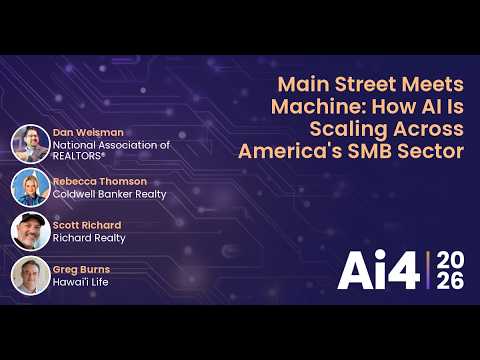
Real Estate SMBs Deploy AI to Counter Consolidation as Volume Falls
Ai4
Boutique brokerages can neutralize multi-billion-dollar corporate tech platforms by vibe-coding proprietary workflows, provided they anchor frontier models to strict internal compliance harnesses and owned data.
## Background
Published on YouTube by Ai4 on August 22, 2026, this panel discussion explores how artificial intelligence is scaling across America's small and medium-sized business sector, using the real estate industry as a massive operational proving ground. Moderated by Dan Weisman of the National Association of REALTORS®, the session examines how independent business owners navigate AI deployment without dedicated IT or data science teams.
## TL;DR
Panelists representing independent agents, boutique brokerages, and national enterprise portfolios explore practical AI workflows, from natural language vibe coding to automated negotiation roleplaying. They stress that proprietary business data and governance 'harnesses' serve as true defensive moats against liability and model obsolescence rather than brittle third-party wrapper apps. The speakers also address the AI trust paradox and automation bias, emphasizing that while multi-model synthetic advisory boards accelerate strategy, high-touch personal connection remains essential to client fiduciary duties.
## Atmosphere & style
The discussion is pragmatic, energetic, and candid, deliberately bypassing abstract corporate hype in favor of actionable, frontline SMB execution. Dan Weisman leads with lively, grounded moderation, creating a balanced rapport between Scott Richard's technical builder insights, Greg Burns's solopreneur agility, and Rebecca Thomson's structured enterprise perspective. Watching the session feels like sitting in on an honest peer-to-peer strategy debrief, combining exciting glimpses of autonomous multi-agent systems with sobering reminders about legal liability and authentic human relationships.
## Key takeaways
- [00:04](https://www.youtube.com/watch?v=XQ2H5EAsatY&t=4s) Real estate serves as a premier proving ground for SMB AI adoption, where the core challenge is translating enterprise-level technology into accessible tools for independent operators without dedicated IT teams.
- [05:21](https://www.youtube.com/watch?v=XQ2H5EAsatY&t=321s) Bottom-up adoption—upskilling operational staff first and using AI for roleplaying difficult conversations—proves far more effective than top-down corporate mandates across independent contractor networks.
- [11:31](https://www.youtube.com/watch?v=XQ2H5EAsatY&t=691s) In regulated industries, SMBs should invest in building a model-agnostic compliance and logging 'harness' rather than standalone applications, allowing them to safely swap underlying foundation models.
- [14:36](https://www.youtube.com/watch?v=XQ2H5EAsatY&t=876s) Generative AI is actively countering enterprise consolidation by enabling individual agents and boutique brokerages to build lightweight custom software without enterprise overhead.
- [17:07](https://www.youtube.com/watch?v=XQ2H5EAsatY&t=1027s) Proprietary business data and domain workflows constitute an SMB's only true defensible moat against shallow wrapper applications.
- [17:07](https://www.youtube.com/watch?v=XQ2H5EAsatY&t=1027s) Conversational development, or 'vibe coding' via frontier LLM coding tools, enables non-technical founders to rapidly prototype and resolve operational bottlenecks with custom MVPs.
- [21:54](https://www.youtube.com/watch?v=XQ2H5EAsatY&t=1314s) Frontier models can act as real-time fiduciary negotiation partners, helping agents analyze contracts, formulate counter-offers, and tailor communication styles to specific client personas.
- [24:37](https://www.youtube.com/watch?v=XQ2H5EAsatY&t=1477s) Unchecked 'sloppy AI' usage and automation bias erode client trust and introduce legal liabilities, underscoring the absolute necessity of human-in-the-loop verification.
- [32:57](https://www.youtube.com/watch?v=XQ2H5EAsatY&t=1977s) Simulating a multi-model 'AI board of directors' with diverse personas allows solo entrepreneurs to stress-test major strategic decisions and eliminate cognitive blind spots.
- [35:30](https://www.youtube.com/watch?v=XQ2H5EAsatY&t=2130s) Automation should be applied selectively to eliminate administrative drag while intentionally safeguarding the direct, high-touch personal interactions that preserve client loyalty.
- [37:46](https://www.youtube.com/watch?v=XQ2H5EAsatY&t=2266s) When approaching the build versus buy dilemma, SMBs achieve optimal ROI by layering hyper-local, proprietary niche data on top of established commercial platforms rather than building custom stacks from scratch.
- [41:26](https://www.youtube.com/watch?v=XQ2H5EAsatY&t=2486s) Macroeconomic market pressures are driving consolidation away from fragmented point tools toward unified platforms, transitioning business operators from manual builders into strategic visionaries.
## Detailed walkthrough
### [00:04](https://www.youtube.com/watch?v=XQ2H5EAsatY&t=4s) Framing AI Adoption for Real Estate and Main Street SMBs
Dan Weisman opens the session by acknowledging the pre-lunch fatigue at the tail end of the conference before defining the panel’s core mission. While many conference sessions spend only two minutes on practical applications before descending into deep technical mechanics, this discussion is deliberately anchored at a practical operational level. The goal is to focus on real-world implementation—examining where artificial intelligence is succeeding, where it is failing, and where the everyday operational friction lies for independent business operators.
The real estate sector serves as a massive proving ground for small and medium-sized business (SMB) technology adoption. With approximately 1.5 million members in the National Association of REALTORS® alone, the industry represents an ecosystem of independent agents, brokers, and franchise owners spanning residential and commercial transactions. Weisman emphasizes that while his innovation strategy team—alongside emerging technology leaders like Sharon—spends ten or more hours a day tracking cutting-edge AI developments, the primary hurdle remains translating that firehose of innovation into actionable, accessible tools that everyday business owners can realistically execute without enterprise-sized IT departments.
```mermaid
flowchart TD
accTitle: SMB AI Implementation Pipeline
accDescription: Workflow moving from AI research to practical adoption by independent agents and brokers.
subgraph Research["Innovation & Strategy Layer"]
A["Emerging Tech Research"] --> B["Curated AI Tools & Workflows"]
end
subgraph Enterprise["Brokerage & Trade Level"]
B --> C["Corporate AI Assistants & Coaching"]
end
subgraph SMB["Main Street Execution"]
C --> D["Independent Agents & Teams"]
D --> E["Client Relationship & Local Marketing"]
end
```
[02:09](https://www.youtube.com/watch?v=XQ2H5EAsatY&t=129s) Panelist Introductions and Primary AI Use Cases
Weisman introduces the panelists and prompts each for a rapid-fire summary of their primary AI use case without getting bogged down in technical specifications. Scott Richard, broker-owner of an independent brokerage based in Cody, Wyoming right outside Yellowstone National Park, highlights his focus on understanding how to effectively deploy AI within a "highly regulated industry." Rebecca Thomson, representing Coldwell Banker Realty from Chicago, points to the successful rollout of an internal chat interface branded as an "AI assistant," which has lowered the barrier to entry for agents who were initially intimidated by the technology. Greg Burns, an agent with Hawai'i Life based in Maui, shares that his most impactful application involves feeding Hawaii's distinctive visual imagery into AI models so the systems can learn directly from visual data and assist in local marketing.
Weisman notes that the three panelists deliberately represent distinct operational perspectives across the SMB scale:
- **Scott Richard:** Leads a boutique brokerage of about 25 agents in Cody, Wyoming.
- **Rebecca Thomson:** Oversees professional development across a national enterprise portfolio spanning company-owned brokerages and independent franchisees.
- **Greg Burns:** Operates as an individual agent handling transactions across the Hawaiian islands.
[03:44](https://www.youtube.com/watch?v=XQ2H5EAsatY&t=224s) Bridging Multimedia Production with Automated AI Marketing
Reflecting on Scott Richard's background as a technologist who transitioned into real estate, Weisman recalls a demonstration Richard presented two years earlier that stitched together tools like HeyGen, ChatGPT, and automated video generation to create autonomous marketing workflows. Richard explains that his career originated with a degree in computer animation followed by running a multimedia production company for nearly a decade. When he entered real estate, the intersection between creative tech and brokerage sales felt entirely natural.
Addressing early skepticism around generative models, Richard points out that early criticisms centered heavily on hallucinations and inaccuracies. At the time, early adopters recognized that the initial flaws represented "the worst it will ever be." Over the subsequent 12 to 24 months, the underlying technology matured rapidly, transforming concepts that were once theoretical future concepts into practical, daily production pipelines.
[05:21](https://www.youtube.com/watch?v=XQ2H5EAsatY&t=321s) Enterprise Upskilling, Roleplay Coaching, and Talent Reallocation
Managing AI adoption across a massive enterprise portfolio requires balancing corporate governance with individual entrepreneurial freedom. Rebecca Thomson explains that their structure—comparable to a portfolio group like LVMH—combines company-owned entities with independent affiliate franchise owners. Because agents and franchisees are independent business operators who choose whether to opt in or opt out of corporate tools, mandates are ineffective. The rollout began by upskilling internal corporate staff and operational employees first, ensuring they could use AI responsibly and comfortably. Once finance team members and front-desk coordinators experienced genuine efficiency gains, they would "rightfully so nerd out" and share those breakthroughs with agents, organically driving adoption from the bottom up.
This grassroots interest quickly expanded into structured sales training and AI-powered roleplaying. Agents leverage the AI assistant as an on-demand coach to practice challenging client conversations, such as navigating difficult pricing discussions with homeowners whose properties have sat on the market for six weeks without selling. For broker-owners and agent teams, this automation allows for strategic talent reallocation rather than workforce reduction. Instead of administrative staff spending hours on rote data entry, operational personnel can leverage AI as a creative "thought partner" to craft comprehensive marketing strategies and focus on higher-value client engagement.
[08:39](https://www.youtube.com/watch?v=XQ2H5EAsatY&t=519s) Scaling Down from Big-Tech Brokerages to Island Client Intimacy
Weisman contrasts the vast tech budgets of venture-backed firms with smaller independent brokerages, prompting Greg Burns to describe his shift from Compass to Hawai'i Life. Burns reflects on his identity as an entrepreneur operating in an isolated geographical market. While Hawaii offers incredible real estate and scenery, the local business ecosystem historically lagged in technology access, feeling at times "like going into the past." Burns originally helped expand Compass into the islands to provide local agents with modern technological infrastructure.
However, transacting real estate in Hawaii requires handling transactions across multiple distinct islands and navigating deeply personal client relationships. Burns ultimately moved to Hawai'i Life to preserve that close-knit client intimacy while adapting modern tools to fit a boutique model. Weisman validates this dynamic, observing that regardless of the artificial intelligence tools deployed, SMB real estate remains an intrinsically human-to-human business where automation must serve to enhance, rather than replace, face-to-face client relationships.
[11:31](https://www.youtube.com/watch?v=XQ2H5EAsatY&t=691s) Sentiment on AI and the Need for Compliance Guardrails
Dan Weisman opens by sharing unreleased data from the National Association of REALTORS® annual tech survey, noting that 55% of realtors reported AI having a positive impact on their business. When Dan asks the panel if that figure feels high or low, Greg Burns immediately responds that 55% is far too low: "It should be 80–90%." For an entrepreneur, AI unlocks the leverage to achieve significantly more work in far less time and at a fraction of the cost, reinforcing Rebecca Thomson's earlier points about operational acceleration.
Scott Richard steps in to take a show of hands from the audience, finding that the room is predominantly composed of small business owners alongside a handful of enterprise leaders. Highlighting the contrast between large corporate brokerages with dedicated IT departments and independent broker-owners who operate without research and development teams, Scott urges small business owners to look past flashy marketing applications and prioritize risk mitigation. In a heavily regulated environment, Scott's highest-leverage implementation was building an internal compliance engine.
Scott emphasizes that while underlying foundational AI models will continuously evolve and get smarter, a small business must focus its engineering and time on building the "harness"—the guardrails and business infrastructure into which any plug-and-play AI model can be slotted. In his own brokerage, where 20 to 30 agents constantly come and go asking questions, this system autonomously delivers answers without hallucinating, explicitly cites its sources, and maintains audit logs for every interaction. Solving governance and compliance first prevents the single costly misstep that could result in catastrophic litigation.
```mermaid
flowchart TD
accTitle: Harness and Compliance Architecture for SMB AI
subgraph Core ["Small Business Core Infrastructure"]
A["Proprietary Business Data & IP"]
B["Compliance Guardrails & Logging Harness"]
end
subgraph ModelLayer ["Interchangeable Model Layer"]
C["Frontier AI Models<br/>(OpenAI / Claude / etc.)"]
end
subgraph OutputLayer ["Operational Output"]
D["Hallucination-Free, Cited Agent Support"]
E["Secure, Auditable Workflows"]
end
A --> B
B <--> C
B --> D
B --> E
```
- **55% of Realtors** in NAR's annual tech survey reported a positive impact from AI, a number panelists believe should be closer to 80% to 90%.
- **The Harness Concept**: Small businesses should build model-agnostic guardrails and logging rather than building brittle standalone apps, allowing them to swap frontier models as AI capabilities advance.
---
[14:36](https://www.youtube.com/watch?v=XQ2H5EAsatY&t=876s) Enterprise Platforms, Integration, and Resisting Shiny Object Syndrome
Rebecca Thomson contrasts the independent builder approach with enterprise investment, revealing that Coldwell Banker's parent organization has invested $2 billion in its end-to-end technology platform to date, supported by an ongoing annual investment of $150 million. On a recent earnings call, leadership disclosed that 50% to 60% of their new code generation is currently produced by AI. For affiliated small business brokers, this centralized ecosystem serves as an antidote to "shiny object syndrome" and the endless barrage of fragmented vendor pitches in conference hallways. Rebecca underscores that whether a business builds its own tools or adopts an enterprise platform, every feature must be vetted for whether it is genuinely additive or merely a distraction, and whether it serves the entire chain: the broker, the agent, and ultimately the consumer.
Greg Burns brings the perspective back to the independent practitioner, reflecting on how massive enterprise tech investments—such as Compass's proprietary tech stack—previously drove aggressive industry consolidation by pricing boutique firms out of modern technology. Generative AI and modern developer tooling are actively reversing that dynamic. By enabling individual agents and boutique brokerages to engage in their own lightweight software development and customization without enterprise overhead, AI allows them to remain independent while preserving intimate, high-touch client relationships.
- **$2 Billion Total Investment**: Enterprise platform scale with ongoing annual capital expenditure of $150 million.
- **50% to 60% of Enterprise Code** is currently produced via AI tooling.
- **Countering Consolidation**: AI levels the competitive playing field, allowing boutique brokerages to deploy sophisticated tooling without succumbing to enterprise acquisition.
---
[17:07](https://www.youtube.com/watch?v=XQ2H5EAsatY&t=1027s) Business-First Thinking, Data Moats, and Vibe Coding
Dan Weisman challenges the panel on the industry's obsession with branding everything as an "AI company." He stresses that technology should not overshadow core business realities: real problems require a mix of people, process, and tools, and owners juggling dozens of operational headaches need a concrete roadmap for where to start. Scott agrees, warning businesses not to get trapped in AI hype or endlessly chasing the "perfect platform," which will inevitably be obsolete in three weeks. Instead, the true defensive moat for any small business is controlling its own proprietary data and intellectual property. Channeling Wayne Gretzky's adage to "skate to where the puck is going, not where it is," Scott advises owners to anticipate where AI capabilities will be in 12 to 24 months, avoid building shallow wrapper apps on frontier models, and use AI behind the scenes so humans can double down on high-touch personal relationships.
When Dan pushes Scott to move past general philosophies and name the exact starting point for an SMB owner today, Scott points directly to modern coding environments like OpenAI Codex and Claude Code. He notes that non-technical operators often shy away from tools labeled "code," but natural language software development—commonly called "vibe coding"—empowers owners to spin up a tailored Minimum Viable Product (MVP) simply by conversing with the model. However, Scott warns that while vibe coding quickly solves an internal business problem, founders must remain vigilant about security, scalability, and data privacy before attempting to turn custom prototypes into enterprise-grade software.
- **Data as the Moat**: Thin wrappers over third-party APIs offer no defensibility; proprietary business records, operational workflows, and domain IP are the only durable assets.
- **Vibe Coding**: Non-technical entrepreneurs can build operational MVPs via conversational prompting using frontier tools like OpenAI Codex and Anthropic's Claude Code.
- **MVP vs. Enterprise Ready**: Rapidly generated vibe-coded applications solve bespoke internal bottlenecks immediately, but require rigorous review before scaling across multi-user or regulated environments.
[21:54](https://www.youtube.com/watch?v=XQ2H5EAsatY&t=1314s) Speaking What You Want and AI as a Negotiating Partner
The panel emphasizes that the interface of the future is natural language: users will simply describe what they want and AI will build it. Rather than treating prompts like brief Google search queries, users should go as deep and detailed as possible into the problem and the envisioned solution. This depth levels the playing field across small businesses, allowing anyone with an idea to create sophisticated tools, though caution and deeper scrutiny are needed when scaling up due to underlying security risks.
```mermaid
flowchart TD
accTitle: AI in Real Estate Workflow
accDescr: Diagram illustrating how real estate contracts and market demand data flow through AI models to generate tailored client strategies.
subgraph DataInput ["Input Layer"]
A["Incoming Real Estate Contract"]
B["Live Market & Buyer Demand Data"]
end
subgraph AIProcessing ["AI Processing Layer (Claude / Custom Assistant)"]
C["Contract Analysis & Strategy Generation"]
D["Audience Persona Adaptation\n(Quant vs. English Major)"]
end
Greg Burns shares how he uses Anthropic's Claude directly as a strategic negotiating partner. When purchase contracts arrive for his listings, he uploads them to Claude to generate counter-strategies and responses. Prior to this, he had to rely entirely on his own perspective or consult his broker; now, Claude provides an immediate, objective third-party opinion that helps him fulfill his fiduciary duty to his clients. Rebecca Thomson notes that Coldwell Banker integrates a buyer demand tool into their AI assistant. Agents can verbally query moving market data and then roleplay negotiation tactics (e.g., how to position a listing when a seller needs to move fast) while tailoring the tone to the client's personality, whether they are an analytical "quant" or a narrative-focused "English major."
- **Prompting Best Practice:** Avoid one-sentence, search-engine-style queries; provide detailed context and deep operational specifications to let frontier models excel.
- **Fiduciary Negotiation:** Claude acts as an outside counsel on incoming contract terms, identifying nuances and refining counter-offers.
- **Persona Adaptation:** AI dynamically translates raw market demand metrics into communication styles tailored to specific buyer/seller mindsets.
---
[24:37](https://www.youtube.com/watch?v=XQ2H5EAsatY&t=1477s) The AI Trust Paradox, Verification, and Avoiding "Sloppy AI"
Dan Weisman introduces a central industry paradox using recent research: while approximately 50% of U.S. adults actively use AI chatbots, 75% report that they do not trust AI. In high-stakes, relationship-driven fields like real estate and small business services, client trust is paramount. Dan humorously recounts trying to troubleshoot his daughter's car issues using ChatGPT, annoying his mechanic of 30 years by trying to tell him how to do his job. The panel addresses how professionals should navigate clients using AI, client skepticism, and the absolute requirement for safety and data accuracy.
Greg Burns and Rebecca Thomson underline a "trust and then verify" methodology. Buyers and sellers now routinely analyze transactions using Claude themselves, citing the model's outputs in negotiations. However, uncritical adoption leads to severe pitfalls:
- **The Anne Hathaway Anecdote:** Rebecca recounts an anecdote where actress Anne Hathaway interviewed candidates for an assistant role and immediately disqualified four applicants after receiving thank-you notes that contained the exact same AI-generated wording.
- **Loss of Discernment:** "Sloppy AI usage is running rampant," leading to a noticeable decline in critical and analytical thinking when users treat AI answers as unquestionable solutions without adding personal inflection.
- **Representing the Brand:** Employees and agents are direct extensions of the business owner; simply regurgitating raw model outputs damages client relationships and strips away the personal touch essential to sales.
---
[28:26](https://www.youtube.com/watch?v=XQ2H5EAsatY&t=1706s) Overcoming "Automation Bias" and the Black Box
Scott Richard explains the danger of *automation bias*—the cognitive tendency for humans to blindly trust computational outputs, similar to accepting numbers spit out by a calculator. In small businesses, employees frequently paste sensitive, proprietary client data into third-party AI models without informing the business owner, exposing the firm to massive liability.
To mitigate this, Scott developed custom internal software harnesses for his brokerage. Rather than letting agents query an opaque "black box," his custom architecture validates every data point, distributes verified brokerage knowledge instantaneously, and forces the human professional to act as the ultimate decision-maker. Because real estate agents carry professional licenses and legal liability, AI must serve purely as a judgment-support layer, not an autonomous agent operating without human oversight.
---
[30:18](https://www.youtube.com/watch?v=XQ2H5EAsatY&t=1818s) Multi-Model "Board of Directors" and Autonomous AI Debates
Dan Weisman brings up an experiment discussed over lunch and inspired by a visit to the Black Hat cybersecurity conference with Greg Burns. At Black Hat, conference leadership demonstrated an operations center where multiple chatbots were pitted against one another to debate defensive strategies.
Scott Richard details how he built an autonomous AI "Board of Directors" by isolating frontier models in a shared environment without personal memory or user context. By removing the human prompter and injecting a single problem statement, the leading frontier models—including OpenAI, Anthropic (Claude), Grok, Meta's Llama, and Google's Gemini—debated the scenarios among themselves.
```mermaid
flowchart LR
accTitle: Multi-Model AI Board of Directors
accDescr: Workflow showing multiple LLMs debating an injected prompt, layered with voice and video generation tools.
Models --> V
Models --> Vid
V --> Output["Autonomous Panel Video Output"]
Vid --> Output
```
Scott layered these interactions with voice synthesis via ElevenLabs and generative video tools (such as Kling or similar tools) to create fully rendered virtual avatars of the models debating business strategy. While not quite ready for live, real-time stage deployment today, Scott predicts that within 12 to 24 months, these autonomous multi-agent video panels will become standard across YouTube and social media channels.
[32:57](https://www.youtube.com/watch?v=XQ2H5EAsatY&t=1977s) AI "Board of Directors" and Cross-Model Collaboration
The panelists discuss how small business owners can leverage multiple large language models collaboratively to solve complex problems and simulate executive decision-making. Greg Burns and Scott Richard describe setting up leading models from OpenAI and Anthropic to debate each other, going back and forth until they reach a refined solution. Rebecca Thomson emphasizes that small business ownership can often be an isolating experience where founders find themselves trapped in an echo chamber. Establishing an AI-powered "board of directors" with distinct personas allows an owner to counterbalance their natural biases—whether they lack risk appetite or have too much of it and need restraint.
```mermaid
flowchart TD
accTitle: Multi-Persona AI Board Decision Architecture
subgraph Input ["Strategic Decision Input"]
A["SMB Owner / Solopreneur<br>Strategic Dilemma & Persona Framing"]
end
subgraph Deliberation ["Synthetic Board of Directors"]
B["Risk-Averse Advisor<br>(e.g., Claude Persona)"]
C["Growth & Innovation Strategist<br>(e.g., ChatGPT Persona)"]
D["Operational Compliance & Feasibility"]
end
subgraph Synthesis ["Consensus & Execution"]
E["Debate, Scenario Stress-Testing & Synthesis"]
F["Actionable Business Decision & Time Savings"]
end
A --> B
A --> C
A --> D
B <--> E
C <--> E
D <--> E
E --> F
```
This synthetic advisory board becomes particularly useful when navigating strategic uncertainty and making decisions without perfect information. Instead of marinating alone on high-stakes choices—such as software adoption or potential mergers—business owners can assign specific roles and scenarios to stress-test their ideas. Ultimately, relying on AI to shoulder heavy cognitive burdens enables entrepreneurs to refocus on the core elements of their craft that they fell in love with in the first place.
- **Cross-Model Debate**: Pitting Claude (Anthropic) against ChatGPT (OpenAI) allows SMBs to achieve well-rounded solutions through automated counter-argumentation.
- **Countering Bias**: Custom personas provide checks and balances against personal risk extremes and mitigate solo echo chambers.
- **Strategic Stress-Testing**: Facilitates rapid "if-this-then-that" scenario modeling for major operational milestones like brokerage mergers or software migrations.
---
[35:30](https://www.youtube.com/watch?v=XQ2H5EAsatY&t=2130s) Autonomous Agents and Preserving Core Human Relationships
Scott Richard recounts the evolution of his multi-model workflows, starting from manually copying and pasting responses back and forth between ChatGPT and Claude to verify and challenge their outputs. Today, autonomous browser-control agents can operate directly across browser tabs, debating and troubleshooting without requiring constant manual intervention. While these advancements can make one "feel inferior about your knowledge," they unlock unprecedented execution speed for individual operators.
```mermaid
flowchart LR
accTitle: Delegation vs Human Touch Framework
subgraph Automated ["Automate / Offload to AI"]
A1["Repetitive Copywriting"]
A2["Basic Video Editing"]
A3["Workflow Automation"]
end
subgraph Preserved ["Preserve Core Human Touch"]
B1["Client Relationships & Trust"]
B2["Personal Passions (e.g. Custom Remarks)"]
B3["High-Touch Consultations"]
end
Automated -.->|"Frees up bandwidth for"| Preserved
```
Despite the power of automated workflows, the panel stresses that AI should amplify human strengths rather than replace the human connection. Rebecca shares an anecdote of a top-producing agent who was a former journalism major and explicitly refused to delegate writing property remarks to AI because he genuinely loved the craft. Panelists agree that delegating too much client communication risks stripping away the "stickiness" and genuine feel of customer relationships.
- **Agentic Browser Control**: Eliminates manual copy-pasting by allowing AI agents to interact with web interfaces and collaborate autonomously.
- **Selective Automation**: Businesses should offload tedious tasks (such as generic copywriting or basic video editing) while retaining activities they personally enjoy.
- **Client Stickiness**: Preserving direct personal contact remains vital to maintaining customer trust and long-term brand equity.
---
[37:46](https://www.youtube.com/watch?v=XQ2H5EAsatY&t=2266s) Q&A: The Build vs. Buy Dilemma for SMBs
Dan Weisman opens the session to audience questions, prompting an inquiry regarding how real estate practitioners and SMBs should navigate the choice between building custom AI solutions versus purchasing off-the-shelf software. Greg Burns explains that as a solopreneur, building custom tools in-house has become radically fast and cost-effective, turning tasks that once demanded extensive time and capital into workflows that can be built in a matter of minutes.
Rebecca Thomson provides a counterweight from an enterprise and brokerage perspective, cautioning that just because an operator *can* build something does not always mean they *should*. For most business owners, spending bandwidth on software development risks creating severe tunnel vision and missing broader operational duties. She highlights a New England brokerage where an agent scanned out-of-print historic architecture reference books to train a hyper-local AI assistant. This niche knowledge base successfully differentiated the office while running on top of their existing purchased infrastructure.
```mermaid
flowchart TD
accTitle: Build vs Buy Decision Framework for Real Estate SMBs
Start["Evaluate Tech Need"] --> Q1{"Is it a hyper-niche,<br>core differentiator?"}
Q1 -- Yes --> Q2{"Do you have the passion<br>& bandwidth without tunnel vision?"}
Q1 -- No --> Buy["Buy Scaled Platform<br>(Leverage Network Effects & Save Time)"]
Q2 -- Yes --> Build["Build Custom Solution<br>(Tailored Niche Data & Workflows)"]
Q2 -- No --> Hybrid["Hybrid Approach<br>(Layer Custom Data onto Existing Platform)"]
```
- **Solopreneur Build Speed**: Modern tooling enables individual agents to build highly functional, custom internal workflows in minutes.
- **ROI on Bandwidth**: Enterprise leaders warn that excessive DIY development can distract from client service and revenue-generating activities.
- **Hybrid Domain Customization**: The New England case study demonstrates how proprietary, scanned offline historical data can be layered onto established commercial software to create a localized competitive edge.
---
[41:26](https://www.youtube.com/watch?v=XQ2H5EAsatY&t=2486s) Q&A: Agent Adoption Trends, Housing Market Pressures, and Future Outlook
An audience member asks about agent adoption trends, software pricing models, and how independent agents conduct cost-benefit analyses as AI advances. Rebecca Thomson explains that many independent brokerages and agents suffer from severe platform fragmentation—juggling disparate tools for CRMs, digital forms, and design platforms like Canva. Because piecemealing these tools introduces friction, Coldwell Banker has seen an increase in inquiries from independents seeking fully integrated, end-to-end technology solutions.
Macroeconomic pressures also shape these investment decisions. With the United States housing market currently tracking around 4.1 million annual transactions—well below the healthier benchmark of 5.5 to 6 million—agents face heightened scrutiny over their time and capital expenditures. In a closing visionary remark, Dan Weisman underscores that within two to five years, businesses may no longer need to puzzle over deployment hurdles, as autonomous systems will build and scale solutions directly, elevating the human owner to the role of pure director and visionary.
| Market Metric / Dynamic | Historical / Target Level | Current Context & Impact on SMBs |
|:--- |:--- |:--- |
| **Annual US Home Transactions** | ~5.5M – 6.0M | **~4.1M**: Lower volume forces rigorous cost-benefit analysis on tech spending. |
| **Tech Stack Architecture** | Fragmented (separate CRM, forms, marketing) | **Shift to End-to-End Integration**: Reduces operational friction for independent brokers. |
| **Operator Role Evolution** | Manual Builder / Tool Integrator | **Visionary & Director**: Guiding autonomous systems that construct workflows on demand. |
## Notable quotes
> [03:44](https://www.youtube.com/watch?v=XQ2H5EAsatY&t=224s) the worst it will ever be. — Scott Richard
> [05:21](https://www.youtube.com/watch?v=XQ2H5EAsatY&t=321s) rightfully so nerd out — Rebecca Thomson
> [08:39](https://www.youtube.com/watch?v=XQ2H5EAsatY&t=519s) like going into the past. — Greg Burns
> [11:31](https://www.youtube.com/watch?v=XQ2H5EAsatY&t=691s) It should be 80–90%. — Greg Burns
> [17:07](https://www.youtube.com/watch?v=XQ2H5EAsatY&t=1027s) skate to where the puck is going, not where it is — Scott Richard
> [24:37](https://www.youtube.com/watch?v=XQ2H5EAsatY&t=1477s) Sloppy AI usage is running rampant — Rebecca Thomson
> [35:30](https://www.youtube.com/watch?v=XQ2H5EAsatY&t=2130s) feel inferior about your knowledge — Scott Richard
## Mentioned
Dan Weisman, Scott Richard, Rebecca Thomson, Greg Burns, Sharon, Anne Hathaway, Wayne Gretzky, National Association of REALTORS®, Richard Realty, Hawai'i Life, Coldwell Banker Realty, LVMH, Compass, Black Hat, OpenAI, OpenAI Codex, ChatGPT, Anthropic, Claude, Claude Code, Google Gemini, Meta, Llama, Grok, HeyGen, ElevenLabs, Synthesia, SeaArt, Kling, Canva, YouTube
## Video description
Dan Weisman — Director, Innovation Strategy, National Association of REALTORS®
Scott Richard — Broker/Owner, Richard Realty
Greg Burns — Realtor Salesperson, Hawai'i Life
Rebecca Thomson — National Vice President, Professional Development, Coldwell Banker Realty
Real estate is not often the first industry that comes to mind when AI leaders think about scaled deployment, but it should be. With more than two million licensed agents and brokers in the United States, nearly all operating as small/medium business owners, real estate represents one of the largest and most diverse testbeds for AI adoption at the SMB level anywhere in the economy.
As AI matures beyond enterprise use, the next wave of transformation will unfold on Mainstreet. This panel examines what happens when AI tools built for enterprise budgets meet SMB reality: limited IT support, no dedicated data teams, and owners that wear every hat. Panelists will share what is working today, from AI-assisted client communication and automated valuation to workflow automation and compliance, and where the gap between the hype and reality remains wide.
The conversation surfaces lessons beyond real estate that are applicable to any SMB. It reframes the 33 million small businesses in America as AI's next major growth market, one that requires a fundamentally different product playbook than enterprise. Attendees will leave with concrete use cases, honest benchmarks, and a clearer picture of what it actually takes to build and deploy AI outside the Fortune 500.
交易量下滑之际,房地产中小企业部署AI抵御行业整合
精品中介机构若将前沿模型锚定于严格的内部合规框架与自有数据,便可通过“氛围编码”(vibe-coding)专有工作流,抗衡价值数十亿美元的巨头技术平台。
代表独立经纪人、精品中介机构和全国性企业资产组合的嘉宾探讨了实用的AI工作流,涵盖从自然语言氛围编码(vibe coding)到自动化谈判角色扮演。他们强调,专有业务数据和治理“框架”(harness)才是防范责任风险和模型过时的真正防御护城河,而非脆弱的第三方套壳应用。演讲者还深入探讨了AI信任悖论与自动化偏见,指出尽管多模型合成顾问团能加快战略决策,但深度的人际互动对于履行对客户的受托责任依然不可或缺。
房地产行业已成为中小企业(SMB)落地 AI 的前沿试验场;实践表明,自下而上赋能一线运营人员并开展模拟对话演练,比自上而下的强制推行更为有效。 (5:21)
在强监管环境中,中小企业应优先投资构建具备审计与防幻觉能力的合规架构(Harness),而非依赖脆弱的独立应用,以便随时安全切换并接入最新的前沿底座模型。 (11:31)
生成式 AI 与“氛围编程(vibe coding)”让非技术人员得以低成本开发专属工具来打破大企业垄断,而私有业务数据与核心工作流则是抵御浅层 API 套壳应用的唯一护城河。 (17:07)
尽管前沿模型能作为受托谈判助手解析合同并制定策略,但缺乏审查的“粗糙 AI”输出与自动化偏差会严重损害客户信任,必须始终保持专业人员的人工核验把关。 (24:37)
Reading summary
Artificial intelligence is lowering technical barriers for small and medium-sized real estate businesses, enabling lightweight development and tactical automation, according to industry practitioners hosted by Ai4. However, the panelists argue that operational success depends on establishing compliance guardrails, protecting proprietary data, and preserving direct client relationships rather than chasing unvetted tools.
Leveling the Playing Field Against Enterprise Budgets (14:36)
Historically, large venture-backed brokerages consolidated market share because boutique operators could not match their software research and development budgets. Rebecca Thomson notes that Coldwell Banker's parent company invested $2 billion into its platform, supported by $150 million annually, with 50% to 60% of new code generated by AI. Despite this enterprise scale, individual practitioner Greg Burns and independent broker Scott Richard report that generative AI and conversational 'vibe coding' via tools like OpenAI Codex and Claude Code now allow solopreneurs and small firms to build bespoke operational workflows in minutes, mitigating the pressure to join large conglomerates.
Compliance Harnesses and Cognitive Bias Risks (11:31)
In highly regulated environments, the panel warns that unmanaged AI deployment introduces severe liability. Richard points out that employees frequently copy proprietary client records into commercial models without realizing the exposure. He advocates building a compliance 'harness'—an internal framework that logs interactions, retrieves cited source material, and allows interchangeable frontier models to be swapped in without hallucinating. The system keeps human professionals liable and in control, countering 'automation bias,' which leads operators to trust automated outputs uncritically.
The AI Trust Paradox and Tactical Workflows (21:54)
Dan Weisman highlights an industry friction: while roughly 50% of U.S. adults use AI chatbots, 75% report that they do not trust them. Panelists advocate a 'trust and then verify' policy, cautioning against 'sloppy AI' usage that strips away brand personality or duplicates generic phrasing. Operationally, practitioners deploy AI as a counterweight rather than an autonomous replacement. Burns uses Anthropic's Claude to review incoming real estate contracts and roleplay negotiation counter-offers, while Thomson outlines using AI assistants to simulate difficult pricing conversations with sellers tailored to specific analytical or narrative client personas.
Synthetic Advisory Boards and Multi-Model Collaboration (30:18)
To counter the operational isolation of small business ownership, Richard and Burns describe deploying multiple distinct models—such as OpenAI, Anthropic's Claude, Google's Gemini, and Meta's Llama—into structured debates. Setting up opposing personas allows an entrepreneur to stress-test major business decisions, such as mergers or platform migrations, balancing aggressive growth strategies against risk-averse compliance. Richard has experimented with pairing these debates with voice synthesis and generative video avatars, forecasting that autonomous multi-agent advisory panels will become common within 12 to 24 months.
The Build Versus Buy Dilemma Under Market Pressure (37:46)
With annual U.S. residential transactions depressed at approximately 4.1 million—well below the typical 5.5 to 6 million range—SMB operators face strict limits on capital and attention. While building internal tools has become technically accessible, Thomson cautions against the distraction of DIY software engineering, noting that many independent brokerages suffer from managing fragmented point solutions. She points to a hybrid model as the ideal balance: layering unique, local intellectual property—such as digitizing out-of-print regional architectural books—on top of proven, commercially purchased software.
While AI provides small businesses with unprecedented operational leverage, panelists agree that long-term defensibility rests on proprietary data assets and authentic human client contact. Dan Weisman envisions that over the next two to five years, autonomous systems will increasingly build and scale software directly, shifting the business owner's day-to-day focus from software integration to executive direction.
## Background
本视频由 Ai4 于 2026 年 8 月 22 日发布在 YouTube 平台上。内容围绕全美房地产经纪人协会(NAR)的 Dan Weisman 主持的圆桌论坛展开,携手行业嘉宾 Scott Richard、Rebecca Thomson 与 Greg Burns,深入探讨了在缺乏专业 IT 团队和庞大技术预算的中小微企业(SMB)现实中,如何将前沿 AI 工具落地到房地产日常业务、合规治理与工作流中。
## TL;DR
圆桌论坛将拥有数百万持牌经纪人的房地产行业视为全美中小微企业采纳 AI 的最大试验场。嘉宾们系统剖析了如何通过搭建合规防护底座(Harness)规避大模型幻觉与法律风险,并分享了利用“氛围编码”(Vibe Coding)快速验证 MVP 以及将 AI 作为谈判助手与销售演练搭档的落地实践。讨论还直面了买卖双方皆用 AI 博弈带来的“信任悖论”,展示了跨模型自主辩论的“AI 虚拟董事会”前沿构想,并明确指出 AI 的真正价值是接管繁重杂务以放大人类能力,而非切断不可替代的人际温度与信任连接。
## Atmosphere & style
整场对话务实干练、幽默风趣且极具实操温度,彻底跳脱出了传统科技峰会堆砌晦涩算法的套路。主持人 Dan Weisman 控场自如,将大型经纪集团的体系化赋能视角、怀俄明独立经纪行老板的极客探索以及夏威夷本土中介注重人情纽带的经验有机交融。现场在探讨多 Agent 辩论等前沿技术时洋溢着极客般的兴奋感,但落脚点始终紧扣商业常识与合规底线,给观众带来一种穿透 AI 泡沫、直击小微企业生存现实的清醒与笃定。
## Key takeaways
- [00:04](https://www.youtube.com/watch?v=XQ2H5EAsatY&t=4s) 房地产行业由数百万独立持牌经纪人组成,本质上是全美最具代表性的小微企业(SMB)试验场,其 AI 采纳逻辑不同于大企业。
- [05:21](https://www.youtube.com/watch?v=XQ2H5EAsatY&t=321s) 去中心化的大型组织无法依靠行政命令推行 AI,通过赋能内部基础员工并口口相传,能自下而上激发业务一线的探索欲。
- [05:21](https://www.youtube.com/watch?v=XQ2H5EAsatY&t=321s) 小微企业应用 AI 的目的并非取代人力或裁员,而是实现人才资产的重新分配,让员工从枯燥死板的数据录入转向高价值的策略思考。
- [12:08](https://www.youtube.com/watch?v=XQ2H5EAsatY&t=728s) 在强监管与高风险行业中,中小企业最应优先构建的是合规框架与防护栏(Harness and Guardrails),通过出处引用与审计日志消除大模型幻觉。
- [17:07](https://www.youtube.com/watch?v=XQ2H5EAsatY&t=1027s) 小企业应警惕“闪亮事物综合征”,避免跟风开发浅层的大模型套壳(Wrappers),企业独有的专有数据和业务 IP 才是长久护城河。
- [20:18](https://www.youtube.com/watch?v=XQ2H5EAsatY&t=1218s) 自然语言的“氛围编码”(Vibe Coding)让无技术背景的创业者能极速搭建 MVP,但企业主必须警惕其在可扩展性与合规安全上的固有漏洞。
- [21:54](https://www.youtube.com/watch?v=XQ2H5EAsatY&t=1314s) 深度提示词让 AI 成为实战中的“谈判搭档”,能够提供中立的第三方策略评估并根据客户画像定制沟通话术,抹平中小企业的技术鸿沟。
- [24:44](https://www.youtube.com/watch?v=XQ2H5EAsatY&t=1484s) 粗制滥造的生硬 AI 内容正在削弱人际信任;面对买卖双方皆使用 AI 博弈的现状,从业者必须坚守“先信任,后核实”并融入人类专业判断。
- [28:38](https://www.youtube.com/watch?v=XQ2H5EAsatY&t=1718s) 中小企业部署 AI Agent 时应将其定位为“判断增强层”而非完全替代者,持牌专业人员必须打破算法黑盒并对最终决策承担法律责任。
- [32:57](https://www.youtube.com/watch?v=XQ2H5EAsatY&t=1977s) 通过让 OpenAI、Anthropic 等不同顶级大模型互相对抗与辩论,中小企业主可以搭建全天候“虚拟董事会”,有效打破孤独决策的信息茧房。
- [36:30](https://www.youtube.com/watch?v=XQ2H5EAsatY&t=2190s) 自动化绝非一刀切,企业主应当将 AI 用于剥离厌烦的杂务,绝不能将直接维系人际温度的核心客户触点全权委托给机器,以免丧失客户黏性。
- [37:46](https://www.youtube.com/watch?v=XQ2H5EAsatY&t=2266s) 小微企业在“自建还是外购”AI 方案时需权衡时间投资回报率(ROI of time),避免因陷入自建的技术细节而产生隧道视野、荒废主业。
- [41:26](https://www.youtube.com/watch?v=XQ2H5EAsatY&t=2486s) 在交易量下行的市场周期中,割裂拼凑的单点工具正被端到端集成平台取代;未来小企业主将全面蜕变为依靠自然语言下达意图的全局愿景指挥官。
## Detailed walkthrough
### [00:04](https://www.youtube.com/watch?v=XQ2H5EAsatY&t=4s) 开场介绍:将 AI 从技术象限拉回中小微企业的现实应用
主持人 Dan Weisman 登台向现场观众致意。临近午餐时段且正值峰会尾声,他首先调动起现场气氛,随后介绍了自己的背景。作为全美房地产经纪人协会(National Association of REALTORS®, NAR)的战略与创新团队负责人,他代表着全美最大的行业贸易组织——旗下汇聚了约 150 万名从事住宅与商业地产交易的经纪人与代理人。Dan 直言不讳地指出,在本次大会的许多分论坛中,演讲嘉宾往往只花两分钟草草带过应用场景,随即一头扎进艰涩的技术架构里。而本场圆桌讨论旨在反其道而行之,将视角牢牢锁定在高层面的实际用例上,重点剖析 AI 在哪些场景中落地成功、在哪些地方遭遇滑铁卢,以及现实中究竟存在哪些痛点与瓶颈。
在 Dan 看来,房地产行业的本质就是千千万万中小微企业(SMB)的集合体,这也是当天探讨的核心:身兼数职、资源有限的中小微企业应当如何在眼花缭乱甚至令人无所适从的 AI 浪潮中摸索前行。他特别提及坐在台前第一排的 NAR 新兴技术总监 Sharon,表示他们的团队每天都要投入 10 个小时以上深潜于技术前沿,但对于广大从业者而言,最关键的问题依然是:如何让普通人真正理解 AI 的价值,并将其切实应用到日常业务中。
- **行业基石规模**:全美房地产经纪人协会(NAR)拥有约 150 万会员经纪人与代理人,构成了美国极具代表性的小微企业网络。
- **研讨核心转向**:跳出底层算法与工程代码的纯技术视角,聚焦中小微企业落地 AI 的真实成败与落地挑战。
### [01:53](https://www.youtube.com/watch?v=XQ2H5EAsatY&t=113s) 嘉宾初识:从怀俄明合规、企业级助手中枢到夏威夷视觉学习
Dan 邀请三位各具代表性的嘉宾进行极简自我介绍,要求他们报出姓名、所在地,并在不透露技术细节的前提下抛出自己最核心的 AI 用例。来自怀俄明州、在黄石国家公园旁经营独立经纪公司的 Scott Richard 首先发言,他将自己的头号挑战与核心探索概括为:“如何在强监管的行业生态中,安全且有效地驾驭 AI”。随后,来自芝加哥的 Coldwell Banker Realty 专业发展全国副总裁 Rebecca Thomson 介绍了她们的实践:团队集成了一款名为“AI Assistant”的聊天功能,有效降低了门槛,让那些原本对技术心存畏惧的经纪人能够轻松上手。最后,夏威夷本土经纪公司 Hawai'i Life 的经纪人 Greg Burns 则以一声热情的“Aloha”开场,他指出夏威夷拥有得天独厚的绝美风光(“eye candy”),他们当前最具成效的探索正是让 AI 深度学习当地丰富的高品质视觉图像。
Dan 随后风趣地梳理了三位嘉宾截然不同的组织生态位:Scott 掌管着一家仅有约 25 人的精品独立经纪行;Rebecca 身处拥有庞大品牌矩阵(涵盖 Coldwell Banker 等)的全国性超大型房地产集团;而 Greg 则是常驻毛伊岛、在海岛一线“苦苦打拼”的独立经纪人。Dan 还借机调侃道,一年前 Greg 曾试图教自己冲浪,可惜以彻底失败告终。
### [03:43](https://www.youtube.com/watch?v=XQ2H5EAsatY&t=223s) 跨界融合与技术演进:自动化营销流水线从概念走向现实
Dan 将话题转向 Scott,指出 Scott 骨子里其实是一位误打误撞进入房地产圈的极客。早在两年前的一次行业演讲中,Scott 就曾通过整合 HeyGen、ChatGPT 以及视频生成等近十种 AI 工具,现场展示了一套惊艳的自动化营销流水线。谈及跨界经历,Scott 回忆起自己最初获得了计算机动画学位,随后经营了一家多媒体公司近十年,当他将数字创意与房地产业务融为一体时,两者所产生的共生反应令人震撼,拥抱 AI 对他而言完全是水到渠成的自然演变。
谈及技术的发展历程,Scott 感慨技术迭代速度之惊人。在生成式 AI 刚面世时,行业内普遍充斥着质疑之声,人们常说“它会产生幻觉、会胡编乱造”。但正如科技界常说的那句话——“那是它有史以来最糟糕的一刻”("That's the worst it will ever be.")。两年前他所展示的工具链更像是一场对未来的概念性预演,而在过去 12 到 24 个月内,随着底层技术的爆发式演进,当年那些看似天方夜谭的自动化全流程如今已经完全可以稳定运行在日常业务之中。
### [05:21](https://www.youtube.com/watch?v=XQ2H5EAsatY&t=321s) 超大型组织中的 AI 普及:赋能、实战演练与人力再分配
Dan 随后向 Rebecca 发问:面对体系内数十万名庞大的经纪人网络,各分支机构、加盟商(affiliates)与独立代理人均自负盈亏,拥有完全自主的加入或退出(opt-in / opt-out)决策权,企业总部根本不可能通过行政指令强推任何工具。在这种极度去中心化的组织结构下,总部该如何跨越鸿沟,真正推动技术的规模化落地?
Rebecca 将其组织架构类比为奢侈品巨头 LVMH 的品牌矩阵运作模式。她指出,集团最初的破局点是从内部员工的专业技能培训切入,确保前台接待与财务团队等基础岗位能够负责任、无负担地上手 AI。当这些普通员工发现某些能极大提效的用例并兴奋地“极客狂欢”(nerd out)时,这种热情会自然传染给身边的经纪人,自下而上地激发后者的探索欲。随后,集团推出的“AI Assistant”逐步深入到销售实战模拟与教练辅导场景:无论是面对挂牌六周未能售出却顽固拒绝降价的房东,还是应对各类苛刻的客户异议,经纪人都可以先与 AI 进行多轮对抗演练以建立信心。
对于小微企业主与经纪行老板而言,AI 的价值绝非裁员,而在于“人才资产的重新分配”(reallocating their talent)。Rebecca 强调,许多经纪人团队的行政助理或运营总监以往被枯燥死板的数据录入所绑架,如今在 AI 的协助下,他们得以解放出来将 AI 视作思考伙伴(thought partner),转而专注于高阶的营销策略制定与业务创新。
```mermaid
flowchart TD
accTitle: 去中心化组织中的 AI 普及与技能进阶路径
subgraph S1["阶段一:内生动能激发"]
A["内部员工专业赋能<br/>(前台、财务等非技术人员)"] --> B["日常提效中体验惊艳用例<br/>(激发自豪感与探索欲)"]
B --> C["口口相传感染独立经纪人<br/>(消除畏难情绪与技术偏见)"]
end
subgraph S2["阶段二:业务实操演练"]
C --> D["落地聊天工具<br/>AI Assistant"]
D --> E["销售实战与异议攻防<br/>(模拟顽固房东、降价谈判等)"]
end
subgraph S3["阶段三:企业人力重构"]
E --> F["打破机械化数据录入桎梏"]
F --> G["运营与行政人才转型升级<br/>(将 AI 作为思考伙伴协同策略)"]
end
```
### [08:39](https://www.youtube.com/watch?v=XQ2H5EAsatY&t=519s) 从科技巨头到本土温度:工具终须回归人际亲密度
Dan 将目光投向曾任职于 Compass 的 Greg。Compass 作为业内公认最具科技前沿属性的房地产企业,在 IPO 上市时甚至直接获得了科技公司的估值溢价。Dan 询问 Greg 为何会选择离开弹药充足、技术预算雄厚的科技型大厂,转投资源规模显然更为有限的夏威夷本土品牌 Hawai'i Life,这一转变又带来了怎样的体验差异。
Greg 剖析了自己作为“创业型经纪人”的心路历程。大约六七年前,夏威夷虽然坐拥顶级豪宅与无敌海景,但商业科技基础设施却极其匮乏,在当地经商“就像穿越回了过去”("it's like going into the past")。他当年将 Compass 引入海岛,正是希望借助先进的技术平台来武装当地经纪人。然而,夏威夷是一个高度讲求人情纽带的私密型市场,业务并非局限在单一街区,而是贯穿群岛全境。随着 Compass 的极速扩张,Greg 最终选择回归 Hawai'i Life,正是看中了这家本土机构能够保留经纪人、客户与经纪行之间无以替代的“亲密感”(intimacy)。
Dan 由此总结道,尽管这是一场名为“Ai4”的 AI 技术峰会,整个会场充斥着对算法的狂热,但中小微企业的底层逻辑永远是“人与人的连接”。房地产更是极度依赖人际互动的行当,AI 的终极定位应当是赋能人类的辅助工具,其根本目标在于通过自动化剥离繁琐杂务,从而让从业者腾出更多时间和精力,去创造高质量、有温度的面对面交流。
### [11:31](https://www.youtube.com/watch?v=XQ2H5EAsatY&t=691s) 行业调查数据与中小微企业的 AI 采纳预期
讨论以全美房地产经纪人协会(National Association of REALTORS®)尚未正式发布的年度技术调查数据切入。主持人 Dan Weisman 透露,调查显示约有 55% 的房产中介(Realtors)认为 AI 对他们的业务产生了正面积极的影响。Dan 向在场嘉宾发问:这个比例到底算高还是算低?
夏威夷房地产中介 Greg Burns 随即直言,55% 这个数字明显偏低,在他看来,这一比例理应达到 80% 到 90%。作为创业者和小企业主,AI 赋予了个体在更短时间内达成更多业务目标的能力;正如 Rebecca Thomson 提到的,中介现在可以用更低的资金成本、更快的执行速度让自己的业务脱颖而出。
- **NAR 年度技术调查未公开数据**:55% 的受访房产经纪人表示 AI 带来了积极业务影响。
- **行业预期差距**:从业者普遍认为随着工具门槛降低,小微创业者应有 80%-90% 享受到降本增效的红利。
---
### [12:08](https://www.youtube.com/watch?v=XQ2H5EAsatY&t=728s) 独立经纪行的破局之道:构建合规框架(Harness)与防护栏
独立经纪行老板 Scott Richard 随后接管话筒,深入技术与实操细节。在询问现场观众构成后(绝大多数为中小微企业主),Scott 指出,像 Rebecca 所在的大型企业拥有独立的研发、IT 团队和庞大预算,而作为独立中小经纪行老板(Broker Owner),自己必须在没有技术团队支持的情况下摸索出一套可落地的方案。
Scott 强调,在尝试各种花哨的 AI 营销噱头之前,他所做的最重要的事情是打造一套**合规工具(Compliance Tool)**。在强监管的房地产行业,错误的回答可能带来昂贵的诉讼风险。Scott 的核心逻辑在于:AI 底层模型会越来越聪明,但小企业最应该投入时间的是构建**“安全马具与防护栏”(Harness and Guardrails)**——即一套标准化的合规与数据基础架构。这套架构能即插即用任意前沿大模型,不仅杜绝幻觉、给出精准的引用来源(Citation),还能全程留存审计日志(Logging),直接接管了以往团队每天向他提出的数十个繁琐业务与合规问题。
```mermaid
flowchart TD
accTitle: AI 合规与防护架构图
subgraph CoreInfra["企业核心合规骨干 (Harness & Guardrails)"]
A["业务数据与制度资产"] --> B["合规校验与事实检索"]
B --> C["防幻觉与出处引用 (Citations)"]
C --> D["审计日志追踪 (Audit Logging)"]
end
subgraph ModelLayer["可插拔模型层"]
M1["OpenAI"] -.-> B
M2["Anthropic"] -.-> B
M3["未来新模型"] -.-> B
end
subgraph FrontEnd["业务场景与人员交付"]
D --> E["经纪人 / 员工合规问答"]
D --> F["客户沟通与业务工作流"]
end
```
- **合规第一原则**:先集中精力攻克一个核心问题(如合规与治理),验证成功后再拓展到其他 AI 工作流。
- **杜绝模型幻觉**:搭建引用事实源(Source Citing)与可追溯日志(Auditing)机制,有效防范监管与诉讼风险。
---
### [14:36](https://www.youtube.com/watch?v=XQ2H5EAsatY&t=876s) 巨头平台的生态投入与中小企业的工具甄别
Coldwell Banker Realty 的 Rebecca Thomson 分享了大机构视角的投入与技术动态。她透露,其所属平台在端到端技术系统上已累计投入超 20 亿美元,并保持每年 1.5 亿美元的研发投入;在财报电话会议中,他们公布目前平台已有 **50% 到 60% 的代码由 AI 自动生成**。
面对市场上层出不穷的 AI 单点工具,Rebecca 提醒中小企业警惕“闪亮事物综合征”(Shiny Object Syndrome)。小企业主在选型时需要保持极强的定力与判断力:
1. **区分增益还是干扰**:评估工具是真正为业务带来增值,还是分散团队精力;
2. **端到端集成度**:如果是采购大型现成平台,必须确保其能覆盖尽可能多的端到端业务需求;
3. **多端受众共鸣**:工具不仅要服务经纪人与加盟经纪行,更要切中买家和卖家的真实消费体验。
Greg Burns 从小型中介的抗风险角度补充道,过去几年行业并购整合加剧,主要原因是 Compass 等大型企业拥有小机构无法负担的技术底座。而当下 AI 工具的普及正在遏制这种整合潮——个体经纪人无需依附庞大的技术团队,借助 AI 即可自主搭建业务支持体系,保持独立性的同时维持与客户更紧密的个性化服务关系。
---
### [17:07](https://www.youtube.com/watch?v=XQ2H5EAsatY&t=1027s) 回归商业本质:小微企业该如何规划 AI 与数据护城河
Dan Weisman 提出质疑:如今人人言必称 AI,但企业的本质是解决业务问题,包含“人”与“流程”的协同;面对扑面而来的 20 多项痛点,小微企业究竟应从何处着手?
Scott Richard 建议从小处着手,第一步就是“直接去用工具”。他指出,AI 并非凭空出现的全新怪物,日常使用的 Netflix 推荐流或社交媒体算法早已是 AI 的体现。企业无需执着于寻找“完美的平台”,因为当前技术每隔三周就会发生迭代更替。
Scott 引用著名冰球运动员 Wayne Gretzky 的名言:“滑向冰球将要到达的地方,而不是它现在所在的地方”("Skate to where the puck is going, not where it is")。对于中小企业的长期布局,他给出了两条核心策略:
- **拒绝单纯做大模型套壳(Wrappers)**:单纯在前沿模型上做一层浅层封装毫无壁垒;
- **掌控自身数据资产**:企业自身的专有数据、知识产权(IP)才是真正的护城河;AI 负责在后台处理繁重任务,释放人类从业者回归以人为本的沟通与信任建立。
---
### [20:18](https://www.youtube.com/watch?v=XQ2H5EAsatY&t=1218s) 从氛围编码(Vibe Coding)到 MVP 落地与安全边界
Dan 进一步追问落地的具体工具与操作路径,指出大众对 AI 的认知往往局限于 ChatGPT 或 Claude 的聊天对话框,希望能给出更具体的实操示例。
Scott 指出,当下最具变革性的工具是前沿模型配套的代码交互环境(如 OpenAI、Anthropic Claude Code 等)。许多小企业主因为看到“Code”字样而望而却步,但当前的交互方式本质上已经是**“氛围编码”(Vibe Coding)**——用户只需用纯自然语言向 AI 描述业务逻辑和需求,AI 就能直接构建出最小可行产品(MVP)。
不过,Scott 也给出了明确的风险预警:通过自然语言快速生成的 MVP 虽然能完美契合自身的个性化业务逻辑,但它通常缺乏企业级的扩展性,甚至可能存在严重的数据安全和合规漏洞。因此,企业主在拥抱氛围编码快速验证业务创意的同时,必须时刻保持对底层安全与合规标准的敬畏。
### [21:54](https://www.youtube.com/watch?v=XQ2H5EAsatY&t=1314s) 深度提示词与AI谈判助手:抹平中小企业的技术鸿沟
与其将生成式 AI 当作简单的搜索引擎,不如直接用自然语言与它进行深度对话。未来的技术趋势正是“你只需说出你的诉求,系统就会为你构建出来”。传统的 Google 搜索习惯让人们习惯输入简短的单个句子,但在大语言模型中,用户输入的问题和业务场景越具体、越深入,模型发挥的效果就越出色。反复进行这种深度交互,能够真正为中小企业抹平与大型企业之间的技术鸿沟——无论是否具备编程背景,任何拥有清晰业务构想的人,都能借助模型将想法落地为现实工具。
在日常房产经纪实务中,AI 已经成为强有力的“谈判搭档”。经纪人 Greg Burns 分享道,当收到房源的买方报价合同时,他会直接将合同上传至 Claude 进行分析。模型会快速反馈策略建议与回应思路。在过去,经纪人只能完全依赖自身经验或咨询主管经纪人(Broker),而现在 AI 提供了一个中立客观的“第三方视角”,协助制定应对要约的最佳谈判策略,从而更好地履行对客户的信托义务(Fiduciary Duty)。
Coldwell Banker Realty 的 Rebecca Thomson 补充指出,他们团队开发了一套“买家需求工具”(Buyer Demand Tool)。在瞬息万变的市场谈判中,AI 助手可以直接调取并汇总后台沉淀的实时买方需求数据。经纪人不仅能基于数据进行销售模拟演练(Sales Roleplay),还能让 AI 根据不同客户画像调整沟通话术——如果面对的是看重数字的量化分析型(Quant)客户,沟通侧重点就完全不同于文学专业背景的客户,AI 能够协助经纪人以最契合受众的方式实现有温度的人际沟通。
```mermaid
flowchart TD
accTitle: AI-assisted negotiation and communication workflow
subgraph Inputs["输入层"]
A["房产买卖合同 / 要约"]
B["实时买家需求数据"]
C["客户画像分析 (理科/文科)"]
end
subgraph Processing["AI 分析与角色演练"]
D["大模型 (Claude / 自研助手)"]
E["第三方策略评估与漏洞审查"]
F["话术定制与销售模拟演练"]
end
subgraph Outputs["输出与交付"]
G["定制化谈判策略方案"]
H["高转化率的个性化客户沟通"]
end
A --> D
B --> D
C --> D
D --> E
D --> F
E --> G
F --> H
```
---
### [24:44](https://www.youtube.com/watch?v=XQ2H5EAsatY&t=1484s) 信任悖论:当客户与中介同时使用AI作为谈判筹码
虽然 AI 让使用者“看起来更聪明”,但技术的快速普及也带来了深刻的信任危机。主持人 Dan Weisman 引用皮尤研究中心(Pew Research)的调查数据指出:全美有 50% 的成年人正在使用各类 AI 聊天机器人,但同时高达 75% 的美国成年人表示“并不信任 AI”。对于极度依赖人际关系与信任的中小企业和房产中介行业而言,这一矛盾尤为突出。Dan 举了一个生活趣事:他女儿的汽车出了故障,修车工排查不出原因,Dan 便用 ChatGPT 搜索解决方案去指导修车工,导致拥有 30 年经验的老师傅对他十分恼火。
在房产买卖中,买家和卖家同样开始熟练运用 Claude 等工具作为谈判助手。Greg Burns 表示,如今客户常在交流中直言“我刚刚把条款输入给 Claude 看了”,买卖双方都在依靠 AI 进行博弈。面对这种情况,专业人士的应对法则是“先信任,后核实”(Trust and verify)。AI 可以提供策略雏形,但给到客户的所有事实和数据必须做到 100% 准确无误。
Rebecca Thomson 强调,粗制滥造的 AI 使用习惯(Sloppy AI usage)正在削弱人际信任。她分享了影视明星安妮·海瑟薇(Anne Hathaway)招聘私人助理的轶事:海瑟薇在面试多位候选人后,收到了 4 封内容一模一样、由 AI 生成的感谢信,海瑟薇当即决定将这 4 个人全部淘汰。这表明,完全剥离个人特质的生硬 AI 内容只会招致反感。企业主必须警惕员工在工作中丧失独立思考与批判性思维,切忌直接将 AI 反刍的内容原封不动地发给客户,而是要将 AI 的观点作为灵感,融入属于人类自己的专业判断与个性化表达。
- **皮尤研究数据**:50% 的美国成年人使用 AI 聊天工具,但 75% 的成年人不信任 AI。
- **面试感谢信案例**:安妮·海瑟薇因收到 4 封完全由 AI 生成的雷同感谢信,直接拒录所有相关求职者。
- **专业原则**:面对买卖双方皆用 AI 的现状,坚持“先信任,后核实”,确保信息 100% 精确。
---
### [28:38](https://www.youtube.com/watch?v=XQ2H5EAsatY&t=1718s) 克服自动化偏见与构建自有判断层
中小企业在使用通用大模型时常面临“黑盒效应”与“自动化偏见”(Automation Bias)——使用者往往盲目相信计算机吐出的答案,就像相信计算器的计算结果一样。更有甚者,许多员工会在未告知企业主的情况下,私自将公司的敏感商业数据输入公共 AI 模型中,带来巨大的合规与法律责任风险。
为了解决这一痛点,Scott Richard 为其经纪公司搭建了定制化的 AI 框架底座(Harnesses)。这套内部系统能够对其代理人查询的所有答案进行事实校验与交叉验证,并将资深管理层的业务知识实时共享给全员。
```mermaid
flowchart LR
accTitle: Human-in-the-loop validation layer
A["业务问题 / 敏感数据"] --> B["企业自有受控 AI 底座 (Harness)"]
B --> C["自动化事实校验与知识库对齐"]
C --> D["透明化依据呈现 (打破黑盒)"]
D --> E["持有执照的专业人类做出最终裁决"]
```
Scott 强调,中小企业部署 AI 的核心逻辑绝不是“用 AI Agent 完全替代人类”,而是将其作为企业的**判断增强层**(Judgment layer):
- 房地产经纪属于特许持牌行业,法律责任最终必须由持牌专业人员承担。
- 系统的职责是将所有推导依据与验证信息清晰展现在人类面前,消除黑盒疑虑。
- 由人类结合实际业务场景做出最终决策,确保合规与精准。
---
### [30:18](https://www.youtube.com/watch?v=XQ2H5EAsatY&t=1818s) “虚拟董事会”实验:多模型辩论与前沿AI协作
在探讨多 Agent 协同决策时,Dan Weisman 和 Greg Burns 提到了他们参观顶级黑客大会 Black Hat 运营指挥中心(Ops Room)的经历。该团队为了抵御各类网络攻击、规划年度防范策略,曾将多个不同的大模型接入系统,让它们相互对抗与推演方案。
在此基础上,Scott Richard 进行了更为激进的“虚拟董事会”(Board of Directors)实验。他将目前全球顶尖的前沿大语言模型——包括 Anthropic(Claude)、OpenAI(GPT)、xAI(Grok)、Meta(Llama)以及 Google(Gemini)置于一个相互隔离、剥离了用户个性化记忆的环境中,输入复杂的业务命题,让几大模型展开实时的跨模型辩论。
为了让推演更直观,Scott 还结合了 ElevenLabs 的语音生成技术以及 AI 视频工具(如 Kling 等),为每个模型赋予独立的虚拟形象和声音,直接在屏幕上复刻出一个多模型圆桌论坛。模型之间自主辩论业务场景与推演方案,人类则作为项目主管在全局进行监督。Scott 预测,虽然目前这套全自动多模态辩论系统还无法直接搬上实体舞台实时演讲,但在未来的 12 至 24 个月内,随着音视频与推理能力的演进,这种多模型协作机制将彻底改变中小企业的内容制作、社交媒体运营以及战略制定流程。
### [32:57](https://www.youtube.com/watch?v=XQ2H5EAsatY&t=1977s) 打造 AI 虚拟董事会与多模型自主辩论
小企业主在做决策时往往非常孤独,甚至容易陷入个人认知的信息茧房。通过为不同的大语言模型设定专属的角色人设(Personas)和具体业务场景,管理者可以搭建一个全天候的“AI 虚拟董事会”。当面对缺乏完整信息的“战略不确定性”(Strategic Uncertainty)时,企业主不必再独自苦思冥想,而是可以直接将潜在的商业决策抛给 AI 顾问团,让不同模型在各种“如果……那么……”(If-then)的推演中展开深度交锋与辩论,以极快的速度呈现出全面的风险权衡与审慎思考。
```mermaid
flowchart TD
accTitle: AI 虚拟董事会协作与辩论决策流程
subgraph S1["企业主决策困境"]
A["孤独决策 / 缺乏对照视角"]
B["信息不完全下的战略不确定性"]
end
subgraph S2["AI 虚拟董事会设置"]
C["分配特定角色人设 (Personas)"]
D["OpenAI 模型 (如 ChatGPT)"]
E["Anthropic 模型 (如 Claude)"]
end
subgraph S3["自主协作与辩论"]
F["浏览器智能体自动串联 / 实时辩论"]
G["推演 If-Then 风险与极端场景"]
end
subgraph S4["商业价值输出"]
H["快速输出深思熟虑的方案"]
I["释放精力回归核心热爱业务"]
end
A & B --> C
C --> D & E
D & E --> F
F --> G
G --> H
H --> I
```
从早期的手动操作到如今的自主智能体,多模型协作的体验经历了巨大跃升。过去,用户需要在一个窗口向 ChatGPT 提问,再将回答复制粘贴到 Claude 中询问“你觉得它说得对不对”;而现在,通过浏览器扩展或让 AI 智能体直接接管浏览器,OpenAI 与 Anthropic 的领先模型能够实现自主互动与互相对抗。这种自动化的辩论不仅能帮助小企业主处理并购意向、新软件采购等重大抉择,还能接管那些繁琐讨厌的事务,让创业者把精力重新放回自己最初热爱的核心业务上。
- **模型协作与进化**:从最初由人类“复制粘贴”充当两家模型(OpenAI 与 Anthropic)之间的传声筒,演变为 AI Agent 自主控制浏览器并进行实时交互辩论。
- **决策场景应用**:AI 虚拟董事会特别适用于评估公司并购要约、引入全新软件系统以及在风险偏好不平衡时提供反制约束。
---
### [36:30](https://www.youtube.com/watch?v=XQ2H5EAsatY&t=2190s) 战略性赋能:保留核心热爱与不可替代的客户黏性
在 AI 工具普及的背景下,并非所有任务都应该被无脑自动化。虽然生成文案和自动化视频剪辑极其简单,但如何使用 AI 完全取决于个人特质与业务价值。例如,一位新闻专业出身的头部房产经纪人,因为由衷热爱撰写房源描述,便选择保留这一环节由自己亲笔创作,而将 AI 运用在其他耗时领域。这种差异化策略表明,自动化绝非“一刀切”。
更关键的是,小企业必须守住维系客户关系的核心触点。AI 的战略价值在于剔除那些管理者不愿做的重复性琐事,但如果将过多直接触达客户的环节也全权委托给技术,就会彻底失去业务的“黏性”(Stickiness)以及与客户之间宝贵的情感共鸣。技术应当是放大个人优势与温度的工具,而不是隔绝真实交流的屏障。
- **核心原则**:“AI 应该 100% 放大你的能力”(It should amplify you 100%)。
- **保留客户关系**:切忌在客户互动上过度委派 AI,失去人情味和温度会导致客户黏性大幅下滑。
---
### [37:46](https://www.youtube.com/watch?v=XQ2H5EAsatY&t=2266s) 现场问答:小企业在自建与外购之间的权衡博弈
在问答环节,现场观众就小企业面对 AI 时究竟该“自建”(Build)还是“外购”(Buy)提出了疑问。对于独立创业者(Solopreneur)而言,由于当今开发工具的门槛极低,只需几分钟就能搭建出高度契合个人工作流的高效工具,自建往往是最具成本效益的途径。然而对于多数企业管理者来说,“能做并不代表应该做”(Just because you can doesn't always mean that you should)。
| 维度 | 自建工具 (Build) | 采购/采用整合方案 (Buy) |
|:--- |:--- |:--- |
| **适用人群** | 具备极高技术热情、流程极具个性的独立创业者 | 追求规模效应、需专注日常经营的经纪公司与团队 |
| **主要优势** | 高度契合特定小众场景;几分钟即可快速成型上线 | 具备网络效应与端到端整合;无需耗费个人带宽维护 |
| **潜在风险** | 容易陷入“技术隧道视野”,忽视企业全局经营 | 需要支付直接软件采购费用;可能存在功能碎片化 |
| **典型案例** | 经纪人手动扫描绝版古籍,训练专属历史建筑知识库 | 经纪公司统一采购并接入标准化的端到端 AI 平台系统 |
企业在做决策时必须以“时间投资回报率”(ROI for your time)为核心考量。新英格兰地区曾有一家专注于历史建筑的房产经纪机构,某位经纪人将一本绝版老书中的内容全部数字化扫描并训练成专属垂直知识库,帮助全办公室的经纪人解答客户关于老宅细节的疑问。但在多数情况下,自建技术极易演变成“无底洞”,导致管理者因陷入技术细节而产生隧道视野,忽略了公司其他关键业务的运转。
- **时间与金钱的博弈**:核心在于评估企业管理者的时间成本与机会成本,避免因沉迷构建工具而荒废主营业务。
---
### [41:26](https://www.youtube.com/watch?v=XQ2H5EAsatY&t=2486s) 市场下行周期下的端到端整合与未来愿景
随着全美房产交易量徘徊在每年约 410 万套的历史低位(行业更期望达到 550 万至 600 万套的健康水平),独立经纪团队在交易量下滑时对每一笔资金和时间开销都极为敏感。虽然不少经纪人尝试过自己拼凑工具,但市面上的服务往往高度碎片化——表单用一套软件、CRM 客户管理用一套软件、营销设计又依赖 Canva 等工具。面对多系统割裂带来的管理负担,越来越多的独立从业者开始放弃自建拼凑,转向能够一站式打通业务流程的端到端(End-to-End)集成解决方案。
展望未来两到五年,关于“自建还是外购”以及“如何落地扩张”的讨论可能会被彻底颠覆。随着技术的几何级跃升,未来的底层系统将能够根据意图完全自动生成所需应用。届时,小企业主将真正蜕变为纯粹的商业愿景规划者(Visionary)与全局指挥官(Director),而这种底层架构变革的速度和深度,将远超目前绝大多数商业组织的认知与准备。
- **宏观交易量现状**:全美房屋交易量目前处于每年约 410 万套的低位,远低于从业者期望的 550 万到 600 万套水平。
- **碎片化挑战**:独立从业者拼凑使用 CRM、表单系统与独立设计软件的模式正在被端到端集成平台所取代。
- **未来角色重塑**:未来的技术将实现“意图即构建”,人类管理者将全面转向企业顶层愿景的制定与指挥。
## Notable quotes
> [03:43](https://www.youtube.com/watch?v=XQ2H5EAsatY&t=223s) That's the worst it will ever be. — Scott Richard
> [05:21](https://www.youtube.com/watch?v=XQ2H5EAsatY&t=321s) reallocating their talent — Rebecca Thomson
> [08:39](https://www.youtube.com/watch?v=XQ2H5EAsatY&t=519s) it's like going into the past — Greg Burns
> [17:07](https://www.youtube.com/watch?v=XQ2H5EAsatY&t=1027s) Skate to where the puck is going, not where it is — Scott Richard
> [24:44](https://www.youtube.com/watch?v=XQ2H5EAsatY&t=1484s) Trust and verify — Greg Burns
> [36:30](https://www.youtube.com/watch?v=XQ2H5EAsatY&t=2190s) It should amplify you 100% — Rebecca Thomson
> [37:46](https://www.youtube.com/watch?v=XQ2H5EAsatY&t=2266s) Just because you can doesn't always mean that you should — Rebecca Thomson
> [20:18](https://www.youtube.com/watch?v=XQ2H5EAsatY&t=1218s) Vibe Coding — Scott Richard
## Mentioned
Dan Weisman, Scott Richard, Rebecca Thomson, Greg Burns, Sharon, Anne Hathaway, Wayne Gretzky, National Association of REALTORS® (NAR), Richard Realty, Coldwell Banker Realty, Hawai'i Life, Compass, LVMH, Pew Research Center, Black Hat, OpenAI, Anthropic, ChatGPT, Claude, Claude Code, HeyGen, Grok (xAI), Llama (Meta), Gemini (Google), ElevenLabs, Kling, Canva, Netflix
## Video description
Dan Weisman — Director, Innovation Strategy, National Association of REALTORS®
Scott Richard — Broker/Owner, Richard Realty
Greg Burns — Realtor Salesperson, Hawai'i Life
Rebecca Thomson — National Vice President, Professional Development, Coldwell Banker Realty
Real estate is not often the first industry that comes to mind when AI leaders think about scaled deployment, but it should be. With more than two million licensed agents and brokers in the United States, nearly all operating as small/medium business owners, real estate represents one of the largest and most diverse testbeds for AI adoption at the SMB level anywhere in the economy.
As AI matures beyond enterprise use, the next wave of transformation will unfold on Mainstreet. This panel examines what happens when AI tools built for enterprise budgets meet SMB reality: limited IT support, no dedicated data teams, and owners that wear every hat. Panelists will share what is working today, from AI-assisted client communication and automated valuation to workflow automation and compliance, and where the gap between the hype and reality remains wide.
The conversation surfaces lessons beyond real estate that are applicable to any SMB. It reframes the 33 million small businesses in America as AI's next major growth market, one that requires a fundamentally different product playbook than enterprise. Attendees will leave with concrete use cases, honest benchmarks, and a clearer picture of what it actually takes to build and deploy AI outside the Fortune 500.
[Source](https://www.youtube.com/watch?v=XQ2H5EAsatY)
Source quotes
[3:43] Scott Richard: That's the worst it will ever be.
[5:21] Rebecca Thomson: reallocating their talent
[8:39] Greg Burns: it's like going into the past
[17:07] Scott Richard: Skate to where the puck is going, not where it is
[24:44] Greg Burns: Trust and verify
[36:30] Rebecca Thomson: It should amplify you 100%
[37:46] Rebecca Thomson: Just because you can doesn't always mean that you should
[20:18] Scott Richard: Vibe Coding
Source quotes
[3:44] Scott Richard: the worst it will ever be.
[5:21] Rebecca Thomson: rightfully so nerd out
[8:39] Greg Burns: like going into the past.
[11:31] Greg Burns: It should be 80–90%.
[17:07] Scott Richard: skate to where the puck is going, not where it is
[24:37] Rebecca Thomson: Sloppy AI usage is running rampant
[35:30] Scott Richard: feel inferior about your knowledge
Original transcript
[0:04] Thanks for hanging out with us. Really appreciate
it. I know we're pushing up against lunch here and
[0:08] uh we're towards the tail end of the conference.
Is everybody enjoying it so far? Yeah. All right,
[0:13] cool. Uh I'm Dan Weissman. As I was
introduced, I run the strategy and
[0:17] innovation team with the National Association
of Realtors. Um, if you're not familiar with N,
[0:23] uh, largest trade association with about 1.5
million members, uh, agents and brokers, um,
[0:30] representing all of us in any sort of real estate
transaction from residential to commercial. Um,
[0:36] so really excited to be here um, and, uh, have
a conversation with this panel. Um, I don't know
[0:42] about all of you, but many of the sessions I've
been in so far have uh talked kind of use case
[0:48] for about 2 minutes and then it dove into kind of
the deep technical side. And what we want to do is
[0:54] keep it at that higher level of actual use cases
where we're seeing implementation be successful,
[1:01] where it's failing, where the challenges are. And
so, um, I'm excited to have this conversation and
[1:06] keep it more at that level as opposed to how you
build things from a technical perspective, but
[1:12] actually how you implement and use them because
I think that's such a critical component of what
[1:16] we're doing. Um, the real estate industry, maybe
you know, maybe you don't, but it's essentially
[1:22] a bunch of small and medium-sized businesses.
And that's what we're going to focus on today
[1:26] is how small and medium-sized businesses
are figuring out the AI landscape. Um it's
[1:33] beyond overwhelming. Um our team uh including
Sharon who's actually sitting right up here,
[1:38] our director of emerging tech, we do this every
single day for 10 plus hours a day researching
[1:44] technology and it's what we focus on. But how do
you get it to that level of people understanding
[1:49] what it can do and how they can actually implement
it is what we're going to talk about today. So,
[1:53] I'm just going to run down the line and let
each of them introduce themselves. Uh, name,
[1:58] uh, where you're from, and then don't dive into
it, but give me like your number one AI use case,
[2:05] but don't dive into it. I know you're going
to No technical details. No technical details.
[2:09] Okay. Scott Richard. I have a brokerage outside
of Yellowstone National Park in Wyoming. And
[2:15] I think my number one AI use case without going
into details is understanding how to effectively
[2:21] use it in such a highly regulated industry that we
work within. That's been the number one challenge.
[2:28] Rebecca Thompson from Chicago, Illinois. And I
would say number one use case for us right now
[2:34] has been uh we've integrated a chat functionality
we call AI assistant and we've had a lot of agents
[2:41] who are not necessarily comfortable with AI and
so it's made it very accessible and userfriendly.
[2:47] Aloha. My name is Greg Burns. I work for
Hawaii Life. I'm a real estate agent there.
[2:54] I would say probably one of the most impactful
ways we're using AI right now is utilizing the
[3:01] eye candy that we have in Hawaii and incorporating
that so that we can start bringing that into the
[3:07] AI and it actually can learn from imagery. Great.
Thanks. And I don't know if you got the sense, but
[3:14] all three of these people take on a different role
within their organizations. Scott runs a brokerage
[3:18] of about 25 people. Uh Rebecca is part of a large
organization uh that is now Compass and has Cowell
[3:26] Banker and a number of other brands. Uh and then
Greg is just a lonely agent out in Maui. So no uh
[3:34] we're roughing it out there. Yeah, it's it's tough
life he lives. Um taught me to surf about a year
[3:38] ago unsuccessfully. But anyway, all right, let's
talk about AI. So um Scott, we've known each other
[3:44] for years and you seem to have been way ahead of
everyone else. Uh because as we've talked about
[3:51] multiple times at heart, you're a technologist.
You just happen to fall into this real estate
[3:56] thing. And so I remember the presentation you
gave at one of our events. I think it was two or
[4:01] so years ago. I start to lose track of time, but
you showed this really neat demo of how you pulled
[4:08] together what felt like 10 different AI products,
hey Genen, chat GPT, and video and created this
[4:15] like automated marketing. So could you talk
a little bit about that and why you did that,
[4:20] how you developed it, how successful it's been
over the past couple years? Yeah. So I think
[4:25] the where I'd want to start with that one is in
real estate. I started with a degree in computer
[4:30] animation. So I come from the tech side and then
had a multimedia company that I did for the better
[4:35] part of 10 years. And then when I merged that into
real estate, the the symbiotic aspect of that was
[4:41] was mind-blowing. Using AI was just a natural
evolution evolution for me. And putting that
[4:47] together when I started to see what the future
was going to look like. As soon as AI came out,
[4:52] everybody was like, "It hallucinates. It makes
things up. It does all of these different things,
[4:56] right? That's the worst it will ever be." And I
imagine you guys have probably heard that term
[5:01] before. I've watched the evolution of AI go
so fast. And what he's talking about a couple
[5:06] years ago was more of a presentation of what the
future's going to look like. And in the last 12
[5:13] to 24 months as the technologies advanced, we can
literally do that now. So very cool. And then so I
[5:21] mentioned before you have a smaller brokerage, 25
people in beautiful Cody, Wyoming. Um Rebecca, you
[5:27] work with this huge organization. I think Compass
has what 300,000 plus agents. I know you're part
[5:33] of one of the organizations within there. Uh you
used to transact. you've kind of shifted roles and
[5:40] now you're like leading up education and training
and getting people to understand this technology.
[5:45] Talk talk about that because as I mentioned
at the opening uh although you may be under a
[5:50] Compass brand or you may be under a coal banker
brand you're most if not all those people are
[5:56] their own small business utilizing the brand to
transact, right? And so you can't just tell your
[6:04] entire organization of 300,000 people they have
to use this thing. it's their own business. So,
[6:08] I'm curious like how are you navigating the
challenges, I assume challenges or opportunities
[6:15] of what you're doing at kind of like I call
it like a corporate level and then getting
[6:19] people to actually utilize the tools that you're
building or suggesting to use. Absolutely. So,
[6:26] as you mentioned, we are the largest real estate
brokerage in the US and we have a kind of like
[6:34] LVMH, we have a portfolio of brands and it's a
combination of company-owned entities and our our
[6:42] affiliates. So, these are franchise owners. So, we
have individual agents who are each running their
[6:47] own business can opt in, opt out. We also have our
affiliates who can also opt in opt out to some of
[6:54] the things that we offer. So some of the early
work we started doing was uh on a professional
[6:59] development side. First it started with our
employees. How can we make sure we are upskilling
[7:04] our employees so they are using AI responsibly
but also comfortably and leveraging it to innovate
[7:11] and scale? Because we found even front desk staff,
our finance team when they found a great use case,
[7:18] they would rightfully so nerd out and talk to an
agent about it and suddenly the agent is excited
[7:24] and asking questions. what then translated
into okay I mentioned our AI assistant so more
[7:30] of a a chat functionality then turned into sales
training and role play and some of that coaching
[7:38] functionality for whether it's real estate or
any sales role the ability to say hey these are
[7:44] the obje like what objections is my client going
to have when I bring this up they don't want to
[7:49] change the price on their home it hasn't sold for
6 weeks they can start to roleplay that and get
[7:56] much more comfortable. Same thing on the broker
owner side, giving them ability to operate more
[8:03] efficiently, taking care of reallocating their
talent. If you're running a small business,
[8:08] it's not necessarily about people not having
a role. It's about for a lot of our agents,
[8:15] whoever their admin or ops director was,
instead of them doing wrote data entry,
[8:22] they're now able to work on marketing strategy
and leveraging AI as that thought partner to
[8:27] build some of those strategies. So, we're seeing
it individual agents, teams, and brokerages really
[8:33] looking at how they can reallocate their talent to
do higher level work. Yeah, I find it interesting
[8:39] too because if you're not familiar with Compass,
uh they are the most techforward brokerage out
[8:44] there. I mean, they always have been. They
pitched themselves as that. When they IPOed,
[8:48] they were valued at a tech company, which is for
another conversation. Uh but I'm curious, Greg,
[8:54] so you you were actually with Compass as of a year
ago or so, and you switched to Hawaii Life, which
[9:01] is significantly smaller, I'm assuming doesn't
have the same tech budget that a Compass does. So,
[9:07] I'd love for you to describe and share like
what you've experienced going from this large
[9:15] organization with a lot of money investing in
tech to what I'm being presumptuous, but assuming
[9:20] that Hawaii Life doesn't have those resources
like just talk a bit about your experience with
[9:25] that transition and how Hawaii Life is thinking
about technology and AI today. Well, you know,
[9:32] as a real estate agent, really what I am is an
entrepreneur and when this is probably six six
[9:39] or seven years ago and Compass was a much smaller
company at the time. And to your point, you know,
[9:44] what we have in Hawaii is I have great real
estate, great beaches, but we truly lack in
[9:53] just good technology and having easy access to
it. Um, and so for me what it was is I wanted
[10:01] to bring a brokerage to the islands that could
support and support the agents with technology
[10:09] because like I mentioned earlier, it's like going
into the past when you go to Hawaii and try to
[10:14] run a business there. So to bring Compass there
and build it out was a phenomenal process as an
[10:20] entrepreneur to build a business there. Hawaii is
very unique market. It's a very intimate market.
[10:27] uh we sell all islands. You don't you're not very
specific to certain markets. You have the ability
[10:33] to sell across the state. And what was really
gravitating me to move to Hawaii Life was this
[10:42] intimacy that stayed with the client and our
brokerage. Compass is a phenomenal company. It
[10:49] grew significantly while we were when I was with
it in Hawaii. Um, but doing business in Hawaii,
[10:56] having that kind of intimate relationship with
your clients, uh, is a little bit more meaningful.
[11:02] Yeah, makes sense. It's actually kind of naturally
leads me into the next topic I want to talk about.
[11:07] Like, I know we're at an AI conference.
It's called AI for everything's about AI,
[11:12] but at the end of the day, especially in the small
medium-sized business, like it comes down to us,
[11:18] us humans. And so AI is a tool to support what
we're doing in order to be able to have more of
[11:25] that face-to-face interaction, especially in real
estate. You all know that better than me. Um we
[11:31] uh do a tech survey every year and uh these
stats, we haven't formally publicized it yet,
[11:36] but we found that 55% of realtors uh found that
AI had a positive impact, which I don't I I don't
[11:47] know. Does that feel high to you, low to you? I
don't really know. I guess I I want to hear what
[11:50] you guys think in terms I think it's a low number.
I mean, it should be 80 90%. And it goes back to
[11:55] my point of being an entrepreneur. Now you have
this ability to accomplish so much more and so
[12:01] much less time. Very much to Rebecca's point, too.
You now can excel your business for less money and
[12:08] do it much quicker. I can I jump in here? Can Can
we jump in the weeds a little and go a little bit
[12:13] more detailed on this? We can do a little tech.
How many of you are small business owners in this
[12:18] room? Okay. Okay. How many of you are large
organizations in this room? A handful. So,
[12:24] mostly small business. Okay. So, I I do want
to actually jump in the weeds for just a moment
[12:28] here because like where Rebecca's coming from,
she has a highlevel aspect where they have the
[12:33] individual brokerages. I'm the entrepreneur. I'm
the independent broker owner of my company and I
[12:39] don't have a huge IT team. I don't have all
of these developers and researchers and all
[12:43] of those things out there. So, I want to give
a little context on what I've done for those
[12:47] of you that are small business since that's what
we're talking about. One of the number one most
[12:52] important things I did outside of trying to do all
the fancy AI things that market your business was
[12:58] create a compliance tool, something that actually
answered those questions that I could trust.
[13:03] Right? Getting people to trust your business
and giving those right answers is something
[13:06] that is incredibly valuable to me. Here's where
I found the most efficiencies as a small business
[13:11] owner. AI technology itself is going to advance
and get smarter and smarter. Where you need to
[13:16] devote a lot of your time is what's called the
harness. Okay? That is the guardrails. That is
[13:21] the infrastructure that you can plug and play any
AI model you want into. Let it get as intelligent
[13:26] as it wants. Those harnesses and guardrails that
you create for your small business are the most
[13:32] important thing you can do and it actually makes
those AI models smarter. So keep that in mind when
[13:37] you do that. One of the most powerful aspects
of time-saving things that ever happened for
[13:41] me was with 20 to 30 different people coming
and going all the time and being the one that
[13:46] was responsible for that company and asking me
questions. My system now answers all of those
[13:52] questions. It does not hallucinate. It does not
make things up. It cites the answer and it tells
[13:56] them exactly where that came from. And then on
a business level, again, we're highly regulated.
[14:01] It's all logged, right? So again, I would tell you
the fancy stuff is incredible. I love that too.
[14:08] But go to the fundamental aspect of your business
and we had this conversation just recently. Solve
[14:14] one problem and solve it very well and then move
to the next one. And when you can figure out
[14:19] the compliance aspect or the governance of your
business and then inject all of the AI workflows
[14:25] on top of it, you feel a lot more secure about it
at least from a highly regulated industry because
[14:30] one mistake from my perspective can cost us an
enormous amount of money in lawsuits. I think,
[14:36] you know, the interesting piece for us, so our our
technology, we've invested $2 billion thus far in
[14:42] our end-to-end platform, and we're continuing at
$150 million a year in investment. The interesting
[14:50] piece I I was mentioning to them uh on our
earnings call, we just shared that 50 to 60%
[14:55] of the code right now that we're generating is AI
produced. And so what a lot of our small business
[15:02] owners, the broker affiliates who we work with
are leveraging with us is unfortunately it's like
[15:08] shiny object syndrome out there. There are so many
different providers for so many different things.
[15:13] And for us the innovation was the integration and
making it a full endto-end system. And so as small
[15:20] business owners, I think it's so important to
look at is something additive, is it distracting,
[15:26] if there is, if you're building your own, that
that governance, that risk management is crucial,
[15:34] but also if you are opting into a larger existing
platform, making sure that it services as many of
[15:41] your needs as possible and looking at who your
employee or client base is and is it something
[15:47] that will resonate with that audience. Because you
know for us we think so much about the customer,
[15:53] the client. So not just our agent is the client,
the our broker is the client, but it's also the
[15:59] consumer, the buyer or the seller. And so making
sure that whatever functionality we've built in
[16:04] also resonates for them because I think there
are so many different I mean how many hallway
[16:09] conversations have you had where somebody's
trying to sell you something? you know,
[16:13] there's so much out there and so really being
disciplined and discerning in deciding what
[16:18] you're going to actually invest in, I think,
is so crucial. You know, being part of a small
[16:25] brokerage these last several years, there's been
a tremendous amount of consolidation. Uh, a lot
[16:30] of that consolidation was around the fact that
companies like Compass can provide a tech stack
[16:36] that these smaller brokers just could not afford.
with AI now and a lot of the programs that are out
[16:42] there, we're able to kind of pause that a little
bit. And now as an agent and an entrepreneur,
[16:49] I can do this on my own. I can do my own vibe
coding. I can there's things that I can do that
[16:54] aren't relying on a larger tech stack. So, it
allows me to stay independent and have that more
[16:59] intimate relationship and feel with my clients.
So, so kind of what I'm getting out of this is is,
[17:07] and I think I've said this to you guys multiple
times, is like everybody wants to be an AI
[17:11] company. That's all they talk about. And sometimes
I'm like, why why aren't we just talking about the
[17:16] business itself? Um, like we all have problems
that we want to solve within our businesses. And
[17:22] a lot of times everybody thinks AI is going to
solve that, but there's also people in process
[17:28] that need to be part of that conversation. Um,
so I guess you want to talk about any specific
[17:33] examples of like Scott, you were kind of talking
about like solve one problem at a time. Like where
[17:39] for these small businesses out here, like where
do you start? Because just like with everything,
[17:44] we've got 20 different things we had need to focus
on and try to fix. So like where to begin? Um,
[17:51] how do you how do you go after it and how did you
decide what to do for your brokerage? I think the
[17:57] number one thing that anybody can do is just to
start to use the tools. Plain and simple. If you
[18:01] start using the tools, you start to understand
how they operate, how they work. And I think
[18:05] where people get lost is when I first started
speaking about this within my industry was agents,
[18:11] and I should say real agents, we're in a different
industry here, but real estate agents would ask
[18:16] me, "Well, how do I get started? How do I use AI?"
And I think you bring up a good point there on
[18:20] what that is, is because we're already using it.
You know, if you're using something like Netflix
[18:25] or any of your social media accounts, AI is
already generating that algorithm to feed you the
[18:30] stuff that you want to watch. Businesses should
be the same way. And I actually agree with that. I
[18:35] think AI is a big hype word of what it is with the
technology. But at the end of the day is if you
[18:40] can build the infrastructure underneath your small
business that does the heavy lifting, I think it's
[18:45] going to bring us as small business owners back to
that forefront of communication, having a personal
[18:50] relationship with somebody and letting the AI do
the heavy lifting behind the scenes. Don't get
[18:55] stuck on learning the perfect platform. I guess
that would be what I would suggest to everybody
[19:00] because it's the fundamental aspect of it's
going to change in three weeks. Every time I try
[19:04] to create a course or do something different, it
constantly changes. So just understand where it's
[19:10] going and the evolution of what's next. What does
your business look like 12 months from now, 24
[19:16] months from now, 3 years from now when AI can do a
lot of the things that it might not be capable of
[19:22] at the moment for you. So look into the future. If
you're relying on building any types of workflows
[19:28] that are added or rappers on top of a frontier
model, I would suggest against that. Build
[19:34] something where you control your own data because
the data is what's going to be the moat for your
[19:39] small business. What intellectual property do you
have? What data is there? And then just follow
[19:44] follow where it's going, right? It leaves it
leaves clues and you can look a little bit ahead
[19:49] into the future and say I might not be able to do
that right now but 12 months from now it can. So
[19:57] plan your business accordingly. You know what
was it? Wayne Gretzky said skate to where the
[20:02] puck's going not where it is. Align your business
to where the future is going to take us with these
[20:06] AI tools. and put less focus on advertising the
AI and more focus on the human nature of what our
[20:14] business is and let the AI do the heavy lifting.
I'm gonna push you on this though because that
[20:18] felt like a general answer in a minute. I want
like a real example of like where as a small
[20:24] business what when you looked at your business I
know compliance you mentioned is a big challenge
[20:29] like that wasn't the first thing you went after
as far as I know. So like how did you decide like
[20:35] your list of challenges and how you'd go after it
and then you you're mentioning like platforms and
[20:41] different tools and I think the general person
thinks when they think AI they think of chat GBT
[20:47] and cloud it's more than that. Um, so do you have
a specific example of like how as a small business
[20:57] you or you know you began kind of picking these
things apart and figuring out what to do first. I
[21:03] think right now I'm not going to talk about what I
did in the past. I would talk about what you have
[21:07] capable in front of you right now. If you look at
the which most people use are the frontier models,
[21:12] right? So you have open AI codecs, right? You have
anthropic clawed code. Dive into those. People
[21:18] are afraid because it says code and they don't
want to touch it. You are literally vibe coding,
[21:22] which means you're talking to AI. Now, where
you'll find yourself getting in trouble is
[21:27] you'll tell it what you want it to do for your
business and it will do it. You'll have a MVP,
[21:32] minimum viable product that spins up. What you
don't realize is that is just custom to your
[21:36] business. That might not be something enterprise
ready that can scale to a lot of different people.
[21:42] It might miss all of the security things that
you need to worry about in your business. So my
[21:47] suggestion would be to use those models right now
to start vibe coding. If you have not done that,
[21:54] do it. You're just talking to it because that's
where the future of this technology is going to
[21:59] take us. We're going to be able to speak to
what we want and it will be built for us.
[22:03] So dig into that. Do not be afraid of that. And
then the more detailed you are on your approach
[22:09] of what it is you're trying to accomplish, that's
where these models excel. Okay? Don't say, "Hey,
[22:14] one sentence. People are so used to searching
Google or you know keeping it a small thing.
[22:18] Go deep as deep as you can possibly go with what
that solution looks like and then just let it run.
[22:26] Do that over and over and over again and you will
start to see the possibilities of what this will
[22:31] do for your business because everybody in this
room there's no one person in this room that is
[22:37] superior when you can have a tool like that that
can do it for you. So, it's evening the playing
[22:43] field if I guess is what I'm trying to say. Now,
obviously, if you're a coder, yeah, you're going
[22:47] to have way more knowledge, but everybody in
this room, think about it. If you have an idea,
[22:52] you can create it. Just go deeper when you would
want to scale it to something bigger because
[22:58] there's a lot of security and things that you're
not thinking about. I think uh lately for me,
[23:04] it's just been a great negotiating partner. Uh, I
get contracts that come in on for properties that
[23:09] we have listed and what I'll do is I'll upload
it to Claude and it will kick back a really great
[23:15] response that prior I would be entirely reliant
on myself or my broker. Now I'm getting a kind
[23:21] of a third opinion, more of an outside opinion on
it. And it helps me strategize responses to these
[23:28] offers. At the end of the day, it helps me do a
better job doing my fiduciary duty for my client.
[23:36] It's funny you mentioned that the negotiating
piece because one of the pieces that we have is
[23:41] this uh buyer demand tool. Problem is when you're
in those negotiation moments, it's the where do
[23:48] we need to be? Where is the market? And the market
is always moving. And so, you know, part of our AI
[23:53] assistant is you speak to it and it's actually
pulling all of that data for you that we've
[24:00] already populated about where that demand is. And
then our agents are taking it one step further
[24:05] and saying, "Okay, so I know this, but I we're
motivated to sell really quickly." And so how do I
[24:12] how do I position this? And so it's a lot of that
like that sales roleplay, but also take the data,
[24:19] help me interpret it, and help me bring it into
is my client a quant. Okay, I'm going to speak to
[24:24] them very differently than the English major. I
was an English major. So, you know, it it really
[24:29] also helps create that very human communication
that resonates with whoever that client is. That's
[24:37] true. It just makes you smarter than you were
the day before. I I agree for the most part, but
[24:44] there's a there's a trust at least look smarter.
You look it does make you look smarter. Uh but
[24:49] there's a trust aspect to that. So there was a Pew
Research did a survey and found that so 50% of US
[24:55] adults are using some sort of AI chop chatbot at
the same time 75% of US adults don't trust AI. So
[25:05] it's a lot of people and so here we're sitting up
here talking about AI AI AI use it and the people
[25:12] in this room are tech forward for the most part
and interested in this type of work. Uh but from
[25:18] the research that's done out there, most people
don't trust AI and especially in small businesses
[25:25] and real estate, your whole business depends on
relationships and trust. And so I'd love to hear
[25:30] some perspectives on how you're kind of dealing
with one, your clients using AI, so now they know
[25:38] more than you. I was just doing I've got an issue
with my daughter's car. The mechanic can't figure
[25:42] it out. So, I'm just using chat GBT and telling
that mechanic he hates me now because I'm using
[25:47] chat GBT to try to tell him how to do his job and
I have no idea how to fix a car. He's been doing
[25:51] it for 30 years. But, so now you have your client
using it, you're using it, and then the numbers
[25:57] are telling us that people don't trust it and
we're sitting here telling everybody to use it.
[26:01] So, talk about that. How do we handle the trust,
the safety, the security? It's a loaded question.
[26:06] I know I to me it's trust and then verify. We're
still in a state where we need to be able to,
[26:13] especially in our business, you have to make sure
that everything you're saying is 100% accurate. On
[26:19] the negotiating side of things and you utilizing
AI, it can res provide you these responses,
[26:26] but with those responses, you get you have to go
and verify everything. And to your point earlier,
[26:31] it's interesting because now we do have the buyers
utilizing Claude the exact same way I am, right?
[26:38] They're using that as a negotiating partner.
And so it's interesting to hear most of the
[26:43] responses from buyers or sellers is well I just
put it in claude and and it's it's just very much
[26:50] part of the conversation line. Now I think you
know it let's start with communication. Uh and
[26:56] of course I when I can't think my brain is too
full I I deflect to pop culture and like weird
[27:03] trivia that makes me useful in a bar at night.
But, you know, I was reading Anne Hathaway was
[27:08] interviewing a bunch of people to be her assistant
and immediately after she got four thank you notes
[27:15] that all said the exact same thing. She said,
"I'm not hiring any of them." And so, this
[27:21] distrust of AI is also because it took away the
personalization. It meant there wasn't a person
[27:28] on the other end communicating, it was AI. And
so I think that one of the most powerful lessons,
[27:35] especially anyone in a sales or or customer
service business is how you can leverage AI
[27:44] to get some of those thoughts and ideas, but how
you can still infuse yourself. The other piece is
[27:50] sloppy AI usage is running rampant. uh we we've
had many robust conversations about, you know,
[27:56] the the loss of critical thinking and analytical
thinking amongst youth, the workforce, you name
[28:05] it. People like, great, AI solves this for me.
And I think especially as small business owners,
[28:09] rep realizing that people that you employ are an
extension of you. It's making sure that you are
[28:16] creating that those processes where you're
not just taking what's been regurgitated to
[28:21] you and shoving it back out there, but but using
that discernment. Yeah. That personalized touch.
[28:26] You know, you and I speak differently. And we
it's got to come across like that when you're
[28:31] utilizing AI with your clients and partners. So,
I would add to that too that most people when you
[28:38] ask Chat GPT or any of the AI tools, it feels
like a black box. you're asking this question,
[28:43] the information comes back and there's something
called automation bias where people just trust the
[28:49] computer, right? If I'm going to use a calculator
and I'm going to punch it in, I'm going to trust
[28:52] the answer. Same thing is happening with AI tools
and on small businesses too, people will use it
[28:59] and not even tell the owner of the company that
they're putting sensitive information into AI,
[29:04] right? And so safeguarding yourself on that
one too was a a huge liability concern from my
[29:10] perspective with with my team and my company. So
by using AI to build those harnesses like what I
[29:17] talked about and building my own custom solutions
for my brokerage, it allowed me to validate every
[29:24] answer that my agents asked for. It allowed me
to share my knowledge instantaneously across
[29:29] my team and they could make a judgment call
because they could see that validation. And I
[29:35] think that's probably where AI could be the most
useful especially to small businesses. Don't try
[29:40] to replace yourself with AI agents that does
everything right. use it as a judgment layer
[29:46] that if you can build the infrastructure for your
companies and put in the key things that actually
[29:51] move the needle and start adjusting to that, then
allow the humans to make the judgment call. That
[29:57] at least for our industry, we're licensed. We're
we're the ones responsible for it. So, if I can
[30:02] put every piece of information in front of you
to give you that answer so it doesn't feel like
[30:06] you're reading a black box and just trusting it
and then make your judgment call. I think that's
[30:11] the key to actually taking these tools to the next
level. Yeah, absolutely. I want to I want to talk
[30:18] about uh at lunch yesterday, we were talking
about this concept of a board of directors. Um,
[30:25] and then Greg and I uh were we were able to sneak
over to the uh Black Hat conference. If you're not
[30:31] familiar with that, it's like the biggest hacker
conference out there. It's an interesting one. We
[30:36] talked to one of the guys who essentially started
it and runs it. Uh we got to see their like ops
[30:42] room where, you know, are you guys familiar
with that conference, Black Hat? Yes. Yeah. So,
[30:47] um, so we got to see their ops room, how
they're trying to protect and stop all these,
[30:52] uh, hackers trying to get into the system. And he
then talked about this similar concept to where he
[30:58] took all these different kind of chat bots and had
them fight out and have all these conversations
[31:03] about how they were going to run things this year.
And so then we talked about it at lunch. And so,
[31:09] can you, if if you're not familiar with this board
of director concept, can you guys elaborate? I
[31:14] think I forget which one of you brought that up.
I think it might have been Rebecca. Uh you had
[31:17] two different versions of it. Go ahead. I did.
No, no, I you you take it first. Okay. Uh well,
[31:25] okay. The best part about this was when you put
multiple AI large language models into a isolated
[31:33] room and have them communicate about something.
Uh it's fascinating to watch when they don't have
[31:38] memory or context on you. And that's where AI
feels magical is you you type something in and
[31:43] it has a memory that it just, you know, snapshots
that. So it feels like it knows everything about
[31:48] you. Remove yourself from that equation, inject a
question and watch the the leading frontier models
[31:54] actually debate each other on it. Uh was one of
the most fascinating things that I think I've
[31:58] seen in in doing that and allowing them to chat.
I started to add voice modes with something like
[32:04] 11 Labs or I started to add the video option to it
using Cance and different things. So I literally
[32:11] replicated a panel just like this of the different
AI models. You had Anthropic, you had Open AI, you
[32:18] had Grock, you had Llama, you had Gemini. And to
listen to them debate was probably one of the most
[32:24] fascinating things that I had done. Now take that
concept here of what the future holds for video.
[32:30] So it created an image of itself using I think
it was seance or cling. I'm not sure which one it
[32:34] did. Um but I had them debate their own scenarios,
their own topics of everything. So they pretty
[32:40] much ran the development of what this is and I
oversaw the project. But the point being is it's
[32:47] not in a position right now to sit on the stage in
front of you to do that. But I promise you within
[32:52] 12 to 24 months as that gets better, those YouTube
channels, those social media channels for your
[32:57] business become self- autonomous news stations
or board of directors to talk to or letting them
[33:03] work collaboratively together to solve a solution
was probably the greatest thing. I literally had
[33:08] them debate and go back and forth to get a better
solution between the two different models, leading
[33:14] models, open AAI and Anthropic. Um, and it's just
absolutely mind-blowing when you start to realize
[33:20] what they're capable of. Well, I think it's that
idea going back to what you said earlier about
[33:25] making the decisions a and sometimes especially as
small business owners, it can be very lonely. And
[33:33] the other danger is are you finding yourself in an
echo chamber? And so by setting up these types of
[33:39] board of directors and maybe you you know yourself
and so you may not have much risk appetite or you
[33:46] might might have ample risk appetite and need some
restraint if you don't have that counterbalance
[33:51] already existing in your organization. Creating
these types of board of directors where you give
[33:56] them personas and you give them scenarios that
you need somebody to say have you thought through
[34:03] this? Have you thought through this? Like one of
my my favorite things to think about strategic
[34:07] uncertainty. We all are in positions where we need
to make decisions without perfect information and
[34:14] we make the best best decisions we can knowing
what we knowing what we do. And so it's like that
[34:20] board of directors and talking through if this
then that and it is hilarious. I mean watching
[34:26] them go at it is is fabulous. But what you get
out of it is that thoughtful debate that you
[34:33] can hit fast forward instead of you just having
to marinate on it alone. Those personas I think
[34:39] are really helpful especially as a small business
owner thinking about what your career moves, what
[34:44] your business moves are. If you are confronted
with hey somebody is looking to merge with you,
[34:48] you are looking to adopt new software those
kinds of things I think are really helpful
[34:54] with that scenario. Yeah, I think these board
of directors allows you to get back to what you
[35:00] love most about your business. There is something
there that you fell in love with in your industry
[35:06] and something that you just you spend all night
doing. You don't know you it's the morning yet.
[35:11] Uh it gives you that opportunity to get back to
the core of that because these board of directors
[35:16] you can rely on much much more and in the future
tremendously more on their responses and allow
[35:24] that to manage some of the some of the things
you did not like doing in your business. Well,
[35:30] okay. So if you ever want to feel inferior about
your knowledge on things, put put Claude in charge
[35:38] of chat GPT on the, you know, Chrome extension so
that they can talk to each other and collaborate.
[35:44] Uh, when that first came out, that option would
be I would ask chat GPT a question. I would take
[35:49] its response and I would go over to Claude and
I would say, "What do you think about what Chat
[35:52] GPT said?" Right? And I was the one copying and
pasting and watching in between. And it was like,
[35:57] okay, I have no idea where these guys are going
and what they're doing. And then once the tools
[36:03] again started to progress where you can actually
open a browser and if you haven't done that,
[36:08] you can let your AI agent basically control your
browser and then watching them go back and forth
[36:14] to solve solutions and then chiming in so I no
longer have to copy and paste is probably one of
[36:18] the most exciting moments. And like I said, less
knowledge from my perspective of like I have no
[36:25] idea how this is even possible, but it is. And
that's where we're headed and it's going in a
[36:30] rapid pace. One other thing I want to go off of
because you mentioned, you know, making sure that
[36:35] you're doing the things that you love. Okay.
So, we know it's very easy to generate copy.
[36:40] I have a a top producer that I coached and he was
a journalism major and he said the one thing that
[36:46] he did not want to give up was he really enjoyed
writing the remarks about the property. So the
[36:53] way he leverages AI for his business is very
different than what most people if you hate
[36:58] writing and you want compelling marketing copy
that's something that you might go to. Uh we
[37:03] were talking about video editing yesterday and
that there are so many things that can be done
[37:07] for us. But I think the beauty of leveraging
AI strategically is that you can take out the
[37:14] things that you don't want to do. But I think it's
also important that we preserve the things that
[37:19] we either enjoy or very importantly going back
to that idea of the customer that reinforce the
[37:25] relationship with the customer because when you
delegate too much of that that's when you lose
[37:30] that stickiness. you you lose the relationship.
Spot on. I mean, that's where the that feel that
[37:37] you need to have with your clients is extremely
important and you it'll be lost otherwise. Yeah,
[37:46] it should amplify you 100%. Um, so real quick, I
want to open the floor to any questions. I haven't
[37:52] been in a lot of these sessions where there's
a lot of interaction. I think it's important to
[37:56] uh get questions from you. So, if you have
a question, do you mind just Oh, do you have
[38:01] an extra microphone? Even better. Didn't I'll be
the robing roving mic. Oh, we've got someone over
[38:05] here. Yes, sir. I I'd like to get some of your
guidance on build versus buy. On the one hand,
[38:13] um um Scott and Greg, I think you guys are talking
about building stuff. And Rebecca, you talked
[38:18] about um uh your company actually building a lot
of stuff for its member realtors. So, where's the
[38:27] line or where's the guidance in build versus
buy? I'll start um being a solo entrepreneur,
[38:34] you're looking at the most cost effective way to
get across that finish line or get to that goal
[38:40] that you're trying to accomplish and the best way
to do it is to build it. Before it would take so
[38:47] much more time and effort and money to be able
to build something that we could utilize in our
[38:54] business. Today I can do in a matter of minutes
and build something that is incredibly functional
[39:01] for me and is effective for my business. You know,
I I it comes down to a couple things. I think you
[39:09] know the the the gentlemen on either side of me
are a bit of an anomaly in that when we talk about
[39:13] doing something that you are passionate about
you both really enjoy that process a and that
[39:19] output. Just because you can doesn't always mean
that you should. And so I would say as a business
[39:27] owner look at what is the problem you are trying
to solve like what is the most important thing
[39:32] that you can be doing and look at that ROI
for your time. And so for a lot of the a lot
[39:40] of the broker owners that we work with while they
could build this they are looking to say or build
[39:46] something they've said hey this is optimized at a
scale we have network effects there's a lot that
[39:52] I want to play into here but what that's going to
enable me to do is my bandwidth is not tied up in
[39:58] building yes I've paid something out of pocket
but now again I can free up my time you have
[40:05] uh we have one brokerage that serves uh an area
in New England with lots of historic homes and
[40:12] it started with I I had an agent who was saying
he would always get asked about things and he had
[40:17] this old book that he'd gotten at some fancy old
bookstore. Nothing is online. He started scanning
[40:24] those pages and for him it then became all of the
agents in his office could now better serve their
[40:29] client because they were training it with all this
data and information that was very unique to them
[40:35] because they already had another platform they
were leveraging for all of the other things. So
[40:40] look at the cost, look at your client base, your
employee base. Is there something that services
[40:46] those needs? If you're really passionate about the
build, you can. But then also don't get lost in it
[40:53] because I think it is very easy to go down that
rabbit hole and you will get tunnel vision and
[40:58] all of the other things that are coming at your
business can be easily missed. And I think again
[41:04] you gentlemen are both the anomaly in that you
can your your blinders off and you're enjoying
[41:11] it but still monitoring the rest of the business.
It can be a very slippery slope. Cost versus time.
[41:18] what's more valuable to you and your business?
One more question. I think you had one over here.
[41:26] Uh I have I have two questions. Rebecca, I wonder
if you could speak to a little bit about how the
[41:33] number of agents that you have opting in has
trended as AI has gotten more advanced. Because
[41:42] one thing I could see is brokers, independent
agents deciding that they do want to go build
[41:49] their own. And I don't know if you can share
anything about pricing, but I'm also curious about
[41:55] how you guys determine pricing as well for when
they opt in, how much they're going to be charged,
[42:01] and how they kind of do that costbenefit
analysis. Yeah. So, you know, as we scale,
[42:08] and I can't get into specifics on on cost, but
darn it, well, some of them well, some of them can
[42:14] do their own. Some of them have tried or they're
using really fragmented service providers. So,
[42:20] what they've done is they've built a thing, but
they are still leveraging a different product
[42:26] for forms. They have a different product for CRM,
they have a different product for marketing, like
[42:31] Canva. Great, there's AI and Canva, but how many
different things are they piece mealing together?
[42:37] And so again, for us, it was that endto-end
innovation is the integration solution that
[42:44] a lot of them have found very attractive. And so
we've actually seen an increase in the number of
[42:50] inquiries we're getting from independents who've
just said, we have so much going on right now.
[42:57] This is the thing that we're going to look to.
Also, if you look at the the housing market in
[43:00] the US, the number of transactions where we're
trending now 4.1 million transactions a year,
[43:06] I think anyone on this stage will agree we'd
rather see it at that 5 and a half six level.
[43:12] And so when you see fewer transactions going
through, it is looking at that costbenefit
[43:18] analysis of if I have fewer transactions coming
in, where am I willing to spend my money? Where am
[43:24] I willing to spend my time? Can I want to add to
that though just for the sake of this conversation
[43:33] goes back to yours earlier too like when do you
buy versus when do you invest the time to build
[43:37] and how are you seeing the adoption and things
like that this is that future visionary moment
[43:41] that I was talking about what is capable right
now is how we're thinking about what we're doing
[43:47] what happens 2 years 3 years four years 5 years
who knows when it's going to hit that we don't
[43:54] have to have these conversations of you how can
I successfully deploy it? How can it scale? How
[43:59] can it does this? And it just builds it for you.
And you become that visionary and the director of
[44:03] your company. That is the future that is going to
change everything. And no, nobody in my opinion
[44:09] is prepared for what that's going to look like.
All right, with that said, uh thank you Scott,
[44:16] Rebecca, and Greg. And thank you all for hanging
out. Hope you enjoy the rest of the show and