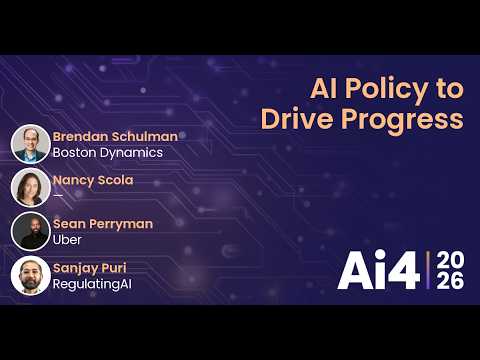
Uber, Boston Dynamics Execs Warn State Patchwork Stalls US AI Policy
Ai4
Congressional inaction and non-public White House frameworks are ceding AI governance to a chaotic 50-state regulatory patchwork, entrenching market concentration while fueling voter backlash over energy costs.
## Background
Published by Ai4 on YouTube on August 21, 2026, this panel brings together policy leaders from Boston Dynamics, Uber, and RegulatingAI, moderated by veteran technology reporter Nancy Scola. According to the description, the session explores what enables and stalls AI progress, examining the regulatory frameworks needed to ensure responsible and impactful AI across business and society.
## TL;DR
The panel assesses the fragmented state of US artificial intelligence policy, highlighting the growing tension between rapid state-level legislative action and the absence of comprehensive federal baselines. The discussion contrasts voluntary industry self-governance with mandatory pre-approval regimes, critiquing closed-door White House frameworks while addressing national security implications in physical robotics and supply chains. Panelists examine real-world deployments—including Boston Dynamics' Spot in law enforcement and Uber's automated decision-making oversight—to show how public skepticism often reflects institutional distrust and kitchen-table anxieties over energy bills and data centers rather than abstract technophobia. Concluding with immediate policy priorities, the speakers emphasize the need for clear human-only decision boundaries, anti-interference protections for elections, and a dedicated national robotics strategy.
## Atmosphere & style
The conversation is pragmatic, analytical, and refreshingly sober, avoiding both speculative tech-utopian hype and hyperbolic apocalyptic rhetoric. Nancy Scola steers an incisive, well-paced discussion that seamlessly bridges high-level Washington politics with ground-level municipal and corporate realities. The panelists engage in candid, collegial exchanges, blending personal anecdotes from Capitol Hill hearings and crisis negotiations with nuanced assessments of legislative gridlock and public distrust.
## Key takeaways
- [01:18](https://www.youtube.com/watch?v=_dOke8n4xHM&t=78s) The U.S. AI policy environment remains fragmented and in its early stages, with states aggressively introducing hundreds of bills to fill the void left by federal inaction.
- [03:46](https://www.youtube.com/watch?v=_dOke8n4xHM&t=226s) Physical AI and robotics policy has gained federal momentum only recently, largely driven by national security concerns, domestic supply chain protection, and geopolitical competition with China.
- [03:46](https://www.youtube.com/watch?v=_dOke8n4xHM&t=226s) The FCC placed foreign advanced robotics on its Covered List, barring certification and imports over concerns about cyber vulnerabilities and physical infrastructure tampering.
- [09:42](https://www.youtube.com/watch?v=_dOke8n4xHM&t=582s) Frontier model pre-vetting regimes face significant hurdles, including how to treat open-source models fairly, the rapid decay of benchmark relevance, and the need for public congressional debate.
- [12:56](https://www.youtube.com/watch?v=_dOke8n4xHM&t=776s) Ground robotics relies largely on post-market oversight and evolving voluntary standards, whereas generative AI presents opaque and unpredictable failure modes that complicate safety verification.
- [16:32](https://www.youtube.com/watch?v=_dOke8n4xHM&t=992s) Closed-door White House AI framework discussions with a select group of major tech firms risk picking winners and losers while fueling public skepticism.
- [19:52](https://www.youtube.com/watch?v=_dOke8n4xHM&t=1192s) While algorithmic literacy among lawmakers is limited, near-term bipartisan legislative progress is most viable in narrow areas such as election deepfakes, energy infrastructure permitting, and consumer utility costs.
- [27:16](https://www.youtube.com/watch?v=_dOke8n4xHM&t=1636s) Public backlash against deploying robots like Boston Dynamics' Spot often stems from systemic community distrust of institutions rather than simple fear of technology.
- [27:16](https://www.youtube.com/watch?v=_dOke8n4xHM&t=1636s) At enterprise scale, companies like Uber balance automated decision-making by implementing human-in-the-loop oversight and formal appeals specifically for consequential, livelihood-impacting outcomes.
- [32:17](https://www.youtube.com/watch?v=_dOke8n4xHM&t=1937s) Federal preemption of state-level AI regulations remains unworkable as long as Congress fails to provide a substantive federal statutory baseline.
- [38:53](https://www.youtube.com/watch?v=_dOke8n4xHM&t=2333s) AI has evolved into an everyday kitchen-table issue as voters connect hyperscaler data center growth to rising household energy bills and local infrastructure strains.
- [40:53](https://www.youtube.com/watch?v=_dOke8n4xHM&t=2453s) The panelists' top policy priorities focus on defining clear outcomes to avoid and domains reserved strictly for humans, establishing a National Robotics Strategy, and safeguarding democratic elections.
## Detailed walkthrough
### [00:04](https://www.youtube.com/watch?v=_dOke8n4xHM&t=4s) Panel Introduction and the Timeliness of AI Policy
Moderator Nancy Scola opens the discussion by highlighting the dual nature of AI governance: the external rules imposed by governments versus internal self-regulation and corporate self-governance. Underscoring the immediate relevance of the topic, Scola notes that several panelists were flying out of Washington, D.C., at the exact same time as OpenAI CEO Sam Altman, who had just spent days meeting with White House officials and members of Congress. The central questions for the panel focus on what constitutes an ideal AI policy landscape and the concrete pathways to achieve it.
Scola introduces the three expert panelists:
- **Sean Perryman**, Global Head of AI & Fairness Policy at Uber.
- **Brendan Schulman**, Vice President of Policy & Government Relations at Boston Dynamics.
- **Sanjay Puri**, Founder and Chairman of the nonprofit advocacy group RegulatingAI.
[01:18](https://www.youtube.com/watch?v=_dOke8n4xHM&t=78s) The Fragmented and Early-Stage Landscape of US AI Policy
Asked for a high-level, 30-second synopsis of AI policy in the United States, Sean Perryman describes the current environment as completely "fragmented and people are grasping for answers at the moment." Rather than a unified national strategy, individual states are aggressively jumping in to fill the federal void. While some states attempt comprehensive AI frameworks, many focus on preventing specific negative outcomes—ranging from surveillance pricing and chatbot risks to vulnerable populations, all the way down the tech stack to data center infrastructure. Perryman characterizes the federal stance as attempting to promote a pro-innovation agenda without providing sufficient concrete guidance, resulting in a "chaotic and volatile state of AI policy."
When asked where policymakers stand on the evolutionary timeline—whether at halftime or three-quarters down the road—Perryman emphasizes that the field is still in its "very, very early days." To illustrate the explosion in legislative interest, he reflects on how the volume of proposed legislation has changed over his decade working in the space:
- **2018–2020**: Only one or two AI-related bills appeared across Congress.
- **2022**: Following the public rollout of ChatGPT, roughly a dozen to twenty-two bills were introduced.
- **Recent Legislative Session**: Between 800 and 1,000 AI-related bills were introduced across the United States.
Despite four years of intense generative AI momentum, Perryman stresses that while political positions are beginning to take shape, the actual policy landscape remains far from mature.
[03:46](https://www.youtube.com/watch?v=_dOke8n4xHM&t=226s) Physical AI and the Push for Robotics National Security Policy
Turning to physical AI, Brendan Schulman discusses how AI is converging with robotics, enabling machines to learn via techniques analogous to large language models (LLMs) and reinforcement learning. Historically, federal robotics policy was virtually nonexistent; President Obama’s National Robotics Initiative primarily funded university-level research without establishing regulatory or industrial frameworks. Schulman observes that only within the past 6 to 12 months has physical AI policy advanced to "first base," transitioning from idle talk to substantive federal policy and legislative proposals on Capitol Hill.
Schulman attributes this sudden regulatory momentum to two primary drivers: the recognition that AI inevitably impacts the physical realm (including critical infrastructure monitoring, manufacturing, border security, and law enforcement) and escalating geopolitical competition with China. Echoing the shift seen previously in the commercial drone market, Chinese robotics manufacturers are expanding rapidly into US markets, prompting Washington to protect domestic manufacturing and supply chains.
```mermaid
flowchart TD
accTitle: FCC National Security Robotics Ban
accDescription: Flowchart showing how geopolitical and infrastructure risks led the FCC to place foreign advanced robotics on the Covered List.
subgraph AgencyAction["Regulatory Intervention"]
D["FCC Covered List Expansion"]
end
subgraph MarketImpact["Market Consequences"]
E["Import Ban on New Foreign Models"]
F["Denial of FCC Equipment Certification"]
G["Protection for US Robotics Base"]
end
Threats --> D
D --> MarketImpact
```
Schulman details a landmark action taken by the Federal Communications Commission (FCC) adding advanced robotics to the FCC Covered List:
- **FCC Covered List Designation**: Similar to previous restrictions applied to Huawei, consumer routers, and foreign drones, newly developed foreign advanced robotic models will no longer be certified or approved for import, sale, or operation in the United States.
- **Underlying Justification**: Advanced robotics are classified as critical to national security, public safety, energy, and defense, necessitating protections against physical infrastructure tampering, cyber vulnerabilities, and foreign technological dependence.
[08:04](https://www.youtube.com/watch?v=_dOke8n4xHM&t=484s) State-Level Momentum vs. Federal Preemption and Public Anxiety
Sanjay Puri evaluates how far current policymaking sits from an ideal framework, arguing that the US remains deeply fractured. While the federal government explores mechanisms to preempt state rules, individual states like California and Colorado continue to push forward aggressively. Puri notes that over 2,000 tech and AI-related bills were introduced at the state level in a single year; even though only 11% to 15% historically pass into law, the sheer volume reflects immense grassroots and legislative energy.
Puri points out that in the mind of the average voter, broader economic and infrastructural anxieties have become synonymous with "AI":
- **Infrastructure Impact**: Massive energy consumption, escalating household electricity bills, and the rapid spread of regional data centers.
- **Economic Anxiety**: Fear of widespread job displacement and the growing concentration of wealth in trillion-dollar tech monopolies.
Because the general public views all these pressures through the lens of AI, Puri argues that significant regulatory intervention is inevitable, even if the policy landscape is currently failing to grapple with these systemic challenges in a mature, coordinated manner.
[09:42](https://www.youtube.com/watch?v=_dOke8n4xHM&t=582s) Frontier Model Pre-Approval and Voluntary Governance Frameworks
Nancy Scola brings up the White House's proposed voluntary governance framework discussed during Sam Altman's Washington visits, which explores pre-approval or pre-vetting regimes where frontier AI labs would submit new models to government regulators before commercial deployment.
```mermaid
flowchart LR
accTitle: Frontier AI Model Oversight Approaches
accDescription: Comparison between mandatory pre-vetting approval and voluntary industry self-governance frameworks.
subgraph GovModel["Government Pre-Approval Regime"]
A["Frontier Model Developed"] --> B["Government Pre-Market Vetting"]
B --> C["Approved for Commercial Release"]
end
subgraph SelfGovModel["Voluntary & Industry Standards"]
D["Model / Robot Developed"] --> E["Industry Standards Testing & Red Teaming"]
E --> F["Voluntary Disclosure of Incidents"]
end
```
Sean Perryman explains why this framework has sparked intense debate:
- **The Open vs. Closed Source Dilemma**: The framework creates confusion by treating open-source models (where weights are publicly released) differently from proprietary closed-source models, exempting open-source releases from the voluntary pre-vetting framework and inadvertently creating perverse regulatory incentives.
- **Pervasive Economic Exposure**: Foundational models act as general-purpose infrastructure across the entire economy. As models grow in sophistication, their capacity to exploit software and systemic vulnerabilities scales rapidly.
- **Reactive vs. Proactive Policy**: Current White House efforts rehash testing regimes debated under previous administrative efforts. Washington remains reactive rather than proactive, with conversations quickly decaying in relevance (e.g., the capabilities of high-end frontier benchmarks like "Mythos" become commoditized across standard models within months).
- **Venue for Debate**: Perryman urges that these critical decisions must be openly debated in the US Congress rather than settled behind closed doors via ad-hoc executive frameworks, noting that congressional efforts like Senator Chuck Schumer’s bipartisan AI insight roundtables are already obsolete given the rapid pace of technological change.
[12:56](https://www.youtube.com/watch?v=_dOke8n4xHM&t=776s) Self-Regulation, Safety Standards, and Incident Disclosure
Brendan Schulman defends voluntary standards and industry self-governance as his preferred regulatory approach, noting its proven track record in physical robotics. Unlike aviation, which relies on strict pre-market FAA airworthiness certifications, ground robotics has historically operated without a dedicated federal safety regulator (relying instead on general workplace safety enforcement via OSHA when workplace accidents occur).
Schulman explains how physical safety standards must evolve to address modern mechanical AI:
- **The Power-Failure Scenario**: Legacy industrial robot standards assumed that if power failed, the machine would simply freeze in place safely. Modern dynamic systems, such as humanoid bipedal robots, will fall over or tumble down stairs during a power cut, creating entirely new physical hazards that require updated international safety standards (which take 2 to 3 years to formalize).
- **Generative AI vs. Physical Verification**: Unlike physical robots—where performance and safety can be directly observed in moving boxes or assembling cars—generative AI software operates with diverse, opaque, and unpredictable failure modes, making independent verification far more difficult.
Addressing OpenAI's voluntary disclosure regarding automated systems infiltrating the Hugging Face platform, Schulman weighs the strengths and blind spots of industry-led governance. While voluntary incident reporting builds public trust (drawing parallels to cybersecurity research and Black Hat disclosures), policymakers face an inherent dilemma: they will never know about the vulnerabilities or incidents that companies choose not to disclose. This blind spot serves as the primary justification for proponents pushing for mandatory, aviation-style pre-market government approvals over post-hoc voluntary reporting.
[16:32](https://www.youtube.com/watch?v=_dOke8n4xHM&t=992s) The Closed-Door White House AI Framework and Concentrated Power
Nancy Scola brings up a recent development involving a White House AI framework discussed with OpenAI CEO Sam Altman. The administration finalized the framework but declined to release it to the general public, asserting that not being classified does not mandate public distribution, and chose to share it with only a select group of major tech companies. Asking Sanjay Puri if this dynamic disadvantages smaller frontier AI startups, Sanjay emphasizes that the federal government should not be in the business of picking winners and losers. He points out that the criteria for inviting certain companies while excluding other pioneering frontier startups remains completely opaque, arguing that any substantive policy discussion must be broad-based and transparent. Sanjay quips that if the federal government can be open about UFO sightings, there is no justification for withholding its foundational AI policy framework from the public, especially when secrecy fuels state-versus-federal regulatory friction.
Sean Perryman seconds these concerns from a public interest perspective. While acknowledging that true frontier model developers comprise a relatively small circle, he echoes earlier remarks from the conference warning that a tiny cohort of commercially motivated actors is effectively dictating national AI policy. Sean argues that public skepticism around AI is directly fueled by seeing four or five corporate leaders raise apocalyptic alarms about the very systems they are building while consolidating control over policy decisions. Without meaningful public transparency and participation, citizens feel the technology is simply being forced upon them, eroding the trust required for long-term adoption.
- The White House finalized a non-public AI framework, sharing it exclusively with a select group of leading AI firms.
- Sanjay Puri argues that excluding smaller frontier AI startups creates an unfair competitive disadvantage and unnecessary public distrust.
- Sean Perryman highlights that public cynicism stems from a handful of dominant tech actors dominating both the commercial landscape and the regulatory agenda.
[19:52](https://www.youtube.com/watch?v=_dOke8n4xHM&t=1192s) Congressional Competency, Algorithmic Literacy, and Areas of Bipartisan Consensus
Turning to the legislative branch, Nancy asks Sean whether Congress is realistically equipped to craft intelligent AI legislation, inviting him to share an insider perspective. Drawing on his experience as an investigator for the House Oversight Committee examining municipal facial recognition systems across the ten largest U.S. cities—as well as his writings on *The Human Cost AI* Substack—Sean pushes back on the cynical narrative that lawmakers are simply not smart enough to regulate tech. While many members of Congress candidly admitted having "no clue" about algorithmic bias, he notes that technical illiteracy is widespread among the general public as well. Lawmakers do not need to be machine learning engineers to understand their constituents' core concerns and the societal outcomes they want to protect; rather, the process depends on well-informed congressional staffers and subject-matter experts educating members so Congress can negotiate effective public safeguards.
```mermaid
flowchart TD
accTitle: Paths to AI Policy Consensus in a Polarized Congress
subgraph Stalled["Ideological Gridlock"]
A["Omnibus AI Legislation"] --> B["Partisan Rejection"]
end
subgraph Consensus["Pragmatic Bipartisan Targets"]
C["AI in Elections & Deepfakes"]
D["Permitting & Energy Infrastructure"]
E["Consumer Power Grid Costs"]
end
Stalled -.->|"Pivot toward agreement"| Consensus
```
When asked what lessons past tech policy battles offer for AI, Sanjay acknowledges that extreme political polarization creates an environment where any proposal from one party faces knee-jerk opposition from the other. Historically, major policy shifts only accelerate after a catastrophic accident or severe crisis forces bipartisan action. To make progress without waiting for disaster, Sanjay advocates focusing on narrow areas of mutual interest where groundswell consensus already exists: mitigating AI-generated deepfakes and political interference, streamlining permitting for data center energy infrastructure, and protecting consumer utility bills from rising electricity grid demands.
- Sean Perryman's congressional investigations into facial recognition revealed low technical literacy around algorithmic bias among lawmakers, highlighting the need for expert staff support.
- Sanjay Puri identifies deepfakes in elections, infrastructure permitting, and grid capacity/energy pricing as viable near-term areas for bipartisan consensus.
[23:30](https://www.youtube.com/watch?v=_dOke8n4xHM&t=1410s) Boston Dynamics' Spot in Policing: Black Mirror Fears vs. Tactical De-escalation
Nancy turns the discussion toward physical robotics by highlighting Boston Dynamics' quadrupedal unmanned ground vehicle, commonly known as Spot the robot dog. When Spot was acquired by the Los Angeles Police Department in 2024 to assist in hazardous operations, the deployment sparked fierce community backlash, with critics warning the robot would be used to intimidate and terrorize vulnerable populations. Brendan Schulman explains that Boston Dynamics anticipated these fears from day one, recognizing that science fiction depictions like *Black Mirror* and *The Terminator* predispose the public to view robots as inherently menacing. To counteract this, the company embedded strict prohibitions directly into its commercial terms and conditions of sale, legally barring any customer from weaponizing the robot or using it to harm or intimidate people.
Brendan describes attending hours of tense, emotionally charged public hearings before the Los Angeles City Council, which ultimately approved the donated robot by a razor-thin 8-to-7 vote. He illustrates the practical value of the robot through real-world law enforcement deployments where Spot prevented bloodshed by keeping armed officers out of high-adrenaline showdowns:
- **LAPD First Deployment:** Spot was sent into an active shootout, successfully locating, grabbing, and removing a firearm from the scene to instantly de-escalate the standoff.
- **Massachusetts Hostage Standoff:** During an armed domestic violence crisis where a suspect held his wife hostage, Massachusetts State Police deployed Spot into the residence to assess the room layout and suspect's status. The robot took three gunshots; the damaged unit was preserved and now sits in the Boston Dynamics headquarters museum as a testament to saving human lives.
- **Motel Barricade:** Instead of breaching a motel room occupied by an armed, distressed military veteran with weapons drawn, police used Spot to monitor the room remotely. The robot confirmed the veteran had passed out several feet away from his weapon, allowing officers to enter peacefully without firing a shot.
[27:16](https://www.youtube.com/watch?v=_dOke8n4xHM&t=1636s) Community Distrust, Civil Rights, and Uber's AI Governance Framework
Sean Perryman offers a civil rights perspective on the LAPD controversy, arguing that public pushback against Spot was less about fear of the machine itself and more about a well-founded historical distrust of the police department deploying it. When advanced technologies—such as Flock automated license-plate recognition cameras—are installed in marginalized communities without prior consultation or transparency, residents naturally expect the tools to be abused. Sean stresses that technology cannot be evaluated in a vacuum separated from the institutions wielding it, placing a clear responsibility on tech firms to engage communities directly before deployment.
```mermaid
flowchart LR
accTitle: Uber Scaled AI Decision and Human-in-the-Loop Oversight
subgraph AutomatedScale["Automated Operations (36-37M Rides/Hour)"]
ML["Michelangelo ML Platform"] --> Match["Rider-Driver Matching"]
ML --> Fraud["Automated Fraud Detection"]
end
subgraph Oversight["Human Governance"]
Dec["Consequential Decision Trigger"] --> Review["Human-in-the-Loop Evaluation"]
Appeal["Driver / Rider Appeal"] --> Review
end
AutomatedScale -->|"Critical Impact Threshold"| Oversight
```
Addressing Uber's own operational reliance on artificial intelligence, Nancy notes that virtually every customer interaction across the company's apps runs through its proprietary machine learning platform, Michelangelo. When asked where Uber draws ethical boundaries, Sean explains that at a scale of 36 to 37 million rides per hour, automated decision-making is an operational necessity. Rather than establishing blanket bans on AI usage, Uber governs its systems by identifying "consequential decisions"—such as account deactivations or high-stakes fraud determinations. For these critical junctures, Uber builds in clear appeal mechanisms and human-in-the-loop review, ensuring that users have access to human judgment when automated systems impact their livelihoods.
- Sean Perryman argues municipal tech pushback reflects systemic institutional distrust rather than technophobia.
- Uber's Michelangelo platform supports tens of millions of machine learning decisions every hour.
- Uber manages risk by reserving human-in-the-loop intervention and formal appeals for high-stakes, consequential decisions.
[32:17](https://www.youtube.com/watch?v=_dOke8n4xHM&t=1937s) The Federal Preemption Debate and State Regulatory Patchworks
Nancy introduces the contentious debate surrounding federal preemption—the legal doctrine that would bar individual U.S. states from enacting their own AI regulations in favor of a single national standard set by Washington, D.C. Sanjay challenges the premise that federal preemption is a viable solution under current circumstances. He points out that preemption is entirely unworkable when the federal government has failed to produce any baseline statutory alternative: "You can't say your stuff is bad and my stuff is good, but I don't have stuff." State governors and a coalition of 36 state Attorneys General have actively pushed back against federal preemption because states are forced to fill the policy vacuum created by congressional inaction. Nancy then turns to Brendan to address the common tech industry objection that complying with a fragmented state-by-state patchwork of laws imposes an impossible burden that stifles technological innovation.
- Sanjay Puri notes that 36 state Attorneys General oppose blanket federal preemption of state AI legislation.
- State-level AI legislation is accelerating primarily because states cannot wait for an inactive federal government to establish baseline protections.
- The panel begins examining the tension between state regulatory patchworks and tech industry compliance burdens.
[33:58](https://www.youtube.com/watch?v=_dOke8n4xHM&t=2038s) Federal Agencies vs. 50-State Patchwork in Complex Tech Regulation
Brendan Schulman reflects on the challenges of fragmented state-level legislation, drawing parallels between current artificial intelligence debates and earlier regulatory battles over commercial drones. He notes that at one point, roughly 300 state bills were introduced per year targeting drones, largely designed not to govern them sensibly but to shut them down and restrict flight operations entirely. From Schulman’s perspective, having to comply with 50 distinct state laws presents an immense burden for any technology developer, making the friction of passing legislation through Congress "to some extent a feature not a bug of the system." Consolidating regulatory authority into a single federal effort prevents a disjointed patchwork of poorly conceived state rules.
Addressing how complex industries are typically overseen in the United States, Schulman points out that Congress rarely drafts deep technical rules directly. Instead, Congress historically establishes a specialized federal agency staffed with scientists and technical researchers to formulate voluntary standards, technical baselines, and certification processes—similar to the models used in aviation, medical devices, and securities. While creating a brand-new AI agency faces significant political headwind given current anti-regulatory moods and efforts to trim government footprint, Schulman argues an expert-led federal approach remains the optimal regulatory path. Nancy Scola observes that current political leaders are often skeptical of independent expert agencies, which Schulman acknowledges makes the climate particularly unfavorable for traditional regulatory blueprints.
```mermaid
flowchart TD
accTitle: Comparison of AI Regulatory Approaches
subgraph FragState["State-by-State Approach"]
S1["50 State Legislatures"] --> S2["Disparate State Bills & Bans"]
S2 --> S3["Compliance Friction & Slowed Innovation"]
end
subgraph FedAgency["Traditional Federal Framework"]
F1["Congress"] --> F2["Specialized Federal Agency"]
F2 --> F3["Technical Experts & Scientists"]
F3 --> F4["Unified Standards & Performance Frameworks"]
end
```
[36:27](https://www.youtube.com/watch?v=_dOke8n4xHM&t=2187s) PAC Spending, Political Pressures, and the Midterm Landscape
Nancy Scola pivots the discussion toward electoral politics, asking how intense political spending by AI-backed political action committees (PACs) shapes candidates' positions. She highlights the primary race of Alex Bores in New York, where an estimated $26 million was spent for and against him after he authored an AI safety bill in the New York State Legislature. Sean Perryman, who ran for Lieutenant Governor of Virginia in 2021, explains that while politicians cannot easily ignore such massive financial pressure, a candidate’s willingness to compromise depends on how central the issue is to their platform. For figures like Bores, who made AI safety a core pillar, external spending is less likely to force a major policy pivot.
Turning to the broader legislative outlook, Schulman suggests that a divided Congress following upcoming midterm elections will naturally slow down legislative progress on AI. Partisan investigations will consume congressional time and bandwidth. However, physical AI and robotics have maintained solid bipartisan traction, including initiatives to establish a National Robotics Commission and counter cybersecurity threats tied to foreign supply chains.
- **Campaign Spending Impact**: High-dollar PAC contributions push candidates to define firm stances, but core policy convictions generally withstand external pressure better than peripheral issues.
- **Congressional Momentum**: Bipartisan agreement remains steady on physical robotics and cybersecurity, though overall legislative output is expected to slow down due to divided party control and oversight inquiries.
---
[38:53](https://www.youtube.com/watch?v=_dOke8n4xHM&t=2333s) Voter Sentiment: Data Centers, Energy Costs, and Kitchen-Table Concerns
Sanjay Puri examines how AI is permeating public consciousness and driving voter behavior across the country. He points out that when candidates from across the political spectrum—from progressive figures like Bernie Sanders and Alexandria Ocasio-Cortez to candidates in battleground states like Michigan, Arizona, and Georgia—make tech infrastructure a headline campaign issue, internal polling has clearly confirmed that the topic resonates with everyday citizens.
Puri emphasizes that voter backlash is largely sparked by local and economic pressures rather than abstract algorithmic debates. Massive investments by hyperscalers have led to the rapid buildout of data centers, provoking "not in my backyard" (NIMBY) opposition at local county meetings. Voters increasingly connect the tech boom to rising residential electricity bills, inflation, and future employment prospects for their children, turning AI into an overarching kitchen-table issue.
---
[40:53](https://www.youtube.com/watch?v=_dOke8n4xHM&t=2453s) Magic Wand Wishes: Guardrails, National Robotics Strategy, and Protecting Democracy
Wrapping up the panel, Nancy Scola poses a final question: if each panelist had a magic wand to enact a single AI policy outcome within the next two years, what would they create?
```mermaid
flowchart LR
accTitle: Panelists' Core AI Policy Priorities
subgraph Wishes["Panelists' Priority AI Policies"]
direction TB
W1["Sean Perryman<br/><b>Core Human Outcomes</b><br/>Ethical boundaries & human-only domains"]
W2["Brendan Schulman<br/><b>National Robotics Strategy</b><br/>Tax incentives, trade policy & workforce"]
W3["Sanjay Puri<br/><b>Protecting Democracy</b><br/>Anti-interference rules for elections"]
end
```
- **Sean Perryman (Uber)**: Pushes back slightly on the premise that AI ethics are fundamentally new, arguing that foundational ethical questions have remained consistent over the last decade. His wish is a national consensus framework establishing "outcomes we want to avoid" and clearly delineating high-stakes functions that must remain strictly reserved for human judgment.
- **Brendan Schulman (Boston Dynamics)**: Advocates for a comprehensive federal "National Robotics Strategy" to accelerate domestic physical automation. This strategy would encompass tax incentives, trade protections, trusted supply chain requirements, and workforce retraining to address domestic labor shortages and support the reshoring of American manufacturing.
- **Sanjay Puri (RegulatingAI)**: Calls for immediate and enforceable guardrails to shield democratic institutions, demanding rules that prevent AI from being weaponized for political interference and electoral manipulation.
## Notable quotes
> [01:18](https://www.youtube.com/watch?v=_dOke8n4xHM&t=78s) fragmented and people are grasping for answers at the moment. — Sean Perryman
> [01:18](https://www.youtube.com/watch?v=_dOke8n4xHM&t=78s) chaotic and volatile state of AI policy. — Sean Perryman
> [01:18](https://www.youtube.com/watch?v=_dOke8n4xHM&t=78s) very, very early days. — Sean Perryman
> [03:46](https://www.youtube.com/watch?v=_dOke8n4xHM&t=226s) first base — Brendan Schulman
> [19:52](https://www.youtube.com/watch?v=_dOke8n4xHM&t=1192s) no clue — Sean Perryman
> [27:16](https://www.youtube.com/watch?v=_dOke8n4xHM&t=1636s) consequential decisions — Sean Perryman
> [32:17](https://www.youtube.com/watch?v=_dOke8n4xHM&t=1937s) You can't say your stuff is bad and my stuff is good, but I don't have stuff. — Sanjay Puri
> [33:58](https://www.youtube.com/watch?v=_dOke8n4xHM&t=2038s) to some extent a feature not a bug of the system. — Brendan Schulman
> [38:53](https://www.youtube.com/watch?v=_dOke8n4xHM&t=2333s) not in my backyard — Sanjay Puri
> [40:53](https://www.youtube.com/watch?v=_dOke8n4xHM&t=2453s) outcomes we want to avoid — Sean Perryman
> [40:53](https://www.youtube.com/watch?v=_dOke8n4xHM&t=2453s) National Robotics Strategy — Brendan Schulman
## Mentioned
Nancy Scola, Sean Perryman, Brendan Schulman, Sanjay Puri, Sam Altman, Alex Bores, Bernie Sanders, Alexandria Ocasio-Cortez, Barack Obama, Chuck Schumer, OpenAI, Boston Dynamics, Uber, RegulatingAI, Hugging Face, Flock Safety, Spot, Michelangelo, The Human Cost AI, Black Mirror, The Terminator, Federal Communications Commission (FCC), FCC Covered List, Occupational Safety and Health Administration (OSHA), Federal Aviation Administration (FAA), National Robotics Initiative, National Robotics Commission, House Oversight Committee, Los Angeles Police Department (LAPD), Massachusetts State Police
## Video description
Brendan Schulman - VP of Policy & Government Relations, Boston Dynamics
Nancy Scola - Veteran Technology Reporter, —
Sean Perryman - Global Head of AI & Fairness Policy, Uber
Sanjay Puri - Chairman/Founder, RegulatingAI
This panel will gather heads of policy at world’s leading AI companies and investors to discuss AI policy. The conversation will center around what enables AI progress, what stalls AI progress, and what regulation is necessary to ensure impactful, responsible AI across business and society.
United States AI governance remains fractured as federal inaction prompts a wave of state-level legislation and public anxiety over infrastructure, while physical robotics emerges as a critical front for national security and trade policy.
Federal Inaction Sparks State Patchworks and Preemption Disputes (1:18)
Sean Perryman and Sanjay Puri describe current U.S. AI policymaking as fragmented and immature. Legislative volume has grown from one or two bills across Congress between 2018 and 2020 to roughly 800 to 1,000 introduced nationwide in a single recent session, alongside over 2,000 tech and AI bills at the state level in one year. Because the federal government has not supplied baseline statutory standards, states such as California and Colorado have stepped in to address harms ranging from surveillance pricing to data center energy demands. While tech industry representatives like Brendan Schulman warn that a 50-state compliance patchwork risks stifling innovation—analogous to previous battles where 300 state bills sought to ground commercial drones—Puri points out that a coalition of 36 state Attorneys General actively opposes federal preemption in the absence of real federal protections.
Physical Robotics, Geopolitics, and National Security Bans (3:46)
Federal attention toward physical AI and robotics has pivoted rapidly over the past 6 to 12 months, driven by geopolitical competition with China and the realization that embodied systems interact directly with critical infrastructure. Schulman highlights a landmark regulatory action by the Federal Communications Commission, which added foreign advanced robotics to the FCC Covered List alongside past restrictions on Huawei and foreign drones. Under this designation, newly developed foreign models will be denied FCC equipment certification, prohibiting their import, sale, and operation to shield domestic manufacturing supply chains and counter potential cyber tampering.
Executive Secrecy and Model Governance Tensions (9:42)
The panel sharply critiques the executive branch's reliance on closed-door governance. Puri and Perryman criticize the White House for sharing a finalized AI framework exclusively with a small group of major tech companies while withholding it from the public and frontier startups, arguing it fuels state-federal friction and public distrust. Debates over proposed pre-approval regimes—requiring frontier labs to submit models for vetting before deployment—also face operational complications. Perryman notes that exempting open-source models creates perverse market incentives, while Schulman observes that unlike physical robotics or aviation, generative AI presents unpredictable failure modes where voluntary incident disclosure leaves regulators blind to risks companies choose to hide.
Public Distrust, Practical Deployment, and Algorithmic Red Lines (23:30)
Public skepticism toward AI increasingly centers on tangible local impacts. Puri emphasizes that voters identify AI with immediate economic burdens, including local NIMBY fights over hyperscaler data centers, rising household electricity bills, and job displacement. Addressing physical safety fears, Schulman explains that Boston Dynamics responded to public backlash over the Los Angeles Police Department's acquisition of Spot by barring weaponization in its contracts, pointing to deployments where the robot de-escalated armed standoffs without gunfire. From a civil rights standpoint, Perryman argues that such resistance reflects institutional distrust of law enforcement rather than mere technophobia. Drawing on Uber's platform—which processes 36 to 37 million rides per hour via its Michelangelo machine learning system—Perryman notes that managing risk requires formal appeals and human-in-the-loop review reserved for consequential, livelihood-altering decisions.
The panel concludes with distinct policy priorities for the near term: Perryman urges clear statutory boundaries reserving high-stakes decisions for human judgment, Schulman advocates a comprehensive National Robotics Strategy combining supply chain protections and workforce retraining, and Puri calls for immediate enforceable safeguards against AI-driven election interference. Unresolved questions remain over whether a divided Congress can overcome regulatory skepticism to establish a dedicated, expert-led federal agency before a major crisis forces its hand.
[1:18] Sean Perryman: fragmented and people are grasping for answers at the moment.
[1:18] Sean Perryman: chaotic and volatile state of AI policy.
[1:18] Sean Perryman: very, very early days.
[3:46] Brendan Schulman: first base
[19:52] Sean Perryman: no clue
[27:16] Sean Perryman: consequential decisions
[32:17] Sanjay Puri: You can't say your stuff is bad and my stuff is good, but I don't have stuff.
[33:58] Brendan Schulman: to some extent a feature not a bug of the system.
[38:53] Sanjay Puri: not in my backyard
[40:53] Sean Perryman: outcomes we want to avoid
[40:53] Brendan Schulman: National Robotics Strategy
Original transcript
[0:04] I'm happy to be here today moderating a panel what
I think is an especially important topic. It is
[0:09] the idea of uh the policy landscape surrounding AI
um from government government imposed rules what
[0:16] we typically think about uh the policy landscape
to um self-governing the sort of self-regulation
[0:22] uh work that companies do internally. And this
almost couldn't be more timely. when I was flying
[0:27] out of Washington, uh I and I think a couple of my
panelists uh were uh flying out of Washington at
[0:34] the same time as Sam Alman was leaving Washington,
right? So the CEO of OpenAI was in Washington to
[0:39] talk to folks at the White House, to talk to
folks in Congress about the policy landscape
[0:43] surrounding AI. So the questions that we're going
to be um asking and hopefully answering today are
[0:48] what's the ideal policy landscape surrounding AI
and how do we go about getting there? And we have
[0:53] a terrific set of panelists to discuss question.
Uh to my left we have Shawn Perryman. Shawn is
[0:58] the global head of AI and fairness policy at Uber.
We also have Brendan Schulman. Um to Shan's left,
[1:04] Brendan Schulman is the VP of policy and
government relations at the robotics company
[1:08] Boston Dynamics. And to Brendan's left we have
Sanjay Pury. He's the founder and chairman of the
[1:14] nonprofit advocacy group regulating AI. So thank
you all for being here. Um Sean, we're going to
[1:18] start with you. Um, let's say someone comes to you
and says, "Give me a quick synopsis of the state
[1:24] of AI policy." And I'm giving the softball first.
The state of AI policy. I don't want to know too
[1:29] much about it, but at a high level, where are we
at this moment when it comes to AI policy in the
[1:33] United States? And briefly, you said in the United
States. It makes it United States, please. Yes.
[1:38] Um, and and thank you all for having me. I really
appreciate it. Uh I would say if someone came
[1:42] to me and said you know give me the 30 seconds I
would say it's fragmented and people are grasping
[1:48] for answers at the at the moment. Uh we are we are
at a moment where all the states are trying to get
[1:55] involved in AI policy in some way. I'm going
beyond the 30 seconds. I'm just going to keep
[1:58] talking. Oh please. No. Well they are all trying
to get involved in AI policy in some way. Some
[2:02] are looking at it from a comprehensive approach.
But I think what we're seeing more frequently now
[2:07] is them looking at what outcomes are we trying to
prevent? whether that be surveillance pricing. Uh
[2:12] the panelists before were talking about data
centers. They're not just talking about AI,
[2:15] they're talking about the entire tech stack and
where where they feel there are issues. So some
[2:20] of these uh folks are are approaching it from
a chatbot perspective like we want to protect
[2:23] certain vulnerable populations from chat bots.
So it's really all over the place. The federal
[2:28] government is trying to promote a pro-innovation
agenda, but they're not really providing I would
[2:34] my opinion enough guidance and the states are
trying to fill that that gap right now. So
[2:38] you really kind of have a chaotic and uh volatile
state of AI policy in the US at the moment. Okay,
[2:44] just quick follow up on that. Where are we in
evolution of AI policym? Are we in the very early
[2:49] days? Are we at halftime? Are we threequarters
down the road? Is how mature is this this process?
[2:54] Um I would say very very early days. It's it's
hard for me to say that because I've been doing
[2:58] this for like 9 10 years now. And so but I used
to have a chart that I used and it's no longer
[3:03] relevant I think. But it used to be let's say in
201819 even though 2020 you would see maybe one
[3:09] two AI bills in the congress uh by 2022 when you
have chat GDP intro uh introduced you see maybe
[3:17] a dozen 22 last year we must have seen somewhere
between 800 and a thousand bills right not just
[3:22] in Congress but in US as a whole right so this
is a top issue and it feels like there's a lot
[3:28] going on but we're four years into the generative
AI uh craze if you And so I don't think this can
[3:35] be seen as a mature thing yet. We understand the
positions in some ways, but I think as far as what
[3:41] shakes out, we're still at the very beginning uh
phases. Okay. Excellent. Thank you. Uh Brendan,
[3:46] the your work I mentioned you're at Boston
Dynamics. Boston Dynamics is a robotics company.
[3:51] Um actual, you know, robots sort of moving around
in real space. So you you work in particular on
[3:56] the idea of physical AI. Same sort of question
to you. somebody comes to you and says, "What
[4:00] is the state of regulating around or the state of
policy around physical AI in particular?" Well,
[4:06] we're uh thank you for having me. Really great to
be here. Um back again at AI4 was here a couple
[4:10] years speaking uh on that topic at the beginning
of AI and robotics policy. I think you know the
[4:17] background here is AI is converging with robotics
in in amazing ways allowing the robots that we
[4:22] make and that other companies make to really
do amazing things and to be trained using AI
[4:27] techniques analogous to the the large language
model uh and reinforcement learning techniques
[4:32] that you see in other domains on the software
side where the policy is is really at at the
[4:36] beginning if you look at where federal robotics
policy has been historically the feds have
[4:41] really just not done anything when it comes to
robotics legislation administration polic policy
[4:46] or regulation. There was a national robotics
initiative under President Obama years ago that
[4:51] really just funded university level research and
that was it. Um, so what we're seeing now, I would
[4:56] say over the past 6 to 12 months is amazing. We
we have bills on Capitol Hill. We have initiatives
[5:03] uh in the administration. We have new policy as of
last week at the FCC relating to national security
[5:08] and foreign robots. I think we'll maybe talk about
a little bit later. But I I would have said we're
[5:12] at the beginning, but now like as of a few months
ago, we're kind of I would say on first base and
[5:17] we're starting to see the policy makers not just
talk about doing something in support of the US
[5:22] robotics industry, but actually issuing policy
that does make a difference. Why do you think
[5:27] there has been that reluctance for to regulate
around the robotics stuff? I think a couple of
[5:31] drivers, you know, first of all, again, if you
care about AI and AI policy, at some point you
[5:36] realize that's going to also have an impact in
the physical realm. It's not just about software,
[5:41] images, text on screen, data analytics. It's also
about machines that build things that that monitor
[5:47] sites that act as public safety machines
uh for law enforcement, border security,
[5:53] etc. Number one. Number two, absolutely China is a
driver. If you if you talk to folks in Washington
[5:58] as you do on the on the generative AI side, the
concerns coming out of uh the rise of China as
[6:04] as a sort of robotics developers and uh even just
here on the floor, you can find a couple at least
[6:10] a couple of Chinese robot companies uh displaying
their products. The capabilities, the the sort of
[6:15] market penetration have really started much in
the way that I think we saw the flying robots,
[6:20] the drone market change at the at the beginning
of the advanced consumer type technologies.
[6:26] uh when it when it came to drones. So that that's
certainly driving folks in Washington to say,
[6:29] "Hey, we need to do something to help support
the US robotics industry as we've done with other
[6:34] key technologies." Okay. And can you we will talk
about it later most likely. Can you talk a little
[6:39] bit about the move the administration made on the
robot front week? So happy to re really uh really
[6:44] kind of I think uh landmark uh policy action
by the FCC as the FCC has done with a number of
[6:50] different technologies over the past year or two
uh in particular drones and and consumer routers.
[6:56] The FCC took action to add advanced robotics
there's a definition you can you can check there's
[7:01] some uh scoping there but advanced robotics to the
FCC covered list. uh uh so the extent that there
[7:07] is a uh foreign robotics product that product
is now no longer uh allowed to be certified or
[7:14] approved for import or sale or use in the United
States. So the FCC is taking very similar action
[7:19] as it is done with starting with Huawei and
and other technologies. And that is premised
[7:24] under national security determination that these
advanced robotics like the kinds that we make are
[7:29] important to manufacturing, to defense, to energy,
to public safety, and and really are deserving
[7:34] of protective national security policy because
of cyber security threats, physical threats to
[7:40] infrastructure, as well as uh the fear that there
will become a a dependency on foreign adversary
[7:47] technologies as we've seen similar concerns
play out in drones and other technologies.
[7:52] So for those reasons, national security, the FCC
is now saying on a go forward basis for any new
[7:58] models of advanced robots, those will no longer be
certified by the FCC if they are foreign products.
[8:04] Okay. Thank you, Sanjay. How far are we from
the perfect uh policy landscape around AI at the
[8:11] moment? How far off the ideal are we right now?
I think you missed the panels before. We are it
[8:17] seems like pretty far uh apart uh because you know
we have a situation where the federal government
[8:25] wants to preempt uh state uh legislation and you
have states uh like California, you have Colorado
[8:33] and several other states that have come up with
these legislations and and they will continue
[8:38] doing that. Over 2,000 bills were passed well not
passed were instituted in just in this year alone.
[8:45] Now obviously between 11 to 15% of these bills
ever get passed but that tells you that there
[8:51] is a lot of energy at the state level and when
you start now looking at the political landscape
[8:58] now whether you call it AI or not the data center
issue whether it's the job issue whether it is my
[9:05] electricity bill issue whether it is concentration
of wealth issue they're kind of wrapping
[9:10] themselves up in AI and you might not want to
call them AI But in a voter's mind, that data
[9:17] center is AI. The job loss is AI, the electricity
bill is AI, the trillion dollar company is AI. So
[9:25] something is going to happen. Uh but you know,
not in the very near future. Okay. So, so the
[9:33] short version is that the policy landscape has not
matured to the point that it's grappling with any
[9:38] of these issues in any meaningful way. Is that a
fair assessment? Okay. Excellent. So I mentioned
[9:42] Sam Alman was uh in Washington discussing uh the
substance of the conversations uh for the most
[9:47] part was this idea of a voluntary framework that
the white house has been working on around AI. The
[9:53] idea there was that Frontier AI labs would have to
come to Washington come to government and say we'd
[9:59] like to release a new model and the government
would take a look at it and prevet it before it
[10:04] was allowed to be released into the market. This
sort of that's sometimes called the pre the uh
[10:09] pre-approval process. Sean, question for you.
Is that a good approach for government to take
[10:13] to say, okay, before we allow these models to be
released into the into the market, they have to go
[10:18] through a sort of government vetting process. This
a smart approach or not? [laughter] Easy question,
[10:24] right? Uh well, I think first I should say about
that framework, it's been pretty controversial,
[10:30] right? because it's not it's not uh opens and then
uh but it's also what they've come uh what they've
[10:36] concluded is that if you have an open source model
so we talk about open source whether it's you make
[10:40] the weights and the model itself available
to people or closed source model it's treated
[10:45] differently under this framework voluntary
framework if it's open source you don't have
[10:48] to go through this voluntary framework so it's
already kind of confusing since it is a voluntary
[10:53] framework and you have if you have an open source
model you you don't have to do it uh but I think
[10:58] that they're what they're trying to do is maybe
push people to make their models open source
[11:03] anyway. So maybe that's the thinking there. Uh is
this the right way to go about doing it? I don't
[11:10] know. Uh we are facing sort of a moment where we
have a a technology that is going to be the fabric
[11:18] of our entire economy in so many different ways.
You know, you're using these foundational models
[11:23] across the economy. uh and what we're seeing is as
the models become more sophisticated, it's able to
[11:28] exploit more vulnerabilities and everything
else. So I see the argument for having uh a
[11:34] testing regime of some sort that's already been
discussed even under the Biden administration.
[11:39] They were talking about these things. So we're
sort of we've cycles we've gone full cycle and
[11:43] come back to the same uh same sort of mechanisms.
So I I don't know. I think there's too many things
[11:50] to weigh uh and we need to have more informed
conversations about this in Washington. You know,
[11:55] we talked a little bit in the earlier panel about
we're not seeing any action out of DC. These are
[11:59] the sort of tough questions that that need to be
to be be debated and be decided on whether or not
[12:05] we want that to be uh the way we go about things.
And the administration is taking their actions,
[12:10] but again, it seems to be in response to some of
the sophistication of the models that we've seen
[12:15] rather than a proactive approach. Where
should those conversations happen? Uh,
[12:20] ideally in Congress and Senate and and those
sorts of things. I mean, we had a few years back
[12:25] uh Senator Schumer had a series of roundts
around AI, but this technology is evolving
[12:30] so rapidly that a conversation 2 years ago is no
longer relevant. Right? So, this is something that
[12:36] I think needs to be hotly debated now and decided
on. The administration is taking their approach uh
[12:41] to have this framework, but I don't know if this
is the right thing. And we're only a few months
[12:46] away from, you know, the big scary boogeyman a few
months ago was Mythos. I think most models will
[12:51] be at that capability within a few months. So, we
have to start thinking ahead and about what we're
[12:56] going to do. Okay. Brendan Sean mentioned that
the Biden administration at the very end of the
[13:00] Biden administration, they tried the same sort
of approach, right? These voluntary commitments
[13:04] from the AI companies that was a little bit more
about uh testing and uh the sharing of risk data,
[13:10] right? But it was the same sort of model of
hey we're going to get these companies to agree
[13:14] to these principles. Is that sort of like soft
regulatory approach? Can it be effected? I mean
[13:20] you've been inside these companies. Is it actually
effective? Does it actually shape how government
[13:23] how these companies operate day in and day out?
It's my preferred approach and I have have seen it
[13:28] work. Um you know and particularly when it comes
to physical AI and robotics you know that we don't
[13:34] have a federal regulator for robotic safety. We
have OSHA if something goes wrong. And it's sort
[13:39] of a general agency when it comes to workplace
safety. But um unlike for example aviation drones,
[13:44] when it comes to ground robotic systems,
it's industry self-governance. You know,
[13:49] there have been standards for robot safety for
decades that have worked well. And we are now
[13:53] working on new standards for the more advanced
systems. So for example, uh to kind of give you
[13:58] the analogy to the AI software AI side, um if
you have a humanoid robot and the power fails,
[14:04] the robot's going to fall, perhaps tumble down
the stairs. That is a power failure scenario
[14:08] that the old standards didn't really account for.
The assumption was if the power fails, the robot's
[14:13] going to freeze in place and therefore it is it
is safe because it is not moving, not going to
[14:17] hurt someone. Not true for these new, you know,
these new systems, some of which you can see out
[14:21] on the on the ex exhibition floor. So, we need new
standards to apply to new technology. I think to
[14:27] some extent that's analogous to what what what the
the administration is trying to do on the gener
[14:32] generative AI side is we we are now at a point
where we have really heightened cyber security
[14:37] risks national security risks and something needs
to be done but the the industry itself could step
[14:43] up to govern itself but I think to some extent
hasn't I like to think on the physical AI side
[14:48] we like we're trying we're working on it the
standards are probably two to three years away
[14:53] uh and they will be international in nature which
is great um I think it's been harder because Gen
[14:58] AI is so diverse and so different and everyone's
kind of just chasing like the next model to kind
[15:04] of prove that the technology even works. With a
robot, you know, it works. You can see whether
[15:07] it's moving your boxes, if it's putting together
parts of the car. I think when it comes to Genai,
[15:11] the kind of the validation is tougher both on the
concern side and also on the performance side. We
[15:17] saw this recent incident where OpenAI let it
be known that their systems had broken free
[15:22] and infiltrated a a platform called Hugging Face.
is that they reported that they made it public.
[15:28] Is that an example of okay these companies
can be trusted to self-regulate or is an
[15:33] example of oh god no we can't let these companies
self-regulate how would you know right like that
[15:38] they're disclosing and they like it's similar to
cyber security I think we got black hat in town
[15:42] this week too so similar to like cyber security
you want to disclose you want people to know you
[15:46] want researchers to come forward but how would you
ever know what they aren't telling us right so I
[15:51] think to some extent it's a good sign and and
this is also true when it comes to physical AI
[15:55] and voluntary reporting of safety incidents And on
the aviation side where I used to work on drones,
[16:01] same thing. We want to encourage voluntary
reporting of incidents that are of concern
[16:04] to policy makers and to the industry. At the
same time, you're never going to hear about the
[16:08] one they don't report. So, how could you evaluate
that? So that that would be the justification for
[16:12] a more hands-on approach where you need to come
to government to get approval to launch your your
[16:18] product of whatever kind it is similar to like
aviation certification rather than we'll wait
[16:22] for an accident or an incident to happen and then
hope that the industry responds and takes action
[16:27] to mitigate future harm. I I I think it's a open
question as to whether or not uh the AI industry
[16:32] is actually um fully disclosing everything that
we would want to know. Um Sanjay this the White
[16:39] House framework I mentioned that Sam Alman came
to DC to discuss they have finalized it and they
[16:43] have declined to make it public. They said just
because it's not classified doesn't mean we need
[16:47] to share it with everyone. They shared it with a
small handful of companies. Is that concerning?
[16:53] Can you just repeat that? Is it concerning that
the White House has come up with a framework
[16:58] and is keeping it closely held? They're sharing
it with a small handful of companies. Does that
[17:02] you know sort of uh is is there put smaller
AI companies in a disadvantaged position that
[17:09] they don't actually know what's [laughter] in the
framework where some of the bigger companies you
[17:13] know do it's some people are making the argument
that it's you know if you're a smaller company
[17:17] you're sort of working at a disadvantage now I
think u again my view is the government should
[17:22] not be in the business of picking uh winners and
losers even though from a regulatory standpoint
[17:27] they've brought in some people um what was the
basis of bringing some of these uh companies in.
[17:34] Uh we don't know uh who was left out. Uh there
are still a lot of uh frontier companies, maybe
[17:43] not as big, uh that are doing some incredible
work out there that should be brought in. Um
[17:49] because if you're going to have that discussion,
you should really have a broad-based discussion.
[17:54] And also unless it is so critically classified
the public should also know what was discussed
[18:02] in that meeting. And I think that is a very very
critical aspect. Unless you know if you are open
[18:08] to telling us about UFO sightings and you have
an issue in telling us what is going on here. I
[18:14] don't you know understand what is uh the issue.
So bring a larger pool of companies in and make
[18:20] sure there is at least some level of disclosure
which like I said people don't know uh what is the
[18:28] executive policy here you know the you got states
you're pitting basically state versus the federal
[18:34] government which is not a good thing for anyone
not for the companies not for the state not for
[18:39] the federal government okay Brendan I mean excuse
me Sean I feel like you're either nodding your
[18:43] head or or disagreeing did you have a response
to that idea I was I was just listening. Um Okay.
[18:48] Sorry. [laughter] I can answer what I think.
Yeah, please. Uh yeah, I I I think uh I agree
[18:54] with a lot of what he said. I mean, for a public
just a public good standpoint, public interest,
[18:59] this seems a public interest, right? You'd want to
know what's in that that framework. Uh as far as a
[19:04] limited number of companies, I guess there's only
a limited number of companies that we consider
[19:07] frontier model companies to begin with. But uh
this is I think it was Kevin in the last panel
[19:13] who said this. We're seeing more and more where
a small set of actors are really dictating how
[19:20] policy works and a lot of them are have commercial
interest in how that policy works. And so that is
[19:25] the what's of concern to me and I think we need
to especially we can tie this all together all the
[19:30] panels we've seen whether it be the elections or
the data centers or anything else. The reason that
[19:35] the public is so skeptical about AI is because
there's about four or five actors who are saying
[19:40] negative things about the technology they're
building and they're making all the decisions,
[19:44] right? And they feel like it's being stuffed
down their throats. And so we need to have
[19:48] more public involvement in this for people to
trust the technology. Okay. I want to stick
[19:52] with you for a minute. We if the White House isn't
necessarily dictating policy, mentioned the idea
[19:58] that Congress should be taking up some of this
conversation, some of this potential rulemaking.
[20:02] You've worked in Congress. Do is Congress capable
of writing smart regulation. [laughter] Uh feel
[20:14] free to dig into the nitty-gritty because people
who haven't worked in the institution I think we
[20:18] both have haven't worked in this institution might
have a particular view of it. I'll say this uh so
[20:22] I I write a substack called the human cost AI uh
substack and I I talk about a lot of these issues.
[20:28] I'll say this, everywhere, everyone everywhere is
struggling with their response to how to deal with
[20:33] this technology. Uh when I worked in Congress,
I worked on the House oversight committee and
[20:37] the way I was exposed to AI policy was dealing
with investigations of how the 10 largest cities
[20:43] were using facial recognition. And uh I spoke
to many members of Congress about algorithmic
[20:48] bias and they were like no clue, right? Uh I
think most of the public they know how they
[20:53] they use the technology but they don't have a real
understanding of how it works. So, I don't want I
[20:58] I see a lot of people say, "Well, they don't
understand the technology. They can't write
[21:01] a bill on it." They understand what we're trying
to solve for. They understand their constituents.
[21:05] They understand the outcomes that they care about.
We need good staffers. We need people who are
[21:10] going there and educating folks on these policy
issues. And so, it's a sort of a copout to say,
[21:15] "Oh, they're not smart enough to do this." A
lot of them do not understand the technology,
[21:18] but a lot of people in the general public don't
either. we are going to have to get to that point
[21:22] where we are hashing out the important issues
here um in a way that we write legislation or
[21:27] regulation that really helps the general public.
Okay. You mentioned some of these past debates
[21:31] about um tech policy that you've lived through
some some of us have lived through that social
[21:36] media facial recognition Sanjay when you look
at those uh past tech debates do you take away
[21:41] that what are the lessons that you take away from
them that that government was too involved that
[21:45] government was too handsoff what are the learnings
from those past debates that you apply to to AI?
[21:50] You mean the from the past experiences of bills
and regulations? Yeah. Well, you know, the thing
[21:57] is the reality is that we have a very polarized
government right now. I mean that we just have to
[22:04] accept the fact uh if one party throws something
up there, it is almost a no on the other side.
[22:12] So that's so what are the we have to identify
Nancy what are the basic things that we can kind
[22:17] of agree on and there are certain basic things I
think that you could get some uh consensus on like
[22:25] political interference deep fakes I think there
is a little bit of a ground swell uh potential for
[22:31] that you could get some uh I think some consensus
on permitting uh for maybe speeding up things
[22:40] that will happen from an energy and those kinds
of things uh perspective because otherwise it's
[22:47] just going to be very very difficult and only a
bad situation is going to bring people together
[22:56] and if you look at the past also an accidents or
bad situations kind of bring us to kind of moving
[23:03] on things faster and we don't want that but let's
at least tackle some basic things whether it is
[23:09] political interference the use of AI and political
interference, permitting and you know land use and
[23:15] things of that nature. The the grid which is
right now, you know, when you talk about the
[23:21] electricity bill of consumers, what can be done
in terms of that? Those are things I think we can
[23:26] all agree on. Okay. Um Brendan, I wanted to um
tee up a specific example that we discussed when
[23:32] we were prepping for this panel. You mentioned
spot the dog, right? This was I think Boston
[23:36] Dynamics refers to it as a quadripedal quadripedal
unmanned ground vehicle. Ground vehicle otherwise
[23:43] known as a robot dog. Uh and Boston Dynamics
specific robot dog is named Spot. Um Spot has
[23:49] been deployed in a number of different use cases.
One of them is in law law enforcement. In 2024,
[23:55] Spot the dog joined the LAPD. Um there was some
enthusiasm around that like the idea that you
[24:01] could put a dog into dangerous situations so
you're not subjecting human officers to those
[24:06] you know dangerous contexts. There was also some
public push back saying this dog is simply going
[24:11] to be used to terrorize vulner vulnerable uh
communities. What is the responsibility of a
[24:16] company like Boston Dynamic to consider how the
dog is actually a dog like or you know a product
[24:22] like Spot is used out out in the real world?
I think we do have that responsibility and and
[24:28] and we a number of ways in which we uh execute
on it. So you know from the outset when we put
[24:33] spot the robot dog on on the market we prohibited
the weaponization of the robot or the use of the
[24:40] robot to harm or intimidate any person. So if you
read our terms and conditions of sale you'll see
[24:45] that right in there. Uh, I think we knew even back
then with basically the first widely launched uh,
[24:51] robot of its kind that people were going to see
it and think of of Black Mirror or Terminator
[24:56] or other science fiction movies in which
robots are the enemy of the people. And uh,
[25:01] that was not our intent when we were founded over
30 years ago at an MIT lab. The the goal was to
[25:07] create machines that protect people and and keep
people safe from harm and make make jobs easier.
[25:13] So we really wanted to make sure that people
understood what what the robots are going to
[25:17] do out there in the world. Now you sort of
like with respect to any kind of AI or any
[25:22] kind of technology we often have seen um uh sort
of the lack of understanding uh trigger concerns
[25:29] including the ones ones that you mentioned. So
when LAPD was given the the gift of the donation
[25:34] of a spot robot for use in keeping people safe
from harm, bomb squad, armed barricaded suspects,
[25:41] uh there were hours and hours of hearings that I
I attended just to answer questions and and a lot
[25:46] of sort of very animated, you know, cursefilled
testimony that this robot must be here to harm
[25:52] people. And that was just so not the case. We had
our terms and conditions. LAPD had its policies in
[25:57] place indicating what the robot would and would
not be used for. Um, it was a close vote. So,
[26:02] city council had to approve the receipt of of
the of the robot and I think the vote was like
[26:08] 8 to seven out of 15. So, it was that close, one
vote to to accept a free robot. It's a really good
[26:14] example of how fear can overcome the benefits.
On the very first deployment of the robot,
[26:19] the robot was sent in to kind of a shootout
situation and was used to to grab and remove a
[26:24] firearm from from this highly dangerous situation.
So immediately deescalated and made it safe for
[26:30] everyone. And that's been very typical use of
spot in dozens of law enforcement departments
[26:34] across the country. So really great case study
perhaps of fear of technology policy that doesn't
[26:40] quite assure everyone that this in fact is a good
idea for the community. And then a really great
[26:46] example on first deployment of actually all the
good that the techn is doing. A quick followup.
[26:50] How you mentioned Boston Dynamics prohibits the
use these certain like negative use cases. How
[26:55] does it actually prohibit them once it's been sold
to? It's it's in our legal terms and conditions of
[26:59] sales. So when you when you buy the robot from us,
you are agreeing not to use it in in ways that are
[27:03] harmful or to weaponize it. Okay. And is that I
just you have a pin. Is that spot the dog? That's
[27:08] spot the dog. Are those publicly available or
you they're on our our company store. You can buy
[27:12] some merch there. [laughter] [clears throat] Sean,
you've worked in civil rights law over the course
[27:16] of your career. Do you uh the spot give you pause?
The use of spot by the LAPD give you pause? Giving
[27:24] you the easy all the easy questions. Um so I I
would push back slightly. I would just say it's
[27:31] I wouldn't look at that as a fear of technology
as a fear of the LAPD, right? Like they have a
[27:35] history. They have a history, right? And people
are saying if you give them this technology,
[27:39] they're going to abuse it. And so a lot of times
when we're deploying technology, we're almost
[27:43] trying to divorce it from the context in which
it's deployed in. We're just saying, "Oh, this is
[27:47] a good thing." No, it may not be depending on your
community and your experience on those things. And
[27:52] that's what you're really overcoming when you're
going for that testimony and uh and and engaging
[27:57] in that process. But I'm I'm happy to hear that
that was that kind of process because I think so
[28:02] many times technology is deployed, especially on
vulnerable populations, with no input. It's just
[28:08] sort of one day you have a flock camera up, you
have a technology that's been introduced and then
[28:12] people are reacting to it. So, uh I think what
we are all have to take from this including Uber,
[28:18] all the all the all the companies is well
what are what are our responsibilities as it
[28:22] relates to transparency, engagement, you know, uh
developing that relationship with communities that
[28:28] we're putting the technology in. Okay. So, Sanjay,
your group advocates for responsible innovation.
[28:33] From the little bit that we've discussed,
spot the dog and its deployment with LAPD,
[28:37] is that responsible innovation? Possible in
terms of uh responsible AI. Is it responsible
[28:44] innovation? The deployment of a robot dog for law
enforcement use. Is that responsible innovation?
[28:50] in law enforcement. I'm I'm not sure uh that
you can see, you know, from that perspective,
[28:57] but I think there are other opportunities, Nancy,
that are possible, but not in law enforcement,
[29:04] okay, per se. Brendan, you want to convince
Sanjay? Should we? Well, let's see. There was
[29:10] a domestic violence uh situation in Massachusetts.
uh an armed man was holding his wife hostage and
[29:16] the Massachusetts State Police sent in their spot
robot to figure out what's going on. Is this a
[29:21] good time to open the door and and send in armed
officers? Is this person asleep? Are they armed?
[29:28] How close is the wife? Um sent in the robot.
The robot was then shot three times. So to me,
[29:34] like that is a much better outcome than having
any person shot three times. We actually have that
[29:40] robot unit in our museum in our headquarters. Um
we then uh rather than replacing the robot, we we
[29:49] kept it for the museum. Um really a great example
of keeping people safe from harm uh in a law
[29:54] enforcement context because instead of sending in,
you know, sort of like adrenaline surged officers
[30:00] who are armed and are worried about someone
jumping out with a gun, you're sending a robot
[30:03] to see what's going on. So, for example, another
example, um there was a veteran who was sort of
[30:07] disturbed and armed in a in a in a motel. They
cleared out the motel. Rather than barging down,
[30:13] blowing down the door and entering with sort of
guns pointed at him, they sent the robot in to and
[30:19] determined that at one moment in this situation,
the uh suspect had a gun right next to him on
[30:25] the counter and then like an hour later, he was
passed out on the floor with the gun several feet
[30:30] away from his feet. a great moment to enter and
peacefully resolve that that sort of situation.
[30:36] So I I think it's better to send in an unarmed
robot than armed humans, in which case you're
[30:43] putting everyone at risk, bystander, suspect,
and officers. So I and we've seen this over and
[30:48] over again. The stories that have come out of law
enforcement use of robots have been amazing. Sean,
[30:52] a question a similar vein. Uber uses AI for all
sorts of things. when I was sort of researching
[30:57] for this panel, it's from rider driver matching,
detecting fraud when somebody's using somebody
[31:02] else's Uber account, um all all sorts of use
cases. There's a a platform called Michelangelo,
[31:08] is that correct? That's a machine learning
platform. And on the Uber website, it talks
[31:12] about virtually every interaction within Uber apps
involves machine learning behind the scenes. Where
[31:17] does how and where does Uber draw the line,
if anywhere, on what AI will be used for?
[31:24] That's a good question. Um, I don't think I don't
think there's a hard line of we won't use AI in a
[31:30] certain situation. I instead think we think about
okay uh at the scale that we operate something
[31:38] like 36 37 million rides an hour. We have to
use AI, right? Uh but in what circumstances
[31:45] do we want to have human involvement? like when
does it uh rise to the the occasion of a human
[31:50] should be involved in this in some way either
before or after a decision. So we think about
[31:56] um what we call very consequential decisions.
Uh there has to be some sort of recourse for
[32:01] the person to appeal it and then they could ask
for a human to be involved in that. So it's not
[32:05] so much is there hard and fast we don't use
AI here at the scale we operate and we almost
[32:11] always are using AI in some way. It's more
where does the human in the loop come in?
[32:17] Um, okay. I wanted to uh we briefly touched on
this idea of state laws versus federal laws.
[32:22] There's a big debate over a federal preeemption.
I'd be fine if the federal preeemption debate like
[32:26] went away because we spent a lot of time on it.
Um, and actually I wanted to Sanjay first tee
[32:30] this up for you. The federal preeemption debate
which is simply the idea that states should not
[32:34] be able to regulate and AI that power should rest
in Washington DC. You're I think you mentioned the
[32:40] idea that you think that that's not an appropriate
approach to policym can you just clarify on that?
[32:46] Well, the federal preeemption uh would be a
good thing if the federal government would
[32:52] have something as an alternate [laughter] to the
state bills. You know, if you have an alternate,
[32:57] then you can talk about your stuff is bad and my
stuff is good, but I don't have stuff. So, that's
[33:03] the issue is when we talk to the governors, the
governors say we don't we wouldn't be doing this
[33:08] if there was something in the federal government
that kind of existed. So, I don't think there
[33:14] is a federal preeemption uh issue here. If the
federal government has a bill, then bring it to
[33:21] the Congress and then bring the governors and the
AGs on the table and say, "Here's what we've got."
[33:29] But you just can't say to 36 attorney generals who
opposed you that thou shalt not do it, but I don't
[33:36] have anything to offer you, but thou shalt not do
it. And so, that's the issue that we have here.
[33:42] Okay. U Brendan, do you The argument you often
hear from AI companies, tech companies generally,
[33:47] is that this patchwork of laws is just impossible
to comply with. It's too much of a burden and for
[33:53] these companies and it prohibits their ability
to innovate. How we're in a safe space. Is that
[33:58] a a fair argument to to make? Absolutely. I mean
that that that for any technology developer if
[34:04] you have to comply with 50 different state laws.
We experienced this in drones too where you know
[34:08] drones were raising concerns and we had I think
at one point 300 state bills per year introduced
[34:14] uh seeking mostly not to reasonably govern drones
but rather to to shut drones down and curtail them
[34:20] and stop them from flying at all. So look I I kind
of think that the difficulty of Congress to pass
[34:24] a bill is to some extent a feature not a bug of
the system. Right? This is hard. I think all the
[34:29] conversations at at at AI4 this year have shown
like how would you want to regulate it if you
[34:34] have 50 different uh legislative bodies trying
to do it, you're going to get a whole bunch of
[34:38] of things that aren't necessarily fully thought
through. So definitely consolidating into one
[34:43] national effort is the way to do it. And then
to kind of respond a little bit to an earlier
[34:47] question about like well you know can Congress
even do this and I think it um to to San's point
[34:52] that they don't seem to be doing it. Um typically
when you have a very complicated technology like
[34:57] aviation like other you know medical devices you
don't have Congress try to regulate anything in
[35:02] detail. You have Congress setting up a federal
agency and giving that agency authority to get
[35:07] really highly technical to set the regulations
the standards the approval processes behind that
[35:12] technology. Now we're in an era where you know
obviously the administration doesn't want a new
[35:17] agency right remember Doge from a year and a half
ago. We're trying to like shrink the agencies or
[35:22] even shut some of them down. So we're not in an
environment where anyone wants to create an AI
[35:26] agency. But when you think about how technology
tends to be governed in the United States,
[35:30] it's not 50 different state frameworks. It's
like a federal agency that has researchers,
[35:36] scientists who actually delve into the details
and set the goals for the industry which tend to
[35:41] be highly technical. And that may be where you
have either a voluntary standard or something
[35:46] that looks at at the performance of these systems.
Nothing on that is probably going to come out of
[35:51] Congress anytime soon, but arguably that would be
the sort of ideal way to regulate any complicated
[35:56] technology that's raising broad concerns like
these. The the administration doesn't want new
[36:00] agencies. They're also not a big fan of expert
agencies, independent expert. Correct. So,
[36:05] does that complicate things at It's not so it's
not it's not the right climate for the way we have
[36:10] tended to regulate complicated technologies like
you know aviation, medical devices, uh security,
[36:16] you know, securities and so on, right? We have all
these agencies that tend to specialize and I agree
[36:21] with you that that is not not a favorite approach
these days. Okay, John, did you have a thought on
[36:27] that or good? The um so let's let's talk politics.
I'm mostly a political reporter. I could do policy
[36:33] as well. But um the politics of this we saw during
uh some primaries that there was a lot of activity
[36:39] on the part of AI backed AI industry backed packs
to oppose or support particular candidates. I'm
[36:46] thinking of Alex Bores in New York. He was running
for Congress. There was something like $26 million
[36:51] that was spent both uh for and against him because
he had authored an AI safety law in the New York
[36:56] State Legislature. Sean, you've run for office.
you ran for lieutenant governor of Virginia
[37:00] in 2021. That sort of pressure being placed on
politicians and would be politicians by the on the
[37:07] part of the AI industry. How much does that affect
how they the positions that may they actually take
[37:12] when they're running or in office or is it easy
to ignore? I don't think it's easy to ignore. I I
[37:19] I think it's definitely something especially when
it's not easy to ignore when there's so much money
[37:24] behind it as well, right? You have to to respond
in some way. But uh I think for some people it
[37:31] depends on how important the issue is for them.
So if it's an issue where they're sort of on the
[37:35] fence or it's a tangental issue then maybe they
could be swayed a little bit more than others. Uh
[37:39] but for Alex Boris for instance this seemed to be
one of his like key key issues. So I don't think
[37:44] he would have been I met him once or twice.
I I don't think he would have been swayed all
[37:48] that much. Um but yeah it's definitely everyone is
going to express their opinions. They're going to
[37:54] put money behind the things they believe in. And
if you're running for office, you're going to have
[37:58] to make some hard choices about what you stand for
and what you're willing to compromise on. Brendon,
[38:03] how much do you think the outcome of the midterm
elections is going to shape the the the creation
[38:08] of AI policy in the coming years? Well, split
Congress is going to slow everything down,
[38:13] including that. Uh I think um you're going to have
um I think right now, especially for robotics,
[38:21] we've had really great support, bipartisan support
on all the legislation that we've seen. uh for
[38:26] example to launch a national robotics commission
to take action against uh Chinese cyber security
[38:30] threats in robotics. I I think that bipartisan uh
interest will continue on the physical AI side. I
[38:37] do think that things will slow down. We probably
will will get distracted or caught up in in sort
[38:42] of political politically driven investigations
for example which are just going to eat up various
[38:47] people's time. So I think in general probably
going to be a slower uh slower path uh to any sort
[38:53] of AI legislation. Okay, Sanjay, this came up in
the the previous panel, but how much do you think
[38:58] voters are actually paying attention to some of
these AI related issues when they're casting their
[39:02] vote? I know data sensors data centers have been
much in the news, but the sort of qualms about AI
[39:07] or the excitement about AI, how much are people
actually voting on those uh those issues? Well,
[39:12] a general indication is when uh candidates
make it their number one issue in campaigning,
[39:18] that tells you that they've done enough polls of
the public that this issue is resonating. So when
[39:24] you go from Michigan or you talk about Bernie
Sanders, AOC or it's a bipartisan issue. You
[39:31] go across uh Arizona, Georgia, etc. So that tells
you that something is bubbling despite a trillion
[39:40] dollars by hyperscalers that this issue has become
such a a big issue that candidates are really when
[39:48] you look at Michigan, it's one of his the Senate
candidate. It's one of his primary planks and it's
[39:54] not just him. It's across the board that whether
it is going to be AI or data centers or you know
[40:02] electricity bills as I said it is kind of
slowly getting wrapped in to be a driving
[40:10] issue for candidates. Now whether it becomes a
partisan issue, we will see. But I don't think it
[40:16] is a partisan issue because there are, you know,
counties and other places that have said we are
[40:23] not going to be doing this. And I think they're
getting people who are coming into their meetings
[40:29] and saying not in my backyard so to speak. So I
think it's it's a big issue. Question becomes is
[40:37] how it comes at you. Maybe it's an electricity
bill. It's inflation, it is jobs for my kids,
[40:45] etc. But the fingers are getting pointed
ultimately to AI, so to speak. Okay, to wrap up,
[40:53] we have a few minutes left. The I'm going to
speak colloquially here. This is really hard
[40:59] stuff. Writing policy around AI, regulating AI.
We've been through these, you know, tech policy
[41:05] debates for years and years and years. This one
seems particularly complicated and difficult,
[41:11] more difficult than in other debates to come
to sort of consensus, conclusions, any sort
[41:16] of manageable framework. What is I mean, and feel
free to disagree with the premise of that, but it
[41:21] just seems like very complex stuff. What's the one
thing you if you had a magic wand and could say,
[41:26] "Okay, in the next two years I could do on
the policy front around AI and make happen,
[41:31] what is the one thing that you would um want
to wish into being?" Sean, can you start? Uh,
[41:39] yeah. I I always say, look, the the technology
evolves pretty rapidly. Uh, in the nearly 10 years
[41:46] that I've been working in this, it's the ethical
questions are the same, the principles, those sort
[41:51] of things are the same. So, I think if we could
come up with a framework of like outcomes we want
[41:55] to avoid, the sort of things that we believe are
only appropriate for humans, that sort of thing,
[42:01] I think we could start there. That would be great.
uh if we had some sort of national consensus on
[42:06] that. Um but you know that's if I had the magic
wand or of some kind but it is hard stuff in some
[42:12] ways. So just do you the premise that it is more
difficult than other tech issues. You sort of push
[42:18] back on that idea. You think that's not not more
I think it's it's more difficult because it's so
[42:23] comprehensive in the many different ways is in our
society and that the technologies rap uh evolving
[42:28] so quickly that people are intimidated by it. the
ethical concerns are basically the same no matter
[42:33] how much the the techn technology evolves. Okay,
Brendon, same question. Magic wand. Yeah. Well,
[42:39] look, I I think on the physical AI side, uh what
I would call robotics policy, we're we're doing
[42:43] really well, especially the last six to 12 months.
Um the things that we're looking for in the
[42:48] industry are are a little different from most of
what is discussed in these kinds of uh settings.
[42:53] Uh namely, we we want the federal government to
initiate a national robotics strategy, which would
[42:58] be a collection of policies that would help boost
the success and and growth of of the domestic
[43:03] robotics uh industry. And that includes anything
from tax incentives to workforce education and
[43:09] training programs, uh great trade policy, you
know, probably touching on tariffs and and things,
[43:16] you know, supply trusted supply chain. um kind
the kinds of issues that yes relate to national
[43:22] security competition with China, but also address
things like the demographics of the workforce in
[43:27] the country, the fact that we don't have enough
workers and in the future we'll have even fewer
[43:31] to work in factories to build things. If we want
to reshore manufacturing, we're going to need
[43:35] the robots, we're going to need automation, and
that means we need the federal government to kind
[43:39] of boost the success of the domestic robotics
industry. So, I'm optimistic actually then and
[43:44] the wish list would be let's get that national
strategy in place. We saw the FCC action last
[43:48] week. That's that's one sort of standalone policy
that kind of replicates what they've done for
[43:53] other technologies, but we need a lot more. And
I'm glad to say the momentum seems to be building
[43:57] and I I think I'm actually optimistic that in
the next year or two we will see a broader set
[44:02] of policies to support our our goals. Okay. Sanjay
Magic one. Well, my panelists have covered a lot
[44:09] of ground. I'll just say one thing because we are
running out of time. What we cherish most in this
[44:15] country is democracy and AI has the power, the
scale, the speed to impact that. So let's make
[44:22] sure we have rules in place that stop us, stop
political interference. AI, the use of AI and
[44:28] political interference. I think that's if we can
cherish our democracy, then everything else kind
[44:33] of is going to go good. So that would be my
thing. Okay. Excellent. Great note to finish
[44:36] on. Thank you so much, Sean, Brendan, Sanjay,
all of you for being here. I appreciate it.